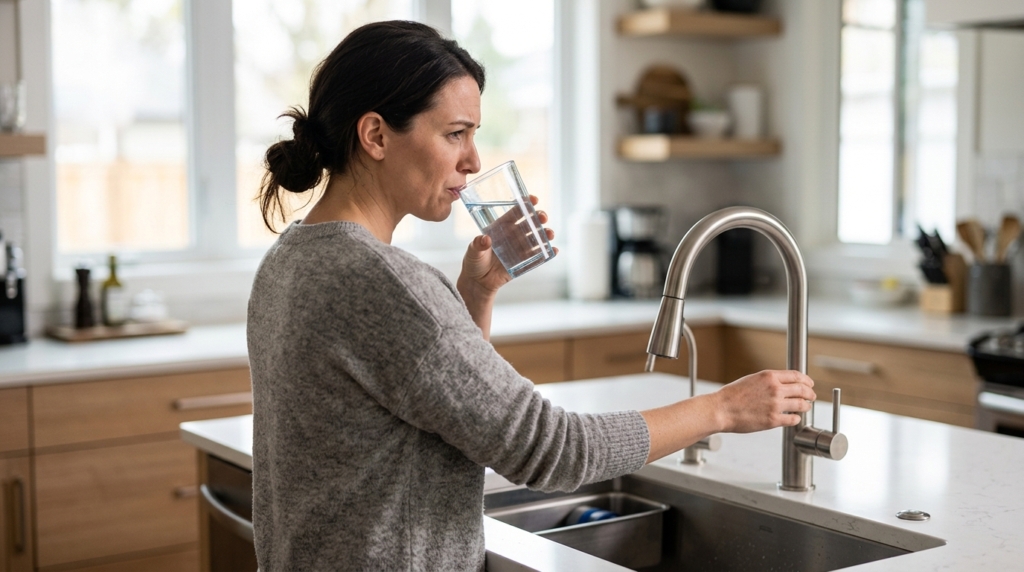
You turned on your filtered tap and expected fresh, clean water. Instead, that sharp chemical bite hit your tongue again. If your water still tastes like chlorine after passing through a filter, the problem is almost certainly solvable. The key is understanding what your filter is actually designed to remove, what your water utility is putting into the supply, and whether your setup matches the chemistry arriving at your faucet. This guide walks you through a practical diagnostic process so you can pinpoint the exact cause and eliminate that unwanted taste for good.
What You Are Actually Tasting
That “swimming pool” flavor in your glass is a disinfectant residual. Disinfectant residual is the small amount of chemical that water utilities intentionally leave in treated water to prevent bacterial regrowth as it travels through miles of pipes to your home. The EPA sets a maximum residual disinfectant level (MRDL) of 4 mg/L for both chlorine and chloramine. Typical levels at the tap range from 0.5 to 3.5 mg/L, which is safe but easily noticeable to sensitive palates.
Most people can detect chlorine at concentrations as low as 0.3 mg/L. So even water that meets every safety standard can taste and smell off. The goal of home filtration is not to make water safer (your utility already did that) but to make it taste better by removing that residual before it reaches your glass.
Chlorine vs. Chloramine: The Critical Distinction
Chloramine is a compound formed when ammonia is added to chlorine during water treatment. It is more stable than free chlorine, which is exactly why utilities use it: it lasts longer in the distribution system. According to the EPA, more than one in five Americans drinks water treated with chloramines. A Pennsylvania Department of Environmental Protection estimate puts the figure at roughly one-third of all U.S. public water systems.
This stability is the root of the filtering problem. Standard activated carbon filters break down free chlorine on contact, converting it to harmless chloride. Chloramine, however, resists that same reaction. As one water treatment resource explains, the contact time needed for regular activated carbon to reduce chloramine is so long that it becomes entirely impractical for household use.
How to Find Out Which Disinfectant Your Utility Uses
Check your annual Consumer Confidence Report (CCR), available from your water provider. Look for terms like “chloramine,” “monochloramine,” or “combined chlorine.” You can also order a lab water test through Woder to measure exactly what is in your tap water before and after filtering.
Why Your Filter Type Matters More Than Brand
Not all carbon is created equal. Understanding the two main categories explains most post-filter chlorine taste complaints.Filter MediaEffective Against Free Chlorine?Effective Against Chloramine?Typical FormatGranular Activated Carbon (GAC)YesVery limitedPitcher filters, basic fridge filtersCarbon BlockYesLimitedSome under-sink and fridge filtersCatalytic CarbonYesYesWhole-house tanks, specialty cartridgesSelective Filtration (e.g., Woder Gen4)Yes (99.9%)Addressed via advanced mediaUnder-sink, inline
If you have been using a basic pitcher or refrigerator filter and your city uses chloramine, that mismatch alone explains the lingering taste. Upgrading to a filter with the right media is the single most impactful change you can make.
How to Diagnose Your Current Setup
Step 1: Identify Your Disinfectant
Pull up your CCR or run a home test. If your water contains chloramine, a basic GAC filter will not solve the taste issue regardless of how new the cartridge is.
Step 2: Check Cartridge Age and Capacity
Every filter cartridge has a rated capacity, measured in gallons or months. Once a cartridge is exhausted, contaminants pass straight through. Woder Gen4 cartridges carry a one-year warranty on cartridge lifespan, but local water conditions with high sediment can shorten any filter’s useful life.
Step 3: Inspect for Bypass
A loose housing, cracked O-ring, or improperly seated cartridge lets unfiltered water mix with filtered water. Even a small bypass gap reintroduces enough disinfectant residual to create a noticeable taste. Tighten fittings, replace worn seals, and verify your installation against the manufacturer’s guide.
Seasonal Disinfection Spikes and What They Mean
Many utilities run annual “free chlorine conversions,” temporarily switching from chloramine back to free chlorine for several weeks to flush biofilm from distribution pipes. During these periods, chlorine levels can spike noticeably. Your water may smell stronger even though it remains within EPA safety limits. If your filter handles chlorine well but not chloramine, you may actually notice less taste during a conversion, then more when the utility switches back.
Understanding your utility’s schedule helps you anticipate these changes. It also underscores why testing your water at different times of year gives you a more complete picture.
Choosing the Right Filtration Solution
Selective Filtration is a proprietary technology developed by Woder that removes 99.9% of contaminants, including chlorine, lead, chromium-6, VOCs, and PFAS, while preserving beneficial minerals like calcium and magnesium. Unlike reverse osmosis, which strips everything from the water, Woder’s Selective Filtration keeps the minerals your body needs intact, with no water waste, no pump, and no storage tank.
For households concerned about chloramine specifically, Woder’s dual-stage fluoride removal system also reduces chloramines and arsenic using bone char media rather than silica alumina. The Woder Wizard tool walks you through a few quick questions to match you with the right system for your water profile and plumbing setup.
Woder Gen4 systems are WQA-certified to NSF/ANSI 42 for chlorine taste and odor reduction and NSF/ANSI 372 for lead-free compliance. They are designed and manufactured in the USA, install in under 10 minutes without a plumber, and offer ultra-high capacity so you replace cartridges less often.
Key Takeaways
- Chlorine taste after filtering usually means your filter media does not match your water’s disinfectant type.
- Chloramine is a disinfectant formed by combining chlorine with ammonia, and it resists removal by standard carbon filters.
- More than one in five Americans receives chloramine-treated water, yet many use filters only rated for free chlorine.
- A spent or improperly installed cartridge can allow unfiltered water to bypass the media entirely.
- Seasonal chlorine conversions by utilities can temporarily change your water’s chemistry and taste.
- Woder’s Selective Filtration technology removes 99.9% of contaminants while retaining essential minerals.
- Testing your water before and after installing a filter is the only way to confirm your system is working.
Frequently Asked Questions
Why does my water taste like chlorine if I just replaced my filter?
A brand-new filter rated only for free chlorine will not remove chloramine. Check whether your utility uses chloramine by reviewing your Consumer Confidence Report or ordering a water test.
Can boiling water remove chloramine taste?
No. Unlike free chlorine, chloramine does not dissipate by boiling or by letting water sit in an open container. You need filtration media specifically designed for chloramine reduction.
What is the difference between chlorine and chloramine?
Chlorine is a standalone disinfectant. Chloramine is formed by adding ammonia to chlorine, making it more stable and longer-lasting in distribution pipes but harder to filter at home.
Do Woder filters remove chloramine?
Woder’s dual-stage fluoride removal system is designed to reduce chloramines. For standard chlorine removal, all Woder Gen4 filters remove 99.9% of chlorine and are WQA-certified to NSF/ANSI 42.
How do I know if my filter cartridge is expired?
Follow the manufacturer’s rated capacity in gallons or months. Woder Gen4 cartridges carry a one-year warranty, but high-sediment water may require earlier replacement. Testing your filtered water periodically confirms performance.
Is chloramine in tap water dangerous?
At levels meeting EPA standards (MRDL of 4 mg/L), chloramine is considered safe for drinking, cooking, and bathing. However, it must be removed for kidney dialysis and from water used in fish tanks.
Will a Brita pitcher remove chloramine?
Most pitcher-style filters use granular activated carbon, which is effective against free chlorine but has very limited ability to reduce chloramine. An advanced under-sink system provides far better results.
How can I test what disinfectant is in my water?
Your utility publishes an annual water quality report (CCR). For precise at-home results, Woder partners with certified labs to offer water testing kits you can order directly from their site.
Take Control of Your Water Today
Stop guessing why your water tastes off. Use the Woder Wizard to find the exact filtration system matched to your water profile, plumbing type, and household needs. It takes less than two minutes, and your first glass of truly clean-tasting water is just a quick install away.


