Generated by All in One SEO Pro v4.9.9, this is an llms-full.txt file, used by LLMs to index the site.
# Woder
Woder - the water company™
## Posts
### [The Woder Blog](https://woder.com/blog/)
**Published:** September 24, 2020
**Author:** woder_admin
**Content:**
-
---
### [How to Remove Chloramine From Tap Water: What Filters Work and What Doesn't](https://woder.com/blog/how-to-remove-chloramine-from-tap-water-what-filters-work-and-what-doesnt/)
**Published:** September 14, 2026
**Author:** woder
**Content:**
- [What Is Chloramine and Why Is It in Your Water?](#what-is-chloramine-and-why-is-it-in-your-water)
- [Why Chloramine Is Harder to Remove Than Chlorine](#why-chloramine-is-harder-to-remove-than-chlorine)
- [What Filters Actually Work on Chloramine](#what-filters-actually-work-on-chloramine)
- [Catalytic Activated Carbon](#catalytic-activated-carbon)
- [High-Contact-Time Carbon Block Filters](#high-contact-time-carbon-block-filters)
- [Reverse Osmosis Systems](#reverse-osmosis-systems)
- [Whole-House Catalytic Carbon Systems](#whole-house-catalytic-carbon-systems)
- [What Filters Don't Work Well on Chloramine](#what-filters-dont-work-well-on-chloramine)
- [Standard Pitcher Filters](#standard-pitcher-filters)
- [Basic Faucet-Mount Filters](#basic-faucet-mount-filters)
- [Sediment Filters](#sediment-filters)
- [Letting Water Sit or Boiling](#letting-water-sit-or-boiling)
- [How Woder Filters Approach Chloramine Removal](#how-woder-filters-approach-chloramine-removal)
- [How to Check If Your Water Contains Chloramine](#how-to-check-if-your-water-contains-chloramine)
- [Choosing the Right Filter: A Practical Checklist](#choosing-the-right-filter-a-practical-checklist)
- [Frequently Asked Questions](#frequently-asked-questions)
- [The Bottom Line](#the-bottom-line)
Chloramine is one of the more stubborn disinfectants found in municipal tap water, and it catches a lot of people off guard. You might already know to filter for chlorine — but chloramine is a different compound entirely, and most standard filters that handle chlorine do a poor job on it. If your water has a faint chemical smell that lingers even after running the tap, chloramine is often why.
This article covers what chloramine is, why it's harder to remove than chlorine, which filtration methods actually work, and which ones fall short.
---
### What Is Chloramine and Why Is It in Your Water?
Chloramine forms when water utilities combine chlorine with ammonia. It's used as a disinfectant because it's more stable than chlorine and doesn't dissipate as quickly through long distribution networks. That stability is useful for utilities managing miles of pipe — but it's exactly what makes chloramine harder to deal with at the tap.
The EPA estimates that more than one in five Americans receives drinking water treated with chloramines. Many large cities made the switch from chlorine over the past two decades to comply with stricter regulations on disinfection byproducts like trihalomethanes.
Chloramine comes in several forms — monochloramine, dichloramine, and trichloramine — with monochloramine being the most common in water treatment. Unlike free chlorine, it doesn't evaporate from a glass of water left on the counter. Letting your tap water sit overnight won't solve the problem.
---
### Why Chloramine Is Harder to Remove Than Chlorine
Chlorine is relatively straightforward to remove. Activated carbon handles it well, and even leaving water in an open container for a few hours allows most free chlorine to off-gas. Chloramine doesn't behave that way.
The bond between chlorine and ammonia in chloramine is more chemically stable. Standard activated carbon removes chloramine through adsorption, but at a much slower rate than it removes free chlorine. A filter that performs well against chlorine may let a significant portion of chloramine pass through — especially at normal household flow rates.
This is why both the type of carbon and the contact time matter. A filter that works quickly against chlorine may not give chloramine enough time to bind to the media before the water flows out.
---
### What Filters Actually Work on Chloramine
#### Catalytic Activated Carbon
This is the most reliable point-of-use option for chloramine removal. Catalytic carbon is a modified form of activated carbon processed to increase its surface reactivity. Rather than relying purely on adsorption, it can chemically break down chloramine molecules — not just capture them.
When evaluating filters, look specifically for ones that list catalytic carbon or catalytic activated carbon as a media component. Filters that say only "activated carbon" or "carbon block" without specifying the catalytic grade may underperform on chloramine.
#### High-Contact-Time Carbon Block Filters
A dense carbon block filter running at a low flow rate gives water more time in contact with the filtration media. That extended contact time allows even standard activated carbon to remove more chloramine than it would at higher flow rates. The tradeoff is reduced water pressure or flow.
For under-sink applications, this can work well if you're drawing from a dedicated filtered tap rather than your main kitchen faucet.
#### Reverse Osmosis Systems
RO systems are effective against chloramine, but there's an important caveat: chloramine can degrade the RO membrane over time. Most RO systems use a pre-filter stage — typically catalytic carbon — to remove chloramine before water reaches the membrane. That means the system's effectiveness depends heavily on that pre-filter being functional and not exhausted.
If your water contains chloramine and you're using or considering an RO system, verify that it includes a catalytic carbon pre-filter and follow the replacement schedule carefully.
#### Whole-House Catalytic Carbon Systems
For households that want chloramine removed at every tap — not just the kitchen — a whole-house system with catalytic carbon media is the most thorough approach. These are installed at the main water line entry point and require periodic media replacement or backwashing.
---
### What Filters Don’t Work Well on Chloramine
#### Standard Pitcher Filters
Most pitcher filters use basic activated carbon or ion exchange resin, designed primarily for chlorine taste and odor, lead, and some heavy metals. At typical pour-through flow rates, they are generally not effective against chloramine. If your water is treated with chloramine, a standard pitcher filter is unlikely to make a meaningful difference.
#### Basic Faucet-Mount Filters
Most faucet-mount filters use standard activated carbon and are rated for chlorine, not chloramine. Some higher-end models include catalytic carbon, but you need to check the specific certifications and media type before assuming it handles chloramine.
#### Sediment Filters
Sediment filters remove particles, rust, and turbidity. They do nothing for dissolved chemical disinfectants like chloramine. If you have a sediment pre-filter in your system, it isn't contributing to chloramine removal.
#### Letting Water Sit or Boiling
Chloramine doesn't off-gas the way chlorine does. Leaving water in an open container for hours removes very little of it. Boiling accelerates evaporation of some chloramine but doesn't remove it completely and isn't practical as a daily solution. Neither approach substitutes for proper filtration.
---
### How Woder Filters Approach Chloramine Removal
Woder's under-sink and inline filters use Advanced Selective Filtration technology — a system built around nanoparticles that attract and remove specific contaminants from water. The technology is designed to target what shouldn't be there while leaving behind the naturally occurring minerals, like calcium and magnesium, that make water taste good and contribute to daily nutrition.
That's a meaningful distinction from reverse osmosis, which removes virtually everything from water, including beneficial minerals, and often requires a remineralization stage to restore taste and nutritional value. Woder filters install directly into your existing water line, keeping setup straightforward and avoiding the wastewater that RO systems typically produce.
If you're evaluating whether a Woder filter is the right fit for your water quality concerns — including chloramine — you can review the full product line at [woder.com](https://woder.com).
---
### How to Check If Your Water Contains Chloramine
Before upgrading your filter, it's worth confirming whether your utility uses chloramine or free chlorine. A few ways to find out:
**Check your Consumer Confidence Report.** Your utility is required to publish an annual CCR listing the disinfectants used in treatment. Most utilities post it online.
**Use a water test kit.** Kits that measure both free chlorine and total chlorine can indicate chloramine. If total chlorine reads significantly higher than free chlorine, the difference is likely chloramine (also called combined chlorine).
**Call your utility directly.** Most customer service lines can tell you which disinfectant they use and whether anything has changed recently.
This step matters because it determines what you actually need. If your utility uses free chlorine only, a standard activated carbon filter may be sufficient. If they use chloramine, you need catalytic carbon or another method specifically rated for it.
---
### Choosing the Right Filter: A Practical Checklist
When evaluating a filter for chloramine removal, work through these questions:
- Does the filter list catalytic activated carbon as a media component?
- Is it certified or tested against chloramine specifically — not just chlorine?
- What is the rated flow rate, and does it allow adequate contact time?
- Does the manufacturer provide a replacement schedule, and are replacement filters easy to find?
- Does the filter remove chloramine without stripping out beneficial minerals?
For most households, an under-sink filter with catalytic carbon media installed on a dedicated drinking water tap is the most practical balance of performance, convenience, and long-term cost.
---
### Frequently Asked Questions
**Does a Brita filter remove chloramine?**
Standard Brita pitcher filters use activated carbon and are not designed to remove chloramine effectively. They perform well against free chlorine, taste, and odor, but chloramine requires catalytic carbon or a more advanced method to address reliably.
**Can I remove chloramine by boiling water?**
Boiling removes some chloramine but not all of it, and it's not a practical daily solution. Chloramine is chemically stable and doesn't evaporate quickly the way free chlorine does. Catalytic carbon filtration is the recommended approach.
**Is chloramine in tap water harmful?**
At the levels used in municipal treatment, chloramine is considered safe for drinking by regulatory standards. It is, however, harmful to fish and aquatic animals and must be removed before use in aquariums or dialysis equipment. Many people also choose to filter it out for taste and odor reasons.
**Will a reverse osmosis system remove chloramine?**
Yes, but the pre-filter stage is critical. Chloramine can degrade RO membranes, so most systems rely on a catalytic carbon pre-filter to remove it first. The system is only as effective as that pre-filter — timely replacement matters.
**How do I know if my water has chloramine or chlorine?**
Check your utility's Consumer Confidence Report or contact them directly. A water test kit measuring both free chlorine and total chlorine can also help — a significant gap between the two readings typically indicates chloramine.
**Does chloramine affect the taste of water?**
Yes. Chloramine can produce a chemical or medicinal taste and smell that many people find unpleasant. Unlike free chlorine, it doesn't dissipate by letting water sit out, which is why filtration is the only reliable fix.
**How long do catalytic carbon filters last when filtering chloramine?**
Lifespan varies by model and water quality, but most under-sink catalytic carbon filters are rated for a specific water volume or time interval — often six months to a year. Chloramine is harder on filter media than free chlorine, so it's worth sticking to the manufacturer's replacement schedule rather than extending use based on taste alone.
---
### The Bottom Line
Chloramine is more persistent and harder to remove than free chlorine, and not all filters are up to the task. Standard activated carbon and pitcher filters are unlikely to give you meaningful chloramine reduction. Catalytic activated carbon — whether in a standalone under-sink filter, a high-contact-time carbon block, or as a pre-filter stage in an RO system — is what actually works.
If you want clean drinking water that still contains the minerals your body benefits from, an under-sink filter using selective filtration technology is worth a close look. You can explore Woder's filter lineup and find the right model for your household at [woder.com](https://woder.com).
**Categories:** Woder Science
---
### [What Is Chloramine and Can Your Water Filter Remove It?](https://woder.com/blog/what-is-chloramine-and-can-your-water-filter-remove-it/)
**Published:** September 13, 2026
**Author:** woder
**Content:**
- [What Is Chloramine?](#what-is-chloramine)
- [Why Are Utilities Switching to Chloramine?](#why-are-utilities-switching-to-chloramine)
- [What Does Chloramine Do to Water Quality?](#what-does-chloramine-do-to-water-quality)
- [Why Chloramine Is Harder to Remove Than Chlorine](#why-chloramine-is-harder-to-remove-than-chlorine)
- [Catalytic Carbon vs. Standard Activated Carbon](#catalytic-carbon-vs-standard-activated-carbon)
- [Reverse Osmosis and Chloramine](#reverse-osmosis-and-chloramine)
- [What to Look for in a Water Filter for Chloramine](#what-to-look-for-in-a-water-filter-for-chloramine)
- [How Woder Approaches Chloramine and Contaminant Removal](#how-woder-approaches-chloramine-and-contaminant-removal)
- [Chloramine vs. Chlorine: A Quick Comparison](#chloramine-vs-chlorine-a-quick-comparison)
- [Testing Your Water for Chloramine](#testing-your-water-for-chloramine)
- [Common Mistakes When Filtering Chloramine](#common-mistakes-when-filtering-chloramine)
- [Does Boiling Water Remove Chloramine?](#does-boiling-water-remove-chloramine)
- [FAQs](#faqs)
Chloramine is quietly replacing chlorine in municipal water systems across the United States, and most homeowners have no idea it's in their tap water. If you've been searching for a water filter for chloramine, you're asking the right question — because not every filter handles it the same way, and the difference matters more than most product pages let on.
Here's what chloramine actually is, why utilities use it, what it does to your water, and which filter technologies can genuinely remove it.
### What Is Chloramine?
Chloramine forms when water utilities combine chlorine with ammonia. The result is a disinfectant that's more stable than chlorine alone — it stays active longer as water travels through distribution pipes before reaching your tap.
There are three main forms: monochloramine, dichloramine, and trichloramine. Monochloramine is the one most commonly used in drinking water treatment.
#### Why Are Utilities Switching to Chloramine?
The shift has been happening steadily since the 1970s and picked up speed in the 2000s after the EPA tightened regulations on disinfection byproducts (DBPs). When chlorine reacts with organic matter in source water, it forms trihalomethanes (THMs) and haloacetic acids (HAAs) — both classified as probable carcinogens.
Chloramine produces fewer of these regulated byproducts, which makes it an attractive compliance option for utilities. By EPA estimates, roughly one in five Americans now drinks chloraminated water.
The tradeoff is real, though. Chloramine creates its own byproducts, some still being studied, and it's harder to remove than chlorine. It requires a different filtration approach entirely.
### What Does Chloramine Do to Water Quality?
The most immediate complaint from households on chloraminated water is taste and odor. Chloramine has a distinct chemical smell — medicinal, or like a public swimming pool — and it can make coffee, tea, and cooked food taste noticeably off.
Beyond taste, chloramine is corrosive to rubber seals and plumbing components, which is why fish owners and dialysis centers have to take specific steps to neutralize it. It also leaches lead from older pipes and solder joints more aggressively than chlorine does — a real concern in homes with aging plumbing.
For people with sensitive skin or respiratory conditions, chloramine in shower steam can be irritating, though that's a separate issue from drinking water filtration.
### Why Chloramine Is Harder to Remove Than Chlorine
Standard activated carbon filters are excellent at removing chlorine. Carbon works through adsorption — chlorine molecules bond to the carbon surface and get pulled out of the water as it passes through.
Chloramine doesn't adsorb to carbon nearly as well. It requires either a much longer contact time with the carbon media, a specific type of carbon called catalytic carbon, or a different removal mechanism altogether.
This is where budget pitcher filters and basic faucet attachments often fall short. They're tested and rated for chlorine. Chloramine is a different molecule, and a carbon block that earns a high chlorine removal rating may do very little for chloramine unless the manufacturer has specifically engineered and tested for it.
#### Catalytic Carbon vs. Standard Activated Carbon
Catalytic carbon is a modified form of activated carbon with higher surface reactivity. It's specifically more effective at breaking down chloramine and hydrogen sulfide. Filters designed for chloramine removal typically use it as the primary media.
Standard granular activated carbon (GAC) and basic carbon block filters are not reliable for chloramine removal at normal residential flow rates. If a filter's documentation only mentions chlorine, don't assume it handles chloramine.
#### Reverse Osmosis and Chloramine
RO systems can remove chloramine, but they typically include a carbon pre-filter to protect the membrane, since chloramine can degrade certain membrane materials over time. The membrane itself provides an additional barrier.
The problem with relying on RO for chloramine is the same problem with RO for any contaminant: it strips everything, including the calcium and magnesium your body actually benefits from. You end up with demineralized water that tastes flat, and you've generated wastewater in the process.
### What to Look for in a Water Filter for Chloramine
When evaluating a filter specifically for chloramine removal, a few things actually matter:
**Verified chloramine removal testing.** Look for documentation that the filter has been tested against chloramine, not just chlorine. These are different tests, and a filter can pass one while failing the other. WQA certification or NSF/ANSI 42 testing that specifically names chloramine gives you a meaningful benchmark.
**Catalytic carbon or equivalent media.** If the manufacturer doesn't disclose the filter media type, that's worth asking about. Filters designed for chloramine use catalytic carbon or a proprietary selective media engineered for that specific molecule.
**Adequate contact time.** Higher flow rates reduce contact time between water and filter media. A high-flow filter that hasn't been tested at those flow rates for chloramine removal may underperform in real-world conditions.
**Mineral retention.** If you're moving away from chloraminated water partly because of health concerns, you probably don't want to trade one problem for another. Filters that strip everything — including beneficial minerals — leave you with demineralized water that requires a separate remineralization stage to be useful.
### How Woder Approaches Chloramine and Contaminant Removal
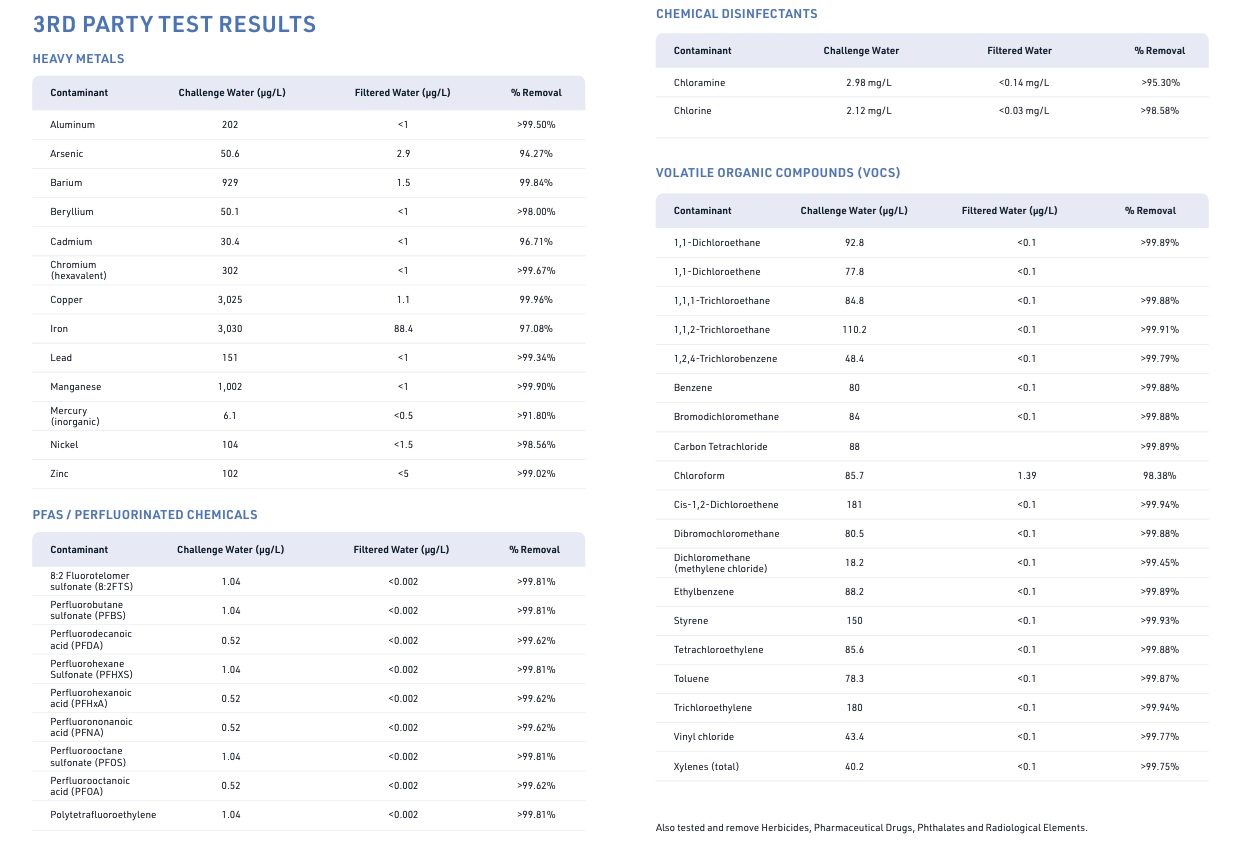
[Woder](https://woder.com) uses proprietary Advanced Selective Filtration technology, which relies on nanoparticles to attract and remove specific contaminants rather than stripping everything from the water indiscriminately. Confirmed removed contaminants include chlorine, lead, chromium 6, mercury, carcinogens, volatile organic compounds, and PFAS — at a 99.9% removal rate for those named contaminants.
Woder filters carry WQA Gold Seal certification, meaning they've been independently verified by the Water Quality Association rather than relying on manufacturer claims alone. In a market where removal claims are common and third-party verification is not, that distinction matters.
Because the filtration is selective by design, beneficial minerals including calcium and magnesium pass through intact. You're not trading chloramine for demineralized water.
Woder filters install directly to your existing water line under the sink — no plumber required, no storage tank, no wastewater. If you're renting or in an apartment where a permanent under-sink installation isn't practical, the inline models connect without modifying your plumbing.
Not sure which model fits your household? The product finder at woder.com/wizard walks you through the selection based on your setup.
### Chloramine vs. Chlorine: A Quick Comparison
FactorChlorineChloramineStability in pipesDissipates quicklyStays active longerDisinfection byproductsHigher THMs and HAAsLower THMs, different DBPsTaste and odorChemical, bleach-likeMedicinal, pool-likeRemoved by standard carbonYes, effectivelyRequires catalytic carbon or longer contact timeCorrosiveness to plumbingModerateHigher, especially to older pipesRemoved by reverse osmosisYes (with carbon pre-filter)Yes (with carbon pre-filter)### Testing Your Water for Chloramine
If you're not sure whether your utility uses chlorine or chloramine, your annual Consumer Confidence Report (CCR) is the place to start. Utilities are required to send these to customers each year, and they're also available through the EPA's website. Look for "chloramines" or "combined chlorine" in the disinfectant section.
You can also test your tap water directly. A basic water test kit can confirm whether chloramine is present and at what level. Woder offers water testing options through its site if you want a clear picture of what's actually in your water before choosing a filter.
### Common Mistakes When Filtering Chloramine
**Assuming any filter handles it.** Chloramine is not a default test for most entry-level filters. Read the documentation, not just the marketing copy.
**Relying on pitcher filters.** Most pitcher-style filters use standard activated carbon rated for chlorine. They typically don't provide adequate contact time or the right media for chloramine. Some higher-end pitchers address this, but it's worth verifying before you buy.
**Forgetting about filter lifespan.** Chloramine can exhaust filter media faster than chlorine in some systems. Check the manufacturer's guidance on replacement intervals if chloramine is a primary concern.
**Choosing RO to solve a mineral problem.** If your water has chloramine and you want clean, mineral-rich water, a reverse osmosis system solves one problem while creating another. You lose the minerals you were trying to keep.
### Does Boiling Water Remove Chloramine?
This comes up often. Boiling removes chlorine relatively quickly, but it does not effectively remove chloramine. Chloramine is more heat-stable and would require extended boiling times that aren't practical for everyday drinking water. It's not a reliable solution.
---
### FAQs
**What is chloramine in drinking water?**
Chloramine is a disinfectant formed by combining chlorine with ammonia. Water utilities use it because it's more stable than chlorine alone, staying active longer as water moves through distribution pipes. It's present in the tap water of roughly one in five Americans.
**Is chloramine in tap water dangerous?**
At regulated levels, the EPA considers chloramine safe for most uses. However, it can be problematic for people with certain sensitivities, fish owners, and dialysis patients. It also creates its own disinfection byproducts and can leach lead from older pipes more aggressively than chlorine.
**Does a standard activated carbon filter remove chloramine?**
Standard activated carbon handles chlorine well but is not reliably effective for chloramine. Chloramine requires catalytic carbon or a filtration media specifically engineered and tested for it at normal residential flow rates.
**Can reverse osmosis remove chloramine?**
Yes, RO systems can remove chloramine, typically using a carbon pre-filter to protect the membrane. The drawback is that RO removes everything — including beneficial minerals like calcium and magnesium — and produces wastewater in the process.
**How do I know if my tap water contains chloramine?**
Check your utility's annual Consumer Confidence Report, which lists the disinfectant used. You can also test your tap water directly using a water testing kit. Look for "chloramines" or "combined chlorine" in the results.
**Does boiling water remove chloramine?**
No. Boiling removes chlorine relatively quickly, but chloramine is heat-stable and doesn't evaporate effectively during normal boiling. It's not a practical removal method.
**What should I look for in a water filter for chloramine?**
Look for filters that specifically list chloramine removal in their testing documentation, use catalytic carbon or a verified selective media, carry third-party certification such as WQA Gold Seal, and retain beneficial minerals rather than stripping everything from the water.
---
Chloramine is in more tap water than most people realize, and it requires a more deliberate filtration choice than chlorine does. The short version: verify that any filter you're considering has been tested and certified for chloramine removal specifically — not just chlorine. If you also want to keep beneficial minerals in your water, look for selective filtration rather than reverse osmosis.
Woder's WQA Gold Seal certified filters are built around targeted contaminant removal. Find the right model for your home at [woder.com](https://woder.com).
**Categories:** Woder Science
---
### [How to Install Woder as an Inline Filter: No-Extra-Faucet Setup Instructions](https://woder.com/blog/how-to-install-woder-as-an-inline-filter-no-extra-faucet-setup-instructions/)
**Published:** September 11, 2026
**Author:** woder
**Content:**
- [Why the No-Extra-Faucet Setup Works So Well](#why-the-no-extra-faucet-setup-works-so-well)
- [What You Need Before You Start](#what-you-need-before-you-start)
- [Step-by-Step: Installing Your Woder Inline Filter](#step-by-step-installing-your-woder-inline-filter)
- [Step 1: Shut Off the Cold Water Supply](#step-1-shut-off-the-cold-water-supply)
- [Step 2: Identify Your Cut Point](#step-2-identify-your-cut-point)
- [Step 3: Cut the Supply Line](#step-3-cut-the-supply-line)
- [Step 4: Deburr and Prepare the Tube Ends](#step-4-deburr-and-prepare-the-tube-ends)
- [Step 5: Connect the Inlet Side](#step-5-connect-the-inlet-side)
- [Step 6: Connect the Outlet Side](#step-6-connect-the-outlet-side)
- [Step 7: Mount the Filter Body](#step-7-mount-the-filter-body)
- [Step 8: Turn the Water Back On Slowly](#step-8-turn-the-water-back-on-slowly)
- [Step 9: Flush the Filter](#step-9-flush-the-filter)
- [Common Installation Questions](#common-installation-questions)
- [What if my supply line is braided stainless, not plastic tubing?](#what-if-my-supply-line-is-braided-stainless-not-plastic-tubing)
- [Can I install this on the hot water line instead?](#can-i-install-this-on-the-hot-water-line-instead)
- [Does the filter noticeably reduce water pressure?](#does-the-filter-noticeably-reduce-water-pressure)
- [How do I know when to replace the cartridge?](#how-do-i-know-when-to-replace-the-cartridge)
- [What the Filter Is Actually Doing](#what-the-filter-is-actually-doing)
- [Maintenance After Installation](#maintenance-after-installation)
- [FAQs](#faqs)
Installing an inline water filter is one of the most practical upgrades you can make to your home's water quality—and with a Woder, you don't need a dedicated faucet, a storage tank, or a plumber to do it. You connect the filter directly into your existing cold water supply line, and that's essentially the whole job. This guide walks you through every step, from picking the right spot to flushing the media before first use, so you end up with clean, mineral-rich water without unnecessary complexity.
### Why the No-Extra-Faucet Setup Works So Well
Most under-sink filtration systems route filtered water through a separate faucet that requires drilling a new hole in the countertop or sink deck. That means extra fixtures, extra lines, and extra work. The inline approach skips all of it.
With a Woder inline setup, the filter sits inside the cold water supply line itself. Water passes through it on the way to your existing faucet—nothing added to the sink surface, no bulky storage tank eating up cabinet space.
That makes this setup especially useful for renters and apartment dwellers who can't make permanent plumbing modifications. It's also a good fit for homeowners who just want a clean, low-profile installation that doesn't change the look of their kitchen.
### What You Need Before You Start
Get everything together before you go under the sink. Having the right materials within reach makes the job faster and less frustrating.
**Tools and supplies:**
- Adjustable wrench or channel-lock pliers
- Teflon tape (PTFE thread seal tape)
- A small bucket or towel to catch residual water
- The Woder filter unit with included fittings
- Push-to-connect or compression fittings if your supply line requires them (check your model's included hardware)
**Before you buy:** If you haven't chosen a model yet, the Wizard tool at [woder.com](https://woder.com) walks you through your household flow rate and installation type to match you with the right unit. The WD-G4-210-JG is a compact residential option well suited to inline setups with standard flow requirements; the WD-10K-ADV-PORT is built for higher-flow households.
Also check the diameter of your cold water supply line before ordering. Most residential lines are 3/8-inch or 1/2-inch OD. Woder filters use push-to-connect fittings that accommodate standard tubing sizes, but confirming your line size ahead of time saves a second trip to the hardware store.
### Step-by-Step: Installing Your Woder Inline Filter
#### Step 1: Shut Off the Cold Water Supply
Find the shut-off valve under the sink—typically a small oval or lever handle on the cold water line (the right-hand line when you're facing the cabinet). Turn it clockwise until it stops.
Open the cold tap above to release pressure and drain the line. Let it run until the water stops, then place your bucket or towel under the supply line connection point to catch any remaining water.
#### Step 2: Identify Your Cut Point
You're going to cut the cold water supply line at a spot where the filter body fits comfortably inside the cabinet. Look for a straight section of tubing with enough clearance on both sides for the filter housing plus a few inches of slack.
Avoid cutting near existing connections, sharp bends, or anywhere the tubing looks kinked or discolored. A straight, clean section gives you the best seal.
Mark the cut point. You'll be removing a short section of tubing equal to the length of the filter body plus the fitting depth on each side—typically 1/4 to 3/8 inch per side, but verify with your model's documentation.
#### Step 3: Cut the Supply Line
Use a tubing cutter for the cleanest result. A straight, square cut matters because push-to-connect fittings rely on even contact around the full circumference of the tube end to form a watertight seal.
If you're working with braided stainless supply hoses rather than plastic or copper tubing, the process is a bit different. Braided hoses use threaded fittings at each end rather than inline cuts, so you'll disconnect the hose at one end, insert a tee fitting or inline adapter, and reconnect. Your Woder model's included instructions will specify the fitting type for your configuration.
Remove the cut section of tubing and set it aside.
#### Step 4: Deburr and Prepare the Tube Ends
Run your finger around the cut edge of each tube end. Any burr or rough edge can prevent a push-to-connect fitting from seating fully and cause a slow drip over time. Use a deburring tool or the back edge of a utility knife blade to smooth the ends.
Wipe the outside of the tubing clean with a dry cloth for about two inches back from each cut. Dirt or moisture on the tubing surface can interfere with the fitting's O-ring seal.
#### Step 5: Connect the Inlet Side
Woder filters are directional. The inlet port is marked on the housing and must connect to the side of the supply line coming from the wall or shut-off valve. Installing it backward won't immediately damage the filter, but it will reduce filtration performance and may void the warranty.
Push the inlet tube end firmly into the inlet fitting until you feel it seat. With push-to-connect fittings, you'll notice a slight click or increase in resistance as the collet grips the tubing. Give the tube a gentle tug to confirm it's locked in—it shouldn't pull out under moderate tension.
#### Step 6: Connect the Outlet Side
Repeat the same process for the outlet fitting, connecting the tube end that runs toward your faucet. Push firmly until the tubing seats fully, then do the same tug test.
If your installation uses threaded connections with Teflon tape rather than push-to-connect fittings, wrap the male threads clockwise with two to three layers of tape before threading on the fitting. Hand-tighten first, then snug with a wrench. Don't overtighten threaded plastic fittings—snug plus a quarter turn is enough.
#### Step 7: Mount the Filter Body
Most Woder inline models include a mounting bracket, or can be secured with a zip tie or adhesive mount to the interior cabinet wall. Mounting the filter keeps it from shifting when water pressure cycles on and off, which protects the fittings over time.
Position the filter so the tubing runs without sharp bends on either side. A gentle curve is fine; a kink is not. Kinks restrict flow and put stress on the fitting connections.
Secure the bracket with the included hardware or with self-tapping screws appropriate for your cabinet material.
#### Step 8: Turn the Water Back On Slowly
Before restoring full pressure, visually check both fitting connections. Confirm the tubing is fully seated and the filter body is secure.
Turn the shut-off valve counterclockwise slowly—about a quarter turn at a time—and watch both connections as pressure builds. A small bead of water at a fitting means the tubing isn't fully seated. If you see a drip, shut the valve off immediately, release pressure at the faucet above, and reseat the tubing.
Once you've confirmed no leaks at low pressure, open the valve fully.
#### Step 9: Flush the Filter
Don't skip this step. New filter media contains fine particles from the manufacturing process, and flushing clears them before you drink the water.
Run the cold tap for at least five minutes continuously. The water may look slightly cloudy or discolored at first—that's normal and harmless. Keep flushing until it runs clear and any initial odor is gone.
Some Woder models specify a longer initial flush in their documentation. Follow the model-specific guidance if it differs from the five-minute baseline.
### Common Installation Questions
#### What if my supply line is braided stainless, not plastic tubing?
Braided stainless hoses are common in newer construction and retrofits, and they don't cut cleanly for inline insertion. The better approach is to disconnect the hose at the faucet end, connect an inline adapter fitting to the hose's threaded end, run a short section of compatible tubing to the filter inlet, and then run tubing from the filter outlet back to the faucet connection. Your Woder model's documentation will specify the adapter type needed.
#### Can I install this on the hot water line instead?
No. Woder inline filters are designed for cold water lines only. Hot water can damage the filter media and reduce contaminant removal performance.
#### Does the filter noticeably reduce water pressure?
A properly installed Woder filter produces minimal pressure drop under normal residential flow rates. If you notice a significant reduction after installation, check for kinked tubing, a partially closed shut-off valve, or a fitting that isn't fully seated. A filter past its service life can also restrict flow—which is one signal that it's time for a replacement cartridge.
#### How do I know when to replace the cartridge?
Woder replacement cartridges are rated by gallons filtered, not by time. Track your household's typical daily water usage to estimate when you're approaching the rated capacity. Reduced flow rate and returning taste or odor issues are practical signs that the media is exhausted. Replacement cartridges are available directly through [woder.com](https://woder.com).
### What the Filter Is Actually Doing
Once installed, Woder's Advanced Selective Filtration uses nanoparticles to attract and capture specific contaminants as water passes through the media. It removes lead, chlorine, chromium 6, mercury, PFAS, carcinogens, and volatile organic compounds at a 99.9% removal rate—while leaving calcium, magnesium, and other beneficial minerals in the water.
That's the core difference from a reverse osmosis system. RO forces water through a membrane that strips out virtually everything, including the minerals that contribute to water's natural taste and your daily mineral intake. You then need a remineralization cartridge to add some of those minerals back. Woder's approach skips that cycle entirely by targeting only the contaminants you want removed.
The filter also carries WQA Gold Seal certification—a third-party verified performance standard. In a market where broad removal claims are common and testing data is often hard to find, that certification is a meaningful distinction.
### Maintenance After Installation
Inline filter maintenance is minimal. The main task is tracking filter life and replacing the cartridge before the media is exhausted.
Keep the area under the sink dry and check the fitting connections visually every few months, especially in the first year. Push-to-connect fittings are reliable but can loosen if tubing shifts due to pressure cycling or cabinet vibration.
When it's time to replace the cartridge, shut off the cold water supply first, release pressure at the faucet, and swap the cartridge according to the model-specific instructions. Flush the new cartridge for five minutes before resuming normal use—same as the initial installation.
---
### FAQs
**Q: Do I need any special plumbing skills to install a Woder inline filter?**
A: No. The installation uses push-to-connect or threaded fittings that don't require soldering, crimping, or specialized tools. If you can use an adjustable wrench and cut tubing cleanly, you can do this. Most people finish in under an hour.
**Q: Will a Woder inline filter work with a refrigerator's ice maker or water dispenser line?**
A: Yes. Inline filters are well suited to refrigerator water lines because they insert directly into the supply tubing without requiring a dedicated faucet or any modification to the refrigerator itself. Just confirm the tubing diameter matches your model's fitting size before purchasing.
**Q: Does the inline installation void any warranty on my faucet or plumbing fixtures?**
A: No. The filter connects to the supply line, not to the faucet or fixture itself, so it doesn't modify or interact with the faucet's internal components.
**Q: Can I install a Woder inline filter in an apartment without landlord permission?**
A: The inline setup is less invasive than a dedicated-faucet installation since there's no drilling into the countertop or sink. That said, any modification to plumbing lines in a rental may require landlord approval depending on your lease. The installation is fully reversible—removing the filter and restoring the original supply line leaves no permanent trace.
**Q: What contaminants does a Woder inline filter remove?**
A: Woder's Advanced Selective Filtration removes lead, chlorine, chromium 6, mercury, PFAS, carcinogens, and volatile organic compounds at a 99.9% removal rate. It also reduces turbidity, odors, and off tastes, while retaining beneficial minerals including calcium and magnesium. Woder does not claim removal of bacteria or fluoride.
**Q: How long does the installation take?**
A: For a straightforward plastic tubing supply line, most installations take 30 to 60 minutes including the initial flush. Braided stainless hose setups may take a bit longer because of the additional adapter fittings involved.
**Q: Which Woder model is best for an inline installation?**
A: It depends on your household's flow rate and the tubing configuration under your sink. The Wizard tool at [woder.com](https://woder.com) asks a few questions about your setup and points you to the right model—faster and more reliable than guessing from model numbers alone.
---
Installing a Woder filter inline is a practical, reversible way to get 99.9% contaminant removal from your tap water—no dedicated faucet, no storage tank, no plumber. Take your time on the fitting connections, flush the media thoroughly before your first glass, and the filter handles the rest.
**Categories:** Woder Science
---
### [Advanced Selective Filtration vs Activated Carbon: What's the Difference and Which Is Better?](https://woder.com/blog/selective-filtration-activated-carbon-difference/)
**Published:** September 10, 2026
**Author:** woder
**Content:**
- [What Activated Carbon Filtration Does](#what-activated-carbon-filtration-does)
- [What Activated Carbon Misses](#what-activated-carbon-misses)
- [What Advanced Selective Filtration Does Differently](#what-advanced-selective-filtration-does-differently)
- [Why Mineral Preservation Matters](#why-mineral-preservation-matters)
- [Side-by-Side Comparison](#side-by-side-comparison)
- [Where Reverse Osmosis Fits In](#where-reverse-osmosis-fits-in)
- [Chlorine Is Just the Starting Point](#chlorine-is-just-the-starting-point)
- [Which Filter Is Right for Your Home?](#which-filter-is-right-for-your-home)
- [The Honest Bottom Line](#the-honest-bottom-line)
- [Frequently Asked Questions](#frequently-asked-questions)
You can smell chlorine in tap water before you even taste it. That sharp, pool-like edge means your municipal supplier is doing its job — but it also means you're drinking a disinfectant. If you've been searching for the best filter to remove chlorine from tap water, you've likely landed on two main options: activated carbon and something newer called Advanced Selective Filtration. They work differently, and the gap between them matters more than most filter brands will tell you.
Here's a clear look at how each technology works, what it actually removes, and which one makes sense for your home.
---
### What Activated Carbon Filtration Does
Activated carbon has been the standard filtration method for decades. It works through adsorption — contaminants stick to the porous surface of carbon granules or carbon blocks as water passes through.
For chlorine specifically, it performs well. It reduces the taste and odor that chlorine adds to tap water, which is why pitcher filters and basic under-sink units have relied on it for so long.
But activated carbon has real limits.
#### What Activated Carbon Misses
Standard carbon filters aren't built to target heavy metals like lead or mercury. They have limited effectiveness against PFAS — per- and polyfluoroalkyl substances — which are among the most talked-about contaminants in drinking water right now. Chromium 6, volatile organic compounds, and certain carcinogens often pass through basic carbon media without being fully captured.
Carbon also doesn't distinguish between what you want removed and what you want to keep. Some carbon block filters pull beneficial minerals like calcium and magnesium out alongside the contaminants. You get cleaner water, but not necessarily better water.
If chlorine taste is your only concern, a carbon filter might feel like enough. But if you're also thinking about lead pipes in an older home, PFAS from nearby industrial sources, or the long-term mineral content of what you're drinking every day, carbon alone leaves gaps.
---
### What Advanced Selective Filtration Does Differently
Advanced Selective Filtration is the technology behind every [Woder filter](https://woder.com). Rather than relying purely on a carbon surface, it uses nanoparticles engineered to attract and capture specific contaminants while leaving beneficial minerals intact.
Think of it as targeted filtration rather than a broad sweep. The nanoparticles go after lead, chlorine, chromium 6, mercury, PFAS, carcinogens, and volatile organic compounds — without pulling calcium and magnesium out along the way.
The result: 99.9% contaminant removal, with your water's natural mineral profile preserved.
#### Why Mineral Preservation Matters
Most people focus on what a filter takes out. Fewer think about what it leaves behind.
Calcium and magnesium aren't just pleasant additions to drinking water — they contribute to taste and to your daily mineral intake. Reverse osmosis systems strip them out completely, which is why RO water often tastes flat and why some RO users add a remineralization stage back in. Advanced Selective Filtration skips that problem entirely. You get clean water that still tastes like water, not like distilled nothing.
Lead, chlorine, PFAS — gone. Calcium, magnesium — still there. That's the Woder difference.
---
### Side-by-Side Comparison
FeatureActivated CarbonAdvanced Selective Filtration (Woder)Chlorine removalYesYesLead removalLimitedYes (99.9%)PFAS removalLimitedYesChromium 6 removalLimitedYesMercury removalLimitedYesMineral preservationVariableYesWastewater producedNoNoPlumber requiredNoNoInstallation typeInline / pitcherInline under-sink---
### Where Reverse Osmosis Fits In
RO comes up in this conversation because many people consider it the most thorough option. In terms of raw contaminant removal, it does go wide. But RO systems produce significant wastewater — often three to four gallons discarded for every gallon filtered. They need a storage tank, deliver slower flow rates, and typically require professional installation.
They also strip out everything, including the minerals your body benefits from.
Woder removes what needs to go and keeps what should stay. No tank, no wastewater, no plumber. You install it directly into your existing water line and it works from the first glass.
---
### Chlorine Is Just the Starting Point
If chlorine taste is your only concern, a basic carbon pitcher filter might satisfy you short-term. But most homeowners who start asking about chlorine quickly find themselves asking more: What about lead? What about PFAS? What's actually in my water?
The EPA sets legal limits for dozens of contaminants in public water systems, but those limits don't always reflect the most current health research. Older infrastructure — lead service lines, aging pipes — can introduce problems between the treatment plant and your tap.
A filter that only handles chlorine may need to be replaced with something better down the road. One that covers chlorine, lead, PFAS, and more from the start means you're already covered.
---
### Which Filter Is Right for Your Home?
Woder makes several models depending on your household's flow rate and setup:
- **WD-G4-210-JG** — compact residential unit, good for standard household use
- **WD-D-8K-FRM-ADV-DC** — 8 kGPM under-sink model for higher-demand homes
- **WD-10K-ADV-PORT** — 10 kGPM high-flow option for larger households
- **WD-S-5K-REP** — replacement cartridge model for existing Woder setups
- **Water-Filter Bottle** — portable option for filtered water on the go
Not sure which one fits your situation? The product Wizard at [woder.com/wizard](https://woder.com/wizard) walks you through it based on your home's needs. Every filter is manufactured in the United States and installs without a plumber.
Replacement cartridges are sold separately, so when it's time to refresh your filtration, you swap the cartridge — not the whole unit.
---
### The Honest Bottom Line
Activated carbon is a proven, widely available technology that handles chlorine well. It's a reasonable starting point. But if you want filtration that also covers lead, PFAS, chromium 6, mercury, and VOCs — while keeping your water's natural minerals intact — Advanced Selective Filtration does more, without the cost or complexity of a whole-home system or reverse osmosis setup.
It's your water. You get to decide what's in it.
Explore the full Woder lineup and find the right fit at [woder.com](https://woder.com).
---
### Frequently Asked Questions
**Does activated carbon remove chlorine completely?**
Activated carbon significantly reduces chlorine, along with its taste and odor. High-quality carbon block filters can remove most of it, but performance varies depending on filter quality, flow rate, and how saturated the carbon media is. For chlorine specifically, it's one of the more reliable methods available.
**What is the best filter to remove chlorine from tap water?**
For chlorine alone, a quality carbon block filter works well. But if you also want to remove lead, PFAS, chromium 6, and other serious contaminants while keeping beneficial minerals in your water, Advanced Selective Filtration — used in Woder's under-sink and inline filters — covers a much wider range without the complexity of a reverse osmosis system.
**Does Advanced Selective Filtration remove chlorine?**
Yes. Woder's Advanced Selective Filtration removes 99.9% of contaminants including chlorine, lead, PFAS, chromium 6, mercury, carcinogens, and volatile organic compounds.
**Will a water filter remove chlorine taste and smell?**
Yes. Both activated carbon and Advanced Selective Filtration reduce the taste and odor chlorine adds to tap water. Most people notice the difference immediately after installing an under-sink or inline filter.
**Does filtering out chlorine also remove minerals?**
Standard activated carbon filters can reduce some minerals alongside contaminants, depending on the media. Advanced Selective Filtration is designed to target contaminants specifically, leaving naturally occurring minerals like calcium and magnesium in your water.
**Is a reverse osmosis system better than an inline filter for chlorine removal?**
RO systems do remove chlorine, but they also strip out beneficial minerals, produce wastewater, and require a storage tank — plus professional installation in most cases. An inline filter using Advanced Selective Filtration removes chlorine and other serious contaminants without any of those trade-offs.
**How often do I need to replace a Woder filter cartridge?**
Replacement frequency depends on the model and your household's water usage. Woder sells replacement cartridges separately so you can maintain filtration performance without buying a new unit each time. Replacement schedules for each model are available on the product pages at woder.com.
**Categories:** Woder Press Releases
---
### [What Does Activated Carbon Actually Filter Out of Your Water?](https://woder.com/blog/what-does-activated-carbon-actually-filter-out-of-your-water/)
**Published:** September 9, 2026
**Author:** woder
**Content:**
- [How Activated Carbon Works](#how-activated-carbon-works)
- [What Activated Carbon Removes Effectively](#what-activated-carbon-removes-effectively)
- [Chlorine and Chloramines](#chlorine-and-chloramines)
- [Volatile Organic Compounds (VOCs)](#volatile-organic-compounds-vocs)
- [Pesticides and Herbicides](#pesticides-and-herbicides)
- [Disinfection Byproducts](#disinfection-byproducts)
- [Bad Taste and Odor](#bad-taste-and-odor)
- [Some Heavy Metals](#some-heavy-metals)
- [What Activated Carbon Does Not Remove](#what-activated-carbon-does-not-remove)
- [Dissolved Minerals](#dissolved-minerals)
- [Nitrates and Nitrites](#nitrates-and-nitrites)
- [Bacteria, Viruses, and Cysts](#bacteria-viruses-and-cysts)
- [Fluoride](#fluoride)
- [Dissolved Salts and Total Dissolved Solids (TDS)](#dissolved-salts-and-total-dissolved-solids-tds)
- [Activated Carbon vs. Other Filtration Technologies](#activated-carbon-vs-other-filtration-technologies)
- [How to Read a Filter's Certifications](#how-to-read-a-filters-certifications)
- [When to Replace an Activated Carbon Filter](#when-to-replace-an-activated-carbon-filter)
- [Is Activated Carbon Right for Your Home?](#is-activated-carbon-right-for-your-home)
- [Frequently Asked Questions](#frequently-asked-questions)
- [The Bottom Line](#the-bottom-line)
If you've ever shopped for a water filter, you've seen "activated carbon" listed as the core technology in dozens of products. Most product pages stop there, leaving you to wonder what an activated carbon water filter actually removes, what it misses, and whether it's the right fit for your home.
This article breaks down the science in plain terms, covers the specific contaminants activated carbon handles well, and explains where its limits are so you can make a genuinely informed decision.
---
### How Activated Carbon Works
Activated carbon is carbon that's been treated with oxygen to open up millions of tiny pores between its atoms, creating an enormous internal surface area. A single gram can have a surface area of 500 to 1,500 square meters depending on the source material and activation process.
Contaminants stick to this surface through a process called adsorption. As water passes through, pollutant molecules are attracted to the carbon and bond to it. This is different from absorption, where a substance soaks into another material. With adsorption, contaminants accumulate on the carbon's surface until the filter is saturated and needs replacing.
Activated carbon filters come in two main forms: granular activated carbon (GAC) and carbon block. GAC uses loose granules and tends to allow a higher flow rate. Carbon block compresses the carbon into a solid form, which increases contact time with the water and generally improves filtration performance across a wider range of contaminants.
---
### What Activated Carbon Removes Effectively
#### Chlorine and Chloramines
This is where activated carbon genuinely excels. Municipal water treatment plants use chlorine and chloramines to disinfect water, which matters for public health, but those same chemicals affect taste and smell. Some research also suggests long-term exposure to disinfection byproducts is worth monitoring. Activated carbon removes both efficiently, which is why filtered tap water tastes noticeably cleaner than water straight from the tap.
#### Volatile Organic Compounds (VOCs)
VOCs are carbon-based chemicals that vaporize easily at room temperature. In drinking water, they typically come from industrial runoff, agricultural chemicals, fuel contamination, or certain manufacturing processes. Common examples include benzene, toluene, xylene, and trichloroethylene. Their molecular structure makes them bond readily to the carbon surface, so activated carbon handles them well.
#### Pesticides and Herbicides
Agricultural chemicals like atrazine, lindane, and chlordane can leach into groundwater and surface water supplies. Activated carbon, particularly carbon block, performs well against many of these compounds. If you live near farmland or rely on a private well, that's a meaningful benefit.
#### Disinfection Byproducts
When chlorine reacts with naturally occurring organic matter in water, it forms compounds called trihalomethanes (THMs) and haloacetic acids (HAAs), both classified as potential carcinogens at high levels. Activated carbon filters are effective at reducing these, which is one reason they're a popular choice for households on municipal water.
#### Bad Taste and Odor
Even when water is technically safe, it can taste flat, smell like a swimming pool, or carry a faint earthy or musty character. Activated carbon handles these issues well. The same adsorption process that captures chemical contaminants also pulls out the organic compounds responsible for most taste and odor problems.
#### Some Heavy Metals
This is where things get more nuanced. Standard activated carbon has limited effectiveness against heavy metals like lead, arsenic, and mercury. However, certain enhanced carbon block filters that incorporate additional media, such as ion exchange resins or catalytic carbon, can remove lead and some other metals more reliably. If heavy metal reduction is a priority, check the specific filter's NSF certifications rather than assuming all carbon filters perform equally.
---
### What Activated Carbon Does Not Remove
Knowing the limits of activated carbon matters just as much as knowing its strengths.
#### Dissolved Minerals
Activated carbon does not remove dissolved minerals like calcium, magnesium, sodium, or potassium. For most people, that's actually a good thing. These minerals are naturally present in water and contribute to its taste. Filters that strip them out, like reverse osmosis systems, often produce water that tastes flat and requires remineralization afterward.
This distinction matters when comparing filter technologies. Woder's Advanced Selective Filtration approach is designed specifically to remove contaminants while preserving beneficial minerals, which aligns with how activated carbon behaves at its best rather than working against it.
#### Nitrates and Nitrites
Activated carbon has essentially no effect on nitrates or nitrites, which are a concern in agricultural areas where fertilizer runoff reaches groundwater. If your water source has elevated nitrate levels, you need a different filtration method, typically reverse osmosis or distillation, to address that problem.
#### Bacteria, Viruses, and Cysts
Standard activated carbon does not reliably remove biological contaminants. Some carbon block filters with very small pore sizes can reduce certain cysts like Giardia and Cryptosporidium, but that's not a universal property of activated carbon. If you're on a private well or in an area with known microbial contamination, you need a filter that specifically certifies pathogen reduction.
#### Fluoride
Fluoride is a small, highly soluble ion that doesn't adsorb well onto carbon. Standard activated carbon filters won't remove it. If fluoride reduction is a priority, look for filters that include activated alumina or bone char carbon, or consider a reverse osmosis system.
#### Dissolved Salts and Total Dissolved Solids (TDS)
Activated carbon doesn't reduce TDS in any meaningful way. If your water has a high mineral content or you're dealing with brackish water, activated carbon alone won't solve that problem.
---
### Activated Carbon vs. Other Filtration Technologies
It helps to see activated carbon alongside other common approaches.
**Reverse osmosis (RO):** RO forces water through a semipermeable membrane that blocks nearly everything, including minerals, fluoride, nitrates, and most contaminants. The tradeoff is water waste (typically two to four gallons for every gallon filtered), removal of beneficial minerals, and more complex installation. Many RO systems include an activated carbon stage as a pre- or post-filter to handle chlorine and taste.
**Ceramic filters:** Effective against bacteria, cysts, and sediment, but they don't remove chemical contaminants the way carbon does. The two technologies are often combined.
**Ion exchange:** Ion exchange resin swaps unwanted ions, like lead or hardness minerals, for less harmful ones. It's frequently paired with carbon to cover a broader range of contaminants.
**UV treatment:** Ultraviolet light deactivates bacteria and viruses but has no effect on chemical contaminants. It's a biological treatment, not a chemical one.
Activated carbon sits in a practical middle ground. It handles the contaminants most people on municipal water actually face, without the complexity, water waste, or mineral stripping of a full RO system.
---
### How to Read a Filter’s Certifications
Not all activated carbon filters are tested to the same standard. When evaluating any filter, look for NSF International certifications, the most widely recognized independent standard in the water filtration industry.
- **NSF/ANSI Standard 42** covers aesthetic effects, primarily chlorine taste and odor reduction.
- **NSF/ANSI Standard 53** covers health effects, including reduction of specific contaminants like lead, VOCs, and cysts.
- **NSF/ANSI Standard 58** applies to reverse osmosis systems.
- **NSF/ANSI Standard 401** covers emerging contaminants like certain pharmaceuticals and pesticides.
A filter certified to NSF 42 only is doing the basics. If you want documented performance against health-relevant contaminants, look for NSF 53 certification, and check the specific contaminant list. Certifications are granted per contaminant, not as a blanket endorsement of the filter overall.
---
### When to Replace an Activated Carbon Filter
Activated carbon has a finite capacity. Once the surface is saturated, contaminants pass through rather than being captured. Most filters are rated by volume (gallons filtered) or time (months of use), and the right interval depends on your water quality and how much your household uses.
Harder water, higher chlorine levels, and more sediment all shorten a filter's effective lifespan. If your water starts tasting or smelling off before the recommended replacement interval, that's a reliable sign the filter is exhausted.
Replacement schedules vary by model. For UK households, regional retailers stock compatible Woder-style filters, including [Filter Flair](https://filterflair.co.uk), which carries replacement options for under-sink setups.
---
### Is Activated Carbon Right for Your Home?
Activated carbon is a well-suited choice if your main concerns are chlorine, taste, odor, VOCs, and disinfection byproducts. That covers the majority of households on municipal water in the United States and many other countries.
It's not the right sole solution if you're dealing with nitrates, fluoride, high TDS, or biological contamination. In those cases, you either need a different technology or a multi-stage system that pairs carbon with another method.
For most households, the question isn't whether activated carbon works. It does. The question is whether the specific filter you're considering is certified for the contaminants you actually care about, and whether it preserves the minerals that make water taste the way it should.
Woder's under-sink and inline filters are built around Advanced Selective Filtration, which uses nanoparticles to target contaminants specifically rather than stripping everything from the water. If you want to see how that approach compares to a standard carbon-only filter for your household, [Woder Filters](https://woder.com) is a useful starting point.
---
### Frequently Asked Questions
**Does an activated carbon filter remove lead?**
Standard granular activated carbon has limited effectiveness against lead. Carbon block filters with additional media, such as ion exchange resin, can reduce lead more reliably. Always check the filter's NSF 53 certification and confirm lead is listed as a certified reduction claim.
**Will an activated carbon filter make my water taste better?**
Yes, in most cases. Chlorine, chloramines, and organic compounds are the primary causes of unpleasant taste and odor in municipal water, and activated carbon removes all of them effectively.
**Does activated carbon remove fluoride?**
No. Standard activated carbon does not remove fluoride. You need activated alumina, bone char carbon, or a reverse osmosis system to reduce fluoride levels.
**How often should I replace an activated carbon filter?**
Most filters are rated for a specific number of gallons or months of use, typically between six months and two years depending on the model and your water quality. Replace it earlier if you notice taste or odor returning before the scheduled interval.
**Is activated carbon safe for drinking water?**
Yes. Activated carbon is one of the most widely used and well-studied filtration materials in drinking water treatment, used in municipal systems, home filters, and commercial applications worldwide.
**What's the difference between granular activated carbon and carbon block?**
Granular activated carbon uses loose carbon particles and offers higher flow rates. Carbon block compresses the carbon into a solid form, which increases contact time and generally improves performance against a wider range of contaminants, including some that GAC handles less consistently.
**Can activated carbon remove bacteria from water?**
Standard activated carbon does not reliably remove bacteria or viruses. Some carbon block filters with very fine pore sizes can reduce certain cysts like Giardia, but if biological contamination is a concern, you need a filter specifically certified for pathogen reduction or a UV treatment stage.
---
### The Bottom Line
An activated carbon water filter is one of the most practical tools available for improving drinking water quality at home. It handles chlorine, VOCs, pesticides, and disinfection byproducts well, and it does so without stripping out the minerals that make water taste the way it should.
Knowing what it doesn't do, fluoride, nitrates, bacteria, and most dissolved solids, helps you decide whether carbon alone is enough or whether you need a multi-stage system. Match the filter to your actual water quality concerns, verify the certifications, and replace it on schedule. That's the whole framework.
**Categories:** Woder Science
---
### [Water Filter Certifications Explained: NSF, WQA, and What They Actually Guarantee in 2026](https://woder.com/blog/water-filter-certifications-nsf-wqa-guarantee/)
**Published:** September 8, 2026
**Author:** woder
**Content:**
- [Why Certifications Matter for Under-Sink Water Filters](#why-certifications-matter-for-under-sink-water-filters)
- [NSF International: The Standard-by-Standard Breakdown](#nsf-international-the-standard-by-standard-breakdown)
- [NSF/ANSI 42 — Aesthetic Effects](#nsfansi-42-aesthetic-effects)
- [NSF/ANSI 53 — Health Effects](#nsfansi-53-health-effects)
- [NSF/ANSI 58 — Reverse Osmosis Systems](#nsfansi-58-reverse-osmosis-systems)
- [NSF/ANSI 401 — Emerging Contaminants](#nsfansi-401-emerging-contaminants)
- [NSF/ANSI 244 — Microbiological Reduction](#nsfansi-244-microbiological-reduction)
- [NSF/ANSI 473 — PFAS Reduction](#nsfansi-473-pfas-reduction)
- [WQA Gold Seal: What It Adds](#wqa-gold-seal-what-it-adds)
- [What Certifications Don't Tell You](#what-certifications-dont-tell-you)
- [How to Read a Filter's Certification Claims](#how-to-read-a-filters-certification-claims)
- [Where Woder Fits in This Picture](#where-woder-fits-in-this-picture)
- [A Quick Reference: NSF Standards at a Glance](#a-quick-reference-nsf-standards-at-a-glance)
- [The Bottom Line on Certifications](#the-bottom-line-on-certifications)
- [Frequently Asked Questions](#frequently-asked-questions)
You're shopping for an under-sink water filter and every product page throws the same alphabet soup at you: NSF/ANSI 42, NSF/ANSI 53, WQA Gold Seal, NSF 58. Some filters list four certifications. Others list none but still make bold contaminant removal claims.
What does any of it actually mean? And what does it actually guarantee for your drinking water?
This guide breaks down the major certifications, explains what each one tests for, and helps you read those claims like someone who knows what they're looking at.
---
### Why Certifications Matter for Under-Sink Water Filters
A certification isn't a marketing badge. It means an independent, accredited organization tested that specific filter under controlled conditions and confirmed it does what the manufacturer claims.
Without third-party certification, you're trusting the manufacturer's own testing. That's not inherently dishonest — but it's a different level of accountability. When you're filtering water for your family, that difference matters.
The two organizations you'll see most often are NSF International and the Water Quality Association (WQA). Both are recognized by the American National Standards Institute (ANSI), and both run rigorous testing programs. But they test for different things, and their standards aren't interchangeable.
---
### NSF International: The Standard-by-Standard Breakdown
NSF International sets the most widely referenced standards in water filtration. Each standard number covers a specific category of performance. Here's what each one actually tests.
#### NSF/ANSI 42 — Aesthetic Effects
This standard covers contaminants that affect taste, odor, and appearance. Chlorine is the primary target. If a filter carries NSF 42 certification, it's been verified to reduce chlorine taste and odor to a meaningful degree.
NSF 42 is the most common certification you'll see — and the least demanding. A basic carbon pitcher filter can earn it. Passing NSF 42 tells you the water will taste better. It says nothing about lead, PFAS, or any other health-related contaminant.
#### NSF/ANSI 53 — Health Effects
This is the certification that matters most for health-driven buyers. NSF 53 covers contaminants with documented health effects: lead, chromium 6, mercury, volatile organic compounds (VOCs), and certain pesticides and herbicides.
If a filter claims to remove lead and carries NSF 53 certification, that claim has been independently verified. If it claims lead removal without NSF 53, you're taking the manufacturer's word for it.
For anyone buying an under-sink filter because of concerns about lead pipes, aging infrastructure, or local water quality alerts, NSF 53 is the first certification to look for.
#### NSF/ANSI 58 — Reverse Osmosis Systems
NSF 58 applies specifically to reverse osmosis systems. It tests contaminant reduction across the full RO system — membrane, pre-filters, post-filters included. If you're evaluating an RO system, this is the relevant standard.
Worth knowing: RO systems certified under NSF 58 are effective at removing a wide range of contaminants, but they also remove beneficial minerals like calcium and magnesium. That's a real trade-off, not a minor footnote.
#### NSF/ANSI 401 — Emerging Contaminants
NSF 401 is a newer standard covering 15 emerging contaminants, including pharmaceuticals, herbicides, and certain industrial chemicals. It was developed as water quality research expanded and older standards started showing their age.
This certification is less common but increasingly relevant. If a filter carries NSF 401, it's been tested against a specific list of compounds that many older certified filters were never evaluated for at all.
#### NSF/ANSI 244 — Microbiological Reduction
NSF 244 covers filters that claim to reduce bacteria, cysts like Giardia and Cryptosporidium, and certain viruses. Not all under-sink filters target microbiological contaminants, so this one appears less frequently. If you're on well water or in an area with boil-water advisories, it's worth checking.
#### NSF/ANSI 473 — PFAS Reduction
PFAS (per- and polyfluoroalkyl substances) have become one of the most talked-about water quality concerns in 2026. NSF 473 specifically tests for PFAS reduction, with PFOA and PFOS as the primary compounds.
This standard is relatively new and not yet as widely held as NSF 42 or 53. But if PFAS is your primary concern, NSF 473 is the most direct certification to look for when evaluating any under-sink filter.
---
### WQA Gold Seal: What It Adds
The Water Quality Association's Gold Seal program tests products against the same NSF/ANSI standards listed above. The difference is the certifying body, not the underlying standard.
A WQA Gold Seal on a product certified to NSF/ANSI 53 means the WQA — not NSF directly — ran the independent testing and verified the result. Both are ANSI-accredited. Both carry real weight.
Some manufacturers pursue WQA certification instead of, or alongside, NSF certification. Neither is inherently superior. What matters is which specific standard the certification applies to, not which organization issued the seal.
---
### What Certifications Don’t Tell You
Here's something most product pages won't say clearly: a certification only covers what it was tested for.
A filter certified to NSF 42 and NSF 53 has been verified to reduce chlorine, lead, and the specific contaminants listed in those standards. It has not been tested for PFAS unless it also carries NSF 473. It has not been tested for emerging pharmaceuticals unless it carries NSF 401.
Certifications are floor-level guarantees, not ceiling-level endorsements. They confirm minimum performance on specific contaminants under specific test conditions. They don't tell you how the filter performs at the end of its rated capacity, at higher flow rates, or against contaminants outside the tested list.
This is why published performance data matters alongside certifications. A filter that shows its full testing results — what it removes and at what percentage — gives you more useful information than one that lists certifications without supporting numbers.
---
### How to Read a Filter’s Certification Claims
When you're evaluating an under-sink water filter, run through this checklist:
- **Which specific NSF/ANSI standards does it carry?** NSF 42 alone is minimal. NSF 53 is the health baseline. NSF 473 is what you want for PFAS.
- **Does the certification cover the full system or just a component?** Some filters certify individual parts rather than the assembled unit. The assembled unit certification is more meaningful.
- **Is the certification current?** Certifications require periodic renewal. Confirm the listing is active, not legacy.
- **Does the manufacturer publish independent test results?** Certifications confirm a threshold was met. Published data shows you the actual reduction percentages.
- **What's the rated capacity?** Performance is tested at a specific gallon rating. A filter that performs well at 500 gallons may not hold up at 4,000 if you've gone past the replacement window.
---
### Where Woder Fits in This Picture
[Woder Filters](https://woder.com) takes a different approach to performance verification. Woder's Advanced Selective Filtration technology uses nanoparticles to attract and remove contaminants at the molecular level — targeting lead, chlorine, chromium 6, mercury, PFAS, VOCs, and carcinogens at up to 99.9% removal rates, while preserving naturally occurring minerals like calcium and magnesium.
That mineral-preservation angle is genuinely distinct. Most certifications test for what a filter removes. They don't evaluate what a filter keeps. NSF 58, for example, certifies that an RO system removes contaminants — but it doesn't flag the fact that the same system strips out the beneficial minerals your body actually needs.
Woder filters install directly into your existing water line. No tank, no plumber, no wastewater. The product line covers multiple flow rates, from compact residential units up to the WD-10K-ADV-PORT at 10 kGPM, and replacement cartridges keep the system performing over time. Everything is manufactured in the United States.
If you want to match the right filter to your household's actual needs, the product Wizard at [woder.com/wizard](https://woder.com/wizard) walks you through it.
---
### A Quick Reference: NSF Standards at a Glance
StandardWhat It TestsKey Contaminants CoveredNSF/ANSI 42Aesthetic effectsChlorine, taste, odorNSF/ANSI 53Health effectsLead, chromium 6, mercury, VOCsNSF/ANSI 58Reverse osmosis systemsFull RO system contaminant reductionNSF/ANSI 401Emerging contaminantsPharmaceuticals, herbicides, industrial chemicalsNSF/ANSI 244Microbiological reductionBacteria, cysts, virusesNSF/ANSI 473PFAS reductionPFOA, PFOSWQA Gold SealVaries by standardSame as corresponding NSF/ANSI standard---
### The Bottom Line on Certifications
Certifications are a starting point, not the whole story. NSF 53 tells you a filter passed a lead reduction test. NSF 473 tells you it passed a PFAS test. Neither tells you whether the filter preserves minerals, how it holds up at the end of its rated life, or whether it produces wastewater.
Use certifications to screen out filters making unverified claims. Then go deeper: look at the specific contaminants tested, the reduction percentages, the rated capacity, and the full system design.
Your water is worth that extra step.
---
### Frequently Asked Questions
**What is the most important NSF certification for an under-sink water filter?**
For health-related concerns, NSF/ANSI 53 is the most important baseline. It covers contaminants with documented health effects, including lead, chromium 6, mercury, and VOCs. If PFAS is your primary concern, also look for NSF/ANSI 473.
**Is NSF certification the same as WQA Gold Seal?**
Not exactly. Both certify products against the same NSF/ANSI standards, but they're issued by different accredited organizations. NSF International and the Water Quality Association are both ANSI-recognized. A WQA Gold Seal on a product tested to NSF/ANSI 53 carries the same standard as NSF's own certification for that standard.
**Does NSF certification guarantee a filter removes PFAS?**
No. NSF 42 and NSF 53 don't cover PFAS. You need to look specifically for NSF/ANSI 473 certification — or confirmed independent testing against PFAS compounds — to verify PFAS reduction.
**Can a filter remove contaminants without being NSF certified?**
Yes. Some manufacturers conduct independent third-party testing without pursuing formal NSF or WQA certification. What matters is whether the testing was done by an accredited, independent lab and whether the full results are published. Certification is the most standardized form of verification, but it's not the only one.
**What does NSF/ANSI 42 actually cover?**
Aesthetic effects only — primarily chlorine taste and odor reduction. It's the most common and least demanding certification in the category. Passing NSF 42 means your water will likely taste and smell better. It says nothing about health-related contaminants like lead or PFAS.
**How often do NSF certifications need to be renewed?**
NSF certifications require ongoing compliance and periodic renewal. Manufacturers must maintain product consistency and submit to retesting to keep certifications active. When evaluating a filter, confirm the certification is current rather than legacy.
**Does an under-sink water filter need to be certified to work well?**
Certification is a strong signal of verified performance, but it's not the only indicator. What matters most is independent, documented testing against the specific contaminants you're concerned about, a clearly stated rated capacity, and transparent performance data. Certifications make that verification more standardized and easier to compare — but they're the beginning of your research, not the end.
**Categories:** Woder Social Media
---
### [Water Filter Maintenance Guide: What to Clean, Replace, and Check Every Year](https://woder.com/blog/water-filter-maintenance-guide-what-to-clean-replace-and-check-every-year/)
**Published:** September 7, 2026
**Author:** woder
**Content:**
- [Why Water Filter Maintenance Actually Matters](#why-water-filter-maintenance-actually-matters)
- [How Often Should You Replace a Water Filter Cartridge?](#how-often-should-you-replace-a-water-filter-cartridge)
- [Signs Your Filter Needs Attention Right Now](#signs-your-filter-needs-attention-right-now)
- [What to Clean and When](#what-to-clean-and-when)
- [Filter Housing and O-Rings](#filter-housing-and-o-rings)
- [Faucet Aerators and Dispenser Heads](#faucet-aerators-and-dispenser-heads)
- [Inline Filter Connections](#inline-filter-connections)
- [Annual Maintenance Checklist](#annual-maintenance-checklist)
- [Maintenance by Filter Type: Quick Reference](#maintenance-by-filter-type-quick-reference)
- [Under-Sink Filters](#under-sink-filters)
- [Inline Fridge Filters](#inline-fridge-filters)
- [Pitcher Filters](#pitcher-filters)
- [Whole-House Systems](#whole-house-systems)
- [Common Maintenance Mistakes to Avoid](#common-maintenance-mistakes-to-avoid)
- [How to Know If Your Filter Is Actually Working](#how-to-know-if-your-filter-is-actually-working)
- [FAQs](#faqs)
- [Keep the Filter Working as Hard as You Need It To](#keep-the-filter-working-as-hard-as-you-need-it-to)
Most people install a water filter, enjoy better-tasting water for a few months, and then forget about it entirely. That's understandable — filters are designed to work quietly in the background. But maintenance isn't optional if you want yours to keep doing its job.
A neglected filter doesn't just gradually lose effectiveness. It can reach a point where it passes more contaminants than it blocks, or where bacterial growth inside a saturated cartridge introduces problems that weren't there before. This guide covers exactly what to check, what to clean, and when to replace every component of a residential water filter system — whether you have an under-sink unit, an inline fridge filter, or a whole-house setup.
---
### Why Water Filter Maintenance Actually Matters
A filter cartridge works by physically capturing or chemically binding contaminants as water passes through it. Over time, those binding sites fill up. Once a cartridge is saturated, it has no remaining capacity to remove what you installed it to remove.
The problem is that this happens invisibly. Your water may still look clear and taste fine even after a cartridge has exceeded its rated capacity. You won't notice the difference until you test the water — or until someone in the household starts reacting to something that was supposed to be filtered out.
There's a secondary issue too: stagnant water inside a cartridge that hasn't been flushed regularly can become a breeding ground for bacteria. This is especially true for carbon-based filters, which create a moist, nutrient-rich environment when left idle for weeks.
Staying on top of maintenance protects both the filter's performance and your household's water quality.
---
### How Often Should You Replace a Water Filter Cartridge?
Replacement intervals vary by filter type, household size, and water quality. Here are the general benchmarks:
**Under-sink filters:** Most under-sink cartridges are rated somewhere between 500 and 10,000 gallons depending on the model. A household using roughly 2 to 3 gallons of filtered water per day goes through about 730 to 1,095 gallons per year — meaning a 5,000-gallon cartridge could last four or more years, while a 500-gallon cartridge might need replacing every six months.
**Inline fridge filters:** These typically carry a 6-month or 200-gallon recommendation, whichever comes first. Fridge filters often sit idle between uses, which accelerates the need for replacement even if the gallon count hasn't been reached.
**Pitcher and countertop filters:** Smaller cartridge size means more frequent changes — usually every two to three months.
**Whole-house sediment filters:** Pre-filters in a whole-house system often need replacement every three to six months, while the main filtration stage may last 12 months or more.
The simplest habit is to track your start date when you install a new cartridge. Write it directly on the cartridge with a marker, or set a calendar reminder. Some households keep a short log near the filter with the installation date and rated capacity.
If your water comes from a private well or a municipal supply known for high sediment or elevated contaminant levels, replace cartridges more frequently than the manufacturer's rated interval. Those ratings assume average tap water conditions.
---
### Signs Your Filter Needs Attention Right Now
Don't wait for the calendar if you notice any of these:
- **Reduced flow rate.** A slow trickle from your filtered tap usually means a clogged or saturated cartridge. Sediment and particulate matter accumulate in the filter media and physically restrict flow.
- **Return of chlorine smell or taste.** If your water starts tasting or smelling like the tap water you were trying to avoid, the carbon in the cartridge is likely exhausted.
- **Cloudy or discolored water.** Turbidity coming through a filter that previously ran clear suggests the media has broken down or the cartridge housing has a leak.
- **An unusual taste that wasn't there before.** A musty or off-putting flavor can indicate bacterial growth inside a saturated or idle cartridge.
- **Visible sediment in your glass.** Fine particles making it through the filter suggest the cartridge has failed or was installed incorrectly.
Any of these warrants immediate inspection — not a note to check it next month.
---
### What to Clean and When
#### Filter Housing and O-Rings
The cartridge gets replaced, but the housing stays. Over time, mineral deposits, biofilm, and sediment can build up inside it. When you swap a cartridge, take five minutes to clean the housing too.
Rinse it with clean water and wipe the interior with a clean cloth. For stubborn mineral buildup, a diluted white vinegar solution works well. Rinse thoroughly before installing the new cartridge.
Check the O-ring every time you change the cartridge. These rubber seals dry out, crack, or deform over time. A damaged O-ring causes slow leaks that are easy to miss until they've done real damage to a cabinet. Replace it if it looks flattened, cracked, or deformed in any way.
#### Faucet Aerators and Dispenser Heads
If your under-sink filter connects to a dedicated dispenser faucet, the aerator can accumulate mineral scale. Remove and rinse it every few months. A short soak in white vinegar dissolves calcium and lime deposits quickly.
#### Inline Filter Connections
For inline filters connected to a refrigerator or ice maker, check the push-fit connections at each end every time you replace the cartridge. Push the tubing firmly into the fitting and give it a gentle tug to confirm it's seated. Loose connections cause slow drips that are easy to miss behind a fridge.
---
### Annual Maintenance Checklist
Once a year, run through this complete check regardless of whether anything seems wrong:
**1. Replace the cartridge if it's within six months of its rated interval.** Don't wait until it's technically due. The cost of a replacement cartridge is far lower than the cost of drinking unfiltered water for weeks while you wait for one to arrive.
**2. Inspect all tubing and connections for leaks, kinks, or discoloration.** Flexible tubing under a sink can kink if something gets pushed against it. Kinked tubing reduces flow and can crack over time. Replace any section that looks brittle or discolored.
**3. Test your water.** This is the step most households skip, and it's arguably the most important. A water test tells you what's actually in your water before and after filtration, so you know whether the filter is performing as expected. Woder offers water testing kits at [woder.com](https://woder.com) that let you check your water at home without sending a sample to a lab.
**4. Check the filter housing for cracks.** Plastic housings can develop hairline cracks, especially in under-sink environments where temperature fluctuates. Run your hand along the housing while water is flowing to feel for any moisture.
**5. Flush the new cartridge before use.** After installing a replacement, run water through the filter for several minutes before drinking it. This clears out any carbon fines or manufacturing residue from the new media.
**6. Update your replacement date log.** Record the installation date and the cartridge's rated capacity so you have a clear reference for the next cycle.
---
### Maintenance by Filter Type: Quick Reference
#### Under-Sink Filters
Under-sink units connect directly into your existing cold water line and don't require a plumber to install or maintain. Cartridge replacement is a straightforward DIY task: shut off the supply valve, relieve pressure by opening the faucet, unscrew the housing, swap the cartridge, and reinstall. The whole process takes about 10 to 15 minutes.
Because under-sink filters handle all the drinking and cooking water in a household, they tend to reach capacity faster than fridge filters. A household of four that cooks with filtered water will exhaust a cartridge faster than a single person using it only for drinking — so track your usage honestly.
Woder's under-sink models, including the WD-D-8K-FRM-ADV-DC and the high-flow WD-10K-ADV-PORT, use Advanced Selective Filtration to remove lead, chlorine, chromium 6, mercury, PFAS, carcinogens, and VOCs at a 99.9% removal rate while preserving calcium, magnesium, and other beneficial minerals. The WQA Gold Seal certification means those performance claims have been independently verified — not just printed on a box.
#### Inline Fridge Filters
Inline fridge filters sit in the water line between your home's supply and the refrigerator's ice maker and dispenser. They're a practical option for renters and apartment dwellers who can't modify plumbing under a sink, since they require no permanent installation.
The maintenance routine is simple: replace the cartridge every six months or at the manufacturer's rated gallon count, check the push-fit connections at each end, and flush the new cartridge before using the ice maker or dispenser.
#### Pitcher Filters
Pitcher filters need the most frequent cartridge changes — often every two months. The housing itself should be washed with mild soap and water monthly. Skip the dishwasher, which can warp the plastic. Storing the pitcher in the refrigerator slows bacterial growth in the water reservoir.
#### Whole-House Systems
Whole-house systems typically run multiple filter stages: a sediment pre-filter, a main filtration stage, and sometimes a post-filter or UV stage. Each stage has its own replacement schedule. The sediment pre-filter usually needs the most frequent attention, since it catches the largest particles and clogs faster than the main stage.
If your system has a pressure gauge, check the reading before and after the filter housing. A significant pressure drop across the housing is a reliable sign the pre-filter needs replacement.
---
### Common Maintenance Mistakes to Avoid
**Ignoring the installation date.** The most common maintenance failure is simply losing track of when a cartridge was installed. Without that date, you're guessing.
**Replacing only when flow drops.** By the time flow rate has noticeably decreased, the cartridge has often been exhausted for weeks. Slow flow is a lagging indicator, not an early warning.
**Skipping the flush after installation.** New cartridges contain carbon fines and manufacturing residue. Always flush before drinking.
**Using incompatible replacement cartridges.** Not all cartridges are interchangeable. Using one not designed for your housing can create bypass channels where water flows around the filter media rather than through it. Always match the replacement cartridge to your specific model.
**Letting a filter sit idle for months.** If the filter won't be used for more than two weeks, flush the system thoroughly when you return. Some manufacturers recommend replacing the cartridge after extended idle periods.
---
### How to Know If Your Filter Is Actually Working
The most reliable way to verify performance is to test your water. A basic home test kit can check for chlorine, lead, pH, and hardness. More comprehensive kits cover a broader range of contaminants.
For a useful baseline, test your unfiltered tap water first, then test the filtered output and compare. A properly functioning filter should show a clear reduction in the contaminants it's rated to remove.
If you're on a municipal supply, your water utility publishes an annual water quality report — sometimes called a Consumer Confidence Report — that lists detected contaminants and their levels. It's a useful starting point for understanding what your filter needs to handle.
---
### FAQs
**How often should I replace my under-sink water filter cartridge?**
It depends on the cartridge's rated capacity and your household's daily water use. Most under-sink cartridges are rated between 500 and 10,000 gallons. Divide the rated capacity by your daily filtered water use to estimate how many months it should last. When in doubt, replace it before it reaches the end of its rated interval rather than after.
**Can I clean a water filter cartridge instead of replacing it?**
For most residential cartridges, no. Carbon block and selective filtration media cannot be meaningfully cleaned once they've captured contaminants. Rinsing or backwashing a saturated cartridge does not restore its filtration capacity. Pleated sediment pre-filters can sometimes be rinsed and reused a few times, but they still need periodic replacement.
**What happens if I don't replace my water filter on time?**
An overdue cartridge loses its ability to remove contaminants. Depending on the filter type, it may also release previously captured contaminants back into the water as the media becomes oversaturated. A return of chlorine taste or odor is usually the first thing you'll notice.
**How do I know if my water filter is working correctly?**
Test your water. Comparing your unfiltered tap water to your filtered output with a home test kit is the most direct way to verify performance. A significant reduction in the contaminants the filter is rated for confirms it's working. Woder's water testing kits are available at [woder.com](https://woder.com) for at-home testing.
**Does my inline fridge filter need the same maintenance as an under-sink filter?**
The replacement schedule is different. Inline fridge filters typically need replacement every six months regardless of gallon count, partly because they sit idle between uses and can develop bacterial growth. Under-sink filters are used more continuously and are rated for higher gallon counts, so they often last longer between replacements.
**Should I flush a new filter cartridge before drinking the water?**
Yes, always. New cartridges contain carbon fines and residue from the manufacturing process. Run water through the filter for several minutes after installation before using it for drinking or cooking. The water that comes out during this flush isn't harmful, but it may look slightly gray or discolored from the carbon fines.
**Does water quality affect how often I need to replace my filter?**
Significantly. High sediment, heavy chlorination, or elevated contaminant levels will push your filter to capacity faster than the manufacturer's rated interval assumes. Households on well water or in areas with known contamination issues should replace cartridges more frequently and test their water regularly to stay ahead of any performance decline.
---
### Keep the Filter Working as Hard as You Need It To
Water filter maintenance comes down to three things: knowing when your cartridge was installed, replacing it before it's exhausted rather than after, and doing a quick annual check of the housing, connections, and tubing.
A properly maintained filter does exactly what you installed it to do. A neglected one is, at best, a placebo — and at worst, a source of new problems.
If you're not sure which Woder model fits your household's flow rate and contaminant concerns, the product finder at [woder.com](https://woder.com) matches you to the right filter based on your specific situation. Replacement cartridges for every model in the lineup are available there as well.
**Categories:** Woder Science
---
### [When to Replace Your Water Filter Cartridge: Signs, Schedules, and What Happens If You Wait](https://woder.com/blog/when-to-replace-your-water-filter-cartridge-signs-schedules-and-what-happens-if-you-wait/)
**Published:** September 6, 2026
**Author:** woder
**Content:**
- [Why Cartridge Lifespan Is Never One-Size-Fits-All](#why-cartridge-lifespan-is-never-one-size-fits-all)
- [Clear Signs Your Water Filter Cartridge Needs Replacing](#clear-signs-your-water-filter-cartridge-needs-replacing)
- [1. Taste or Odor Changes](#1-taste-or-odor-changes)
- [2. Reduced Flow Rate](#2-reduced-flow-rate)
- [3. Visible Discoloration in the Water](#3-visible-discoloration-in-the-water)
- [4. You've Hit the Usage Threshold](#4-youve-hit-the-usage-threshold)
- [How to Build a Replacement Schedule That Actually Works](#how-to-build-a-replacement-schedule-that-actually-works)
- [Start With the Manufacturer's Rating](#start-with-the-manufacturers-rating)
- [Factor In Your Water Quality](#factor-in-your-water-quality)
- [Adjust for Household Size](#adjust-for-household-size)
- [Set a Physical Reminder](#set-a-physical-reminder)
- [What Happens If You Don't Replace It on Time](#what-happens-if-you-dont-replace-it-on-time)
- [Contaminant Passthrough](#contaminant-passthrough)
- [Bacterial Growth](#bacterial-growth)
- [Damage to Your Filter System](#damage-to-your-filter-system)
- [The False Sense of Security](#the-false-sense-of-security)
- [Different Filter Types, Different Replacement Timelines](#different-filter-types-different-replacement-timelines)
- [Practical Tips for Staying on Schedule](#practical-tips-for-staying-on-schedule)
- [FAQs](#faqs)
- [Keep Your Filter Working the Way It's Supposed To](#keep-your-filter-working-the-way-its-supposed-to)
Most people replace their water filter cartridge on a rough schedule — maybe when they remember, maybe when the water starts tasting off. Neither approach is reliable. A cartridge that looks fine can be exhausted well before its rated lifespan, and one that's technically "due" might still have months of useful life left depending on your water quality and how much your household actually uses it.
This guide covers the real signs your water filter replacement cartridge needs attention, how to build a schedule that fits your situation, and what happens if you let it go too long.
---
### Why Cartridge Lifespan Is Never One-Size-Fits-All
Filter manufacturers publish lifespan estimates in gallons or months, and those numbers are a reasonable starting point. But they're based on average water quality and average household consumption. Your water isn't average.
If your municipal supply carries higher-than-normal sediment, chlorine, or heavy metals, your filter works harder and exhausts faster. A household of five goes through water faster than a couple. A filter in a vacation home might sit idle for months, then see heavy use on weekends.
Think of the rated lifespan as a ceiling, not a guarantee. Pay attention to the signals below.
---
### Clear Signs Your Water Filter Cartridge Needs Replacing
#### 1. Taste or Odor Changes
This is the most obvious signal. When a cartridge approaches exhaustion, it stops catching the chlorine, sulfur compounds, and organic matter that make tap water taste or smell unpleasant. If your water starts tasting flat, metallic, or faintly chemical, the cartridge is likely saturated.
The catch: some contaminants are tasteless and odorless. A change in taste tells you the filter is done, but the absence of one doesn't mean it's still working.
#### 2. Reduced Flow Rate
A drop in water pressure at your filtered tap is a reliable physical indicator. As sediment and particulate matter accumulate inside the cartridge, they restrict flow. If your faucet is running noticeably slower or your filtered pitcher takes longer to fill, the cartridge may be clogged rather than chemically exhausted.
Some filters slow down before they stop filtering effectively. Others maintain flow while losing their ability to remove contaminants. Either way, a significant drop in flow rate is reason to inspect or replace the cartridge.
#### 3. Visible Discoloration in the Water
Cloudiness, a yellowish tint, or visible particles in filtered water are signs the cartridge is no longer doing its job. This is less common with quality filters under normal conditions, but it can happen when a cartridge is severely overdue or when a sudden spike in source water quality overwhelms an aging filter.
#### 4. You’ve Hit the Usage Threshold
Even if the water looks and tastes fine, a cartridge that has processed its rated volume should be replaced. The filtration media inside has a finite capacity to bind contaminants. Once that capacity is reached, contaminants pass through whether you can detect them or not.
Track your replacement dates and, where possible, your household's daily water consumption. A family of four using roughly 50 gallons of filtered water per day will cycle through a 10,000-gallon-rated cartridge in about 200 days — not the full year the packaging might suggest.
---
### How to Build a Replacement Schedule That Actually Works
#### Start With the Manufacturer’s Rating
The rated lifespan is your baseline. Note it, then adjust based on your household.
#### Factor In Your Water Quality
If you're on city water with high chlorine levels, or in an area with known agricultural runoff or aging infrastructure, assume your cartridge will exhaust toward the lower end of its rated range. If your source water is relatively clean and you're filtering mainly as a precaution, the upper end is more realistic.
Your municipality's annual water quality report is a good starting point — it's required to be published each year. For more precise data, a home water test kit or lab test gives you a clearer picture of what your filter is actually working against.
#### Adjust for Household Size
A simple calculation: divide the cartridge's rated gallon capacity by your household's estimated daily filtered water consumption. Most households use between 1 and 3 gallons of drinking and cooking water per person per day from a filtered source. A household of three using 2 gallons per person per day consumes about 6 gallons daily, which means a 6,000-gallon cartridge lasts roughly 1,000 days under those conditions.
#### Set a Physical Reminder
Don't rely on memory. Write the installation date on the cartridge with a marker, set a recurring calendar reminder, or use the date-tracking feature if your system includes one. Set the reminder a few weeks before the expected end date so you have time to order a replacement without a gap in coverage.
---
### What Happens If You Don’t Replace It on Time
#### Contaminant Passthrough
The most serious consequence is straightforward: an exhausted filter stops removing what it's rated to remove. Heavy metals, chlorine byproducts, sediment, and other contaminants flow through as if the filter weren't there. Depending on your source water, this could mean drinking water that's meaningfully worse than unfiltered tap water — because the filter housing can also become a collection point for what it previously captured.
#### Bacterial Growth
A saturated or neglected cartridge can become a site for bacterial growth, particularly if the filter sits idle for extended periods. The organic matter trapped in an exhausted cartridge provides a food source. It's a less common concern with well-maintained systems, but a real risk when cartridges are left in place far beyond their rated lifespan.
#### Damage to Your Filter System
Excessive sediment buildup inside an overdue cartridge can restrict flow to the point where it stresses fittings, connections, and the filter housing itself. More of a long-term wear issue than an immediate concern, but another reason not to let replacement slide indefinitely.
#### The False Sense of Security
Perhaps the most practical risk is behavioral. If you believe your water is filtered when it isn't, you're less likely to take other precautions. An exhausted cartridge that still produces clear, odorless water can be genuinely misleading.
---
### Different Filter Types, Different Replacement Timelines
Not all water filter replacement cartridges follow the same schedule. The filtration technology determines both how the cartridge works and when it needs replacing.
**Activated carbon filters** are the most common type in under-sink and inline systems. They adsorb chlorine, organic compounds, and some heavy metals. Typical ratings run from 6 months to a year for household use, though high-demand households may need to replace sooner.
**Sediment pre-filters** are often the first stage in multi-stage systems, catching particulate matter before it reaches the main filter. Because they're trapping physical debris, they can clog faster than chemical filtration stages — especially in areas with older pipes or high-turbidity water.
**Selective filtration media**, like the nanoparticle-based technology used in [Woder filters](https://woder.com), works differently from standard activated carbon. Rather than adsorbing contaminants indiscriminately, it targets specific ones while leaving beneficial minerals intact. Replacement schedules still apply, but the more targeted filtration mechanism affects how the cartridge ages and what you're monitoring for.
**Reverse osmosis membranes** have their own replacement cycle — typically every two to three years for the membrane itself, with pre- and post-filters replaced more frequently. RO systems generally require more maintenance than inline or under-sink filters without membranes.
---
### Practical Tips for Staying on Schedule
- **Buy your replacement cartridge before you need it.** Shipping delays and out-of-stock situations happen. Having a spare on hand means no gap in filtration.
- **Pair replacement with a recurring event.** Changing your clocks, a seasonal milestone, or a birthday — anything that happens on a predictable schedule makes it easier to remember.
- **Test your water periodically.** An annual water test, or one after any significant change in your source water (nearby construction, a boil-water advisory, a change in supplier), helps you calibrate your replacement schedule to actual conditions rather than estimates.
- **Keep a simple log.** A sticky note inside the cabinet with the installation date and expected replacement date takes 30 seconds and removes all ambiguity.
---
### FAQs
**How do I know if my water filter cartridge is exhausted before the rated date?**
Watch for changes in taste, odor, or flow rate. Any of these can signal the cartridge has reached its capacity earlier than expected — usually because your source water has higher contaminant levels than the manufacturer's baseline assumption.
**Can I run a water filter cartridge past its rated lifespan if the water still tastes fine?**
It's not a good idea. Many contaminants — including certain heavy metals and some chlorine byproducts — are tasteless and odorless. A cartridge that tastes fine can still be passing contaminants it's no longer able to capture.
**Does a filter cartridge go bad if the system isn't used for a long time?**
Yes, it can. Extended stagnation can promote bacterial growth inside a saturated cartridge. If your filtered water system has been sitting unused for more than a few weeks, flush it thoroughly and consider replacing the cartridge before resuming regular use.
**What's the difference between replacing a cartridge and replacing the whole filter unit?**
The cartridge is the replaceable filtration media inside the filter housing. The housing itself is designed to last for years. You're typically replacing only the cartridge on a regular schedule — not the entire unit — which keeps ongoing maintenance costs manageable.
**How does household size affect how often I need to replace my water filter cartridge?**
Directly. A larger household consumes more filtered water, which means the cartridge processes more volume and exhausts faster. Divide the cartridge's rated gallon capacity by your estimated daily filtered water usage to get a more accurate replacement timeline than the generic "replace every 12 months" guidance.
**Is there a way to test whether my current cartridge is still working?**
A home water test kit can give you a rough sense of contaminant levels in your filtered water compared to your unfiltered tap. If the filtered water shows similar levels to the unfiltered source for the contaminants your filter is rated to remove, the cartridge is likely exhausted.
**Do all filter cartridges need to be replaced at the same frequency in a multi-stage system?**
No. Different stages have different lifespans. Sediment pre-filters often need replacing more frequently than the main filtration cartridge because they catch physical debris that accumulates faster. Follow the manufacturer's guidance for each stage individually.
---
### Keep Your Filter Working the Way It’s Supposed To
A water filter cartridge doesn't announce when it's done. It just quietly stops doing its job. The best approach combines scheduled replacements based on your actual household usage, attention to the physical signals your water gives you, and periodic testing to confirm your filtered water is meeting the standard you expect.
If you're using an under-sink or inline filter and want to understand the specific replacement schedule for your system, [Woder](https://woder.com) provides guidance for their filter models based on filtration technology and household conditions. Getting the timing right is the simplest thing you can do to make sure your filter keeps delivering what it promises.
**Categories:** Woder Science
---
### [Water Softener vs Water Filter: Which One Does Your Home Actually Need in 2026?](https://woder.com/blog/water-softener-vs-water-filter/)
**Published:** September 4, 2026
**Author:** woder
**Content:**
- [What a Water Softener Actually Does](#what-a-water-softener-actually-does)
- [Signs You Might Have Hard Water](#signs-you-might-have-hard-water)
- [What a Water Filter Actually Does](#what-a-water-filter-actually-does)
- [Remove the Bad. Keep the Good.](#remove-the-bad-keep-the-good)
- [Water Softener vs Water Filter: Side-by-Side](#water-softener-vs-water-filter-side-by-side)
- [Can You Use Both?](#can-you-use-both)
- [Which Problem Are You Actually Trying to Solve?](#which-problem-are-you-actually-trying-to-solve)
- [What About Reverse Osmosis?](#what-about-reverse-osmosis)
- [Finding the Right Filter for Your Home](#finding-the-right-filter-for-your-home)
- [Frequently Asked Questions](#frequently-asked-questions)
If you've been researching home water treatment, you've probably seen both terms come up. Water softener. Water filter. They sound related, but they solve completely different problems — and buying the wrong one means spending real money on something that won't fix what's actually bothering you.
Here's exactly what each system does, when you need one, and when you might need both.
### What a Water Softener Actually Does
A water softener targets hardness minerals — specifically calcium and magnesium ions that make water "hard." Hard water leaves chalky scale on your faucets, spots on your dishes, and a filmy feeling on your skin after a shower. Over time, it also shortens the life of water heaters and appliances.
Softeners work through ion exchange: they swap calcium and magnesium ions for sodium ions, which don't cause scale. The result is softer water that's easier on your pipes and plumbing.
What a softener won't do is remove lead, PFAS, chlorine, chromium 6, mercury, or volatile organic compounds. It has no meaningful effect on the contaminants that make water unsafe to drink. A softened water supply can still carry serious health-related contaminants.
#### Signs You Might Have Hard Water
- White, chalky deposits around faucets and showerheads
- Dishes come out of the dishwasher spotted
- Soap won't lather properly
- Your water heater runs less efficiently than it should
- Laundry feels stiff or looks dull
Hard water is a household maintenance problem. Annoying and costly over time — but not a drinking water safety issue.
### What a Water Filter Actually Does
A water filter removes contaminants that affect your health and the taste of your water. Depending on the type, that includes lead, PFAS, chlorine, chloramines, chromium 6, mercury, carcinogens, and volatile organic compounds.
Not all filters are equal, though. A basic carbon pitcher filter handles chlorine and some taste issues but won't touch lead or PFAS. A reverse osmosis system removes nearly everything — including the calcium and magnesium your body actually needs — and wastes a significant amount of water in the process.
There's a middle ground most people don't know about.
#### Remove the Bad. Keep the Good.
[Woder Filters](https://woder.com) uses Advanced Selective Filtration technology — nanoparticles that attract and remove harmful contaminants while leaving naturally occurring minerals intact. Lead, chlorine, PFAS, chromium 6, mercury, VOCs: gone. Calcium and magnesium: still there.
That distinction matters. Your water ends up clean and mineral-rich, not stripped bare.
Woder filters install directly into your existing water line under the sink. No plumber, no tank, no whole-home overhaul. Built in the US, installed in minutes.
### Water Softener vs Water Filter: Side-by-Side
FeatureWater SoftenerWater Filter (Selective)Removes hardness mineralsYesNoRemoves leadNoYesRemoves PFASNoYesRemoves chlorineNoYesRemoves chromium 6NoYesPreserves calcium and magnesiumNo (replaces with sodium)YesAffects drinking water safetyNoYesWhole-home installation requiredTypically yesNoProduces wastewaterNoNo (non-RO filters)Adds sodium to waterYesNoThese two systems solve different problems. One protects your pipes and appliances. The other protects your health.
### Can You Use Both?
Yes — and in some homes, it makes sense. If you have very hard water and you also want clean drinking water, a softener handles scale throughout the house while an inline or under-sink filter handles drinking water quality at the tap.
Just don't assume one covers the other. Many homeowners with whole-home softeners are still drinking water that contains lead or PFAS, simply because they believe the softener is doing more than it actually does.
### Which Problem Are You Actually Trying to Solve?
Before spending money on either system, ask yourself a few honest questions.
**Do you have scale buildup, appliance damage, or soap lathering problems?** That points to hard water. A softener addresses those symptoms directly.
**Are you concerned about what's in your drinking water?** Lead from old pipes, PFAS from industrial contamination, chlorine from the treatment plant? That's a filtration problem, not a softening problem.
**Did you recently move, have a baby, or come across something alarming about your local water supply?** Those are common triggers — and they almost always point toward filtration. Your concern is likely about contaminant removal, not water hardness.
**Are you buying bottled water because you don't trust the tap?** A quality inline filter is almost certainly a better answer, both financially and environmentally.
Most people searching "water softener vs water filter" are actually worried about drinking water safety. If that's you, a filter is what you need.
### What About Reverse Osmosis?
RO systems do filter contaminants, but they strip everything out — including the minerals your body benefits from. They require a storage tank, produce wastewater, and typically need professional installation. For most homeowners, that's more than the problem calls for.
Selective filtration gives you the contaminant removal without those trade-offs. No wastewater. No tank. No stripped minerals. No plumber.
### Finding the Right Filter for Your Home
Woder makes multiple filter models to match different household flow rates and setups, from compact residential units to high-flow options. The interactive Wizard at [woder.com/wizard](https://woder.com/wizard) helps you find the right fit based on your specific situation — no guesswork required.
If you want to know what's actually in your water before deciding, Woder also offers water testing kits so you're working from facts, not assumptions.
---
### Frequently Asked Questions
**Does a water softener make water safe to drink?**
No. A softener removes hardness minerals through ion exchange, but it does not remove lead, PFAS, chlorine, chromium 6, or other contaminants that affect drinking water safety. You need a water filter for that.
**Can a water filter replace a water softener?**
Not if you have a genuine hard water problem. Filters remove contaminants but aren't designed to address scale buildup, appliance wear, or the other symptoms of hard water. They serve different purposes.
**Does a water softener add sodium to drinking water?**
Yes. The ion exchange process replaces calcium and magnesium with sodium ions. For most people this is a minor concern, but if you're on a low-sodium diet or managing certain health conditions, it's worth knowing. A water filter does not add sodium.
**What does selective filtration remove that a softener doesn't?**
A selective filter like those from Woder removes lead, PFAS, chlorine, chromium 6, mercury, carcinogens, and volatile organic compounds — while preserving naturally occurring minerals. A softener removes none of those contaminants.
**Do I need both a water softener and a water filter?**
In some homes, yes. If hard water is causing scale and appliance wear, a softener handles that. If you also want clean, safe drinking water, an inline or under-sink filter handles that separately. They work on different problems and can coexist without issue.
**How hard is it to install an under-sink water filter?**
Woder's full product line installs directly into an existing water line — no plumber needed. The process typically takes minutes and requires no major plumbing changes.
**How do I know which water problem I actually have?**
A water testing kit is the most direct answer. Testing tells you whether you're dealing with hardness, contaminants, or both — so you can spend money on the right fix. Woder offers testing kits to help you start from a clear picture of what's actually in your water.
---
Your water should work for you, not against you. Whether you need a softener, a filter, or both, the answer starts with understanding what's actually coming out of your tap. Head to [woder.com](https://woder.com) to explore your options and use the Wizard to find the right fit for your home.
**Categories:** Woder Science
---
### [Best Filter to Remove Chlorine From Tap Water in 2026: What Actually Works](https://woder.com/blog/filter-remove-chlorine-tap-water/)
**Published:** September 2, 2026
**Author:** woder
**Content:**
- [Why Chlorine in Tap Water Is Worth Addressing](#why-chlorine-in-tap-water-is-worth-addressing)
- [The Main Types of Chlorine Filters](#the-main-types-of-chlorine-filters)
- [Pitcher Filters](#pitcher-filters)
- [Reverse Osmosis Systems](#reverse-osmosis-systems)
- [Inline and Under-Sink Filters](#inline-and-under-sink-filters)
- [What Makes a Chlorine Filter Actually Effective](#what-makes-a-chlorine-filter-actually-effective)
- [How Woder Handles Chlorine (and Everything Else)](#how-woder-handles-chlorine-and-everything-else)
- [Comparing Your Options Side by Side](#comparing-your-options-side-by-side)
- [What to Do Before You Buy](#what-to-do-before-you-buy)
- [The Bottom Line](#the-bottom-line)
- [Frequently Asked Questions](#frequently-asked-questions)
If your tap water smells like a swimming pool, you already know chlorine is in there. Municipal water systems add it on purpose — it kills bacteria and keeps the supply safe from the treatment plant to your faucet. That part makes sense. The problem is chlorine doesn't stop working when it reaches your tap. It rides all the way to your glass, and by then it's just making your water taste and smell off.
So what actually removes it? This guide covers your real options in 2026, what each filter type does well, and what to look for before you buy.
### Why Chlorine in Tap Water Is Worth Addressing
Low levels of chlorine aren't an acute health emergency. But chlorine does react with organic matter in pipes to form disinfection byproducts — compounds like trihalomethanes (THMs) and haloacetic acids — and long-term exposure to those byproducts is something researchers and regulators watch closely. Beyond the chemistry, there's a simpler issue: chlorinated water tastes flat and can dry out your skin and hair.
And if you're filtering for chlorine, you're almost certainly dealing with other contaminants too. Lead, PFAS, VOCs — they don't announce themselves. A filter worth buying handles all of it, not just the one thing on the label.
### The Main Types of Chlorine Filters
#### Pitcher Filters
Pitchers like Brita and PUR use activated carbon to reduce chlorine taste and odor. For that specific job, they work reasonably well. The trade-off is speed, volume, and depth — they're slow, hold a small amount of water, and don't address serious contaminants like lead or PFAS with any real reliability. If taste is your only concern, a pitcher is a low-cost starting point. For broader protection, it's not enough.
#### Reverse Osmosis Systems
RO removes chlorine effectively — along with almost everything else, including the calcium and magnesium your body actually benefits from. These systems produce wastewater during filtration, require a storage tank under your sink, and usually need a plumber to install. They're thorough, but they're also expensive, wasteful, and more complicated than most homeowners want to take on.
#### Inline and Under-Sink Filters
This is where most people land when they want real performance without the full RO commitment. Inline and under-sink filters connect directly to your existing water line — no tank, no wastewater, no plumber. The best ones remove chlorine alongside lead, PFAS, chromium 6, mercury, and VOCs, while keeping beneficial minerals right where they belong.
That's exactly what [Woder Filters](https://woder.com) is built for.
### What Makes a Chlorine Filter Actually Effective
Not every filter that claims to remove chlorine does it at the same level. Here's what separates a good one from a mediocre one:
**Contaminant range.** Chlorine rarely travels alone. Your water likely carries other contaminants too. A filter worth buying handles the full picture — chlorine, chloramines, lead, PFAS, VOCs, and more.
**Flow rate.** Some filters slow your water to a trickle. Look for a model matched to your household's actual demand. A family of four has different needs than a single-person apartment.
**Mineral preservation.** This is the detail most filter brands skip. Activated carbon and RO systems both remove chlorine, but RO strips out calcium and magnesium in the process. A filter that removes contaminants while keeping minerals gives you genuinely better water — not just less-bad water.
**Installation simplicity.** If you need a plumber, you're adding cost and complexity before you've even turned the water on. The best under-sink filters go in within minutes using basic tools.
**Ongoing cost.** The unit is just the beginning. Replacement cartridges are the real long-term expense. Know what you're committing to before you buy.
### How Woder Handles Chlorine (and Everything Else)
Woder filters use Advanced Selective Filtration technology, which relies on nanoparticles to attract and remove contaminants at a molecular level. The "selective" part is what matters: the technology targets harmful substances — chlorine, lead, PFAS, chromium 6, mercury, carcinogens — while leaving calcium, magnesium, and other naturally occurring minerals exactly where they are.
The result is water that's clean and still tastes the way good water should. Not flat. Not stripped. Not mineral-free.
Woder's lineup covers a range of household needs:
- **WD-G4-210-JG** — a compact residential unit suited to smaller households
- **WD-D-8K-FRM-ADV-DC** — an 8 kGPM under-sink model for standard family use
- **WD-10K-ADV-PORT** — a 10 kGPM high-flow option for higher-demand households
- **WD-S-5K-REP** — a 5 kGPM replacement cartridge for existing Woder setups
- **Water-Filter Bottle** — a portable option for filtered water wherever you go
Every unit is manufactured in the United States. Installation connects directly to your existing water line — no whole-home overhaul, no tank, no professional required.
### Comparing Your Options Side by Side
Filter TypeRemoves ChlorineRemoves Lead/PFASKeeps MineralsNo WastewaterDIY InstallPitcher filterPartiallyRarelyYesYesYesReverse osmosisYesYesNoNoOften noWoder inline/under-sinkYesYesYesYesYesAquasana under-sinkYesYesYesYesMostlyCulligan whole-homeYesYesVariesNoNoAquasana is the closest competitor to Woder in the selective filtration space. Their Claryum technology is NSF-certified and performs well. The main difference is price — Aquasana typically runs 20 to 30 percent higher than comparable Woder models, which adds up once you factor in replacement cartridges over time.
Culligan covers the whole home but starts at $500 and generally requires professional installation. That's a different commitment entirely.
### What to Do Before You Buy
If you're not sure what's actually in your tap water, start there. Woder offers a water testing tool on their site that helps you understand your specific situation before you choose a filter. Knowing whether your water has elevated lead, chlorine, or PFAS changes which model makes the most sense for your home.
From there, the product Wizard at [woder.com/wizard](https://woder.com/wizard) walks you through your household's flow rate and needs to match you with the right filter. It takes a few minutes and removes the guesswork.
### The Bottom Line
Chlorine removal is table stakes for any decent water filter in 2026. The real question is what else the filter handles, whether it keeps the minerals your water should have, and whether you can install it yourself without calling anyone.
Pitcher filters handle taste. RO handles everything but wastes water and strips minerals. A Woder inline or under-sink filter handles everything — chlorine, lead, PFAS, VOCs — while keeping calcium and magnesium in your glass where they belong. No tank, no plumber, no wastewater.
Remove the bad. Keep the good. That's the Woder difference.
Find the right filter for your home at [woder.com](https://woder.com).
---
### Frequently Asked Questions
**Does a water filter actually remove chlorine, or just reduce it?**
It depends on the filter. Activated carbon reduces chlorine taste and odor but may not eliminate it entirely. Filters using more advanced technology — like Woder's Advanced Selective Filtration — remove 99.9% of contaminants including chlorine, which is a meaningfully different result than basic carbon alone.
**Will removing chlorine from my water make it unsafe to drink?**
No. Chlorine is added during treatment to kill bacteria in the distribution system. By the time water reaches your tap, that job is done. Filtering it out at the point of use doesn't reintroduce bacteria or make your water less safe.
**Do under-sink filters remove chloramine as well as chlorine?**
Many municipalities now use chloramine instead of chlorine because it's more stable in the distribution system. Not all filters handle both equally well. Woder's Advanced Selective Filtration addresses chlorine and a broad range of related contaminants. If you're on a chloramine-treated supply, check your local water report and confirm your filter covers it.
**What's the difference between an under-sink filter and a whole-home filter for chlorine removal?**
An under-sink filter treats water at the point you drink it — your kitchen faucet. A whole-home system treats all water entering the house, including showers and laundry. For drinking water quality, an under-sink filter is usually the more practical and cost-effective choice. Whole-home systems require professional installation and a significantly higher upfront investment.
**How often do I need to replace the filter cartridge?**
Replacement frequency depends on your household's water consumption and the model you're using. Woder sells replacement cartridges separately, so you swap the cartridge rather than the entire unit. The site includes guidance on replacement schedules based on your specific filter model.
**Can I install an under-sink water filter myself?**
Yes — if you choose the right filter. Woder filters connect inline to your existing water line without any plumbing modifications or professional help. Most homeowners finish installation in under 30 minutes with basic tools.
**Is filtered tap water better than bottled water for chlorine removal?**
For most households, yes. Bottled water quality varies by brand and isn't uniformly held to a higher standard than tap water. A quality under-sink filter gives you consistent, verified filtration at a fraction of the ongoing cost of bottled water — and without the plastic waste.
**Categories:** Woder Social Media
---
### [PPM vs TDS in Water: What the Numbers on Your Water Tester Actually Mean](https://woder.com/blog/ppm-tds-water-numbers/)
**Published:** September 1, 2026
**Author:** woder
**Content:**
- [What Is TDS?](#what-is-tds)
- [What Is PPM?](#what-is-ppm)
- [How Does a TDS Meter Actually Work?](#how-does-a-tds-meter-actually-work)
- [What's a Normal TDS Range for Drinking Water?](#whats-a-normal-tds-range-for-drinking-water)
- [High TDS Doesn't Always Mean Dangerous Water](#high-tds-doesnt-always-mean-dangerous-water)
- [Low TDS Doesn't Always Mean Better Water](#low-tds-doesnt-always-mean-better-water)
- [What TDS Testing Is Actually Useful For](#what-tds-testing-is-actually-useful-for)
- [When to Go Beyond a TDS Meter](#when-to-go-beyond-a-tds-meter)
- [How Filtration Affects Your TDS Reading](#how-filtration-affects-your-tds-reading)
- [The Bottom Line on PPM and TDS](#the-bottom-line-on-ppm-and-tds)
- [Frequently Asked Questions](#frequently-asked-questions)
You dip a small pen-shaped tester into a glass of tap water. A number flashes on the screen. Is that good? Bad? Should you be worried?
If you've ever stared at a water test result and felt more confused than informed, you're not alone. PPM and TDS get used interchangeably all the time, but they're not quite the same thing — and understanding the difference helps you make smarter decisions about your water.
Here's what those numbers actually mean, what they can tell you, and — just as importantly — what they can't.
### What Is TDS?
TDS stands for Total Dissolved Solids. It measures everything dissolved in your water that isn't water itself — minerals like calcium and magnesium, salts, metals like lead or copper, chlorine byproducts, and other compounds.
The word "total" is doing a lot of work here. TDS doesn't tell you *what* is dissolved in your water. It just tells you *how much* of something is there.
### What Is PPM?
PPM stands for parts per million. It's a unit of measurement, not a separate test. When your water tester gives you a TDS reading, it almost always expresses that reading in PPM.
So when someone says "my TDS is 250 PPM," they mean: for every million parts of water, 250 parts are dissolved solids.
Think of it this way — TDS is the category, PPM is the unit you use to express it. Asking "PPM vs TDS" is a bit like asking "miles vs distance." One describes what you're measuring, the other describes how.
### How Does a TDS Meter Actually Work?
Most handheld TDS meters don't directly measure dissolved solids. They measure electrical conductivity. Dissolved minerals and salts conduct electricity, so the meter uses conductivity as a proxy for total dissolved solids and converts that into a PPM reading.
This works reasonably well for minerals and salts. It works less well for everything else.
Contaminants like PFAS, volatile organic compounds (VOCs), certain pesticides, and even lead don't conduct electricity well. A TDS meter won't reliably detect them. Your water could test at a perfectly normal 150 PPM and still contain contaminants you'd want removed.
That's the most important limitation to understand before you put too much weight on a single number.
### What’s a Normal TDS Range for Drinking Water?
Here's a general reference for interpreting TDS readings in PPM:
TDS Reading (PPM)What It Suggests0–50Very low — may indicate distilled or RO-treated water; low in minerals50–150Generally considered ideal for drinking water150–300Acceptable; typical for many municipal water supplies300–500Higher mineral content; still within safe limits for most people500+Above the EPA's recommended secondary standard; worth investigating1000+Not recommended for regular drinking without treatmentThe EPA sets a secondary standard of 500 PPM for TDS in drinking water. Secondary standards are non-enforceable guidelines related to taste, odor, and appearance — not health-based limits. That distinction matters.
### High TDS Doesn’t Always Mean Dangerous Water
This is where a lot of people get tripped up. A high TDS reading can simply mean your water has a lot of calcium and magnesium — minerals that are actually good for you. Hard water from a natural aquifer might read 400 PPM and be perfectly safe to drink.
On the other hand, water with a TDS of 100 PPM could still contain trace amounts of lead, PFAS, or chlorine disinfection byproducts — none of which a standard TDS meter will flag.
The number tells you about concentration. It doesn't tell you about composition.
### Low TDS Doesn’t Always Mean Better Water
Reverse osmosis systems are famous for producing very low TDS readings — sometimes under 20 PPM. That sounds impressive, but it means the system has stripped out nearly everything, including calcium and magnesium.
Those minerals aren't just neutral. They contribute to taste and play a role in your overall mineral intake. Water with very low TDS can taste flat or slightly acidic, and you lose the benefit of naturally occurring minerals in every glass.
This is why filtration that removes contaminants while preserving minerals offers something meaningfully different from RO. The goal isn't the lowest possible TDS reading. The goal is water that's free of harmful contaminants and still contains what's naturally good for you.
### What TDS Testing Is Actually Useful For
Even with its limitations, a TDS meter is a useful tool in the right context:
- **Tracking filter performance over time.** If your filter is working well, TDS readings should stay relatively consistent. A sudden spike can indicate your cartridge needs replacing.
- **Comparing tap water to filtered water.** A meaningful drop in TDS after filtration suggests your filter is removing dissolved material.
- **Getting a quick baseline.** If you've just moved into a new home and want a starting point before investing in more detailed testing, a TDS reading gives you a rough picture.
For anything more specific — lead levels, PFAS concentration, chlorine byproducts — you need a more targeted water test.
### When to Go Beyond a TDS Meter
If your tap water comes from a municipal supply, your utility publishes an annual water quality report (sometimes called a Consumer Confidence Report). That report lists specific contaminants and their measured concentrations — a far better starting point than a TDS reading for understanding what's actually in your water.
If you're on well water, or if you have specific concerns about lead or PFAS, a lab-based water test will give you far more actionable information than a handheld meter.
Woder offers water testing kits alongside its filter line, so you can get a clearer picture of what you're dealing with before deciding on a filter.
### How Filtration Affects Your TDS Reading
Different filter types affect TDS in very different ways.
A standard carbon block filter removes chlorine, some VOCs, and certain other contaminants — but it doesn't dramatically reduce TDS because it leaves most dissolved minerals intact. Your reading might not change much, but your water quality improves in ways the meter simply doesn't show.
A reverse osmosis system will drop your TDS significantly, often by 90% or more. But as covered above, that includes the minerals you'd want to keep.
Woder's Advanced Selective Filtration technology takes a different approach. It uses nanoparticles to attract and remove contaminants — lead, chlorine, PFAS, chromium 6, mercury, VOCs — while leaving calcium, magnesium, and other beneficial minerals in place. Your TDS reading after filtering with Woder won't drop to near zero, and that's the point. The minerals stay. The contaminants go.
Remove the bad. Keep the good. That's the Woder difference.
### The Bottom Line on PPM and TDS
PPM is the unit. TDS is what you're measuring. A TDS meter gives you a useful snapshot, but it's not a complete picture of water safety.
High TDS doesn't automatically mean dangerous water. Low TDS doesn't automatically mean safe or healthy water. The number matters most when you understand what it does — and doesn't — capture.
Use your TDS reading as a starting point, not a final answer. Pair it with a proper water test, check your utility's annual report, and choose a filter that targets the specific contaminants you're concerned about.
Your water deserves more than one number.
---
### Frequently Asked Questions
**What is the difference between PPM and TDS in water testing?**
TDS (Total Dissolved Solids) is the measurement category — it refers to everything dissolved in your water that isn't water. PPM (parts per million) is the unit used to express that measurement. When a water tester displays a TDS reading, it almost always shows the result in PPM. The two terms are closely related but not identical: TDS describes what you're measuring, PPM describes how.
**Is a high TDS reading in tap water dangerous?**
Not necessarily. A high TDS reading can simply mean your water contains a lot of naturally occurring minerals like calcium and magnesium, which are harmless and even beneficial. TDS becomes a concern when it's driven by harmful dissolved solids such as heavy metals or industrial chemicals — but a standard TDS meter can't tell you which is which. A reading above 500 PPM is worth investigating further with a more detailed water test.
**Can a TDS meter detect lead or PFAS?**
No. Standard TDS meters measure electrical conductivity as a proxy for dissolved solids. Lead, PFAS, and many volatile organic compounds don't conduct electricity well, so they don't register accurately on a TDS meter. Your water could show a perfectly normal TDS reading and still contain these contaminants. For lead, PFAS, or other specific concerns, you need a targeted lab test or a certified test kit.
**What TDS level is ideal for drinking water?**
Most water quality guidance suggests a TDS range of 50 to 300 PPM is suitable for drinking water, with the EPA's secondary (non-enforceable) standard set at 500 PPM. That said, the ideal range depends on what's driving the reading. Water rich in calcium and magnesium at 300 PPM is very different from water at 300 PPM due to industrial runoff. The number alone doesn't tell the full story.
**Does a water filter lower TDS?**
It depends on the type of filter. Reverse osmosis systems reduce TDS dramatically — sometimes by over 90% — because they remove nearly everything, including beneficial minerals. Carbon block filters may not change TDS much because they leave most dissolved minerals intact while targeting specific contaminants. Woder's Advanced Selective Filtration removes harmful contaminants while preserving naturally occurring minerals, so TDS won't drop to near zero — and that's intentional.
**Why does my filtered water still show a TDS reading?**
Because not all dissolved solids are contaminants. If your filter preserves calcium, magnesium, and other beneficial minerals, those will still show up in a TDS reading. A reading that's lower than your unfiltered tap water but not near zero often means your filter is doing exactly what it should — removing the bad while keeping the good.
**How often should I test my water's TDS?**
Testing once when you set up a new filter gives you a useful baseline. After that, periodic checks every few months help you track whether your filter is still performing well. A noticeable increase in TDS over time can signal that your cartridge is due for replacement. For a more complete picture of your water quality, pair TDS testing with a broader water quality test at least once a year.
**Categories:** Woder Science
---
### [Lead Water Filter Buying Guide 2026: What Removes Lead and What Doesn't](https://woder.com/blog/lead-water-filter-buying/)
**Published:** August 31, 2026
**Author:** woder
**Content:**
- [Why Lead in Tap Water Is Still a Concern in 2026](#why-lead-in-tap-water-is-still-a-concern-in-2026)
- [What Filter Technologies Actually Remove Lead](#what-filter-technologies-actually-remove-lead)
- [Activated Carbon Filters (Pitcher Filters)](#activated-carbon-filters-pitcher-filters)
- [Reverse Osmosis (RO) Systems](#reverse-osmosis-ro-systems)
- [Advanced Selective Filtration](#advanced-selective-filtration)
- [What to Look for When Buying a Lead Water Filter](#what-to-look-for-when-buying-a-lead-water-filter)
- [Verified Lead Removal Claims](#verified-lead-removal-claims)
- [Mineral Preservation](#mineral-preservation)
- [Flow Rate and Household Size](#flow-rate-and-household-size)
- [Installation Requirements](#installation-requirements)
- [Replacement Cartridge Availability](#replacement-cartridge-availability)
- [How Woder Compares to Other Lead Filter Options](#how-woder-compares-to-other-lead-filter-options)
- [Do You Actually Have Lead in Your Water?](#do-you-actually-have-lead-in-your-water)
- [Why "Lead-Free" Pipes Don't Mean Lead-Free Water](#why-lead-free-pipes-dont-mean-lead-free-water)
- [The Case Against Bottled Water as a Lead Solution](#the-case-against-bottled-water-as-a-lead-solution)
- [Finding the Right Woder Filter for Your Home](#finding-the-right-woder-filter-for-your-home)
- [Frequently Asked Questions](#frequently-asked-questions)
Lead in tap water is a real problem — and it gives you no warning. You can't see it, smell it, or taste it. It moves silently from aging pipes or solder joints straight into your glass. If you're shopping for a lead water filter in 2026, this guide will help you cut through the noise, understand what actually works, and choose the right filter for your home.
### Why Lead in Tap Water Is Still a Concern in 2026
Most people assume lead contamination is a relic of the past. It isn't. The primary source isn't your municipal water treatment plant — it's the plumbing between the plant and your tap. Older homes with lead service lines, lead solder, or brass fixtures can leach lead into water even when the source water tests clean.
Homes built before 1986 carry the highest risk, but newer construction isn't automatically safe. Brass fittings and fixtures certified as "lead-free" can still legally contain up to 0.25% lead under current standards. If you have a new baby, are pregnant, or simply want to know what's coming out of your tap, testing first is the smart move. Woder offers water testing kits at [woder.com](https://woder.com) that give you a clear starting point.
### What Filter Technologies Actually Remove Lead
Not every filter handles lead the same way. Here's an honest breakdown of the main types.
#### Activated Carbon Filters (Pitcher Filters)
Standard activated carbon — the kind found in most pitcher filters — doesn't reliably remove lead. It handles chlorine and some taste and odor issues well enough, but lead is a heavy metal, and basic carbon isn't designed to capture it. If your pitcher filter doesn't specifically claim lead removal with testing data to back it up, assume it doesn't remove lead.
#### Reverse Osmosis (RO) Systems
RO systems do remove lead effectively. They push water through a semi-permeable membrane that blocks heavy metals along with nearly everything else — including beneficial minerals like calcium and magnesium. You get very clean water, but you also get wastewater produced during filtration, a storage tank under your sink, a more involved installation, and water that's been stripped of the minerals your body actually uses. For some households, that trade-off makes sense. For many, it doesn't.
#### Advanced Selective Filtration
This is where Woder sits. Advanced Selective Filtration uses nanoparticles to attract and remove contaminants — lead, chlorine, PFAS, chromium 6, mercury, VOCs — while leaving naturally occurring minerals intact. You get 99.9% contaminant removal without losing the calcium and magnesium that make water genuinely good for you.
It's the meaningful middle ground: more capable than a pitcher filter, smarter than an RO system.
### What to Look for When Buying a Lead Water Filter
#### Verified Lead Removal Claims
Look for documented contaminant removal rates, not marketing language. A filter should tell you exactly what it removes and at what percentage. Woder's Advanced Selective Filtration removes 99.9% of contaminants including lead — that's the kind of specificity worth trusting.
#### Mineral Preservation
Most filters that aggressively remove contaminants also strip out minerals. If mineral content matters to you — and it should — confirm that the filter you choose is designed to preserve calcium and magnesium, not just eliminate everything indiscriminately.
#### Flow Rate and Household Size
A filter that slows your water to a trickle is frustrating to live with. Woder's product line covers a range of household needs:
- **WD-G4-210-JG** — compact residential unit, ideal for smaller households
- **WD-D-8K-FRM-ADV-DC** — 8 kGPM under-sink model, suited for standard family use
- **WD-10K-ADV-PORT** — 10 kGPM high-flow model for higher-demand homes
- **WD-S-5K-REP** — 5 kGPM replacement cartridge for ongoing filtration
Matching filter capacity to your household's actual flow rate keeps performance consistent over time.
#### Installation Requirements
Some filters require a plumber. Some require drilling new faucet holes. Some need a dedicated storage tank. Woder filters install directly inline into your existing water line — no whole-home overhaul, no tank, no professional required. That matters whether you're a renter, someone who wants to avoid a major project, or just someone who wants clean water without a complicated setup.
#### Replacement Cartridge Availability
A filter is only as good as its maintenance. Make sure replacement cartridges are easy to find and reasonably priced. Woder sells replacement cartridges separately, so you replace only what needs replacing — not the entire unit.
### How Woder Compares to Other Lead Filter Options
Filter TypeRemoves LeadPreserves MineralsNo WastewaterDIY InstallNo Plumber NeededPitcher filter (basic carbon)NoYesYesYesYesReverse osmosisYesNoNoModerateSometimesWoder (Advanced Selective)YesYesYesYesYesWhole-home system (e.g., Culligan)YesVariesVariesNoNoAquasana is Woder's closest competitor in the selective filtration space, using its Claryum technology with strong NSF certifications. It performs well — but it prices 20 to 30 percent higher than comparable Woder models. For buyers who want professional-grade lead removal without the premium, that gap matters.
Culligan and similar whole-home systems handle lead but typically cost between $500 and $5,000 and require professional installation. That's a significant commitment for most households.
### Do You Actually Have Lead in Your Water?
You might. You might not. The honest answer is that you can't know without testing.
Your municipal water utility publishes an annual Consumer Confidence Report covering source water quality. But that report measures water leaving the treatment plant — not water arriving at your tap. Lead typically enters between the plant and your faucet, which means the report alone doesn't tell the full story.
A home water test gives you actual data for your specific tap. Once you know what you're dealing with, choosing the right filter becomes straightforward.
### Why “Lead-Free” Pipes Don’t Mean Lead-Free Water
This is a common point of confusion. Even pipes and fixtures labeled "lead-free" can contain trace amounts of lead under current regulations. Older homes with original plumbing carry more risk, but the age of your home isn't the only variable. Service lines, solder from past repairs, and brass components throughout your plumbing system all contribute.
The safest approach is to filter at the point of use — at the tap where you drink and cook — rather than assuming your pipes are clean.
### The Case Against Bottled Water as a Lead Solution
Reaching for bottled water to avoid tap contamination is understandable as a short-term fix. As a long-term strategy, it's expensive, wasteful, and not necessarily cleaner. Bottled water isn't held to stricter standards than municipal tap water, and single-use plastic creates ongoing environmental waste that adds up fast.
An inline filter at your tap removes lead and other contaminants continuously — without the plastic, without the recurring cost of buying cases every week, and without hauling anything home.
### Finding the Right Woder Filter for Your Home
Woder's product line covers compact single-person households up to high-flow family homes. If you're not sure which model fits your setup, the interactive Wizard tool at [woder.com/wizard](https://woder.com/wizard) walks you through it based on your household size and flow rate.
All Woder filters are manufactured in the United States. Built here. Installed in minutes. Trusted for years.
---
### Frequently Asked Questions
**Does a standard pitcher filter remove lead from water?**
Most pitcher filters using basic activated carbon don't reliably remove lead. Lead is a heavy metal that requires a specifically designed filtration medium. Always check whether a filter explicitly claims and documents lead removal before relying on it.
**What is the most effective type of filter for lead removal?**
Both reverse osmosis systems and Advanced Selective Filtration filters remove lead effectively. The key difference is that RO strips out beneficial minerals and produces wastewater, while Advanced Selective Filtration removes contaminants while preserving calcium and magnesium.
**How do I know if my tap water contains lead?**
Test your water directly at the tap. Your utility's annual water quality report covers source water but doesn't account for lead that enters through your home's plumbing. A home water test kit gives you specific data for your tap.
**Do I need a plumber to install a lead water filter?**
It depends on the filter type. Whole-home systems and some under-sink setups require professional installation. Woder filters install directly into your existing water line — no plumber, no whole-home overhaul.
**Will a lead water filter remove other contaminants too?**
Yes, if you choose the right one. Woder's Advanced Selective Filtration removes 99.9% of contaminants including lead, chlorine, PFAS, chromium 6, mercury, and volatile organic compounds — not just lead in isolation.
**How often do I need to replace my lead water filter cartridge?**
Replacement frequency depends on your filter model and household water usage. Woder sells replacement cartridges separately, so you replace only the cartridge when needed rather than the full unit.
**Is filtered tap water better than bottled water for lead removal?**
A properly certified tap filter removes lead at the point of use and delivers consistent results. Bottled water isn't regulated more strictly than tap water, generates significant plastic waste, and costs considerably more over time. A quality inline filter is the more practical and sustainable choice.
---
Lead in your water is a solvable problem. You don't need a whole-home overhaul or a complicated system to fix it. You need a filter that actually works, installs easily, and keeps the good stuff in your water while removing the bad.
Remove the bad. Keep the good. Find the right filter for your home at [woder.com](https://woder.com). It's your water.
**Categories:** Woder Social Media
---
### [Hard Water vs Contaminated Water: Two Different Problems That Need Two Different Fixes](https://woder.com/blog/hard-water-contaminated-water-fixes/)
**Published:** August 30, 2026
**Author:** woder
**Content:**
- [What Is Hard Water?](#what-is-hard-water)
- [What Is Contaminated Water?](#what-is-contaminated-water)
- [Water Filtration vs Softener: Why the Distinction Matters](#water-filtration-vs-softener-why-the-distinction-matters)
- [The Mineral Question: What Should Stay in Your Water](#the-mineral-question-what-should-stay-in-your-water)
- [When You Might Need Both](#when-you-might-need-both)
- [How to Figure Out What You Actually Have](#how-to-figure-out-what-you-actually-have)
- [Choosing the Right Filter for Contamination](#choosing-the-right-filter-for-contamination)
- [A Quick Side-by-Side](#a-quick-side-by-side)
- [The Bottom Line](#the-bottom-line)
- [Frequently Asked Questions](#frequently-asked-questions)
Spotty dishes. Soap that won't lather. A white crust building up around your faucet. If any of that sounds familiar, you've probably heard "water softener" offered as the fix.
But hard water and contaminated water aren't the same problem. Treating them like they are is one of the most common — and costly — mistakes homeowners make when trying to improve their tap water.
Here's what each problem actually is, why the solution for one won't solve the other, and how to figure out which one you're dealing with.
---
### What Is Hard Water?
Hard water has high concentrations of dissolved minerals — mainly calcium and magnesium — picked up naturally as water moves through rock and soil before reaching your pipes.
It's not a health hazard. It won't make you sick. What it does cause is a set of real, visible frustrations:
- Scale buildup on faucets, showerheads, and appliances
- Soap and shampoo that refuse to lather properly
- Spots on dishes and glassware after washing
- Reduced efficiency and shorter lifespan for water heaters and dishwashers
How hard your water is depends almost entirely on where you live. The Midwest, Southwest, and parts of the Southeast tend to have moderately to very hard water.
---
### What Is Contaminated Water?
Contaminated water is a different category entirely. It contains substances that pose real health risks — things that have no place in your drinking water at any level.
Common contaminants found in US tap water include:
- **Lead** — enters through aging pipes and fixtures, with no safe exposure level
- **PFAS (per- and polyfluoroalkyl substances)** — synthetic chemicals linked to serious health effects, found near industrial sites, military bases, and certain agricultural areas
- **Chlorine and chloramines** — added by municipal treatment plants to disinfect water, but associated with taste, odor, and byproduct concerns
- **Chromium 6** — a carcinogen detected in water supplies across multiple states
- **Mercury and volatile organic compounds (VOCs)** — industrial and agricultural runoff that finds its way into groundwater
Here's the part that catches people off guard: water can look, smell, and taste completely normal and still carry these contaminants. That's what makes them so different from hardness minerals. You can see scale. You can't see lead.
---
### Water Filtration vs Softener: Why the Distinction Matters
A water softener is built for one job: hardness. It works through ion exchange, swapping calcium and magnesium ions for sodium ions. The result is softer water that's easier on your pipes, appliances, and skin.
What it doesn't do is remove contaminants. A softener won't touch lead. It won't capture PFAS. It won't reduce chlorine or chromium 6. If drinking water safety is your concern, a softener alone gives you a false sense of security.
A water filter targets contaminants. Depending on the technology, it removes the harmful substances that affect your health — while leaving your water safe to drink.
There's a catch worth knowing about: many filters also remove hardness minerals in the process. Reverse osmosis systems, for example, strip out virtually everything — including calcium and magnesium. That solves the contamination problem but leaves you with demineralized water that tastes flat and lacks the minerals your body actually benefits from.
---
### The Mineral Question: What Should Stay in Your Water
Calcium and magnesium aren't just the cause of hard water. They're naturally occurring minerals that contribute to your daily intake. Removing them entirely isn't automatically the right move.
This is the real tension in the water filtration vs softener conversation. You want to remove the bad. You don't want to remove everything.
That's the thinking behind [Woder Filters](https://woder.com). Woder's Advanced Selective Filtration technology uses nanoparticles to attract and remove contaminants — lead, PFAS, chlorine, chromium 6, mercury, VOCs — while leaving calcium, magnesium, and other beneficial minerals right where they belong. Remove the bad. Keep the good.
That's a meaningful difference from both softeners (which swap minerals rather than remove contaminants) and reverse osmosis systems (which remove contaminants but strip out the minerals along with them).
---
### When You Might Need Both
Some households genuinely have both problems. Your water might be hard and contain lead or PFAS. In that case, a softener and a filter aren't competing options — they serve different purposes and can work alongside each other.
A common setup is a whole-home softener to handle scale and appliance protection, paired with an under-sink filter at the kitchen tap for drinking water safety. The softener handles your plumbing. The filter handles what you actually drink and cook with.
For most households, though, the priority is clear: protect your drinking water first, then address hardness if it's causing real problems.
---
### How to Figure Out What You Actually Have
Before spending money on any system, test your water. Guessing is expensive.
A basic water test will tell you:
- **Hardness level** — measured in grains per gallon (GPG) or milligrams per liter (mg/L)
- **Lead concentration**
- **Chlorine and chloramine levels**
- **pH and other basic chemistry**
For PFAS and more specific contaminants, a more comprehensive test is worth the investment. Woder offers water testing kits on their site, and your local municipality is required to publish an annual Consumer Confidence Report (CCR) listing detected contaminants in your supply. That report is a solid starting point before you commit to anything.
Once you know what's actually in your water, the right fix becomes a lot clearer.
---
### Choosing the Right Filter for Contamination
If your test shows contaminants, a quality inline or under-sink filter is the most practical solution for your drinking water.
Woder's lineup covers a range of household needs. The WD-D-8K-FRM-ADV-DC handles up to 8 kGPM under the sink. The WD-10K-ADV-PORT is built for higher flow rates. The compact WD-G4-210-JG works well for smaller households or renters who need a low-profile setup. Every model installs directly into your existing water line — no plumber, no tank, no whole-home overhaul.
All Woder filters are manufactured in the United States and run on the same Advanced Selective Filtration technology. Lead, chlorine, PFAS — gone. Calcium, magnesium — still there.
Not sure which model fits your home? The product Wizard at [woder.com/wizard](https://woder.com/wizard) walks you through the options based on your flow rate and household size.
---
### A Quick Side-by-Side
Water SoftenerWater Filter (Selective)Reverse OsmosisRemoves hardness mineralsYesNoYesRemoves leadNoYesYesRemoves PFASNoYesYesPreserves beneficial mineralsYesYesNoProduces wastewaterNoNoYesDIY installVariesYesVariesAddresses drinking water safetyNoYesYesThe trade-offs are pretty clear. If your main concern is what you're drinking, selective filtration gives you contaminant removal without sacrificing the minerals that actually belong in your water.
---
### The Bottom Line
Hard water is an inconvenience. Contaminated water is a health concern. They need different thinking and different tools.
A softener won't protect you from lead or PFAS. A filter won't stop scale from building up in your dishwasher. Knowing which problem you have — through testing, not guessing — is the first step to fixing it properly.
If drinking water safety is your priority, start there. Clean, mineral-rich water straight from your tap, without a plumber or a complicated system, is entirely within reach. It's your water. Make sure it's actually working for you.
Head to [woder.com](https://woder.com) to explore the full filter lineup, or use the Wizard to find the right fit for your home.
---
### Frequently Asked Questions
**Can a water softener make my drinking water safe?**
No. A water softener exchanges hardness minerals for sodium through ion exchange — it doesn't remove contaminants like lead, PFAS, chlorine, or chromium 6. If drinking water safety is your concern, you need a water filter, not a softener.
**Do I need both a water softener and a water filter?**
It depends on your water. If testing shows both high hardness and health-relevant contaminants, you may benefit from both. A softener handles scale and appliance protection; an under-sink filter handles what you drink and cook with. They serve different purposes and work well together.
**Does a water filter make hard water soft?**
Most filters aren't designed to reduce hardness. Reverse osmosis systems do remove hardness minerals, but they also strip out beneficial minerals like calcium and magnesium in the process. Selective filtration systems like Woder target harmful contaminants while leaving those beneficial minerals intact.
**What contaminants does a water filter actually remove?**
A quality selective filtration system removes lead, PFAS, chlorine, chromium 6, mercury, carcinogens, and volatile organic compounds. Woder's Advanced Selective Filtration technology removes 99.9% of these contaminants while preserving naturally occurring minerals.
**How do I know if my water is hard or contaminated?**
Test it. A basic water test covers hardness, lead, chlorine, and pH. For PFAS and other specific contaminants, a more comprehensive test is worth it. Your municipality's annual Consumer Confidence Report also lists detected contaminants in your local supply — a useful first look before you invest in anything.
**Is reverse osmosis better than a selective inline filter?**
RO systems are effective at removing contaminants, but they also strip out beneficial minerals and produce wastewater. Selective filtration removes the harmful stuff while keeping minerals like calcium and magnesium intact — no wastewater, no tank, no complicated installation.
**Can renters install an under-sink water filter?**
Yes. Inline and under-sink filters like those in the Woder lineup connect directly to your existing water line without permanently modifying your plumbing. No drilling, no major installation, no plumber — which makes them a practical option for renters and homeowners alike.
**Categories:** Woder Press Releases
---
### [Aquasana Water Filter Review 2026: Tested Performance and Honest Verdict](https://woder.com/blog/aquasana-water-filter-review-2026-tested-performance-and-honest-verdict/)
**Published:** August 29, 2026
**Author:** woder
**Content:**
- [What Aquasana Makes and Who It's For](#what-aquasana-makes-and-who-its-for)
- [How Aquasana Filters Perform](#how-aquasana-filters-perform)
- [Contaminant Reduction](#contaminant-reduction)
- [Flow Rate and Pressure](#flow-rate-and-pressure)
- [Filter Lifespan and Replacement Costs](#filter-lifespan-and-replacement-costs)
- [Aquasana Whole-House Rhino: Specific Notes](#aquasana-whole-house-rhino-specific-notes)
- [Aquasana vs. Reverse Osmosis Systems](#aquasana-vs-reverse-osmosis-systems)
- [What Aquasana Does Well](#what-aquasana-does-well)
- [Where Aquasana Falls Short](#where-aquasana-falls-short)
- [The Mineral Retention Question](#the-mineral-retention-question)
- [How Woder Compares](#how-woder-compares)
- [Who Should Buy Aquasana](#who-should-buy-aquasana)
- [Aquasana Review Summary](#aquasana-review-summary)
- [Frequently Asked Questions](#frequently-asked-questions)
- [Final Verdict](#final-verdict)
Aquasana is one of the most searched water filter brands in the US, and for good reason — people want a straight answer before spending real money. This review covers how Aquasana's main systems actually perform, where they fall short, and how they compare to other approaches so you can make a confident call.
### What Aquasana Makes and Who It’s For
Aquasana covers a lot of ground: under-sink filters, whole-house systems, countertop pitchers, shower filters, and reverse osmosis units. Their most popular products sit in the under-sink and whole-house categories.
The flagship under-sink option is the Claryum Direct Connect, which runs water through a multi-stage process combining activated carbon, catalytic carbon, and a sub-micron filter. On the whole-house side, the Rhino line is built for homeowners who want filtered water at every tap, not just the kitchen.
The core audience is health-conscious homeowners who are done paying for bottled water or worried about tap water quality but don't want to hire a plumber every time something needs attention. Aquasana positions itself as a mid-to-premium brand, and the pricing reflects that.
### How Aquasana Filters Perform
#### Contaminant Reduction
Aquasana publishes NSF certifications for several of its systems, and those certifications carry real weight. Their Claryum technology is certified to reduce chlorine, chloramines, lead, mercury, VOCs, pesticides, pharmaceuticals, and cysts — which covers the most common concerns for municipal water users.
The catalytic carbon stage is worth calling out specifically. Standard activated carbon handles chlorine well but struggles with chloramines. If your utility uses chloramines for disinfection rather than chlorine, that distinction matters more than most buyers realize.
The notable gap is fluoride. Standard Claryum systems don't remove it. You can add a separate fluoride filter module, but that adds cost and reduces flow rate. If fluoride removal is a priority, factor that into your budget before you buy.
#### Flow Rate and Pressure
All under-sink filters reduce flow rate to some degree. The Claryum Direct Connect holds up reasonably well, maintaining usable pressure for most kitchen setups. The OptimH2O reverse osmosis system is slower by design — that's true of every RO system — but it does include a remineralization stage that adds calcium and magnesium back into the water.
Whole-house Rhino systems are rated for high flow to serve multiple fixtures at once. Real-world performance depends on your incoming water pressure and pipe diameter, so check those specs against Aquasana's requirements before purchasing.
#### Filter Lifespan and Replacement Costs
Under-sink cartridges are rated for six months or 500 gallons, whichever comes first. For a household of four, that usually means two replacements a year. Rhino pre-filters need attention every three months, while the main tank is rated for a much longer service life.
Replacement costs are one of the most consistent complaints in user reviews, and it's a fair one. The upfront system price is only part of what you'll spend. Calculate annual replacement costs before comparing Aquasana to anything else.
### Aquasana Whole-House Rhino: Specific Notes
The Rhino is widely considered Aquasana's strongest product. It uses a two-stage setup — a sediment pre-filter followed by a main tank with copper-zinc and activated carbon media — that handles chlorine, chloramines, heavy metals, and sediment effectively.
The practical catch is installation. Cutting into your main water line isn't a weekend DIY project for most homeowners, and a plumber adds to the total cost. Budget for that upfront.
The Rhino also doesn't soften water. If you have hard water, you'll need a separate softener running alongside it, which means more equipment and more space in your utility room.
### Aquasana vs. Reverse Osmosis Systems
RO systems from brands like APEC or iSpring remove a broader range of contaminants than carbon-based filters — including nitrates, arsenic, and fluoride. The trade-offs are real though: RO systems reject a significant percentage of incoming water, output is slower, and they strip out beneficial minerals along with contaminants.
Aquasana's OptimH2O addresses the mineral problem with a remineralization cartridge, but it still produces water more slowly than a standard under-sink filter and generates wastewater in the process.
For households on well water with serious contamination concerns, RO may be the right call despite those trade-offs. For municipal water users primarily concerned about chlorine, chloramines, lead, and taste, a high-quality under-sink filter is usually the more practical choice.
### What Aquasana Does Well
- NSF-certified contaminant reduction across multiple categories
- Effective chloramine reduction, which many filters don't address
- Consistent taste improvement in user reports
- A broad product lineup that covers most household needs
- Wide retail availability, making replacement filters easy to find
### Where Aquasana Falls Short
- No fluoride removal on standard under-sink models without an add-on
- Replacement filter costs run higher than some competitors
- Whole-house installation requires a plumber for most homeowners
- No remineralization on standard under-sink filters — only on the OptimH2O RO model
- Customer service quality is inconsistent, with some users reporting slow response times
### The Mineral Retention Question
A common concern among filter shoppers is whether filtration strips out beneficial minerals like calcium and magnesium. It's a legitimate question. Those minerals enter water naturally as it moves through geological formations before reaching treatment plants, and they contribute to both taste and, according to some research, health.
Standard carbon filtration — including Aquasana's Claryum technology — doesn't remove dissolved minerals. They stay in the water. That's a meaningful advantage over reverse osmosis, which removes everything and requires a remineralization stage to add minerals back.
If mineral retention matters to you, it's worth weighing seriously when comparing systems.
### How Woder Compares
If you're evaluating Aquasana, it's worth understanding how other under-sink approaches work. [Woder Filters](https://woder.com) uses a different technology called Advanced Selective Filtration, which relies on nanoparticles to attract and remove specific contaminants rather than pushing all water through a dense carbon block. The design goal is targeted removal: contaminants come out, beneficial minerals stay in.
Woder's filters install inline, connecting directly into your existing water line without requiring a dedicated faucet or a complicated under-sink setup. For renters or homeowners who want a cleaner installation, that's a real advantage. The approach also avoids the water waste that comes with reverse osmosis.
Where Aquasana has the edge is brand recognition, a broader product lineup, and prominently documented NSF certifications. Where Woder's approach differs is in the filtration mechanism itself and the inline format — which suits different households depending on their setup and priorities.
### Who Should Buy Aquasana
Aquasana is a strong fit if you:
- Want a whole-house filtration system and are comfortable with professional installation
- Need NSF-certified contaminant reduction for municipal water
- Are specifically concerned about chloramines
- Want a countertop or shower filter from the same brand as your under-sink system
It's less ideal if you:
- Need fluoride removal without adding an extra module
- Want a simple inline installation without a dedicated faucet
- Are watching your budget and want to keep replacement costs low
- Have well water with complex contamination that requires broader-spectrum removal
### Aquasana Review Summary
Aquasana makes genuinely capable water filters. The NSF certifications are real, the chloramine performance is above average for the category, and the Rhino whole-house system is one of the more respected options in its price range. The brand's reputation is built on consistent performance, not just marketing.
The weaknesses are real too. Fluoride removal requires an add-on, replacement costs are higher than some alternatives, and whole-house installation means hiring a plumber. None of those are dealbreakers for the right buyer — but they matter for the wrong one.
Before committing to any filter system, pull your local water quality report. Your utility is required to publish one annually, and it tells you exactly what's in your water. That report should drive your filter choice far more than brand recognition.
---
### Frequently Asked Questions
**Does Aquasana remove fluoride?**
Standard Aquasana under-sink filters using Claryum technology do not remove fluoride. Aquasana sells a separate fluoride filter add-on that can be paired with their under-sink systems. If fluoride removal is a priority, confirm you're buying the right configuration before purchasing.
**How long do Aquasana filters last?**
Under-sink cartridges are rated for six months or 500 gallons. Rhino whole-house pre-filters need replacement every three months, while the main filtration tank has a longer service life. Actual lifespan depends on your water quality and how much your household uses.
**Does Aquasana remove beneficial minerals from water?**
No. Aquasana's carbon-based systems don't remove dissolved minerals like calcium and magnesium — they stay in the water. That's one advantage over reverse osmosis systems, which strip minerals out and need a remineralization stage to add them back.
**Is Aquasana NSF certified?**
Yes. Several Aquasana products carry NSF certifications for specific contaminant reduction categories, including NSF/ANSI 42 and 53. Check the documentation for the specific product you're considering, since certifications vary across the lineup.
**How does Aquasana compare to reverse osmosis filters?**
Aquasana's carbon-based filters are faster, waste no water, and retain minerals — but they don't remove contaminants like nitrates, arsenic, or fluoride that RO systems handle. RO offers broader removal but produces water slowly and wastes a portion of incoming water. The right choice depends on what's actually in your water.
**Can I install an Aquasana under-sink filter myself?**
Aquasana's under-sink systems are designed for DIY installation and come with instructions. Most homeowners with basic plumbing comfort can get it done in under an hour. The Rhino whole-house system is a different story and typically requires a licensed plumber.
**What's a good alternative to Aquasana for under-sink filtration?**
Several brands compete in this space, including iSpring, Waterdrop, and Woder. [Woder Filters](https://woder.com) uses an inline installation format and Advanced Selective Filtration technology designed to remove contaminants while keeping beneficial minerals intact — a good fit for homeowners who want a simpler setup than a dedicated under-sink system with a separate faucet.
---
### Final Verdict
Aquasana earns a recommendation for the right buyer: municipal water users who want certified chloramine and lead reduction, homeowners open to professional installation for a whole-house system, or anyone who wants a broad product ecosystem from a single brand. It's not the right fit for everyone, and the fluoride gap and ongoing replacement costs are worth knowing before you commit.
Pull your local water quality report, compare certified reduction lists across brands, and choose the system that matches what's actually in your water. If you want to see how a different filtration approach handles the same problem, [Woder Filters](https://woder.com) is worth a look alongside Aquasana.
**Categories:** Woder Science
---
### [Reverse Osmosis vs Carbon Filter: Which One Is Right for Your Household?](https://woder.com/blog/reverse-osmosis-vs-carbon-filter-which-one-is-right-for-your-household/)
**Published:** August 28, 2026
**Author:** woder
**Content:**
- [How Reverse Osmosis Works](#how-reverse-osmosis-works)
- [What RO Removes Well](#what-ro-removes-well)
- [How Carbon Filters Work](#how-carbon-filters-work)
- [What Carbon Filters Remove Well](#what-carbon-filters-remove-well)
- [What Carbon Filters Miss](#what-carbon-filters-miss)
- [The Core Trade-Off: Removal Breadth vs Mineral Retention](#the-core-trade-off-removal-breadth-vs-mineral-retention)
- [A Third Option: Selective Filtration](#a-third-option-selective-filtration)
- [Side-by-Side Comparison](#side-by-side-comparison)
- [Which Households Benefit Most from Reverse Osmosis](#which-households-benefit-most-from-reverse-osmosis)
- [Which Households Benefit Most from Selective Filtration](#which-households-benefit-most-from-selective-filtration)
- [Which Households Benefit Most from Standard Carbon Filters](#which-households-benefit-most-from-standard-carbon-filters)
- [What to Check Before You Decide](#what-to-check-before-you-decide)
- [Installation: What Each System Actually Involves](#installation-what-each-system-actually-involves)
- [The Mineral Question Deserves More Attention](#the-mineral-question-deserves-more-attention)
- [Making the Decision](#making-the-decision)
- [Frequently Asked Questions](#frequently-asked-questions)
- [The Bottom Line](#the-bottom-line)
Choosing between a reverse osmosis system and a carbon filter is one of the most common decisions homeowners face when researching water filtration. It matters because these two technologies work in fundamentally different ways — and the wrong choice can mean paying for complexity you don't need, or ending up with protection that doesn't match what's actually in your water.
This guide breaks down how each technology works, what each removes, where each falls short, and how to figure out which one fits your household.
---
### How Reverse Osmosis Works
Reverse osmosis forces water through a semipermeable membrane under pressure. The pores are small enough to block dissolved solids, heavy metals, salts, and most contaminants. The result is very pure water — but the process comes with real trade-offs.
For every gallon of filtered water, a traditional RO system sends two to four gallons down the drain. That ratio varies by model, but wastewater is built into the process.
RO also removes beneficial minerals along with the harmful ones. Calcium, magnesium, and other naturally occurring minerals pass through the membrane just as readily as lead or arsenic. Many households notice the difference immediately — the water tastes flat and slightly acidic. Some RO systems add a remineralization stage to compensate, which adds cost and another component to maintain.
Most under-sink RO systems also require a storage tank. Because the membrane filters slowly, the tank holds a reserve for when you open the tap. That takes up cabinet space, and water sitting in the tank can stagnate if the system isn't maintained properly.
Installation is more involved than a basic filter swap. You typically need to connect a drain line, mount the storage tank, and run a dedicated faucet line through your countertop. Many households end up hiring a plumber.
#### What RO Removes Well
Reverse osmosis handles a broad range of dissolved contaminants:
- Heavy metals including lead, arsenic, and chromium
- Nitrates and nitrites
- Fluoride
- Dissolved salts and total dissolved solids
- Many PFAS compounds, though performance varies by membrane quality
- Bacteria and some viruses
That breadth of removal is RO's main argument. If your water has high total dissolved solids, nitrates from agricultural runoff, or confirmed arsenic contamination, RO is a strong option.
---
### How Carbon Filters Work
Carbon filtration uses activated carbon — usually derived from coconut shell or coal — to adsorb contaminants as water passes through. Adsorption means contaminants bind to the carbon's surface rather than being physically blocked. The more surface area the carbon has, the more it can capture.
Standard carbon filters are excellent at removing chlorine, chloramines, volatile organic compounds, and the compounds responsible for bad taste and odor. They're simple, affordable, and widely available.
The limitation is that basic carbon filters don't address heavy metals like lead, chromium 6, or PFAS at meaningful levels. If your concern is taste and chlorine smell, carbon handles that well. If your concern is lead from old pipes or PFAS from nearby industrial contamination, a standard carbon filter isn't enough.
#### What Carbon Filters Remove Well
- Chlorine and chloramines
- Volatile organic compounds (VOCs)
- Some pesticides and herbicides
- Sediment and turbidity
- Taste and odor compounds
#### What Carbon Filters Miss
- Lead and heavy metals (standard carbon only)
- PFAS
- Nitrates
- Fluoride
- Dissolved salts
That gap is why many households find themselves looking for something between a basic carbon filter and a full RO system.
---
### The Core Trade-Off: Removal Breadth vs Mineral Retention
The real decision isn't just what each system removes — it's what each system removes that you actually need filtered, versus what you'd prefer to keep.
RO removes nearly everything, which sounds ideal until you realize that includes the calcium and magnesium your body uses. Some people find the water feels less satisfying to drink. Adding a remineralization cartridge solves this, but it adds cost and maintenance.
Standard carbon filters preserve everything, including the good minerals, but they leave too many serious contaminants unaddressed for households dealing with lead pipes, PFAS exposure, or chromium 6 concerns.
That gap has led to a third category: selective filtration systems designed to target specific contaminants while leaving beneficial minerals intact.
---
### A Third Option: Selective Filtration
Selective filtration sits between basic carbon and full RO in both complexity and contaminant coverage. Instead of blocking everything or adsorbing broadly, it uses targeted media — often including nanoparticles — to attract and remove specific harmful contaminants without affecting mineral content.
[Woder](https://woder.com) builds its under-sink and inline filters around proprietary Advanced Selective Filtration technology that works exactly this way. The filters remove 99.9% of targeted contaminants including lead, chlorine, chromium 6, mercury, carcinogens, volatile organic compounds, and PFAS, while leaving calcium, magnesium, and other naturally occurring minerals in the water.
The practical differences from RO are significant:
- No storage tank required
- No wastewater produced
- No plumber needed for installation
- Connects directly to your existing water line
- No remineralization cartridge needed because minerals were never removed
That matters for renters, for households with limited under-sink space, and for anyone who doesn't want to pay for or maintain a multi-stage system.
---
### Side-by-Side Comparison
FeatureReverse OsmosisStandard CarbonSelective FiltrationRemoves leadYesNo (standard)YesRemoves PFASYes (varies by membrane)NoYesRemoves chlorineYesYesYesRemoves chromium 6YesNoYesRetains beneficial mineralsNoYesYesProduces wastewaterYesNoNoRequires storage tankUsuallyNoNoRequires plumberOftenNoNoInstallation complexityHighLowLowOngoing maintenanceMultiple stagesSingle cartridgeSingle cartridgeNo single column is perfect for every household. The right choice depends on your water source, your contamination concerns, and how much complexity you're willing to manage.
---
### Which Households Benefit Most from Reverse Osmosis
RO makes the most sense when:
**Your water has high total dissolved solids or confirmed nitrate contamination.** RO is one of the few residential technologies that effectively reduces nitrates, which are common in areas with heavy agricultural activity. If your well water tests high for TDS or nitrates, RO's broad removal profile is a real advantage.
**You're dealing with arsenic.** Arsenic is a serious concern in certain regions, particularly the Southwest and parts of the Midwest. RO handles it well, and selective filtration systems generally aren't marketed for arsenic removal.
**You want the widest possible safety margin and don't mind the trade-offs.** Some households simply want maximum removal breadth and are comfortable adding a remineralization stage, managing the tank, and paying higher upfront costs. RO delivers that.
---
### Which Households Benefit Most from Selective Filtration
Selective filtration is the better fit when:
**You want lead, PFAS, and chlorine removed without losing minerals.** This is the most common profile among households switching away from RO — serious contaminant coverage, but without flat, demineralized water.
**You're renting or have limited under-sink space.** No storage tank, no drain line, no countertop faucet to drill. Woder's inline models connect directly to your water line and work without permanent plumbing modifications.
**You're replacing bottled water.** If your household buys bottled water because you don't trust the tap, a selective filtration system addresses the actual contaminants driving that decision — without the ongoing cost and plastic waste.
**You want straightforward maintenance.** Replacing a single cartridge is simpler than managing a multi-stage RO system with pre-filters, membranes, post-filters, and a remineralization stage.
---
### Which Households Benefit Most from Standard Carbon Filters
A basic carbon filter is sufficient when:
**Your only concern is taste and chlorine.** If your municipal water is otherwise clean and you just want to remove the chlorine smell and improve taste, carbon handles that effectively and at low cost.
**You need a pre-filter for a larger system.** Carbon is commonly used as a first stage in whole-home setups for sediment and chlorine reduction.
For most households actively researching water quality today, basic carbon alone isn't enough. PFAS contamination is now documented in water systems across the country, and lead from aging pipes remains a concern in cities that haven't finished infrastructure replacement. If either of those is on your radar, you need more than carbon.
---
### What to Check Before You Decide
Before choosing any filtration system, it helps to know what's actually in your water. Your municipality is required to publish an annual water quality report — sometimes called a Consumer Confidence Report — which lists detected contaminants and their levels.
If you're on well water, or if you want more detail than the municipal report provides, Woder's site includes a water testing kit category that can give you a clearer picture of your specific situation before you invest in a system.
Once you know your contamination profile, matching it to the right technology becomes straightforward.
---
### Installation: What Each System Actually Involves
**Reverse osmosis:** Typically involves connecting a cold water supply line, a drain line for wastewater, mounting a pressurized storage tank under the sink, and running a dedicated line to a separate faucet. Many households hire a plumber, especially for the drain connection and countertop drilling.
**Standard carbon:** Usually a simple inline connection or faucet mount. Some models require no tools at all.
**Selective filtration (under-sink):** Connects directly to the cold water supply line. No drain connection, no tank, no dedicated faucet required in most configurations. Woder's models are designed for DIY installation without professional help.
That installation gap matters if you're renting, if you're not comfortable with basic plumbing, or if you simply want to avoid a service call.
---
### The Mineral Question Deserves More Attention
As more households have moved away from RO, the conversation around minerals in filtered water has grown. The concern isn't just taste. Calcium and magnesium in drinking water contribute to daily mineral intake, and some research suggests that consistently drinking demineralized water over long periods may have nutritional implications worth considering.
RO manufacturers have responded by adding remineralization stages — which add cost and create another component to replace. Selective filtration sidesteps the issue entirely by not removing minerals in the first place.
If mineral retention matters to you, that's a meaningful differentiator when comparing systems.
---
### Making the Decision
The reverse osmosis vs carbon filter question doesn't have a universal answer, but most households can narrow it down quickly:
- If your water has nitrates, arsenic, or very high TDS, RO is worth the complexity.
- If your concern is lead, PFAS, chlorine, or chromium 6 — and you want to keep your minerals — selective filtration covers those contaminants without the trade-offs.
- If taste and chlorine are your only concerns, a quality carbon filter is sufficient.
For most households on standard municipal water, selective filtration hits the right balance: serious contaminant removal, mineral retention, simple installation, and no wastewater.
If you're not sure which model fits your home's setup, [Woder's product finder](https://woder.com) walks you through the selection based on your water line and household needs.
---
### Frequently Asked Questions
**Does a carbon filter remove lead?**
Standard activated carbon filters do not reliably remove lead. Some specialty carbon block filters are certified for lead reduction, but basic carbon is not designed for heavy metal removal. If lead is a concern, you need a system specifically rated for it — such as a reverse osmosis unit or a selective filtration filter like those from Woder.
**Does reverse osmosis remove PFAS?**
RO membranes can reduce PFAS levels, but performance varies by membrane quality and the specific compounds present. Not all RO systems are certified for PFAS removal. If PFAS is your primary concern, verify the system's certification claims before purchasing.
**Why does RO water taste flat?**
Reverse osmosis removes dissolved minerals including calcium and magnesium, which contribute to water's taste and mouthfeel. Without them, the water can taste noticeably different. Some RO systems include a remineralization stage to restore mineral content after filtration.
**Can I install an under-sink filter without a plumber?**
Selective filtration systems like Woder's under-sink models are designed for DIY installation and connect directly to your existing cold water supply line. Reverse osmosis systems typically require a drain connection and sometimes countertop drilling, which many households prefer to have done professionally.
**Is reverse osmosis water safe to drink long-term?**
RO water is safe to drink. The concern some people raise is that consistently drinking demineralized water may reduce dietary mineral intake from water. This is generally considered a minor factor for people with a balanced diet, but it's a real consideration for households that rely heavily on water as a mineral source.
**What's the difference between selective filtration and a carbon filter?**
A standard carbon filter adsorbs chlorine, VOCs, and taste compounds but doesn't address lead, PFAS, or heavy metals. Selective filtration uses targeted media — including nanoparticles in Woder's case — to remove specific serious contaminants like lead, chromium 6, mercury, and PFAS, while leaving beneficial minerals in the water. The result is broader contaminant coverage without the trade-offs of reverse osmosis.
**How often do I need to replace a water filter cartridge?**
Replacement frequency depends on the model and your household's water usage. Woder sells replacement cartridges separately, and the right interval varies by filter model. Check the documentation for your specific unit, or use Woder's product finder at woder.com to identify the correct replacement schedule for your setup.
---
### The Bottom Line
Reverse osmosis offers the broadest removal profile but comes with real costs: wastewater, mineral loss, storage tanks, and installation complexity. Standard carbon filters are simple and affordable but leave serious contaminants like lead and PFAS unaddressed. Selective filtration covers the contaminants that matter most to the majority of households — without the trade-offs of either extreme.
The right system is the one that matches your actual water quality concerns. Start with a water test if you're unsure, then match the technology to what you find.
**Categories:** Woder Science
---
### [Sink Water Purification Systems: A Complete Buyer's Guide](https://woder.com/blog/sink-water-purification-systems/)
**Published:** August 28, 2026
**Author:** woder_admin
**Content:**
A parent can spend an evening reading a municipal water report, notice references to lead or PFAS, and then lose another hour comparing sink water purification systems. One product promises broad contaminant reduction. Another emphasizes mineral retention. A third displays certification marks that look similar until you learn they cover different types of claims.
The confusion is understandable. “Under-sink,” “inline,” and “countertop” describe installation architectures, not necessarily filtration performance. Activated carbon, ion exchange, selective media, and reverse osmosis can all appear in products sold for the same kitchen. The right choice depends on your water profile, available cabinet space, plumbing, and willingness to maintain the system.
This guide focuses on those practical decisions. The aim isn't maximum removal at any cost. It's to help you choose a system that addresses the contaminants that matter in your water while fitting the way your household uses the kitchen.
## Table of Contents
- [Why Choosing a Sink Water Purification System Feels Overwhelming](#why-choosing-a-sink-water-purification-system-feels-overwhelming)
- [Certification claims need close reading](#certification-claims-need-close-reading)
- [The same kitchen can need a different filter](#the-same-kitchen-can-need-a-different-filter)
- [Under-Sink vs Inline Filtration Systems Explained](#under-sink-vs-inline-filtration-systems-explained)
- [Plumbing architecture changes the user experience](#plumbing-architecture-changes-the-user-experience)
- [Filtration Technologies and What They Remove](#filtration-technologies-and-what-they-remove)
- [Activated carbon handles common taste problems well](#activated-carbon-handles-common-taste-problems-well)
- [Other media target different contaminant classes](#other-media-target-different-contaminant-classes)
- [How to Match a Filter to Your Household Needs](#how-to-match-a-filter-to-your-household-needs)
- [Cabinet space sets the first boundary](#cabinet-space-sets-the-first-boundary)
- [Plumbing determines what installation really involves](#plumbing-determines-what-installation-really-involves)
- [Water chemistry eliminates mismatches](#water-chemistry-eliminates-mismatches)
- [Selecting the Right System and Cartridge for Your Water](#selecting-the-right-system-and-cartridge-for-your-water)
- [Match the cartridge to the actual concern](#match-the-cartridge-to-the-actual-concern)
- [Making a Confident Decision for Your Home](#making-a-confident-decision-for-your-home)
## Why Choosing a Sink Water Purification System Feels Overwhelming
A homeowner can open a water report, notice references to lead or PFAS, and then face dozens of sink water purification systems that make broad claims. The key question is narrower: which contaminant needs attention, how much water must the system treat, where can it fit, and what maintenance will the household realistically complete?
“Effective” has no useful meaning without those details. A filter that improves chlorine taste and odor is not automatically certified for lead, PFAS, fluoride, or chromium. **A certification applies to a specific contaminant claim, not to a product's entire marketing page.**
### Certification claims need close reading
**NSF/ANSI 42** generally covers aesthetic treatment, including chlorine taste and odor. **NSF/ANSI 53** addresses health-related contaminant reduction claims such as lead. **NSF/ANSI 58** applies to reverse-osmosis systems and may cover dissolved contaminants such as fluoride, arsenic, chromium-6, and PFAS, but only when those claims are specifically listed for the certified product. Review the [EPA drinking-water information](https://www.epa.gov/ground-water-and-drinking-water) for federal drinking-water context, then verify the exact certification and capacity for the model under consideration.
A certification mark alone does not settle the purchase. Check the contaminant, rated capacity, replacement cartridge, and installation requirements shown for that product.
### The same kitchen can need a different filter
A municipal-water household may mainly want better chlorine taste. An older home may raise plumbing concerns, while a private-well owner may first need testing for sediment, metals, or changing water chemistry. A general “best filter” ranking cannot account for those conditions.
PFAS require particular care because the EPA is establishing the first nationwide, legally enforceable drinking-water standards for these compounds. That makes PFAS a significant U.S. tap-water concern, not a reason to buy the broadest system without confirming the specific claim.
> **Practical rule:** Start with the contaminant, not the filter category. A system should earn its place by matching a documented water concern.
Three checks narrow the choices quickly:
- **What's in the water?** Read the utility's Consumer Confidence Report, or test private-well water through a qualified laboratory.
- **What space and plumbing do you have?** Cabinet dimensions, shutoff access, faucet openings, and drain connections can eliminate otherwise suitable systems.
- **What maintenance will you perform?** A capable filter becomes a poor household choice if cartridges are ignored or reduced flow goes unnoticed.
These checks prevent a common mistake: choosing the most aggressive technology because its marketing sounds all-encompassing. Reverse osmosis has a clear role when dissolved contaminants require that level of treatment. A carbon or selective-filtration system may fit better when the goal is targeted reduction, mineral retention, limited cabinet space, and simpler installation.
Household situationUsually sensible starting pointMain tradeoffChlorine taste and odorCertified carbon filtrationIt may not address every health-related contaminantDocumented lead concernA product with a specific NSF/ANSI 53 lead claimCertification must match the exact product and capacityPFAS or dissolved contaminantsA certified system with the specific PFAS claim, often evaluated against RO optionsMore complexity may mean more maintenance or installation workRental or limited cabinet spaceCompact inline filtrationPlumbing compatibility and pressure deserve attentionPrivate well with uncertain chemistryWater testing before equipment selectionTesting adds a step, but prevents mismatched media
## Under-Sink vs Inline Filtration Systems Explained
Under-sink and inline systems can use similar filter media. Their biggest difference is **where they connect to the plumbing and which faucet receives the treated water**.
An under-sink system usually sits on the cabinet wall or floor. A tee fitting connects it to the cold-water line, and purified water travels through dedicated tubing to a separate faucet installed in the sink deck or countertop. The arrangement keeps treatment equipment out of sight and gives you a distinct drinking-water outlet, but it uses cabinet space and may require a new countertop opening.
A typical unit may occupy a meaningful section of the cabinet, especially if it uses multiple cartridges. Before buying, measure the available width, depth, and vertical clearance with the cabinet doors closed and the shutoff valves accessible. The filter shouldn't force you to kink tubing, block the main shutoff, or make cartridge replacement nearly impossible.
Inline systems splice into an existing cold-water line. Depending on the application, they may serve the main faucet, refrigerator, ice maker, coffee machine, or another point-of-use connection. They generally avoid a dedicated faucet and countertop drilling, which makes them attractive to renters and homeowners who want less visible hardware.
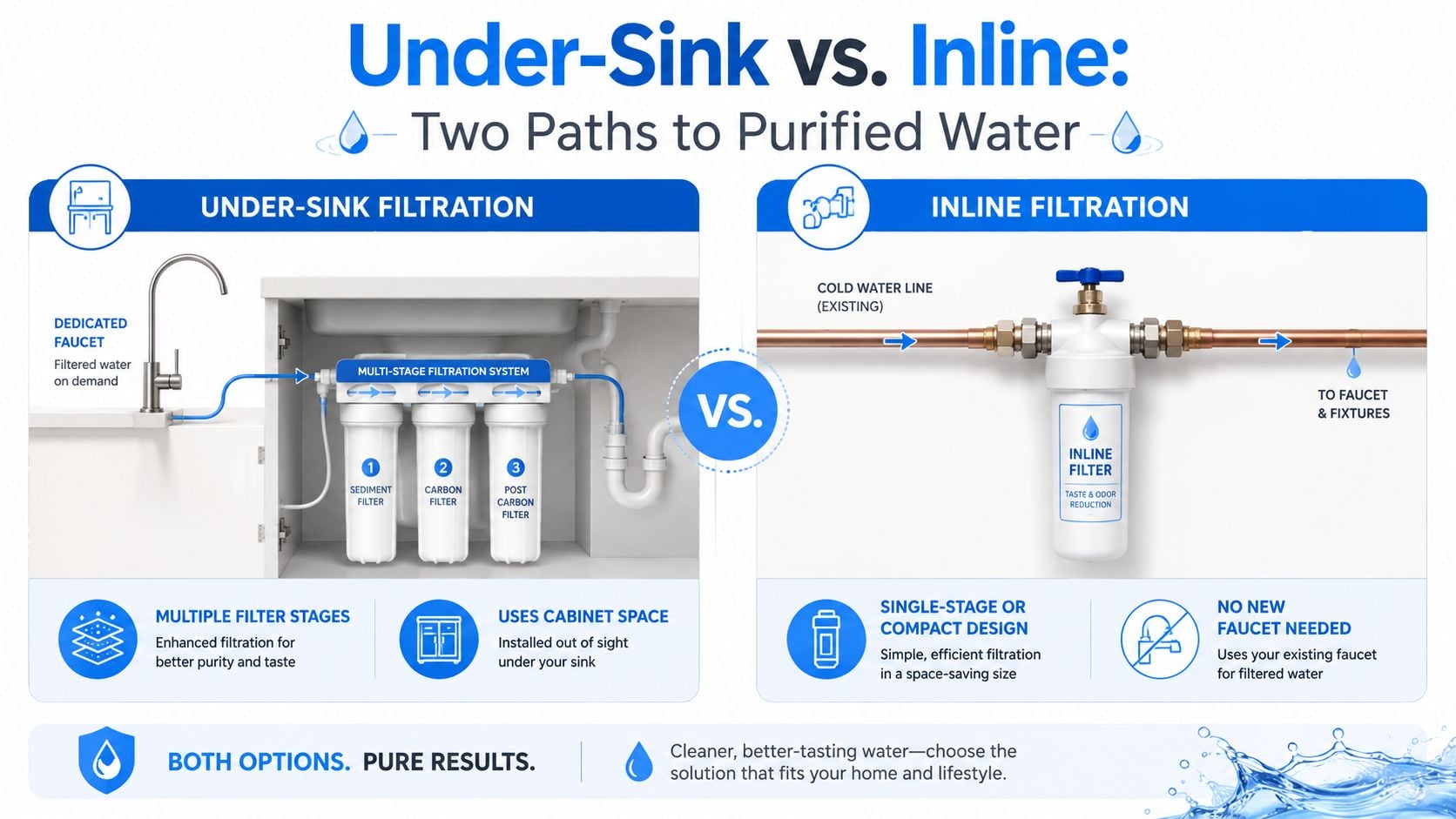
### Plumbing architecture changes the user experience
A dedicated under-sink faucet separates filtered drinking water from unfiltered water used for washing dishes. That's useful when you want to reserve treated water for drinking and cooking. An inline arrangement is more integrated, but the flow path and connection point must be confirmed before installation.
Flow also depends on cartridge design, pressure, temperature, and loading. Under-sink dedicated faucets commonly feel slower than the main kitchen faucet because the water passes through restricted media and smaller tubing. Inline systems can preserve the familiar faucet arrangement, but sediment accumulation can create pressure loss as the cartridge loads.
Don't confuse a faster outlet with better filtration. Longer contact time can help carbon media reduce certain compounds, while excessive flow can shorten the opportunity for treatment. The relevant design question is whether the system's rated flow and capacity match your household's use.
For a neutral overview of how installation layouts and filter technologies compare, this [clean water system comparison](https://prazpurewater.com/best-under-sink-water-filter-systems/) is a useful additional resource. You can also review Woder's explanation of an [inline water filter system](https://woder.com/blog/inline-water-filter-system/) before deciding whether an existing cold-water connection can accommodate one.
The [Woder Advanced Inline Water Filter WD-G4-JG](https://woder.com/products/wd-g4-jg/) uses Advanced Selective Filtration, retains essential minerals, and is made in the USA. Those are product attributes, not a substitute for checking the contaminant claim that matches your water.
## Filtration Technologies and What They Remove
The right filter depends on your water profile, available space, and willingness to replace cartridges. The number of stages on the box is a weak buying guide. Several stages may improve sediment control or taste, but they do not prove that the system targets the contaminant in your water.
### Activated carbon handles common taste problems well
Granular activated carbon and carbon block are widely used for chlorine, taste, odor, and some organic compounds. Carbon block generally provides more consistent contact and particulate capture than loose granular media, but performance depends on the formulation, bed depth, flow rate, and cartridge condition.
For free chlorine, effective empty-bed contact time is commonly around **one to two minutes**, with reported removal above **95% to 99%** under the cited conditions. Chloramine is harder to reduce. It may need approximately **three to four minutes** of contact time for roughly **85% to 95%** removal. In a sink system, that makes flow control and water residence time important. The performance ranges and testing context are summarized in this [NSF certification and contact-time guide](https://www.tapwaterdata.com/blog/guides/understanding-nsf-water-filter-certifications).
Catalytic carbon is the better choice when chloramine is the concern. Its treated or specially structured surface supports reactions that ordinary carbon may handle less efficiently. Confirm that the cartridge lists a chloramine claim rather than assuming any carbon filter provides the same reduction.
### Other media target different contaminant classes
Ion exchange can bind selected dissolved ions, including some metals. KDF-type media use copper and zinc formulations to support reduction of certain heavy metals and chlorine. These media are specialized tools, not universal solutions. Match the product claim and test protocol to the contaminant you need to address.
Reverse osmosis pushes water through a semipermeable membrane. It can reduce a broad range of dissolved contaminants and produce very low TDS, but it also removes minerals. It typically requires a storage tank, drain connection, and more maintenance than a basic point-of-use cartridge. A zero-TDS reading means dissolved solids have been removed, including both desirable and undesirable minerals. It does not establish that the water is healthier in every respect.
Filtration technologyPrimary contaminants addressedNSF/ANSI standards commonly relevantMinerals retainedTypical flow-rate impactActivated carbonChlorine taste and odor, some organic compounds, selected pesticides and VOCsNSF/ANSI 42, with NSF/ANSI 53 or other claims when specifically certifiedUsually retains calcium and magnesiumLow to moderate restriction, depending on carbon density and flowCatalytic carbonChloramine and selected organic compoundsProduct-specific claims, often evaluated alongside NSF/ANSI standardsGenerally retains most mineralsModerate restriction because contact time mattersIon exchange or KDF mediaSelected metals and dissolved ionsNSF/ANSI 53 or other product-specific claimsVaries by resin and target ionModerate restriction as media loadsSelective filtrationTargeted contaminants listed by the manufacturer, while retaining selected mineralsCheck the exact certification and performance sheetDesigned to retain essential mineralsUsually lower complexity than RO, but depends on cartridgeReverse osmosisBroad dissolved-contaminant reduction, including claims for fluoride, arsenic, chromium-6, and PFAS when listedNSF/ANSI 58No, it removes dissolved minerals with other TDSHigher plumbing complexity and lower treated-water deliveryUse certification as the buying checkpoint. The documentation should name the contaminant, influent challenge, effluent limit, and rated capacity. NSF/ANSI 42 chlorine testing commonly uses challenge water at **3.0 mg/L** and requires effluent at or below **0.5 mg/L** through rated capacity. NSF/ANSI 53 lead certification must reduce **150 µg/L** lead to **5 µg/L or less**, representing more than **99% removal** under that test. Review the [NSF certification and contact-time guide](https://www.tapwaterdata.com/blog/guides/understanding-nsf-water-filter-certifications) for the relevant certification framework.
For a kitchen drinking tap, maximum contaminant removal is not automatically the best choice. If testing shows a targeted need, choose media that addresses that contaminant, retains desired minerals when appropriate, and fits your cabinet, flow expectations, and cartridge replacement routine. Choose RO when broad dissolved-contaminant reduction justifies its tank, wastewater, space, and maintenance demands.
## How to Match a Filter to Your Household Needs
The right system emerges from constraints, not from a universal ranking. Start under the sink with a tape measure, then look at the plumbing, the water report, and your maintenance habits.
### Cabinet space sets the first boundary
Measure the usable space, not the empty cabinet. Leave room for tubing bends, shutoff access, cartridge removal, and the filter housing's service direction. A system that fits only when the doors are open isn't a workable installation.
Renters often prefer inline designs because they can avoid drilling for a dedicated faucet. Homeowners with generous cabinet space may choose a multi-stage under-sink layout, especially when sediment or several treatment steps need to be managed separately.
### Plumbing determines what installation really involves
Identify the cold-water shutoff and determine whether the supply uses copper, PEX, or another connection. Do not assume an adapter will fit just because a product page shows a generic diagram. Check the connection size, available shutoff configuration, tubing route, and whether the filter serves a dedicated faucet or the existing line.
If an RO system discharges to the sink trap, plumbing rules may require an air gap above the sink rim. Minnesota's point-of-use RO guidance also says the air-gap faucet or device must meet **IAPMO PS 65, NSF 58, or ASME A112.1.3** standards. Review the [Minnesota Department of Health point-of-use RO guidance](https://www.health.state.mn.us/communities/environment/water/docs/factsheet/pointofuse.pdf) before modifying a drain connection.
### Water chemistry eliminates mismatches
Use your Consumer Confidence Report for municipal water, but remember that a utility report describes the system, not necessarily the water after it travels through your home's plumbing. Private-well owners should test before selecting media. Hardness, sediment, chlorine, lead, PFAS, fluoride, and chromium require different questions and may call for different technologies.
Your maintenance tolerance matters just as much. A cartridge that loads quickly in high-sediment water needs closer attention than the same cartridge on a clean municipal supply. If you know you won't monitor several stages, a simpler system with a clear replacement process may serve you better than an elaborate setup.
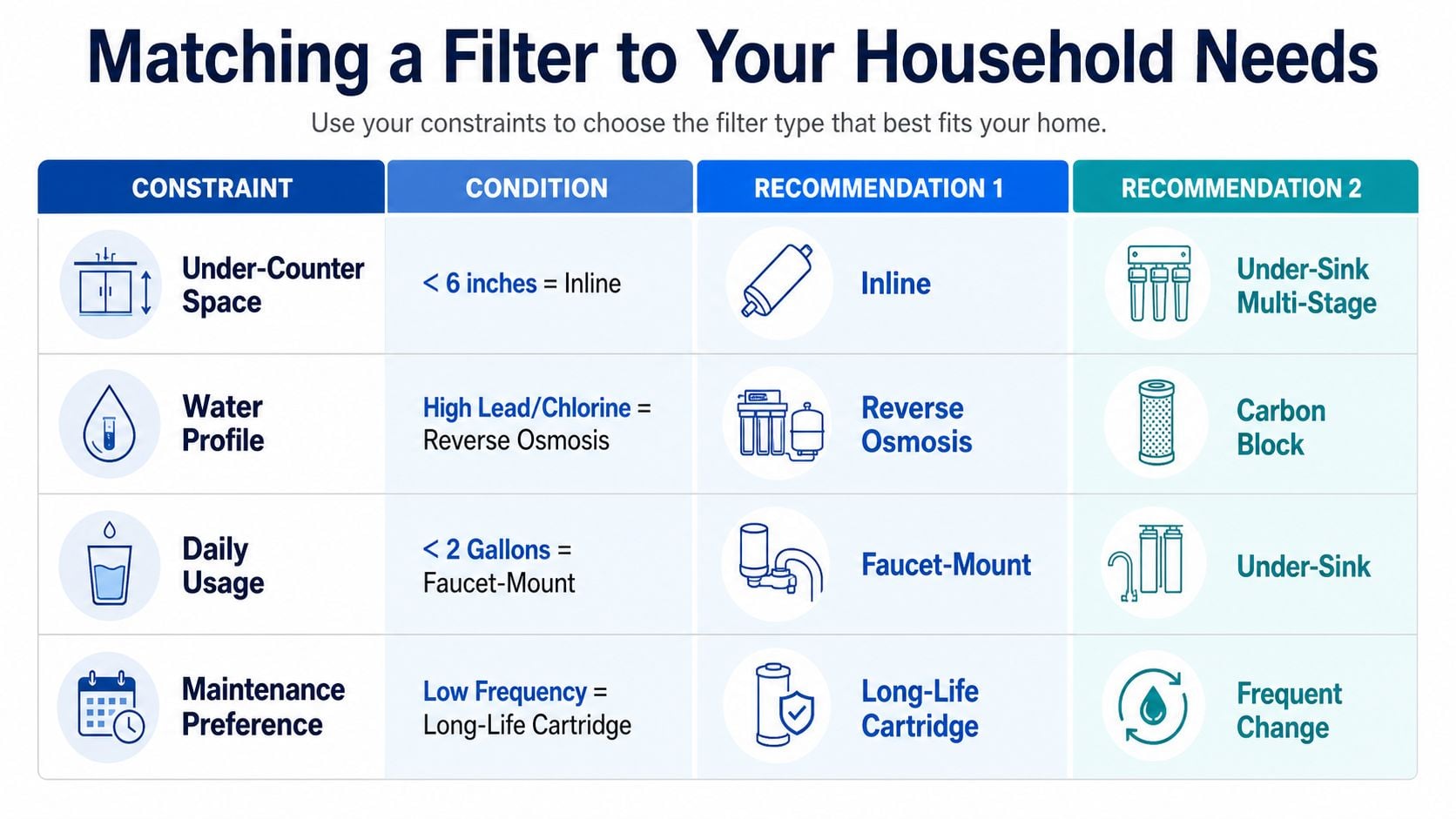
Use this decision logic:
- **Limited space or rental restrictions:** Start with an inline system that matches the existing connection.
- **Sediment or changing well conditions:** Consider staged treatment with a pre-filter, but test first.
- **Specific lead concern:** Require a product-specific NSF/ANSI 53 claim rather than relying on a general “heavy metals” statement.
- **PFAS or dissolved contaminants:** Compare a certified claim for the exact contaminant against the added drain, tank, and maintenance requirements of RO.
- **Taste and mineral preference:** Carbon or selective filtration may offer a better fit than a zero-TDS approach.
A filter isn't “good enough” because it removes many contaminants on paper. It's good enough when its certified claims match the water you have, its flow meets your use, and you'll replace the cartridge on schedule.
## Selecting the Right System and Cartridge for Your Water
A kitchen filter should address a specific water problem, fit the available cabinet or connection, and match the maintenance you will perform. Start with evidence. Download your utility's Consumer Confidence Report, identify the listed contaminants, and separate aesthetic concerns such as chlorine taste from health concerns such as lead or PFAS. Private-well owners should use independent testing rather than rely on regional assumptions.
Read the product documentation before buying. It should name the contaminant claim, test standard, rated capacity, installation conditions, and replacement requirements. “Reduces impurities” is too vague to support a sound choice. Verify the exact cartridge, housing, fittings, flow direction, and replacement part.
### Match the cartridge to the actual concern
For chlorine taste and odor, look for an NSF/ANSI 42 claim. For lead, require NSF/ANSI 53 certification that names lead specifically. Fluoride, arsenic, chromium-6, and PFAS require an exact contaminant claim. NSF/ANSI 58 may apply to these reductions when the certification listing names the contaminant, often directing buyers toward RO or another specifically tested technology.
Woder's Advanced Selective Filtration® is designed around targeted contaminant reduction while retaining essential minerals. Woder Filters is a U.S.-based manufacturer of point-of-use systems. Check any Woder product against your water test and the cartridge's current performance documentation.
Contaminant concernRecommended cartridge approachCompatible systemsCertified reductionChlorine taste and odorActivated carbon or selective media with an NSF/ANSI 42 claimInline or under-sink point-of-use systems, subject to manufacturer fitUse the exact product certification, not a general category claimLeadCarbon block, ion exchange, or specialized media with NSF/ANSI 53 lead certificationUnder-sink or inline systems designed for the cartridgeConfirm that the product's NSF/ANSI 53 claim covers lead specificallyPFASCarbon, RO, or another technology with a specific PFAS claimProduct-specific, with capacity and flow limitsDo not assume a generic reduction rate. Verify the exact listingFluorideRO or another specifically tested selective processUsually a dedicated under-sink systemNSF/ANSI 58 can cover fluoride when the claim is specifically listedChromium, including chromium-6Media certified for the relevant chromium claimDepends on the product listingConfirm whether the certification covers the form of chromium in questionSedimentSediment pre-filter or carbon block with particulate reductionUsually staged under-sink systemsCheck the product's particulate claim and replacement guidanceThe [under-sink water filter cartridge guide](https://woder.com/blog/under-sink-water-filter-cartridge/) explains cartridge fit, replacement, and installation details. Use it to check compatibility rather than treating similar-looking housings as interchangeable.
RO adds a drain line and usually a storage component. A selective or inline cartridge needs less plumbing, but it will not automatically address every dissolved contaminant. Compare the filter's certified claim with your test results, available space, flow needs, and willingness to replace cartridges. Choose the simplest system that solves the identified problem.
## Making a Confident Decision for Your Home
A sound purchase follows four questions:
1. **What does the water test show?** Identify the contaminant, not just the general concern.
2. **What space is available?** Measure the cabinet and inspect shutoffs, tubing paths, and drain access.
3. **What maintenance will happen?** Choose a replacement schedule and system complexity you can sustain.
4. **Which technology fits the tradeoff?** Compare certified reduction, mineral retention, water use, installation, and cost over time.
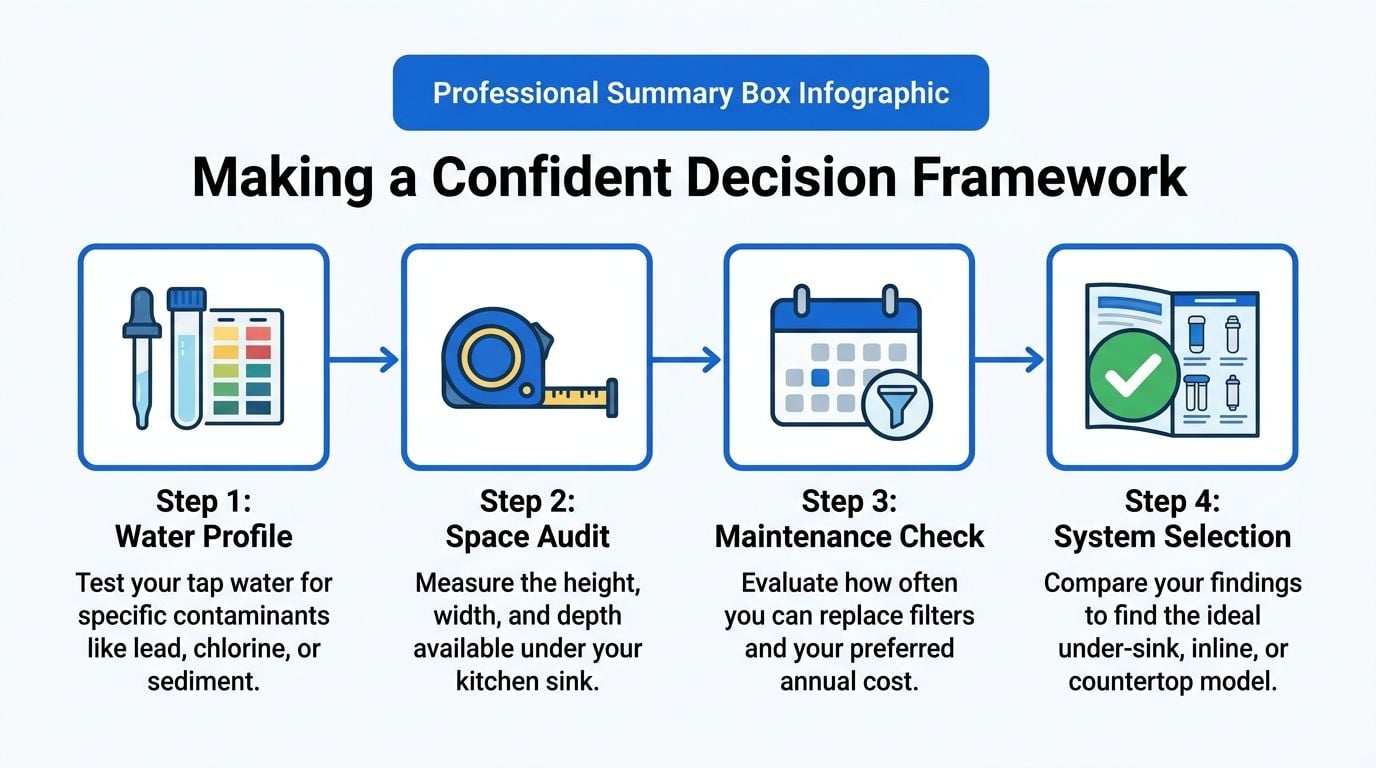
Three household patterns appear often. A renter or apartment resident may favor a compact inline carbon system that avoids countertop drilling. A homeowner with cabinet room and several treatment needs may prefer an under-sink system with staged media. A household facing a documented dissolved-contaminant concern may accept the tank, drain, wastewater, and maintenance demands of RO because its broader removal profile is necessary.
Selective filtration deserves serious consideration for everyday drinking water. It targets harmful contaminants while retaining essential minerals, rather than treating very low TDS as the only definition of quality. That doesn't make it universal, and it doesn't replace testing. It does make the comparison more honest.
Certification labels also deserve a closer look. The [water filter NSF certification guide](https://woder.com/blog/water-filter-nsf-certified/) explains why the standard, contaminant, and product listing matter more than a logo displayed without context.
Take a few minutes to download your water report, measure the cabinet, and write down the maintenance you're realistically prepared to handle. That small audit can prevent a mismatched cartridge, an awkward installation, or a system whose claimed performance doesn't fit your kitchen.
---
Woder Filters offers U.S.-made point-of-use filtration systems built around Advanced Selective Filtration®, with options designed to reduce targeted contaminants while retaining essential minerals. Visit [Woder Filters](https://woder.com) to compare the available approach with your water profile, space, and maintenance preferences before choosing a sink water purification system.
**Categories:** Woder Science
**Tags:** point of use filters, selective filtration, sink water purification systems, under sink filters, water filtration comparison
---
### [What Happens to Your Body When You Drink Filtered Water Every Day? The Science in 2026](https://woder.com/blog/filtered-water-body-science/)
**Published:** August 27, 2026
**Author:** woder
**Content:**
- [Your Body Notices What's in the Water](#your-body-notices-whats-in-the-water)
- [What Filtered Water Does for You Day to Day](#what-filtered-water-does-for-you-day-to-day)
- [Better Hydration Without the Aftertaste](#better-hydration-without-the-aftertaste)
- [Reduced Exposure to Lead and Heavy Metals](#reduced-exposure-to-lead-and-heavy-metals)
- [Lower Cumulative PFAS Exposure](#lower-cumulative-pfas-exposure)
- [The Mineral Question: Why "Pure" Isn't Always Better](#the-mineral-question-why-pure-isnt-always-better)
- [How Selective Filtration Works (Without the Chemistry Lecture)](#how-selective-filtration-works-without-the-chemistry-lecture)
- [What Happens Over Time When You Make the Switch](#what-happens-over-time-when-you-make-the-switch)
- [Filtered Water vs. Bottled Water: What You're Actually Getting](#filtered-water-vs-bottled-water-what-youre-actually-getting)
- [Choosing the Right Filter for Your Home](#choosing-the-right-filter-for-your-home)
- [FAQs](#faqs)
Most people know they should drink more water. Fewer stop to think about what's actually in the water they're drinking.
If you've been wondering whether filtered water makes a real difference — or what the healthiest drinking water actually looks like — here's a straight answer. No scare tactics, no overclaiming. Just what the science says about daily filtered water intake, what contaminants do when they stay in your glass, and why the minerals in your water matter more than most people realize.
### Your Body Notices What’s in the Water
Water makes up roughly 60% of your body weight. You use it for digestion, circulation, temperature regulation, and flushing waste. When you drink two liters a day, you're also delivering whatever's dissolved in that water directly into your system.
For most tap water drinkers, that includes chlorine, chloramines, and trace amounts of contaminants like lead, PFAS, and volatile organic compounds. None of these show up in concentrations that cause immediate illness. The concern is cumulative — what builds up over months and years.
Filtered water reduces that cumulative load. That's the core benefit, and it's worth understanding in specific terms.
### What Filtered Water Does for You Day to Day
#### Better Hydration Without the Aftertaste
Chlorine keeps municipal water safe during distribution. By the time it reaches your tap, that job is done. What lingers is the taste and smell — and for a lot of people, that's enough to make them drink less water than they should.
Remove chlorine at the point of use and water just tastes cleaner. People who switch to filtered water consistently report drinking more simply because they enjoy it more. Better hydration means better energy, clearer skin, and more efficient kidney function. Those aren't dramatic claims — they're the basic downstream effects of actually drinking enough water.
#### Reduced Exposure to Lead and Heavy Metals
Lead doesn't enter your water at the treatment plant. It comes from old pipes and fixtures between the plant and your faucet, which means municipal testing doesn't always catch what's coming out of your specific tap. Lead has no safe level of exposure, especially for children and pregnant women.
Drinking filtered water every day eliminates that ongoing exposure. When you stop adding to the load, your body naturally processes and clears what's already there. A filter that removes lead at the point of use is one of the most direct protective steps a household can take.
#### Lower Cumulative PFAS Exposure
PFAS — per- and polyfluoroalkyl substances — are synthetic chemicals found in a wide range of consumer products and industrial processes. They've been detected in drinking water sources across the country, and they don't break down in the body. They accumulate.
Long-term PFAS exposure has been linked to thyroid disruption, immune system effects, and elevated cholesterol. Drinking filtered water every day won't reverse past exposure, but it does stop new exposure from piling on. The longer you maintain the habit, the more that matters.
### The Mineral Question: Why “Pure” Isn’t Always Better
Here's something that often gets lost in the filtration conversation: not everything in your tap water is bad for you.
Calcium and magnesium are naturally occurring minerals that support bone density, muscle function, and heart health. They're present in most tap water — and they're still present in water that's been filtered selectively.
Reverse osmosis systems strip them out along with everything else. You get genuinely pure water, but you also lose a meaningful daily source of these minerals. Some RO owners add mineral drops back in afterward, which tells you something about the tradeoff they've made.
The healthiest drinking water isn't the most stripped-down water. It's water that's free of contaminants and still carries the minerals your body actually uses.
That distinction matters when you're choosing a filter. Remove the bad, keep the good — that's the difference between filtration that just sounds thorough and filtration that's actually good for you.
### How Selective Filtration Works (Without the Chemistry Lecture)
[Woder](https://woder.com) builds its filters around Advanced Selective Filtration technology, which uses nanoparticles to attract and remove contaminants while leaving beneficial minerals intact. You install the filter directly into your existing water line under the sink. No tank, no wastewater, no plumber required.
What you get is water free of lead, chlorine, PFAS, chromium 6, mercury, carcinogens, and volatile organic compounds — with calcium and magnesium still in the glass.
That's what the healthiest drinking water actually looks like in practice: contaminant-free, mineral-rich, and coming straight from your tap.
### What Happens Over Time When You Make the Switch
The benefits of daily filtered water don't show up dramatically in the first week. They build, just like the harm from unfiltered water does.
Over weeks and months, most people find they're drinking more water because it tastes better. That alone improves energy and digestion. Over years, you're reducing your total lifetime exposure to lead, PFAS, and chlorination byproducts — while getting a consistent daily source of calcium and magnesium that supports long-term bone and cardiovascular health.
You're also cutting out plastic. If filtered water replaces bottled water in your household, you're eliminating hundreds of single-use bottles a year. Better for the environment, and better for your wallet.
### Filtered Water vs. Bottled Water: What You’re Actually Getting
A lot of people assume bottled water is the gold standard. It isn't, for a few reasons.
Bottled water regulation is less stringent than municipal tap water regulation in several respects. Plastic bottles leach trace compounds into the water, especially when stored in heat. And the environmental cost — production, transport, disposal — adds up fast.
A good under-sink filter delivers water that's cleaner than most bottled options, at a fraction of the ongoing cost, without the plastic waste. The upfront investment pays for itself quickly once you stop buying cases of water every week.
### Choosing the Right Filter for Your Home
Not every filter removes the same contaminants, and this is where the category gets confusing.
Pitcher filters handle chlorine and some sediment — they're not built for lead, PFAS, or heavy metals. Reverse osmosis handles everything but wastes water and strips out minerals. Selective filtration sits in between: serious contaminant removal, mineral preservation, no wastewater, no complex installation.
If you're not sure which type fits your household, the [Woder Wizard at woder.com/wizard](https://woder.com/wizard) walks you through it based on your flow rate and filtration needs. Woder's product line covers compact residential units up to high-flow 10 kGPM models, all manufactured in the United States.
---
### FAQs
**Does drinking filtered water every day actually improve your health?**
Yes, over time. The benefits are cumulative. You reduce ongoing exposure to contaminants like lead, PFAS, and chlorination byproducts, and you tend to drink more water because it tastes better. Better hydration supports energy, digestion, kidney function, and skin health.
**What is the healthiest drinking water?**
Water that's free of harmful contaminants — lead, PFAS, chlorine, heavy metals — while still containing naturally occurring minerals like calcium and magnesium. Reverse osmosis removes the beneficial minerals along with the bad. Selective filtration preserves that balance.
**Is filtered tap water better than bottled water?**
In most cases, yes. Bottled water faces less rigorous testing requirements than municipal tap water in some categories, can leach trace compounds from plastic packaging, and generates significant plastic waste. A quality under-sink filter consistently outperforms bottled water on contaminant removal, cost, and environmental impact.
**Does filtered water still contain minerals?**
It depends on the filter. Reverse osmosis removes minerals along with contaminants. Selective filtration systems — like those made by Woder — remove contaminants while leaving calcium, magnesium, and other naturally occurring minerals intact.
**How long does it take to notice a difference from drinking filtered water?**
Most people notice the taste difference immediately. The health benefits from reduced contaminant exposure build over weeks, months, and years of consistent use. Think of it as reducing your cumulative load rather than producing one dramatic change.
**Can filtered water help with PFAS exposure?**
A filter rated for PFAS can stop new dietary exposure from tap water. It doesn't reverse past accumulation in the body, but eliminating an ongoing daily source is a meaningful step. Not all filters remove PFAS, so confirm your filter is specifically rated for it.
**Do I need a plumber to install an under-sink water filter?**
Not with most inline or under-sink filters. Woder filters install directly into your existing water line — no professional help needed, no tank, no whole-home overhaul.
---
Your water is something you interact with dozens of times a day. Getting it right doesn't require a major renovation or an expensive system. It just requires the right filter. Find yours at [woder.com](https://woder.com).
**Categories:** Woder Social Media
---
### [Water Filter NSF Certified: What It Really Means](https://woder.com/blog/water-filter-nsf-certified/)
**Published:** August 27, 2026
**Author:** woder_admin
**Content:**
A water filter carrying an **NSF certified** label isn't automatically certified to remove every contaminant you care about. NSF certification applies to a specific standard, a specific performance claim, and often a specific model. The number beside the certification mark matters more than the logo itself.
That distinction changes how you should compare filters for PFAS, lead, fluoride, chromium, chlorine, and other substances in municipal or well water. A filter can be independently certified for chlorine taste and odor while having no certified claim for lead or PFAS. The practical question isn't, “Is this filter NSF certified?” It's, **“Certified to which NSF/ANSI standard, for which contaminant, and under what conditions?”**
## Table of Contents
- [Why the NSF Certified Label Is Not Enough](#why-the-nsf-certified-label-is-not-enough)
- [The number is the meaningful part](#the-number-is-the-meaningful-part)
- [Decoding the Core NSF Standards for Home Water Filters](#decoding-the-core-nsf-standards-for-home-water-filters)
- [NSF/ANSI 42: taste, odor, and chlorine](#nsfansi-42-taste-odor-and-chlorine)
- [NSF/ANSI 53: named health contaminants](#nsfansi-53-named-health-contaminants)
- [NSF/ANSI 58: reverse-osmosis systems](#nsfansi-58-reverse-osmosis-systems)
- [NSF/ANSI 401: selected emerging compounds](#nsfansi-401-selected-emerging-compounds)
- [The Critical Difference Between Lead-Free and Lead Reduction](#the-critical-difference-between-lead-free-and-lead-reduction)
- [Why both claims can matter](#why-both-claims-can-matter)
- [What PFAS Certification Covers Today](#what-pfas-certification-covers-today)
- [Questions worth asking before purchase](#questions-worth-asking-before-purchase)
- [How to Verify a Filter's Real Certification Claims](#how-to-verify-a-filters-real-certification-claims)
- [Start with the exact product identity](#start-with-the-exact-product-identity)
- [Compare the listing with the product documents](#compare-the-listing-with-the-product-documents)
- [Matching Certification to Your Household Water Needs](#matching-certification-to-your-household-water-needs)
- [Technology involves trade-offs](#technology-involves-trade-offs)
## Why the NSF Certified Label Is Not Enough
NSF certification on a water filter signals one thing: the model meets a specific standard for a defined set of contaminants. The label becomes useful only after you identify the standard number and the performance claim behind it. NSF's overview of drinking-water treatment standards explains that NSF/ANSI 42 covers aesthetic effects such as chlorine, taste, and odor, while NSF/ANSI 53 addresses specified health-related contaminant reduction and NSF/ANSI 401 covers selected emerging compounds. NSF's overview of drinking-water treatment standards shows why the number defines the claim.
A filter certified under NSF/ANSI 42 may have validated performance for chlorine taste or odor without a certified claim for lead. The certification can be legitimate while the shopper's interpretation is wrong. **A certification is a tested promise about a defined function, not a universal declaration that the water is free from every possible contaminant.**
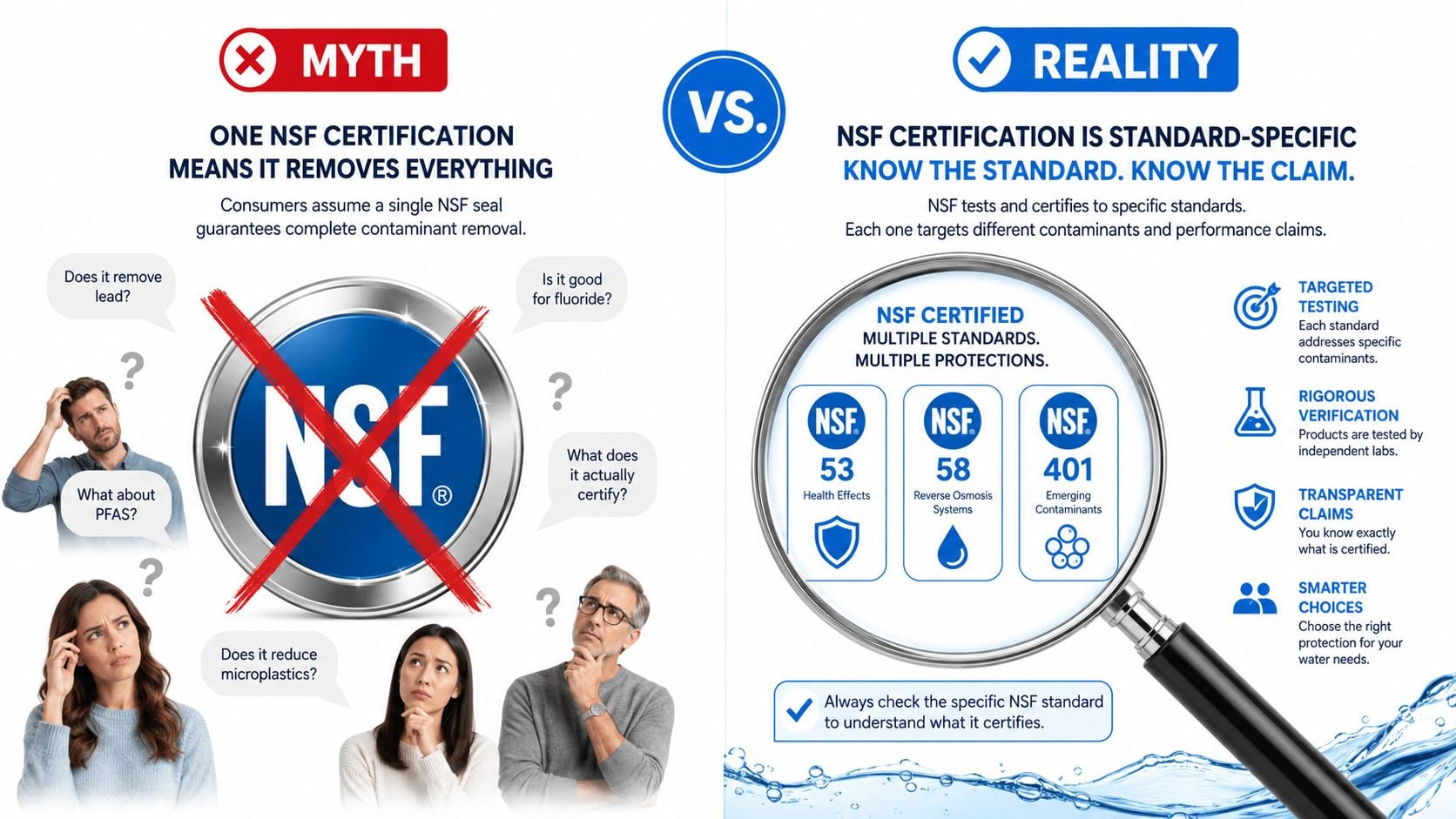
### The number is the meaningful part
Read the full wording on the box, performance data sheet, or manufacturer listing:
- **NSF/ANSI 42** generally points to taste, odor, chlorine, and other aesthetic effects.
- **NSF/ANSI 53** points to specified health-related contaminants, such as lead, when that contaminant appears in the certified claim.
- **NSF/ANSI 58** applies to reverse-osmosis systems and their defined reduction claims.
- **NSF/ANSI 401** addresses selected emerging compounds.
The standards portfolio also includes **42, 53, 58, 62, 177, and NSF P473**. [A plain-language standards guide](https://waterfilterguru.com/nsf-ansi-standard-certifications-explained/) explains why “NSF certified” alone leaves important questions unanswered.
> **Practical rule:** Treat the NSF logo as the beginning of your research. Treat the standard number and contaminant listing as the actual evidence.
Manufacturers may give the seal more attention than the limited scope of the certification. Check the exact contaminant claim before comparing capacity, installation style, or price. For terminology covering certification organizations and water-quality standards, see [WQA, NSF, and ANSI water-quality terms](https://woder.com/blog/wqa-nsf-ansi-wth-water-quality-alphabet-soup/).
## Decoding the Core NSF Standards for Home Water Filters
Each NSF standard targets a distinct category of concern. Matching the standard to your household's water issue helps turn a broad label into a practical shopping filter.
### NSF/ANSI 42: taste, odor, and chlorine
Choose NSF/ANSI 42 when municipal water has a swimming-pool smell, an unpleasant flavor, or visible particulate concerns. The standard evaluates **aesthetic effects**, so it can support claims about chlorine, taste, odor, and some particles. A 42 claim does not establish reduction of lead, PFAS, fluoride, or other health-related contaminants.
### NSF/ANSI 53: named health contaminants
NSF/ANSI 53 applies when a filter makes a performance claim for a specified health-related contaminant. Lead is one example, but the contaminant must appear in the product's certified listing or performance data. A 53 certification does not create a blanket claim for every contaminant associated with the standard.
### NSF/ANSI 58: reverse-osmosis systems
For a homeowner comparing reverse-osmosis equipment, NSF/ANSI 58 is the relevant standard to examine. Certified RO systems may list reductions for dissolved substances such as fluoride, lead, and chromium-related contaminants. The listed claim remains the deciding detail, because two NSF 58 systems may address different substances.
### NSF/ANSI 401: selected emerging compounds
NSF/ANSI 401 covers selected emerging compounds, including some pharmaceuticals, herbicides, and other chemical compounds. It can matter when the concern involves substances outside the familiar taste, odor, and traditional health-contaminant categories.
StandardChoose it when…Examples listed in certified claimsTypical filter typesNSF/ANSI 42Chlorine taste, odor, or particulate concerns affect drinking waterChlorine, taste, odor, particulatesCarbon and other point-of-use or point-of-entry filtersNSF/ANSI 53You need a named health-contaminant reduction claimLead and other specified health contaminantsCarbon, specialty media, and other certified systemsNSF/ANSI 58You are evaluating a reverse-osmosis system for dissolved substancesFluoride, lead, chromium-related contaminants, and other named substancesReverse-osmosis systemsNSF/ANSI 401Your concern involves selected emerging compoundsPharmaceuticals, herbicides, and other specified chemical compoundsAdvanced carbon and other systems with specific claimsFilter technology provides useful context, but the certification claim remains contaminant-specific. Woder's [WD-G4-DC Lead, Chlorine, HM and PFAS Water Filter](https://woder.com/products/wd-g4-dc/) uses Advanced Selective Filtration® and retains essential minerals. Its WD-G4-REP filters are certified by WQA to NSF/ANSI 42 for chlorine taste and odor and NSF/ANSI 372 for lead-free compliance, as substantiated by test data.
Write down the water concern first. Then look for the matching **standard plus contaminant claim**. That sequence keeps a familiar logo from standing in for evidence about what the cartridge removes.
## The Critical Difference Between Lead-Free and Lead Reduction
“Lead-free” and “lead reduction” describe different things. **NSF/ANSI 372 concerns the lead content of product materials**, while NSF/ANSI 53 evaluates whether a drinking-water treatment unit reduces a named contaminant, including lead. NSF's lead-reduction listings distinguish these categories, and they shouldn't be treated as synonyms. [NSF's lead-reduction certification listings](https://info.nsf.org/Certified/DWTU/listings_leadreduction.asp) are the appropriate reference for checking the performance claim.
A filter certified for lead-free materials has components that meet lead-content requirements. That's important because water should not pick up lead from the filter itself. But the certification doesn't prove that the cartridge removes dissolved lead already present in incoming water.
Lead reduction requires a performance claim under the relevant standard. The U.S. EPA's National Primary Drinking Water Regulations use a **lead action level of 0.15 mg/L, or 15 ppb**, as a public-water compliance benchmark. [NSF's drinking-water treatment reference](https://info.nsf.org/Certified/dwtu/) provides context for the standard and the role of certified treatment units.
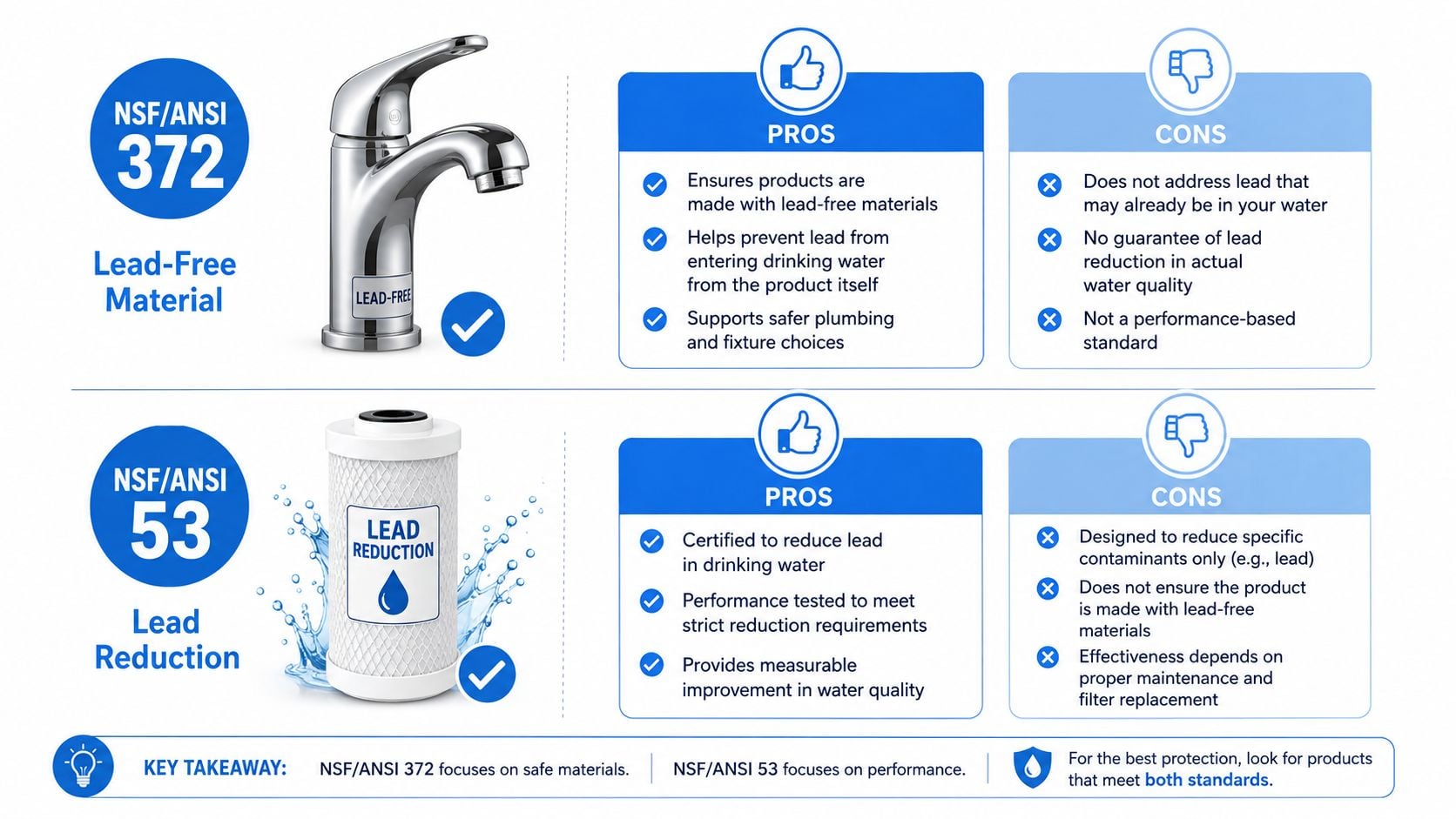
### Why both claims can matter
Under-sink systems, inline filters, and other point-of-use devices put drinking water in contact with housings, fittings, seals, and filter media. A responsible evaluation therefore has two separate questions:
1. **Are the materials suitable for contact with drinking water?**
2. **Does the treatment system reduce the lead already in the water?**
The first question relates to material safety. The second relates to filtration performance. One certificate cannot answer both unless the product documentation shows both applicable claims.
Marketing language can create confusion by placing “lead-free” in a prominent position without making a lead-reduction claim equally clear. That wording may be accurate, but it can lead shoppers to infer protection the certification doesn't establish.
> **Read the claim literally:** “Lead-free” describes the product. “Lead reduction” describes what the product does to contaminated water.
For a household with an older service line, aging plumbing, or a known lead concern, check the exact model, the NSF/ANSI 53 lead claim, the NSF/ANSI 372 material claim, and the replacement requirements. Woder's educational resource on an [under-sink water filter for lead](https://woder.com/blog/under-sink-water-filter-for-lead/) can help clarify the distinction before you choose a system.
## What PFAS Certification Covers Today
PFAS certification under **NSF/ANSI 53 or NSF/ANSI 58** is narrower than the phrase “PFAS certified” implies. Current claims depend on the tested compounds and the specific claim listed for that product. NSF says a filter making a PFAS reduction claim must reduce PFAS to below **20 parts per trillion**. NSF's contaminant-reduction claims guide directs consumers to its certified-product database for individual claims, including PFOA and PFOS.
NSF's consumer guidance describes how these certifications developed. The earlier PFAS-focused protocol, NSF P473, was followed by PFAS claims under standards such as NSF/ANSI 53 and 58. The standards added more PFAS compounds and lowered the combined PFAS claim threshold from **70 ppt to 20 ppt**. NSF's PFAS drinking-water guidance identifies a further limitation: existing PFAS certification standards do not yet show whether a filter will reduce PFAS to the newer EPA drinking-water standard.
The practical meaning is precise. A filter certified for a named PFAS claim has been evaluated for that claim under specified test conditions. That certification does not establish removal of every PFAS compound or compliance with every regulatory target.
PFAS CompoundCommonly Certified Under NSF 53/58Typical Detection in Municipal WaterCurrent EPA Health Advisory LevelPFOAMay be included in a listed PFAS claimVaries by location and sourceUse the applicable current federal or state guidance for interpretationPFOSMay be included in a listed PFAS claimVaries by location and sourceUse the applicable current federal or state guidance for interpretationPFAS compounds beyond the named claimNot automatically includedVaries by location and sourceCheck the current guidance for the specific compoundThe table's qualitative fields are intentional. **A national average can't tell you what's at your tap**, while a brand name cannot show which PFAS compounds a cartridge has been tested to reduce.
### Questions worth asking before purchase
Check the exact model listing and ask:
- Which PFAS compounds are named?
- Is the claim for PFOA, PFOS, or a broader Total PFAS category?
- What influent and effluent conditions appear in the performance documentation?
- Does the claim match contaminants identified in your utility report or private-water test?
For practical guidance on choosing a system, Woder's guide to a [PFAS removal water filter](https://woder.com/blog/pfas-removal-water-filter/) is a useful starting point. Treat certification as specific technical evidence, then compare that evidence with the compounds and water conditions relevant to your home.
## How to Verify a Filter's Real Certification Claims
You don't have to rely on packaging alone. NSF maintains a consumer database of certified products and systems, and its listings can be checked for the model and contaminant claims that matter to you.
### Start with the exact product identity
Find the **manufacturer name and complete model number** on the cartridge, housing, box, installation manual, or performance data sheet. A product family name may not be enough. Different cartridges, revisions, or system configurations can have different listings.
Search the model in NSF's database, then inspect the entry rather than stopping at the search result. Confirm:
- The manufacturer matches the product in your hands.
- The exact model number appears.
- The applicable standard numbers are listed.
- The contaminants are named under those standards.
- The certification status is current.
- The claim applies to the filter or complete system you intend to use.
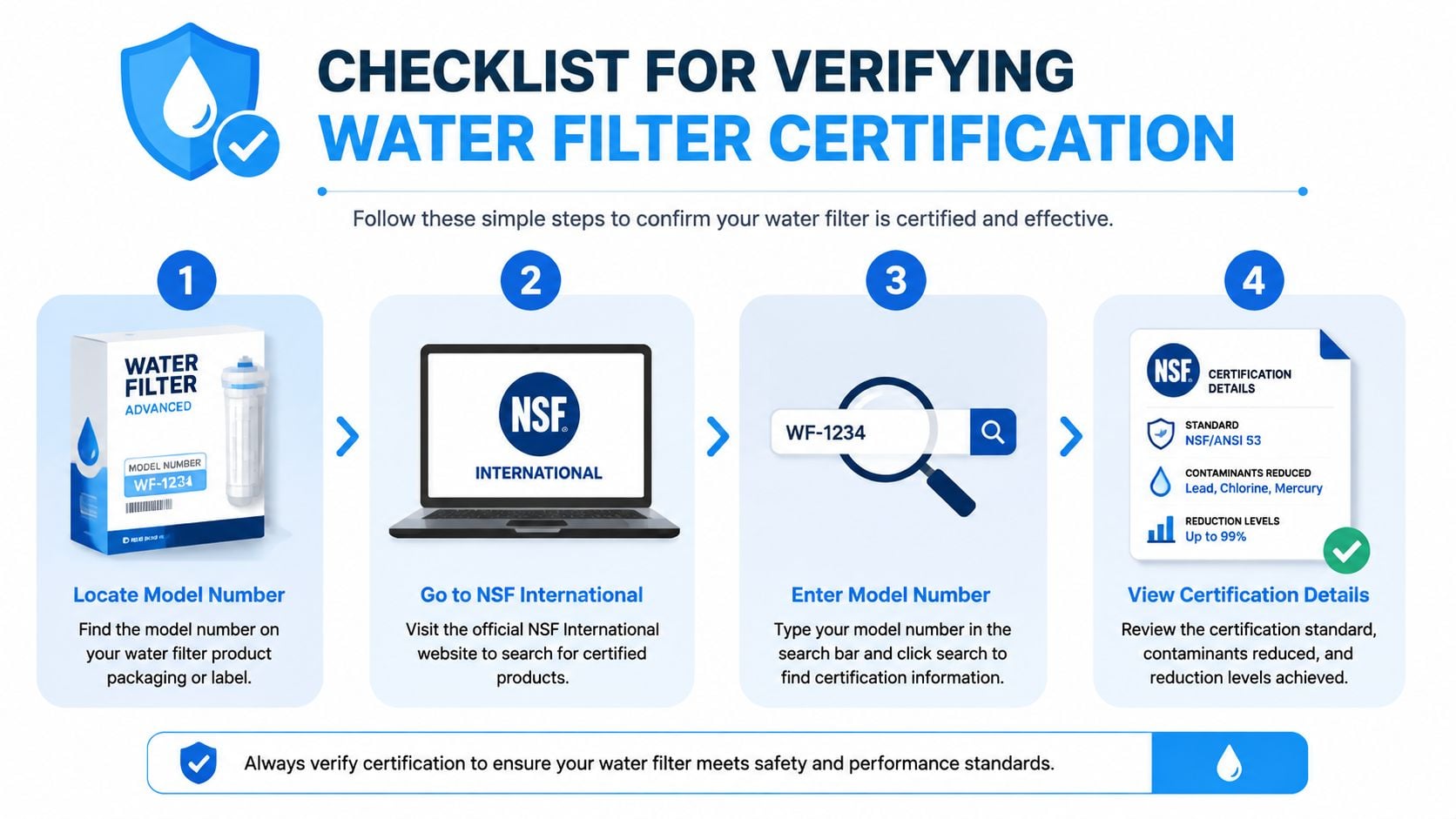
### Compare the listing with the product documents
The database entry should agree with the package, manual, and manufacturer website. If the package highlights PFAS but the listing shows only a chlorine claim, pause before buying. If a housing is certified for material safety but the complete filtration system has no contaminant-reduction listing, don't treat the housing certification as proof of treatment performance.
Phrases such as **“tested to NSF standards”** also need careful reading. Testing to a standard isn't the same as third-party certification, which involves independent evaluation and continuing oversight. The exact wording, certifier, standard, and model all matter.
Finally, read the operating conditions. Capacity limits, flow requirements, cartridge replacement intervals, and installation instructions affect whether the certified performance applies in your home. A filter used beyond its rated conditions may no longer deliver the performance the listing evaluated.
> **Before checkout:** Match the exact model, standard number, named contaminant, certification status, and operating instructions. If one piece is missing, keep researching.
## Matching Certification to Your Household Water Needs
The right filter begins with the water issue, not the seal. A municipal customer can start with the utility's consumer confidence report, while a private-well owner may need water testing because well conditions can vary by property. Either way, identify the actual concern before choosing a technology.
Use this practical mapping:
- **Chlorine taste or odor:** Look for NSF/ANSI 42 and a specific chlorine claim.
- **Lead from plumbing:** Look for NSF/ANSI 53 lead reduction, then separately check NSF/ANSI 372 for lead-free materials.
- **PFAS:** Look for a named PFAS claim under NSF/ANSI 53 or 58, and verify which compounds are included.
- **Fluoride or dissolved contaminants:** NSF/ANSI 58 is the established certified route for reverse-osmosis systems.
- **Selected pharmaceuticals or herbicides:** Check NSF/ANSI 401 and its listed compounds.
- **Chromium or other heavy metals:** Confirm the exact contaminant claim and the standard under which it was tested.
Water source changes the priority. Municipal water has treatment and distribution controls, but plumbing can still affect what reaches the tap. Well water doesn't pass through the same public-system framework, so testing and treatment selection deserve particular attention. A household with infants or immunocompromised residents may also choose to discuss test results and treatment decisions with an appropriate health professional.
### Technology involves trade-offs
Activated carbon and selective media can target particular contaminants while preserving minerals, but their claims depend on media design, contact time, flow, and replacement. Reverse osmosis can provide broad dissolved-solids reduction and is the established certified route for fluoride, though it also strips dissolved minerals and brings additional maintenance and water-use considerations.
A zero-TDS reading isn't proof of “pure” drinking water. **TDS measures dissolved solids collectively, good and bad alike**, so a zero reading indicates that minerals have been removed along with unwanted substances. RO systems can achieve very low TDS, but that result alone doesn't identify which contaminants were reduced or whether the trade-off suits your household.
For a neutral overview of technology trade-offs, including filtration cost and contaminant removal considerations, review this [cost and contaminant removal guide](https://www.covenantairesolutions.com/post/reverse-osmosis-vs-water-filter).
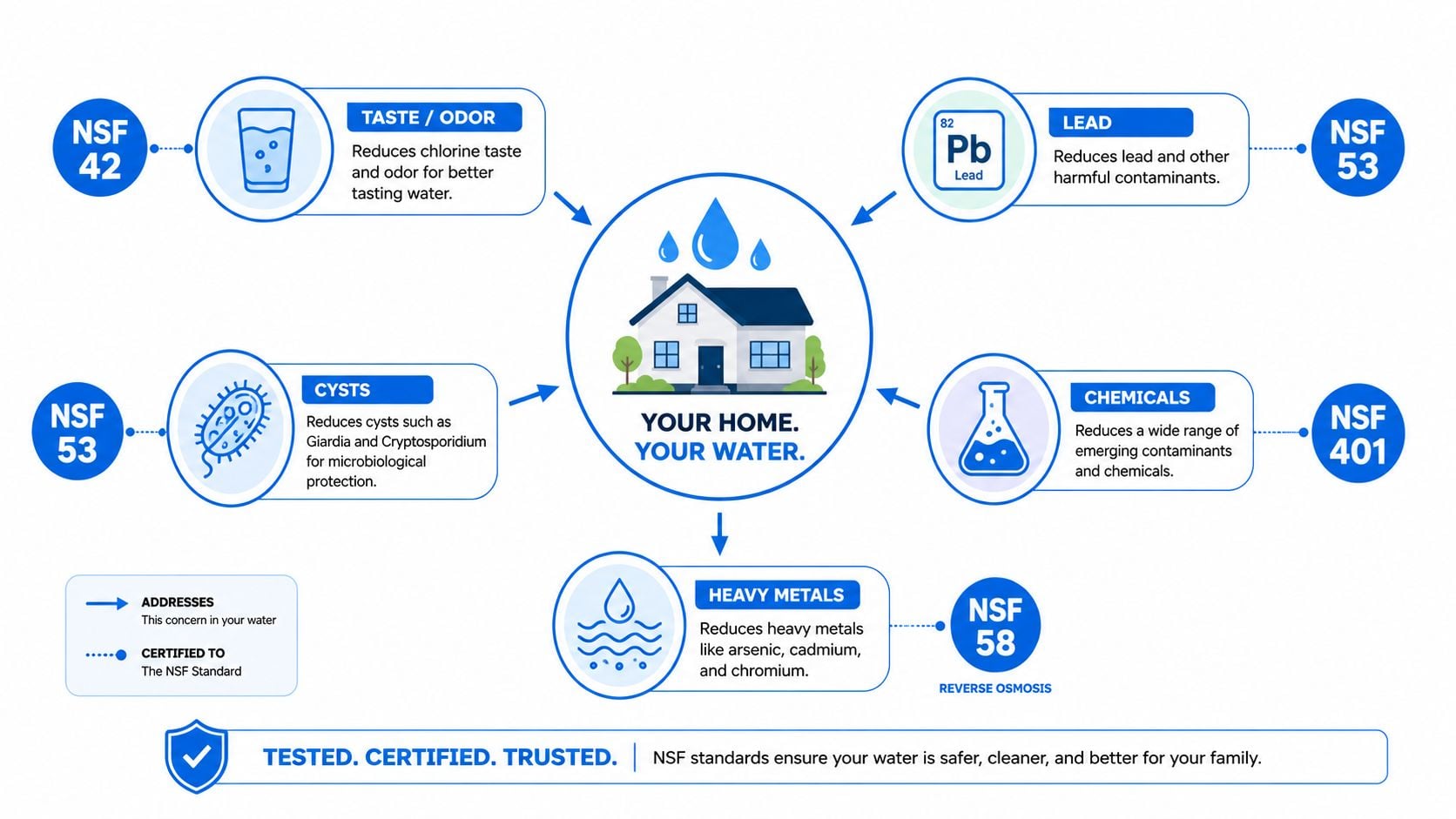
A sensible process is simple: review your water report or test results, identify your top three concerns, and search only for filters with matching, verifiable claims. Woder Filters offers U.S.-made point-of-use systems using **Advanced Selective Filtration®**, designed to reduce listed contaminants while retaining essential minerals, with each cartridge backed by a one-year guarantee. Visit [Woder Filters](https://woder.com) to compare the relevant certification language and find a system that fits your water, fixture, and household needs.
**Categories:** Woder Science
**Tags:** lead water filter, nsf certification standards, nsf water filter, pfas water filter, water filter nsf certified
---
### [Why Does My Water Smell Like Rotten Eggs? Causes and Fixes in 2026](https://woder.com/blog/rotten-eggs-water-causes-fixes/)
**Published:** August 26, 2026
**Author:** woder
**Content:**
- [What Causes Water to Smell Like Rotten Eggs?](#what-causes-water-to-smell-like-rotten-eggs)
- [Sulfur Bacteria in Your Supply or Pipes](#sulfur-bacteria-in-your-supply-or-pipes)
- [A Corroding Water Heater Anode Rod](#a-corroding-water-heater-anode-rod)
- [Naturally Occurring Sulfur in Groundwater](#naturally-occurring-sulfur-in-groundwater)
- [Municipal Treatment Residuals](#municipal-treatment-residuals)
- [How to Narrow Down the Source](#how-to-narrow-down-the-source)
- [How to Fix Water That Smells Like Rotten Eggs](#how-to-fix-water-that-smells-like-rotten-eggs)
- [Replace the Water Heater Anode Rod](#replace-the-water-heater-anode-rod)
- [Shock Chlorinate Your Well](#shock-chlorinate-your-well)
- [Install a Filter Built for Odor and Chemical Residuals](#install-a-filter-built-for-odor-and-chemical-residuals)
- [Flush and Clean Your Pipes](#flush-and-clean-your-pipes)
- [Check Ventilation Around Your Water Heater](#check-ventilation-around-your-water-heater)
- [When to Call a Professional](#when-to-call-a-professional)
- [A Note on Filters and What They Actually Do](#a-note-on-filters-and-what-they-actually-do)
- [Frequently Asked Questions](#frequently-asked-questions)
You turn on the tap, fill a glass, and get hit with a smell that belongs in a chemistry lab — not your kitchen. That sulfur odor, the one that makes you think of rotten eggs, is one of the most common water quality complaints homeowners deal with. And while it's genuinely unpleasant, it's usually fixable once you understand what's behind it.
Here's how to identify the source, narrow it down to your specific situation, and actually do something about it.
### What Causes Water to Smell Like Rotten Eggs?
Almost always, the culprit is hydrogen sulfide gas. It forms naturally under certain conditions and produces that sharp, sulfur-like odor even at extremely low concentrations — your nose can pick it up at levels as low as 0.5 parts per billion, which is why the smell often feels more intense than any test result would suggest.
Here are the most common reasons it ends up in your water.
#### Sulfur Bacteria in Your Supply or Pipes
Sulfur bacteria are naturally occurring microorganisms that feed on sulfur compounds and release hydrogen sulfide as a byproduct. They're the most frequent cause in private well systems, but they can also colonize municipal supply lines, particularly in older infrastructure.
A useful clue: if the smell is stronger from hot water than cold, or if it comes and goes depending on how long water has sat in the pipes, bacteria are likely involved.
#### A Corroding Water Heater Anode Rod
Your water heater has a magnesium or aluminum anode rod inside it — its job is to protect the tank from corrosion. When that rod reacts with sulfate-rich water, hydrogen sulfide is a common result. This is why many homeowners only notice the smell from the hot tap.
If your water heater is a few years old and the anode rod has never been replaced, that's a strong place to start.
#### Naturally Occurring Sulfur in Groundwater
In certain regions, groundwater moves through geological formations — limestone, shale — that are naturally rich in sulfur compounds. If your home draws from a private well and the smell is consistent year-round regardless of water temperature, the source water itself is likely the issue.
#### Municipal Treatment Residuals
Some water systems use sulfur-based compounds during treatment. In rare cases, these interact with organic matter inside your pipes and produce trace hydrogen sulfide. If you're on city water and the smell is mild and inconsistent, this is worth considering.
### How to Narrow Down the Source
Before spending money on a fix, spend five minutes on a diagnosis.
**Step 1: Hot vs. cold.** Run the cold tap alone for 30 seconds, then the hot tap alone. If the smell is noticeably stronger from hot water, the anode rod is the most likely culprit.
**Step 2: One faucet or all of them?** A smell isolated to a single faucet points to something localized — a drain, aerator, or that specific pipe run. If every faucet smells, the problem is upstream.
**Step 3: Run the tap and wait.** If the smell fades after 30 to 60 seconds of running water, it's been sitting in your pipes — likely localized bacterial growth. If it stays strong no matter how long you run it, the issue is coming from the source.
**Step 4: Test your water.** A water test confirms whether hydrogen sulfide, sulfate, or bacteria are present and at what levels. Woder offers water testing kits at [woder.com](https://woder.com) so you can get a clear picture of what's actually coming out of your tap.
### How to Fix Water That Smells Like Rotten Eggs
The right fix depends on what your diagnosis turns up.
#### Replace the Water Heater Anode Rod
If the smell is coming only from hot water, swapping the magnesium anode rod for an aluminum or zinc alloy version often solves the problem entirely. It's a DIY-friendly repair on most water heaters — and if you'd rather not tackle it yourself, a plumber can handle it in under an hour.
#### Shock Chlorinate Your Well
If you have a private well and sulfur bacteria are the cause, shock chlorination is the standard fix. It flushes the system with a high concentration of chlorine to kill off the bacteria and can keep the problem at bay for months or longer. Your local cooperative extension office or a well water specialist can walk you through the process.
#### Install a Filter Built for Odor and Chemical Residuals
For ongoing protection — especially if your source water naturally contains sulfur compounds or your municipal supply carries residual treatment chemicals — a quality inline or under-sink filter makes a real difference.
Woder's Advanced Selective Filtration technology removes 99.9% of contaminants, including volatile organic compounds, chlorine, and other chemical residuals that cause odor and taste problems. It installs directly into your existing water line with no plumber required. And unlike reverse osmosis systems, it doesn't strip out everything in the process — calcium, magnesium, and other naturally occurring minerals stay right where they belong.
That distinction matters. Most odor-removal filters take a blunt approach. Woder removes what doesn't belong while keeping what does.
#### Flush and Clean Your Pipes
If the smell is limited to one faucet or only shows up after water sits overnight, bacterial buildup inside a specific pipe section or aerator may be the cause. Remove and clean the aerator, then flush the affected line thoroughly. In older homes with iron or steel pipes, more extensive flushing may be needed.
#### Check Ventilation Around Your Water Heater
Sometimes hydrogen sulfide accumulates around the water heater rather than in the water itself. Make sure the area is properly ventilated and look for any visible corrosion on the tank or connections.
### When to Call a Professional
Most rotten egg smell issues don't require a plumber. But reach out to one if:
- The smell is strong and persistent from every tap, hot and cold
- You're on a private well and shock chlorination hasn't resolved it
- The smell comes alongside discolored water or reduced pressure
- Your water test shows elevated hydrogen sulfide or bacterial contamination
These combinations can point to something more serious — a well issue, a compromised water main connection, or deteriorating pipe integrity.
### A Note on Filters and What They Actually Do
Reaching for a filter when your water smells off is a reasonable instinct. But the filter has to be the right kind.
Pitcher filters use basic activated carbon, which can reduce some odors but won't touch sulfur bacteria or serious chemical contamination. Reverse osmosis systems are more thorough but come with real trade-offs: they're expensive, they produce significant wastewater, and they strip out the minerals your body actually benefits from.
Woder sits in a smarter middle ground. Advanced Selective Filtration uses nanoparticles to target contaminants specifically — removing VOCs, chlorine, and chemical residuals that cause odor and taste issues, while leaving beneficial minerals intact. It installs inline under your sink, works with your existing water line, and requires no whole-home overhaul. Built in the United States.
If you're ready to stop second-guessing your tap water, [find your Woder](https://woder.com/wizard) at woder.com.
---
### Frequently Asked Questions
**Is water that smells like rotten eggs safe to drink?**
It depends on the cause. Low levels of hydrogen sulfide aren't generally considered a health hazard, but sulfur bacteria in your supply can be a different story. If the smell is strong, test your water before drinking it regularly — a water test will tell you whether bacteria, sulfate, or other contaminants are present.
**Why does only my hot water smell like rotten eggs?**
This almost always points to the water heater. The magnesium anode rod inside the tank reacts with sulfate in the water and produces hydrogen sulfide. Replacing it with an aluminum or zinc alloy rod typically takes care of the problem.
**Can a water filter remove the rotten egg smell?**
Yes — if it's the right kind. Filters that target volatile organic compounds and chemical residuals can significantly reduce sulfur-related odors. Basic pitcher filters usually aren't up to the job. An inline or under-sink filter with advanced filtration media is a more effective long-term solution.
**Why does my water only smell like rotten eggs sometimes?**
Intermittent odor often points to bacterial growth in your pipes or water heater. Bacteria produce hydrogen sulfide as they metabolize, and the smell is strongest when water has been sitting still. Running the tap for 30 to 60 seconds before use can help confirm whether that's the pattern.
**Does the smell mean something is seriously wrong with my plumbing?**
Not necessarily. The smell is unpleasant, but it often has a straightforward cause — an aging anode rod, sulfur-containing groundwater, or localized bacterial growth. That said, if the smell is strong, persistent, and coming from every tap, a water test and a professional consultation are worth it to rule out a well or pipe issue.
**Will the smell go away on its own?**
Unlikely. Hydrogen sulfide odors tied to bacteria or a corroding anode rod tend to persist — or get worse — without intervention. Diagnosing the source and addressing it directly is the only reliable path to clean, odor-free water.
**How do I know if I need a whole-house filter or just an under-sink filter?**
Start with a water test to understand what you're actually dealing with. If the issue is localized to your drinking water and the cause is chemical or mineral-related, an under-sink filter at the point of use is usually the most practical and cost-effective fix. Whole-home systems make more sense when the problem affects bathing, laundry, or appliances too.
---
That sulfur smell is annoying — but it's also a signal worth paying attention to. Once you know the source, the fix is usually straightforward. And once clean, filtered water is flowing reliably from your tap, you stop thinking about it entirely. That's exactly where you want to be.
**Categories:** Woder Science
---
### [Reusable Sediment Water Filter: Benefits, Limits, and How](https://woder.com/blog/reusable-sediment-water-filter/)
**Published:** August 26, 2026
**Author:** woder_admin
**Content:**
A reusable sediment water filter is a washable pre-filter that traps sand, silt, rust, and dirt before they reach your plumbing and downstream filters. It works best when cleaned regularly, not replaced on a fixed schedule.
That distinction matters when a homeowner installs a filter under the sink or near the main water entry, then forgets about it. At first, the water looks clearer and the filter seems almost invisible. Months later, the shower weakens, a faucet slows, or a glass fills with cloudy water after plumbing work. The filter may not have failed. It may be full of the material it was installed to catch.
## Table of Contents
- [Why Your Sediment Filter Needs More Attention Than You Think](#why-your-sediment-filter-needs-more-attention-than-you-think)
- [How Sediment Filtration Actually Works](#how-sediment-filtration-actually-works)
- [What it can catch](#what-it-can-catch)
- [What it cannot solve](#what-it-cannot-solve)
- [Benefits and Limits of Reusable Filters](#benefits-and-limits-of-reusable-filters)
- [Finer capture has a cost](#finer-capture-has-a-cost)
- [Reusable Versus Disposable Sediment Filters](#reusable-versus-disposable-sediment-filters)
- [How to Clean and Maintain Your Reusable Sediment Filter](#how-to-clean-and-maintain-your-reusable-sediment-filter)
- [Follow the full cleaning cycle](#follow-the-full-cleaning-cycle)
- [When to Choose Reusable and When to Choose Disposable](#when-to-choose-reusable-and-when-to-choose-disposable)
- [An old idea with a modern maintenance lesson](#an-old-idea-with-a-modern-maintenance-lesson)
- [How a Sediment Filter Protects Your Whole Home](#how-a-sediment-filter-protects-your-whole-home)
- [Frequently Asked Questions About Reusable Sediment Filters](#frequently-asked-questions-about-reusable-sediment-filters)
- [How often should you clean one?](#how-often-should-you-clean-one)
- [Can you use one with a high-iron well?](#can-you-use-one-with-a-high-iron-well)
- [When should you replace the element instead of cleaning it?](#when-should-you-replace-the-element-instead-of-cleaning-it)
## Why Your Sediment Filter Needs More Attention Than You Think
A homeowner named Mark installed a washable sediment cartridge to deal with grit entering his home from a private well. The first weeks went smoothly. He stopped seeing particles in the utility sink and assumed the filter would keep working indefinitely.
Several months later, the kitchen faucet had noticeably less flow. The shower pressure felt weak, and the under-sink contaminant filter was loading faster than expected. Mark initially blamed the plumbing. When he opened the sediment housing, he found the pleated media coated with sand, rust-colored residue, and fine dirt. The filter was doing its job, but the accumulated debris had narrowed the water path.
That's the basic operating cycle of a **reusable sediment water filter**. It traps suspended material, then gradually becomes more restrictive as that material builds up. A reusable cartridge can be rinsed, but “reusable” doesn't mean maintenance-free. Guidance for washable cartridges notes that cleaning needs depend heavily on incoming sediment, with well-water and high-iron conditions potentially shortening the interval from months to weeks ([maintenance guidance for washable sediment cartridges](https://manuals.plus/ko/asin/B072YVNRZN)).
> **Practical rule:** Treat flow as a maintenance signal, not as a fixed calendar appointment.
A loaded pre-filter can also place extra demand on downstream equipment. Pumps may work harder to move water through a restricted path, and finer filters can clog sooner when a coarse stage stops accepting sediment efficiently. The solution isn't automatically a finer cartridge. It's usually a better maintenance routine, correct sizing, or staged filtration matched to the water entering the home.
The important question is therefore not only, “How long does this filter last?” Ask instead, “How quickly is it loading, and what does its pressure and flow tell me?” That answer changes with the source, the household's water use, and the amount of sediment in the supply.
## How Sediment Filtration Actually Works
A sediment filter is a mechanical barrier. Water passes through a screen or fibrous media while suspended particles become trapped. The filter can catch material such as **sand, silt, loose scale, clay, organic matter, and sometimes insoluble iron and manganese**, according to [Nebraska Extension guidance on household water treatment](https://extensionpubs.unl.edu/publication/g1492/na/html/view).
Think of a coffee filter. It holds back coffee grounds while allowing brewed liquid through. A sediment filter performs a similar physical separation, although its media and construction are designed for water flow and particulate loading rather than coffee preparation.
### What it can catch
The filter works on substances that are floating in the water rather than fully dissolved in it. Common targets include:
- **Sand and grit**, which may enter from a private well or disturbed plumbing.
- **Silt and clay**, which can create a hazy or cloudy appearance.
- **Rust flakes and loose scale**, often released by aging pipes, valves, or water heaters.
- **Organic debris**, depending on the media and the size of the material.
Micron rating describes the approximate particle size the media is intended to capture. A smaller rating generally targets finer particles, but a nominal rating isn't the same as an absolute guarantee that every particle of that size will be retained.
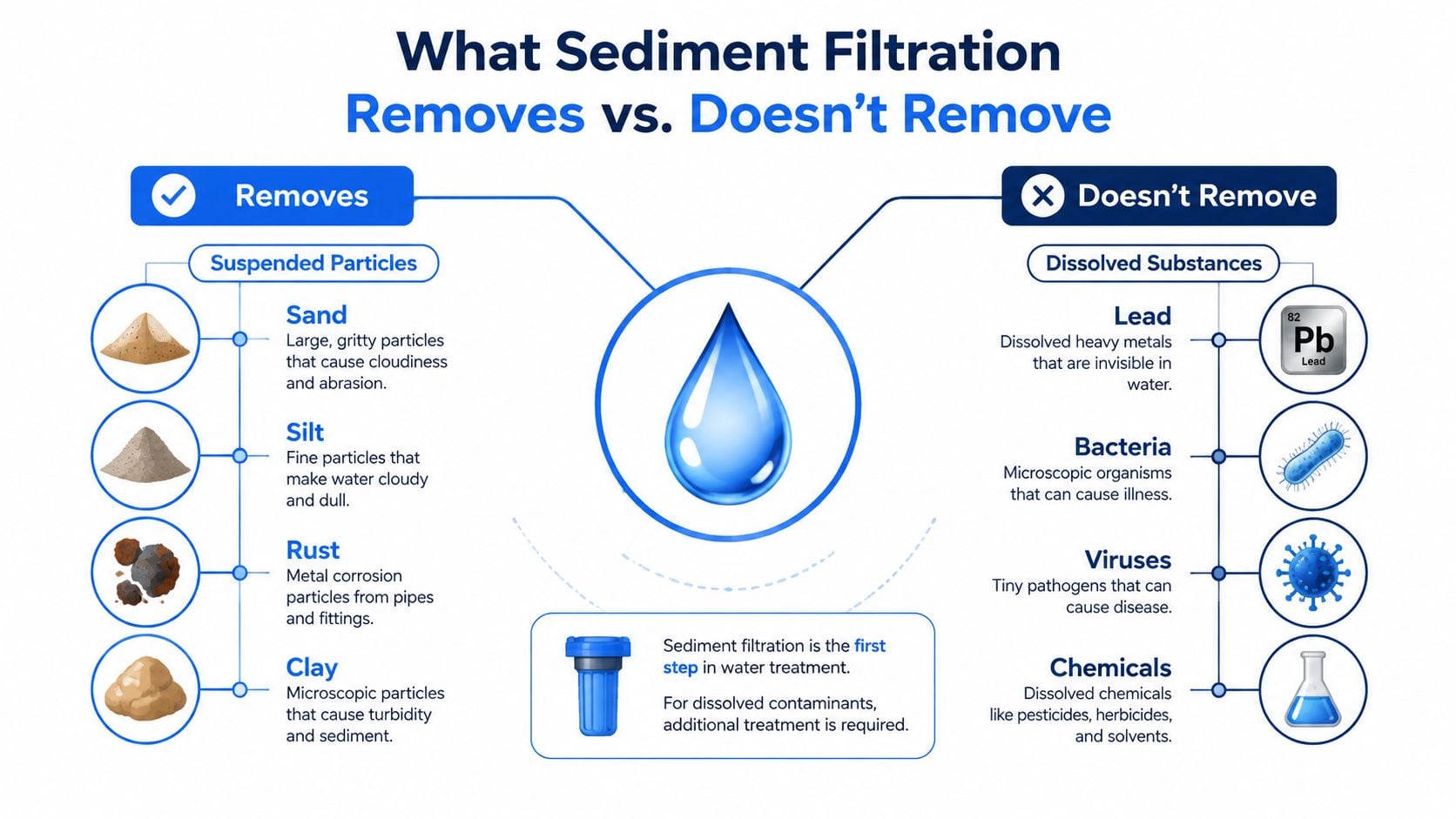
### What it cannot solve
Dissolved contaminants pass through a basic sediment barrier. The same extension guidance explains that sediment filters don't effectively remove **nitrate, heavy metals, pesticides, or trihalomethanes**. They also aren't a complete treatment for PFAS, chlorine, fluoride, chromium, or other dissolved water-quality concerns.
That's why a homeowner needs to separate two questions:
1. **Is the water carrying visible or suspended particles?**
2. **Does testing or a water report show dissolved contaminants that need another treatment method?**
A sediment stage may protect a carbon, selective, or other contaminant filter from premature clogging. It shouldn't be presented as the treatment stage for every contaminant in the water. For example, the [Woder Sediment Water Filter for dirt, sand, and dust removal](https://woder.com/products/wd-20m-dc/) is described as a made-in-the-USA, 20-micron pre-sedimentation filter for under-sink use. That role is different from a filter designed to address dissolved chemicals or metals.
## Benefits and Limits of Reusable Filters
A reusable filter earns its place when a home receives a steady load of coarse sediment. Instead of throwing away the cartridge after it fills, the homeowner can remove it, rinse off trapped debris, inspect the media, and put it back if the structure remains sound. This can reduce cartridge waste in homes that regularly receive sand, rust, or dirt.
Cleaning frequency determines whether that benefit holds up. A cartridge that is easy to rinse but left clogged will still restrict flow and reduce protection. Regular inspection and cleaning make reusable filtration useful. Ignoring those tasks turns its main advantage into a maintenance problem.
The filter also serves as a protective first stage. It intercepts larger particles before they reach a finer under-sink cartridge, appliance valve, water heater, or pump. Its job is mechanical separation, not complete water treatment. A sediment filter performs the same kind of physical separation as a coffee filter, but its media is engineered for continuous water flow and particulate loading.
Micron selection sets the main tradeoff. One product specification lists washable Harmsco sediment cartridges at **0.35, 5, 20, and 50 microns**. It also lists flow rates for different cartridge sizes and ratings ([washable sediment cartridge specifications](https://shop.martinwater.com/products/5-micron-10-in-washable-harmscor-sediment-filter)).
### Finer capture has a cost
A tighter rating can capture smaller particles, but it leaves less open space for water and sediment to pass through. In heavily sedimented water, the media may load quickly, reducing flow and requiring more frequent cleaning. A coarser rating may work better in practice if it keeps water moving while protecting a finer stage farther along the line.
Reusable media is not permanent. Pleats can become damaged, stretched, packed with material, or difficult to clean completely. A cartridge may look clear after rinsing while its structure has weakened, so inspection belongs in every cleaning cycle.
For more detail on how micron ratings affect capture and flow, see this guide to [0.5-micron water filters](https://woder.com/blog/water-filter-0-5-micron/). Choose the rating for the actual sediment load, then watch flow, pressure, cleaning frequency, and cartridge condition. The smallest rating is not automatically the best choice.
## Reusable Versus Disposable Sediment Filters
Reusable and disposable cartridges solve the same basic problem, but they place the work in different parts of the ownership cycle. A reusable filter asks the homeowner to clean and inspect the element. A disposable filter asks the homeowner to keep replacement cartridges available and install a new one when it loads.
CriteriaReusable FilterDisposable FilterUpfront costMay require a washable cartridge and compatible housingUsually uses a replacement-cartridge systemOngoing maintenance effortRequires shutoff, pressure release, cleaning, inspection, and reassemblyRequires shutoff, cartridge removal, and replacementFiltration lifespanDepends on sediment loading and whether the media remains intact after cleaningEnds when the cartridge loads or reaches its service limitEnvironmental impactCan reduce the number of discarded filter elementsProduces a discarded cartridge each time the element is replacedA disposable filter can be the easier choice for a city apartment with relatively little visible sediment. The homeowner may prefer a predictable replacement routine over handling dirty media. Convenience has value, especially when the filter is easy to access and the incoming water doesn't load it quickly.
A reusable cartridge becomes more attractive when a home receives moderate or heavy sediment. A private well, seasonal disturbance, visible sand, or recurring rust can make repeated disposable replacements inconvenient. The tradeoff is that the owner has to clean the element properly and recognize when washing no longer restores useful flow.
Neither option is universally superior. A reusable filter that nobody cleans is less useful than a disposable filter replaced on time. A disposable filter in a heavily sedimented home may create needless maintenance trips and recurring waste. The best choice depends on **water condition, access to the housing, household flow needs, and willingness to perform routine service**.
## How to Clean and Maintain Your Reusable Sediment Filter
Cleaning should be deliberate, not rushed. Before opening the housing, identify the shutoff valve, place a container or towel beneath the assembly, and make sure nobody needs water while the system is depressurized.
### Follow the full cleaning cycle
1. **Shut off the water supply.** Close the valve feeding the filter. If the system has a pump, follow the manufacturer's safe shutdown procedure.
2. **Release pressure.** Open a downstream faucet until the water stops and the housing no longer holds line pressure.
3. **Remove the housing.** Use the supplied housing wrench if needed. Support the housing as it comes free so the fittings and connected tubing aren't strained.
4. **Inspect the cartridge.** Look for torn pleats, crushed media, permanent discoloration, cracks, or material that remains embedded after rinsing.
5. **Clean the element.** Rinse it with clean water. A soft brush can loosen buildup, but don't use an abrasive pad that could damage the media.
6. **Clean the housing.** Remove residue from the bottom and from the O-ring groove. Use a mild, unscented soap if the housing requires more than rinsing, then rinse thoroughly.
7. **Check the O-ring.** Look for flattening, cracks, brittleness, or distortion. A damaged O-ring can leak even when the cartridge is in good condition.
8. **Reassemble carefully.** Seat the cartridge and O-ring correctly, thread the housing evenly, and tighten it as directed. Avoid forcing or overtightening the plastic housing.
9. **Restore pressure slowly.** Open the supply valve gradually and check every connection for leaks.
A pressure gauge can make the decision easier. One independent specification sheet reports a **15.6 psi pressure drop** at a stated flow condition, while another washable cartridge line is marketed with pressure drop **under 5 psi** and maximum operating pressure up to **6.5 bar** ([sediment filter pressure-drop specification sheet](https://cdn.accentuate.io/6675977339048/15739448688808/AXEON_MKTF-237-SDF-Series_Specification_Sheet-v1641324328466.pdf)). These figures aren't universal limits for every housing. They show why the clean starting pressure and the loaded pressure matter more than a vague promise that a filter has “high flow.”
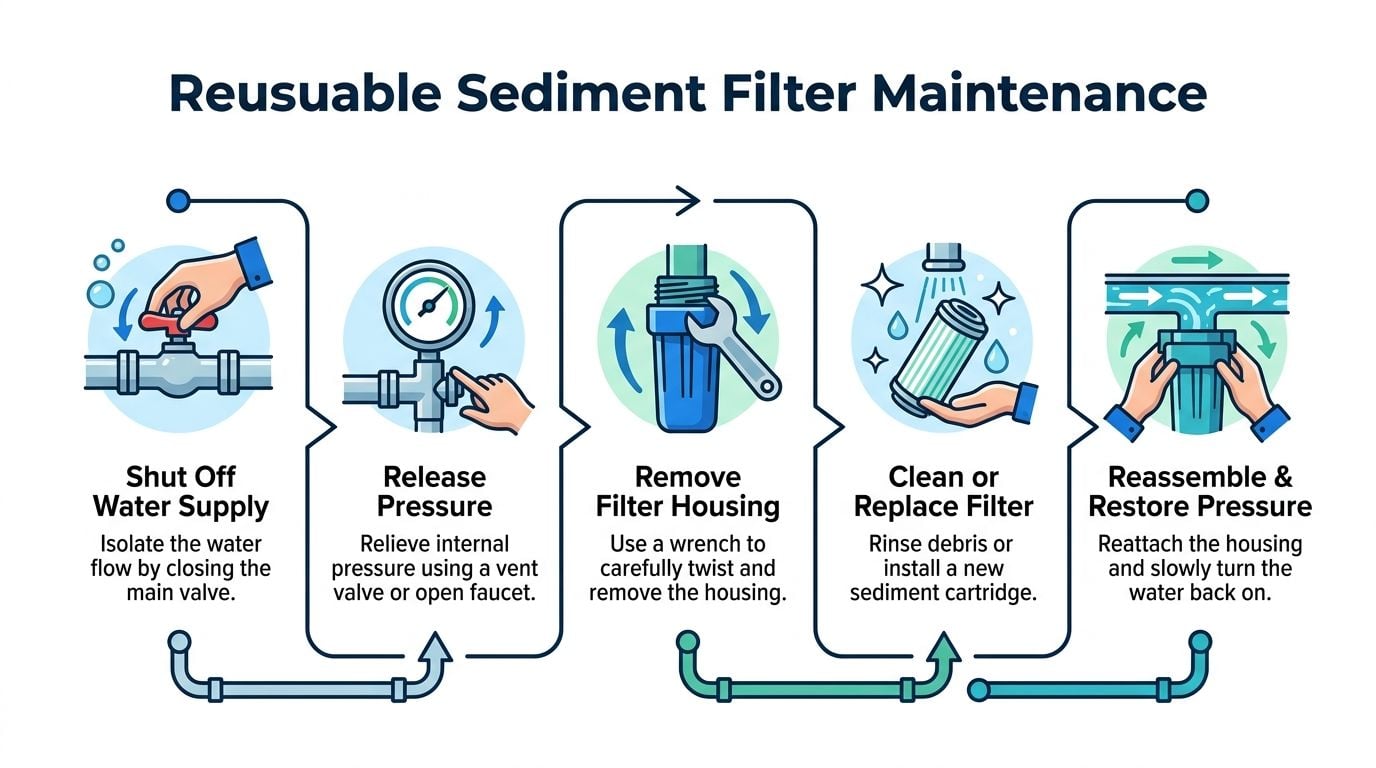
A noticeable pressure difference across the housing is a practical signal to inspect the cartridge. For detailed housing guidance, use this resource on [water filter housing maintenance](https://woder.com/blog/water-filter-housing-10/). If the housing is cracked, warped, persistently cloudy, or unable to seal, replace the housing rather than trying to extend its service life.
## When to Choose Reusable and When to Choose Disposable
The best choice starts with the water source, not with the filter's marketing label.
A private well with visible sand or recurring sediment is a strong candidate for a reusable pre-filter. The cartridge may need frequent attention, but that is precisely where washability has practical value. A homeowner can remove the accumulated material instead of treating every clogged element as disposable.
A city apartment with municipal water and little visible sediment may favor a disposable cartridge. The supply may still need point-of-use treatment for taste or dissolved contaminants, but a washable sediment stage can be unnecessary if the mechanical load is light and access is inconvenient.
A third situation is an under-sink contaminant filter that clogs prematurely. In that case, a reusable upstream sediment stage can serve as a protective barrier. It won't replace the downstream treatment. It can keep sand, rust, and dirt from occupying the finer filter's working capacity.
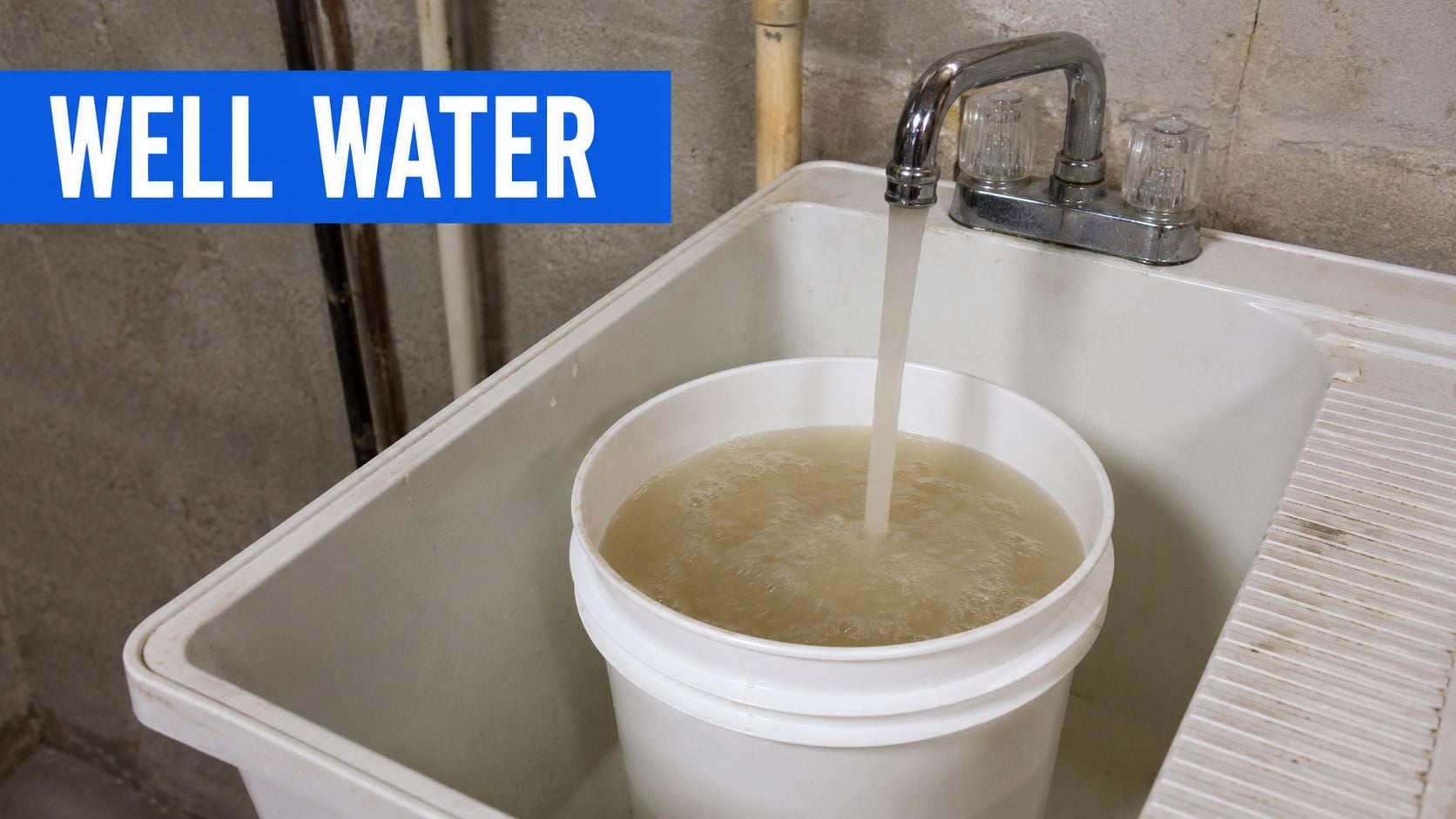
### An old idea with a modern maintenance lesson
The principle is not new. Depictions in Egyptian tombs at Thebes from the **15th to 13th century BCE** show early water filtration practices, and sand filters, settlement cisterns, and ceramic hydraulic filters were being used before **1100 BCE** to remove sediment from domestic water supplies ([history of water filters](https://en.wikipedia.org/wiki/History_of_water_filters)). In modern documented filtration history, John Gibb installed an experimental sand filter in Paisley, Scotland, in **1804**, a milestone often associated with modern point-of-use and municipal filtration development.
The equipment has changed, but the logic remains familiar. Trap particles before they travel farther into the system.
Use this decision framework:
- **Choose reusable** if your water carries visible sediment, your housing is accessible, and you're willing to clean the element.
- **Choose disposable** if sediment is light, convenience matters most, and replacement is easier than washing.
- **Use staged filtration** if the water is dirty enough to load a fine cartridge quickly.
- **Test dissolved contaminants separately** if your concern includes chemicals, metals, PFAS, fluoride, chlorine, or other substances a sediment barrier isn't designed to remove.
This guide to a [pleated sediment water filter](https://woder.com/blog/pleated-sediment-water-filter/) can help you compare cartridge construction and fit.
## How a Sediment Filter Protects Your Whole Home
A maintained sediment pre-filter works at the system's first checkpoint. It catches larger particles before they reach finer filters, valves, pumps, appliances, and fixtures. By reducing debris entering those components, it can limit loading, support steadier operation, and make service easier.
The cartridge also has a clear limit: it removes suspended physical particles, not substances dissolved in water. Concerns about **PFAS, lead, heavy metals, fluoride, chromium, chlorine, or taste and odor** require treatment designed for those targets.
The EPA's final PFAS rule sets enforceable maximum contaminant levels of **4.0 parts per trillion for PFOA and PFOS**, **10 parts per trillion for PFHxS, PFNA, and HFPO-DA**, and a **Hazard Index of 1** for specified mixtures ([EPA PFAS drinking water rule](https://www.epa.gov/sdwa/and-polyfluoroalkyl-substances-pfas)). A mechanical sediment filter cannot meet dissolved-contaminant targets because those substances pass through a particle barrier.
Woder manufactures point-of-use sediment filters in the United States, including the **WD-20m-DC**, described as a 20-micron pre-sedimentation stage. For broader contaminant treatment, Woder's **Advanced Selective Filtration®** is designed to target contaminants while retaining essential minerals, unlike reverse osmosis systems that strip dissolved solids from treated water.
Placement and upkeep determine how much protection the cartridge provides. A reusable filter can help when it is cleaned before heavy loading restricts flow. Left unattended, even a correctly sized filter becomes a clogged checkpoint, so maintenance frequency is a better performance guide than the label alone.
## Frequently Asked Questions About Reusable Sediment Filters
### How often should you clean one?
Clean it whenever flow declines noticeably, the pressure difference across the housing increases, or visible loading covers the media. Homes with heavy well sediment may need attention far more often than homes with clean municipal water. Keep a simple maintenance log so you can spot your own pattern instead of relying on a generic interval.
### Can you use one with a high-iron well?
You can use a reusable sediment filter as a coarse pre-filter when iron is present as suspended particles. It won't reliably solve dissolved iron, and high-iron water may load or stain the media quickly. Test the water and use treatment designed for the form of iron involved.
### When should you replace the element instead of cleaning it?
Replace it when rinsing no longer restores flow, the pleats are torn or collapsed, the media has become brittle, or the cartridge remains heavily embedded with material. Also replace the housing or seal when cracks, distortion, or persistent leakage appear. A washable element is useful only while it can be cleaned and safely reinstalled.
A reusable sediment filter is manageable when you match it to the water and pay attention to its condition. You're not choosing between perfect and useless equipment. You're choosing the right first stage for the particles your home receives.
---
Woder Filters offers U.S.-manufactured point-of-use filtration, including sediment pre-filtration and Advanced Selective Filtration® for targeted contaminant removal while retaining essential minerals. Visit [Woder Filters](https://woder.com) to review options for your water source, fixture, and maintenance preferences.
**Categories:** Woder Science
**Tags:** home water filter, reusable water filter, sediment filter, sediment removal, water filtration
---
### [Does a Water Filter Remove Fluoride? What Homeowners Need to Know in 2026](https://woder.com/blog/water-filter-remove-fluoride/)
**Published:** August 25, 2026
**Author:** woder
**Content:**
- [What Is Fluoride Doing in Your Tap Water?](#what-is-fluoride-doing-in-your-tap-water)
- [Which Filter Types Remove Fluoride?](#which-filter-types-remove-fluoride)
- [Reverse Osmosis (RO)](#reverse-osmosis-ro)
- [Activated Alumina and Bone Char Carbon](#activated-alumina-and-bone-char-carbon)
- [Standard Carbon Block and Activated Carbon Filters](#standard-carbon-block-and-activated-carbon-filters)
- [Selective Filtration (What Woder Uses)](#selective-filtration-what-woder-uses)
- [Should You Actually Remove Fluoride?](#should-you-actually-remove-fluoride)
- [What to Prioritize When Choosing a Filter in 2026](#what-to-prioritize-when-choosing-a-filter-in-2026)
- [A Quick Comparison: Filter Types and Fluoride](#a-quick-comparison-filter-types-and-fluoride)
- [Test Your Water First](#test-your-water-first)
- [FAQs](#faqs)
Fluoride is one of the most searched water quality topics — and one of the most misunderstood. If you're shopping for a water filter and wondering whether it will remove fluoride from your tap water, the honest answer is: it depends entirely on the type of filter you choose.
Some filters remove fluoride. Others don't touch it. And whether you actually want to remove it is worth thinking through before you buy.
Here's what you need to know.
### What Is Fluoride Doing in Your Tap Water?
Most municipal water suppliers in the United States add fluoride intentionally. The practice started in the 1940s as a public health measure to reduce tooth decay, and it's still standard in most cities today. The EPA sets a maximum allowable level of 4 mg/L, with a secondary recommendation of 2 mg/L or below.
Unlike lead, PFAS, or chlorine byproducts, fluoride in municipal water isn't a contaminant that snuck in. It was added on purpose, at regulated levels, for a specific reason.
That said, some homeowners prefer to filter it out — whether for personal health reasons, because they're on well water with naturally high fluoride levels, or out of concern about cumulative exposure. That's a valid choice. The key is knowing which filter types actually do the job.
### Which Filter Types Remove Fluoride?
Not all filtration methods work the same way on fluoride. Here's how the main categories compare.
#### Reverse Osmosis (RO)
RO systems are the most effective at removing fluoride. They push water through a semi-permeable membrane that blocks most dissolved solids, fluoride included. Removal rates typically exceed 90%. If fluoride removal is your top priority, RO gets the job done.
The trade-offs are real, though. RO strips out beneficial minerals too — calcium, magnesium, and others your body actually uses. It also produces wastewater (often 3 to 4 gallons discarded for every gallon filtered), requires a storage tank, and usually needs professional installation. That's a meaningful investment in both cost and complexity.
#### Activated Alumina and Bone Char Carbon
These are specialty media designed specifically to adsorb fluoride. Activated alumina filters can achieve high removal rates when water pH is right and the filter is properly maintained. Bone char carbon, made from animal bones, has been used for fluoride removal for decades.
Both require dedicated filter media and specific conditions to perform well. They're not common in mainstream under-sink products.
#### Standard Carbon Block and Activated Carbon Filters
This is where a lot of homeowners get surprised. Standard carbon filters — including most pitcher filters and many inline filters — do not effectively remove fluoride. Carbon excels at chlorine, chloramines, taste, odor, and some organic compounds. Fluoride is a small, stable ion that carbon simply doesn't bind to well.
If you buy a basic carbon filter expecting fluoride removal, you're likely not getting it.
#### Selective Filtration (What Woder Uses)
Woder's Advanced Selective Filtration technology uses nanoparticles to attract and remove specific contaminants while leaving naturally occurring minerals in your water. That includes lead, PFAS, chromium 6, mercury, chlorine, carcinogens, and volatile organic compounds — 99.9% removal across that group.
Fluoride is not on Woder's removal list. That's not a gap — it's a deliberate design choice. The technology is built to tell the difference between a harmful contaminant and a beneficial mineral. Since fluoride at regulated municipal levels isn't classified in the same category as lead or PFAS, it falls outside the target removal profile.
If your main concerns are lead, PFAS, chlorine, and VOCs — the contaminants most commonly found at harmful levels in US tap water — Woder handles those comprehensively. If fluoride removal is specifically what you need, an RO system is the more appropriate tool, with the understanding that it removes your minerals too.
### Should You Actually Remove Fluoride?
Worth pausing on. The debate around fluoride is ongoing, and opinions vary. Here's a grounded way to think about it.
**If you're on municipal water:** Fluoride levels are regulated and monitored. The EPA's enforceable limit is 4 mg/L, and most municipal systems operate well below that. For most households, fluoride in tap water is not the most urgent water quality concern.
**If you have well water:** Naturally occurring fluoride can vary significantly by region. Some areas have naturally high levels that exceed safe thresholds. If you're on a private well, testing your water is the right first step before deciding what to filter.
**If you have specific health concerns:** Talk to your doctor or dentist. Fluoride's relationship to dental health is well-documented, and individual circumstances — particularly for infants and young children — may factor into your decision.
The point is: fluoride removal is a specific, intentional choice. It's not the same as filtering out lead or PFAS, which most water quality experts agree you want to remove whenever possible.
### What to Prioritize When Choosing a Filter in 2026
For most homeowners, the contaminants with the clearest documented risk are lead, PFAS, chlorine disinfection byproducts, chromium 6, and mercury. These show up in water systems across the country, often at levels that exceed health guidelines, and they don't belong in your drinking water.
If your goal is to address those contaminants without the cost and complexity of a whole-home RO system, an inline or under-sink selective filter is a practical, proven option. [Woder's filter lineup](https://woder.com) covers a range of household flow rates and installs directly into your existing water line — no tank, no plumber, no wastewater.
If fluoride removal is also on your list, you'll want to either pair a selective filter with a dedicated fluoride-removal stage, or go with an RO system and accept the mineral trade-off.
### A Quick Comparison: Filter Types and Fluoride
Filter TypeRemoves Fluoride?Removes Lead/PFAS?Removes Minerals?Reverse OsmosisYes (90%+)YesYes (strips all)Activated AluminaYes (when maintained)LimitedNoStandard CarbonNoLimitedNoWoder Advanced SelectiveNoYes (99.9%)No (minerals preserved)The right filter depends on what's actually in your water and what you want to keep or remove.
### Test Your Water First
Before you spend money on any filter, know what you're filtering. A water quality test tells you exactly what's in your tap water — fluoride levels, lead, PFAS, hardness, and more. Woder offers water testing resources at [woder.com](https://woder.com) so you can start from real information rather than guesswork.
Once you know what's in your water, choosing the right filter gets a lot simpler.
---
### FAQs
**Does a standard under-sink water filter remove fluoride?**
Most standard under-sink filters, including carbon-based models, do not remove fluoride effectively. Fluoride is a stable ion that carbon doesn't bind to well. If fluoride removal is your goal, look for a filter specifically rated for it — an RO system or one with activated alumina media.
**Does Woder's filter remove fluoride?**
Woder's Advanced Selective Filtration removes 99.9% of harmful contaminants including lead, PFAS, chromium 6, mercury, chlorine, and VOCs. Fluoride at regulated municipal levels is not part of Woder's target removal profile. The technology is designed to remove documented harmful contaminants while preserving naturally occurring minerals.
**Is fluoride in tap water dangerous?**
At regulated levels, fluoride in municipal water is not classified as a health hazard by the EPA. The enforceable maximum is 4 mg/L. Concerns typically arise with well water in high-fluoride regions or with prolonged exposure above recommended levels. If you're unsure, test your water and talk to a healthcare provider.
**What's the best filter for removing fluoride?**
Reverse osmosis systems are the most effective option, typically achieving 90% removal or higher. Activated alumina filters are another route. Both require more investment than a basic carbon filter, and RO systems remove beneficial minerals along with contaminants.
**Can I remove fluoride and keep my minerals?**
This is difficult with current mainstream filtration technology. RO removes fluoride but also strips calcium, magnesium, and other minerals. Some multi-stage systems add a remineralization stage after RO, but that adds cost and complexity. Selective filtration like Woder's preserves minerals but does not target fluoride.
**How do I know what's actually in my tap water?**
Your municipal water supplier publishes an annual Consumer Confidence Report listing detected contaminants and their levels. You can also run an independent water test for a more detailed picture. Woder's website offers testing resources to help you understand your water quality before you choose a filter.
**Should I filter fluoride if I have young children?**
Fluoride exposure for infants and young children is worth discussing with your pediatrician or dentist, especially around formula preparation. There are specific guidelines around fluoride intake at different ages. If you have concerns, a water test and a conversation with your child's doctor will give you the clearest guidance.
---
Your water quality priorities are personal. Whether you're focused on lead, PFAS, chlorine, fluoride, or all of the above, the first step is knowing what's actually in your water. From there, choosing the right filter becomes a much clearer decision — not just grabbing whatever's popular on the shelf.
If lead, PFAS, and chlorine are your main concerns, [Woder](https://woder.com) is built for exactly that. Use the product Wizard at [woder.com/wizard](https://woder.com/wizard) to find the right model for your home. It's your water — filter it on your terms.
**Categories:** Woder Press Releases
---
### [Best Inline Water Filter for Refrigerator (2026 Guide)](https://woder.com/blog/best-inline-water-filter-for-refrigerator/)
**Published:** August 25, 2026
**Author:** woder_admin
**Content:**
The most popular advice about the **best inline water filter for a refrigerator** is also the least useful: buy the cartridge made by your refrigerator brand, or choose any generic filter that fits the water line. Fit only tells you that water can pass through. It doesn't tell you whether the cartridge addresses lead, PFAS, fluoride, chromium, chlorine, or other contaminants in your supply.
The better starting point is **certification scope**, followed by flow, pressure, capacity, and replacement requirements. A filter certified only for taste and odor is a different product from one with documented health-related contaminant claims, even if both use similar-looking housings.
Filter priorityStandard or evidence to look forBest fitChlorine taste, odor, and some particlesNSF/ANSI 42Municipal water that tastes or smells unpleasantLead and other listed health-related contaminantsNSF/ANSI 53, with the exact contaminant namedOlder plumbing or a documented contaminant concernCertain emerging compoundsNSF/ANSI 401, with the exact substance namedWater reports identifying emerging contaminantsPFAS targetsA specific, verified PFAS reduction claimHomes concerned about PFOA, PFOS, or other named PFASFluorideA technology and test claim specifically covering fluorideHouseholds whose water profile makes fluoride removal a priority## Table of Contents
- [Why Your Refrigerator Filter Choice Matters More Than the Brand](#why-your-refrigerator-filter-choice-matters-more-than-the-brand)
- [The label on the box isn't enough](#the-label-on-the-box-isnt-enough)
- [What NSF and ANSI Standards Actually Cover in an Inline Filter](#what-nsf-and-ansi-standards-actually-cover-in-an-inline-filter)
- [Read the standard in the right order](#read-the-standard-in-the-right-order)
- [Flow Rate, Micron Rating, and Capacity](#flow-rate-micron-rating-and-capacity)
- [Three numbers deserve attention](#three-numbers-deserve-attention)
- [Pressure is the hidden variable](#pressure-is-the-hidden-variable)
- [Carbon Block Versus Selective Filtration](#carbon-block-versus-selective-filtration)
- [Choose precision when the water report demands it](#choose-precision-when-the-water-report-demands-it)
- [Matching an Inline Filter to Your Home's Water Situation](#matching-an-inline-filter-to-your-homes-water-situation)
- [A municipal household with PFAS concerns](#a-municipal-household-with-pfas-concerns)
- [A well household with sediment and hardness](#a-well-household-with-sediment-and-hardness)
- [A renter who wants better-tasting ice](#a-renter-who-wants-better-tasting-ice)
- [A Practical Buyer Checklist for Refrigerator Inline Filters](#a-practical-buyer-checklist-for-refrigerator-inline-filters)
- [What to Look for Beyond the Marketing Claims](#what-to-look-for-beyond-the-marketing-claims)
- [A short verification routine](#a-short-verification-routine)
## Why Your Refrigerator Filter Choice Matters More Than the Brand
The familiar refrigerator brand on the box is a weak buying criterion. Start with the contaminant claim, then check certification scope, pressure drop, flow behavior, and replacement timing. **“Inline” describes the installation location, not the filter's performance.**
An inline cartridge treats the water line feeding the dispenser and ice maker, not every tap in the home. That focused design can improve taste and odor, but filtered ice does not prove that lead, PFAS, fluoride, or another concern has been reduced. A cartridge certified for NSF/ANSI 42 serves a different purpose from one with a documented NSF/ANSI 53 or 401 claim.
Two cartridges can fit the same refrigerator line while differing in filter media, pressure tolerance, rated capacity, and tested reduction claims. One may target chlorine taste and odor. Another may list lead under NSF/ANSI 53. A third may advertise PFAS without naming the compound, standard, or test conditions. Treat that vague claim as incomplete, not as proof of protection.
Market demand explains why brands offer so many similar-looking cartridges, but it does not establish safety or performance. One forecast estimates the global refrigerator water filter market at **USD 3,748.9 million in 2024** and **USD 5,709.9 million by 2032**, with a **5.4% CAGR** and North America at **35% of the 2024 market**. The [refrigerator water filter market forecast](https://www.credenceresearch.com/report/refrigerator-water-filter-market) provides that projection. These figures describe commercial growth, not the quality of any individual filter.
### The label on the box isn't enough
Begin with your utility's water quality report. Private-well owners should use a laboratory test. Match the identified concern to the filter's certification documentation, and check the rated flow and capacity so the cartridge can supply the dispenser and ice maker without excessive pressure loss.
If lead is the concern, NSF/ANSI 42 alone is the wrong specification, regardless of the brand. A product page that says “reduces contaminants” without naming them gives you no reliable comparison. The same problem applies to a broad “NSF certified” statement that omits the standard and specific claim. **A certification mark matters only when its scope matches your water problem.**
Replace the cartridge according to its rated capacity or the manufacturer's stated interval, then sooner if flow drops or ice production changes.
> **Practical rule:** Buy for a contaminant claim you can verify, not for a logo you recognize.
## What NSF and ANSI Standards Actually Cover in an Inline Filter
A filter is not “certified” in the abstract. **NSF/ANSI 42, 53, and 401** cover different test scopes, so the number beside the mark matters more than the word “certified.” NSF identifies these as leading standards for filtration products and systems in its filtration standards overview.
### Read the standard in the right order
**NSF/ANSI 42** covers aesthetic effects, mainly chlorine taste and odor plus certain particulate claims. Choose this scope when treated water smells like a swimming pool or ice tastes stale. It does not establish reduction of health-related contaminants.
**NSF/ANSI 53** covers health-related contaminants, but the specific claim still controls. If lead is the concern, lead must appear in the product listing or documentation. The EPA lists lead's action level at **0.010 mg/L**, so households with older plumbing should look for a verified lead-reduction claim instead of relying on an aesthetic certification. The EPA's [National Primary Drinking Water Regulations](https://www.epa.gov/ground-water-and-drinking-water/national-primary-drinking-water-regulations) provide the regulatory context.
**NSF/ANSI 401** applies to certain named emerging compounds. It does not cover every pharmaceutical, pesticide, or PFAS compound. Check the listing for the exact substance and claim.
StandardContaminants coveredBest forNSF/ANSI 42Chlorine taste, odor, and some particlesBetter-tasting water and iceNSF/ANSI 53Specific health-related contaminants, such as lead, when listedDocumented lead or other listed health concernsNSF/ANSI 401Certain named emerging compoundsA water report that identifies an applicable compoundFor a plain-language explanation of how these labels differ, see this guide to [WQA and NSF/ANSI water quality standards](https://woder.com/blog/wqa-nsf-ansi-wth-water-quality-alphabet-soup/). Use a direct rule: **42 for aesthetics, 53 for named health-related contaminants, and 401 for named emerging compounds.**
The [Woder WD-GEN4-2512-JG Inline Water Filter (New WD-10K-ADV-JG)](https://woder.com/products/wd-g4-2512-jg/) is a U.S.-made inline filter with an Advanced filtration formula and additional heavy metal removal media. Its catalog documentation says Woder Advanced filters are certified by WQA to NSF/ANSI 42 for chlorine taste and odor and to NSF/ANSI 372 for lead-free compliance, with those claims supported by test data. That profile does not equal NSF/ANSI 53 or 401 coverage. Match the documented claim to your water concern, then judge flow and replacement timing before buying.
## Flow Rate, Micron Rating, and Capacity
Certification defines the contaminants a filter has been tested to reduce. **Flow and capacity determine whether your refrigerator behaves normally after installation.** A cartridge may improve taste while slowing the dispenser or leaving the ice maker short of water during its fill cycle. Check these specifications after confirming the relevant NSF/ANSI claim.
A practical refrigerator-inline benchmark is **0.5 gallons per minute, or 1.9 liters per minute**, with operating pressure commonly listed at **20 to 100 psi** and rated capacity near **300 gallons or 6 months**. The [inline water filter technical sheet](https://images.thdstatic.com/catalog/pdfImages/39/392e8d7a-eaff-42bb-87ab-71da5b3519b5.pdf) provides those figures. Treat them as a comparison point, not a universal requirement.
### Three numbers deserve attention
**Flow rate** comes first. The refrigerator valve needs enough pressure and volume to dispense water and refill the ice mold. A restrictive cartridge can slow the dispenser and reduce the water delivered during the ice maker's fill cycle, especially where inlet pressure is already weak. A large gallon rating will not correct poor flow.
**Micron rating** describes particle size, not the full contaminant claim. A smaller rating may support particulate or cyst reduction, but it does not by itself establish lead, PFAS, fluoride, or chromium reduction. Use this [0.5-micron water filter explanation](https://woder.com/blog/water-filter-0-5-micron/) to understand what the rating can and cannot tell you.
**Capacity** indicates how long the cartridge is rated to perform under stated test conditions. Hard water, sediment, and frequent refrigerator use can load media sooner than a clean municipal supply. A high-capacity claim matters only when the cartridge also maintains suitable flow and the manufacturer explains the test basis.
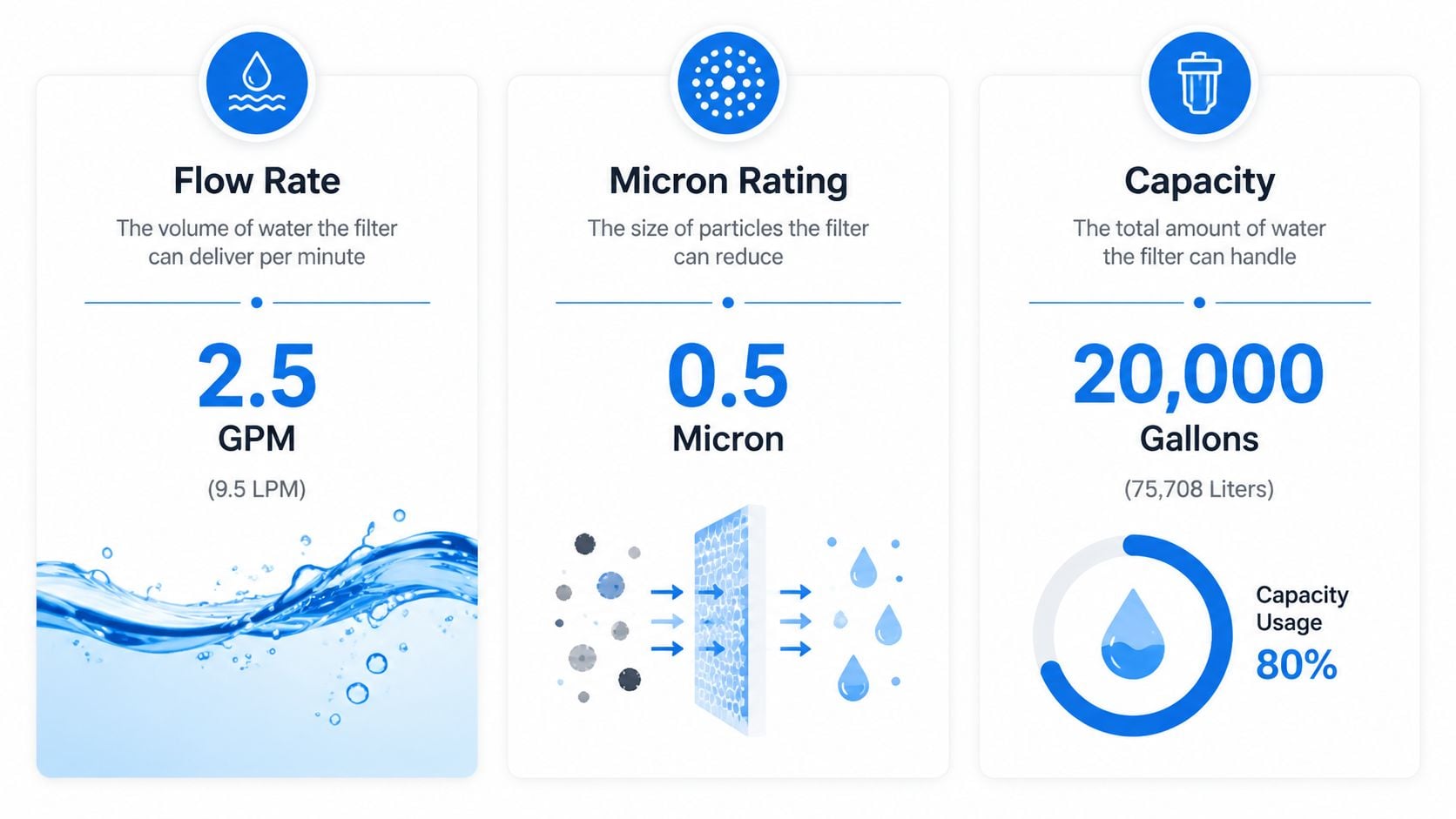
### Pressure is the hidden variable
A filter can meet its capacity claim and still struggle in a home with low inlet pressure or sediment-heavy water. A fine filter may work well on clean municipal water but clog sooner on a private well system. Check the manufacturer's pressure range and fitting size. Leave enough tubing for refrigerator movement without kinking the line.
Replace the cartridge at its rated gallon limit or time limit, whichever comes first. Replace it sooner if dispensing slows, ice cubes become undersized, or sediment appears. Those signs point to restricted flow or incoming-water problems, not automatically a refrigerator fault.
## Carbon Block Versus Selective Filtration
Carbon block filtration polishes taste and odor, but media composition, block design, and tested claims determine real-world performance. Compressed activated carbon can address additional contaminants when the specific cartridge carries the relevant certification. Review the **NSF/ANSI 42, 53, or 401** scope instead of treating “carbon block” as a complete specification.
Selective filtration takes a more targeted approach. Woder's [Selective Filtration explanation](https://woder.com/blog/selective-filtration/) describes a system designed to target listed contaminants while retaining essential minerals. Reverse osmosis follows a broader removal strategy for dissolved solids and can produce very low TDS water. That difference affects taste, mineral content, wastewater handling, and the type of installation required.
FactorCarbon blockSelective filtrationMain design goalBroad polishing of taste, odor, and selected contaminantsTargeted reduction of listed contaminantsLead and heavy metalsDepends on the exact NSF/ANSI 53 claimDepends on documented product claims and mediaPFASRequires a specific PFAS claim and applicable certificationRequires a specific PFAS claim and applicable certificationMineralsGenerally remains in the waterDesigned to retain essential mineralsWastewaterInline operation doesn't require a drain streamInline operation doesn't require a drain streamFlow behaviorCan become more restrictive as the media loadsDepends on media design and sediment exposureFor a refrigerator line, the practical comparison comes down to contaminant scope and hydraulic behavior. A cartridge with a narrow, verified claim may suit a known concern better than a broadly marketed carbon filter. Check whether the claim was tested at a flow rate and capacity that resemble refrigerator dispensing and ice-maker demand.
### Choose precision when the water report demands it
For chlorine taste and odor, a properly certified carbon block is often the sensible answer. Lead, PFAS, fluoride, and chromium require a named reduction claim supported by applicable certification or test documentation. NSF/ANSI 42 generally addresses aesthetic effects, while NSF/ANSI 53 and 401 cover different health-effect or emerging-contaminant claims. The standard number alone does not prove reduction of every contaminant in that category.
Selective media can cost more and may require cleaner incoming water. Carbon block is easier to source, but sediment loading can reduce flow and affect dispenser output or ice-maker fill behavior before the cartridge reaches its stated capacity. A filter that slows noticeably can make a technically suitable refrigerator setup frustrating to use.
Choose the architecture whose documented contaminant scope, pressure behavior, and replacement interval fit the refrigerator line. Marketing language matters less than the certification listing, test conditions, and evidence that the cartridge will maintain usable flow until replacement.
## Matching an Inline Filter to Your Home's Water Situation
The same filter can be a reasonable choice for one household and a poor one for another. Start with the water source, then consider how heavily the refrigerator is used.
### A municipal household with PFAS concerns
Suppose your utility report identifies PFAS, and you want the refrigerator and ice maker treated rather than only the kitchen faucet. Look for a cartridge with a specific PFAS reduction claim and documentation that identifies the named compound. EPA's April 2024 rule sets enforceable limits of **4.0 parts per trillion for PFOA and PFOS**, and **10 parts per trillion for PFHxS, PFNA, and HFPO-DA**, while applying a hazard index limit of **1** to certain mixtures. The [EPA PFAS drinking water rule overview](https://www.epa.gov/system/files/documents/2024-04/pfas-npdwr-presentation_4.9.24_overview.pdf) explains those benchmarks.
Don't treat NSF/ANSI 401 as a universal PFAS guarantee. Confirm the exact contaminant listed for the cartridge. If the water profile is broader or the refrigerator filter cannot document the needed compound, an under-sink system may be more appropriate.
### A well household with sediment and hardness
A private well with visible sediment can clog a fine cartridge quickly. In that setting, install sediment treatment upstream, then choose a carbon or selective cartridge whose pressure and capacity specifications fit the treated water. Otherwise, the refrigerator may develop weak dispensing even though the filter itself is technically functioning.
Hardness also deserves separate attention. A drinking-water filter shouldn't automatically be treated as a softener or a scale-control system. Test the well water, address sediment first, and make sure the refrigerator line isn't carrying more debris than the cartridge was designed to handle.
### A renter who wants better-tasting ice
A renter with no documented health-contaminant concern may reasonably prioritize NSF/ANSI 42, correct fittings, and a pressure range compatible with the apartment's supply. A standard quick-connect inline filter can improve chlorine taste and odor without turning the installation into a cabinet project.
Check the lease before modifying the line, and choose connections that can be removed cleanly. If the refrigerator has a slow dispenser already, don't install a restrictive cartridge without checking pressure and flow requirements first.
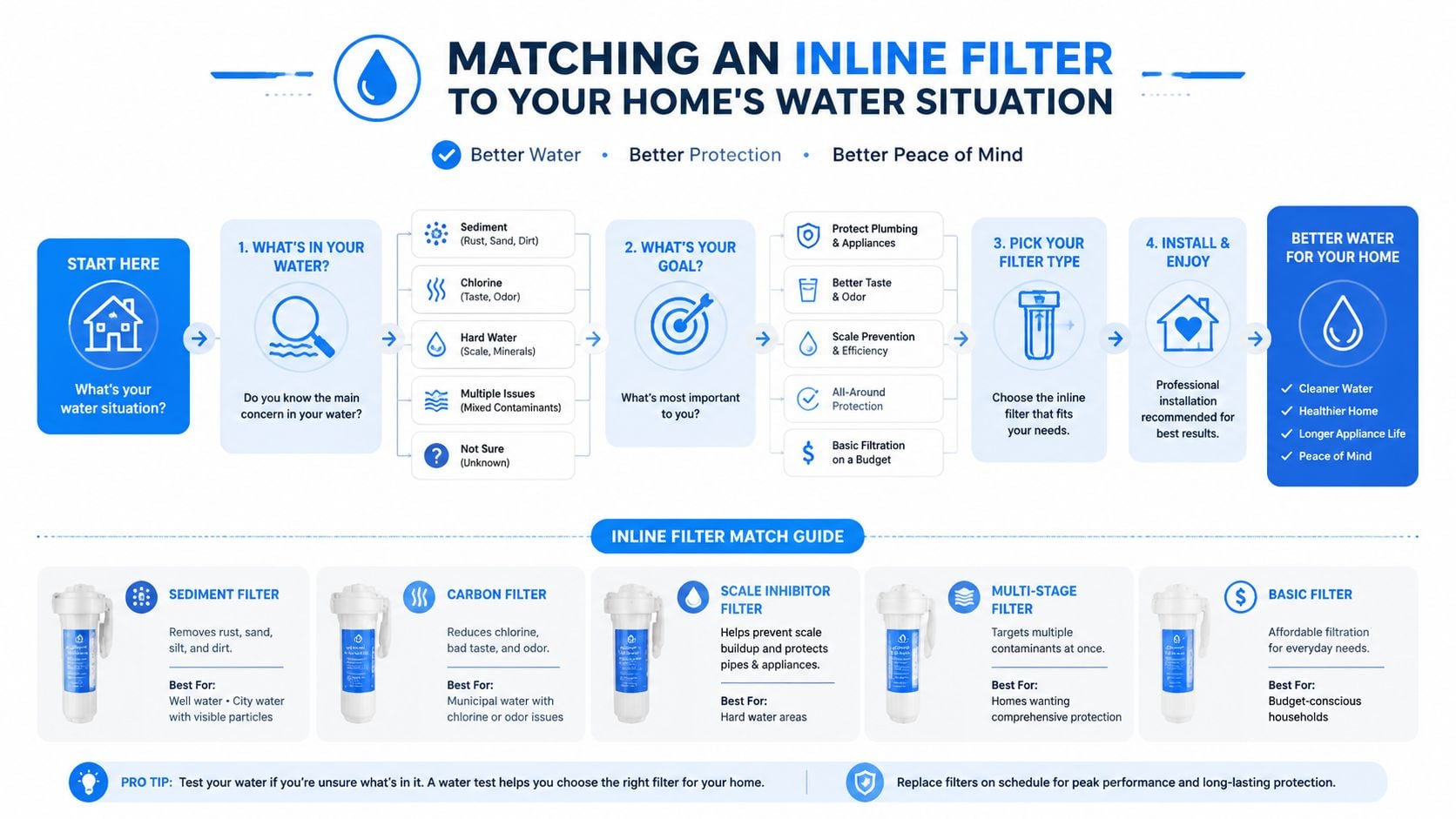
> A refrigerator filter is enough when the target is narrow and documented. It isn't a substitute for well-water treatment, broad under-sink treatment, or whole-home protection.
## A Practical Buyer Checklist for Refrigerator Inline Filters
Use this checklist before comparing brands or clicking “buy.” It keeps the decision tied to your water and appliance instead of the loudest product page.
1. **Name the contaminant priority.** Chlorine taste and odor point toward NSF/ANSI 42. Lead and other named health-related contaminants require NSF/ANSI 53 claims. Emerging compounds require NSF/ANSI 401 claims, with the exact substance listed.
2. **Read the pressure specification.** Retrieved refrigerator filter sheets commonly use a **20 to 100 psi** operating range, but your cartridge may differ. Confirm the manufacturer's stated range and investigate whether a pressure regulator or plumbing repair is needed. The cited benchmark appears in this [refrigerator filter specification sheet](https://images.thdstatic.com/catalog/pdfImages/39/392e8d7a-eaff-42bb-87ab-71da5b3519b5.pdf).
3. **Match flow to the appliance.** A dispenser and ice maker need adequate water delivery. Favor a cartridge designed for refrigerator service rather than one chosen only for an impressive capacity figure.
4. **Check capacity and replacement timing.** A cartridge rated around **300 gallons or 6 months** is common in retrieved technical sheets, but the actual rating for your model controls. Set a reminder and replace sooner if flow, taste, or ice quality changes.
5. **Confirm the connection.** Many refrigerator lines use compact quick-connect fittings, but tubing and inlet sizes vary. Confirm the filter's inlet and outlet, line diameter, directional arrow, and available clearance before installation.
6. **Verify the certificate.** Search the manufacturer's documentation or the certifier's listing. A product photo that says “NSF” without a standard number doesn't tell you whether the filter covers chlorine, lead, PFAS, or anything else you care about.
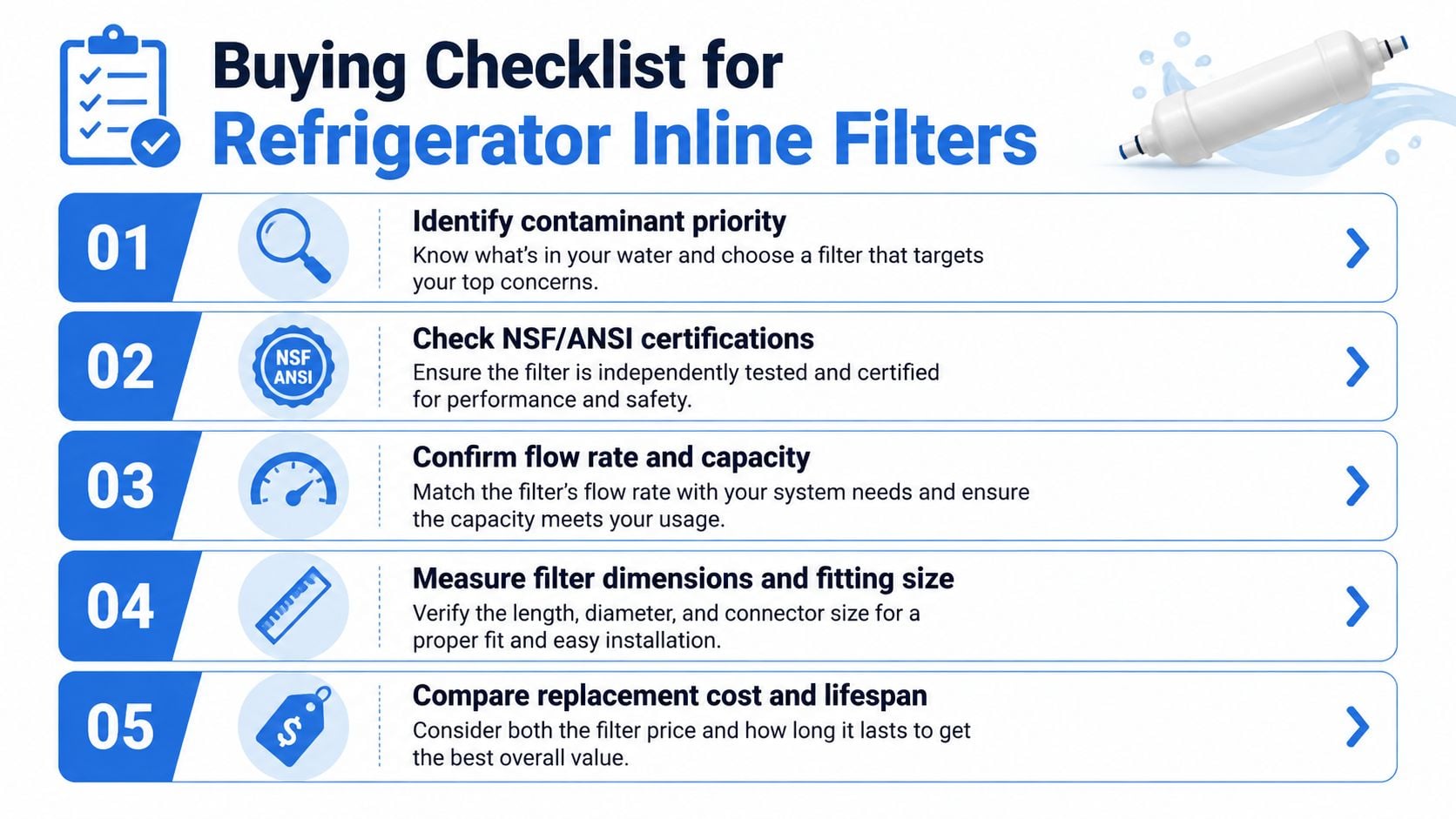
One more point matters for health-conscious households: **lead-free materials certification is not the same as lead-reduction certification**. NSF/ANSI 372 addresses lead-free compliance for materials, while NSF/ANSI 53 addresses health-related reduction claims when lead is specifically listed. Don't confuse the two.
## What to Look for Beyond the Marketing Claims
Marketing language is a poor basis for choosing an inline refrigerator filter. “Reduces contaminants” means little until the manufacturer identifies the contaminant, testing standard, capacity, flow conditions, and test basis. “PFAS protection” also needs a named compound and a defined certification scope.
Certification scope comes first. NSF/ANSI 42 generally addresses aesthetic effects such as chlorine taste and odor, while NSF/ANSI 53 covers listed health-related contaminants. NSF/ANSI 401 addresses certain emerging compounds. A micron rating describes particle filtration. It does not, by itself, prove reduction of dissolved lead, fluoride, chromium, or PFAS. **Micron rating, certification, and capacity answer different questions.**
### A short verification routine
- **Check the certificate listing.** Match the product model to the exact standard and contaminant claim.
- **Compare claims with your water report.** If your utility identifies PFOA, PFOS, lead, or another compound, that name should appear in the filter documentation.
- **Inspect materials information.** Confirm the manufacturer explains lead-free materials and housing construction. Lead-free materials certification is different from lead-reduction certification.
- **Check performance under refrigerator conditions.** A filter can meet its claim on paper yet restrict pressure enough to slow the dispenser or weaken ice-maker fill. Favor a cartridge rated for refrigerator service, not one selected only for a large capacity figure.
- **Question long-life promises.** A capacity claim around **1,400 gallons** appears in some product listings, but your pressure, sediment load, and usage determine actual service life. Market context is discussed in [inline refrigerator filter coverage](https://filtergearlab.com/best/best-inline-water-filter/).
- **Plan replacement support.** Choose a company that provides replacement timing, fitting information, and technical documentation. Replace the cartridge when flow, taste, or ice quality declines, even if the calendar reminder has not arrived.
Your choice should rest on **certification scope, pressure handling, flow, and replacement cadence**. Brand familiarity comes afterward. Woder Filters offers inline systems using **Woder Advanced Selective Filtration®**, with a one-year cartridge guarantee. See [Woder Filters](https://woder.com) for refrigerator-line options.
**Categories:** Woder Science
**Tags:** best inline filter, fridge water filter, inline water filter, refrigerator filter, refrigerator water filter guide
---
### [Why Does My Water Taste Like Metal? 6 Causes and How to Fix Them in 2026](https://woder.com/blog/water-taste-metal-causes-fix/)
**Published:** August 24, 2026
**Author:** woder
**Content:**
- [What Causes That Metallic Taste in Tap Water?](#what-causes-that-metallic-taste-in-tap-water)
- [1. Old or Corroding Pipes](#1-old-or-corroding-pipes)
- [2. Lead from Plumbing Fixtures or Service Lines](#2-lead-from-plumbing-fixtures-or-service-lines)
- [3. Chlorine and Chloramine Disinfectants](#3-chlorine-and-chloramine-disinfectants)
- [4. Low pH (Acidic Water)](#4-low-ph-acidic-water)
- [5. High Iron or Manganese Content](#5-high-iron-or-manganese-content)
- [6. A Filter That Needs Replacing](#6-a-filter-that-needs-replacing)
- [How to Diagnose the Source](#how-to-diagnose-the-source)
- [How to Fix Metallic-Tasting Water](#how-to-fix-metallic-tasting-water)
- [Flush Your Pipes Regularly](#flush-your-pipes-regularly)
- [Replace Old Plumbing Fixtures](#replace-old-plumbing-fixtures)
- [Install a Quality Under-Sink Filter](#install-a-quality-under-sink-filter)
- [Don't Rely on a Pitcher Filter for Lead or Heavy Metals](#dont-rely-on-a-pitcher-filter-for-lead-or-heavy-metals)
- [Address pH if You're on Well Water](#address-ph-if-youre-on-well-water)
- [When to Take It More Seriously](#when-to-take-it-more-seriously)
- [The Bottom Line](#the-bottom-line)
- [Frequently Asked Questions](#frequently-asked-questions)
You fill a glass from the tap, take a sip, and something's off. Not bad exactly — just wrong. That faint metallic taste is one of the most common water complaints homeowners have, and it almost always traces back to a specific cause.
The good news: most of the time, it's fixable. Some fixes require nothing more than running your tap for a minute. Others point to something worth taking seriously. Here's how to tell the difference.
### What Causes That Metallic Taste in Tap Water?
#### 1. Old or Corroding Pipes
This is the most common culprit. Homes with older iron, galvanized steel, or copper pipes can leach small amounts of metal into the water as it sits or moves through them. The older the plumbing, the more likely this is happening.
If the taste is strongest first thing in the morning — when water has been sitting in the pipes overnight — that's a reliable sign the pipes are the source, not your municipal supply.
#### 2. Lead from Plumbing Fixtures or Service Lines
Lead is a more serious concern. Homes built before 1986 may have lead solder at the pipe joints, and some older service lines connecting your home to the street main are made of lead. Lead doesn't always produce a strong taste, but it can contribute to that metallic quality.
Unlike iron or copper, there's no safe level of lead exposure. If your home is older and you haven't tested your water, this one deserves your attention.
#### 3. Chlorine and Chloramine Disinfectants
Municipal water suppliers add chlorine or chloramine to kill bacteria and keep water safe through the distribution system. Both are effective — but both can leave a chemical, slightly metallic aftertaste, especially in areas where treatment levels run higher.
If your water tastes more like a swimming pool than a clean drink, chlorine is likely a factor. It's not a health emergency, but it does affect taste in a real way.
#### 4. Low pH (Acidic Water)
Acidic water is more aggressive at leaching metals from pipes and fixtures. Even if your plumbing is in decent shape, water with a low pH can pick up enough iron, copper, or zinc along the way to produce a noticeable metallic taste.
Private well owners run into this more often than municipal customers, since well water pH isn't regulated the same way.
#### 5. High Iron or Manganese Content
Both iron and manganese occur naturally in groundwater. Iron gives water a slightly rusty, metallic flavor. Manganese tends toward something more bitter and mineral-heavy. Neither is immediately dangerous at low levels, but both affect taste noticeably — and can stain sinks and laundry over time.
#### 6. A Filter That Needs Replacing
If you already use a water filter and the metallic taste has come back or gotten worse, your cartridge may be past its service life. An exhausted filter stops removing contaminants effectively and can even start releasing what it previously captured back into your water.
Replacement schedules exist for a reason. If you've pushed yours past the recommended lifespan, the filter itself may now be part of the problem.
### How to Diagnose the Source
Before you fix anything, narrow down where the taste is actually coming from.
**Run the cold tap for 30 to 60 seconds first.** If the metallic taste fades after flushing the line, your pipes are the likely source. If it stays strong regardless, the issue is probably in your supply water or your filter.
**Test your water.** A home water testing kit can tell you whether you're dealing with elevated iron, lead, or other metals. Woder sells water testing kits alongside its filter line, so you can get a clear picture of what's actually in your water before deciding on a fix.
**Check your filter's age.** If you have a filter installed, look up when you last replaced the cartridge. If you can't remember, that's probably your answer.
### How to Fix Metallic-Tasting Water
#### Flush Your Pipes Regularly
If the taste appears after water has sat overnight, running the cold tap for a minute before drinking or cooking is a simple, free habit that helps. It doesn't solve the underlying pipe issue, but it reduces how much metal-laden water you're consuming day to day.
#### Replace Old Plumbing Fixtures
If your home has aging galvanized or iron pipes, a plumber can assess whether partial or full replacement makes sense. It's a longer-term fix, but it addresses the root cause rather than working around it.
#### Install a Quality Under-Sink Filter
For most households, this is the most practical fix. A good inline or under-sink filter removes the metals and contaminants causing the taste — without overhauling your plumbing or committing to an expensive whole-home system.
[Woder's](https://woder.com) Advanced Selective Filtration technology removes 99.9% of contaminants including lead, chlorine, chromium 6, mercury, and volatile organic compounds. It connects directly to your existing water line under the sink, with no plumber required and no reverse osmosis tank eating up cabinet space.
What sets it apart from most filters is what it keeps. Calcium, magnesium, and other naturally occurring minerals stay in your water. You get clean water that still tastes like water — not flat, not stripped.
#### Don’t Rely on a Pitcher Filter for Lead or Heavy Metals
Pitcher filters are convenient, but most aren't built to handle serious contaminants like lead or chromium 6 at meaningful concentrations. If your metallic taste is coming from lead pipes or high iron content, a pitcher filter probably won't cut it. You need something rated for those specific contaminants.
#### Address pH if You’re on Well Water
If you're on a private well and your water tests acidic, a pH neutralizer or a filter designed for well water can reduce the corrosiveness of your supply — protecting your pipes as well as your taste buds.
### When to Take It More Seriously
A metallic taste that comes on suddenly, or shows up alongside discolored water, is worth investigating right away. Sudden changes in taste or color can signal a shift in your water source, a pipe failure, or contamination that goes beyond normal mineral content.
If you're in an older home, pregnant, or have young children, testing specifically for lead is worth doing regardless of taste. Lead doesn't always announce itself clearly, and the health stakes are higher for those groups.
### The Bottom Line
Metallic-tasting water is almost always fixable. The cause usually comes down to pipes, minerals, disinfectants, or a filter that's past its prime. Figuring out which one applies takes a few minutes and sometimes a basic water test.
If you want a long-term fix that handles lead, chlorine, iron, and other metals right at the tap, a quality under-sink filter is the most practical option for most homes. Remove the bad. Keep the good. That's the Woder difference.
Find the right filter for your home at [woder.com](https://woder.com).
---
### Frequently Asked Questions
**Why does my water taste like metal all of a sudden?**
A sudden metallic taste often points to a change in your water supply, a pipe that has started corroding, or a filter cartridge that has reached the end of its service life. If the taste appeared overnight without an obvious cause, testing your water is the fastest way to find out what changed.
**Is metallic-tasting water safe to drink?**
It depends on the cause. Slight mineral content from iron or copper is generally not dangerous at low levels. Lead is a different story — there's no safe exposure threshold, and a metallic taste combined with older plumbing is a reason to test your water before continuing to drink it untreated.
**Can a water filter remove metallic taste?**
Yes. A quality under-sink or inline filter rated for heavy metals, lead, and chlorine will remove the contaminants responsible for most metallic tastes. Just make sure the filter you choose is rated for the specific contaminants in your water, not just general sediment.
**Why does my water taste metallic only in the morning?**
Water that sits in pipes overnight picks up more metal from the pipe walls. A strong metallic taste first thing in the morning that fades after running the tap is a classic sign that your pipes are leaching iron, copper, or other metals into standing water.
**Does boiling water remove metallic taste?**
Boiling kills bacteria, but it doesn't remove dissolved metals like lead, iron, or copper. It can actually concentrate minerals by reducing water volume. Filtration is the right approach when metallic taste is caused by metal contaminants.
**How often should I replace my water filter to avoid metallic taste?**
Follow the manufacturer's replacement schedule for your specific filter model. Most under-sink cartridges have a recommended lifespan measured in gallons or months. Pushing past that limit reduces filtration effectiveness and can allow previously captured contaminants back into your water.
**What's the difference between metallic taste from pipes versus from the water supply?**
Pipe-sourced metallic taste tends to be strongest after water has sat still — like first thing in the morning — and fades when you run the tap. Supply-sourced metallic taste stays consistent regardless of how long the water runs. Testing your water can confirm which source is responsible.
**Categories:** Woder Science
---
### [5 Practical Ways to Get the Best Tasting Water](https://woder.com/blog/best-tasting-water/)
**Published:** August 24, 2026
**Author:** woder_admin
**Content:**
Colder water or a clean glass can make a drink seem fresher, but they won't fix persistent chlorine taste, earthy odors, visible sediment, or metallic notes. Those problems can come from the source water, household plumbing, storage conditions, or a filter that removes the wrong things. The aim isn't a zero-TDS reading. Total dissolved solids include minerals that influence mouthfeel, and removing every dissolved solid is different from reducing unwanted contaminants. The EPA treats TDS as an aesthetic measure rather than a health-based limit, and notes that water below **600 mg/L** is generally considered good-tasting, while water becomes increasingly unpalatable above about **1,000 mg/L**. [EPA taste research](https://www.sciencedirect.com/science/article/abs/pii/S0043135412007701)
For U.S. tap and well-water households, a practical path is to address sediment, identify the off-flavor, choose point-of-use filtration that matches the concern, retain useful minerals when taste matters, and serve the water under clean, cool conditions. These [filtration tips from Pep Tea](https://peptea.com.au/counter-top-water-filter/) can help with the broader decision, but the five options below focus on what you can control at the faucet or appliance.
## Table of Contents
- [1. Woder Sediment Water Filter for Dirt, Sand and Dust Removal](#1-woder-sediment-water-filter-for-dirt-sand-and-dust-removal)
- [Why sediment affects taste](#why-sediment-affects-taste)
- [Who should consider it](#who-should-consider-it)
- [2. Woder Advanced Inline Water Filter WD-G4-JG](#2-woder-advanced-inline-water-filter-wd-g4-jg)
- [A better way to think about mineral retention](#a-better-way-to-think-about-mineral-retention)
- [3. Woder WD-20m-JG Sediment Removal Water Filter](#3-woder-wd-20m-jg-sediment-removal-water-filter)
- [When an inline sediment filter fits](#when-an-inline-sediment-filter-fits)
- [4. Woder WD-G4-DC for Lead, Chlorine, Heavy Metals and PFAS](#4-woder-wd-g4-dc-for-lead-chlorine-heavy-metals-and-pfas)
- [Read certification language carefully](#read-certification-language-carefully)
- [5. Woder WD-GEN4-2512-DC Water Filter](#5-woder-wd-gen4-2512-dc-water-filter)
- [Match the filter to the source](#match-the-filter-to-the-source)
- [Top 5 Woder Filters for Best-Tasting Water](#top-5-woder-filters-for-best-tasting-water)
- [Choose Taste Improvements That Match Your Water](#choose-taste-improvements-that-match-your-water)
## 1. Woder Sediment Water Filter for Dirt, Sand and Dust Removal
Better-tasting water does not always require removing dissolved minerals. Sometimes the first problem is physical: dirt, sand, dust, rust, or other suspended particles can make water feel gritty, leave residue in a glass, and burden a downstream carbon or selective filter. Private wells, older plumbing, and recently disturbed lines can all make sediment control a sensible starting point.
The [Woder Sediment Water Filter, Dirt, Sand and Dust Removal](https://woder.com/products/wd-20m-dc/) is a single-stage under-sink filter with **20µ pre-sedimentation**. Its stated function is to reduce dust, dirt, and other suspended material through sediment filtration. Made in the USA, it treats water near the drinking outlet instead of filtering every fixture in the home.
### Why sediment affects taste
Sediment filtration addresses particles, not every substance that can affect flavor or odor. A physical barrier of this type is different from treatment designed to reduce dissolved chlorine, PFAS, lead, fluoride, or other compounds that pass through a coarse filter. Its role is narrower: clear suspended material before it reaches the glass and reduce the particle load placed on another cartridge.
The water's condition should guide the setup. Clear water with a chlorine taste points toward a different treatment need, while grit or cloudiness after plumbing work makes particle reduction more relevant. Storage also matters. A clean filter cannot prevent a dirty pitcher, glass, or faucet aerator from adding residue after treatment, and serving temperature can change how noticeable an off-flavor seems.
> **Practical rule:** Reduce visible particles first, then assess dissolved taste and odor. A clear glass shows that suspended material is lower, not that every taste-causing compound has been addressed.
The [Woder guide to pleated sediment water filters](https://woder.com/blog/pleated-sediment-water-filter/) explains why particle filtration is a separate step from contaminant-selective treatment. That distinction helps homeowners compare a filter's documented function with the specific complaint, rather than relying on broad product wording.
### Who should consider it
This option suits households that need **pre-sedimentation** at a kitchen sink or want to shield another point-of-use filter from suspended material. It may also fit well-water users who notice sand, dirt, or rust residue.
Inspect or test the source before treating sediment as the only issue. Metallic, salty, chemical, or persistent odors may require a different filter, while mineral retention can still matter if the goal is a fuller water character rather than the lowest possible dissolved-solids level.
## 2. Woder Advanced Inline Water Filter WD-G4-JG
The best tasting water usually isn't the water with the fewest minerals. Sensory research has found that very low-mineral water can seem flat, while moderate mineral content often supports a fresher, more balanced impression. One study found that the preferred waters clustered around **300 to 350 mg/L TDS**, where participants described them as tasteless and cooler. [Consumer sensory research](https://pubmed.ncbi.nlm.nih.gov/26925543/)
The [Woder Advanced Inline Water Filter WD-G4-JG](https://woder.com/products/wd-g4-jg/) is designed around **Advanced Selective Filtration**, which targets unwanted contaminants while retaining essential minerals. That approach differs from reverse osmosis, which produces very low-TDS water by reducing dissolved minerals along with contaminants. Very low TDS can be useful for some applications, but it isn't automatically a guarantee of better flavor or safer drinking water.
### A better way to think about mineral retention
Calcium and magnesium contribute to the character of drinking water. The EPA's taste summary identifies a calcium taste threshold in the approximate range of **100 to 300 mg/L**, and notes that sodium and chloride influence taste more strongly than several other common minerals. [EPA taste findings](https://www.sciencedirect.com/science/article/abs/pii/S0043135412007701) Since taste is shaped by the entire mineral profile, removing everything can create a neutral profile rather than a satisfying one.
That doesn't mean every mineral-rich water tastes good. Excessive dissolved solids, high sodium, or an imbalanced profile can produce a harsh, salty, bitter, or drying impression. The useful goal is selective reduction, not indiscriminate stripping.
> Water can taste cleaner without tasting empty. The filter's treatment method determines whether those two outcomes stay connected.
An inline design can suit a refrigerator, ice maker, coffee machine, or another dedicated beverage line, provided the connection and flow requirements match the installation. It can also be a practical choice for renters or homeowners who want point-of-use treatment without adding a large system to the property.
For a plain-language explanation of the format, see this [guide to inline water filter systems](https://woder.com/blog/inline-water-filter-system/). Before buying, check the product documentation for the contaminants addressed, installation location, replacement process, and any performance conditions that apply to your water.
## 3. Woder WD-20m-JG Sediment Removal Water Filter
A kitchen faucet isn't the only place where poor-tasting water shows up. Sediment can affect refrigerator water, ice, coffee equipment, and other beverage lines, especially when the incoming supply carries sand, rust, or dirt. A point-of-use inline filter gives you a way to target one line rather than redesigning the household's entire plumbing system.
The [Woder WD-20m-JG Sediment Removal Water Filter](https://woder.com/products/wd-20m-jg/) is a U.S.-made inline pre-sedimentation filter. Its stated filtration role is **20µ pre-sedimentation** for sediment, dirt, sand, rust, and contaminant removal. The product's relevance is straightforward: it addresses suspended material at the point where you drink or make ice.
### When an inline sediment filter fits
Choose this type of approach when the problem is localized. For example, if the kitchen faucet is acceptable but refrigerator water carries particles, filtering the refrigerator line may be more practical than installing a whole-home system. The same logic applies to a coffee machine or beverage line that needs cleaner incoming water without treating every shower and toilet.
Sediment reduction can also help protect equipment. Particles may settle in tubing, valves, or appliance components, although the filter shouldn't be treated as a complete solution for scale, dissolved metals, PFAS, chlorine, or other chemicals.
- **For sand and dirt:** Use sediment filtration when particles are the visible or tactile problem.
- **For rust residue:** Investigate plumbing and source conditions if discoloration continues after filtration.
- **For refrigerator lines:** Confirm that the inline connection matches the appliance and available space.
- **For broader taste issues:** Add a filter with documented reduction for the specific dissolved contaminant involved.
A filter that improves clarity may not change a chlorine taste. Chlorine acceptance also varies among people. A PubMed study found that tap-water consumers and non-consumers didn't differ in chlorine detection threshold or sensitivity, but they did differ in how acceptable and pleasant they found chlorinated solutions. [Chlorine preference research](https://pubmed.ncbi.nlm.nih.gov/19896690/) Familiarity and exposure can influence whether the same flavor seems normal or unpleasant.
That's why a sediment filter is a focused tool, not a universal taste remedy. It's a good match for particulate problems and a poor match for a complaint that is clearly chemical, salty, or medicinal.
## 4. Woder WD-G4-DC for Lead, Chlorine, Heavy Metals and PFAS
Persistent chlorine taste is often the reason homeowners start comparing filters, but taste can also signal a broader need to understand the water supply. A carbon or selective point-of-use filter may be appropriate when the complaint involves chlorine, odors, or concern about listed contaminants. The right choice depends on the documented performance of the cartridge, not on a vague promise to make water “pure.”
The [Woder WD-G4-DC Lead, Chlorine, HM and PFAS Water Filter](https://woder.com/products/wd-g4-dc/) uses Woder's **Advanced Selective Filtration** approach and is described as retaining essential minerals while targeting unwanted contaminants. Its replacement filters are identified in the product information as WQA-certified to **NSF/ANSI 42** for chlorine taste and odor, and **NSF/ANSI 372** for lead-free compliance, with supporting test data. Those standards address specific aspects of performance and material compliance. They shouldn't be read as proof that a product reduces every contaminant.
### Read certification language carefully
NSF/ANSI 401 applies to point-of-use and point-of-entry systems used on water that is already microbiologically safe and of known quality. [ANSI information on NSF/ANSI 401](https://webstore.ansi.org/standards/nsf/nsfansi4012023) That makes the standard relevant to household filters targeting specific contaminants in treated drinking water, not to making unsafe source water safe in every circumstance.
Lead deserves separate attention because it can enter water through household plumbing and corrosion. The EPA lists a lead action level of **0.010 mg/L** and identifies potential health risks that include developmental or mental delays in children, kidney problems, and high blood pressure in adults. [EPA drinking-water regulations](https://www.epa.gov/ground-water-and-drinking-water/national-primary-drinking-water-regulations)
PFAS is another reason to inspect the exact performance documentation. In its April 2024 rule, the EPA set enforceable limits of **4.0 parts per trillion** for PFOA and PFOS individually, **10 parts per trillion** for PFNA, PFHxS, and HFPO-DA, and a hazard index of **1** for certain mixtures. [EPA PFAS drinking-water rule](https://www.epa.gov/newsreleases/biden-harris-administration-finalizes-first-ever-national-drinking-water-standard)
For taste, this filter is most relevant when chlorine or odor is paired with a need for targeted contaminant reduction. Review the applicable test data, installation instructions, replacement support, and your local water information before deciding whether it matches the household's actual concern.
## 5. Woder WD-GEN4-2512-DC Water Filter
Some households need more than a basic sediment barrier but don't want the mineral stripping and system complexity associated with reverse osmosis. Reverse osmosis can deliver strong contaminant reduction and very low TDS, but it also reduces naturally occurring calcium and magnesium, requires ongoing maintenance, and can waste water during filtration. Those trade-offs may be worthwhile for a particular source, but they aren't automatically the best route to enjoyable drinking water.
The [Woder WD-GEN4-2512-DC Water Filter, New WD-10K-ADV-DC](https://woder.com/products/wd-g4-2512-dc/) combines Woder's Advanced filtration formula with additional heavy-metal removal media. It's made in the USA and is positioned for areas with higher heavy-metal concerns. The product information identifies WQA-certified Woder Advanced filters as certified to **NSF/ANSI 42** for chlorine taste and odor and **NSF/ANSI 372** for lead-free compliance, with performance supported by test data.
### Match the filter to the source
A larger or more advanced cartridge isn't automatically a better choice. It's better when its documented contaminant targets match the water entering your home and when its installation fits the sink, faucet, flow, and maintenance routine. If you're uncertain, a water-quality report or laboratory test can help separate a taste complaint from a contaminant concern.
The mineral-retention design is important for homeowners who dislike the flat profile sometimes associated with very low-mineral water. Research on bottled and tap water found that preferred samples tended to have moderate TDS and relatively higher bicarbonate, sulfate, calcium, magnesium, and pH levels. [Peer-reviewed water taste analysis](https://pubmed.ncbi.nlm.nih.gov/23200507/) That doesn't establish one universal flavor, but it supports a practical conclusion: balanced mineral content often matters as much as contaminant reduction.
> **Look beyond the TDS number:** A low reading tells you that dissolved solids were removed. It doesn't tell you whether the remaining water has the taste, contaminant coverage, or certification details your household needs.
Check component standards as well as filter claims. NSF explains that **NSF/ANSI/CAN 372** addresses lead content in drinking-water system components, while **NSF/ANSI 61 Annex G** covers both lead content and lead leaching requirements. NSF water and wastewater standards Those are different questions, so the wording on a package matters.
## Top 5 Woder Filters for Best-Tasting Water
ProductImplementation complexityResource requirementsExpected outcomesIdeal use casesKey advantagesWoder Sediment Water Filter – Dirt, Sand and Dust Removal (WD-20m-DC)Moderate, under-sink single-stage install, basic plumbingLow, no power, periodic 20µ cartridge replacementRemoves dirt, sand, dust; 20µ pre-sedimentationHomes with sediment-heavy supply; pre-filter for appliancesUS-made; simple sediment protection; first-party productWoder Advanced Inline Water Filter WD-G4-JGLow, inline installation, minimal plumbingLow, no power, regular cartridge replacementSelective filtration that reduces contaminants while retaining beneficial mineralsPoint-of-use for improved taste without full mineral removal; inline appliance useMineral retention; inline simplicity; US-madeWoder WD-20m-JG Sediment Removal Water FilterLow, inline POU install, compact setupLow, no power, periodic 20µ cartridge replacement20µ removal of sediment, dirt, sand and rustInline pre-sedimentation for faucets, appliances, well waterCompact inline sediment protection; US-madeWoder WD-G4-DC Lead, Chlorine, HM and PFAS Water FilterModerate, under-sink system, plumbing connections requiredModerate, certified media, scheduled cartridge replacementsReduces lead, chlorine taste/odor, PFAS and some heavy metals while retaining mineralsMunicipal or private water supplies with chemical/metal concerns; under-sink drinking waterWQA-certified (NSF/ANSI 42 & 372); targets PFAS/lead; US-madeWoder WD-GEN4-2512-DC (New WD-10K-ADV-DC)Moderate, one-piece advanced under-sink installModerate, heavy-metal media, routine replacementAdvanced heavy-metal removal plus chlorine/taste improvement; higher contaminant capacityAreas with elevated heavy-metal contamination; robust drinking-water filtrationWQA-certified; enhanced heavy-metal media; successor to WD-10K; US-made
## Choose Taste Improvements That Match Your Water
Start with what you can observe. If water contains visible dirt, sand, rust, or dust, address sediment before expecting a taste-focused cartridge to perform well. A sediment prefilter can make the water feel cleaner and may protect a later-stage filter, but it won't remove every dissolved compound.
Next, identify the flavor. **Chlorine and odor** call for a filter with documented taste-and-odor performance. Metallic notes or concerns about old plumbing call for attention to lead and other heavy metals, along with a review of local water-quality information. PFAS, fluoride, chromium, and similar concerns require product documentation that names the contaminant or provides relevant test results. Don't treat a broad phrase such as “purifies water” as a substitute for performance evidence.
Taste also depends on what you leave behind. Research summarized by the EPA places good-tasting water below **600 mg/L TDS** and increasingly unpalatable water above about **1,000 mg/L**, while consumer research has repeatedly favored moderate mineral profiles over water with almost no dissolved minerals. [EPA mineral and taste background](https://www.sciencedirect.com/science/article/abs/pii/S0043135412007701) A zero-TDS result isn't a universal quality score. It indicates that dissolved solids, including desirable minerals, have been removed.
Serving conditions still matter. Use clean storage, avoid leaving water exposed to odors in the refrigerator, wash reusable bottles and pitchers regularly, and serve the water cool if that's how your household prefers it. Those steps can improve perception, but they shouldn't be used to hide a persistent source or plumbing problem.
For uncertain well water or changing municipal conditions, review available water-quality information and consider laboratory testing. Then compare the filter's documented contaminant coverage, certification language, installation fit, replacement support, and warranty terms. Woder provides a **one-year cartridge guarantee**, replacing a cartridge if it underperforms, and offers U.S.-made point-of-use systems built around Advanced Selective Filtration and mineral retention. That's one option among several, not a reason to skip testing or product research.
---
Woder Filters offers U.S.-made under-sink and inline point-of-use systems that target unwanted contaminants while retaining essential minerals, helping homeowners improve taste without automatically stripping the water bare. Visit [Woder Filters](https://woder.com) to compare filter formats, review installation resources, and find an approach that fits your water and the fixture you use most.
**Categories:** Woder Science
**Tags:** best tasting water, mineral balance, tap water taste, water filtration, water storage
---
### [Clearly Filtered Review 2026: Contaminant Removal, Price, and Who Should Buy It](https://woder.com/blog/clearly-filtered-review-2026-contaminant-removal-price-and-who-should-buy-it/)
**Published:** August 23, 2026
**Author:** woder
**Content:**
- [What Is Clearly Filtered?](#what-is-clearly-filtered)
- [Contaminant Removal: What Clearly Filtered Does Well](#contaminant-removal-what-clearly-filtered-does-well)
- [Where the Removal Claims Get Complicated](#where-the-removal-claims-get-complicated)
- [Price and Long-Term Cost](#price-and-long-term-cost)
- [What Clearly Filtered Does Not Do: Mineral Retention](#what-clearly-filtered-does-not-do-mineral-retention)
- [Clearly Filtered Pros and Cons](#clearly-filtered-pros-and-cons)
- [Pros](#pros)
- [Cons](#cons)
- [Who Should Buy Clearly Filtered](#who-should-buy-clearly-filtered)
- [A Closer Look at the Alternatives](#a-closer-look-at-the-alternatives)
- [Clearly Filtered vs. Woder: Side-by-Side](#clearly-filtered-vs-woder-side-by-side)
- [The Verdict](#the-verdict)
- [Frequently Asked Questions](#frequently-asked-questions)
Clearly Filtered has built a loyal following on the back of strong contaminant removal claims and a reputation for testing transparency. If you've been researching water filters recently, you've almost certainly come across the brand. But a strong reputation and polished marketing don't always tell the full story.
This review covers what Clearly Filtered genuinely does well, where it falls short, and who it actually makes sense for. It also looks at where other options — including selective filtration systems like those from [Woder Filters](https://woder.com) — may be a better fit depending on your priorities.
### What Is Clearly Filtered?
Clearly Filtered is a US-based water filtration brand offering pitchers, under-sink systems, refrigerator filters, and water bottles. Their core technology is called Affinity Filtration — a proprietary multi-stage process designed to remove a wide range of contaminants while maintaining reasonable flow through the filter media.
The brand leans heavily on contaminant testing transparency, publishing third-party lab results for many of its products. That's a real strength. Buyers who want documented removal data rather than marketing claims will find Clearly Filtered more forthcoming than most competitors.
### Contaminant Removal: What Clearly Filtered Does Well
Clearly Filtered's removal claims are among the most detailed in the consumer filter market. Their pitcher and under-sink products are marketed to remove or reduce:
- Lead
- PFAS (per- and polyfluoroalkyl substances)
- Chlorine and chloramines
- Chromium 6
- Pharmaceuticals
- Herbicides and pesticides
- Volatile organic compounds (VOCs)
Independent lab results back many of these claims, which adds real credibility. For buyers who want proof rather than promises, that transparency is worth something.
#### Where the Removal Claims Get Complicated
High removal percentages only tell part of the story. Flow rate matters in practice. Clearly Filtered pitchers are known for slow filtration — waiting several minutes for water to pass through is a genuine inconvenience that adds up over daily use.
Under-sink models largely solve the flow rate problem, but at a cost. Clearly Filtered's under-sink systems run $200 to $350, putting them at the higher end of the mid-market range.
### Price and Long-Term Cost
The upfront price is only part of the equation. Replacement cartridge costs for Clearly Filtered products are notably higher than many alternatives, and over two to three years, the total cost of ownership can climb well past the initial purchase price.
Before committing, it's worth pricing out replacement filters for whatever model you're considering. A filter with a lower sticker price and more affordable replacements can end up significantly cheaper over its lifetime — even if the initial units look comparable on paper.
### What Clearly Filtered Does Not Do: Mineral Retention
One area where Clearly Filtered's marketing is quieter is mineral retention. Affinity Filtration targets contaminants effectively, but it doesn't specifically preserve beneficial minerals like calcium and magnesium.
That matters for a couple of reasons. Calcium and magnesium affect how water tastes — people who switch from reverse osmosis often notice their water tastes flat or slightly off, and the same can apply here. These minerals also have nutritional value. If you're drinking several glasses of filtered water a day, losing them entirely is worth factoring in.
Selective filtration systems work differently. Woder's Advanced Selective Filtration technology, for example, uses nanoparticles to target specific contaminants while leaving beneficial minerals intact. That's a structural difference in how the filtration works — not a marketing distinction.
### Clearly Filtered Pros and Cons
#### Pros
- Strong, documented contaminant removal across a wide range of substances
- Third-party lab testing published for many products
- Multiple product formats: pitcher, under-sink, bottle, fridge filter
- Testing transparency gives buyers real confidence
#### Cons
- Higher price range ($200 to $350 for under-sink systems)
- Replacement filter costs are high relative to alternatives
- Pitcher models have slow flow rates
- Does not specifically retain calcium and magnesium
- No WQA Gold Seal certification noted in available product information
### Who Should Buy Clearly Filtered
Clearly Filtered makes sense if:
- Documented, third-party-tested contaminant removal is your top priority
- You're comfortable paying a premium for that level of transparency
- You want a pitcher format and can live with slower flow
- Mineral retention isn't a concern for you
It's a harder sell if you're working with a tighter budget, want faster flow, or specifically want to keep calcium and magnesium in your drinking water.
### A Closer Look at the Alternatives
If Clearly Filtered's pricing or mineral-stripping approach gives you pause, it helps to understand the broader category.
**Basic carbon filters** — standard pitcher filters or faucet attachments — are inexpensive but won't address lead or PFAS. If those are your primary concerns, a basic carbon filter isn't the right tool.
**Reverse osmosis systems** remove nearly everything, contaminants included. The catch is they also strip out calcium and magnesium, produce wastewater, require a storage tank, and typically need professional installation. For most households, that's more complexity and cost than the problem actually requires.
**Selective filtration systems** sit between those two options. They use filtration media engineered to attract and remove specific harmful substances while leaving beneficial minerals alone. Woder's under-sink filters are WQA Gold Seal certified, remove lead, chlorine, chromium 6, mercury, PFAS, carcinogens, and VOCs at a stated 99.9% removal rate, and retain calcium and magnesium. They install directly into an existing water line — no plumber, no storage tank, no wastewater.
Woder models fall within the $50 to $200 range that most households in this category are working with. If you want help finding the right model for your flow rate and household size, the product finder at woder.com/wizard walks you through it.
### Clearly Filtered vs. Woder: Side-by-Side
FeatureClearly FilteredWoderFiltration technologyAffinity FiltrationAdvanced Selective FiltrationContaminant removalStrong, lab-documented99.9% (WQA Gold Seal certified)Mineral retentionNot specifically preservedCalcium and magnesium retainedPrice range$200 to $350 (under-sink)$50 to $200 rangeReplacement filter costHigherLowerInstallationVaries by modelSelf-install, no plumber neededWastewater producedNoNoCertificationSee product listingsWQA Gold SealUS manufacturedNot confirmed in available dataYes### The Verdict
Clearly Filtered is a credible brand with real strengths — particularly around testing transparency and the breadth of contaminants it addresses. If you want a pitcher filter and are willing to pay for documented removal data, it's a defensible choice.
That said, if you're shopping for an under-sink system, want to keep beneficial minerals in your water, and want to stay under $200, Clearly Filtered's pricing and mineral-stripping approach make it a tougher sell. Selective filtration systems that retain calcium and magnesium, install without a plumber, and carry third-party certification address the same contaminant concerns at a lower total cost of ownership.
For a full look at what's available in the selective filtration category, visit [woder.com](https://woder.com).
---
### Frequently Asked Questions
**Does Clearly Filtered remove PFAS?**
Clearly Filtered markets its products as capable of reducing PFAS and publishes third-party lab data to support that claim. Removal percentages vary by product, so check the published test results for the specific model you're considering.
**Does Clearly Filtered keep minerals in the water?**
Affinity Filtration is designed to remove contaminants but doesn't specifically preserve beneficial minerals like calcium and magnesium. If mineral retention matters to you, look at selective filtration systems engineered to leave those minerals intact.
**Is Clearly Filtered worth the price?**
It depends on what you're optimizing for. If testing transparency is your top priority, the premium may be justified. If you're comparing total cost of ownership — including replacement filters — or if mineral retention is important, there are lower-cost alternatives with comparable or better performance on those dimensions.
**What is the difference between Clearly Filtered and reverse osmosis?**
Reverse osmosis forces water through a semi-permeable membrane that strips out nearly all dissolved substances, including calcium and magnesium. It also produces wastewater and requires a storage tank. Clearly Filtered uses Affinity Filtration, which targets contaminants without a membrane and produces no wastewater — but it also doesn't specifically retain beneficial minerals.
**How often do you replace Clearly Filtered filters?**
It depends on the product and your household's water usage. Pitcher filters typically need replacement every 100 gallons. Under-sink models last longer. Either way, Clearly Filtered's replacement filter costs are higher than most alternatives, which affects the long-term math.
**What is a good alternative to Clearly Filtered for under-sink filtration?**
If you want under-sink filtration that removes lead, PFAS, chlorine, and other contaminants while retaining calcium and magnesium, selective filtration systems are worth a close look. Woder's under-sink models are WQA Gold Seal certified, self-install without a plumber, and fall within the $50 to $200 range. The product finder at woder.com/wizard can match you to the right model for your household.
**Does Clearly Filtered require professional installation for under-sink models?**
Clearly Filtered's under-sink systems are designed for DIY installation. No plumber is required for a standard setup.
**Categories:** Woder Science
---
### [What Is TDS in Water and Should You Actually Care About It in 2026?](https://woder.com/blog/tds-water-care/)
**Published:** August 23, 2026
**Author:** woder
**Content:**
- [What TDS Actually Means](#what-tds-actually-means)
- [What TDS Does Not Tell You](#what-tds-does-not-tell-you)
- [What TDS Does Tell You](#what-tds-does-tell-you)
- [The Ranges You'll See Referenced](#the-ranges-youll-see-referenced)
- [Why RO Systems Score Well on TDS (And Why That's Not the Whole Story)](#why-ro-systems-score-well-on-tds-and-why-thats-not-the-whole-story)
- [What Actually Matters More Than TDS](#what-actually-matters-more-than-tds)
- [How Selective Filtration Handles This Differently](#how-selective-filtration-handles-this-differently)
- [Should You Care About TDS in 2026?](#should-you-care-about-tds-in-2026)
- [Frequently Asked Questions](#frequently-asked-questions)
You buy a TDS meter, dip it in your tap water, and get a reading of 280 ppm. Is that bad? Should you be worried? Should you go buy a filter right now?
Here's the honest answer: TDS tells you something, just not what most people assume. Understanding what that number actually means — and what it can't tell you — can save you from making the wrong call about your water.
### What TDS Actually Means
TDS stands for Total Dissolved Solids. It measures the combined concentration of everything dissolved in your water — minerals, salts, metals, and other particles small enough to pass through a standard filter.
The reading comes out in milligrams per liter (mg/L) or parts per million (ppm). For water, those two units mean the same thing. So when you see "TDS vs ppm" debated online, there's no real conflict — ppm is simply the unit you use to express a TDS reading.
A TDS of 200 ppm means 200 milligrams of dissolved material per liter of water. That's the whole definition.
### What TDS Does Not Tell You
This is the part that actually matters.
TDS gives you a total count, not a breakdown. It cannot tell you *what* is dissolved in your water. A glass with 300 ppm from calcium and magnesium is a completely different situation from a glass with 300 ppm that includes lead or PFAS. The meter has no way to distinguish between them.
That's the core limitation. A low TDS reading does not mean your water is safe. A high reading does not mean it's dangerous. Two water samples can show identical numbers while containing entirely different substances.
This matters because some of the most serious drinking water contaminants — lead, PFAS, chromium 6, volatile organic compounds — can be present at harmful concentrations without meaningfully moving your TDS number. You'd never know from the meter alone.
### What TDS Does Tell You
That said, TDS is still useful in specific situations.
It gives you a rough sense of your water's mineral content. Higher TDS often points to harder water with more calcium and magnesium, which affects taste and scale buildup on appliances. Very low TDS water can taste flat because those minerals are largely absent.
It also works as a quick consistency check. If your TDS reading jumps significantly without explanation, something in your water supply or plumbing may have changed — and that's worth looking into.
For reverse osmosis systems, TDS is commonly used to track membrane performance. When a membrane starts to fail, TDS climbs back up. In that specific context, it's a practical monitoring tool.
### The Ranges You’ll See Referenced
Most guidance puts acceptable drinking water TDS somewhere below 500 ppm, with many municipal supplies falling between 50 and 300 ppm. Water above 1,000 ppm often tastes noticeably salty or heavy with minerals.
But those ranges describe taste and mineral load — not safety from contaminants. Your tap water could sit at a perfectly normal 150 ppm and still contain lead from aging pipes, chlorine byproducts, or PFAS from nearby industrial sources. None of those would push your TDS reading anywhere near alarm territory.
### Why RO Systems Score Well on TDS (And Why That’s Not the Whole Story)
Reverse osmosis systems produce very low TDS water, often under 20 ppm. That sounds impressive, and it's a big reason people associate low TDS with clean water.
The problem is that RO strips out beneficial minerals right alongside the contaminants. Calcium and magnesium — things your body actually uses — get removed along with the lead and chlorine. What you're left with is very pure water that's also mineral-depleted. RO systems also produce wastewater, require a storage tank, and typically need professional installation.
A near-zero TDS score from an RO system isn't inaccurate. But it conflates "clean" with "empty."
### What Actually Matters More Than TDS
If your goal is genuinely clean, healthy drinking water, the questions worth asking are:
- What specific contaminants are present in my water?
- Does my filter actually remove those contaminants?
- Does it preserve the minerals I want to keep?
Your local water utility publishes an annual Consumer Confidence Report (CCR) listing detected contaminants and their levels. That document tells you far more than any TDS meter will. A home water testing kit can fill in the gaps — especially for contaminants that enter your water through your pipes rather than the source supply.
Once you know what you're dealing with, you can choose filtration that targets the right things.
### How Selective Filtration Handles This Differently
This is where Woder's approach becomes relevant.
[Woder's Advanced Selective Filtration technology](https://woder.com) uses nanoparticles to attract and remove specific contaminants — lead, chlorine, chromium 6, mercury, PFAS, carcinogens, and volatile organic compounds — while leaving calcium, magnesium, and other naturally occurring minerals intact. It removes 99.9% of those contaminants without stripping your water bare.
The result is water that will likely show a moderate TDS reading, not near-zero like RO output. That's intentional. The minerals that remain are the ones you want. The contaminants are gone.
Woder sits between a basic pitcher filter — which handles taste but not serious contaminants — and a full reverse osmosis system, which removes everything including the good stuff. It's a practical middle ground for homeowners who want real protection without a major installation project or a system that wastes water in the process.
Every Woder filter installs directly into your existing water line. No plumber. No tank. No whole-home overhaul.
### Should You Care About TDS in 2026?
Yes — but keep it in context.
TDS is a useful starting point, not a verdict. It can flag changes in your water and give you a rough sense of mineral content. What it cannot do is tell you whether your water is actually safe to drink.
The more important habit is knowing your local water quality, understanding which contaminants are present, and choosing filtration that targets those specifically. A TDS meter is one tool. It's not the complete picture.
If you want to understand what's actually in your water before choosing a filter, Woder's site at [woder.com](https://woder.com) includes a water testing tool and an interactive Wizard that matches you to the right filter for your household and flow rate.
Your water deserves more than a single number.
---
### Frequently Asked Questions
**What is TDS in water?**
TDS stands for Total Dissolved Solids. It measures the total concentration of all dissolved substances in water, expressed in milligrams per liter (mg/L) or parts per million (ppm) — including minerals, salts, metals, and other dissolved particles.
**Is TDS the same as ppm?**
For water measurement purposes, yes. Parts per million (ppm) is the unit used to express a TDS reading. A TDS of 150 means 150 ppm of dissolved material per liter of water. The two terms describe the same thing.
**What is a safe TDS level for drinking water?**
Most guidance considers TDS below 500 ppm acceptable, with many municipal supplies falling between 50 and 300 ppm. That said, TDS level alone doesn't indicate whether water is safe — dangerous contaminants like lead or PFAS can be present at harmful concentrations without significantly affecting the TDS number.
**Can water have a low TDS and still be unsafe?**
Yes, and this is the most important thing to understand about TDS. A low reading means less total dissolved material, but it says nothing about which specific substances are present. Lead, PFAS, and other serious contaminants can exist at harmful levels without meaningfully raising TDS.
**Does a water filter lower TDS?**
It depends on the filter type. Reverse osmosis systems dramatically lower TDS by removing nearly everything, including beneficial minerals. Selective filtration systems like Woder target specific contaminants while preserving minerals, so they won't produce near-zero TDS readings — but that's by design. The goal is removing harmful substances, not emptying the water entirely.
**How do I find out what's actually in my tap water?**
Your water utility publishes an annual Consumer Confidence Report (CCR) listing detected contaminants and their levels. A home water testing kit can give you a more specific picture of your household supply, including contaminants that may enter through your pipes rather than the source water itself.
**Is TDS testing enough to decide whether I need a water filter?**
No. TDS testing is a useful starting point but not sufficient on its own. Knowing the specific contaminants in your water — through a CCR or a dedicated water test — gives you much better information for choosing the right filtration approach.
**Categories:** Woder Science
---
### [Milky Water from Hot Tap: How to Diagnose and Fix It in 2026](https://woder.com/blog/milky-water-from-hot-tap/)
**Published:** August 23, 2026
**Author:** woder_admin
**Content:**
Milky water from a hot tap is usually a temporary physical effect caused by dissolved air coming out of solution when heated water is depressurized at the faucet. You can often diagnose it immediately with a simple glass test, watching whether the cloudiness clears upward as the bubbles rise.
You turn on the hot faucet and the stream looks white, almost like diluted milk. The cold water beside it is clear, so the change feels alarming. In most cases, though, the tiny bubbles are scattering light, not signaling contamination. The important question is whether the appearance disappears quickly or remains after the water has rested.
That distinction helps separate harmless aeration from sediment, galvanized plumbing corrosion, or a water-heater problem. The right response starts with observation, not panic.
## Table of Contents
- [Understanding Why Hot Water Turns Milky](#understanding-why-hot-water-turns-milky)
- [Why the hot tap matters](#why-the-hot-tap-matters)
- [The Definitive Glass Test for Cloudy Water](#the-definitive-glass-test-for-cloudy-water)
- [Follow the bubbles](#follow-the-bubbles)
- [What the result tells you](#what-the-result-tells-you)
- [Isolating the Source of the Cloudiness](#isolating-the-source-of-the-cloudiness)
- [Cloudiness source indicators](#cloudiness-source-indicators)
- [When Milky Water Signals Plumbing Issues](#when-milky-water-signals-plumbing-issues)
- [Signs that the heater or pipes need attention](#signs-that-the-heater-or-pipes-need-attention)
- [Decision Guide for Homeowners and Repairs](#decision-guide-for-homeowners-and-repairs)
- [Choose the next step by symptom](#choose-the-next-step-by-symptom)
- [Maintaining Clear and Safe Water Quality](#maintaining-clear-and-safe-water-quality)
## Understanding Why Hot Water Turns Milky
Hot water can look cloudy because heating changes how much dissolved gas the water can hold. As water warms inside a heater or boiler, dissolved air can come out of solution. When the pressurized water reaches the faucet and pressure drops, that air forms countless tiny bubbles that scatter light, creating a white or milky appearance. Guidance from [A. O. Smith](https://www.hotwater.com/info-center/technical-bulletins/bulletin-24.html) describes this effect as especially common when only the hot tap is affected.
The visual effect can be confusing. A glass filled from the hot faucet may look opaque at first, then gradually clear as the bubbles move upward and disappear. The water itself hasn't necessarily changed color. Light is just bouncing off suspended bubbles, much as it does in a glass of carbonated water.
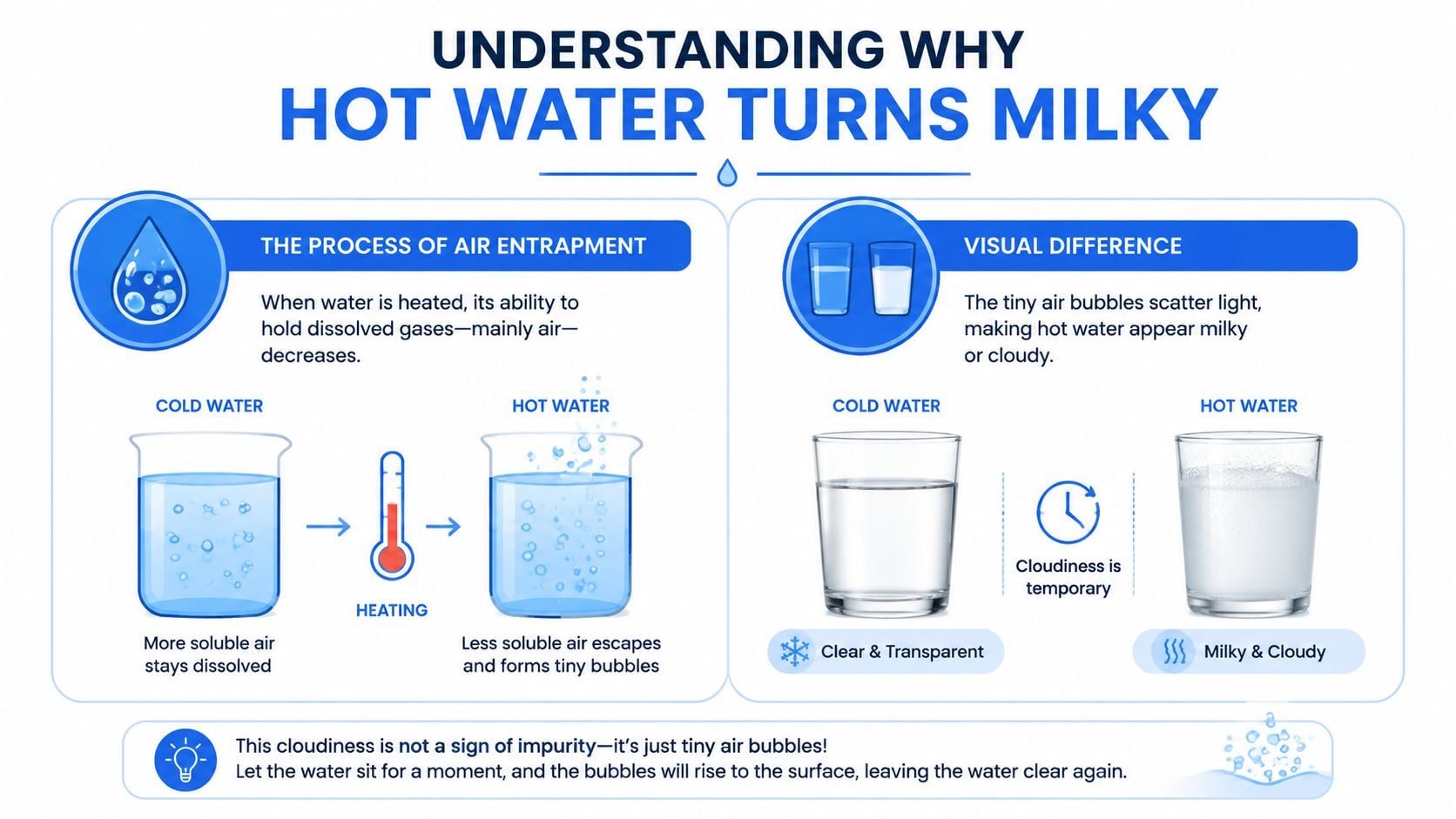
### Why the hot tap matters
If the cold tap is clear and the hot tap is milky, the heating system becomes the logical starting point. The heater raises the water temperature, and the faucet creates the pressure change that releases the dissolved air. That pattern points more strongly toward the water heater or boiler than toward a problem affecting the incoming cold supply.
This doesn't mean every hot-water-only issue is harmless. It means the symptom has a likely physical explanation that you can test without dismantling anything.
> **Practical rule:** Clear water that loses its cloudiness as bubbles rise is behaving differently from water that leaves particles or residue behind.
Long-standing utility guidance continues to use the same basic observation. Fill a glass, let it sit, and watch the direction of clearing. This simple test gives you more useful information than the initial white appearance alone.
## The Definitive Glass Test for Cloudy Water
A clear drinking glass is enough to begin. Use the hot faucet that shows the symptom, and avoid stirring or shaking the sample after filling it. Set the glass on a stable surface where you can see both the water and the sides of the glass.
### Follow the bubbles
1. **Fill the glass from the affected hot tap.** Look at the water immediately after filling it. Note whether the cloudiness appears uniform or whether you can already see fine bubbles.
2. **Leave the glass undisturbed.** Don't swirl it, pour it into another container, or place it under running water. Movement can make the observation harder to interpret.
3. **Watch where clarity returns first.** If the water clears from the bottom upward, the bubbles are rising through the glass. That bottom-up clearing pattern supports harmless aeration, as described in utility guidance from [SA Hot Water](https://sahotwater.com.au/faqs.html).
4. **Look for residue or visible material.** Persistent cloudiness, flakes, grit, or a film on the glass suggests that particles or minerals may be involved rather than air alone.
The direction matters because bubbles rise. A sample that becomes clear from the bottom upward is showing the physical movement expected from trapped air. Cloudiness that remains evenly distributed after resting doesn't fit that simple pattern.
### What the result tells you
A bottom-up change points toward dissolved air released by temperature or pressure conditions. A sample that stays cloudy deserves closer attention, especially if the water leaves residue, contains flakes, or has an unusual taste or odor. The [Colorado Springs Utilities water discoloration guidance](https://www.csu.org/hubfs/39606065/Document%20Library/WaterDiscoloration.pdf?hsLang=en) notes that white or milky water that doesn't settle can involve zinc or other minerals, galvanized plumbing, or a water-heater or service issue.
The test doesn't identify every possible cause, and it isn't a laboratory analysis. It does give you a practical first division between bubbles and suspended material. If you need separate contaminant treatment after diagnosing the appearance, the [Woder WD-G4-DC Lead, Chlorine, HM and PFAS Water Filter](https://woder.com/products/wd-g4-dc/) uses selective filtration while retaining essential minerals. Its WD-G4-REP filters are certified by WQA to NSF/ANSI 42 for chlorine taste and odor and NSF/ANSI 372 for lead-free compliance, as substantiated by test data.
## Isolating the Source of the Cloudiness
The next clue is location. Test the hot water at more than one faucet, then compare it with cold water from those same fixtures. A single affected faucet suggests a local fixture, aerator, or branch-pipe issue. Cloudiness at every hot faucet points farther upstream, toward the water heater or boiler.
Utility guidance from [Severn Trent Water](https://www.stwater.co.uk/content/dam/stw/tier2_helpandcontacts/CloudyMilky-factsheet.pdf) makes a useful distinction. Hot-only cloudiness is usually associated with the heating system, while cloudiness in both hot and cold water can reflect trapped air in the supply after a pressure change or main break.
### Cloudiness source indicators
SymptomLikely sourceActionOnly hot water looks milky, and the glass clears upwardWater heater, boiler, or heat-related air releaseMonitor the pattern and inspect the heater if it persistsHot and cold water both look cloudySupply-side trapped air after a pressure change or main workCheck utility notices and compare with nearby homesOne faucet is affected while other hot taps are clearLocal aerator, fixture, or branch connectionClean or inspect that fixtureWater stays cloudy and leaves flakes or residueMinerals, galvanized plumbing, or heater-related materialArrange a plumbing or water-heater inspectionTiming adds another layer. A new symptom after a pressure change, main repair, fire-hydrant use, or work on clean or newly installed pipework can reflect air entering or moving through the distribution network. If neighbors report the same appearance, the source is more likely outside your home.
For a municipal supply, your utility's water-quality information can provide context, but it won't necessarily identify a problem inside your house. Reviewing [how to read a water quality report](https://woder.com/blog/read-water-quality-report/) can help you understand what the utility tests and where household plumbing conditions fall outside that report.
If only your hot taps are affected and the glass test shows bottom-up clearing, observation may be reasonable. If the symptom is persistent, localized, or accompanied by material in the water, the pattern calls for inspection rather than repeated guessing.
## When Milky Water Signals Plumbing Issues
The phrase “it's just air” becomes misleading when homeowners use it to dismiss water that never clears. Air bubbles are a common explanation for temporary milky water, but persistent cloudiness can point to material coming from the plumbing or heating system.
Galvanized steel plumbing deserves particular attention in older homes. Corrosion can affect the zinc coating and release zinc or other minerals into the water. The result may look white or milky, but unlike aeration, it can remain cloudy in a glass or leave a deposit after the water sits. That difference is why the glass test should include an inspection for residue, flakes, or sediment, not just a quick glance at the initial color.
### Signs that the heater or pipes need attention
A water-heater issue can produce more than a change in appearance. Look for a combination of persistent cloudiness, sediment, flakes, unusual taste, or a visible leak around the tank and connections. A deteriorating anode component may also alter the chemistry inside the tank and contribute to material or sediment, but the visible symptom alone can't confirm anode failure.
Don't open a pressurized tank or remove heater components as a first response. A qualified plumber can inspect the tank, connections, anode condition, temperature controls, and discharge piping. If you also see water collecting around the unit, use this [water heater leak repair guide](https://restotektx.com/water-heater-leak-repair/) to understand why the location and type of leak matter before arranging service.
Mineral deposits can create confusion because they may appear as white scale on fixtures rather than suspended cloudiness in the glass. Cleaning a faucet or showerhead won't correct a source inside the heater or old pipework, but [this guide to cleaning calcium deposits](https://woder.com/blog/clean-calcium-deposits/) can help distinguish surface scale from a water-quality symptom.
> Persistent cloudiness, flakes, or sediment deserves follow-up even when the water is hot-only.
The practical dividing line is behavior. Bubbles rise and the water clears upward. Particles settle, float, cling to the glass, or leave residue. When the sample behaves like the second group, treat it as a plumbing or water-quality question that needs investigation.
## Decision Guide for Homeowners and Repairs
Start with the least invasive explanation, then escalate based on what you observe. A short-lived, hot-only appearance that clears from the bottom upward is consistent with aeration. You can monitor it, check whether a recent pressure change or utility work preceded it, and compare several faucets.
A different response fits water that remains cloudy. Persistent cloudiness, flakes, sediment, residue, or an unusual taste or odor warrants contact with a plumber, water heater technician, or water utility, depending on whether the issue affects one fixture, all hot taps, or both hot and cold supplies.
### Choose the next step by symptom
- **Temporary bubbles:** Repeat the glass test at another hot faucet and record whether the same clearing pattern occurs. Avoid treating clear, air-related cloudiness as proof that you need a filter.
- **Sediment or residue:** Save a clean sample or photograph the material, then request an inspection. The [pleated sediment water filter guide](https://woder.com/blog/pleated-sediment-water-filter/) can help you understand the role of sediment filtration, but a filter shouldn't replace finding the source.
- **Hot and cold water affected:** Contact the utility if the condition appears throughout the home or in the neighborhood, particularly after supply work or pressure changes.
- **Leak or heater symptoms:** Arrange professional service promptly. Water around the heater, worsening sediment, or repeated changes in taste and appearance point beyond a simple air release.
Renters should document the appearance, location, and glass-test result and notify property management when the issue continues. Homeowners with private wells should involve a qualified water professional when cloudiness suggests a pump, casing, or plumbing problem, because the glass test can't establish microbiological safety.
The aim is proportional action. Don't ignore persistent material, but don't pay for emergency work solely because hot water looks white for a moment and then clears.
## Maintaining Clear and Safe Water Quality
Milky water from a hot tap is a useful reminder that appearance and water quality aren't the same thing. The glass test can identify likely aeration, while persistent residue or sediment calls for plumbing and heater attention. For broader household planning, homeowners comparing point-of-use and whole-home approaches may find this overview of [whole house water filtration in Louisville](https://www.alderstonewater.com/blog/whole-house-water-filter-louisville) useful.
Woder Filters offers U.S.-made point-of-use systems built around Advanced Selective Filtration®, designed to reduce targeted contaminants while retaining essential minerals. Visit [Woder Filters](https://woder.com) to review filtration options and choose a system based on your household's water-quality needs, not on cloudiness alone.
**Categories:** Woder Science
**Tags:** cloudy water, home maintenance, hot tap water, milky water, water quality
---
### [BPA Free Water: What the Label Really Means for Your Home](https://woder.com/blog/bpa-free-water/)
**Published:** August 22, 2026
**Author:** woder_admin
**Content:**
A **BPA-free** label doesn't mean the water in a bottle, pitcher, filter housing, or cap is free from every chemical concern. It makes a narrower statement about one material ingredient, and that distinction matters because chemicals can migrate from plastic under real-use conditions, while the water itself may contain contaminants unrelated to the container.
For homeowners researching **BPA free water**, the better question isn't just whether a product carries the label. It's what material touches the water, how the product is used, whether the manufacturer supports its claim with migration testing, and whether the water needs treatment for broader contaminants such as PFAS, lead, fluoride, chromium, or chlorine.
## Table of Contents
- [Why BPA Free Does Not Mean Chemical Free](#why-bpa-free-does-not-mean-chemical-free)
- [The substitute problem](#the-substitute-problem)
- [How Temperature and Materials Drive Chemical Migration](#how-temperature-and-materials-drive-chemical-migration)
- [How everyday use changes the exposure pathway](#how-everyday-use-changes-the-exposure-pathway)
- [Reading Container Labels and Recycling Codes Correctly](#reading-container-labels-and-recycling-codes-correctly)
- [A practical label check](#a-practical-label-check)
- [Bottled Water Safety Claims Versus Actual Testing Results](#bottled-water-safety-claims-versus-actual-testing-results)
- [Two separate questions often get mixed together](#two-separate-questions-often-get-mixed-together)
- [Connecting BPA Concerns to Broader Water Quality Issues](#connecting-bpa-concerns-to-broader-water-quality-issues)
- [Why a single-chemical mindset falls short](#why-a-single-chemical-mindset-falls-short)
- [Making Informed Choices for Your Household Water](#making-informed-choices-for-your-household-water)
- [A filter decision should answer four questions](#a-filter-decision-should-answer-four-questions)
## Why BPA Free Does Not Mean Chemical Free
The most popular advice is also the least complete: look for “BPA-free,” and the water is safe from plastic chemicals. **BPA-free is a narrow ingredient claim**, not a universal purity certification. It doesn't promise that a product contains no other bisphenols, plasticizers, stabilizers, additives, or contaminants that may enter water during use.
Public concern about bisphenol A, or BPA, grew sharply in the 2000s. A **2008 Harvard study** found that participants' urinary BPA concentrations increased significantly after drinking from polycarbonate bottles, helping drive the shift toward BPA-free labeling in bottles and similar drinkware. You can review the study background in [Harvard Medical School's report on chemicals leaching from water bottles](https://hms.harvard.edu/news/water-bottle-chemicals-leach-human-body).
Earlier work had already measured BPA migration from reusable plastic water bottles at **0.20 to 0.79 nanograms per hour**. That finding matters because it showed that routine contact with water could release measurable BPA into the contents, even without an unusual accident or visibly damaged bottle.
### The substitute problem
Manufacturers responded to consumer demand by removing BPA from many products. Some replaced it with related bisphenols, including BPS. A product can therefore meet a BPA-free specification while still using a different chemical in the resin, lining, cap, or another component that touches the water.
A controlled study of reusable plastic drinking bottles labeled BPA-free detected BPA in **all bottle migrates**, reaching up to **0.047 micrograms per liter**, while BPS reached up to **0.043 micrograms per liter** in the tested products, as reported in the [peer-reviewed PubMed study on bisphenol migration from BPA-free bottles](https://pubmed.ncbi.nlm.nih.gov/34388431/). Those results don't mean every BPA-free bottle behaves identically. They do show why the label shouldn't be treated as proof of zero bisphenol migration.
> **Practical rule:** Read “BPA-free” as “this product is marketed without intentionally using BPA,” not as “nothing can migrate into the water.”
That distinction is similar to the difference between filtered and purified water. [Filtered water and purified water](https://woder.com/blog/filtered-water-vs-purified-water/) describe different treatment outcomes, just as BPA-free and chemical-free describe very different claims. The material, temperature, contact time, and complete water pathway all matter.
## How Temperature and Materials Drive Chemical Migration
Heat changes the migration equation. Chemicals move more readily from some polymers into water when the container is heated, exposed to hot contents, or subjected to repeated high-temperature washing. A bottle left in a hot car and a bottle stored at room temperature may look identical, but they haven't experienced the same material conditions.
A peer-reviewed study of polycarbonate bottles found BPA migration into water of **228 to 521 micrograms per liter after heating at 70°C for six days**, with average migration rates of **1.84 to 4.83 nanograms per square centimeter per hour**. The results are documented in the [study of BPA migration from polycarbonate bottles](https://pubmed.ncbi.nlm.nih.gov/18636679/).
The same study reported no detectable BPA contamination during room-temperature storage in lower-risk materials such as co-polyester plastic or uncoated stainless steel. That contrast points to two variables working together: **polymer chemistry and thermal stress**.
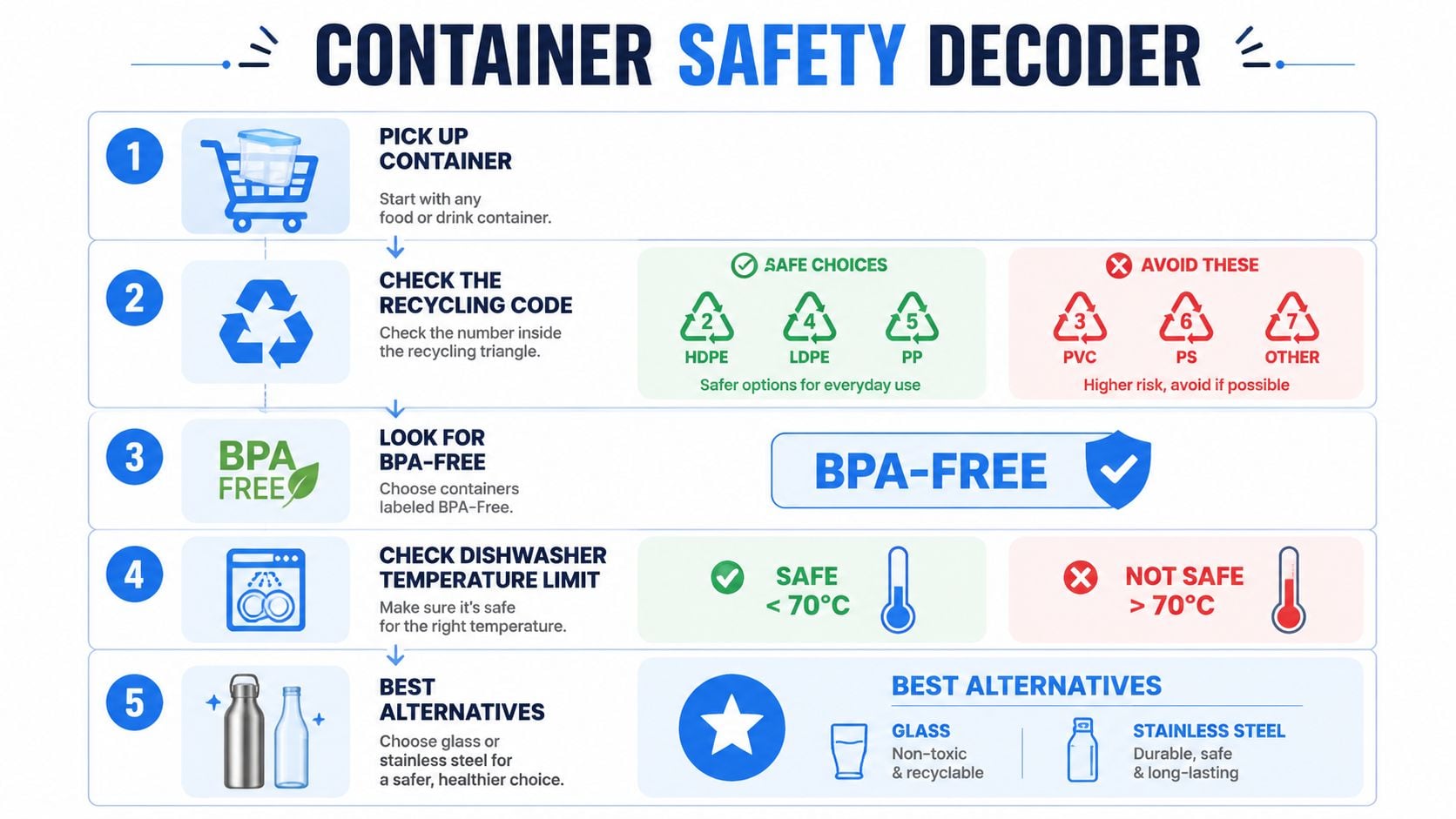
### How everyday use changes the exposure pathway
A container doesn't have to be visibly damaged to deserve careful handling. Heat, long storage, repeated washing, and contact with the lid assembly can all change which materials touch the water and for how long.
- **Hot storage:** Don't use a plastic bottle for hot water unless the manufacturer specifically designs it for that use.
- **Dishwasher cycles:** Follow the product's temperature and dishwasher instructions. Repeated heat can place more stress on some plastics than cool hand washing.
- **Long contact times:** Water stored for extended periods has more time to interact with the container, cap, gasket, or straw.
- **Component contact:** The bottle body may be stainless steel while the cap liner, straw, or gasket uses a separate polymer.
Material choice also matters in filtration equipment. A household evaluating heavy-metal concerns may consider the [Woder Heavy Metals and Advanced Filtration System](https://woder.com/products/wd-hmg4-dc/), which combines Woder's Advanced filtration formula with additional heavy-metals and lead-removal media and is described as a **US-made water filter**. The housing and water-contact components still deserve the same attention as any other drinking-water product.
Taste can provide a useful warning about plumbing or materials, but it can't identify every contaminant. A metallic taste may have several possible causes, so homeowners should avoid treating taste alone as a complete water-quality test. The discussion of [metallic-tasting water, pipes, and health](https://woder.com/blog/metallic-tasting-water-pipes-health/) offers useful context for separating sensory clues from verified testing.
## Reading Container Labels and Recycling Codes Correctly
Start with the part of the product that contacts water. That may include the bottle body, interior coating, cap liner, straw, valve, gasket, filter housing, adhesive, or tubing. A manufacturer can describe the main bottle material accurately while providing little information about the smaller components that remain in contact with water every day.
The FDA says a plastic container marked with **recycling code 7 may be made of a BPA-containing plastic**, so a BPA-free claim is more specific than looking for a resin code. The FDA also explains that BPA labeling concerns the material used, not a universal safety certification or a guarantee that substitute chemicals aren't present. Its [consumer guidance on BPA in food-contact applications](https://www.fda.gov/food/food-packaging-other-substances-come-contact-food-information-consumers/questions-answers-bisphenol-bpa-use-food-contact-applications) is a useful primary source.
### A practical label check
Use the product information as a set of questions rather than a single pass or fail sticker.
1. **Identify the main material.** Glass, uncoated stainless steel, and some co-polyester products may behave differently from polycarbonate under heat.
2. **Check every water-contact component.** Look for details about caps, liners, straws, gaskets, and filter housings.
3. **Read temperature instructions.** A BPA-free label doesn't make a container suitable for boiling water or high-temperature cleaning.
4. **Look for test details.** Independent migration testing is more informative when the product faces heat, repeated washing, or prolonged storage.
5. **Separate claims from certifications.** A material claim and a performance certification answer different questions.
The same logic applies to water filters. A system may claim to reduce a contaminant, comply with a material standard, or carry an independent certification, but those statements shouldn't be blended together. The explanation of [WQA, NSF, and ANSI water-quality terminology](https://woder.com/blog/wqa-nsf-ansi-wth-water-quality-alphabet-soup/) can help decode those labels.
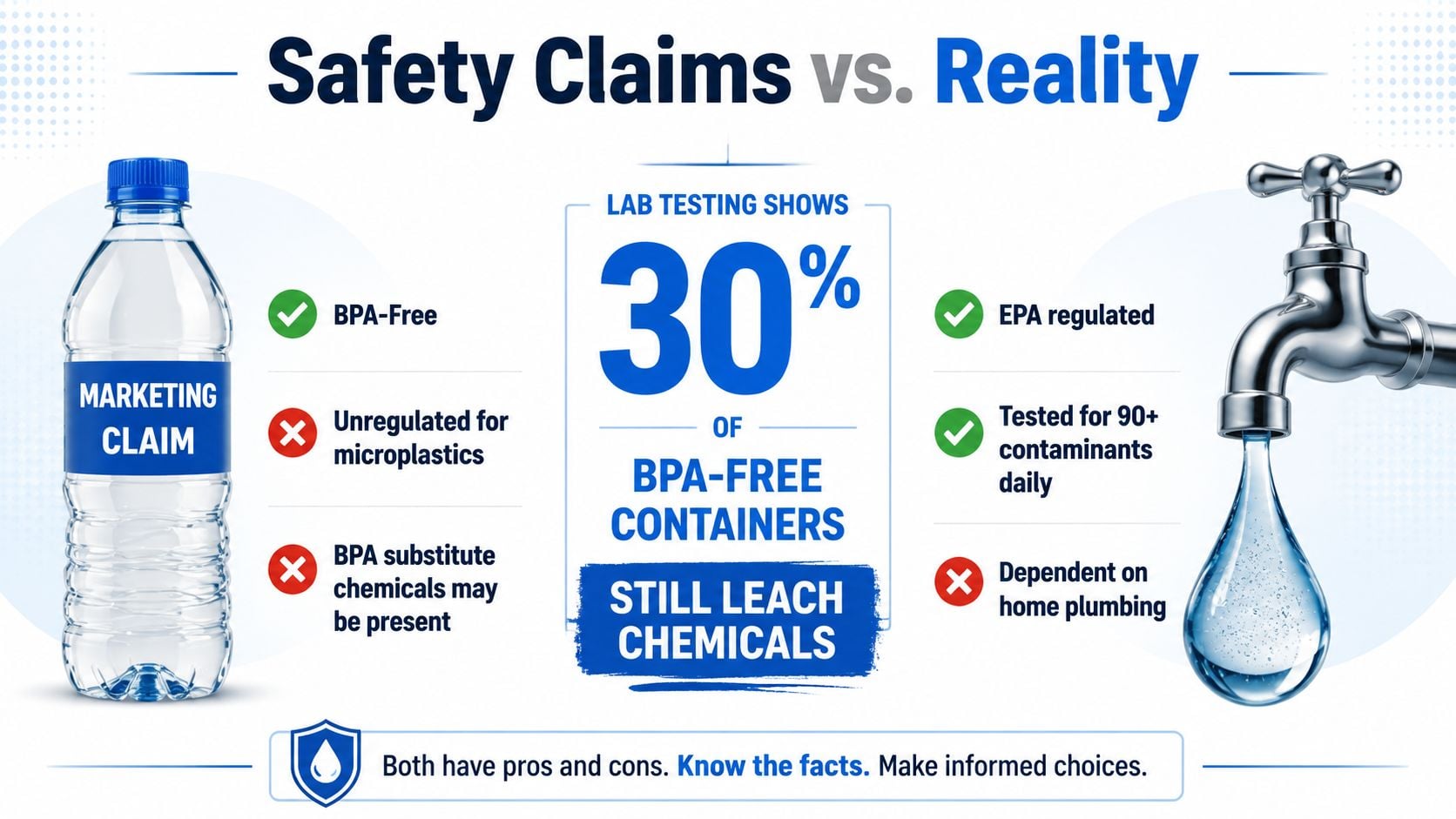
For families comparing bottles, a plain-language [bottle chemical safety guide](https://www.inchbug.com/blogs/blog/chemical-labels-for-bottles) can help organize the questions around plastics and component materials. The important habit is to inspect the complete water-contact pathway, not just the largest printed claim on the package.
For under-sink use, the [Woder WD-G4-DC Lead, Chlorine, HM and PFAS Water Filter](https://woder.com/products/wd-g4-dc/) uses Advanced Selective Filtration, retains essential minerals, and is a US-made water filter. Woder states that its WD-G4-REP advanced filters are certified by WQA to NSF/ANSI 42 for chlorine taste and odor and NSF/ANSI 372 for lead-free compliance, as verified and substantiated by test data.
## Bottled Water Safety Claims Versus Actual Testing Results
A BPA-free bottle label tells you about the packaging claim. It doesn't tell you that the water inside is free from PFAS or other contaminants. That's why the bottled-water question can't be answered by comparing package labels alone.
Consumer Reports found PFAS in several bottled-water products and reported that **39 of more than 100 tested bottled waters contained PFAS** in a peer-reviewed study, as described in its [report on PFAS in bottled water](https://www.consumerreports.org/health/bottled-water/pfas-in-bottled-water-new-study-finds-a1111233122/). FDA testing in **April 2025** also found detectable PFAS in **10 bottled-water samples**. These findings don't establish that every bottled-water product has the same result, but they do challenge the assumption that bottled automatically means cleaner for every contaminant category.
### Two separate questions often get mixed together
When a homeowner asks whether bottled water is safer, they may be asking about several different things:
QuestionWhat the package label can tell youWhat it can't establishIs BPA intentionally used in the bottle?A BPA-free claim addresses that specific ingredientIt doesn't address every substitute chemicalIs the water free from PFAS?Usually nothing conclusiveOnly testing or validated treatment can answer thatAre the cap and liner low-migration materials?Sometimes, if the manufacturer provides detailsA bottle-body claim may not cover every componentIs tap water a better everyday option?The label can't compare sourcesWater reports, testing, and treatment determine the answerBPA-free packaging and PFAS-free water are different goals. A product can address one while leaving the other unanswered, and the reverse can also be true. The most direct way to reduce exposure is to identify the contaminant in question and choose a treatment process tested for that contaminant, rather than relying on a broad impression created by package design.
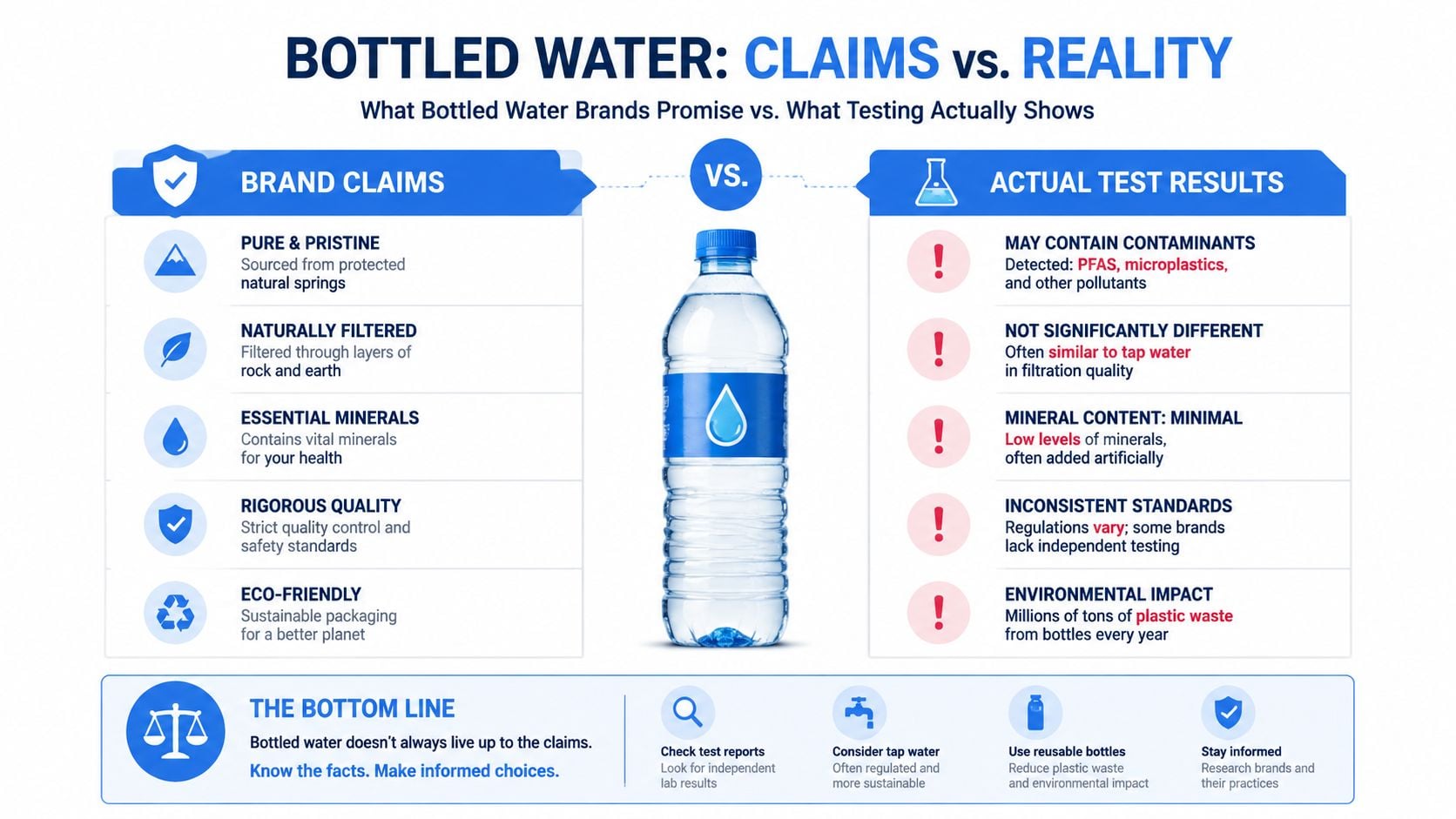
For many households, point-of-use filtration can offer a more consistent way to manage drinking and cooking water at the kitchen tap. It also lets the homeowner evaluate the incoming water and the filter's documented performance separately, instead of assuming that a sealed container resolves every water-quality concern.
## Connecting BPA Concerns to Broader Water Quality Issues
BPA is only one part of a household water decision. If the goal is safer drinking water, a bottle label can't answer whether the tap supply contains PFAS, lead, fluoride, chromium, chlorine, or another contaminant that enters before the water ever reaches the container.
PFAS illustrates the scale of the issue. EPA regulations set enforceable limits for **five PFAS chemicals individually**, including PFOA, PFOS, PFNA, PFHxS, and HFPO-DA. The final maximum contaminant levels are **4.0 parts per trillion for PFOA**, **4.0 parts per trillion for PFOS**, and **10 parts per trillion each for PFNA, PFHxS, and HFPO-DA**, according to the [EPA's national primary drinking-water regulations](https://www.epa.gov/ground-water-and-drinking-water/national-primary-drinking-water-regulations).
### Why a single-chemical mindset falls short
Homeowners often begin with one visible concern, such as BPA in a bottle. The more useful approach is to map the entire path:
- **Source water:** Municipal and well supplies can have different contaminant profiles.
- **Treatment and distribution:** Utilities treat public water, but pipes and building plumbing can affect water before it reaches the faucet.
- **Fixture and container materials:** Caps, liners, tubing, and bottles add another possible contact point.
- **Use conditions:** Heat, storage time, and repeated cleaning can influence migration.
Chromium adds another layer of confusion. EPA's national drinking-water standard for **total chromium is 0.1 milligrams per liter, or 100 parts per billion**, and that standard includes all forms of chromium, including chromium-6, as explained in the EPA information summarized by [The Cary Company's discussion of BPA-free bottles and water concerns](https://www.thecarycompany.com/insights/articles/identify-bpa-free-bottles). A homeowner choosing treatment should look at measured water results and verified filter performance, rather than assuming that a product designed for one form of chromium covers every situation.
Woder's **Advanced Selective Filtration®** is designed to target contaminants such as PFAS, lead, heavy metals, fluoride, chromium, and chlorine while retaining essential minerals. That differs from reverse osmosis, which can produce very low-TDS water by removing dissolved solids broadly, including minerals. A zero-TDS reading therefore isn't proof that water is “pure” in a meaningful health sense. It indicates that dissolved solids, beneficial and undesirable alike, have been stripped out.
## Making Informed Choices for Your Household Water
Begin with the water, not the marketing. Read your utility's Consumer Confidence Report if you receive municipal water, and consider laboratory testing when you use a private well or need a more specific contaminant profile. A report tells you about the supply, while testing at the point of use can help reveal what changes between the source and your kitchen faucet.
For containers, choose materials and designs that limit unnecessary exposure to heat and prolonged contact. Glass and uncoated stainless steel are practical options for many households, while any plastic product deserves careful attention to its resin, temperature instructions, cap assembly, and cleaning method. If you're comparing metal bottles, this guide to [titanium versus stainless steel water bottles](https://everti.com.au/blogs/news/titanium-bottle-the-ultimate-guide-to-choosing-between-titanium-and-stainless-steel-water-bottles) provides a useful material-focused comparison.
### A filter decision should answer four questions
1. **What's in the water?** Match treatment to a verified contaminant profile rather than a general promise.
2. **Where do you need treatment?** An under-sink filter suits drinking and cooking at one faucet, while an inline system may fit a refrigerator or ice maker.
3. **What does the system retain?** Woder's Advanced Selective Filtration is intended to remove targeted contaminants while leaving essential minerals in the water.
4. **What evidence supports the claim?** Look for relevant independent testing or certifications, including WQA Gold Seal where applicable, and confirm that the certification covers the performance claim you care about.
Reverse osmosis remains a legitimate option for homeowners who want broad dissolved-solids reduction and very low TDS. Its tradeoffs include mineral removal, more maintenance, and water waste during filtration. Woder Filters offers US-manufactured point-of-use systems built for U.S. building-code compliance, with a one-year cartridge guarantee. The choice should follow your water test, plumbing setup, desired mineral profile, and willingness to manage maintenance.
Your water decision is yours, and understanding the difference between a narrow **BPA-free** claim and targeted filtration makes that decision clearer.
---
Visit [Woder Filters](https://woder.com) to review US-made point-of-use filtration options that target contaminants such as PFAS, lead, heavy metals, fluoride, chromium, and chlorine while retaining essential minerals. Use your water report or lab results to identify the system that fits your household, then choose a filtration approach based on evidence rather than a bottle sticker.
**Categories:** Woder Science
**Tags:** bpa free bottles, bpa free water, drinking water safety, pfas free water, water filtration
---
### [Waterdrop Filter Review 2026: Is It Worth the Price for a US Household?](https://woder.com/blog/waterdrop-filter-review-2026-is-it-worth-the-price-for-a-us-household/)
**Published:** August 22, 2026
**Author:** woder
**Content:**
- [What Waterdrop Is and How It Works](#what-waterdrop-is-and-how-it-works)
- [Where Waterdrop Performs Well](#where-waterdrop-performs-well)
- [Contaminant Removal](#contaminant-removal)
- [Design and Smart Features](#design-and-smart-features)
- [Availability and Support](#availability-and-support)
- [Where Waterdrop Falls Short](#where-waterdrop-falls-short)
- [Mineral Stripping](#mineral-stripping)
- [Wastewater Production](#wastewater-production)
- [Price Point](#price-point)
- [The Mineral Question: Why It Matters More Than You Might Think](#the-mineral-question-why-it-matters-more-than-you-might-think)
- [How Waterdrop Compares to Selective Filtration](#how-waterdrop-compares-to-selective-filtration)
- [Who Should Consider Waterdrop](#who-should-consider-waterdrop)
- [Who Should Look Elsewhere](#who-should-look-elsewhere)
- [A Note on Certifications](#a-note-on-certifications)
- [The Bottom Line](#the-bottom-line)
- [Frequently Asked Questions](#frequently-asked-questions)
Waterdrop has built a real following on sleek design and smart features. If you've spent any time researching under-sink filters, you've almost certainly come across their systems. But looking good and working well for your specific household aren't always the same thing.
This review covers what Waterdrop actually offers in 2026, where it holds up, where it doesn't, and what's worth thinking through before you spend $200 to $600 on a filtration system.
### What Waterdrop Is and How It Works
Waterdrop makes a range of under-sink filtration systems built primarily around reverse osmosis (RO) technology. Their lineup includes tankless RO units with app connectivity, filter life monitoring, and compact designs meant to fit cleanly under a kitchen sink.
The appeal is straightforward: a modern system with digital features that take the guesswork out of maintenance. For households that care about aesthetics and tech integration, Waterdrop delivers on those fronts.
Most of their popular models use multi-stage RO filtration, which is effective at removing a broad range of contaminants including heavy metals, chlorine, and PFAS.
### Where Waterdrop Performs Well
#### Contaminant Removal
RO-based systems are thorough by design. The membrane filtration process removes dissolved solids, lead, chlorine, PFAS, and a wide range of other contaminants. If your primary goal is reducing what's in your water, an RO system will get the job done.
#### Design and Smart Features
Waterdrop's tankless design eliminates the bulky storage tank that traditional RO systems require — a genuine improvement over older setups. The app-based filter life monitoring is a practical touch, especially for households that tend to lose track of replacement schedules.
#### Availability and Support
Waterdrop is widely available through major retailers and has a strong online presence. Replacement filters and customer support are generally easy to access.
### Where Waterdrop Falls Short
#### Mineral Stripping
This is the most significant tradeoff with any RO-based system, and it applies directly to Waterdrop's core lineup. RO membranes work by pushing water through a semi-permeable barrier, but that process doesn't distinguish between harmful contaminants and beneficial ones. Calcium, magnesium, and other naturally occurring minerals get stripped out along with everything else.
Some Waterdrop models include a remineralization stage that adds minerals back after filtration. But that's an engineered workaround to a problem the filtration method itself creates — removing minerals, then adding them back through a synthetic step, rather than simply preserving them in the first place.
For households where mineral content matters, whether for taste, health considerations, or just not wanting demineralized water, this is a real limitation worth weighing.
#### Wastewater Production
RO systems produce wastewater as a byproduct of filtration. Waterdrop's tankless units are more efficient than traditional RO setups, but they still generate drain water. If reducing household water waste is a priority, that's worth factoring in.
#### Price Point
Waterdrop systems run $200 to $600 depending on the model, putting them firmly in the premium tier of the under-sink market. That's a meaningful investment, and it's fair to ask how much of that price reflects filtration performance versus design and smart features.
### The Mineral Question: Why It Matters More Than You Might Think
The debate over whether RO-filtered water is "healthy" is ongoing, but the practical concern for most households is simpler: water stripped of minerals often tastes flat. A lot of people notice this immediately after switching to an RO system.
Beyond taste, calcium and magnesium are minerals your body actually uses. Most people get them through food rather than water, but there's no benefit to removing them from your drinking water either.
If you want to remove PFAS, lead, chlorine, and chromium 6 without also removing the minerals that naturally belong in your water, an RO system requires a workaround. Selective filtration handles this differently from the start.
### How Waterdrop Compares to Selective Filtration
The core difference between RO-based filtration and selective filtration comes down to how each technology targets contaminants.
RO uses pressure to push water through a membrane that blocks nearly everything — including beneficial minerals. Selective filtration uses a different mechanism to attract and remove specific contaminants while leaving beneficial minerals intact. No membrane, no wastewater, no remineralization stage required.
[Woder](https://woder.com) uses proprietary Advanced Selective Filtration technology built on nanoparticles that attract targeted contaminants — including lead, chlorine, chromium 6, mercury, PFAS, carcinogens, and volatile organic compounds — with a stated 99.9% removal rate for those specific substances. Calcium, magnesium, and other naturally occurring minerals are preserved through the process rather than stripped out and re-added.
Woder filters are WQA Gold Seal certified and US-manufactured. Installation connects directly to an existing water line with no plumber required, no storage tank, and no wastewater produced.
On price, Waterdrop's systems run $200 to $600. Woder's models sit in the mid-market range. For households that want effective contaminant removal without the mineral tradeoff — and without paying a premium for app connectivity — that difference is worth considering.
### Who Should Consider Waterdrop
Waterdrop makes sense if:
- You want app-based filter monitoring and a modern aesthetic
- You're comfortable with the mineral-stripping tradeoff, or prefer remineralized water
- You have a higher budget and want a tankless RO system
- You're in an area with extremely high dissolved solids or heavy contamination where comprehensive RO filtration is the priority
### Who Should Look Elsewhere
Waterdrop may not be the right fit if:
- You want to preserve naturally occurring calcium and magnesium in your water
- Avoiding wastewater production matters to you
- Your budget is in the $100 to $200 range
- You want a DIY installation with no permanent plumbing changes
- You're a renter or apartment dweller who needs an inline solution without modifying existing plumbing
For that second group, selective filtration is worth a closer look. Woder's under-sink and inline models are built specifically for households that want targeted contaminant removal without the compromises baked into RO technology.
### A Note on Certifications
Waterdrop lists certifications across various models, but it's worth verifying which certifications apply to the specific model you're considering before purchasing. Certification claims in the water filter market vary significantly — sometimes between models from the same brand.
Woder holds WQA Gold Seal certification, which provides independent, third-party verification of performance claims. In a category where contaminant-removal claims are common and outside verification is less so, that distinction matters.
### The Bottom Line
Waterdrop builds well-designed systems with genuine smart features. If you want a premium RO unit with app connectivity and a clean form factor, it delivers on those promises.
But if your priority is removing lead, PFAS, chlorine, and chromium 6 while keeping the beneficial minerals in your water, the RO approach requires a workaround that selective filtration simply doesn't. Factor in the wastewater production and the price premium, and the value equation shifts depending on what you actually need from a filter.
Before committing to any system, it's worth matching your water quality concerns to the filtration technology — not the other way around. Woder's site includes a Wizard tool that helps match households to the right model based on their specific needs. You can explore it at [woder.com](https://woder.com).
---
### Frequently Asked Questions
**Does Waterdrop remove PFAS?**
Most Waterdrop RO models are designed to reduce PFAS through reverse osmosis membrane filtration. Check the specific model's documentation to confirm which contaminants are covered and at what reduction rates, since performance varies by model.
**Does Waterdrop water taste flat?**
Some users report that RO-filtered water tastes flat because the process removes dissolved minerals including calcium and magnesium. Waterdrop models with a remineralization stage add minerals back after filtration, which can improve taste — though results vary by individual preference.
**Is Waterdrop worth the price?**
It depends on what you're optimizing for. If you want smart features, app monitoring, and a tankless RO design, Waterdrop is competitive at its price point. If you want effective contaminant removal without mineral stripping and at a lower cost, selective filtration alternatives may offer better value.
**What's the difference between RO filtration and selective filtration?**
RO filtration pushes water through a membrane that blocks nearly everything, including beneficial minerals, and produces wastewater in the process. Selective filtration targets specific contaminants through a different mechanism, leaving beneficial minerals like calcium and magnesium intact without generating wastewater.
**Do Waterdrop filters require a plumber to install?**
Most Waterdrop under-sink systems are designed for DIY installation, though the process is more involved than a standard inline filter. Some models require connecting to a drain line in addition to the water supply line.
**How often do Waterdrop filters need to be replaced?**
Replacement intervals vary by model and household water usage. Waterdrop's app connectivity is designed to track filter life and alert you when a replacement is due — one of the more practical features in their lineup.
**What's a good alternative to Waterdrop for a household that wants to keep minerals in their water?**
If mineral preservation is a priority, look at selective filtration rather than RO-based systems. Woder's under-sink and inline filters use Advanced Selective Filtration to remove lead, chlorine, PFAS, chromium 6, mercury, and other contaminants at a 99.9% rate for those specific substances, while retaining naturally occurring calcium and magnesium. No remineralization stage needed.
**Categories:** Woder Science
---
### [Under Sink Water Filter for Lead: A 2026 Guide](https://woder.com/blog/under-sink-water-filter-for-lead/)
**Published:** August 21, 2026
**Author:** woder_admin
**Content:**
Lead has no known safe level of exposure, yet the federal action level for lead in tap water is **15 parts per billion**, or **0.015 mg/L**. That difference is the first thing to understand when you're choosing an **under-sink water filter for lead**. An action level is a trigger for utility action, not a guarantee that every household tap is free of lead. ([EPA lead drinking water guidance](https://www.epa.gov/ground-water-and-drinking-water/basic-information-about-lead-drinking-water))
The most useful shopping insight is also easy to miss: **“NSF certified” isn't specific enough**. For a point-of-use filter intended to address both dissolved lead and lead carried on particles, look for the exact model to list **NSF/ANSI 53 for lead reduction** and **NSF/ANSI 42 Class 1 for particulate reduction**, then verify that listing through an independent certification directory. That distinction matters more than a large claim printed on a box.
CriteriaAdvanced Selective FiltrationReverse OsmosisLead reductionDepends on the exact contaminant certification and modelUses a membrane to reduce dissolved contaminantsMineral contentRetains essential mineralsStrips dissolved solids, including mineralsWater useDoesn't require a reject-water stream in the same way as ROSends concentrate to the drain during filtrationInstallationPoint-of-use installation with a dedicated drinking-water outletUsually requires a membrane, storage components, drain connection, and dedicated faucetMaintenanceReplace the cartridge according to the manufacturer's scheduleRequires maintenance of prefilters, membrane, and post-treatment componentsCertification checkConfirm the exact contaminant claim and standardsConfirm the exact membrane and contaminant certification## Table of Contents
- [Why Lead in Tap Water Demands a Point-of-Use Filter](#why-lead-in-tap-water-demands-a-point-of-use-filter)
- [The action level isn't a safety line](#the-action-level-isnt-a-safety-line)
- [Why point-of-use treatment makes sense](#why-point-of-use-treatment-makes-sense)
- [The Two Certifications Your Lead Filter Must Have](#the-two-certifications-your-lead-filter-must-have)
- [What each standard tells you](#what-each-standard-tells-you)
- [How to verify a listing](#how-to-verify-a-listing)
- [Selective Filtration vs Reverse Osmosis for Lead Removal](#selective-filtration-vs-reverse-osmosis-for-lead-removal)
- [Mineral removal isn't the same as contaminant removal](#mineral-removal-isnt-the-same-as-contaminant-removal)
- [The practical cost of complexity](#the-practical-cost-of-complexity)
- [How to Use an Under-Sink Lead Filter Safely](#how-to-use-an-under-sink-lead-filter-safely)
- [Know the tested boundary](#know-the-tested-boundary)
- [Real-World Proof That Point-of-Use Filters Work](#real-world-proof-that-point-of-use-filters-work)
- [What the field result does and doesn't prove](#what-the-field-result-does-and-doesnt-prove)
- [Applying the evidence to a household tap](#applying-the-evidence-to-a-household-tap)
- [Choosing the Right Under-Sink Lead Filter for Your Home](#choosing-the-right-under-sink-lead-filter-for-your-home)
## Why Lead in Tap Water Demands a Point-of-Use Filter
The EPA sets the **maximum contaminant level goal for lead at zero** because there's no known safe level of lead exposure. The agency also estimates that drinking water can account for **20% or more of a person's total lead exposure**, depending on individual circumstances and other sources. ([EPA lead drinking water information](https://www.epa.gov/ground-water-and-drinking-water/basic-information-about-lead-drinking-water))
That doesn't mean every home has the same risk. Lead often enters water after treatment, as water moves through aging service lines, solder, brass fixtures, or other plumbing components. A utility can deliver water that meets requirements at the treatment plant while conditions inside a particular building still affect what comes out of one tap.
### The action level isn't a safety line
Under the federal framework described by the EPA, the legal lead action level in tap water is **15 ppb**. If more than **10% of collected samples** exceed that level, the utility must take additional action. ([EPA lead and drinking water overview](https://www.epa.gov/lead/lead-drinking-water))
That benchmark applies to utility response. It doesn't turn a reading below 15 ppb into a health-based target, because the EPA's health goal remains zero. It also doesn't tell you exactly what's happening at your kitchen faucet. A building-specific test can reveal conditions that a system-wide report won't show.
> **Practical distinction:** The action level tells you when a water system must respond. It doesn't certify that your individual tap is lead-free.
### Why point-of-use treatment makes sense
A whole-house solution can have an important role, especially when plumbing conditions affect multiple fixtures. But if your immediate goal is to reduce lead in the water you drink and use for cooking, an under-sink point-of-use system treats the water at the place where you'll consume it. It also lets you use a dedicated drinking-water outlet instead of treating every gallon used for bathing, laundry, or cleaning.
Before buying, test your water or review your utility's available information. [This guide to testing for lead](https://woder.com/blog/test-for-lead/) can help you understand what a household test can and can't tell you. A test won't replace certification, but it can help you decide whether a point-of-use filter is an appropriate interim measure while plumbing issues are investigated.
## The Two Certifications Your Lead Filter Must Have
A generic “NSF certified” statement leaves out the detail that matters most, the **specific contaminant and performance claim**. NSF/ANSI Standard 53 covers health-related contaminant reduction claims, but certification must identify what the product has been evaluated to reduce. NSF maintains separate listings for lead and other contaminants, so a badge without a named claim shouldn't be treated as proof of lead reduction. (NSF contaminant reduction claims guide)
Lead can appear in water in more than one physical form. Some lead is dissolved, while some can be attached to or carried by particles. That's why a filter designed for real-world lead concerns may need both a health-related lead-reduction claim and a particulate-reduction claim.
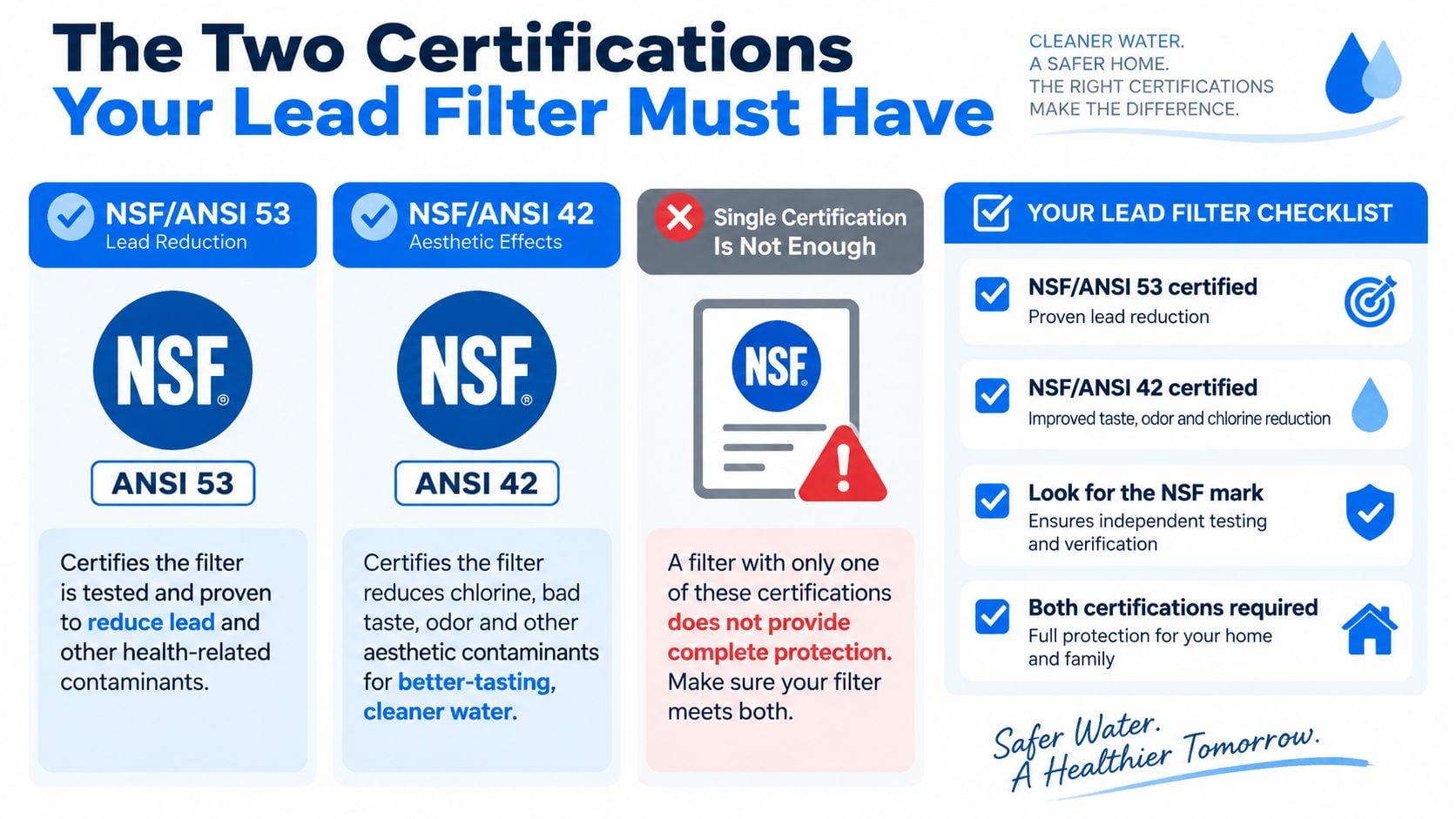
### What each standard tells you
**NSF/ANSI 53** is the key standard to check for a lead-reduction claim. It addresses health-related contaminant reduction, and the listing should name lead rather than just displaying the words “NSF certified.”
**NSF/ANSI 42 Class 1** addresses particulate reduction. That matters because lead may be attached to sediment or other particles, and reducing particles can address a different part of the problem than reducing dissolved lead.
A product with only Standard 42 isn't automatically a dissolved-lead filter. A product with only a general Standard 53 statement may not provide the particulate scope you're looking for. EPA consumer guidance for 2025 identifies the more protective setup as one listing **NSF/ANSI 53 for lead reduction** and **NSF/ANSI 42 Class 1 for particulate reduction**. ([EPA filter guidance PDF](https://www.epa.gov/system/files/documents/2025-08/reduce-risk.pdf))
### How to verify a listing
Look up the **exact model number** in the NSF or WQA certification directory. Check that the entry names lead reduction, identifies the relevant standard, and matches the cartridge or complete system you're considering. Don't assume that every cartridge in a product family has the same certification scope.
Since **February 2022**, NSF lead-reduction requirements for Standards 53 and 58 have required certified units to reduce lead to **5 ppb or less**, tightening the earlier **10 ppb** benchmark and aligning with Health Canada's **5 ppb** threshold. ([ScienceDirect discussion of lead-reduction requirements](https://www.sciencedirect.com/science/article/abs/pii/S0043135423008655)) Health Canada's consumer guidance also describes lead-reduction performance around **99.5% to 99.6%** under the standard's test conditions, with a maximum permissible product-water concentration of **5 µg/L**. ([Health Canada filter guidance](https://www.canada.ca/content/dam/hc-sc/documents/services/publications/healthy-living/infographic-finding-drinking-water-filter/infographic-finding-drinking-water-filter.pdf))
For a broader explanation of how certification language works, see [water filter filtration certifications and removal claims](https://woder.com/blog/water-filter-filtration-certifications-removal/). A product such as the [Woder WD-G4-DC Lead, Chlorine, HM and PFAS Water Filter](https://woder.com/products/wd-g4-dc/) should still be evaluated by checking the exact certification claims for the specific filter and contaminant you're concerned about. Its catalog information identifies WQA certification for NSF/ANSI 42 chlorine taste and odor and NSF/ANSI 372 lead-free compliance, which is not the same wording as an NSF/ANSI 53 lead-reduction certification.
## Selective Filtration vs Reverse Osmosis for Lead Removal
Lead reduction isn't the only decision under your sink. The filtration method also determines what happens to the rest of the water, how the system fits into your cabinet, and what maintenance you'll manage over time.
Reverse osmosis forces water through a semipermeable membrane that reduces many dissolved substances. It can produce very low TDS, but **zero TDS doesn't prove that water is safer**. It means dissolved solids, including both unwanted substances and naturally occurring minerals, have been removed.
Woder's **Advanced Selective Filtration®** takes a different approach. The technology is designed to target listed contaminants such as lead, PFAS, heavy metals, fluoride, chromium, and chlorine while retaining essential minerals. That contrasts with RO's mineral-stripping process. The right choice depends on which tradeoffs fit your water and your preferences.
CriteriaAdvanced Selective FiltrationReverse OsmosisContaminant focusTargets specified contaminants according to the product's claims and certificationsBroad dissolved-contaminant reduction through a membraneLeadVerify the exact lead-reduction certification for the modelVerify the exact RO certification and performance claimMineralsRetains essential mineralsRemoves dissolved minerals along with other dissolved solidsTDSDoesn't aim to drive TDS to zeroCan produce very low TDSWater wastePoint-of-use filtration without the conventional RO reject-water processProduces reject water as part of membrane operationMaintenanceCartridge replacement remains the central taskMultiple components may require scheduled replacement and careSpaceTypically uses a compact dedicated filtration arrangementOften needs room for membrane components, connections, and storageTasteMineral retention can preserve the character of the source waterPost-treatment and remineralization choices affect taste
### Mineral removal isn't the same as contaminant removal
RO water may appeal to people who want the lowest possible dissolved-solids reading. But that reading doesn't distinguish calcium and magnesium from lead or other unwanted substances. A zero-TDS result is therefore a measure of what the system removed, not a complete safety analysis.
Selective filtration appeals to households that want targeted contaminant reduction without stripping the water of its naturally occurring minerals. It also avoids making a low TDS reading the sole definition of quality.
### The practical cost of complexity
RO systems generally need more components and plumbing connections than a basic under-sink cartridge system. They also send reject water to the drain and require attention to several replacement intervals. Those tradeoffs may be worthwhile for a household whose testing shows a broad dissolved-contaminant problem, but they're not automatically necessary for every lead concern.
For a plain-language explanation of RO operation and its tradeoffs, read [what reverse osmosis water filters do](https://woder.com/blog/what-is-reverse-osmosis-water-filter/). Whatever technology you choose, match the decision to verified performance claims instead of assuming that the most aggressive-sounding treatment is automatically the most suitable.
## How to Use an Under-Sink Lead Filter Safely
A certified filter can only perform within its tested scope and operating conditions. Installation, water temperature, and cartridge maintenance all affect whether the water reaching your glass receives the treatment you expect.
Start with the manufacturer's instructions, then keep four rules in view:
1. **Use cold water only.** The EPA advises users never to run hot water through a lead filter. Use the unfiltered cold tap for hot-water needs, and filter cold water before heating it for drinking or cooking. ([EPA filter guidance](https://www.epa.gov/lead/will-my-filter-remove-lead))
2. **Replace the cartridge on schedule.** Filter media has a service life. An exhausted cartridge may no longer reduce contaminants at its stated performance level, even if water still flows through it normally.
3. **Confirm the exact model.** Certification belongs to a specific product and claim, not to a brand name or a broad product category. Check the listing for lead reduction and particulate reduction before installation.
4. **Follow installation and flushing directions.** A loose connection, incorrect flow path, or inadequate initial flush can compromise the setup. The instructions supplied with the system are part of its safe operation.
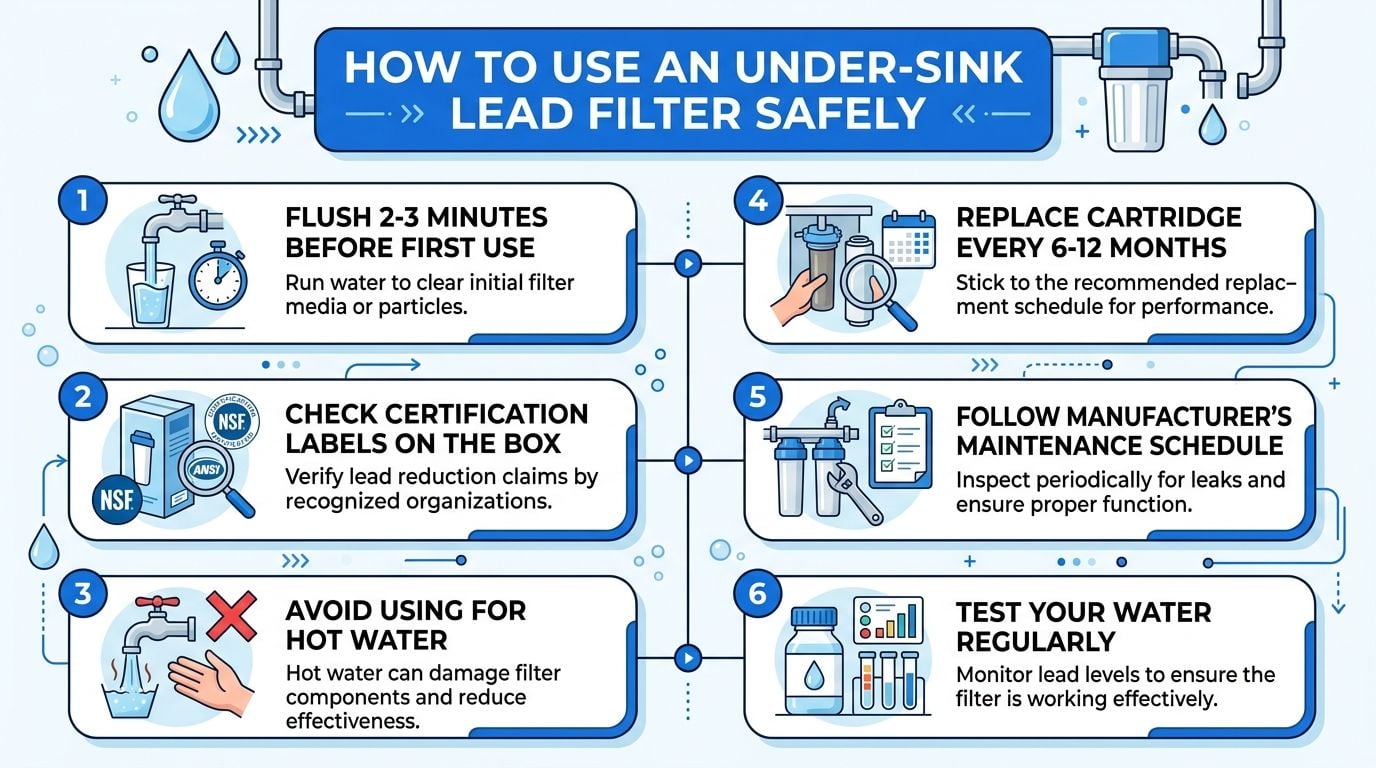
### Know the tested boundary
NSF/ANSI lead-reduction certification uses a **150 ppb lead challenge**, and NSF notes that certified filters are evaluated for effectiveness only up to that level. The EPA likewise cautions that performance isn't evaluated above **150 ppb**, so a household that suspects higher contamination shouldn't treat a certified filter as a complete answer without further investigation. ([NSF and EPA performance boundary research](https://www.sciencedirect.com/science/article/abs/pii/S0043135423008655))
That's where a confirmed water test and plumbing assessment matter. Filtration can reduce exposure at the drinking tap, while plumbing remediation addresses the source. If moisture, leaks, or staining are also present inside the cabinet, a resource on [moisture fixes for under sink](https://ampmrestorations.com/black-mold-under-sink/) can help separate a water-quality concern from an under-sink moisture problem.
> **Safety rule:** A filter is a point-of-use control. It isn't a substitute for correcting severely contaminated plumbing.
## Real-World Proof That Point-of-Use Filters Work
Laboratory certification tells you how a filter was challenged under a defined protocol. Field evidence answers a different question, whether point-of-use filtration can perform in a real plumbing emergency.
A **2016 study in Flint, Michigan** examined filtered water from **more than 345 locations** during severe lead contamination. The researchers found that **over 97% of filtered samples contained less than 0.5 µg/L of lead**, and the maximum filtered-water concentration was **2.9 µg/L**. ([Flint point-of-use filtration study](https://pubmed.ncbi.nlm.nih.gov/31074704/))
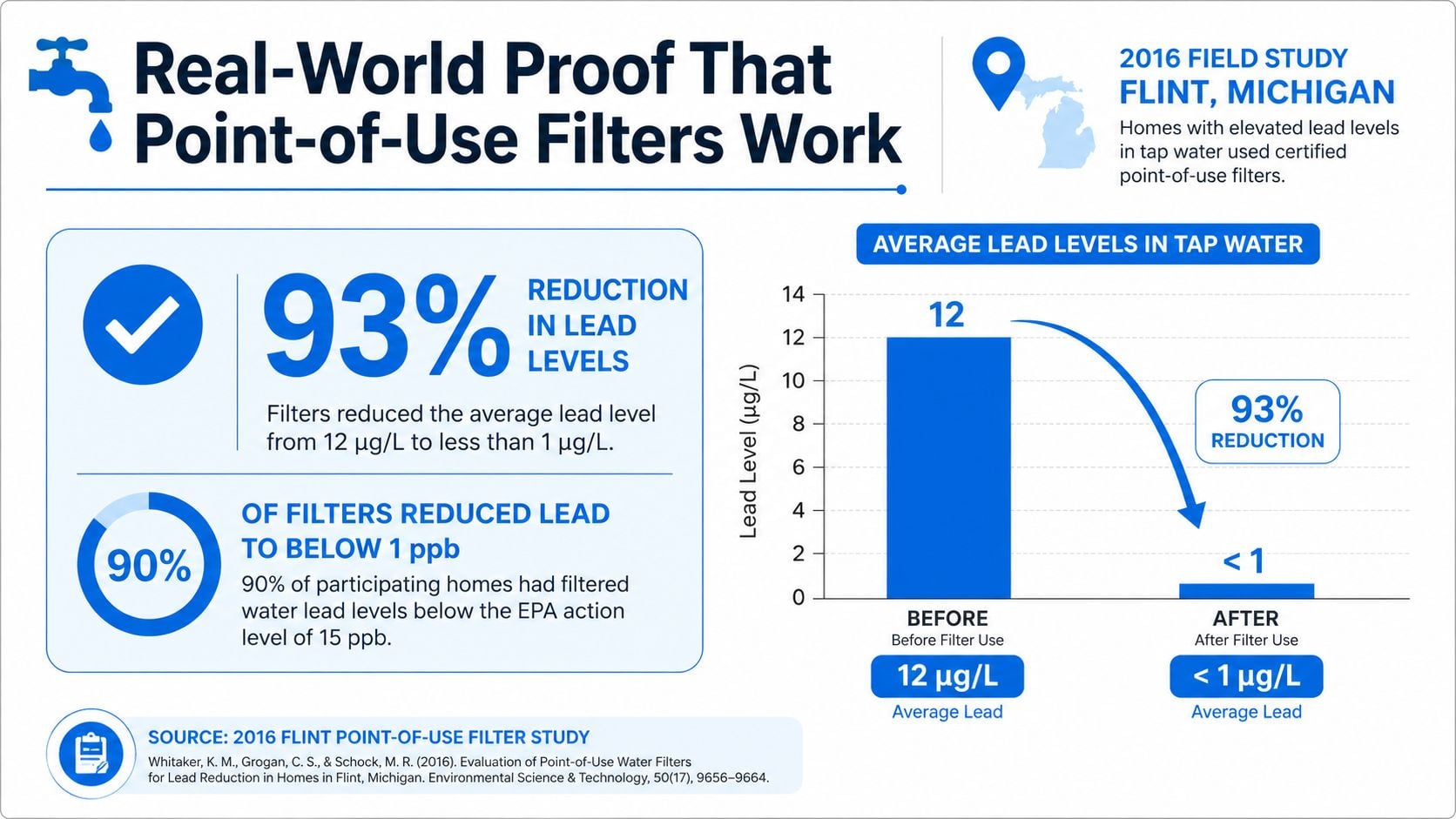
### What the field result does and doesn't prove
The result supports the value of correctly selected point-of-use filtration under difficult conditions. It doesn't mean every filter removes lead equally, and it doesn't turn a generic “lead reducing” claim into verified performance. The system must carry the relevant certification, operate within its tested boundary, and receive timely cartridge changes.
The same research notes that NSF/ANSI 53 lead-certified filters are challenged with **150 µg/L of soluble and particulate lead** during certification. That challenge is **30 times higher than a 5 µg/L benchmark**, which helps show why the certification protocol is more meaningful than an unsupported marketing statement. ([Flint study and certification challenge](https://pubmed.ncbi.nlm.nih.gov/31074704/))
### Applying the evidence to a household tap
A severe event and an ordinary home aren't identical situations. Plumbing materials, water chemistry, flow rate, cartridge age, and installation quality can all affect results. Still, the field evidence gives homeowners a grounded reason to take certified point-of-use filtration seriously, without assuming that any product with a certification badge will provide the same protection.
The useful conclusion is narrow and practical: **certified point-of-use filtration can work in real contaminated systems**, but the buyer must verify the exact claim and maintain the filter as directed.
## Choosing the Right Under-Sink Lead Filter for Your Home
Begin with your own water. Review your utility's Consumer Confidence Report, check available information about household plumbing, or order a qualified laboratory test if you need a direct reading from your tap.
Then use this decision sequence:
- **Verify the claim:** Look for NSF/ANSI 53 lead reduction and NSF/ANSI 42 Class 1 particulate reduction on the exact model.
- **Check the scope:** Confirm that the certification names lead, not merely chlorine, taste, odor, or lead-free materials compliance.
- **Choose the treatment style:** Selective filtration retains essential minerals, while RO strips dissolved solids and brings additional water use and maintenance considerations.
- **Plan for ownership:** Confirm the cartridge schedule, replacement availability, installation requirements, and household capacity.
- **Match broader concerns:** If PFAS, fluoride, chromium, chlorine, or other contaminants matter to you, verify that the product's own documentation names those contaminants and provides appropriate certification or test support.
Woder Filters manufactures U.S.-made point-of-use systems built for U.S. building-code compliance and uses **Advanced Selective Filtration®** in its product line. The company also offers the Woder Wizard selection tool, lab water testing services, replacement cartridges, and installation documentation. Those resources can help you compare a system against your actual water conditions rather than choosing by packaging alone.
Lead reduction starts with a specific claim, a verified model, and correct operation. Once you know what's in your water, the choice between selective filtration and RO becomes a practical decision about contaminants, minerals, water use, space, and maintenance.
---
Woder Filters offers U.S.-made point-of-use systems that use Advanced Selective Filtration® to target contaminants while retaining essential minerals, with replacement cartridges and testing resources to support the setup. Review the options at [Woder Filters](https://woder.com) and compare the product documentation with your water test before choosing an under-sink filter for lead.
**Categories:** Woder Science
**Tags:** lead water filter, NSF certified lead filter, selective filtration, under sink water filter for lead, under-sink filter
---
### [Is Metallic-Tasting Water Bad for You? What It Signals About Your Pipes and Your Health](https://woder.com/blog/metallic-tasting-water-pipes-health/)
**Published:** August 21, 2026
**Author:** woder
**Content:**
- [Why Does Your Water Taste Metallic?](#why-does-your-water-taste-metallic)
- [Old or Corroding Pipes](#old-or-corroding-pipes)
- [Iron and Manganese](#iron-and-manganese)
- [Chlorine and Chloramine Reactions](#chlorine-and-chloramine-reactions)
- [Low pH Water](#low-ph-water)
- [Is Metallic-Tasting Water Actually Bad for You?](#is-metallic-tasting-water-actually-bad-for-you)
- [How to Find Out What's Actually in Your Water](#how-to-find-out-whats-actually-in-your-water)
- [What a Metallic Taste Might Signal About Your Pipes](#what-a-metallic-taste-might-signal-about-your-pipes)
- [What Actually Removes Metallic Taste (and What Doesn't)](#what-actually-removes-metallic-taste-and-what-doesnt)
- [When to Take Metallic Taste More Seriously](#when-to-take-metallic-taste-more-seriously)
- [The Fix Most People Overlook](#the-fix-most-people-overlook)
- [Frequently Asked Questions](#frequently-asked-questions)
You fill a glass from the tap, take a sip, and something's off. Not dramatically wrong — just a faint taste of pennies or old pipes. That's your water telling you something. It's worth listening.
The good news: metallic-tasting water isn't always dangerous. The less reassuring news: sometimes it is. Here's how to tell the difference, what's likely behind it, and what you can actually do.
### Why Does Your Water Taste Metallic?
Water doesn't naturally taste like metal. Something is introducing that flavor — from your plumbing, your local supply, or both. The most common sources are worth knowing.
#### Old or Corroding Pipes
Homes built before 1986 have a real chance of containing lead pipes or lead solder. As those pipes corrode, lead leaches directly into the water moving through them. There's no safe level of lead exposure, especially for children and pregnant people.
Copper pipes — generally considered safer — can also contribute a metallic taste when they corrode or when water sits in them for too long.
#### Iron and Manganese
These naturally occurring minerals can enter your water from the source itself or from aging infrastructure. Both are detectable by taste at relatively low concentrations. Iron gives water a sharp, almost rusty edge. Manganese tends toward something more bitter and chemical.
#### Chlorine and Chloramine Reactions
Municipal treatment uses chlorine and chloramine to disinfect. These chemicals can react with organic matter in your pipes and produce compounds that taste metallic or chemical. If your water tastes different after sitting overnight, this is often why.
#### Low pH Water
Slightly acidic water is more aggressive toward metal pipes — it pulls iron, copper, and other metals into solution more readily. If you're seeing blue-green staining in your sink alongside a metallic taste, low pH is likely part of the picture.
### Is Metallic-Tasting Water Actually Bad for You?
It depends entirely on what's causing the taste.
**Iron or manganese at low levels** — the health risk is generally low for most adults. Unpleasant, but neither mineral is acutely toxic at the concentrations typically found in household water.
**Lead** — a different situation entirely. Lead is a neurotoxin. There's no established safe level for children. Adults face cardiovascular and kidney risks with prolonged exposure. The tricky part: lead doesn't always produce a dramatic taste. You can have elevated lead levels without a strong metallic flavor at all.
**Copper** — short-term exposure at low levels is generally not harmful, but high concentrations over time can cause gastrointestinal problems and, in serious cases, liver and kidney damage.
**Chlorine byproducts** — the concern here is long-term exposure to disinfection byproducts, some of which are classified as potential carcinogens.
The metallic taste is a signal. It tells you something is in your water that probably shouldn't be there. Whether that something is a health concern depends on what it actually is — which is exactly why testing matters.
### How to Find Out What’s Actually in Your Water
Don't guess. Test.
Your local water utility is required to publish an annual Consumer Confidence Report listing detected contaminants and their levels. It's a useful starting point — but it measures water at the treatment plant, not at your tap. By the time water reaches your glass, it's traveled through miles of aging infrastructure and your home's own pipes.
A home water test gives you a more accurate picture of what you're actually drinking. [Woder](https://woder.com) offers water testing kits alongside their filter products, so you can understand your specific situation before choosing a solution.
### What a Metallic Taste Might Signal About Your Pipes
The taste is often a symptom of something broader. Here's how to read the signals:
- **Consistent metallic taste from cold water only**: Likely a pipe or infrastructure issue, not treatment-related. Worth testing for lead and copper.
- **Taste is stronger after water sits overnight**: Stagnation lets metals leach from pipes. Run cold water for 30 to 60 seconds before drinking, especially in older homes.
- **Taste is stronger in hot water**: Heat accelerates corrosion and leaching. Never use hot tap water for cooking or drinking.
- **Blue-green staining in sinks or tubs**: A sign of copper corrosion — your water is acidic enough to eat through copper pipes.
- **Reddish or orange staining**: Points to iron, either from your pipes or the source water itself.
- **Taste varies by season**: Some contaminants fluctuate with rainfall and runoff. Spring and fall are common times for shifts in taste and quality.
### What Actually Removes Metallic Taste (and What Doesn’t)
A basic carbon pitcher filter will reduce chlorine taste and improve general flavor. But it won't reliably remove lead, and it won't address iron or manganese at meaningful concentrations. If your metallic taste has a serious source, a pitcher filter isn't enough.
Reverse osmosis systems remove most contaminants, including lead and metals. But they also strip out calcium, magnesium, and other beneficial minerals. They produce wastewater, require a tank, and typically need a plumber to install.
There's a middle path: a filter that removes the harmful stuff while keeping the beneficial minerals intact. That's what Woder's Advanced Selective Filtration technology does. Using nanoparticles, it attracts and removes contaminants like lead, chlorine, mercury, and chromium 6 — while leaving calcium and magnesium right where they belong. No wastewater. No tank. No plumber.
Woder filters install directly into your existing water line under the sink. The WD-D-8K-FRM-ADV-DC handles standard household flow rates. The WD-10K-ADV-PORT suits higher-demand homes. The compact WD-G4-210-JG works well for smaller setups or renters who need a less invasive option.
Remove the bad. Keep the good. That's the Woder difference.
### When to Take Metallic Taste More Seriously
Some situations call for faster action:
- Your home was built before 1986 and you've never tested for lead
- You have young children or someone in your household is pregnant
- Your water utility has issued a recent advisory or violation notice
- The metallic taste appeared suddenly after plumbing work or a water main repair
- The taste has been getting stronger over time
In any of these cases, test first, then act on what you find. Don't wait.
### The Fix Most People Overlook
Most people either ignore the metallic taste or start buying cases of bottled water. Both responses are understandable. Neither is a real fix.
Ignoring it means continued exposure to whatever is causing the taste. Bottled water creates significant plastic waste and costs far more over time than a quality inline filter.
An under-sink filter from [Woder](https://woder.com) installs in minutes, requires no plumber, and targets the contaminants most likely behind a metallic taste — including lead, chlorine, mercury, and VOCs. Replacement cartridges keep the filtration current without replacing the whole unit.
Built in the US. Installed in minutes. Trusted for years.
Not sure which model fits your home? The [Woder Wizard at woder.com/wizard](https://woder.com/wizard) walks you through it based on your household's needs and flow rate.
---
### Frequently Asked Questions
**Is metallic-tasting water safe to drink?**
It depends on the cause. A mild metallic taste from low iron or copper levels isn't an acute health risk for most adults. But a metallic taste caused by lead is a serious concern — there's no safe exposure level, particularly for children. Testing your water is the only way to know what you're actually dealing with.
**What causes tap water to taste like metal?**
The most common causes are corroding lead or copper pipes, elevated iron or manganese in the source water, chlorine and chloramine reactions with organic matter in your plumbing, and low pH water that pulls metals into solution. Older homes are more likely to have pipe-related causes.
**Does a metallic taste mean there's lead in my water?**
Not necessarily — but it can. Lead doesn't always produce a strong taste, which makes it harder to detect by flavor alone. If your home was built before 1986 or you have any reason to suspect lead pipes, get your water tested rather than relying on taste as your indicator.
**Can a standard pitcher filter fix metallic-tasting water?**
Basic carbon pitcher filters reduce chlorine taste and some general flavor issues, but they don't reliably remove lead, iron, or manganese at meaningful concentrations. If the metallic taste has a serious source, a capable inline or under-sink filter is a better choice.
**How do I test my water for the cause of a metallic taste?**
Your local utility publishes an annual Consumer Confidence Report, but that measures water at the treatment plant — not your tap. A home water test kit gives you a more accurate picture of what's actually coming out of your faucet. Woder offers testing kits alongside their filter products.
**Will a water filter remove the metallic taste completely?**
A quality filter that targets the specific contaminant causing the taste will eliminate it. Woder's Advanced Selective Filtration removes 99.9% of contaminants including lead, chlorine, chromium 6, and mercury — the most common sources of metallic taste — while keeping beneficial minerals like calcium and magnesium in the water.
**How long does it take to install an under-sink water filter?**
Most under-sink inline filters, including Woder models, install directly into your existing water line without special tools or a plumber. The typical installation takes under 30 minutes, and Woder's site includes a full installation guide to walk you through it.
---
Your water shouldn't taste like old pipes. If it does, that taste is telling you something worth hearing. Test your water, understand the source, and choose a filter that actually addresses it. It's your water — make sure it's working for you.
**Categories:** Woder Science
---
### [Under Sink Water Filter Cartridge Guide for 2026](https://woder.com/blog/under-sink-water-filter-cartridge/)
**Published:** August 20, 2026
**Author:** woder_admin
**Content:**
You're kneeling in front of the kitchen cabinet with an old cartridge in one hand, an empty box somewhere in the recycling, and no clear idea what to order next. The model number has faded, the replacement page is full of codes, and every cartridge seems to promise a different micron rating, capacity, or certification.
That moment is less about shopping than **matching**. The right under sink water filter cartridge has to fit the housing, seal against the correct O-ring, suit the system's connection style, and address the contaminants you care about. A smaller micron number alone doesn't make it the right choice.
## Table of Contents
- [Staring at an Old Cartridge and Wondering What's Next](#staring-at-an-old-cartridge-and-wondering-whats-next)
- [What an Under-Sink Cartridge Actually Is](#what-an-under-sink-cartridge-actually-is)
- [The main media families](#the-main-media-families)
- [Micron Ratings Explained in Real Terms](#micron-ratings-explained-in-real-terms)
- [Cartridge Sizes, Fittings, and Connection Types](#cartridge-sizes-fittings-and-connection-types)
- [Matching a Replacement Cartridge to Your Existing System](#matching-a-replacement-cartridge-to-your-existing-system)
- [Use the system's own clues](#use-the-systems-own-clues)
- [Reading an NSF Listing Like a Shortcut](#reading-an-nsf-listing-like-a-shortcut)
- [A practical reading checklist](#a-practical-reading-checklist)
- [Swapping Out a Cartridge Without Flooding the Cabinet](#swapping-out-a-cartridge-without-flooding-the-cabinet)
- [The standard housing sequence](#the-standard-housing-sequence)
- [When to Replace Based on Use, Not the Calendar](#when-to-replace-based-on-use-not-the-calendar)
- [Build a simple usage record](#build-a-simple-usage-record)
- [Standard Carbon vs Selective Filtration vs RO Stages](#standard-carbon-vs-selective-filtration-vs-ro-stages)
- [Quick Reference Table for Choosing Your Next Cartridge](#quick-reference-table-for-choosing-your-next-cartridge)
## Staring at an Old Cartridge and Wondering What's Next
A homeowner replacing a cartridge usually starts with the wrong question: “Which filter has the highest rating?” The more useful question is, “Which cartridge belongs in the system I already have, and what is that system meant to reduce?”
The old cartridge may be a quick-change unit that twists out, a drop-in element inside a reusable sump, or an inline filter attached directly to tubing. Those formats aren't interchangeable just because they look similar in a product photo. A cartridge with the wrong diameter, end cap, or sealing surface may fail to seat, leak, or bypass water entirely.
Before ordering, look for four clues:
- **System identity:** Find the brand and model on the housing, manifold, or installation label.
- **Cartridge identity:** Inspect the printed or stamped part number on the old element.
- **Physical fit:** Measure the cartridge and note its end caps, tabs, threads, and O-ring location.
- **Water purpose:** Decide whether the system is intended for sediment, chlorine taste and odor, health-related contaminants, or several targets together.
Micron rating matters, but it comes after physical compatibility and certified performance. A fine cartridge that doesn't fit is useless, and a cartridge that fits but lacks a claim for your concern may provide only taste improvement.
Replacement timing also needs more thought than a generic calendar reminder. Carbon media can lose adsorption capacity while water still flows normally, so the manufacturer's rated interval or gallon capacity should guide replacement, whichever comes first. That's especially important in kitchens where filtered water is used for drinking, cooking, coffee, and ice.
## What an Under-Sink Cartridge Actually Is
An **under-sink water filter cartridge** is the replaceable canister containing the filter media. It fits inside a dedicated housing connected to the cold-water line, while treated water usually flows to a separate drinking-water faucet. The housing, bracket, tubing, shutoff valve, and fittings remain in place and form the reusable plumbing around the cartridge.
The housing determines how the cartridge is supported and sealed. Tubing determines how water enters and exits. A cartridge can look similar to another model yet fail to seat correctly if its diameter, end caps, threads, or sealing surfaces differ. The result may be a leak or water that bypasses the media instead of passing through it.
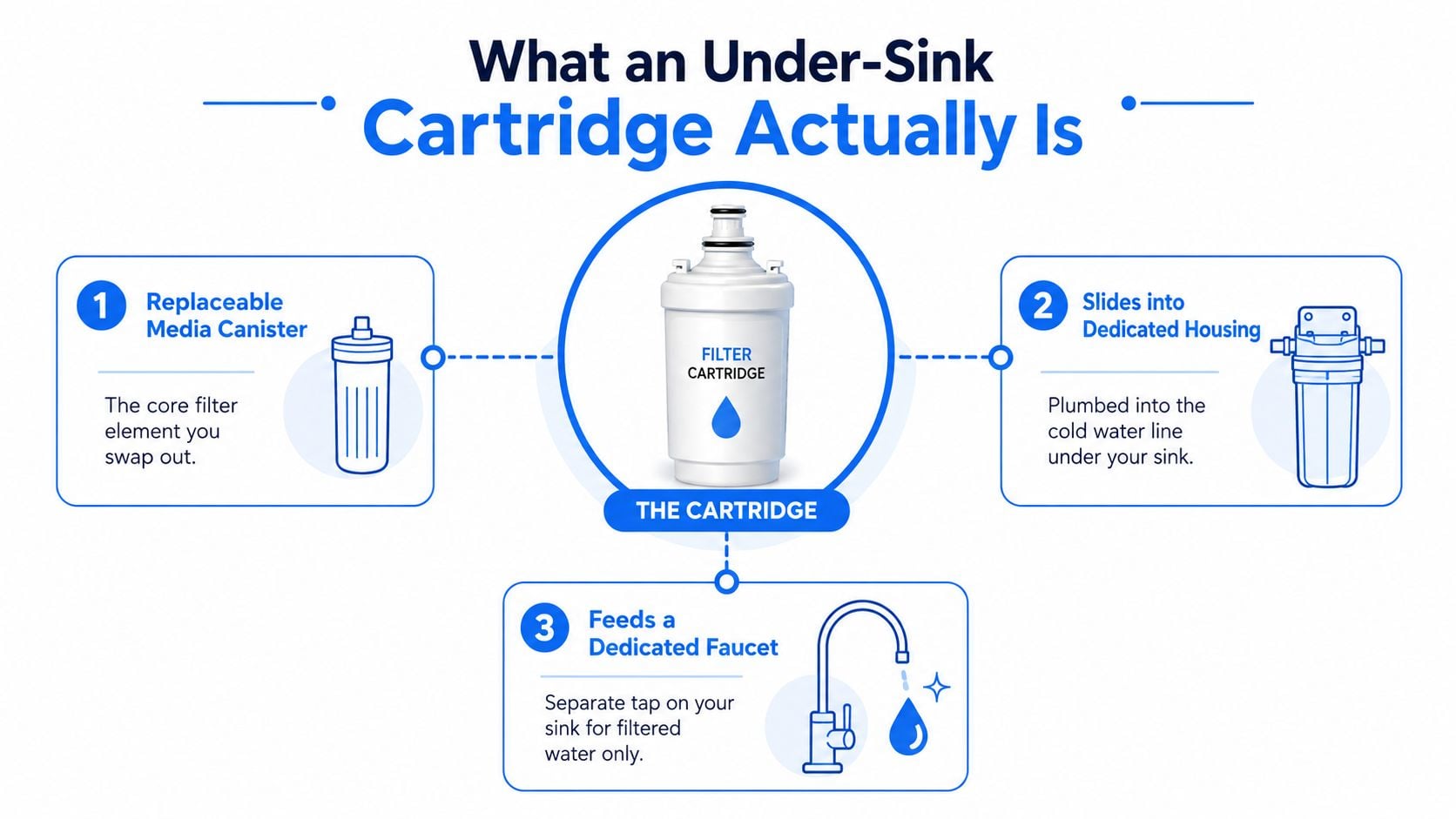
### The main media families
**Sediment cartridges** use pleated or spun polypropylene to catch physical particles such as rust, sand, silt, dust, and pipe scale. They often sit before a carbon stage because trapped sediment can clog finer media and reduce its useful life.
**Carbon cartridges** contain granular activated carbon or carbon block. Their familiar role is reducing chlorine, taste, and odor. Some are also certified for health-related contaminant reductions, but that depends on the specific product and its listing, not only on the word “carbon.”
**Specialty media** can include KDF, ion-exchange resin, or alkaline ceramic. Each is chosen for particular water concerns, so its usefulness depends on the stated contaminant targets and tested configuration.
Reverse osmosis systems use several stages rather than one general-purpose cartridge. A typical arrangement includes sediment and carbon pre-filters, a semipermeable membrane, and post-treatment. Each stage has a separate job, although a standalone cartridge may combine multiple media types in one canister.
For example, the [Woder Sediment Removal and Advanced Dual Filtration System](https://woder.com/products/wd-d-20m-g4-dc/) pairs a 20µ sediment-removal first stage with ADV Filtration. Its listed targets include lead, PFAS, heavy metals, chlorine, mercury, chromium 6, chloramines, VOCs, odors, tastes, and sediment. The product states that its WD-GEN4-2512TC second-stage cartridge is WQA certified to NSF/ANSI 42 for chlorine taste and odor and NSF/ANSI 372 for lead-free compliance.
## Micron Ratings Explained in Real Terms
A **micron** is a unit of length, roughly **1/25,000 of an inch**. On a filter label, the number indicates the particle size the cartridge is designed to capture under specific test conditions. It is one part of the selection process, not a score for overall quality, and it does not show whether the cartridge reduces dissolved substances such as PFAS, fluoride, or chlorine.
The rating works like a sieve size. A larger opening generally allows more water through, while a finer one can hold back smaller particles but may increase resistance. A 20-micron sediment cartridge is commonly used before finer media to catch visible particles, sand, rust, and pipe scale. A 5-micron carbon block may reduce chlorine, cysts, and cloudiness when the product is designed and certified for those claims. A 1-micron block handles finer sediment and may address asbestos fibers under applicable testing. A 0.5-micron sub-micron block may meet cyst or bacterial reduction standards when specifically certified, though it can reduce faucet flow more quickly as pressure loss rises.
Micron RatingTypical Cartridge TypeWhat It CatchesTradeoff to Expect20 micronSediment pre-filterSand, rust, dust, silt, and pipe scaleHigher flow, but it leaves finer particles behind5 micronCarbon block or finer sediment elementChlorine-related treatment, cysts, and much cloudiness when certifiedMore pressure loss than a coarse pre-filter1 micronFine carbon blockFiner sediment and specific particle targets such as asbestos fibers when certifiedFlow can fall as the cartridge loads0.5 micronSub-micron carbon blockCyst and bacterial reduction when the exact product is certifiedGreater resistance and potentially earlier replacementA cartridge's **nominal** and **absolute** ratings describe different levels of performance. Nominal filtration indicates general particle reduction. Absolute filtration refers to a tighter threshold measured under a defined test, so the terms should not be treated as interchangeable.
Choose the rating by considering your incoming water, the cartridge's certified claims, and the system it fits. If sediment is the main issue, a coarse pre-filter can protect a finer stage while preserving more flow. If health-related contaminants are the concern, the tested contaminant list matters more than selecting the smallest micron number. The explanation of [what a 0.5-micron filter means](https://woder.com/blog/water-filter-0-5-micron/) can help clarify why a small rating alone is not a complete safety answer.
## Cartridge Sizes, Fittings, and Connection Types
The cartridge's physical format determines compatibility before the media type enters the discussion. Under most kitchen sinks, you'll encounter four broad designs.
The **standard 2.5-inch cartridge**, often roughly 10 inches tall, fits many two-stage and three-stage housings. The **large-diameter version**, often called “Big Blue,” provides more media volume and is used where the system needs greater flow or capacity. Those larger housings require matching cartridges and won't accept standard narrow elements.
A **quick-change cartridge** twists into a dedicated head and pulls out without opening a sump. An **inline cartridge** has no reusable housing. It connects directly to tubing, often through 1/4-inch fittings, and is common for direct-connect drinking lines, refrigerators, ice makers, and coffee equipment.
Form FactorTypical DimensionsConnection StyleCommon SystemsStandard drop-inAbout 2.5 inches wide and roughly 10 inches tallHousing with threaded sump and O-ring sealTwo-stage and three-stage under-sink housingsLarge diameterWider than standard drop-inMatching large housing and fittingsHigher-volume or higher-flow systemsQuick-changeProprietary shape determined by filter headTwist-lock head connectionCompact single-stage or multi-stage systemsInlineNarrow sealed canister1/4-inch NPT or push-to-connect tubing fittingsDirect-connect faucet, refrigerator, ice-maker, and beverage linesThreads can be another source of confusion. A 1/4-inch NPT threaded port isn't the same as a push-to-connect fitting in which tubing slides into a John Guest-style connector. The cartridge body may be compatible while the fittings still require a different adapter.
O-ring placement matters too. Some cartridges seal at the top, some at the bottom, and some use tabs or a molded interface instead of a loose O-ring. The [Woder water filter housing guide](https://woder.com/blog/water-filter-housing-10/) shows why the housing and cartridge have to be treated as one matched assembly.
The [Woder Advanced HM and Lead Removal Dual Filtration System](https://woder.com/products/wd-d-hmg4-g4-dc/) is a U.S.-made dual-stage system formulated for households and communities where testing has confirmed heavy-metal concentrations above EPA maximum contaminant levels. Its WD-GEN4-2512TC second-stage cartridge is WQA certified to NSF/ANSI 42 for chlorine taste and odor and NSF/ANSI 372 for lead-free compliance, according to the product snapshot.
## Matching a Replacement Cartridge to Your Existing System
The safest replacement process starts with identification, not browsing. Open the cabinet and photograph the entire assembly before disconnecting anything. Include the housing, manifold, tubing, faucet connection, labels, and the old cartridge's printed end.
### Use the system's own clues
Check the brand label on the sump or filter head first. If the label is missing, inspect the cartridge for a stamped part number, molded end-cap code, or identifying tabs. A multi-stage manifold may also carry the model number on its bracket or central panel.
Woder Gen3 and Gen4 systems use their own replacement families, and a Gen4 successor may not be a universal substitute for every Gen3 configuration. The same caution applies to standard 10-inch housings sold under brands such as APEC, iSpring, and Whirlpool WHKF-DB0. “10-inch” describes length, not every dimension that controls sealing.
Culligan US-550 systems, direct-connect inline formats from PUR, and Woder inline setups may all look like simple under-sink filters, but their heads and fittings can differ. A cartridge that threads onto one head may need a push-to-connect interface on another.
> **Practical rule:** Match the head, diameter, end-cap style, and O-ring location before comparing micron ratings.
Don't assume that a replacement cartridge from one manufacturer fits another brand's housing just because both listings mention standard dimensions. Compare the printed specification sheet with the stamped cap or manifold model. If those identifiers conflict, pause before ordering. A manufacturer's replacement-parts reference is more reliable than a marketplace category label.
## Reading an NSF Listing Like a Shortcut
An NSF/ANSI mark is useful only when you read what it covers. **NSF/ANSI 42** addresses aesthetic effects, including chlorine taste and odor. **NSF/ANSI 53** covers health-effect contaminants, including reductions such as lead, cysts, and other regulated contaminants when the specific product is listed for them. **NSF/ANSI 401** addresses emerging contaminants. These distinctions are summarized in this [NSF/ANSI certification comparison](https://www.frizzlife.com/blogs/guide/nsf-ansi-water-filter-certification-42-vs-53-58-401).
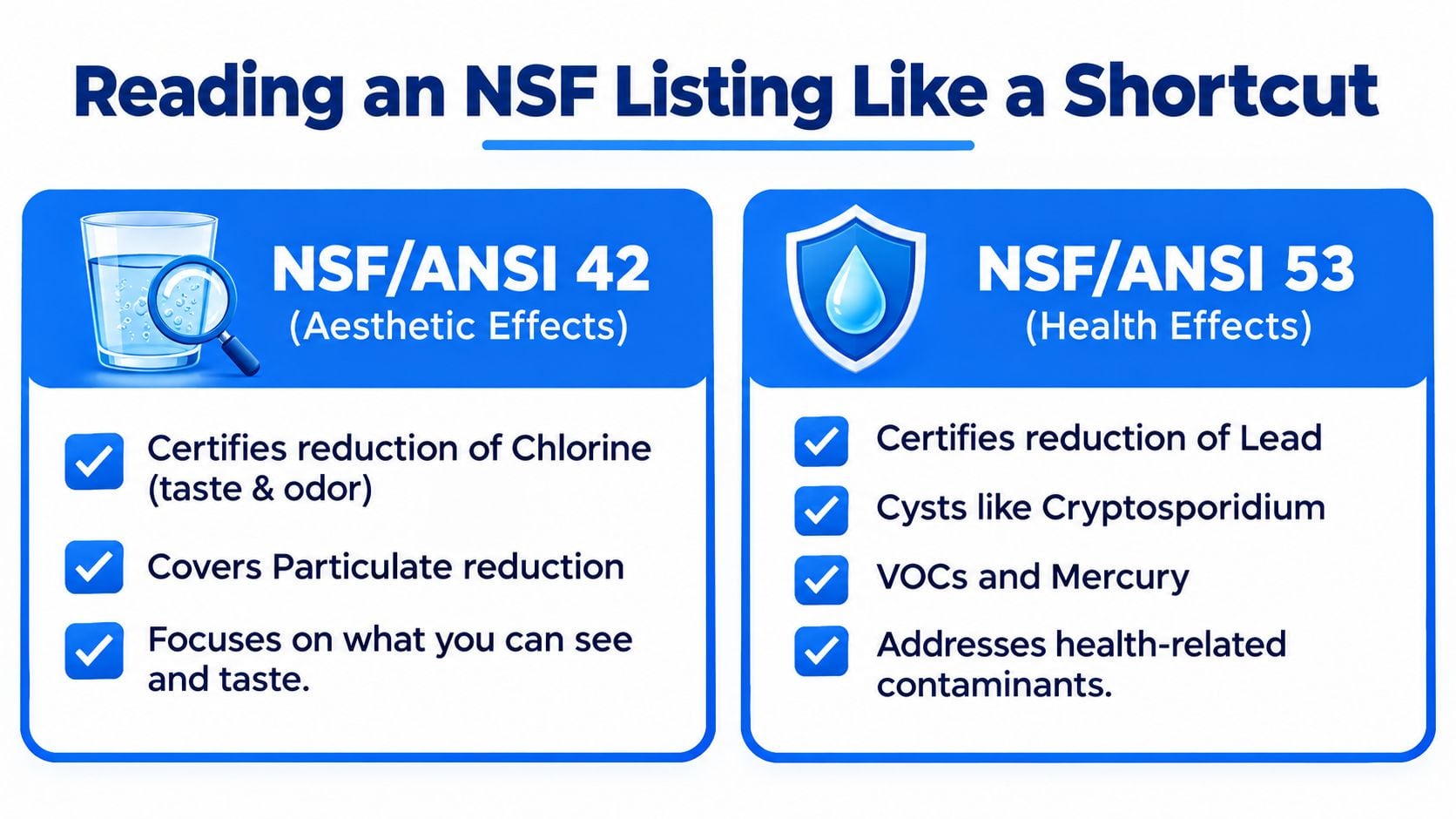
The standard applies to a tested product and configuration. A brand may sell several cartridges, but that doesn't mean every cartridge carries the same certification or contaminant claim. Look for the exact model, the standard number, the contaminant, and the rated capacity.
### A practical reading checklist
- **Start with the concern:** Use the water utility report or a certified home test to identify the contaminant you're trying to reduce.
- **Verify the endpoint:** Confirm that the exact cartridge listing names that contaminant, not just “impurities” or “heavy metals.”
- **Read the wording:** “Reduces” describes tested performance under defined conditions. It isn't the same as claiming total removal in every home.
- **Check operating conditions:** Flow rate, pressure, capacity, and cartridge configuration affect how the system performs.
- **Ignore irrelevant badges:** Don't pay extra for a certification that doesn't address a concern present in your water.
NSF also identifies point-of-use systems as a category with voluntary national standards because no federal regulations govern residential filters, purifiers, and reverse osmosis systems. NSF/ANSI 42 and NSF/ANSI 53 therefore function as major U.S. benchmarks for cartridge-based systems, including under-sink devices. [NSF's lead-reduction listings](https://info.nsf.org/Certified/dwtu/listings_leadreduction.asp) are a useful place to verify a specific health-effect claim.
## Swapping Out a Cartridge Without Flooding the Cabinet
A cartridge replacement is usually manageable, but water pressure turns small mistakes into cabinet damage quickly. Start by locating the cold-water shutoff, either at the dedicated stop or the system's supply valve. Close it before loosening any housing.
Open the dedicated filtered-water faucet. That releases pressure in the line and makes the housing easier to open. Put a towel and shallow pan under the sump because some water will remain inside even after the supply is closed.
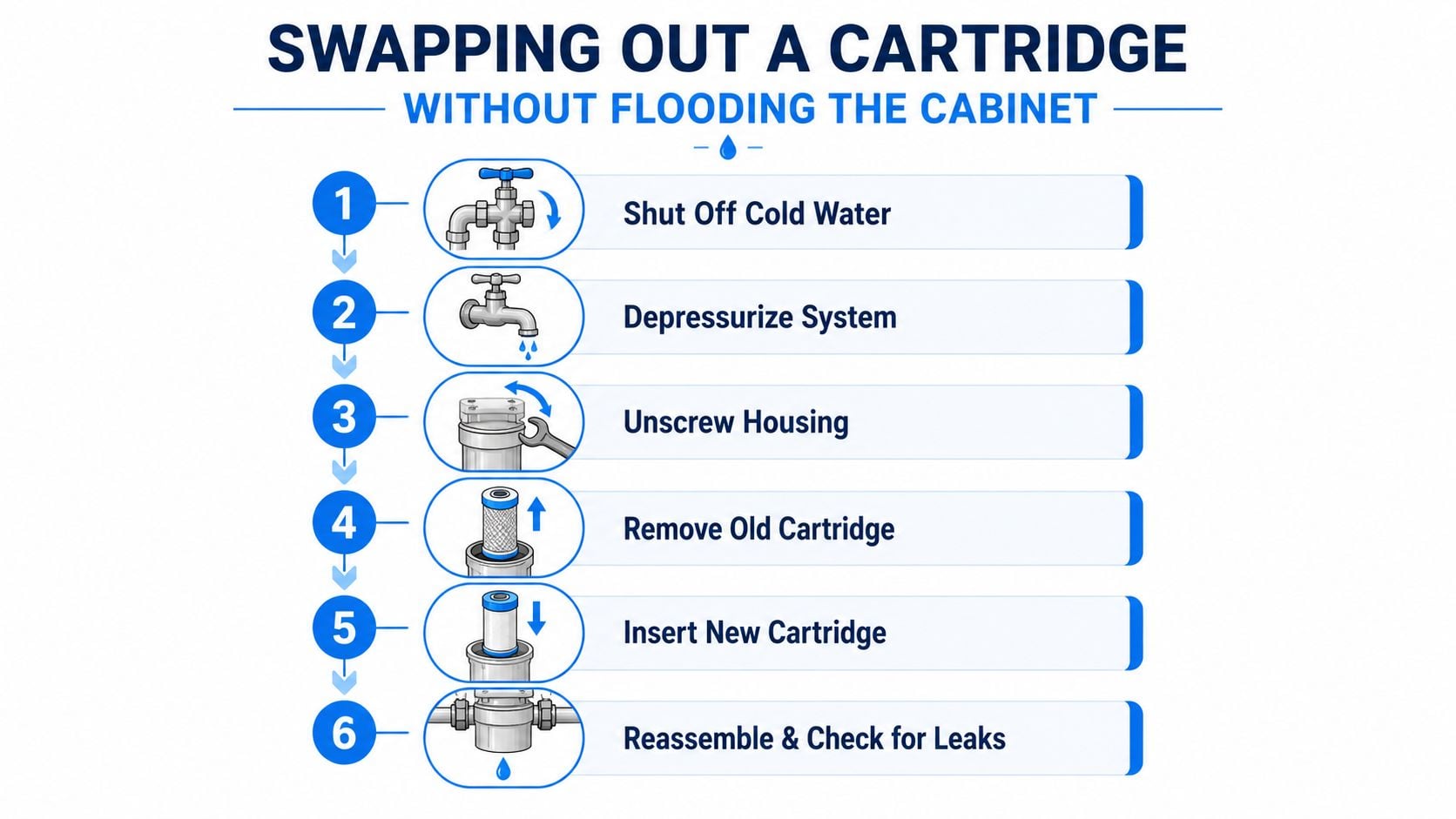
### The standard housing sequence
1. **Shut off the cold water.** Turn the valve fully, but don't force a stiff or corroded valve.
2. **Depressurize the system.** Leave the dedicated faucet open until flow stops.
3. **Open the housing.** Twist the sump carefully, keeping the pan underneath.
4. **Remove the old cartridge.** Note which end faces up and how the O-ring sits.
5. **Insert the replacement.** Seat it straight, with the correct end and seal in place.
6. **Reassemble and test.** Thread the sump by hand first so it doesn't cross-thread.
Quick-change cartridges skip the sump step. They typically twist out of the filter head and the replacement locks into place, but the exact turning direction varies by system.
Inspect the O-ring before reassembly. A pinched, dirty, dry, or displaced O-ring can cause a slow leak. Push-to-connect tubing creates another common failure point. The tube must be cut square and inserted fully into the fitting, with the collet engaged around it.
Reopen the supply slowly and watch the housing, fittings, and tubing for at least five minutes. Confirm flow at the faucet, then flush the new cartridge according to its instructions. Carbon cartridges commonly need several gallons flushed to clear carbon fines. The [under-sink cartridge replacement guide](https://woder.com/blog/how-to-replace-water-filter/) offers another visual reference for the sequence.
Here's a video showing the replacement process:
## When to Replace Based on Use, Not the Calendar
The familiar **6 to 12 month** replacement range is a starting point, not a universal rule. Carbon cartridge life depends on the manufacturer's rated interval or gallon capacity, whichever comes first, along with incoming chlorine or chloramine load and the volume of water processed. [Maintenance guidance for filter media replacement](https://purewaterguys.com/blogs/pure-water-guide/filter-media-replacement-schedule) explains why adsorption media can exhaust before flow visibly drops.
A household that uses filtered water for every drink, pot of pasta, coffee, and ice will consume a cartridge faster than a lightly used drinking tap. High sediment can also load a cartridge early, even when the water still tastes acceptable.
### Build a simple usage record
Write the installation date on the housing with a permanent marker. Record the cartridge's rated capacity and estimate how much filtered water the household uses over several days. A state health resource recommends estimating daily sink usage over **3 days** to help decide when replacement is due, rather than relying only on a generic interval. [This public tap-water filter guidance](https://trackingcalifornia.org/projects/tap/filters) also warns that overused cartridges may lose effectiveness and can allow bacterial growth.
Use these clues as supporting signals:
- **Flow changes:** A noticeable reduction can indicate sediment loading or pressure loss.
- **Taste returns:** Chlorine taste or odor returning may signal exhausted carbon media.
- **Water-use rises:** Heavy cooking, frequent beverage preparation, or a larger household shortens the service interval.
- **Source conditions change:** A plumbing repair, well disturbance, or utility treatment change can alter cartridge loading.
Don't treat normal flow as proof that the cartridge is still performing. Adsorption capacity can be depleted without a dramatic visual or taste warning. Replace on the rated schedule when usage tracking is uncertain, and replace sooner when the water profile or household demand has changed.
## Standard Carbon vs Selective Filtration vs RO Stages
The three approaches under a kitchen sink serve different purposes. **Standard carbon** is a practical choice for chlorine taste, odor, and some chemical compounds. It generally leaves naturally occurring minerals in the water and doesn't function as a broad dissolved-solids remover.
**Selective filtration** uses media chosen for particular contaminants. Woder's **Advanced Selective Filtration®** is designed to target listed contaminants such as PFAS, lead, heavy metals, fluoride, chromium, and chlorine while retaining essential minerals. The product claims must still be matched to the specific cartridge, certification, and tested contaminant list.
Reverse osmosis adds a semipermeable membrane. It can achieve very low TDS by removing dissolved solids broadly, but it also strips minerals and usually requires more equipment, maintenance, and water handling than a single cartridge. A zero-TDS reading isn't proof that water is healthier. It indicates that dissolved solids, both desirable and undesirable, have been removed.
Filter TypeRemovesKeeps MineralsFlow ImpactBest ForStandard carbonChlorine, taste, odor, and listed chemical targetsGenerally yesUsually lower complexity and less resistance than ROTaste and odor concernsSelective filtrationSpecific listed contaminants such as lead, PFAS, metals, fluoride, chromium, and chlorineDesigned to retain essential mineralsDepends on media and configurationTargeted contaminant reduction without mineral strippingRO stagesBroad dissolved-solids and contaminant reduction through a membraneNo, unless a remineralization stage is addedSlower, with more equipment and wastewaterSituations requiring broad dissolved-solids reductionThe right comparison depends on the water report, not on the most aggressive-sounding technology. Readers deciding between countertop, pitcher, and installed systems may also find this guide helpful for how to [compare pitcher and under-sink filters](https://grifglo.com/blogs/blog/best-water-filters).
## Quick Reference Table for Choosing Your Next Cartridge
Use this table as a first-pass lookup, then verify the exact part number and housing interface. Typical micron ranges describe common formats, not a guarantee for every product in that category.
Cartridge TypeTypical Micron RatingPrimary Reduction TargetCommon Compatible SystemsStandard 2.5-inch carbon blockAbout 0.5 to 5 micronChlorine, taste, odor, and listed health-related contaminantsStandard two-stage or three-stage housingsLarge-diameter carbonProduct-specificChlorine, taste, odor, and listed chemical targetsLarge-volume housingsQuick-change twistProduct-specificDepends on the dedicated cartridge designMatching quick-change filter headInline sedimentOften around 20 micron for pre-sedimentationSand, dust, dirt, silt, and visible particlesDirect-connect lines and pre-filter arrangementsReverse osmosis stagesStage-specificSediment, chlorine, dissolved solids, and membrane-specific contaminantsRO systems with matched pre-filters, membrane, and post-filterWoder Gen3 or Gen4 replacementProduct-specificDepends on the exact replacement model and systemMatching Woder Gen3 or Gen4 housing and headStart with the **existing housing and fittings**. Then confirm the cartridge dimensions, micron range, rated capacity, and NSF listing against the water concerns present in your home. If PFAS, lead, fluoride, chromium, or heavy metals are the reason you're shopping, don't rely on a generic “multi-contaminant” label.
Check the cartridge's exact model number, compare it with the system documentation, and record the installation date after you replace it. That small habit prevents the next cabinet-floor search.
---
Woder Filters offers U.S.-made point-of-use systems and replacement cartridges using Advanced Selective Filtration® to target listed contaminants while retaining essential minerals. Visit [Woder Filters](https://woder.com) to match an under-sink cartridge to your existing system, water concerns, and installation needs.
**Categories:** Woder Science
**Tags:** filter installation, micron rating, NSF certified filters, replacement cartridge, under sink water filter cartridge
---
### [Water Softener Alternative: When a Filter Is All You Really Need](https://woder.com/blog/water-softener-filter-alternative/)
**Published:** August 20, 2026
**Author:** woder
**Content:**
- [What a Water Softener Actually Does](#what-a-water-softener-actually-does)
- [What a Water Filter Actually Does](#what-a-water-filter-actually-does)
- [The Overlap: When Hard Water and Contamination Both Matter](#the-overlap-when-hard-water-and-contamination-both-matter)
- [Do You Actually Have Hard Water, or Just a Contamination Problem?](#do-you-actually-have-hard-water-or-just-a-contamination-problem)
- [Why a Filter Is Often All You Need](#why-a-filter-is-often-all-you-need)
- [A Quick Decision Framework](#a-quick-decision-framework)
- [What to Look for in a Filter If You Skip the Softener](#what-to-look-for-in-a-filter-if-you-skip-the-softener)
- [The Bottom Line](#the-bottom-line)
- [Frequently Asked Questions](#frequently-asked-questions)
You've noticed the white crust around your faucet. Maybe your skin feels dry after a shower, or your dishes come out spotted. So you type "water softener" into a search bar — and then pause. Because somewhere in the back of your mind, you're not sure that's actually what you need.
That pause is worth listening to.
A water softener and a water filter are not the same thing. They solve different problems. And for many homeowners, a quality inline filter handles everything that actually matters — without the salt, the maintenance, or the $1,000+ installation bill.
Here's how to figure out which one your household actually needs.
---
### What a Water Softener Actually Does
A water softener targets hard water. Hard water contains elevated levels of calcium and magnesium — minerals that leave scale deposits on pipes, appliances, and fixtures. A traditional ion-exchange softener swaps those minerals out for sodium ions, which don't cause scale.
That's the whole job.
A softener does not remove lead. It doesn't filter out PFAS. It won't reduce chlorine, chromium 6, mercury, or volatile organic compounds. If your concern is drinking water safety, a softener leaves all of that untouched.
There's also a side effect worth knowing: softened water tastes flat to many people. The calcium and magnesium that got removed are the same minerals that give water its natural, slightly crisp character. You traded scale prevention for stripped water.
---
### What a Water Filter Actually Does
A water filter targets contaminants — the stuff in your water that poses a health risk or affects taste and smell. Depending on the technology, that means removing lead, PFAS, chlorine, chromium 6, mercury, carcinogens, and volatile organic compounds.
The key difference between filter types comes down to what they do with minerals.
Reverse osmosis removes almost everything, including the calcium and magnesium your body uses. That's why so many homeowners searching for a water softener alternative end up frustrated with RO — you fix one problem and create another.
Selective filtration takes a different approach. [Woder's Advanced Selective Filtration](https://woder.com) uses nanoparticles to attract and remove specific contaminants while leaving beneficial minerals intact. You get 99.9% reduction of lead, PFAS, chlorine, chromium 6, mercury, and VOCs — and you keep the calcium and magnesium that make water taste right and support your health.
That's not stripped water. It's clean water.
---
### The Overlap: When Hard Water and Contamination Both Matter
Some households have genuinely hard water and legitimate contamination concerns. If that's your situation, you're not really choosing between a softener and a filter — you may need both, running in sequence.
A common setup: a whole-house softener on the main line to protect your pipes and appliances, plus an inline point-of-use filter at the kitchen tap for drinking and cooking water. The softener handles scale. The filter handles safety.
But before you spend money on both, it's worth asking a simpler question first.
---
### Do You Actually Have Hard Water, or Just a Contamination Problem?
Hard water and contaminated water produce different symptoms.
**Signs you likely have hard water:**
- White or chalky deposits on faucets, showerheads, and kettles
- Soap that doesn't lather well
- Spots on glassware and dishes after washing
- Reduced efficiency in your water heater or dishwasher over time
**Signs your concern is contamination:**
- Metallic or chemical taste in tap water
- Chlorine smell, especially after municipal treatment
- A local PFAS or lead advisory you've seen in the news
- Older pipes or a home built before 1986
- Elevated contaminants listed in your municipal water report
If your symptoms fall into that second column, a water softener won't help you at all. You need filtration — specifically filtration that targets the contaminants you're actually worried about.
---
### Why a Filter Is Often All You Need
Most homeowners searching for a water softener alternative aren't dealing with severe scale buildup. They're dealing with water that tastes off, smells like chlorine, or comes from a municipality that's been in the news for PFAS or lead contamination.
For those households, an inline filter like Woder is a complete answer.
- No salt to buy or refill
- No brine discharge into the water supply
- No $800 to $1,500 installation cost
- No plumber required — Woder connects inline in under 30 minutes
- No wastewater, no pressurized tank, no drain line
- Replacement cartridges run $40 to $80 per year
Compare that to a traditional softener, which requires ongoing salt purchases, periodic regeneration cycles, and professional servicing. Or to a reverse osmosis system, which runs $300 to $600 installed and strips out the minerals you want to keep.
A selective filter sits in the middle — doing more for drinking water safety than a softener, and doing it without the cost or complexity of RO.
---
### A Quick Decision Framework
Your situationWhat you likely needScale on fixtures, spotty dishes, dry skinWater softener (or descaler)Metallic taste, chlorine smell, PFAS concernPoint-of-use filterBoth scale and contamination concernsSoftener on main line + filter at the tapYou want clean drinking water, full stopInline filterIf you're still not sure what's in your water, Woder offers water testing kits that give you a clear starting point before you spend anything.
---
### What to Look for in a Filter If You Skip the Softener
Not all filters are equal. When you're comparing options, these are the things that actually matter:
**Contaminant coverage.** Look for verified removal of lead, PFAS, chlorine, and chromium 6 at minimum. Vague claims about "improving taste" aren't enough.
**Mineral retention.** If you're avoiding a softener or RO specifically because you want to keep minerals, confirm the filter uses selective filtration — not a membrane that strips everything out.
**Filter life.** Woder's models are rated at 5K, 8K, and 10K gallons depending on the unit. Longer filter life means lower annual cost and less time spent on maintenance.
**Installation simplicity.** An inline filter that connects to your existing water line without a plumber is a real advantage. Woder's 30-minute setup is an actual number, not a marketing claim.
**US manufacturing.** When you're filtering drinking water, knowing where the filter was made matters. Woder manufactures in the US.
---
### The Bottom Line
A water softener is a specific tool for a specific problem: scale from hard water. If that's genuinely your issue, it does its job well. But if your real concern is what's in your drinking water — lead, PFAS, chlorine, or other contaminants — a softener won't touch any of that.
For most homeowners, a quality inline filter is the smarter, simpler, and more affordable answer. It removes what you don't want. It keeps what you do. And it installs in the time it takes to watch a short video.
It's your water. Make sure what's in it is actually what you want.
Explore the full Woder filter lineup and find the right model for your household at [woder.com](https://woder.com).
---
### Frequently Asked Questions
**Can a water softener replace a water filter?**
No. A water softener removes calcium and magnesium to prevent scale, but it doesn't filter out contaminants like lead, PFAS, chlorine, or chromium 6. If your concern is drinking water safety, you need a filter, not a softener.
**Is a water filter a good alternative to a water softener?**
It depends on your actual problem. If hard water is causing scale on fixtures and appliances, a filter won't solve that. But if your concern is taste, odor, or health-related contaminants, a point-of-use filter is often all you need — and it's significantly cheaper and easier to install than a softener.
**Does a water filter remove hardness minerals like calcium and magnesium?**
Most standard filters don't remove hardness minerals. Reverse osmosis systems do, but many homeowners consider that a drawback. Woder's Advanced Selective Filtration is specifically designed to keep calcium and magnesium while removing harmful contaminants.
**What's the cost difference between a water softener and an inline filter?**
A traditional water softener typically costs $800 to $1,500 installed, plus ongoing salt and servicing costs. An inline filter like Woder runs $80 to $200 for the unit and $40 to $80 per year on replacement cartridges — a fraction of what a softener requires over time.
**Do I need both a water softener and a water filter?**
Some households benefit from both — a whole-house softener to protect pipes and appliances, plus a point-of-use filter at the kitchen tap for drinking water. But many homeowners only need the filter. Start by testing your water to understand what you're actually dealing with before buying either.
**How do I know if my water problem is hardness or contamination?**
Hard water typically shows up as white scale deposits on fixtures, spotty dishes, and poor soap lather. Contamination usually presents as a metallic or chemical taste, a chlorine smell, or elevated levels listed in your municipal water quality report. A water testing kit gives you a definitive answer.
**How long does a Woder filter take to install?**
Woder filters connect inline to your existing water line and typically install in under 30 minutes. No plumber needed, and there's no tank, drain line, or wastewater involved.
**Categories:** Woder Science
---
### [Nitrates in Drinking Water: Where They Come From and How to Remove Them](https://woder.com/blog/nitrates-drinking-water-remove/)
**Published:** August 19, 2026
**Author:** woder
**Content:**
- [What Are Nitrates?](#what-are-nitrates)
- [Where Do Nitrates Come From?](#where-do-nitrates-come-from)
- [Agricultural Runoff](#agricultural-runoff)
- [Septic Systems](#septic-systems)
- [Industrial Discharge](#industrial-discharge)
- [Natural Sources](#natural-sources)
- [What Are the Health Risks?](#what-are-the-health-risks)
- [How to Know If Your Water Has Nitrates](#how-to-know-if-your-water-has-nitrates)
- [Check Your Annual Water Quality Report](#check-your-annual-water-quality-report)
- [Test Your Well](#test-your-well)
- [How to Remove Nitrates from Drinking Water](#how-to-remove-nitrates-from-drinking-water)
- [Reverse Osmosis (RO)](#reverse-osmosis-ro)
- [Ion Exchange (Anion Exchange)](#ion-exchange-anion-exchange)
- [Distillation](#distillation)
- [What About Standard Carbon Filters?](#what-about-standard-carbon-filters)
- [Where Woder Fits In](#where-woder-fits-in)
- [Practical Steps If You're Concerned About Nitrates](#practical-steps-if-youre-concerned-about-nitrates)
- [Frequently Asked Questions](#frequently-asked-questions)
Nitrates don't smell. They don't taste like anything. You won't see them in your glass. That's what makes them one of the more unsettling contaminants in tap water — they can be present at harmful levels without giving you any warning at all.
If you've recently checked your municipal water quality report or tested a private well and nitrates showed up, you're not alone. Here's what you need to know: where nitrates come from, what the health risks actually look like, and what works for removing them from your drinking water.
### What Are Nitrates?
Nitrates are nitrogen-based compounds that occur naturally in soil, but the concentrations that end up in drinking water are almost always the result of human activity. They're water-soluble, which means they move easily through soil and into groundwater or surface water supplies.
The EPA sets the maximum contaminant level (MCL) for nitrates in public drinking water at 10 milligrams per liter (mg/L), measured as nitrogen. That standard exists because nitrate exposure above that threshold carries real health consequences — particularly for infants and pregnant women.
### Where Do Nitrates Come From?
#### Agricultural Runoff
This is the single biggest source. Fertilizers — both synthetic and organic, including manure — are high in nitrogen. When it rains, water carries nitrates from fields into streams, rivers, and groundwater. Communities near farming areas, especially across the Midwest, consistently show elevated nitrate levels.
#### Septic Systems
Older or failing septic systems can leach nitrates into surrounding soil and eventually into groundwater. If your home uses a private well and there's a septic system nearby, regular nitrate testing is worth doing.
#### Industrial Discharge
Certain manufacturing processes and wastewater treatment facilities release nitrogen compounds that can reach local water supplies. Urban areas aren't immune, though agricultural runoff tends to be the dominant driver nationally.
#### Natural Sources
Some nitrate presence in water is natural — soil decomposition and lightning-driven nitrogen fixation both contribute small amounts. But naturally occurring nitrates rarely reach concentrations that raise health concerns. When levels get high, land use is almost always the reason.
### What Are the Health Risks?
The most documented risk is methemoglobinemia, sometimes called "blue baby syndrome." In infants under six months, high nitrate intake interferes with the blood's ability to carry oxygen. The EPA's 10 mg/L standard was originally set with this in mind.
For adults, the picture is more complex. Short-term exposure at elevated levels can cause similar oxygen-transport problems. Research over the past decade has also linked chronic high-nitrate exposure to increased risk of certain cancers, thyroid disruption, and adverse pregnancy outcomes — though the science on long-term adult exposure is still developing.
The practical takeaway: if your water tests above 10 mg/L, act on it. If you have an infant, are pregnant, or are immunocompromised, that threshold matters even more.
### How to Know If Your Water Has Nitrates
#### Check Your Annual Water Quality Report
If you're on a municipal supply, your utility is required to send you a Consumer Confidence Report (CCR) each year. It lists detected contaminants and whether they fall within legal limits. Nitrates will appear if they were detected.
#### Test Your Well
Private wells aren't regulated by the EPA. If you use well water, testing is your responsibility. The EPA recommends testing at least once a year for nitrates — especially if you live near farmland or have a septic system close by. Home test kits exist, but a certified lab gives you more reliable results.
You can also explore testing options at [Woder Filters](https://woder.com), which carries water testing products to help you understand what's actually in your tap water before choosing a filter.
### How to Remove Nitrates from Drinking Water
Not every filter removes nitrates — and this is one of the most important things to understand when shopping for a water filter for nitrates. Standard carbon block filters and basic pitcher filters do a solid job with chlorine, some VOCs, and taste and odor issues, but they don't reliably remove nitrates.
Here are the methods that do work:
#### Reverse Osmosis (RO)
Reverse osmosis is one of the most effective options for nitrate removal. It forces water through a semipermeable membrane that blocks nitrates along with a wide range of other contaminants, typically reducing nitrate levels by 83 to 92 percent or more depending on the system and water chemistry.
The tradeoffs are real, though. RO strips out beneficial minerals alongside contaminants — calcium and magnesium both get removed. It also wastes water (typically 3 to 4 gallons for every gallon produced), requires a storage tank, and usually needs professional installation. For some households, that's the right call. For many, it's more than necessary.
#### Ion Exchange (Anion Exchange)
Ion exchange resins designed specifically for nitrate removal work by swapping nitrate ions for chloride ions. These systems are highly effective and widely used in municipal treatment. Point-of-use anion exchange units exist for home use, though they require periodic regeneration with salt and can be more involved to maintain than standard filters.
#### Distillation
Distillation removes nitrates by boiling water and collecting the steam, leaving contaminants behind. It works, but it's slow, energy-intensive, and strips out minerals in the process — similar to RO in that respect.
#### What About Standard Carbon Filters?
Carbon filters — activated carbon block or granular activated carbon — are excellent for chlorine, chloramines, VOCs, PFAS, lead, and many other contaminants. Nitrates aren't on that list. If nitrate removal is your primary goal, a carbon-only filter won't be enough on its own.
### Where Woder Fits In
Woder's Advanced Selective Filtration technology removes 99.9% of lead, chlorine, chromium 6, mercury, PFAS, carcinogens, and volatile organic compounds — while keeping beneficial minerals like calcium and magnesium intact. That's a meaningful range of contaminants addressed without the mineral stripping that comes with reverse osmosis.
Nitrates, however, require a different filtration mechanism — typically ion exchange or RO membrane technology. Woder filters are built to handle the contaminants their technology targets well, and being straightforward about that matters more than overpromising.
If your water test shows nitrates above the EPA limit, you'll want a filter specifically rated for nitrate removal, whether that's an RO system or an anion exchange unit. If your water also contains lead, PFAS, chlorine, or other contaminants alongside nitrates, a layered approach may make sense — and that's where Woder can be part of the solution.
Not sure what's in your water? Testing first is the smartest move. Once you know what you're dealing with, you can match the right filter to the actual problem. The product finder at [woder.com/wizard](https://woder.com/wizard) can help you identify the right Woder model for the contaminants their filters are built to address.
### Practical Steps If You’re Concerned About Nitrates
1. **Test your water.** Don't guess. A certified lab test gives you actual numbers to act on.
2. **Check your CCR.** If you're on city water, your annual report tells you what was detected and at what levels.
3. **Match your filter to your problem.** If nitrates are confirmed above 10 mg/L, look specifically for a filter rated for nitrate removal — ion exchange or RO.
4. **Consider the full picture.** Most water quality issues aren't single-contaminant problems. Lead, PFAS, and chlorine are common alongside nitrates, especially in older homes or agricultural areas.
5. **Replace cartridges on schedule.** Whatever filter you use, an expired cartridge doesn't protect you. Stay on top of replacement intervals.
---
### Frequently Asked Questions
**What is the safe level of nitrates in drinking water?**
The EPA's maximum contaminant level for nitrates in public water supplies is 10 mg/L (measured as nitrogen). Levels above this are considered unsafe, particularly for infants under six months, pregnant women, and people with certain health conditions.
**Can you taste or smell nitrates in water?**
No. Nitrates are colorless, odorless, and tasteless at the concentrations typically found in drinking water. The only way to know if your water contains elevated nitrates is to test it.
**Do standard water filters remove nitrates?**
Most standard carbon filters do not. Effective nitrate removal requires reverse osmosis, anion exchange resin specifically rated for nitrates, or distillation. Always check a filter's performance data before assuming it handles nitrates.
**Is well water more likely to have nitrates than city water?**
Private wells aren't subject to federal regulation or routine testing, which makes contamination easier to miss. Municipal supplies are tested regularly and must meet EPA standards. That said, city water can still contain nitrates — it just has to stay below the legal limit to be distributed.
**How often should I test my well water for nitrates?**
The EPA recommends testing private wells at least once a year. More frequent testing makes sense if you live near active farmland, have a nearby septic system, or have had elevated results before.
**Are nitrates and nitrites the same thing?**
They're closely related but not identical. Nitrites are a converted form of nitrates and are actually more immediately toxic. The EPA sets a separate MCL for nitrites at 1 mg/L. Both can be present in water, and both are worth testing for if you're concerned about contamination.
**What's the best water filter for nitrates in a home setting?**
For point-of-use nitrate removal, reverse osmosis and anion exchange systems are the most reliable options. RO is widely available and effective, though it removes minerals along with contaminants and produces wastewater. If your concern is a broader mix of contaminants, testing first helps you choose a filter matched to your actual water quality.
---
Your water is worth knowing. Start with a test, read your results, and pick a filter built for what's actually in your water. Find your Woder at [woder.com](https://woder.com).
**Categories:** Woder Science
---
### [Best Drinking Water Filter System Guide 2026](https://woder.com/blog/drinking-water-filter-system/)
**Published:** August 19, 2026
**Author:** woder_admin
**Content:**
A parent fills a child's glass at the kitchen tap, then notices the latest Consumer Confidence Report waiting in the mail. A quick search for a **drinking water filter system** opens a maze of carbon blocks, reverse osmosis membranes, selective media, NSF standards, replacement schedules, and confident product claims. The difficult question isn't whether filtration exists. It's which contaminants are present in this home, and whether a specific system has verified performance against them.
The right choice depends on more than a product category. A municipal supply, an older home with possible lead plumbing, and a private well can present very different filtration needs. The following guide focuses on how water moves through a household, what the main technologies do, where their limits are, and how to compare certified claims without treating any one system as a universal answer.
## Table of Contents
- [Why Choosing a Drinking Water Filter System Feels Overwhelming](#why-choosing-a-drinking-water-filter-system-feels-overwhelming)
- [The label doesn't tell the whole story](#the-label-doesnt-tell-the-whole-story)
- [The best system is specific to the house](#the-best-system-is-specific-to-the-house)
- [The Three Main Types of Point-of-Use Drinking Water Filter Systems](#the-three-main-types-of-point-of-use-drinking-water-filter-systems)
- [Faucet-mounted systems](#faucet-mounted-systems)
- [Countertop and inline systems](#countertop-and-inline-systems)
- [Under-sink systems](#under-sink-systems)
- [How Filtration Technologies Actually Work](#how-filtration-technologies-actually-work)
- [Activated carbon block](#activated-carbon-block)
- [Selective adsorption media](#selective-adsorption-media)
- [Reverse osmosis](#reverse-osmosis)
- [Matching Your Water to the Right Filter](#matching-your-water-to-the-right-filter)
- [Turn the report into a filter question](#turn-the-report-into-a-filter-question)
- [Reverse Osmosis Compared With Selective Filtration](#reverse-osmosis-compared-with-selective-filtration)
- [What RO changes](#what-ro-changes)
- [What selective filtration preserves](#what-selective-filtration-preserves)
- [Maintenance, Cartridge Life, and Real-World Ownership](#maintenance-cartridge-life-and-real-world-ownership)
- [Service life is a working estimate](#service-life-is-a-working-estimate)
- [Build a routine you can keep](#build-a-routine-you-can-keep)
- [What Clean Water Actually Means Beyond Zero TDS](#what-clean-water-actually-means-beyond-zero-tds)
- [A lower number isn't automatically a better glass](#a-lower-number-isnt-automatically-a-better-glass)
- [A Practical Framework for Choosing Your System](#a-practical-framework-for-choosing-your-system)
## Why Choosing a Drinking Water Filter System Feels Overwhelming
### The label doesn't tell the whole story
A household may begin with a simple concern, such as chlorine taste, then discover that filters marketed for taste aren't necessarily designed for lead, nitrate, fluoride, chromium, bacteria, or PFAS. The [EPA home drinking water filtration fact sheet](https://www.epa.gov/ground-water-and-drinking-water/home-drinking-water-filtration-fact-sheet) exists in part because homeowners need clearer explanations of what household systems do and don't treat.
Certification language adds another layer. NSF/ANSI 42, 53, 58, 401, and 473 don't mean the same thing, and a certification applies to a defined performance claim, not to every contaminant a product might encounter. A system can be well suited to chlorine reduction yet not be the right choice for nitrate or a particular PFAS claim.
> **Practical rule:** Choose the contaminant claim first, then choose the filter format that can deliver it conveniently.
### The best system is specific to the house
A family in a city apartment may want a compact filter for drinking and cooking, while a homeowner with a private well may need laboratory testing before selecting any cartridge. A water utility report can reveal what the supplier detects in treated water, but it won't always describe conditions inside a home's service line, plumbing, or storage equipment.
That distinction explains why generic “best filter” lists often disappoint. They rank features without answering the more important question, which is whether the product is certified for the substances in your water and remains practical for your daily use. A calm decision starts with the local water profile, then weighs **contaminant reduction, mineral retention, flow, installation, maintenance, and certification scope**.
The point-of-use market reflects how many households are looking for that kind of control. One market summary valued the global point-of-use water treatment systems market at **US$17.39 billion in 2024** and projects **US$38.72 billion by 2033**, with a projected **10.51% CAGR from 2025 to 2033**. The same summary estimates that about **780 million households** worldwide depend on these systems for drinking and cooking, and identifies North America as the largest regional market in 2024 with **38% share**. These figures come from the market summary published by Yahoo Finance.
## The Three Main Types of Point-of-Use Drinking Water Filter Systems
Before comparing filtration media, identify where the system sits. A point-of-use device treats water at one fixture, usually the kitchen sink, rather than filtering every line entering the home.
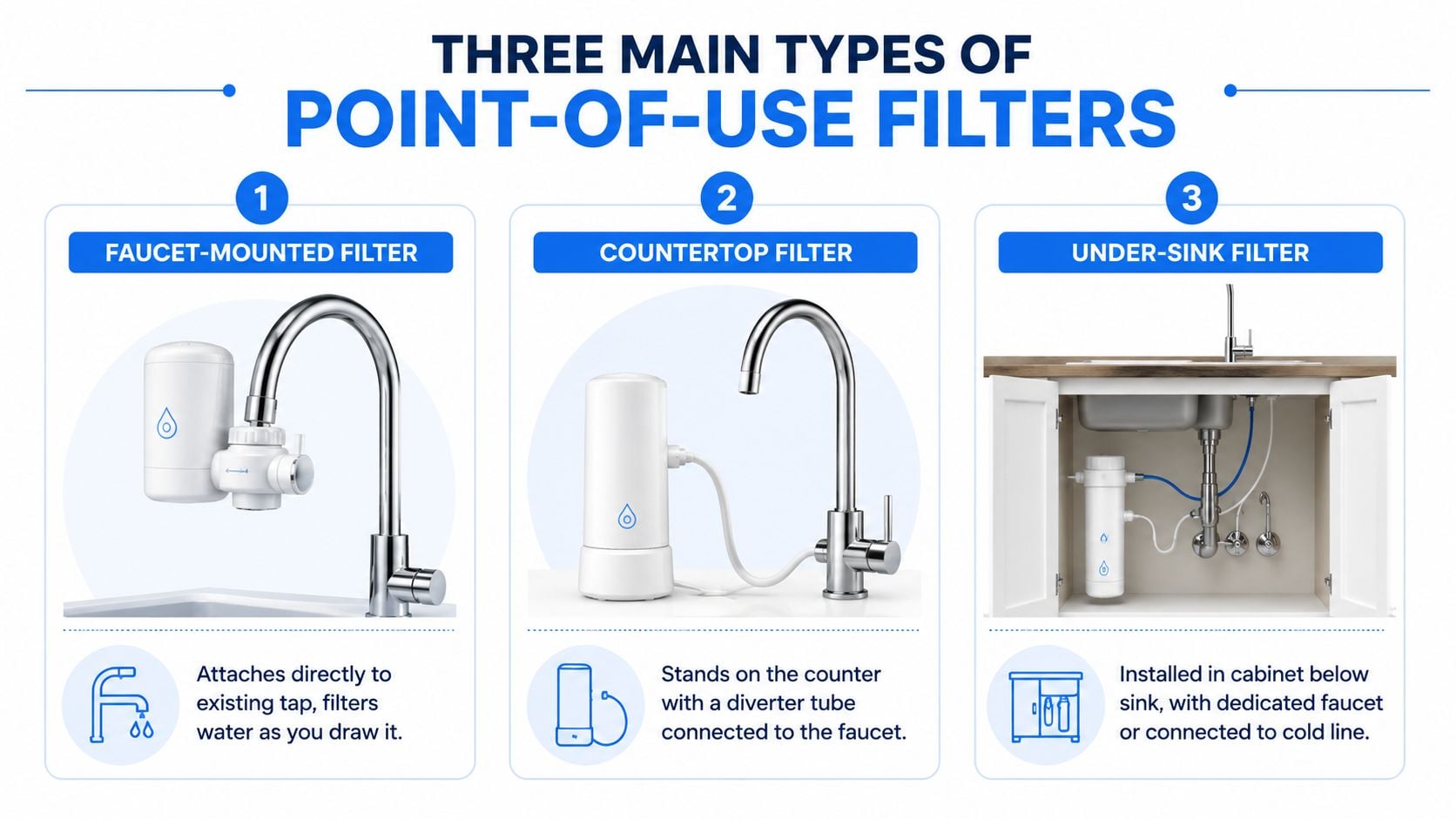
### Faucet-mounted systems
A faucet-mounted filter attaches directly to the existing tap. When you turn on the filtered setting, water passes through a small cartridge before leaving the spout. The assembly stays visible above the sink, takes little space, and usually suits renters or households that want installation to take only a short time.
The tradeoff is capacity. A compact cartridge has less room for media than a larger under-sink housing, and the filter may reduce flow as it loads with sediment. The faucet connection also has to fit the tap, so pull-out and specialty faucets may limit compatibility.
### Countertop and inline systems
A countertop filter sits beside the sink and connects to the faucet through a diverter tube. It sends water through a cartridge before dispensing it from the unit or through a connected outlet. This arrangement avoids cabinet work and can suit renters, temporary homes, or anyone who has counter space but doesn't want to drill for a dedicated faucet.
An inline filter follows a similar idea but remains in the water line. It can serve a refrigerator, ice maker, coffee machine, or dedicated beverage line. The visible equipment is minimal, although the cartridge still needs a compatible connection and a replacement plan.
### Under-sink systems
An under-sink system connects to the cold-water supply below the cabinet. Filtered water may travel to a dedicated faucet, or the system may feed a selected cold-water line. The housing occupies cabinet space, and installation can involve a shutoff connection, tubing, fittings, and sometimes a new faucet opening.
This format generally gives the designer more room for higher-capacity media or multiple stages. For a homeowner comparing an under-sink option, the [Woder WD-G4-DC Lead, Chlorine, HM and PFAS Water Filter](https://woder.com/products/wd-g4-dc/) is described as a U.S.-made under-sink system using selective filtration that retains essential minerals. Its WD-G4-REP filters are identified as certified by WQA to NSF/ANSI 42 for chlorine taste and odor, and to NSF/ANSI 372 for lead-free compliance, based on the supplied product information.
## How Filtration Technologies Actually Work
The cartridge housing tells you where filtration happens. The media inside tells you what the system can plausibly reduce.
### Activated carbon block
Activated carbon uses adsorption. Instead of trapping every dissolved substance like a sieve, the media provides surfaces that attract and hold certain compounds. Carbon is widely used for chlorine taste and odor, chlorination byproducts, and many organic compounds.
Carbon isn't a universal chemical sponge. Basic carbon filtration generally does little for dissolved minerals, fluoride, nitrate, or broad inorganic contamination. PFAS performance also depends on the media design, contact time, cartridge condition, and the exact claim being tested. A carbon block built for aesthetic improvement shouldn't automatically be treated as a health-protection system.
### Selective adsorption media
Selective filtration adds media designed to interact more strongly with particular contaminants. Catalytic carbon can improve performance against some chlorine-related compounds, while specialized adsorbents and ion-exchange materials can target substances such as lead or certain PFAS compounds when the complete system has been tested for that purpose.
That specificity is useful because it can reduce unwanted contaminants without removing every dissolved mineral. Woder describes **Advanced Selective Filtration®** as its core approach, designed to remove listed contaminants while retaining essential minerals. Its U.S. manufacturing and stated U.S. building code compliance are relevant considerations for homeowners who want domestic construction and installation expectations aligned with local practice.
The [Woder explanation of how water filters work](https://woder.com/blog/how-do-water-filters-work/) offers additional background for readers who want to follow the movement from incoming water to treated output. For households that serve filtered water at events or offices, durable drinkware such as [durable tritan bottles for branding](https://custommark.co/tritan-water-bottle/) can also make a practical filtered-water program easier to manage, but the bottle doesn't replace treatment certification.
### Reverse osmosis
Reverse osmosis forces water through a semipermeable membrane under pressure. Residential RO membranes typically reject about **95% to 99% of total dissolved solids**, according to the extension guidance summarized by [Crystal Quest's RO rejection-rate explanation](https://crystalquest.com/blogs/reverse-osmosis/ro-rejection-rate). The same guidance lists common contaminant-specific rejection ranges, including **94% to 96% for arsenic**, **93% to 96% for nitrate**, **94% to 96% for fluoride**, **96% to 98% for lead**, and **99% or more for bacteria and sulfates**.
RO can provide broad dissolved-solids reduction, but it also removes minerals and creates a wastewater stream. NSF/ANSI 58 is the relevant standard for reverse osmosis systems, while NSF/ANSI 42 covers aesthetic claims, NSF/ANSI 53 covers health-related claims such as lead and cyst reduction, and NSF/ANSI 401 addresses selected emerging contaminants. A PFAS claim should be tied to a specific certified standard and test scope, not inferred from the phrase “multi-stage filtration.”
## Matching Your Water to the Right Filter
Start with the document your water utility provides. A Consumer Confidence Report, often available on the utility website, describes detected contaminants and compares results with applicable regulatory limits. It gives you a starting profile for municipal water, not a complete diagnosis of every tap in every home.
Look for the contaminant names, reported concentrations, and notes about the source or treatment process. If lead is your concern, recognize the regulatory threshold clearly. EPA's Lead and Copper Rule uses an action level of **15 ppb**, and the [EPA rule explanation](https://www.epa.gov/dwreginfo/lead-and-copper-rule) says additional corrosion-control actions are required when more than **10%** of tap samples exceed that level. EPA also expresses the threshold as **0.015 mg/L**, which equals 15 ppb, in its [basic drinking-water information](https://archive.epa.gov/water/archive/web/html/basicinformation.html).
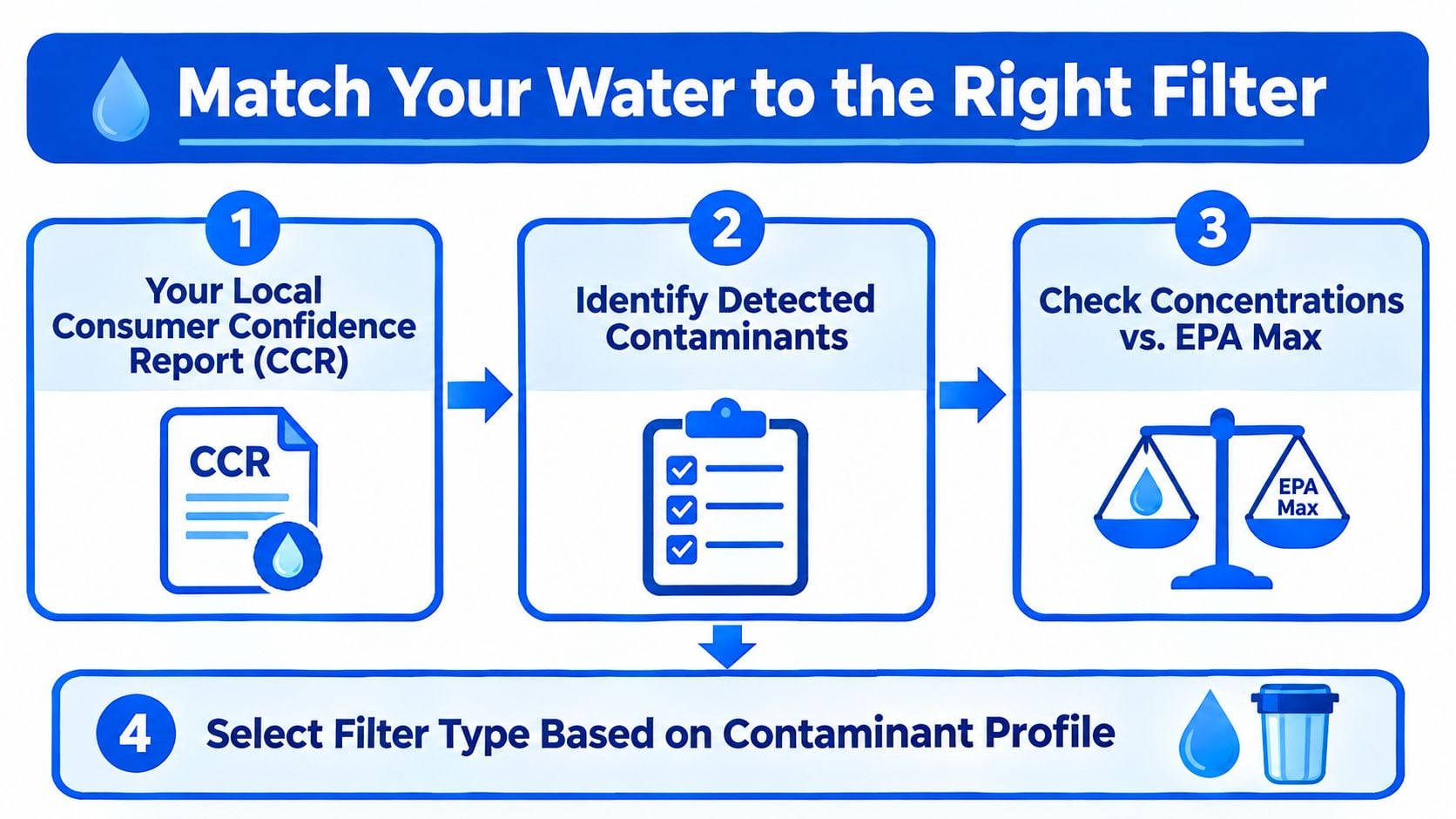
### Turn the report into a filter question
A report showing chlorine as the main taste concern points toward an aesthetic reduction claim. A home with suspected lead plumbing needs a health-related lead claim supported by the right certification and usage conditions. Nitrate, arsenic, fluoride, microorganisms, and PFAS may require different media or a different system altogether.
For PFAS, don't stop at the word “PFAS.” NSF explains that drinking-water units certified to **NSF/ANSI 53 or NSF/ANSI 58** can be effective ways to limit exposure, and that its P473 protocol was created to verify reduction of specific long-chain PFAS such as PFOA and PFOS under a defined challenge condition maintained across the rated cartridge life. The NSF explanation of PFAS filtration standards shows why a new-filter snapshot isn't enough.
EPA finalized the first national legally enforceable drinking-water standard for six PFAS in April 2024. The rule sets **4.0 ppt** limits for PFOA and PFOS, **10 ppt** limits for PFHxS, PFNA, and HFPO-DA, also known as GenX, and a hazard-index limit for mixtures involving PFHxS, PFNA, HFPO-DA, and PFBS, as described by [EPA's PFAS drinking-water rule](https://www.epa.gov/sdwa/and-polyfluoroalkyl-substances-pfas).
If the CCR is unavailable, outdated, or doesn't answer questions about the household tap, test the water directly. The result should guide the certified reduction list. **Filter type alone isn't enough.**
## Reverse Osmosis Compared With Selective Filtration
Reverse osmosis and selective filtration solve different problems. RO is built to reject a broad range of dissolved material, while selective systems are built to target specified contaminants and leave much of the mineral profile in place.
### What RO changes
RO's membrane can produce very low TDS because it rejects dissolved solids broadly. That can be useful when the incoming water contains several dissolved contaminants, when a laboratory result points to a broad treatment need, or when the homeowner specifically wants mineral-stripped water.
The cost of that broad removal is practical. RO typically needs pressure, a drain connection for concentrate water, and often a storage tank. It also removes calcium and magnesium along with unwanted substances. The system may require more components and more maintenance than a single-cartridge selective system, and the water can taste noticeably flatter to people accustomed to mineral-containing tap water.
### What selective filtration preserves
Selective systems use media chosen for particular contaminant interactions. They can reduce substances such as lead, chlorine, certain heavy metals, and selected PFAS compounds when the product's performance data supports those claims. Because the process isn't designed to remove every dissolved solid, essential minerals can remain in the treated water.
That design usually means no RO-style wastewater stream and a simpler point-of-use footprint. It can also support a more direct flow from the cold-water line to a dedicated faucet. The limitation is equally important: selective filtration isn't automatically the right answer for every dissolved contaminant, and the certified scope must match the water test.
Decision factorReverse osmosisSelective filtrationMain approachSemipermeable membrane under pressureTargeted adsorption and related mediaTDS resultVery low TDS is possibleMinerals generally remainWaste streamProduces concentrate waterDoesn't use an RO wastewater streamInstallationOften needs drain and additional componentsOften fits a simpler point-of-use layoutBest starting questionIs broad dissolved-solids reduction needed?Which specific contaminants need reduction?Neither approach deserves a blanket verdict. Choose RO when broad dissolved-solids reduction is the priority and its installation and maintenance are acceptable. Choose selective filtration when certified contaminant targeting, mineral retention, water efficiency, and a smaller setup matter more.
## Maintenance, Cartridge Life, and Real-World Ownership
A filter can meet its performance claim only while it's used within its rated conditions. Replacement timing matters because a cartridge can become exhausted or clogged without producing an obvious visual warning.
### Service life is a working estimate
Basic carbon blocks are often planned around **six months**, staged systems around **twelve months**, and RO membranes or remineralization cartridges around **two to three years**, assuming typical household use. Those intervals come from the supplied product guidance, not a universal rule, and actual life changes with sediment, hardness, pressure, contaminant concentration, and water volume.
A busy household may reach the cartridge limit earlier. A well with substantial sediment can clog a prefilter before the stated calendar date. A sudden pressure drop may signal loading, while a return of taste or odor can indicate exhausted media. Neither symptom reliably proves that every contaminant is being reduced, so follow the manufacturer's rated capacity and replacement instructions.
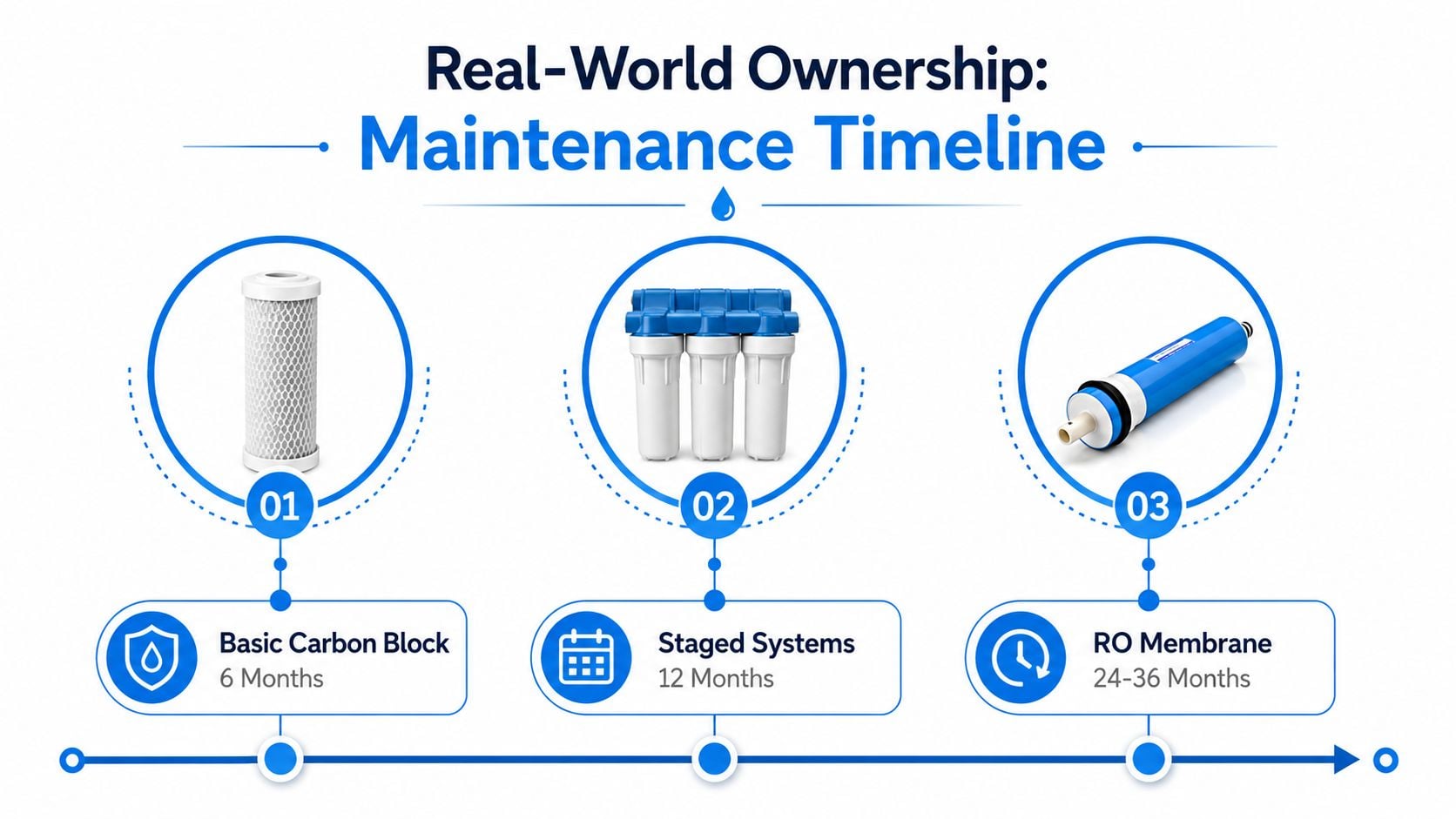
### Build a routine you can keep
Mark the installation date on the housing or in a phone calendar. Keep the next cartridge available before the current one reaches its scheduled interval, and inspect tubing and connections whenever you replace media.
During a housing change, shut off the supply, relieve pressure, and follow the system's sanitation instructions. Under-sink installations may require a dedicated faucet opening and a cold-water connection, while faucet-mounted and some inline units can be installed with minimal tools. If a fitting, valve, or cabinet layout is unfamiliar, a plumber can prevent a small leak from becoming a larger repair.
The [Woder water filter replacement schedule guide](https://woder.com/blog/water-filter-replacement-schedule/) can help organize that calendar-based routine. Woder also states that every cartridge includes a **one-year guarantee**, with replacement if it underperforms under the guarantee terms. That kind of support doesn't remove the need for maintenance, but it gives the homeowner a clearer ownership path.
## What Clean Water Actually Means Beyond Zero TDS
A zero-TDS reading sounds definitive because it produces a simple number. TDS, or total dissolved solids, is a bulk measurement, however. It includes harmless dissolved minerals such as calcium and magnesium as well as substances a homeowner may want to reduce.
A meter that reads zero can't identify every individual contaminant. It mainly reflects the conductivity of the water, so it may confirm that dissolved ions have been removed without proving that volatile organic compounds or every health-related contaminant has been addressed. The [explanation of why TDS is not an effective measure of water quality](https://woder.com/blog/tds-ppm-rate-is-not-an-effective-indication-of-water-quality/) makes the practical distinction clear.
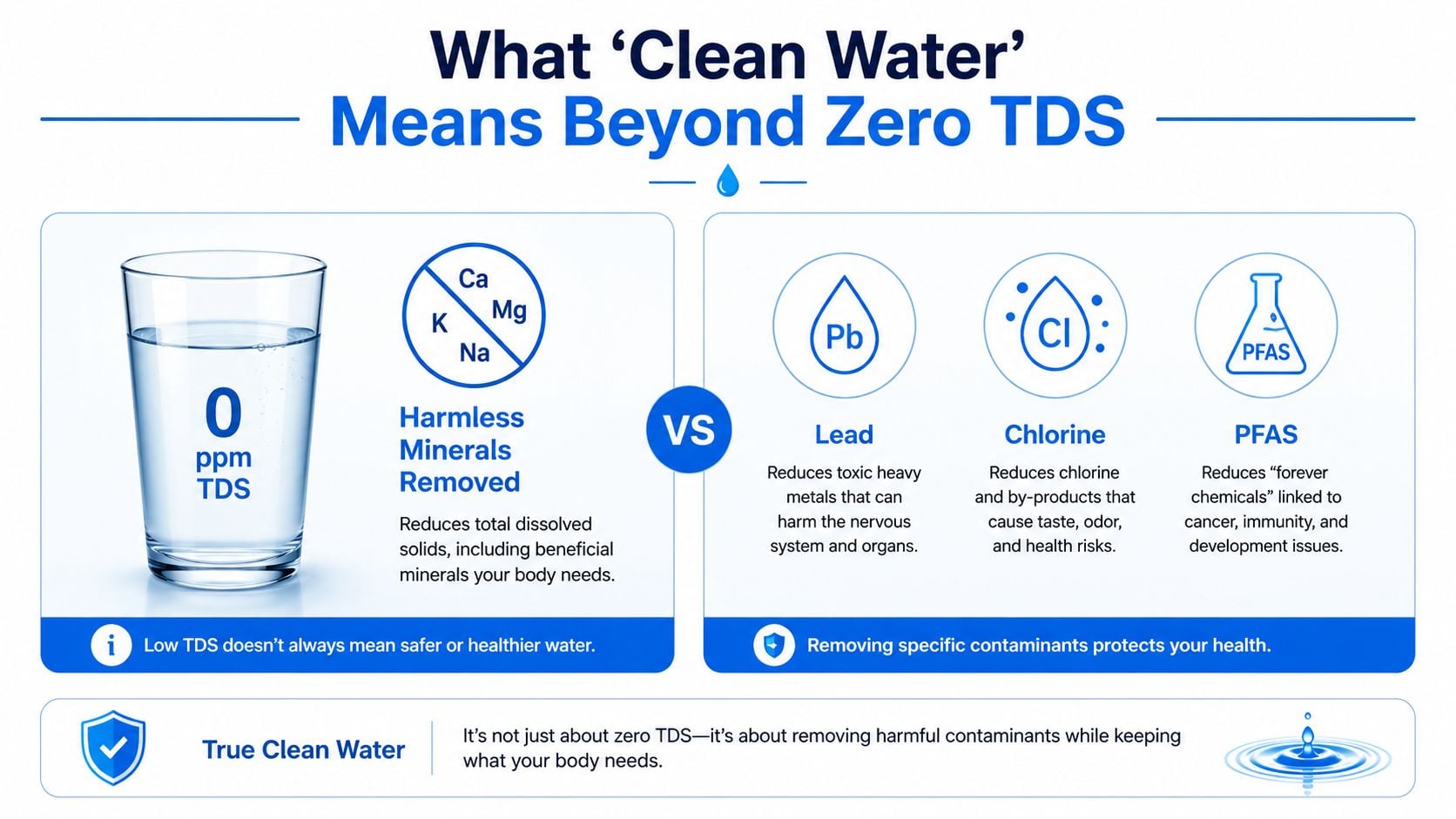
### A lower number isn't automatically a better glass
RO and distillation can strip water of minerals, producing a very low-solids result. Some people prefer that taste, while others find mineral-containing water more pleasant. Mineral removal also changes the chemistry that flows through the home's dispensing equipment, so the TDS number should be treated as one measurement, not a complete safety score.
For drinking water, “clean” is more useful when it means **verified reduction of specific unwanted contaminants**. That could mean chlorine and taste compounds for one household, lead for another, or selected PFAS compounds for a home whose testing and certification review point in that direction.
The better question isn't “How low can the TDS go?” It's “What does my water contain, what do I want to reduce, and does the system prove that it can do so while operating within its rated life?”
## A Practical Framework for Choosing Your System
Begin with the most recent Consumer Confidence Report and, when appropriate, a tap-water test. Note the contaminants that matter to your home, including **lead, PFAS, nitrate, arsenic, chlorine byproducts, and hardness**, then separate a taste concern from a health-related reduction need.
Next, decide which tradeoffs you value:
- **Broad reduction:** Consider whether the water profile calls for membrane treatment or targeted media.
- **Mineral preservation:** Look for a system designed to reduce specified contaminants without stripping all dissolved minerals.
- **Low waste:** Compare whether the process sends water to a drain.
- **Simple ownership:** Check cartridge access, replacement timing, flow, and installation requirements.
Then verify the shortlist against the relevant third-party standard. Depending on the claim, that may include **NSF/ANSI 42, 53, 58, 401, or 473**, but the standard number alone isn't enough. Read the exact contaminant list, test conditions, rated cartridge life, installation requirements, and any limitations.
Finally, check **U.S. manufacturing, U.S. building code compliance, performance data, replacement support, and warranty terms**. Woder presents its Advanced Selective Filtration® approach as a way to target contaminants such as PFAS, lead, heavy metals, fluoride, chromium, and chlorine while retaining essential minerals. Its stated philosophy, **It's Your Water®**, is a useful reminder that the homeowner should make the decision from verified information, not pressure.
---
If your water report points toward targeted contaminant reduction with mineral retention, explore the point-of-use options from [Woder Filters](https://woder.com). Review the certified scope, installation requirements, replacement support, and one-year cartridge guarantee before deciding whether the system fits your household.
**Categories:** Woder Science
**Tags:** drinking water filter system, pfas water filter, point-of-use filtration, reverse osmosis alternatives, under sink water filter
---
### [How to Know If PFAS Is in Your Tap Water (and What You Can Do About It)](https://woder.com/blog/pfas-in-tap-water/)
**Published:** August 18, 2026
**Author:** Vlad
**Content:**
A neighbor of mine got a letter from her water utility last spring. Buried in the fine print was a PFAS result she’d never heard of before, and she called me asking what it meant. That conversation is happening in a lot of households right now, usually starting the same way: someone reads the fine print about pfas chemicals in tap water and realizes they have no idea what it means. pfas in tap water isn’t some rare contamination event anymore. It shows up in cities, small towns, and plenty of private wells too, and most of the time you’d never know it just by looking at a glass of water. Below, we’ll cover where these chemicals come from, how to actually find out if they’re in your supply, and what to do once you know.
## **PFAS, in Plain Terms**
PFAS is short for per- and polyfluoroalkyl substances. Manufacturers have used these chemicals since the 1940s, mostly for their ability to repel water, grease, and stains. That’s why they show up in nonstick pans, rain jackets, fast food wrappers, and firefighting foam. The chemistry that makes them so useful is also what makes them a problem: the carbon-fluorine bond holding these molecules together is one of the strongest in organic chemistry, and it just doesn’t break down easily. Scientists started calling them forever chemicals for a reason.
Once PFAS gets into soil or groundwater, it stays put for years, sometimes decades. Researchers have linked long-term exposure to thyroid issues, cholesterol changes, and effects on the immune system. The EPA tightened its limits on several PFAS compounds in drinking water recently, and a number of states went further with rules of their own. None of that means your water is automatically unsafe. It just means the question is worth asking rather than assuming.
## **Where PFAS Actually Comes From**
There’s rarely one single explanation for PFAS contamination across an entire region. Usually it traces back to something specific nearby: a manufacturing plant, an airport or military base where firefighting foam was used during training, or an old landfill that took in PFAS-containing waste for years before anyone realized what that meant. From there, the chemicals migrate through soil and into groundwater, which is the same groundwater that feeds municipal treatment plants and the wells sitting in a lot of backyards.
That’s also why levels can swing wildly between two towns twenty miles apart, or even between two streets in the same neighborhood. A citywide water report might look perfectly fine on average while an older stretch of pipe near a former industrial site tells a different story. Well owners have it even harder here, since private wells don’t fall under the same testing rules that public utilities have to follow.
## **Actually Testing Your Water**
Guessing gets you nowhere with PFAS. Testing does. There’s more than one way to go about it, and which one makes sense depends on how much detail you want and how fast you need an answer.
Your utility’s annual water quality report is the easiest starting point, and it costs nothing. As more testing requirements roll out, larger utilities have started publishing PFAS numbers alongside the usual chlorine and lead figures. Just keep in mind that this only tells you about the water leaving the treatment plant, not what’s happening by the time it reaches your faucet through decades-old pipes.
For something more precise, a pfas water test kit from an accredited lab is your best bet. You collect the sample yourself following the kit’s instructions, mail it off, and a lab that specializes in PFAS analysis runs the numbers. Anyone who has genuinely dug into how to test for pfas in water, or looked up how to test pfas in water step by step, usually lands here eventually. Certified lab testing can pick up specific compounds at concentrations most consumer-grade kits simply can’t detect.
Don’t overlook your state, either. Several state health departments and university programs offer free or discounted PFAS testing, especially in areas where contamination has already been documented. A quick search for your state plus PFAS testing might save you the cost of a private lab entirely.
On a well? The logic behind how to test water for pfas doesn’t really change, but the stakes go up a notch, since nobody else is checking your water for you. How to test for pfas in water at home on a private well usually means the same certified kits used for city water, often bundled with a wider panel that also flags bacteria and heavy metals while you’re at it.
Here’s something people miss: not every pfas water test on the shelf checks for the same compounds. Cheaper kits might only screen for a few of the more common PFAS chemicals, while a full lab panel can run dozens. Before you decide to pfas test water with a particular kit, or before you test my water for pfas through some random online seller, it pays to read exactly what’s included. A test that misses half the relevant compounds isn’t much of an answer.
## **Reverse Osmosis and PFAS: The Real Story**
People ask this constantly once a test comes back positive, so let’s just answer it directly. Does reverse osmosis remove PFAS from water? Generally, yes. An RO membrane is fine enough to block most PFAS molecules along with a long list of other contaminants. But nothing’s free. RO systems also strip out calcium, magnesium, and other minerals your body actually wants, and they waste a fair amount of water in the process, often several gallons for every gallon that comes out filtered.
That tradeoff is why more homeowners look past RO toward filtration built to target PFAS specifically, without hauling the minerals and water waste along for the ride.
## **Beyond RO: Other Ways to Deal with PFAS**
RO isn’t the only path if you’re figuring out how to remove pfas from water, and for a lot of households, it isn’t even the most practical one. A few other routes worth knowing:
Activated carbon. This is probably the most common method used to remove pfas from water outside of RO. Water passes through a bed of carbon media that adsorbs PFAS molecules along the way. Not all carbon filters are created equal here, so check whether a product has actually been tested against PFAS specifically before assuming it’ll do the job.
Selective filtration media. Instead of blocking nearly everything the way an RO membrane does, this newer approach uses media engineered to target specific contaminants like PFAS, lead, and chlorine, while letting the good minerals pass right through untouched. [Woder’s Gen4 Advanced filters](https://woder.com/products/wd-g4-dc/) are built on exactly this idea, cutting PFAS without the wasted water or stripped minerals that come standard with reverse osmosis.
These systems swap PFAS ions for harmless ones as water passes through a bed of resin. It can work well for certain PFAS compounds, though the resin eventually needs replacing or regenerating to keep doing its job.
For most people, an inline or under-sink filter running selective or activated carbon media is the simplest answer to how to remove pfas from water at home, no major plumbing overhaul required. Whole-home systems exist for bigger problems, but they cost a lot more, and they’re usually only worth it once testing confirms contamination at the source rather than just at one tap. If your water also carries visible sediment, pairing PFAS filtration with a [dedicated sediment pre-filter](https://woder.com/product-category/filters/under-sink-filters/sedimentation/) is worth considering too, since sediment can wear down other filter media faster than it should.
A couple of things worth knowing don’t work: boiling water does nothing for PFAS (it can actually concentrate it slightly as water evaporates), and a basic pitcher filter without PFAS-rated media might improve taste without touching the actual chemicals. So when you’re comparing filters that remove pfas from water, look past the marketing and check for real PFAS-specific test data, not just claims about chlorine or sediment.
## **Got a Positive Result? Here’s What to Do**
First, don’t panic. Do take it seriously, though. Look closely at which compounds showed up and at what levels. Not every PFAS chemical carries the same risk, and current EPA guidance focuses mainly on PFOA and PFOS. From there, match your filtration to your actual exposure. If drinking and cooking water is the main concern, a single tap filter often covers it. If contamination runs through your whole plumbing, point-of-entry treatment makes more sense.
Want to remove pfas from drinking water without redoing your whole kitchen setup? A certified inline or under-sink filter is usually the quickest, cheapest place to start. And once you understand how to remove pfas from drinking water the right way, don’t skip the retest afterward. It’s the only way to confirm your filter is actually doing what it claims, since real-world performance doesn’t always match the lab numbers on the box.
## **The Bottom Line**
You can’t see PFAS, you can’t taste it, and you definitely can’t guess your way to an answer. Testing is the only way to know what you’re actually dealing with. Once you have that number in hand, picking the right filter gets a lot simpler. [Woder](https://woder.com/) builds its Gen4 Advanced filters specifically to cut PFAS, lead, and chlorine while keeping the minerals your water is supposed to have. If your test already came back and you’d rather skip the wasted water and mineral loss that come with reverse osmosis, take a look at our [full lineup of water filters](https://woder.com/product-category/filters/) to find the right fit for your home.
## **Frequently Asked Questions**
**How do I know if there’s PFAS in my tap water?**
The only reliable way is testing. Start with your utility’s annual water quality report for a general picture, then follow up with a certified lab test if you want an answer specific to the water coming out of your own tap, especially if you’re on a private well.
**Can I test my own water for PFAS at home?**
Yes. Most certified test kits let you collect a sample at home and mail it to an accredited lab for analysis. Just check what compounds a specific kit actually screens for before you buy, since coverage varies a lot between products.
**Does boiling water remove PFAS?**
No. Boiling doesn’t break down PFAS, and it can even concentrate the chemicals slightly as water evaporates. Filtration, not heat, is what actually reduces PFAS levels in drinking water.
**Is reverse osmosis the best way to remove PFAS from water?**
RO does remove most PFAS effectively, but it also strips out beneficial minerals and wastes several gallons of water for every gallon filtered. Selective filtration media, like the technology behind Woder’s Gen4 Advanced filters, targets PFAS and other contaminants without those tradeoffs.
**How soon should I retest my water after installing a filter?**
It’s worth retesting shortly after installation to confirm the filter is performing as expected, since real-world results can differ from lab claims. After that, an annual retest is a reasonable habit, especially if you’re on a private well.
**Categories:** Woder Science
---
### [Drinking Water Faucet Options for Cleaner Home Water](https://woder.com/blog/drinking-water-faucet/)
**Published:** August 18, 2026
**Author:** woder_admin
**Content:**
You've spent time comparing under-sink filters, checking contaminant claims, and measuring the cabinet space beneath the kitchen sink. Then you fill a glass from the faucet and realize the last part of the system, the fixture the water touches before you drink it, received almost no attention.
That endpoint matters. A filter can be carefully selected, but the faucet still has wetted materials, internal passages, seals, and connection points that affect how filtered water reaches your glass. The right setup also determines whether filtration is convenient enough for everyday drinking and cooking, or whether your household gradually stops using it.
## Table of Contents
- [Why Your Faucet Choice Matters as Much as Your Filter](#why-your-faucet-choice-matters-as-much-as-your-filter)
- [The endpoint can affect exposure](#the-endpoint-can-affect-exposure)
- [Understanding the Two Main Faucet Configurations](#understanding-the-two-main-faucet-configurations)
- [Integrated filtration through the main faucet](#integrated-filtration-through-the-main-faucet)
- [A separate dedicated drinking tap](#a-separate-dedicated-drinking-tap)
- [Integrated Main Faucet Versus Dedicated Drinking Tap](#integrated-main-faucet-versus-dedicated-drinking-tap)
- [Installation and countertop appearance](#installation-and-countertop-appearance)
- [Daily use and maintenance](#daily-use-and-maintenance)
- [Certification Standards That Define a Safe Drinking Water Faucet](#certification-standards-that-define-a-safe-drinking-water-faucet)
- [NSF/ANSI/CAN 61 addresses leaching](#nsfansican-61-addresses-leaching)
- [NSF/ANSI/CAN 372 addresses lead content](#nsfansican-372-addresses-lead-content)
- [Pairing Your Faucet with the Right Under-Sink Filtration](#pairing-your-faucet-with-the-right-under-sink-filtration)
- [Match the outlet to the filtration path](#match-the-outlet-to-the-filtration-path)
- [Match the certification to the contaminant](#match-the-certification-to-the-contaminant)
- [How to Choose the Right Setup for Your Household](#how-to-choose-the-right-setup-for-your-household)
- [Begin with household use](#begin-with-household-use)
- [Check the installation details](#check-the-installation-details)
- [Common Misconceptions About Faucet Filters and Water Quality](#common-misconceptions-about-faucet-filters-and-water-quality)
## Why Your Faucet Choice Matters as Much as Your Filter
A parent filling a child's cup before school usually isn't thinking about plumbing design. They're thinking about breakfast, backpacks, and whether the water tastes or smells different today. Yet that quick pour passes through a complete delivery system, including the supply line, filter, fittings, and faucet.
The faucet is the final point of contact. Its materials and internal design can influence lead contribution during periods when water sits inside the fixture. That's why a drinking-water faucet shouldn't be treated as decorative hardware added after the filter decision. It's part of the water-quality system.
### The endpoint can affect exposure
U.S. drinking-water faucets must meet lead-leaching requirements under **NSF/ANSI/CAN 61**. Current NSF guidance says endpoint devices that dispense drinking water, including faucets, use a pass/fail criterion of **1 microgram of lead leaching**, reduced from **5 micrograms** under the earlier test regime. The test is intended to reflect the faucet as a potential exposure source during stagnation, so material selection, alloy composition, and wetted-surface design matter directly. Read the [current NSF guidance on NSF/ANSI/CAN 61](https://blog.ansi.org/ansi/nsf-ansi-61-2025-drinking-water-system-components/) before relying on a broad “lead-free” statement.
> **Practical rule:** Treat the faucet, tubing, filter, and connections as one system. A strong cartridge doesn't automatically make every downstream component appropriate for drinking water.
Configuration matters, too. An integrated main faucet can make filtered water available without changing the appearance of the sink, but it may send more water through the filter than your household drinks. A dedicated drinking tap limits filtered flow to drinking and cooking, while leaving the main faucet available for washing dishes and other tasks.
That distinction affects **filter capacity, daily convenience, installation effort, and countertop appearance**. The best choice isn't universal. It depends on how your household uses water and what your kitchen can accommodate.
## Understanding the Two Main Faucet Configurations
The two configurations operate differently. An integrated system sends filtered water through the kitchen's main faucet, while a dedicated drinking tap creates a separate outlet for water used for drinking and cooking. That choice affects installation, countertop appearance, and which filtration systems will fit beneath the sink.
### Integrated filtration through the main faucet
An integrated setup keeps one visible fixture. Depending on the product, filtered water may travel through a dedicated internal channel, a diverter, or an inline connection beneath the sink. You use the existing faucet and select the appropriate mode when the design provides one.
This arrangement suits homeowners who want a clear countertop and prefer not to drill a new opening. It can also work when the existing faucet has the required connection or when the filtration system is designed for that fixture. The term “faucet filter” covers several installation types, so review the plumbing arrangement in this [guide to a water filter for a faucet](https://woder.com/blog/water-filter-for-faucet/) before choosing a connection.
Compatibility deserves close attention. The faucet, filter, diverter, tubing, and shutoff arrangement must work together, particularly when the system uses advanced selective filtration rather than a basic cartridge.
An inline product such as the [Woder Advanced Inline Water Filter WD-G4-JG](https://woder.com/products/wd-g4-jg/) uses Advanced Selective Filtration to retain essential minerals instead of removing all minerals. Its catalog describes the product as made in the USA and intended for inline water filtration.
### A separate dedicated drinking tap
A dedicated setup sends filtered water through its own faucet beside the main fixture. A separate line runs from the filter outlet to that tap under the sink. The main faucet remains available for ordinary cold water, hot water, dishwashing, rinsing, and cleanup.
This layout generally requires another hole in the sink or countertop. An unused soap-dispenser opening can provide a convenient location. A solid countertop may require drilling, and brittle materials such as stone or porcelain call for careful work by a plumber or countertop professional.
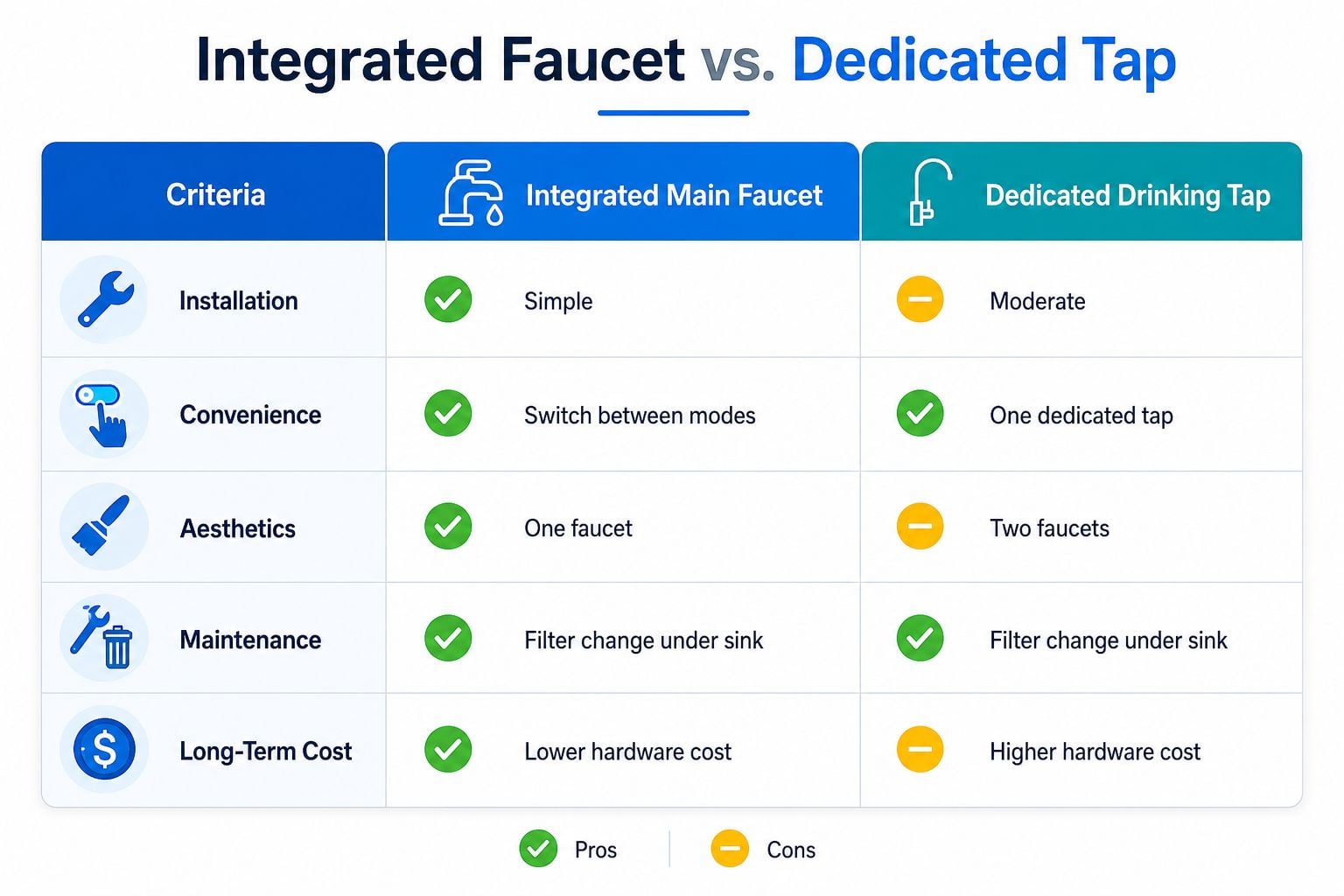
The practical distinction is simple: an integrated faucet makes filtered water available at the main fixture, while a dedicated tap reserves the filtered line for drinking and cooking.
## Integrated Main Faucet Versus Dedicated Drinking Tap
The choice becomes noticeable during ordinary kitchen routines. An integrated system sends filtered water through the kitchen's main fixture, while a dedicated tap creates a separate outlet used mainly for drinking and cooking. That difference affects filter use, installation work, and the appearance of the countertop.
An integrated faucet can supply filtered water for a glass, coffee maker, rinsing produce, or meal preparation. Because the same fixture may also handle other tasks, the filter can process more water than a drinking-only setup. This may make cartridge replacement less predictable, especially in a busy kitchen.
A dedicated drinking tap keeps the filtered line focused. The main faucet remains available for dishes, rinsing, and cleanup, while the smaller outlet supplies drinking and cooking water. Its purpose is easy to identify, much like having a clearly labeled control instead of sharing one control among several functions.
### Installation and countertop appearance
An integrated arrangement may preserve a one-faucet look and may avoid drilling when the existing fixture supports the connection. The convenience depends on compatibility among the faucet, filter, diverter, tubing, and shutoff components. Advanced selective filtration systems can make that matching more specific because the filtered outlet must operate as intended without sending treated water through the wrong path.
A dedicated tap adds a visible fixture, but it also gives the filtered water its own dispensing point. An existing soap-dispenser opening or sink knockout may provide a straightforward location. If the sink or countertop has no suitable opening, drilling adds work, and brittle surfaces such as stone or porcelain require careful handling by a plumber or countertop professional.
### Daily use and maintenance
Both configurations typically place the cartridge beneath the sink. Replacement access therefore depends on cabinet clearance and the position of nearby plumbing, not solely on the faucet style.
An integrated fixture can feel natural when several people share the kitchen. If it uses a switch or separate mode, everyone must know which setting provides filtered water. A dedicated tap removes that decision at the point of use, although it occupies more counter space.
The main tradeoffs are:
- **Integrated main faucet:** fewer visible fixtures, potentially simpler installation, and filtered water at the primary sink outlet. It may send treated water to tasks that do not require filtration, and it depends closely on the existing faucet's design.
- **Dedicated drinking tap:** a separate, clearly identified source for drinking and cooking, with the main faucet available for general work. It may require another opening and creates a second visible fixture.
- **Advanced selective filtration compatibility:** either layout can work, provided the faucet and connection arrangement match the filter's intended outlet and flow path.
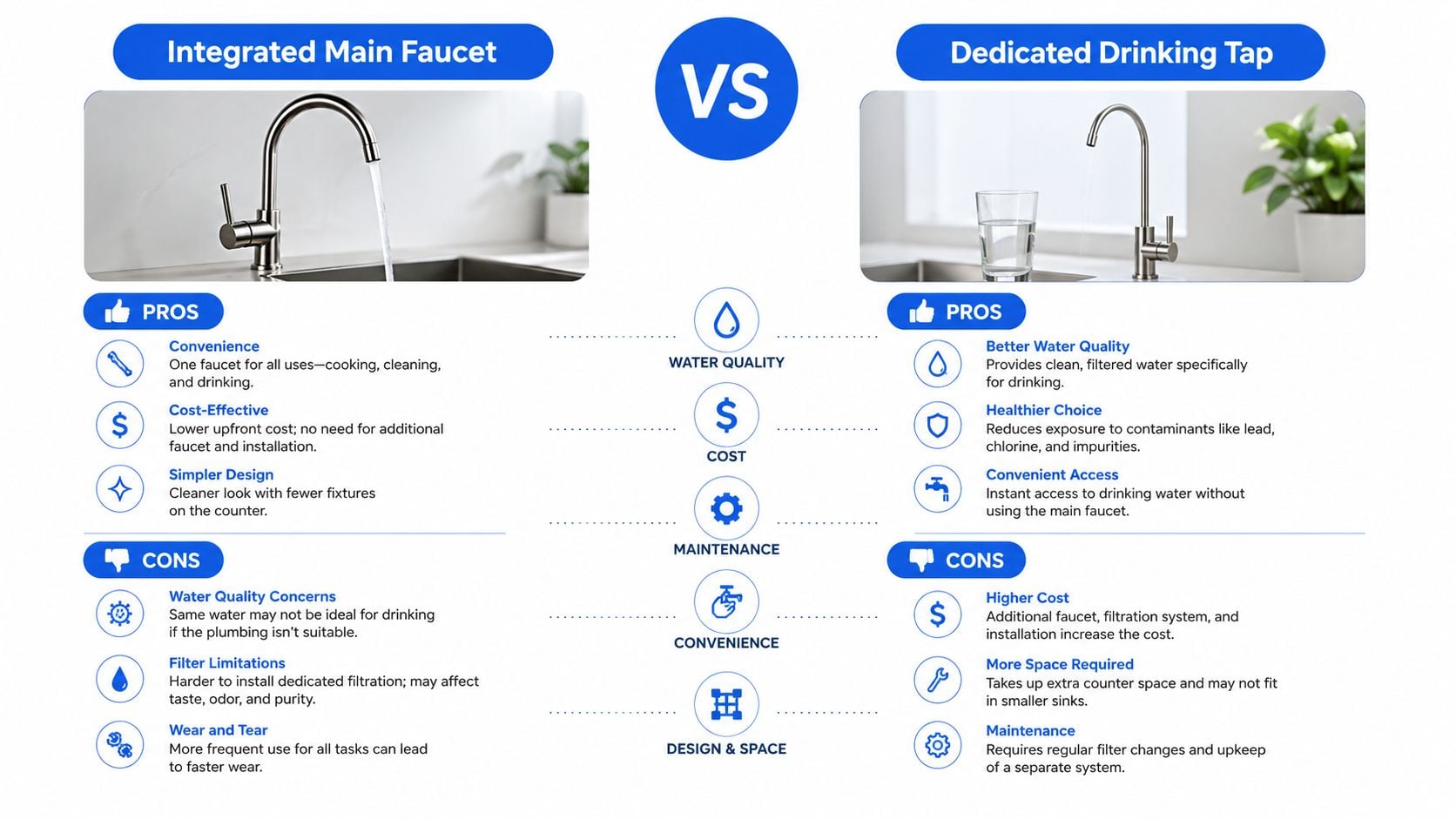
Neither configuration automatically makes water safer. The faucet needs materials suitable for drinking-water contact, and the filter must target the contaminants you want to reduce.
## Certification Standards That Define a Safe Drinking Water Faucet
A faucet can look polished and still require closer inspection before it supplies drinking water. “Lead-free” describes an outcome, but the certification tells you which materials, components, and tests support that wording. Faucet certification evaluates the fixture's contact with drinking water. It does not show that the faucet removes **PFAS, fluoride, chromium, chlorine**, or other contaminants.
### NSF/ANSI/CAN 61 addresses leaching
For drinking-water faucets sold in the U.S., **NSF/ANSI/CAN 61** evaluates whether materials release contaminants into water. As noted in the previous section, current guidance identifies **1 microgram** as the stricter pass/fail criterion for endpoint devices such as faucets, compared with **5 micrograms** under the prior testing regime. The point is the water's contact with the faucet, including water that remains inside the fixture before use.
Brass alloys, stainless steel, plating, seals, and other wetted components all form part of that evaluation. A visible finish is only the outer layer. Chrome plating may cover a brass body, so check how the complete water-contacting assembly performs under the applicable test.
### NSF/ANSI/CAN 372 addresses lead content
**NSF/ANSI/CAN 372** sets a maximum weighted lead content of **0.25%** for drinking-water system components. The Safe Drinking Water Act requirements explained by NSF connects certification with lead content and lead leaching, depending on the product and certification path.
Check the package, product documentation, or certification listing for specific markings, such as **NSF/ANSI/CAN 61: Q ≤ 1** and **NSF/ANSI/CAN 372**. Terms such as “safe,” “low lead,” or “lead-free” provide less information without a named standard.
The same check matters when pairing a faucet with an under-sink or [inline water filter system overview](https://woder.com/blog/inline-water-filter-system/). The faucet must suit the filter's outlet and intended water path, while the filter's certification and performance claims determine which contaminants it addresses. For broader terminology, consult this [water-quality standards guide](https://woder.com/blog/wqa-nsf-ansi-wth-water-quality-alphabet-soup/) while comparing fixtures.
Certification is a defined technical claim, not a substitute for checking the filter's contaminant-reduction claims.
## Pairing Your Faucet with the Right Under-Sink Filtration
The faucet and filter function as one water path. Choosing the faucet first can create a mismatch if the filter uses a particular connection, requires a certain flow rate, or treats water for a specific purpose. Confirm those details before deciding whether one integrated fixture or a separate drinking tap fits the installation.
Woder® Advanced Selective Filtration® targets selected contaminants rather than broadly removing dissolved solids. Its stated focus includes **PFAS, lead, heavy metals, fluoride, chromium, and chlorine**, while retaining essential minerals. Reverse osmosis follows a different treatment path, reducing dissolved solids broadly, including minerals that can affect taste.
### Match the outlet to the filtration path
A dedicated drinking tap works naturally with a point-of-use filter. The treated line runs to that faucet, so drinking and cooking water receive filtration while dishwashing remains on the main supply. This arrangement also limits cartridge use for tasks that do not require filtered water.
An integrated main faucet sends filtered water through the fixture everyone already uses. That can simplify the visible countertop layout, but it may send more cold-water activity through the cartridge. The household's actual usage should therefore match the filter's intended capacity and flow behavior.
For installation options and connection details, see [a guide to inline water filter systems](https://woder.com/blog/inline-water-filter-system/). An inline product using Advanced Selective Filtration retains essential minerals rather than stripping them away.
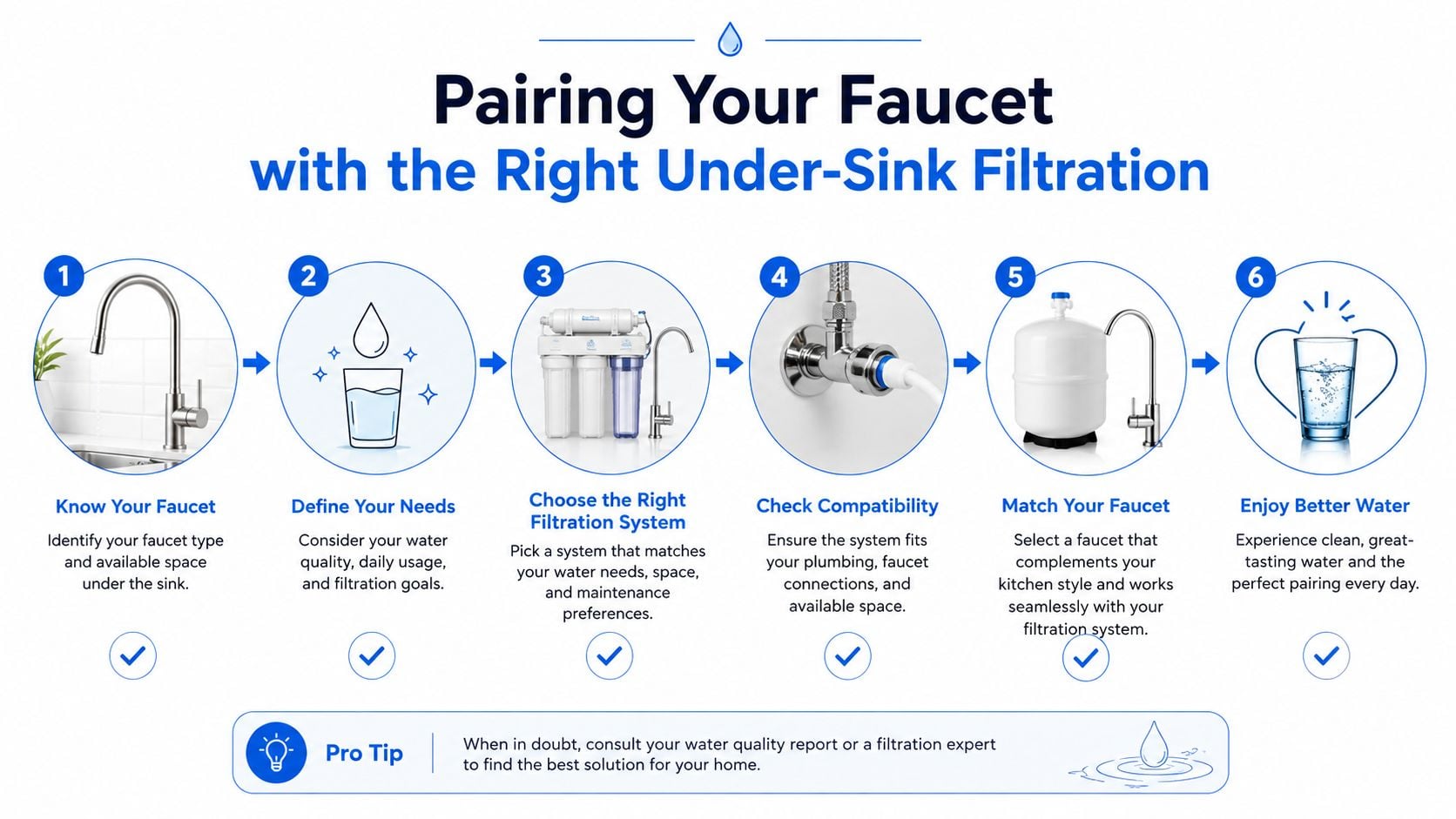
### Match the certification to the contaminant
**NSF/ANSI 53** covers point-of-use and point-of-entry drinking-water treatment units designed to reduce specified health-related contaminants. The [NSF/ANSI 53 overview](https://blog.ansi.org/ansi/nsf-ansi-53-2023-drinking-water-units-health-effect/) explains the standard's testing context.
A general certification does not establish every contaminant claim. For PFAS, fluoride, chromium, or lead, look for a performance claim that names the contaminant and identifies its testing or certification scope. The faucet may suit the plumbing arrangement while the cartridge still lacks the treatment capability required by the available water-quality information.
## How to Choose the Right Setup for Your Household
Start with the way water moves through your kitchen, not with the faucet's finish. A polished fixture may look excellent, but it won't solve a layout problem, fit a crowded cabinet, or make an unsuitable cartridge effective.
### Begin with household use
Ask yourself a few practical questions:
- **Drinking demand:** How many people regularly fill glasses or bottles from the sink?
- **Cooking habits:** Do you use filtered water for soups, coffee, tea, and meal preparation?
- **Existing openings:** Does the sink or counter already have a suitable opening for a dedicated tap?
- **Cabinet access:** Can you reach the shutoff, tubing, and cartridge without removing stored items?
- **Water source:** Are you on municipal water or a private well, and what concerns appear in your available water-quality information?
A dedicated faucet often makes sense when filtered water is reserved for drinking and cooking. An integrated arrangement may be more appropriate when a single visible fixture matters most or when adding a countertop opening would be difficult.
### Check the installation details
Before ordering, confirm the filter's inlet and outlet connections, the faucet's required tubing, the available cabinet clearance, and the expected flow behavior. If you're installing reverse osmosis, check local plumbing requirements because some systems use an air-gap faucet for wastewater backflow protection. That requirement doesn't automatically apply to every under-sink filter.
A DIY installation may be realistic when the sink already has a compatible opening and the system uses straightforward connections. Drilling stone or porcelain, modifying supply plumbing, or working in a cramped cabinet is a reasonable point to call a licensed plumber.

Use a selection tool such as the Woder Wizard to compare fixture types and water profiles, and consider lab testing when you don't know which contaminants are present. The point isn't to buy the most complicated system. It's to choose a faucet and filter that match your actual water, habits, and kitchen.
## Common Misconceptions About Faucet Filters and Water Quality
A zero-TDS meter reading is often presented as proof of “pure” water. It isn't. TDS measures dissolved solids collectively, so removing good minerals and unwanted substances can produce the same broad result. Very low TDS is associated with distilled or reverse-osmosis-style treatment, but it doesn't identify which contaminants were reduced or whether the remaining water meets your household's needs.
“NSF certified” also needs context. A faucet may be certified for material safety under a standard such as NSF/ANSI/CAN 61 or NSF/ANSI/CAN 372, while a filter's contaminant-reduction claims may involve a different standard. **The fixture certification and the cartridge performance certification answer different questions.**
Reverse osmosis has its own recognized standard, **NSF/ANSI 58**, which covers contaminant-reduction claims including fluoride and hexavalent chromium. NSF/ANSI 58 is distinct from **NSF/ANSI 53**, which focuses on health-effect reductions in general drinking-water treatment units. The [NSF standards comparison](https://www.thedriller.com/articles/85296-nsf-standards-explained) helps clarify why one certification shouldn't be used as shorthand for another.
Finally, under-sink filters aren't interchangeable with every drinking-water faucet. Flow rates, connection sizes, filter capacity, pressure, and the intended dispensing configuration all have to align. A dedicated tap can simplify the water path, but only when the cartridge and fixture were selected as compatible parts of the same installation.
---
Woder Filters offers U.S.-manufactured point-of-use and inline systems using Advanced Selective Filtration®, including options designed to reduce targeted contaminants while retaining essential minerals. Visit [Woder Filters](https://woder.com) to review filter and faucet configurations, use the Woder Wizard, and choose a setup that fits your kitchen and water-quality priorities.
**Categories:** Woder Science
**Tags:** drinking water faucet, kitchen water tap, selective filtration, under-sink filter, water filtration faucet
---
### [Why Your Sink Water Smells Like Sewage — And How to Fix It Fast](https://woder.com/blog/sink-water-sewage-fix/)
**Published:** August 18, 2026
**Author:** woder
**Content:**
- [First, Figure Out Where the Smell Is Coming From](#first-figure-out-where-the-smell-is-coming-from)
- [When the Smell Is Coming From Your Drain](#when-the-smell-is-coming-from-your-drain)
- [Dry P-Trap](#dry-p-trap)
- [Buildup Inside the Drain](#buildup-inside-the-drain)
- [Blocked or Slow Vent Pipe](#blocked-or-slow-vent-pipe)
- [Wax Ring or Toilet Seal (Bathroom Sinks)](#wax-ring-or-toilet-seal-bathroom-sinks)
- [When the Smell Is Coming From Your Water](#when-the-smell-is-coming-from-your-water)
- [Hydrogen Sulfide in Well Water](#hydrogen-sulfide-in-well-water)
- [Municipal Water Issues](#municipal-water-issues)
- [Old or Corroding Pipes](#old-or-corroding-pipes)
- [What a Water Filter Can and Cannot Do Here](#what-a-water-filter-can-and-cannot-do-here)
- [A Simple Diagnostic Checklist](#a-simple-diagnostic-checklist)
- [When to Call a Plumber](#when-to-call-a-plumber)
- [FAQs](#faqs)
You turn on the tap and something smells wrong. Not just stale or slightly off — actually foul, like rotten eggs or a backed-up drain. It's unpleasant, and it's understandably alarming.
Here's the thing: sink water that smells like sewage usually has a fixable cause. The tricky part is that there are several possible sources, and the right fix depends entirely on which one you're dealing with. Work through each cause below, figure out what's actually going on, and go from there.
### First, Figure Out Where the Smell Is Coming From
Before you blame your water, do a quick test. Fill a clean glass from your tap, walk to another room, and smell it there.
- **If the glass smells fine away from the sink**, the odor is coming from your drain — not your water.
- **If the glass still smells**, the issue is in your water supply or your pipes.
That one step eliminates a lot of guesswork.
### When the Smell Is Coming From Your Drain
Most of the time, a sewage smell at the kitchen or bathroom sink traces back to the drain itself. A few common culprits:
#### Dry P-Trap
The P-trap is the curved pipe section under your sink. It holds a small amount of water that acts as a seal, blocking sewer gases from rising up through the drain. If a sink sits unused for a while, that water evaporates and the seal breaks.
**Fix:** Run the water for 30 to 60 seconds to refill the trap and restore the barrier. If the smell returns quickly, you may have a slow drain leak that keeps emptying it.
#### Buildup Inside the Drain
Food particles, grease, soap scum, and organic matter collect inside your drain over time. Bacteria feed on that buildup and produce hydrogen sulfide gas — which smells exactly like rotten eggs or sewage.
**Fix:** Pour boiling water down the drain, follow it with a baking soda and white vinegar mixture, let it sit for 15 to 20 minutes, then flush with hot water. For stubborn buildup, a drain brush or enzyme-based cleaner works better than harsh chemical products.
#### Blocked or Slow Vent Pipe
Your plumbing system has vent pipes that release sewer gases safely outside your home. If a vent gets blocked by debris, a bird nest, or ice in cold climates, those gases get pushed back down into your drains instead.
**Fix:** This one usually needs a plumber. You can check your roof vent for visible blockages, but clearing a clogged vent stack isn't a typical DIY job.
#### Wax Ring or Toilet Seal (Bathroom Sinks)
If the sewage smell is near a bathroom toilet, a failing wax ring on the toilet base can let sewer gas escape into the room and drift toward the sink drain. Check whether the toilet rocks slightly when you sit on it — that's a sign the seal has failed.
### When the Smell Is Coming From Your Water
If your filled glass still smells in another room, the problem is in the water itself. Less common, but worth taking seriously.
#### Hydrogen Sulfide in Well Water
If your home uses a private well, naturally occurring hydrogen sulfide in the groundwater is a frequent cause of that rotten egg smell. Sulfur-reducing bacteria in the well or water heater can also produce it.
**Fix:** Have your well water tested. Treatment options range from aeration systems to activated carbon filtration, depending on concentration levels.
#### Municipal Water Issues
City water can occasionally carry an odor after heavy rain events, seasonal algae blooms in source reservoirs, or temporary shifts in treatment chemistry. These events are usually short-lived, and your water utility should notify you when they occur.
**Fix:** Run your cold tap for a few minutes to flush standing water from your pipes. If the smell lingers beyond a day or two, contact your utility and request a water quality report.
#### Old or Corroding Pipes
In older homes, deteriorating pipes — especially galvanized steel — can introduce metallic or sulfur-like odors as water passes through. The smell is often strongest first thing in the morning, when water has been sitting in the pipes overnight.
**Fix:** Let the tap run for a minute before using it. If the smell is consistent and strong, pipe replacement is the long-term answer. A quality inline filter can reduce odor and contaminants in the meantime.
### What a Water Filter Can and Cannot Do Here
A good under-sink filter handles a specific set of problems well. If your water carries chlorine odors, certain VOCs, or low-level hydrogen sulfide, filtration can make a real difference in taste and smell.
What filtration won't fix: a dry P-trap, drain buildup, a blocked vent pipe, or a failing toilet seal. Those are plumbing issues, not water quality issues.
If the water itself is the source of the smell, that's where a filter earns its place. [Woder's](https://woder.com) Advanced Selective Filtration technology removes 99.9% of contaminants — including chlorine, VOCs, and other compounds that affect taste and odor — while keeping naturally occurring minerals like calcium and magnesium intact. It installs directly into your existing water line, no plumber needed.
That matters because some odor issues are really contaminant issues in disguise. Chlorine treatment byproducts, for example, can produce off smells that a pitcher filter won't fully address. An inline filter targeting a broader range of compounds does a more complete job.
### A Simple Diagnostic Checklist
Work through this in order before calling anyone:
1. Fill a glass, walk away from the sink, and smell it
2. If the glass smells fine, clean the drain and check the P-trap
3. If the glass smells, run the tap for a minute and test again
4. If the smell persists in the water, check whether you're on well water or city supply
5. For well water, get it tested
6. For city water, check your utility's recent water quality reports
7. If the smell is intermittent and tied to specific times of day, suspect pipe corrosion or water heater bacteria
### When to Call a Plumber
Some situations go beyond DIY:
- The smell is strong, constant, and coming from multiple drains
- You notice it throughout the house, not just at one sink
- Your toilet rocks or you see moisture around its base
- You suspect a blocked vent pipe
- Your pipes are old and the smell is getting worse over time
Persistent sewer gas isn't just unpleasant — hydrogen sulfide at high concentrations is a genuine health concern. If you can't identify and fix the source yourself, get a professional involved.
---
### FAQs
**Why does my sink water smell like sewage only in the morning?**
Water sitting in your pipes overnight picks up more minerals and compounds from the pipe walls. A morning smell that clears after running the tap for a minute usually points to pipe corrosion or water heater bacteria, not a problem with your main supply.
**Can a water filter fix a sewage smell in my water?**
It depends on the cause. If the smell comes from chlorine byproducts, VOCs, or certain dissolved compounds, a quality inline or under-sink filter can significantly reduce or eliminate it. If it's from a dry P-trap or drain buildup, a filter won't help — that's a plumbing issue, not a water quality issue.
**Is it safe to drink water that smells like sewage?**
Not without knowing the cause first. A faint, temporary odor after a municipal treatment event is usually low-risk. A persistent sulfur or sewage smell warrants testing before you drink it, especially on well water.
**What causes the rotten egg smell specifically?**
Hydrogen sulfide gas. It forms when sulfur-reducing bacteria break down organic matter in your drain, water heater, or well. It's the same compound that gives rotten eggs their smell — and even at low concentrations, the odor is hard to miss.
**How do I clean a smelly drain without harsh chemicals?**
Start with boiling water, then add half a cup of baking soda followed by half a cup of white vinegar. Cover the drain for 15 minutes, then flush with hot water. Repeat weekly for maintenance. Enzyme-based drain cleaners also work well for ongoing buildup.
**Could my water heater be causing the smell?**
Yes. Sulfur-reducing bacteria can grow inside water heaters, especially when the temperature is set below 140°F. If the smell only shows up in your hot water, the heater is the likely source. Flushing the tank and raising the temperature setting often clears it up.
**How do I know if my water quality is the actual problem?**
Test it. Woder offers water testing kits, and your local utility publishes annual water quality reports. If you're on well water, an independent lab test gives you the clearest picture of what's actually in your supply.
---
A sewage smell at your sink is fixable. Start with the drain, rule out the easy causes, and if the water itself is the problem, treat it at the source. For cleaner, better-tasting water as a baseline going forward, the [Woder product Wizard at woder.com/wizard](https://woder.com/wizard) can match you with the right filter for your home in just a few steps. It's your water — it should smell like nothing at all.
**Categories:** Woder Science
---
### [What Does Lead in Water Actually Taste Like — And Can You Detect It Without Testing?](https://woder.com/blog/lead-water-taste-detect/)
**Published:** August 17, 2026
**Author:** woder
**Content:**
- [Lead in Water Has No Reliable Taste or Smell](#lead-in-water-has-no-reliable-taste-or-smell)
- [So What Does Cause a Metallic Taste in Water?](#so-what-does-cause-a-metallic-taste-in-water)
- [Why Your Senses Can't Protect You Here](#why-your-senses-cant-protect-you-here)
- [What About the "Water Tastes Like Blood" Sensation?](#what-about-the-water-tastes-like-blood-sensation)
- [Is Metallic-Tasting Water Bad for You?](#is-metallic-tasting-water-bad-for-you)
- [The Only Reliable Way to Know: Test Your Water](#the-only-reliable-way-to-know-test-your-water)
- [What to Do If You Suspect Lead in Your Water](#what-to-do-if-you-suspect-lead-in-your-water)
- [FAQs](#faqs)
You notice something off about your tap water. Maybe it tastes faintly metallic, or there's a hint of something you'd describe as pennies or blood. Your first thought: is there lead in this water?
It's a reasonable question. And the honest answer might surprise you.
### Lead in Water Has No Reliable Taste or Smell
Here's what most people don't know: lead is colorless, odorless, and tasteless at the concentrations typically found in household tap water. You cannot detect it by taste, smell, or appearance. It simply doesn't announce itself.
That metallic taste you're noticing? It's real, and it's worth paying attention to. But lead almost certainly isn't causing it.
### So What Does Cause a Metallic Taste in Water?
A metallic taste usually points to one of a few other culprits:
- **Iron or manganese** leaching from aging pipes or well water sources
- **Copper** from household plumbing, especially in newer homes where pipes haven't fully oxidized
- **Zinc** from galvanized pipes or fittings
- **Chlorine byproducts** that can produce a sharp, chemical-adjacent taste
- **Low pH water** that's slightly acidic and more reactive with metal plumbing
Some people describe iron-heavy water as tasting like blood or pennies. That's a real sensory experience — it's your pipes talking. But it's not lead.
Lead pipes and lead solder don't produce a distinctive flavor at typical exposure levels. That's part of what makes lead contamination so difficult to catch without testing.
### Why Your Senses Can’t Protect You Here
Your senses are genuinely useful for some water quality problems. You can smell chlorine. You can taste iron. You can see sediment or discoloration.
But lead doesn't play by those rules. It's a heavy metal that dissolves into water at concentrations too low to taste, yet still high enough to cause harm over time. The same is true for PFAS, chromium 6, and many volatile organic compounds — none of them have a reliable sensory signature.
Water quality experts are consistent on this point: taste, smell, and appearance are poor proxies for safety. Water can look and taste perfectly clean and still contain contaminants you'd want removed.
#### What About the “Water Tastes Like Blood” Sensation?
If your water tastes like blood, elevated iron is the most likely explanation — not lead. Iron gives water that distinctive metallic, copper-penny flavor. Unpleasant, but a different kind of problem.
That said, if your home has older plumbing, both issues can coexist. Homes built before 1986 are more likely to have lead solder or lead service lines. If yours is one of them, the absence of a metallic taste doesn't mean you're in the clear.
### Is Metallic-Tasting Water Bad for You?
It depends on the source. A faint metallic taste from trace copper or iron is usually not a serious health concern at low levels. But if the taste is strong, persistent, or you're in an older home, it's worth investigating.
The bigger concern is what you can't taste. Lead exposure has well-documented health effects, particularly for children and pregnant people. The fact that lead-contaminated water often tastes completely normal is exactly why relying on your senses alone is a mistake.
### The Only Reliable Way to Know: Test Your Water
If you're genuinely concerned about lead, testing is the only way to be certain. Home water testing kits can screen for lead and other common contaminants. [Woder's site](https://woder.com) includes a water testing tool alongside their product resources, so you can understand what you're dealing with before choosing a filter.
For a more detailed picture, certified lab testing gives you a full breakdown of what's actually in your water supply.
### What to Do If You Suspect Lead in Your Water
Testing confirms the problem. Filtration solves it.
A quality inline or under-sink filter specifically rated for lead removal is the most practical protection for most households — but not all filters handle lead equally well. Basic carbon pitcher filters typically don't remove lead at meaningful levels. Reverse osmosis systems do remove lead, but they also strip out beneficial minerals like calcium and magnesium, produce wastewater, and require more involved installation.
Woder's Advanced Selective Filtration takes a different approach. It uses nanoparticles to attract and remove 99.9% of contaminants — lead, PFAS, chromium 6, mercury, VOCs — while leaving naturally occurring minerals intact. Lead gone. Calcium and magnesium still there.
Filters install directly into your existing water line. No plumber, no tank, no whole-home overhaul. Built in the US, installed in minutes, trusted for years.
Remove the bad. Keep the good. That's the Woder difference.
Ready to find the right filter for your home? The [Woder product Wizard at woder.com/wizard](https://woder.com/wizard) walks you through your options based on your household's flow rate and filtration needs.
---
### FAQs
**Does lead in water have a taste or smell?**
No. Lead is colorless, odorless, and tasteless at the concentrations typically found in household tap water. Your senses can't detect it. Testing is the only reliable way to know if lead is present.
**What does it mean when water tastes metallic?**
A metallic taste usually comes from iron, copper, zinc, or manganese leaching from pipes or plumbing fixtures. Chlorine byproducts and low pH water can also be factors. Worth investigating — but not a reliable indicator of lead specifically.
**Can water taste completely normal and still contain lead?**
Yes, and this is one of the most important things to understand about lead in tap water. Water can look clear, smell fine, and taste neutral while still containing lead at levels that pose real health risks over time.
**Is metallic-tasting water bad for you?**
It depends on the source and concentration. Trace iron or copper at low levels is generally not a serious health risk. But a persistent or strong metallic taste warrants testing, especially in older homes where lead pipes or solder may be present.
**What's the best way to remove lead from tap water?**
A filter specifically rated for lead removal is the most practical option for most households. Look for inline or under-sink filters that target lead directly. Woder's Advanced Selective Filtration removes 99.9% of contaminants including lead while preserving beneficial minerals — and installs without a plumber.
**Do pitcher filters remove lead?**
Most basic carbon pitcher filters aren't rated to remove lead at meaningful levels. If lead removal is a priority, you need a filter specifically designed and tested for that purpose — not a standard countertop pitcher.
**How do I know if my home is at higher risk for lead in water?**
Homes built before 1986 are more likely to have lead solder or lead service lines. Older urban areas and homes without recent plumbing updates are also at higher risk. If that describes your home, testing your water is a smart first step — regardless of what it tastes like.
---
Your taste buds can't protect you from lead. Testing tells you what's there, and the right filter removes it. If you want clean water you can actually trust, start at [Woder](https://woder.com) and find the filter that fits your home.
**Categories:** Woder Science
---
### [Inline Water Filter System: A Practical Homeowner's Guide](https://woder.com/blog/inline-water-filter-system/)
**Published:** August 17, 2026
**Author:** woder_admin
**Content:**
A faint chlorine smell from the refrigerator dispenser, scale collecting in a coffee carafe, and a family that wants better-tasting water without opening a wall can all point to the same practical question: **where does filtration need to happen?** For many U.S. kitchens, the answer isn't a whole-home treatment plant. It's a filter installed directly on the line serving the refrigerator, ice maker, coffee machine, or drinking tap.
An **inline water filter system** works in that single water path. It can improve taste and target specific contaminants without taking over a cabinet or requiring a storage tank. But “inline” describes the filter's location, not everything it can remove. The cartridge media, flow rate, pressure, testing, installation, and maintenance still determine whether the system fits your home.
## Table of Contents
- [Why the Line Behind Your Fridge Matters More Than You Think](#why-the-line-behind-your-fridge-matters-more-than-you-think)
- [What an Inline Water Filter System Actually Is](#what-an-inline-water-filter-system-actually-is)
- [Where Inline Filters Make Sense in a Real Kitchen](#where-inline-filters-make-sense-in-a-real-kitchen)
- [Refrigerator water and ice](#refrigerator-water-and-ice)
- [Standalone ice makers](#standalone-ice-makers)
- [Coffee and espresso machines](#coffee-and-espresso-machines)
- [Secondary sinks and wet bars](#secondary-sinks-and-wet-bars)
- [Installation Basics Without the Plumbing Headache](#installation-basics-without-the-plumbing-headache)
- [Renters and apartment residents](#renters-and-apartment-residents)
- [What These Filters Actually Remove and What They Don't](#what-these-filters-actually-remove-and-what-they-dont)
- [Read the standard, not just the bullet point](#read-the-standard-not-just-the-bullet-point)
- [Inline Filtration vs Reverse Osmosis Without the Hype](#inline-filtration-vs-reverse-osmosis-without-the-hype)
- [What to Check Before You Buy and What Comes Next](#what-to-check-before-you-buy-and-what-comes-next)
## Why the Line Behind Your Fridge Matters More Than You Think
The water line behind a refrigerator is easy to ignore. It stays out of sight, yet it supplies the water your household drinks, freezes into ice, and uses in everyday routines. If that water tastes strongly of chlorine, an inline filter can treat it before it reaches the dispenser and ice maker. If a coffee machine develops mineral residue, filtering its dedicated feed may improve the water going into the heating system, although a drinking-water filter shouldn't be confused with a descaler or a whole-house softener.
That distinction matters because one kitchen can contain several different water jobs. A refrigerator line needs enough flow for dispensing and ice production. A coffee machine may draw water in short bursts. A wet-bar faucet may serve as a steady drinking-water outlet. Each application places a different demand on the cartridge.
> **Practical rule:** Filter the line you actually use for drinking or beverage preparation instead of treating every fixture in the home by default.
An inline unit sits between the cold-water supply and the selected appliance or fixture. It doesn't normally need a tank, drain connection, or electrical outlet. That makes it useful when a family wants a quieter upgrade than a remodel, or when a renter needs a solution that can be removed later. Renters and apartment residents still need permission before changing supply connections, but the physical footprint can be much smaller than an under-sink reverse-osmosis installation.
The refrigerator itself also creates confusion. Some models use a proprietary cartridge inside the appliance. Others allow a filter to connect along the external supply line. The connection type, available clearance, pressure, and manufacturer requirements matter more than the label “fridge filter.” A helpful starting point is this guide to [inline refrigerator water filter models](https://woder.com/blog/inline-refrigerator-water-filter-models/), especially if you're trying to determine which arrangement your appliance supports.
The useful question isn't whether an inline filter is automatically better. It's whether the filter's tested performance and plumbing design match the one line that matters most in your kitchen.
## What an Inline Water Filter System Actually Is
Think of an inline filter as a **toll booth on one water line**, not a treatment plant for the entire house. Water enters through the cold-water feed, passes through the cartridge, and continues to one destination. If that destination is the refrigerator, the shower and bathroom sinks remain untreated.
Most systems have a few straightforward parts:
1. **An inlet connection**, where unfiltered water enters.
2. **A sealed cartridge or housing**, which contains the treatment media.
3. **An outlet connection**, which sends filtered water to the appliance or tap.
4. **Tubing and fittings**, often designed for compact appliance connections.
Because the water moves through the existing line, an inline water filter system typically has **no storage tank, no drain line, and no electricity**. That simplicity is its advantage in a tight kitchen. It also defines its limits. The cartridge is usually sized for drinking-water or appliance flow, not for simultaneous showers, laundry, toilets, and kitchen use.
Inline systems commonly use **granular activated carbon**, carbon block, or a more selective adsorption medium. Activated carbon works by attracting certain substances to its internal surface. Carbon block compresses carbon into a denser form, guiding water through more of the media and helping limit channeling. Selective media use a different design goal, targeting particular contaminants while retaining some naturally occurring minerals.
The word “inline” doesn't tell you whether a cartridge addresses lead, PFAS, fluoride, chromium, chlorine, or sediment. Those claims must come from the actual product specifications and test documentation. Woder's [Woder Advanced Inline Water Filter WD-G4-JG](https://woder.com/products/wd-g4-jg/) uses Advanced Selective Filtration® and is described as retaining essential minerals rather than stripping them from the water.
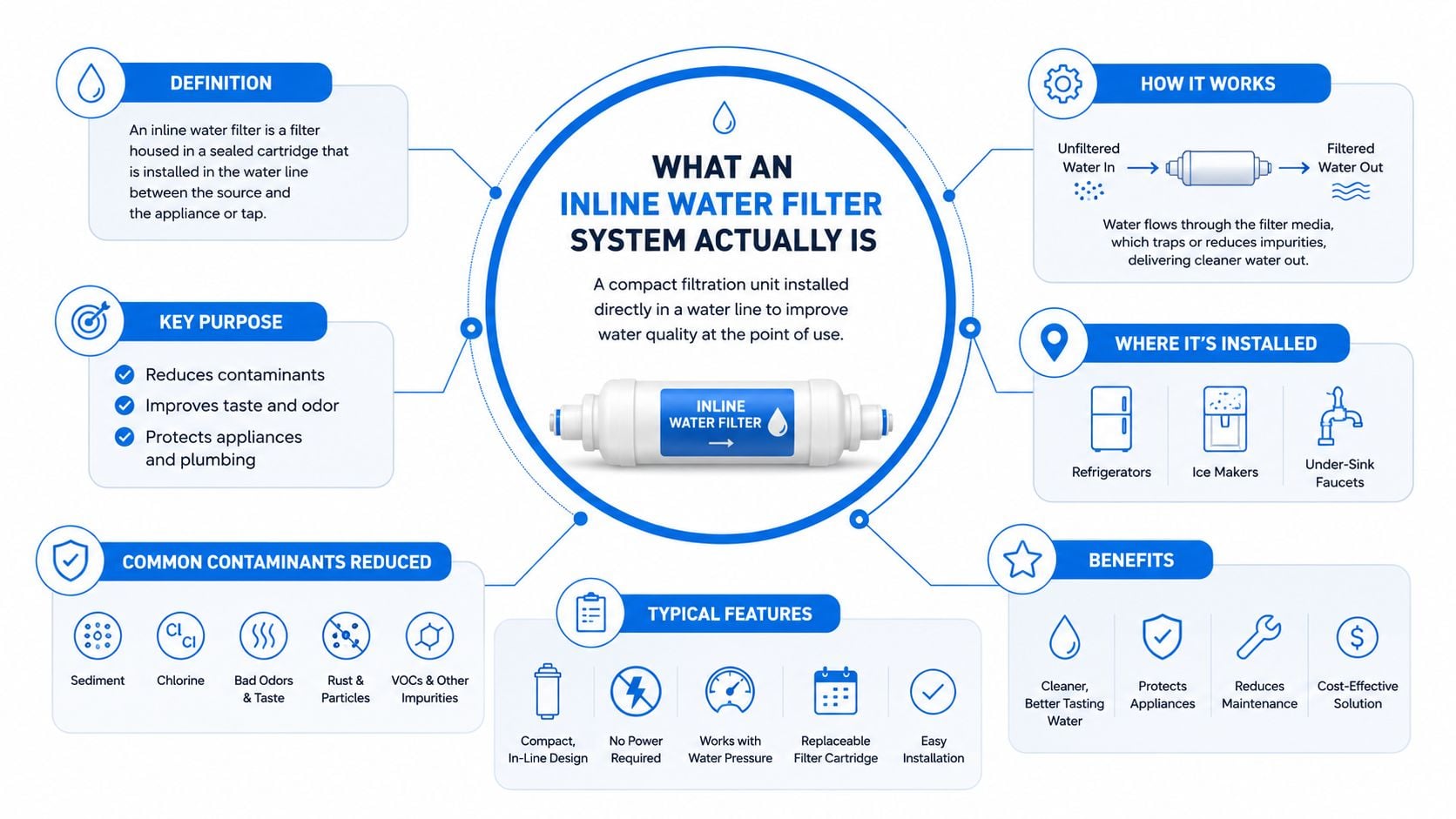
Typical inline designs operate at modest appliance-scale flow. One drinking-water cartridge is specified at **1.0 gallon per minute at 60 psi**, with a **30 to 100 psi** operating range, while another refrigerator-style cartridge is rated at **0.5 gallon per minute** with limits of **20 to 90 psig**. Those specifications come from the manufacturer data summarized in [inline filter specifications](https://www.water2drink.com/pdfs/Manuals-Specs-06-2017/Specs/Multipure-Aquaperform-Inline-Specifications.pdf). In plain language, the filter needs enough pressure to deliver water, but moving water faster can reduce the time it spends in contact with the media.
## Where Inline Filters Make Sense in a Real Kitchen
The best application is usually the fixture that provides drinking or beverage water but doesn't require whole-home volume. Four kitchen setups appear often.
### Refrigerator water and ice
A refrigerator line is a natural match because one filter can treat both dispenser water and ice, provided the appliance and connection layout support that arrangement. Ice makers can make taste problems more noticeable because unpleasant odors become concentrated in something you chew or let melt into a drink.
A busy refrigerator may draw water throughout the day, while a lightly used unit may sit for long periods. Cartridge life depends on the water entering the filter, the volume your household uses, and the filter's stated capacity. Don't infer service life from the appliance alone. A cartridge serving only an occasional dispenser can experience a very different workload from one serving a large household's drinks and ice.
### Standalone ice makers
A dedicated ice maker often has a short, accessible supply line. An inline filter can be installed upstream when the connection size and pressure requirements match. Flush the cartridge before sending treated water into the machine, and make sure the housing can be removed without pulling on the appliance tubing.
### Coffee and espresso machines
Coffee equipment benefits from water that tastes clean, but filtration doesn't solve every scale problem. Carbon may improve chlorine taste and odor, while hardness minerals can still affect heating components if the cartridge is designed to retain minerals. Check the coffee machine's water requirements and maintenance instructions before choosing a filter.
A machine that draws water only during morning preparation may use less total water than a refrigerator dispenser, yet its heated passages can make residue more noticeable. The right cartridge depends on whether your priority is taste, contaminant reduction, scale control, or a combination that the product documents.
### Secondary sinks and wet bars
A wet bar or secondary drinking tap is a strong candidate when you want filtered water in a specific location without treating every cold-water fixture. The line should remain accessible enough for cartridge replacement, and the tap should be used regularly enough to support the manufacturer's storage and flushing guidance.
For broader household habits that reduce waste and resource use, Fillaree's practical [eco-friendly kitchen tips](https://fillaree.com/blogs/news/7-way-to-make-your-kitchen-more-eco-friendly) can complement a point-of-use filtration plan.
The central decision is simple: **match the filter to the line's job**. A compact inline system is a mismatch for a whole home's peak demand, but it can be a sensible choice for one refrigerator, beverage machine, ice maker, or dedicated drinking tap.
## Installation Basics Without the Plumbing Headache
An inline installation is often manageable, but “simple” doesn't mean “careless.” Before touching the tubing, identify the cold-water shut-off, confirm the filter's inlet and outlet direction, and check whether the existing line uses push-fit, John Guest-style, compression, or another connection.
The basic sequence looks like this:
1. **Shut off the water.** Use the local valve if one exists. Apartment residents may need building management to identify the correct shut-off.
2. **Depressurize the line.** Open the connected tap or dispenser until water stops flowing.
3. **Plan the cut.** Mark a clean, straight section of tubing with enough slack for the filter and future cartridge removal.
4. **Add a feed adapter or tee if required.** Don't force incompatible fittings together.
5. **Mount the housing accessibly.** Leave room to disconnect the line and remove the cartridge without moving the refrigerator or emptying a cabinet.
6. **Flush the new cartridge.** Carbon fines can appear as dark particles if this step is skipped.
7. **Inspect under pressure.** Turn the water back on slowly, check every connection, and revisit the area after use.
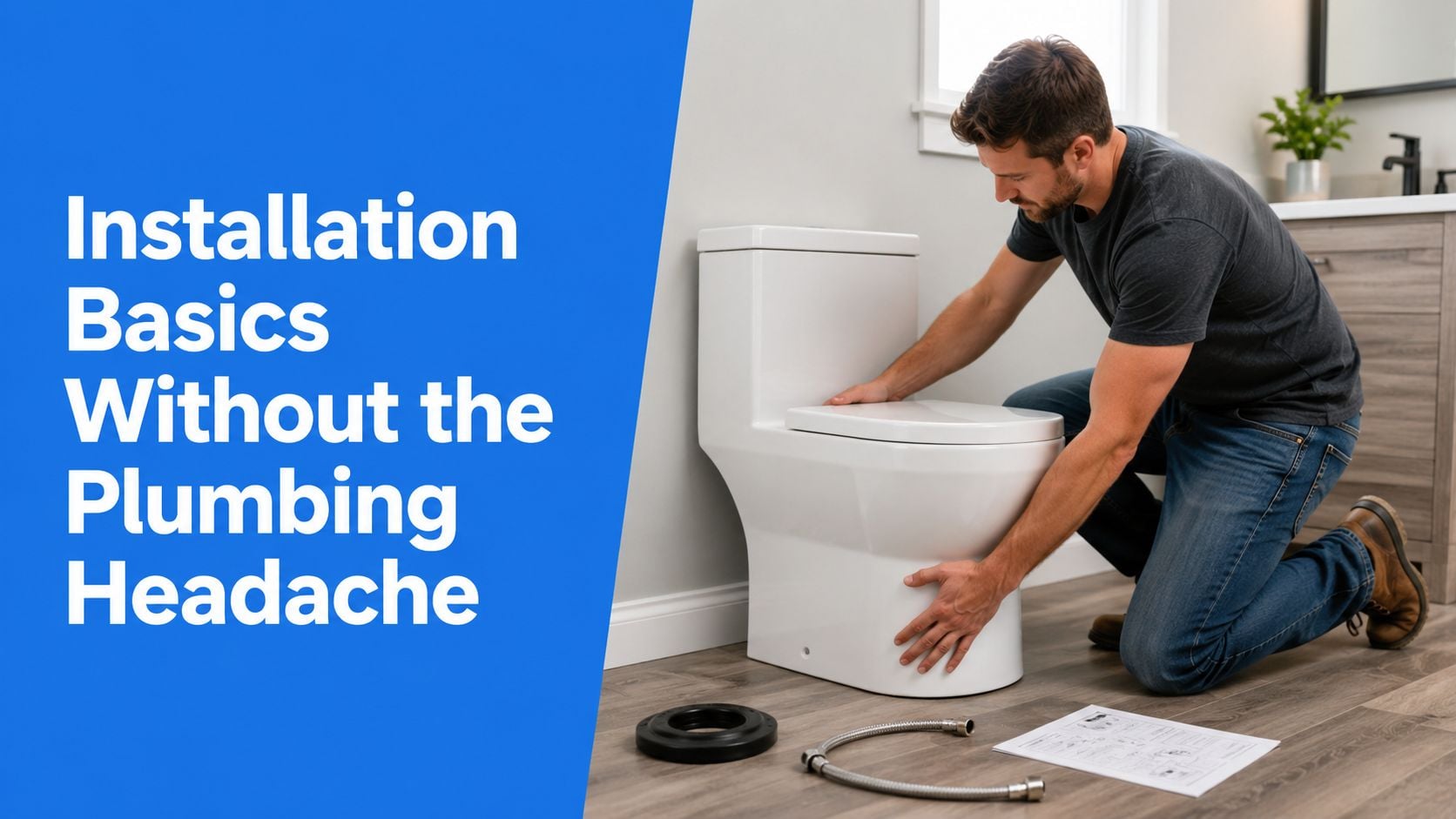
A refrigerator installation has its own traps. Tubing can kink when the appliance slides back, and a filter mounted sideways may technically work while making cartridge changes awkward. Keep the filter supported, avoid sharp bends, and don't let the housing hang from a small plastic connection.
If you're planning a remodel or adding a new branch line, it helps to [check water pressure before remodeling](https://www.trademasterkz.com/water-line-pressure-testing/). Pressure affects fixture performance and filter flow, so it shouldn't be treated as an afterthought.
### Renters and apartment residents
A renter should check the lease before altering a supply line, even if the modification seems reversible. Look for an existing appliance valve or accessible cold-water connection, and favor fittings that can be removed without cutting built-in plumbing. Shared shut-offs, cramped cabinets, and landlord restrictions can make a plumber the safer choice.
Call a professional when the shut-off doesn't close, the tubing is brittle, the connection is unfamiliar, or the installation requires opening a wall. A small leak behind a refrigerator can go unnoticed long enough to damage flooring, so confidence should come from a controlled installation, not from avoiding a service call.
## What These Filters Actually Remove and What They Don't
An inline filter isn't a magic eraser. **The cartridge media, flow rate, contact time, and documented testing** determine which contaminants it can reduce.
Activated carbon works somewhat like a sponge with a finite supply of useful surfaces. As water moves through, some compounds attach to the carbon. Once available sites fill, performance can decline. A faster flow gives water less contact time with the media, which is why a cartridge optimized for appliance delivery can't automatically be treated as a whole-home solution.
Carbon block designs can improve contact by forcing water through the media bed and reducing channeling. Technical material from Pentair describes the relationship between flow, contact time, and adsorption, and notes that carbon cartridges are tested across different operating conditions in [carbon cartridge guidance](https://www.pentair.eu/sites/default/files/collaterals/brochure_carbon_cartridges_en.pdf).
### Read the standard, not just the bullet point
A claim such as “reduces contaminants” needs a specific target and test basis. The common standards serve different purposes:
StandardWhat it generally addresses**NSF/ANSI 42**Aesthetic concerns such as chlorine taste, odor, and particulate reduction**NSF/ANSI 53**Health-related contaminant reduction claims, including lead when the product is certified for that claim**NSF/ANSI 401**Certain emerging or incidental contaminants, depending on the certified claim**NSF/ANSI P473**Specific PFAS-related claims for certified productsThe [EPA guide to filters certified for lead reduction](https://www.epa.gov/system/files/documents/2024-06/how-to-id-filters-certified-to-reduce-lead-in-drinking-water-epa_june-2024.pdf) explains that lead-reduction claims for point-of-use filters should connect to **NSF/ANSI 53**. It also distinguishes NSF/ANSI 42 for particulate reduction and NSF/ANSI 58 for certified reverse-osmosis systems that make lead-reduction claims.
Lead content and lead leaching aren't identical. NSF explains that **NSF/ANSI/CAN 372** addresses lead-content requirements, while **NSF/ANSI 61 Annex G** covers both lead content and lead leaching requirements in its standards portfolio. A product can therefore satisfy a materials requirement without carrying the same certification for leaching performance.
PFAS deserves extra caution. NSF explains that certified systems can make elective PFAS claims under NSF/ANSI 53 or 58, while WQA discusses current national standards supporting PFOS and PFOA reduction to a cumulative **20 parts per trillion** for total PFAS claims, with limits for specific compounds in PFAS filtration standards guidance. Performance can vary across PFAS compounds, media types, cartridge sizes, and flow conditions. “Good for PFAS” isn't precise enough by itself.
Chromium, including chromium-related concerns, also requires a documented claim. WQA's standards discussion identifies NSF/ANSI 53 and 58 as addressing several metals, including total chromium, when the specific product carries the applicable certification and claim. Fluoride, chlorine, lead, PFAS, and other contaminants shouldn't be treated as one interchangeable category.
> **A useful buying test:** If the product page doesn't identify the contaminant, standard, test challenge, flow condition, and capacity, the claim needs more investigation.
Water quality can also affect appliances, not only drinking taste. For a practical discussion of how water affects dishwashers, see [Simply Hospitality's dishwasher water guide](https://simplyhospitality.co.nz/blogs/product-thoughts/how-water-quality-affects-dishwasher-performance). For a focused explanation of contaminant claims, this guide to [inline water filter contaminant removal](https://woder.com/blog/inline-water-filters-contaminant-removal/) offers another useful reference.
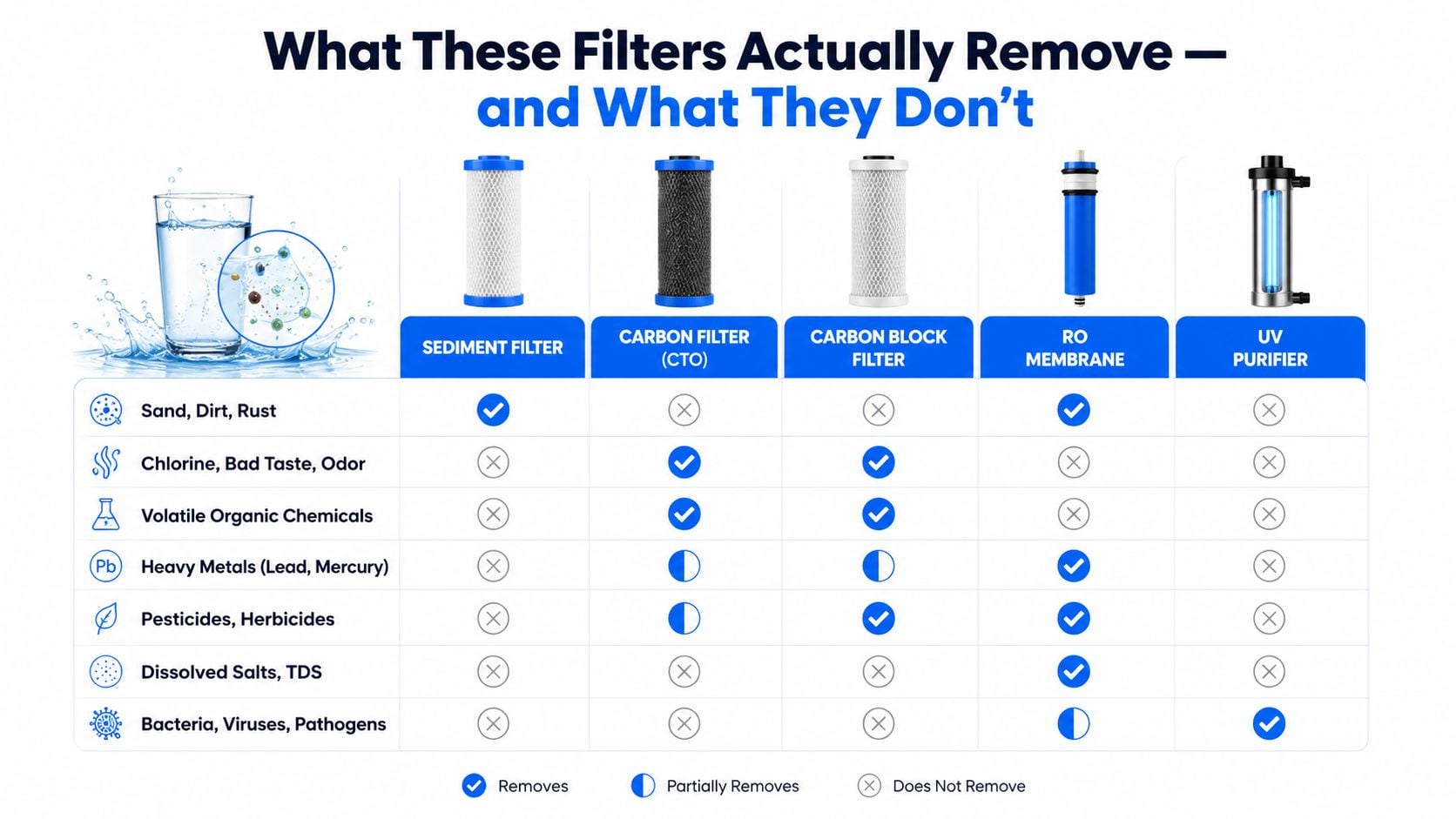
## Inline Filtration vs Reverse Osmosis Without the Hype
Reverse osmosis and inline selective filtration solve different problems. RO pushes water through a semipermeable membrane, producing water with very low dissolved-solids content. That can be useful when a household has a documented contamination profile that calls for RO, or when a specialized application requires very low TDS.
The tradeoff is that RO removes dissolved substances broadly. That includes calcium and magnesium, the minerals many people associate with the taste of ordinary drinking water. RO systems also commonly use a storage tank and drain connection, and their operation can involve water waste, more components, and more maintenance than a direct inline cartridge.
A **zero-TDS reading isn't proof that water is safe or ideal for drinking**. It shows that dissolved solids, both desirable and undesirable, have been removed. TDS meters also don't identify individual contaminants, so a low reading can't confirm PFAS, lead, fluoride, chromium, or any other specific reduction claim.
Selective inline filtration follows another philosophy. Woder's Advanced Selective Filtration® is designed to target listed contaminants while retaining essential minerals, rather than treating mineral removal as the definition of purity. A direct inline setup can avoid a tank and drain line, which is useful in a crowded cabinet or for a refrigerator feed.
ConsiderationInline selective filtrationReverse osmosis**Minerals**Designed to retain essential minerals when the product documentation supports that approachRemoves dissolved solids broadly**TDS reading**May remain above zero because minerals remainCan produce very low TDS**Plumbing**Usually connects directly to a selected lineCommonly needs drain and storage components**Maintenance**Cartridge replacement and flushingMultiple filter and membrane service needs**Best fit**Targeted point-of-use drinking and appliance linesSpecific contamination profiles or specialized low-TDS needsNeither technology deserves blanket praise or dismissal. Choose based on your water test, the contaminant claim you need, the space available, and whether retaining minerals matters to your daily drinking water.
## What to Check Before You Buy and What Comes Next
A sensible purchase starts with the water, not the marketing label. Work through these questions in order:
1. **What enters the home?** Read your utility's Consumer Confidence Report, or arrange a laboratory test for a private well or a more specific contaminant profile.
2. **Which line needs treatment?** Identify the refrigerator, ice maker, coffee machine, wet bar, or dedicated tap.
3. **What backs the claim?** Match each target, such as lead, chlorine, PFAS, fluoride, or chromium, to a documented test and applicable standard.
4. **Can you service it?** Confirm that the cartridge can be changed without moving an appliance or dismantling the cabinet.
5. **Can you reverse the installation?** Renters should verify lease rules and preserve the original fittings.
Woder offers lab water testing, installation resources, and replacement cartridges for its point-of-use systems. If you're comparing cartridge formats and service needs, this guide to the [best water filter cartridge](https://woder.com/blog/best-water-filter-cartridge/) can help organize the decision.
---
Woder Filters offers U.S.-made point-of-use inline and under-sink filtration systems that use Advanced Selective Filtration® to target listed contaminants while retaining essential minerals. Review your water report, identify the line you want to treat, and visit [Woder Filters](https://woder.com) to find a system and replacement-cartridge path that fits your kitchen.
**Categories:** Woder Science
**Tags:** fridge water filter, home water filtration, inline water filter system, point of use filter, under sink filtration
---
### [Best Inline Water Filters of 2026: Ranked by Contaminant Removal, Flow Rate, and Value](https://woder.com/blog/inline-water-filters-contaminant-removal/)
**Published:** August 16, 2026
**Author:** woder
**Content:**
- [What Makes an Inline Water Filter Worth Buying](#what-makes-an-inline-water-filter-worth-buying)
- [The Best Inline Water Filters of 2026](#the-best-inline-water-filters-of-2026)
- [1. Woder WD-10K-ADV-PORT — Best Overall](#1-woder-wd-10k-adv-port-best-overall)
- [2. Woder WD-D-8K-FRM-ADV-DC — Best Under-Sink Inline Filter](#2-woder-wd-d-8k-frm-adv-dc-best-under-sink-inline-filter)
- [3. Aquasana AQ-5200 — Best Competitor for Selective Filtration](#3-aquasana-aq-5200-best-competitor-for-selective-filtration)
- [4. iSpring RCC7 — Best Value RO System (If You Don't Mind Losing Minerals)](#4-ispring-rcc7-best-value-ro-system-if-you-dont-mind-losing-minerals)
- [5. Clearly Filtered Under-Sink System — Strong Claims, Slower Flow](#5-clearly-filtered-under-sink-system-strong-claims-slower-flow)
- [6. Waterdrop G3P800 — Best for Tech-Savvy RO Buyers](#6-waterdrop-g3p800-best-for-tech-savvy-ro-buyers)
- [7. Frizzlife MK99 — Budget Inline Option](#7-frizzlife-mk99-budget-inline-option)
- [How These Filters Compare at a Glance](#how-these-filters-compare-at-a-glance)
- [Inline Filters vs. Pitcher Filters vs. Reverse Osmosis: Which One Actually Fits Your Life?](#inline-filters-vs-pitcher-filters-vs-reverse-osmosis-which-one-actually-fits-your-life)
- [What to Look For When Choosing Your Filter](#what-to-look-for-when-choosing-your-filter)
- [The Bottom Line](#the-bottom-line)
- [Frequently Asked Questions](#frequently-asked-questions)
Shopping for an inline water filter sounds straightforward until you start comparing products. Some remove chlorine but leave lead untouched. Some strip out everything — including the minerals your body actually needs. Some require a plumber. Some cut your water pressure to a crawl.
This guide cuts through all of that. We ranked the best inline water filters of 2026 on four criteria that actually matter: contaminant removal breadth, flow rate, installation ease, and total cost of ownership. Whether you're moving into a new home, expecting a baby, or just done buying bottled water, here's a clear answer.
---
### What Makes an Inline Water Filter Worth Buying
Before the rankings, here's what separates a good inline filter from a mediocre one.
**Contaminant removal** is the most important factor. Lead, PFAS, chlorine, chromium 6, mercury, and volatile organic compounds are the contaminants that show up most often in municipal and well water. A filter that only handles chlorine taste and odor isn't doing the full job.
**Flow rate** matters more than people expect. A filter rated for 0.5 gallons per minute will frustrate you every time you fill a pot. Look for flow rates measured in thousands of gallons per minute (kGPM) for household use.
**Installation ease** is what separates inline filters from whole-home systems. The best ones connect directly to your existing water line — no special tools, no tank, no plumber.
**Total cost of ownership** means factoring in replacement cartridges, not just the sticker price. A cheaper filter with expensive, frequent replacements often costs more over two years than a pricier unit with longer-lasting media.
One more thing worth knowing: filtration methods are not all equal. Reverse osmosis removes almost everything, including calcium and magnesium — the naturally occurring minerals that are actually good for you. Basic pitcher filters use activated carbon, which helps with taste but often can't handle lead or PFAS at meaningful levels. The best inline filters sit in the middle: they remove the harmful stuff and leave the beneficial minerals alone.
---
### The Best Inline Water Filters of 2026
#### 1. Woder WD-10K-ADV-PORT — Best Overall
**Best for:** Households that want maximum contaminant removal without sacrificing minerals or flow rate
The Woder WD-10K-ADV-PORT earns the top spot because it does something most filters can't: it removes 99.9% of contaminants — including lead, PFAS, chromium 6, mercury, chlorine, carcinogens, and VOCs — while keeping calcium, magnesium, and other naturally occurring minerals in your water.
That distinction matters. Most filters treat your water like a problem to be solved by removing everything. Woder's Advanced Selective Filtration technology uses nanoparticles to attract and capture specific contaminants, leaving behind what's actually beneficial. The result is clean water that still tastes like water — not flat, stripped-down liquid.
At 10 kGPM, this is the highest-flow model in the Woder lineup. It installs inline into your existing water line with no tank, no wastewater, and no plumber required. Replacement cartridges are sold separately, so maintaining performance over time doesn't mean buying a whole new unit. Everything is manufactured in the United States.
**What it removes:** Lead, PFAS, chlorine, chromium 6, mercury, VOCs, carcinogens
**What it keeps:** Calcium, magnesium, naturally occurring minerals
**Flow rate:** 10 kGPM
**Installation:** DIY inline, no plumber needed
**Wastewater:** None
**Verdict:** Professional-grade filtration, DIY install, no mineral stripping. Remove the bad. Keep the good.
---
#### 2. Woder WD-D-8K-FRM-ADV-DC — Best Under-Sink Inline Filter
**Best for:** Homeowners who want a dedicated under-sink setup with high-capacity filtration
The WD-D-8K-FRM-ADV-DC is Woder's 8 kGPM under-sink model. It delivers the same Advanced Selective Filtration performance as the top-ranked unit — same contaminant removal, same mineral-preservation approach — in a format built specifically for under-sink installation.
Flow rate is strong at 8 kGPM, and the inline design means no separate faucet, no tank, and no countertop footprint. This model is the right call for homeowners who want a permanent, tidy setup that works through their existing tap.
**What it removes:** Lead, PFAS, chlorine, chromium 6, mercury, VOCs, carcinogens
**Flow rate:** 8 kGPM
**Installation:** Under-sink inline, no plumber needed
**Wastewater:** None
**Verdict:** Same performance as the top-ranked model, tucked out of sight. A clean, permanent solution for under-sink installs.
---
#### 3. Aquasana AQ-5200 — Best Competitor for Selective Filtration
**Best for:** Buyers who want NSF-certified selective filtration and don't mind paying more
Aquasana is the closest competitor to Woder in the selective filtration space. Their Claryum technology is NSF-certified and targets a similar range of contaminants, including lead, chlorine, and PFAS. The brand has strong recognition and positions around "optimal drinking water."
The trade-off is price. Aquasana typically runs 20 to 30 percent higher than comparable Woder models. You're paying a premium for the name without a meaningful performance advantage.
**What it removes:** Lead, chlorine, PFAS, cysts
**Flow rate:** Varies by model
**Installation:** Under-sink; some models require a separate faucet
**Wastewater:** None
**Verdict:** Solid performer with strong certification credentials, but the price gap is real. Worth comparing directly against Woder before you decide.
---
#### 4. iSpring RCC7 — Best Value RO System (If You Don’t Mind Losing Minerals)
**Best for:** Buyers who prioritize low upfront cost and aren't concerned about mineral retention
iSpring competes on value with strong certifications and a no-frills approach. The RCC7 is a reverse osmosis system, which means it removes a very wide range of contaminants — and also removes beneficial minerals, producing wastewater at a typical 3:1 or 4:1 waste-to-filtered ratio.
If mineral content matters to you, or if you want zero wastewater, iSpring isn't the right fit. For buyers who want budget-friendly RO performance and aren't worried about what gets stripped out, it's a credible option.
**What it removes:** Very broad contaminant range
**What it loses:** Calcium, magnesium, other minerals
**Flow rate:** Slower than inline filters; requires a storage tank
**Installation:** More complex; tank required
**Wastewater:** Yes, significant
**Verdict:** Good value for RO buyers, but a different product category than true inline filters. Not a direct comparison to Woder.
---
#### 5. Clearly Filtered Under-Sink System — Strong Claims, Slower Flow
**Best for:** Buyers focused on contaminant breadth who can tolerate slower flow
Clearly Filtered makes strong contaminant removal claims and has built a following among health-focused buyers. The under-sink system covers a wide range of contaminants, including PFAS and heavy metals.
The main limitations are flow rate and replacement cost. Flow is noticeably slower than Woder's lineup, and replacement filters tend to cost more over time. For households with higher water demand, that slower flow becomes a daily frustration.
**What it removes:** Lead, PFAS, heavy metals, chlorine
**Flow rate:** Slower than Woder models
**Installation:** Under-sink
**Wastewater:** None
**Verdict:** Capable filter with genuine contaminant coverage, but the slower flow and higher ongoing cost make it harder to recommend for most households.
---
#### 6. Waterdrop G3P800 — Best for Tech-Savvy RO Buyers
**Best for:** Buyers who want app connectivity and tankless RO in a premium package
Waterdrop targets a different buyer profile entirely. Their tankless RO systems come with app connectivity, sleek design, and premium pricing — typically 30 to 50 percent above Woder. It's a tech-forward product for buyers who want features alongside filtration.
Like all RO systems, Waterdrop strips out minerals along with contaminants. If you want mineral-rich water, a simpler install, or a lower price point, this isn't the right direction. But if smart-home integration and modern aesthetics are priorities, Waterdrop leads the category.
**What it removes:** Very broad RO-level removal
**What it loses:** Calcium, magnesium, other minerals
**Flow rate:** Strong for RO
**Installation:** More involved than inline; tankless design helps
**Wastewater:** Yes, though more efficient than traditional RO
**Verdict:** Great product for the right buyer. Not the right buyer if you want minerals preserved, a simpler install, or a more accessible price.
---
#### 7. Frizzlife MK99 — Budget Inline Option
**Best for:** Renters or buyers with tight budgets who need basic inline filtration
Frizzlife offers budget-friendly inline and RO options with decent performance for the price. The MK99 handles chlorine, sediment, and some heavy metals. Brand recognition is limited, and contaminant coverage is narrower than Woder's Advanced Selective Filtration.
For renters who need something simple and inexpensive, Frizzlife is worth a look. For homeowners who want comprehensive removal — especially PFAS and lead — the coverage gap is significant.
**What it removes:** Chlorine, sediment, some heavy metals
**Flow rate:** Moderate
**Installation:** Inline DIY
**Wastewater:** None (non-RO models)
**Verdict:** Fine for basic filtration on a tight budget. Not the right choice if PFAS or lead are your primary concerns.
---
### How These Filters Compare at a Glance
FilterPFAS RemovalLead RemovalMinerals PreservedWastewaterDIY InstallWoder WD-10K-ADV-PORTYesYesYesNoYesWoder WD-D-8K-FRM-ADV-DCYesYesYesNoYesAquasana AQ-5200YesYesYesNoPartialiSpring RCC7YesYesNoYesPartialClearly FilteredYesYesYesNoYesWaterdrop G3P800YesYesNoYesPartialFrizzlife MK99LimitedLimitedYesNoYes---
### Inline Filters vs. Pitcher Filters vs. Reverse Osmosis: Which One Actually Fits Your Life?
This question comes up constantly, and the honest answer depends on what you're trying to remove.
**Pitcher filters** are convenient and cheap upfront. They handle chlorine taste and some sediment. They don't reliably remove lead or PFAS at levels that matter. If those contaminants are in your water, a pitcher isn't enough.
**Reverse osmosis systems** remove nearly everything — which sounds ideal until you realize that includes calcium and magnesium. They also produce wastewater, require a storage tank, and usually need professional installation. For renters or anyone who wants a simpler setup, RO is often overkill in the wrong direction.
**Inline filters** sit in the middle. They connect directly to your water line, require no tank, produce no wastewater, and the best ones remove serious contaminants while keeping beneficial minerals intact. That's the sweet spot for most households.
---
### What to Look For When Choosing Your Filter
**Start with your water.** On municipal water, your biggest concerns are likely chlorine, lead (especially in older homes), and PFAS. On well water, sediment and bacteria may also be factors. Woder's site includes a water testing tool to help you understand what's actually in your supply.
**Match the flow rate to your household.** A single-person apartment has different demands than a family of four. Woder's lineup spans from compact residential models up to the 10 kGPM WD-10K-ADV-PORT, so there's a fit for most households.
**Factor in cartridge costs.** The filter you buy today needs replacements over time. Look at the cost per cartridge and the replacement interval before committing. Woder sells replacement cartridges separately, so you swap the media without buying a whole new unit.
**Think honestly about installation.** If you're renting, a whole-home system isn't realistic. An inline filter that connects to your existing line is the practical choice. If you own your home and want a permanent under-sink setup, Woder's under-sink models give you that without a plumber.
---
### The Bottom Line
The best inline water filter of 2026 removes the contaminants that actually threaten your health, keeps the minerals your body needs, installs without a plumber, and doesn't cost a fortune to maintain.
Woder's lineup — particularly the WD-10K-ADV-PORT for high-flow households and the WD-D-8K-FRM-ADV-DC for under-sink installs — hits all four marks. Lead, chlorine, PFAS, chromium 6 — gone. Calcium, magnesium — still there. Built in the US. Installed in minutes.
Not sure which model fits your home? Use the interactive product Wizard at [woder.com](https://woder.com) to find the right filter for your flow rate and filtration needs.
---
### Frequently Asked Questions
**What is an inline water filter and how does it work?**
An inline water filter connects directly into your existing water supply line. Water flows through the filter media before it reaches your tap, removing contaminants along the way. Unlike pitcher filters, inline filters work at the point of entry to your faucet. And unlike reverse osmosis systems, the best inline filters don't require a storage tank or produce wastewater.
**Do inline water filters remove PFAS?**
The best ones do. Woder's Advanced Selective Filtration technology removes PFAS along with lead, chlorine, chromium 6, mercury, and VOCs. Basic carbon filters and many entry-level inline filters don't reliably remove PFAS. Always check the specific contaminant removal list for any filter you're considering.
**Will an inline water filter remove beneficial minerals like calcium and magnesium?**
It depends on the filter type. Reverse osmosis systems strip out minerals along with contaminants. Woder's inline filters use selective filtration, which targets specific contaminants while leaving naturally occurring minerals like calcium and magnesium intact. That's one of the main reasons selective inline filters are a better fit than RO for many households.
**How often do inline water filter cartridges need to be replaced?**
Replacement intervals vary by model and household water usage. Woder sells replacement cartridges separately so you can maintain performance without replacing the entire unit. Check the product specifications for your specific model to understand the expected cartridge lifespan.
**Can I install an inline water filter myself, or do I need a plumber?**
Most inline filters — including Woder's full lineup — are designed for DIY installation. They connect directly to your existing water line without special tools or plumbing modifications, which makes them a practical option for renters as well as homeowners.
**What's the difference between an inline water filter and a reverse osmosis system?**
An inline filter connects to your water line and filters water as it flows through — no tank, no wastewater. A reverse osmosis system uses pressure to push water through a membrane, removing nearly all dissolved solids including beneficial minerals. RO systems require a storage tank, produce significant wastewater, and usually need professional installation. Inline selective filters are simpler, less wasteful, and preserve the minerals that RO strips out.
**How do I know which inline water filter is right for my home?**
Start by identifying your main water quality concerns — whether that's lead, PFAS, chlorine, or a combination. Then match a filter to your household's flow rate needs. Woder's interactive Wizard at woder.com walks you through both questions and points you to the right model for your situation.
**Categories:** Woder Social Media
---
### [Best Water Filter Cartridge: How to Choose the Right One](https://woder.com/blog/best-water-filter-cartridge/)
**Published:** August 16, 2026
**Author:** woder_admin
**Content:**
The most popular advice about the **best water filter cartridge** is also the least useful: choose the cartridge with the longest life, the most impressive contaminant list, or the highest review score. None of those answers tells you whether the cartridge is right for your water.
A cartridge should earn its place through **verified contaminant reduction at its rated capacity**, compatibility with your plumbing, acceptable flow, and a sensible replacement cost. Municipal water, private well water, older plumbing, and refrigerator lines create different filtration problems. A cartridge that performs well in one kitchen may be the wrong choice in the next.
The comparison below gives you the short version before the technical details.
Cartridge approachBest suited toMain strengthMain limitationSediment mediaSand, rust, silt, and visible particlesProtects downstream equipmentDoesn't address dissolved contaminantsGranular activated carbonChlorine, taste, odor, and some organic compoundsSimple and widely availableFlow and contact time can limit performanceCarbon blockChlorine, taste, odor, and selected organic contaminantsMore consistent contact with carbon than loose granulesRequires attention to pressure drop and certificationIon exchange resinSelected dissolved ions and hardness-related applicationsTargets specific charged contaminantsCan alter mineral chemistry and needs a precise use caseSelective filtration mediaCertified target contaminants while retaining mineralsTargets contaminants without treating every dissolved solid as wasteMust be matched to the exact certification and rated lifeReverse osmosisVery broad dissolved-solids reductionProduces very low TDS waterRemoves beneficial minerals and adds maintenance and water-waste tradeoffs## Table of Contents
- [Why There Is No Single Best Cartridge for Every Home](#why-there-is-no-single-best-cartridge-for-every-home)
- [Municipal water and well water need different starting points](#municipal-water-and-well-water-need-different-starting-points)
- [The useful question is narrower](#the-useful-question-is-narrower)
- [Decoding Water Filter Certifications and What They Actually Verify](#decoding-water-filter-certifications-and-what-they-actually-verify)
- [Read the performance listing, not just the package](#read-the-performance-listing-not-just-the-package)
- [Verify independent certification](#verify-independent-certification)
- [Comparing Cartridge Media Types by Contaminant Target](#comparing-cartridge-media-types-by-contaminant-target)
- [Matching Your Water Profile to the Right Cartridge](#matching-your-water-profile-to-the-right-cartridge)
- [Start with the source](#start-with-the-source)
- [Match the claim to the contaminant](#match-the-claim-to-the-contaminant)
- [Account for the plumbing](#account-for-the-plumbing)
- [The Real Cost of Cartridge Ownership Over Time](#the-real-cost-of-cartridge-ownership-over-time)
- [Use capacity, not calendar language alone](#use-capacity-not-calendar-language-alone)
- [Look for the hidden cost](#look-for-the-hidden-cost)
- [Building Your Cartridge Decision Framework](#building-your-cartridge-decision-framework)
- [Confirm the contaminant claim](#confirm-the-contaminant-claim)
- [Check the physical match](#check-the-physical-match)
- [Compare ownership rather than sticker price](#compare-ownership-rather-than-sticker-price)
- [Why Selective Filtration Outperforms Reverse Osmosis for Most Homes](#why-selective-filtration-outperforms-reverse-osmosis-for-most-homes)
- [The practical tradeoff](#the-practical-tradeoff)
## Why There Is No Single Best Cartridge for Every Home
A cartridge isn't good in the abstract. It's good or bad **for a specific source-water profile**.
Municipal systems can differ in disinfectant use, pipe materials, mineral content, and contaminant history. A homeowner concerned mainly with chlorine taste needs a different verified performance claim from someone dealing with lead from household plumbing or PFAS in the source supply. Private wells add another layer because groundwater conditions can vary by location, well construction, depth, and local geology.
That makes product rankings based on one overall score misleading. They often compare capacity, price, or review sentiment without asking the question that determines filtration performance: **what must this cartridge remove from your water?**
### Municipal water and well water need different starting points
A city water report can show regulated contaminants detected in the distribution system, but it won't necessarily describe what happens between the street and your faucet. Older service lines, household plumbing, and point-of-use fixtures can change the water that reaches a glass.
Well owners have an even stronger reason to test before buying. A clear glass doesn't prove that well water is free of dissolved metals, microorganisms, or other contaminants. A filter designed for chlorine taste won't solve every well-water problem, and a cartridge designed for drinking water shouldn't be treated as whole-home treatment for sediment, bacteria, or hardness.
> **Practical rule:** Start with the water report or a laboratory test, not a product ranking.
The market itself shows why replacement cartridges deserve careful comparison. The **global water filter cartridges market was valued at US$13.9 billion in 2024 and is projected to reach US$19.7 billion by 2030**, a projected increase of US$5.8 billion and a compound annual growth rate of 6.1%, according to the [market reference associated with the cartridge category](https://santeforhealth.com/products/1-5lbs-kdf-85-coconut-shell-gac-af-10-2216). Replacement filtration is now a recurring purchase, so a poor match can keep costing you long after installation.
### The useful question is narrower
Instead of asking, “What is the best cartridge overall?” ask:
- **What contaminants are present?**
- **Which of those contaminants matter most at my tap?**
- **Does the cartridge have certification for those specific claims?**
- **Will it still meet the claim at the end of rated life?**
- **Can my fixture deliver the required flow without excessive pressure loss?**
That framework eliminates many attractive but irrelevant options. It also prevents a common mistake, choosing a cartridge because it sounds thorough when its documented certification covers only chlorine taste and odor.
## Decoding Water Filter Certifications and What They Actually Verify
Certification logos don't mean a cartridge removes everything. They identify a standard, a tested claim, and a defined test method. The contaminant claim matters more than the logo by itself.
**NSF/ANSI 42** generally addresses aesthetic effects such as chlorine, taste, and odor. A cartridge listed under this standard may be appropriate for improving drinking-water flavor, but that certification alone doesn't establish reduction of lead, PFAS, fluoride, or chromium-6.
**NSF/ANSI 53** addresses health-related contaminant claims, including lead and other substances covered by the specific certification. **NSF/ANSI 58** is associated with reverse osmosis systems. Other standards, including NSF/ANSI 401, may address emerging contaminants, but you still need to identify the exact substances included in the product's listing.
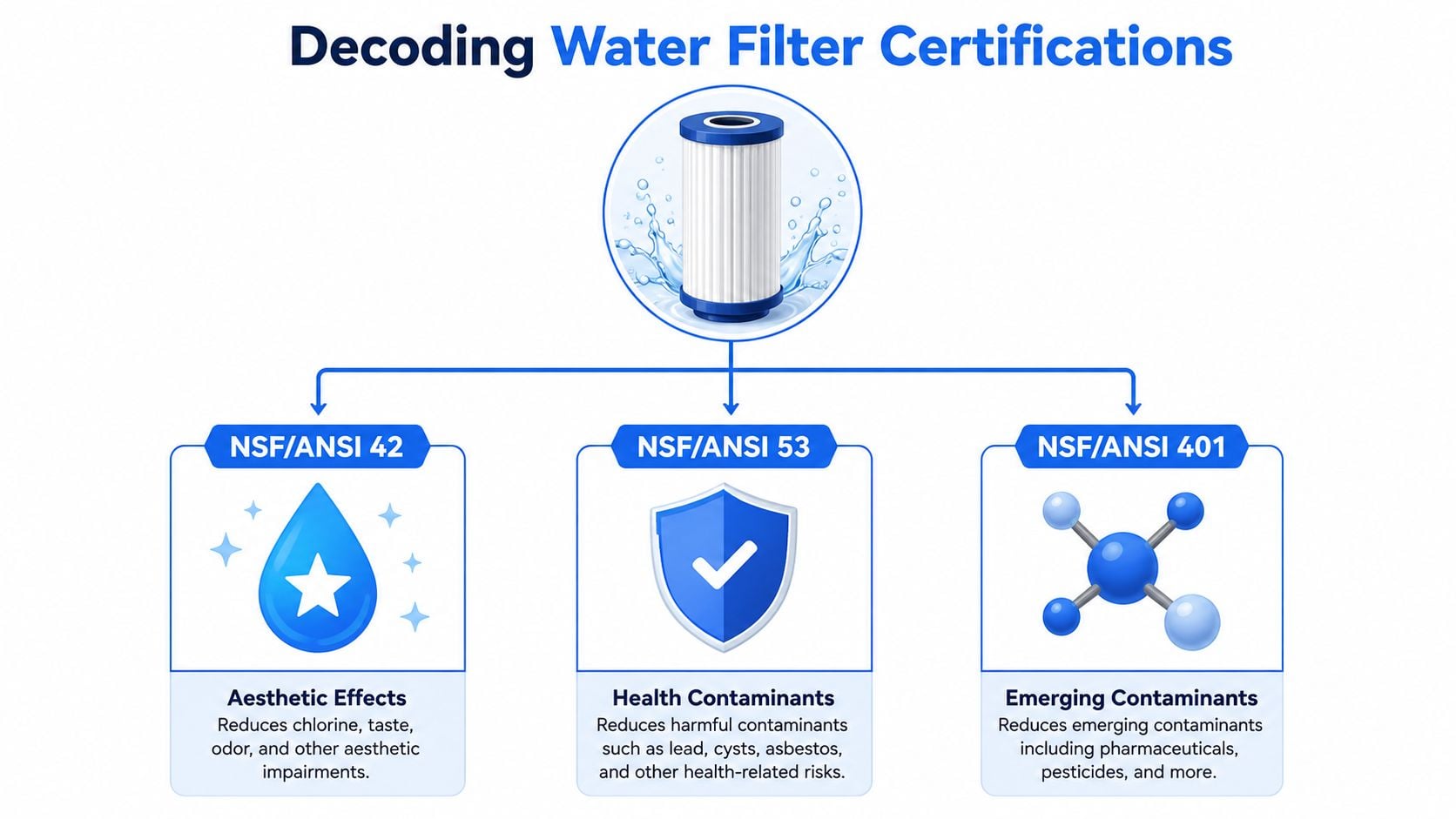
### Read the performance listing, not just the package
A proper listing should tell you:
1. **The exact contaminant claim**, such as chlorine taste and odor or lead reduction.
2. **The rated capacity**, meaning how much water the cartridge is intended to treat under the stated conditions.
3. **The challenge conditions**, including relevant water chemistry and flow requirements.
4. **The replacement instruction**, because capacity isn't a guarantee that the cartridge performs indefinitely.
5. **The certification scope**, which may apply to a replacement cartridge rather than every part of a complete system.
For example, one NSF listing reports a cartridge tested to a capacity of **4,000 liters for chlorine, taste, and odor reduction under NSF/ANSI 42**. That figure is meaningful for that tested claim and test context. It isn't evidence that the same cartridge removes every health-related contaminant.
Lead claims require closer reading. NSF/ANSI 53-certified point-of-use filters for lead reduction are tested with challenge water at **pH 6.5 and pH 8.5**. The benchmark tightened in December 2019 from total lead reduction to **≤10 μg/L** to **≤5 μg/L**, and the test requires the filter to meet the lead benchmark at **100% of rated capacity** while maintaining post-capacity flow at or below **75% of the initial clean flow rate** under the pH 8.5 challenge, as detailed in this [PFAS and point-of-use filtration fact sheet](https://www.uaf.edu/fs/files/water-plant/DBPPOU_Fact-Sheet.pdf).
### Verify independent certification
A certification mark is useful only when you can verify the listing and its scope. The [Water Quality Association explanation of Gold Seal certification](https://wqa.org/grow/product-certification/) describes independent product certification as testing to recognized industry standards, with a public indication that a product has been proven effective at reducing certain contaminants.
For a plain-language explanation of the labels and organizations involved, see [WQA, NSF, and ANSI water-quality terminology](https://woder.com/blog/wqa-nsf-ansi-wth-water-quality-alphabet-soup/). If you're reviewing a product such as the [Woder WD-G4-DC Lead, Chlorine, HM and PFAS Water Filter](https://woder.com/products/wd-g4-dc/), check the specific listing rather than assuming the product name itself establishes every reduction claim.
## Comparing Cartridge Media Types by Contaminant Target
The media inside a cartridge determines what it can plausibly reduce. **Granular activated carbon**, carbon block, ion exchange resin, and selective filtration media rely on different mechanisms, so the label “carbon filter” isn't enough to predict performance.
Granular activated carbon adsorbs many compounds and is commonly used for chlorine, taste, odor, and some organic contaminants. Carbon block compresses carbon into a denser structure. Purdue Extension notes that block activated carbon has been shown to remove chlorine, taste, and halogenated organic compounds more effectively than granular activated carbon, while a peer-reviewed study found that meaningful micropollutant removal required a minimum empty-bed contact time of **20 to 30 minutes** under the study conditions, as reported in this [activated-carbon filtration research](https://pubs.acs.org/doi/10.1021/acssusresmgt.4c00414).
That finding has a practical consequence. **Flow rate and contact time matter as much as media name.** Water moving too quickly through a cartridge may leave sorption capacity underused. A cartridge that creates excessive pressure loss may be difficult to live with, even if its media is technically capable of reducing the target contaminant.
Media typePFASLeadChlorineChromium-6FluorideMineral retentionGranular activated carbonRequires a specific verified claimMay reduce selected metals, only trust a documented claimCommon applicationRequires a specific verified claimUsually not the default choiceGenerally retains dissolved mineralsCarbon blockRequires PFAS-specific certificationMay address lead when specifically testedOften stronger than loose granules for taste and odorRequires a specific verified claimUsually limited without additional mediaGenerally retains dissolved mineralsIon exchange resinDepends on resin chemistry and certificationCan target selected ionsNot its primary roleDepends on the resin and test claimCan be used in specialized designsMay exchange one ion for anotherSelective filtration mediaMust be certified for the PFAS claimCan target lead and other listed metals when verifiedCan address chlorine when testedCan target chromium-6 when verifiedRequires an explicit fluoride claimDesigned to retain essential mineralsReverse osmosis membraneBroad dissolved-contaminant reduction depends on system designStrong reduction potentialUsually requires pretreatmentStrong reduction potentialStrong reduction potentialRemoves dissolved minerals with other dissolved solidsPFAS deserves special caution. The [EPA guidance on filters certified to reduce PFAS](https://www.epa.gov/water-research/identifying-drinking-water-filters-certified-reduce-pfas) directs consumers to look for NSF/ANSI 53 or NSF/ANSI 58 labeling, but certification is tied to a defined standard and claim. It isn't a blanket guarantee for every PFAS compound or every gallon of use.
For chlorine-specific guidance, use this practical explanation of [how filters address chlorine](https://woder.com/blog/filter-for-chlorine/). The right cartridge depends on whether your priority is taste and odor, lead, PFAS, fluoride, chromium-6, or a combination. Don't infer one result from another.
## Matching Your Water Profile to the Right Cartridge
Choosing a cartridge becomes straightforward once you stop treating “water quality” as one problem. Work from the source to the faucet and match each concern to a documented claim.
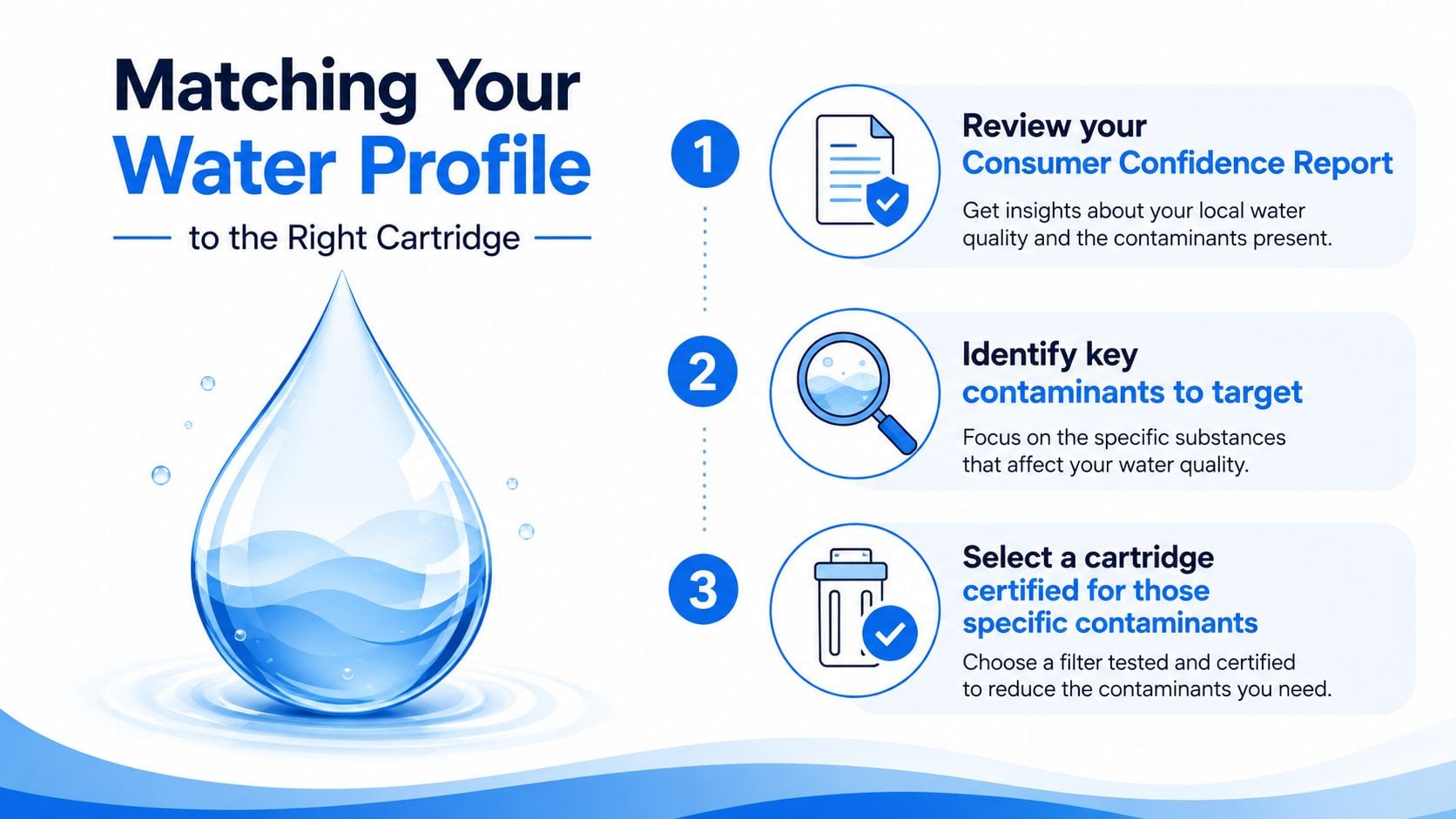
### Start with the source
If you receive municipal water, find your utility's Consumer Confidence Report. Look for contaminant tables, detected levels, treatment information, and any notes about source-water vulnerabilities. The report describes the regulated public system, so it should be treated as a starting point rather than a complete analysis of water after it travels through household plumbing.
If you use a private well, arrange laboratory testing before selecting treatment. A useful overview of [water quality testing methods from BacteriaFAQ.com](https://bacteriafaq.com/2026/03/05/water-quality-testing-methods/) can help you understand the difference between sampling approaches and why test selection matters.
### Match the claim to the contaminant
Make a short list, not a shopping list. If chlorine taste is the problem, look for NSF/ANSI 42 chlorine, taste, and odor claims. If lead is the concern, look for a lead claim under NSF/ANSI 53 and verify the rated capacity and challenge conditions. If PFAS is the concern, look for an explicit PFAS reduction certification rather than relying on the word “carbon.”
The EPA's finalized PFAS rule sets enforceable maximum contaminant levels of **4.0 parts per trillion for PFOA and PFOS**, plus **10 parts per trillion for PFHxS, PFNA, and HFPO-DA, also called GenX chemicals**, along with a hazard index for certain PFAS mixtures, according to the [EPA's PFAS drinking-water rule](https://www.epa.gov/sdwa/and-polyfluoroalkyl-substances-pfas). A later **2025 federal update** indicated that the agency planned to retain the 4 ppt PFOA and PFOS limits, narrow the broader rule to those two prevalent PFAS, and extend public-system compliance to **2031**, as reported in this [federal regulatory update](https://www.kaplankirsch.com/resources-and-news/epa-limits-its-pfas-drinking-water-standard-to-pfoa-and-pfos-and-delays-compliance-timeline-to-2031trump-epa-announces-major-actions-to-combat-pfas-contamination/).
> The contaminant list on the front of a box is a starting point. The certification listing is the evidence.
### Account for the plumbing
Older plumbing can create a point-of-use lead concern even when the utility report looks acceptable. A well may require treatment beyond a drinking-water cartridge, particularly if testing identifies bacteria, high sediment, iron, sulfur compounds, or hardness. In those cases, solve the whole-water problem separately and use a point-of-use cartridge for the contaminants that remain relevant at the tap.
## The Real Cost of Cartridge Ownership Over Time
The purchase price is only the first line in the cost calculation. A cartridge with a low upfront price can become expensive if it needs frequent replacement, loses flow early, or isn't certified for the contaminant you need to remove.
Replacement timing varies widely. Neutral maintenance guidance commonly places sediment-filter replacement around **3 to 6 months**, carbon cartridges around **6 to 12 months**, and RO membranes around **24 to 36 months or longer**, depending on water quality and usage, as summarized in this [water filter cartridge replacement schedule](https://waterfiltrationauthority.com/filter-cartridge-replacement-schedule/). Those are categories, not universal promises.
### Use capacity, not calendar language alone
A replacement interval printed on a package may assume a particular household's consumption and water conditions. Sediment can clog a cartridge early. High contaminant loading can consume media capacity before the calendar date. Low usage can make a large cartridge look economical while offering little practical advantage.
Calculate your annual cost this way:
**Annual cartridge cost = cartridge price × the number of replacements required each year**
Then calculate:
**Cost per gallon = total cartridge cost ÷ gallons treated during the same period**
A cartridge's rated capacity is useful only when you also know your household demand and the claim attached to that capacity. The Ferguson listing for a Pentair granular activated carbon cartridge illustrates why shoppers should read the full specification. Distribution listings may show formats such as 10-inch and 20-inch cartridges and service-life claims such as 15,000 gallons or 3 months, but those claims must be evaluated against the specific product, water conditions, and certified reduction target.
The required visual illustrates a simple example using a $30 cartridge replaced every 6 months, with a $0.10 cost per gallon and a $60 annual cost. Treat that as a calculation example, not a universal market price or performance promise.
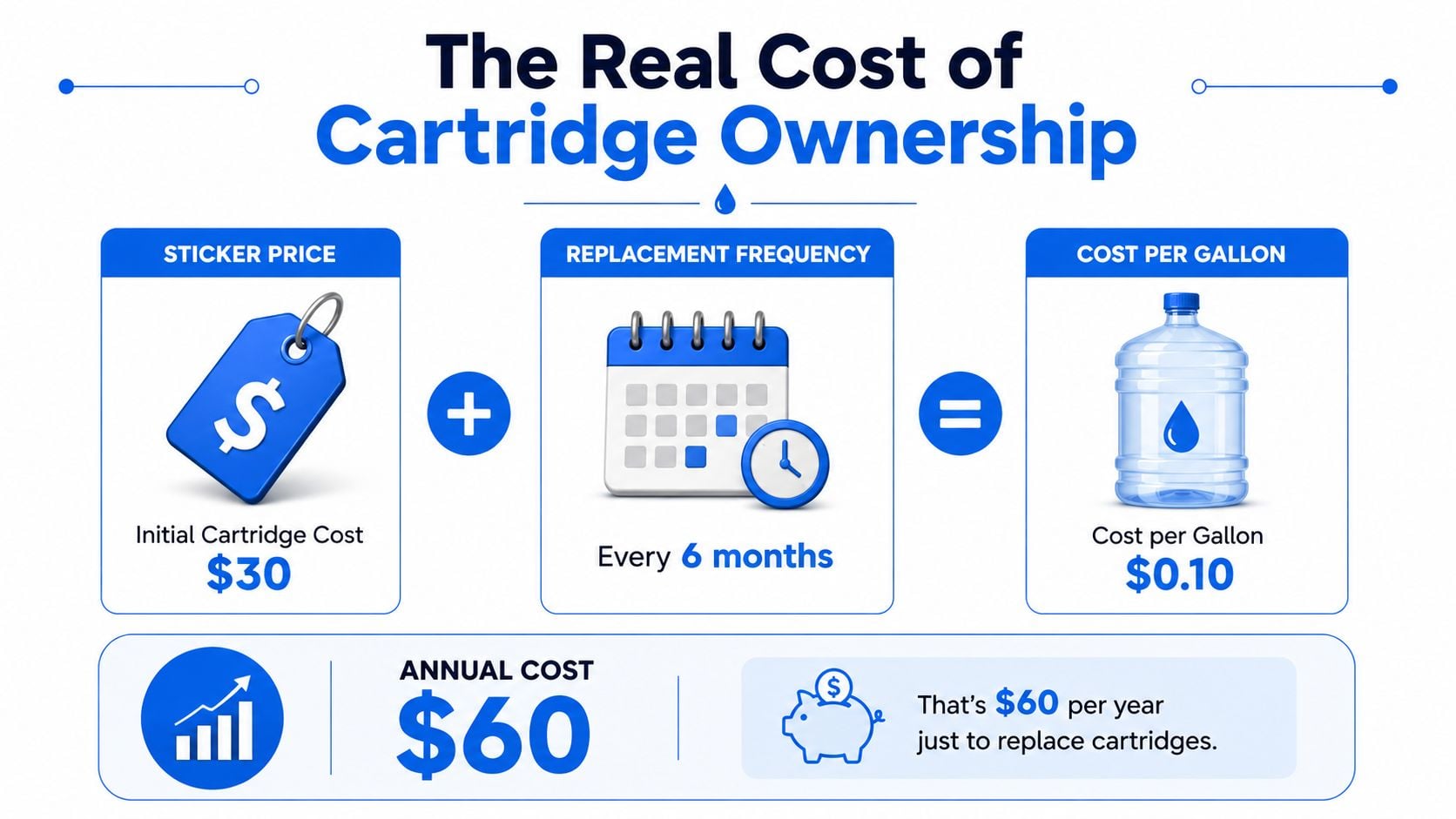
### Look for the hidden cost
The most expensive cartridge is often the one that solves the wrong problem. If it doesn't address your target contaminant, its capacity has no meaningful value. If it reduces flow enough that your household stops using it, the theoretical savings disappear.
Choose a capacity that fits actual demand. A low-use apartment may not benefit from a very large cartridge, while a busy household may pay more over time by choosing a small cartridge that reaches capacity quickly.
## Building Your Cartridge Decision Framework
You don't need to compare every cartridge on the market. Build a shortlist by applying the same filters in the same order.
### Confirm the contaminant claim
Write down the specific targets first: PFAS, lead, chlorine, fluoride, chromium-6, heavy metals, or another identified concern. Then reject any cartridge that lacks a verifiable claim for the contaminant that matters most.
A general certification logo isn't enough. Record the standard, exact contaminant, rated capacity, flow conditions, and replacement instruction. This turns vague marketing language into comparable information.
### Check the physical match
A technically suitable cartridge still fails if it doesn't fit the system. Confirm:
- **Housing compatibility:** Under-sink housings, refrigerator lines, inline coffee filters, and dedicated drinking taps use different connection and size requirements.
- **Flow requirements:** A cartridge must deliver enough water for the fixture without unacceptable pressure loss.
- **Installation limits:** Check available space, shutoff access, tubing connections, and the system's intended operating conditions.
- **Replacement access:** A cartridge is only practical if the correct replacement remains available when needed.
### Compare ownership rather than sticker price
Estimate annual replacements using your actual household usage. Include the cartridge cost, any required prefilter, installation parts, and the time or service cost involved in changing it. Then compare the cost per gallon for the same verified contaminant claim.
Narrow the choice to two or three cartridges. The winner should be the one that satisfies all four conditions:
1. **It targets the contaminant identified in your water.**
2. **Its certification applies to the exact claim.**
3. **Its capacity and flow fit your household.**
4. **Its replacement cost makes sense over time.**
This framework also exposes misleading comparisons. “Long life” means little if the claim applies only to initial performance. A cartridge that maintains verified reduction through rated life is more useful than one with a larger headline capacity but unclear end-of-life evidence.
## Why Selective Filtration Outperforms Reverse Osmosis for Most Homes
Reverse osmosis is a capable technology, but very low TDS isn't the same as universally better drinking water. RO membranes reduce dissolved solids broadly, which means they also remove minerals such as calcium and magnesium. The result is water with very low TDS, but the meter can't distinguish beneficial minerals from unwanted contaminants.
Woder's **Advanced Selective Filtration®** takes a different approach. It uses engineered filtration media to target contaminants such as PFAS, lead, heavy metals, fluoride, chromium-6, and chlorine while retaining essential minerals. That distinction matters if you want filtered drinking water without turning every dissolved solid into a problem.
### The practical tradeoff
RO can be the right choice for a household with a specific need for broad dissolved-solids reduction. It can also address contaminants that require membrane treatment when the system is correctly designed and maintained. But it generally adds more components, maintenance tasks, installation complexity, and water waste than a simple point-of-use cartridge.
A zero-TDS reading only proves that dissolved solids have been removed. It doesn't prove that the water is healthier, and it doesn't identify which solids were removed. For many homeowners, selective filtration is the more sensible balance because it focuses treatment on unwanted contaminants while preserving mineral character and avoiding the complexity associated with full dissolved-solids stripping.
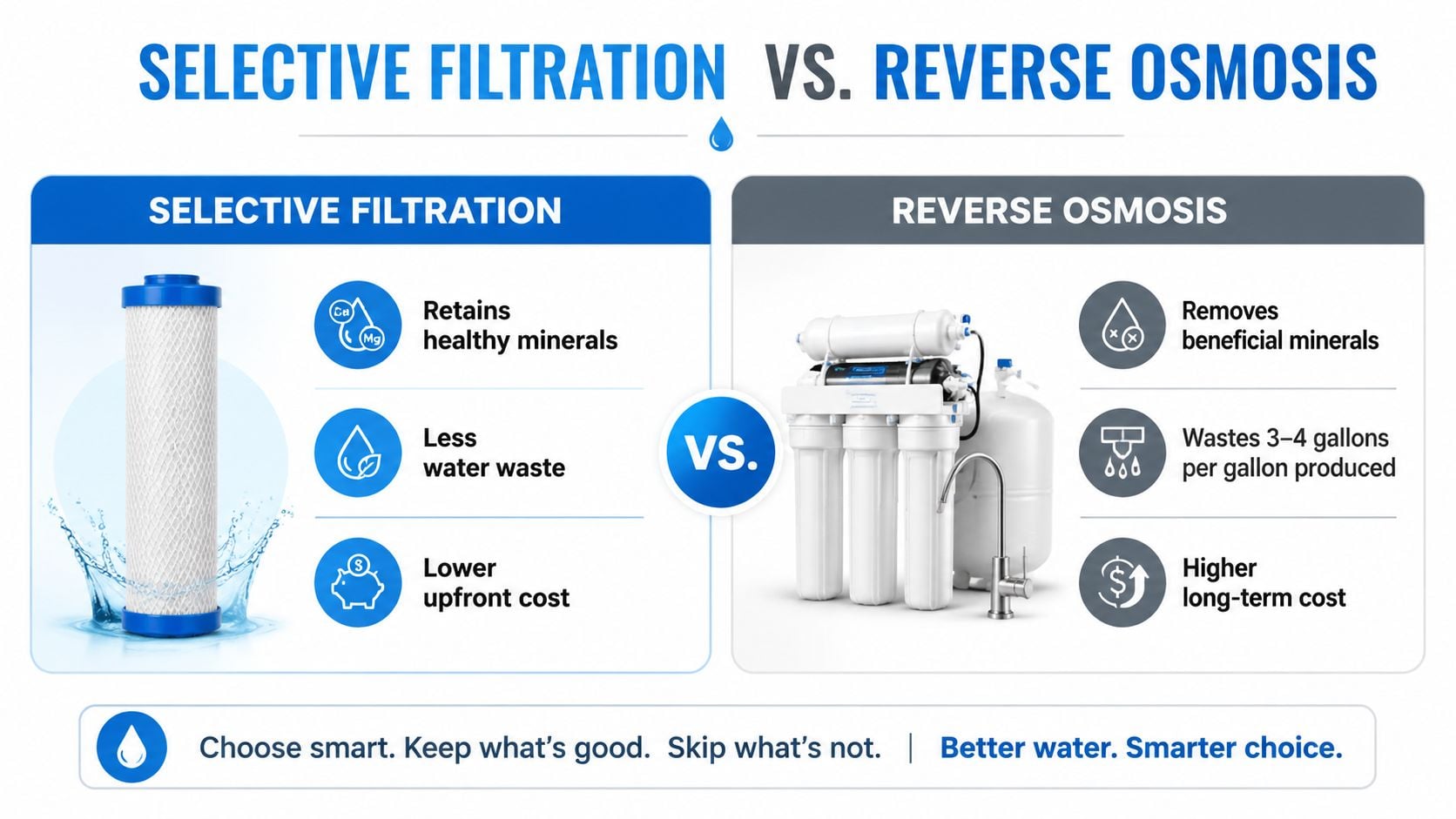
RO systems also waste water during production, while selective point-of-use filtration doesn't require the same membrane reject-water process. For a homeowner who wants filtered water at a kitchen faucet, refrigerator, ice maker, or coffee line, a cartridge can be easier to install and maintain.
The difference is explained in more detail in this guide to [selective filtration and mineral retention](https://woder.com/blog/selective-filtration/).
Woder is manufactured in the United States and built for U.S. building code compliance. Each Woder cartridge comes with a one-year guarantee, and the company states that it replaces a cartridge if it underperforms, without requiring the customer to complete a complicated claim. The broader principle is simple: choose the treatment method that matches your water and your priorities, then verify the claim at rated life.
---
Woder Filters offers U.S.-manufactured point-of-use cartridges using Advanced Selective Filtration® to target contaminants while retaining essential minerals, with under-sink and inline options for household fixtures. Review your water profile and visit [Woder Filters](https://woder.com) to compare a cartridge approach with your specific drinking-water needs.
**Categories:** Woder Science
**Tags:** best water filter cartridge, pfas water filter, selective filtration, under-sink filter, water filter replacement
---
### [Does Brita Remove Lead? What Pitcher Filters Miss That Under-Sink Filters Catch](https://woder.com/blog/brita-lead-pitcher-under-sink/)
**Published:** August 15, 2026
**Author:** woder
**Content:**
- [What Brita Actually Filters (And What It Doesn't)](#what-brita-actually-filters-and-what-it-doesnt)
- [Why Pitcher Filters Have Structural Limits](#why-pitcher-filters-have-structural-limits)
- [Contact time and flow rate](#contact-time-and-flow-rate)
- [Capacity and replacement tracking](#capacity-and-replacement-tracking)
- [What pitcher filters don't target at all](#what-pitcher-filters-dont-target-at-all)
- [What Under-Sink Filters Do Differently](#what-under-sink-filters-do-differently)
- [The Minerals Question](#the-minerals-question)
- [Installation: Simpler Than You Think](#installation-simpler-than-you-think)
- [Pitcher Filter vs. Under-Sink Filter: A Direct Comparison](#pitcher-filter-vs-under-sink-filter-a-direct-comparison)
- [When a Pitcher Filter Is Enough](#when-a-pitcher-filter-is-enough)
- [Finding the Right Under-Sink Filter](#finding-the-right-under-sink-filter)
- [Frequently Asked Questions](#frequently-asked-questions)
You bought a Brita because you wanted cleaner water. That makes sense — pitcher filters are cheap, easy to find, and require zero installation. But if lead is your main concern, the answer to "does Brita remove lead?" is more complicated than the packaging suggests. The gap between what a pitcher filter actually does and what an under-sink filter does is worth understanding before you assume you're protected.
### What Brita Actually Filters (And What It Doesn’t)
Brita makes several filter types, and they don't perform the same way. The standard Brita pitcher filter — the one most people buy — is certified to reduce chlorine taste and odor, zinc, and some particulates. It is not certified to reduce lead.
Brita does make a separate product called the Longlast filter, which carries NSF/ANSI Standard 53 certification for lead reduction. So the honest answer to "does Brita remove lead?" is: some Brita filters do, most don't, and the one that does requires you to buy the right cartridge and confirm you're actually using it.
That distinction matters more than most people realize. A lot of households running a standard Brita pitcher believe they're filtering lead. They're not.
### Why Pitcher Filters Have Structural Limits
Even when a pitcher filter is certified for lead reduction, the format itself creates problems that have nothing to do with the filter media.
#### Contact time and flow rate
Pitcher filters work by gravity. Water drips slowly through activated carbon or ion exchange media — and that slow drip is actually necessary for the filter to work. Contaminants need enough contact time with the media to be captured. If you fill the reservoir and pour immediately, you may be drinking water that moved through too quickly to be properly filtered.
Under-sink filters connect directly to your water line at a controlled flow rate. The filter does its job every time, without you managing anything.
#### Capacity and replacement tracking
A standard Brita filter handles roughly 40 gallons before it needs replacing. The Longlast handles around 120 gallons. That sounds like a lot, but a household of two or three people can burn through 40 gallons in a few weeks. Most people don't track this carefully. When a filter is overdue, it stops reducing contaminants effectively — and in some cases can release previously captured contaminants back into the water.
Under-sink filters typically handle 8,000 to 10,000 gallons per cartridge, which works out to roughly one to two years for most households. Less frequent replacement means less room for error.
#### What pitcher filters don’t target at all
Standard pitcher filters — even good ones — aren't designed to remove PFAS, chromium 6, mercury, or volatile organic compounds. These are the contaminants showing up in municipal water quality reports and local news stories with increasing frequency. If your concern goes beyond taste and basic chlorine, a pitcher filter isn't the right tool.
### What Under-Sink Filters Do Differently
An under-sink filter connects inline to your cold water line, usually beneath the kitchen sink. Water passes through the filter every time you turn on the tap — no reservoir to fill, no waiting, no gravity drip.
Better under-sink filters use more sophisticated filtration media than activated carbon alone. [Woder's filters](https://woder.com) use Advanced Selective Filtration technology, which targets specific contaminants — lead, chlorine, chromium 6, mercury, PFAS, carcinogens, and volatile organic compounds — at a 99.9% reduction rate. The design is selective by intent: it removes those contaminants while leaving calcium, magnesium, and other naturally occurring minerals in the water.
That last point is worth pausing on. Reverse osmosis strips nearly everything, including minerals. Pitcher filters don't remove enough. Woder's approach sits in between: targeted removal of harmful contaminants, intentional retention of beneficial minerals. Your water tastes like water — not like stripped-down nothing.
### The Minerals Question
Calcium and magnesium aren't just nice to have. They affect how water tastes and contribute to your daily mineral intake. People who switch from tap water to heavily filtered or RO water sometimes notice it tastes flat or slightly off. That's the minerals missing.
A pitcher filter doesn't strip minerals, but it also doesn't remove much else. An under-sink filter with selective filtration removes the harmful stuff and keeps the minerals — a meaningfully different outcome than either a pitcher or an RO system delivers.
### Installation: Simpler Than You Think
One reason people stick with pitcher filters is that under-sink filters sound complicated. They're not. Woder's inline filters connect directly to your existing water line with no tank, no drain line, and no wastewater output. Setup takes under 30 minutes and doesn't require a plumber. Renters can install one without making permanent plumbing changes.
Compare that to a reverse osmosis system, which typically costs $300 to $600 installed, requires a dedicated faucet, produces wastewater, and usually needs professional setup. An under-sink inline filter is a straightforward DIY project.
### Pitcher Filter vs. Under-Sink Filter: A Direct Comparison
FeaturePitcher Filter (standard)Pitcher Filter (Longlast)Under-Sink Inline FilterLead reductionNoYes (NSF 53)YesPFAS removalNoNoYes (Woder)Chromium 6 removalNoNoYes (Woder)Mineral retentionYesYesYes (Woder)Capacity per cartridge~40 gallons~120 gallons8,000–10,000 gallonsInstallation requiredNoneNone30-minute DIY inlineWastewater producedNoNoNo### When a Pitcher Filter Is Enough
Pitcher filters aren't useless. If your only concern is chlorine taste and you're on a municipal supply with no lead pipe risk, a standard Brita handles that job at minimal cost. For renters who genuinely can't touch plumbing, a pitcher is better than nothing.
But if you've seen a water quality report flagging lead, PFAS, or chromium 6 in your area — or if you live in a home built before 1986 with original plumbing — a pitcher filter isn't adequate protection. The contaminants that matter most require a filter actually designed to target them.
### Finding the Right Under-Sink Filter
Not all under-sink filters are the same. The right model depends on your household's water flow rate and setup. Woder's product finder at [woder.com/wizard](https://woder.com) walks you through the options and matches you to the right model. Replacement cartridges run roughly $40 to $80 per year — a fraction of what most households spend on bottled water.
If you want to know what's actually in your water before buying anything, Woder also sells water testing kits. That's a smart first step if you're not sure what you're dealing with.
---
### Frequently Asked Questions
**Does Brita remove lead from tap water?**
The standard Brita pitcher filter is not certified to reduce lead. Brita's Longlast filter carries NSF/ANSI Standard 53 certification for lead reduction. If lead is your concern, you need to confirm which filter you're using — and know that even the Longlast doesn't address PFAS, chromium 6, or mercury.
**What contaminants does a standard Brita filter actually remove?**
Standard Brita filters are certified to reduce chlorine taste and odor, zinc, and some particulates. They are not designed to remove lead, PFAS, chromium 6, mercury, or volatile organic compounds.
**What's the difference between a pitcher filter and an under-sink filter?**
Pitcher filters rely on gravity flow and have limited capacity — typically 40 to 120 gallons per cartridge. Under-sink filters connect inline to your water line, filter every drop at a controlled rate, and handle 8,000 to 10,000 gallons per cartridge. They also target a much broader range of contaminants.
**Do under-sink filters remove beneficial minerals?**
It depends on the filter type. Reverse osmosis systems strip nearly all minerals. Woder's under-sink filters use selective filtration that removes harmful contaminants while retaining calcium, magnesium, and other naturally occurring minerals.
**How hard is it to install an under-sink inline filter?**
Most inline under-sink filters connect directly to your existing cold water line without a plumber, a dedicated faucet, or permanent plumbing changes. Woder's filters typically install in under 30 minutes and produce no wastewater.
**How do I know if my home has a lead risk?**
Homes built before 1986 are more likely to have lead pipes or lead solder in the plumbing. Your municipal water quality report — available from your water utility — will note whether lead has been detected. A home water test kit gives you a direct reading from your tap.
**Is an under-sink filter worth it compared to bottled water?**
For most households, yes. Replacement cartridges for a Woder filter run roughly $40 to $80 per year. A household that regularly buys bottled water typically spends several times that annually, with no filtration transparency and a lot of plastic waste.
---
A pitcher filter is a reasonable starting point, but if lead, PFAS, or other serious contaminants are on your radar, it's not enough. An under-sink filter with selective filtration gives you real protection without stripping out the minerals that make water taste good and support your health. Find the right model for your home at [woder.com](https://woder.com).
**Categories:** Woder Science
---
### [Renter Friendly Water Filter Guide for Clean Tap Water](https://woder.com/blog/renter-friendly-water-filter/)
**Published:** August 15, 2026
**Author:** woder_admin
**Content:**
You've just moved into an apartment, filled a glass at the kitchen tap, and started wondering what the filter from your last place can remove. A pitcher might be simple, but it takes refrigerator space. An under-sink system keeps the counter clear, but connecting it to the cold-water line may conflict with your lease. An older cabinet may also leave barely enough room to install and service a cartridge.
A **renter friendly water filter** has to do more than avoid drilling. It needs to fit the fixture, work within the lease, leave the plumbing intact, and come with you when you move.
## Table of Contents
- [Why Renters Need a Different Approach to Filtered Water](#why-renters-need-a-different-approach-to-filtered-water)
- [What renter friendly really means](#what-renter-friendly-really-means)
- [Choosing a Renter Friendly Filter Without Drilling or Damage](#choosing-a-renter-friendly-filter-without-drilling-or-damage)
- [When under-sink is the better fit](#when-under-sink-is-the-better-fit)
- [How to Make Any Filter Lease Safe Before You Buy](#how-to-make-any-filter-lease-safe-before-you-buy)
- [A practical permission checklist](#a-practical-permission-checklist)
- [Installing and Removing Your Filter With No Damage](#installing-and-removing-your-filter-with-no-damage)
- [Prepare the cabinet first](#prepare-the-cabinet-first)
- [Connect slowly and check every joint](#connect-slowly-and-check-every-joint)
- [Reverse the process at move-out](#reverse-the-process-at-move-out)
- [What Cleaner Water Actually Means for Renters on Tap Water](#what-cleaner-water-actually-means-for-renters-on-tap-water)
- [Read lead claims in context](#read-lead-claims-in-context)
- [Keeping Your Portable Filter Ready for Your Next Move](#keeping-your-portable-filter-ready-for-your-next-move)
- [Pack the system like a fixture](#pack-the-system-like-a-fixture)
## Why Renters Need a Different Approach to Filtered Water
Renters and homeowners face different filtration decisions. A homeowner can approve a dedicated faucet, modify cabinetry, or install whole-home equipment. A renter usually needs a point-of-use system that connects temporarily, occupies little space, and can be removed without leaving evidence that it was ever there.
That makes apartment filtration less about choosing the most elaborate technology and more about matching the filter to the home. A faucet-mounted unit may be ideal for someone who wants no plumbing work. A direct-connect under-sink filter may make more sense for someone who wants filtered water without filling a pitcher, provided the lease and cabinet allow it.
Renters are already an important part of the household filtration market. A **2022 U.S. analysis found that 29.5% of respondents lived in rented housing**, and renters were more likely than homeowners to use a filter for drinking tap water at home, with an adjusted odds ratio of **1.36**, with a **95% confidence interval of 1.02–1.80** ([the housing-status study](https://pmc.ncbi.nlm.nih.gov/articles/PMC9086145/)). The practical lesson isn't that every renter needs the same filter. It's that rental status itself is closely connected with point-of-use filtration decisions.
### What renter friendly really means
A filter marketed for apartments should answer four basic questions:
- **Can it be installed without permanent alteration?** “No drilling” is useful, but it doesn't automatically mean the plumbing connection is permitted.
- **Can it fit the space?** Measure cabinet width, depth, height, and the room needed to remove the cartridge.
- **Can it be reversed cleanly?** You should be able to restore the original adapter, hose, aerator, or valve arrangement.
- **Does it target the contaminants you care about?** Taste improvement alone doesn't tell you whether the filter addresses lead, PFAS, fluoride, chromium-6, or other dissolved contaminants.
Woder's **Advanced Selective Filtration®** takes a different approach from reverse osmosis. It is designed to remove targeted contaminants such as PFAS, lead, heavy metals, fluoride, chromium-6, and chlorine while retaining essential minerals. RO systems can reduce dissolved solids very aggressively, but they also strip minerals from the water and bring added maintenance and water-use considerations.
> **Practical rule:** A filter is renter friendly only when its installation, performance claims, physical footprint, and removal process all fit your situation.
The right choice may be a pitcher, a faucet attachment, a countertop-adjacent unit, or an under-sink system. The label matters less than the connection, the lease, and the actual contaminant claim.
## Choosing a Renter Friendly Filter Without Drilling or Damage
Start with the connection, not the marketing name. Four formats cover most apartment kitchens, and each solves a different problem.
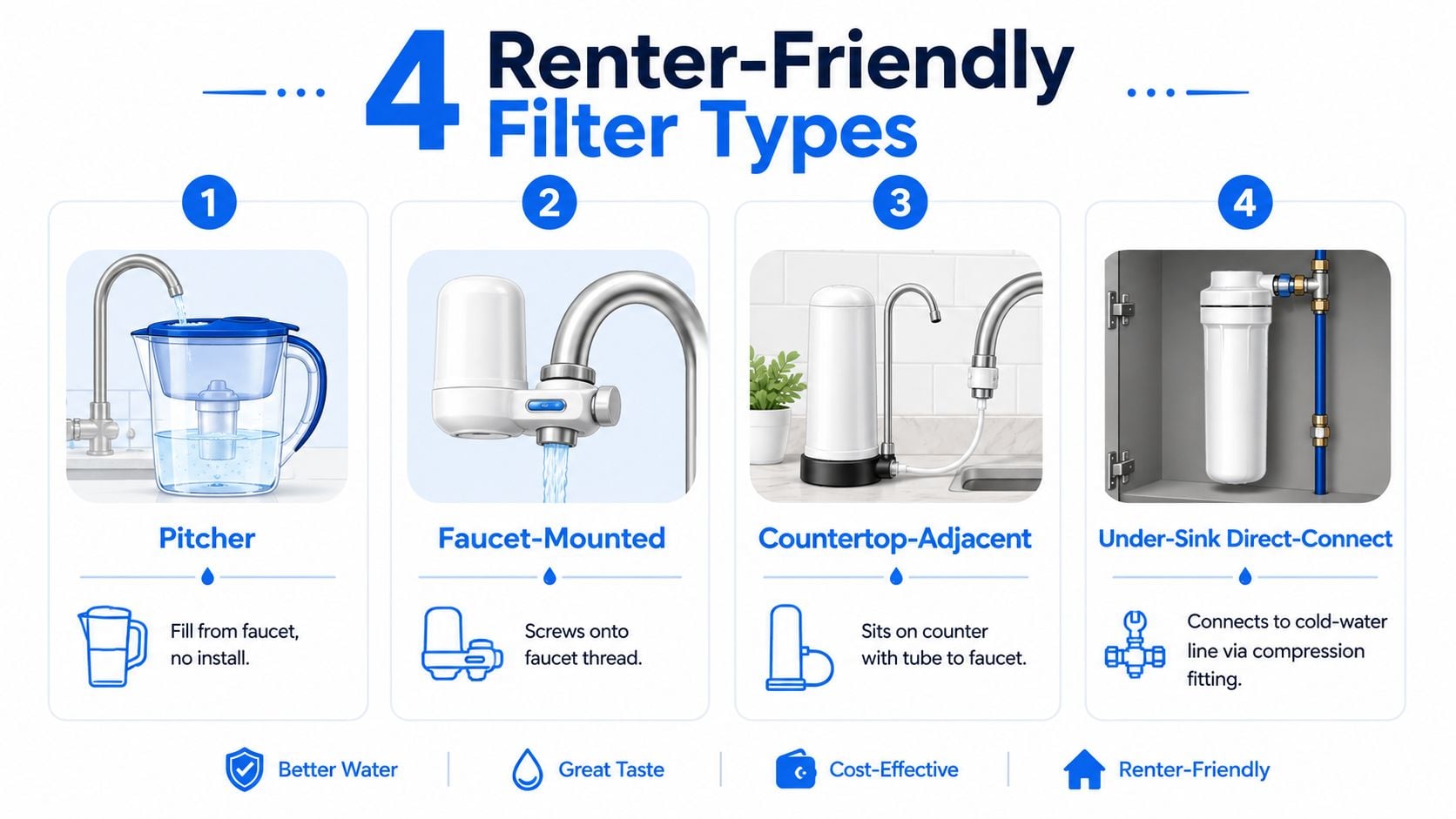
FormatInstallation impactDaily tradeoffPortability**Pitcher**Fill it from the faucet, with no installationSlower, and it occupies refrigerator or counter spaceVery high**Faucet-mounted**Attaches to the faucet threadCan affect flow and may not fit every faucetHigh**Countertop-adjacent**Sits beside the sink and connects near the faucetUses counter space but avoids cabinet workHigh**Under-sink direct-connect**Connects to the cold-water lineConvenient and discreet, but requires compatibility and lease reviewModerate to highA pitcher is the least complicated choice. You fill it, wait for filtration, and store it. It's useful when the lease prohibits plumbing work or when you expect to move soon. The cost of that simplicity is space and the need to refill it.
Faucet-mounted systems attach to an existing faucet outlet, so they don't require drilling or changes below the cabinet. They're easy to remove, but threaded faucet designs vary, and some pull-down or specialty faucets don't accept attachments. Flow can also feel slower when the filter is operating.
Countertop-adjacent systems sit beside the sink and use a connection at or near the faucet. They avoid cabinetry changes, although the tubing and equipment remain visible. This format often suits renters who want more daily convenience than a pitcher without touching the cold-water shutoff.
### When under-sink is the better fit
Under-sink direct-connect systems keep filtration out of sight and send treated water through the existing faucet or a compatible outlet. They're most reversible when they reuse an existing opening, such as a soap-dispenser or unused sprayer hole, rather than requiring a new hole in the counter ([apartment filter installation options](https://www.aquasana.com/info/water-filter-for-apartment-pd.html)).
Before buying, check the filter's intended claims. Under-sink carbon or compound systems commonly reference **NSF/ANSI 42, 53, 401, and 372**, while reverse osmosis systems add **NSF/ANSI 58**. These standards aren't interchangeable labels. Read what the specific product has been evaluated to reduce, and confirm that the claim applies to the exact model.
For sediment that may enter through dusty, older, or disturbed plumbing, the [Woder Sediment Water Filter – Dirt, Sand and Dust Removal](https://woder.com/products/wd-20m-dc/) is a made-in-the-USA, single-stage under-sink sediment filter with **20µ pre-sedimentation** for dust, dirt, and contaminants filtration. It isn't a substitute for a contaminant-specific drinking-water filter, so treat it as a sediment-focused component.
For a plain-language look at faucet attachments and their limitations, see this [faucet water filter guide](https://woder.com/blog/water-filter-for-faucet/). The useful question isn't “Which format is best?” It's “Which format gives me the needed filtration without creating a lease or maintenance problem?”
## How to Make Any Filter Lease Safe Before You Buy
“Reversible” and “lease-safe” aren't the same thing. A system may come out of the cabinet cleanly while still requiring you to touch a shutoff valve, disconnect a supply line, or alter a fixture. Some renter guidance states that landlords can prohibit under-sink systems and may require written approval for supply-line work, even when no drilling is involved ([renter-focused lease guidance](https://www.frizzlife.com/blogs/guide/best-water-filter-for-small-apartments-renter-friendly-water-filtration-systems)).
Read the lease before opening a product page. Search for language about plumbing, fixtures, alterations, water connections, cabinetry, and tenant responsibility for damage. If the wording is unclear, ask the landlord or property manager in writing and describe the exact connection you plan to make.
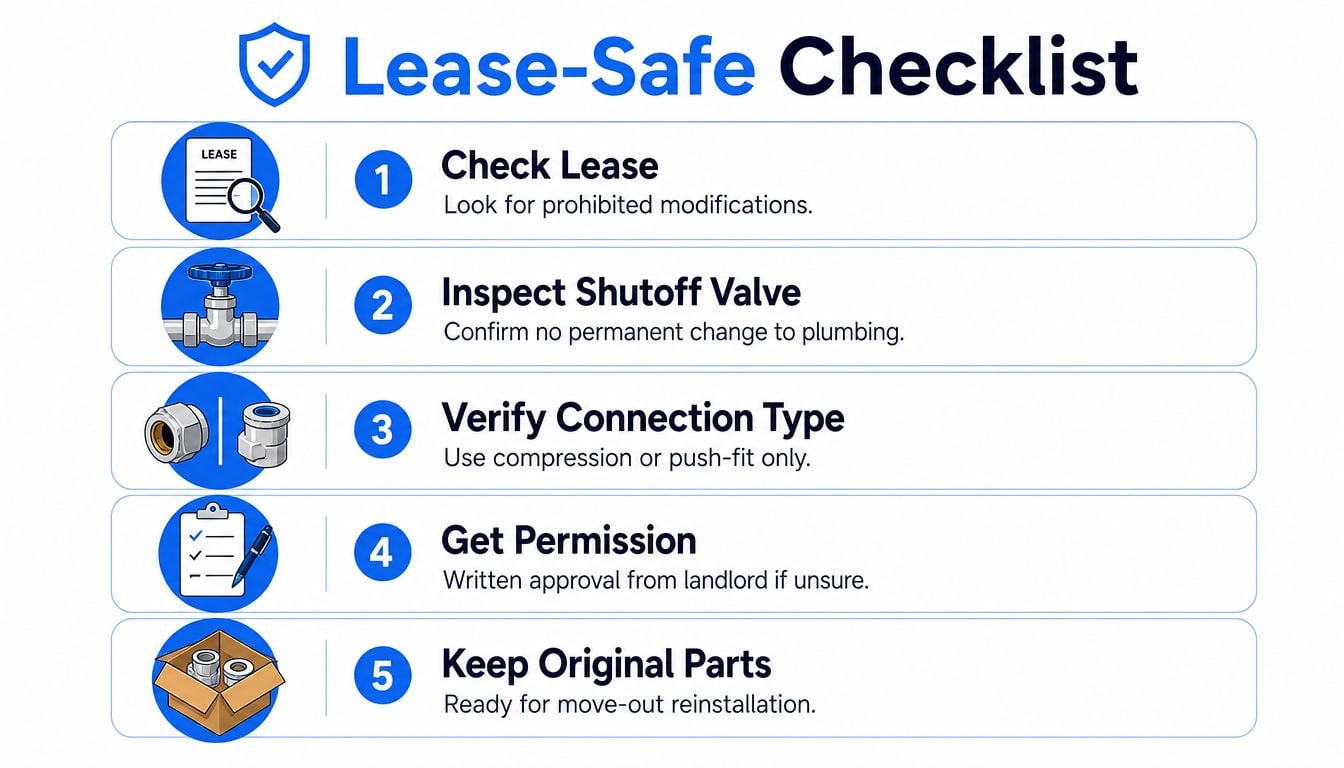
### A practical permission checklist
1. **Check the lease.** Look for restrictions on plumbing changes, supply lines, valves, and fixture removal.
2. **Identify the connection.** Determine whether the filter attaches to the faucet, an existing opening, or the cold-water line.
3. **Inspect before touching anything.** Photograph the valve, hose, fittings, cabinet floor, and faucet area. Save the photos with your move-in records.
4. **Ask for written approval when unsure.** A short message that names the filter type and confirms that you'll restore the original parts protects both sides.
5. **Keep every original part.** Store the original hose, adapter, aerator, mounting hardware, and any removed fastener in a labeled bag.
Approval should specify restoration expectations. Ask whether the landlord wants the filter removed at move-out, whether the original configuration must be restored, and whether maintenance staff must handle the connection.
A filter made in the United States and built to U.S. building code compliance still isn't automatically permitted by your lease. **Building-code compliance describes the product and installation requirements. Lease permission describes your relationship with the property owner.** You need both to be comfortable.
## Installing and Removing Your Filter With No Damage
A direct-connect filter can work in an apartment when the parts fit, the cabinet has room, and the shutoff valve operates normally. The basic sequence is to close the cold-water valve, release pressure, disconnect the cold-water line, add a compatible tee or feed adapter, connect the tubing, and flush the cartridge before drinking. Follow the manufacturer's instructions for the exact fittings and connection order.
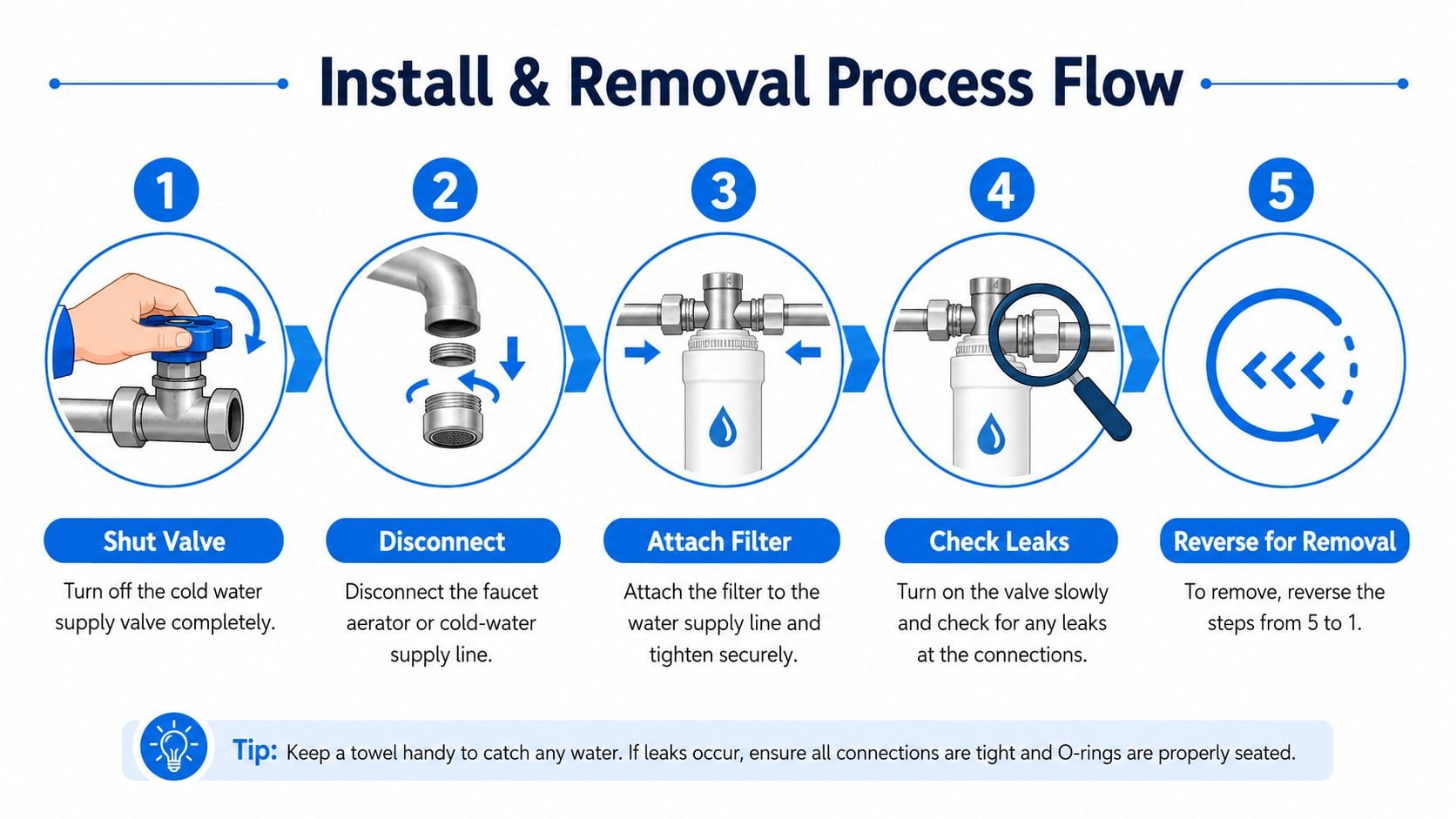
### Prepare the cabinet first
Empty the cabinet completely. Place a towel or shallow tray under the valve, then keep an adjustable wrench, the filter instructions, a dry paper towel, and a container within reach. Photograph the original plumbing arrangement before disconnecting anything. That picture gives you a clear reference when the filter comes out.
Measure the cabinet with the doors both open and closed. The filter body needs enough room to fit, but also space to turn, pull out, and replace the cartridge later. A unit that fits only when it stays untouched is not a practical apartment installation.
Test the shutoff valve gently. If it feels stuck, appears corroded, or drips while you operate it, stop and contact maintenance or the landlord. An old valve can fail when forced, changing a small installation into a plumbing repair.
### Connect slowly and check every joint
Close the cold-water valve, then open the cold faucet briefly to release pressure. Disconnect the cold line and install the compatible tee or feed adapter as directed. Push-fit tubing must enter fully and evenly. It should not bend sharply or pull sideways on the fitting.
The two common trouble spots are **connector mismatch** and **incomplete push-fit seating**. A fitting that looks nearly right can still leak if its size or thread does not match. Tubing that stops short of its proper seat may pull out or seep once pressure returns.
Before reopening the valve, place a dry paper towel beneath each connection. Open the valve gradually and inspect the towel. A small damp mark appears on paper before water spreads across the cabinet floor, giving you time to shut the valve and correct the joint.
Flush the cartridge according to the instructions. New filtration media can release harmless startup fines or affect taste until flushing is complete, so the first output is not a reliable indication of normal performance.
Watch this installation demonstration for a visual reference:
### Reverse the process at move-out
Turn off the cold-water valve and open the faucet to release pressure. Disconnect the filter tubing, remove the tee or adapter, and reinstall the original cold-water line using your photograph as a guide. Run the faucet, then check the connection with a dry paper towel.
Faucet-mounted and countertop systems need the same care. Remove the attachment without twisting the faucet body, reinstall the original aerator, and wipe away residue. For help adapting a faucet connection, see this [faucet replacement resource](https://woder.com/blog/water-filter-faucet-replacement/).
If a valve will not close, a line will not loosen, or a connection starts leaking, stop and call maintenance. More force can damage an older fitting and make restoration harder.
## What Cleaner Water Actually Means for Renters on Tap Water
A filter claim should identify **what it reduces**, under what testing conditions, and whether the claim applies to the exact cartridge you're buying. “Cleans water” is too broad to guide a purchase. Taste and odor improvements can be useful, but they don't prove removal of every contaminant that concerns you.
EPA's April 2024 PFAS rule provides a concrete benchmark. It established legally enforceable Maximum Contaminant Levels for six PFAS. **PFOA and PFOS each have a limit of 4.0 ppt**, while PFHxS, PFNA, and HFPO-DA, also known as GenX, each have a limit of **10 ppt**. The rule also includes a **Hazard Index limit of 1** for mixtures containing at least two of PFHxS, PFNA, HFPO-DA, and PFBS ([EPA's PFAS drinking water rule](https://www.epa.gov/sdwa/and-polyfluoroalkyl-substances-pfas)).
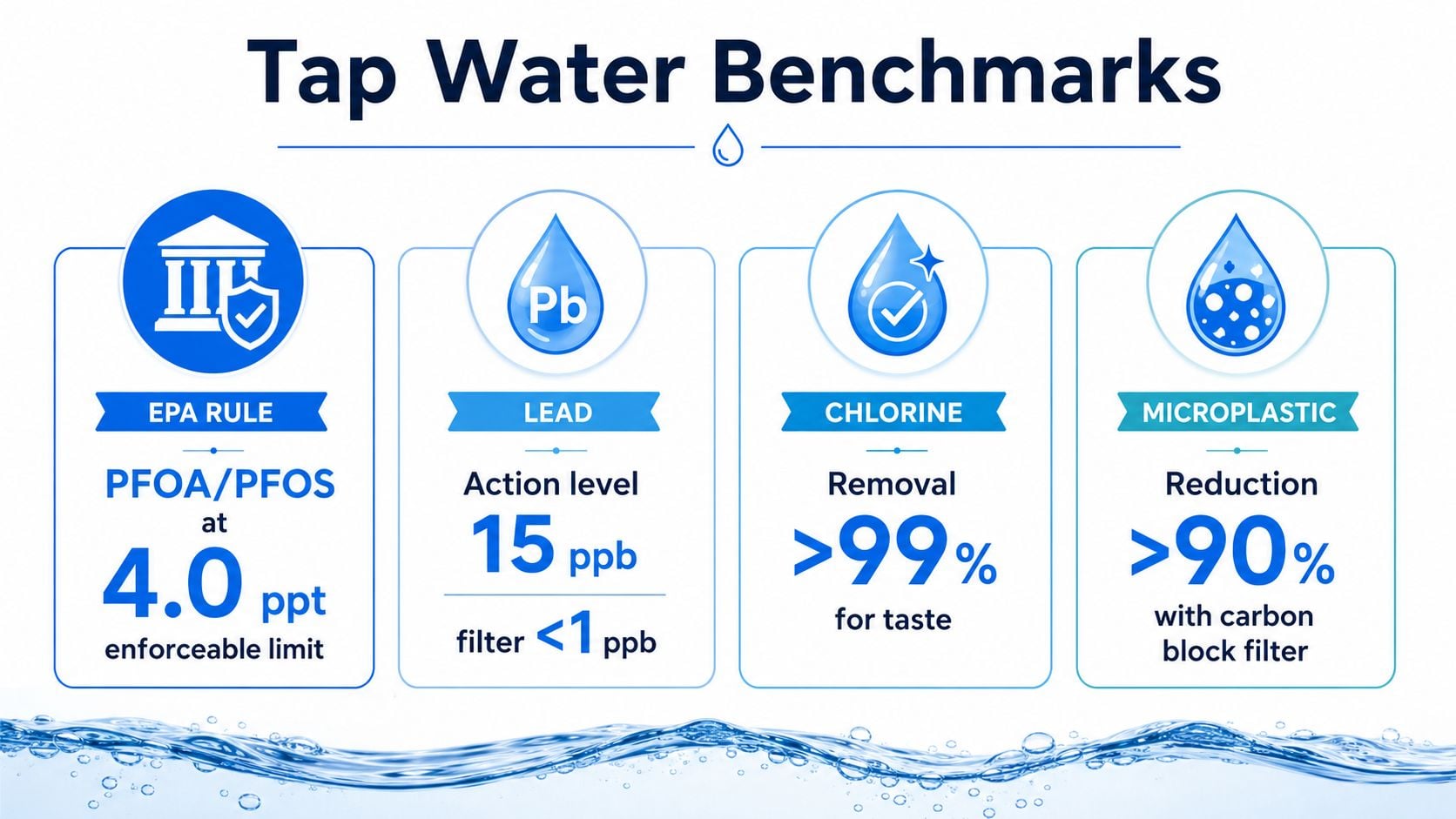
### Read lead claims in context
EPA's Lead and Copper Rule uses an action level of **15 ppb**, which is the same as **0.015 ppm**. If lead exceeds that level in more than **10% of customer taps sampled**, the water system must take additional corrosion-control actions ([EPA's Lead and Copper Rule](https://www.epa.gov/dwreginfo/lead-and-copper-rule)).
That rule is based on system sampling, not a guarantee that every individual faucet has identical water. Lead can enter through plumbing and service lines, so a point-of-use kitchen filter can still be relevant even when a utility meets its system-wide obligations.
A zero-TDS reading doesn't prove that water is safe or that a filter selected the unwanted substances. TDS measures dissolved material generally. A reading near zero means minerals and other dissolved solids have been removed together, which describes distilled-style water, not a targeted assessment of PFAS, lead, chromium-6, fluoride, or chlorine.
Woder's Advanced Selective Filtration is designed around targeted removal while retaining essential minerals such as calcium and magnesium. That creates a different tradeoff from RO, which can produce very low TDS but also removes beneficial minerals, requires more maintenance, and may waste water during filtration.
For renters thinking about water use beyond drinking and cooking, [dry climate landscaping for rentals](https://www.verticalrent.com/blog/drought-resistant-landscaping-services-serving-markets-with-water-restrictions) offers broader context on making responsible water choices in rental properties. The same principle applies here: measure the actual need rather than treating a single number as the whole answer.
## Keeping Your Portable Filter Ready for Your Next Move
A portable filter should be chosen for the apartment you have now and the kitchen you may have later. Keep the footprint modest, leave access around the cartridge, and avoid a design that depends on a particular cabinet opening or dedicated faucet unless you already have permission to use it.
Maintenance is part of portability. Mark cartridge changes on a calendar or use the manufacturer's schedule, and don't wait for a major taste change before checking the filter. A change in taste or odor can signal that the cartridge needs attention, but normal taste doesn't prove that the filter is still performing every claimed reduction.
Use this [water filter replacement schedule](https://woder.com/blog/water-filter-replacement-schedule/) to create a simple reminder system. Woder also provides a **one-year guarantee with every cartridge**. If a cartridge underperforms, Woder replaces it without questions, according to the brand's stated guarantee.
### Pack the system like a fixture
Keep the original parts in a sealed, labeled bag. Store adapters, tubing, aerators, brackets, caps, and instructions together. Photograph the filter before removal, then cap or secure loose lines according to the product instructions so they don't collect dust or become damaged during the move.
For a new apartment, inspect the cabinet before reconnecting anything. Older buildings may have restricted cabinet clearance, worn valves, or pressure conditions that make installation unsuitable. Guidance for apartment systems discusses input pressure around **20 PSI as a minimum** and notes that many apartments operate around **40–80 PSI** ([apartment pressure and space considerations](https://clearwaterhomelab.com/best-under-sink-water-filter-for-renters/)). If your pressure seems weak or inconsistent, ask maintenance to evaluate it rather than assuming the filter is defective.
Some renters need a sediment pre-filter for dirt or dust, while others need an inline connection for a refrigerator, ice maker, or coffee machine. The right setup depends on the line, the fixture, and the contaminants you want to address. Optional lab testing can help identify that profile before you buy, and a selection tool such as the Woder Wizard can help match a system to the incoming water and fixture.
The larger lesson is simple. **Choose the filter around your lease, connection, cabinet, pressure, and contaminant goals.** Keep the original parts, maintain the cartridge, and leave the apartment exactly as you found it. It's Your Water®.
---
Woder Filters offers U.S.-made point-of-use systems using Advanced Selective Filtration® to target contaminants while retaining essential minerals, with installation resources and replacement support for apartment setups. Review your lease, measure your cabinet, and visit [Woder Filters](https://woder.com) to compare an approach that can move with you.
**Categories:** Woder Science
**Tags:** apartment water filter, no drill water filter, portable water filter, renter friendly water filter, under sink filter rental
---
### [Woder vs Frizzlife: Which Under-Sink Water Filter Is Right for You in 2026?](https://woder.com/blog/woder-vs-frizzlife-which-under-sink-water-filter-is-right-for-you-in-2026/)
**Published:** August 14, 2026
**Author:** woder
**Content:**
**Woder vs. Frizzlife**
**Which Under-Sink Water Filter Is Right for You?**
Choosing between two under-sink filters sounds straightforward until you start looking at how they actually work. Both Woder and Frizzlife position themselves as smarter alternatives to bottled water, and both appeal to homeowners who want cleaner drinking water without calling a plumber. But the filtration approaches are genuinely different — and those differences have real implications depending on what you want from your water.
This comparison covers filtration technology, contaminant removal, installation, mineral retention, pricing, and what each brand’s approach means day to day.
# **At a Glance**
**Feature****Woder****Frizzlife Non-RO****Frizzlife RO****Certification**WQA Gold Seal (NSF/ANSI 42 & 372)NSF/ANSI 42 & 53NSF/ANSI various**Contaminant Scope**Broad — PFAS, VOCs, chromium 6, mercury, lead, chlorineChlorine & lead (certified)Comprehensive (RO-level)**Mineral Retention**Yes — minerals never removedYesNo — stripped then re-added**Remineralization**Not neededNot neededAlkaline cartridge (standardized)**Drain Line Required**NoNoYes**Storage Tank**NoNoSome models**DIY Install**YesYesMore complex**Manufacturing**Mobile, Alabama, USACixi City, Ningbo, ChinaCixi City, Ningbo, China**Price Range**See woder.com$60 – $130$200+# **What Makes Woder Different**
Woder is built around proprietary Advanced Selective Filtration technology. The system uses nanoparticles that attract and bind specific contaminants, pulling them out of your water while leaving beneficial minerals like calcium and magnesium completely untouched. Nothing is stripped and re-added. The minerals that were in your tap water stay in your filtered water.
Woder holds a **WQA Gold Seal certification**. The Gen4 WD-G4-REP cartridge — Woder’s most common advanced replacement filter — is independently certified by the Water Quality Association to:
- NSF/ANSI 42 — chlorine reduction, taste, and odor
- NSF/ANSI 372 — lead-free materials compliance
Both certifications are verified and substantiated by independent third-party test data. Beyond those certified claims, Woder also claims 99.9% removal of lead, chromium 6, mercury, PFAS, carcinogens, and volatile organic compounds (VOCs) based on their own testing of Advanced Selective Filtration technology.
Woder filters are manufactured and assembled in Mobile, Alabama, USA.
# **What Makes Frizzlife Different**
Frizzlife operates across two distinct product categories that work very differently from each other.
## **Frizzlife Non-RO Filters**
The MK99, SK99, and FK99 series use multi-stage carbon and composite filtration to reduce chlorine, taste, odor, and lead. These filters carry NSF/ANSI 42 and NSF/ANSI 53 certifications. NSF 42 covers aesthetic improvements like chlorine reduction, taste, and odor. NSF 53 covers health-related contaminants, primarily lead. Both certifications involve independent third-party verification.
The trade-off is scope. NSF 42 and 53 address a narrower set of contaminants. For households primarily concerned with chlorine taste and lead, Frizzlife’s certified non-RO filters handle those directly. For households worried about PFAS, chromium 6, mercury, or VOCs, Frizzlife’s non-RO line does not prominently certify against those contaminants.
## **Frizzlife RO Systems**
The PD600-TAM3, PX500-A, and similar models use reverse osmosis, which removes nearly all dissolved solids. That makes contaminant removal very thorough — but it also strips out calcium, magnesium, and other minerals people generally want in their drinking water.
Frizzlife addresses this with an alkaline remineralization cartridge that adds minerals back after the RO membrane does its work. What gets added back is a standardized mineral blend — not the natural mineral profile of your original tap water.
Frizzlife filters are manufactured by **Ningbo Eastpure Environmental Technology Co., Ltd.**, located on Xincheng Avenue, Cixi City, Ningbo, China.
# **Filtration Technology: A Side-by-Side Look**
## **Contaminant Removal**
Woder’s Advanced Selective Filtration targets contaminants selectively — removing lead, chlorine, chromium 6, mercury, PFAS, carcinogens, and VOCs without disrupting your water’s mineral content. The WQA Gold Seal certification independently verifies chlorine, taste, and odor reduction (NSF/ANSI 42) and lead-free materials compliance (NSF/ANSI 372).
Frizzlife’s non-RO filters carry NSF/ANSI 42 and 53 certification — solid third-party verification for chlorine and lead specifically. For households worried about PFAS, chromium 6, mercury, or VOCs, Frizzlife’s non-RO line does not prominently certify against those contaminants.
Frizzlife’s RO systems offer the most thorough removal of the three options — but at the cost of stripping minerals and requiring a remineralization stage.
## **Mineral Retention**
This is where the two brands diverge most sharply.
Woder’s Advanced Selective Filtration is designed specifically to remove contaminants while leaving calcium and magnesium in the water. The minerals are never removed, so there is nothing to add back. This reflects a genuinely different filtration mechanism — not a marketing claim.
Frizzlife’s non-RO filters also retain minerals. Their RO systems, however, strip minerals out and then add a standardized mineral blend back through a remineralization cartridge. What gets added back is not the natural mineral profile of your original tap water.
**Why this matters** *If mineral-rich water is important to you, understand that Woder retains your tap water’s natural minerals from the start. Frizzlife’s RO line strips minerals and adds back a standardized blend afterward — a different outcome, even if both describe the result as “mineral water.”*# **Installation: What Each System Requires**
## **Woder**
Woder filters are inline under-sink systems. Installation is DIY-friendly and does not require a drain line, a storage tank, or a dedicated faucet in most configurations. You connect the filter directly into your existing cold water supply line, there is no wastewater output, and most homeowners complete the installation without a plumber.
## **Frizzlife Non-RO Filters**
Frizzlife’s non-RO under-sink filters are also DIY-installable and drain-line-free. Installation complexity is similar to Woder’s. Both brands target the same type of homeowner — someone who wants cleaner water than a pitcher filter provides but does not want to deal with a full RO system.
## **Frizzlife RO Systems**
Frizzlife’s RO models require considerably more. Reverse osmosis produces wastewater as a byproduct, so a drain line connection is required. Some models also need a storage tank under the sink. Even where Frizzlife markets their RO systems as tankless, you still need to account for the drain line and the additional cartridge stages.
If you rent, have limited under-sink space, or want the simplest possible setup, Woder and Frizzlife’s non-RO filters are in the same category. Frizzlife’s RO systems are a different commitment.
# **Manufacturing Origin**
**Woder** filters are manufactured and assembled in **Mobile, Alabama, USA**.
**Frizzlife** filters are manufactured by **Ningbo Eastpure Environmental Technology Co., Ltd.**, located on Xincheng Avenue, Cixi City, Ningbo, China.
If country of manufacture is an important factor in your decision, both brands are transparent about where their products are made — Woder in the USA, Frizzlife in China.
# **Pricing**
Frizzlife’s non-RO under-sink filters are commonly priced in the $60 to $130 range. Their RO systems typically run higher, often $200 and above depending on the model and configuration.
For current Woder pricing, visit woder.com or use the filter finder to identify the right model for your household size and flow rate.
# **Who Each Filter Is Best For**
## **Woder Makes Sense If You:**
- Want broad contaminant removal — including PFAS, chromium 6, VOCs, mercury, and lead — in a single inline filter
- Want WQA Gold Seal certified performance for chlorine, taste, odor, and lead-free materials
- Want to keep your tap water’s natural mineral content without any remineralization stage
- Prefer a simple inline installation with no drain line and no storage tank
- Value US manufacturing
## **Frizzlife Non-RO Makes Sense If You:**
- Want NSF/ANSI 42 and 53 certified filtration for chlorine and lead specifically
- Prefer third-party verified performance claims with a well-known certification body
- Are working with a tighter budget ($60–$130 range)
- Want a DIY install without a drain line
## **Frizzlife RO Makes Sense If You:**
- Want the most thorough contaminant removal available and are comfortable with the RO trade-offs
- Are not concerned about losing natural minerals, since remineralization adds them back
- Have the under-sink space and are willing to run a drain line
- Are dealing with specific water quality issues that call for RO-level filtration
# **The Core Trade-Off**
Frizzlife’s non-RO line offers NSF-certified filtration at an accessible price point, with a narrower contaminant removal scope. Their RO line offers more thorough removal but adds complexity, wastewater, and a bolt-on remineralization step — and is manufactured in China.
Woder filters selectively from the start — removing a broad range of contaminants without touching the minerals, backed by WQA Gold Seal certification and manufactured in the USA.
Neither is the objectively right answer for every household. The right choice comes down to what contaminants are actually in your water, how much weight you put on third-party certification, and how you feel about mineral retention.
# **Find the Right Woder Filter for Your Home**
Woder’s lineup includes multiple models suited to different flow rates and household sizes. Use the filter finder at woder.com to find the right fit for your setup, or reach out to the team directly for personalized guidance.
# **Frequently Asked Questions**
## **Does Woder have third-party certification?**
Yes. Woder holds a WQA Gold Seal certification. The Gen4 WD-G4-REP cartridge is certified by the Water Quality Association to NSF/ANSI 42 (chlorine, taste, and odor reduction) and NSF/ANSI 372 (lead-free materials compliance), both verified by independent third-party test data.
## **Does Woder remove PFAS?**
Woder claims 99.9% removal of PFAS along with lead, chlorine, chromium 6, mercury, carcinogens, and VOCs. These claims are based on Woder’s own testing of Advanced Selective Filtration technology, in addition to the independently certified claims above.
## **Is Frizzlife NSF certified?**
Frizzlife’s non-RO under-sink filters carry NSF/ANSI 42 and NSF/ANSI 53 certifications, covering chlorine, taste and odor, and lead. NSF 42 and 53 do not cover PFAS or chromium 6.
## **Does Woder require a drain line?**
No. Woder’s inline under-sink filters connect directly to your existing cold water supply line and produce no wastewater, so no drain line is needed.
## **Do Frizzlife RO systems waste water?**
Yes. Reverse osmosis systems, including Frizzlife’s RO models, produce wastewater as part of the filtration process. This is a standard characteristic of RO technology.
## **Does Frizzlife’s remineralization cartridge replace natural minerals?**
Not exactly. Frizzlife’s RO systems add minerals back after the RO membrane removes them. What gets added is a standardized mineral blend, not the natural mineral profile of your original tap water. Woder’s filters retain your tap water’s existing minerals without removing them in the first place.
## **Where are Woder and Frizzlife filters made?**
**Woder** filters are manufactured and assembled in Mobile, Alabama, USA. **Frizzlife** filters are manufactured by Ningbo Eastpure Environmental Technology Co., Ltd. in Cixi City, Ningbo, China.
## **How do I find the right Woder model for my home?**
Visit woder.com to explore model details, use the filter finder, or contact the team for personalized guidance.
**Categories:** Woder Science
---
### [Water Filter for Ice Maker: Installation & Care Guide](https://woder.com/blog/water-filter-for-ice-maker/)
**Published:** August 14, 2026
**Author:** woder_admin
**Content:**
Your ice maker will tell on your water before anything else does. Cloudy cubes, slower fills, flat-tasting ice, and scale in the bin usually mean the line feeding the machine has more going on than plain water. In a lot of homes, that's the first clue that the **water filter for ice maker** setup is either missing, undersized, overdue, or matched to the wrong water.
I've seen plenty of machines blamed for bad ice when the actual issue was upstream. A clogged cartridge, hard water, or too much sediment can change how the ice forms long before the machine itself fails. If a leak or overflow has already caused damage around the kitchen, a practical [water damage response guide](https://www.sensitiveenvironmental.com/what-to-do-after-water-damage-in-your-home-and-why-acting-fast-matters/) is worth keeping close while you sort out the source.
The bigger point is this, an ice maker is less like a passive appliance and more like a little water-quality checkpoint. If the water is wrong, the ice shows it. If the filter is wrong, the machine shows that too. For broader context on what's often in household water in the first place, the [Woder drinking water quality guide](https://woder.com/blog/us-drinking-water-quality-pfas-lead-chlorine/) is a useful companion read.
## Table of Contents
- [Why Your Ice Tells You About Your Water](#why-your-ice-tells-you-about-your-water)
- [What Makes Ice Makers Harder to Filter Than a Kitchen Tap](#what-makes-ice-makers-harder-to-filter-than-a-kitchen-tap)
- [They care about flow, not just cleanliness](#they-care-about-flow-not-just-cleanliness)
- [Cold water and mineral load change the outcome](#cold-water-and-mineral-load-change-the-outcome)
- [Matching Filter Specs to Your Machine's Demand](#matching-filter-specs-to-your-machines-demand)
- [The Three Stages That Actually Matter](#the-three-stages-that-actually-matter)
- [Sediment first, because grit causes the earliest problems](#sediment-first-because-grit-causes-the-earliest-problems)
- [Carbon for taste and chlorine control](#carbon-for-taste-and-chlorine-control)
- [Scale inhibition only when the water warrants it](#scale-inhibition-only-when-the-water-warrants-it)
- [Installing the Filter Without Calling a Plumber](#installing-the-filter-without-calling-a-plumber)
- [Replacement Timing Driven by Use, Not the Calendar](#replacement-timing-driven-by-use-not-the-calendar)
- [When a Filter Is the Wrong Answer](#when-a-filter-is-the-wrong-answer)
- [Use water chemistry, not guesswork](#use-water-chemistry-not-guesswork)
## Why Your Ice Tells You About Your Water
A homeowner usually notices the problem in the most ordinary way possible. The freezer is cold, the bin is working, but the cubes come out hazy, smell a little like chlorine, or take longer to build up than they used to. That's not just an ice issue. It's often the water line advertising what's in the supply.
Ice freezes in layers, so anything dissolved or suspended in the water gets reflected in the finished cube. Sediment can make ice look dull. Chlorine can leave an off-taste. Scale can start to show up as white crust around the machine or slow the fill path enough that output drops. In other words, the ice becomes a crude but honest snapshot of the water feeding it.
> **Practical rule:** if the ice changed before anything else in the kitchen did, start with the filter and the water source before you start replacing parts.
That's why a **water filter for ice maker** isn't really about luxury. It's about keeping the line stable enough that the machine can do its job without fighting mineral buildup or taste problems. For a homeowner who wants the issue to stay small, that early clue matters more than waiting for the machine to fail outright.
There's also a useful parallel with how people think about water damage. The visible problem usually appears late, while the core issue has been building unseen in the background. That same pattern shows up here, where the ice is often the first visible sign that the supply line needs attention.
## What Makes Ice Makers Harder to Filter Than a Kitchen Tap
### They care about flow, not just cleanliness
A kitchen tap can live with a little pressure variation. An ice maker usually cannot. It needs water delivered through a fill valve at the rate the machine expects, and the filter has to match that demand without choking the line. In the category, service flow rates commonly run from 0.5 to 4.2 gpm, and maximum inlet pressure is often capped at 125 psi. If the filter slows the fill too much, the machine makes less ice and the timing gets off.
That is why a generic filter that works fine on a drinking line can be a poor fit for an ice machine. A filter spec only makes sense when it matches the machine's fill demand, the micron target, and the pressure window together. If the filter is too restrictive, production drops. If it is too loose, sediment and taste problems can still reach the machine. A practical guide to [inline refrigerator water filter models](https://woder.com/blog/inline-refrigerator-water-filter-models/) helps show why the cartridge choice has to follow the appliance, not just the label.
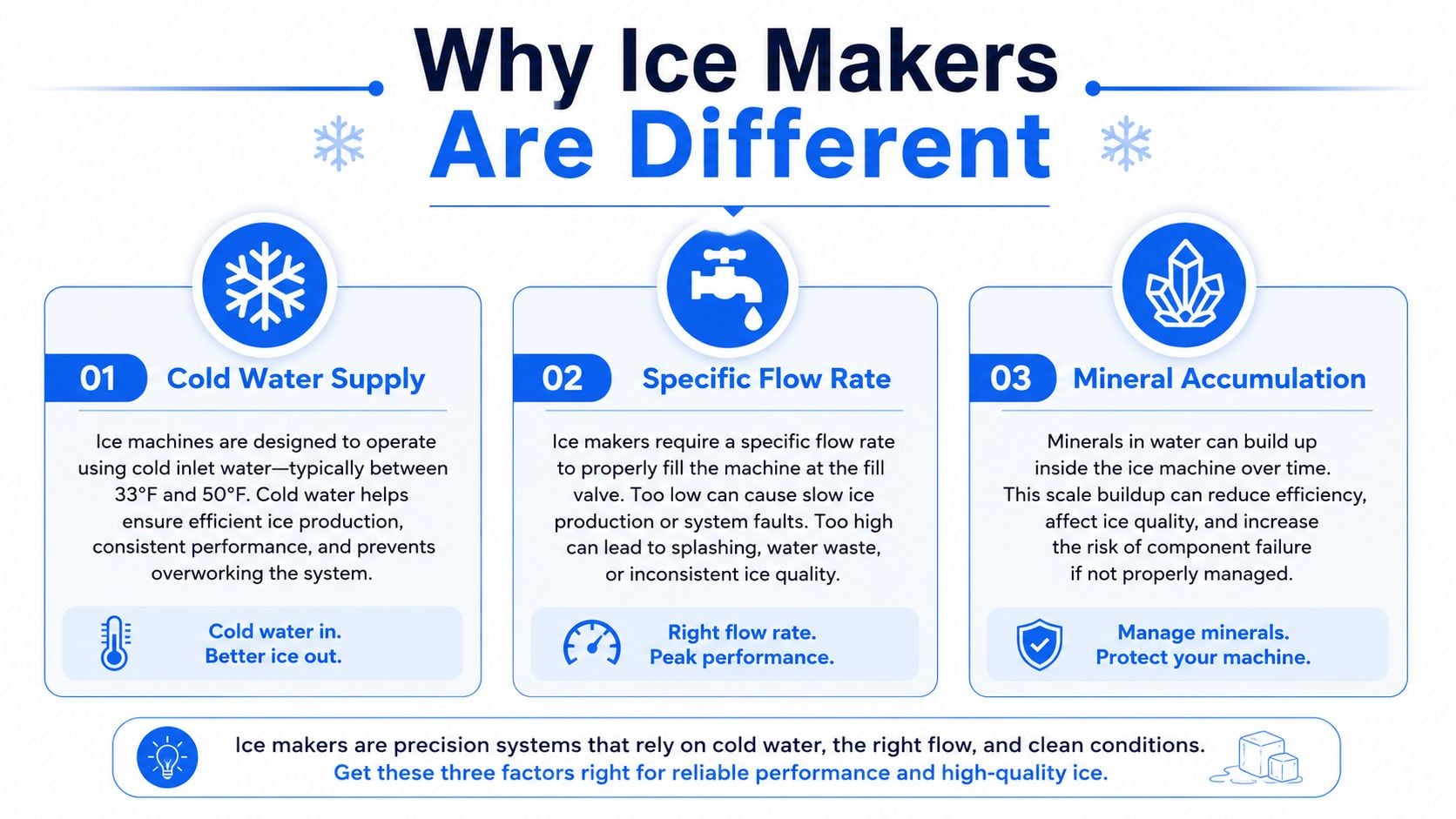
### Cold water and mineral load change the outcome
Ice makers run on cold inlet water, and cold water behaves differently in the system than a room-temperature faucet supply. The colder the water path, the more any restriction or mineral loading tends to show up in real use. Add sediment, and the strain gets worse. Add hard-water minerals, and scale starts building where you do not want it.
Manufacturers respond to that with **0.5-micron** particulate control and, in some systems, staged protection for sediment and scale. One practical example in the market is the [Woder WD-G4-210-JG Inline Water Filter w. JG (New WD-4K-ADV-JG)](https://woder.com/products/wd-g4-210-jg/), which is described as a U.S.-made inline filter for homes with whole-house sediment filtration or low sedimentation levels, with WQA certification to NSF/ANSI 42 for chlorine taste and odor and NSF/ANSI 372 for lead-free compliance.
The useful takeaway is simple. A water filter for ice maker has to match the machine's appetite, not just the water's taste problem. That is a different job than a faucet filter.
## Matching Filter Specs to Your Machine's Demand
Start with the machine, not the cartridge aisle. The daily ice output tells you the rough load, the inlet flow tells you how much water the unit expects to receive, and the pressure range tells you how much restriction the system can tolerate before performance starts slipping. That's the sizing logic often overlooked.
A filter spec only makes sense when it fits three things at once, **micron rating**, **service flow**, and **pressure window**. If the filter flow rating sits below the machine's fill demand, you can throttle production. If the micron rating is too coarse, you may miss the sediment that causes trouble. If the pressure range is too tight, the system can be fussy in real-world conditions.
Ice Maker Capacity Tiers and Filter Spec TargetsDaily Ice OutputTarget Service FlowMicron RatingFilter Capacity Range0 to 600 lb/dayMatch inlet demand with headroom0.5-micron target is commonAround 14,000 gallons601 to 1,000 lb/dayHigher-flow cartridge or housing0.5-micron target is commonAround 20,000 gallons1,000 to 2,500 lb/dayHigh-flow commercial-style setup0.5-micron target is commonAround 40,000 gallonsThe pattern behind those tiers is easy to miss if you only compare product labels. Smaller residential systems can get by with less capacity, while higher-output machines need larger cartridges or staged housings because the daily demand is higher. A filter that looks oversized on paper might still be the right choice if the machine runs a lot or the incoming water is dirty enough to load media quickly.
For homeowners comparing hardware in any category, the discipline is the same as choosing [how to choose kitchen hardware](https://kitchenrenovationsperfected.com/how-to-choose-kitchen-hardware/). You match the part to the actual use, not the marketing label. The same logic applies here, just with water flow instead of drawer pulls.
If you're trying to keep replacement parts straight, the [Woder cartridge replacement guide](https://woder.com/blog/water-filter-replacement-cartridge/) is a useful reference point for planning around maintenance instead of guessing.
## The Three Stages That Actually Matter
One cartridge can be enough in the right conditions, but that isn't the same as saying every ice maker needs the same setup. In commercial work, the cleanest results usually come from a staged approach, sediment first, carbon second, and scale inhibition only when the water chemistry calls for it. That sequence protects the machine without overbuilding the system.
### Sediment first, because grit causes the earliest problems
A sediment prefilter catches the larger particles before they load the carbon block. That matters because a clogged first stage can lower flow for everything downstream. In practice, it's the stage that prevents the rest of the filter train from getting buried too early.
### Carbon for taste and chlorine control
Carbon does the work most homeowners notice first. It reduces chlorine taste and odor, which helps the ice taste cleaner. KitchenAid's performance data sheet reports a **96.9% average reduction** in chlorine taste and odor, from an average influent of **1.987 mg/L** to an average effluent of **0.086 mg/L** under NSF test conditions [KitchenAid performance data sheet](https://www.kitchenaid.com/content/dam/global/documents/202405/performance-data-sheet-w11407771-revD.pdf).
### Scale inhibition only when the water warrants it
Scale control is the extra stage that earns its place in hard-water areas. One commercial ice system in the market uses a **10-inch 20-micron sediment filter**, **two 20-inch 5-micron carbon block filters**, and a polyphosphate scale inhibitor, while other commercial lines use particulate reduction at **1 micron** and capacities of **14,000, 20,000, and 40,000 gallons** [Watts ice/refrigerator filtration systems](https://www.watts.com/products/water-quality-rainwater-harvesting-solutions/filtration-solutions/icerefrigerator-filtration-systems/pwice3/pwice3).
> Not every water source needs the same stack. Soft municipal water with low sediment often does fine with a simpler setup. Hard water or heavy particulate loading is where the extra stage starts paying for itself.
That's also where a selective-filtration approach makes sense. You want enough treatment to protect the ice maker, not a system that strips the water past the point of practicality.
## Installing the Filter Without Calling a Plumber
The cleanest installs are usually the boring ones. Turn off the cold-water supply, leave yourself enough room to change the cartridge later, and cut into the feed line only after you've confirmed the line size and routing. Most setups land on **1/4-inch or 3/8-inch** tubing, so the fittings matter as much as the filter body itself.
The first thing I look for is clearance. If you can't reach the cartridge comfortably, you'll delay replacement later, and that's how good systems turn into neglected ones. A tee fitting may be needed to branch off the supply cleanly, especially if you're feeding both a faucet and an ice maker.
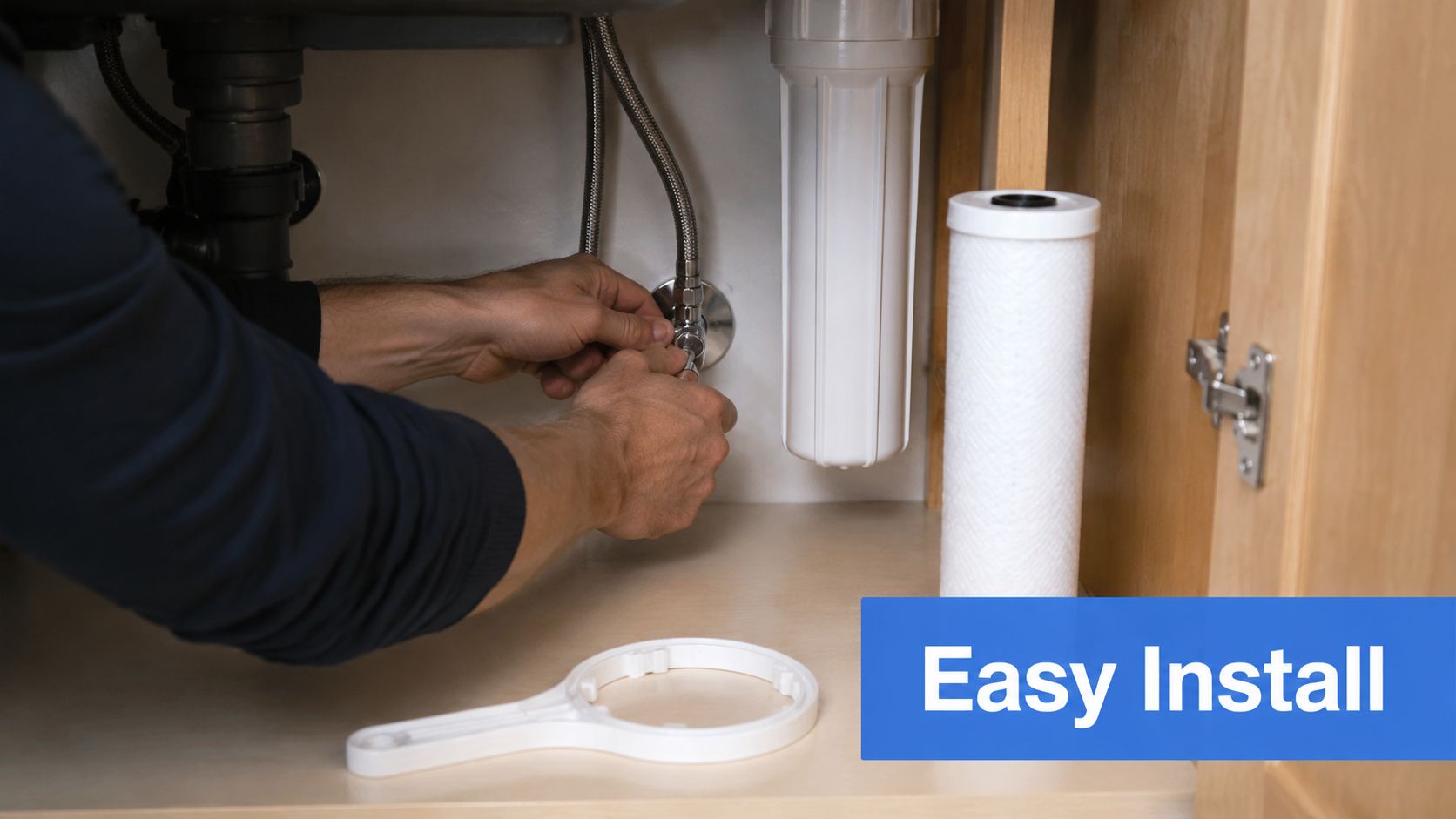
After the connections are tight, flush the line before you make ice. One ice-maker filter guide recommends running **3 to 5 gallons** through the system to purge air and carbon residue before the first batch [Best Ice Maker install guide](https://www.best-ice-maker.com/blog/the-truth-about-ice-maker-water-filter-everything-you-need-to-know). Skip that step and the first cubes often come out flat, dusty, or off-tasting.
A simple install checklist usually comes down to the basics:
- **Shut off the supply:** Don't start cutting until the line is dead.
- **Confirm the tube size:** A mismatched fitting causes more trouble than the filter itself.
- **Mount for future access:** The next cartridge change should be easy, not a contortion.
- **Flush before use:** That first rinse clears air and loose carbon.
- **Reset the indicator if present:** The reminder should reflect the new cartridge, not the old one.
If the tubing is tight, the access is awkward, or the appliance sits in a place you can't reach cleanly, it's reasonable to hand the job off. A good install is about preserving flow and serviceability, not just getting water through the box once.
## Replacement Timing Driven by Use, Not the Calendar
The calendar gives you a starting point, not the full answer. Whirlpool says a freestanding ice maker's water filter should generally be changed **every six months** or after **2,000 gallons** of use, and some retail inline systems are sold with a **6-month filter life** Whirlpool guidance) Home Depot GE inline system.
That interval matters because filters aren't static. As sediment loads up and carbon media ages, flow drops and performance drifts. A house with heavier sediment or more frequent ice use will usually hit the limit sooner than a lightly used system on cleaner water.
The signs are usually practical before they're technical. Ice production slows. Cubes get smaller or hollow. Chlorine taste starts creeping back. Sediment shows up where it didn't before. Those are the moments when the cartridge is telling you it's out of breathing room.
For planning household maintenance, the same logic shows up in broader building water management, where routine replacement and inspection matter more than waiting for a visible failure. A [practical building water guide](https://facilitymanagementinsights.com/2026/05/06/water-management-plan/) is useful if you like managing systems on a schedule instead of reacting to messes.
## When a Filter Is the Wrong Answer
A filter is not automatically the right move, and that's the part most ice maker guides don't say clearly enough. If the water is already low in hardness, low in sediment, and within the machine's expected range, adding more hardware may not buy you much. In some cases, it only adds pressure drop and another cartridge to maintain.
The opposite problem is over-filtration. Very pure water can cause trouble of its own in ice equipment, especially when the machine expects a minimum conductivity or a normal mineral background for sensor behavior. Independent discussion around ice-machine manuals notes that deionized water is not recommended and that extremely pure water may need blending or post-treatment because it can be too aggressive for the system. That's a reminder that “cleaner” isn't always “better” in mechanical terms.
### Use water chemistry, not guesswork
Consumer guidance for ice maker water recommends keeping **TDS around 70 to 200 ppm**, **hardness around 1 to 5 grains per gallon**, which is about **17 to 85 ppm as CaCO3**, **free chlorine below 0.05 ppm**, and **pH near 6.8 to 7.4**, with sediment plus carbon filtration as the standard everyday setup [Euhomy guide](https://www.euhomy.com/blogs/inspiration/best-water-for-ice-maker-guide). Those targets don't tell you everything, but they give you a practical frame for deciding whether you need more filtration, less filtration, or just a different cartridge.
A lot of homeowners never pull their water report, so they end up buying by fear or by habit. The better move is to check the local Consumer Confidence Report or order a basic lab test, then compare the results against the machine's flow and pressure needs. If the water is already within a reasonable range, a simpler system may be enough. If it isn't, the right staged filter can solve the problem without overshooting it.
> The decision isn't filter or no filter. It's whether the filter matches your water, your ice maker, and the amount of ice you actually use.
That's where a single-cartridge selective filtration approach can make sense for readers who want to reduce common contaminants while keeping the water usable for the appliance. Woder's point-of-use filters are built around that idea, which is why the fit matters more than the label.
---
If your ice maker has been making cloudy cubes, slow fills, or flat-tasting ice, start with the water report, the machine's flow demand, and the cartridge spec before you replace parts at random. Woder Filters offers point-of-use filtration designed for American homes that want targeted contaminant reduction without stripping out essential minerals, and that same approach fits the reality of a well-matched **water filter for ice maker** setup. Visit [Woder Filters](https://woder.com) to compare options, then choose the cartridge that fits your water instead of guessing.
**Categories:** Woder Science
**Tags:** filter installation, ice maker filter, ice maker maintenance, inline water filter, refrigerator filtration
---
### [US Drinking Water Quality Statistics 2026: The Cite-Ready Data Page on PFAS, Lead, Chlorine & Contamination Rates](https://woder.com/blog/us-drinking-water-quality-pfas-lead-chlorine/)
**Published:** August 13, 2026
**Author:** woder
**Content:**
- [Key Statistics at a Glance](#key-statistics-at-a-glance)
- [Introduction](#introduction)
- [PFAS (Per- and Polyfluoroalkyl Substances)](#pfas-per--and-polyfluoroalkyl-substances)
- [Lead](#lead)
- [Chlorine and Disinfection Byproducts](#chlorine-and-disinfection-byproducts)
- [Microplastics](#microplastics)
- [Arsenic and Other Heavy Metals](#arsenic-and-other-heavy-metals)
- [Emerging and Unregulated Contaminants](#emerging-and-unregulated-contaminants)
- [Global Context](#global-context)
- [How to Check Your Own Water](#how-to-check-your-own-water)
- [What the Data Means for Filtration Choices](#what-the-data-means-for-filtration-choices)
- [Sources](#sources)
- [Frequently Asked Questions](#frequently-asked-questions)
*Last updated: August 2026. This page compiles publicly available data from federal agencies, academic institutions, and third-party surveys for reference and citation purposes.*
---
### Key Statistics at a Glance
StatFigureSourceAmericans with PFAS-contaminated drinking water~165 millionEWG / EPA UCMR data, 2025US tap water estimated to contain PFASAt least 45%USGS national studyUS population served by regulated community water systems~90%CDCAmericans concerned about unfiltered tap water quality82%Aquasana 8th Annual Water Quality Survey, 2026Unregulated contaminants under EPA review (CCL 6)75 chemicals, 4 chemical groups, 9 microbesEPA CCL 6 draft, April 2026People globally using feces-contaminated drinking water sourcesAt least 1.7 billionWHO (global figure, not US-specific)---
### Introduction
Most Americans assume their tap water is safe. For many, it is — but "safe by regulatory standards" and "free of all contaminants" are not the same thing.
Federal drinking water standards cover a defined list of regulated substances. Hundreds of chemicals in active use today remain unregulated. Detection methods have also improved significantly over the past decade, and that progress has surfaced contamination that older testing simply missed.
This page compiles the most current US drinking water quality statistics available, organized by contaminant type, with every figure attributed to its source. Researchers, journalists, and anyone trying to understand what is actually in American tap water can use this as a starting reference.
---
### PFAS (Per- and Polyfluoroalkyl Substances)
PFAS are a class of thousands of synthetic chemicals used in nonstick cookware, food packaging, firefighting foam, and industrial manufacturing. They don't break down naturally — in the environment or in the human body — which is why they've earned the name "forever chemicals."
**Key statistics:**
- A USGS national study estimated that at least **45% of US tap water** contains one or more types of PFAS. Because the study tested only a subset of known PFAS compounds, the actual share could be higher.
- According to EWG analysis of EPA Unregulated Contaminant Monitoring Rule (UCMR) data updated in June 2025, approximately **165 million Americans** have PFAS-contaminated drinking water — an increase of roughly 6.5 million people (about 4%) compared to earlier estimates.
- The EPA's April 2026 draft Contaminant Candidate List 6 (CCL 6) includes PFAS as one of four chemical groups under formal review for potential future regulation.
- In 2024, the EPA finalized maximum contaminant levels (MCLs) for six PFAS compounds, setting enforceable limits for PFOA and PFOS at 4 parts per trillion — among the strictest drinking water standards ever established.
Epidemiological research has associated PFAS exposure with thyroid disruption, immune suppression, and certain cancers, though establishing direct causation in individuals remains methodologically complex.
---
### Lead
Lead enters drinking water through aging infrastructure: lead service lines, lead solder in plumbing joints, and brass fixtures. Source water leaving a treatment plant may be lead-free; contamination typically happens somewhere between the plant and the tap.
**Key statistics:**
- The EPA estimates between **6 and 10 million lead service lines** remain in use across the United States. The Biden administration set a goal to replace all of them within 10 years, backed by funding from the Infrastructure Investment and Jobs Act.
- There is no established safe level of lead exposure for children. The CDC uses a blood lead reference value of 3.5 micrograms per deciliter to flag elevated exposure, but neurological effects have been documented below even that threshold.
- The EPA's Lead and Copper Rule Improvements (LCRI), finalized in 2024, tightened the action level for lead from 15 parts per billion to 10 parts per billion and strengthened service line inventory requirements.
- Homes built before 1986 — when lead solder was banned in plumbing — are statistically more likely to have lead-containing fixtures or pipes.
Lead contamination tends to be concentrated in specific cities and zip codes with aging infrastructure. National averages significantly understate local risk in many communities.
---
### Chlorine and Disinfection Byproducts
Chlorine is added to municipal water as a disinfectant, and it works. The issue is what happens when chlorine reacts with naturally occurring organic matter in source water.
Those reactions produce disinfection byproducts (DBPs) — primarily trihalomethanes (THMs) and haloacetic acids (HAAs). Both groups are regulated by the EPA because long-term exposure at elevated concentrations has been associated with increased cancer risk and adverse reproductive outcomes in some studies.
**Key statistics:**
- The EPA's Stage 2 Disinfectants and Disinfection Byproducts Rule limits total trihalomethanes to **80 micrograms per liter** and total haloacetic acids to **60 micrograms per liter** in community water systems.
- Approximately **90% of the US population** is served by a community water system regulated under EPA rules (CDC), meaning DBP standards apply to the vast majority of Americans' tap water.
- Chloramine, used as an alternative disinfectant in some systems, produces different byproducts — including iodoacids — that are less well studied and not currently regulated under the same framework.
Water that meets current DBP standards is not necessarily unsafe, but regulated compliance levels are not the same as zero exposure to compounds with documented health associations.
---
### Microplastics
Microplastics in drinking water are an emerging area of concern. Research is still developing, and as of 2026, no federal maximum contaminant level exists for microplastics in drinking water.
**Key statistics:**
- The EPA's April 2026 draft CCL 6 includes microplastics as one of four chemical groups under active review, signaling that federal regulation is being seriously considered.
- Multiple peer-reviewed studies have detected microplastics in treated tap water, bottled water, and source water across the US, though varying detection methods and particle size definitions make direct comparisons between studies difficult.
- The health effects of ingested microplastics remain under active investigation. Some studies have detected microplastic particles in human blood, lung tissue, and placental tissue, but dose-response relationships are not yet established.
Because no regulatory standard exists, water quality reports don't include microplastic data. Consumers currently have no standardized way to assess their personal exposure from tap water.
---
### Arsenic and Other Heavy Metals
Arsenic occurs naturally in rock and soil and leaches into groundwater across many parts of the US — particularly the Southwest, New England, and parts of the Midwest. It is also a byproduct of certain mining and agricultural activities.
**Key statistics:**
- The EPA's MCL for arsenic in drinking water is **10 micrograms per liter (10 ppb)**. The WHO guideline matches that figure, though some health researchers argue the standard isn't protective enough given arsenic's classification as a Group 1 human carcinogen.
- Chromium-6 (hexavalent chromium) is another heavy metal of concern. The EPA proposed a national primary drinking water regulation for chromium-6 in 2023; as of 2026, that regulatory process is ongoing.
- Mercury, cadmium, and barium are regulated under the EPA's National Primary Drinking Water Regulations with established MCLs, though exceedances still occur in some systems — particularly smaller community water systems with limited monitoring capacity.
---
### Emerging and Unregulated Contaminants
The gap between what is regulated and what is actually present in water is significant. The EPA's Contaminant Candidate List process exists specifically to address it.
**Key statistics:**
- The **EPA's CCL 6 draft (April 2026)** identifies **75 chemicals, 4 chemical groups** (including PFAS and microplastics), **and 9 microbes** that are not currently subject to national primary drinking water regulations but are known or anticipated to occur in public water systems.
- Pharmaceuticals and personal care products (PPCPs) — including antibiotics, hormones, and antidepressants — have been detected in surface water and some treated drinking water supplies. None are currently regulated under the Safe Drinking Water Act.
- Nitrates from agricultural runoff remain a persistent problem in rural areas. The EPA's MCL for nitrates is 10 mg/L, but exceedances are common in agricultural regions and disproportionately affect private well users, who fall outside federal regulatory coverage.
---
### Global Context
The US drinking water picture, while concerning in specific areas, is considerably better than the global baseline.
The WHO estimates that at least **1.7 billion people globally** use a drinking water source contaminated with feces. This is a global statistic and does not describe conditions in the US, where fecal contamination of regulated community water systems is rare and subject to strict monitoring requirements.
---
### How to Check Your Own Water
Two federal resources let you assess your local water quality directly:
1. **Consumer Confidence Reports (CCRs):** Every community water system is required to publish an annual CCR detailing detected contaminants and how they compare to EPA standards. Most utilities publish these online; you can also search by zip code through the EPA's CCR website.
2. **Water Quality Portal (waterqualitydata.us):** This interagency platform aggregates water quality data from the USGS, EPA, and state agencies. It's primarily designed for researchers but is publicly accessible and searchable by location.
If you rely on a private well, federal regulations don't apply to you — you're responsible for testing your own water. The EPA recommends annual testing at minimum.
---
### What the Data Means for Filtration Choices
The statistics on this page describe a water supply that is regulated and monitored — but not contaminant-free. PFAS, lead, chlorine byproducts, and emerging chemicals appear across the country at varying concentrations, often in water that fully complies with current standards.
For households that want protection beyond what treatment plants provide, point-of-use filtration is the most practical option.
[Woder](https://woder.com) makes under-sink and inline water filters built around Advanced Selective Filtration technology, which uses nanoparticles to attract and remove specific contaminants from the water line. Per manufacturer specifications, Woder filters target lead, chlorine, chromium-6, mercury, PFAS, carcinogens, and VOCs at a 99.9% removal rate. This figure is a manufacturer-stated specification; Woder's filters are not currently NSF-certified, and independent third-party certification would be required to verify these claims against a standardized testing protocol.
One meaningful difference from reverse osmosis: Woder's technology is designed to remove contaminants selectively, leaving beneficial minerals like calcium and magnesium intact. Reverse osmosis strips those out along with everything else. For households concerned about PFAS or lead but not looking to demineralize their water entirely, that distinction is worth considering.
---
### Sources
1. **USGS** — National study estimating PFAS presence in US tap water (at least 45%). U.S. Geological Survey, 2023.
2. **EWG / EPA UCMR data** — Approximately 165 million Americans have PFAS-contaminated drinking water; ~6.5 million increase per updated data. Environmental Working Group analysis of EPA Unregulated Contaminant Monitoring Rule data, June 2025.
3. **EPA** — Contaminant Candidate List 6 (CCL 6) draft: 75 chemicals, 4 chemical groups, 9 microbes. U.S. Environmental Protection Agency, April 2026.
4. **EPA** — Lead and Copper Rule Improvements (LCRI), finalized 2024. U.S. Environmental Protection Agency.
5. **EPA** — Stage 2 Disinfectants and Disinfection Byproducts Rule. U.S. Environmental Protection Agency.
6. **EPA** — National Primary Drinking Water Regulations (arsenic, chromium, mercury, nitrates, etc.). U.S. Environmental Protection Agency.
7. **CDC** — Approximately 90% of the US population is served by a community water system regulated by EPA. Centers for Disease Control and Prevention.
8. **WHO** — At least 1.7 billion people globally use a drinking water source contaminated with feces. World Health Organization (global statistic).
9. **Aquasana** — 82% of Americans express concern about the quality of unfiltered tap water at home. Aquasana 8th Annual Water Quality Survey, 2026. (Third-party consumer survey; not a laboratory test or scientific study.)
---
### Frequently Asked Questions
**What percentage of US tap water contains PFAS?**
A USGS national study estimated that at least 45% of US tap water contains one or more types of PFAS. Because the study tested for only a subset of known PFAS compounds, the actual share may be higher.
**How many Americans are exposed to PFAS-contaminated drinking water?**
According to EWG analysis of EPA Unregulated Contaminant Monitoring Rule data updated in June 2025, approximately 165 million Americans have PFAS-contaminated drinking water — an increase of roughly 6.5 million people compared to earlier estimates.
**Is my tap water safe to drink?**
About 90% of Americans are served by community water systems regulated under EPA standards (CDC). Regulated water meets established contaminant limits, but meeting current standards is not the same as being free of all contaminants — many chemicals, including most PFAS compounds until recently and microplastics currently, are not regulated. Checking your utility's Consumer Confidence Report and using point-of-use filtration are two practical ways to reduce exposure beyond regulatory minimums.
**What are the most common contaminants found in US drinking water?**
The most widely documented contaminants in US tap water include PFAS (detected in at least 45% of tap water per USGS), lead (primarily from aging service lines and plumbing), chlorine disinfection byproducts such as trihalomethanes, nitrates in agricultural areas, and arsenic in groundwater-dependent regions. The EPA's April 2026 CCL 6 draft identifies 75 additional chemicals and 4 chemical groups currently under review for potential future regulation.
**What is the EPA Contaminant Candidate List 6?**
The EPA's Contaminant Candidate List 6 (CCL 6), released in draft form in April 2026, identifies 75 chemicals, 4 chemical groups (including PFAS and microplastics), and 9 microbes that are not currently regulated under the Safe Drinking Water Act but are known or anticipated to occur in public water systems. Inclusion on the CCL does not mean a substance is regulated — it means it is under active consideration for future regulation.
**Categories:** Woder Press Releases
---
### [Water Filter Bacteria Removal: A Practical Guide](https://woder.com/blog/water-filter-bacteria-removal/)
**Published:** August 13, 2026
**Author:** woder_admin
**Content:**
Most advice about **water filter bacteria removal** starts in the wrong place. People are told to look for a filter that “cleans” water, as if taste improvement, odor reduction, and bacterial safety all come from the same mechanism. They don't. A pitcher that makes water taste better can still be the wrong tool for bacteria, because **removing microbes is a physical job**, and physical jobs depend on pore size, validated performance, and what the filter does after it's been in a house for weeks or months.
That difference matters because the word **filter** gets used very loosely. Some products are built to strain microbes out, some are built to reduce chlorine and improve flavor, and some do a little of both. If you want real protection, the better question is not “Which brand sounds strongest?” It's “What technology is doing the work, and how reliably does it hold up in normal use?”
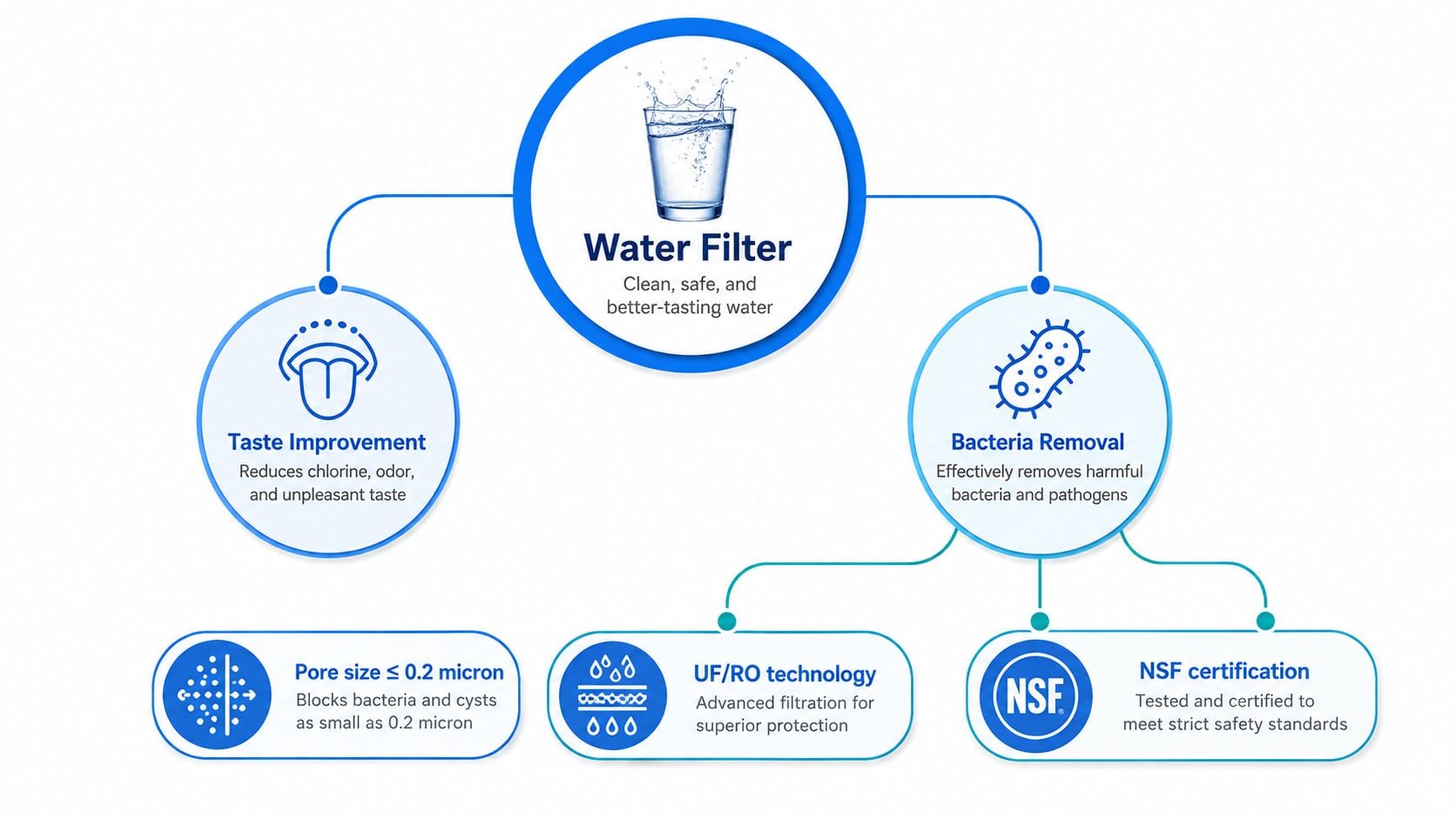
## Table of Contents
- [Why Bacteria Removal Is Not the Same as Purification](#why-bacteria-removal-is-not-the-same-as-purification)
- [Physical removal is a size problem](#physical-removal-is-a-size-problem)
- [Micron Ratings and What They Actually Mean](#micron-ratings-and-what-they-actually-mean)
- [Absolute versus nominal](#absolute-versus-nominal)
- [What to read on the label](#what-to-read-on-the-label)
- [The Four Technologies That Remove Bacteria From Water](#the-four-technologies-that-remove-bacteria-from-water)
- [Mechanical membranes](#mechanical-membranes)
- [UV, carbon, and chemical treatment](#uv-carbon-and-chemical-treatment)
- [Log Reduction Values and the Standards Behind Them](#log-reduction-values-and-the-standards-behind-them)
- [What the standards mean](#what-the-standards-mean)
- [Why the number and the standard both matter](#why-the-number-and-the-standard-both-matter)
- [Real-World Reliability After Installation](#real-world-reliability-after-installation)
- [Why performance can drift](#why-performance-can-drift)
- [Maintenance is part of the design](#maintenance-is-part-of-the-design)
- [Matching a Bacteria Filter to Your Water Source](#matching-a-bacteria-filter-to-your-water-source)
- [City water and apartments](#city-water-and-apartments)
- [Private wells and higher-risk sources](#private-wells-and-higher-risk-sources)
- [What to Look for Before You Buy](#what-to-look-for-before-you-buy)
- [A short buyer checklist](#a-short-buyer-checklist)
## Why Bacteria Removal Is Not the Same as Purification
The cleanest way to separate **taste treatment** from **microbial removal** is to ask what the filter is built to do. Carbon can improve flavor and reduce chlorine, so water often seems cleaner after filtration, but better taste does not mean bacteria are being removed. A filter can change how water tastes without being designed to stop microbes from passing through.
### Physical removal is a size problem
Bacteria are microscopic, but they are still larger than water molecules, which means the right membrane can stop them. The CDC notes that filters with an **absolute pore size of 0.3 micron or smaller**, or **ultrafiltration/nanofiltration**, remove bacteria such as *Salmonella* and *E. coli* from water, while larger pores may reduce particles and taste without reliably removing bacteria ([CDC guidance on home water filters](https://www.cdc.gov/drinking-water/prevention/about-choosing-home-water-filters.html)). That is the part many buyers miss, because a pleasing glass of water is not the same thing as a microbiologically safer one.
A membrane works like a screen with a defined opening. A carbon block works more like a sponge with a large internal surface that can grab certain compounds. Both can improve water, but they do not do the same job, and the technology matters more than the packaging.
> **Practical rule:** if the claim is about bacteria, look for a membrane or purifier standard, not just a taste-and-odor label.
A broad review in the scientific literature found that **membrane filtration** technologies, including microfiltration, ultrafiltration, and reverse osmosis, achieved the highest average bacterial reduction, with an average **log removal value of 4.5** across **75 studies** and **226 measurements**, which works out to about **99.997% removal** ([systematic review](https://pubs.acs.org/doi/10.1021/acs.est.4c03494)). That does not mean every membrane performs the same way, but it does show why membrane-based point-of-use systems belong in a different category from carbon-only filters when bacteria is the concern.
A taste filter polishes water. A bacteria filter has to stop organisms from moving through the media at all.
For a simple companion explanation, Woder's article on boiling water and purification is useful background: [does boiling water purify it](https://woder.com/blog/does-boiling-water-purify-it).
## Micron Ratings and What They Actually Mean
Micron ratings are where many homeowners get tripped up, because the number looks exact even when the rating method is not. A **micron** is a unit of size, but the real question is whether the filter rating is **absolute** or **nominal**. Those words sound similar. In practice, they are very different.
### Absolute versus nominal
An **absolute** rating means the filter is built to stop particles at or below a stated size under test conditions. A **nominal** rating usually means the filter captures some fraction of particles around that size, not all of them. Two products can carry the same micron number and still behave very differently in real water.
Bacteria-size comparisons help, but they do not settle the question by themselves. A bacterium may be larger than the opening on paper, yet flow rate, pressure, media quality, and cartridge condition can still affect what gets through. A spec sheet with a small number is not enough unless the rating type and test method are clear.
### What to read on the label
If a product says **0.2 micron absolute**, that is a very different claim from **1 micron nominal**. The first language points to a tighter physical barrier. The second can describe a filter that improves water clarity and taste while still letting some bacteria pass under the wrong conditions.
> **Rule of thumb:** when you see a micron number, ask two follow-up questions, “Is it absolute?” and “What organism or test was used to verify it?”
That is why pore-size language matters so much, and why a small micron number can mean very different things depending on how the cartridge is built. For a plain-language primer on what **0.5 micron** means in practice, [Woder's explanation of water filter 0.5 micron](https://woder.com/blog/water-filter-0-5-micron/) is a useful reference point. A filter rated in this range may sound precise, but the rating still needs context before you assume it is a bacteria barrier.
If you're reading product pages, one useful example is the [Woder Sediment Removal and Advanced Dual Filtration System](https://woder.com/products/wd-d-20m-g4-dc/). Its published snapshot combines a **20µ sediment removal first stage** with ADV Filtration and lists reductions for contaminants including **chlorine, chloramines, VOCs, and other impurities**. That kind of staged design is about broader water quality, not a stand-alone bacteria purifier claim, which is exactly why the details matter.
For a deeper primer on size ratings, Woder's post on small micron filters helps frame the difference between nominal language and actual barrier claims.
## The Four Technologies That Remove Bacteria From Water
Different technologies solve different problems, and the confusion starts when people treat all of them as interchangeable. They aren't. A homeowner comparing **water filter bacteria removal** should ask a simpler question first, whether the device **physically removes** microbes, **inactivates** them, or only improves the water in ways that make it seem cleaner.
### Mechanical membranes
Mechanical membranes, including microfiltration, ultrafiltration, nanofiltration, and reverse osmosis, remove bacteria by **physically blocking passage**. That is their main advantage. Their weak point is just as straightforward. If the membrane is damaged, bypassed, fouled, or used outside its tested conditions, performance can change.
The CDC's pore-size guidance fits here because membranes work by size exclusion rather than by taste correction. A recent [systematic review](https://pubs.acs.org/doi/10.1021/acs.est.4c03494) also places this category among the strongest options for bacterial reduction. In practical terms, this is the technology class with the clearest path to verified microbial removal.
### UV, carbon, and chemical treatment
UV works differently. It does not strain microbes out of the water. It damages their DNA so they cannot reproduce, which is why UV systems are often used after prefiltration, when the water is clear enough for light to do its job well. Carbon is different again. It can improve taste and reduce some chemicals, but by itself it does not reliably act as a bacteria barrier.
Chemical disinfection, such as chlorine or iodine, kills microbes rather than catching them. That can be useful in some settings, but it leaves a residual and does not feel the same as turning on a faucet and drinking directly from a point-of-use membrane.
A useful external primer on the broader treatment framework is BacteriaFAQ.com on water safety, which helps separate filtration from purification without burying the reader in jargon.
> Carbon can improve water quality. It is just not a substitute for a barrier designed to stop bacteria.
That distinction shows up in the field studies too. One [household and lab study](https://pmc.ncbi.nlm.nih.gov/articles/PMC2937016/) found an active filter with an LRV of **2.98** for total thermotolerant coliforms, which the authors translated to about **99.8% removal**, and **64%** of treated samples were completely free of thermotolerant coliforms. In lab testing, the same filter reached **6.9 logs** of bacterial reduction, about **99.99999% removal**. The same technology can look very strong under one condition and much less consistent under another, which is why the mechanism matters as much as the headline claim.
## Log Reduction Values and the Standards Behind Them
Log reduction is the measurement scientists use to show how much of a microorganism load a treatment removes. A **6-log reduction** means **99.9999% removal**. That figure matters because it says more than “passed a test” or “removes bacteria.” It shows how much was removed under a defined test condition, which is the level of detail a homeowner can compare across products.
### What the standards mean
Home water standards are the bridge between marketing claims and evidence. **NSF P231** is tied to microbiological purifier claims. **NSF/ANSI 53** is often associated with mechanical filtration claims for specific contaminants. **NSF/ANSI 58** covers reverse osmosis systems, which is why RO products often come up in bacteria discussions even though they are usually discussed for broader contaminant reduction too.
StandardWhat it testsTypical bacterial claimBest used forNSF P231Microbiological purifier performanceHigh-level bacteria removal claimsSystems meant for purifier-style microbial protectionNSF/ANSI 53Mechanical filtration performance for specific health-related claimsFilter-specific reduction claimsFilters that need defined contaminant performanceNSF/ANSI 58Reverse osmosis system performanceRO-based reduction claimsRO systems used for broad drinking-water treatmentFor readers who want to make sense of certification language without getting lost in abbreviations, Woder's guide to the standards is a practical companion: [WQA, NSF, ANSI, WTH water quality alphabet soup](https://woder.com/blog/wqa-nsf-ansi-wth-water-quality-alphabet-soup/).
A standard is only part of the story. It tells you the test framework, while the log reduction tells you the size of the microbial barrier under that framework. A filter that claims a high reduction number without naming the standard is like a thermometer with no scale. The number may look precise, but you cannot judge what it means.
### Why the number and the standard both matter
A **6-log target** is common in purifier-style products, and the benchmark matters because it shows the product was tested against a meaningful microbial challenge. Independent product data sheets also report ultrafilters with **0.02-micron membranes** achieving **99.999999% bacteria reduction** under test conditions, which shows how tight membrane design and validation can be when the goal is microbial control ([product data sheet](https://pdf.lowes.com/productdocuments/f4bae25e-7747-46ea-906a-ee3394ad417e/65386682.pdf)).
A useful way to read these claims is to ask two questions. How much bacteria was removed, and under what standard was that verified? The first tells you the claimed performance. The second tells you the testing frame behind it. That difference separates a brochure promise from a filter you can evaluate with confidence.
## Real-World Reliability After Installation
A filter's lab performance is only the first question. The second is what happens after it sits under a sink, handles everyday flow, and gets exposed to real household water. That's where buyers often run into the gap between test claims and daily reality.
### Why performance can drift
One older but still useful study found that **total coliform bacteria persisted and proliferated on drinking-water filters for several days after transient contamination of the influent water**, and that **silver-containing activated carbon filters suppressed total coliform but not total bacterial growth** ([ASM study](https://journals.asm.org/doi/pdf/10.1128/aem.41.3.646-651.1981)). That tells you something important. The filter itself can become part of the microbial environment if it isn't designed, installed, and maintained carefully.
There's also the issue of breakthrough. A 2021 study on popular faucet-mounted activated-carbon point-of-use filters found **early breakthrough** of spiked bacteria in the effluent under simulated daily use, which means some products can let bacteria pass sooner than buyers expect ([2021 field and laboratory study](https://pubs.rsc.org/en/content/articlehtml/2021/ew/d0ew00982b)). That doesn't mean every filter fails. It does mean the household story is more complicated than the box copy.
### Maintenance is part of the design
Flow rate, cartridge age, and sitting water all matter. If water moves too quickly through the media, the contact time changes. If a cartridge gets old, its performance can drift. If water sits in the unit, growth conditions can change again. None of that is glamorous, but it's the part that decides whether bacteria removal stays dependable.
> **Practical question:** ask the seller what happens to bacterial performance at the end of the cartridge's life, not just on day one.
The broader systematic evidence also points to variability over time. Recent review data noted that two household-treatment studies averaged **94% E. coli reduction** and improved over time to **99%**, which is a useful reminder that real-world performance can be variable rather than binary ([systematic evidence in the household-treatment review](https://pubs.acs.org/doi/10.1021/acs.est.4c03494)).
## Matching a Bacteria Filter to Your Water Source
A city home and a private well need different answers. That sounds obvious until people shop as if one filter category fits every house. It doesn't. The right setup depends on whether your utility is already disinfecting water, whether your plumbing is holding up, and whether you can install a permanent unit or need a removable point-of-use solution.
### City water and apartments
If you're on municipal water and your **Consumer Confidence Report** is current and reassuring, your main goal may be added protection at the tap rather than emergency disinfection. In that case, a point-of-use membrane or purifier-style unit can make sense if you're specifically concerned about bacteria at the faucet or in premise plumbing. Renters and apartment dwellers often need a compact, noninvasive solution, which is why under-sink and inline point-of-use systems are usually more practical than whole-house equipment.
The trick is not to assume every faucet-mounted or under-sink filter does the same thing. Some are built mainly for taste and chlorine. Others are built for microbial reduction. That difference should drive the choice.
### Private wells and higher-risk sources
Private well owners have a different burden, because source water can be exposed to surface contamination, and there isn't a city treatment plant buffering the risk. In those homes, bacteria control tends to point toward **absolute-pore membranes**, UV in the right conditions, or multi-barrier setups that combine treatment steps. If the water is cloudy, UV gets less attractive until prefiltration is handled well.
For people who travel or live in small spaces, a resource like [safe drinking water in a caravan](https://ringhotwater.com.au/2026/07/17/water-filter-for-caravan/) can be useful because it shows how limited space changes the filtration strategy. The same idea applies to apartments and RVs, where point-of-use design matters as much as the treatment method.
Woder's own approach fits this point-of-use world. The brand's U.S.-made systems use **Advanced Selective Filtration®** to remove contaminants while retaining essential minerals, and that can be a good match when your main goal is chemical reduction and better tasting water, not bacterial purification. If bacteria is the primary concern, though, the membrane or purifier standard still has to be part of the conversation.
## What to Look for Before You Buy
The calmest way to shop is to ask four questions and ignore the noise around them. First, **what mechanism is removing bacteria**. Second, **what pore size or standard backs the claim**. Third, **how does the filter hold up after installation and aging**. Fourth, **what maintenance schedule keeps the claim valid**.
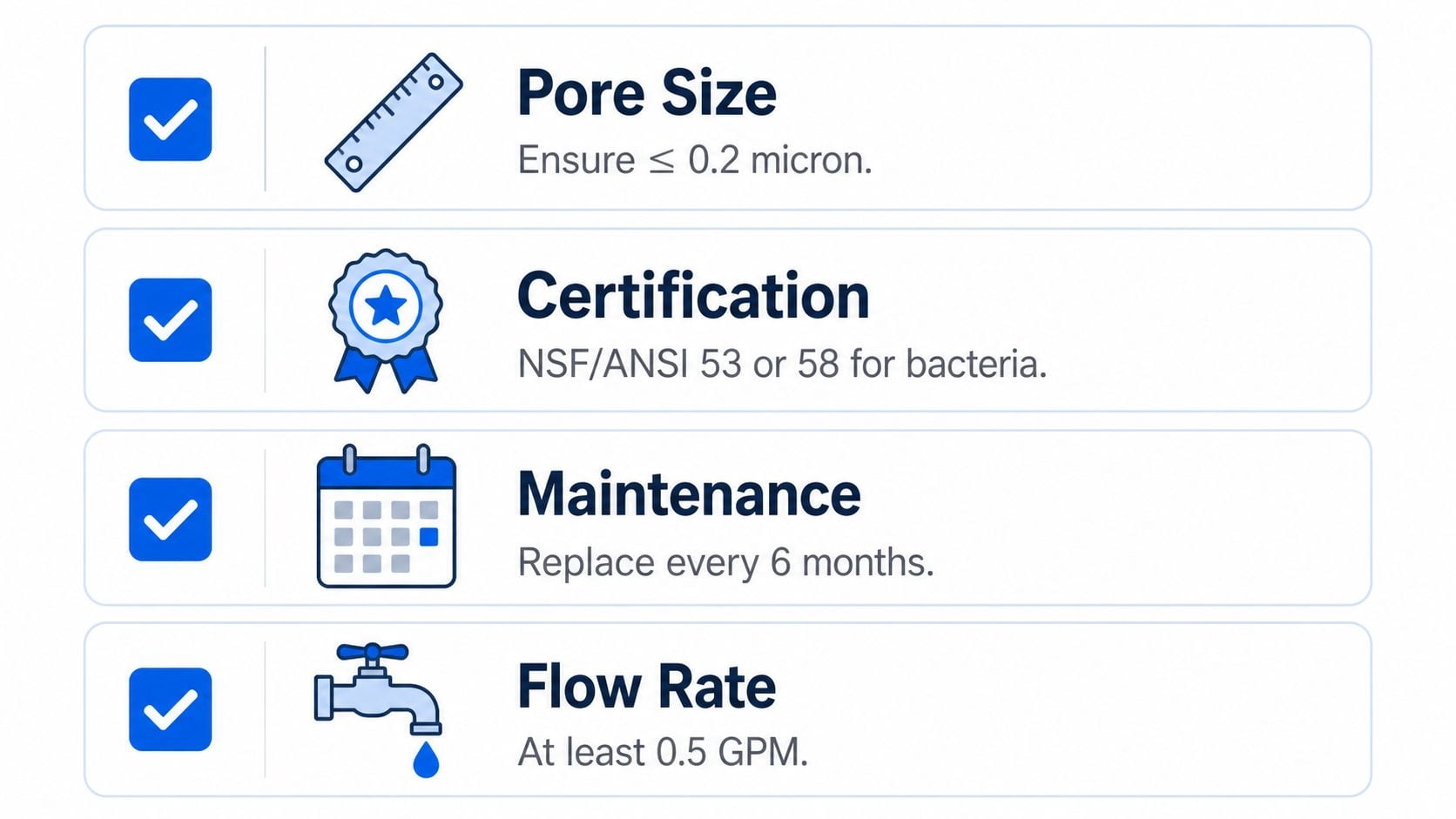
### A short buyer checklist
- **Pore size:** look for **absolute** ratings and membrane technologies that are sized to stop bacteria.
- **Certification:** check whether the product is tied to a relevant microbial standard, not just a general taste claim.
- **Maintenance:** replace cartridges on schedule, because aging media can change performance.
- **Real use:** ask what happens after normal household flow, not just in a lab setup.
If you're comparing broader options for a house, a guide like [choose the best whole-house filter](https://www.waterfilteradvisor.com/advice/) can help frame whether you need point-of-use protection, whole-home treatment, or both. The right answer depends on the water source and the problem you're solving.
For readers who care about **retaining minerals** while reducing contaminants, selective filtration is a real advantage, but it's a different goal from bacteria removal. If microbial protection is your top priority, don't let mineral-retention language distract you from the actual bacteria barrier.
---
If you want a U.S.-made point-of-use filter built around **contaminant reduction without stripping out essential minerals**, take a look at [Woder Filters](https://woder.com). If you're comparing options for bacteria control, use the standards and pore-size checks above first, then see how Woder's systems fit your broader water-quality goals.
**Categories:** Woder Science
**Tags:** bacteria water filter, micron rating filter, NSF certified water filter, UV water filter, water filter bacteria removal
---
### [Where to Buy Woder Water Filters in 2026: Direct, Amazon, and Retailer Buying Guide](https://woder.com/blog/where-to-buy-woder-water-filters-in-2026-direct/)
**Published:** August 12, 2026
**Author:** woder
**Content:**
- [Buying Direct at woder.com](#buying-direct-at-wodercom)
- [The Current Model Lineup](#the-current-model-lineup)
- [Buying on Amazon](#buying-on-amazon)
- [Retail Stores: Home Depot, Walmart, Target, and Others](#retail-stores-home-depot-walmart-target-and-others)
- [Why Sourcing Matters for Lead-and-PFAS-Rated Filters](#why-sourcing-matters-for-lead-and-pfas-rated-filters)
- [How to Pick the Right Woder Model](#how-to-pick-the-right-woder-model)
- [How Often Do You Need to Reorder Cartridges?](#how-often-do-you-need-to-reorder-cartridges)
- [FAQs](#faqs)
You've done the research. You know Woder's Advanced Selective Filtration technology removes contaminants without stripping out beneficial minerals, and now you just need to know where to buy one. This guide covers every reliable channel, what to watch out for with third-party sellers, and how to make sure you're getting a genuine filter that actually matches your setup.
---
### Buying Direct at woder.com
The simplest and most reliable way to buy a Woder filter is directly through [Woder Filters](https://woder.com) at woder.com. For a product like this, buying direct comes with a few advantages worth knowing about.
**You get the current model and the right cartridge for it.** Woder's product line has evolved over time, and when you buy from the official site, you're getting the latest generation of each model alongside the replacement cartridges built to work with it. That pairing matters more than it might seem — a housing and cartridge from different generations can underperform or fail to seat correctly.
**The product finder wizard removes the guesswork.** Not sure which model fits your setup? The finder tool at woder.com walks you through household size, flow rate needs, and installation type to point you toward the right choice before you commit to anything.
#### The Current Model Lineup
Woder's under-sink and inline filter range covers several use cases:
- **WD-D-8K-FRM-ADV-DC** — An under-sink direct-connect model. A clean setup that ties into your existing cold water line without requiring a separate faucet.
- **WD-S-5K-REP** — A replacement cartridge model, typically used when you already have a compatible Woder housing and just need a fresh filter.
- **WD-10K-ADV-PORT** — A higher-capacity option for households with heavier daily water usage or more demanding filtration needs.
- **WD-G4-210-JG** — A 1/4-inch John Guest push-fit inline model, well suited for refrigerator lines, ice makers, and similar applications.
Replacement cartridges for each model are available directly on the site. It's worth stocking a spare at the time of your initial purchase — cartridge availability from third-party sellers is less predictable, and you don't want to be scrambling when it's time to replace.
**On pricing:** Woder doesn't publish a fixed retail price list. Current pricing for each model and cartridge is shown at checkout on woder.com and varies by model.
---
### Buying on Amazon
Amazon is a secondary channel where Woder filters appear, and for many buyers it's a convenient option — especially if you have Prime shipping or prefer to keep purchases in one place.
A few things to keep in mind before you buy:
**Verify the seller is authorized.** Amazon's marketplace includes both first-party listings and third-party seller listings. For a filter designed to remove lead and PFAS-category contaminants, you want confidence that what arrives is a genuine, current-generation product. Before purchasing, confirm the listing is either fulfilled directly by the brand or by a verified authorized seller. An unfamiliar seller name combined with an unusually low price is worth scrutinizing.
**Stock and listings can vary.** Not every Woder model available at woder.com will be listed on Amazon, and what is listed may come from a third-party seller at a different price, with different shipping timelines, or as an older-generation unit. Cross-reference the model number against what's current on woder.com before completing any purchase.
**Be especially careful with cartridges.** Replacement cartridges are where counterfeit and mismatched products are most likely to surface on marketplace platforms. A cartridge that looks right but isn't a genuine match for your housing won't filter the way it's supposed to. When in doubt, order cartridges direct.
---
### Retail Stores: Home Depot, Walmart, Target, and Others
Water filters are commonly sold at major home improvement and general merchandise retailers. Home Depot carries a range of under-sink and inline filter brands. Walmart and Target stock filtration products both in-store and online. Whether you'll find Woder specifically at any of these locations depends on the store and changes over time — availability isn't guaranteed.
#### Why Sourcing Matters for Lead-and-PFAS-Rated Filters
This is worth being direct about. A water filter rated to reduce lead or PFAS-category contaminants is a health-relevant product. Buying through an authorized channel means you're getting a filter that was manufactured, stored, and shipped according to the brand's standards.
Buying through an unauthorized reseller — whether a physical store carrying old inventory or a third-party online listing — introduces a few real risks:
- **Older-generation cartridges.** A cartridge that's been sitting in a warehouse or on a shelf for an extended period may be past its optimal pre-use condition, or it may be a previous-generation product that doesn't match current housings.
- **Counterfeit product.** Counterfeit water filter cartridges are a documented problem across the industry. They can look nearly identical to genuine products while using entirely different filtration media.
- **No manufacturer support.** If something goes wrong with a product purchased through an unauthorized channel, warranty and support options are typically limited or unavailable.
For a basic pitcher filter, buying from a random shelf carries relatively low stakes. For an under-sink system you're relying on to reduce lead and PFAS from your drinking water, where you buy it actually matters.
---
### How to Pick the Right Woder Model
If you're new to Woder or upgrading from an older unit, narrowing down the right model doesn't take long. A few questions will get you there:
**What's your installation type?** Under-sink direct-connect models like the WD-D-8K-FRM-ADV-DC are built for kitchen drinking water lines. Inline push-fit models like the WD-G4-210-JG are better suited for refrigerator lines or other inline applications.
**How much filtered water does your household use daily?** Higher-capacity models like the WD-10K-ADV-PORT are designed for households that put more demand on their filter. Matching capacity to usage affects both filter life and flow rate.
**Are you replacing an existing Woder unit?** If you already have a Woder housing, you may need a replacement cartridge like the WD-S-5K-REP rather than a full new system. Check your current model number before ordering.
The product finder wizard at woder.com is the fastest way to get a recommendation matched to your specific setup — it's built for exactly this kind of decision.
---
### How Often Do You Need to Reorder Cartridges?
Woder cartridges are rated by gallon capacity rather than a fixed time period. The WD-S-5K-REP, for example, is rated for 5,000 gallons. For a household using around 2 gallons of filtered water per day, that works out to roughly 6–7 years of cartridge life. Higher-usage households will hit the replacement threshold sooner.
A few signs your cartridge may need replacing ahead of schedule: reduced flow rate, a change in taste or odor, or simply reaching the rated gallon capacity based on your usage estimate.
Getting a replacement cartridge before you actually need one is a practical habit. Running a filter past its rated capacity means it's no longer filtering effectively — which defeats the whole point.
---
### FAQs
**Where can I buy Woder water filters?**
The most reliable place is directly at woder.com, where you'll find the full current lineup, replacement cartridges, and the product finder wizard. Woder filters are also available on Amazon, but buyers should verify the seller is authorized before purchasing.
**Is Woder sold in stores?**
Woder filters may appear at some retail locations or through third-party sellers, but availability varies and isn't guaranteed. Buying direct at woder.com or through a verified authorized seller is the safest way to ensure you're getting a current-generation product.
**How do I know I'm getting a genuine Woder cartridge?**
Purchasing directly from woder.com is the most reliable way to confirm authenticity. On Amazon or other platforms, check that the seller is authorized and that the model number matches what's listed on woder.com. Unusually low prices or unfamiliar seller names are worth investigating before you buy.
**How often do I need to reorder cartridges?**
Woder cartridges are rated by gallon capacity, so replacement frequency depends on your household's daily filtered water usage. Check your model's rated capacity and estimate your daily usage to build a reasonable replacement schedule.
**Can I use any replacement cartridge with my Woder housing?**
No. Replacement cartridges need to match your specific Woder housing model. A mismatched cartridge can result in poor filtration performance or a poor seal. The model number on your current housing is the reference point for finding the correct replacement.
**What's the difference between the WD-D-8K-FRM-ADV-DC and the WD-G4-210-JG?**
The WD-D-8K-FRM-ADV-DC is an under-sink direct-connect model designed for kitchen drinking water lines. The WD-G4-210-JG is a 1/4-inch John Guest inline model suited for refrigerator lines, ice makers, and similar applications. Your installation type determines which one is the right fit.
**Does Woder ship replacement cartridges directly?**
Yes. Replacement cartridges are available through woder.com alongside the filter housings. Ordering direct is the most reliable way to get a genuine, current-generation match for your existing unit.
---
The short version: buy direct at woder.com when you can, use Amazon as a secondary option only when the seller is verified, and be cautious about any listing that can't confirm it's an authorized, current-generation product. For a filter you're relying on to reduce lead and PFAS from your drinking water, sourcing matters. Start with the product finder at [woder.com](https://woder.com) to find the right model for your setup.
**Categories:** Woder Press Releases
---
### [Water Filter Housing 10: A Complete Compatibility Guide](https://woder.com/blog/water-filter-housing-10/)
**Published:** August 12, 2026
**Author:** woder_admin
**Content:**
You're standing under the sink with a replacement cartridge in one hand and a flashlight in the other, and the problem isn't the filter media at all. It's the **housing**. The label says **10-inch**, but the threads don't match, the canister feels too tight in the cabinet, or the O-ring starts weeping after you put everything back together.
That's the part most product pages skip. A **water filter housing 10** is defined by more than one measurement, and if you get the wrong one, the whole installation turns into a leak hunt. Fit, connection size, pressure limits, cartridge dimensions, and service habits all matter more than the word “10” suggests.
## Table of Contents
- [Why 10-Inch Filter Housings Cause More Confusion Than They Should](#why-10-inch-filter-housings-cause-more-confusion-than-they-should)
- [The problem is fit, not just filtration](#the-problem-is-fit-not-just-filtration)
- [Understanding the 10-Inch Housing Form Factor](#understanding-the-10-inch-housing-form-factor)
- [Sump, Head, and the Seal That Matters](#sump-head-and-the-seal-that-matters)
- [Connection Sizes and Plumbing Compatibility](#connection-sizes-and-plumbing-compatibility)
- [Match the port size to the job](#match-the-port-size-to-the-job)
- [Pressure Ratings and Temperature Limits](#pressure-ratings-and-temperature-limits)
- [Why pressure matters before you mount anything](#why-pressure-matters-before-you-mount-anything)
- [Temperature is just as important](#temperature-is-just-as-important)
- [Standard vs Jumbo Cartridge Compatibility](#standard-vs-jumbo-cartridge-compatibility)
- [Diameter changes the whole installation](#diameter-changes-the-whole-installation)
- [O-Ring Maintenance and Housing Service Life](#o-ring-maintenance-and-housing-service-life)
- [What to do at each service interval](#what-to-do-at-each-service-interval)
- [Why reuse can be false economy](#why-reuse-can-be-false-economy)
- [Installing a 10-Inch Housing Under Your Sink](#installing-a-10-inch-housing-under-your-sink)
- [Mounting, sealing, and opening the supply](#mounting-sealing-and-opening-the-supply)
- [What a 10-Inch Housing Does Not Solve](#what-a-10-inch-housing-does-not-solve)
- [Upstream sediment management matters](#upstream-sediment-management-matters)
- [Troubleshooting Common Housing Problems](#troubleshooting-common-housing-problems)
- [Symptom, likely cause, and fix](#symptom-likely-cause-and-fix)
- [Quick Reference Checklist for Housing Selection and Maintenance](#quick-reference-checklist-for-housing-selection-and-maintenance)
- [Keep the maintenance simple](#keep-the-maintenance-simple)
## Why 10-Inch Filter Housings Cause More Confusion Than They Should
The first mistake is assuming **10-inch** means one universal part. In practice, it usually tells you only one piece of the puzzle, the cartridge length the housing is built around, not whether the unit will fit your cabinet, match your plumbing, or seal correctly after service. That gap is why homeowners end up with a housing that looks right online but behaves wrong in the world.
### The problem is fit, not just filtration
When people talk about a replacement housing, they often jump straight to contaminant claims. That misses the day-to-day reality of the product. The main questions are usually simpler, and more practical, like whether the housing has **brass or metal parts**, how to open a stuck canister, whether the cartridge change will spray water, and how to avoid damaging the seal during reassembly.
> **Practical rule:** if the listing doesn't show the port size, the cartridge diameter, and the pressure rating, keep looking.
That's also why clear education matters. A homeowner shopping for a **water filter housing 10** needs published specs, replacement-filter pricing, and maintenance instructions before buying, not after the leak shows up. The category is full of standardized language, but the service questions are still buried in forum threads and product comments.
The useful mindset is to treat the housing as a plumbing component first and a filter holder second. If you know what your sink cabinet can physically accept, what your plumbing connection uses, and what your water pressure does under load, you're already ahead of most bad installs.
## Understanding the 10-Inch Housing Form Factor
The phrase **10-inch** refers to the cartridge length, not the outside of the housing. Most residential point-of-use housings are built around the **2.5 x 10-inch cartridge standard**, so the internal chamber is designed to accept a filter element that is about 10 inches long and 2.5 inches in diameter. That naming convention is simple, but it is also where a lot of buying mistakes begin.
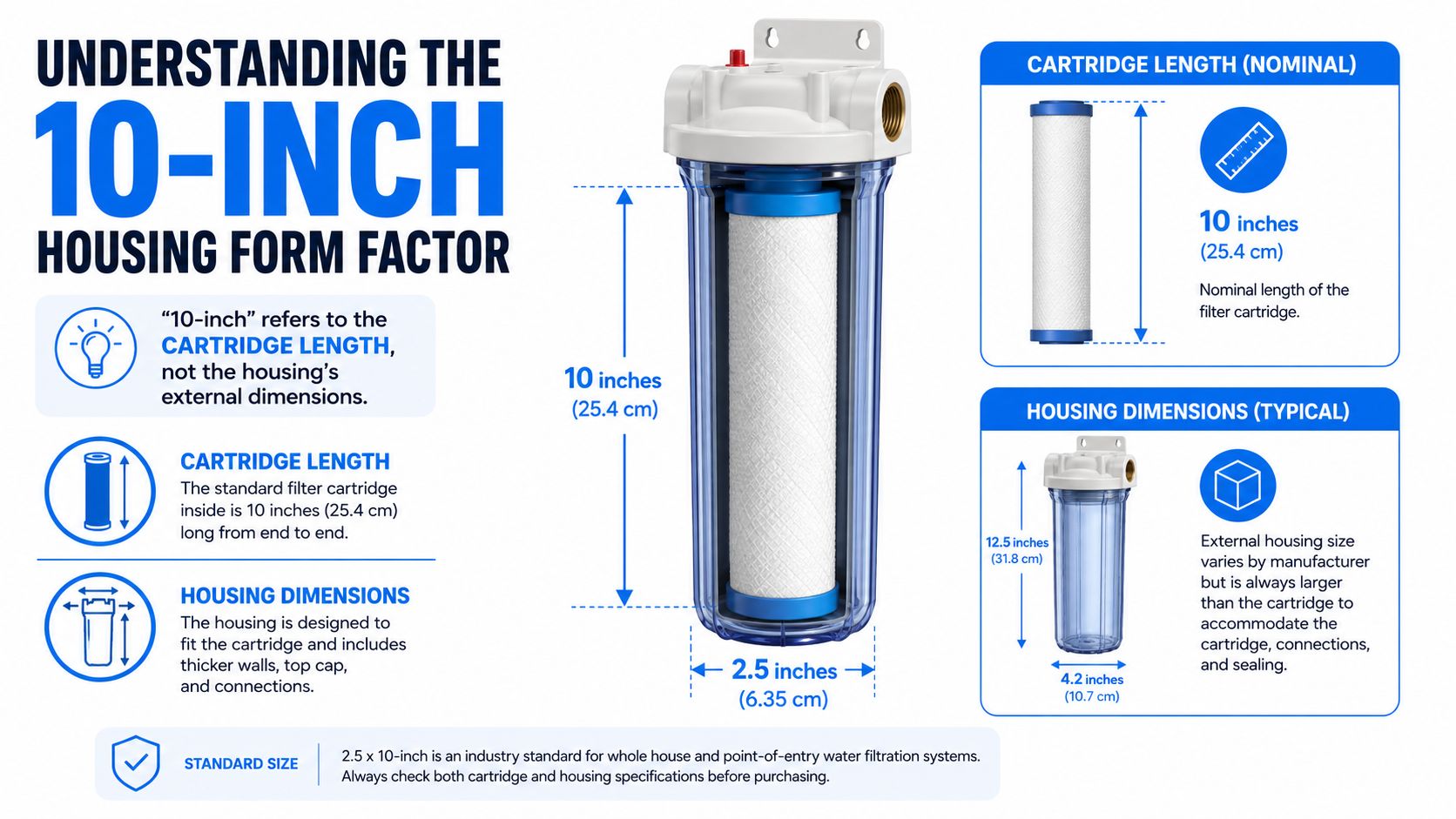
### Sump, Head, and the Seal That Matters
A housing has two main parts. The **head** is the upper section with the inlet and outlet ports. The **sump** is the lower bowl that holds the cartridge. Between them sits the **O-ring** in a groove, and that seal is what keeps water in the housing when the system is pressurized.
If the O-ring is dirty, dry, twisted, or pinched, the housing can leak even when the cartridge is correct. That is why the seal gets more attention in service work than it usually gets in product listings. The housing does not hold because the sump is cranked down hard. It holds because the O-ring compresses evenly between the sump and the head.
On a real install, that seal can be the difference between a clean service and a soaked cabinet. If the groove is not clean, if the O-ring is rolled out of place, or if the sump is cross-threaded on the way back up, water finds the weak point fast. I have seen homeowners blame the cartridge when the problem was a dry seal or a gasket that should have been replaced during service.
The same practical check applies to cartridge choice. A sediment stage may be a simple part on paper, but the housing still has to match the cartridge format, leave enough room for service, and allow the sump to drop without fighting the cabinet floor or nearby plumbing. If access is tight, maintenance gets harder every time you open it.
The primary job is fit, clearance, and serviceability. If the housing format is right but the cabinet is too cramped, or the seal cannot be inspected and lubricated properly, the system may still be a bad match for the space under the sink.
## Connection Sizes and Plumbing Compatibility
Most purchasing mistakes happen in this area. A **10-inch housing** is not one universal plumbing size, even if the cartridge form factor looks familiar. Published product specs show common inlet and outlet options in **3/4-inch**, **1-inch**, and **1/4-inch** connections, and those are not interchangeable without planning.
### Match the port size to the job
A **1/4-inch** connection usually feeds a dedicated drinking faucet or refrigerator line. That's a small line, and it's meant for a point-of-use branch, not a high-flow main. **3/4-inch** and **1-inch** ports are more appropriate when the housing is part of a line that needs more throughput and less restriction.
If you're unsure what you have, measure the existing threaded connection rather than guessing from the outside diameter of the fitting. A pipe thread that “almost” fits is not a fit. Forcing it with an adapter can create a stress point, and stress points are where leaks start.
Common 10-Inch Housing Connection SizesTypical ApplicationFlow Rate SuitabilityCommon Use Case**1/4-inch**Dedicated drinking faucet or refrigerator lineLow flow, point-of-useUnder-sink drinking water branch**3/4-inch**Residential filtration lineModerate to higher flowSink or small branch line**1-inch**Larger residential lineHigher flow suitabilityMain branch or higher-demand setup> **Measure first, adapt second.** If the thread size is wrong, the right housing is the one that matches your plumbing, not the one that needs the most adapters.
This is also where a lot of homeowners overcomplicate the fix. If your cabinet plumbing is already set for a smaller branch, don't buy a larger-port housing and assume adapters will make it easier. Extra fittings mean extra leak points, and every added junction needs to be supported properly.
## Pressure Ratings and Temperature Limits
Every housing has an operating envelope, and the envelope is tighter than many buyers expect. Published examples for residential 10-inch housings show ratings from **90 psi** up to **125 psi** maximum pressure, with temperature limits from **40°F** to **125°F**. If the housing is pushed beyond that range, the failure is usually mechanical, not subtle.
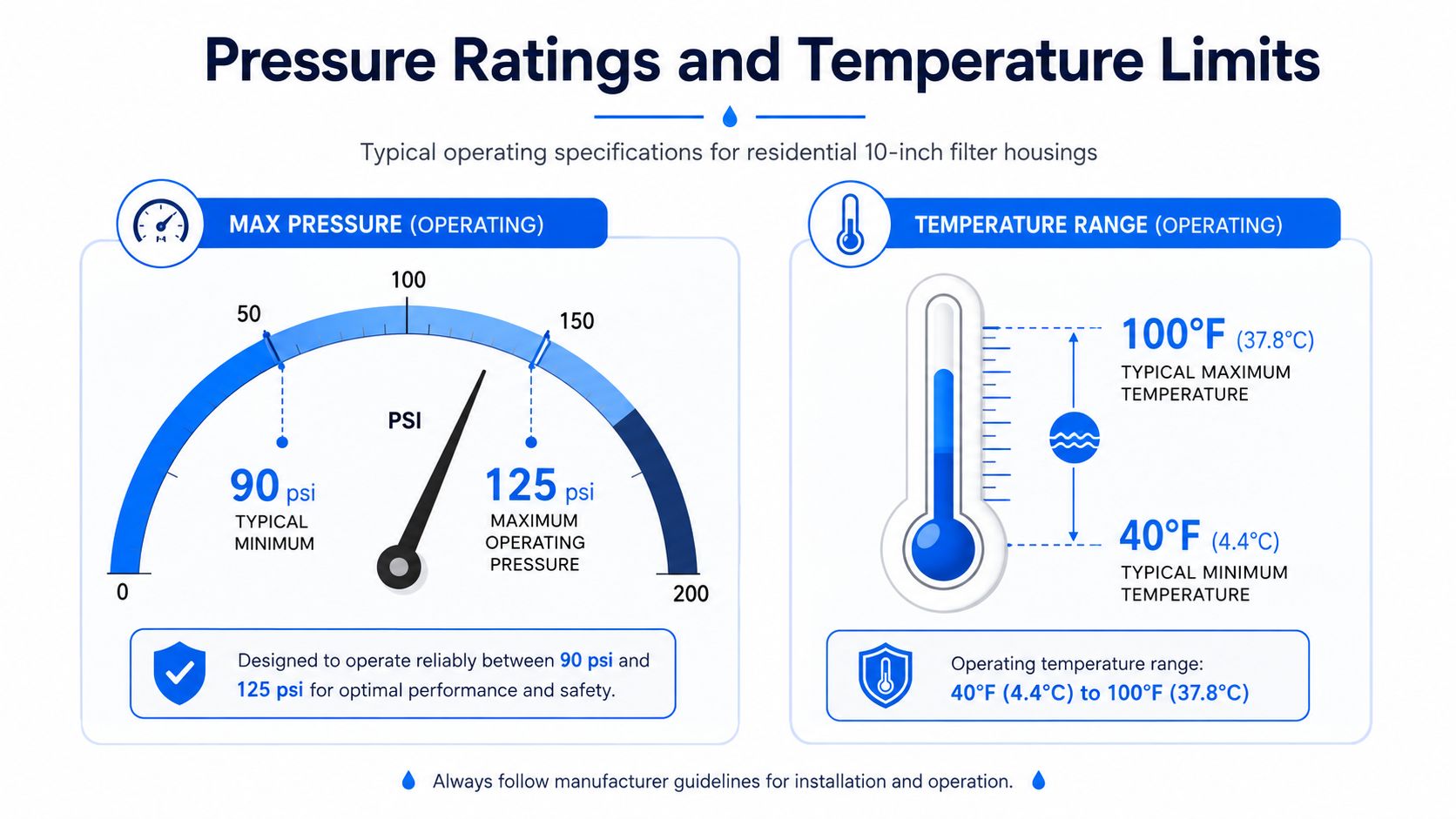
### Why pressure matters before you mount anything
Pressure spikes are hard on plastic housings. They can crack a canister, distort the seal, or blow water past the O-ring when the system sees a sudden surge. That's why checking home pressure before installation isn't optional. A simple gauge on an indoor hose bib or laundry outlet tells you more than guessing ever will.
If the pressure is too high, a pressure-reducing valve upstream can protect the housing and everything downstream. That's especially important if the water supply surges at different times of day or if the house already has older plumbing that amplifies shock.
### Temperature is just as important
The other limit homeowners overlook is heat. A housing rated for residential cold-water use is not meant for a hot water line, and an under-sink location in freezing conditions is a separate risk. Plastic gets brittle when conditions move outside the design range, and that's when you see split bodies, deformed threads, or sudden leaks.
The rule is simple. Match the housing to the water it will see, not the water you hope it sees. If the pressure or temperature is outside the spec sheet, the housing isn't the problem. The install is.
## Standard vs Jumbo Cartridge Compatibility
The common residential format is **2.5 x 10 inches**, but not every housing accepts that same cartridge diameter. Some housings are built for larger **4.5 x 10-inch** jumbo cartridges, often called **big blue** style cartridges, and those are physically different enough that you can't treat them as drop-in swaps.
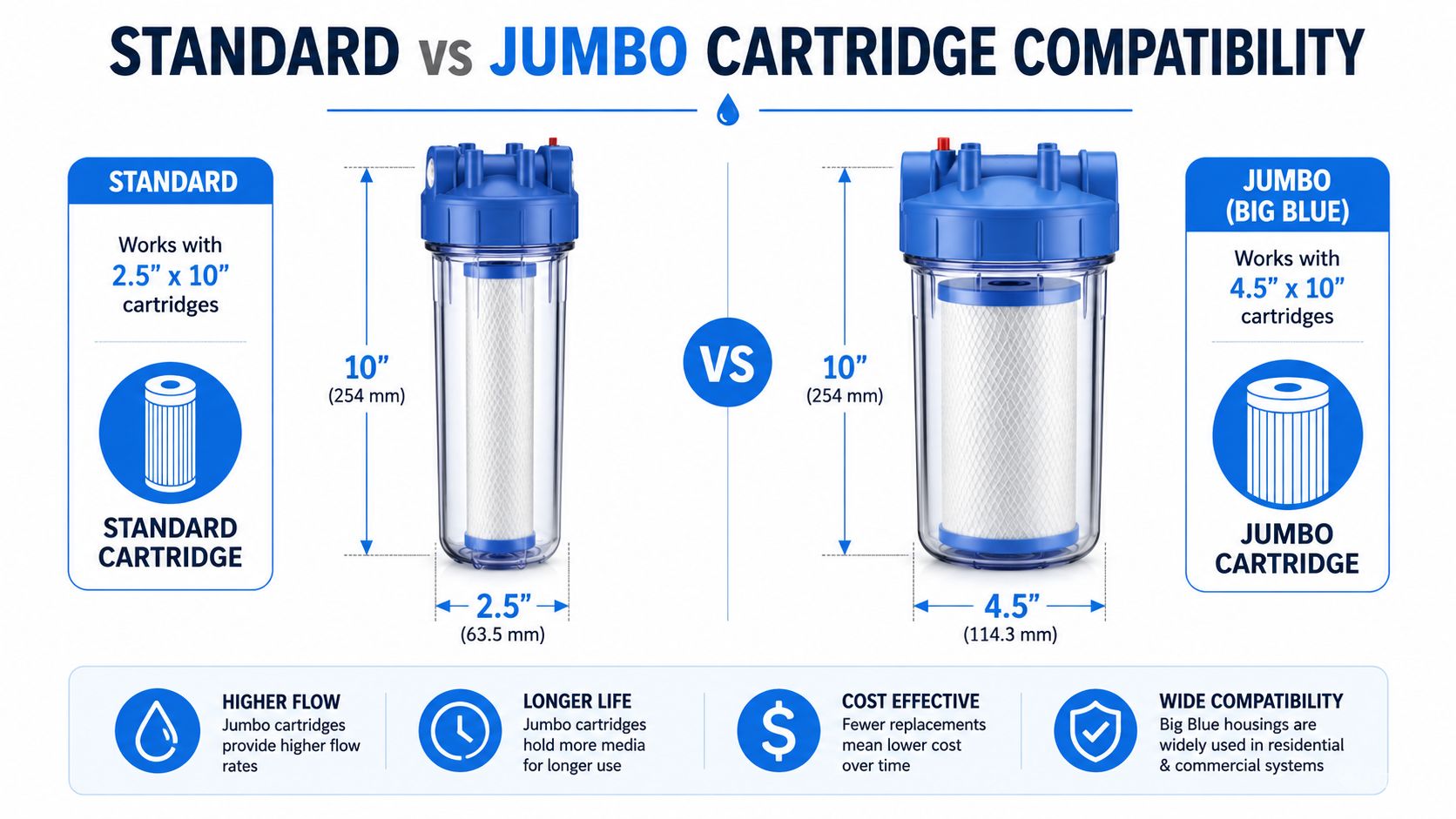
### Diameter changes the whole installation
A standard 2.5-inch cartridge is compact and fits tight under-sink spaces more easily. A **4.5-inch jumbo** cartridge gives you a larger body and more room for media, but the housing gets bigger too. That makes it more forgiving in some high-sediment applications, yet harder to place where cabinet space is limited.
The other detail that trips people up is length tolerance. Some housings accept elements ranging from **9.75 to 10 inches** in length, while others want an exact 10-inch cartridge. Verify both the diameter and the length before ordering, because a close match on paper can still be wrong in the sump.
The safest order process is boring, but it works. Check the housing label, confirm the cartridge diameter, confirm the cartridge length, and compare the new cartridge to the one you're replacing before opening the package. If you're replacing a standard cartridge, the matching replacement guide at [Woder's cartridge replacement article](https://woder.com/blog/water-filter-replacement-cartridge/) is a useful reference point for the kind of information homeowners should expect to see before they buy.
## O-Ring Maintenance and Housing Service Life
The **O-ring** is the smallest part that causes the biggest headaches. It is the seal that keeps the sump and head watertight, and it usually fails because it gets ignored until the first drip shows up. A flattened, cracked, sticky, or nicked O-ring is already telling you it is near the end of its useful life.
### What to do at each service interval
At every cartridge change, clean the O-ring groove and inspect the ring closely. Wipe out grit, scale, and old grease, because even a small particle can keep the seal from seating evenly. A light coat of food-grade silicone grease helps the ring seat properly and reduces friction when the housing is tightened.
If the ring looks flattened or damaged, replace it instead of trying to get one more cycle out of it. If you want a standard replacement process to compare against your own housing, the [water filter replacement guide](https://woder.com/blog/how-to-replace-water-filter/) is a useful reference.
> **Practical rule:** if the O-ring no longer looks round and supple, do not trust it under pressure.
Housing service life matters too. Many manufacturers recommend replacing the entire housing after about **six years** of normal use because plastic fatigue and micro-cracking can build up where you will not see them. That is a harder call to make than replacing a cartridge, but it is the right one when the body has been under pressure for years and the threads start to lose their clean feel.
### Why reuse can be false economy
A new cartridge in an old housing only works if the housing still holds its shape and the threads are sound. Once the body has started to age, you can spend more time chasing leaks than you would spend replacing the unit. An old housing can also make future maintenance harder because the threads bind, the cap sticks, and the O-ring groove gets less forgiving over time.
That is why service parts matter as much as the cartridge itself. If you are checking the housing during routine maintenance, the replacement is an investment in keeping the whole assembly predictable, not just keeping water moving. A housing that seals cleanly, opens without a fight, and accepts a fresh ring without distortion is the one that will give you fewer surprises at the next changeout.
## Installing a 10-Inch Housing Under Your Sink
Under-sink installs fail most often because the housing was mounted where nobody could service it. Leave enough clearance below the sump for cartridge removal, because a filter change with no room to drop the bowl turns into a mess fast. In practical terms, you want several inches of open space under the housing so the sump can come down cleanly.
### Mounting, sealing, and opening the supply
Fasten the bracket to solid cabinet material, not thin paneling that flexes. Use thread sealant or Teflon tape on threaded connections where the fitting calls for it, then tighten the joints in sequence without over-torquing. Cross-threading or muscling the cap down is a quick way to damage the housing before it ever sees service.
When the system is assembled, open the water supply slowly and watch the connections for several minutes. A dry joint for the first ten seconds isn't proof of anything. Tiny leaks often show up only after the housing pressurizes fully.
Some housing heads include a **pressure relief button**. Use it during cartridge changes to release trapped pressure before you unscrew the sump. That makes the housing easier to open and helps reduce the chance of a sudden spray.
If you want a visual walkthrough for the physical install, the [Woder under-sink installation guide](https://woder.com/blog/how-to-install-under-sink-water-filter/) is the kind of reference homeowners should compare against any housing they buy, even if the exact unit differs.
## What a 10-Inch Housing Does Not Solve
A standard housing does not fix every water problem by itself. If the incoming water carries a heavy sediment load, the cartridge clogs early, flow drops, and the housing ends up doing more work than it should. Sand, grit, and rust are hard on the cartridge first, then they start showing up as service headaches for the housing body and the seal.
### Upstream sediment management matters
A sediment stage or pre-filter ahead of the finer cartridge often makes the whole system behave better. Well water and older municipal lines can send enough particulate into the line to shorten cartridge life and make repeated service cycles harder on the O-ring and sump threads. The housing can still be in good condition and still be a poor match if the water is too dirty for that stage to handle alone.
The **CDC** recommends testing water and choosing filters for the contaminants present, and the **EWG** stresses matching the filter to the local water problem instead of assuming one product covers everything. That same logic applies to housing selection. The shell is part of a system, and the cartridge choice, sediment load, and service interval all have to fit together.
If you are comparing sediment-first options, [Woder's sediment filter product](https://woder.com/products/wd-20m-dc/) is an example of a **20µ pre-sedimentation** approach aimed at dust, dirt, and contaminants before the finer stage does its work. The label matters less than the setup. The key question is whether the system matches the water coming into the house and gives the cartridge a fair service life.
## Troubleshooting Common Housing Problems
A housing that won't open usually needs the correct wrench, not more force. Grip the canister with the right housing wrench, apply steady pressure, and don't jerk it. If the O-ring has stuck, a little warm water around the joint can help loosen it before you try again.
### Symptom, likely cause, and fix
- **Leak at the sump seam:** The O-ring is often pinched, dry, dirty, or seated out of its groove. Remove the sump, clean the groove, lubricate the ring lightly, and reseat it squarely.
- **Leak at the inlet or outlet:** The thread sealant may be insufficient, or the fitting may have been cross-threaded. Back it off, inspect the threads, and reassemble without forcing the angle.
- **Pressure drop after installation:** The cartridge is likely loading up with sediment, which means the cartridge needs attention, not the housing body.
- **Housing feels stuck during service:** Use the wrench, steady pressure, and patience. Over-force is how plastic threads crack.
> The symptom usually tells you whether the problem is sealing, threading, or cartridge loading. Read the leak before you reach for another tool.
If the housing is old and the threads no longer feel crisp, stop trying to save it with extra torque. That's usually the point where replacement becomes cheaper than another failed service call.
## Quick Reference Checklist for Housing Selection and Maintenance
A 10-inch housing causes problems fastest when the fit is off. Before you buy, confirm the connection size matches your plumbing, verify the cartridge diameter and length, and check the pressure and temperature ratings against the water conditions in your home. Make sure the cabinet leaves enough room to drop the sump for service, because a housing that cannot be opened comfortably turns into a maintenance problem on day one.
### Keep the maintenance simple
- **Confirm connection size matches plumbing.** Match **1/4-inch**, **3/4-inch**, or **1-inch** ports to the actual line.
- **Check pressure rating compatibility.** Stay within the housing's rated envelope.
- **Verify temperature limits.** Keep the housing in a cold-water application within its published range.
- **Ensure cartridge size fits.** Confirm **2.5 x 10** or **4.5 x 10** before buying.
- **Inspect O-rings regularly.** Look for flattening, cracks, or nicks at every service.
- **Note installation date.** Housing age matters as much as cartridge age.
- **Schedule cartridge replacement.** Do not let sediment loading decide for you.
For homeowners who want a broader home-maintenance reference, Restore Heroes keeps a practical [plumbing inspection checklist 2026](https://restoreheroesaz.com/plumbing-inspection-checklist/) that pairs well with filter-housing planning.
If you are matching a sediment stage to a point-of-use setup, an example of an under-sink pre-sedimentation unit is a useful reference point for how cartridge choice and service timing need to line up with the housing itself. A key takeaway is simple: the housing, the cartridge, and the maintenance schedule all have to fit the same system, or the setup becomes harder to live with than it should be.
Woder Filters helps homeowners compare point-of-use options with clearer specs, replacement cartridges, and installation resources that make housing and cartridge selection easier to get right the first time. If you want a U.S.-made filtration approach that keeps fit, maintenance, and contaminant reduction in the same conversation, visit [Woder Filters](https://woder.com) and start with the system that matches your water, your cabinet space, and your plumbing.
**Categories:** Woder Science
**Tags:** 10 inch filter housing, filter housing compatibility, under sink filter housing, water filter housing 10, water filter specifications
---
### [Woder Under-Sink Filter Pricing Guide 2026: Which Model Is Worth It for Your Budget](https://woder.com/blog/woder-under-sink-filter-pricing-guide-2026-which-model-is-worth-it-for-your-budget/)
**Published:** August 11, 2026
**Author:** woder
**Content:**
- [How Woder Filters Are Priced](#how-woder-filters-are-priced)
- [The Woder Model Lineup: What Each One Does](#the-woder-model-lineup-what-each-one-does)
- [WD-D-8K-FRM-ADV-DC](#wd-d-8k-frm-adv-dc)
- [WD-S-5K-REP](#wd-s-5k-rep)
- [WD-10K-ADV-PORT](#wd-10k-adv-port)
- [WD-G4-210-JG](#wd-g4-210-jg)
- [Which Model Is Worth It for Your Situation](#which-model-is-worth-it-for-your-situation)
- [What You're Actually Paying For](#what-youre-actually-paying-for)
- [Annual Cost Comparison: Woder vs. Alternatives](#annual-cost-comparison-woder-vs-alternatives)
- [How to Choose Without Guessing](#how-to-choose-without-guessing)
- [FAQs](#faqs)
- [The Bottom Line](#the-bottom-line)
If you're trying to figure out which Woder filter fits your home and whether the price is actually justified, this guide answers that directly.
Woder makes under-sink and inline water filters built around proprietary Advanced Selective Filtration technology — a nanoparticle-based system that removes 99.9% of lead, chlorine, chromium 6, mercury, PFAS, carcinogens, and volatile organic compounds while leaving calcium and magnesium in the water. No reverse osmosis, no wastewater, no plumber. The product line spans several models, and picking the right one comes down to household size, flow rate, and whether you want a permanent under-sink setup or something more flexible.
Here's how to think through each option.
---
### How Woder Filters Are Priced
Woder sells direct at [woder.com](https://woder.com), with current pricing listed on each product page. Filter units generally run $80 to $200, and annual replacement cartridges typically fall between $40 and $80. That's a significant gap from a full reverse osmosis system, which often costs several hundred dollars before professional installation is factored in.
The cost structure has two parts worth keeping in mind:
- **Initial unit cost:** the filter housing and first cartridge
- **Ongoing cartridge cost:** annual replacement to maintain performance
Over two years, most Woder setups cost less than a year's worth of bottled water for a family of four. If you're currently spending $30 to $50 a month on single-use bottles, that math isn't complicated.
---
### The Woder Model Lineup: What Each One Does
Each Woder model is built around the same core filtration technology, but they differ in capacity, form factor, and installation type.
#### WD-D-8K-FRM-ADV-DC
This is Woder's flagship under-sink model. The 8K rating means it's good for 8,000 gallons before the cartridge needs replacing. It connects directly inline with your existing cold water line — no dedicated faucet, no drain line, no pressurized tank. For a household of two to four people using filtered water for drinking and cooking, this is typically the right fit.
The Advanced Selective Filtration in this model uses nanoparticles to pull out contaminants without stripping the minerals that affect taste and health. If your concern is PFAS, lead, or chlorine taste, this is the model most buyers are looking at.
#### WD-S-5K-REP
The 5K model is a cartridge-compatible unit rated at 5,000 gallons, suited for smaller households or lower-volume use. If you're a renter who wants filtration without a major installation commitment — or if filtered water is mainly for drinking rather than cooking — the 5K capacity is usually enough for a full year before replacement. It also works well as a secondary filter at a second sink or in a smaller apartment.
#### WD-10K-ADV-PORT
At 10,000 gallons of rated capacity, this is Woder's highest-volume option. It's built for families of four or more, or households where filtered water runs through cooking, coffee, and drinking throughout the day. The "portable" designation refers to its flexible inline installation, not that it's handheld — it still installs under the sink but can be repositioned more easily than fixed configurations.
#### WD-G4-210-JG
This model is designed for refrigerator and icemaker line connections. If your main concern is the water going into your fridge's dispenser or ice maker, it installs inline with the refrigerator supply line and uses the same Advanced Selective Filtration mechanism. It's also a natural pairing with an under-sink model if you want both your tap and fridge covered.
---
### Which Model Is Worth It for Your Situation
**Single person or couple, apartment or renter:** The WD-S-5K-REP covers your volume, installs without permanent modifications, and keeps annual costs low. One cartridge replacement per year is typically all you need.
**Family of three or four, homeowner:** The WD-D-8K-FRM-ADV-DC is the most common choice here. The 8K capacity handles daily drinking and cooking use for a full year, and the inline installation takes under an hour with basic tools — no ongoing plumber dependency.
**Larger household or high daily volume:** The WD-10K-ADV-PORT gives you more time between cartridge replacements and handles heavier use without flow rate drop-off. If you're running filtered water to a coffee maker, a cooking pot, and a drinking glass at the same time, the higher capacity matters.
**Refrigerator or icemaker line:** The WD-G4-210-JG handles this specific use case cleanly. Pair it with an under-sink model if you want full coverage.
---
### What You’re Actually Paying For
**Contaminant removal without mineral stripping.** Reverse osmosis removes minerals along with contaminants, which affects both taste and the nutritional profile of your water. Woder's Advanced Selective Filtration removes the contaminants while keeping calcium and magnesium intact. That's the core reason buyers in the $80 to $200 range choose Woder over an RO system. It's worth noting that Aquasana makes a similar mineral-preserving claim under its Claryum technology, but Aquasana units typically price higher than comparable Woder models.
**No installation overhead.** Professional RO installation can add $150 to $300 to your total cost before the filter does anything. Woder's inline design eliminates that entirely — connect it to your existing cold water line, and you're done.
**US manufacturing.** All Woder filters are made in the United States. For buyers who factor origin into purchasing decisions, that's a concrete differentiator from most competitors in this price range.
---
### Annual Cost Comparison: Woder vs. Alternatives
OptionEstimated First-Year CostOngoing Annual CostWoder under-sink filter$80–$200 (unit + first cartridge)$40–$80 (replacement cartridge)Bottled water (family of 4)$360–$600+Same or moreReverse osmosis system$200–$500+ (unit)$50–$150 (filters + membrane)Pitcher filter (basic carbon)$30–$60$60–$120 (frequent replacement)The RO comparison is worth unpacking. Systems in the $200 to $500 range often require a plumber, produce wastewater, and strip minerals. Woder sits below that cost ceiling with no installation fees and no mineral trade-off.
Pitcher filters cost less upfront, but replacement frequency is higher, flow rate is slower, and most don't remove PFAS or heavy metals at the same claimed removal rate.
---
### How to Choose Without Guessing
Woder's site includes a product finder wizard that walks you through household size, installation type, and primary concerns to point you toward the right model. If you're unsure whether the 5K or 8K capacity fits your usage, it's the fastest way to get a specific answer without digging through spec sheets.
The full model lineup, current pricing, and replacement cartridges are all at [woder.com](https://woder.com).
---
### FAQs
**How often do Woder filter cartridges need to be replaced?**
It depends on the model's rated capacity and your household's daily consumption. The 5K model is typically sufficient for one year in a one to two person household. The 8K covers a family of three to four for roughly a year. The 10K extends that timeline for larger households. Woder's product pages and the model finder can give you a more specific estimate based on your usage.
**Does Woder pricing include the replacement cartridge?**
Initial unit purchases typically include the first cartridge. Replacement cartridges are sold separately and available for all models at woder.com. Annual cartridge cost generally falls between $40 and $80 depending on the model.
**Is a Woder filter hard to install?**
No. Woder filters connect directly inline with your existing cold water line under the sink. There's no tank, no drain line, and no dedicated faucet required. Most installations take under an hour with basic tools and no plumbing experience.
**Does Woder remove PFAS?**
Woder claims 99.9% removal of PFAS through its Advanced Selective Filtration technology. If PFAS is your primary concern, Woder also offers water testing kits to establish a baseline before and after installation.
**Will a Woder filter remove the minerals from my water?**
No. Unlike reverse osmosis, Woder's selective filtration is designed to remove contaminants while leaving naturally occurring calcium and magnesium in the water. That's the core distinction between Woder and RO-based systems.
**Which Woder model is best for a family of four?**
The WD-D-8K-FRM-ADV-DC is the most commonly suited model for a household of three to four people. Its 8,000-gallon capacity covers typical drinking and cooking use for a full year before cartridge replacement. Use the product finder at woder.com to confirm based on your specific usage patterns.
**Can I use a Woder filter for my refrigerator water line?**
Yes. The WD-G4-210-JG is designed specifically for refrigerator and icemaker line connections. It installs inline with the refrigerator supply line and uses the same filtration technology as the under-sink models.
---
### The Bottom Line
Woder filters occupy a specific, practical position: more effective than a pitcher filter, less expensive and less disruptive than reverse osmosis, and built to remove the contaminants that matter most in 2026 without sacrificing the minerals you actually want in your water.
The right model depends on your household size and how you use filtered water day to day. For most families, the 8K under-sink model covers the full range of needs at a cost that holds up over a two-year horizon. For smaller households or renters, the 5K keeps costs lower without giving anything up on filtration quality.
See current pricing and find your model at [woder.com](https://woder.com).
**Categories:** Woder Science
---
### [Water Filter 0.5 Micron](https://woder.com/blog/water-filter-0-5-micron/)
**Published:** August 11, 2026
**Author:** woder_admin
**Content:**
Have you ever seen **0.5 micron** on a water filter box and assumed that number told you everything you needed to know? It doesn't. Two filters can share the same rating and still behave very differently once water starts moving through them, which is why the label alone can be misleading for homeowners trying to make a practical choice.
The question is simpler. What does **0.5 micron** mean in the kitchen, at the faucet, and in the practical world of sediment, cysts, taste, and flow? A good filter answer should help you understand what the number does, what it doesn't prove, and why the difference between **nominal** and **absolute** ratings matters more than most packaging makes clear.
## Table of Contents
- [Why Micron Rating Alone Doesn't Tell the Whole Story](#why-micron-rating-alone-doesnt-tell-the-whole-story)
- [The number on the box is only the starting point](#the-number-on-the-box-is-only-the-starting-point)
- [Why labels can be misleading](#why-labels-can-be-misleading)
- [Understanding What 0.5 Micron Means](#understanding-what-05-micron-means)
- [What a micron looks like in practice](#what-a-micron-looks-like-in-practice)
- [Nominal and absolute ratings aren't the same](#nominal-and-absolute-ratings-arent-the-same)
- [What Contaminants a 0.5 Micron Filter Removes](#what-contaminants-a-05-micron-filter-removes)
- [Protozoan cysts and fine particles](#protozoan-cysts-and-fine-particles)
- [Carbon block filters and everyday taste issues](#carbon-block-filters-and-everyday-taste-issues)
- [The Flow Rate Trade-Off You Need to Consider](#the-flow-rate-trade-off-you-need-to-consider)
- [The numbers behind the slowdown](#the-numbers-behind-the-slowdown)
- [What that means at the tap](#what-that-means-at-the-tap)
- [When 0.5 Micron Filtration Makes Sense for Your Home](#when-05-micron-filtration-makes-sense-for-your-home)
- [Good fits and poor fits](#good-fits-and-poor-fits)
- [Where coarser filtration still wins](#where-coarser-filtration-still-wins)
- [Looking Beyond Micron Rating for Complete Water Protection](#looking-beyond-micron-rating-for-complete-water-protection)
- [What to check before you buy](#what-to-check-before-you-buy)
- [The smarter way to think about the number](#the-smarter-way-to-think-about-the-number)
## Why Micron Rating Alone Doesn't Tell the Whole Story
A **micron rating** measures the size of particles a filter is meant to capture, but that number does not tell you how consistently the filter performs. In actual household use with sediment, cysts, taste, and flow, the media inside the cartridge, the housing design, the water pressure, and the amount of sediment in your water all shape what happens at the tap. That is why one **water filter 0.5 micron** can work like a solid polishing stage, while another only looks precise on paper.
### The number on the box is only the starting point
The industry also uses different kinds of ratings. A **nominal** micron rating can capture around **85%** of particles at the stated size, while an **absolute** rating is much more consistent. That difference matters because a nominal filter may still let some particles through even though the label sounds precise. One technical source notes that some nominal **1-micron** filters can still allow **20–30%** of 1-micron particles such as **Cryptosporidium** to pass, which is a good example of why the size printed on the package is not the whole story ([All Filters micron flow guide](https://www.allfilters.com/blog/micron-water-filter-flow-rate-pressure-guide)).
That is also why buyers get frustrated when they compare products only by the micron number. A filter can be tight enough to sound impressive and still be the wrong match for a home with sediment-heavy water or a high-flow kitchen tap. The better question is whether the rating is paired with the right media and the right use case.
> **Practical rule:** If two filters share the same micron rating, compare the rating type, cartridge construction, and intended application before you compare the price.
For homeowners who want a clear example of how selective filtration is framed differently from simple straining, Woder's explanation of **[Advanced Selective Filtration®](https://woder.com/blog/selective-filtration/)** gives useful context. It shows why the filtration conversation should not stop at pore size.
### Why labels can be misleading
Marketing often makes a fine rating sound like a universal solution. Real filtration does not work that way. A 0.5-micron cartridge built for drinking water can be excellent at polishing taste and reducing fine particles, while a different product with the same number might be tuned more for sediment capture or slower flow.
The short version is this. Micron rating tells you the rough size of what a filter is designed to catch. It does not tell you whether the filter is absolute or nominal, how quickly it will clog, or whether it is built for a faucet, a refrigerator line, or a whole-house system. That is the gap that trips people up.
## Understanding What 0.5 Micron Means
A **0.5-micron** opening is small enough to sit in the fine filtration range used for drinking water and food-and-beverage applications. It matters in a practical way because many contaminants people worry about are much larger than that. **Giardia** cysts are typically about **4–7 microns** and **Cryptosporidium** oocysts about **4–6 microns**, so a **0.5-micron** filter sits well below their size and is commonly used for cyst reduction in drinking-water systems (FilterTested micron rating guide).
### What a micron looks like in practice
A micron is one-millionth of a meter, which makes the number hard to picture until you compare it with real particles. A **0.5-micron** pore is meant for tiny contaminants that sit far below what your eye can track, while a **5-micron** filter is more suited to sediment, rust, sand, and fine silt. In the source comparison table, **0.5 µm** is explicitly associated with **cysts such as Cryptosporidium and Giardia** and with **fine bacteria**.
The gap between **1 micron** and **0.5 micron** is larger than it sounds. One source notes that the pore cross-sectional area drops from **0.785 square microns to 0.196 square microns**, which means the **1-micron pore is 4 times larger** ([Brother Filtration micron guide](https://www.brotherfiltration.com/how-many-microns-should-your-water-filter-be/)). That tighter geometry is part of why finer filters can catch more small particles, and it also helps explain why they usually restrict flow more.
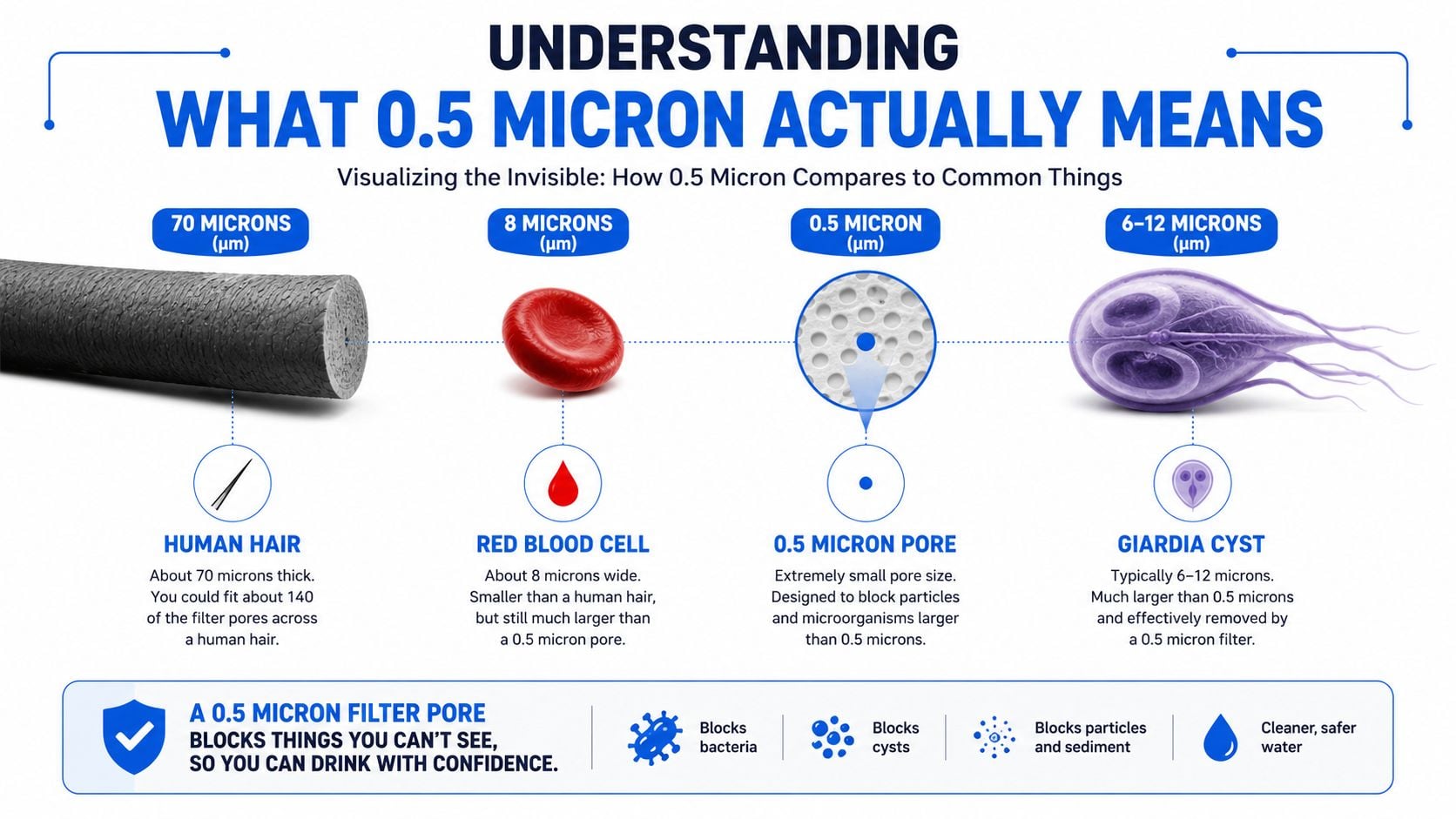
You can also see why **0.5 micron** became relevant in point-of-use drinking-water systems. It is small enough to address protozoan risks and visible taste issues, while still being practical for under-sink and faucet-mounted formats. For a product example in that category, the [Woder Fluoride Removal and Advanced Dual Filtration System](https://woder.com/products/wd-d-frm-g4-jg/) combines fluoride-focused filtration with a second-stage advanced cartridge. The product snapshot states that the system is a U.S.-made inline filter with up to **95%** fluoride removal, while the second-stage cartridge is WQA Gold Seal certified for NSF/ANSI 42 chlorine taste and odor, and NSF/ANSI 372 lead-free compliance. For a closer look at how fine media is built for sediment capture, see this explanation of a [pleated sediment water filter](https://woder.com/blog/pleated-sediment-water-filter/).
### Nominal and absolute ratings aren't the same
A **nominal** rating means the filter captures most particles around that size, not all of them. An **absolute** rating is much stricter and gives you a more consistent barrier. That distinction matters most when you are trying to understand what the number promises versus what it implies.
> A smaller micron number is not a guarantee of broad microbiological protection. It is only one part of the picture.
The clearest takeaway is to read the rating as a starting point, not a verdict. A well-made **0.5-micron** filter can be a strong drinking-water stage, but the label only makes sense when you know whether the rating is nominal or absolute and what the cartridge is built to do.
## What Contaminants a 0.5 Micron Filter Removes
A **0.5-micron** filter is most useful when the concern is fine particulate, cyst reduction, and taste or odor issues at the tap. It is not meant to replace whole-house treatment. It works as a point-of-use stage, so the water you drink and cook with gets a finer finish than a coarse sediment filter can provide.
### Protozoan cysts and fine particles
Protozoan cysts are one of the main reasons people look at this rating. **Giardia** and **Cryptosporidium** are much larger than **0.5 micron**, so a properly built 0.5-micron system is aimed at that class of contamination. That is why this rating matters in drinking-water treatment, especially in setups that focus on tap-side protection rather than whole-house throughput.
It also handles the kind of material homeowners can see and feel. The verified comparison table links **0.5 µm** to **fine bacteria** and **cysts**, while **5 µm** is tied more to sediment, rust, sand, and fine silt. In plain terms, **0.5 micron** sits on the polishing end of the filter range, not the coarse debris end.
A tighter rating helps with very small contaminants, but it does not solve every water issue. Filter choice starts with the contaminant, then the cartridge rating, then the build quality behind that rating.
- **Protozoan cysts:** A fine rating is useful because Giardia and Cryptosporidium are much larger than **0.5 micron**, so the pore size is well below the target.
- **Fine bacteria:** The verified data links **0.5 µm** with fine bacteria in source comparisons, which is one reason these filters are used as drinking-water polishers.
- **Sediment and visible particles:** A 0.5-micron carbon block can still catch fine particulate matter, but if the water is heavily loaded, it can clog early and lose flow.
For readers trying to separate particulate concerns from newer chemical concerns, Woder's page on **[microplastics in tap water research and health](https://woder.com/blog/microplastics-tap-water-research-health/)** is a useful companion read. It helps frame what a fine filter can trap at the faucet and what still needs a different treatment approach.
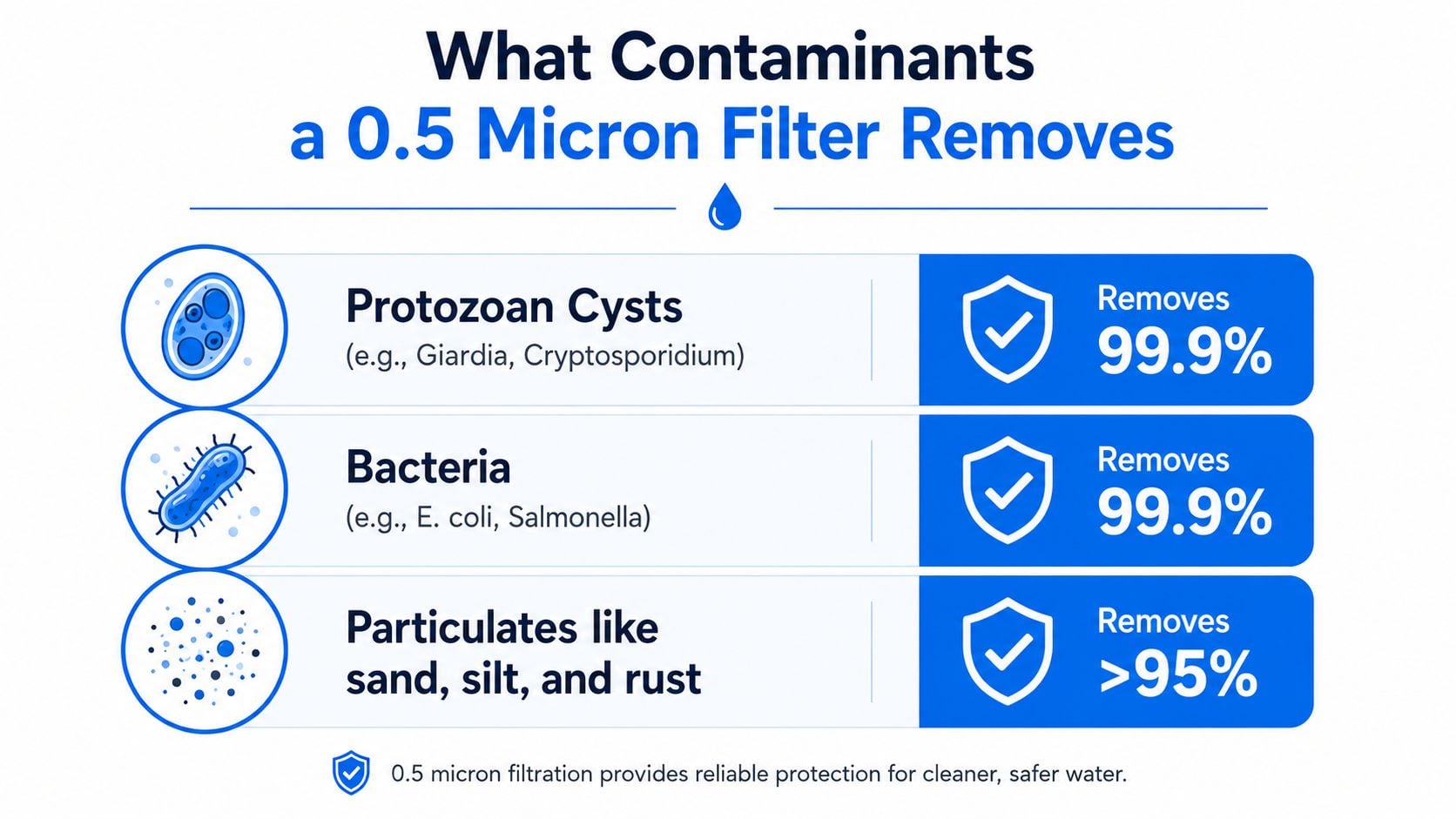
### Carbon block filters and everyday taste issues
A 0.5-micron carbon block does more than strain particles. Product specifications show these filters being used for **chlorine, taste and odor, sediment, dirt and particles, organic matter, Giardia cyst, Cryptosporidium, and lead** at the faucet or under the sink ([BWT specification sheet](https://digitalassets.reecegroup.com.au/m/dedfafc47349688f/original/Specification-Sheet-BWT-Professional-Plus-Series-Inline-Water-Filter-0-5-Micron.pdf)). Another product spec lists reduction targets including **chlorine taste and odour, cysts, lead, sediment, dissolved organic matter, microplastics, pathogenic bacteria, pesticides and herbicides, PFAs, turbidity, and VOCs** ([Finer Filters product spec](https://www.finerfilters.co.uk/3m-ap2-c405-g-water-filter-cartridge)).
That is why 0.5-micron carbon block cartridges are popular at the sink. They are small enough to polish drinking water, yet still practical for daily use. They are not trying to do every job at once.
## The Flow Rate Trade-Off You Need to Consider
Finer filtration almost always brings a trade-off. As the pores get tighter, water meets more resistance on the way through, so a **0.5-micron** filter usually flows more slowly than a **1-micron** filter, and both are generally slower than coarser sediment cartridges.
### The numbers behind the slowdown
One flow-rate guide notes that clean **1-micron gravity filters** typically process about **1 to 1.5 liters per minute**, while comparable **0.5-micron** units flow at about **0.5 to 0.75 liters per minute**. That is roughly half the flow rate in exchange for finer particle capture. The point is simple. More protection can mean less speed at the tap. If you want a closer look at the wider home-maintenance trade-offs around filtration and upkeep, the [home maintenance priorities guide](https://homeadditionma.com/home-maintenance-priorities/) is a useful companion read.
This is also why a filter can feel fine on day one and slower a few months later. As the carbon block loads with sediment or organics, flow can drop before the cartridge reaches its full rated life. The filter is still doing its job, but the buildup changes how easily water moves through it.
The hardware matters as much as the micron rating. A **0.5-micron** point-of-use carbon block can be rated at **1.7 gpm** with a **14,000-gallon / 6-month** service life, operating at **25–125 psi** and **40°F+** ([Grainger 3M Aqua-Pure quick-connect filter](https://www.grainger.com/product/3M-AQUA-PURE-Quick-Connect-Water-Filter-49Y025)). Another **0.5-micron** inline filter is rated at **3.8 L/min (1.0 gpm)** with a **7,600 L** maximum capacity, which shows how cartridge geometry and intended use shape the flow you get ([Reece BWT spec sheet](https://digitalassets.reecegroup.com.au/m/dedfafc47349688f/original/Specification-Sheet-BWT-Professional-Plus-Series-Inline-Water-Filter-0-5-Micron.pdf)).
> **Practical rule:** If your household needs faster delivery than about **1 to 1.7 gpm**, expect either a noticeable pressure drop or a larger-capacity housing.
### What that means at the tap
A slower flow is often acceptable at a dedicated drinking faucet. At a refrigerator line or a kitchen sink where several people draw water back to back, it can become annoying if the system is undersized. Micron rating and cartridge design need to be considered together, because the same **0.5-micron** label does not guarantee the same day-to-day experience.
A **5-micron** filter is still better for simple sediment jobs, while **0.5 micron** is the finer choice for point-of-use polishing. The right pick depends on whether you care more about speed or fine capture, and in many homes you have to choose the balance that fits the way the faucet is used.
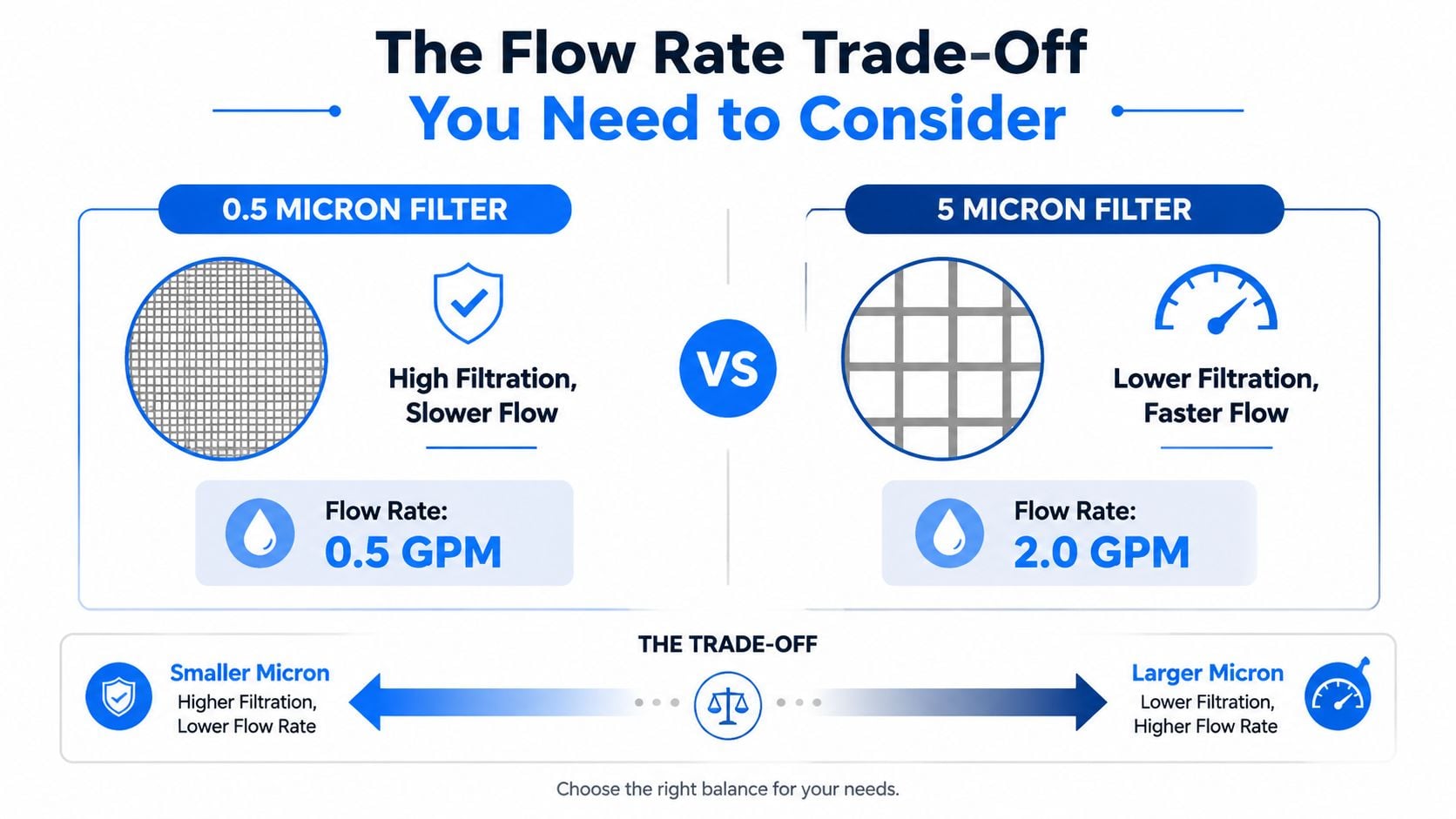
## When 0.5 Micron Filtration Makes Sense for Your Home
A **0.5-micron** filter makes the most sense when you want cleaner water at one tap, not filtered water for the whole house. It is a good fit for a kitchen sink, a drinking faucet, or a refrigerator line where the goal is finer polishing, better taste, and stronger reduction of small particles. The important detail is that two filters with the same micron label do not always perform the same way. A **nominal** 0.5-micron cartridge is more of a general size claim, while an **absolute** 0.5-micron filter is built to hold back particles at that size more consistently.
### Good fits and poor fits
Homes that rely on well water, or that live with a higher concern for protozoan cysts, are common candidates for a finer drinking-water cartridge. The same applies when the water tastes flat, smells off, or carries fine visible specks that you notice at the glass or faucet. In those cases, a **0.5-micron** filter is usually better placed at a point of use than in a whole-house setup.
Product details help show how that plays out in real use. A **0.5-micron** point-of-use carbon block filter is rated at **1.7 gpm** with a **14,000-gallon / 6-month service life**, operating at **25–125 psi** and **40°F+**, which makes it suitable for under-sink drinking taps and refrigerator lines ([Grainger 3M Aqua-Pure quick-connect filter](https://www.grainger.com/product/3M-AQUA-PURE-Quick-Connect-Water-Filter-49Y025)). Another product snapshot shows a **0.5-micron** system designed for under-sink use at up to **7.5 L/min** with a **6 to 12 month** cartridge life.
That contrast matters because the micron number alone does not tell you how the filter behaves at the tap. A finer cartridge can do a better job on small particles, but if it is paired with a limited housing or a high-demand fixture, you may feel the trade-off in flow. That is why homeowners should compare the rating with the intended use, not just read the label and assume all 0.5-micron products work the same way.
If you are trying to set home upkeep priorities and fit filtration into the rest of your maintenance plan, the [home maintenance priorities guide](https://homeadditionma.com/home-maintenance-priorities/) is a useful way to keep the decision in context.
### Where coarser filtration still wins
A coarser filter is the better choice when the incoming water carries a lot of visible sediment. In that situation, a **0.5-micron** cartridge can load up faster than expected and lose flow before it has delivered much useful service. The finer rating helps with polishing, but it is not the best first step when grit is the main issue.
> **Simple filter logic:** If the main complaint is grit, start coarser. If the main complaint is drinking-water polish, move finer.
For many homes, a 0.5-micron stage belongs near the sink, not at the service entrance. That keeps the system practical, avoids pushing a fine cartridge into a job it was not meant to do, and helps you choose a setup that matches how the house uses water.
## Looking Beyond Micron Rating for Complete Water Protection
A micron rating tells you one thing. It does not tell you whether the filter is independently verified, whether the claim is tested, or whether the system is built for the contaminant you're worried about. That's why homeowners get better results when they think in terms of **certification, media type, and treatment stages**, not just pore size.
### What to check before you buy
Reputable guidance points buyers toward certification-backed claims such as NSF/ANSI testing for cyst reduction rather than relying on micron size alone. That matters because lower micron ratings don't automatically mean broader microbiological protection. It's also the reason a product can be highly effective for chlorine, taste, and fine particles while still not being a universal solution for every contaminant class.
A useful example is Woder's U.S.-made point-of-use approach, which is built around **Advanced Selective Filtration®**. In the brand's own materials, that technology is positioned to remove contaminants like **PFAS, lead, heavy metals, fluoride, chromium, and chlorine** while leaving essential minerals in the water. That's a very different promise from a simple mechanical filter, and it helps explain why some homeowners prefer selective filtration to approaches that strip out everything dissolved.
For readers comparing filtration methods, a technical overview like **[how chlorine dioxide works](https://virusfaq.com/2026/06/28/chlorine-dioxide-disinfection/)** can be helpful context for understanding how disinfection chemistry differs from physical filtration. It's a reminder that not every water treatment method solves the same problem.
### The smarter way to think about the number
The best filter choice starts with your water, not with the label. Testing, source awareness, and the right certification matter more than a clean-looking specification sheet. A 0.5-micron cartridge is a useful tool, but it works best as part of a strategy, not as a stand-alone guarantee.
For homeowners who want a point-of-use system that focuses on targeted reduction rather than stripping water down to zero TDS, Woder Filters offers U.S.-made under-sink and inline options built around selective filtration. If you want to compare how that approach fits your tap, visit [Woder Filters](https://woder.com) and look at the cartridge type, certification, and application that match your water.
**Categories:** Woder Science
**Tags:** drinking water safety, micron rating, point of use filter, water filter 0.5 micron, water filtration
---
### [How to Clean Calcium Deposits: Expert Tips 2026](https://woder.com/blog/clean-calcium-deposits/)
**Published:** August 10, 2026
**Author:** woder_admin
**Content:**
You notice it when the bathroom light hits the faucet just right. There's a chalky film on the chrome, white crust at the base of the spout, maybe a ring around the showerhead that doesn't wipe off easily. That's usually **calcium buildup**, and it's frustrating because it looks like dirt even when the underlying issue is mineral-rich water drying on the surface.
The useful shift is to treat it as a **surface problem** and a **water-quality clue** at the same time. You can clean the deposit, but if the same residue keeps coming back, the water itself is telling you something about hardness, evaporation, and where minerals are settling out. For a quick visual comparison on what hard water spots look like in other contexts, see [removing stubborn boat water spots](https://shopboatjuice.com/blogs/boat-care/how-to-remove-hard-water-stains), which uses the same basic mineral logic you see on faucets and glass.
## Table of Contents
- [That Chalky Buildup on Your Faucets and What It Means](#that-chalky-buildup-on-your-faucets-and-what-it-means)
- [Why it shows up where you can see it](#why-it-shows-up-where-you-can-see-it)
- [Why Calcium Deposits Form in the First Place](#why-calcium-deposits-form-in-the-first-place)
- [Hard water leaves minerals behind when it dries](#hard-water-leaves-minerals-behind-when-it-dries)
- [This is why some homes fight the same spots over and over](#this-is-why-some-homes-fight-the-same-spots-over-and-over)
- [What the buildup is telling you](#what-the-buildup-is-telling-you)
- [How to Safely Clean Deposits from Different Surfaces](#how-to-safely-clean-deposits-from-different-surfaces)
- [Chrome and stainless steel need a gentle touch](#chrome-and-stainless-steel-need-a-gentle-touch)
- [Glass shower doors can handle more, but not everything](#glass-shower-doors-can-handle-more-but-not-everything)
- [Stone and coated finishes need a different mindset](#stone-and-coated-finishes-need-a-different-mindset)
- [A few surface-specific habits that help](#a-few-surface-specific-habits-that-help)
- [A Step-by-Step Method for Stubborn Buildup](#a-step-by-step-method-for-stubborn-buildup)
- [Use the fixture itself as the guide](#use-the-fixture-itself-as-the-guide)
- [Work in the order that protects the finish](#work-in-the-order-that-protects-the-finish)
- [When to Stop Cleaning and Start Preventing](#when-to-stop-cleaning-and-start-preventing)
- [Prevention is usually easier than removal](#prevention-is-usually-easier-than-removal)
- [The Difference Between Hard Minerals and Harmful Contaminants](#the-difference-between-hard-minerals-and-harmful-contaminants)
- [Calcium deposits are visible, contaminants usually aren't](#calcium-deposits-are-visible-contaminants-usually-arent)
- [Zero TDS isn't the same as better water](#zero-tds-isnt-the-same-as-better-water)
## That Chalky Buildup on Your Faucets and What It Means
That white crust on a faucet does not automatically mean the water is unsafe. In most homes, it means water carrying dissolved minerals landed on the fixture, dried, and left those minerals behind as a visible deposit. The result is familiar, a dull ring, a rough patch, or a chalky edge that keeps coming back after cleaning.
### Why it shows up where you can see it
Calcium deposits usually collect anywhere water lingers, especially around faucet bases, showerheads, aerators, and seams. They are easier to spot where drips hit the same area again and again, because each drying cycle adds another thin layer. A faucet can look clean right after wiping, then show spots again after one day of use.
The point is that this is **mineral residue**, not ordinary grime. You are not only dealing with grease or soap film, you are dealing with water that leaves a trace behind every time it evaporates. Homeowners who clean tile or glass see the same problem, and [window and tile care guides from Jennifer Gilmer Kitchen & Bath](https://www.gilmerkitchens.com/blog/bathroom-tile-design-ideas) are useful here because material-safe cleaning matters as much as the cleaner itself.
> **Practical rule:** if the residue returns only where water dries, start by thinking about mineral buildup, not dirt.
That also explains why aggressive scrubbing usually disappoints. Once the deposit bonds to the surface, elbow grease alone does not change the chemistry. A cleaner that dissolves mineral scale, used on the right material, does. For heavier buildup on tough spots, [removing stubborn boat water spots](https://shopboatjuice.com/blogs/boat-care/how-to-remove-hard-water-stains) follows the same basic idea, because the mineral problem is the same even when the surface is different.
A quick check also helps separate surface staining from water quality concerns. If the spots appear on fixtures, glass, or tile where water evaporates, you are usually looking at hard-water residue. If the taste, color, or smell of the water has changed, that points to a separate issue and deserves a closer look. Information on [hard water basics and what mineral-heavy water does in the home](https://woder.com/blog/hard-water/) helps make that distinction clear without turning every chalky mark into a larger alarm.
## Why Calcium Deposits Form in the First Place
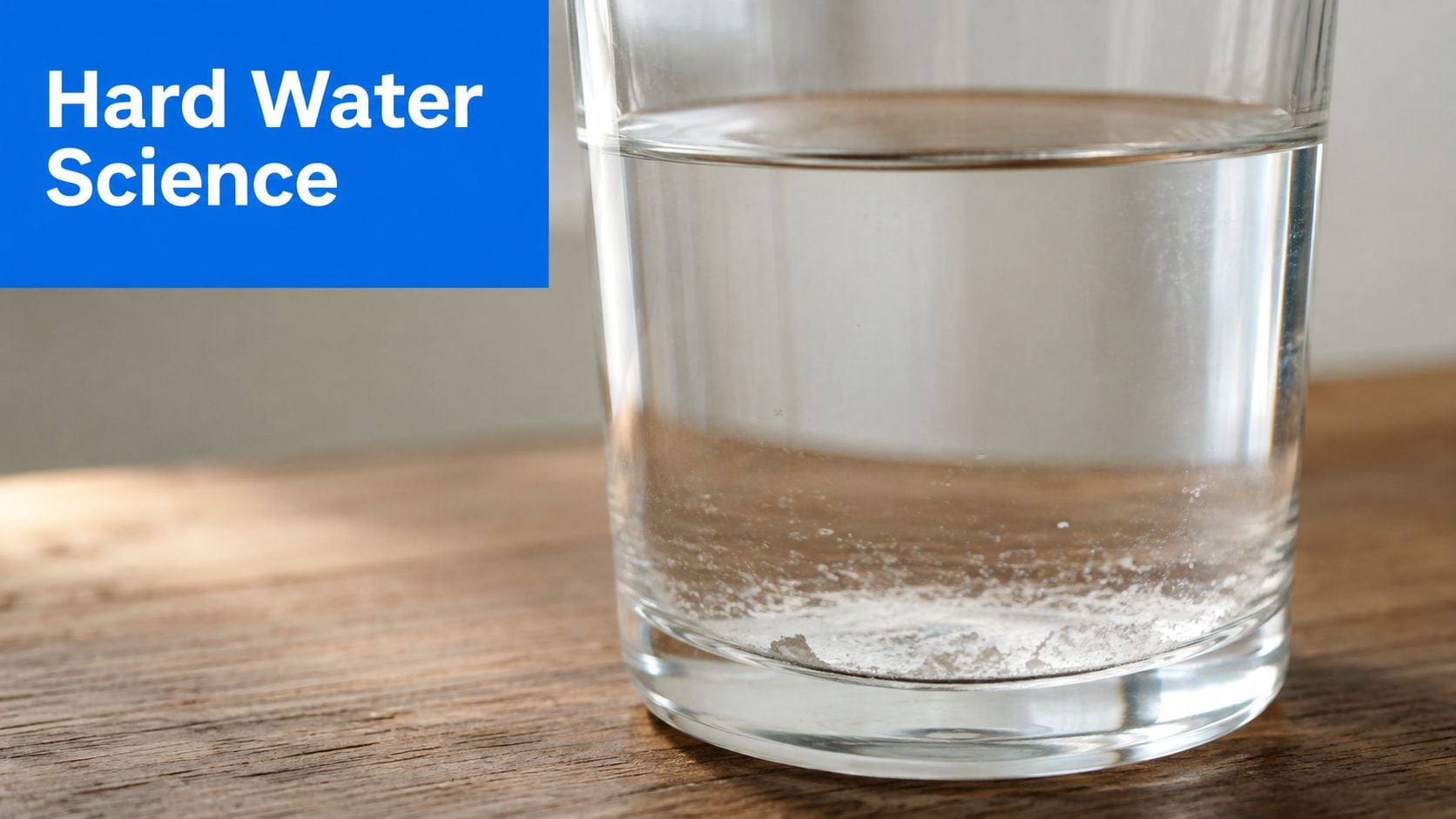
### Hard water leaves minerals behind when it dries
Calcium deposits on household fixtures are usually the result of **hard water**. As water evaporates, dissolved minerals such as calcium carbonate are left behind as a chalky buildup, and the problem is more common in hard-water or well-water areas because those supplies contain more lime and minerals, according to the source on toilet-bowl calcium buildup from [HowStuffWorks](https://home.howstuffworks.com/home-improvement/household-hints-tips/cleaning-organizing/how-to-clean-calcium-deposits-from-your-toilet-bowl.htm).
That simple drying process explains most of what people call limescale. The water itself may look clear, but the minerals don't disappear, they stay on the surface. Once the residue hardens, it becomes much harder to remove without some kind of mild acid or specialized descaler.
### This is why some homes fight the same spots over and over
A home with hard water often develops a pattern. The same faucet tips, shower doors, and appliance parts show buildup first because those are the places where water repeatedly sits and dries. That's also why the same cleaning trick that works on one fixture may fail on another, especially if the finish or material is sensitive.
The broader point is that mineral buildup isn't random. It tracks with water composition, evaporation, and surface type. If you want a deeper primer on the plumbing side of that pattern, the explanation in [Woder's hard water guide](https://woder.com/blog/hard-water/) is useful because it connects mineral content to what you see on fixtures.
A practical filter example fits here too. The [Woder WD-G4-DC Lead, Chlorine, HM and PFAS Water Filter](https://woder.com/products/wd-g4-dc/) is described as an under-sink system that uses selective filtration while retaining essential minerals, which is a different goal from cleaning a deposit after it forms.
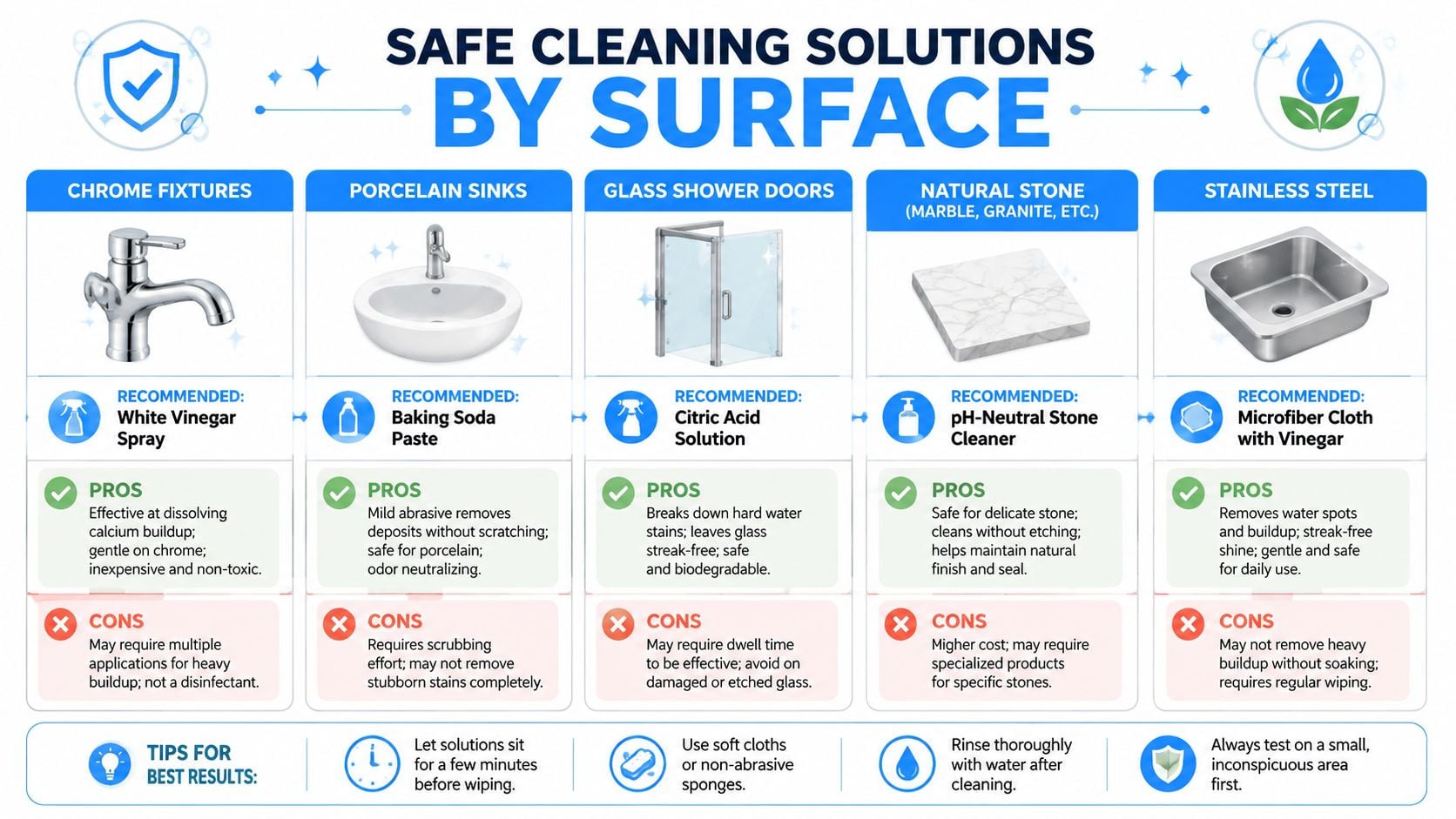
### What the buildup is telling you
If you're seeing it mostly on fixtures, the water is probably drying in place and leaving minerals behind. If you're seeing it across several rooms, the home may have a broader hard-water issue. Either way, the deposit is a clue, not just a nuisance.
## How to Safely Clean Deposits from Different Surfaces
### Chrome and stainless steel need a gentle touch
A faucet with chalky rings or a sink with dull white spots usually tempts people to scrub harder, but chrome and stainless steel respond better to restraint. Start with a soft cloth, warm water, and a mild acid such as white vinegar. A 50/50 vinegar-and-water mix can remove light deposits, and lemon juice can also help with softer buildup, according to [Rainguard Pro's mineral-deposit guide](https://blog.rainguardpro.com/newsroom/the-difference-between-efflorescence-and-calcium-deposits). Use the mixture briefly, then rinse and dry the surface so the minerals do not settle back as the water evaporates.
Keep abrasive tools away from chrome. Steel wool and rough pads can leave fine scratches, and those marks give new deposits more places to cling. A microfiber cloth or a non-abrasive sponge usually does the work with less risk to the finish.
### Glass shower doors can handle more, but not everything
Glass often tolerates vinegar better than other bathroom surfaces, especially when the deposit is still thin. Let the cleaner sit for a moment, then wipe with a soft cloth or use a plastic scraper at a low angle. That approach lifts the mineral film without grinding it into the glass.
Test a small area first if the door has a coating or an etched pattern. Those finishes can react differently from plain glass, and the same cleaner that clears one door may haze another. A light hand matters more than force.
### Stone and coated finishes need a different mindset
Natural stone is where many generic cleaning tips go wrong. Acid can etch stone, so vinegar and lemon juice are not universal answers on marble, some coated faucets, and other sensitive surfaces, as noted by [Ocean Care Store's discussion of acid damage](https://www.oceancarestore.com/how-to-remove-calcium-deposits-without-acid-damage). For those materials, use a stone-safe cleaner and finish with a dry cloth instead of leaving the surface wet.
That same caution matters if you are choosing materials for a bathroom that needs to stay easy to maintain. A practical design reference like [guide to stunning bathroom tiles](https://www.gilmerkitchens.com/blog/bathroom-tile-design-ideas) helps because texture and porosity affect how quickly deposits show, and some surfaces retain water longer than others.
> **Material rule:** if you do not know the surface, do not start with acid. Test a hidden area first or choose the mildest cleaner that matches the material.
### A few surface-specific habits that help
- **Chrome fixtures:** Use a vinegar wipe for light scale, then dry immediately.
- **Glass doors:** Apply cleaner, wait, and scrape lightly instead of scrubbing hard.
- **Stone countertops:** Stick to pH-neutral products and avoid vinegar unless the material is confirmed safe.
- **Porcelain sinks:** Start mild, then repeat rather than jumping to abrasive pads.
- **Coated faucets:** Test first, because some finishes react badly even to common household acids.
## A Step-by-Step Method for Stubborn Buildup
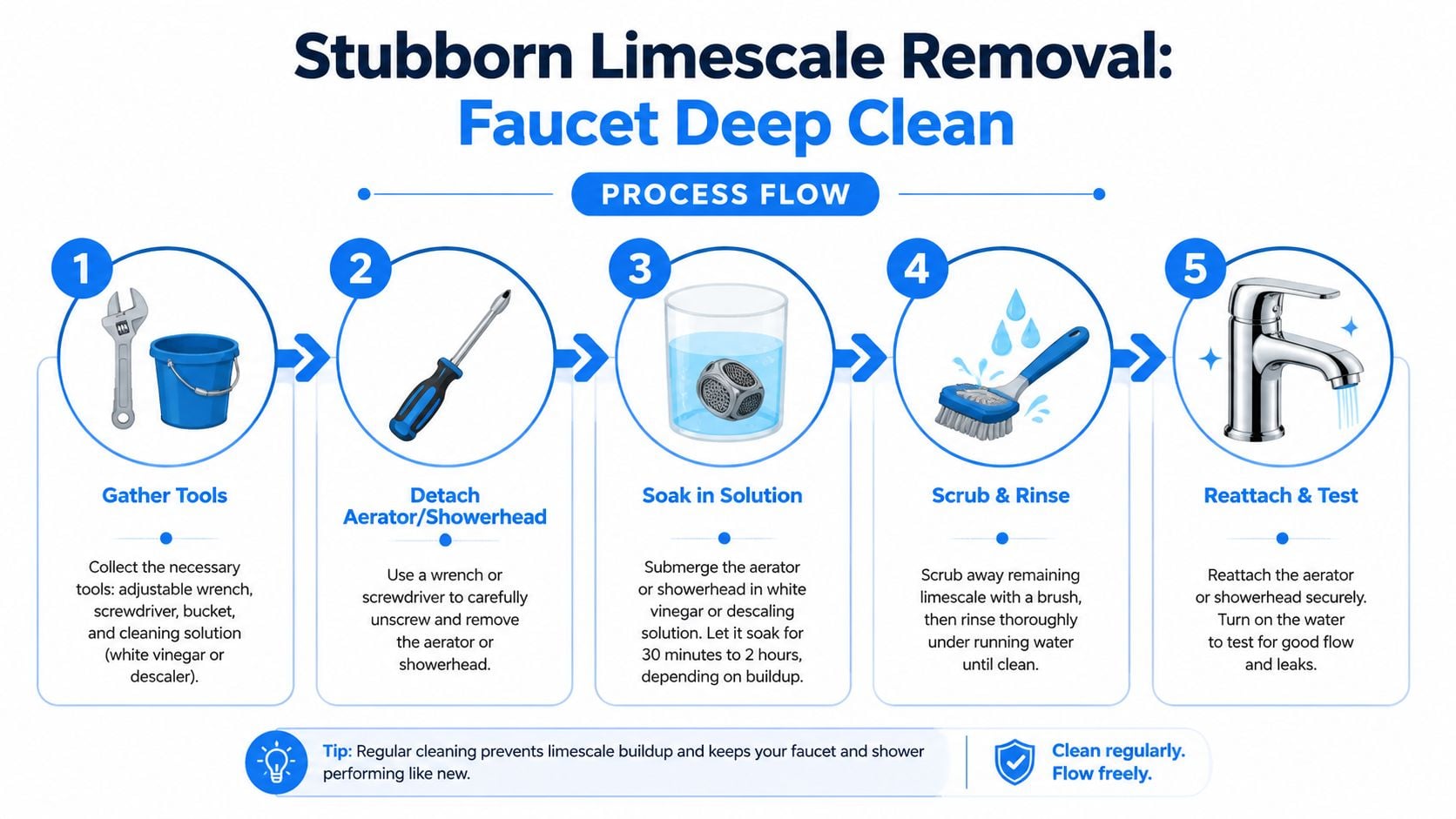
### Use the fixture itself as the guide
A faucet that sprays unevenly, or a showerhead with weak, off-center streams, usually tells you the deposits have moved past a cosmetic issue. Mineral scale is starting to narrow the openings. That is the kind of buildup where soaking works better than scrubbing harder.
Remove the aerator or showerhead if it comes off without forcing the threads. Soak the part in a **mild vinegar-and-water solution**, because a gentle acid can loosen light to moderate scale without immediately risking the finish. A 50/50 mix of white vinegar and water is a practical first pass for stubborn calcium deposits, and the same basic approach is often used on softer buildup source.
After soaking, work the residue loose with a soft brush. A toothbrush usually reaches the small openings without chewing up the metal or plastic. Rinse thoroughly, check the spray pattern, then reattach the part and test the flow.
### Work in the order that protects the finish
1. **Gather the tools.** A small bowl, white vinegar, water, a soft brush, and a microfiber cloth are usually enough.
2. **Detach the part.** Remove the showerhead or aerator carefully so you do not damage the threads.
3. **Soak it.** Let the solution sit long enough to loosen the crust, then check the finish instead of walking away from it.
4. **Scrub and rinse.** Clear deposits from the holes and crevices, then rinse well so loosened minerals do not dry back in place.
5. **Reassemble and test.** Turn the water back on and confirm that the spray is even again.
For glass doors and other exposed surfaces, [South Mountain Window Cleaning's expert tips](https://www.southmountainwindowcleaning.com/mineral-deposits-on-glass/) point to the same practical habit, remove the mineral film, then dry the surface so fresh spots do not set as fast. That drying step matters on faucets too. It slows the next round of spotting and reduces how quickly new minerals bond to the finish.
One more trade-off matters here. If the part is badly crusted, a longer soak can help, but if the finish is delicate, short intervals with a quick check are safer than leaving it unattended.
## When to Stop Cleaning and Start Preventing
If you're wiping the same faucet every few days, cleaning isn't solving the underlying issue anymore. The buildup is still being created by hard water, and every cycle of dry, scrub, repeat costs time without changing the source. That's why repeated descaling eventually becomes a maintenance loop rather than a fix.
The better line to draw is simple. Light deposits are a cleaning problem. Constant deposits are a water-quality problem. That distinction matters, and the discussion at [Leak Experts USA on recurring calcium buildup](https://leakexpertsusa.com/how-to-remove-calcium-buildup/) points to the same practical question, when does spot cleaning stop being enough and the water need upstream treatment?
### Prevention is usually easier than removal
Routine wiping helps, but it doesn't change mineral content. If your fixtures, glass, and appliances keep crusting up, you're better off looking at the water entering the home and deciding whether softening, selective filtration, or another approach makes more sense for the problem at hand. The right answer depends on whether you're fighting scale, taste, or a larger water-quality concern.
For a broader look at those trade-offs, [Woder's water softener vs water filter guide](https://woder.com/blog/water-softener-vs-waterfilter/) is a good reference because it separates mineral management from contaminant reduction. Those aren't the same job.
A practical outside perspective comes from [South Mountain Window Cleaning's mineral deposit tips](https://www.southmountainwindowcleaning.com/mineral-deposits-on-glass/), especially for glass surfaces where recurring spotting can be a sign that cleaning alone won't keep up.
## The Difference Between Hard Minerals and Harmful Contaminants
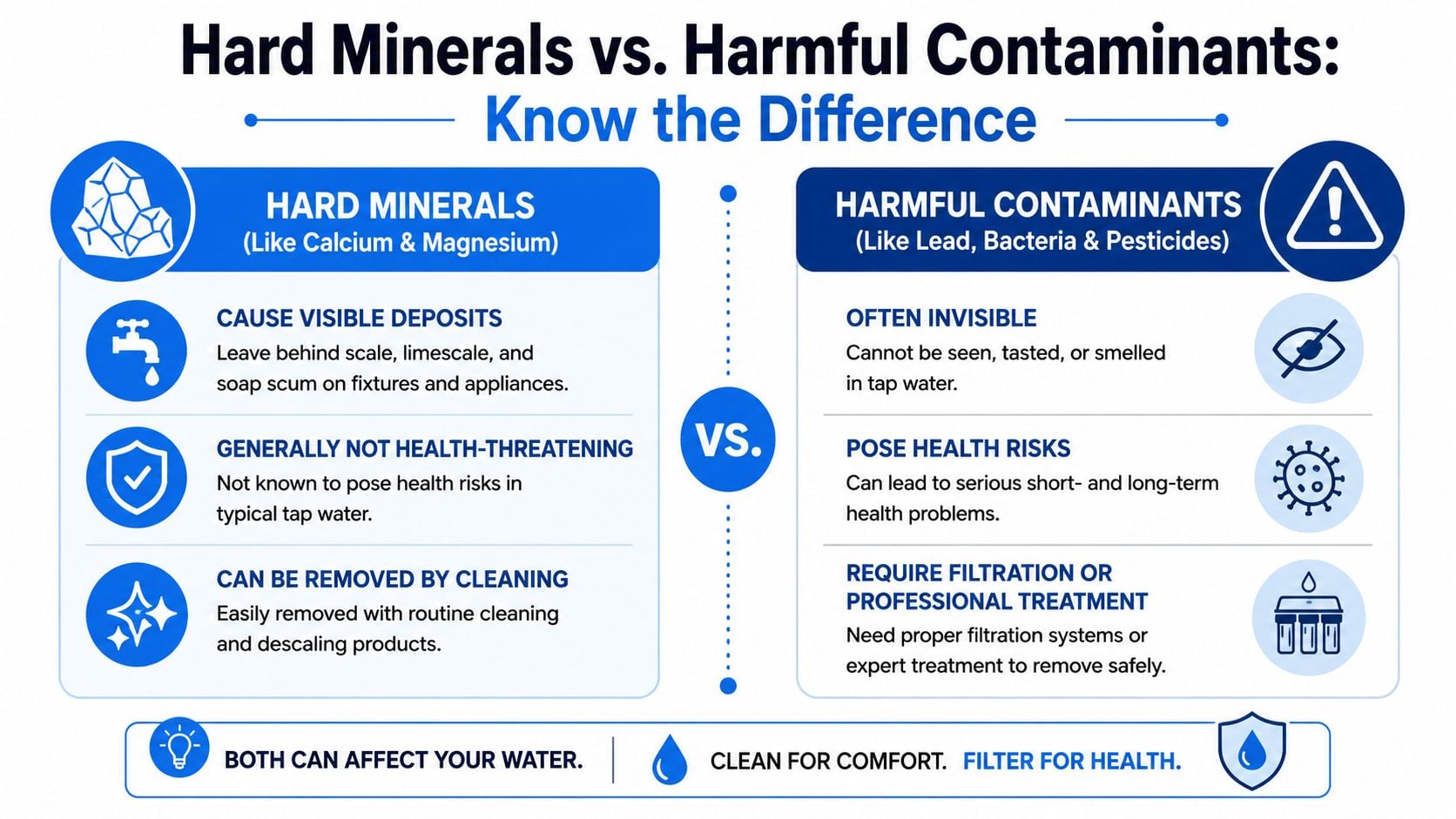
### Calcium deposits are visible, contaminants usually aren't
The minerals that leave scale behind, like calcium and magnesium, are not the same thing as harmful contaminants. They can be a nuisance on fixtures, and the scale itself can reduce appliance efficiency and lifespan, but that's a different category from invisible pollutants that affect drinking-water safety. The distinction matters because cleaning a visible deposit doesn't address what may be dissolved in the water.
That's where a smarter filter strategy comes in. The goal isn't to strip water down to nothing. It's to remove the harmful stuff while leaving the naturally occurring minerals that belong in drinking water, which is the idea behind Woder's **Advanced Selective Filtration®** approach.
### Zero TDS isn't the same as better water
A lot of homeowners get distracted by numbers that look tidy on a meter. But a **zero-TDS** reading only means the water has been stripped of dissolved solids, good and bad alike, which is closer to distilled water than to balanced drinking water. For a deeper explanation, see [why TDS and PPM aren't reliable stand-ins for water quality](https://woder.com/blog/tds-ppm-rate-is-not-an-effective-indication-of-water-quality/).
That's the bigger framework behind this topic. Calcium scale tells you about hardness and drying behavior. Lead, PFAS, chromium, chlorine, and other contaminants are a different concern entirely, and they call for filtration rather than cleaning.
> **Bottom line:** clean the deposit on the surface, then judge the water by what's dissolved in it, not by what a meter number looks like.
---
If you're sorting out whether you're dealing with cosmetic mineral buildup, hard water, or a broader drinking-water concern, take a look at [Woder Filters](https://woder.com). Woder's point-of-use systems are built to remove targeted contaminants while leaving essential minerals in place, which makes them a practical fit when you want better water at the tap without stripping it bare.
**Categories:** Woder Science
**Tags:** clean calcium deposits, hard water stains, how to clean faucets, remove limescale, water quality at home
---
### [Woder Water Filter Reviews 2026: What Real Customers Say About Performance, Installation, and Taste](https://woder.com/blog/woder-water-filter-reviews/)
**Published:** August 10, 2026
**Author:** woder
**Content:**
- [Why Social Proof Matters More for Water Filters](#why-social-proof-matters-more-for-water-filters)
- [What Customers Consistently Praise](#what-customers-consistently-praise)
- [Taste and Mineral Retention](#taste-and-mineral-retention)
- [Installation Ease](#installation-ease)
- [Confidence in Contaminant Removal](#confidence-in-contaminant-removal)
- [Value Against RO Systems and Bottled Water](#value-against-ro-systems-and-bottled-water)
- [What to Watch For: Honest Concerns](#what-to-watch-for-honest-concerns)
- [Cartridge Replacement Costs](#cartridge-replacement-costs)
- [Flow Rate](#flow-rate)
- [Point-of-Use Coverage](#point-of-use-coverage)
- [How to Verify Current Certifications and Specs](#how-to-verify-current-certifications-and-specs)
- [The Overall Pattern](#the-overall-pattern)
- [Frequently Asked Questions](#frequently-asked-questions)
When you're buying a water filter, marketing copy only gets you so far. What you really want to know is how it performs in an actual kitchen, with actual water pressure, on an ordinary morning. That's where customer reviews come in.
This page pulls together what customers and independent reviewers consistently say across Woder's product line — not just one model. If you're trying to decide whether a Woder filter fits your home, here's what the broader pattern of feedback looks like, including the friction points worth knowing before you buy.
---
### Why Social Proof Matters More for Water Filters
Water filtration is a trust purchase. Contaminants are invisible. Chlorine at low levels is often undetectable by taste. You're relying on a device to do something you can't directly observe, which is exactly why reviews carry more weight here than they do for most household products.
The questions buyers are really asking are practical: Does the water actually taste better? Can a non-plumber install this? Does flow rate take a noticeable hit? And is the filtration meaningful, or just a marketing claim?
Across review platforms, installer forums, and comparison sites, a few consistent themes emerge for Woder filters.
---
### What Customers Consistently Praise
#### Taste and Mineral Retention
This is the most frequently cited benefit, and it's the one that most clearly sets Woder apart from reverse osmosis systems. Customers repeatedly describe filtered water that tastes clean without tasting flat — a distinction that matters more than it might sound.
RO systems are effective at removing contaminants, but they also strip out calcium, magnesium, and other minerals that give water its natural character. Woder's Advanced Selective Filtration technology is built around that tradeoff. The nanoparticle-based filtration targets contaminants while leaving beneficial minerals intact. Reviewers who've come from RO setups often mention this directly, noting that Woder water has a more rounded, natural quality compared to the slightly hollow taste of fully demineralized water.
For some customers, this isn't just a preference — it's the reason they switched. Many RO users eventually add a remineralization stage to restore what the membrane removed. Woder skips that step entirely.
#### Installation Ease
Under-sink installations can range from simple to genuinely frustrating depending on the product. Woder consistently earns positive marks here. The inline design connects directly into an existing water line, which means no new faucet holes, no significant plumbing reconfiguration, and no need to call anyone in.
Customers with basic DIY comfort regularly report finishing the installation in under 30 minutes. Standard fittings, a compact form factor, and clear instructions all contribute to that. Independent installer guides and home improvement forums tend to categorize Woder as one of the more accessible under-sink options for non-plumbers — a meaningful distinction in a category where installation complexity is a real barrier.
#### Confidence in Contaminant Removal
Woder's manufacturer specifications include removal of lead, chlorine, chloramines, heavy metals, and other common tap water contaminants, with removal rates cited up to 99.9% for certain contaminants as a product specification.
Customers who use well water or live in areas with known water quality issues frequently mention noticing a difference — both in taste and in the absence of metallic or chemical notes their tap water previously carried. Reviewers in older homes, where lead pipes remain a concern, specifically call out peace of mind around lead removal as a deciding factor.
One important note: certifications and contaminant removal specs can change between product generations. For the most accurate picture of what the current filter is rated to remove and under what testing conditions, check the live product page at [woder.com](https://woder.com) rather than relying on older review content.
#### Value Against RO Systems and Bottled Water
Reverse osmosis systems are effective, but they come with real costs: higher upfront price, professional installation in many cases, ongoing membrane replacement, and significant water waste per gallon filtered. Woder's inline design sidesteps most of that.
Customers frequently describe Woder as the practical middle ground — meaningfully better than a pitcher filter or faucet-mount attachment, without the complexity and expense of a full RO system. For renters or anyone who doesn't want to modify their plumbing, this value framing comes up again and again as a primary reason for choosing Woder.
---
### What to Watch For: Honest Concerns
#### Cartridge Replacement Costs
The most consistent friction point across Woder reviews is the ongoing cost of cartridge replacement. These filters aren't designed to be cleaned and reused indefinitely — cartridges have a rated lifespan and need to be swapped out periodically.
For buyers who factor this in upfront, the math still compares favorably to bottled water over time. But reviewers who didn't account for replacement costs at purchase sometimes express surprise. Before buying, check the current cartridge pricing and replacement interval on the product page so you're working with the full cost of ownership, not just the sticker price.
#### Flow Rate
A smaller number of reviewers mention a reduction in flow rate, particularly in homes where water pressure is already on the lower end. This is a characteristic of inline filtration generally — any filter media creates some resistance — and isn't unique to Woder.
Woder offers multiple models with different flow rate ratings, and reviewers who matched the right model to their household's usage and pressure generally don't flag this as a problem. It's worth doing that homework before you buy rather than after.
It's also worth knowing that some older reviews online reference discontinued models, including earlier Gen3 versions. Those products used different filtration cartridges than the current Gen4 line, and their performance characteristics aren't directly comparable. If a review mentions a specific older model number, verify whether it applies to current products before drawing any conclusions.
#### Point-of-Use Coverage
Woder's under-sink and inline filters are point-of-use devices. They filter water at the specific tap where they're installed — not throughout the home. Reviewers occasionally note that other faucets remain unfiltered, which matters if you have concerns about water quality at multiple points in the house.
This isn't a flaw in the product; it's a category characteristic. But it's worth understanding before purchase, especially for households with broader water quality concerns.
---
### How to Verify Current Certifications and Specs
Product specifications and certifications change between generations. What applied to a Gen3 model may not apply to the current Gen4 cartridge, and third-party review sites and comparison articles sometimes lag behind those updates.
Before making a purchase decision based on certification claims, contaminant removal specs, or pricing, go directly to the source. Woder maintains current product information at [woder.com](https://woder.com), and that's the most reliable place to confirm what the current generation of filters is rated to remove and under what testing conditions. If third-party certification status matters to your decision, verify it on the current product listing rather than trusting older review content.
---
### The Overall Pattern
Across the review landscape, Woder filters earn consistent praise for three things: water that tastes clean and retains its minerals, installation that doesn't require a plumber, and a practical value position against both RO systems and bottled water.
The honest concerns center on ongoing cartridge costs and the importance of selecting the right model for your flow rate and usage. Neither is a dealbreaker for most buyers, but both are worth understanding before you commit.
For households that want meaningful filtration without the complexity or mineral-stripping tradeoff of reverse osmosis, the pattern of customer feedback is consistently positive. For households with specific certification requirements or whole-house filtration needs, the current product specs are worth reading carefully.
The full product line and current specifications are at [woder.com](https://woder.com).
---
### Frequently Asked Questions
**Do Woder filters actually improve water taste?**
Yes — and this is the most commonly cited benefit in customer reviews. The improvement is typically described as clean-tasting water that doesn't carry the flat or hollow quality associated with reverse osmosis systems. Because Woder's filtration is designed to remove contaminants while retaining naturally occurring minerals, the result tends to taste more like water is supposed to taste.
**Is a Woder filter easy to install without a plumber?**
Most customers with basic DIY comfort report finishing installation in under 30 minutes. The inline design connects directly into an existing water line using standard fittings, and no new faucet holes are typically required. Independent installer forums consistently place Woder among the more accessible under-sink options for non-plumbers.
**How does Woder compare to a reverse osmosis system?**
RO systems remove a broad range of contaminants but also strip out beneficial minerals and typically waste a meaningful volume of water per gallon filtered. Woder's selective filtration targets contaminants while retaining minerals, requires no dedicated drain line, and involves lower upfront and installation costs. The right choice depends on your specific water quality concerns and how much complexity you want to manage.
**What contaminants does Woder filter remove?**
Woder's manufacturer specifications include removal of lead, chlorine, chloramines, heavy metals, and other common tap water contaminants, with removal rates up to 99.9% cited for certain contaminants as a product specification. For the current generation's full contaminant list and the testing basis behind those claims, check the live product page at woder.com.
**Does a Woder filter slow down water flow?**
Some reduction in flow rate is normal for any inline filter. A small number of reviewers mention this, particularly in homes with lower baseline water pressure. Woder offers models with different flow rate ratings, so choosing the model that matches your household's usage and pressure helps avoid this issue.
**How often do Woder filter cartridges need to be replaced?**
Replacement intervals vary by model and usage volume. Ongoing cartridge costs are the most common friction point in reviews — buyers who don't factor them in upfront sometimes find them surprising. Check the current product page for the rated lifespan and replacement pricing before purchasing.
**Are older Woder reviews still relevant to current products?**
Not always. Some reviews online reference earlier discontinued models, including Gen3 versions that used different filtration cartridges. Current Gen4 products represent a distinct generation of selective filtration technology, and performance characteristics aren't directly comparable across generations. Always confirm that a review applies to the current model before using it to inform your decision.
**Categories:** Woder Social Media
---
### [Water Filter Buying Guide: Comparing Filtration Types, Certifications, and Contaminant Removal Data (2026)](https://woder.com/blog/water-filter-filtration-certifications-removal/)
**Published:** August 9, 2026
**Author:** woder
**Content:**
- [What Contaminants Should You Actually Be Filtering?](#what-contaminants-should-you-actually-be-filtering)
- [PFAS (Per- and Polyfluoroalkyl Substances)](#pfas-per--and-polyfluoroalkyl-substances)
- [Lead](#lead)
- [Chlorine, Chloramines, and Disinfection Byproducts](#chlorine-chloramines-and-disinfection-byproducts)
- [Other Regulated Contaminants](#other-regulated-contaminants)
- [Filter Technology Comparison](#filter-technology-comparison)
- [Reverse Osmosis (RO)](#reverse-osmosis-ro)
- [Activated Carbon and Pitcher Filters](#activated-carbon-and-pitcher-filters)
- [Selective Filtration (Under-Sink Inline)](#selective-filtration-under-sink-inline)
- [Certifications Explained: What They Actually Guarantee](#certifications-explained-what-they-actually-guarantee)
- [NSF/ANSI 42 — Aesthetic Effects](#nsfansi-42-aesthetic-effects)
- [NSF/ANSI 53 — Health Effects](#nsfansi-53-health-effects)
- [NSF/ANSI 58 — Reverse Osmosis](#nsfansi-58-reverse-osmosis)
- [WQA Gold Seal](#wqa-gold-seal)
- [What Certification Doesn't Tell You](#what-certification-doesnt-tell-you)
- [How Woder Fits In](#how-woder-fits-in)
- [Frequently Asked Questions](#frequently-asked-questions)
- [Make Your Decision Based on Data, Not Marketing](#make-your-decision-based-on-data-not-marketing)
Buying a water filter should be straightforward. It rarely is. Most people end up buried in brand marketing, vague performance claims, and spec sheets that never answer the questions that actually matter: what contaminants does this filter remove, how do you verify it works, and what will it cost you over time?
This guide answers those questions directly. It compares every major filtration technology side by side, explains what certifications actually guarantee (and where they fall short), and pulls together the contaminant data you need to make a confident, informed decision. Everything here is grounded in published data from the EPA, CDC, USGS, and other primary sources — no filler, no fear-mongering.
---
### What Contaminants Should You Actually Be Filtering?
Before you pick a filter, you need to know what you're filtering for. Most people assume their tap water is safe because it meets federal standards. That's partially true — and partially a reason to look closer.
#### PFAS (Per- and Polyfluoroalkyl Substances)
PFAS are a class of synthetic chemicals used in industrial and consumer products for decades. They don't break down in the environment, which is why they've accumulated in water supplies across the country.
In April 2024, the EPA finalized the first-ever enforceable federal limits for PFAS in drinking water, setting the maximum contaminant level for PFOA and PFOS at 4 parts per trillion (ppt) each (EPA, epa.gov). That limit is stricter than most states had previously set, and it reflects how seriously regulators now treat this chemical class.
The scale of the problem is significant. A 2022 USGS study found detectable PFAS in approximately 45% of tap water samples tested across the United States (USGS, usgs.gov) — a figure that covers both public water systems and private wells.
#### Lead
The CDC is direct on this point: there is no safe level of lead exposure (CDC, cdc.gov). Lead enters tap water primarily through aging pipes and plumbing fixtures, not the source water itself — which means a clean municipal supply report doesn't tell you what's happening inside your building.
A 2021 investigation by Consumer Reports and The Guardian US found detectable lead in 118 out of 120 tested locations across the country. That's not a regional issue. It's a systemic one tied to infrastructure age, and it affects homes in cities with otherwise well-managed water systems.
The EPA's Lead and Copper Rule requires utilities to take action when lead levels exceed 15 parts per billion (ppb) at the tap (EPA, epa.gov). But since the CDC recognizes no confirmed safe blood lead level in children, that "action level" is a regulatory threshold — not a health guarantee.
#### Chlorine, Chloramines, and Disinfection Byproducts
Water utilities use chlorine and chloramines to disinfect water during treatment, and that's a good thing. The problem is that these disinfectants react with organic matter in the water to form byproducts — including trihalomethanes (THMs) and haloacetic acids (HAAs) — which the EPA regulates because of their long-term health associations.
Chlorine also affects taste and odor, which is the most common reason people reach for a filter in the first place.
#### Other Regulated Contaminants
The EPA's National Primary Drinking Water Regulations cover more than 90 contaminants, including arsenic, mercury, nitrates, and various industrial chemicals (EPA, epa.gov). The Environmental Working Group (EWG, ewg.org) maintains a broader tap water database that tracks contaminants detected above health guidelines, even when they fall below legal limits. Their data consistently shows a gap between what's legal and what independent researchers consider safe.
The practical takeaway: your municipal water report tells you whether your utility is in compliance. It doesn't tell you what's in the water by the time it reaches your glass, or whether every detected contaminant sits below a health-protective threshold.
---
### Filter Technology Comparison
Three main filtration approaches are available for home use. Here's how they compare on the factors that matter most.
#### Reverse Osmosis (RO)
Reverse osmosis forces water through a semi-permeable membrane that blocks dissolved solids, including most contaminants.
**What it does well:**
- Removes a very broad range of contaminants, including lead, arsenic, nitrates, fluoride, and many PFAS compounds
- A strong option for households dealing with severely contaminated water
**What it doesn't do well:**
- Strips out beneficial minerals along with contaminants. The CDC's own guidance on point-of-use filters states that "filters also remove beneficial chemicals" including minerals like calcium and magnesium (CDC, cdc.gov). Some RO users add a remineralization stage to compensate, which adds cost and complexity.
- Wastes significant water — most residential RO systems discharge 3 to 4 gallons of wastewater for every gallon of filtered water produced, though newer systems are improving on this ratio.
- Requires a storage tank under the sink, which takes up space and can harbor bacteria if not properly maintained.
- Produces filtered water slowly, which is why the tank is necessary in the first place.
- Typically involves professional installation and periodic membrane replacement.
**Ongoing cost pattern:** Higher. You're paying for membrane replacements, pre-filter and post-filter cartridges, and potentially a remineralization stage on top of that.
#### Activated Carbon and Pitcher Filters
Activated carbon is the most common filtration medium in consumer products, from countertop pitchers to faucet attachments.
**What it does well:**
- Effectively reduces chlorine, chloramines, and many volatile organic compounds (VOCs)
- Noticeably improves taste and odor
- Low upfront cost, and pitcher-style filters require no installation at all
**What it doesn't do well:**
- Limited contaminant removal breadth. Standard activated carbon does not reliably remove lead, PFAS, nitrates, arsenic, or dissolved heavy metals unless the filter is specifically certified for those contaminants.
- Pitcher filters require frequent cartridge changes — often every 40 gallons — and their slow flow rates make them impractical as a whole-tap solution.
- Faucet-mounted carbon filters are easy to install but can reduce water pressure and don't address the full contaminant spectrum.
**Ongoing cost pattern:** Low upfront, but frequent cartridge replacements add up. Pitcher filters in particular tend to cost more per year than they appear to at purchase.
#### Selective Filtration (Under-Sink Inline)
Selective filtration is a newer approach that targets specific contaminants using engineered media — including nanoparticle-based systems — while allowing beneficial minerals to pass through.
**What it does well:**
- Removes a broad set of health-relevant contaminants without stripping the water of naturally occurring minerals
- Installs directly into your existing water line with no storage tank, no separate faucet, and no wastewater output
- Maintains normal water pressure and flow rate
- Most installations don't require a plumber
**What it doesn't do well:**
- Not as widely understood or certified across as many product lines as RO or activated carbon, so verifying certifications for the specific product you're considering matters more here
- May not be the right fit for water with extreme contamination levels that call for the brute-force removal capacity of RO
**Ongoing cost pattern:** Mid-range. Filter cartridges last longer than pitcher filters, and there's no tank or membrane to replace.
---
### Certifications Explained: What They Actually Guarantee
Certifications are the most reliable way to evaluate a filter's performance claims. Here's what each major standard covers, in plain language.
#### NSF/ANSI 42 — Aesthetic Effects
This certification covers contaminants that affect taste, odor, and appearance — primarily chlorine and particulates. A filter certified to NSF/ANSI 42 has been independently tested to reduce these aesthetic contaminants to the levels the manufacturer claims (NSF International, nsf.org).
What it doesn't cover: health-effect contaminants like lead, PFAS, or heavy metals. A filter with only NSF/ANSI 42 certification may make your water taste better without making it meaningfully safer.
#### NSF/ANSI 53 — Health Effects
This is the certification that matters most for health-related contaminants. NSF/ANSI 53 covers filters that reduce contaminants with established health effects, including lead, mercury, cysts, and certain VOCs (NSF International, nsf.org).
When you see NSF/ANSI 53 on a filter, it means third-party testing has confirmed the filter reduces those specific contaminants to below the EPA's maximum contaminant levels. One important nuance: certification is contaminant-specific. A filter certified under NSF/ANSI 53 for lead is not automatically certified for every other health-effect contaminant on the list.
#### NSF/ANSI 58 — Reverse Osmosis
This standard applies specifically to RO systems and covers reduction of total dissolved solids (TDS) and other contaminants addressed by the RO membrane (NSF International, nsf.org). If you're evaluating an RO system, NSF/ANSI 58 is the relevant benchmark to look for.
#### WQA Gold Seal
The Water Quality Association's Gold Seal program (WQA, wqa.org) is an independent certification that tests filters against NSF/ANSI standards. A WQA Gold Seal indicates the product has been independently verified to perform as claimed — a meaningful signal, particularly for brands that have pursued third-party validation beyond self-reporting.
#### What Certification Doesn’t Tell You
Certification is both contaminant-specific and standard-specific. A filter can carry multiple certifications covering different contaminants, or it can carry a single certification that addresses only a narrow slice of what it claims to remove. Always check which specific contaminants a filter is certified to reduce — not just whether a certification logo appears on the packaging.
---
> **On point-of-use filters and mineral content:**
> The CDC's published guidance on point-of-use and point-of-entry treatment systems states: "Filters also remove beneficial chemicals such as fluoride, which is added to water to prevent tooth decay. Children and infants who consume filtered water may not receive the full benefits of fluoride." This guidance applies specifically to filters that remove dissolved minerals and additives along with contaminants. Source: CDC (cdc.gov).
---
### How Woder Fits In
If you've worked through the filtration comparison and want clean water without the trade-offs of RO or the limitations of a pitcher filter, Woder occupies a distinct position in the market.
Woder's under-sink and inline filters use proprietary Advanced Selective Filtration technology — a nanoparticle-based system designed to attract and remove contaminants while allowing naturally occurring beneficial minerals to pass through. The company claims 99.9% contaminant removal across its filter line. That's a product claim, and it's worth evaluating alongside any available third-party data for the specific model you're considering.
What separates Woder from RO is what it doesn't do: no mineral stripping, no storage tank, no wastewater output, no dedicated filtered-water faucet. You connect it inline to your existing water supply line, and your normal tap delivers filtered water at normal pressure. The setup is simpler, and the footprint under the sink is significantly smaller.
What separates it from pitcher filters is scope and practicality. You're not refilling a slow-flow countertop unit or swapping cartridges every few weeks. The filter handles your whole tap.
Woder filters are manufactured in the United States, and installation is designed to be straightforward enough that most homeowners can handle it without calling a plumber — which keeps the total cost of ownership lower than systems that require professional setup.
For households that want meaningful contaminant reduction, mineral-rich water, and a cleaner setup than RO, Woder is worth a close look. You can explore the full product line at [woder.com](https://woder.com).
---
### Frequently Asked Questions
**What is the best water filter for removing PFAS?**
Filters using reverse osmosis or activated carbon specifically rated for PFAS removal are the most documented options for reducing PFAS in drinking water. The EPA recommends point-of-use filters certified to NSF/ANSI 58 (for RO systems) or NSF/ANSI 53 for specific PFAS compounds. Selective filtration systems that target PFAS at the contaminant level are also available. Always verify which specific PFAS compounds a filter is certified to remove — PFAS is a class of thousands of chemicals, not a single substance.
**Does a water filter remove essential minerals?**
It depends on the filter type. Reverse osmosis systems remove most dissolved solids, including beneficial minerals like calcium and magnesium — the CDC notes this explicitly in its guidance on point-of-use treatment. Activated carbon filters generally don't remove minerals. Selective filtration systems like Woder's are specifically designed to remove contaminants while preserving naturally occurring minerals.
**What is the difference between NSF/ANSI 42 and NSF/ANSI 53?**
NSF/ANSI 42 covers aesthetic contaminants — chlorine, taste, odor, and particulates — but does not address health-effect contaminants. NSF/ANSI 53 covers health-effect contaminants including lead, mercury, and certain VOCs. If your concern is safety rather than taste, NSF/ANSI 53 certification for the specific contaminants you're worried about is the standard that matters.
**Do I need a plumber to install an under-sink water filter?**
Not necessarily. Many under-sink inline filters — including Woder's models — are designed for DIY installation by connecting directly to your existing water supply line. RO systems are more involved, often requiring a separate faucet and a storage tank, which some homeowners prefer to have professionally installed. Pitcher filters and faucet-mounted filters require no installation at all.
**How do I know if my tap water has lead in it?**
Your municipal utility is required to publish an annual Consumer Confidence Report (CCR) that includes lead testing results. That said, lead contamination often occurs in the pipes within your own building rather than in the municipal supply — so utility-level data doesn't always reflect what comes out of your tap. The most reliable approach is to have your tap water tested by a certified laboratory. The EPA maintains a list of state-certified testing labs at epa.gov.
---
### Make Your Decision Based on Data, Not Marketing
The right filter comes down to three things: what's in your water, how much removal breadth you need, and what trade-offs you're willing to accept on minerals, installation complexity, and ongoing cost.
If you want the broadest possible contaminant removal and can live with the wastewater and mineral loss, RO is a proven option. If chlorine and taste are your only concerns, a certified activated carbon filter handles that job well. If you want meaningful contaminant reduction, mineral-rich water, and a simpler setup than RO, selective filtration deserves serious consideration.
Whatever you choose, prioritize certified performance over marketing claims, and match the filter's tested contaminant list to what's actually in your water.
To see how Woder's Advanced Selective Filtration compares to your current setup, find your filter at [woder.com](https://woder.com).
**Categories:** Woder Press Releases
---
### [Chromium 6 Water Filter: What Actually Removes It](https://woder.com/blog/chromium-6-water-filter/)
**Published:** August 9, 2026
**Author:** woder_admin
**Content:**
You turn on the tap, fill a glass, and move on with your day. That routine feels ordinary because the water looks ordinary. The trouble with chromium-6 is that a utility report can still look acceptable even when the hexavalent form is present, and most homeowners never get a clear breakdown of what's in the water they drink.
That's why a **chromium 6 water filter** isn't just a product search. It's a decision about testing, certification, and whether the number on a report is telling you the whole story. Federal rules, state rules, and filter claims don't always line up, so the smarter first step is to understand what your water report can, and can't, prove.
## Table of Contents
- [The Glass of Water Most Homeowners Don't Think Twice About](#the-glass-of-water-most-homeowners-dont-think-twice-about)
- [Why a normal report can leave you with a blind spot](#why-a-normal-report-can-leave-you-with-a-blind-spot)
- [What Chromium-6 Is and Where It Comes From](#what-chromium-6-is-and-where-it-comes-from)
- [Where it tends to enter water](#where-it-tends-to-enter-water)
- [Why chromium-6 gets its own conversation](#why-chromium-6-gets-its-own-conversation)
- [Why Federal Rules and State Rules Tell Different Stories](#why-federal-rules-and-state-rules-tell-different-stories)
- [The state goal sits much lower than the federal ceiling](#the-state-goal-sits-much-lower-than-the-federal-ceiling)
- [Why the numbers matter in practice](#why-the-numbers-matter-in-practice)
- [How to Find Out Whether Chromium-6 Is Actually in Your Water](#how-to-find-out-whether-chromium-6-is-actually-in-your-water)
- [What to look for first](#what-to-look-for-first)
- [A simple workflow that keeps you from guessing](#a-simple-workflow-that-keeps-you-from-guessing)
- [Filtration Technologies That Remove Chromium-6](#filtration-technologies-that-remove-chromium-6)
- [What the certified technologies actually do](#what-the-certified-technologies-actually-do)
- [A quick comparison homeowners can actually use](#a-quick-comparison-homeowners-can-actually-use)
- [How to Read Filter Claims and Certifications Without Getting Misled](#how-to-read-filter-claims-and-certifications-without-getting-misled)
- [What the certification should tell you](#what-the-certification-should-tell-you)
- [How to check a claim before you buy](#how-to-check-a-claim-before-you-buy)
- [Why RO Is Not the Only Answer for Renters and Small Spaces](#why-ro-is-not-the-only-answer-for-renters-and-small-spaces)
- [When the default advice stops fitting real life](#when-the-default-advice-stops-fitting-real-life)
- [The use case matters as much as the chemistry](#the-use-case-matters-as-much-as-the-chemistry)
- [A Practical Next Step for Your Household](#a-practical-next-step-for-your-household)
- [A simple decision path](#a-simple-decision-path)
## The Glass of Water Most Homeowners Don't Think Twice About
The kitchen gets quiet at night. Someone fills a glass, drinks half of it, and leaves the rest by the sink. That's the moment people never question, because the water is clear and the report from the utility usually looks reassuring on the surface.
The catch is that **total chromium** and **chromium-6** are not the same thing. The U.S. EPA regulates **total chromium** at **0.1 mg/L, or 100 ppb**, but that federal limit combines chromium-6 with chromium-3 and does **not** set a separate national standard for hexavalent chromium specifically, according to the EPA's drinking water page. [EPA chromium drinking water overview](https://www.epa.gov/sdwa/chromium-drinking-water)
### Why a normal report can leave you with a blind spot
That distinction matters because a homeowner can look at a report, see “chromium,” and assume the issue is settled. It isn't. If the utility only reports total chromium, you still don't know how much, if any, is the hexavalent form that people usually mean when they say chromium-6.
> **Practical rule:** if your report doesn't separate chromium-6 from total chromium, treat it as incomplete, not reassuring.
The other reason this topic comes up so often is that chromium-6 has shown up broadly in U.S. water systems. The EPA's national survey found it in **more than three-fourths** of sampled systems, which supplied water to **more than two-thirds of the American population**. That doesn't tell you what's in your tap today, but it does explain why this contaminant can't be dismissed as a niche issue. [EPA chromium drinking water overview](https://www.epa.gov/sdwa/chromium-drinking-water)
For a homeowner, the takeaway is simple. A glass of water can look fine while the report still leaves a key question unanswered. The issue isn't panic, it's knowing whether your utility data distinguishes between **total chromium** and **chromium-6**, because that changes the filter decision later.
## What Chromium-6 Is and Where It Comes From
Chromium is an element, but it does not behave the same way in every form. **Chromium-6**, also called **hexavalent chromium**, is one chemical form of the metal, while **chromium-3** is another. The two forms share a name, but they do not play the same role in drinking water or in the body. One form is used in some biological processes, while the other is the one that raises concern in water treatment.
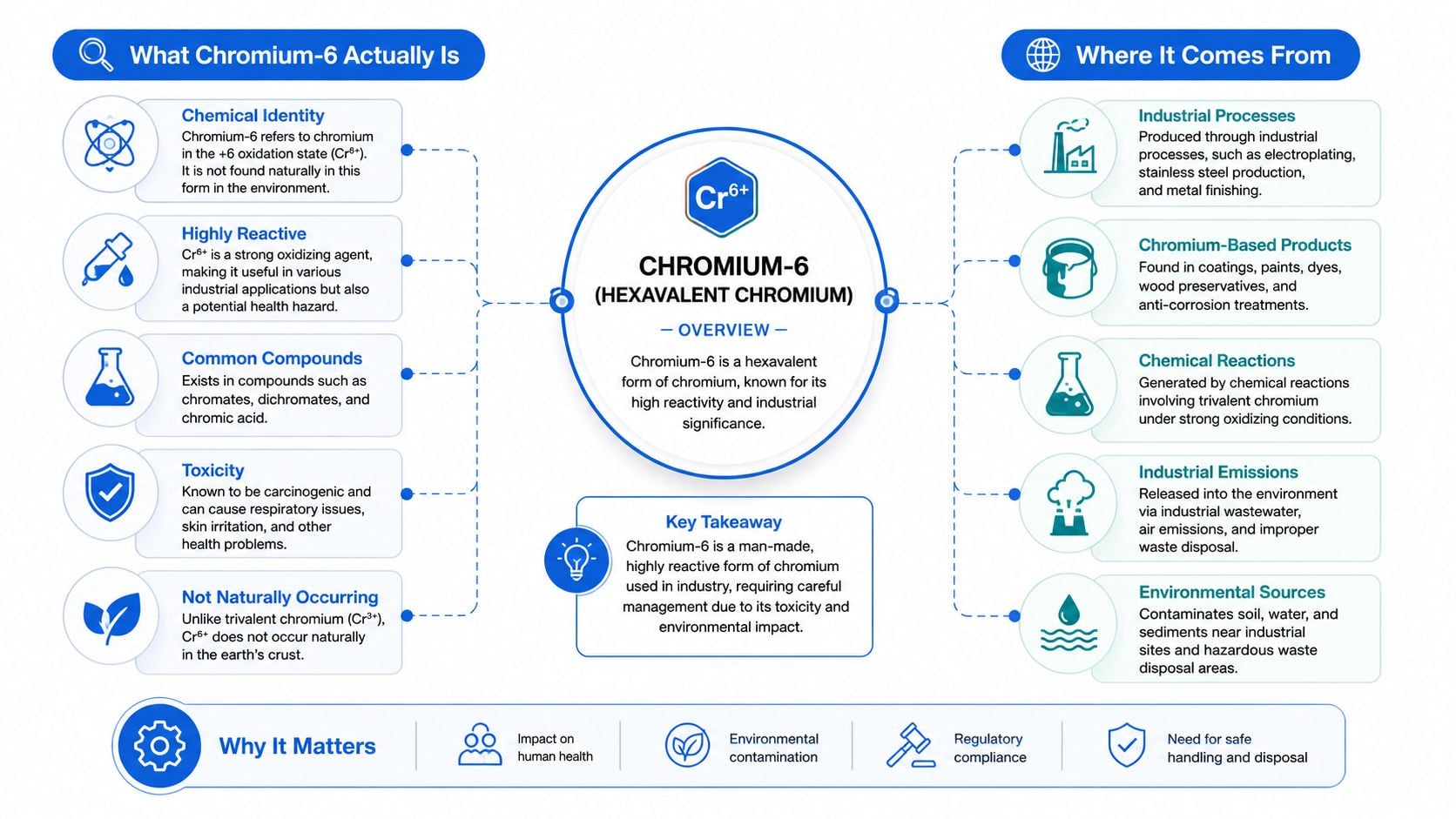
### Where it tends to enter water
Chromium-6 can enter drinking water through industrial discharge, legacy plating operations, and natural occurrence in some geological formations. That mix is why it can show up in both municipal systems and private wells. The source matters, but the homeowner-facing problem stays the same, it may be present even when the water looks clear and has no obvious smell or taste.
A small point of practical plumbing helps here. If your water also carries sediment, dirt, or dust, a pre-sedimentation stage such as [Woder Sediment Water Filter – Dirt, Sand and Dust Removal](https://woder.com/products/wd-20m-dc/) can make sense before you evaluate contaminant-specific treatment. It is a **20µ pre-sedimentation** under-sink filter, made in the USA, and it is meant for particulate load, not for solving the chromium-6 question by itself.
### Why chromium-6 gets its own conversation
A lot of consumer filter content groups all heavy metals together. That is too broad for this contaminant. Chromium-6 deserves its own discussion because certification and performance claims depend on whether a system was tested for the specific form, not just for “metals” in general.
> Chromium-6 is a contaminant you usually have to identify by name. Generic language rarely tells you enough.
That is the point to keep in mind as you read the rest of your report and compare filters. Rather than buying the most impressive-looking cartridge, match a real contaminant profile with a system verified for that contaminant.
## Why Federal Rules and State Rules Tell Different Stories
A homeowner opening a water report can easily expect one clear chromium answer. The problem is that the rules do not line up that neatly. The EPA sets a **100 ppb** limit for **total chromium**, while California set a much tighter **10 ppb** chromium-6-specific drinking-water limit in **July 2024**, making it the first U.S. jurisdiction with an enforceable chromium-6 standard. Those numbers measure different things, so they cannot be treated as the same standard. [EPA chromium drinking water overview](https://www.epa.gov/sdwa/chromium-drinking-water)
### The state goal sits much lower than the federal ceiling
California's public-health benchmark sits even lower. Its health goal is **0.02 ppb**, which is **5,000 times lower** than the EPA's **100 ppb** total-chromium limit. That does not mean every household needs the same treatment level, but it does show the size of the gap between a legal ceiling and a health-based target. [EWG chromium-6 drinking water review](https://vettedclean.com/water/chromium-6-in-drinking-water/)
That gap is a big reason homeowners get mixed signals. A utility may report total chromium and still leave you unsure how much of it is chromium-6. A kitchen tap report can feel a little like a receipt that lists “fruit” without saying whether you bought apples, oranges, or both. For filter selection, that missing detail matters, because a general metals problem and a hexavalent chromium problem do not lead to the same choice.
### Why the numbers matter in practice
Analysts at the Environmental Working Group reported that a **2016 analysis** of EPA tap-water testing found measurable chromium-6 in water serving **more than 218 million Americans** across **all 50 states**, based on **more than 60,000 utility samples** collected between **2013 and 2015**. Those figures do not tell you what is in your own tap, but they do explain why homeowners keep running into this issue in ordinary municipal water. The pattern was broad enough to show up across the country, even though any one household still needs local information before buying a filter.
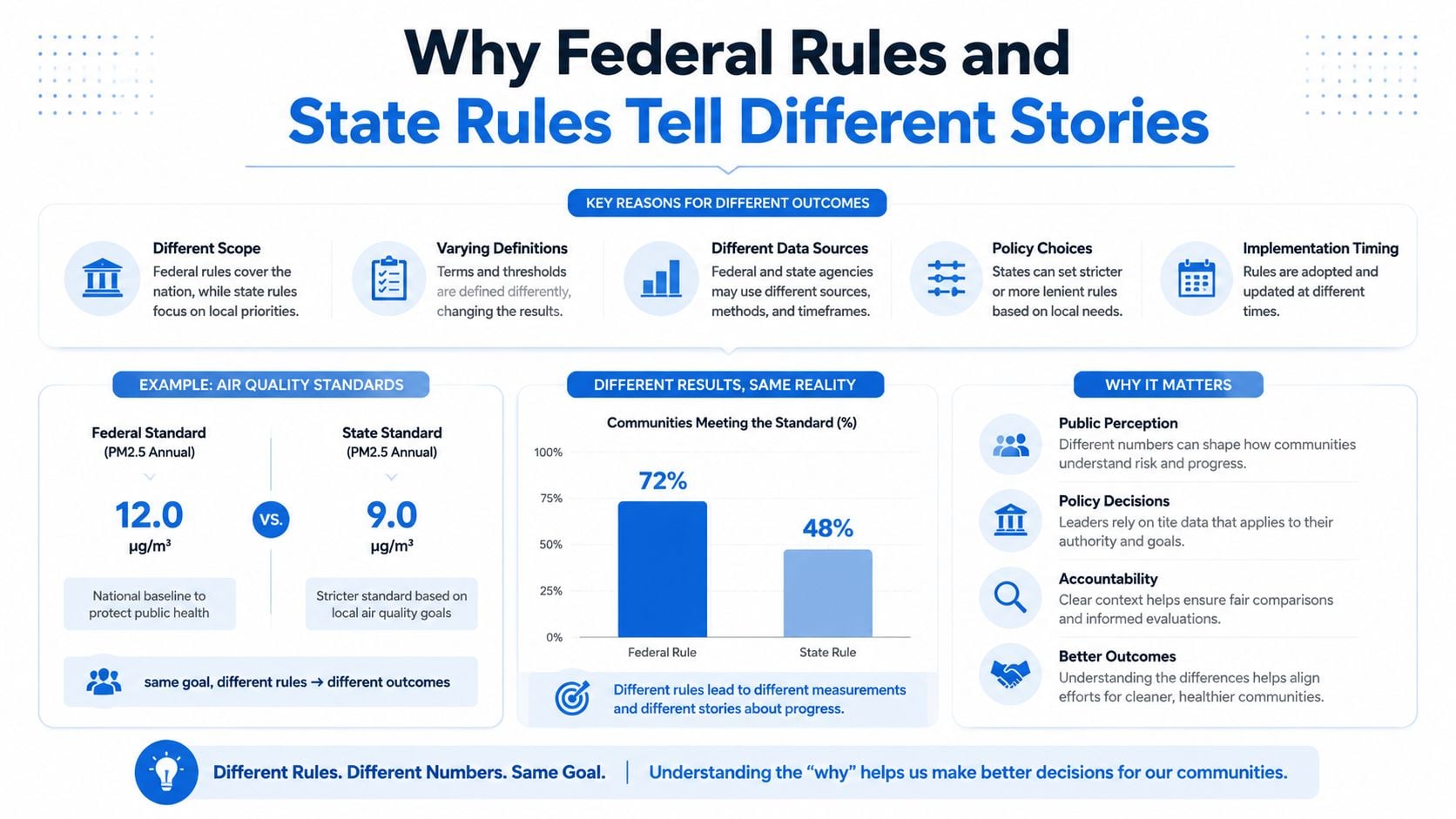
> **Bottom line:** a legal total-chromium number can be true and still leave the chromium-6 question unanswered.
That is why the smartest starting point is not a filter brand. It is the level of detail in the rules, then the quality of the data in your own report. If the report does not separate chromium forms, you still do not have the information needed to choose a treatment system with confidence.
## How to Find Out Whether Chromium-6 Is Actually in Your Water
Start with the utility report. Your Consumer Confidence Report may list chromium, total chromium, or sometimes more specific notes, and that's the first place to look before you shop for anything. If you want a plain-language guide for reading that report, the walkthrough at [how to read a water quality report](https://woder.com/blog/read-water-quality-report/) is a useful companion.
### What to look for first
If the report only gives a total chromium number, you still don't know whether chromium-6 is the form of concern. That's the main blind spot. Total chromium can be helpful as a screening number, but it can't tell you the ratio between chromium-3 and chromium-6, and that ratio is exactly what affects the filter choice.
A private well owner has a different problem. Generic metals panels may tell you that chromium is present, but they may not separate hexavalent chromium. In that case, a specialized lab test for chromium-6 is the cleaner option because it measures the contaminant you're trying to solve for.
### A simple workflow that keeps you from guessing
1. **Check the utility report.** Look for chromium, total chromium, or a separate chromium-6 line.
2. **See whether the report separates forms.** If it doesn't, treat the data as partial.
3. **Use a specialized lab test when needed.** Private wells and vague utility reports often need a chromium-6-specific result.
4. **Match the test to the filter.** Don't buy based on “heavy metals” language alone.
5. **Verify the certification before purchase.** The contaminant name has to appear on the product's performance data sheet.
6. **Retest after installation if the situation is unclear.** That gives you a cleaner picture of whether the system fits the actual water.
> If the report only gives you a general metals number, don't treat that as a chromium-6 answer. It's a starting point, not a conclusion.
This step matters because it keeps you from overbuying or buying the wrong technology. The right filter choice starts with knowing whether you're dealing with a known chromium-6 issue, a broad metals concern, or a report that still needs better testing.
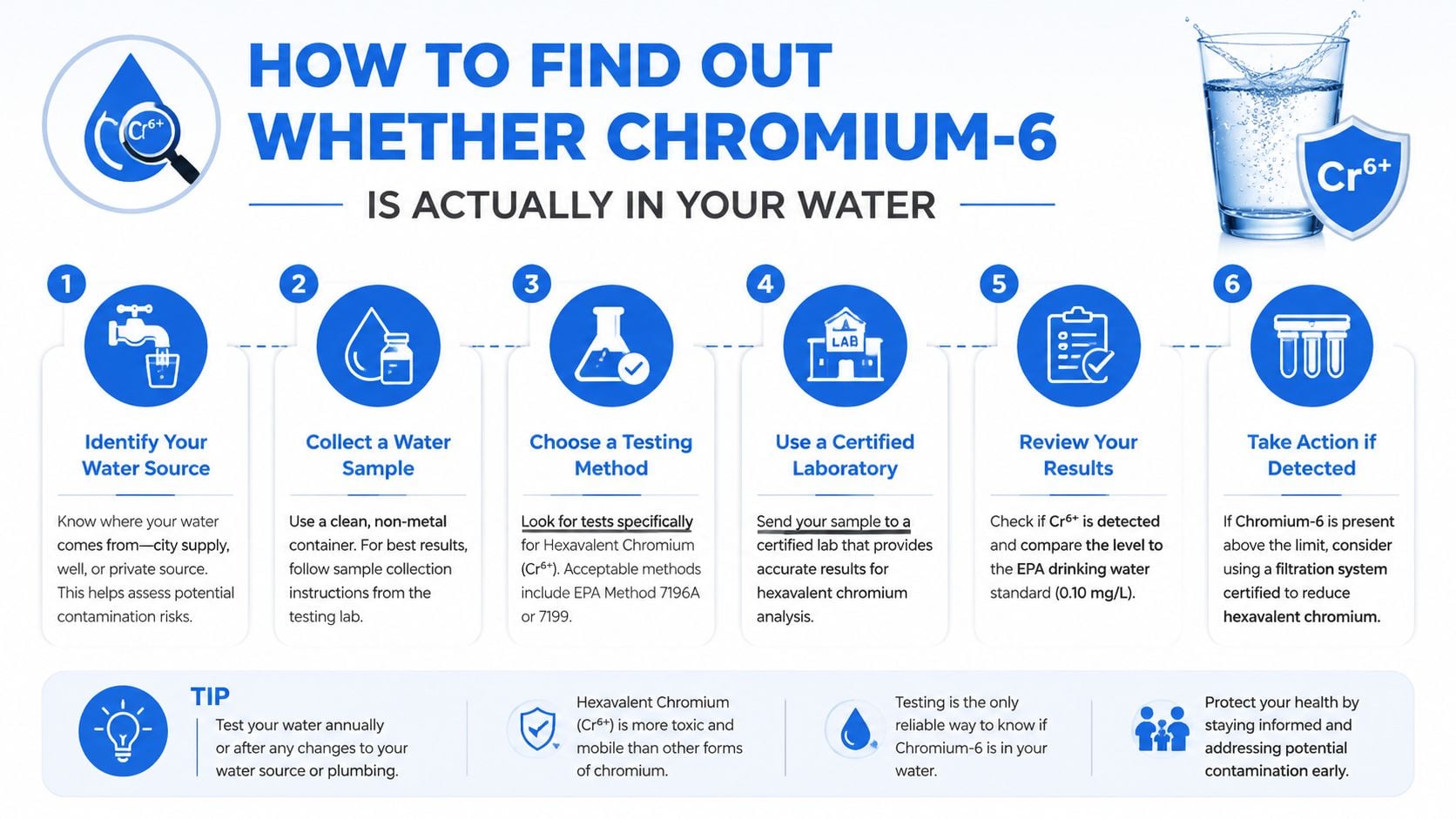
## Filtration Technologies That Remove Chromium-6
A homeowner staring at a utility report can feel stuck between vague labels and product claims. The useful question is narrower than “What kind of filter should I buy?” It is whether a system has **certified performance for chromium-6 itself**, because that is what separates a marketing claim from a tested result. In practice, that usually leads you to **reverse osmosis**, certain **carbon or selective-filtration systems** that list chromium-6 on the performance data sheet, or **ion-exchange** systems.
### What the certified technologies actually do
Reverse osmosis is the most common certified path for chromium-6 reduction. Guidance from the Water Research Foundation explains that **NSF/ANSI 58** is used to verify performance against dissolved inorganic contaminants under standardized test conditions. Many carbon pitchers and faucet filters are not certified for hexavalent chromium at all, which is why the category name alone does not tell you much. [Water Research Foundation chromium-6 background document](https://www.waterrf.org/sites/default/files/file/2019-10/4457_BackgroundInfo_Chromium6.pdf)
Health Canada gives a concrete example of what verified reduction can look like. It cites a pilot-scale **polyamide thin-film composite RO membrane** that reduced **5.0 mg/L Cr(VI)** feed water to **0.01 mg/L** permeate, with **>99% rejection** at **58.8 L/m²·h** flux and **>42.5% recovery**. That matters because it shows chromium-6 reduction can be measured under test conditions, not just described with broad claims. [Health Canada chromium technical document](https://www.canada.ca/en/health-canada/services/publications/healthy-living/guidelines-canadian-drinking-water-quality-guideline-technical-document-chromium.html)
Some **NSF/ANSI 53** carbon systems can reduce chromium-6 too, but only when the product's performance data sheet explicitly lists it. That is different from generic carbon filtration, which may improve taste or odor without proving anything about hexavalent chromium. Ion-exchange systems can also target dissolved contaminants, but the deciding factor is still the product's test data, not the label type by itself.
### A quick comparison homeowners can actually use
TechnologyTypical CertificationChromium-6 PerformanceMineral ImpactBest FitReverse osmosisNSF/ANSI 58Certified products can reduce chromium-6 under test conditionsStrips many dissolved minerals along with contaminantsHomeowners who want a dedicated drinking-water systemSelective filtration or carbon with chromium-6 listedNSF/ANSI 53 when the data sheet names chromium-6Product-specific, only if tested and listedUsually preserves more minerals than RORenters or smaller installs that need a non-RO optionIon exchangeProduct-specific, sometimes paired with other certificationsDepends on resin and test dataCan alter mineral balance depending on designTargeted contaminant reduction in certain systemsIf you are comparing options beyond the kitchen sink, a broader resource like a [water filter for hiking trips](https://shop.myhydaway.com/blogs/news/water-filter-reusable) can help you see how different filtration setups trade portability against contaminant coverage. The setting is different, but the decision rule is the same, the specific contaminant claim matters more than the product category.
For homeowners who also want to compare certification language across product types, a practical reference on [heavy metal water filter certifications and system claims](https://woder.com/blog/heavy-metal-water-filter-certifications-systems/) can make the labels easier to sort out. The point is not to memorize every standard. It is to check whether chromium-6 is named, whether the certification matches the technology, and whether the test data fits the system you are planning to install.
Chromium-6 reduction is highly product-specific. Two filters in the same technology family can perform very differently depending on membrane design, resin type, or whether the manufacturer tested for chromium-6 instead of only saying “heavy metals.”
## How to Read Filter Claims and Certifications Without Getting Misled
A label can sound reassuring and still leave the key question unanswered. Phrases like “heavy metals,” “cleaner water,” or “advanced filtration” may be true in a broad sense, yet they do not tell you whether a filter has been verified for chromium-6. Start with the contaminant name, then check whether the certification matches the technology.
### What the certification should tell you
For chromium-6, **NSF/ANSI 58** is the standard most often tied to reverse osmosis systems, while **NSF/ANSI 53** may apply to certain carbon or selective-filtration products only when chromium-6 appears on the performance data sheet. A generic carbon pitcher may improve taste and odor, but that does not mean it is certified for hexavalent chromium.
The background guidance from the Water Research Foundation makes the same point. Many carbon pitchers and faucet filters are **not certified** to remove hexavalent chromium, so the product category alone does not tell you much. As noted earlier in the filtration technologies section, the chemistry and the certification have to line up before a claim becomes useful.
### How to check a claim before you buy
- **Find the exact NSF listing.** A logo in a product photo is not enough.
- **Look for chromium-6 by name.** “Heavy metals” is too vague.
- **Check the performance data sheet.** The contaminant should be listed with the test condition.
- **Compare the certification to the technology.** RO claims should line up with **NSF/ANSI 58**.
- **Read the concentration tested.** A claim without the test level is hard to evaluate.
For a closer look at how certifications are tied to different system types, see our guide to [heavy metal water filter certifications and systems](https://woder.com/blog/heavy-metal-water-filter-certifications-systems/).
> **Practical rule:** if chromium-6 is not named on the data sheet, assume the product was not verified for it.
A company's filtration language matters too. Woder's **Advanced Selective Filtration®** is described as reducing contaminants without stripping the minerals that remain naturally in water, and the brand materials cite **WQA Gold Seal** verification. That kind of claim is different from broad “filters everything” wording, because it sends you back to certification and product-specific performance instead of marketing phrasing.
The habit to build is simple. Look for the exact contaminant, the exact standard, and the exact product data. If one of those is missing, you still do not have a solid chromium-6 answer.
## Why RO Is Not the Only Answer for Renters and Small Spaces
Reverse osmosis gets recommended so often for chromium-6 that it can sound like the only serious option. Renters and apartment dwellers often run into a different set of limits, though. RO can reduce dissolved contaminants well, but it also needs under-sink space, a drain line, and ongoing upkeep, and it removes beneficial minerals along with the contaminants.
### When the default advice stops fitting real life
That matters for renters, apartment dwellers, breakrooms, and refrigerator or coffee-machine lines. In those settings, installation space can be limited, lease rules may block plumbing changes, and wastewater is a real concern. If you are trying to improve drinking water without turning the kitchen into a project, those tradeoffs can rule RO out. To understand how reverse osmosis works and where it fits, see our guide to [reverse osmosis water filters](https://woder.com/blog/what-is-reverse-osmosis-water-filter/).
A more realistic answer can be a **point-of-use selective-filtration system**, or a carbon system that is certified for chromium-6 on its data sheet. Woder's **Advanced Inline Water Filter WD-G4-JG** is one example of a made-in-the-USA inline approach that uses selective filtration and is described as retaining essential minerals. It is the kind of form factor that fits drinking taps and small installs better than a full RO setup.
### The use case matters as much as the chemistry
For a refrigerator line, ice maker, or shared office sink, the question is usually not “What is the most aggressive system?” It is “What can I install, maintain, and verify in this space?” A filter that fits the plumbing and has documented chromium-6 performance is more useful than a stronger-sounding system that cannot be installed cleanly or kept up over time.
Under-sink selective systems and inline options deserve more attention than they usually get in chromium-6 discussions. They can give a homeowner or renter a way to target the contaminant without taking on the space and plumbing demands of a full reverse osmosis setup.
> **Practical rule:** choose the smallest certified system that matches the contaminant profile and the space you actually have.
RO still makes sense for many homes, especially when you want a dedicated drinking-water tap and do not mind the mineral loss. But it should not be treated as the default answer for every household. The better choice is the one that fits your layout, your tolerance for maintenance, and the certification that matches your water.
## A Practical Next Step for Your Household
Start with the paper trail, not the product page. Review your utility's Consumer Confidence Report for **total chromium** and any separate chromium-6 notation, then decide whether the report is specific enough to answer your question. If you're on a private well, or the data are vague, a specialized chromium-6 lab test is the cleaner next move.
### A simple decision path
1. **Confirm the contaminant.** Total chromium isn't the same as chromium-6.
2. **Confirm the space.** Under-sink RO is useful, but it's not always practical.
3. **Confirm the certification.** Look for the exact contaminant on the performance data sheet.
4. **Choose the format that fits your home.** RO, selective filtration, or a certified carbon option.
5. **Keep the minerals question in view.** Some households want contaminant reduction without stripping everything else out.
Woder's **Advanced Selective Filtration®** fits that mineral-preserving approach, and the brand also points to **WQA Gold Seal** verification as part of its documentation. That doesn't replace your own testing, but it does give you a framework for comparing products without getting lost in broad claims.
**It's Your Water®** means the choice is yours, but it should be an informed choice. Check the report, verify the certification, and pick the system that matches both the contaminant and the way you live.
---
If you want a straight answer for your own kitchen, start by reviewing the filter options and product documentation at [Woder Filters](https://woder.com). Their point-of-use systems are built for homeowners who want targeted contaminant reduction, including chromium-related concerns, without giving up the minerals they want to keep.
**Categories:** Woder Science
**Tags:** chromium 6 water filter, hexavalent chromium, NSF certification, tap water safety, water filtration
---
### [Woder 10K Gen 3 vs Gen 4: What Changed and Which Cartridge Is Right for You](https://woder.com/blog/woder-10k-gen-3-vs-gen-4-what-changed-and-which-cartridge-is-right-for-you/)
**Published:** August 8, 2026
**Author:** woder
**Content:**
- [What the Woder 10K Is](#what-the-woder-10k-is)
- [Gen 3 vs Gen 4: What Actually Changed](#gen-3-vs-gen-4-what-actually-changed)
- [Filtration Media](#filtration-media)
- [Housing Compatibility](#housing-compatibility)
- [Flow Rate](#flow-rate)
- [Installation](#installation)
- [Which One Do You Need?](#which-one-do-you-need)
- [How to Tell Which Generation You Have](#how-to-tell-which-generation-you-have)
- [When to Replace Your Cartridge](#when-to-replace-your-cartridge)
- [What Hasn't Changed](#what-hasnt-changed)
- [FAQs](#faqs)
If you own a Woder 10K or you're shopping for a replacement cartridge, you've probably noticed there are two versions floating around — Gen 3 and Gen 4. It's a reasonable source of confusion. Do they fit the same housing? Did the filtration actually get better? Which one should you buy?
Here's a straightforward breakdown so you can order the right cartridge and move on.
---
### What the Woder 10K Is
The Woder 10K is an inline under-sink water filter that connects directly into your cold water line. It runs on Woder's Advanced Selective Filtration technology — a nanoparticle-based system that targets contaminants like chlorine and heavy metals while leaving beneficial minerals like calcium, magnesium, and potassium in the water.
That distinction matters. Reverse osmosis systems strip everything out, including the minerals that make water taste good and support your health. The Woder 10K filters what you don't want without removing what you do.
The "10K" refers to its rated capacity: 10,000 gallons per cartridge, which works out to roughly three years for a typical household.
---
### Gen 3 vs Gen 4: What Actually Changed
#### Filtration Media
The Gen 4 cartridge uses a refined version of the Advanced Selective Filtration media. The nanoparticle formulation was updated to improve contact efficiency — meaning contaminants are captured more reliably, even when water is moving through quickly. Gen 3 performed well in normal conditions, but Gen 4 closes the small gaps that appeared under higher flow demand.
If multiple people in your household are drawing water throughout the day, Gen 4 handles that more consistently.
#### Housing Compatibility
This is the most important practical question. Gen 3 cartridges fit Gen 3 housings. Gen 4 cartridges fit Gen 4 housings. They are not interchangeable. Forcing the wrong cartridge into a housing will compromise the seal, risk a leak, and reduce filtration performance. Before ordering a replacement, check the label on your existing housing to confirm which generation you have.
#### Flow Rate
Gen 4 was designed with an improved flow path that reduces pressure drop across the filter. The result is tap pressure that stays closer to unfiltered flow — and stays there more consistently as the cartridge ages. Gen 3 users sometimes noticed a gradual drop in flow over time. Gen 4 is more stable throughout its service life.
#### Installation
Both generations install the same way: inline connection to the cold water supply line, standard fittings, no dedicated faucet, no storage tank, no electricity. If you've installed a Gen 3, setting up a Gen 4 will feel identical.
---
### Which One Do You Need?
It comes down to what's already installed under your sink.
**Starting fresh?** Go with Gen 4. You'll get the current housing and cartridge together, and future replacements will be simple.
**Already have a Gen 3 system?** Order a Gen 3 replacement cartridge. Your housing is built for it, and swapping the cartridge on schedule is all you need to keep it running well.
**Gen 3 housing showing its age?** That's a reasonable time to move to a full Gen 4 setup — new housing, updated media, improved flow, and a clean starting point.
There's no reason to upgrade from Gen 3 to Gen 4 just for the sake of it. If your current system is working, a replacement cartridge is the right call. Gen 4 is an incremental improvement, not a reinvention.
---
### How to Tell Which Generation You Have
The generation is printed on the label of your filter housing. If the label is worn or missing, your original order confirmation will have the model number. You can also reach out to Woder's support team with a photo of the unit — they can confirm which cartridge you need.
---
### When to Replace Your Cartridge
Woder rates the 10K at 10,000 gallons or three years, whichever comes first. Watch for these signs that it's time:
- Noticeable drop in flow from your filtered tap
- A change in the taste or smell of your water
- Three or more years since the last cartridge change
Don't wait until the water tastes off. At that point, the media is already saturated and filtration has degraded. Set a reminder when you install a new cartridge so the timing doesn't sneak up on you.
---
### What Hasn’t Changed
Across both generations, the core approach is the same: remove contaminants, keep minerals, no wastewater, no electricity, no remineralization step required afterward. That's what separates the Woder 10K from reverse osmosis systems on one end and basic pitcher filters on the other. It's whole-line filtration that works through your existing tap without any added complexity.
---
### FAQs
**Can I use a Gen 4 cartridge in my Gen 3 housing?**
No. The two are not interchangeable. Using the wrong cartridge can cause leaks or reduce filtration effectiveness. Always match the cartridge to your housing generation.
**How do I know which generation I have?**
Check the label on your filter housing — the generation is printed on it. If it's unreadable, your original order confirmation or Woder's support team can help you confirm.
**How long does a cartridge last?**
Up to 10,000 gallons or approximately three years, whichever comes first.
**Does Gen 4 remove more contaminants than Gen 3?**
Both generations target the same contaminant categories, including chlorine and heavy metals. Gen 4's updated media improves contact efficiency at higher flow rates, but the filtration scope is the same.
**Do I need to upgrade if my Gen 3 is working fine?**
No. A Gen 3 replacement cartridge is all you need if your system is functioning well and within its service life. Upgrading to Gen 4 makes the most sense when your housing needs replacing or you're setting up a new system.
**Does either version need a separate faucet or storage tank?**
No. Both connect inline to your existing cold water supply and deliver filtered water through your standard tap. No extra hardware required.
**Will upgrading to Gen 4 affect my water pressure?**
Gen 4's improved flow path reduces pressure drop across the filter. If you move from an aging Gen 3 cartridge to a new Gen 4 system, you'll likely notice a modest improvement in tap pressure.
---
The right cartridge is whichever one matches your housing. Match the generation, replace on schedule, and the Woder 10K will keep doing its job without any fuss. If you're ready to start fresh or pick up a replacement, the current lineup is at [woder.com](https://woder.com).
**Categories:** Woder Science
---
### [How to Dechlorinate Tap Water: A Complete Guide for 2026](https://woder.com/blog/dechlorinate-tap-water/)
**Published:** August 8, 2026
**Author:** woder_admin
**Content:**
You've probably noticed it at the sink already, a faint pool-like smell when the glass first fills, or a taste that seems sharper in coffee and tea than it should. That doesn't automatically mean your tap water is unsafe. In most homes, it means the utility did its job, and a disinfectant residual made it all the way to your faucet.
For homeowners, the question isn't just how to **dechlorinate tap water**, it's whether you're dealing with **free chlorine** or **chloramine**. That single detail decides whether sitting water overnight works, whether a carbon filter will keep up, and whether you need a faster chemical neutralizer for certain uses. If you get that part right, the rest of the decision gets much simpler.
## Table of Contents
- [Why Your Tap Water Smells Like a Swimming Pool](#why-your-tap-water-smells-like-a-swimming-pool)
- [What the residual means](#what-the-residual-means)
- [The Critical Difference Between Chlorine and Chloramine](#the-critical-difference-between-chlorine-and-chloramine)
- [Why standing water works for one and fails for the other](#why-standing-water-works-for-one-and-fails-for-the-other)
- [Dechlorination Methods and How Long Each Takes](#dechlorination-methods-and-how-long-each-takes)
- [What works by method](#what-works-by-method)
- [A simple method comparison](#a-simple-method-comparison)
- [Activated Carbon Filtration Done Right](#activated-carbon-filtration-done-right)
- [Why flow rate changes everything](#why-flow-rate-changes-everything)
- [Standard GAC or catalytic carbon](#standard-gac-or-catalytic-carbon)
- [Choosing the Right Method for Your Situation](#choosing-the-right-method-for-your-situation)
- [A simple decision path](#a-simple-decision-path)
- [Match the method to the use case](#match-the-method-to-the-use-case)
- [When Dechlorination Isn't Enough](#when-dechlorination-isnt-enough)
## Why Your Tap Water Smells Like a Swimming Pool
You turn on the tap, fill a glass, and catch that sharp, pool-like odor before the water even reaches the counter. That smell usually comes from chlorine or chloramine, both of which utilities add on purpose to keep water protected as it moves through pipes and storage. The CDC explains that U.S. utilities first used chlorine in tap water in **1908**, with chloramine following in **1929**, and that history matters because those disinfectants solved one problem while creating a common point-of-use nuisance at the faucet, refrigerator line, or appliance [CDC water disinfection overview](https://www.cdc.gov/drinking-water/about/about-water-disinfection-with-chlorine-and-chloramine.html).
### What the residual means
By the time disinfectant reaches your kitchen, it is usually there to preserve water quality in the distribution system, not to make the glass at your sink materially different from the water leaving the plant. The CDC says chlorine or chloramine levels up to **4 mg/L**, or **4 ppm**, are considered safe in drinking water [CDC water disinfection overview](https://www.cdc.gov/drinking-water/about/about-water-disinfection-with-chlorine-and-chloramine.html). In practice, municipal chlorine residuals are often much lower than that ceiling, which is why people usually notice taste and odor before they notice anything else.
> **Practical rule:** If the water tastes and smells off, you are usually dealing with a quality issue, not a safety crisis.
That is why dechlorination makes sense for drinking water, cooking water, coffee, and ice. It can also reduce the smell on bath water, which is why many homeowners look for a separate **[chlorine filter for bathtub](https://ecoquestpurifiers.com/shop/living_water/bathtub_chlorine_removal_filter/)** when shower or bath comfort matters.
For homeowners comparing options, the decision is straightforward. If you only want better taste, point-of-use treatment is often enough. If you want to remove other contaminants too, chlorine removal becomes one part of a broader filtration plan. If you want a concise consumer-facing primer on household chlorine issues, Woder's overview, [Does Tap Water Have Chlorine?](https://woder.com/blog/does-tap-water-have-chlorine/), is a useful place to start.
## The Critical Difference Between Chlorine and Chloramine
A lot of dechlorination advice falls apart right here. **Free chlorine** and **chloramine** both disinfect water, but they behave very differently once they leave the utility's pipes. In the U.S., about **20%** of water systems use chloramine, which means a big share of “just let it sit” advice won't work for those homes [TapWaterData guide](https://www.tapwaterdata.com/blog/guides/dechlorinate-tap-water).
### Why standing water works for one and fails for the other
Free chlorine is unstable enough to leave water fairly quickly when it sits in an open container. Chloramine is deliberately more stable, which is why utilities choose it for longer-lasting protection in the distribution system. That same stability makes it stubborn at home, especially if you're trying to remove it by off-gassing alone.
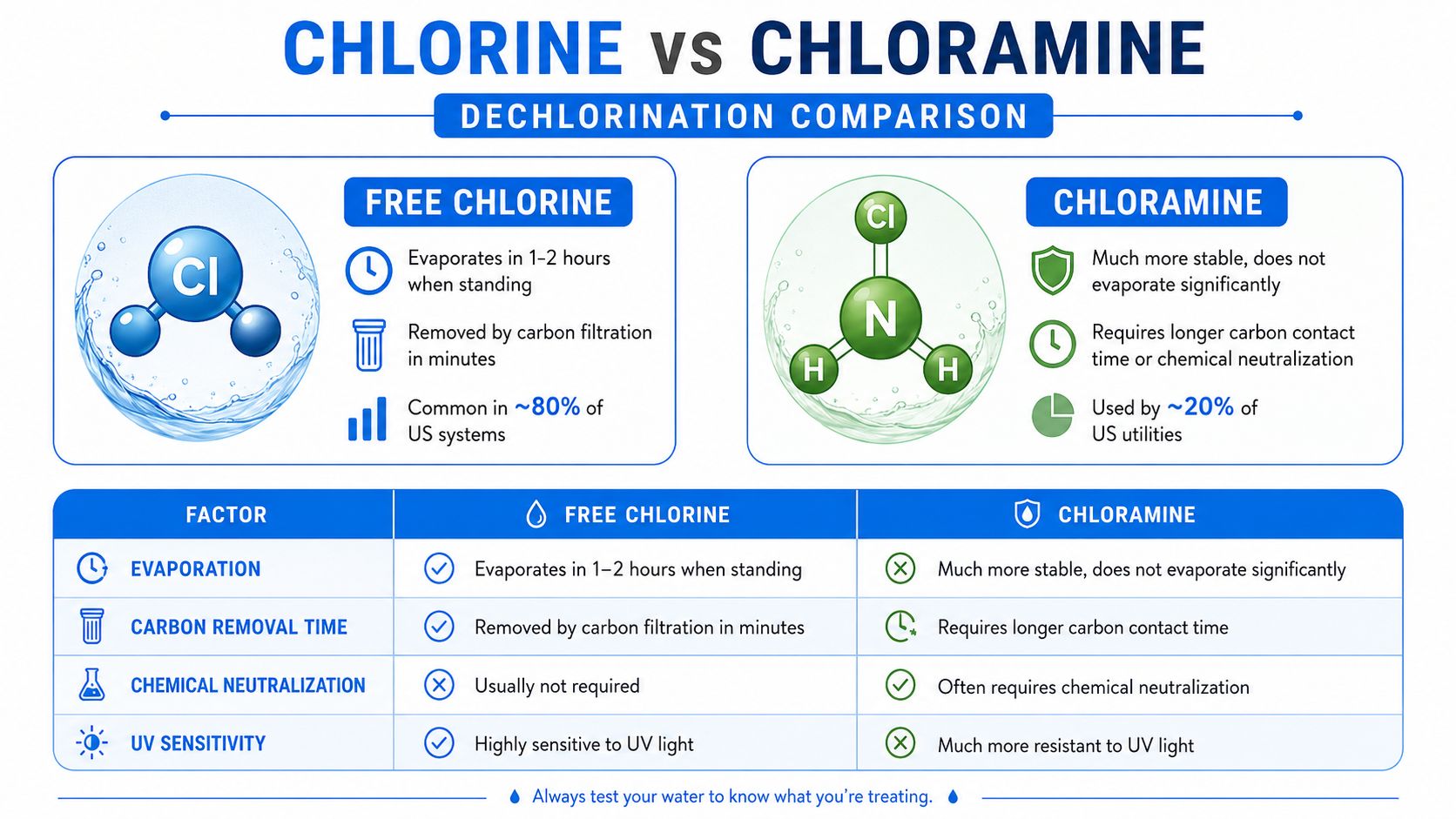
The cleanest way to find out which disinfectant you have is to read your utility's **Consumer Confidence Report**. That report is where the disinfectant type should be listed, and it's the first thing I'd check before buying anything. If you're in one of the chloraminated systems, the method that works for your neighbor's water may do almost nothing in your kitchen.
[Woder Sediment Removal and Advanced Dual Filtration System](https://woder.com/products/wd-d-20m-g4-dc/) is a good example of how product design reflects that difference, since its stated performance includes chlorine reduction and chloramines among the targeted contaminants. The broader point isn't about a single product, though. It's that your dechlorination method should match the disinfectant in your utility, not just your preference for a filter style.
> If you don't know whether your utility uses chlorine or chloramine, you're guessing at the solution.
## Dechlorination Methods and How Long Each Takes
If you need to dechlorinate tap water for drinking, cooking, or a quick household batch, the method depends on whether you are dealing with **free chlorine** or **chloramine**. Boiling is the fastest way to reduce free chlorine. A comparative BCIT study found boiling reduced chlorine to **0.24 ppm**, while off-gassing left a mean of **0.51 ppm** and filtration left **0.55 ppm**. That boil result also fell below the WHO's **0.3 ppm** taste and smell threshold, which is why boiled water often tastes flatter or less “chemical” than untreated tap water.
### What works by method
Boiling is the blunt instrument. It is fast, it works well for free chlorine, and it becomes awkward if you need large volumes every day. The same BCIT work also found boiling was statistically superior under a Kruskal–Wallis test, with **P=0.000**. If you need water tonight, it helps. If you need a daily kitchen fix, it usually is not the method you keep using.
Passive aeration is the old “leave it on the counter” method. It can work for free chlorine, but it does not handle chloramine. For households on chloraminated water, that is the point where overnight standing water stops being a real solution. The BCIT study comparison showed how the three approaches differed even before you account for disinfectant type, with mean chlorine of **0.51 ppm after off-gassing**, **0.24 ppm after boiling**, and **0.55 ppm after filtration**.
### A simple method comparison
MethodTimelineWorks for ChlorineWorks for ChloramineBest ForBoilingFastYesNoImmediate use, emergenciesOff-gassingSlowYesNoFree chlorine, patient usersCarbon filtrationContinuousYesSometimes, with proper sizingDaily drinking waterVitamin CFastYesYesBaths, aquariums, quick neutralizationVitamin C is the most direct chemical option. The USDA Forest Service says **1 gram of ascorbic acid neutralizes 1 mg/L of chlorine per 100 gallons of water**, and the reaction is very fast. That makes it useful when speed matters, especially for batch treatment rather than glass-by-glass drinking water.
For chloramine, the practical answer is different. **Overnight standing water does not reliably remove it**, and boiling is not the right fix either. If your utility uses chloramine, a carbon filter designed for that disinfectant is the method that deserves attention, not a pitcher left on the counter. The BCIT journal article reports the same lab comparison as the PDF version, so the two links point to the same underlying study rather than separate results.
If you want a practical walk-through of boiling as a household method, Woder's guide on [Does Boiling Water Purify It?](https://woder.com/blog/does-boiling-water-purify-it/) is a straightforward companion read.
## Activated Carbon Filtration Done Right
Carbon is the most practical long-term answer for many homes, but the filter media and contact time matter more than most buyers realize. The key term is **empty-bed contact time**, or **EBCT**, which is the time water spends in contact with the carbon. For chlorine, guidance in brewing and water-treatment references points to **2 to 3 minutes EBCT**. For chloramine, the target is about **8 minutes EBCT**, which is a much higher bar.
### Why flow rate changes everything
A cartridge that looks generous on paper can still underperform if water moves through it too quickly. That's the basic trap: capacity claims tell you how much water a filter can process over its life, but not whether the water lingers long enough in the media to remove disinfectant well. When chloramine is present, **standard granular activated carbon** may not be enough, and **catalytic carbon** is the better fit because it's built for the slower chemistry of chloramine removal.
> **Practical rule:** A filter's size matters less than its contact time when you're trying to remove chloramine reliably.
That's why flow rate needs to stay in the conversation. If you run a high-volume tap through undersized carbon, you can get weak dechlorination even when the cartridge is brand new. For a kitchen sink, that usually means choosing a system built for point-of-use flow rather than a generic cartridge sold on gallon count alone.
### Standard GAC or catalytic carbon
Use **standard GAC** when your utility uses free chlorine and you want a simple drinking-water solution. Use **catalytic carbon** when chloramine is in the supply, or when you want more reliable performance under slower chemistry. The difference isn't marketing language. It's the difference between a filter that handles easy disinfection residuals and one built to handle the harder one.
The Woder article on [filter for chlorine](https://woder.com/blog/filter-for-chlorine/) fits naturally here if you want to compare how carbon-based point-of-use systems are framed for everyday household use. That said, the right system still depends on your water report and your tap's actual flow, not just the label on the box.
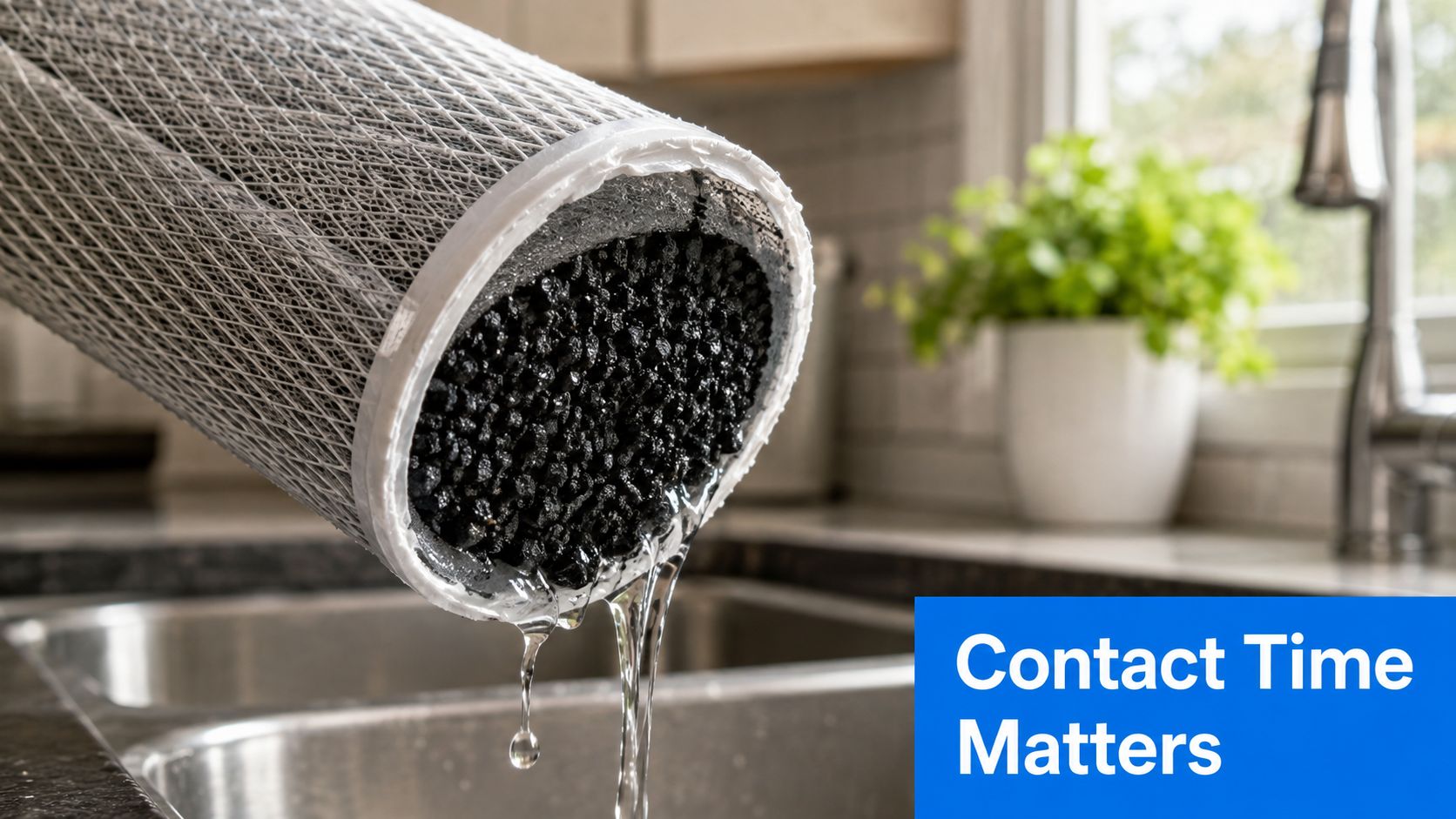
## Choosing the Right Method for Your Situation
The decision starts with three questions. What disinfectant does your utility use, how fast do you need the water ready, and what are you using it for. Once you answer those, the “best” method becomes a lot less vague.
### A simple decision path
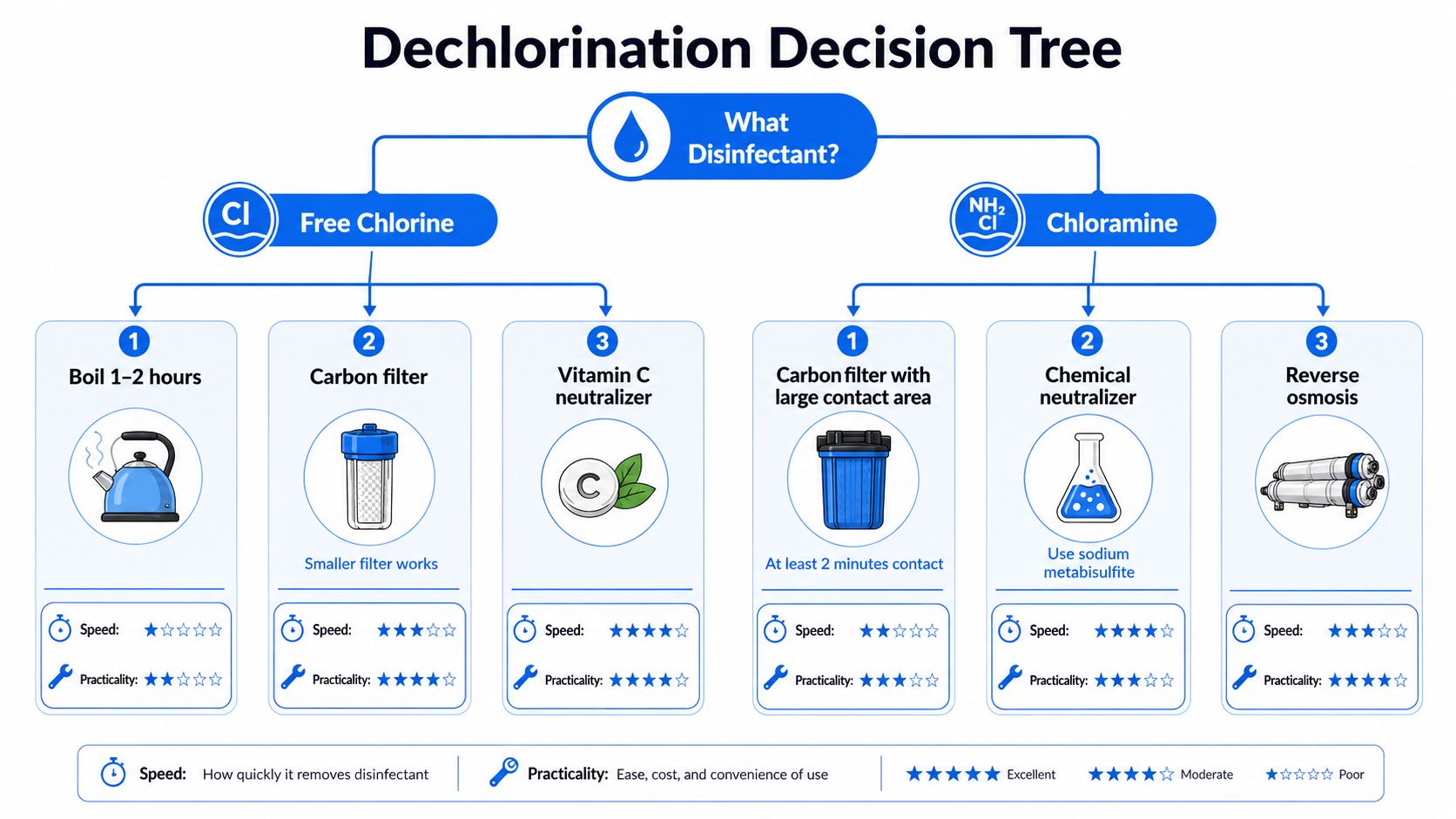
If your water contains **free chlorine** and you're planning ahead, sitting water in an open container can work well enough for tomorrow's coffee or cooking. If you need water right now, boiling is the quickest route. If your utility uses **chloramine**, standing water isn't a real solution, and you'll need carbon filtration with the right contact time or a chemical neutralizer like vitamin C.
### Match the method to the use case
For drinking water, carbon filtration is usually the cleanest balance of convenience and taste. For coffee and tea, carbon has one more advantage, it removes the disinfectant residual without stripping the water down to a mineral-less base. That matters because many people want the chlorine gone but still want calcium and magnesium left in the water for flavor and extraction.
For aquariums, the rules are stricter. Untreated tap water can be a bad idea because fish are sensitive to disinfectants, so quick neutralization is often more important than flavor. For sensitive appliances, the issue is less about taste and more about preventing odor transfer and keeping the water chemistry predictable.
Boiling can help in a pinch, but it's not the best fit for every household use. Reverse osmosis also removes chlorine, but it changes the water much more aggressively than most homeowners want for everyday drinking and cooking. If your goal is just cleaner-tasting water, you usually don't need to go that far.
## When Dechlorination Isn't Enough
Sometimes taking chlorine out of the water reveals the next problem. Chlorine can mask metallic tastes, organic odors, or mineral issues, so once the disinfectant is gone, the rest of the water becomes easier to notice. That's not a failure of dechlorination. It's useful feedback.
If the water still tastes off after removal, that's your sign to look deeper. Maybe the issue is lead or other metals. Maybe it's PFAS, sediment, or something your nose can pick up but your eye can't. A simple carbon filter can be enough when the only complaint is chlorine taste or smell, but it's not the answer if your concern is broader household water quality.
That's where point-of-use filtration becomes more than a taste fix. Woder's approach, for example, is built around **Advanced Selective Filtration®**, which targets contaminants while leaving beneficial minerals in place. For homeowners who want better-tasting water without stripping everything out, that distinction is often the deciding factor.
> Test first, taste second. What you notice after dechlorination is often the clue you needed.
If you're still unsure what's in your tap, start with your Consumer Confidence Report and then choose the method that matches your disinfectant, your timeline, and your use case. If you want a point-of-use system that fits that kind of decision-making, visit [Woder Filters](https://woder.com) and compare the options against your own water report and sink setup.
**Categories:** Woder Science
**Tags:** chloramine removal, dechlorinate tap water, remove chlorine, tap water treatment, water filtration
---
### [How to Replace Water Filter: How to Replace Your Water](https://woder.com/blog/how-to-replace-water-filter/)
**Published:** August 7, 2026
**Author:** woder_admin
**Content:**
The first sign that a filter needs attention is usually not a dramatic leak. It's a faucet that runs a little slower, water that tastes a little flat, or a cartridge housing that looks simple until you crack it open and find pressure still trapped inside. That's why knowing how to replace water filter systems safely matters just as much as knowing which cartridge to buy.
A clean swap is usually straightforward. The part that goes wrong is the plumbing around it, especially **pressure relief**, **O-ring care**, and the final **flush** that clears air and carbon fines before the filter goes back into daily use.
## Table of Contents
- [Why Most Filter Replacements Go Wrong](#why-most-filter-replacements-go-wrong)
- [The real weak points are predictable](#the-real-weak-points-are-predictable)
- [Knowing When Your Filter Needs Replacement](#knowing-when-your-filter-needs-replacement)
- [Replacement schedules and real-world signals](#replacement-schedules-and-real-world-signals)
- [Preparing Your System and Relieving Pressure](#preparing-your-system-and-relieving-pressure)
- [Set up for the spill you don't want](#set-up-for-the-spill-you-dont-want)
- [Don't rush the first turn](#dont-rush-the-first-turn)
- [Swapping the Cartridge and Reassembling the Housing](#swapping-the-cartridge-and-reassembling-the-housing)
- [Seal care matters more than force](#seal-care-matters-more-than-force)
- [Flushing the New Filter and Verifying Performance](#flushing-the-new-filter-and-verifying-performance)
- [Watch the water, not just the stopwatch](#watch-the-water-not-just-the-stopwatch)
- [Troubleshooting Leaks and Flow Problems After Installation](#troubleshooting-leaks-and-flow-problems-after-installation)
- [Match the symptom to the fix](#match-the-symptom-to-the-fix)
## Why Most Filter Replacements Go Wrong
A homeowner usually starts with the cartridge itself and assumes that's the whole job. In practice, the cartridge is the easy part. The failures happen around it, when someone opens a pressurized housing too soon, pinches the seal on reassembly, or skips the flush and wonders why the water tastes odd afterward.
### The real weak points are predictable
Residual pressure is the first problem. DIY installation guides consistently tell you to shut off the incoming valve and open a downstream faucet before loosening the housing, because the trapped pressure is what sends water everywhere when the canister breaks free. The other common failure is seal damage, especially when an **O-ring** gets twisted, dry, or overtightened on the way back together. A plastic housing doesn't forgive brute force.
> **Practical rule:** if a filter change leaks, the cause is usually at the seal or the pressure, not in the new cartridge itself.
There's a reason this feels harder the first time. A filter replacement is a small plumbing procedure, not a parts swap. Once the pressure is gone and the gasket is treated carefully, the job gets much more forgiving.
That's also why many people think they “broke” something when the first attempt goes badly. More often, they just followed the right sequence in the wrong order. The housing should be opened after pressure is relieved, the new cartridge should be seated gently, and the system should be brought back online slowly so leaks show up before the housing fully loads.
A good replacement is quiet. No spray, no crossed threads, no surprise drip on the cabinet floor. If those things happen, the fix usually starts with the same three basics, pressure, seal, and flush.
## Knowing When Your Filter Needs Replacement
A calendar helps, but it does not tell the whole story. Most household filters are replaced on a time-based cycle of about **2 to 12 months**, depending on filter type and water quality, with common benchmarks of **2 months** for pitchers or dispensers, **3 to 4 months** for faucet-mount filters, **4 to 6 months** for refrigerator filters, and **6 to 12 months** for under-sink carbon filters, plus some filters rated around **100 gallons or roughly four months, whichever comes first** source. Those are useful guardrails, but they are not the only signal.
### Replacement schedules and real-world signals
A cartridge can still let water through while doing a weaker job than it did when new. When filter media traps chlorine, sediment, and other contaminants, it loses adsorption capacity. Reduced flow is one clue, but taste, odor, and visible sediment matter too.
- **Reduced pressure or slower flow:** Often means the media is loading up with sediment or the cartridge is nearing capacity.
- **Taste or odor coming back:** Usually points to exhausted carbon performance, especially with chlorine.
- **Visible particles or discoloration:** Suggests the filter is no longer catching what it used to.
- **Indicator light or service timer:** Useful, but only if the system was installed and flushed correctly.
For households that care about contaminants like lead, PFAS, or chromium, the harder question is whether a filter still performs before the date on the calendar. Water testing answers that better than guessing. If incoming water quality varies or the home uses more filtered water than expected, condition-based replacement makes more sense than relying on a fixed date alone.
The basic rule is simple. Replace on schedule when you have no better data, and replace sooner if the flow changes, taste changes, or a test result suggests the cartridge has done its job. A filter that still passes water is not automatically protecting as well as it did on day one.
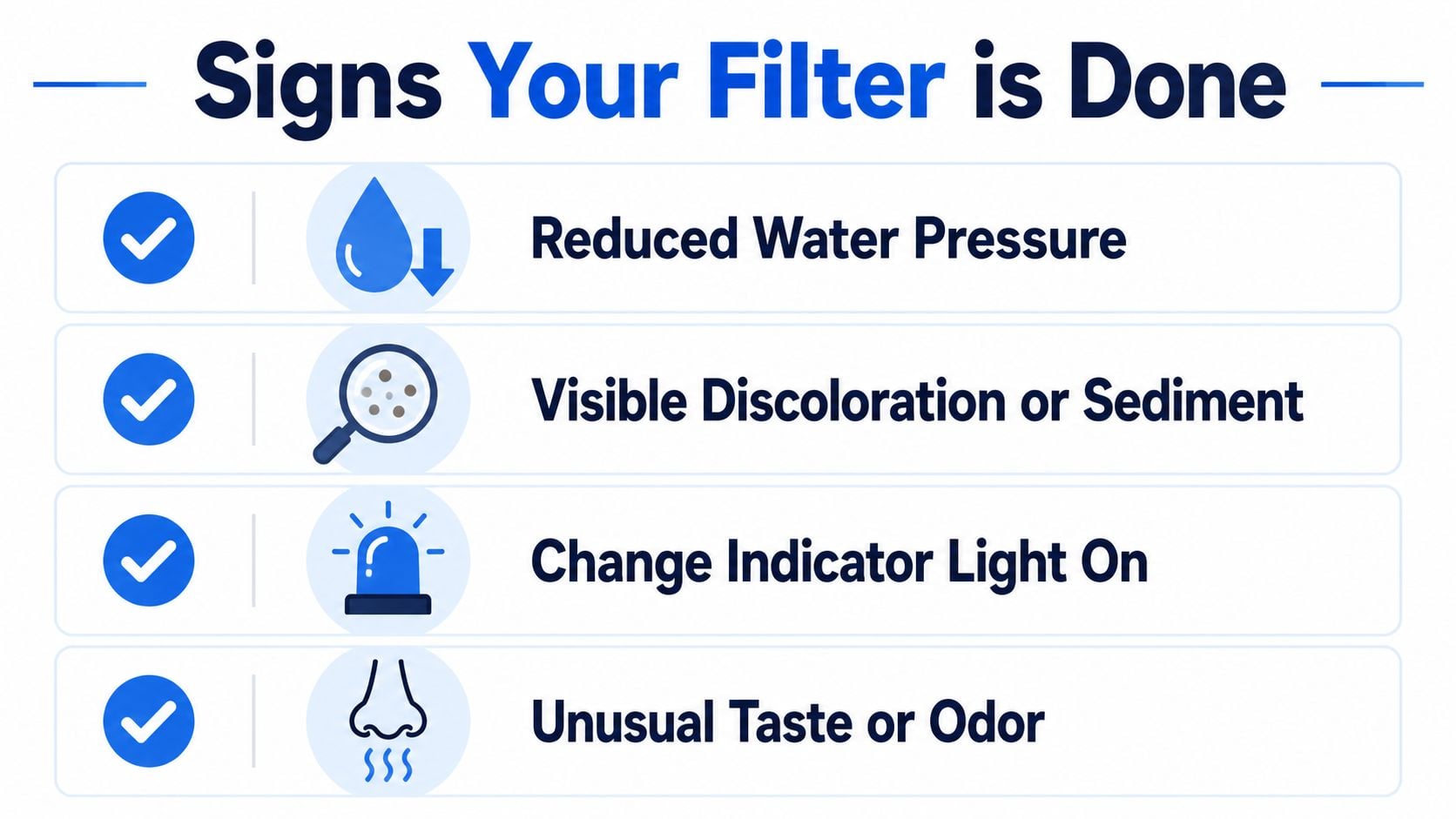
If you want a simple reference point for replacement timing, keep a copy of the [Woder's filter replacement schedule](https://woder.com/blog/water-filter-replacement-schedule/). For a more specialized setup, a product such as [Woder WD-G4-DC Lead, Chlorine, HM and PFAS Water Filter](https://woder.com/products/wd-g4-dc/) is positioned around advanced selective filtration while retaining essential minerals, with WQA-cited NSF/ANSI 42 and NSF/ANSI 372 references in the product snapshot.
Time still matters because filter media wears out even in a low-use home. Usage volume and water quality can shorten the useful life, especially when the incoming supply carries more sediment or chlorine than expected. If the cartridge is rated for a certain interval and your household pushes a lot of water through it, the calendar alone will not protect you.
The cleanest way to think about it is this. **Time tells you when to look. Performance tells you when to act.** If your system has an indicator light, treat it as a reminder, not a guarantee. If it has no indicator at all, watch the water itself and pay attention when the change becomes noticeable.
## Preparing Your System and Relieving Pressure
The safest filter swap starts before the housing moves at all. Shut off the incoming water, then open a downstream faucet to bleed off trapped pressure. That single step keeps the canister from spraying water when it opens, and it makes the housing easier to loosen.
### Set up for the spill you don't want
Place a bucket or towels under the housing before you touch the wrench. A little residual water is normal, and a little planning saves a lot of cabinet cleanup. Have the wrench, the new cartridge, and silicone grease ready so you're not hunting around with the housing half open.
> A housing that feels stuck is often just holding pressure. Release that pressure first, then try again.
For whole-house and under-sink cartridge swaps, the sequence is consistent across guides. Shut off the valve, open a faucet, then loosen the canister. If the housing has a pressure-release button, use it. If it doesn't, the faucet does the job.
A refrigerator filter is simpler. Most refrigerator systems don't require shutting off the household supply, and the cartridge usually twists or pushes in without tools. That's why refrigerator changes feel quicker, even though they still need a proper flush afterward.
Once the line is depressurized, the housing is much less likely to fight you. That's the hidden difference between a clean change and a messy one. A lot of homeowners assume the wrench is the hard part, but the hard part is getting the system into a safe state before the wrench ever turns.
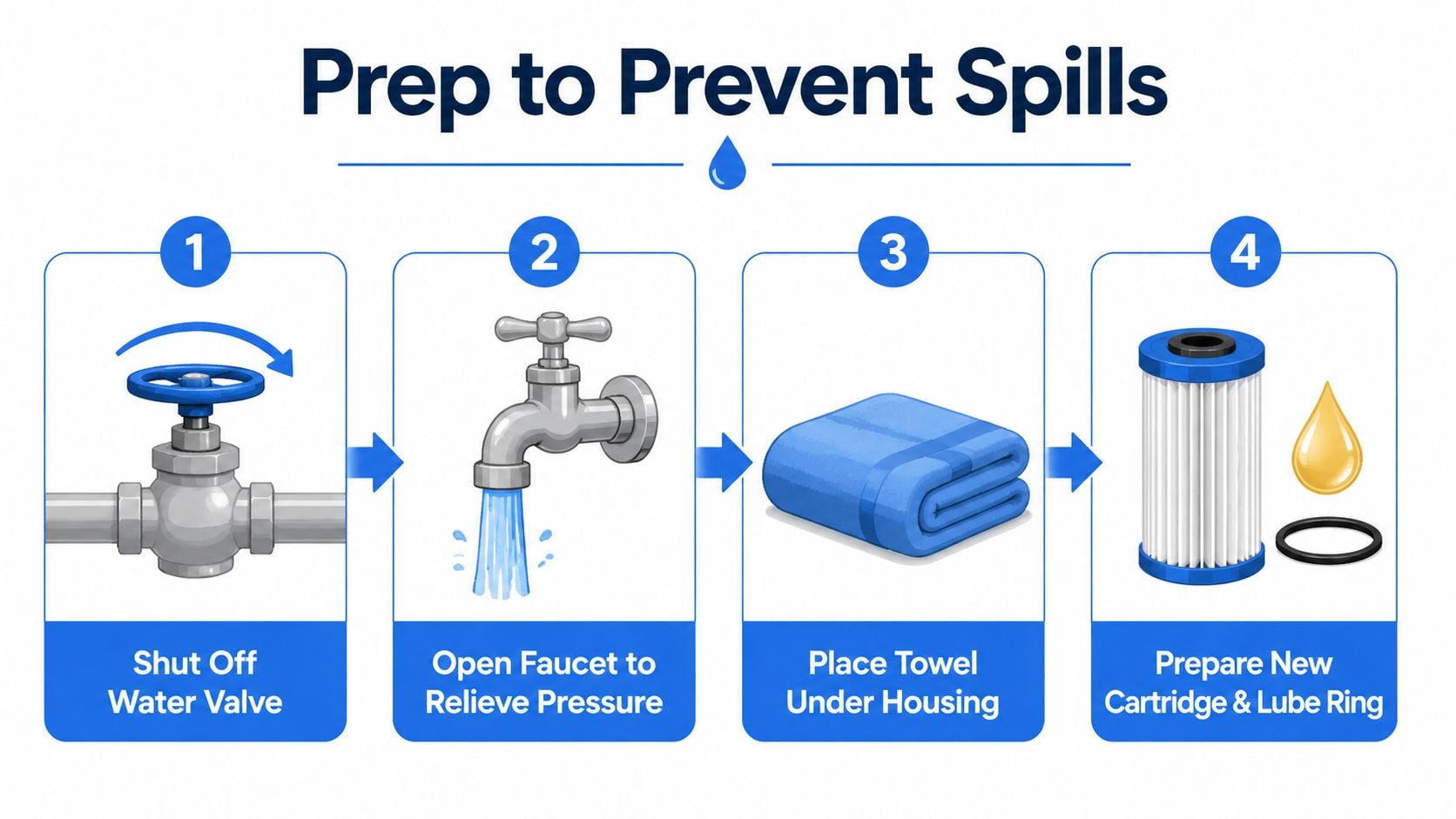
The same pressure-first approach is what you'll see in a broader DIY walkthrough like [Woder's cartridge replacement guide](https://woder.com/blog/water-filter-replacement-cartridge/). The tool-light refrigerator approach is different, but the principle stays the same, get the system calm before you open it.
### Don't rush the first turn
If the housing still won't budge, stop and check the setup rather than forcing it. The canister may still be carrying pressure, or the wrench may not be seated squarely. For plastic housings, that matters. Cross-threading or slipping the wrench can turn a routine job into a damaged housing.
## Swapping the Cartridge and Reassembling the Housing
Once the housing is open, remove the old cartridge and inspect the inside of the sump. Wipe out any grit or loose carbon, then look closely at the **O-ring**. If it's dry, pinched, flattened, or out of its groove, fix that before you install the new cartridge.
### Seal care matters more than force
Apply a light coat of silicone grease to the O-ring so it seats smoothly. That small step helps the seal slide into place instead of twisting when the housing tightens. It also makes the next replacement easier, which is why installers do it even when the old gasket looks fine.
Hand-tight is the goal. After that, a quarter-turn is enough. More force doesn't improve the seal, it can deform the O-ring and make the next change much harder. On plastic housings, over-tightening is a common mistake because people assume tighter means safer. It usually doesn't.
> **Keep the seal clean and the threads straight.** If the housing starts crooked, back it off and start again before the threads bite.
Refrigerator cartridges are simpler, but the same discipline applies. Align the tabs or push-fit connection carefully, seat the filter fully, and only then reset the cover or locking mechanism. If the cartridge isn't fully engaged, the dispenser can restrict flow or leak at the manifold connection.
When the reassembly feels too easy or too hard, pause and check the fit. A cartridge that drops into place cleanly is what you want. A cartridge that needs force usually means alignment is off.
After you seat the housing, bring the water back slowly. Don't slam the valve open. Slow pressurization gives you time to catch seepage before the housing loads fully.
There's a short visual guide here if the physical sequence is still giving you trouble, and it's useful to compare it to the parts in front of you:
The same logic applies whether the system is under the sink or on the refrigerator line. Seat the part, preserve the seal, tighten only enough to hold pressure. Anything beyond that makes the next maintenance cycle worse, not better.
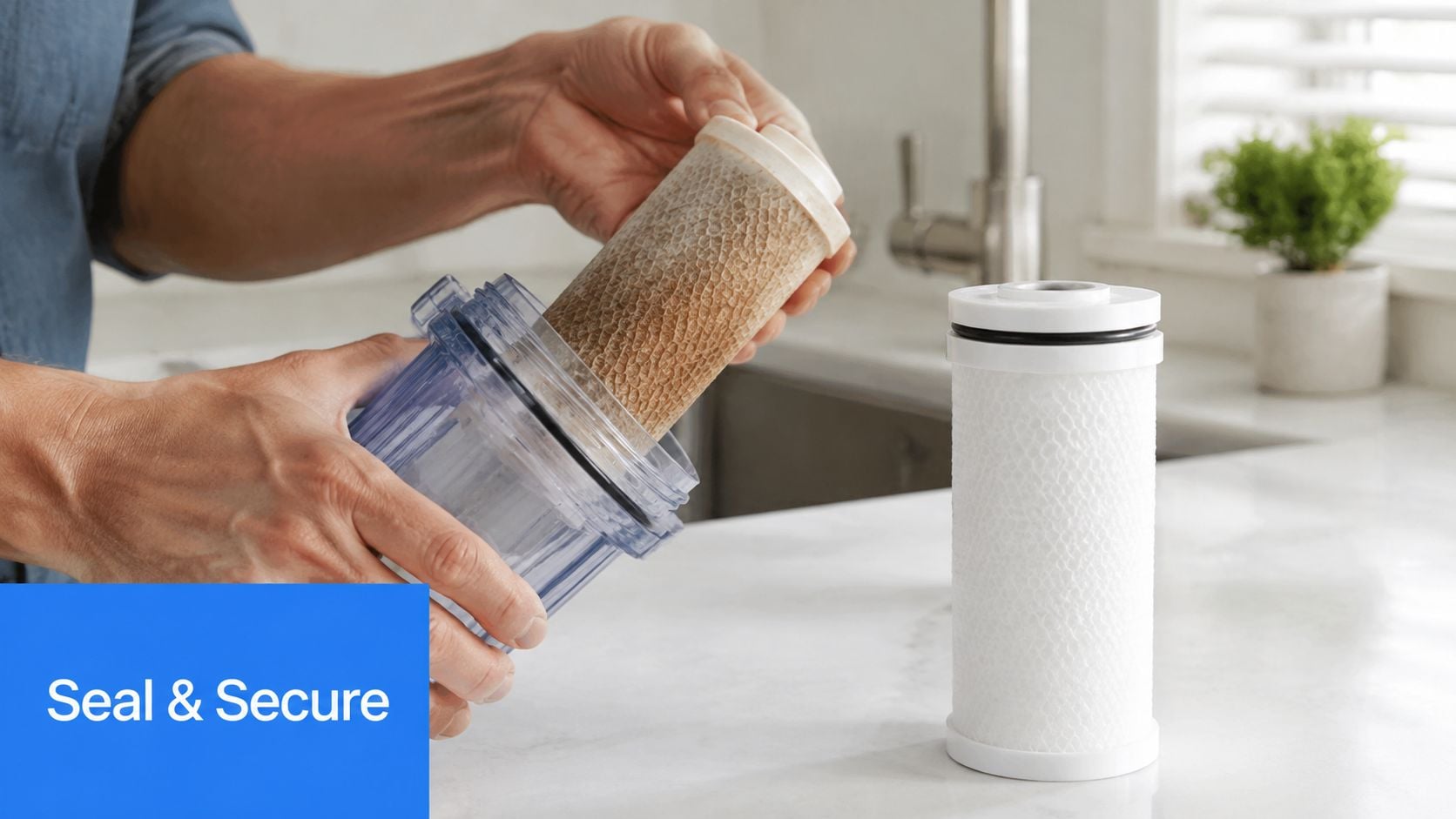
## Flushing the New Filter and Verifying Performance
A new cartridge is not ready the moment it is installed. It needs a flush to clear loose carbon fines, air pockets, and any residual manufacturing material. Consumer guidance commonly uses about **2 to 3 gallons** before regular use [source](https://www.consumerreports.org/home-garden/water-filters/how-to-change-a-refrigerator-water-filter-a1029258037/). Whirlpool's refrigerator guidance calls for **four gallons** after replacement, while whole-house installation guides often use **3 to 4 gallons** or **5 to 10 minutes** of flow as the cleanup window [source](https://www.whirlpool.com/blog/kitchen/how-to-replace-refrigerator-water-filters.html).
### Watch the water, not just the stopwatch
The first water may spit or sputter. That is air getting pushed out of the line. You may also see a bit of black carbon fines at the start, especially with activated carbon cartridges. That is normal during the first flush, and it should clear as the line stabilizes.
Reset the indicator light only after the flush is finished. If you reset it early, the timer starts from installation time instead of actual use, and that makes the replacement schedule less accurate. Whirlpool also ties the indicator reset to the post-flush process, reinforcing the same sequence [source](https://www.whirlpool.com/blog/kitchen/how-to-replace-refrigerator-water-filters.html).
A good flush ends with clear, steady flow and no sputtering. If the stream still looks cloudy after a reasonable flush, keep running water for a bit longer. If it stays cloudy well past the expected cleanup period, the issue is more likely a seating problem or trapped air than a bad cartridge.
The point of this step is not just taste. It confirms that the system is sealed, purged, and delivering water the way it should. If the flush feels uneven, that is useful information, not a failure.
> **Flush until the water runs clear and stable.** That is the moment you know the line is behaving normally again.
## Troubleshooting Leaks and Flow Problems After Installation
Most post-install problems fall into a small number of patterns. A slow drip at the housing seam usually points to an **O-ring** that isn't seated correctly, is twisted, or has been pinched. Sputtering often means air is still trapped in the line. Reduced flow can come from a cartridge that isn't fully seated or from debris that shifted during the change.
### Match the symptom to the fix
- **Drip at the seam:** Shut the water off, depressurize again, open the housing, and check the O-ring groove. If the ring is damaged or flattened, replace it.
- **Sputtering or air bursts:** Keep flushing the line in short runs until the flow steadies. Trapped air usually clears with use.
- **Flow feels weak:** Confirm the cartridge is fully locked or seated, then inspect for kinks, debris, or a housing that went back together unevenly.
- **Cloudy water beyond the first flush:** Continue flushing for a bit longer, then recheck seating and seal position if the cloudiness doesn't clear.
If the leak gets worse after re-pressurizing, stop and reset the housing rather than tightening harder. That's usually a seal problem, not a torque problem. If the cartridge still won't seat correctly after one careful retry, the part or the housing may be damaged.
For faucet-side issues that look like a bad filter but turn out to be a bad connection, a dedicated check of the faucet interface can save time. A simple walkthrough such as [Woder's faucet replacement guide](https://woder.com/blog/water-filter-faucet-replacement/) can help you separate a cartridge issue from a fixture issue.
The main thing to remember is that most leaks are fixable at home if you slow down and trace the symptom. A stubborn seam drip is not a reason to panic, it's a reason to reopen the housing, inspect the seal, and reassemble with less force and better alignment.
---
Woder Filters offers under-sink and inline point-of-use systems designed around **Advanced Selective Filtration®**, which removes targeted contaminants while keeping essential minerals in the water. If you're replacing a filter because the old one is overdue, leaking, or no longer performing the way it should, visit [Woder Filters](https://woder.com) to review replacement cartridges, installation resources, and product options that fit this kind of maintenance routine.
**Categories:** Woder Science
**Tags:** filter cartridge swap, how to replace water filter, under sink filter change, water filter maintenance, water filter replacement
---
### [Reverse Osmosis Water Side Effects: What You Lose When You Strip Everything From Your Water](https://woder.com/blog/reverse-osmosis-water-side-effects-what-you-lose-when-you-strip-everything-from-your-water/)
**Published:** August 7, 2026
**Author:** woder
**Content:**
- [What Reverse Osmosis Actually Does to Your Water](#what-reverse-osmosis-actually-does-to-your-water)
- [The Side Effects Worth Knowing About](#the-side-effects-worth-knowing-about)
- [You Lose Calcium and Magnesium](#you-lose-calcium-and-magnesium)
- [Demineralized Water Tends to Be More Acidic](#demineralized-water-tends-to-be-more-acidic)
- [RO Systems Waste a Significant Amount of Water](#ro-systems-waste-a-significant-amount-of-water)
- [Installation Is More Involved Than Most People Expect](#installation-is-more-involved-than-most-people-expect)
- [Does RO Water Taste Different?](#does-ro-water-taste-different)
- [Is RO Still Worth It in Some Cases?](#is-ro-still-worth-it-in-some-cases)
- [A Different Approach: Selective Filtration](#a-different-approach-selective-filtration)
- [What to Ask Before Choosing a Filtration System](#what-to-ask-before-choosing-a-filtration-system)
- [The Real Trade-Off](#the-real-trade-off)
- [Frequently Asked Questions](#frequently-asked-questions)
Reverse osmosis does exactly what it promises. It forces water through a membrane so fine that almost nothing gets through — contaminants, bacteria, heavy metals, PFAS, chlorine, all of it blocked.
The problem is that "almost nothing" includes the minerals your body actually needs.
If you've been researching RO systems and something about the trade-off feels off, you're not imagining it. There are real side effects to drinking water that's been stripped of everything, and they're worth understanding before you commit.
---
### What Reverse Osmosis Actually Does to Your Water
An RO membrane works by pressure. Water gets pushed through pores so small that dissolved particles can't pass. The result is genuinely very pure water.
But pure doesn't always mean better. Your tap water naturally carries calcium and magnesium — two minerals your body uses every day for bone density, muscle function, and heart rhythm. RO removes them right alongside the contaminants.
What comes out the other side is demineralized water. Some people describe it as flat or slightly hollow. That's not just perception. Water without dissolved minerals behaves differently in your mouth and in your body.
---
### The Side Effects Worth Knowing About
#### You Lose Calcium and Magnesium
This is the most documented concern. RO-filtered water typically contains very low concentrations of both minerals compared to unfiltered tap water. If your diet already covers your mineral intake, the gap may not matter much. But if you drink a lot of water and rely on it as a minor mineral source, that gap adds up.
The World Health Organization has published guidance noting that long-term consumption of water low in calcium and magnesium may carry health implications, particularly for populations where dietary mineral intake is already marginal.
#### Demineralized Water Tends to Be More Acidic
Without dissolved minerals, water typically sits at a lower pH. Mildly acidic water isn't dangerous in small amounts, but over time it can be more aggressive toward pipes, fixtures, and tooth enamel. Some RO systems include a remineralization stage to address this — which adds both cost and complexity.
#### RO Systems Waste a Significant Amount of Water
For every gallon of filtered water an RO system produces, it typically sends two to four gallons down the drain. In a household that drinks heavily filtered water, that's thousands of gallons a year. If you're on a well or in a water-restricted area, that's not a minor footnote.
#### Installation Is More Involved Than Most People Expect
Most RO systems require a dedicated faucet, a storage tank under the sink, and a drain line. Many homeowners end up hiring a plumber. The tank takes up cabinet space, and the system needs ongoing maintenance beyond a simple cartridge swap.
---
### Does RO Water Taste Different?
Yes, and most people notice it right away. Minerals contribute to the round, slightly sweet quality of good drinking water. Strip them out and the water can taste flat, faintly metallic, or just empty. Some people prefer it. Many don't.
If you've ever had water at a good restaurant and wondered why it tasted better than what comes out of your tap at home, minerals are a big part of that answer.
---
### Is RO Still Worth It in Some Cases?
Absolutely. If your water source has severe contamination — high total dissolved solids, arsenic, nitrates, or other issues a standard filter can't address — RO is a serious option. Its thoroughness has real value in the right situation.
The question is whether that level of thoroughness is actually what you need, or whether you're solving a more specific problem.
Most US homeowners aren't dealing with extreme contamination. They want to remove lead, PFAS, chlorine, and chromium 6 from municipal tap water while keeping the water drinkable and mineral-rich. For that goal, RO is overkill. You pay more, waste water, lose minerals, and take on a more complicated installation.
---
### A Different Approach: Selective Filtration
There's a middle path between a basic pitcher filter and a full RO system. Selective filtration targets contaminants specifically without stripping everything else out of the water.
[Woder Filters](https://woder.com) uses proprietary Advanced Selective Filtration technology — nanoparticles that attract and remove specific contaminants while leaving calcium, magnesium, and other beneficial minerals intact. The result is water with 99.9% reduction of lead, chlorine, chromium 6, mercury, PFAS, carcinogens, and volatile organic compounds, but that still tastes the way water is supposed to taste.
No tank. No drain line. No wastewater. Installation connects directly to your existing water line and takes under 30 minutes without a plumber. All filters are made in the United States.
That's a meaningful difference. You get genuinely clean water without the side effects that come from stripping everything out.
---
### What to Ask Before Choosing a Filtration System
A few questions worth getting clear on before you decide:
- **What's actually in your water?** Your local utility publishes an annual Consumer Confidence Report that lists contaminants and their levels.
- **Do you have a specific concern?** Lead from older pipes, PFAS from industrial runoff, and high chlorine from municipal treatment are the most common issues for US homeowners.
- **How much water does your household drink at home?** A family drinking heavily from the tap has more to gain from a high-quality filter than one that mostly uses filtered water for cooking.
- **Do minerals matter to you?** If you drink a lot of water and want to preserve its natural mineral content, RO is a poor fit.
If you're not sure which filter matches your setup, the product finder at [woder.com/wizard](https://woder.com/wizard) walks you through the right model based on your water source and usage.
---
### The Real Trade-Off
RO isn't a bad technology. It's just a blunt one. It solves contamination by removing everything, and in some situations that's exactly the right call.
But for most homeowners who want safe, clean, great-tasting tap water, the trade-off doesn't hold up. You lose minerals, waste water, spend more on installation, and end up with water that tastes flat.
Clean water shouldn't mean empty water. The goal is to remove what harms you and keep what helps you — and that distinction matters more than most people realize when they're standing in a hardware store comparing filter boxes.
---
### Frequently Asked Questions
**Is reverse osmosis water safe to drink every day?**
RO water isn't harmful in the short term. The concern with long-term daily consumption is the consistent removal of calcium and magnesium. If your diet already covers your mineral needs, the impact may be minimal. If you rely on water as a mineral source, it's worth factoring in.
**Does reverse osmosis remove PFAS?**
Yes. RO membranes are effective at removing PFAS compounds. That said, selective filtration systems that specifically target PFAS can also achieve very high removal rates — without stripping beneficial minerals from the water.
**Why does RO water taste flat?**
Dissolved minerals, particularly calcium and magnesium, contribute to the taste and mouthfeel of water. When an RO system removes them, the water loses that roundness. Some people prefer the neutral result. Many find it noticeably different from mineral-rich water.
**How much water does a reverse osmosis system waste?**
Most traditional RO systems produce one gallon of filtered water for every two to four gallons sent to the drain. Tankless RO systems are more efficient but still produce some wastewater. Selective filtration systems that don't use a membrane produce none.
**What is selective filtration and how is it different from RO?**
Selective filtration targets specific contaminants — lead, chlorine, PFAS, heavy metals — while leaving beneficial minerals in the water. RO removes everything indiscriminately. The result with selective filtration is clean water that still tastes like water.
**Do I need a plumber to install a water filter?**
Not necessarily. Inline and under-sink filters that connect directly to your existing water line typically install in under 30 minutes without professional help. RO systems are more involved and often require a plumber for the dedicated faucet, tank, and drain line.
**Can I get clean water without losing minerals?**
Yes. Selective filtration systems remove contaminants like lead, PFAS, chlorine, and chromium 6 at 99.9% reduction rates while preserving the calcium and magnesium naturally present in your water. You don't have to choose between clean and mineral-rich.
---
Your tap water shouldn't be a guessing game, and fixing it shouldn't mean trading one problem for another. If you want to remove the bad and keep the good, start at [woder.com](https://woder.com).
**Categories:** Woder Science
---
### [Water Filter Replacement Schedule: Essential Guide](https://woder.com/blog/water-filter-replacement-schedule/)
**Published:** August 6, 2026
**Author:** woder_admin
**Content:**
You set a reminder for “six months,” forgot about it, and then noticed the water pressure dropping before the calendar app ever buzzed. That's how you might find yourself facing a **water filter replacement schedule**. The part that's easy to miss is that the date on the calendar is only one piece of the decision, because the cartridge, the amount of water you use, and the quality of the water coming in all change how long a filter really lasts.
A filter can look fine and still be past its useful life. Carbon media can be saturated before the flow fully stops, sediment can pack into a cartridge until pressure falls, and reverse osmosis stages can age on different timelines even when they live inside the same housing. A good schedule doesn't guess. It gives you a way to decide when a cartridge is still doing its job and when it's just sitting there.
## Table of Contents
- [Why Replacement Timing Is Not Just a Date on the Calendar](#why-replacement-timing-is-not-just-a-date-on-the-calendar)
- [The calendar is only one input](#the-calendar-is-only-one-input)
- [How Replacement Schedules Actually Work](#how-replacement-schedules-actually-work)
- [Time and capacity work together](#time-and-capacity-work-together)
- [Recommended Replacement Windows by Filter Type](#recommended-replacement-windows-by-filter-type)
- [The quick comparison homeowners actually need](#the-quick-comparison-homeowners-actually-need)
- [Reverse Osmosis Systems and Their Multi-Stage Schedule](#reverse-osmosis-systems-and-their-multi-stage-schedule)
- [Each stage wears differently](#each-stage-wears-differently)
- [Factors That Shorten or Lengthen the Schedule](#factors-that-shorten-or-lengthen-the-schedule)
- [What pushes replacement earlier](#what-pushes-replacement-earlier)
- [Signs a Cartridge Needs Replacing Sooner](#signs-a-cartridge-needs-replacing-sooner)
- [A one-minute homeowner checklist](#a-one-minute-homeowner-checklist)
- [When Source-Water Changes Should Reset the Schedule](#when-source-water-changes-should-reset-the-schedule)
- [When to start the clock over](#when-to-start-the-clock-over)
- [The Real Annual Cost of Staying on Schedule](#the-real-annual-cost-of-staying-on-schedule)
- [Budgeting for upkeep, not surprises](#budgeting-for-upkeep-not-surprises)
- [Building a Replacement Routine You Will Actually Follow](#building-a-replacement-routine-you-will-actually-follow)
- [Set it up once](#set-it-up-once)
- [What Filter Ratings and Certifications Actually Guarantee](#what-filter-ratings-and-certifications-actually-guarantee)
- [Rated capacity versus real capacity](#rated-capacity-versus-real-capacity)
- [What Happens When You Wait Too Long](#what-happens-when-you-wait-too-long)
- [Quiet failure is the real risk](#quiet-failure-is-the-real-risk)
- [Your Three-Rule Replacement Reference](#your-three-rule-replacement-reference)
## Why Replacement Timing Is Not Just a Date on the Calendar
A homeowner sets a phone reminder for six months, changes the cartridge right on time, and later realizes the old one still had plenty of life left. Another household does the opposite, lets the reminder slide, and keeps running a filter that's already packed with sediment. Both households are looking at the same problem from the wrong angle, because replacement is never just about the date. It's about **filter type**, **household load**, and **source-water conditions**.
### The calendar is only one input
A point-of-use cartridge doesn't age in a straight line. It loads faster when the water carries more particles, when chlorine demand is higher, or when a family uses a lot of water every day. That's why a cartridge can still be inside its nominal service window and yet already be underperforming. In practical terms, the schedule starts with the manufacturer's date, then gets adjusted by how hard the filter is working.
> **Practical rule:** if your water use changed or your water source changed, the old reminder may no longer fit.
That's also why “nothing looks wrong” can be misleading. A filter often loses performance before it stops flowing altogether, and the decline is usually quiet. Flow may thin out, taste may start to creep back, and the cartridge can be doing less work than it did on installation day.
For readers comparing system designs, that's one reason Woder's [Woder Sediment Removal and Advanced Dual Filtration System](https://woder.com/products/wd-d-20m-g4-dc/) is framed around a sediment stage plus a second-stage cartridge, because each part does different work and won't age the same way. The important part isn't the product name, it's the maintenance logic behind it.
## How Replacement Schedules Actually Work
Every sensible **water filter replacement schedule** uses two clocks at once. One clock is time, because media and membranes lose capacity even when water quality is decent. The other clock is volume, because each cartridge is built to treat a certain amount of water before performance starts to drift. The trick is not choosing one clock, it's respecting both.
### Time and capacity work together
If a cartridge is rated for a certain service life, that number is the ceiling, not a suggestion to go past it. If it's also rated for a gallon capacity, that capacity should override the calendar when heavy use gets there first. A low-use household might hit the date limit before it reaches the gallon limit. A busy home can do the reverse and wear through the rated volume early.
The easiest way to think about it is this, a cartridge lasts until the first hard limit shows up. That can be elapsed time, gallons treated, or a condition sign like pressure loss or taste return. When all three agree, the decision is simple. When they don't, the earliest warning wins.
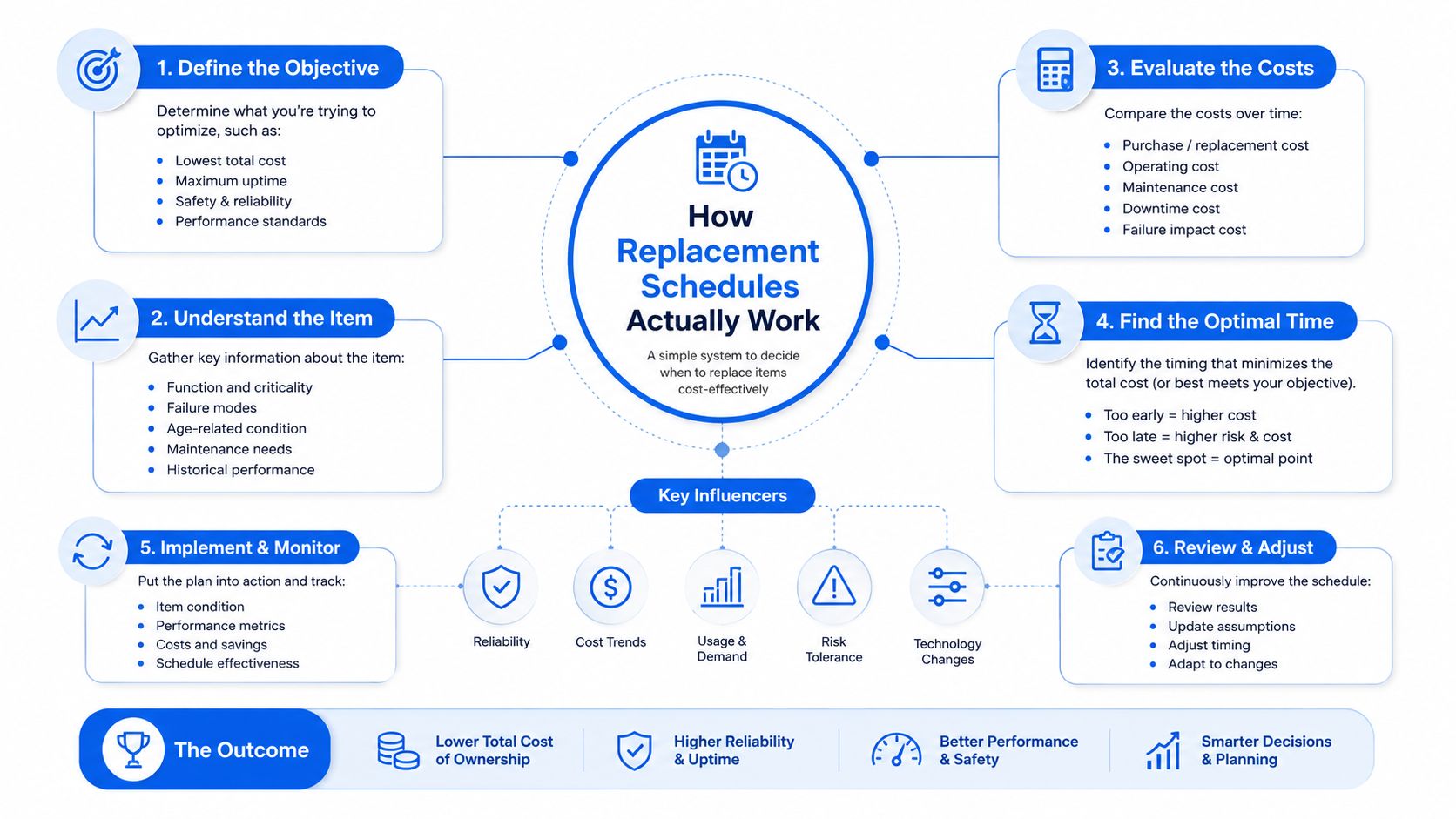
If you want to see how cartridge stages fit into a broader system, Woder's guide on [how water filters work](https://woder.com/blog/how-do-water-filters-work/) is a useful companion. The core idea is simple, the filter's job is finite, so the maintenance plan has to be finite too.
## Recommended Replacement Windows by Filter Type
Different filter formats live on different timelines because they're built for different jobs. A tiny cartridge in a pitcher can only hold so much media. A larger under-sink block has more capacity, so it usually lasts longer. Inline filters serving appliances sit somewhere else again, because they're built around a different duty cycle and flow profile.
### The quick comparison homeowners actually need
Filter TypeTypical IntervalRated CapacityTrigger to Replace SoonerPitcher filterAbout 2 monthsAbout 40 gallonsSlow pour rate, taste returns, cartridge looks loadedFaucet-mount filter3 to 4 monthsAbout 100 gallonsFlow drop, taste or odor return, visible loadingRefrigerator filterAbout 6 monthsAbout 200 to 400 gallonsWater slows, ice production changes, taste returnsUnder-sink carbon filter6 to 12 monthsAbout 500 to 1,000 gallonsPressure loss, odor breakthrough, source water gets dirtierInline refrigerator or appliance filter6 to 12 monthsAbout 1,500 gallonsDispenser slows, taste changes, water use is heavyThe big mistake is reading those windows as promises instead of baselines. A pitcher filter handles a very small amount of water and usually fills a convenience role, so it reaches the end of useful life quickly. A refrigerator cartridge lasts longer, but it still depends on how often the dispenser runs and how much debris the incoming water carries.
Under-sink carbon filters are where people often get the most confused. The calendar says one thing, the gallon rating says another, and the right answer is whichever limit comes first. That's also where the internal maintenance guidance on [replacement cartridges](https://woder.com/blog/water-filter-replacement-cartridge/) is easiest to apply, because the cartridge itself is the limiting factor, not the faucet handle.
If you're reading your own setup, identify the form factor first, then look at the capacity line, then check whether the flow or taste has already started to drift. That sequence usually gets you to the right answer faster than guessing from the date alone.
## Reverse Osmosis Systems and Their Multi-Stage Schedule
Reverse osmosis is different because it isn't one cartridge, it's a stack. A typical setup uses a sediment pre-filter, one or more carbon pre-filters, the membrane itself, and sometimes a post-polish stage. Each part ages on its own schedule, and that's why treating the whole system like a single annual chore usually creates problems.
### Each stage wears differently
The pre-filters are the front line. They catch particles and reduce chlorine before water reaches the membrane, and they're usually the parts that need attention first. The membrane lasts much longer because it's doing a different job, a physical separation step rather than an adsorption step. That's why the membrane's service life runs for years, while the carbon stages around it are usually replaced much sooner.
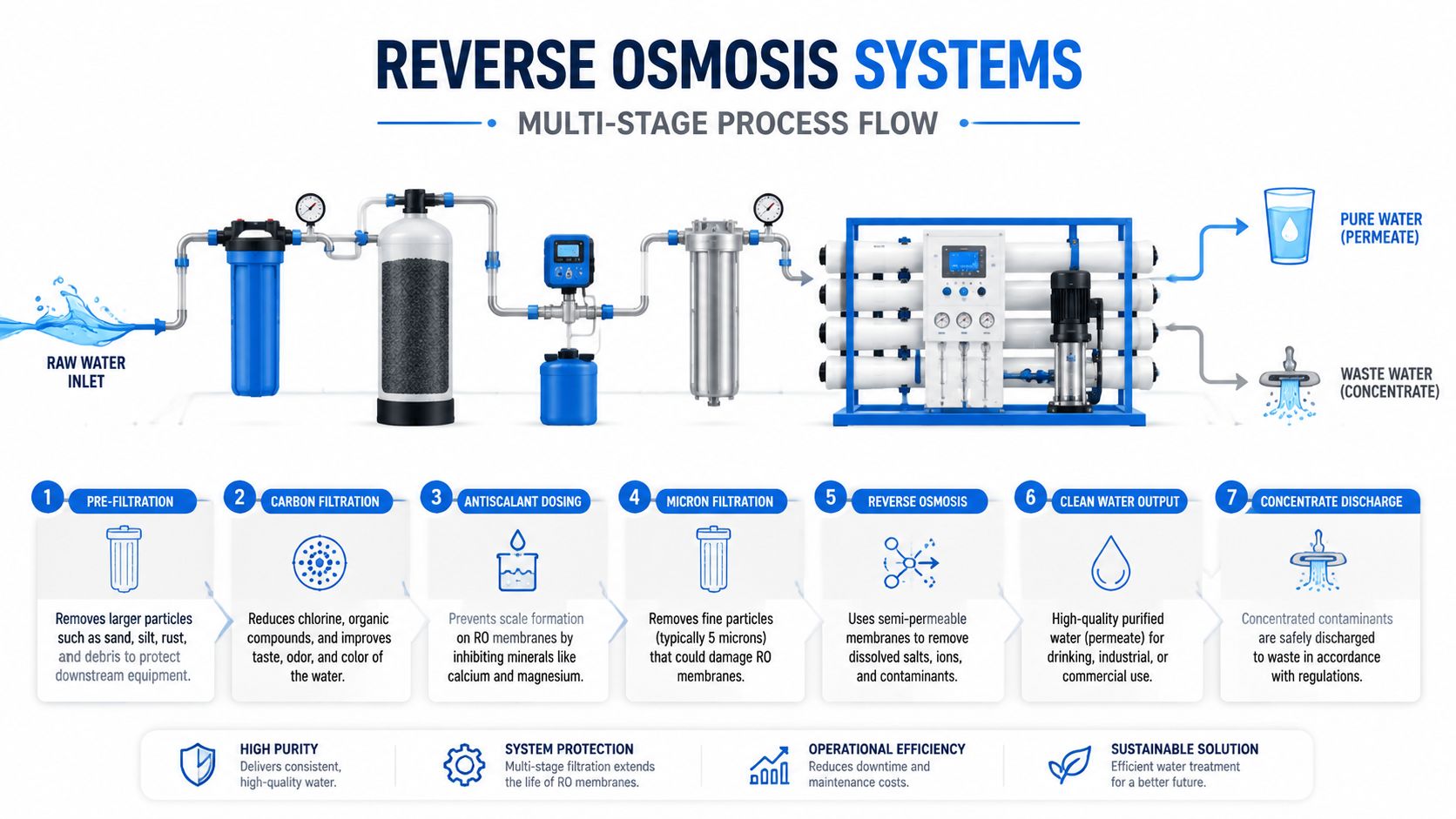
The mistake homeowners make is letting the membrane's longer life lull them into ignoring the rest of the stack. When pre-filters go stale, they can choke the system ahead of the membrane and shorten the useful life of the whole unit. If you're comparing system types, Bluepoint Plumbing & Service Inc. has a helpful page to [compare water filtration systems](https://bluepointplumbers.com/water-filtration/reverse-osmosis/) and see how multi-stage RO differs from simpler point-of-use designs.
Woder's own primer on [what reverse osmosis water filter](https://woder.com/blog/what-is-reverse-osmosis-water-filter/) is also useful for understanding why the membrane and the pre-filters should never be treated as one maintenance item. The membrane is the long-life part. The surrounding stages are the regular-service parts.
## Factors That Shorten or Lengthen the Schedule
A published interval is a starting point, not a verdict. The schedule changes when the household, the water source, or the plumbing conditions change. That's why two homes with the same cartridge can get very different results.
### What pushes replacement earlier
**Household size and daily use** matter first. More people run more water through the cartridge, so the media loads faster and the gallon rating arrives sooner. **Source-water sediment** matters too, especially on private wells, because fine particles can crowd the filter media long before the calendar says it should be done. **Chlorine demand** in municipal water can also shorten the useful life of carbon stages, because the filter is spending more of its capacity on taste and odor control.
> **Practical rule:** the dirtier or busier the water stream, the shorter the safe interval.
Seasonal properties work differently. If a home sits idle for months, the cartridge may not be “used up” in the same way, but it can still be a fresh-start situation when service resumes, because stagnation and long idle periods change how people should think about replacement.
Water pressure matters as well. If pressure drops across the cartridge, the filter is telling you it's loading up, even if the housing still looks normal. A family of five on a sediment-heavy well may need to move a nominal six-to-twelve-month carbon interval much earlier. A single occupant on clean municipal water in an apartment may be able to stay closer to the full rated window.
The point isn't to chase perfect precision. It's to stop treating every home as if it drinks the same water at the same pace.
## Signs a Cartridge Needs Replacing Sooner
The fastest way to check a cartridge is to use your senses and a quick look at the system. You don't need lab equipment to spot the common warning signs. You just need to know what counts.
### A one-minute homeowner checklist
- **Flow slows down:** If the faucet, dispenser, or appliance is moving water more slowly than usual, the cartridge may be loading with sediment or the membrane may be fouling.
- **Taste or odor comes back:** If chlorine taste or smell returns, the adsorption media may be exhausted and no longer catching what it was installed to remove.
- **Housing looks dirty:** A sediment cartridge that's visibly discolored is usually telling you it's packed with captured debris.
- **Pressure behavior changes:** On systems with gauges, a needle moving into the red zone usually means the cartridge is restricting flow more than it should.
- **Sound or delivery changes:** If a refrigerator or appliance starts sounding strained, or the water seems to pulse oddly, the filter may be past its useful point.
The key is not to wait for all five signs. One strong sign is usually enough to inspect the cartridge and compare it against the calendar or gallon limit. If the flow has already dropped and the taste has already changed, the cartridge is no longer in the “watch and wait” category.
For systems with gauges, the gauge gives you the most objective clue. For systems without one, flow and taste are usually the best field checks. Either way, the sign is telling you the same thing, the cartridge is doing less work than it was on day one.
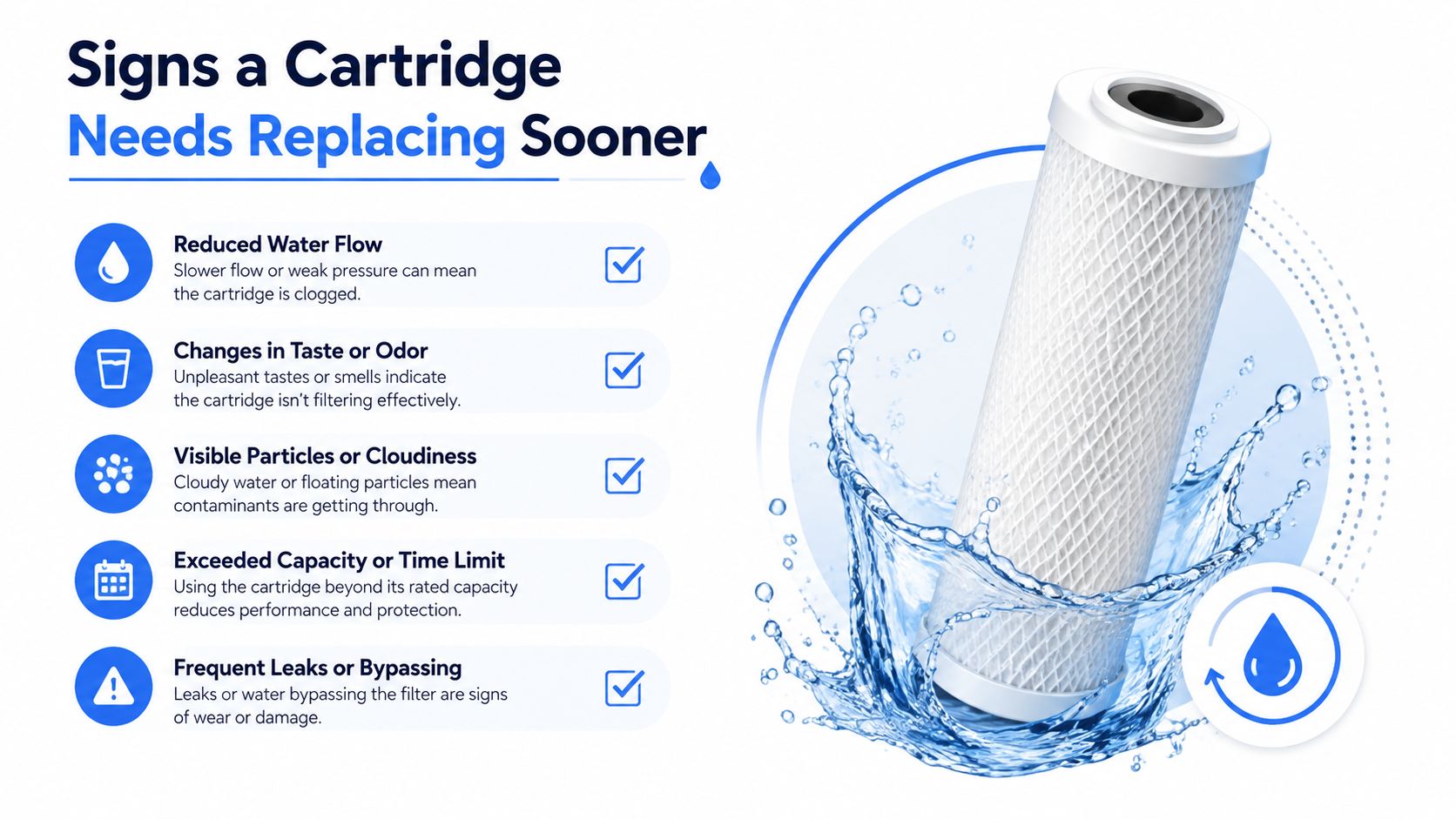
## When Source-Water Changes Should Reset the Schedule
Some changes don't just shorten the current interval, they should make you rethink the whole cadence. A municipal change, a well event, or a long idle period can reset the maintenance rhythm because the filter is suddenly working against different water than it was before.
### When to start the clock over
If a city changes its treatment approach or a new source comes online, the filter may see a different chlorine load or a different mix of particulates. In that case, it usually makes sense to replace on the next planned maintenance window rather than panic-replace on the spot. A boil-water advisory is different from a standard supply shift, but the practical lesson is the same, check the filter early and don't assume yesterday's schedule still applies.
Private wells need more judgment. Heavy rain, nearby construction, or a drought cycle can all shift sediment and taste. If that happens, replace the sediment pre-filter first, then watch the carbon stage closely because the front end may have taken the hit.
Seasonal homes are a separate case. A cartridge that sat unused for months should be treated as a fresh maintenance decision when the home comes back into service, not as if it had been running continuously the whole time.
> When the water changes, the old schedule may not mean much anymore.
A good homeowner routine beats a flat reminder. The schedule should flex when the source water flexes, because the cartridge's real workload lives in the water, not in the calendar app.
## The Real Annual Cost of Staying on Schedule
Replacement feels like an annoying recurring expense until you compare it with the cost of running past useful life. Then it starts to look like ordinary maintenance. A cartridge that gets replaced on time is part of the operating cost of the home, not an emergency.
### Budgeting for upkeep, not surprises
Pitcher and faucet-mount cartridges are usually the cheapest to keep on schedule because they're small and simple. Refrigerator filters and under-sink carbon filters sit higher because they hold more media and work longer before replacement. RO systems cost more to maintain because they have multiple service stages, not because one part is uniquely fragile.
If you want a broader home-maintenance yardstick, thecalcs has a practical tool to [estimate water heater costs](https://www.thecalcs.com/calculators/home-services-cost/water-heater-replacement-cost-calculator), and the same mindset applies here. You budget for systems before they fail, not after.
The hidden cost of waiting is rarely dramatic. People start buying bottled water because the tap tastes off. Ice makers and coffee machines get blamed when the issue is filtered water quality drifting. The old cartridge may still be moving water, but it isn't earning its keep the way it did before.
Woder's selective-filtration approach is relevant here because it keeps the maintenance conversation tied to drinking water quality without stripping away the minerals people expect in the glass. That doesn't make maintenance optional. It just keeps the cost discussion focused on keeping a living filter system working, not replacing a disposable habit.
## Building a Replacement Routine You Will Actually Follow
A good routine should be boring. If it takes effort to remember, it won't last. The easiest systems are the ones that leave a trail at the filter, in your phone, and in a household calendar all at once.
### Set it up once
Write the install date on a sticker near the housing, then add a reminder to your phone for the calendar limit and another note for the gallon limit if your usage is high. Keep one spare cartridge on hand if the model is standard enough to stock. That way, a replace-now moment doesn't become a same-day search for parts.
A quick monthly glance is enough for the rest of the year. Check flow at the tap, look for discoloration in any clear housing, and confirm that nothing about taste or odor has drifted. Once a year, scan your local utility's water-quality report for any meaningful source change, because that's the kind of update that can justify changing your plan.
If you like a paper trail, the [2026 equipment maintenance log guide](https://recurrr.com/articles/equipment-maintenance-log) is a good model for keeping replacement records simple. A clean record beats memory every time.
The point is not to turn water care into a hobby. It's to make sure the filter is always ready when you need it, without turning replacement into a last-minute chore.
## What Filter Ratings and Certifications Actually Guarantee
A cartridge rating is only useful if you read it correctly. A “rated for 1,000 gallons” claim means the manufacturer is telling you where performance is expected to begin declining under defined testing conditions, not that the filter should be pushed until the flow dies. The schedule exists because the rating assumes timely replacement.
### Rated capacity versus real capacity
**Rated capacity** is the published number on the box or spec sheet. **Real-world capacity** depends on what enters the filter, including sediment load, chlorine burden, household demand, and pressure. Real-world capacity can be shorter than the rating, but it won't be longer in any meaningful maintenance sense, because the filter doesn't get to ignore what it has already captured.
NSF/ANSI testing and WQA certification help the buyer understand that the product was evaluated under defined conditions, which is exactly why those labels matter when you're deciding when to replace. They don't mean “run it forever.” They mean the cartridge has a tested range, and your schedule should stay inside it.
Homeowners sometimes overread the label. A certification can support a performance claim, but it doesn't remove the need for a maintenance plan. The cartridge still ages with use, and the replacement interval is part of the claim's logic, not an afterthought.
## What Happens When You Wait Too Long
"I forgot, but the water seems fine" is a common line, and it's understandable. The trouble is that a saturated cartridge usually fails without a dramatic warning. It gives you a smaller stream, a familiar taste returning, and a gradual drop in contaminant reduction that you can't see by looking at a glass.
### Quiet failure is the real risk
That's why a cartridge can feel normal to the touch and still be underperforming. The filter may still be holding water back, but it's no longer removing what it was designed to capture with the same consistency. If the water tastes off, you may already be late. If the water still tastes fine, the cartridge still may be past its best work.
The simple takeaway is that **looks fine** is not the same as **still working**. Point-of-use filtration only gives you what it was built to give if the maintenance stays current. Once the cartridge is exhausted, the system doesn't become useless overnight, it just becomes less reliable in ways you might not notice right away.
That's why replacement is the maintenance task that decides whether the rest of the filtration investment is doing its job.
## Your Three-Rule Replacement Reference
Keep the schedule simple. **First, respect the calendar limit.** **Second, respect the gallon rating.** **Third, watch the condition signals, flow, taste, pressure, and color.** Pitcher and faucet-mount filters run short, refrigerator cartridges usually live around the half-year mark, under-sink carbon blocks need more attention than many people expect, and RO systems need each stage tracked on its own.
When in doubt, replace on the earlier trigger, not the later one. That's the cleanest rule for a water filter replacement schedule that works in a real home.
---
If you want a point-of-use filter that keeps maintenance straightforward while staying focused on drinking water quality, take a look at [Woder Filters](https://woder.com). Woder's under-sink and inline systems are built around selective filtration, so the replacement conversation stays tied to real cartridge work, not guesswork.
**Categories:** Woder Science
**Tags:** filter cartridge timing, home water filters, point-of-use filtration, water filter replacement schedule, when to change filter
---
### [Under-Sink Water Filter for the Bathroom Sink: Does It Make Sense and Which Models Work](https://woder.com/blog/under-sink-water-filter-for-the-bathroom-sink-does-it-make-sense-and-which-models-work/)
**Published:** August 5, 2026
**Author:** woder
**Content:**
- [Why Anyone Would Filter Bathroom Sink Water](#why-anyone-would-filter-bathroom-sink-water)
- [When It Makes Sense to Filter the Bathroom Sink](#when-it-makes-sense-to-filter-the-bathroom-sink)
- [When It Probably Isn't Worth It](#when-it-probably-isnt-worth-it)
- [What to Look for in a Bathroom Sink Filter](#what-to-look-for-in-a-bathroom-sink-filter)
- [Which Woder Models Work for a Bathroom Sink](#which-woder-models-work-for-a-bathroom-sink)
- [WD-10K-ADV-PORT](#wd-10k-adv-port)
- [WD-G4-210-JG](#wd-g4-210-jg)
- [WD-S-5K-REP](#wd-s-5k-rep)
- [Installation Considerations for the Bathroom Sink](#installation-considerations-for-the-bathroom-sink)
- [Bathroom Sink Filter vs. Kitchen Sink Filter: Do You Need Both?](#bathroom-sink-filter-vs-kitchen-sink-filter-do-you-need-both)
- [Frequently Asked Questions](#frequently-asked-questions)
Most people think about water filtration in the kitchen. That makes sense — it's where you fill a glass, cook pasta, and rinse produce. The bathroom sink gets overlooked.
But if you brush your teeth with tap water, rinse your mouth after flossing, or wash your face every morning, you're using that bathroom tap twice a day without thinking much about what's in it. Whether filtering it is worth the effort comes down to a few honest, practical questions.
### Why Anyone Would Filter Bathroom Sink Water
Your bathroom tap draws from the same municipal supply line as your kitchen. Same source, same treatment, same potential contaminants. Lead from aging pipes, chlorine added during treatment, PFAS compounds, volatile organic compounds — none of that stops at the kitchen faucet.
The difference is how you use the water. You're probably not filling a glass from the bathroom sink every morning, but you are exposing your mouth and skin to whatever's in that water every single day. Chlorine is a known skin irritant and can dry out hair and skin with repeated exposure. Lead exposure through brushing and rinsing accumulates over time, especially in children.
If your home has older plumbing or your municipal water report flags elevated lead or PFAS levels, the bathroom sink isn't a low-risk tap just because you're not drinking from it directly.
### When It Makes Sense to Filter the Bathroom Sink
You don't need a filter on every tap in your home. But the bathroom sink earns one in a few specific situations.
**You have young children.** Kids brush their teeth multiple times a day and swallow some water every time. Lead and PFAS exposure carries real developmental risk, and the bathroom sink is a daily contact point that's easy to overlook.
**Your home has older pipes.** Homes built before 1986 often have lead solder in the plumbing. Water that sits in those pipes overnight picks up lead before it reaches the faucet — and the bathroom tap, which typically runs first thing in the morning after hours of sitting, can carry higher concentrations than you'd expect.
**Your water report flags contaminants.** Your municipality's annual water quality report applies to every tap in your home, not just the kitchen. Elevated lead, chlorine byproducts, or PFAS in that report means the bathroom sink is affected too.
**Someone in your household has sensitive skin.** Chlorine in tap water can aggravate eczema, dry skin, and scalp conditions. Filtering the bathroom tap reduces that daily exposure in a way that adds up over weeks and months.
### When It Probably Isn’t Worth It
If your home has newer plumbing, your local water report is clean, and no one in your household has health conditions that make contaminant exposure a particular concern, a bathroom sink filter is optional. Your kitchen filter already handles the water you're drinking and cooking with, which is the majority of your daily ingestion.
That said, installation is simple enough that the barrier to adding one is genuinely low.
### What to Look for in a Bathroom Sink Filter
A few things matter specifically for bathroom installation.
**Compact form factor.** Bathroom sink cabinets are smaller than kitchen ones. You want an inline filter that fits in a tight space without requiring a pressurized tank or a drain line.
**No wastewater output.** Reverse osmosis systems produce wastewater that needs a drain connection. Bathroom cabinets typically don't have the same drain access as kitchen setups, which makes RO impractical here.
**Contaminant removal that matches your concern.** Lead and chlorine are the most relevant for bathroom use. PFAS removal is worth having if your area has documented contamination.
**Mineral retention.** If you're filtering bathroom water partly for skin and hair reasons, you want to keep calcium and magnesium in the water. Demineralized water has a different pH profile and can actually be more aggressive on skin than mineral-balanced water.
### Which Woder Models Work for a Bathroom Sink
[Woder](https://woder.com) makes inline under-sink filters that connect directly to an existing water line — no tank, no drain line, no wastewater output. That design fits bathroom sink installation well.
The filters use Advanced Selective Filtration technology, which removes 99.9% of lead, chlorine, chromium 6, mercury, PFAS, carcinogens, and volatile organic compounds while keeping calcium and magnesium in the water. That mineral-preserving design matters for bathroom use, where you want clean water without stripping the minerals that support skin and hair health.
#### WD-10K-ADV-PORT
This portable inline model is a practical choice for bathroom installation. It connects inline to the supply line, requires no dedicated faucet, and fits comfortably in compact under-sink spaces. With a 10,000-gallon capacity, most households replace it once a year or less.
#### WD-G4-210-JG
This model uses standard John Guest push-fit fittings, which simplifies installation in tight spaces. If your bathroom sink cabinet doesn't leave much room to maneuver, this is a good option.
#### WD-S-5K-REP
Already have a Woder filter housing installed elsewhere? The replacement cartridge line makes it easy to extend consistent filtration to the bathroom without buying a whole new setup.
All Woder filters are manufactured in the United States. Installation takes under 30 minutes and requires no plumber.
Not sure which model fits your bathroom setup? The Wizard tool on the Woder site walks you through your household's flow rate and space constraints to match you with the right filter.
### Installation Considerations for the Bathroom Sink
Bathroom under-sink plumbing is slightly different from kitchen setups. A few things worth checking before you buy:
- **Supply line size.** Most bathroom sink supply lines use 3/8-inch compression fittings. Confirm your fitting size before ordering.
- **Cabinet depth.** Measure the depth of your under-sink cabinet. Inline filters are compact, but clearance is worth confirming.
- **Hot vs. cold line.** Connect the filter to the cold water supply line only. Filtration media is designed for cold water; hot water shortens cartridge life.
- **No drain line needed.** Woder filters require no drain connection, which removes the biggest installation obstacle in bathroom setups.
### Bathroom Sink Filter vs. Kitchen Sink Filter: Do You Need Both?
You don't have to choose between them. A kitchen filter handles your drinking and cooking water. A bathroom filter handles daily oral and skin exposure. The two serve different use cases and can run independently.
If budget is a factor, prioritize the kitchen sink first — that's where your highest-volume water ingestion happens. Add the bathroom filter if you have young children, older plumbing, or documented contaminant concerns in your area.
Replacement cartridges for a Woder filter run roughly $40 to $80 per year, which makes running two filters a manageable expense compared to bottled water or a full reverse osmosis system.
---
### Frequently Asked Questions
**Is it safe to brush your teeth with unfiltered tap water?**
For most households on municipal water, unfiltered tap water meets safety standards for brushing. But homes with older lead pipes, areas with documented PFAS contamination, or households with young children face higher risk from daily oral exposure. A bathroom sink filter reduces that exposure without changing anything about your routine.
**Can I install an under-sink filter on a bathroom sink myself?**
Yes. Inline under-sink filters like those from Woder connect directly to your existing cold water supply line using standard compression fittings. Most installations take under 30 minutes and don't require a plumber or special tools.
**Does a bathroom sink filter need a drain connection?**
Not if you use an inline filter. Reverse osmosis systems require a drain line for wastewater, which makes them difficult to install in bathroom cabinets. Inline filters like Woder's produce no wastewater and need no drain connection.
**Will filtering bathroom water help with dry skin or hair?**
Chlorine in tap water is a known skin and scalp irritant, and removing it can reduce dryness with repeated exposure. Woder's selective filtration removes chlorine while keeping calcium and magnesium in the water, preserving the mineral balance that supports skin and hair health.
**How often do I need to replace the filter cartridge in a bathroom sink filter?**
It depends on your household's water usage and the filter's rated capacity. Woder filters are rated for thousands of gallons, which typically works out to one replacement per year for most bathroom sink applications. Replacement cartridges are available directly from Woder.
**Does a bathroom sink filter remove PFAS?**
Woder filters remove PFAS at a 99.9% rate using Advanced Selective Filtration technology. If your area has documented PFAS contamination, a filter on the bathroom sink provides meaningful protection for daily oral and skin exposure.
**Is it worth filtering both the kitchen and bathroom sink?**
If you have young children, older plumbing, or a water quality report that flags contaminants, filtering both makes sense. The kitchen sink covers drinking and cooking water. The bathroom sink covers daily brushing, rinsing, and skin exposure. Both are regular contact points, and the annual cost of maintaining two inline filters is far lower than bottled water or a whole-home system.
---
Filtering the bathroom sink isn't overkill. For households with real contaminant concerns, it's the logical next step after the kitchen. Installation is simple, ongoing cost is low, and the daily exposure reduction is real. If you're ready to find the right model for your setup, [Woder's product finder](https://woder.com) can match you to the right filter in a few minutes.
**Categories:** Woder Science
---
### [Water Filter for Faucet: Types, Choices & How to Pick](https://woder.com/blog/water-filter-for-faucet/)
**Published:** August 5, 2026
**Author:** woder_admin
**Content:**
Most advice about a **water filter for faucet** starts with the wrong question. People ask which model removes the most contaminants, then discover too late that the filter slows the sink to a crawl, doesn't fit the faucet, or gets in the way every time they wash a pan. In real kitchens, the better question is simpler, what flow can you live with, and what level of filtration do you need at the tap?
That tradeoff is why faucet filtration is still a serious category, not a gimmick. One market report puts the global faucet water filter market at **USD 360.29 million in 2025**, rising to **USD 581.01 million by 2031**, with an estimated **8.29% CAGR** over 2026 to 2031, while another projects the faucet-mounted segment at about **USD 2.5 billion in 2024** and **USD 4.5 billion by 2033** with **6.2% CAGR** from 2025 to 2033 ([TechSci Research](https://www.techsciresearch.com/report/water-filter-faucet-market/15622.html)). That growth makes sense when you've seen how many households want point-of-use filtration without a full under-sink overhaul.
## Table of Contents
- [The Hidden Tradeoff in Faucet Filtration](#the-hidden-tradeoff-in-faucet-filtration)
- [More filtration usually means less speed](#more-filtration-usually-means-less-speed)
- [What matters more than the longest contaminant list](#what-matters-more-than-the-longest-contaminant-list)
- [Faucet-Mounted and Under-Sink Options Compared](#faucet-mounted-and-under-sink-options-compared)
- [What each form factor does well](#what-each-form-factor-does-well)
- [Which household fits which setup](#which-household-fits-which-setup)
- [How Flow Rate Shapes Real-World Performance](#how-flow-rate-shapes-real-world-performance)
- [Why faucet filters feel slower](#why-faucet-filters-feel-slower)
- [Capacity and micron rating change the maintenance cycle](#capacity-and-micron-rating-change-the-maintenance-cycle)
- [What to compare before you buy](#what-to-compare-before-you-buy)
- [Understanding Contaminant Removal and What Certifications Actually Mean](#understanding-contaminant-removal-and-what-certifications-actually-mean)
- [Certifications tell you what was tested, not everything a label implies](#certifications-tell-you-what-was-tested-not-everything-a-label-implies)
- [Zero TDS is not the same thing as better drinking water](#zero-tds-is-not-the-same-thing-as-better-drinking-water)
- [How to read the label without getting overwhelmed](#how-to-read-the-label-without-getting-overwhelmed)
- [Installation Constraints and Renters Compatibility](#installation-constraints-and-renters-compatibility)
- [The first question is fit, not filtration](#the-first-question-is-fit-not-filtration)
- [Renters need reversible setups](#renters-need-reversible-setups)
- [How to Choose a Water Filter for Your Specific Situation](#how-to-choose-a-water-filter-for-your-specific-situation)
- [Match the filter to the household, not the hype](#match-the-filter-to-the-household-not-the-hype)
- [Minerals matter to some buyers more than others](#minerals-matter-to-some-buyers-more-than-others)
- [A simple decision rule](#a-simple-decision-rule)
## The Hidden Tradeoff in Faucet Filtration
### More filtration usually means less speed
The biggest mistake I see is treating filtration as a single ladder, where more stages always equal a better result. In faucet systems, that's not how daily use feels. Lower flow usually means more water contact time with the media, and that gives the cartridge a better shot at reducing contaminants, but it also means the faucet can feel slower than people expect.
That's why a faucet filter can be technically impressive and still irritating in a busy kitchen. If you cook often, fill pots at the sink, or rinse produce throughout the day, a sluggish stream becomes part of your routine fast. A filter that looks strong on paper can become the one you stop using because it's inconvenient.
> **Practical rule:** choose the slowest flow you'll still use every day, not the slowest flow the packaging will let you tolerate.
### What matters more than the longest contaminant list
The smartest buyers don't start by chasing the longest list of contaminants. They start by deciding whether they need a compact tap-mounted unit, a larger under-sink system, or a setup that preserves faucet clearance. That's why a good shopping process begins with usage, not marketing language.
If you want a broader look at how selective filtration fits into that decision, the overview at [Woder's selective filtration guide](https://woder.com/blog/selective-filtration/) is a useful place to compare the idea against more familiar carbon-only approaches. For plumbers and homeowners comparing parts and layouts, even a catalog like [Jays Plumbing water treatment gear](https://jaysplumbingandsewer.com/product-category/water-filtration/) can be more useful than product ads because it shows how much the market is shaped by fittings, mounts, and cabinet space as much as by claims.
The takeaway is plain. A faucet filter should match your habits first, then your water concerns. If it doesn't fit your sink, your pace, or your patience, its contaminant claims won't matter much in day-to-day use.
## Faucet-Mounted and Under-Sink Options Compared
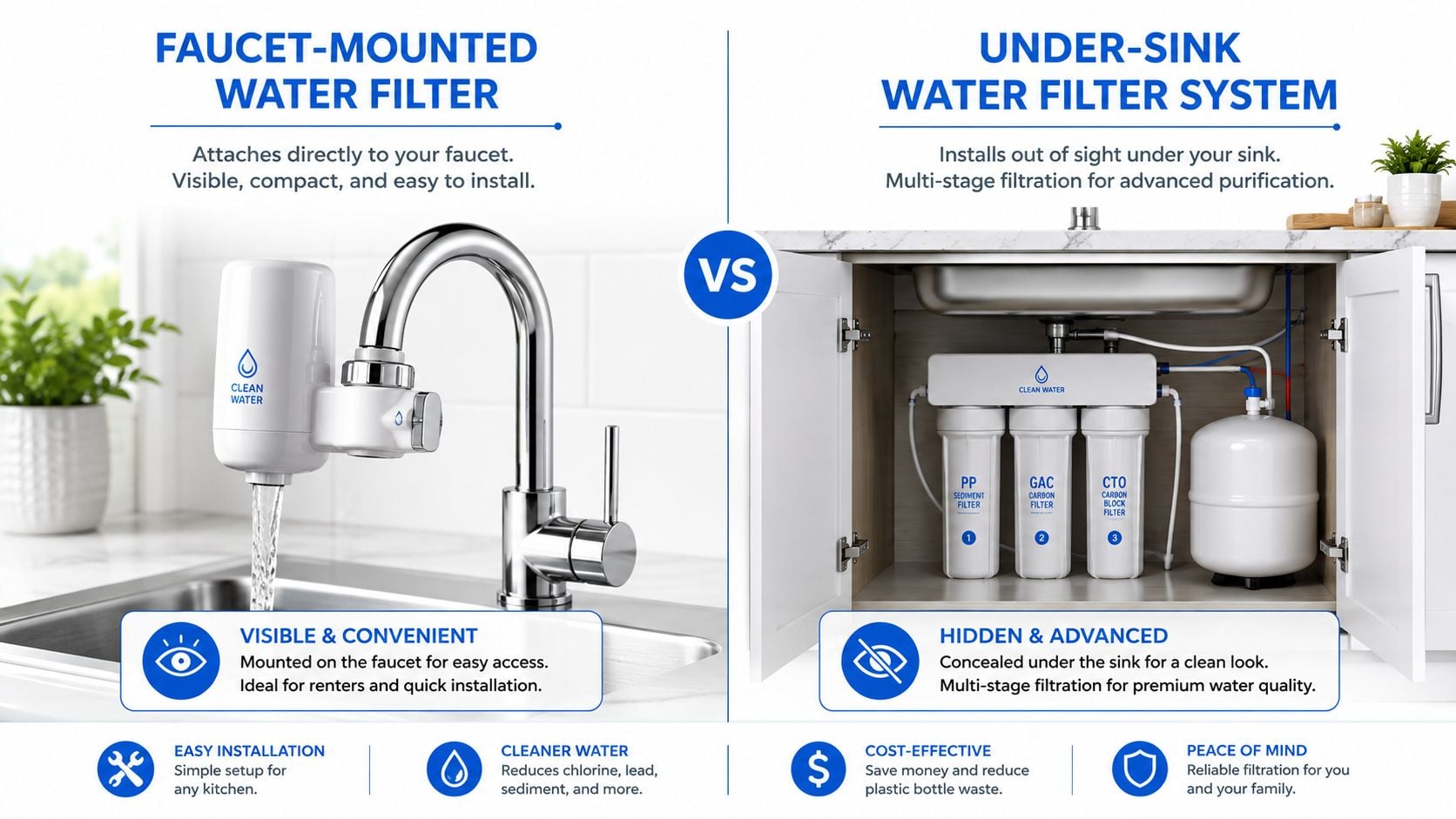
### What each form factor does well
Faucet-mounted filters attach directly to the tap and are the most visible option in the kitchen. They're usually easier to remove, they don't require plumbing changes, and they're a straightforward choice when you want filtered drinking water without committing to a cabinet install. Their main weakness is also obvious once you use one, they're constrained by the faucet's shape, clearance, and existing flow path.
Under-sink filters work differently. They sit below the counter, connect to the cold-water line, and can feed either the existing kitchen faucet or a dedicated drinking-water faucet. They usually offer more room for multi-stage media and better cartridge capacity, but they ask for cabinet space and some installation effort in return. One under-sink option in the supplied product data, the [Woder Sediment Removal and Advanced Dual Filtration System](https://woder.com/products/wd-d-20m-g4-dc/), is described as a U.S.-made under-sink water filter with a 20µ sediment stage and a second stage certified to NSF/ANSI 42 and NSF/ANSI 372.
### Which household fits which setup
A faucet-mounted unit often makes sense for a small kitchen, a short-term living arrangement, or a buyer who wants reversibility. An under-sink system makes more sense when the sink cabinet has room, the household uses a lot of drinking and cooking water, or the family wants less visual clutter on the faucet itself.
That difference matters because the form factor determines the experience before the cartridge ever gets involved. A faucet-mount can be fine for a renter who wants an easy install, while an under-sink setup can be better for a homeowner who wants more hidden capacity and fewer daily compromises. The wrong choice usually isn't about water quality, it's about making your sink harder to live with.
## How Flow Rate Shapes Real-World Performance
### Why faucet filters feel slower
Flow rate is where product pages stop sounding abstract and start affecting daily life. GE's specification chart lists faucet-mount flow at **0.6 gpm**, while a kitchen and bath system is listed at **2.0 gpm** and a high-flow shower system at **2.5 gpm** ([GE Appliances](https://products.geappliances.com/appliance/gea-support-search-content?contentId=22693)). That gap isn't a defect, it's the result of design.
A faucet cartridge has to create enough contact time for treatment, and that slows the water. In plain terms, the media can't work hard and move fast at the same time. That's why faucet filters are usually a better fit for drinking and cooking water than for tasks where you want a strong stream right away.
> Lower flow is often the price of better treatment at the tap. The question is whether your kitchen habits make that trade acceptable.
### Capacity and micron rating change the maintenance cycle
Flow isn't the only number that matters. Capacity and micron rating shape how often you'll be changing cartridges and how much fine material the filter can handle before it needs replacement. In the supplied specification examples, one under-sink model is rated at **2.5 gpm** with **6,000 gallons** capacity and a **0.5 nominal micron** rating, while another is rated at **0.6 gpm**, **625 gallons**, and **0.2 micron** ([HD Supply](https://s3.amazonaws.com/hdsupplyca/hdsupplyca/content/207037_971869.pdf)).
The practical lesson is straightforward. Higher capacity usually means fewer replacements, but tighter filtration and lower flow usually come with more resistance. Those numbers are linked, not separate features you can optimize independently. A cartridge that lasts longer may not be the one that gives you the smoothest faucet feel, and the most restrictive cartridge isn't automatically the right choice either.
### What to compare before you buy
- **Daily use pattern:** If you fill bottles, cook often, or rinse food at the sink, slower flow will feel more noticeable.
- **Replacement rhythm:** A cartridge with a shorter service life may cost you more attention even if the initial install is simple.
- **Sink role:** Drinking-water taps can tolerate a slower stream better than the main prep faucet.
One lab-reviewed comparison listed a faucet model at **0.52 gpm** with **100-gallon** capacity and NSF/ANSI **42, 53, and 401** certification, while another faucet-mount system was listed at **0.30 gpm or less** with **2,000 gallons** and a **6 to 12 month** service life ([Quality Water Lab](https://qualitywaterlab.com/faucet/)). That range shows how different faucet filters can feel in practice even when they all look compact on the shelf.
## Understanding Contaminant Removal and What Certifications Actually Mean
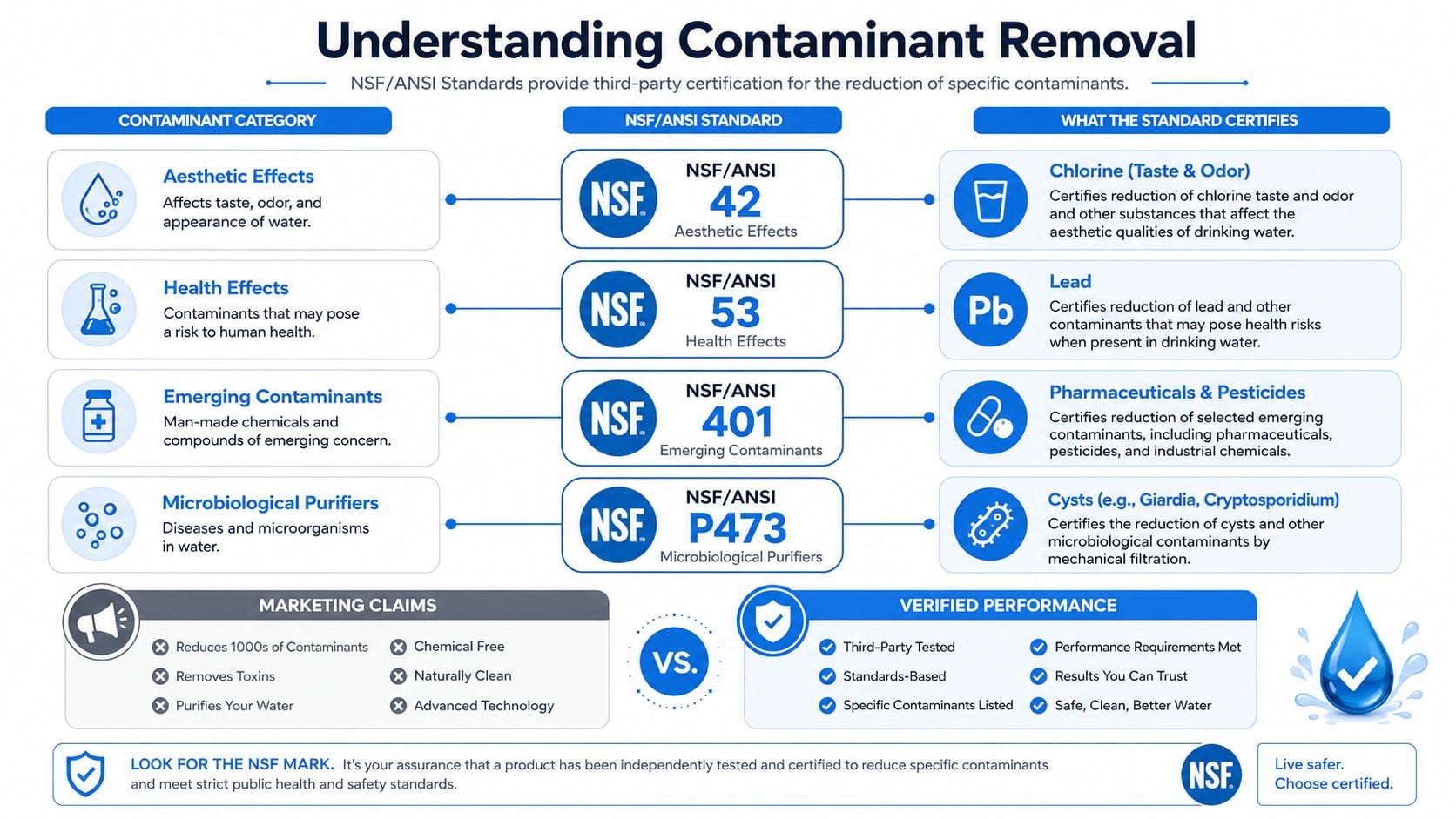
### Certifications tell you what was tested, not everything a label implies
Contaminant claims only mean something when they're tied to a standard that matches the problem you're trying to solve. The CDC's home-filter guidance says consumers should choose a filter based on the specific contaminant they want to address, because no single filter removes everything and the certification has to match the need ([CDC](https://www.cdc.gov/drinking-water/prevention/about-choosing-home-water-filters.html)). That advice cuts through a lot of packaging noise.
In U.S. retail coverage, faucet filters commonly advertise NSF/ANSI **42** for chlorine, taste, and odor, and NSF/ANSI **53** for health-related contaminants such as lead ([CDC](https://www.cdc.gov/drinking-water/prevention/about-choosing-home-water-filters.html)). Some higher-end systems claim reduction of **71 contaminants**, but that statement still only matters if the underlying test standard lines up with the contaminant you care about. A published test summary also describes top faucet models as removing **99% of lead**, which is only meaningful when the certification or test method is identified and verifiable ([CDC](https://www.cdc.gov/drinking-water/prevention/about-choosing-home-water-filters.html)).
### Zero TDS is not the same thing as better drinking water
A lot of shoppers still get misled by a zero-TDS reading. Zero TDS means all dissolved solids are stripped out, both the beneficial minerals and the unwanted contaminants. That's distilled water behavior, not selective drinking-water filtration.
That distinction matters because not every buyer wants mineral-stripped water at the sink. If a system removes contaminants while leaving in naturally occurring minerals, it's serving a different goal than reverse osmosis. The reader doesn't need more jargon here, just a clear filter question, do you want broad stripping, or targeted reduction with minerals left in place?
### How to read the label without getting overwhelmed
- **NSF/ANSI 42:** Look here for taste, odor, and chlorine concerns.
- **NSF/ANSI 53:** Look here when the concern is a health-related contaminant such as lead.
- **Specific contaminant claims:** Treat these as useful only when the certified standard backs them up.
- **Zero TDS claims:** Treat them as a description of what was removed, not proof of purity.
For the alphabet soup behind the standards themselves, the primer at [Woder's NSF and WQA guide](https://woder.com/blog/wqa-nsf-ansi-wth-water-quality-alphabet-soup/) is useful because it keeps the focus on what the certifications mean, not just the badge on the box. That's the part many buyers skip, then regret later.
## Installation Constraints and Renters Compatibility
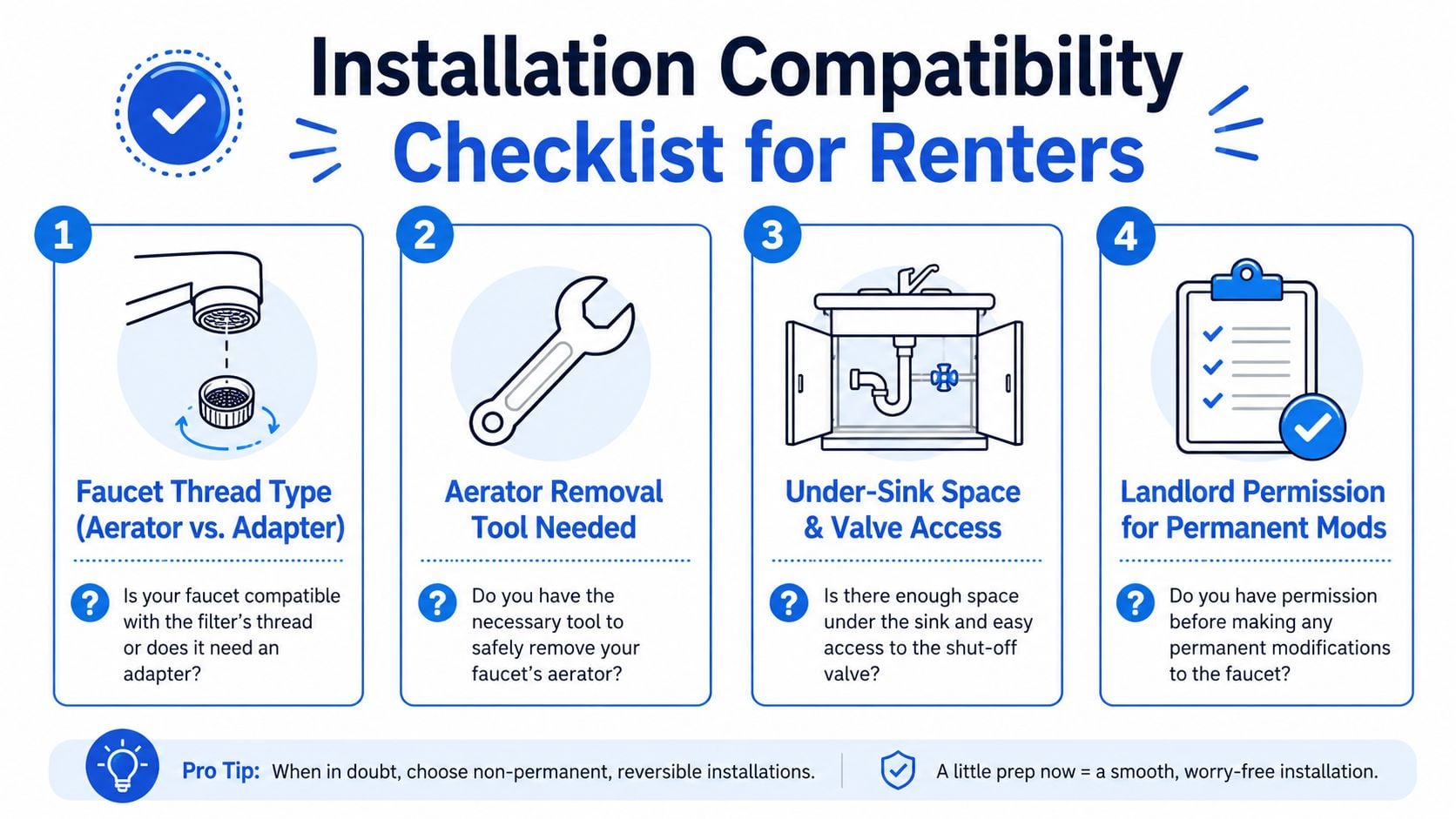
### The first question is fit, not filtration
A filter can be certified and still be a bad fit for your sink. Independent reviews repeatedly note that faucet-mounted filters can clash with sink geometry or create a fixed horizontal body that gets in the way during normal use ([Drinking Water Co.](https://www.drinking-water.co/filter/best/faucet/)). That's why the first question shouldn't be which cartridge removes the most, it should be whether the unit will live comfortably on your faucet.
A lot of shopping guides fall short. They explain contaminant reduction, but they gloss over clearance, swivel range, and the awkwardness of a bulky attachment at the sink. If the filter blocks the spray path, hangs too low, or makes the faucet harder to maneuver, the daily cost shows up immediately.
> If the faucet stops feeling like a faucet, the installation probably wasn't a good match.
### Renters need reversible setups
Renters and apartment dwellers face a different problem. Many under-sink filters assume a dedicated faucet hole or at least minor plumbing changes, while many households don't have that option or don't want to ask a landlord for it ([The New York Times Wirecutter](https://www.nytimes.com/wirecutter/reviews/best-under-sink-water-filter/)). That's why direct-connect and other reversible setups keep showing up in practical buying advice.
A useful checklist is simple:
- **Faucet thread type:** Does your faucet use an aerator that can accept an adapter?
- **Tool access:** Do you have the wrench or removal tool needed to take the aerator off cleanly?
- **Cabinet space:** If you're considering under-sink equipment, is there room for the housing and valve access?
- **Lease limits:** Will your landlord allow a permanent modification, or do you need something that leaves no trace?
The bigger point is that “works in a kitchen” and “works in your kitchen” are not the same thing. If you're comparing replacement options, the practical overview at [Woder's faucet replacement guide](https://woder.com/blog/water-filter-faucet-replacement/) is useful because it centers fit and swap-out realities instead of only talking about filtration media.
## How to Choose a Water Filter for Your Specific Situation
### Match the filter to the household, not the hype
There isn't one correct answer for every home. If you want the highest contaminant reduction capacity and don't mind under-sink installation, a larger point-of-use system is usually easier to live with than a faucet body hanging off the tap. If you're renting or sharing a small kitchen, a reversible faucet-mount or direct-connect setup is usually the cleaner choice.
Water concerns should drive the certification choice. Families focused on lead, PFAS, chromium-6, or fluoride should look for filters backed by health-contaminant standards such as NSF/ANSI **53** or equivalent validation, while households mainly bothered by chlorine taste and odor can focus on NSF/ANSI **42**. That distinction keeps you from paying for claims you don't need.
### Minerals matter to some buyers more than others
The mineral question comes up a lot, and it's worth handling directly. Selective filtration systems remove contaminants while leaving beneficial minerals in place, which is different from reverse osmosis, where the water is pushed toward a stripped-down, low-TDS result. For some households, that's exactly the tradeoff they want. For others, it's more filtration than they need.
If you're selecting fixtures as part of a bigger kitchen update, a practical design guide like [choosing the perfect kitchen fixture](https://www.thecabinetcoach.com/a-guide-to-choosing-the-perfect-kitchen-or-bathroom-fixture/) can help you think about clearance, use patterns, and visual fit before you buy hardware. The sink is a system, and the filter has to work inside that system.
### A simple decision rule
- **Homeowners with cabinet space:** lean toward under-sink systems when flow and longer cartridge life matter more than visible hardware.
- **Renters and apartment dwellers:** favor reversible setups that don't require drilling or permanent mods.
- **Taste and odor concerns:** NSF/ANSI 42 is often the right starting point.
- **Health-related concerns:** look for validated claims tied to the contaminant you're trying to reduce.
If you want a point-of-use system that removes contaminants while keeping the setup focused and straightforward, Woder offers under-sink and inline filtration built around selective filtration and U.S. manufacturing. Visit [Woder Filters](https://woder.com) to compare options, check fit, and decide whether your faucet setup calls for selective filtration or a different point-of-use layout.
**Categories:** Woder Science
**Tags:** faucet water filter, point of use filter, under-sink filter, water filter for faucet, water filtration guide
---
### [Arsenic in Drinking Water: How It Gets There and What Filter to Use in 2026](https://woder.com/blog/arsenic-in-drinking-water-how-it-gets-there-and-what-filter-to-use-in-2026/)
**Published:** August 4, 2026
**Author:** woder
**Content:**
- [Where Arsenic Comes From](#where-arsenic-comes-from)
- [Natural Sources](#natural-sources)
- [Industrial and Agricultural Sources](#industrial-and-agricultural-sources)
- [Municipal vs. Well Water](#municipal-vs-well-water)
- [Health Risks of Arsenic Exposure](#health-risks-of-arsenic-exposure)
- [How to Know If Your Water Has Arsenic](#how-to-know-if-your-water-has-arsenic)
- [What Filter Types Actually Remove Arsenic](#what-filter-types-actually-remove-arsenic)
- [Reverse Osmosis](#reverse-osmosis)
- [Activated Alumina](#activated-alumina)
- [Ion Exchange (Anion Exchange)](#ion-exchange-anion-exchange)
- [Advanced Selective Filtration](#advanced-selective-filtration)
- [Choosing the Right Filter for Arsenic in 2026](#choosing-the-right-filter-for-arsenic-in-2026)
- [A Note on Filter Certifications](#a-note-on-filter-certifications)
- [What You Can Do Right Now](#what-you-can-do-right-now)
- [Frequently Asked Questions](#frequently-asked-questions)
Arsenic doesn't announce itself. No taste, no smell, no color. You can drink water that contains it for years without any indication something is wrong. That's what makes it one of the more serious contaminants in US drinking water — and one worth understanding before you choose a filter.
This article covers where arsenic comes from, how it ends up in tap water, what the health risks actually look like, and which filter types genuinely remove it.
### Where Arsenic Comes From
Arsenic is a naturally occurring element found in soil and rock throughout the earth's crust. Industrial pollution can make things worse, but it doesn't need to be present for arsenic to show up in your water.
#### Natural Sources
As groundwater moves through rock formations, it picks up arsenic along the way. This is especially common in parts of the western United States, New England, and the upper Midwest, where certain geological formations slowly release arsenic into aquifers. Private wells drawing from these aquifers are particularly vulnerable — they aren't subject to the same federal monitoring requirements as municipal systems.
#### Industrial and Agricultural Sources
Mining operations, smelters, and coal-burning power plants release arsenic into the surrounding environment. Pesticides used in agriculture historically contained arsenic compounds, and residues can persist in soil for decades, eventually leaching into groundwater. Pressure-treated lumber manufactured before 2004 used chromated copper arsenate, which can contaminate soil near older structures.
#### Municipal vs. Well Water
Public water systems are required to test for arsenic and keep levels below 10 parts per billion (ppb) — the EPA's current maximum contaminant level, in place since 2006. Some systems still occasionally exceed it, and it's worth noting that the 10 ppb threshold is a regulatory compromise, not a declaration of safety. The EPA's own maximum contaminant level goal for arsenic is zero.
Private well owners don't have that safety net. No federal agency tests your well for you. You're responsible for doing it yourself. The US Geological Survey has documented elevated arsenic levels in groundwater across dozens of states, with particularly high concentrations in parts of Nevada, Arizona, California, Maine, and Michigan.
### Health Risks of Arsenic Exposure
Long-term arsenic exposure is linked to serious health outcomes. The most well-documented include:
- **Bladder, lung, and skin cancers** from chronic exposure
- **Cardiovascular disease**, including increased heart attack risk
- **Neurological effects**, particularly in children, where arsenic exposure has been associated with lower IQ scores and developmental delays
- **Skin changes**, including darkening and lesions, at higher exposure levels
The risk is cumulative. Drinking water at 5 ppb for ten years is a very different exposure profile than drinking it for one year. That's why the filter you use at home matters more than any single test result.
### How to Know If Your Water Has Arsenic
The most direct step is testing. For municipal water, your utility publishes an annual Consumer Confidence Report (CCR) listing detected contaminant levels. You can usually find it on your utility's website or request it directly.
For well water, you'll need an independent test. A certified lab can test specifically for arsenic, or you can order a broader panel covering multiple contaminants at once. Many county health departments can point you toward certified labs in your area.
If you're in a region with known arsenic geology, testing isn't optional — it's the only way to know what you're actually dealing with.
### What Filter Types Actually Remove Arsenic
Not every filter removes arsenic, and this is where a lot of homeowners get tripped up. A standard carbon block filter does an excellent job on chlorine, chloramines, and some volatile organic compounds, but it won't meaningfully reduce arsenic.
Here's how the main filter categories perform:
#### Reverse Osmosis
RO systems are effective at removing arsenic, particularly arsenic V — the oxidized form. They force water through a semipermeable membrane that blocks most dissolved solids. The tradeoffs are real, though: RO systems typically waste 3 to 4 gallons for every gallon filtered, require a pressurized tank and drain line, and strip out beneficial minerals like calcium and magnesium along with the contaminants. Installation usually requires a plumber and runs $300 to $600 or more. The output is demineralized water, which many people find flat-tasting.
#### Activated Alumina
Activated alumina filters are specifically designed for arsenic removal and work well for both arsenic III and arsenic V. They're used in whole-house and point-of-use setups alike. Flow rate tends to be slower than other filter types, and the media needs periodic replacement.
#### Ion Exchange (Anion Exchange)
Anion exchange resins can remove arsenic V effectively by swapping arsenic ions for less harmful ones. These systems are often paired with other filtration stages and appear more commonly in whole-house setups than in consumer-grade under-sink products.
#### Advanced Selective Filtration
This is where [Woder](https://woder.com) fits in. Woder's proprietary Advanced Selective Filtration uses nanoparticles that attract and bind specific contaminants — including heavy metals and carcinogens — while leaving beneficial minerals intact. Unlike RO, it doesn't strip everything out indiscriminately. Calcium and magnesium stay in your water. There's no wastewater output, no pressurized tank, no drain line. Installation is inline, connects directly to your existing water line, and takes about 30 minutes without a plumber.
For homeowners who want arsenic removal without the cost and complexity of a full RO system — and without sacrificing the minerals that make water taste right — selective filtration is a practical middle ground.
### Choosing the Right Filter for Arsenic in 2026
A few questions help narrow the choice before you buy:
**What's your arsenic level?** Water testing at 2 ppb calls for a different approach than water testing at 15 ppb. Higher concentrations may warrant a more aggressive removal method.
**Is it arsenic III or arsenic V?** Arsenic V is more common in oxygenated surface water and easier to remove. Arsenic III, found more often in groundwater, is harder to capture with some filter types. If you're on a well, this distinction matters. Pre-oxidation — adding chlorine or another oxidant before filtration — converts arsenic III to arsenic V, making it more filterable.
**Do you want to keep minerals?** If the taste and health implications of demineralized water concern you, RO may not be the right call. Selective filtration keeps the minerals you want while targeting the contaminants you don't.
**What's your installation situation?** Renters and homeowners who'd rather not call a plumber benefit from inline filter systems that connect to an existing water line without permanent modification. Woder's models — including the WD-10K-ADV-PORT and WD-D-8K-FRM-ADV-DC — are designed for exactly this kind of setup.
**What's your budget?** A full RO system with installation runs $300 to $600 upfront. A quality under-sink selective filter sits in the $80 to $200 range, with replacement cartridges running $40 to $80 annually. Over three to five years, the cost difference adds up quickly.
### A Note on Filter Certifications
When evaluating any filter for arsenic removal, look for NSF/ANSI Standard 58 (for RO systems) or NSF/ANSI Standard 53 (for reduction of health-related contaminants). These certifications mean the filter has been independently tested to verify the removal claims on the label. Don't rely on marketing language alone — ask specifically whether the filter is certified for arsenic reduction and at what concentration.
Woder's certified removal claims cover lead, chlorine, chromium 6, mercury, PFAS, carcinogens, and volatile organic compounds. If arsenic is your primary concern, use the product finder at [woder.com/wizard](https://woder.com/wizard) to identify which model fits your household's flow rate and contaminant profile.
### What You Can Do Right Now
1. **Get your water tested.** If you're on a well, order an independent arsenic test. If you're on municipal water, pull your most recent Consumer Confidence Report.
2. **Know your arsenic form.** Ask your lab whether the detected arsenic is primarily arsenic III or arsenic V — it affects which filter technology will work best.
3. **Match the filter to the problem.** A carbon pitcher filter isn't enough. Arsenic requires a filter specifically rated for heavy metal or arsenic removal.
4. **Factor in the full cost.** Installation, ongoing cartridge replacement, and water waste all affect what a filter actually costs you over time.
Once you know what's in your water, choosing the right filter is straightforward.
---
### Frequently Asked Questions
**Does a standard Brita or carbon pitcher filter remove arsenic?**
No. Standard activated carbon filters, including most pitcher filters, are designed for chlorine, taste, and odor — not arsenic. If arsenic is a concern, you need a filter specifically rated for arsenic or heavy metal reduction.
**What is the safe level of arsenic in drinking water?**
The EPA's maximum contaminant level for arsenic in public water systems is 10 ppb. The EPA's own goal, however, is zero — because arsenic is a known human carcinogen. Most health researchers treat 10 ppb as a regulatory threshold, not a safety guarantee.
**Is arsenic more common in well water or city water?**
Both can contain arsenic, but private well water carries higher risk because it isn't subject to federal monitoring requirements. Homeowners with wells are responsible for testing their own water. Municipal systems must test regularly and publish results.
**Does reverse osmosis remove arsenic?**
RO systems are effective against arsenic V, the more common oxidized form, but less effective against arsenic III without pre-treatment. The tradeoff is that RO also removes beneficial minerals, produces wastewater, and requires a more involved installation.
**What is the difference between arsenic III and arsenic V?**
Arsenic III (arsenite) is the reduced form, more common in low-oxygen groundwater. Arsenic V (arsenate) is the oxidized form, more common in surface water and oxygenated systems. Arsenic V is generally easier to remove through filtration. Converting arsenic III to arsenic V through pre-oxidation improves removal rates for most filter types.
**Can I use a Woder filter if arsenic is my main concern?**
Woder's Advanced Selective Filtration targets heavy metals and carcinogens. If arsenic is your primary concern, use the product finder at [woder.com/wizard](https://woder.com/wizard) to identify the right model for your situation and confirm which contaminants each model is certified to reduce.
**How often do I need to replace my filter if I'm filtering for arsenic?**
Replacement frequency depends on your water volume and the specific filter model. For Woder filters, replacement cartridges are available and designed to maintain consistent performance over time. Following the manufacturer's recommended replacement schedule matters — a saturated filter can stop removing contaminants effectively, and in some cases may release previously captured contaminants back into the water.
**Categories:** Woder Science
---
### [Filtered Water vs Purified Water Explained for Homeowners](https://woder.com/blog/filtered-water-vs-purified-water/)
**Published:** August 4, 2026
**Author:** woder_admin
**Content:**
Most advice about water treatment starts with a false choice: **filtered water vs purified water** as if one is the upgraded version of the other. That's the wrong frame. The question is what you want removed from your water, and what you want to keep in it.
A lot of homeowners run into this confusion because the labels sound familiar and the packaging looks confident. But **filtered** and **purified** point to different treatment goals. One usually aims at taste, odor, and selected contaminants. The other aims at broader contaminant removal, often at the cost of stripping out minerals too.
CategoryMain goalTypical effect on mineralsCommon examples**Filtered water**Reduce specific contaminants, improve taste and odorUsually keeps naturally occurring mineralsCarbon filters, sediment filters, selective media**Purified water**Remove a wider range of substancesOften removes most dissolved mineralsReverse osmosis, distillation, multi-stage purification## Table of Contents
- [Why the Labels Confuse Most People](#why-the-labels-confuse-most-people)
- [The shortest useful distinction](#the-shortest-useful-distinction)
- [What Each Category Actually Means](#what-each-category-actually-means)
- [Filtered water](#filtered-water)
- [Purified water](#purified-water)
- [How Each Method Handles Common Contaminants](#how-each-method-handles-common-contaminants)
- [What gets handled well, and what doesn't](#what-gets-handled-well-and-what-doesnt)
- [The Mineral Question Most Comparisons Skip](#the-mineral-question-most-comparisons-skip)
- [Why zero TDS is not the same as better water](#why-zero-tds-is-not-the-same-as-better-water)
- [Side-by-Side at the Kitchen Tap](#side-by-side-at-the-kitchen-tap)
- [What changes in daily use](#what-changes-in-daily-use)
- [Matching the Right Approach to Your Home](#matching-the-right-approach-to-your-home)
- [Three common household situations](#three-common-household-situations)
- [A Practical Decision Framework](#a-practical-decision-framework)
- [The cleanest way to choose](#the-cleanest-way-to-choose)
- [Questions Homeowners Actually Ask](#questions-homeowners-actually-ask)
- [Is filtered water safer than purified water?](#is-filtered-water-safer-than-purified-water)
- [Does bottled water count as purified water?](#does-bottled-water-count-as-purified-water)
- [What does NSF certification tell me?](#what-does-nsf-certification-tell-me)
- [Can a filter replace a purifier?](#can-a-filter-replace-a-purifier)
## Why the Labels Confuse Most People
A filter and a purifier can both sit under your sink, connect to the same cold line, and promise cleaner water. That overlap is exactly why the labels blur together. The words point to different treatment goals, though, and that difference matters if you care more about better taste, less sediment, or much deeper contaminant reduction.
### The shortest useful distinction
**Filtered water** usually means water passed through a medium that targets specific nuisance contaminants, like sediment, chlorine, or certain odors. In plain English, the system is designed to improve the parts of the water you notice first, especially taste and appearance, without trying to strip away everything dissolved in it.
**Purified water** goes further. Water.com describes purification systems as removing **90% to 95% of all contaminants**, including bacteria and viruses, while filtration is described more as improving taste and odor and reducing certain contaminants rather than removing nearly everything, and also notes that purification can remove toxic metals such as lead and copper, plus trace pharmaceuticals (Water.com).
> **Practical rule:** If the main goal is better-tasting water, a filter may be enough. If the goal is broader contaminant reduction, you are in purification territory.
That is the shift in how to read the labels. The question is not which word sounds better. It is what you want the system to remove, and what you want it to leave behind at the tap.
Marketing language blurs that line. One system may do a strong job with chlorine and sediment, another may push dissolved solids much lower, and both may still be sold as “better water.” If you want to judge the category correctly, the label matters less than the treatment method underneath it.
For a fuller look at why **TDS and ppm are not a reliable shortcut for water quality**, see [Woder's explanation](https://woder.com/blog/tds-ppm-rate-is-not-an-effective-indication-of-water-quality/).
## What Each Category Actually Means
### Filtered water
Filtered water is water that has passed through a media designed to reduce **specific contaminants**. In plain terms, that usually means activated carbon, sediment media, or another selective layer that improves taste, odor, and appearance while generally leaving the water's natural minerals in place. If you want the mechanics behind that process, [how water filters work](https://woder.com/blog/how-do-water-filters-work/) gives a helpful plain-English overview.
That is why filtered water often fits everyday drinking and cooking. It changes the water enough to make it more pleasant, but it does not try to strip away everything dissolved in it. For many households, that is the point.
The Woder approach fits this middle ground. [Woder Sediment Removal and Advanced Dual Filtration System](https://woder.com/products/wd-d-20m-g4-dc/) is a U.S.-made under-sink water filter described as combining a 20µ sediment removal first stage with ADV Filtration, with listed performance for lead, PFAS, chlorine, chromium 6, copper, nitrates, chloramines, VOCs, odors, bad tastes, and other contaminants. Its second-stage cartridge is described as WQA certified to NSF/ANSI 42 for chlorine taste and odor and NSF/ANSI 372 for lead-free compliance, which shows how a selective filtration setup can target contaminant reduction without aiming for demineralized water.
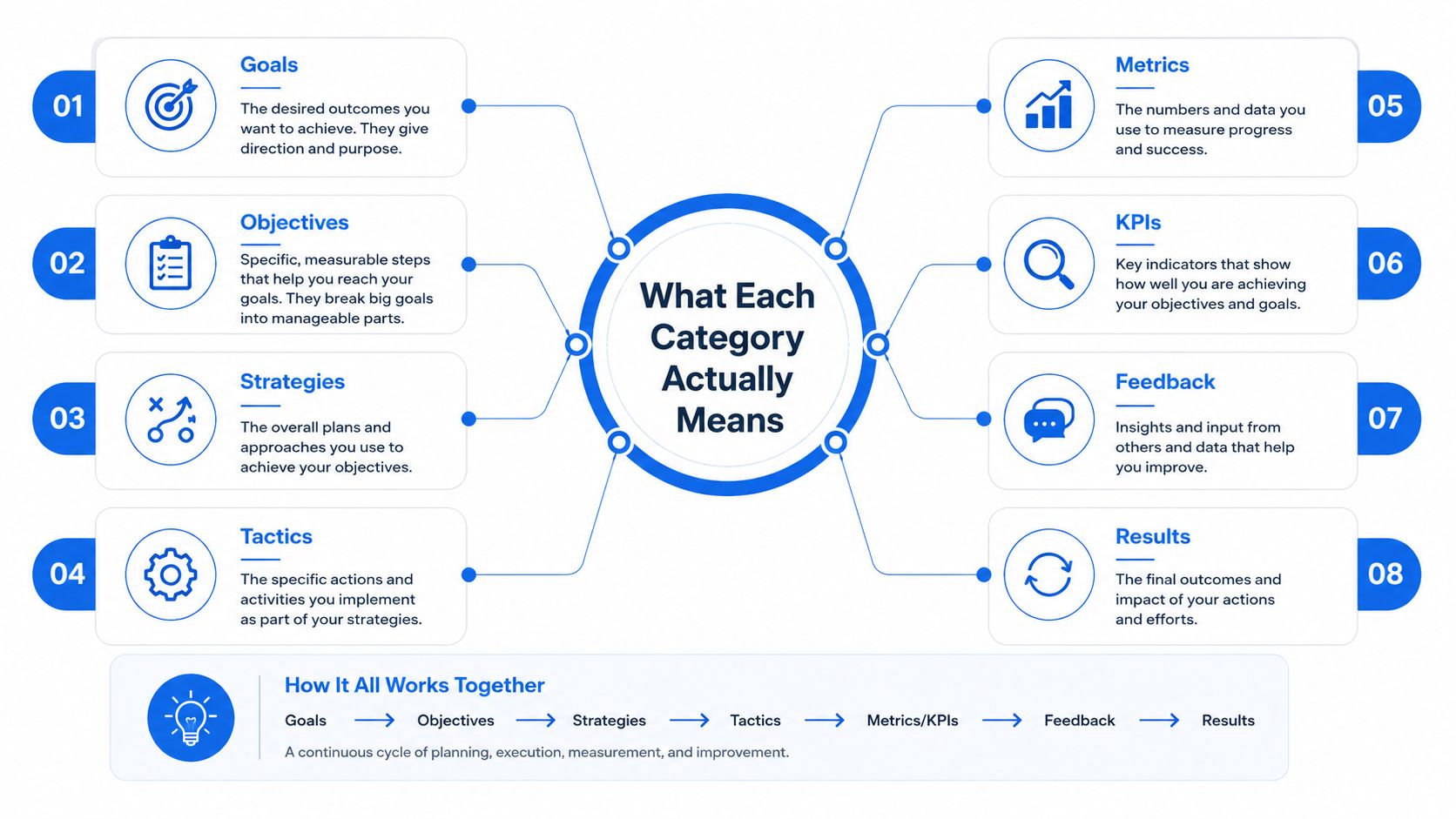
### Purified water
Purified water is a broader treatment category. It can include filtration, distillation, reverse osmosis, disinfection, sedimentation, coagulation, and flocculation, with the goal of removing a wider range of substances including inorganic minerals and organic materials. That broader scope is why purified water is often the term used when someone wants more than taste improvement.
A useful benchmark appears in USP-style usage, where water labeled **purified** must contain fewer than **10 ppm total dissolved solids (TDS)** ([Water Filter Advisor](https://www.waterfilteradvisor.com/purified-vs-filtered-water/)). That does not mean every purifier works the same way, but it gives a reference point for what purification is trying to accomplish. The target is very low dissolved material.
Reverse osmosis is one of the most common purification methods in homes and small offices. Crystal Quest reports that RO blocks **95% to 99% of dissolved contaminants**, including lead, arsenic, PFAS, fluoride, nitrates, microplastics, and most bacteria and viruses ([Crystal Quest](https://crystalquest.com/blogs/health-wellness-home/healthiest-water-to-drink)). That level of reduction is why so many people choose it when their water concerns go beyond chlorine taste or sediment.
If you need a plain-English sentence for the difference, this works: **filtered water reduces selected contaminants while usually keeping minerals, purified water aims for much broader contaminant removal and often removes minerals too**.
## How Each Method Handles Common Contaminants
### What gets handled well, and what doesn't
The confusion usually disappears once you stop asking “Which is better?” and start asking “Which contaminant am I trying to deal with?” A carbon filter can improve chlorine taste and some organic compounds very well, but it isn't designed to do the same job as reverse osmosis on dissolved inorganic contaminants. That's the practical split.
The BBC noted that under-sink reverse osmosis and two-stage filters can remove nearly all PFAS tested, and it also pointed out that water sitting in faucets or under-sink filters overnight can show higher bacterial concentrations, which makes system design and maintenance part of the safety conversation too ([BBC Future](https://www.bbc.com/future/article/20240417-is-filtered-water-healthier-than-tap-water)). That's a good reminder that the label on the box is only part of the story.
Standard filtration is often strong on **chlorine**, taste, odor, and visible sediment. Purification, especially RO or distillation, goes much further on dissolved contaminants such as **lead**, **PFAS**, **fluoride**, and **nitrates**. That's why households worried about multiple contaminant types often end up comparing more than one treatment path before they buy.
ContaminantStandard FiltrationPurification (RO/Distillation)ChlorineOften reduces taste and odor wellAlso reduces it wellLeadMay reduce some forms depending on media, but not the same as purificationStronger reduction, especially with ROPFASSome selective systems perform well, but not all filters doStrong reduction reported for RO and two-stage systemsFluorideUsually not the main strength of standard filtrationRO is commonly used for thisChromium-6Usually not a standard filter's main targetPurification methods are commonly chosen for deeper dissolved contaminant reductionBacteria and virusesDepends on system design, not just the labelPurification systems are more often built for broader removalIf you care about more than one contaminant family, that's where the conversation changes. A basic filter might solve one annoyance and leave the actual concern untouched. A purifier may solve more, but often by taking minerals out too.
For readers who also think about taste in beverages, water choice affects more than drinking straight from the glass. A separate guide on [improve coffee flavour with water](https://ads-coffee-supplies.co.uk/water-filtration-system/) can be useful because mineral content changes extraction, which is one reason this topic shows up so often in kitchens and coffee corners.
## The Mineral Question Most Comparisons Skip
### Why zero TDS is not the same as better water
The easiest mistake to make is treating a low or zero TDS reading like a scorecard for better water. TDS, or total dissolved solids, measures everything dissolved in the water, not just the things people usually worry about. That includes minerals such as calcium and magnesium, which help shape how water tastes and how it behaves in the home.
A zero reading, then, does not mean the water is automatically cleaner in every meaningful sense. It means the water has been stripped of dissolved material, the helpful parts and the unwanted parts together. That is why zero-TDS water sits much closer to distilled water than to ordinary drinking water, and why the meter alone cannot tell you whether the water fits your household needs.
> **Simple takeaway:** TDS tells you how much is dissolved, not whether what is dissolved is a problem.
Purified water is generally associated with very low mineral content because purification is built to remove dissolved material more aggressively than standard filtration. That is the point of the method. It aims for broader reduction, often through reverse osmosis or distillation, so the result ends up with far less of what was originally in the water.
Filtered water usually keeps naturally occurring minerals such as calcium and magnesium in place. That matters because those minerals contribute to taste, and taste is one reason people keep or skip water systems once they start using them. It also matters in the kitchen. Coffee, tea, broth, and dough can all respond differently depending on how much mineral content remains in the water.
If you have ever wondered why one sample looks better on a meter but does not seem better in a glass, the answer is often that the meter is measuring quantity, not quality. A useful plain-English explanation is in this guide on [why TDS PPM rate is not an effective indication of water quality](https://woder.com/blog/tds-ppm-rate-is-not-an-effective-indication-of-water-quality/).
The choice is whether you want a system that keeps minerals while reducing nuisance contaminants, or one that removes a much larger share of dissolved material overall. That tradeoff is easy to miss if the conversation stays stuck on labels.
## Side-by-Side at the Kitchen Tap
### What changes in daily use
The differences show up quickly once water leaves the faucet. Filtered water usually tastes fuller because minerals remain, so it can feel closer to the water people expect to drink every day. Purified water often tastes flatter, which some people prefer and some do not.
Here's the kitchen-table version of the comparison:
Everyday factorFiltered waterPurified waterTasteOften fuller, because minerals remainOften flatter, because minerals are removedOdorCan improve noticeablyAlso improves, usually more broadlyCookingKeeps mineral profile closer to source waterProduces a more stripped-down water profileSystem upkeepUsually simplerOften more involvedWater wasteTypically none in a point-of-use filterRO systems can waste water during treatmentStorageOften direct-to-tapRO setups often use a tankThat makes filtration a common choice when the main issue is chlorine taste or sediment, while purification appeals more when the goal is a deeper reduction in dissolved contaminants. The right answer depends on the water source and the household's priorities.
RO systems also tend to require more maintenance than simple point-of-use filters, and they often need a storage tank. That comes from how the technology works, as explained in [this overview of reverse osmosis water filters](https://woder.com/blog/what-is-reverse-osmosis-water-filter/). In a small kitchen, that difference can matter more than people expect.
> Water that tastes better is water people actually drink.
If you're looking at a kitchen remodel or replacing old fixtures, it helps to treat water treatment the same way you treat sinks and faucets. The practical fit matters. A resource on [bath kitchen project ideas](https://piperplumbing.com/bath-kitchen/) can be useful if you're already planning under-sink space and fixture changes at the same time.
## Matching the Right Approach to Your Home
### Three common household situations
A renter on municipal water who mainly wants less chlorine taste usually has a different need than a homeowner on well water. That sounds obvious, but a lot of shopping overlooks it. The best system is the one that fits the actual water coming into the home, not the one with the broadest-sounding label.
A family with **well water** may care about sediment, taste, and microbiological risk in a way that makes broader purification more appealing. A person on **municipal water** with ordinary taste concerns may only need selective filtration at the tap. A homeowner with documented **PFAS** or **lead** concerns sits between those two, because the issue isn't just flavor, it's the contaminant profile.
That's where selective filtration earns attention. Woder's point-of-use approach, for example, is built around removing contaminants like lead, PFAS, chromium 6, chlorine, and heavy metals while leaving essential minerals in place. That middle ground matters for people who want meaningful contaminant reduction without turning their drinking water into demineralized water.
The bigger lesson is simple. Water treatment is not a ranking contest. It's a fit problem.
Some households also care about installation, U.S. manufacturing, and building-code compliance. Those details don't tell you whether the water is safer by themselves, but they do matter when you want a system that's designed for American homes and plumbing conditions. That's one reason under-sink and inline systems have become so common in everyday use.
If you're narrowing choices, think in this order:
- **Start with your water source:** Municipal and well water bring different issues.
- **Then name the contaminant:** Chlorine, lead, PFAS, fluoride, chromium 6, or something else.
- **Then decide what you want to keep:** Minerals, taste, and water simplicity matter too.
## A Practical Decision Framework
### The cleanest way to choose
There are really three honest paths here. Standard filtration makes sense when you want better taste and nuisance-contaminant reduction. Purification makes sense when you want maximum contaminant removal and you're comfortable with mineral loss and the extra complexity that comes with it. Selective filtration sits in the middle when you want substantial contaminant reduction without stripping out the minerals.
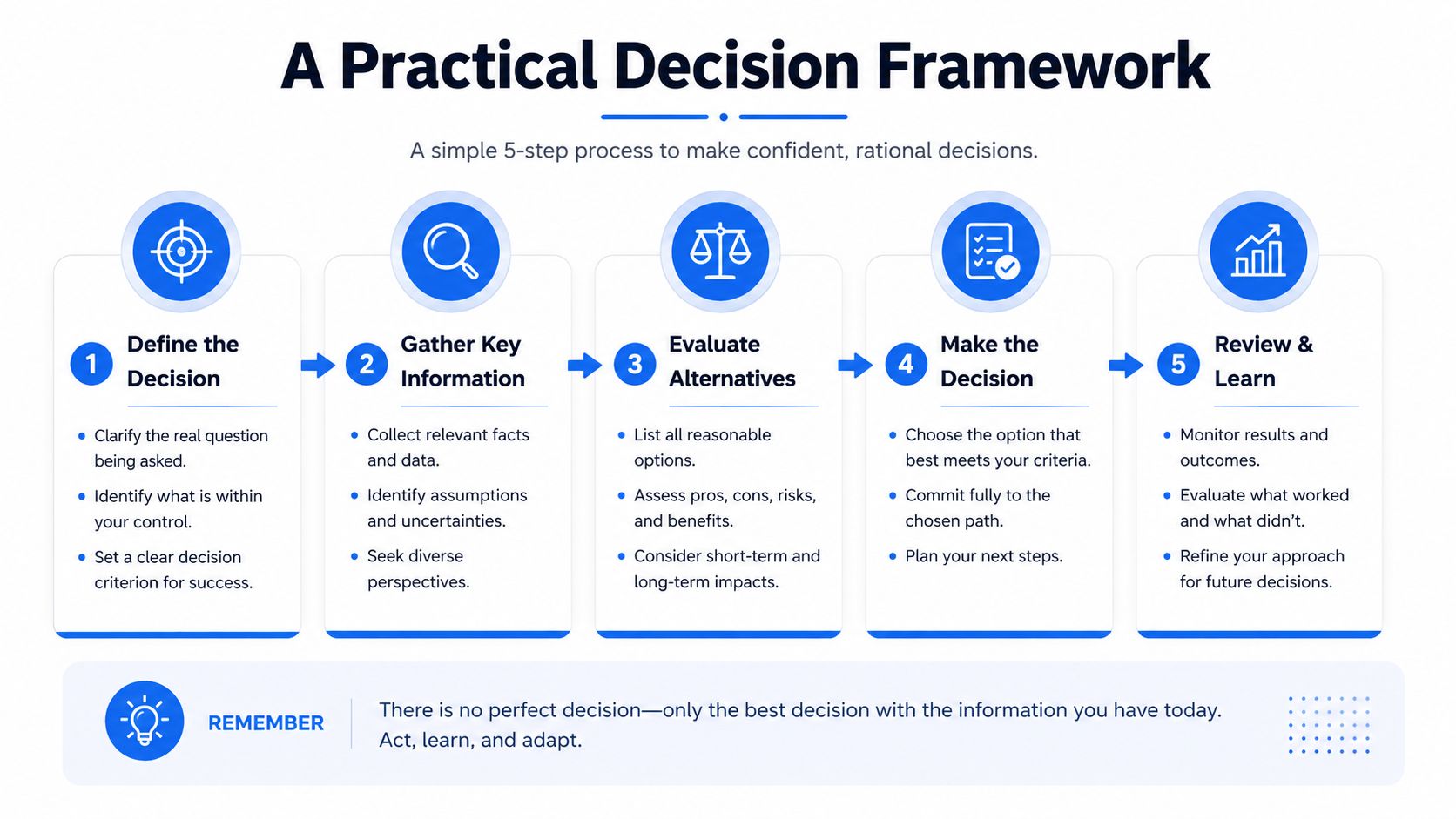
If you want the shortest version, use this:
1. **Choose filtration** if taste, chlorine, and sediment are the main problems.
2. **Choose purification** if your main concern is broader dissolved contaminant reduction.
3. **Choose selective filtration** if you want a strong middle ground, especially for lead, PFAS, chlorine, and similar concerns.
The right answer still depends on your incoming water quality, your plumbing setup, your household size, and how you use water every day. A faucet used mostly for drinking and coffee doesn't need the same setup as a line feeding a whole family's daily cooking and hydration.
> The best system is the one that matches the water you have, not the one with the loudest promise.
That's the useful way to think about it. The label on the box matters less than the treatment goal underneath it.
## Questions Homeowners Actually Ask
### Is filtered water safer than purified water?
Sometimes, but the answer depends on the contaminant and the system, not the label on the package. If the main issue is chlorine taste or everyday nuisance contaminants, filtration may be enough. If the concern is dissolved contaminants like lead, PFAS, or fluoride, purification usually does more.
### Does bottled water count as purified water?
Not automatically. Bottled water can come from different sources and use different treatment methods, so the bottle itself does not tell you much. The process matters more than the container.
### What does NSF certification tell me?
It tells you the product has been tested against a defined standard, which helps move the conversation away from marketing language. The important detail is which standard was tested and what the certification covers.
### Can a filter replace a purifier?
Sometimes yes, sometimes no. If your concern is mainly taste, odor, or selected contaminants, a filter can be enough. If you want broader dissolved contaminant reduction, a purifier is the more direct tool.
---
Woder Filters builds point-of-use systems for homeowners who want to reduce contaminants without stripping away the minerals that keep water tasting like water. If you are comparing filtered water vs purified water for your own home, visit [Woder Filters](https://woder.com) to look at selective filtration options and decide what fits your tap, your water, and your routine.
**Categories:** Woder Science
**Tags:** contaminants, filtered water, home water filter, purified water, water filtration
---
### [How to Read Your Water Quality Report in 2026: A Plain-English Guide](https://woder.com/blog/read-water-quality-report/)
**Published:** August 3, 2026
**Author:** woder
**Content:**
- [What Is a Water Quality Report?](#what-is-a-water-quality-report)
- [Where to Find Your Report](#where-to-find-your-report)
- [The Key Sections and What They Mean](#the-key-sections-and-what-they-mean)
- [Source Water Information](#source-water-information)
- [Detected Contaminants Table](#detected-contaminants-table)
- [Understanding MCLG vs. MCL](#understanding-mclg-vs-mcl)
- [Contaminants Worth Reading Carefully](#contaminants-worth-reading-carefully)
- [The "Likely Source" Column](#the-likely-source-column)
- [Violations and Notices](#violations-and-notices)
- [What the Report Doesn't Tell You](#what-the-report-doesnt-tell-you)
- [What to Do If You See Something Concerning](#what-to-do-if-you-see-something-concerning)
- [Choosing a Filter Based on What You Find](#choosing-a-filter-based-on-what-you-find)
- [FAQs](#faqs)
Your water utility mails you a report every year. Most people glance at it, decide it looks like a tax document, and set it aside. That's fair — it's not exactly designed for easy reading. But your water quality report tells you a lot about what's actually coming out of your tap, and once you know what to look for, it takes about five minutes to get through.
This guide walks you through every section in plain English, so you know what the numbers mean and what to do if something looks off.
### What Is a Water Quality Report?
Every community water system in the United States is required by the Safe Drinking Water Act to publish an annual Consumer Confidence Report, or CCR. Your utility typically mails it in the summer or posts it online. It covers water quality testing results from the previous calendar year.
The report lists every contaminant the utility tested for, the level detected, and the legal limit set by the EPA. That's the core of it.
### Where to Find Your Report
If you haven't received one, check your water utility's website and search for "Consumer Confidence Report" or "CCR." You can also look up your zip code through the EPA's drinking water database. If you're on a private well, no CCR applies to you — you'd need to arrange your own water quality testing independently.
### The Key Sections and What They Mean
#### Source Water Information
This section tells you where your water comes from — a river, reservoir, lake, or groundwater aquifer. Source type matters. Surface water like rivers and lakes typically requires more treatment than groundwater and is more vulnerable to runoff carrying pesticides, industrial chemicals, and PFAS.
#### Detected Contaminants Table
This is the most important part of the report. It usually appears as a table with these columns:
- **Contaminant name** — what was tested
- **MCLG** — Maximum Contaminant Level Goal, the ideal health-based target (often zero for known carcinogens)
- **MCL or AL** — the legal limit (MCL = Maximum Contaminant Level; AL = Action Level, used for lead and copper)
- **Amount detected** — what was actually found in your water
- **Violation** — yes or no
- **Likely source** — where the contaminant probably came from
A "No" in the violation column doesn't automatically mean your water is perfectly clean. It means the detected level fell below the legal limit. Those limits are set based on a balance of health risk and what's technically feasible to remove — not always on what's ideal for your health.
#### Understanding MCLG vs. MCL
The MCLG is the health-based goal. For lead, that goal is zero — no amount is considered safe. But the legal Action Level for lead is 15 parts per billion, because eliminating lead entirely from aging infrastructure isn't always possible.
So when you see lead listed with a detected amount below 15 ppb and "No violation," that doesn't mean lead is absent. It means the level is within the legal threshold. That's a meaningful distinction if you have young children or are pregnant.
#### Contaminants Worth Reading Carefully
Not every line in the table carries the same weight. These are the ones that deserve your attention:
**Lead** — No safe level exists for children. Lead doesn't come from the treatment plant — it enters water through pipes and fixtures in older homes. If your home was built before 1986, pay close attention to this line.
**PFAS (per- and polyfluoroalkyl substances)** — These synthetic chemicals have been linked to serious health effects. As of 2026, the EPA has set enforceable limits for several PFAS compounds. Check whether your report includes PFAS testing — some utilities are still catching up.
**Chlorine and chloramines** — Added intentionally as disinfectants. Legal and generally safe at regulated levels, but they affect taste and odor noticeably.
**Chromium 6** — Both a naturally occurring and industrial contaminant. The MCLG is zero, but current MCLs allow detectable levels. Worth noting if your source is groundwater near industrial areas.
**Nitrates** — Particularly relevant if you have infants. High nitrate levels are dangerous for babies under six months.
**Trihalomethanes (THMs) and haloacetic acids (HAAs)** — These form when chlorine reacts with organic matter in water. They're regulated, but worth watching if your source is surface water.
#### The “Likely Source” Column
This column tells you where a contaminant probably originated — erosion of natural deposits, agricultural runoff, industrial discharge, or aging pipes. It's useful context. Chromium 6 from "erosion of natural deposits" is a different situation than chromium 6 traced to nearby industrial discharge.
#### Violations and Notices
If your report shows a violation, your utility is required to explain what happened and what to do. A treatment technique violation is different from an MCL violation, so read the notice carefully. Boil-water advisories are issued separately and urgently — they don't wait for the annual report.
### What the Report Doesn’t Tell You
Here's something important: the CCR reflects water quality at the treatment plant or at monitoring points in the distribution system. It does not measure what comes out of your specific tap.
Lead is the clearest example. If your home has lead service lines or lead solder in the plumbing, your tap water could have higher lead levels than anything shown in the report. The same applies to older apartment buildings.
If you want to know what's actually in your water at the faucet, a home water quality testing kit gives you a direct answer. Woder offers testing kits at [woder.com](https://woder.com) alongside its filter lineup, so you can test first and filter based on what you actually find.
### What to Do If You See Something Concerning
First, don't panic. Context matters. A detected level below the MCL is different from a violation, and a violation doesn't mean your water is immediately dangerous.
Here's a practical sequence:
1. **Compare the detected amount against the MCLG** — not just whether there's a violation. If the detected amount is above zero for a contaminant with a zero MCLG, like lead or certain PFAS, that's worth acting on.
2. **Think about your household** — Pregnant? Young children at home? Recently moved into an older home? These factors raise the stakes for contaminants like lead and PFAS.
3. **Test your tap directly** — The CCR is a system-wide average. Your tap may tell a different story.
4. **Filter for the specific contaminants you found** — Not all filters remove the same things. A basic pitcher filter handles chlorine taste but won't touch lead or PFAS at meaningful levels.
### Choosing a Filter Based on What You Find
Once you know what your report shows, matching a filter to those contaminants is straightforward. The key is making sure the filter you choose actually removes what you're concerned about.
Woder's Advanced Selective Filtration technology removes 99.9% of contaminants — lead, PFAS, chromium 6, mercury, chlorine, and volatile organic compounds. And it does this without stripping out calcium, magnesium, and other naturally occurring minerals that are good for you. Most filters don't make that distinction.
The filter installs directly into your existing water line under the sink. No plumber, no tank, no wastewater. Built in the United States. If your report flagged lead or PFAS and you want a practical DIY fix, that's the kind of filter worth looking at.
Use the [Woder product Wizard](https://woder.com/wizard) to find the right model for your household's flow rate and needs.
---
### FAQs
**Where do I find my water quality report?**
Your water utility is required to mail it annually, typically in the summer. You can also find it on your utility's website or by searching your zip code through the EPA's drinking water database. If you're on a private well, no CCR applies — you'll need to arrange independent water quality testing.
**What does "no violation" mean on a water quality report?**
It means the detected level of a contaminant fell below the legal limit set by the EPA. It does not mean the contaminant is absent. For contaminants like lead, where the health-based goal is zero, a "no violation" result can still include a detectable amount.
**Does my water quality report show what comes out of my tap?**
Not exactly. The report reflects water at the treatment plant or distribution system monitoring points. Lead, in particular, often enters water through household plumbing and fixtures — not from the source. Testing your tap directly with a home water testing kit gives you a more accurate picture.
**What contaminants should I look for first?**
Lead, PFAS, chromium 6, and nitrates deserve close attention because their health-based goals are zero or near zero. Chlorine and chloramines are regulated and generally safe but affect taste. Trihalomethanes and haloacetic acids are worth noting if your source is surface water.
**Do water filters remove everything listed in the report?**
It depends on the filter. Basic carbon pitcher filters handle chlorine taste but aren't effective against lead or PFAS. Under-sink filters using selective filtration technology — like those from Woder — remove 99.9% of serious contaminants including lead, PFAS, and chromium 6, while keeping beneficial minerals intact.
**How often should I read my water quality report?**
Once a year when it's published. Also check it after any local news about water contamination, after moving to a new home, or if you notice a change in your water's taste or odor.
**What if my report shows a violation?**
Your utility is required to notify you and explain what happened. Read the notice carefully to understand the specific contaminant, the level detected, and any recommended actions. If the violation involves lead, PFAS, or a pathogen, follow the utility's guidance promptly and consider independent tap testing.
---
Your water quality report gives you real information. Most people never read it. Now you know how to. Start with the detected contaminants table, compare the amounts against the MCLGs, and think about what matters most for your household.
If you want to go further, test your tap directly and filter for what you find. It's your water — you should know what's in it.
**Categories:** Woder Science
---
### [The Woder Way](https://woder.com/blog/the-woder-way/)
**Published:** May 9, 2026
**Author:** woder
**Content:**
Woder – Oak Magazine Feature Inspired by Oak Magazine · Brand Feature
# The Woder Way
A conversation about clean water, selective filtration® and the ‘slow water’ idea — and why gravity may hold the key to the future of modern filtration. Woder Filters founder Idan Granit lays out his vision.
What does it mean to truly own your water? Woder’s founder answers ten questions — from the grandmother who sparked the mission, to the technology redefining what “clean” really means.
1## In your own words, what is your company and what problem does it solve, or what experience does it create, that wasn’t being addressed before you entered the market?
Woder started with a conversation between me and my grandmother Rivka. She was a survivor of one of the darkest chapters in human history, and access to clean water was never something she took for granted after that experience. When I was finishing university and thinking about what to do with my life, she was the one who made me see that making clean water accessible to people was something worth doing.
The problem we set out to solve was much bigger than just filtration itself. The U.S. water filter market is crowded, confusing, and misleading. We found that brands were tested to insufficient standards, excessive technical information served to overwhelm rather than inform, and there were too many promises that didn’t hold up. Because of these issues, consumers are often left navigating a maze, unsure which filter addresses their specific needs. Woder cuts through that noise. We make the right information accessible, ensure every product is properly tested, certified, and compliant with U.S. building codes, and we stand behind a simple promise: you get exactly what you’re looking for.
When we started building water filters, TDS (Total Dissolved Solids) meters were one of the most popular devices consumers used to check water quality. The problem with this method, however, is that it cannot tell the difference between beneficial minerals and harmful contaminants because it measures everything dissolved in water equally. Zero TDS simply means distilled water — the kind used in car batteries, not the kind recommended for human consumption. We felt that this must be changed!
At the heart of our technology is Woder® Advanced Selective Filtration™ — a proprietary approach that removes 99.9% of contaminants while preserving the essential minerals your body needs.
Traditional reverse osmosis strips water of both good and bad minerals, while our formula targets impurities while letting healthy minerals pass through. In addition to our selective filtration process, our approach targets the main contamination challenges across the US: PFAS, lead and heavy metals, and fluoride.
2## What principles guide how you develop products? We’re interested in the philosophy behind your decisions around materials, functionality, aesthetics, and sustainability, and how those priorities play off each other.
Most people know a great deal about the food they eat. They typically know where it is grown, how it was raised, and what is in it. Yet when it comes to the water they drink, there’s a striking lack of awareness. Where the water comes from, how it travels to its faucet, and what it picks up along the way is widely unknown. At Woder, we believe this needs to change.
We draw inspiration from the Slow Food movement, which for over two decades has championed the idea that food grown closer to us is better for us and better for the planet. We apply that same philosophy to water but call it *slow water*. We believe that tap water should be as crisp and nourishing as spring water, retaining the essential local minerals that nature intended it to carry. And just as the Slow Food movement returned the ownership of food back to the individual and the community, we believe the same should be true for water.
We registered the trademark It’s Your Water®® — because we mean it literally. You are the owner of your water and it is your choice and responsibility for how it’s filtered and treated.
For us, the filtration mechanism inside the cartridge is paramount. That’s what sets us apart, and it’s the area we invest in the most. The rest of the system, including the housing, the fittings, and the form, specifically exist to ensure it fits your plumbing and that the water flows properly. We don’t over-engineer or add complexity for the sake of aesthetics. We believe that every element should earn its place.
Woder® Advanced Selective Filtration™ focuses on doing one thing exceptionally well: giving you water that is clean, mineral-rich, and truly yours.
3## How would you describe the person you designed this product for? What are they looking for, and why do existing options fall short for them?
We designed our product for everyday American homeowners. For the people who are health-conscious and want to know that the water coming out of their tap is safe to drink, but who are also overwhelmed by too many options and unclear guidance.
The way I think about it is simple: I imagine my father is the one shopping for a water filter. I know he would be willing to put in the effort to find the right one, but I also know he might become overwhelmed with the abundance of options, technical information, and confusing installation instructions. This image drives not only the design of our product, but the design of the entire experience around it. We believe when looking for a product, the information must be clear enough for people to make the right choice with confidence, and the installation must be straightforward enough for customers to handle it on their own.
4## What specifically sets this product apart from the alternatives a well-informed buyer would be comparing it against? Skip the marketing language here. We’re after the honest, real-world differences.
The most common alternative is a reverse osmosis (RO) system. RO systems focus on achieving low or zero TDS levels in water. While they do deliver great filtration and produce noticeably clearer ice cubes, it comes at a cost. RO strips both beneficial minerals and harmful contaminants from the water. The result is natural water in the laboratory sense, but not in the sense that matters for daily human consumption. RO systems are expensive, demanding to maintain, and waste a significant amount of water in the process.
Woder does not strive to produce low or zero TDS water. We believe in our Advanced Selective Filtration™ system and trust it to deliver clean water that also preserves the healthy minerals our bodies need.
Other systems manufactured abroad, mainly in China or Taiwan, may undercut us on price. Those brands also tend to compete on capacity. While some of these systems are very good, the problem is that the cartridge lifespan is not based on a fixed number. It depends almost entirely on the quality of your local municipal water. For example, a system rated for 10,000 gallons in one city may clog within months in another. Advertising capacity without acknowledging this variability can result in an incomplete picture.
Our answer to this uncertainty is to offer a full one-year guarantee for every Woder cartridge. If the cartridge falls short for any reason, we ship a replacement. No questions asked.
5## Tell us about the development process for this product. What were the key decisions, and were there moments where you had to choose one priority over another?
Our earlier generations (Gen 1, 2, and 3) used housings sourced from a third-party supplier. For a time, this arrangement made sense, but when several systems failed, we had to learn a hard lesson: a supplier can walk away from a problem in a way that you, the brand, simply cannot. As a brand, the responsibility lands with you regardless of where the fault lies, and that was not a position we were willing to stay in.
The decision to internally manufacture our housing systems was not cheap, and it took us a couple of years just to match the quality housings of our ex-supplier. But we knew that owning the entire product was the only way to own the outcome and be responsible for it.
6## How does your product line change over time? What drives those updates: technology, customer feedback, market shifts, or something else?
Our original instinct was to focus mainly on our proprietary filtration mechanism within our cartridges. But we believe that building a product that people trust in their homes means being accountable for every component, not just the part you’re most proud of. Every new generation of Woder is focused on how we can improve our systems and make them better for our customers. We value our customer feedback and keep it top of mind while designing all components of future iterations.
7## How do you think about the relationship between price and value in your category? Where does your product sit, and why is that the right position for it?
We believe Woder filters are priced above the category average for good reason. We strive to support American workers and their surrounding communities by fully manufacturing our products in the United States. And we believe our Advanced Selective Filtration system is unmatched.
Our one-year guarantee means our customers are buying a full year of clean water at a fixed price. If the cartridge falls short for any reason (most of the time, it comes down to local municipal water quality), we make it right by shipping a new one with no conditions attached.
When you look at it that way, the question isn’t whether Woder costs more than other options on the shelf. The question is what a year of genuinely clean, mineral-rich water is worth to you and your family. We think the answer is clear (and full of minerals).
8## What does your after-sale experience look like? How do you handle support, feedback, and the ongoing relationship with someone who’s bought from you?
Every purchase is followed by a personal thank you for your business email with installation instructions included. We end the email with the same line every time, “I’ll be here if you need anything.” We never use chatbots or frustrating ticketing systems. We have real team members available to respond to and assist our customers with their every need.
What we’re most proud of is how rarely our customers need to reach out. The vast majority of people who buy a Woder filter never contact us after the sale — and we take that as a meaningful signal. It tells us that our online selection wizard is doing its job, guiding customers to the right product for their specific needs before they buy. It tells us that our product pages are informative enough to answer the questions people have. And it tells us that when the filter arrives, the installation is exactly what we promised: fast, simple, and straightforward.
9## What’s ahead for the brand? New products, new markets, new directions. Anything you can share about where you’re headed?
The next chapter for Woder is built on the idea that the best solutions are the ones that work with nature rather than against it. We’ve been fortunate to find a like-minded local company with best-in-class gravity filtration technology. Gravity naturally filtered water long before technology existed — pulling water through the earth, through layers of mineral-rich rock, producing the kind of fresh, natural spring water we’ve spent years trying to replicate at the tap. This is a direction that feels true to everything Woder has stood for since the beginning: simple, natural, and built to last.
10## Is there something about your brand or this product that you feel rarely comes across in press coverage? Consider this an open floor.
We’re genuinely grateful that Oak Magazine thought to ask not just about what we manufacture, but about the *why* behind what we’re manufacturing.
Woder is a water filtration brand. But moreover, it is a consumer advocacy brand that is committed to the people who buy our products and the people who help us build them. The reason we developed our Advanced Selective Filtration™ system is because we believe that stripping water of everything, beneficial minerals included, is the wrong answer. We believe that water, like food, deserves more attention and respect. And at the heart of that philosophy is something we felt strongly enough about to trademark:
It’s Your Water®® — not as a slogan, but as a belief.
**Woder Water Filtration** · Made in the USA · *It’s Your Water®*
**Categories:** Woder Science
**Tags:** woder filters
---
### [Filter for Chlorine: A Practical Guide for Homeowners](https://woder.com/blog/filter-for-chlorine/)
**Published:** August 3, 2026
**Author:** woder_admin
**Content:**
A glass of tap water can look perfectly clear and still smell faintly like a pool. If you notice that in the kitchen, you're not imagining it, and the water isn't necessarily unsafe. In many homes, that smell is the sign of a disinfectant doing the job it was added to do, then lingering long enough to reach your faucet.
That's why people start looking for a **filter for chlorine**. They're usually not trying to fix a broken water system, they're trying to make everyday water taste and smell better for drinking, cooking, coffee, and ice. The hard part is that “chlorine filter” gets used loosely, and the wrong filter can leave you with the same taste, the same odor, and a lot of confusion.
## Table of Contents
- [Why the Water from Your Tap Sometimes Smells Like a Pool](#why-the-water-from-your-tap-sometimes-smells-like-a-pool)
- [Why the smell shows up at the kitchen sink](#why-the-smell-shows-up-at-the-kitchen-sink)
- [What Chlorine Does in Your Water](#what-chlorine-does-in-your-water)
- [What a homeowner is likely to see](#what-a-homeowner-is-likely-to-see)
- [How Filters Remove Chlorine](#how-filters-remove-chlorine)
- [The main media homeowners run into](#the-main-media-homeowners-run-into)
- [The Chloramine Problem Most Buyers Miss](#the-chloramine-problem-most-buyers-miss)
- [How to find out what your utility uses](#how-to-find-out-what-your-utility-uses)
- [Reading Certifications and Spec Sheets Without Getting Fooled](#reading-certifications-and-spec-sheets-without-getting-fooled)
- [What the other common standards mean](#what-the-other-common-standards-mean)
- [Choosing Between Under-Sink, Inline, and Whole-House Options](#choosing-between-under-sink-inline-and-whole-house-options)
- [Matching the form factor to the use case](#matching-the-form-factor-to-the-use-case)
- [A Simple Framework for Picking the Right Filter](#a-simple-framework-for-picking-the-right-filter)
- [What to Do Next With What You Just Learned](#what-to-do-next-with-what-you-just-learned)
## Why the Water from Your Tap Sometimes Smells Like a Pool
You fill a glass at the kitchen sink, and the first thing you notice is the smell. It may be strongest in the morning, after the house has sat overnight, or right after the utility flushes lines in your neighborhood. That is usually what sends homeowners looking for a **filter for chlorine**, because the water may be acceptable on paper while still tasting and smelling wrong at the tap.
That distinction matters. Chlorine in tap water is usually there on purpose, and it became part of public health practice because it helped reduce waterborne disease at scale. The history matters too, because it explains why removing chlorine is not a rejection of safe water, it is a choice about taste, odor, and how the water feels when you use it every day. Chlorine's modern history as a disinfectant runs from its discovery in **1774**, to identification as an element in **1810**, to first use in a public water supply in **1897** in Maidstone, Kent, and then into routine municipal treatment in the early **20th century**. [NCBI](https://www.ncbi.nlm.nih.gov/books/NBK506911/)
### Why the smell shows up at the kitchen sink
The smell is often easiest to notice where you use water cold and close. Coffee, tea, rice, soup, and ice make it harder to ignore because they do not mask flavor the way juice or a strongly flavored drink might. In practical terms, the problem the average homeowner is trying to solve is **taste and odor**.
> **Practical rule:** if your tap water smells like disinfectant but your utility is treating the supply properly, you are usually dealing with a quality-of-life issue, not a sign that the water system has failed. For a plain-language explanation of why this happens, see [does tap water have chlorine?](https://woder.com/blog/does-tap-water-have-chlorine/)
That is also why chlorine gets discussed differently from contaminants like lead or PFAS. Chlorine is intentionally present in treated water, and Minnesota's Department of Health notes that it keeps protecting water as it moves from the treatment plant to the tap. [Minnesota Department of Health](https://www.health.state.mn.us/communities/environment/water/factsheet/chlorination.html)
If you want a similar example from another everyday water setting, [modern pool water treatment systems](https://poolandlandscapingofvistancia.com/pool-water-treatment-systems/) show the same basic pattern, disinfectant is used to control microbial growth, but the user experience changes when the residual becomes noticeable.
## What Chlorine Does in Your Water
Municipal utilities add chlorine because water doesn't stop moving once it leaves the treatment plant. It travels through pipes, tanks, valves, and pressure changes before it reaches your sink, and disinfectant has to stay active long enough to protect the water on that journey. A simple way to understand it is that chlorine works like a security guard that stays on duty inside the distribution system.
The EPA notes that disinfectants like chlorine played the **largest role** in reducing waterborne disease outbreaks in the early **1900s**. CDC historical material also says that after Jersey City's **1908** adoption of routine disinfection, **thousands** of U.S. cities and towns followed over the next decade. [EPA historical material](https://archive.epa.gov/water/archive/web/pdf/2001_11_15_consumer_hist.pdf) That history is why chlorine is still built into modern public water treatment, and why many utilities continue to rely on it or on chloramine.
### What a homeowner is likely to see
The World Health Organization notes that disinfected drinking water commonly contains free chlorine at about **0.2–1 mg/L**. [WHO](https://www.who.int/docs/default-source/wash-documents/wash-chemicals/chlorine-chemical-fact-sheet.pdf) The exact numbers vary by utility, but the pattern is the same. There is enough residual left to keep water protected as it travels.
That residual is what can produce the taste, smell, or slightly dry feeling people notice at the tap. The EPA limit on chlorine residuals exists for public water systems, and that matters because it confirms the chlorine is being managed, not left to wander unchecked. For many households, the decision to use a **filter for chlorine** starts right there, with the gap between safe water and pleasant water.
Some guides stop at “carbon fixes chlorine,” but the choice is broader. You need to know whether your utility uses free chlorine or chloramine, because standard carbon behaves differently with each one. If you want the basic mechanics behind that difference, see [how water filters work](https://woder.com/blog/how-do-water-filters-work/). That is also why **modern pool water treatment systems** get mentioned in water-treatment conversations, since they show the same basic pattern, disinfectant is used to control microbial growth, but the user experience changes when the residual becomes noticeable.
## How Filters Remove Chlorine
The basic idea is straightforward. Chlorine is small, reactive, and easy for the right media to catch, but the water still needs enough time in the filter for that to happen. So the main performance factors are **contact time**, **flow rate**, and **bed depth**, not just the wording on the box.
Activated carbon removes chlorine mainly through **adsorption** and **catalytic reduction**. In plain terms, the chlorine is held on the carbon surface and also chemically changed as water moves through it. The geometry matters a great deal. Pentair's technical sheet shows that a C2 cartridge is rated for **>9,460 L at 1.9 L/min**, while a longer C1-20 cartridge reaches **>37,850 L at 7.6 L/min** under the same 2 ppm free-chlorine test condition, and the sheet warns that **higher flow rates reduce chlorine removal effectiveness**. [Pentair technical sheet](https://www.pentair.eu/sites/default/files/collaterals/technical_sheet_c_series_acic_cartridges_en.pdf)
### The main media homeowners run into
MediaHow it handles chlorineLeaves minerals in placeKey tradeoffActivated carbonAdsorbs chlorine and helps reduce taste and odorYesNeeds enough contact time, and higher flow weakens performanceCatalytic carbonHandles chlorine and is better suited for tougher disinfectant chemistryYesUsually needs more media or more spaceKDF mediaUses a copper-zinc redox reaction to reduce free chlorineYesOften works best as part of a multi-stage setupSelective filtrationTargets contaminants while retaining mineralsYesPerformance depends on the engineered media, not just the housingReverse osmosisRemoves chlorine as part of a much broader dissolved-solids reductionNoBetter purity, but it changes the mineral profile and needs a different plumbing decisionThat last row is the comparison many homeowners miss. Reverse osmosis removes chlorine, but it does so as part of a much broader stripping process. That makes it a different decision from a point-of-use carbon system or a selective-filtration setup, and it is why people comparing products should not treat all “chlorine filters” as the same thing.
> **Practical rule:** if a filter promises chlorine reduction, look at how much carbon it contains, and whether the flow rating matches the tap or appliance you want to use.
Cartridge size gives another useful clue. Independent product data for a **5 µm, 2.5" × 9 7/8"** cartridge shows a rating of **20,000 gallons at 1 gpm** with **4.0 psid** initial pressure drop, while a shorter **2.5" × 4 7/8"** version is rated for **3,000 gallons** at **2.0 psid**. [CB-series cartridge data](https://images.thdstatic.com/catalog/pdfImages/bd/bda01099-9946-4b45-b48c-1c5e31f5147a.pdf) The lesson is simple. More carbon volume often means longer service life, but it can also mean more pressure drop and a larger cartridge.
If you want a plain-language explanation of filter mechanics, [how water filters work](https://woder.com/blog/how-do-water-filters-work/) is a helpful companion. For sediment-heavy plumbing, [Woder Sediment Water Filter – Dirt, Sand and Dust Removal](https://woder.com/products/wd-20m-dc/) shows the other side of the sizing question, where pre-filtration protects the downstream cartridge from dirt and debris rather than handling chlorine itself.
## The Chloramine Problem Most Buyers Miss
A lot of homeowners think they need a chlorine filter when what they really have is **chloramine**. That matters because chloramine is not the same job for a filter, and a standard carbon block that handles plain chlorine well may leave chloramine behind at the tap. That's one reason people buy something, install it, and still notice disinfectant taste.
Independent guides note the split clearly, plain chlorine can usually be handled by NSF/ANSI 42 carbon filters, while chloramine often needs **catalytic carbon** and more contact time, especially in whole-house or stronger under-sink systems. [Clean Water Critic](https://cleanwatercritic.com/best/best-water-filter-for-chlorine/) Municipal utilities in many major markets use chloramine as a secondary disinfectant, so the question is often not “what filter removes chlorine,” but “what disinfectant is in my water?”
### How to find out what your utility uses
The most reliable place to start is your utility's annual **Consumer Confidence Report**. It should tell you whether the system uses chlorine, chloramine, or both. If you want a quick at-home check, total-chlorine and free-chlorine testing can also show whether combined disinfectant is present, but the utility report is the cleaner first step.
> **Practical rule:** if your tap water still tastes like disinfectant after you install a basic carbon filter, don't assume the filter failed, check whether the utility is using chloramine.
That confusion shows up all the time because “chlorine filter” pages often talk as if all disinfectants behave the same. They don't. Chloramine is used because it lasts longer in distribution systems, but that same stability makes it harder to remove with ordinary carbon alone. For homeowners, this means the right filter starts with the right water report, not with the most confident marketing copy.
## Reading Certifications and Spec Sheets Without Getting Fooled
A filter box can look convincing and still miss the point. For chlorine taste and odor, the most relevant marker is **NSF/ANSI 42**, because that standard is tied to chlorine reduction rather than a broad set of health claims. A filter certified to 42 has to show chlorine reduction under controlled conditions, and the Canadian guideline document says a filter certified to NSF/ANSI 42 should reduce chlorine by at least **50%** from an influent concentration of **2 mg/L**. As noted earlier, that kind of label tells you the filter is built for chlorine, not for every other water issue in the house.
That certification does not mean the cartridge also handles lead, PFAS, or chloramine. Those claims sit under different standards, and sometimes they depend on different media altogether. A clear [WQA and NSF label guide](https://woder.com/blog/wqa-nsf-ansi-wth-water-quality-alphabet-soup/) is useful because it shows why the badge on the package has to match the contaminant, not just the shopper's expectation.
### What the other common standards mean
- **NSF/ANSI 53:** health-related contaminant reduction, used for claims like lead in the right products.
- **NSF/ANSI 401:** emerging compounds, a separate category from basic chlorine taste and odor.
- **NSF/ANSI 372:** lead content compliance in materials, not the same thing as lead removal.
The spec sheet matters just as much as the certification line. Flow rate, micron rating, and cartridge life all work together, and a 5-micron filter that says it removes chlorine can still disappoint if water rushes through too little media. Micron rating mostly speaks to sediment loading, not chlorine chemistry, so a fine particle rating does not automatically mean stronger chlorine reduction.
A long list of contaminant claims is not the same as a good fit for your home. Match the standard, the media, and the flow rate to the water problem you have.
The quickest checklist is straightforward. Confirm the disinfectant, verify the relevant certification, read the flow rating, and check whether the cartridge life assumes your kind of usage. If the spec sheet does not answer those four questions clearly, keep looking.
If you are considering a bigger setup, the replacement side matters too. A [whole house filter replacement guide](https://goodboyfl.com/how-to-replace-whole-house-water-filter/) is useful because a system that is hard to service can become a source of frustration even when the cartridge itself performs well.
## Choosing Between Under-Sink, Inline, and Whole-House Options
Where the filter sits matters as much as what's inside it. For many homes, the right choice is a point-of-use system, not a whole-house system, because most households only want better-tasting water at the kitchen sink or one appliance. Under-sink units are the cleanest fit for drinking and cooking, inline filters are better when the problem is tied to a refrigerator, ice maker, or coffee machine, and whole-house systems make sense when every tap needs the same treatment.
### Matching the form factor to the use case
Under-sink systems give you a dedicated drinking tap and keep the countertop clear. Inline filters are more targeted, which is useful if the fridge water or ice has the chlorine taste, but the rest of the house doesn't need it. Whole-house systems are the broadest option, yet they also bring the biggest plumbing, replacement, and pressure-drop considerations.
That pressure-drop piece gets overlooked. If the filter creates too much resistance at the flow your household uses, the tap feels weak and the system becomes annoying to live with. For a homeowner, that's usually the quiet failure point, not the filter media itself.
If you're thinking about a bigger setup, a practical reference is a [whole house filter replacement guide](https://goodboyfl.com/how-to-replace-whole-house-water-filter/) from Good Boy Plumbing, because replacement access is part of the decision, not an afterthought. A system that's easy to maintain gets used, and a system that gets used is the one that pays off in daily life.
One reason many people move toward point-of-use filtration is that it lets them focus on the taps that matter most. Woder's under-sink and inline systems are built around **Advanced Selective Filtration®**, which removes contaminants like chlorine, lead, chromium, and PFAS while retaining beneficial minerals. That's one coherent path for households that want targeted filtration without turning the whole house into a project.
## A Simple Framework for Picking the Right Filter
The cleanest decision process is straightforward. First, identify whether your utility uses chlorine, chloramine, or both, using the **Consumer Confidence Report** or a quick home test. Second, match that disinfectant to the right media, because carbon that handles chlorine well may not handle chloramine well. Third, verify the certification scope, since **NSF/ANSI 42** covers taste and odor reduction but not every other contaminant under the sun. Fourth, size the filter to the tap or appliance that matters most.
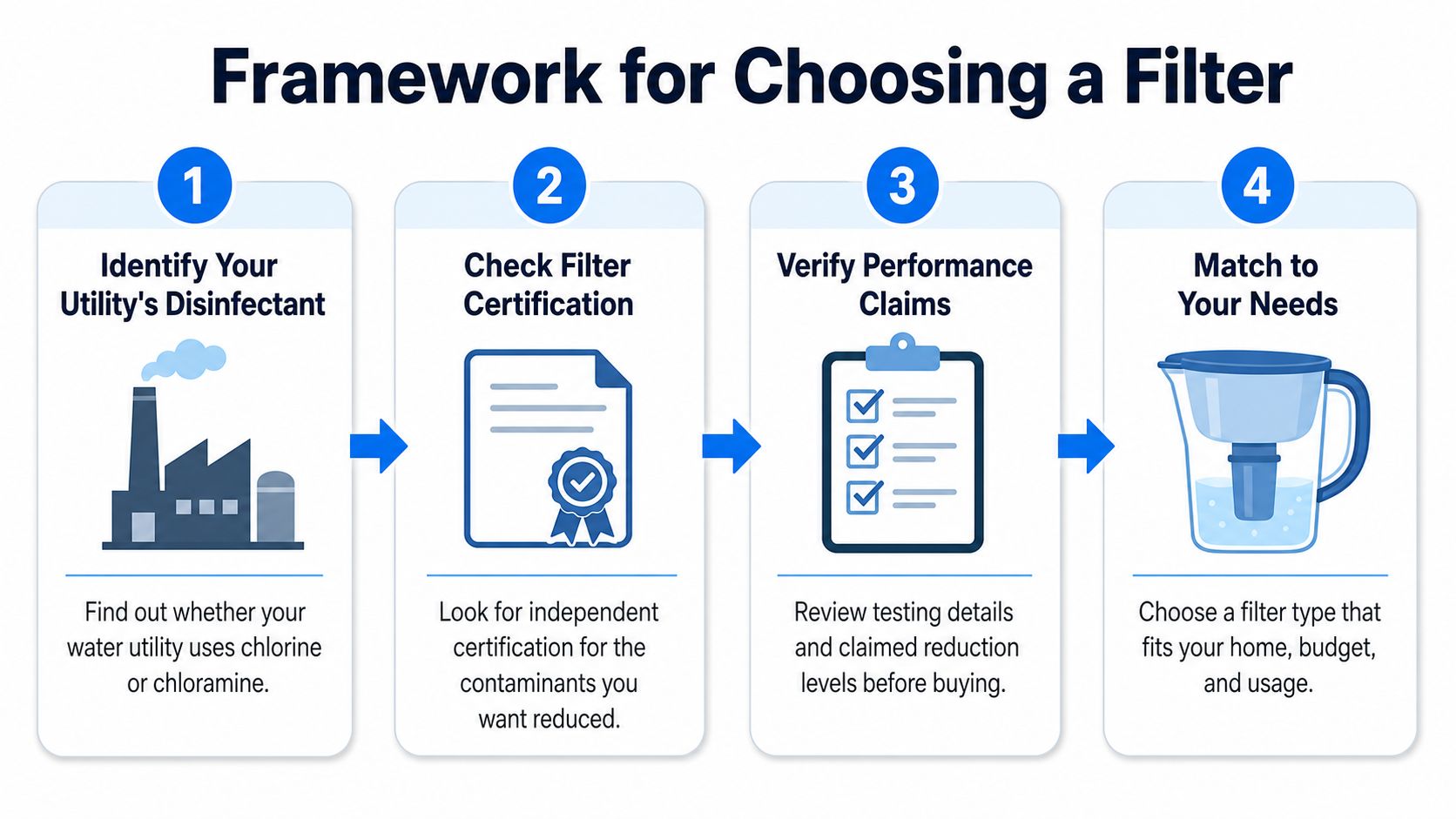
That framework keeps the decision grounded. It also explains why a selective-filtration approach can fit so many households, because it targets the contaminants people want out of their water, including chlorine, while leaving minerals in place. The point isn't to buy the biggest system, it's to buy the one that matches your water report and your tap.
> **Practical rule:** if you know your disinfectant, know your certification, and know your flow rate, you're already ahead of most marketing claims.
## What to Do Next With What You Just Learned
A chlorine smell at the tap usually means the water is being protected, not that your home has a problem. The next step is simple, pull up your utility's **Consumer Confidence Report**, confirm whether you're dealing with chlorine or chloramine, and then compare filters against that specific disinfectant instead of a vague “removes chlorine” claim. That one check changes almost everything about the product you should consider.
If you want a point-of-use path that keeps the decision focused, Woder Filters offers under-sink and inline systems built around selective filtration, so the choice stays tied to your tap, your water report, and the contaminants you care about. It's a calm way to get better-tasting water without overbuying for the whole house. Visit [Woder Filters](https://woder.com) when you're ready to compare options with your own water in hand.
**Categories:** Woder Science
**Tags:** activated carbon filter, chlorine water filter, filter for chlorine, NSF/ANSI 42, point-of-use filtration
---
### [Inline Refrigerator Water Filter: What to Look For and Which Models Actually Work](https://woder.com/blog/inline-refrigerator-water-filter-models/)
**Published:** August 2, 2026
**Author:** woder
**Content:**
- [Why an Inline Filter Makes Sense for Your Refrigerator](#why-an-inline-filter-makes-sense-for-your-refrigerator)
- [What to Look For in an Inline Refrigerator Water Filter](#what-to-look-for-in-an-inline-refrigerator-water-filter)
- [Filtration Certifications](#filtration-certifications)
- [Contaminant Reduction Claims](#contaminant-reduction-claims)
- [Flow Rate Compatibility](#flow-rate-compatibility)
- [Filter Life and Cost Per Gallon](#filter-life-and-cost-per-gallon)
- [Mineral Retention](#mineral-retention)
- [Installation Format](#installation-format)
- [Which Types of Models Actually Work](#which-types-of-models-actually-work)
- [Basic Carbon Inline Filters](#basic-carbon-inline-filters)
- [Multi-Stage Inline Filters](#multi-stage-inline-filters)
- [Selective Filtration Inline Filters](#selective-filtration-inline-filters)
- [What to Skip](#what-to-skip)
- [Installation: What the Process Actually Looks Like](#installation-what-the-process-actually-looks-like)
- [FAQs](#faqs)
- [The Bottom Line](#the-bottom-line)
Your refrigerator's built-in filter does a decent job, but it has limits. Most fridge filters rely on basic carbon blocks that target chlorine taste and odor — and not much else. Heavier contaminants like lead, cysts, or certain industrial chemicals often pass right through. An inline water filter for refrigerator lines addresses this by sitting between your water supply and the fridge, handling filtration before water ever reaches your ice maker or dispenser.
This guide covers what actually matters when choosing one, what to avoid, and which types of models hold up in real use.
---
### Why an Inline Filter Makes Sense for Your Refrigerator
Refrigerators with water dispensers or ice makers connect directly to a cold water supply line. That line delivers unfiltered water straight to the fridge, where the built-in cartridge handles whatever it can.
The issue is that built-in fridge filters are designed for convenience, not thorough filtration. They're typically NSF 42 certified, which covers taste and odor. Most aren't certified to NSF 53 or NSF 58 standards — the ones that cover health-related contaminants like lead, volatile organic compounds (VOCs), and cysts.
Adding an inline filter to the supply line gives your water a proper filtration pass before it even reaches the fridge. You're no longer relying entirely on a cartridge engineered to fit a specific appliance rather than address your local water quality.
---
### What to Look For in an Inline Refrigerator Water Filter
#### Filtration Certifications
Start here. NSF/ANSI certifications tell you what a filter has been independently tested to remove. The key ones:
- **NSF 42** covers aesthetic contaminants — chlorine, taste, and odor
- **NSF 53** covers health-related contaminants including lead, cysts, and certain VOCs
- **NSF 372** covers lead-free materials in the filter housing itself
A filter that only carries NSF 42 isn't doing much beyond improving taste. If you're filtering for health reasons, NSF 53 is the minimum worth accepting.
#### Contaminant Reduction Claims
Read the spec sheet carefully. Some filters list an impressive range of contaminants on the packaging but only reduce them by a small margin. Look for filters that specify the actual percentage reduction for contaminants you care about — not just a vague list of names.
If your municipal water report shows elevated lead, chloramines, or agricultural runoff byproducts, match your filter's verified reduction claims to those specific contaminants.
#### Flow Rate Compatibility
Refrigerator water lines typically run between 30 and 120 PSI depending on your home's supply. An inline filter adds resistance to that flow. If the filter is too restrictive for your line pressure, you'll notice slow ice production and weak dispenser output.
Check the filter's rated flow rate and minimum operating pressure before buying. Most quality inline filters are built for standard residential pressure ranges, but it's worth confirming before you commit.
#### Filter Life and Cost Per Gallon
Inline filters are rated by gallon capacity — typically anywhere from 500 to 2,000 gallons before replacement. A household that regularly uses its ice maker and water dispenser might go through 1 to 2 gallons per day, meaning a 500-gallon filter lasts roughly eight months to a year.
Calculate cost per gallon, not just sticker price. A cheaper filter that needs replacing every four months can easily cost more over a year than a pricier one rated for 1,500 gallons.
#### Mineral Retention
Standard carbon block filters and reverse osmosis systems take very different approaches to filtration. RO systems remove nearly everything — including beneficial minerals like calcium and magnesium. Many people find RO water flat-tasting as a result, and there's ongoing discussion about whether long-term consumption of demineralized water is ideal.
Some inline filters are designed to remove contaminants selectively without stripping out naturally occurring minerals. [Woder Filters](https://woder.com) uses a proprietary Advanced Selective Filtration technology built around nanoparticles that attract and remove specific contaminants while leaving beneficial minerals intact. That's a meaningful distinction if you want filtered water that still tastes like water rather than something distilled.
#### Installation Format
Inline filters come in a few connection styles:
- **Push-to-connect fittings** are the easiest to work with. Cut the existing water line, push each end into the filter housing, and you're done — no special tools beyond a tubing cutter.
- **Compression fittings** take a bit more care but create a very secure connection.
- **Threaded connections** are less common on refrigerator lines but appear on some models.
Most modern inline refrigerator filters use push-to-connect fittings on standard 1/4-inch tubing, which is the most common size for refrigerator supply lines. Confirm your tubing size before ordering.
---
### Which Types of Models Actually Work
#### Basic Carbon Inline Filters
The most common and most affordable option. They handle chlorine taste and odor reliably. If your main concern is water that tastes and smells clean, a basic carbon inline filter does that job well.
They're not the right call if your water contains lead, heavy metals, or other health-related contaminants. Think of them as a taste upgrade, not a health solution.
#### Multi-Stage Inline Filters
These combine different filter media in a single housing — often pairing a sediment pre-filter with a carbon block or similar media. They cover a broader range of contaminants than single-stage carbon filters and are a better fit for households on well water or in areas with older plumbing.
Look for NSF 53 certification on any multi-stage filter you're considering for health-related filtration.
#### Selective Filtration Inline Filters
This is a newer category. Rather than filtering everything indiscriminately, selective filtration technology targets specific contaminants while leaving beneficial minerals in place. Woder's inline filter models fall here, using nanoparticle-based media to attract contaminants without stripping the water of calcium, magnesium, and other minerals that contribute to both taste and health.
For households that want clean water without the flat output of an RO system — and without the complexity of installing a full under-sink setup — this type of filter is worth a close look.
#### What to Skip
Avoid filters with no third-party certifications. Any filter that only cites internal testing or uses vague language like "removes up to 99% of contaminants" without specifying which ones or under what conditions isn't giving you useful information. Certification from NSF International or an equivalent independent body is the baseline for any filter you're trusting with your drinking water.
---
### Installation: What the Process Actually Looks Like
Installing an inline filter on a refrigerator water line is a straightforward DIY job for most people. Here's the general process:
1. Turn off the water supply to the refrigerator
2. Pull the fridge away from the wall to access the supply line
3. Decide where you want to position the filter — usually near the wall or behind the fridge
4. Cut the supply line at that point
5. Connect each cut end to the filter using the included fittings
6. Turn the water back on and check for leaks
7. Run a few gallons through the dispenser to flush the new filter before drinking
The whole job typically takes 15 to 30 minutes. No plumber needed.
---
### FAQs
**What is an inline water filter for a refrigerator?**
An inline water filter connects directly to the supply line feeding your refrigerator. It filters water before it reaches the ice maker and dispenser, adding a layer of filtration beyond what the built-in fridge filter provides.
**Do I still need the built-in refrigerator filter if I add an inline filter?**
You can run both, and some people do. If your inline filter already handles the contaminants you're concerned about, the built-in filter becomes redundant. That said, some refrigerators require a cartridge to be installed for the dispenser to function — even if it's just a bypass cartridge.
**How often do I need to replace an inline refrigerator filter?**
Most inline filters are rated for 500 to 2,000 gallons depending on the model. For average household use, that typically works out to 6 to 18 months. Check the manufacturer's rated capacity and track your usage to know when it's time to replace.
**Will an inline filter slow down my ice maker or water dispenser?**
A well-matched filter shouldn't cause noticeable slowdowns. Problems usually come from a filter whose flow restriction is too high for your home's water pressure. Always check the filter's minimum operating pressure and flow rate specs against your supply line conditions before buying.
**What contaminants does an inline refrigerator filter remove?**
It depends on the filter. Basic carbon filters reduce chlorine, taste, and odor. Filters certified to NSF 53 also reduce health-related contaminants like lead, cysts, and certain VOCs. Selective filtration models like those from Woder target specific contaminants while retaining beneficial minerals. Always check the filter's certified contaminant reduction list.
**Is an inline filter the same as a reverse osmosis system?**
No. A reverse osmosis system uses a membrane to remove nearly all dissolved solids, including minerals. Inline filters use media like activated carbon or selective filtration technology to target specific contaminants. RO systems require more space, produce wastewater, and strip out minerals along with contaminants.
**Can I install an inline refrigerator filter myself?**
Yes, for most standard setups. Filters with push-to-connect fittings on 1/4-inch tubing are designed for DIY installation and don't require special tools beyond a tubing cutter. If your supply line uses an unusual size or material, check compatibility before purchasing.
---
### The Bottom Line
An inline water filter for your refrigerator is one of the simpler, more cost-effective ways to improve your drinking water without overhauling your plumbing. The key is matching the filter to your actual water quality concerns — not just grabbing the cheapest option available.
Look for third-party certifications, verify contaminant reduction claims against what your water actually contains, and pay attention to flow rate compatibility. If keeping beneficial minerals in your water matters to you, selective filtration is worth looking at specifically.
You can explore Woder's inline and under-sink filter models at [woder.com](https://woder.com) to find the right fit for your setup.
**Categories:** Woder Science
---
### [Pleated Sediment Water Filter Guide and Selection Tips](https://woder.com/blog/pleated-sediment-water-filter/)
**Published:** August 2, 2026
**Author:** woder_admin
**Content:**
You can have clear water at the faucet and still have a sediment problem sitting upstream. The clue is often a small one, cloudy water after a hydrant flush, grit after a pump cycle, or a cartridge that seems to clog too quickly even though the water doesn't look terrible. A **pleated sediment water filter** is usually about protecting the rest of the system first, so the more useful question isn't just “what micron rating should I buy,” it's “what kind of particles is my house seeing?”
## Table of Contents
- [Why Sediment Control Is the First Filter Decision](#why-sediment-control-is-the-first-filter-decision)
- [How a Pleated Sediment Filter Works](#how-a-pleated-sediment-filter-works)
- [The parts that matter](#the-parts-that-matter)
- [Pleated vs String-Wound vs Melt-Blown Depth Filters](#pleated-vs-string-wound-vs-melt-blown-depth-filters)
- [Choosing the Right Micron Rating and Housing Size](#choosing-the-right-micron-rating-and-housing-size)
- [When a Pleated Filter Is the Wrong First Choice](#when-a-pleated-filter-is-the-wrong-first-choice)
- [Rinsing, Reuse, and Replacement Economics](#rinsing-reuse-and-replacement-economics)
- [How Pleated Sediment Filtration Fits the Whole System](#how-pleated-sediment-filtration-fits-the-whole-system)
## Why Sediment Control Is the First Filter Decision
A homeowner usually notices sediment at the worst moment, right after work on the water line, after the well pump kicks on, or when a faucet suddenly spits out cloudy water. That's not just a cosmetic issue. Sediment acts like grit in a machine, it wears on downstream filters, clogs refrigerator lines, and settles in water heaters and other fixtures.
The first defense depends on where the particles are coming from. Municipal systems can shed debris after line disturbance, private wells often bring in silt and variable turbidity, and older galvanized piping can release rust and mineral scale as it ages. Those are different problems, even if they all show up as “dirty water.”
A pleated cartridge usually sits at the front of the system, not because it solves everything, but because it protects everything else. If the house is also using selective contaminant media or carbon, the sediment stage keeps those cartridges from loading up too early. That's why sediment control is less about chasing the cleanest-looking water and more about preserving the life and flow of the whole setup.
> **Practical rule:** if the water looks cloudy after a disturbance, start by asking what the particles are, not just how to filter them.
For a plain-language walkthrough of water testing basics, the guide on [how to test your water](https://woder.com/test-your-water/) is a useful starting point. If you're also dealing with hot-water issues, [Big Bear water heater repair tips](https://584hero.com/blog/plumbing/plumbing-replacement/hot-water-dirty-cold-water-clean/) from Bear Valley Plumbing & Heating gives a helpful example of how sediment and system wear can show up at the fixture.
## How a Pleated Sediment Filter Works
A pleated cartridge increases surface area the way an accordion expands, the material is the same, but more of it meets the water at once. That extra face area gives fine silt more places to land, which helps the cartridge hold debris longer in water that is cloudy some days and clearer on others.
### The parts that matter
The media is usually a fine synthetic sheet, often PET polyester in product families described by suppliers. A polypropylene core keeps the cartridge from collapsing under flow, and the end caps seal the element into a standard housing. Those parts may seem minor, but they determine whether the cartridge keeps its shape, keeps its flow, and seats correctly in the filter body.
Pleated elements are surface filters. Particles collect on the outside of the folds, so the cartridge can hold more sediment before flow starts to tighten. That is different from depth-style cartridges, where particles move into the media itself and load through the thickness. The surface approach is why pleated designs are commonly described as having **5 to 10 times** the surface area of standard filters, and one manufacturer notes **up to 300% more surface area** than spun-bond alternatives. That extra area helps lower pressure drop and stretch service intervals. [Source on pleated surface-area design](https://houseoffiltration.com/no/forside/water-filter-elements/)
Micron rating adds another layer. A nominal rating tells you where a cartridge is expected to catch a large share of particles, while an absolute rating is tighter. Industry descriptions in the brief place pleated product families across a broad range, roughly **0.1 μm to 60 μm**, so the design can be matched to very different water conditions. [Product family micron range](https://houseoffiltration.com/no/forside/water-filter-elements/)
Fine silt behaves differently from coarse grit. In water with changing turbidity, the first layer of sediment can spread across the folds instead of packing a single patch, which is why the cartridge often keeps flowing after a small cloud of debris passes through. That behavior is easier to understand once you see how pleated media gives the water more lanes to move through instead of forcing everything onto one small spot. For a plain-language overview of filter flow and cartridge behavior, [how water filters work](https://woder.com/blog/how-do-water-filters-work/) is a helpful reference.
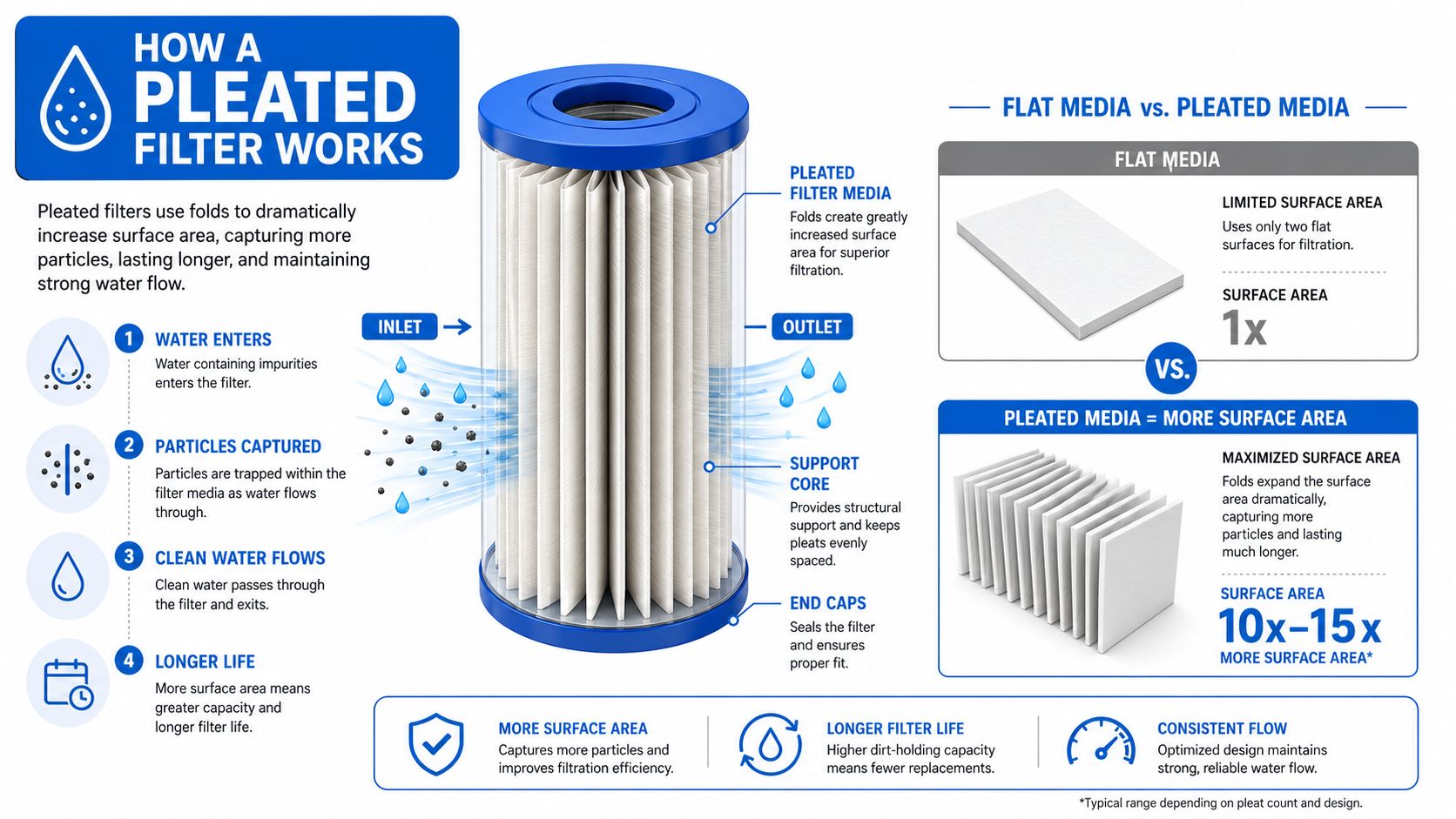
Housing SizeFlow Rate (GPM)Micron RatingsTypical Use2.5 in x 10 in4.46 to 4.721 to 50Under-sink or inline sediment protection4.5 in x 20 in21.08 to 22.001 to 50Whole-house or higher-flow serviceThe housing size changes how the pleats behave in the world. A smaller cartridge suits a compact point-of-use setup, while a larger housing gives more media area for a whole-house system that has to handle a bigger and less predictable sediment load. A catalog example that matches this format is [Woder Sediment Water Filter – Dirt, Sand and Dust Removal](https://woder.com/products/wd-20m-dc/), a U.S.-made under-sink sediment filter described as a **20µ pre-sedimentation** cartridge for dust, dirt, and contaminants.
## Pleated vs String-Wound vs Melt-Blown Depth Filters
Pleated cartridges are usually the easiest to understand because they filter on the surface. That's also why they stay more stable in clean municipal water, where the particle load is modest and the main goal is to preserve pressure. The tradeoff is that the surface can cake over, which changes performance fast once the outside layer starts loading.
String-wound cartridges work differently. They trap particles through the thickness of the media, so the dirty water keeps moving inward while the filter loads. That depth behavior gives them a strong role in harsher well-water conditions, but the pressure drop tends to rise sooner because the cartridge is doing more work inside a tighter structure.
Melt-blown cartridges sit in between on cost and construction. They're made from compressed fibers with graded density, which makes them practical and widely available. They're also the type homeowners often see in cheaper housings, but they usually load faster than a pleated cartridge when the water carries a steady sediment stream.
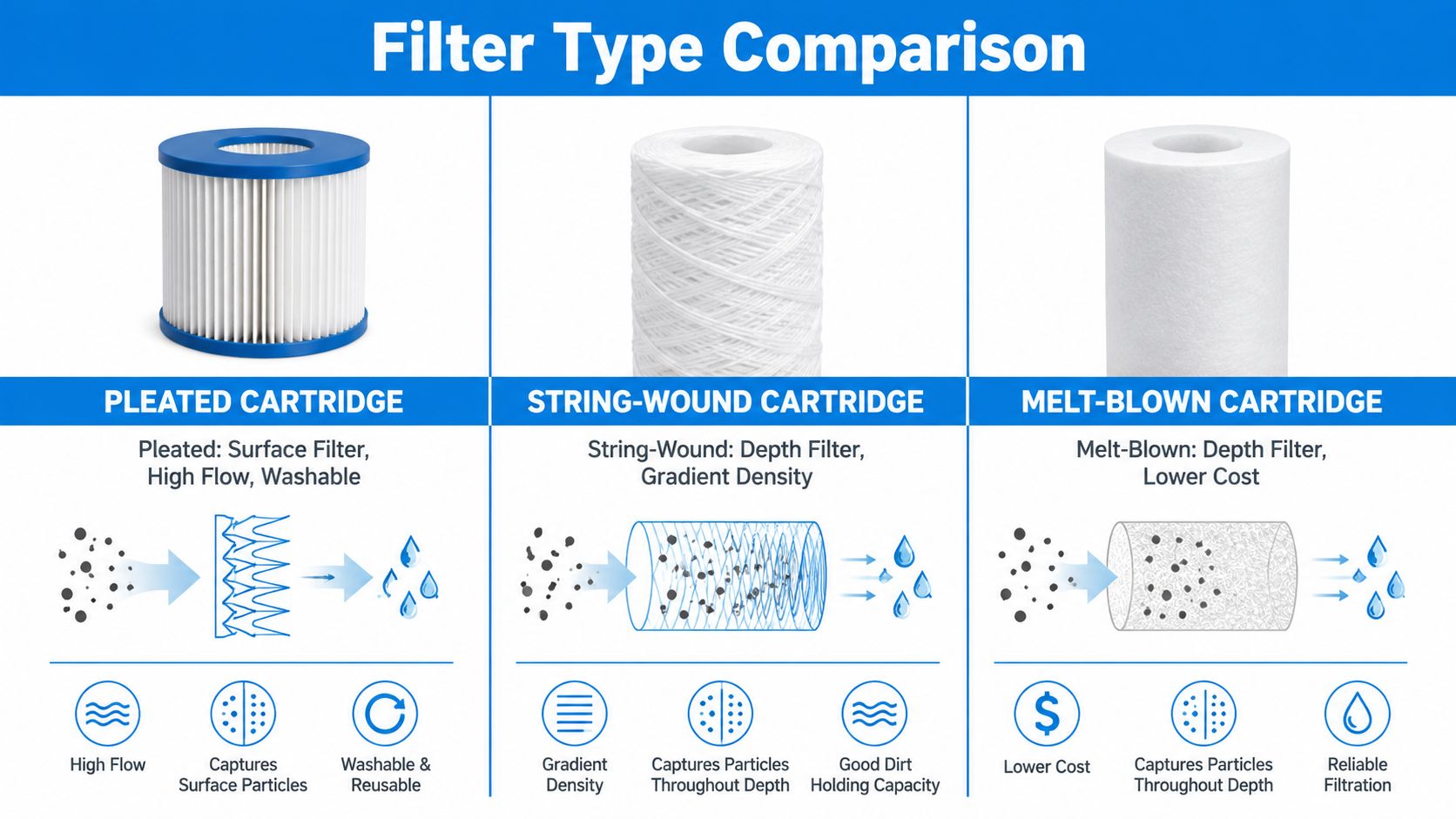
Cartridge TypeHow It Traps SedimentMain StrengthCommon TradeoffPleatedSurface loading on the foldsLower pressure drop, washable in some modelsCan cake over on fine, variable siltString-woundDepth loading through the mediaGood for heavier sediment loadsPressure can fall off fasterMelt-blownGraded-density depth filtrationLower-cost optionLoads quickly in dirty waterThe selection question isn't which one sounds more advanced. It's which one matches the water profile. If the incoming water is mostly light sediment and you care about flow, pleated makes sense. If the water is muddy or highly variable, depth-style cartridges may belong first, with pleated media used later as a polishing stage.
## Choosing the Right Micron Rating and Housing Size
A homeowner usually starts noticing the problem at the tap. The water may leave rust streaks, carry visible sand, or turn cloudy after a storm or a pump cycle, and that is the cue to match the micron rating to the sediment you are dealing with. If the water carries obvious sand or rust, a **50-micron** cartridge is often the starting point. For general downstream protection, **20-micron** is a common middle ground. Finer silt points the selection toward **5-micron**, and polishing applications can go down to **1-micron**.
The cartridge size has to keep pace with that choice. A **2.5 x 10 inch** cartridge fits under-sink and inline installations where space is tight, but it has less media area to spread out the load. A **4.5 x 10 or 20 inch** housing gives the pleats more room to work, which helps when flow demand rises and the cartridge needs more open area to avoid an early pressure drop. Product sheets in the brief show how larger formats support much higher service flow, with flow rates reaching the low 20s GPM in larger housings. [Atlas Filtri pleated cartridge spec sheet](https://us.atlasfiltri.com/index.php/downloads/1755611367_spec-sheet-004-0524-pleatedfilter.pdf)
The operating limits matter just as much as micron rating and size. One product sheet lists a **176°F** maximum operating temperature, **0.45 MPa** maximum feed pressure, and **0.15 MPa** proposed replacement differential pressure. Another Watts cartridge lists a **maximum flow rate of 8.0 GPM**, **maximum temperature of 140°F**, and **maximum capacity of 9,999 gallons** for a **2.5 in x 9.78 in** format. Those limits define where the cartridge can run safely, and they also explain why a fine cartridge in a small housing can feel restrictive at the faucet. [Operating limits and flow example](https://www.watts.com/products/water-quality-rainwater-harvesting-solutions/water-quality-parts-accessories/filter-cartridges/pwpl/pwpl10m20)
> **Decision shortcut:** match the cartridge to the worst particle you can see, then choose the housing that keeps flow steady at peak demand.
For readers comparing tighter polishing stages, [install and maintain a 0 2 micron](https://homeprobadge.com/blog/0-2-micron-filter) shows how quickly expectations change as the rating gets finer. A washable pleated example can also be built for reuse, as shown by the Finerfilters **10-inch standard pleated sediment filter**, which is rated for **160,000 liters / 42,268 U.S. gallons**, with an average flow rate of **0.3 U.S. gallons per minute** and a **6-month** lifespan. [Washable pleated cartridge example](https://www.finerfilters.co.uk/pleated-sediment-water-filter-10-standard)
## When a Pleated Filter Is the Wrong First Choice
Pleated doesn't automatically mean better. In water with fine silt, mixed particle sizes, or biologically active well conditions, the outside of the pleats can build a surface cake fast. The cartridge may still look usable, but flow can drop sharply because the water is being forced through a loaded skin instead of open media.
That's the part many product pages skip. A pleated cartridge can handle large particulate loads well, but it's not always the most forgiving option when the water is messy in a different way. Academic guidance on mechanical filtration notes that pleated cartridges are good at large particulate loads and high turbidity, yet the same surface-cake mechanism can slow flow as particles accumulate. [UGA mechanical filtration guidance](https://fieldreport.caes.uga.edu/publications/B1523/mechanical-filtration-methods-and-devices/)
A chronically muddy well often needs a different first step. A depth-style or gradient-density pre-filter can take the brunt of the load, then a pleated cartridge can polish the water afterward. That sequence is less glamorous than buying the sleekest-looking cartridge first, but it usually fits the water better.
> A filter that lasts longer isn't automatically a filter that works better for your house.
This is the main counterpoint to the usual consumer advice. If the water profile is unstable, sediment type matters more than cartridge style. Pleated media still has a place, just not always at the front of the line.
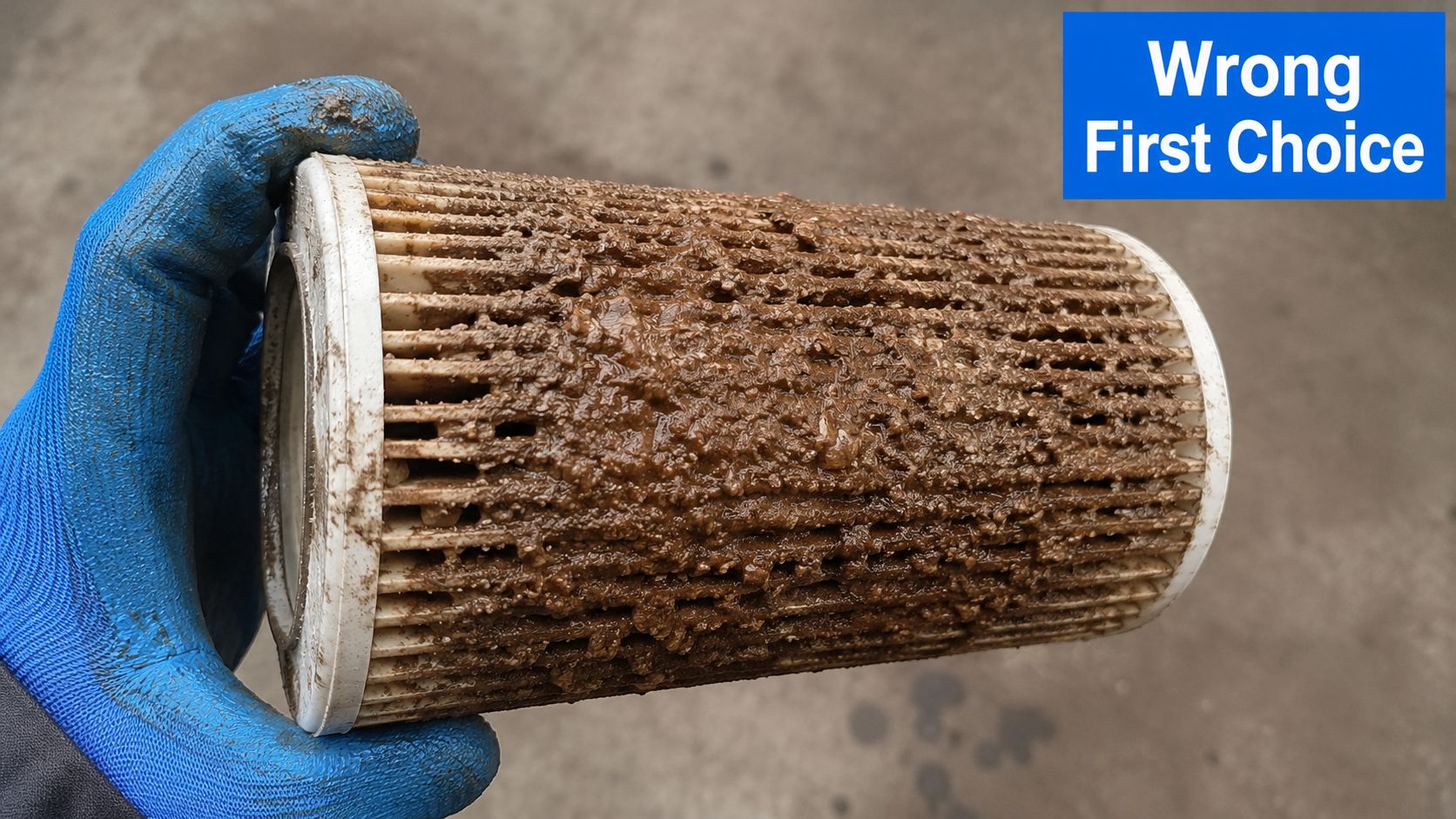
## Rinsing, Reuse, and Replacement Economics
The maintenance question is the one homeowners ask after the first cartridge clogs: rinse it, or replace it. There isn't one universal answer. Manufacturer-support guidance says the number of washes can range from **1 to 14** depending on use, and replacement timing is often tied to pressure drop rather than a fixed calendar date. [Wash-count guidance](https://support.boshart.com/how-many-times-can-i-wash-my-pleated-filter-cartridge)
The practical rule is straightforward. Rinse when the cartridge is loaded with inert sediment like sand, rust, or silt, and the media still looks intact. Replace when the cartridge is discolored, when biological growth is present, or when flow doesn't recover after a rinse. If the water has iron, biofilm, or oily residue, rinse-and-reuse becomes less predictable and replacement is usually the cleaner choice.
The economics change a lot by design. A reusable pleated cartridge can be engineered for far more total service than a disposable one, which is why the same product family can look inexpensive on paper but perform very differently in a real house. The Finerfilters example makes that obvious, a single **10-inch** washable pleated cartridge is described with a **160,000 liter / 42,268 U.S. gallon** capacity and a **6-month** life, which tells you the manufacturer is assuming reuse as part of the maintenance model. [Washable pleated cartridge example](https://www.finerfilters.co.uk/pleated-sediment-water-filter-10-standard)
For a broader replacement discussion, [water filter replacement cartridge](https://woder.com/blog/water-filter-replacement-cartridge/) is a useful companion piece if you're trying to compare upkeep styles across cartridge types. The key is to treat rinsing as a recovery step, not a guarantee. If the cartridge doesn't bounce back, it's telling you the load is beyond what that element should keep taking.
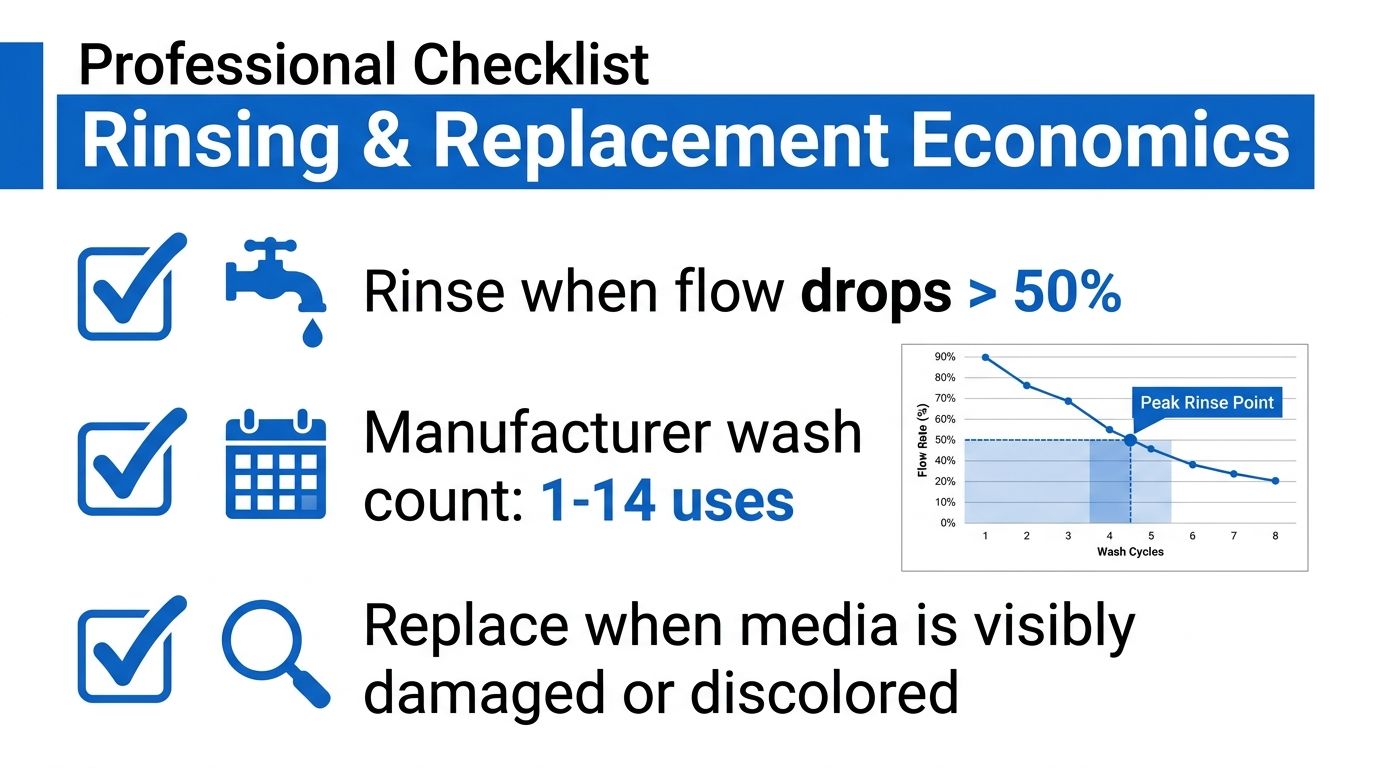
## How Pleated Sediment Filtration Fits the Whole System
A pleated sediment cartridge doesn't finish the job, it makes the rest of the system viable. Once grit and suspended solids are removed, the next stage can focus on the contaminants that matter most in drinking water, like lead, PFAS, chlorine, and chromium-6, without being worn down by particles first. That's the part many whole-house plans miss, they treat filtration like one decision instead of a sequence.
Selective filtration becomes useful here. Woder's **Advanced Selective Filtration®** is built to remove contaminants while leaving essential minerals like calcium and magnesium in the water, which is a different outcome from reverse osmosis systems that strip dissolved solids out of the water entirely. The distinction matters because a sediment stage protects the selective stage, and the selective stage protects the water you drink.
For homeowners comparing installation paths, it helps to think in layers. The sediment cartridge takes the mechanical load. The selective stage handles the chemistry. If the house has variable sediment, cloudy water after maintenance work, or a well that changes with the season, that first layer is the one that keeps the rest of the system from getting exhausted too early.
If you're checking a plumbing setup at the same time, [Melbourne hot water system installation tips](https://www.totalplumbing.net.au/services/hot-water-systems/) is a practical reminder that water treatment and water heating often affect each other more than people expect. Sediment in one part of the system tends to show up in another.
The most useful next step is simple, find out what your water contains through a Consumer Confidence Report or a lab test, then match the sediment stage and the contaminant stage to that profile. That keeps the decision grounded in the house you live in, not the label on the cartridge.
---
Woder Filters offers point-of-use systems built around **Advanced Selective Filtration®**, along with sediment cartridges that can help protect downstream drinking-water stages from grit and clogging. If you're comparing cartridge types for your home, visit [Woder Filters](https://woder.com) to review the options and see which setup fits your water profile.
**Categories:** Woder Science
**Tags:** micron rating, pleated sediment water filter, sediment filtration, water filter cartridges, whole house filtration
---
### [Whole House Water Filter vs Under-Sink Filter: Which One Solves Your Problem in 2026](https://woder.com/blog/whole-house-under-sink-filter/)
**Published:** August 1, 2026
**Author:** woder
**Content:**
- [What Each System Actually Does](#what-each-system-actually-does)
- [Whole House Water Filters](#whole-house-water-filters)
- [Under-Sink Water Filters](#under-sink-water-filters)
- [Point of Entry vs Point of Use](#point-of-entry-vs-point-of-use)
- [When a Whole House Filter Makes Sense](#when-a-whole-house-filter-makes-sense)
- [When an Under-Sink Filter Makes More Sense](#when-an-under-sink-filter-makes-more-sense)
- [The Mineral Retention Question](#the-mineral-retention-question)
- [Cost Comparison](#cost-comparison)
- [Can You Use Both?](#can-you-use-both)
- [Making the Decision](#making-the-decision)
- [Frequently Asked Questions](#frequently-asked-questions)
Not all water problems are the same, and neither are the systems built to fix them. If you're weighing a whole house water filter against an under-sink filter, the right answer comes down to what's actually wrong with your water and where you need it clean.
This guide covers how each system works, what it handles well, where it falls short, and how to figure out which one fits your situation.
### What Each System Actually Does
#### Whole House Water Filters
A whole house filter — also called a point-of-entry system — connects to your main supply line, usually near where it enters the home. From that point forward, every tap, shower, appliance, and toilet receives filtered water.
These systems are built for volume. They're most effective against sediment, chlorine, chloramines, and certain heavy metals across every fixture in the house. Some include multiple filter stages or a water softener component.
The tradeoff is cost and complexity. Whole house systems typically run from a few hundred dollars to well over a thousand, before installation. Most require a professional plumber, and the filter media needs periodic replacement.
#### Under-Sink Water Filters
An under-sink filter connects directly to your cold water line beneath the kitchen sink and treats water at that single point of use. Only the water coming out of that tap gets filtered.
These systems are compact, relatively affordable, and easy enough for most homeowners to install in under an hour. Because they're filtering a smaller volume of water, they can use more targeted media — and often achieve finer contaminant removal than a whole house system at a similar price.
The limitation is straightforward: filtered water at one location. Your shower, bathroom sink, and washing machine still get unfiltered tap water.
### Point of Entry vs Point of Use
This is the core distinction, and it matters more than most people think.
A whole house filter treats water before it reaches any fixture. An under-sink filter treats water at the fixture you actually drink from. If your main concern is drinking water quality, filtering at the kitchen sink is often the more efficient and cost-effective approach — you're treating the water you consume, not the water going to your dishwasher or outdoor spigot.
If the problem is broader — chlorine irritating your skin in the shower, sediment wearing down your appliances, or water quality issues throughout the home — a whole house system addresses things an under-sink filter simply can't reach.
### When a Whole House Filter Makes Sense
A whole house water filter is worth considering when:
- **Sediment or particulates** are clogging appliances, discoloring laundry, or affecting shower fixtures
- **Hard water** is a home-wide issue and you want to protect pipes and water-using appliances
- **Chlorine or chloramine levels are high** and you're noticing it in showers and baths, not just at the tap
- **You're on well water** with consistent contamination across all uses
- **Multiple household members** have sensitivities that go beyond drinking water
One thing to keep in mind: whole house systems use larger, less specialized filter media. They're built for volume, not precision. A whole house carbon filter will reduce chlorine effectively, but it won't match the contaminant-specific removal you get from a purpose-built under-sink system.
### When an Under-Sink Filter Makes More Sense
An under-sink filter tends to be the better fit when:
- **Drinking water quality is your main concern** — taste, odor, lead, chlorine byproducts, PFAS
- **You're renting** or don't want to touch your main water line
- **Budget matters** and you want the most filtration per dollar
- **Your municipal water is generally fine** but you want a cleaner result for cooking and drinking
- **You want to ditch bottled water** without committing to a full home system
Under-sink filters also tend to preserve the beneficial minerals in your water, which affects both taste and health. Reverse osmosis systems — a common under-sink option — strip out nearly everything, including calcium and magnesium. Selective filtration approaches, like the technology behind [Woder filters](https://woder.com), are designed specifically to remove harmful contaminants while leaving those naturally occurring minerals intact.
### The Mineral Retention Question
It's worth addressing this directly because it comes up often. More filtration isn't always better.
Reverse osmosis removes 95 to 99 percent of dissolved solids — contaminants, yes, but also minerals your body actually uses. Whole house carbon filters don't strip minerals, but they also don't remove fine contaminants with much precision. A well-designed under-sink filter using selective filtration can target specific contaminants without touching mineral content, giving you water that's genuinely clean and still tastes the way water should.
If mineral retention matters to you, it's a real differentiator when comparing systems.
### Cost Comparison
Whole House FilterUnder-Sink Filter**Upfront cost**$300 to $1,500+$50 to $400**Installation**Usually professionalOften DIY**Filter replacement**Every 6 to 12 months (varies)Every 6 to 12 months (varies)**Coverage**Entire homeSingle tap**Contaminant specificity**ModerateHighThese are general ranges. What you actually pay depends on your water quality, flow rate requirements, and the specific system you choose.
### Can You Use Both?
Yes — and some households do. A whole house sediment pre-filter paired with an under-sink filter for drinking water is a practical combination. The whole house filter handles particulates and protects your appliances. The under-sink filter handles precision filtration for the water you consume.
It's a layered approach that gives you broad coverage without the cost of a high-end whole house system trying to do everything at once.
### Making the Decision
Three questions worth asking yourself:
1. **Where is the problem?** If it's only at the tap you drink from, an under-sink filter is probably enough. If it's throughout the home, you need a whole house system.
2. **What contaminants are you dealing with?** Get a water test if you haven't already. Knowing what's actually in your water makes the decision much clearer.
3. **What's your budget and installation tolerance?** Under-sink filters cost less and are easier to install. Whole house systems require more upfront investment and usually a plumber.
For most households focused on clean drinking water, an under-sink filter is the simpler, more targeted answer. If your water problems extend beyond the kitchen, a whole house system deserves serious consideration — possibly alongside an under-sink filter for drinking. You can explore the Woder lineup at [woder.com](https://woder.com) to find a model suited to your flow rate and household needs.
---
### Frequently Asked Questions
**Does a whole house water filter replace an under-sink filter?**
Not necessarily. Whole house filters are built for high-volume, broad-spectrum filtration across every fixture. Under-sink filters offer more targeted removal for drinking and cooking water. Many households benefit from using both.
**What does a whole house water filter actually remove?**
Most whole house filters handle sediment, chlorine, chloramines, and some heavy metals effectively. What gets removed depends on the filter media. They're generally less precise than point-of-use systems when it comes to fine contaminants like PFAS or certain heavy metals.
**How long do under-sink filters last before replacement?**
Most need replacement every 6 to 12 months, depending on water quality and usage. Some high-capacity models last longer. Follow the manufacturer's replacement schedule to keep filtration performance where it should be.
**Is an under-sink filter hard to install?**
Most are designed for DIY installation and connect directly to your existing cold water line. The process typically takes under an hour with basic tools — no plumber required in most cases.
**Will an under-sink filter remove beneficial minerals from my water?**
It depends on the type. Reverse osmosis systems remove nearly all dissolved solids, including beneficial minerals like calcium and magnesium. Selective filtration systems, like those used in Woder filters, are designed to remove harmful contaminants while keeping those minerals in place.
**Do I need a water test before buying a filter?**
Strongly recommended. A water test tells you exactly what contaminants are present, which helps you choose a filter rated to handle them. Testing kits are widely available, and most municipalities publish annual water quality reports.
**Is a whole house water filter worth the cost?**
If you have consistent water quality issues throughout your home — sediment, hard water, high chlorine affecting showers and appliances — a whole house filter can absolutely be worth it. If your concern is limited to drinking water, an under-sink filter typically delivers better value for that specific problem.
---
The right filter is the one that matches your actual water problem. Start with what you know about your water, decide where you need the filtration most, and go from there. For most households, clean drinking water is the goal — and an under-sink filter is the simpler, more cost-effective way to get there.
**Categories:** Woder Science
---
### [Water Filter Faucet Replacement: Steps and Leak Tips](https://woder.com/blog/water-filter-faucet-replacement/)
**Published:** August 1, 2026
**Author:** woder_admin
**Content:**
A faucet-mounted filter usually needs a new cartridge every **2 to 4 months**, sometimes around **100 to 200 gallons**, while some higher-capacity cartridges can stretch to **18 months** or **600 to 800 gallons** depending on water quality and use ([replacement timing guidance](https://www.cnboda.com/news/industry-news/what-is-a-faucet-replacement-filter-and-why-you-need.html)). That short cycle is why **water filter faucet replacement** is less about “fixing” a problem and more about routine upkeep that keeps flow usable and filtration effective. It's also why a quick swap can matter more than people expect, because clogged faucet filters can cut flow by about **20% to 50%** ([same guidance](https://www.cnboda.com/news/industry-news/what-is-a-faucet-replacement-filter-and-why-you-need.html)).
The good news is that replacement is usually straightforward once you know where the friction lives. The cartridge is rarely the hard part. The harder part is often the plumbing around it, the seal at the housing, and whether your faucet setup is compatible before you buy.
## Table of Contents
- [Why Water Filter Faucet Replacement Matters](#why-water-filter-faucet-replacement-matters)
- [Tools and Valve Checks Before You Start](#tools-and-valve-checks-before-you-start)
- [Essential tools and a quick fit check](#essential-tools-and-a-quick-fit-check)
- [Replacing a Faucet-Mounted Filter Cartridge](#replacing-a-faucet-mounted-filter-cartridge)
- [Swapping a Dedicated Filter Faucet](#swapping-a-dedicated-filter-faucet)
- [Leak Testing and Flush Sequence](#leak-testing-and-flush-sequence)
- [Choosing a Certified Replacement Cartridge](#choosing-a-certified-replacement-cartridge)
- [Your Next Step Toward Cleaner Water](#your-next-step-toward-cleaner-water)
## Why Water Filter Faucet Replacement Matters
A faucet filter is easy to ignore until the flow slows or the water starts tasting flat. The reason is straightforward, the cartridge wears out sooner than many homeowners expect, and that wear affects both **filtration capacity** and **usable flow**. Faucet-mounted cartridges usually need attention on a tighter schedule than under-sink systems, which are often built for longer service intervals. For a practical sense of how filter life varies by setup, [this overview of filter lifespan](https://woder.com/blog/how-long-does-a-water-filter-last/) gives useful context.
> **Practical rule:** if the stream has become noticeably sluggish, replacement is already part of the fix, not an optional upgrade.
That flow drop is more than a nuisance. A clogged faucet filter can make the sink harder to use for cooking, filling kettles, or rinsing produce. In real homes, that is usually what pushes people to replace the cartridge earlier than planned. The filter is handling two jobs at once, catching contaminants and keeping water moving through a small body, so buildup shows up as a performance loss long before the cartridge looks full.
The replacement market reflects that pattern. Cartridges are recurring purchases, not a one-time add-on. A [market estimate](https://datahorizzonresearch.com/home-water-filtration-system-replacement-market-74541) places the home water filtration replacement category at **USD 8.3 billion in 2025**, with growth projected through the following years, and it also points to strong demand in North America. That scale matches what installers see in the field, homes keep using point-of-use filtration, so cartridges keep getting swapped.
The main bottleneck is usually not the cartridge itself. It is the upstream fit. If the valve outlet, adapter, or sealing surface does not match the replacement, the job becomes harder and leak-prone no matter how carefully the cartridge is installed. That is why a pre-purchase fit check matters before any swap.
For homeowners comparing the broader DIY side of the job, the [fixture replacement tips for homeowners](https://ez-plumbing.com/how-to-replace-plumbing-fixtures-a-diy-guide/) cover the same kind of planning that applies here, access, sealing, and the space around the sink.
## Tools and Valve Checks Before You Start
### Essential tools and a quick fit check
Before you touch the housing, confirm that your plumbing matches the replacement you plan to install. That sounds basic, but older kitchens and apartment sinks often surprise people. One installation guide notes that **3/8-inch angle valve outlets** connect directly, while **1/2-inch outlets** need a converter, and another recommends replacing a single-port angle stop with a **dual-port model** so the faucet and filter can be serviced separately ([retrofit compatibility guidance](https://images.thdstatic.com/catalog/pdfImages/30/30a39856-f5a5-40c4-b470-b4db8c263eeb.pdf)).
> **Compatibility matters more than force.** If the valve and adapter path are wrong, tightening harder won't solve it, and it can make the next service cycle worse.
A solid pre-install kit usually includes an **adjustable wrench**, **plumber's tape**, a **bucket**, and a couple of towels. If the space under the sink is tight, a faucet swap-out wrench can save time because it reaches the nut without fighting the cabinet walls. For that, [browse the faucet swap wrench](https://valuetools.co/products/milwaukee-faucet-swap-out-wrench) from Value Tools Co. and compare it to the space you have under the sink.
An older home or rental may need a little more planning. Limited cabinet clearance, corroded shutoffs, or nonstandard threads can turn a quick cartridge change into a small plumbing project. If the shutoff valve feels stiff, look at the valve body before the cartridge. You want a clean shutoff you can trust when it's time to depressurize the line.
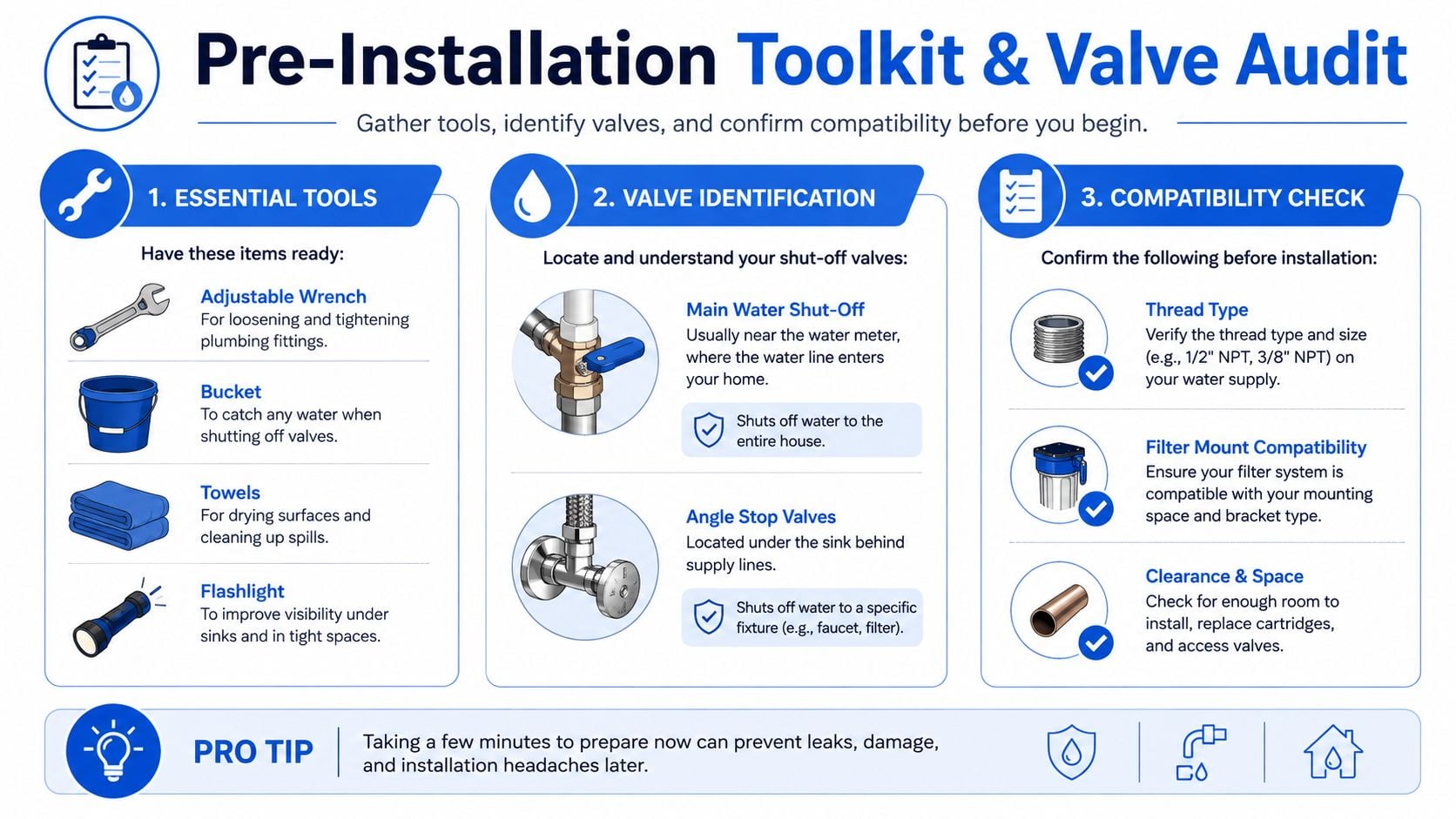
A simple under-sink audit helps before you buy a replacement cartridge or faucet body:
- **Shutoff access:** Make sure you can close the local supply without reaching past sharp edges or buried plumbing.
- **Valve type:** Check whether the outlet is **3/8-inch** or **1/2-inch**, since that decides whether you need an adapter.
- **Space for service:** Leave room for future swaps, not just today's install.
- **Thread and mount fit:** Confirm the replacement uses the same connection style and housing format.
- **Parts on hand:** Keep tape, towels, and the adapter ready before loosening anything.
For homeowners in older buildings, this is the part that usually saves the most time. A cartridge that fits the media spec but not the valve path is still a bad purchase.
## Replacing a Faucet-Mounted Filter Cartridge
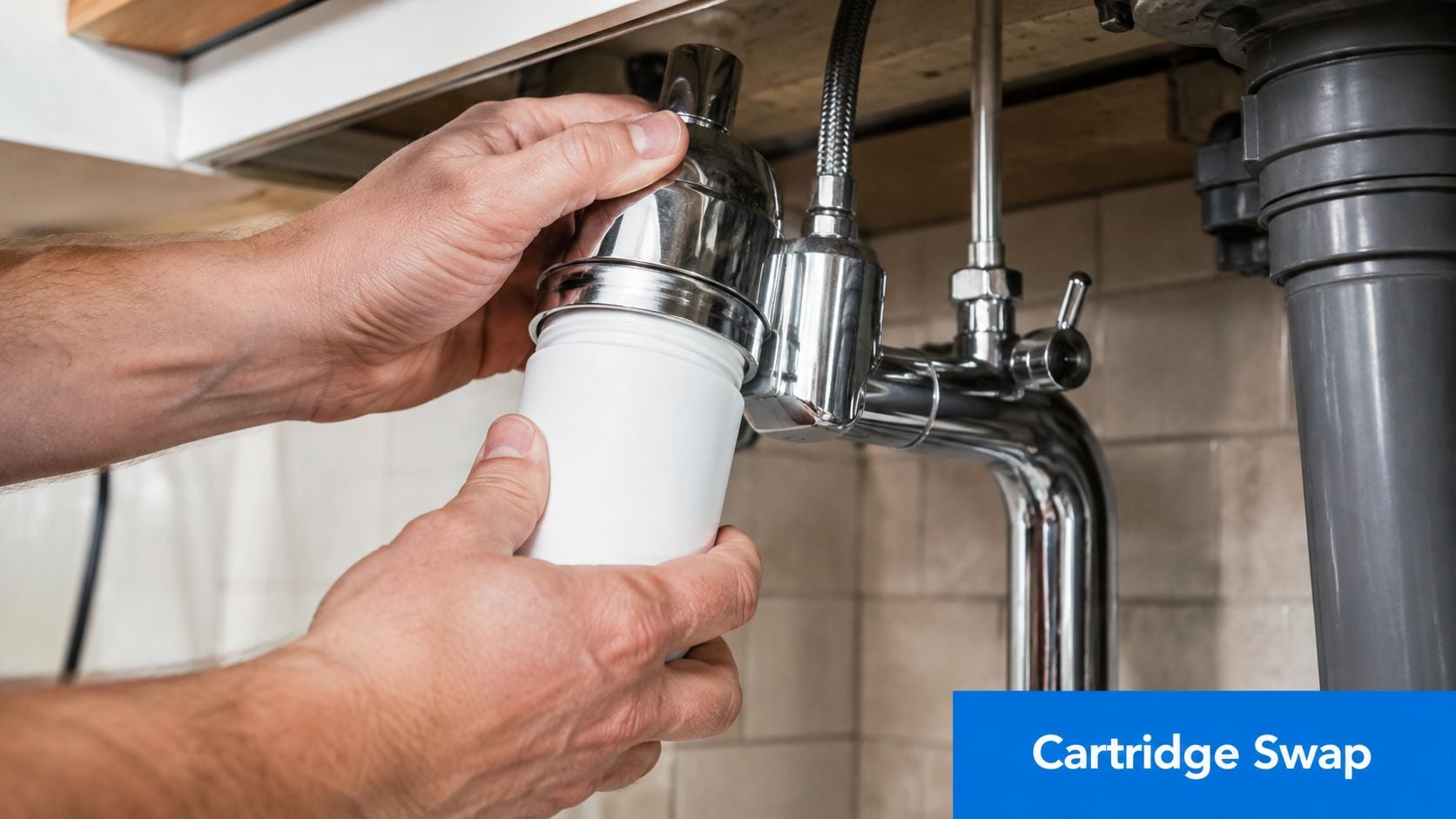
Most cartridge swaps fail at the same point, the housing is under pressure or the seal is not seated correctly. Shut off the local supply, open the filtered faucet, and let the line drain before you touch the canister or cartridge. If you skip that step, the housing can spray, the threads can bind, and the seal can shift as soon as you break it open. Manufacturer [installation guidance](https://images.thdstatic.com/catalog/pdfImages/86/860bc6ab-4444-4afb-8ba3-3166cedc6584.pdf) follows the same order for a reason.
Once the pressure is out, remove the housing and inspect the **O-ring** before anything else. Look for dryness, pinching, twists, or a ring that has slipped out of its groove. Re-seat it carefully if needed, because most leaks start at that contact point, not in the cartridge media itself. Hand-tighten the housing first, then use only the light wrench help the manufacturer allows. Excess force can flatten the gasket and make the next service cycle harder.
Seal integrity matters more than force. A housing that closes with brute pressure often leaks later, and it is harder to reopen without damage. If the cap feels resistant before it seats fully, stop and check the ring, the threads, and the housing alignment instead of driving it tighter.
If your setup uses a point-of-use inline filter rather than a basic faucet housing, the same fit check still applies. The [Woder Advanced Inline Water Filter WD-G4-JG](https://woder.com/products/wd-g4-jg/) is a U.S.-made inline filter that uses advanced selective filtration and keeps essential minerals in the water, which is the kind of difference that matters when you compare replacement styles for a kitchen line. Before you buy, confirm the connection type, the available clearance, and the direction of flow so the swap matches the plumbing path instead of fighting it.
A flush sequence clears trapped air and carbon fines after the new cartridge goes in. The usual guidance calls for a **5-minute flush**, a **1-hour wait**, then another **5-minute flush**. That is not busywork. It clears the line before normal use and gives you a chance to spot a slow seep while the cabinet is still open.
The common mistakes are predictable, and they are avoidable. A mis-seated O-ring, skipped pressure relief, or an over-torqued housing can leave a drip that shows up after the cabinet dries and the line is back under pressure. If the housing needs more than a little hand effort to close, stop and inspect the seal instead of tightening harder.
If your replacement uses tubing or a connector style you have not handled before, keep the [installation guide](https://woder.com/install/) open while you work. For a separate point of comparison, the partner note on [how to replace RO membrane](https://h20management.com/reverse-osmosis-filter-replacement/) shows the same habit in a different filtration setup, confirm the fit first, then make the swap. A careful check up front saves a second trip to the hardware store.
## Swapping a Dedicated Filter Faucet
A dedicated filtered-water faucet is a different job from a cartridge swap, even though homeowners often use the same phrase for both. Here you're replacing the tap body itself, so the main issues are tubing direction, washer fit, and how cleanly the new faucet seats at the mounting hole. Quick-connect guidance makes the sequence plain, close the dedicated valve, depressurize the line until flow stops, then remove the old faucet with the right release method for the fitting style ([quick-connect installation guidance](https://hl-water.net/en/blog/how-to-replace-quick-connect-inline-filter/)).
The seal comes from the parts matching properly, not from cranking the hardware down. OEM installation guidance for related faucet installs stresses full hand-tightening and the correct washer or adapter fit, which is the lesson here too. If the washer stack is wrong or the tubing isn't fully seated past the collet, the joint will leak no matter how hard you turn the nut.
> Seal integrity beats force. That's true under the sink, at the faucet body, and at every push-fit connection in the line.
When the new faucet goes in, align it with the flow direction before you tighten anything. Reversed inlet and outlet lines are one of the most common self-inflicted mistakes, and they're easy to miss until the restart. Push tubing fully past the collet ring, seat the faucet squarely in the hole, and keep the bend radius gentle so the line doesn't kink behind the cabinet wall.
If you're comparing a faucet-body swap with a reverse osmosis setup, [how to replace RO membrane](https://h20management.com/reverse-osmosis-filter-replacement/) is a useful contrast point because it shows how much of the work in water filtration is really about respecting fittings, direction, and pressure. The mechanics are different, but the same idea holds, clean install work depends on the connections being correct before you ever run water.
## Leak Testing and Flush Sequence
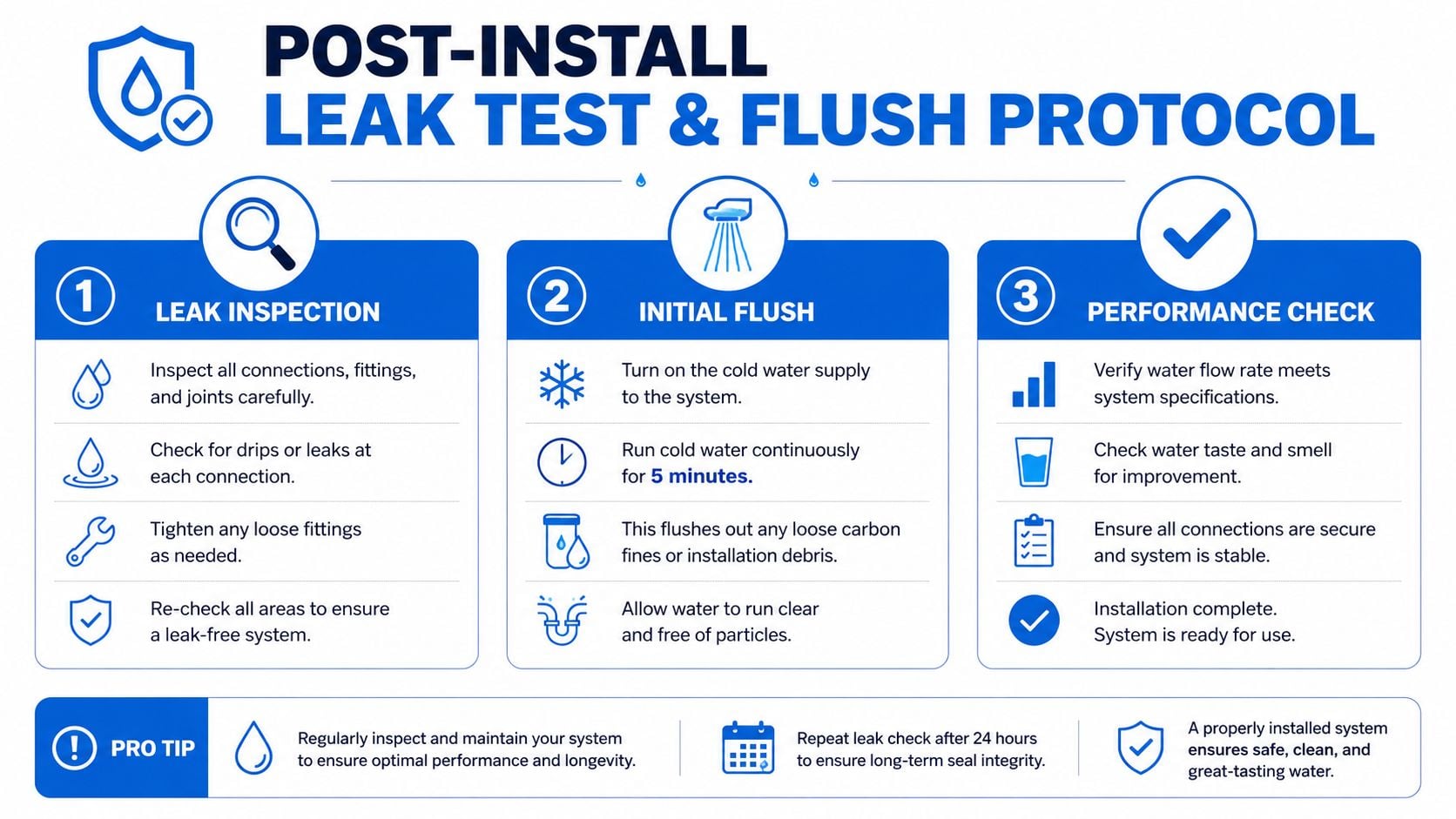
Leak checks start with controlled pressure, not a full open valve. Bring water back slowly and watch the housing seam, the O-ring interface, and the faucet body as the system repressurizes. A drip at startup usually points to a seal issue, and it is better to stop there than let the line run and mask the problem.
The first flush does more than clear the cartridge. It also shows whether the line still has trapped air, whether the cartridge seated cleanly, and whether the fittings hold under flow. Sputtering or a short burst of spray often means the system was not fully depressurized before restart, or the cartridge and gasket stack need another look. A housing that seals correctly should tighten by hand, with only a light wrench assist if the setup calls for it.
A simple checklist keeps the test honest:
- **Look at the seams:** Check the housing joint and faucet base for fresh moisture.
- **Listen to the flow:** Sputtering points to air or a rushed restart.
- **Feel the cabinet floor:** A dry paper towel under the fittings shows leaks faster than your eyes do.
- **Recheck after the flush:** Some drips only show up after the first few minutes of pressure.
Flush according to the cartridge instructions, then pause if the guide calls for a rest period and run it again afterward. That second pass clears loose carbon fines and confirms the system stayed sealed through a full restart cycle. If the flow stays steady and the cabinet stays dry, the replacement is holding the way it should. If you are still decoding labels or fixture ratings before you buy the next cartridge, the [WQA and NSF-ANSI water quality alphabet soup](https://woder.com/blog/wqa-nsf-ansi-wth-water-quality-alphabet-soup/) guide is a useful reference for sorting the terms without guesswork.
## Choosing a Certified Replacement Cartridge
For replacement cartridges, the label carries more weight than the marketing copy. NSF/ANSI 53 lead certification shifted in **2020** from a **10 µg/L** benchmark to a stricter **5 µg/L** benchmark for post-2019 certified filters, so the certification context and the date behind it matter ([NSF/ANSI 53 review](https://pmc.ncbi.nlm.nih.gov/articles/PMC11866865/)). A filter can advertise “lead reduction” and still leave you guessing about the standard behind that claim.
NSF/ANSI 53 Lead Cert Pass Rates (2024 Review)Filter TypePass RateDevices TestedFaucet-mounted**98%****1,449/1,486**Under-sink**88%****22/25**Pitcher**79%****132/167**That table matters because it separates performance categories from marketing language. In a 2024 review of **1,678** tested devices, **96%** passed the relevant benchmark overall, as noted in the same review. For homeowners, the practical question is simple: does the cartridge you are buying match the certification you care about, and is it certified for the type of fixture you are installing?
If the certification language on a product page or label feels hard to sort out, the [WQA and NSF-ANSI water quality alphabet soup](https://woder.com/blog/wqa-nsf-ansi-wth-water-quality-alphabet-soup/) breakdown helps decode the jargon without turning it into a guessing game. The key is a certification statement that matches both the installation type and the contaminant you want addressed.
A replacement cartridge that keeps the water moving, fits the housing, and carries the right post-2019 certification is doing the job you paid for. That standard is more useful than vague promises or a zero-TDS obsession that says more about mineral stripping than drinking-water quality.
## Your Next Step Toward Cleaner Water
The hardest part of **water filter faucet replacement** is often the part nobody thinks about first, the valve, adapter, or faucet body that makes the cartridge easy or difficult to service later. Once you know your shutoff type and confirm the seal path, the rest becomes routine maintenance instead of trial and error. That's the point of being informed without being overwhelmed.
For many homes, the best next move is to verify the fitting under the sink, match the cartridge to a real certification, and keep the replacement cycle on a calm schedule. A **U.S.-built**, certified filter that uses selective filtration and retains essential minerals is a practical fit for a lot of households, especially when you don't want to trade good-tasting water for unnecessary complexity. The choice stays yours, which is how it should be.
---
If you want a straightforward place to start, [Woder Filters](https://woder.com) offers point-of-use systems, replacement cartridges, and installation resources designed for homeowners who want cleaner water without stripping out the minerals that belong in it. Check your valve type, confirm the fit, then choose the cartridge path that matches your sink and your routine.
**Categories:** Woder Science
**Tags:** DIY water filter, faucet filter replacement, leak testing tips, water filter cartridge, water filter faucet replacement
---
### [Microplastics in Tap Water: What the Latest 2026 Research Says About Your Health](https://woder.com/blog/microplastics-tap-water-research-health/)
**Published:** July 31, 2026
**Author:** woder
**Content:**
- [What Are Microplastics, Exactly?](#what-are-microplastics-exactly)
- [What 2026 Research Is Finding](#what-2026-research-is-finding)
- [Prevalence in Tap Water](#prevalence-in-tap-water)
- [What Happens When You Drink Them](#what-happens-when-you-drink-them)
- [Children and Vulnerable Populations](#children-and-vulnerable-populations)
- [How Microplastics Get Into Your Tap Water](#how-microplastics-get-into-your-tap-water)
- [What Standard Filters Do and Don't Do](#what-standard-filters-do-and-dont-do)
- [What to Look for in a Microplastics Water Filter](#what-to-look-for-in-a-microplastics-water-filter)
- [Practical Steps You Can Take Now](#practical-steps-you-can-take-now)
- [FAQs](#faqs)
Microplastics are no longer just an ocean problem. They're showing up in tap water, bottled water, human blood, and lung tissue. If you've been wondering whether your drinking water is actually safe, the latest 2026 research gives you more reason to pay attention — and more reason to do something about it.
Here's what the science currently says, what the health risks look like, and what you can realistically do at home.
---
### What Are Microplastics, Exactly?
Microplastics are plastic particles smaller than 5 millimeters. Nanoplastics are even smaller — often invisible to the naked eye. They come from a wide range of sources: degrading plastic bottles and packaging, synthetic clothing fibers, industrial runoff, and the breakdown of plastic components in aging water infrastructure.
Once these particles enter the water supply, they're extremely difficult to remove. Most municipal treatment systems simply weren't designed with microplastics in mind.
---
### What 2026 Research Is Finding
The evidence has grown considerably over the past few years. Studies published in 2026 continue to confirm what earlier research suggested: microplastics are widespread in drinking water sources globally, including municipal tap water across the United States.
#### Prevalence in Tap Water
Water samples collected across North America and Europe consistently show microplastic contamination. The particles detected include polyethylene, polypropylene, polystyrene, and PET fragments. Concentrations vary by region and source, but their presence is no longer in question.
#### What Happens When You Drink Them
The health research is still developing, but the direction is concerning. Current studies are examining several mechanisms of potential harm:
- **Inflammation**: Microplastic particles can trigger inflammatory responses in gut tissue, with some research pointing to effects on the intestinal lining.
- **Chemical leaching**: Plastics carry additives including plasticizers, flame retardants, and colorants that can leach into surrounding tissue after ingestion.
- **Bioaccumulation**: Nanoplastics are small enough to cross biological membranes. Researchers have detected them in human blood, placenta tissue, and organs.
- **Microbiome disruption**: Emerging evidence suggests chronic exposure may alter gut microbiome composition, though the long-term implications aren't yet fully understood.
As of 2026, no regulatory agency has established a safe exposure threshold for microplastics in drinking water. The science is moving faster than the policy.
#### Children and Vulnerable Populations
Researchers are paying particular attention to children, pregnant women, and people with compromised immune systems. Smaller body mass and developing organ systems may make these groups more susceptible to the effects of chronic low-level exposure.
---
### How Microplastics Get Into Your Tap Water
Understanding the source helps explain why this problem is so persistent.
**Aging infrastructure**: Older pipes — especially those with plastic components or plastic-lined joints — shed particles directly into the water moving through them.
**Source water contamination**: Rivers, lakes, and reservoirs used for municipal supply already contain microplastics from agricultural runoff, urban stormwater, and industrial discharge.
**Treatment gaps**: Standard treatment relies on filtration, sedimentation, and disinfection. These steps can reduce microplastic load, but they don't eliminate it. Nanoplastics in particular pass through most conventional filters.
**Home plumbing**: Even after water leaves the treatment plant, it can pick up particles from plastic fittings, tubing, and fixtures inside your home.
---
### What Standard Filters Do and Don’t Do
Not all filtration is equal when it comes to microplastics.
**Activated carbon filters** — like pitcher filters and most faucet attachments — can reduce some larger microplastic particles, but their pore sizes are often too large to catch nanoplastics or fine fragments.
**Reverse osmosis (RO) systems** are currently among the most effective options for microplastic reduction. The semi-permeable membrane blocks particles at a very small scale. The tradeoff: RO systems also strip out beneficial minerals like calcium and magnesium, waste a significant amount of water in the process, and require more involved installation.
**Under-sink inline filters with advanced media** can offer meaningful reduction depending on the technology used. The key variable is whether the filter can attract and capture particles at the nano scale — not just block them by size.
---
### What to Look for in a Microplastics Water Filter
If you're evaluating your options, here are the factors that actually matter:
**Filtration mechanism**: Size-exclusion alone is less effective against nanoplastics than filters that also use electrostatic or adsorptive attraction to capture particles.
**Mineral retention**: Some filtration methods remove contaminants but also strip calcium, magnesium, and other minerals your body needs. If that matters to you, check whether the filter is designed to preserve them.
**Flow rate and household fit**: A filter that slows your water to a trickle isn't practical for daily use. Match the filter's rated flow rate to your household's actual demand.
**Replacement schedule**: Filter media has a finite capacity. A filter past its service life may actually release captured particles back into the water.
[Woder Filters](https://woder.com) uses Advanced Selective Filtration technology, which relies on nanoparticles to attract and remove contaminants while leaving beneficial minerals intact. This approach is designed to address the limitations of both basic carbon filters and full RO systems — offering meaningful filtration without the mineral stripping or water waste that RO requires.
---
### Practical Steps You Can Take Now
You don't need to wait for regulatory guidance to reduce your exposure.
1. **Test your water**: A certified lab test gives you a baseline. Some services now test specifically for microplastics, though this is still an emerging category in consumer testing.
2. **Upgrade your filtration**: If you're relying on a basic pitcher filter or an aging faucet attachment, an under-sink or inline filter with more advanced media is worth considering.
3. **Reduce plastic contact in your kitchen**: Avoid heating food or water in plastic containers. Use glass or stainless steel where possible.
4. **Replace old plastic fixtures**: If your home has older plastic plumbing components, switching to metal alternatives removes one source of particle introduction.
5. **Stay informed**: The research on microplastics is moving quickly. What we know in mid-2026 will likely be updated before the year is out.
---
### FAQs
**What are microplastics and why are they in tap water?**
Microplastics are plastic particles under 5 millimeters that enter water supplies through aging infrastructure, environmental contamination, and the breakdown of plastic materials. Standard municipal treatment doesn't fully remove them.
**Are microplastics in tap water dangerous to your health?**
Research in 2026 links microplastic exposure to inflammation, chemical leaching, and potential bioaccumulation in human tissue. No safe exposure threshold has been established, and scientists consider chronic low-level ingestion a legitimate concern.
**Can a water filter remove microplastics?**
Some filters can significantly reduce microplastic levels. Reverse osmosis membranes and filters that use adsorptive or electrostatic mechanisms tend to outperform basic activated carbon pitchers, which often can't capture nanoplastics.
**Does reverse osmosis remove microplastics?**
Yes, RO systems are effective at removing microplastics, including smaller particles. The downsides are that they also remove beneficial minerals, waste water during filtration, and require more involved installation than inline alternatives.
**Will a Brita or pitcher filter remove microplastics?**
Standard pitcher filters use activated carbon and may reduce larger microplastic particles, but they're not designed to capture nanoplastics or fine fragments. Their pore sizes are generally too large for comprehensive removal.
**How do I know if my tap water contains microplastics?**
You can request a water quality report from your utility, but most municipal reports don't yet include microplastic data. Specialized lab testing services can analyze your tap water for microplastic content, though this type of testing is still becoming more widely available.
**What is the best type of filter for microplastics in 2026?**
Filters that combine fine physical filtration with adsorptive media tend to perform best. Under-sink inline filters using advanced selective filtration technology — like those from [Woder](https://woder.com) — offer a practical middle ground between basic carbon filters and full RO systems, removing contaminants while retaining the minerals your body actually uses.
---
The science on microplastics isn't finished, but it's consistent enough to act on. You don't need to overhaul your entire home. A well-chosen filter installed directly at your water line is one of the most straightforward steps you can take to reduce what ends up in your glass.
**Categories:** Woder Science
---
### [Water Filter Replacement Cartridge: How to Choose Right](https://woder.com/blog/water-filter-replacement-cartridge/)
**Published:** July 31, 2026
**Author:** woder_admin
**Content:**
You've got the old cartridge out, or maybe you're staring at a housing that's still working but isn't doing the job anymore, and now the problem shows up. The water tastes off, the flow feels weaker, the original box is gone, and the part number on the filter has worn to nothing. That's where most homeowners get stuck, because the next cartridge looks simple until you try to match the old one to a shelf full of almost-identical options.
A **water filter replacement cartridge** is rarely a universal swap. The right one has to match the housing, seal correctly, fit the flow and pressure your system experiences, and stay within the cartridge's operating limits. A calendar reminder can help, but it won't tell you whether the filter has reached the end of its useful life.
## Table of Contents
- [When the Cartridge Goes Bad and You Don't Know What to Order](#when-the-cartridge-goes-bad-and-you-dont-know-what-to-order)
- [The gap most buyers fall into](#the-gap-most-buyers-fall-into)
- [How to Identify the Cartridge You Already Have](#how-to-identify-the-cartridge-you-already-have)
- [Read the part like a mechanic, not like a shopper](#read-the-part-like-a-mechanic-not-like-a-shopper)
- [What the Spec Sheet Means](#what-the-spec-sheet-means)
- [Temperature, pressure, flow, and capacity are linked](#temperature-pressure-flow-and-capacity-are-linked)
- [Why the numbers have to travel together](#why-the-numbers-have-to-travel-together)
- [Cartridge Types and Where Each One Fits](#cartridge-types-and-where-each-one-fits)
- [The main cartridge families](#the-main-cartridge-families)
- [Match the cartridge to the fixture](#match-the-cartridge-to-the-fixture)
- [Replacement Timing Based on System Behavior](#replacement-timing-based-on-system-behavior)
- [Why pressure drop often matters more than age](#why-pressure-drop-often-matters-more-than-age)
- [What changes the lifespan](#what-changes-the-lifespan)
- [A Safe and Clean Replacement Procedure](#a-safe-and-clean-replacement-procedure)
- [The replacement sequence](#the-replacement-sequence)
- [Why the little steps matter](#why-the-little-steps-matter)
- [Buying Without Getting Burned](#buying-without-getting-burned)
- [What to verify before you order](#what-to-verify-before-you-order)
- [Quick Reference and Next Steps](#quick-reference-and-next-steps)
## When the Cartridge Goes Bad and You Don't Know What to Order
The usual moment is plain enough. The faucet slows down, the taste changes, and the old cartridge is either stained beyond recognition or already in the trash. If you've ever stood there with the housing open and a phone in your hand, you already know the problem isn't just replacement, it's identification.
### The gap most buyers fall into
Many know they need a new cartridge, but they don't know which details matter enough to trust. Brand names help when the old part is still labeled, but plenty of cartridges lose their markings, and older housings can outlast the original paperwork by years. That's when guessing gets expensive, because a cartridge can look close and still fail to seal.
The category itself also encourages confusion. Replacement timing is often discussed as if every filter lived on the same schedule, but typical guidance puts most cartridges in a **3- to 12-month** window, with many drinking-water and inline systems landing in the **6- to 12-month** range [source](https://www.springsv.com/news/industry-news/how-often-should-a-water-filter-cartridge-be-replaced.html). That's useful as a broad frame, but it doesn't tell you whether your cartridge is the right size, the right media, or the right fit for the housing in front of you.
> **Practical rule:** when the old part is gone, the housing and the cartridge dimensions matter more than the memory of what used to be installed.
For homeowners moving between generations of the same setup, even a model change can matter. Woder's own discussion of the transition from a Gen3 to a Gen4 replacement cartridge shows how easy it is to assume “close enough” will work when the interface changed enough to matter, especially at the sealing points [Woder Gen3 to Gen4 replacement guidance](https://woder.com/blog/potential-challenge-when-transitioning-from-a-woder-gen3-to-a-gen4-replacement-cartridge/). That's the mindset to keep here, measure first, then order.
By the time you finish this guide, the cartridge in front of you should feel less like a mystery part and more like a spec sheet you can read with confidence.
## How to Identify the Cartridge You Already Have
Start with the cartridge itself, not the store listing. Look for a brand name, model code, flow marking, or any printed spec that hasn't fully faded. Then check the housing, because some systems tell you more from the cap, label, or canister shape than from the cartridge body.
### Read the part like a mechanic, not like a shopper
The three measurements that matter most are **length**, **outside diameter**, and **inside diameter**. Industry support guidance says those are the core dimensions to verify, along with the core style, because a mismatch can stop the cartridge from sealing even if the filtration media is correct [Boshart cartridge identification guidance](https://support.boshart.com/how-do-i-identify-what-filter-cartridge-i-have-in-my-water-filter). If the cartridge uses a plastic or metal core, note that too, because the interface is part of the fit.
You'll also want to look at the connection style. Some cartridges use push-fit or quick-connect arrangements, while others rely on threaded housings or a compression-style seal. A cartridge that slides in the wrong way can leave a tiny bypass path, and bypass is one of those failures that often shows up as “the filter doesn't seem to work,” even though the part technically installed.
If the old cartridge has no visible part number, don't stop there. Measure the body, check the seal groove, and compare the housing opening to the cartridge ends before you order anything. That's especially useful in legacy systems where the original part number has vanished but the physical dimensions are still readable.
One practical example of why this matters is Woder's [Woder Sediment Removal and Advanced Dual Filtration System](https://woder.com/products/wd-d-20m-g4-dc/). Its second-stage cartridge, the WD-GEN4-2512TC, is described with WQA certification to NSF/ANSI 42 for chlorine taste and odor and NSF/ANSI 372 for lead free compliance, but the fit still depends on the system's cartridge envelope and interface, not just the media claim.
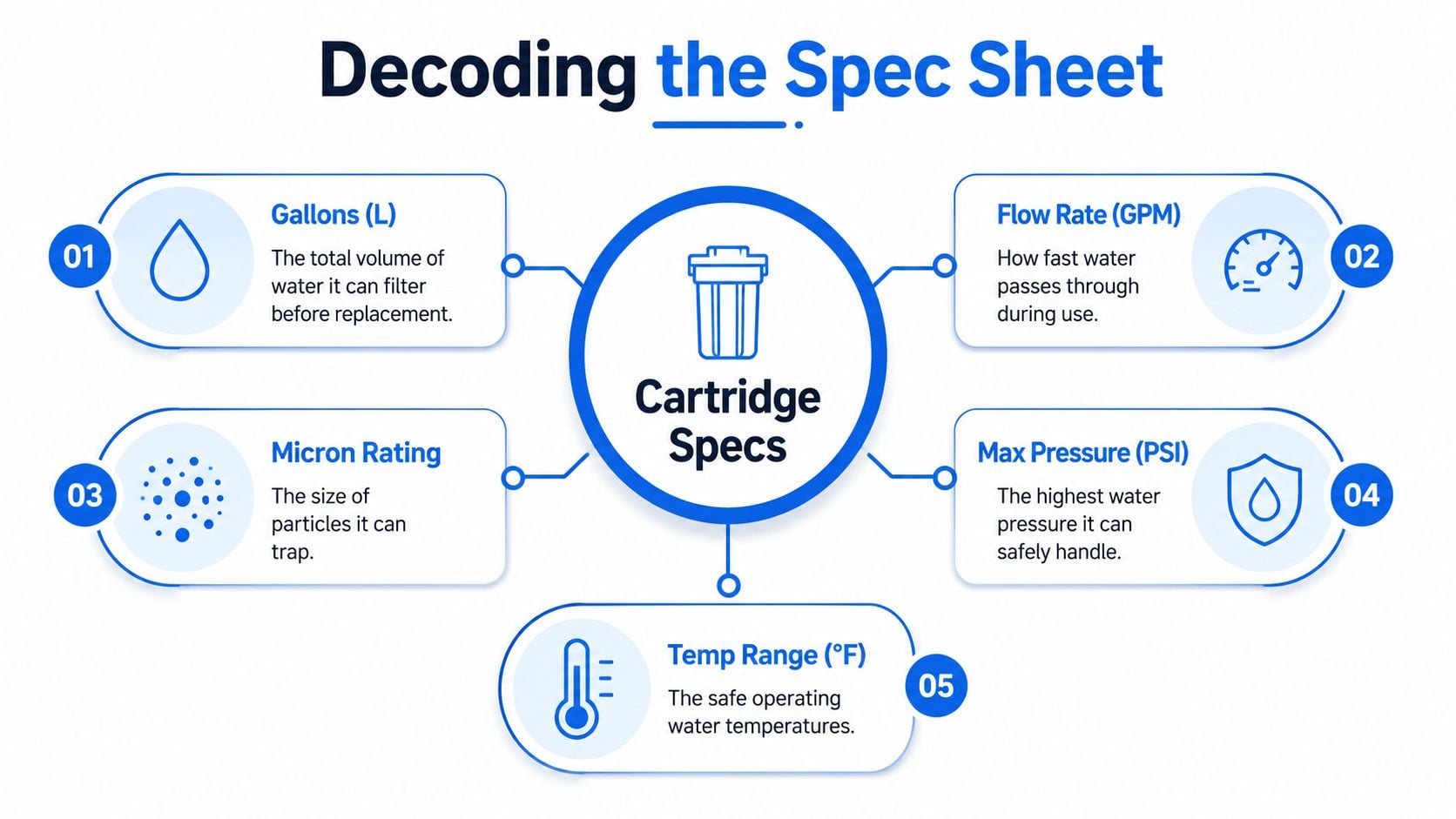
> If the old cartridge is missing its label, the housing dimensions usually tell the truth faster than the brand memory does.
## What the Spec Sheet Means
A cartridge spec sheet can look dense because it combines safety limits, performance numbers, and the conditions the manufacturer assumed when testing it. Once those pieces are separated, the page becomes much easier to read. The goal is not to memorize every line. It is to know which numbers protect the cartridge, and which numbers describe how it behaves in service.
### Temperature, pressure, flow, and capacity are linked
Start with temperature. That range tells you the water the cartridge can safely handle without its materials being pushed past what they were designed to do. In one example, the spec data lists **40–100°F (4.4–38°C)**, while another common home cartridge class lists **40–120°F** as its pressure context and **25–125 psi** as a pressure range, with up to **1.67 gpm** maximum flow [Atlas Filtri spec sheet](https://us.atlasfiltri.com/downloads/1737042144_spec-sheet-0010-0924-ec1358112s-waterfiltercartridge.pdf). Those figures are not filler. They describe the operating window where the cartridge is expected to hold up.
Capacity is a different kind of number. A cartridge rated at **700 gallons** and **0.7 gpm** can fit a household differently than a higher-flow model, even if the two cartridges look similar on paper [Atlas Filtri spec sheet](https://us.atlasfiltri.com/downloads/1737042144_spec-sheet-0010-0924-ec1358112s-waterfiltercartridge.pdf). The gallon rating tells you how much water it can process before replacement under the stated conditions, while flow rate tells you how quickly water can move through it during use. That is why two cartridges with similar shapes can behave very differently once they are in the same sink or appliance.
### Why the numbers have to travel together
A spec sheet only helps if you read the numbers as a group. A cartridge with generous capacity can still fall short if the pressure is too high, the temperature is outside its range, or the daily demand is heavier than the design assumed. A single number on its own can hide that mismatch.
> **Practical rule:** if the pressure or temperature is outside the stated range, the gallon rating stops being a clean promise and becomes a rough starting point.
Certification labels can create a second layer of confusion, because the badge often gets noticed before the underlying test scope does. Woder's explanation of [WQA, NSF, and ANSI on water filter labels](https://woder.com/blog/wqa-nsf-ansi-wth-water-quality-alphabet-soup/) is useful here, because it helps translate what those marks mean on a cartridge spec sheet. That matters when you are comparing two cartridges that sound similar but are not tested for the same conditions.
The same habit helps with **better home water quality** decisions, where the box may sound persuasive but the spec sheet is what tells you whether the cartridge fits your system, your water, and your actual use. Once the sheet is read in pieces, the numbers stop feeling random and start acting like a map.
## Cartridge Types and Where Each One Fits
Different cartridges solve different problems, and they belong in different parts of the system. A homeowner filtering a kitchen tap, a refrigerator line, or a whole-house feed is not shopping for the same cartridge class, even if the packaging looks similar.
### The main cartridge families
Sediment pre-filters usually catch visible grit first, which is why they are often placed ahead of finer stages. Activated carbon blocks are common in drinking-water systems where taste and odor matter, and specialty media cartridges are used when a system is tuned for contaminants like lead or PFAS. Inline refrigerator filters are smaller and usually tied to appliance service lines, while reverse osmosis membranes sit in a different category altogether because they operate as part of a membrane system rather than a simple drop-in cartridge.
Typical capacities make the differences easier to see. Pitcher filters are often around **40 gallons**, refrigerator filters around **200–300 gallons**, under-sink filters around **500–1,000 gallons**, and RO membranes about **1,500–2,000 gallons or more** [Springsv capacity guide](https://www.springsv.com/news/industry-news/how-often-should-you-change-a-water-filter-cartridge-the.html). A cartridge that works fine in a refrigerator line can be the wrong fit for a kitchen sink, even before you look at the media inside it.
### Match the cartridge to the fixture
The cartridge should match the fixture and the water problem together. A sediment stage makes sense where grit is the issue. A selective media block makes more sense where the goal is targeted contaminant reduction at a drinking tap. A refrigerator filter needs to be compact and appliance-friendly, while an RO membrane is part of a system that behaves very differently from a standard replacement cartridge.
For homeowners comparing whole-home and point-of-use options, [better home water quality](https://jmjplumbing.com/halo-water-filtration/) often depends on where the cartridge sits in the plumbing, not only on what media it uses. Placement changes the job, the load, and the kind of maintenance you end up doing.
Cartridge ClassTypical CapacityCommon Replacement WindowPitcher filterAbout 40 gallonsAround 2 monthsRefrigerator filter200–300 gallonsAbout 6 monthsUnder-sink filter500–1,000 gallons6–12 monthsRO membrane1,500–2,000 gallons or more2–5 years
## Replacement Timing Based on System Behavior
The cleanest replacement date is often the one printed on the box. The more reliable one is usually the system telling you it is time. Water quality shifts, household use changes, and one neighborhood can load a cartridge very differently from another, so the calendar alone can miss the pattern.
### Why pressure drop often matters more than age
A cartridge does not wear out in a vacuum. It clogs, loads with sediment, or slows as the water passing through it changes. That is why some technical guidance treats **pressure drop** or a visible flow decline as a better signal than age alone, and whole-house systems often use a **15 psi** pressure-drop threshold as a replacement trigger. If the faucet flow has changed in a way you can notice, that is information worth taking seriously.
Slow flow does not always mean the cartridge is finished. A partially closed inlet valve, sediment sitting in the housing, or trapped air after installation can create the same symptom. A clogged filter and a plumbing issue can look alike at the tap, the way a weak battery and a loose connection can both make a flashlight seem unreliable. A quick check of the valve position and the housing condition helps before you order a new part.
### What changes the lifespan
Incoming water quality is one of the biggest factors. Daily draw volume matters too, because a family that fills bottles, cooks from the tap, and sends ice through the same line will load a cartridge faster than a lighter-use household. Media type matters as well, since different cartridges follow different service patterns, as shown by the range of replacement intervals in the earlier section.
Usage is often where people get misled. Two homes can buy the same cartridge and still see different replacement timing because one system is doing more work all day. A cartridge on a rarely used line may still look fine long after the printed schedule, while a heavily used one may slow down early. The filter does not care what month it is. It responds to what has passed through it.
For a practical cross-check, the [water filter cartridge replacement guide](https://waterfiltrationsystems.com.au/2026/07/09/water-filter-cartridge-replacement/) is a useful reminder that replacement is as much about keeping system behavior steady as it is about swapping parts. The better habit is to look at the water first, then the calendar second.
> **Practical rule:** when the flow changes, check the system before you blame the cartridge. A stuck valve or trapped air can look exactly like filter failure.
## A Safe and Clean Replacement Procedure
A cartridge change should feel like routine maintenance, not a guess-and-check job. The sequence is simple, but the details decide whether the swap ends cleanly or turns into a slow leak that shows up later.
### The replacement sequence
Start by shutting off the water supply and releasing pressure from the line. Open the housing, remove the old cartridge, and clean the housing so grit, film, and loose sediment do not carry into the new part. Check the **O-ring** carefully. If it is cracked, flattened, or no longer sealing well, replace it.
Install the new cartridge in the correct orientation and make sure it seats fully. A cartridge that is slightly off-center can cause trouble even when it looks close enough by eye. Close the housing, then flush the system before putting it back into normal use.
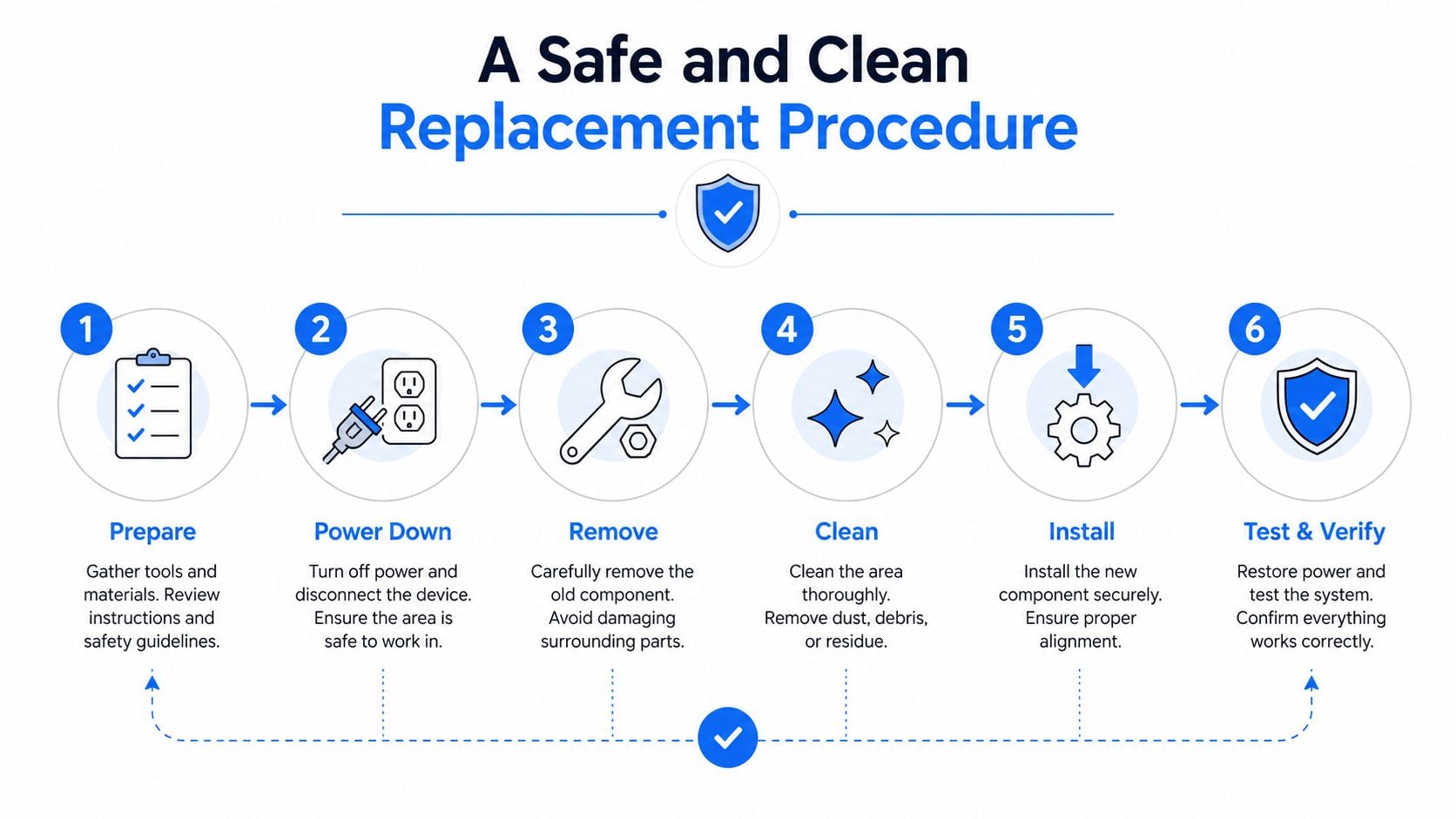
### Why the little steps matter
Flushing clears the first water through the cartridge and helps carry out trapped air and loose fines. Cleaning the housing matters because sediment can settle where you cannot see it. Checking the O-ring matters because a seal can look fine and still fail once pressure returns.
A missed seal or an unflushed cartridge can lead to leaks, weaker performance, or contaminated first-use water.
The same basic sequence shows up in standard replacement instructions, and it also lines up with the kind of buying caution covered in the [PureHQ Inc. brewing guide](https://www.purehqfilters.com/blog/tag/water-filter-buying-guide/). For a matching parts overview, the [Woder replacement cartridges](https://woder.com/product-category/replacement-cartridges/) page is a practical reference point for seeing how cartridge options are grouped before installation. Replacement is maintenance, not just part swapping.
[replacement guide](https://mmpfilter.com/blogdetail/water-filter-cartridge-replacement-guide)
## Buying Without Getting Burned
The cartridge market is full of parts that look right until you compare the details. Some listings inflate capacity claims, some labels sound official without showing independent verification, and some cartridges fit the housing while still underdelivering on what they're supposed to remove.
### What to verify before you order
Check whether the cartridge has a real, independent certification that matches the claim being made. Look for the specific standard, not just the word “certified.” A claim about chlorine taste and odor should point to the relevant standard, and a lead-related claim should show the standard that applies to lead-free compliance or contaminant reduction.
You should also expect performance claims to be backed by published test data when the seller is serious. If the listing says the cartridge removes a contaminant but offers no document trail, treat that as a warning sign. A cartridge can be relabeled from a generic body and still look convincing in photos.

For a practical buying lens, the [PureHQ Inc. brewing guide](https://www.purehqfilters.com/blog/tag/water-filter-buying-guide/) is a useful reminder that any filter purchase should be tied to use case, not just a generic product title. That applies here too.
- **Check the exact fit:** Match length, outside diameter, inside diameter, and core style before you buy.
- **Match the claim to the standard:** Don't assume one certification label covers every contaminant claim.
- **Ask for the test trail:** If a seller claims unusual contaminant reduction, look for the document behind it.
- **Watch for physical fit without true compatibility:** A cartridge can slide into a housing and still leak or bypass.
- **Confirm the replacement category:** Use the right cartridge class for the fixture, whether it's under-sink, refrigerator, or membrane-based.
If you want a clean place to start browsing replacements that are organized by system type, the [replacement cartridges](https://woder.com/product-category/replacement-cartridges/) category is the right kind of reference point.
## Quick Reference and Next Steps
The shortest version is simple. Identify the cartridge before you order. Match the dimensions, the connection style, and the operating limits to the system in front of you. Let pressure drop, flow decline, and water behavior tell you when it's time, then replace the cartridge with the full cleanup and flush routine.
Cartridge ClassTypical GallonsCommon Replacement WindowPitcher filterAbout 40 gallonsAround 2 monthsRefrigerator filter200–300 gallonsAbout 6 monthsUnder-sink filter500–1,000 gallons6–12 monthsRO membrane1,500–2,000 gallons or more2–5 yearsIf the old part number is gone, confirm the housing age with the manufacturer or measure the housing itself before ordering. If you want to match a cartridge to a specific contaminant profile instead of swapping blindly, a lab test on incoming water is the cleaner next step. That gives you a better baseline than guesswork ever will.
---
Woder Filters makes U.S.-made point-of-use filtration systems and replacement cartridges designed for homeowners who want a clearer match between water conditions and cartridge choice. If you're comparing options for a kitchen tap, a refrigerator line, or a legacy replacement, visit [Woder Filters](https://woder.com) to review the available systems and support resources.
**Categories:** Woder Science
**Tags:** cartridge compatibility, filter installation, replacement filter guide, under-sink filter, water filter replacement cartridge
---
### [Does Hard Water Cause Hair Loss? What Dermatologists Actually Say in 2026](https://woder.com/blog/does-hard-water-cause-hair-loss-what-dermatologists-actually-say-in-2026/)
**Published:** July 30, 2026
**Author:** woder
**Content:**
- [What Is Hard Water, Exactly?](#what-is-hard-water-exactly)
- [What Hard Water Does to Your Hair](#what-hard-water-does-to-your-hair)
- [Does Hard Water Cause Hair Loss? The Dermatologist View](#does-hard-water-cause-hair-loss-the-dermatologist-view)
- [What About Chlorine and Other Contaminants?](#what-about-chlorine-and-other-contaminants)
- [Hard Water vs. Water Contaminants: Two Different Problems](#hard-water-vs-water-contaminants-two-different-problems)
- [What You Can Actually Do](#what-you-can-actually-do)
- [For Shower and Scalp Issues](#for-shower-and-scalp-issues)
- [For Drinking Water Quality](#for-drinking-water-quality)
- [The Mineral Question: Should You Keep Calcium and Magnesium?](#the-mineral-question-should-you-keep-calcium-and-magnesium)
- [When to See a Dermatologist](#when-to-see-a-dermatologist)
- [FAQs](#faqs)
You move to a new city and suddenly notice more hair in the drain. Your scalp feels dry and itchy. Your hair looks dull no matter what conditioner you reach for. Hard water gets the blame constantly — but does it actually cause hair loss, or is that a myth that's taken on a life of its own?
Here's what the research and dermatologists actually say, and what you can realistically do about it.
### What Is Hard Water, Exactly?
Hard water contains elevated levels of dissolved minerals — primarily calcium and magnesium — picked up as groundwater moves through limestone and chalk deposits. The US Geological Survey estimates that roughly 85 percent of American homes receive hard water, so white deposits on your faucets and that slippery-soap feeling are pretty common experiences.
Hardness is measured in grains per gallon (GPG) or milligrams per liter (mg/L). Above 7 GPG is generally considered hard. Parts of the Midwest, Southwest, and South regularly see levels above 15 GPG.
### What Hard Water Does to Your Hair
Hard water doesn't rinse cleanly off your hair the way soft water does. Calcium and magnesium ions bind to the proteins in your hair and to the surfactants in your shampoo, leaving behind a mineral film. Over time, that buildup makes hair feel rough, look dull, and tangle more easily.
The physical effects are real and well-documented:
- **Texture changes.** Hair feels coarser and harder to manage.
- **Color fading.** Hard water can strip artificial color faster than soft water.
- **Scalp irritation.** Mineral deposits disrupt the scalp's natural moisture balance, causing dryness and flaking.
- **Reduced lather.** Shampoo doesn't foam as well, which often leads to over-washing.
These are legitimate complaints. The question is whether any of this crosses into actual hair loss.
### Does Hard Water Cause Hair Loss? The Dermatologist View
The short answer, as of 2026, is no — hard water does not directly cause hair loss. It can, however, create conditions that make existing hair problems worse.
A frequently cited study in the *International Journal of Trichology* found no statistically significant difference in tensile strength or elasticity between hair washed in hard water versus distilled water over 30 days. The hair looked and felt different, but the follicles themselves were not damaged.
Dermatologists draw a clear line here. Clinical hair loss stems from follicle damage, hormonal shifts, nutritional deficiencies, autoimmune conditions like alopecia areata, or genetic factors like androgenetic alopecia. Hard water doesn't attack the follicle — it affects the hair shaft and the scalp surface.
There is an indirect pathway worth acknowledging, though. When hard water causes chronic scalp irritation or dermatitis and you scratch repeatedly, that mechanical friction can increase shedding. If you're already predisposed to thinning, a compromised scalp environment doesn't help. But the mineral buildup itself isn't the root cause.
#### What About Chlorine and Other Contaminants?
This is where the conversation gets more nuanced — and where hard water and contaminated water often get conflated, even though they're different problems.
Chlorine, used as a disinfectant in most municipal water supplies, is a known scalp and hair irritant. It strips natural oils from both the scalp and the hair shaft. Heavy chlorine exposure — like daily pool swimming — has been linked to increased hair fragility, and the same logic applies, to a lesser degree, to tap water with high chlorine levels.
Lead and heavy metals are a separate concern. Chronic lead exposure through drinking water has been associated with systemic health effects, and some research suggests heavy metal accumulation may interfere with normal hair growth cycles. That's a different mechanism from hard water mineral buildup, but it's a reason to pay attention to what's actually in your tap water — not just how hard it is.
### Hard Water vs. Water Contaminants: Two Different Problems
These are worth separating clearly, because the solutions aren't the same.
IssueWhat It Does to HairPrimary SolutionHard water (calcium, magnesium)Buildup, dullness, texture changesChelating shampoo, shower filter, water softenerChlorineStrips oils, increases brittlenessCarbon filtration, shower filterLead / heavy metalsPotential systemic effects on hair growth cycleContaminant-removing water filterPFAS / VOCsEmerging research; systemic health concernAdvanced filtrationCalcium and magnesium — the minerals that make water hard — are actually beneficial when you drink them. They support bone density, cardiovascular health, and hundreds of enzymatic processes. The problem with hard water is topical, not systemic. Drinking water with calcium and magnesium isn't hurting your hair from the inside.
This distinction matters when you're choosing a water filter. Reverse osmosis systems remove virtually everything, including the calcium and magnesium your body genuinely needs. That might address shower buildup in a whole-home setup, but it strips out minerals that have real health value.
### What You Can Actually Do
#### For Shower and Scalp Issues
If hard water is affecting your hair texture and scalp comfort, the most targeted fix is a showerhead filter that reduces chlorine and some mineral content. Chelating shampoos — those containing EDTA or citric acid — break down mineral deposits on the hair shaft and are widely available.
A clarifying wash once or twice a month also helps reset buildup. Look for ingredients like phytic acid or apple cider vinegar, which dissolve calcium deposits without aggressively stripping your hair.
#### For Drinking Water Quality
If your concern extends beyond hair to your overall health, what you're drinking matters more than what you're showering in. Tap water can carry lead, PFAS, chlorine, chromium 6, mercury, and volatile organic compounds — none of which belong in your body, regardless of what they do to your hair.
[Woder Filters](https://woder.com) takes a different approach from reverse osmosis. Woder's Advanced Selective Filtration removes 99.9% of lead, chlorine, PFAS, chromium 6, mercury, and VOCs while leaving calcium and magnesium intact. You get genuinely clean water without losing the minerals that support your health. Installation connects directly to your existing water line in under 30 minutes — no tank, no drain line, no wastewater.
Not sure which model fits your home? The [Woder product finder](https://woder.com/wizard) matches your household to the right filter.
### The Mineral Question: Should You Keep Calcium and Magnesium?
Calcium and magnesium are not contaminants. They're naturally occurring minerals your body uses constantly. The reason hard water causes hair problems is topical chemistry — not because the minerals themselves are harmful.
When you drink water that contains calcium and magnesium, you're getting a small but meaningful contribution to your daily mineral intake. Naturally occurring calcium and magnesium in groundwater have been part of human diets for thousands of years. Stripping them out of your drinking water in the name of "purity" trades a real nutritional benefit for a perceived one.
That's why a selective filtration approach makes more sense for drinking water than a system that removes everything indiscriminately.
### When to See a Dermatologist
If you're experiencing significant shedding, patchy loss, or a receding hairline, hard water is almost certainly not the cause. See a dermatologist. The real culprits — hormonal imbalances, thyroid dysfunction, iron deficiency, androgenetic alopecia, alopecia areata — require proper diagnosis and treatment. No water filter addresses those conditions.
Hard water can make your hair look and feel worse. It can irritate your scalp. But it doesn't destroy follicles, and it doesn't cause the kind of hair loss that ends up in a dermatologist's office.
---
### FAQs
**Does hard water cause permanent hair loss?**
No. Dermatologists consistently find that hard water affects the hair shaft and scalp surface but does not damage hair follicles. Permanent hair loss requires follicle damage, which hard water does not cause.
**Can switching to filtered water improve my hair?**
Filtering out chlorine and other chemical irritants from your shower water can improve scalp comfort and reduce brittleness over time. Drinking cleaner water removes contaminants that may have broader health effects, but it won't reverse genetic or hormonal hair loss.
**Is calcium and magnesium in water bad for your hair?**
Topically, mineral buildup from calcium and magnesium can make hair feel rough and look dull. But those same minerals are beneficial when you drink them. The problem is on the surface of your hair, not inside your body.
**What type of water filter is best for hair health concerns?**
For drinking water, a filter that removes chlorine, lead, and PFAS while preserving calcium and magnesium is the most balanced choice. For shower use, a dedicated showerhead filter targeting chlorine is the most direct fix for scalp and texture issues.
**Should I get a water softener if I have hard water?**
Water softeners replace calcium and magnesium with sodium ions, which solves the buildup problem but adds sodium to your water. Many people prefer a targeted filtration approach for drinking water — one that keeps beneficial minerals while removing actual contaminants.
**Can PFAS in tap water affect hair growth?**
Research on PFAS and hair growth is still emerging, but PFAS are classified as persistent environmental contaminants with documented systemic health effects. Removing them from your drinking water is a sound precaution regardless of any specific hair-related concern.
**How do I know if my water is hard?**
Your municipality's annual water quality report will list hardness levels. You can also pick up an inexpensive water hardness test kit, or check the US Geological Survey's national hardness map for a general sense of your region's typical range.
---
Hard water is a genuine nuisance for your hair — but it's not the hair loss culprit it's so often made out to be. The more useful question isn't how hard your water is. It's what your water actually contains. Clean water that keeps its minerals is better for your body than stripped water that's technically "pure." It's your water. Make sure it's working for you.
**Categories:** Woder Science
---
### [How to Install Under Sink Water Filter: 2026 Guide](https://woder.com/blog/how-to-install-under-sink-water-filter/)
**Published:** July 30, 2026
**Author:** woder_admin
**Content:**
You're probably under the sink right now, holding a filter kit in one hand and staring at a cold-water valve with the other, wondering whether this is a simple upgrade or the start of a plumbing mistake. That moment is normal. Most under-sink systems are built for a first-time DIY install, and the part that feels hardest is usually the cramped cabinet, not the plumbing itself, especially with compact point-of-use systems that are designed to fit standard shutoff-valve connections and can be installed without a plumber in many homes. The market for these systems is large and still growing, valued at **USD 6.7 billion in 2024** and projected to reach **USD 11 billion by 2034** with a **5.1% CAGR** from 2025 to 2034, which helps explain why so many homeowners are trying this job themselves. [gminsights.com](https://www.gminsights.com/industry-analysis/under-sink-water-filter-system-market)
What follows is the practical version of **how to install under sink water filter** without making it harder than it needs to be. You'll see how to prep the cabinet, connect the cold line, choose between a dedicated faucet and a no-drill route, flush the system, and handle the small leaks that show up when the water comes back on. If you're the kind of person who wants clear water at the tap but doesn't want to turn the kitchen into a construction zone, that's the right place to start.
## Table of Contents
- [What the Job Actually Looks Like Under There](#what-the-job-actually-looks-like-under-there)
- [What changes the job is the space, not the concept](#what-changes-the-job-is-the-space-not-the-concept)
- [Tools, Parts, and Pre-Flight Checks Before You Start](#tools-parts-and-pre-flight-checks-before-you-start)
- [Check the cabinet before you touch the valve](#check-the-cabinet-before-you-touch-the-valve)
- [Mounting the Filter and Tapping Into the Cold Line](#mounting-the-filter-and-tapping-into-the-cold-line)
- [Mount first, then branch the line](#mount-first-then-branch-the-line)
- [Choosing Your Faucet Setup, Including the No-Drill Option](#choosing-your-faucet-setup-including-the-no-drill-option)
- [Dedicated faucet or no-drill route](#dedicated-faucet-or-no-drill-route)
- [Turning the Water Back On and Flushing the Filter](#turning-the-water-back-on-and-flushing-the-filter)
- [The flush is part of the install](#the-flush-is-part-of-the-install)
- [Troubleshooting the Small Problems That Show Up After Install](#troubleshooting-the-small-problems-that-show-up-after-install)
- [The usual culprits and the quickest fix](#the-usual-culprits-and-the-quickest-fix)
- [Keeping It Working and Knowing What's Next](#keeping-it-working-and-knowing-whats-next)
## What the Job Actually Looks Like Under There
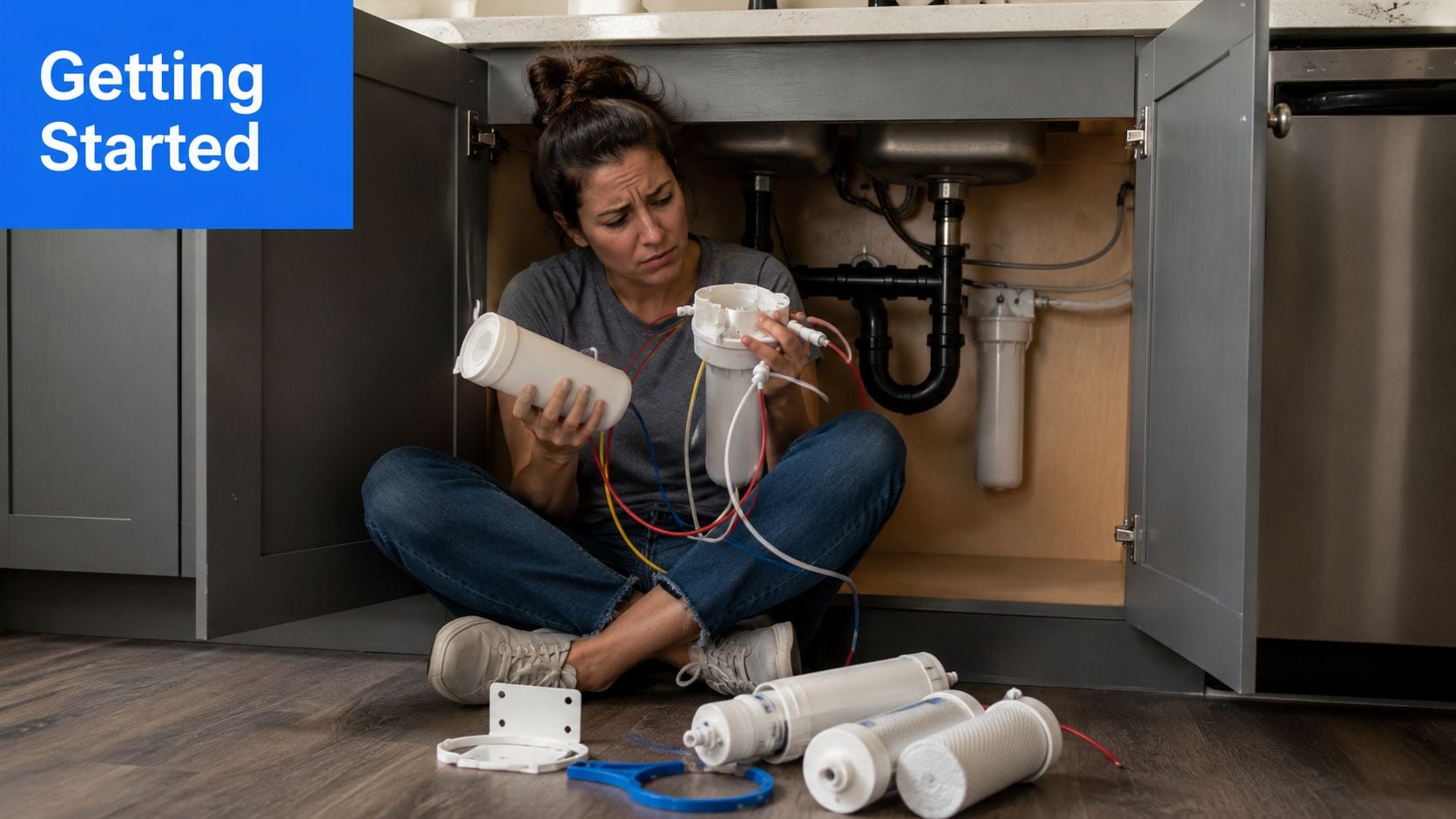
The first time you crawl under the sink, the parts usually look more complicated than the box photos suggest. The cabinet is part storage space, part plumbing puzzle, and it is normal to wonder whether this is a job you should have handed to a plumber. For most under-sink systems, the challenge is cabinet layout and access, not advanced plumbing skill.
### What changes the job is the space, not the concept
Consumer guides point out that many under-sink systems are built around a **dedicated faucet**, which may mean using an existing hole or drilling a new one, while the plumbing connection itself stays straightforward. A simple install can take **about 10 minutes** with an adjustable wrench and, if brackets are involved, a screwdriver, after the cold-water valve is shut off and the adapter is attached. More involved reverse osmosis setups take longer, often **about 45 to 90 minutes**, because they can require a **dedicated faucet hole and drain line**. [Consumer Reports](https://www.consumerreports.org/home-garden/water-filters/buying-guide/)
That is why the job feels different from a larger plumbing project. You are not replacing pipes or tearing out a sink. You are usually making a clean connection to the cold line, mounting the filter where it can be serviced later, then deciding whether the filtered water gets its own faucet or shares the existing one.
> **Practical rule:** if you can shut off the water, connect an adapter, and check for drips, you can handle most under-sink installs.
If you want a visual reference before you start, this [best under sink filter for remodel](https://gosouthray.com/2026/07/03/water-filter-under-sink/) article from SouthRay Kitchen & Bath shows how the upgrade fits into a real kitchen layout. That helps because the install is easier when you can picture the finished cabinet instead of only the loose parts on the floor.
A quick water test can also keep the rest of the job from turning into guesswork. If you are not sure what is coming through the tap now, a simple check from [Woder's water testing guide](https://woder.com/test-your-water/) can help you decide what kind of filter setup makes sense before you start drilling, mounting, or planning a faucet swap.
The rest of the work is about order, not force. Clear the space, make the connection, choose the faucet path, and test for leaks. Keep that sequence, and the project stays manageable, even if the cabinet is cramped or the shutoff valve feels stuck at first.
## Tools, Parts, and Pre-Flight Checks Before You Start
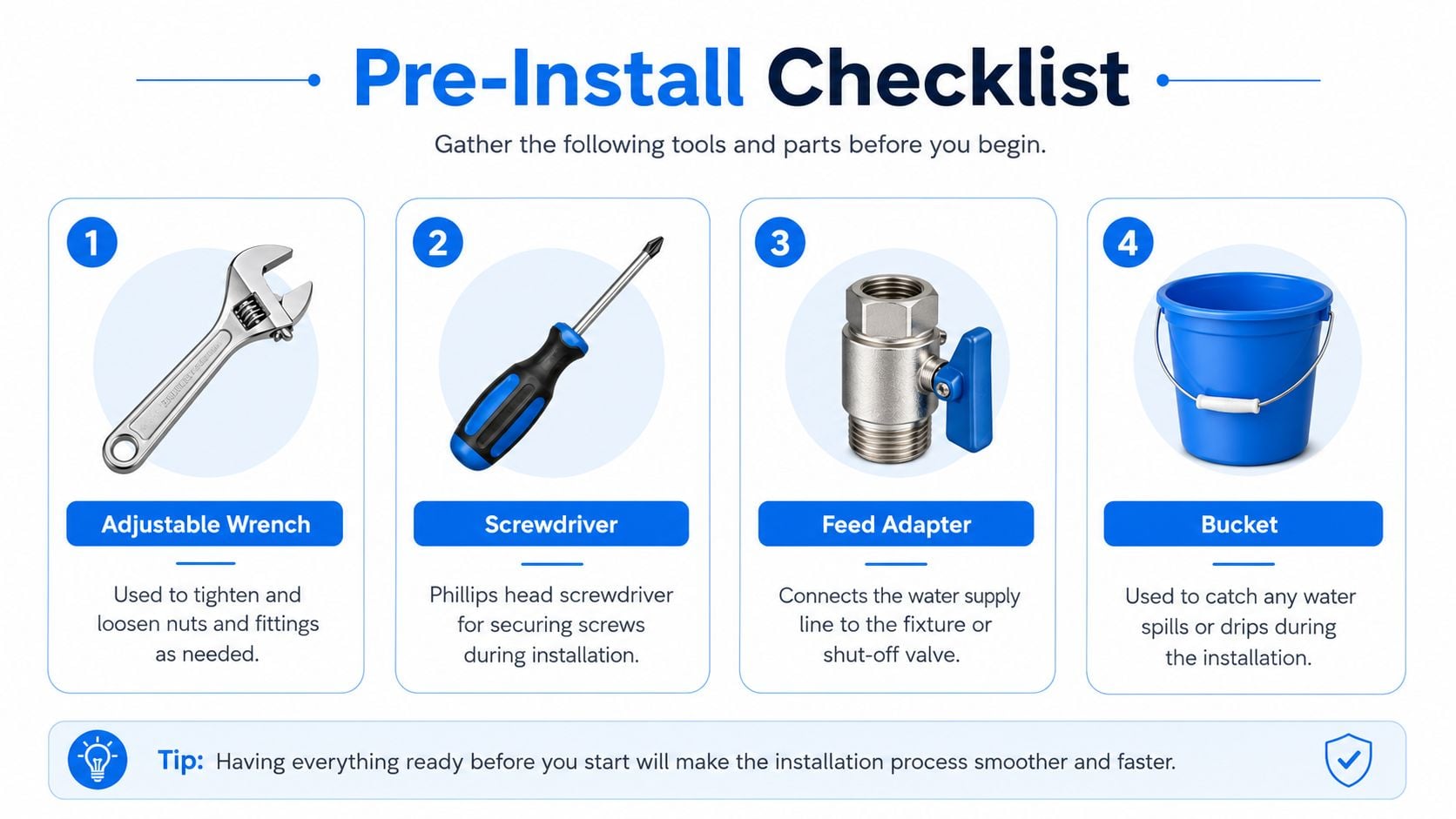
A smooth install starts with everything on the counter before you touch the valve. You want an **adjustable wrench**, a **Phillips screwdriver** for the mounting bracket if your system uses one, the supplied **feed adapter** and fittings, **plumber's tape** for threaded connections that need it, and a **towel** for the drip that always seems to happen anyway. If the box includes a bracket, read that part first, because some filter heads mount differently than the photos suggest.
### Check the cabinet before you touch the valve
A reliable installation guide starts with the cold-water line, then moves to cabinet clearance. Fresh Water Systems notes that the filter should be mounted with enough room to service it later, and one published guide specifies leaving **at least 4 inches** between the bottom of the cartridge and the cabinet floor so you can remove it without pulling the whole unit out. [Fresh Water Systems](https://www.freshwatersystems.com/blogs/blog/how-to-install-an-under-sink-water-filtration-system)
That clearance sounds small until you try to twist a cartridge free with a trash can, a pull-out organizer, and a cleaning caddy in the way. If the cabinet is cramped, move the stored items now. It's much easier than discovering the filter can't be changed without dismantling half the under-sink space.
> **Remember this:** if the shutoff valve doesn't close fully, stop and fix that first. An old valve that only partially seals can turn a simple install into a wet cabinet fast.
It also helps to confirm the water line you're tapping is the **cold-water supply** and not the hot side. Most under-sink drinking systems are built for cold feed only, and hot water can damage cartridges that aren't rated for it. If the line you plan to use feels wrong or is unclear, trace it back before you open anything.
If you're stuck on valve location, this [Voyager Plumbing shut off valve locations](https://voyagerplumbing.com.au/blog/main-water-shut-off-valve-location/) guide is a useful reference for figuring out where the main shutoff usually lives. For a broader water-quality check before or after installation, Woder's [test your water](https://woder.com/test-your-water/) page is a practical next stop when you want to match the filter to what's in your supply.
A steady setup here saves time later. Once the tools are out, the cabinet is clear, and the cold valve is identified, you're ready to move.
## Mounting the Filter and Tapping Into the Cold Line
Start by shutting off the cold-water valve, then open the kitchen faucet until the pressure drops and the flow stops. That little release matters. It clears the line so the adapter isn't fighting residual pressure while you're attaching it, and it keeps the first connection from spraying you or the cabinet floor.
### Mount first, then branch the line
Once the line is quiet, mount the filter bracket to the cabinet wall or floor where the cartridge can still be removed later. Some systems use a one-piece body that hangs neatly once the bracket is secured, while others use separate head and canister parts. If you're using a [Woder WD-G4-210-DC Water Filter (New WD-4K-ADV-DC)](https://woder.com/products/wd-g4-210-dc/), the product snapshot says the Gen4 one-piece filter is meant for homes with whole-house sediment filtration or low sedimentation levels, and it replaces older WD-G4-210-DC family versions. It's a useful example of a modern under-sink layout, because the installation still follows the same basic cabinet logic even when the body design changes.
Then tap into the cold line with the supplied compression tee or feed adapter. Hand-tighten the compression nut first, then give it a small turn with the wrench. That habit does more to prevent leaks than cranking hard from the start, because ferrules seal best when they seat cleanly instead of being forced sideways.
> Keep the tubing smooth. A kinked line can slow the flow later, and a twisted line makes troubleshooting harder than it needs to be.
If your kit uses threaded fittings, wrap the threads with plumber's tape before assembly. If the parts are push-to-connect, follow the box and skip the tape where it doesn't belong. Not every connection wants the same treatment, and mixing methods is how people create leaks they didn't need.
By the end of this part, the filter body should be mounted and the cold line branched off cleanly. At that point, the plumbing is in place, and the remaining choice is how the filtered water will reach the sink.
## Choosing Your Faucet Setup, Including the No-Drill Option
Many install guides assume you own the house and have a spare hole waiting for a filtered faucet. That's not everyone's situation. If you're in a rental or just don't want to drill, the faucet decision matters as much as the filter itself.
### Dedicated faucet or no-drill route
A dedicated filtered faucet gives you the cleanest daily setup. Consumer and home-improvement guides note that this path may involve drilling an extra hole in the countertop or sink, or using an existing unused opening such as a soap dispenser hole. The faucet then connects to the filter with the outlet line, often a small-diameter tube routed neatly through the cabinet and up to the sink deck. [Consumer Reports](https://www.consumerreports.org/home-garden/water-filters/buying-guide/), Home Depot
That setup is the one most homeowners like best once it's in place, because filtered water has its own tap and doesn't interrupt the main faucet. It's also the path most aligned with permanent installs and remodels, especially if you already have a spare hole or deck plate to work with.
The no-drill option is the rental-friendly alternative. Instead of adding a new faucet, a diverter valve attaches to the existing faucet aerator and lets you switch between filtered and unfiltered flow. It's simple, reversible, and practical when you can't modify the sink. The tradeoff is that it can compromise flow rate and convenience compared with a dedicated tap.
> **Short version:** if you can drill and you plan to stay, a dedicated faucet usually feels better day to day. If you can't drill, a diverter can still give you filtered water without touching the counter.
The important thing is not to treat one option as second-class. A renter can still get very good filtration without making a permanent change, and a homeowner can still choose the simplest install path if the cabinet layout already supports it. The right setup is the one that fits the kitchen you have.
## Turning the Water Back On and Flushing the Filter
Slowly open the cold-water shutoff valve and watch every fitting as the pressure returns. Don't flip it open fast. A sudden surge can push past a half-tightened compression nut and soak the cabinet before you notice the drip. If the system holds, you're past the part that makes many people nervous.
### The flush is part of the install
Once everything stays dry, run the filtered faucet and let the water flow for **several minutes** or **5 to 10 minutes**, depending on the cartridge instructions. SharkBite notes that this startup flush clears **carbon fines** and debris before normal use, and that step is part of the system's startup mechanics, not an optional extra. [SharkBite](https://www.sharkbite.com/us/en/resources/videos/how-to-install-an-under-sink-water-filter)
The first water may look cloudy or taste a little off for a short time. That usually comes from loose carbon dust settling out of a new cartridge. It doesn't mean the install failed. It means the filter is doing what new filters often do when they first fill.
If you're filling a cup during the flush, use a bucket or let the water run straight into the sink so you're not staring at the first cloudy glass and wondering what went wrong. The line should clear as the media rinses out.
After that, shut the faucet off and check the cabinet again. Dry fittings now save time later. If anything is damp, you've got the clue you need before the cabinet turns into a surprise leak box.
## Troubleshooting the Small Problems That Show Up After Install
Most post-install problems are small, and the fix is usually simpler than the symptom makes it feel. A leak doesn't automatically mean the whole setup is wrong. It usually means one fitting isn't seated, one line is pinched, or the cartridge hasn't finished flushing.
### The usual culprits and the quickest fix
- **Drip at the compression fitting:** The ferrule probably didn't seat cleanly. Tighten the nut **1/4 turn** and check again, or disassemble and reset the connection if it keeps weeping.
- **Low water pressure:** Look for a partially closed shutoff, a kinked line, or a filter that's still finishing its flush. In some cases, the system just needs a little more purge time before flow feels normal.
- **Cloudy water:** That's usually carbon-fine carryover and should clear on its own after the initial flush.
- **Plastic or chemical taste in the first glasses:** The flush was too short. Run the water for another **5 minutes** and taste it again.
A separate issue people sometimes mistake for a filter problem is chlorine taste coming back after install. Woder's [chlorine taste after filtering hidden causes and fixes](https://woder.com/blog/chlorine-taste-after-filtering-hidden-causes-and-fixes/) article is useful when the taste doesn't match what the system should be doing. The point isn't to panic. It's to separate a real install issue from a normal startup effect.
> A few minutes of checking is usually enough to solve the problem. If the cabinet is dry and the flow is steady, the system is probably fine.
The main thing to avoid is redoing the whole install too early. Most of these issues come from a single loose or partially seated connection, not a bad system. Tighten, purge, and look again before you assume something bigger is wrong.
## Keeping It Working and Knowing What's Next
A good install only stays good if the cartridge stays in service. Most under-sink filters need replacement on a regular schedule, and the warning signs often show up before the calendar does, like falling flow, a returning chlorine taste, or visible discoloration of the media. If you want a practical reminder of service life, Woder's [how long does a water filter last](https://woder.com/blog/how-long-does-a-water-filter-last/) article is a useful reference point.
For homes with specific concerns, a lab water test before or after install can help confirm whether the filter choice matches the actual water coming in. That matters for issues like PFAS, lead, and other contaminants because the right filter choice depends on the supply, not on a marketing claim. If the water quality is unclear, test first, then choose.
If the install is done and the water tastes right, the next useful decision is whether the filter you picked is the right fit for your home over time. Woder Filters offers U.S.-made point-of-use systems, under-sink and inline options, and guidance for matching filtration to the water at your tap. If you want to compare your setup with a mineral-retaining approach built for everyday drinking water, visit [Woder Filters](https://woder.com) and look at the options with your cabinet, your faucet, and your water in mind.
**Categories:** Woder Science
**Tags:** DIY installation, home water filtration, kitchen plumbing, under sink water filter, water filter setup
---
### [Heavy Metal Water Filter Guide: What Certifications to Look For and Which Systems Qualify](https://woder.com/blog/heavy-metal-water-filter-certifications-systems/)
**Published:** July 29, 2026
**Author:** woder
**Content:**
- [Why Heavy Metals in Drinking Water Are Worth Taking Seriously](#why-heavy-metals-in-drinking-water-are-worth-taking-seriously)
- [What Certifications Actually Mean for Heavy Metal Filters](#what-certifications-actually-mean-for-heavy-metal-filters)
- [NSF/ANSI 53 — The Heavy Metal Standard](#nsfansi-53-the-heavy-metal-standard)
- [NSF/ANSI 42 — Aesthetic Reduction](#nsfansi-42-aesthetic-reduction)
- [NSF/ANSI 58 — Reverse Osmosis Systems](#nsfansi-58-reverse-osmosis-systems)
- [NSF/ANSI 401 — Emerging Contaminants](#nsfansi-401-emerging-contaminants)
- [WQA Gold Seal](#wqa-gold-seal)
- [What to Watch Out For](#what-to-watch-out-for)
- [Which Filter Technologies Remove Heavy Metals](#which-filter-technologies-remove-heavy-metals)
- [Activated Carbon](#activated-carbon)
- [Selective Filtration](#selective-filtration)
- [Reverse Osmosis](#reverse-osmosis)
- [Ion Exchange](#ion-exchange)
- [KDF Media](#kdf-media)
- [How to Evaluate a Heavy Metal Filter Before You Buy](#how-to-evaluate-a-heavy-metal-filter-before-you-buy)
- [Systems That Qualify for Heavy Metal Removal](#systems-that-qualify-for-heavy-metal-removal)
- [Where Woder Fits](#where-woder-fits)
- [FAQs](#faqs)
- [The Bottom Line](#the-bottom-line)
You found a water quality report in your mailbox, or maybe a headline about lead in local tap water sent you searching. Either way, you want a filter that actually handles heavy metals — not one that just looks credible on a product page.
This guide covers what heavy metal contamination looks like in drinking water, which certifications tell you a filter genuinely works, and what to look for when comparing systems. No filler, no fear-mongering — just what you need to make a confident decision.
---
### Why Heavy Metals in Drinking Water Are Worth Taking Seriously
Heavy metals enter drinking water through a handful of common routes: aging lead service lines and household plumbing, industrial runoff, agricultural chemicals, and naturally occurring minerals in groundwater. The most frequent offenders in US tap water are lead, mercury, chromium 6, and arsenic.
Lead gets the most attention, and for good reason. There is no safe level of lead exposure for children. The EPA's action level of 15 parts per billion is a trigger for remediation — not a safety guarantee. Homes built before 1986 carry higher risk because lead solder and lead pipes were standard construction materials at the time.
Chromium 6 occurs naturally in some regions but also shows up near industrial sites. Mercury appears in groundwater around certain mining and manufacturing areas.
None of this is meant to alarm you. Most municipal water meets federal standards. But "meets standards" and "contains no heavy metals" are not the same statement.
---
### What Certifications Actually Mean for Heavy Metal Filters
Certifications are the most reliable signal that a filter does what it claims. Here is what each one means and why it matters.
#### NSF/ANSI 53 — The Heavy Metal Standard
NSF/ANSI 53 is the benchmark certification for health-effects reduction. A filter carrying this certification has been independently tested and verified to reduce specific contaminants — including lead, chromium, and mercury — to below health-based limits.
This is the certification to prioritize when shopping for a heavy metal water filter. If a product does not carry NSF/ANSI 53, any manufacturer claims about heavy metal removal are unverified.
#### NSF/ANSI 42 — Aesthetic Reduction
NSF/ANSI 42 covers taste, odor, and chlorine reduction. It is not a heavy metal certification on its own. Many quality filters carry both 42 and 53, but seeing 42 alone tells you nothing about lead or chromium removal.
#### NSF/ANSI 58 — Reverse Osmosis Systems
NSF/ANSI 58 applies specifically to reverse osmosis systems and covers contaminant reduction across the full RO process. If you are evaluating an RO unit for heavy metal removal, look for this alongside NSF/ANSI 53.
#### NSF/ANSI 401 — Emerging Contaminants
This certification covers a broader contaminant list including pharmaceuticals, herbicides, and some PFAS compounds. It is a newer standard and not all filters carry it, but it signals a manufacturer willing to test beyond the minimum requirements.
#### WQA Gold Seal
The Water Quality Association runs an independent certification program that mirrors NSF standards. A WQA Gold Seal is a credible alternative or complement to NSF certification and indicates genuine third-party performance verification.
#### What to Watch Out For
Some filters are marketed as "tested to NSF standards" rather than "certified by NSF." These are not the same thing. Tested-to means the manufacturer ran internal tests using NSF protocols. Certified means an independent body verified the results. Look for the certified designation — not just the tested-to language.
---
### Which Filter Technologies Remove Heavy Metals
Not every filtration technology handles heavy metals equally. Understanding how each one works helps you match the right system to your actual water quality concern.
#### Activated Carbon
Standard activated carbon filters are excellent at reducing chlorine, VOCs, and taste issues. On their own, they have limited effectiveness against heavy metals like lead and chromium 6. Some carbon block filters with tight pore structures do reduce lead — but verify this with NSF/ANSI 53 certification specific to that product, not just the category.
#### Selective Filtration
Selective filtration uses targeted media — often nanoparticle-based materials — to attract and bind specific contaminants while leaving beneficial minerals like calcium and magnesium in the water. It is a more precise approach than broad-spectrum removal. A well-designed selective filtration system can achieve 99.9% removal of lead, mercury, and chromium 6 without stripping the minerals that affect both taste and health.
This is the approach [Woder Filters](https://woder.com) takes. Their Advanced Selective Filtration technology removes lead, PFAS, chlorine, chromium 6, mercury, carcinogens, and VOCs while keeping calcium and magnesium intact. That mineral retention is a deliberate design choice — not a side effect.
#### Reverse Osmosis
RO systems are highly effective at heavy metal removal and carry NSF/ANSI 58 certification. The trade-off is that RO removes virtually everything, including the minerals your body benefits from. Installation typically runs $300 to $600, requires a pressurized tank and a drain line, and produces wastewater. For heavy metal removal specifically, it is not the only option — and for many homeowners, it is more than the situation calls for.
#### Ion Exchange
Ion exchange resins are commonly used for water softening and can remove certain heavy metals, particularly lead. They work by swapping harmful ions for sodium or potassium ions. They are often used as one stage in a multi-stage system rather than as standalone heavy metal filters.
#### KDF Media
Kinetic Degradation Fluxion media uses a copper-zinc alloy to reduce heavy metals, chlorine, and scale through an electrochemical process. KDF is frequently combined with carbon filtration in multi-stage systems to extend filter life and improve overall contaminant reduction.
---
### How to Evaluate a Heavy Metal Filter Before You Buy
Once you understand certifications and technologies, the buying decision comes down to a few practical questions.
**What does your water actually contain?** Your municipality's annual Consumer Confidence Report lists detected contaminants and their measured levels. If you are on well water, a professional test is the only reliable way to know what you are dealing with. Some homeowners on private wells benefit from working with a water treatment specialist before choosing a filter.
**What is the filter's verified removal rate for the specific metals in your water?** A filter certified under NSF/ANSI 53 for lead reduction may not be certified for chromium 6 or mercury. Check the specific contaminant list in the certification documentation — not just the headline claim on the packaging.
**Does the filter preserve minerals?** If you are removing heavy metals because you care about your family's health, stripping out calcium and magnesium works against that goal. Selective filtration systems that retain beneficial minerals give you clean water without the mineral deficit that comes with RO.
**What is the installation footprint?** Under-sink inline filters that connect directly to your existing water line require no tank, no drain line, and no plumber. Installation typically takes under 30 minutes — a very different commitment than a full RO system.
**What is the long-term cost?** A filter unit in the $80 to $200 range with annual replacement cartridges at $40 to $80 is significantly less expensive than bottled water over time, and far less than the installed cost of a typical RO system.
---
### Systems That Qualify for Heavy Metal Removal
Here is a quick framework for evaluating whether a specific system qualifies as a genuine heavy metal filter:
CriteriaWhat to Look ForCertificationNSF/ANSI 53 certified for lead, chromium, and/or mercury specificallyTechnologySelective filtration, certified carbon block, KDF, or RO (NSF/ANSI 58)Mineral retentionCalcium and magnesium preserved (not applicable to RO)InstallationInline or under-sink; no plumber required for point-of-useReplacement cycleClear cartridge replacement schedule with available replacement partsManufacturer transparencyContaminant-specific test data available, not just headline claimsA system that checks all of these boxes is a genuine heavy metal filter. One that only checks two or three may still be useful for other purposes, but it is not a complete answer to heavy metal contamination.
---
### Where Woder Fits
Woder's filters are built for homeowners who want verified heavy metal removal without the cost and complexity of a full RO installation. The Advanced Selective Filtration technology removes 99.9% of lead, chromium 6, and mercury alongside chlorine, PFAS, and VOCs — while keeping calcium and magnesium in the water by design.
Filters install inline into your existing water line. No tank. No drain line. No wastewater. No plumber. Replacement cartridges run $40 to $80 per year.
Not sure which model fits your household's flow rate and water source? The [product finder wizard at woder.com/wizard](https://woder.com/wizard) walks you through it in a few steps.
---
### FAQs
**What certifications should a heavy metal water filter have?**
Look for NSF/ANSI 53 certification, which independently verifies that a filter reduces health-affecting contaminants — including lead, chromium, and mercury — to below safe limits. It is the most important certification for heavy metal removal specifically. WQA Gold Seal certification is also credible and uses comparable testing standards.
**Does NSF/ANSI 42 certification mean a filter removes heavy metals?**
No. NSF/ANSI 42 covers aesthetic reduction — chlorine, taste, and odor. It does not verify heavy metal removal. A filter needs NSF/ANSI 53 certification to make verified claims about lead, chromium, or mercury reduction.
**Will a heavy metal filter remove beneficial minerals like calcium and magnesium?**
It depends on the technology. Reverse osmosis systems remove virtually all minerals along with contaminants. Selective filtration systems are designed to target specific contaminants while leaving beneficial minerals intact. If mineral retention matters to you, look for a selective filtration system with documented mineral preservation.
**How do I know which heavy metals are actually in my tap water?**
Start with your municipality's annual Consumer Confidence Report, which lists detected contaminants and their measured levels. If you are on well water or want more detail, a certified water testing lab can provide a full analysis of your specific supply.
**Is a heavy metal filter the same as a water softener?**
No. Water softeners use ion exchange to reduce hardness minerals like calcium and magnesium, which cause scale buildup. They are not designed to remove heavy metals like lead or chromium 6. If you have both hard water and heavy metal concerns, you need a dedicated heavy metal filter — not a softener.
**How often do I need to replace a heavy metal filter cartridge?**
Replacement schedules vary by filter capacity and household water usage. Most quality inline and under-sink filters specify a replacement interval in gallons or months. Following the manufacturer's schedule matters — a saturated filter can stop removing contaminants effectively even when water flow still seems normal.
**Can a heavy metal filter handle PFAS and chlorine at the same time?**
Many selective filtration and multi-stage systems are designed to address multiple contaminant categories simultaneously. Check the specific certification documentation for each contaminant you want removed. A filter certified under NSF/ANSI 53 for lead does not automatically cover PFAS unless that is specifically listed in its certification scope.
---
### The Bottom Line
Certifications are not marketing language. NSF/ANSI 53 is the line between a filter that has been independently verified for heavy metal removal and one that has not. Start there, then look at the technology, the mineral retention approach, and the real cost of ownership.
Clean water that still tastes like water is the goal. You do not need to overspend or over-engineer to get there. Visit [woder.com](https://woder.com) to find the right filter for your home.
**Categories:** Woder Science
---
### [PFAS Removal Water Filter: A Homeowner's Guide](https://woder.com/blog/pfas-removal-water-filter/)
**Published:** July 29, 2026
**Author:** woder_admin
**Content:**
A **PFAS removal water filter** is only as good as the chemistry inside it. In one major residential study, **reverse osmosis and under-sink dual-stage systems** removed **94% or more** of GenX and other PFAS in most cases, while some activated-carbon filters performed much less consistently, especially on shorter-chain compounds like GenX and PFBA ([study](https://pubs.acs.org/doi/10.1021/acs.estlett.0c00004)). That single difference explains why the label on the box matters less than the design behind it.
PFAS are a large family of man-made chemicals used where water, grease, or heat resistance matters. The carbon-fluorine bond in these compounds is unusually strong, which is why people call them **“forever chemicals.”** A simple way to think about it is a molecular suit of armor, it protects the compound in the environment and makes it harder for the body to break down or clear away.
For homeowners, that means the question is not whether a filter says “PFAS.” The question is which PFAS it was tested against, how the filter is built, and whether the claim is verified. That's where the details start to matter.
## Table of Contents
- [What PFAS Are and Why Homeowners Should Pay Attention](#what-pfas-are-and-why-homeowners-should-pay-attention)
- [Why chemistry matters more than the label](#why-chemistry-matters-more-than-the-label)
- [How PFAS Travel Into U.S. Tap and Well Water](#how-pfas-travel-into-us-tap-and-well-water)
- [The path from source site to faucet](#the-path-from-source-site-to-faucet)
- [The Four Filtration Technologies That Reduce PFAS](#the-four-filtration-technologies-that-reduce-pfas)
- [What each technology does to the water](#what-each-technology-does-to-the-water)
- [Why Filter Design Matters More Than the Label](#why-filter-design-matters-more-than-the-label)
- [Contact time and chain length change the result](#contact-time-and-chain-length-change-the-result)
- [The Certifications That Verify PFAS Reduction](#the-certifications-that-verify-pfas-reduction)
- [What the standards tell you](#what-the-standards-tell-you)
- [How to check a claim before you buy](#how-to-check-a-claim-before-you-buy)
- [Common Misconceptions That Lead Homeowners Astray](#common-misconceptions-that-lead-homeowners-astray)
- [The three mistakes to watch for](#the-three-mistakes-to-watch-for)
- [How to Choose, Install, and Maintain the Right Filter](#how-to-choose-install-and-maintain-the-right-filter)
- [Match the system to the test result](#match-the-system-to-the-test-result)
- [What an Informed Filter Choice Looks Like](#what-an-informed-filter-choice-looks-like)
## What PFAS Are and Why Homeowners Should Pay Attention
PFAS are not one chemical. They're a whole class of compounds built for durability, and that durability is exactly what makes them hard to deal with in water treatment. In the residential point-of-use study above, long-chain PFAS were removed more effectively than short-chain compounds, with some carbon-based filters averaging about **60% to 70% removal** for long-chain PFAS versus about **40% removal** for short-chain PFAS ([study](https://pubs.acs.org/doi/10.1021/acs.estlett.0c00004)). That's a useful reminder that **PFAS filter** is not a single performance category.
### Why chemistry matters more than the label
The chemistry is simple to picture once you stop thinking of PFAS as a single thing. A long carbon-fluorine chain behaves differently from a shorter one, and the shorter compounds can slip through some filters more easily. That's why a filter can look impressive in marketing and still struggle once the compound mix changes.
> **Practical rule:** if a filter claim doesn't say which PFAS it was tested against, treat it as incomplete.
The household relevance is straightforward. People don't drink “PFAS in general,” they drink whatever is in their water. A municipal supply and a private well can carry different compounds in different amounts, so the right filter has to match the water, not the slogan.
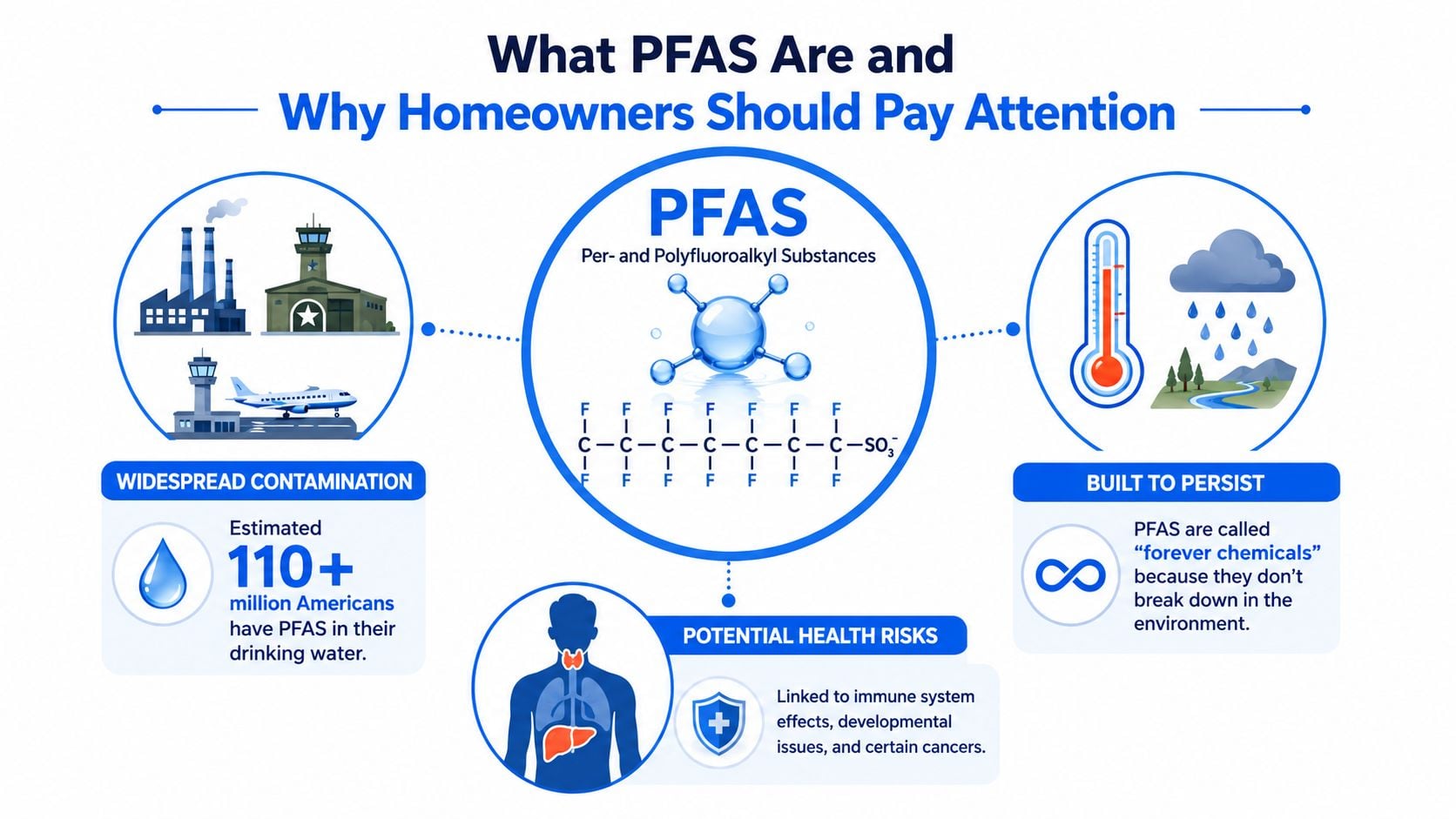
The public conversation often compresses all of this into a single phrase, “forever chemicals,” which is useful but incomplete. The better mental model is persistence plus diversity. PFAS don't just stick around, they also come in forms that behave differently in a filter bed.
For a broader primer on the chemistry and where these compounds show up, see [what PFAS are and why they end up in tap water](https://woder.com/blog/what-are-pfas-and-why-does-it-end-up-in-your-tap-water/). That background helps explain why the filtration question starts with the molecule, not the brand.
## How PFAS Travel Into U.S. Tap and Well Water
PFAS reach drinking water through familiar water pathways, which is why the issue is not confined to one region or one kind of home. Industrial discharge is one route, firefighting foam is another, and both can move downstream through soil, groundwater, and rivers. Once these compounds enter the water cycle, they tend to travel with it.
### The path from source site to faucet
Military bases and airports draw attention because of AFFF firefighting foam use, especially during training and emergency response. Factories and landfills can add to the load, and wastewater systems can concentrate the problem when they receive contaminated inflow. Biosolids spread on farmland create another route, since those materials can carry PFAS into soil and eventually into groundwater.
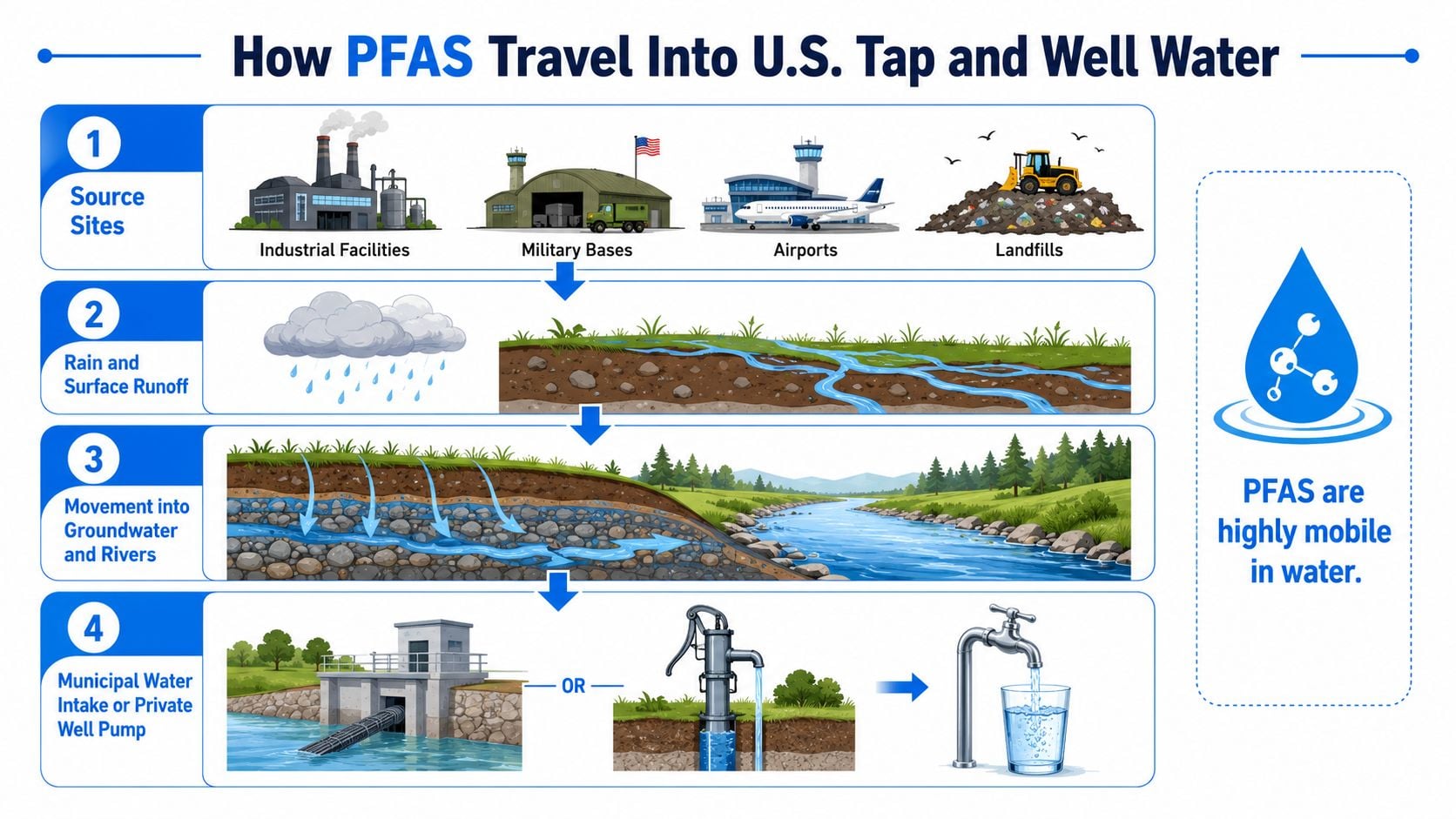
A clear way to follow the movement is layer by layer. A source releases PFAS. Rain and runoff move them into surface water or soil. Groundwater and rivers carry them farther. A treatment plant may draw from that water, or a private well may pull it straight from the aquifer.
> **Useful check:** if a home depends on a private well, there is no municipal safety net looking for contamination trends on the homeowner's behalf.
That matters because private wells can sit outside routine municipal testing. A household may not notice anything unusual from taste or smell, since PFAS are not the kind of contaminants that announce themselves at the tap. The water can look normal and still carry a meaningful PFAS burden.
For homeowners comparing treatment options, it helps to pair this pathway with a clear product example. [Woder WD-G4-DC Lead, Chlorine, HM and PFAS Water Filter](https://woder.com/products/wd-g4-dc/) is described as an under-sink system that uses advanced selective filtration and retains essential minerals, which is the kind of design difference that becomes relevant once you know how PFAS move through water.
If you want a clearer picture of how membrane systems fit into that decision, this overview of [reverse osmosis water filter basics](https://woder.com/blog/what-is-reverse-osmosis-water-filter/) explains the role of pressure-driven filtration in a household setting. For readers who want to compare under-sink options, you can also [browse drinking water systems](https://prazpurewater.com/under-the-sink-reverse-osmosis/).
## The Four Filtration Technologies That Reduce PFAS
EPA research identifies **granular activated carbon, ion exchange, reverse osmosis, and nanofiltration** as the main drinking-water technologies used for PFAS reduction ([EPA](https://www.epa.gov/water-research/identifying-drinking-water-filters-certified-reduce-pfas)). In plain terms, each one either pulls PFAS onto a media bed or pushes water through a barrier that PFAS have a harder time crossing. The label matters less than the design, because contact time, media volume, and membrane behavior all shape the result.
### What each technology does to the water
**Granular activated carbon, or GAC**, works like a sponge with microscopic pore space. PFAS molecules attach to the carbon surface, but performance depends on contact time and cartridge condition. EPA notes that GAC vendors commonly recommend a **minimum empty bed contact time of 20 minutes** for PFAS removal, and the same EPA source reports maximum GAC removal efficiencies of **90% or greater** for PFAS compounds with available data, with **greater than 99%** for PFOA and PFOS in some cases ([EPA](https://nepis.epa.gov/Exe/ZyPURL.cgi?Dockey=P101BIIU.TXT)).
That gap in performance starts to make sense once you separate long-chain PFAS from short-chain PFAS. Longer-chain compounds are easier for some carbon-based filters to catch, while shorter-chain compounds can pass through more readily if the media bed is undersized or overused.
**Ion exchange** uses a charged resin to attract and hold PFAS. It can work well in point-of-use formats, but the outcome still depends on flow rate, resin loading, and the quality of the incoming water. If the water moves too quickly, capture drops. If the resin is loaded with competing contaminants, it loses capacity sooner.
**Reverse osmosis and nanofiltration** use membranes instead of loose media. The membrane acts more like a fine barrier at the molecular level, so it can reject a broader range of contaminants, including many PFAS compounds. The tradeoff is that reverse osmosis also removes minerals along with contaminants, and it creates wastewater during operation. For a plain-language overview of that process, see [what reverse osmosis water filters do](https://woder.com/blog/what-is-reverse-osmosis-water-filter/).
**Engineered selective media** is a newer approach that targets specific contaminants while leaving beneficial minerals behind. It matters for households that want to reduce PFAS without changing the taste and mineral profile of the finished water too much.
TechnologyHow It Reduces PFASKey Trade-Off for HomeownersGranular activated carbonAdsorbs PFAS onto carbon surfacesNeeds enough contact time and timely replacementCarbon blocksUses denser carbon structure to trap contaminantsCan vary widely by design and may slow flowIon exchangeResin binds PFAS moleculesMedia life depends on flow and influent loadReverse osmosisMembrane rejects PFAS and many other dissolved substancesRemoves minerals and creates wastewaterNanofiltrationFine membrane reduces PFAS and other contaminantsPerformance depends on membrane design and pressureIf you want a broad shopping overview, [browse drinking water systems](https://prazpurewater.com/under-the-sink-reverse-osmosis/) from Praz Pure Water, Inc. can help you compare form factors before you narrow down the PFAS-specific question.
## Why Filter Design Matters More Than the Label
Two filters can both say **PFAS filter** and still act very differently at the kitchen sink. That happens because design controls how long water stays in contact with the media, how much media is inside the cartridge, and how well the media matches the PFAS compounds in the water. A label does not show any of that.
### Contact time and chain length change the result
A residential study from 2020 found that reverse osmosis and under-sink dual-stage systems delivered the strongest overall results, with **94% or more removal** for GenX and other PFAS in most cases. The same study reported that all reverse osmosis and dual-stage filters examined reduced PFEAs by at least **97%**, except GenX in one case that stayed above **74% to 75%** removal depending on system type. It also showed that long-chain PFAS were removed more effectively than short-chain compounds in some carbon-based filters. ([study](https://pubs.acs.org/doi/10.1021/acs.estlett.0c00004))
That difference is why **empty bed contact time** matters. If water moves through a cartridge too quickly, the PFAS molecules have less time to attach to the media, the way dust misses a sticky surface when the surface is only brushed past. If influent concentration rises, the cartridge also reaches breakthrough sooner. Those are mechanical realities, not marketing language.
A 2024 review adds an uncomfortable but important point. Few point-of-use systems are tested under real-use conditions, long-term performance is uncertain, and poorly maintained activated-carbon systems may even increase PFAS in purified water (review). That is why replacement schedules matter as much as the original install.
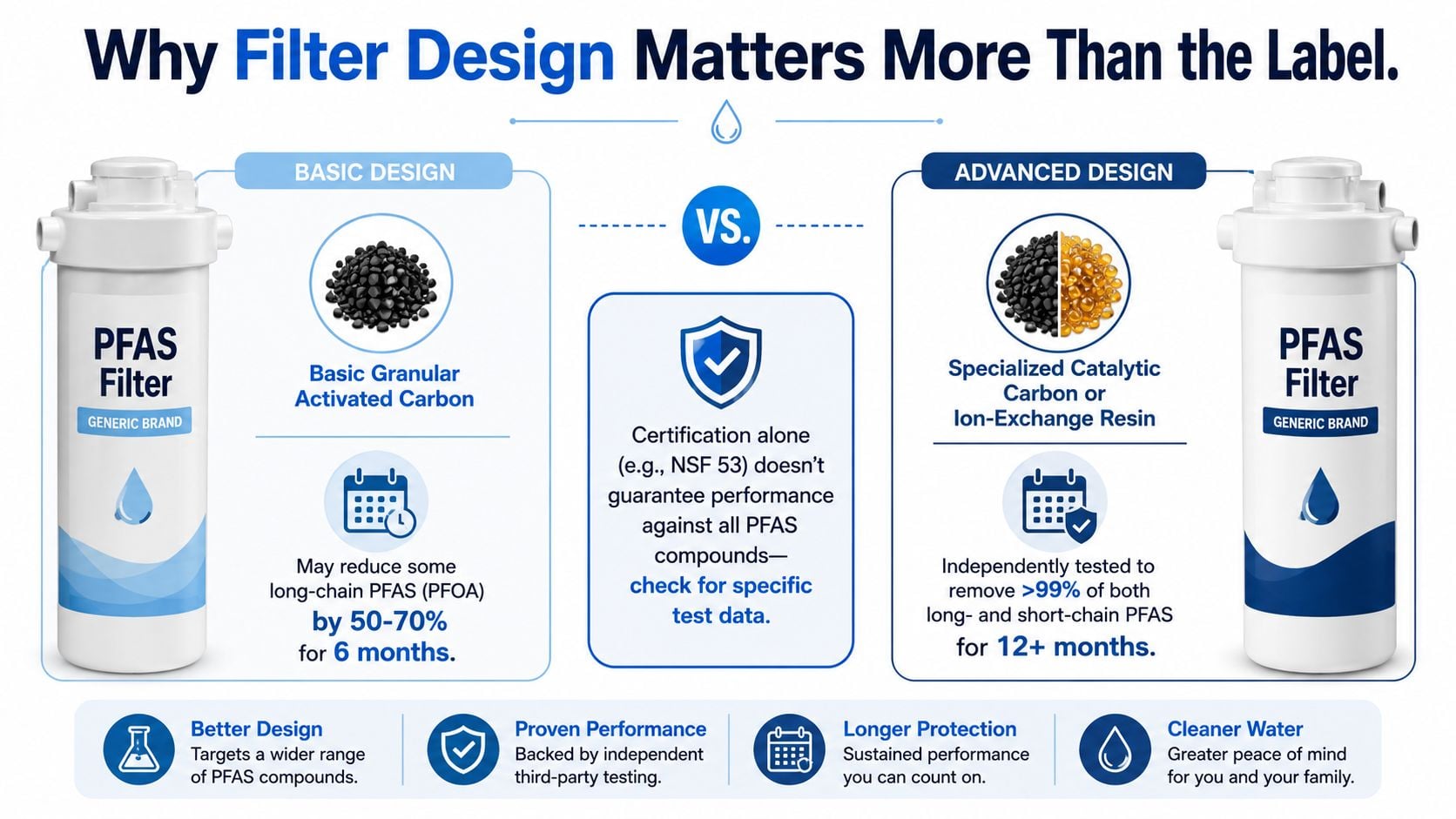
> **Bottom line:** a PFAS claim is only as strong as the test conditions behind it.
For homeowners comparing technologies in practice, the [best water filtration for Vancouver homes](https://www.encanovan.com/uncategorized/water-filtration-system-types/) overview is a useful way to think about whole-system tradeoffs before settling on a tap-level solution. If the terminology around certifications and standards still feels like alphabet soup, a plain-language guide to [water quality certification terms](https://woder.com/blog/wqa-nsf-ansi-wth-water-quality-alphabet-soup/) can help you sort out what the labels are proving. The same logic applies anywhere. Match the filter design to the actual water, not the broadest label.
## The Certifications That Verify PFAS Reduction
Certification is the quickest way to separate a real PFAS claim from a vague one. The names that matter most are **NSF/ANSI 53**, **NSF/ANSI 58**, and **NSF P473**. Each one verifies a different kind of performance, and those differences matter at the kitchen sink.
### What the standards tell you
EPA says consumers should look for certification to **NSF/ANSI 53 or NSF/ANSI 58** when selecting a filter for PFAS reduction, and verify the product in the certification body's directory if there's any doubt ([EPA fact sheet](https://www.epa.gov/system/files/documents/2024-04/water-filter-fact-sheet.pdf)). NSF says a filter making a PFAS reduction claim must reduce PFAS to **below 20 parts per trillion** to earn that claim, and it identifies NSF/ANSI **53** and **58** as the relevant pathways for drinking-water PFAS reduction (NSF).
Washington State's PFAS point-of-use guidance gives the standards a more concrete shape. For **NSF P473**, it describes an initial **1,500 ppt** PFOS plus PFOA challenge reduced to **70 ppt or less**, and for the broader **Total PFAS** standard it describes **2,160 ppt** mixed PFAS reduced to **20 ppt or less** ([Washington State guidance](https://doh.wa.gov/sites/default/files/2025-07/331-713.pdf)). That helps because the certification is tied to a known test challenge, not a loose marketing promise.
### How to check a claim before you buy
1. **Find the mark on the package.** EPA says certification marks are typically printed on the packaging, so this is the first check.
2. **Confirm the listing in the public directory.** The mark tells you the claim exists, but the directory tells you whether the exact model was certified.
3. **Match the certification to the water.** A claim about PFOS and PFOA is different from a claim about total PFAS or short-chain compounds.
The label vocabulary can feel like a pile of acronyms, which is why a plain-language guide to the standards can help. For a clear walkthrough of the certification terms, see [WQA NSF ANSI WTH water quality alphabet soup](https://woder.com/blog/wqa-nsf-ansi-wth-water-quality-alphabet-soup/). The point is not to memorize every abbreviation. It is to know which label verifies the contaminant you are trying to reduce.
## Common Misconceptions That Lead Homeowners Astray
The hardest part of buying a **PFAS removal water filter** is not the technology. It's the assumptions people bring to the search. Three of them show up over and over again, and each one can push a homeowner toward the wrong cartridge.
### The three mistakes to watch for
**Any carbon filter will catch PFAS.** Some will help, but not all carbon media are equal. The studies above showed wide variation, and short-chain PFAS were harder to remove than long-chain compounds in some carbon-based filters. Cartridge condition and contact time matter just as much as the carbon itself.
**Zero TDS means pure water.** It doesn't. Zero total dissolved solids means dissolved minerals have been stripped out along with other things, good and bad alike. That's why a zero-TDS reading is better understood as distilled water behavior, not a guarantee of healthy drinking water.
**Once installed, a PFAS filter keeps working forever.** It won't. Cartridges have a service life, and that life depends on incoming PFAS levels, flow, and maintenance. A neglected cartridge can lose performance, and some systems can even let previously captured PFAS reappear in the outlet water if they're left in service too long.
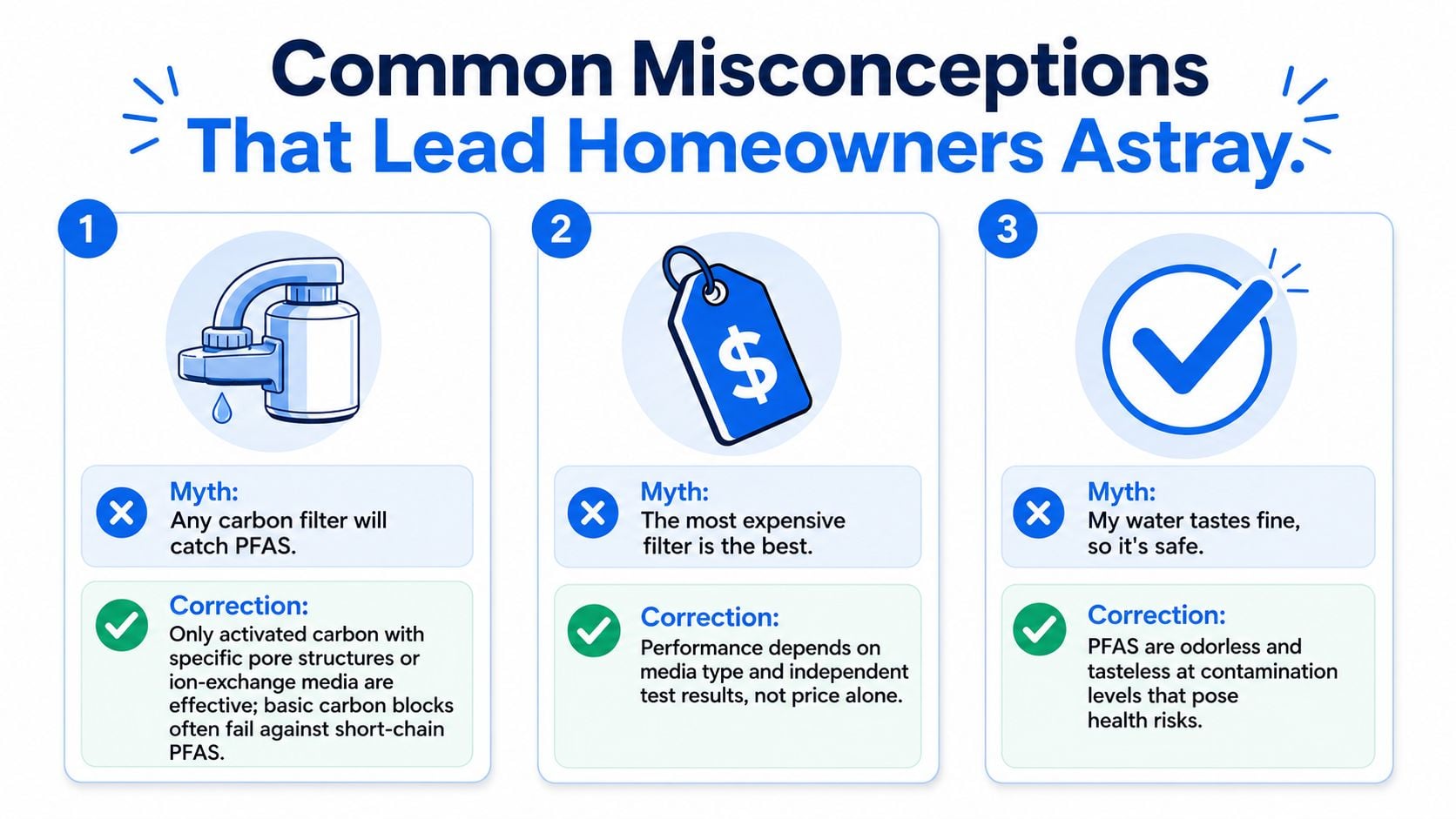
> **Simple test:** if a filter claim doesn't mention replacement guidance, assume the performance promise is incomplete.
Selective filtration has a practical appeal. Systems that retain essential minerals avoid the false choice between “clean” and “tasteful.” They also avoid the reflex to chase a low TDS number that tells you very little about specific contaminant reduction.
## How to Choose, Install, and Maintain the Right Filter
Start with the water, not the product. If you're on municipal water, review the latest Consumer Confidence Report and look for PFAS-related findings or treatment notes. If you're on a private well, a lab test is the smarter first move because the water utility isn't sampling for you.
### Match the system to the test result
Once you know what's in the water, pick a technology that fits the contaminant profile. **NSF P473** is the clearest shorthand when the goal is verified PFAS reduction, while **NSF/ANSI 53** and **58** can also be relevant depending on the system type. If you're comparing under-sink units, check whether the manufacturer documents the flow rate and the contact time used during testing.
Then look at the tradeoffs you care about. Reverse osmosis gives strong contaminant reduction, but it also removes minerals and wastes water during the process. Selective filtration and some advanced carbon or resin systems preserve more of the water's natural mineral content, which matters to people who want the tap to taste like water, not like an empty vessel.
> **Maintenance matters as much as installation.** Replace cartridges on schedule, track the date, and don't assume a filter is still performing just because the faucet keeps flowing.
If your source water is heavy with sediment, a pre-sediment filter can extend cartridge life. That's especially useful in wells or older plumbing, where debris can load the media faster than PFAS alone would.
The practical goal is not to buy the most complicated setup. It's to choose a system whose certification, flow behavior, and maintenance pattern fit your water. One of the advantages of a point-of-use approach is that it can be matched to a single sink, appliance line, or drinking tap without overbuilding the rest of the house.
## What an Informed Filter Choice Looks Like
An informed choice comes down to three things. **Technology** tells you how the filter treats PFAS and what it gives up in return, like minerals, flow, or water efficiency. **Certification** tells you whether the PFAS claim was tested. **Maintenance** tells you whether the performance will still be there months later.
A filter label can sound confident and still leave out the part that matters most. Two systems may both mention PFAS reduction, yet one may rely on longer contact time, a different media blend, or a narrower claim that only applies under specific test conditions. That is why the design matters as much as the marketing copy, and why the distinction between long-chain and short-chain PFAS should stay in view. Long-chain compounds are often easier for carbon and resin systems to capture, while shorter-chain compounds can pass through more easily unless the system is built and certified for that job.
The best fit is not the most aggressive system on paper. It is the one that matches the water profile, the household's taste preferences, and the level of upkeep the home will realistically follow. If you want a tap-level system, that often means starting with a lab report or utility report, then comparing verified standards instead of broad marketing language. Contact time matters here too, because water that moves too quickly through a cartridge gives the media less chance to bind PFAS, the same way a sponge has less time to soak up a spill when water runs over it too fast.
If you want a next step today, review your utility's Consumer Confidence Report or order a lab test if you're on a private well. Then compare the result against the certification and service life of any **PFAS removal water filter** you're considering.
A practical way to think about it is simple. First identify what is in the water. Then match that to a system with a specific PFAS reduction claim, a flow rate that fits daily use, and a maintenance plan your household can keep up with.
---
Woder Filters offers U.S.-made point-of-use systems designed to remove targeted contaminants while retaining essential minerals, which makes them relevant for homeowners weighing PFAS reduction against taste and water waste. If you're ready to compare options with that balance in mind, visit [Woder Filters](https://woder.com) and look at the systems, replacement cartridges, and support materials side by side.
**Categories:** Woder Science
**Tags:** activated carbon filtration, forever chemicals filter, nsf p473, pfas removal water filter, pfas water filter
---
### [Woder vs Aquasana: Which Under-Sink Filter Is Worth Your Money in 2026?](https://woder.com/blog/woder-vs-aquasana-which-under-sink-filter-is-worth-your-money-in-2026/)
**Published:** May 12, 2026
**Author:** woder
**Content:**
## Table of Contents
- [What Both Filters Actually Do](https://okara.ai/agent/cmo/c8200766-7042-4e40-8f3f-5713b47c752c#what-both-filters-actually-do)
- [Filtration Technology: How They Compare](https://okara.ai/agent/cmo/c8200766-7042-4e40-8f3f-5713b47c752c#filtration-technology-how-they-compare)
- [Contaminant Removal](https://okara.ai/agent/cmo/c8200766-7042-4e40-8f3f-5713b47c752c#contaminant-removal)
- [Minerals: The Detail Most Comparisons Skip](https://okara.ai/agent/cmo/c8200766-7042-4e40-8f3f-5713b47c752c#minerals-the-detail-most-comparisons-skip)
- [Installation and Setup](https://okara.ai/agent/cmo/c8200766-7042-4e40-8f3f-5713b47c752c#installation-and-setup)
- [Price and Long-Term Cost](https://okara.ai/agent/cmo/c8200766-7042-4e40-8f3f-5713b47c752c#price-and-long-term-cost)
- [Where Each Filter Makes Sense](https://okara.ai/agent/cmo/c8200766-7042-4e40-8f3f-5713b47c752c#where-each-filter-makes-sense)
- [Quick Comparison Table](https://okara.ai/agent/cmo/c8200766-7042-4e40-8f3f-5713b47c752c#quick-comparison-table)
- [FAQs](https://okara.ai/agent/cmo/c8200766-7042-4e40-8f3f-5713b47c752c#faqs)
- [The Bottom Line](https://okara.ai/agent/cmo/c8200766-7042-4e40-8f3f-5713b47c752c#the-bottom-line)
---
If you’re comparing these two, you’ve already done something most buyers haven’t — you’ve narrowed it down to filters that actually belong in the same category of under the sink PFAS removal water filters. That matters.
Both Woder and Aquasana use selective filtration. They remove contaminants without stripping out the minerals your body needs. That shared approach is what makes this comparison worth having. The real differences come down to price, how they install, and a few specifics that may or may not matter depending on your home and priorities.
Here’s what you need to know.
---
## What Both Filters Actually Do
Woder and Aquasana both sit between basic pitcher filters and full reverse osmosis systems. They install under your sink, connect directly into your water line, and filter water before it reaches your tap. No tank. No wastewater. No plumber.
That puts them in a different class from brands like Waterdrop, APEC, iSpring, and AquaTru — all of which use reverse osmosis and strip out minerals along with contaminants. If you’ve been looking at those options and something felt off, that’s likely why.
---
## Filtration Technology and PFAS removal: How They Compare
**Woder** uses proprietary Advanced Selective Filtration. Nanoparticles attract and remove contaminants while leaving calcium, magnesium, and other beneficial minerals untouched. Every Woder filter is manufactured in the United States.
**Aquasana** uses its NSF-certified Claryum technology — a combination of activated carbon, catalytic carbon, and ion exchange that targets specific contaminants while also preserving minerals. It carries independent NSF/ANSI certifications for contaminant reduction.
Both approaches are legitimate, and both are a meaningful step up from a basic carbon pitcher filter. The core philosophy is the same: clean water that’s still good for you.
---
## Contaminant Removal
Woder removes 99.9% of contaminants, including:
- Lead
- PFAS
- Chlorine
- Chromium 6
- Mercury
- Carcinogens
- Volatile organic compounds (VOCs)
- Heavy metals
It also reduces turbidity, odors, and bad taste.
Aquasana’s Claryum filtration covers a comparable list and carries NSF certifications across several contaminant categories. If third-party certification documentation is a firm requirement for your household, Aquasana’s paperwork is well-established.
For most people concerned about lead, PFAS, and chlorine, both filters address the core threats. Performance isn’t the main reason to choose one over the other.
---
## Minerals: The Detail Most Comparisons Skip
This is where both filters genuinely stand apart from the rest of the market — and where they’re most alike.
Reverse osmosis systems are effective at removing contaminants, but they also pull out naturally occurring minerals in the process. What you’re left with is very pure water that’s also flat and mineral-free. Some people are fine with that. Many aren’t, especially once they understand that calcium and magnesium in drinking water have real nutritional value.
Woder preserves those minerals by design. The nanoparticles in Advanced Selective Filtration are built to leave them alone. Aquasana does the same through its Claryum process.
If mineral preservation is your main reason for steering clear of RO, both filters deliver on that. You don’t have to choose between clean water and healthy water.
---
## Installation and Setup
Both filters install under the sink and connect inline to your existing water line. Neither requires a whole-home overhaul or a professional installer.
Woder’s inline design is particularly clean. It connects directly to your cold water supply line, and most homeowners finish the install without any special tools. There’s no dedicated faucet to drill for, no tank to find space for, no drain line to run.
Aquasana’s under-sink systems typically require a dedicated filter faucet, which means drilling into your sink or countertop. That’s not a complicated job, but it is an extra step — and an extra fixture to deal with down the road.
If you’re renting, or you just want the simplest possible setup, Woder’s approach has a real practical edge.
---
## Price and Long-Term Cost
This is where the comparison gets concrete.
Woder sits in the $100 to $200 range. Aquasana prices 20 to 30 percent higher for comparable filter capacity — and that gap doesn’t disappear at replacement time. For a household swapping filters on a regular schedule, the difference adds up. Over two or three years, you’re paying meaningfully more for filters that perform comparably on the things most buyers care about.
For context, Waterdrop and AquaTru price 30 to 50 percent higher than Woder and use RO technology that strips minerals. So if you’ve been looking at those and found Aquasana more appealing, Woder gives you the same mineral-preserving approach at a lower price point.
---
## Where Each Filter Makes Sense
**Choose Woder if:**
- You want a straightforward inline install with no dedicated faucet
- You’re renting and need something easy to remove when you move
- US-made filtration at a lower price point matters to you
- You want mineral preservation without paying a premium for it
- You’re done with bottled water and want a low-maintenance replacement
**Consider Aquasana if:**
- NSF certification documentation is a non-negotiable for your household
- You’re already set up for a dedicated filter faucet and prefer that configuration
- Budget is less of a concern and you’re comfortable paying more for a brand with a longer track record
Both filters solve the same core problem. The choice mostly comes down to price and installation preference, not performance.
---
## Quick Comparison Table
FeatureWoderAquasanaFiltration typeAdvanced Selective FiltrationClaryum (selective)Removes lead, PFAS, chlorineYesYesPreserves mineralsYesYesInstallation styleInline, no dedicated faucetDedicated faucet requiredManufactured in the USYesNot a primary differentiatorPrice range$100–$20020–30% higherTank requiredNoNoWastewater producedNoNo---
Not sure which Woder model fits your water line and flow rate? Use the [product finder at woder.com](https://woder.com/) to get matched to the right filter in a few clicks.
---
## FAQs
### **Is Woder or Aquasana better for PFAS removal?**
Both filters target PFAS. Woder’s Advanced Selective Filtration removes 99.9% of contaminants, PFAS included. Either is a strong choice if PFAS in tap water is your main concern.
### ****Do both filters preserve minerals?****
Yes. Both use selective filtration that removes contaminants while keeping naturally occurring minerals like calcium and magnesium in your water. That’s the defining difference between these filters and reverse osmosis systems.
### ******Which is easier to install?******
Woder connects directly to your existing cold water supply line — no dedicated faucet, no drilling. Aquasana’s under-sink systems typically require a separate filter faucet, which means cutting into your sink or countertop. For renters or anyone who wants the simplest possible setup, Woder has the edge.
### ********Is Woder cheaper than Aquasana over time?********
Yes. Woder is priced 20 to 30 percent lower than comparable Aquasana capacity upfront, and that difference carries through to replacement filters as well.
### **********Are Woder filters made in the United States?**********
Yes. All Woder filters are manufactured in the United States.
### ************Do either of these filters produce wastewater like RO systems?************
No. Neither Woder nor Aquasana uses reverse osmosis, so there’s no wastewater. Every drop that enters the filter comes out filtered.
### **************Can I use Woder if I’m renting?**************
Yes. Woder’s inline install connects to your existing water line without permanent modifications, making it a practical option for long-term renters who want filtered water without altering the property.
---
## The Bottom Line
If mineral preservation matters to you and RO isn’t the right fit, Woder and Aquasana are genuinely the two best options in this category. On performance, they’re more similar than different. Where they diverge is price, installation simplicity, and where they’re made.
Woder costs less, installs more simply, and is made in the US. For most households, that combination is hard to argue with.
Find the right filter for your home at [woder.com](https://woder.com/).
**Categories:** Woder Science
**Tags:** pfas removal, woder
---
### [Best Place to Buy an Under Sink Water Filter That Keeps Minerals](https://woder.com/blog/best-place-to-buy-an-under-sink-water-filter-that-keeps-minerals/)
**Published:** March 25, 2026
**Author:** woder
**Content:**
The Best Place to Buy an Under Sink Water Filter That Keeps Minerals
Finding a water filter that strikes the perfect balance between purity and nutrition can be challenging. Most conventional filters either miss dangerous contaminants or strip away the healthy minerals your body needs. This guide explores the best options for selective filtration.
## Why Keep Minerals in Your Water?
Many high-end filtration systems, such as Reverse Osmosis (RO), use a process that removes everything from the water—including essential minerals like calcium, magnesium, and potassium. While this results in pure H2O, it often leads to “dead water” that is acidic and lacks the crisp taste associated with natural springs.
- **Health Benefits:** Magnesium and calcium are vital for bone health and cardiovascular function.
- **Improved Taste:** Minerals provide a natural alkalinity that improves the flavor of drinking water, coffee, and tea.
- **Better Hydration:** Electrolytes (minerals) help your body absorb water more efficiently.
## The Solution: Advanced Selective Filtration
If you are looking for the best place to buy an under sink water filter that keeps minerals, you need to look for **Selective Filtration Technology**. Unlike RO systems, these filters use advanced granulated activated carbon and specialized media to target heavy metals, chlorine, and VOCs while allowing dissolved minerals to pass through.
At [Woder](https://woder.com/), our [WD-G4-DC](https://woder.com/products/wd-g4-dc/) and all other [Gen4 undersink water filters](https://woder.com/product-category/filters/under-sink-filters/) are specifically engineered to maintain the natural mineral content of your water while removing 99.9% of contaminants.
## What to Look for When Shopping
When searching for a mineral-retaining filter, ensure the product meets these criteria:
1. **NSF/ANSI Certification:** Look for Standard 42 (Aesthetic Effects) and Standard 53 (Health Effects).
2. **Flow Rate:** Under sink filters should maintain a high flow rate (at least 2GPM) so you don’t have to wait for your glass to fill.
3. **Filter Life:** High-quality filters like Woder’s can last up to 8,400 gallons or 3 years, significantly reducing the cost per gallon.
4. **Ease of Installation:** Ensure the system comes with “Direct Connect” hoses that fit standard plumbing.
## Where to Buy: Woder.com
The best place to buy an under sink water filter that keeps minerals is directly from the manufacturer to ensure you receive genuine products and the latest filter technology. Woder filters are designed, assembled, and tested in the USA.
By shopping at Woder’s official store, you get access to expert support, comprehensive warranties, and the guarantee that your water remains both safe and healthy.
### Conclusion
You shouldn’t have to choose between clean water and mineral-rich water. By choosing an advanced under sink filtration system, you can enjoy the best of both worlds. Visit Woder today to find the perfect fit for your kitchen.
**Categories:** Woder Science
**Tags:** Woder water filters
---
### [Lead Removal Without RO: 5 Filtration Methods Compared](https://woder.com/blog/blog-lead-removal-without-ro-filtration-methods-compared/)
**Published:** April 8, 2026
**Author:** woder
**Content:**
Millions of Americans drink water from systems with detectable lead levels, and the EPA’s updated Lead and Copper Rule Improvements now lower the action level to 10 ppb, effective 2027. If you want heavy metal protection at home but refuse to sacrifice counter space, waste water, or strip healthy minerals, you have more options than ever. This guide compares five non-RO filtration methods side by side so you can pick the right technology for your household, your budget, and your health goals.
## Table of Contents
- [Why Lead in Tap Water Still Matters in 2026](#why-lead-matters)
- [5 Non-RO Methods for Removing Lead and Heavy Metals](#five-methods)
- [Side-by-Side Comparison Table](#comparison-table)
- [What Is Selective Filtration and Why Does It Stand Out?](#selective-filtration)
- [How to Choose the Right Filter for Your Home](#choosing-filter)
- [Key Takeaways](#takeaways)
- [Frequently Asked Questions](#faq)
- [Find Your Filter](#cta)
## Why Lead in Tap Water Still Matters in 2026
Lead is a neurotoxin with no known safe exposure level. The EPA’s Maximum Contaminant Level Goal (MCLG) for lead is [zero parts per billion](https://www.epa.gov/dwreginfo/lead-and-copper-rule) because even trace amounts pose health risks, especially for children and pregnant women. An [NRDC analysis](https://www.nrdc.org/press-releases/worrisome-lead-levels-drinking-water-systems-serving-more-250-million-people) found that over 250 million Americans receive water from systems that detected lead at or above 1 ppb between 2021 and 2024.
Most lead enters drinking water not at the treatment plant but through aging service lines and premise plumbing inside your home. That means point-of-use filtration at the tap is one of the most practical defenses you can deploy today.
## 5 Non-RO Methods for Removing Lead and Heavy Metals
### 1. Pitcher Filters with Lead-Reduction Cartridges
Pitcher filters are the entry-level option. Some models carry NSF/ANSI 53 certification for lead reduction, but their small cartridges exhaust quickly and flow rates are slow. They also cannot connect to your faucet for on-demand filtered water.
### 2. Faucet-Mount Filters
Faucet-mount filters attach directly to your spout. They offer moderate lead reduction, but limited cartridge capacity means frequent replacements. They can also reduce water pressure and may not fit all faucet styles.
### 3. Standard Activated Carbon Block Filters
Activated carbon block is a porous filtration medium that traps contaminants through adsorption. Standard carbon blocks handle chlorine and taste issues well, but many lack the specialized media needed to target dissolved heavy metals like lead, mercury, and chromium 6 at high removal rates.
### 4. Gravity-Fed Countertop Systems
Gravity-fed systems use no water pressure and sit on your counter. While some use ceramic or carbon elements rated for lead, they occupy significant countertop space and filter slowly, similar to the storage-tank limitation of RO.
### 5. Inline Selective Adsorption Filters
Selective adsorption is a filtration process in which engineered nanoparticles attract and bind specific contaminant ions while allowing beneficial minerals to pass through. Inline filters using this technology connect directly to your cold water line under the sink, delivering filtered water at full pressure through your existing faucet with zero water waste. [Woder’s HMG4 series](https://woder.com/products/wd-hmg4-dc/) is a prime example, combining Gen4 Advanced media with dedicated heavy metal removal media in a single compact cartridge.
## Side-by-Side Comparison Table
CriteriaPitcherFaucet-MountCarbon BlockGravity-FedInline Selective AdsorptionLead Removal RateModerateModerateVariesModerate-HighUp to 99.9%Retains MineralsYesYesYesDependsYesWater WasteNoneNoneNoneNoneNoneFlow RateVery SlowSlow-ModerateModerateVery SlowFull PressureCounter/Cabinet SpaceCountertopOn FaucetUnder SinkCountertopSlim Under-SinkTypical Cartridge Life2-3 months2-3 months6-12 months6-12 monthsUp to 1 yearPFAS RemovalRareRareSomeSomeYesApprox. Annual Cost$40-$80$50-$100$60-$120$80-$200$64-$116## What Is Selective Filtration and Why Does It Stand Out?
Selective Filtration is a proprietary technology developed by [Woder](https://woder.com/about-woder-filters/) that uses nanoparticles with an affinity for contaminants but not for essential minerals. Unlike RO membranes that strip everything from the water, Selective Filtration targets lead, mercury, chromium 6, VOCs, PFAS, and other harmful substances while calcium, potassium, and magnesium pass through untouched.
This matters because RO systems waste thousands of gallons of water annually flushing contaminants down the drain. They also produce what some filtration experts call “dead water” that lacks the minerals your body needs. By contrast, a [Woder Gen4 inline filter](https://woder.com/products/wd-g4-dc/) delivers mineral-rich, contaminant-free water on demand with no drain line and no storage tank.
### Tested Removal Claims
Woder’s advanced filters remove 99.9% of lead, heavy metals, chlorine, chromium 6, mercury, volatile organic compounds, carcinogens, PFAS, and other contaminants. These claims are tested by CLB Labs. For homes with heavy metal levels above the EPA’s recommended thresholds, the [WD-D-HMG4-G4-DC dual-stage system](https://woder.com/products/wd-d-hmg4-g4-dc/) pairs a dedicated heavy metals cartridge with a WQA Gold Seal Certified Gen4 cartridge for maximum protection.
## How to Choose the Right Filter for Your Home
### Step 1: Know Your Water
Start by checking your local Consumer Confidence Report or ordering a home water test. If your results show lead or heavy metals above the EPA action level, a specialized heavy metal filter is the right call. Woder encourages customers to [test their water before buying a filter](https://woder.com/blog/before-you-buy-a-water-filter/) to ensure a proper match.
### Step 2: Evaluate Your Plumbing Setup
Direct-connect (DC) systems attach to standard 3/8″ fittings under your kitchen sink and route filtered water through your existing faucet. John Guest (JG) quick-connect systems use 1/4″ tubing, ideal for refrigerator lines, ice makers, and dedicated filtered-water faucets. Both options install in under 10 minutes with no plumber required.
### Step 3: Match the Filter to Your Contaminant Profile
If your primary concern is general contaminants and chlorine, a [Gen4 Advanced filter](https://woder.com/product-category/filters/) covers you. If your water has elevated heavy metals, step up to an HMG4 or dual-stage system. Households dealing with high sediment should consider a dual-stage sediment-plus-advanced configuration to protect cartridge longevity.
## Key Takeaways
- The EPA’s MCLG for lead is zero ppb; there is no safe exposure level, making point-of-use filtration essential.
- RO systems remove contaminants effectively but waste water, strip minerals, and require bulky tanks.
- Selective adsorption inline filters deliver 99.9% contaminant removal while preserving essential minerals and producing zero water waste.
- Woder’s HMG4 series is specifically engineered for homes with lead and heavy metal levels above EPA thresholds.
- Annual cartridge replacement costs for Woder systems range from $64 to $116, making them competitively priced against every non-RO alternative.
- The EPA’s 2024 Lead and Copper Rule Improvements lower the lead action level to 10 ppb by 2027, making proactive home filtration even more relevant.
- Always test your water first to select the correct filter configuration for your specific contaminant profile.
## Frequently Asked Questions
### Can an inline filter really remove as much lead as an RO system?
Yes. Advanced inline filters using selective adsorption media, such as Woder’s HMG4 line, remove 99.9% of lead and heavy metals. This matches RO performance without the water waste or mineral stripping.
### What is the difference between Woder’s Gen4 and HMG4 filters?
Gen4 Advanced filters target a broad range of contaminants including lead, chlorine, VOCs, and PFAS. HMG4 filters add extra heavy metal removal media, making them the better choice for homes where lead or other heavy metals exceed EPA-recommended levels.
### Do I need a plumber to install a Woder filter?
No. Both direct-connect (DC) and John Guest (JG) systems are designed for DIY installation in under 10 minutes. DC models connect to standard under-sink fittings, while JG models use quick-connect tubing.
### How often do I need to replace the cartridge?
Woder cartridges carry a 1-year warranty and are designed for annual replacement. Actual lifespan depends on local water quality and usage volume. High-sediment areas may require earlier replacement or a dual-stage sediment pre-filter.
### Does Selective Filtration remove beneficial minerals?
No. Selective Filtration is specifically designed to leave essential minerals like calcium, potassium, and magnesium in your water. RO systems, by contrast, remove all dissolved minerals along with contaminants.
### Is a dual-stage system worth the extra cost?
If your water has very high heavy metal levels or elevated sediment, a dual-stage system like the WD-D-HMG4-G4-DC provides both dedicated heavy metal removal and advanced filtration in two stages. The second-stage cartridge is WQA Gold Seal Certified, adding an extra layer of third-party validation.
### What contaminants besides lead do Woder filters remove?
Woder filters remove 99.9% of heavy metals, chlorine, chromium 6, mercury, VOCs, PFAS, carcinogens, and other contaminants. They also reduce turbidity, odors, and bad tastes.
## Find Your Filter
Not sure which Woder filter fits your home? Use the [Woder Filter Wizard](https://woder.com/shop-filters/) to answer a few quick questions about your plumbing and water quality, and get a personalized recommendation in seconds. Clean, mineral-rich water is less than 10 minutes away.
**Categories:** Woder Science
---
### [Woder vs iSpring: Comparing Under-Sink Water Filters for 2026](https://woder.com/blog/woder-vs-ispring-comparing-under-sink-water-filters-for-2026/)
**Published:** May 11, 2026
**Author:** woder
**Content:**
## Table of Contents
- [Who This Comparison Is For](https://okara.ai/agent/cmo/c8200766-7042-4e40-8f3f-5713b47c752c#who-this-comparison-is-for)
- [How iSpring Filters Work](https://okara.ai/agent/cmo/c8200766-7042-4e40-8f3f-5713b47c752c#how-ispring-filters-work)
- [How Woder Filters Work](https://okara.ai/agent/cmo/c8200766-7042-4e40-8f3f-5713b47c752c#how-woder-filters-work)
- [Head-to-Head: Key Differences](https://okara.ai/agent/cmo/c8200766-7042-4e40-8f3f-5713b47c752c#head-to-head-key-differences)
- [Filtration Technology](https://okara.ai/agent/cmo/c8200766-7042-4e40-8f3f-5713b47c752c#filtration-technology)
- [Mineral Preservation](https://okara.ai/agent/cmo/c8200766-7042-4e40-8f3f-5713b47c752c#mineral-preservation)
- [Installation and Setup](https://okara.ai/agent/cmo/c8200766-7042-4e40-8f3f-5713b47c752c#installation-and-setup)
- [Wastewater](https://okara.ai/agent/cmo/c8200766-7042-4e40-8f3f-5713b47c752c#wastewater)
- [Where They’re Made](https://okara.ai/agent/cmo/c8200766-7042-4e40-8f3f-5713b47c752c#where-theyre-made)
- [What Each Filter Removes](https://okara.ai/agent/cmo/c8200766-7042-4e40-8f3f-5713b47c752c#what-each-filter-removes)
- [Which One Is Right for You](https://okara.ai/agent/cmo/c8200766-7042-4e40-8f3f-5713b47c752c#which-one-is-right-for-you)
- [FAQs](https://okara.ai/agent/cmo/c8200766-7042-4e40-8f3f-5713b47c752c#faqs)
- [Conclusion](https://okara.ai/agent/cmo/c8200766-7042-4e40-8f3f-5713b47c752c#conclusion)
---
You’re shopping for an under-sink water filter and iSpring keeps showing up. It’s a well-known brand with a wide product range, so that’s not surprising. But before you commit, it’s worth understanding what you’re actually getting with an iSpring system — and how a fundamentally different approach stacks up.
This article breaks down the real differences between iSpring and [Woder](https://woder.com/): what each system removes, what it keeps, and what the whole setup costs you in time, money, and cabinet space.
---
## Who This Comparison Is For
You want cleaner drinking water at home. Maybe you’ve seen local news about lead or PFAS. Maybe you just moved, you’re expecting a baby, or you’ve simply had enough of buying bottled water every week.
You’re not looking to call a plumber or gut your kitchen. You want something that installs cleanly under your sink, removes the contaminants you’re concerned about, and doesn’t require a second mortgage.
Both iSpring and Woder live in the under-sink category. But they use very different technologies — and those differences have real consequences for your water, your space, and your wallet.
---
## How iSpring Filters Work
iSpring’s most popular products are reverse osmosis (RO) systems. Their flagship line — including the widely reviewed RCC7 and RCC7AK — pushes water through a semipermeable membrane under pressure across multiple filtration stages.
That membrane is effective. It blocks a broad range of contaminants, including lead, chlorine, and dissolved solids.
The catch is that RO doesn’t discriminate. It filters out nearly everything dissolved in your water, including calcium and magnesium — minerals that occur naturally in tap water and that your body actually uses. Some iSpring models, like the AK versions, include a remineralization cartridge that adds a small amount of minerals back after filtration. But that’s a separate add-on stage, not how the core filtration works.
RO systems also produce wastewater by design. For every gallon of filtered water an iSpring system delivers, it typically drains two to four gallons. That ratio shifts depending on your water pressure and the specific model, but there’s no version of RO that eliminates it.
And then there’s the tank. iSpring systems store pre-filtered water in a pressurized tank that lives under your sink. It works, but it takes up real space.
---
## How Woder Filters Work
Woder takes a different approach entirely. Instead of a membrane that blocks everything, Woder’s Advanced Selective Filtration uses nanoparticles with a specific affinity for contaminants — attracting and removing lead, chlorine, PFAS, chromium 6, mercury, carcinogens, and volatile organic compounds.
The word that matters here is *selective*. Those nanoparticles go after contaminants, not minerals. Calcium and magnesium pass through untouched because the filtration is designed to leave them alone.
No tank. No wastewater. Woder installs inline, directly into your existing cold water line, and filtered water flows on demand. The under-sink footprint is minimal, and every Woder filter is manufactured in the United States.
---
## Head-to-Head: Key Differences
### Filtration Technology
iSpring uses reverse osmosis — a pressure-driven membrane process that removes contaminants by blocking virtually all dissolved particles. It’s thorough, but it doesn’t distinguish between what you want gone and what you want to keep.
Woder uses Advanced Selective Filtration, a nanoparticle-based process engineered to target specific contaminants while leaving beneficial minerals intact.
### Mineral Preservation
This is the most meaningful practical difference between the two systems.
iSpring RO strips calcium and magnesium from your water. The remineralization cartridge on certain models adds some back, but that’s an afterthought built on top of a process that removed them in the first place.
Woder preserves the minerals that naturally occur in your tap water. You get clean water that still contains the calcium and magnesium your body benefits from — no add-on stage required.
### Installation and Setup
iSpring RO systems are a real installation project. You’re connecting multiple filter stages, mounting a storage tank, running a drain line, and adding a dedicated faucet. Most homeowners can handle it, but it takes time and the under-sink space requirements are significant.
Woder connects inline to your existing cold water line. No dedicated faucet, no tank, no drain connection. Most homeowners can complete the install with nothing more than a wrench.
### Wastewater
iSpring RO systems drain two to four gallons for every gallon they produce. Over weeks and months, that adds up — especially if reducing waste is part of why you’re moving away from bottled water in the first place.
Woder produces zero wastewater. Every drop that enters the filter comes out clean.
### Where They’re Made
iSpring is a US-based company, but they don’t prominently disclose where their filter components are manufactured.
All Woder filters are made in the United States.
---
## What Each Filter Removes
ContaminantiSpring RO (e.g., RCC7)WoderLeadYesYes (99.9%)ChlorineYesYes (99.9%)PFASPartial (varies by model)YesChromium 6YesYesMercuryYesYesVOCsPartialYesCarcinogensPartialYesCalcium & MagnesiumRemovedPreservedWastewater producedYes (2–4x ratio)NoneiSpring’s RO membrane handles a wide range of contaminants. The tradeoff is mineral loss and ongoing water waste. Woder removes 99.9% of the contaminants listed above while keeping your water’s natural mineral content right where it belongs.
---
## Which One Is Right for You
**Choose iSpring if:**
- Your water has extremely high total dissolved solids and you want near-total dissolved particle removal
- You’re comfortable with a larger installation and a tank under your sink
- The wastewater output isn’t a concern for you
- Mineral content in your filtered water isn’t a priority
**Choose Woder if:**
- You want to remove lead, PFAS, chlorine, and other contaminants without stripping beneficial minerals
- You want a clean, simple install with no tank and no drain line
- Reducing water waste matters to you
- You want a US-made filter at a mid-market price
- You want water that’s clean *and* actually good for you
For most homeowners and renters focused on specific contaminants — lead, PFAS, chlorine — Woder is the more direct fit. It removes what you don’t want and keeps what you do.
Not sure which model is right for your home? The product finder at [woder.com](https://woder.com/) matches you to the right filter based on your water line and household usage.
---
## FAQs
**Does iSpring remove PFAS?**
Some iSpring RO models reduce PFAS, but performance varies by model and the specific compounds involved. Woder’s Advanced Selective Filtration removes PFAS as part of its standard contaminant removal.
**Does Woder use reverse osmosis?**
No. Woder uses Advanced Selective Filtration — a nanoparticle-based process, not an RO membrane. That means no wastewater, no storage tank, and no mineral stripping.
**Why does mineral preservation matter?**
Calcium and magnesium in drinking water contribute to your daily mineral intake. RO systems remove these along with contaminants. Woder’s selective approach takes out the contaminants and leaves those minerals alone.
**Is iSpring hard to install?**
iSpring RO systems involve multiple filter stages, a pressurized tank, a dedicated faucet, and a drain connection. Most homeowners can get it done, but it takes more time and space than an inline filter like Woder.
**How much water does an iSpring RO system waste?**
Typically two to four gallons of drain water for every gallon of filtered water produced. The exact ratio depends on your water pressure and model.
**Are Woder filters made in the US?**
Yes. All Woder filters are manufactured in the United States.
**How do I know which Woder filter to buy?**
Use the product finder on the Woder homepage at [woder.com](https://woder.com/). It matches you to the right model based on your water line setup and household needs.
---
## Conclusion
iSpring makes capable RO systems, and for households dealing with very high TDS or specific water chemistry challenges, that technology has its place. But for most people who want to remove lead, PFAS, chlorine, and other contaminants without losing beneficial minerals or wasting water, RO is more than you need — and less than ideal.
Woder removes 99.9% of the contaminants you’re actually worried about, keeps calcium and magnesium in your water, installs without a plumber, and produces zero wastewater. Cleaner water, simpler setup, nothing stripped that shouldn’t be.
Find the right filter for your home at [woder.com](https://woder.com/).
**Categories:** Woder Science
---
### [What are PFAS and Why Does It End Up in Your Tap Water?](https://woder.com/blog/what-are-pfas-and-why-does-it-end-up-in-your-tap-water/)
**Published:** May 4, 2026
**Author:** woder
**Content:**
## Table of Contents
- [What Are PFAS, Exactly?](https://okara.ai/agent/cmo/c8200766-7042-4e40-8f3f-5713b47c752c?tab=gsc#what-are-pfas-exactly)
- [How PFAS Get Into Your Drinking Water](https://okara.ai/agent/cmo/c8200766-7042-4e40-8f3f-5713b47c752c?tab=gsc#how-pfas-get-into-your-drinking-water)
- [Why PFAS Are Called “Forever Chemicals”](https://okara.ai/agent/cmo/c8200766-7042-4e40-8f3f-5713b47c752c?tab=gsc#why-pfas-are-called-forever-chemicals)
- [Who Is Most at Risk?](https://okara.ai/agent/cmo/c8200766-7042-4e40-8f3f-5713b47c752c?tab=gsc#who-is-most-at-risk)
- [How to Know If PFAS Are in Your Water](https://okara.ai/agent/cmo/c8200766-7042-4e40-8f3f-5713b47c752c?tab=gsc#how-to-know-if-pfas-are-in-your-water)
- [What You Can Actually Do About It](https://okara.ai/agent/cmo/c8200766-7042-4e40-8f3f-5713b47c752c?tab=gsc#what-you-can-actually-do-about-it)
- [FAQs](https://okara.ai/agent/cmo/c8200766-7042-4e40-8f3f-5713b47c752c?tab=gsc#faqs)
---
You turn on the tap, fill a glass, and drink. Simple enough. But what if something invisible was already in that water before it reached you — something that doesn’t break down, doesn’t smell, and doesn’t show up on a basic water quality report?
That’s the reality for millions of households across the US right now. PFAS contamination in drinking water is one of the most talked-about water safety issues of 2026, and for good reason. This article explains what PFAS are, how they end up in your tap water, and what you can do to protect your household. What Is PFAS?
---
## What is PFAS, exactly?
PFAS stands for per- and polyfluoroalkyl substances. It’s a group of more than 12,000 synthetic chemicals that have been manufactured and used in industrial and consumer products since the 1940s.
You’ll find PFAS in things like:
- Non-stick cookware coatings
- Water-resistant clothing and carpets
- Food packaging (especially grease-resistant wrappers)
- Firefighting foam used at airports and military bases
- Stain-resistant treatments on furniture and upholstery
The chemistry behind them is straightforward: PFAS are built around an extremely strong carbon-fluorine bond. That bond makes them incredibly useful for repelling water, grease, and heat. It also makes them nearly impossible to break down in the environment — or in the human body.
---
## How PFAS Get Into Your Drinking Water
PFAS don’t appear in your tap water by accident. They follow a path from manufacturing sites, military bases, and industrial facilities into the soil, and from the soil into groundwater and surface water supplies.
Here’s how it typically happens:
**Industrial discharge.** Factories that produce or use PFAS release them into nearby waterways. Even when discharge is regulated, trace amounts can accumulate over time.
**Firefighting foam runoff.** Aqueous film-forming foam (AFFF) used at military bases and airports contains high concentrations of PFAS. When this foam soaks into the ground, it migrates into local groundwater — sometimes for miles.
**Landfill leaching.** Products containing PFAS end up in landfills. Over time, rainwater pulls PFAS out of that waste and carries them into the ground below.
**Agricultural contamination.** Some municipal sewage sludge used as fertilizer contains PFAS. When it’s spread on farmland, PFAS can leach into the soil and reach groundwater that feeds local wells and water treatment plants.
Once PFAS reach a water source, conventional water treatment processes don’t reliably remove them. Standard filtration and chlorination — the methods most municipal systems rely on — aren’t designed to handle these chemicals. So they pass through and come out of your tap.
---
## Why PFAS Are Called “Forever Chemicals”
The nickname isn’t an exaggeration. PFAS don’t degrade under normal environmental conditions. They don’t break down in sunlight. They don’t biodegrade in soil. And once they enter the human body, they accumulate in blood, organs, and tissue over time.
That persistence is what makes PFAS different from many other contaminants. A heavy rain doesn’t wash them away. Boiling your water doesn’t remove them. They stay put — in the environment and in your body — which is why long-term exposure is the main concern.
Research into the health effects of PFAS is ongoing, but regulatory agencies including the EPA have identified links between PFAS exposure and a range of health concerns. The science is still developing, but the precautionary principle is clear: reducing your exposure is a reasonable and practical step to take now.
---
## Who Is Most at Risk?
PFAS contamination isn’t evenly distributed. Some households face significantly higher exposure than others, depending on where they live and where their water comes from.
**Communities near military bases or airports.** AFFF foam has been used at these sites for decades. Many surrounding communities have documented PFAS contamination in their water supplies.
**Households on private wells.** Private wells aren’t subject to the same federal monitoring requirements as municipal systems. If your well draws from contaminated groundwater, you may not know it without testing.
**Areas near industrial sites.** Manufacturing facilities that produce or use PFAS — including certain chemical plants, textile mills, and semiconductor manufacturers — can contaminate local water sources.
**Rural communities near agricultural land.** If PFAS-containing sludge has been used as fertilizer nearby, groundwater contamination is a real possibility.
That said, PFAS have been detected in water systems across all 50 states. You don’t have to live next to a military base to be affected. Municipal water systems in major cities have also shown detectable PFAS levels.
Not sure what’s in your local water? Your municipality is required to publish an annual water quality report (also called a Consumer Confidence Report). It’s a useful starting point, though it may not test for every PFAS compound.
---
## How to Know If PFAS Are in Your Water
There are a few ways to find out whether PFAS are present in your drinking water.
**Check your local water quality report.** Municipal suppliers publish these annually. Look for PFAS or PFOA/PFOS listings. Keep in mind that regulations are still catching up — not all PFAS compounds are required to be reported yet.
**Use the EPA’s PFAS data resources.** The EPA maintains public data on PFAS monitoring results from water systems across the country. It’s searchable and worth checking.
**Get your water independently tested.** Third-party lab testing is the most thorough option, especially if you’re on a private well. Look for a certified lab that tests for a broad panel of PFAS compounds, not just the most common two or three.
Testing gives you real data about your specific water. That’s more useful than general statistics, because contamination varies significantly by location.
---
## What You Can Actually Do About It
Here’s the part that matters most: you’re not powerless here.
Once you know PFAS are a concern — whether through local news, a water report, or a test result — you can take a practical step to filter them out at home. The key is choosing the right filtration method.
**What doesn’t work:** Standard pitcher filters and basic carbon filters aren’t designed to remove PFAS effectively. Boiling water concentrates PFAS rather than removing them.
**What does work:** Filtration technologies specifically designed to target PFAS. Activated carbon filters at a sufficient contact time can reduce PFAS levels, and advanced selective filtration systems are built to go further — removing a broad range of contaminants including PFAS, lead, chlorine, chromium 6, and volatile organic compounds, without stripping out the beneficial minerals your water naturally contains.
That last point matters. Some filtration systems (reverse osmosis in particular) remove nearly everything from your water — including calcium and magnesium, which are good for you. A smarter approach targets the contaminants specifically and leaves the minerals behind.
Woder’s under-sink filters are built around exactly that principle. Their Advanced Selective Filtration technology removes 99.9% of contaminants including PFAS, while preserving the essential minerals your body actually benefits from. No whole-home system required. No plumber needed. It connects directly to your existing water line.
Not sure which filter is right for your home? [Visit woder.com](https://woder.com/) to use the product finder and get a recommendation based on your household’s needs.
---
Your tap water shouldn’t be a guessing game. Understanding PFAS is the first step — and now you have a clear picture of what they are, where they come from, and what you can do about them. The next step is making sure your household’s water is actually clean.
---
## FAQs
### What does PFAS stand for?
PFAS stands for per- and polyfluoroalkyl substances. It’s an umbrella term for a large group of more than 12,000 synthetic chemicals used in industrial and consumer products since the 1940s.
### Are PFAS in all tap water in the US?
Not all tap water contains PFAS, but they have been detected in water systems across all 50 states. Communities near military bases, industrial sites, airports, and agricultural land using contaminated sludge tend to face higher risk. Checking your local Consumer Confidence Report or getting your water independently tested is the best way to know your specific situation.
### Can boiling water remove PFAS?
No. Boiling water does not remove PFAS. In fact, it can concentrate them by reducing water volume. To remove PFAS from drinking water, you need a filtration system specifically designed to target them.
### What are the health concerns associated with PFAS exposure?
Research is ongoing, but regulatory agencies including the EPA have identified links between long-term PFAS exposure and various health concerns. Because PFAS accumulate in the body over time and don’t break down, reducing exposure through filtration is a practical precaution many health-conscious households are taking in 2026.
### Do standard pitcher filters remove PFAS?
Most standard pitcher filters are not effective at removing PFAS. Basic carbon filters may reduce some PFAS compounds at low concentrations, but they’re not designed or certified for reliable PFAS removal. Look for filtration systems that specifically list PFAS removal in their performance claims.
### What is the difference between PFAS and PFOA or PFOS?
PFOA (perfluorooctanoic acid) and PFOS (perfluorooctane sulfonate) are two of the most studied and historically common PFAS compounds. They’re often referenced specifically because they’ve been the focus of regulatory action. PFAS is the broader category that includes thousands of related chemicals, many of which are still being studied.
### Does a Woder filter remove PFAS?
Woder’s Advanced Selective Filtration is designed to remove 99.9% of contaminants including PFAS, lead, chlorine, chromium 6, and volatile organic compounds, while preserving beneficial minerals. Visit [woder.com](https://woder.com/) to find the right filter model for your home.
**Categories:** Woder Science
**Tags:** pfas
---
### [Where to Buy Under Sink Water Filters That Keep Minerals](https://woder.com/blog/where-to-buy-under-sink-water-filters-that-keep-minerals/)
**Published:** April 13, 2026
**Author:** Cytd AI
**Content:**
Shopping for an under sink water filter that removes contaminants without stripping beneficial minerals can feel overwhelming. Dozens of brands compete for your attention across online marketplaces, big-box retailers, and direct-to-consumer websites. The trick is knowing which purchase channel gives you the best combination of product authenticity, customer support, and long-term value. This guide walks you through exactly where to shop, what to evaluate before you click “buy,” and why the source you choose matters just as much as the filter itself.
## Table of Contents
- [What Is Selective Filtration and Why Does It Matter?](#selective-filtration)
- [Purchase Channels Compared: Direct, Amazon, and Retail](#purchase-channels)
- [The Science Behind Keeping Minerals in Filtered Water](#mineral-science)
- [Woder Gen4 Lineup: Picking the Right Model](#woder-lineup)
- [Installation and Ongoing Costs](#installation)
- [Red Flags When Buying Water Filters Online](#red-flags)
- [Key Takeaways](#takeaways)
- [Frequently Asked Questions](#faq)
## What Is Selective Filtration and Why Does It Matter?
Selective Filtration is a water treatment method that targets harmful substances like lead, chlorine, and volatile organic compounds (VOCs) while allowing naturally occurring minerals to pass through. Traditional reverse osmosis (RO) systems remove virtually everything from your water, including calcium, magnesium, and potassium that your body relies on daily.
Woder’s proprietary [Selective Filtration technology](https://woder.com/products/wd-g4-dc/) uses nanoparticles that have an affinity for contaminants but not for essential minerals. The result is water that is both remarkably clean and mineral-rich. For households that want purification without the flat taste of demineralized water, this approach offers a practical middle ground.
## Purchase Channels Compared: Direct, Amazon, and Retail
Where you buy your filter affects warranty coverage, pricing transparency, and access to expert guidance. Below is a comparison of the three most common channels for purchasing a mineral-retaining under sink filter.
FactorManufacturer Direct (woder.com)AmazonBig-Box RetailProduct AuthenticityGuaranteed genuineVerify seller carefullyUsually genuine, limited selectionFull Product RangeComplete Gen4 lineupMost popular modelsSelect models onlyCustomer SupportDirect access to specialistsRouted through marketplaceGeneral store staffPersonalized Recommendations[Woder Wizard tool](https://woder.com/blog/choosing-the-right-woder-filter/) availableNot availableNot availableReturn Window60 days30 days (standard)Varies by storeRecycling Program[Green Disposal](https://woder.com/disposal/) offeredNot offeredNot offeredBuying directly from the manufacturer is the safest route when you want the full product catalog, access to the Woder Wizard recommendation tool, and a 60-day return policy. Amazon is convenient for fast shipping, but always confirm the seller is the official Woder storefront. Big-box stores rarely carry the specialized models that focus on mineral retention.
## The Science Behind Keeping Minerals in Filtered Water
Minerals in drinking water are not a marketing gimmick. The [National Academy of Sciences](https://www.ncbi.nlm.nih.gov/books/NBK216589/) has studied the contribution of drinking water to mineral nutrition in humans, noting that magnesium in water may provide nutritional benefit for individuals on a magnesium-deficient diet. A [2016 study published in Clinical Cases in Mineral and Bone Metabolism](https://pmc.ncbi.nlm.nih.gov/articles/PMC5318167/) found that high levels of magnesium in drinking water may reduce the risk of coronary heart disease mortality in European populations.
Calcium is an essential nutrient critical to bone and teeth development, muscle function, and nerve transmission. Potassium helps your heart and muscles work properly and plays a role in blood pressure regulation. When an RO system strips these out, you lose a convenient daily source of nutrients that your body absorbs easily from water.
### WHO Recommendations
The World Health Organization recommends that water utilities regularly analyze their water for calcium, magnesium, and trace elements. Epidemiological research in the U.S. and Europe suggests health benefits may be associated with at least 20 to 30 mg/L of calcium and 10 mg/L of magnesium in drinking water. Filters that preserve these naturally occurring levels align with WHO guidance.
## Woder Gen4 Lineup: Picking the Right Model
Woder offers several under sink models, each built around the same Selective Filtration core but tailored to different household needs. Since 2016, Woder has become one of the highest-rated and best-selling water filters on Amazon Prime, designed in Israel and manufactured in the USA.
### Standard Contaminant Removal
The [WD-G4-DC](https://woder.com/products/wd-g4-dc/) is the flagship under sink system. It removes 99.9% of lead, heavy metals, chlorine, PFAS, chromium 6, and mercury while preserving calcium, magnesium, and potassium. Its cartridge lasts up to one year under warranty.
### High Heavy-Metal Environments
The [WD-HMG4-DC](https://woder.com/products/wd-hmg4-dc/) combines the Gen4 advanced media with additional heavy metals removal formula. It is designed for households where lead or other heavy metal levels exceed EPA recommendations.
### Fluoride Removal
For homes concerned about fluoride, the [WD-D-FRM-G4-DC](https://woder.com/products/wd-d-frm-g4-dc/) dual-stage system removes up to 95% of fluoride alongside standard contaminants. The first stage handles fluoride while the second stage provides the Gen4 advanced filtration.
## Installation and Ongoing Costs
One reason to buy directly from woder.com is the robust [installation support](https://woder.com/install/) library. Every Woder system connects under your sink in roughly 10 minutes using a built-in shut-off valve and standard compression fittings. No countertop drilling or permanent plumbing changes are needed.
Ongoing cost is a major consideration. The WD-G4-REP replacement cartridge filters up to 8,480 gallons before needing a swap, which translates to roughly one replacement per year for most families. Compared to bottled water or pitcher filters, the per-gallon cost drops dramatically over 12 months.
### Cost Comparison Over One Year
MethodEstimated Annual CostMinerals Retained?Woder Gen4 Under Sink~$60 to $80 (cartridge)YesReverse Osmosis System~$150 to $300 (filters + water waste)NoBottled Mineral Water (family of 4)~$1,200+Yes, but plastic wastePitcher Filter~$80 to $120 (frequent cartridges)Varies by brand## Red Flags When Buying Water Filters Online
Not every listing that claims to “keep minerals” delivers on the promise. Here are warning signs to watch for when shopping online:
- **No third-party testing references.** Woder cites testing by CLB Labs and holds WQA certification to NSF/ANSI 42 and NSF/ANSI 372. Filters without any lab references should raise concern.
- **Vague filtration claims.** Terms like “multi-stage purification” without specifying what is removed (and what stays) are often meaningless.
- **Unauthorized resellers.** Third-party Amazon sellers may offer expired or counterfeit cartridges. Always verify you are purchasing from an authorized source.
- **No mineral-retention explanation.** If a brand cannot explain the mechanism by which minerals are preserved, the claim may be unsubstantiated.
## Key Takeaways
- Selective Filtration is the technology that removes contaminants while preserving essential minerals like calcium, magnesium, and potassium.
- Buying directly from [woder.com](https://woder.com/) gives you the full Gen4 product range, the Woder Wizard recommendation tool, and a 60-day return window.
- The WHO and National Academy of Sciences both recognize the health value of minerals naturally present in drinking water.
- Woder Gen4 systems are WQA certified, made in the USA, and install in about 10 minutes with no plumbing expertise.
- Replacement cartridges last up to 8,480 gallons, keeping annual maintenance costs far below bottled water or RO alternatives.
- Always verify seller authenticity and look for third-party lab testing before purchasing any water filter online.
## Frequently Asked Questions
### What is the best place to buy an under sink water filter that keeps minerals?
The best place is directly from the manufacturer’s website. For Woder filters, shopping at [woder.com](https://woder.com/) ensures you receive genuine products, full warranty coverage, and access to the Woder Wizard tool that matches you with the right system for your water conditions.
### Do Woder filters remove PFAS while keeping minerals?
Yes. The Woder WD-G4-DC and other Gen4 models use Selective Filtration to remove 99.9% of PFAS, lead, chlorine, and heavy metals while allowing beneficial minerals like calcium and magnesium to remain in your water.
### How long does a Woder replacement cartridge last?
The WD-G4-REP cartridge filters up to 8,480 gallons of water. For most households, that translates to approximately one year of use. Woder provides a one-year manufacturer warranty on each cartridge.
### Is reverse osmosis better than selective filtration?
Both methods remove 99.9% of contaminants. However, reverse osmosis also strips all minerals from the water and can waste thousands of gallons annually during the flushing process. Selective Filtration preserves essential minerals and produces zero water waste.
### Can I install a Woder filter myself?
Absolutely. Woder systems are designed for DIY installation in under 10 minutes. The direct-connect models include a built-in shut-off valve and standard compression fittings. Detailed guides are available on the [Woder installation support page](https://woder.com/install/).
### Are minerals in tap water actually good for you?
Research supports it. A meta-analysis cited by the National Institutes of Health found that magnesium in drinking water may reduce coronary heart disease mortality risk. The World Health Organization recommends monitoring calcium and magnesium levels in municipal water to support public health.
### Does Woder offer a recycling program for used cartridges?
Yes. Woder’s [Green Disposal program](https://woder.com/disposal/) lets you mail back used cartridges for responsible recycling. The service costs $15 to cover return shipping, and Woder recycles the housing and composts the filter media locally.
### Which Woder model should I choose if I have high lead levels?
The [WD-HMG4-DC](https://woder.com/products/wd-hmg4-dc/) is specifically engineered for households with elevated heavy metal and lead levels. It combines the Gen4 advanced media with additional heavy metals removal formula in a single-stage unit.
## Ready to Upgrade Your Tap Water?
Stop guessing and start filtering. Use the [Woder Wizard](https://woder.com/blog/choosing-the-right-woder-filter/) to find the exact under sink system that matches your water quality, household size, and plumbing setup. Your minerals stay in. The contaminants come out. It is that simple.
**Categories:** Woder Science
---
### [Chlorine Taste After Filtering? Hidden Causes and Fixes](https://woder.com/blog/chlorine-taste-after-filtering-hidden-causes-and-fixes/)
**Published:** April 4, 2026
**Author:** woder
**Content:**
You turned on your filtered tap and expected fresh, clean water. Instead, that sharp chemical bite hit your tongue again. If your water still tastes like chlorine after passing through a filter, the problem is almost certainly solvable. The key is understanding what your filter is actually designed to remove, what your water utility is putting into the supply, and whether your setup matches the chemistry arriving at your faucet. This guide walks you through a practical diagnostic process so you can pinpoint the exact cause and eliminate that unwanted taste for good.
## What You Are Actually Tasting
That “swimming pool” flavor in your glass is a disinfectant residual. Disinfectant residual is the small amount of chemical that water utilities intentionally leave in treated water to prevent bacterial regrowth as it travels through miles of pipes to your home. The [EPA sets a maximum residual disinfectant level (MRDL)](https://www.epa.gov/ground-water-and-drinking-water/national-primary-drinking-water-regulations) of 4 mg/L for both chlorine and chloramine. Typical levels at the tap range from 0.5 to 3.5 mg/L, which is safe but easily noticeable to sensitive palates.
Most people can detect chlorine at concentrations as low as 0.3 mg/L. So even water that meets every safety standard can taste and smell off. The goal of home filtration is not to make water safer (your utility already did that) but to make it taste better by removing that residual before it reaches your glass.
## Chlorine vs. Chloramine: The Critical Distinction
Chloramine is a compound formed when ammonia is added to chlorine during water treatment. It is more stable than free chlorine, which is exactly why utilities use it: it lasts longer in the distribution system. According to the [EPA](https://www.epa.gov/dwreginfo/chloramines-drinking-water), more than one in five Americans drinks water treated with chloramines. A Pennsylvania Department of Environmental Protection estimate puts the figure at roughly one-third of all U.S. public water systems.
This stability is the root of the filtering problem. Standard activated carbon filters break down free chlorine on contact, converting it to harmless chloride. Chloramine, however, resists that same reaction. As one water treatment resource explains, the contact time needed for regular activated carbon to reduce chloramine is so long that it becomes entirely impractical for household use.
### How to Find Out Which Disinfectant Your Utility Uses
Check your annual Consumer Confidence Report (CCR), available from your water provider. Look for terms like “chloramine,” “monochloramine,” or “combined chlorine.” You can also [order a lab water test through Woder](https://woder.com/test-your-water/) to measure exactly what is in your tap water before and after filtering.
## Why Your Filter Type Matters More Than Brand
Not all carbon is created equal. Understanding the two main categories explains most post-filter chlorine taste complaints.Filter MediaEffective Against Free Chlorine?Effective Against Chloramine?Typical FormatGranular Activated Carbon (GAC)YesVery limitedPitcher filters, basic fridge filtersCarbon BlockYesLimitedSome under-sink and fridge filtersCatalytic CarbonYesYesWhole-house tanks, specialty cartridgesSelective Filtration (e.g., Woder Gen4)Yes (99.9%)Addressed via advanced mediaUnder-sink, inline
If you have been using a basic pitcher or refrigerator filter and your city uses chloramine, that mismatch alone explains the lingering taste. Upgrading to a filter with the right media is the single most impactful change you can make.
## How to Diagnose Your Current Setup
### Step 1: Identify Your Disinfectant
Pull up your CCR or run a home test. If your water contains chloramine, a basic GAC filter will not solve the taste issue regardless of how new the cartridge is.
### Step 2: Check Cartridge Age and Capacity
Every filter cartridge has a rated capacity, measured in gallons or months. Once a cartridge is exhausted, contaminants pass straight through. [Woder Gen4 cartridges](https://woder.com/blog/choosing-the-right-woder-filter/) carry a one-year warranty on cartridge lifespan, but local water conditions with high sediment can shorten any filter’s useful life.
### Step 3: Inspect for Bypass
A loose housing, cracked O-ring, or improperly seated cartridge lets unfiltered water mix with filtered water. Even a small bypass gap reintroduces enough disinfectant residual to create a noticeable taste. Tighten fittings, replace worn seals, and verify your installation against the manufacturer’s guide.
## Seasonal Disinfection Spikes and What They Mean
Many utilities run annual “free chlorine conversions,” temporarily switching from chloramine back to free chlorine for several weeks to flush biofilm from distribution pipes. During these periods, chlorine levels can spike noticeably. Your water may smell stronger even though it remains within EPA safety limits. If your filter handles chlorine well but not chloramine, you may actually notice *less* taste during a conversion, then more when the utility switches back.
Understanding your utility’s schedule helps you anticipate these changes. It also underscores why [testing your water](https://woder.com/blog/before-you-buy-a-water-filter/) at different times of year gives you a more complete picture.
## Choosing the Right Filtration Solution
Selective Filtration is a proprietary technology developed by Woder that removes 99.9% of contaminants, including chlorine, lead, chromium-6, VOCs, and PFAS, while preserving beneficial minerals like calcium and magnesium. Unlike reverse osmosis, which strips everything from the water, [Woder’s Selective Filtration](https://woder.com/blog/selective-filtration/) keeps the minerals your body needs intact, with no water waste, no pump, and no storage tank.
For households concerned about chloramine specifically, Woder’s [dual-stage fluoride removal system](https://woder.com/product-category/filters/) also reduces chloramines and arsenic using bone char media rather than silica alumina. The [Woder Wizard](https://woder.com/wizard/) tool walks you through a few quick questions to match you with the right system for your water profile and plumbing setup.
Woder Gen4 systems are WQA-certified to NSF/ANSI 42 for chlorine taste and odor reduction and NSF/ANSI 372 for lead-free compliance. They are designed and manufactured in the USA, install in under 10 minutes without a plumber, and offer ultra-high capacity so you replace cartridges less often.
## Key Takeaways
- Chlorine taste after filtering usually means your filter media does not match your water’s disinfectant type.
- Chloramine is a disinfectant formed by combining chlorine with ammonia, and it resists removal by standard carbon filters.
- More than one in five Americans receives chloramine-treated water, yet many use filters only rated for free chlorine.
- A spent or improperly installed cartridge can allow unfiltered water to bypass the media entirely.
- Seasonal chlorine conversions by utilities can temporarily change your water’s chemistry and taste.
- Woder’s Selective Filtration technology removes 99.9% of contaminants while retaining essential minerals.
- Testing your water before and after installing a filter is the only way to confirm your system is working.
## Frequently Asked Questions
### Why does my water taste like chlorine if I just replaced my filter?
A brand-new filter rated only for free chlorine will not remove chloramine. Check whether your utility uses chloramine by reviewing your Consumer Confidence Report or ordering a water test.
### Can boiling water remove chloramine taste?
No. Unlike free chlorine, chloramine does not dissipate by boiling or by letting water sit in an open container. You need filtration media specifically designed for chloramine reduction.
### What is the difference between chlorine and chloramine?
Chlorine is a standalone disinfectant. Chloramine is formed by adding ammonia to chlorine, making it more stable and longer-lasting in distribution pipes but harder to filter at home.
### Do Woder filters remove chloramine?
Woder’s dual-stage fluoride removal system is designed to reduce chloramines. For standard chlorine removal, all Woder Gen4 filters remove 99.9% of chlorine and are WQA-certified to NSF/ANSI 42.
### How do I know if my filter cartridge is expired?
Follow the manufacturer’s rated capacity in gallons or months. Woder Gen4 cartridges carry a one-year warranty, but high-sediment water may require earlier replacement. Testing your filtered water periodically confirms performance.
### Is chloramine in tap water dangerous?
At levels meeting EPA standards (MRDL of 4 mg/L), chloramine is considered safe for drinking, cooking, and bathing. However, it must be removed for kidney dialysis and from water used in fish tanks.
### Will a Brita pitcher remove chloramine?
Most pitcher-style filters use granular activated carbon, which is effective against free chlorine but has very limited ability to reduce chloramine. An advanced under-sink system provides far better results.
### How can I test what disinfectant is in my water?
Your utility publishes an annual water quality report (CCR). For precise at-home results, Woder partners with certified labs to offer water testing kits you can order directly from their site.
## Take Control of Your Water Today
Stop guessing why your water tastes off. [Use the Woder Wizard](https://woder.com/wizard/) to find the exact filtration system matched to your water profile, plumbing type, and household needs. It takes less than two minutes, and your first glass of truly clean-tasting water is just a quick install away.
**Categories:** Woder Science
---
### [Fish-Inspired Filters Stop Microplastics / PFAS](https://woder.com/blog/fish-inspired-filters-could-stop-microplastics-pfas-at-the-source/)
**Published:** December 17, 2025
**Author:** woder
**Content:**
Scientists at the [University of Bonn](https://www.uni-bonn.de/en/home) have designed a new washing machine filter. This filter mimics the way fish use their gill arches to trap food.
#### This nature-inspired system prevents clogging and removes more than 99% of microplastic fibers from wastewater. This is according to tests published in npj Emerging Contaminants.
[Microplastics](https://oceanservice.noaa.gov/facts/microplastics.html) are a growing concern: a single household washing machine can release up to 500 grams of fibers each year. This often end up in sewage sludge and spread onto farmland. Existing filters struggle with blockages or poor efficiency. The Bonn team’s design uses a funnel-like structure that keeps particles rolling along the filter instead of sticking to it.
The invention, now patent-pending, could help manufacturers integrate effective microplastic filters into future washing machines. This is in order to reduce pollution before it reaches the environment.
It might take time until fish-inspired systems can also tackle PFAS chemicals in your water. Until then, you can rely on [Woder Filters](https://woder.com/) to keep your drinking water safe.
**Categories:** Woder Science
---
### [Water Softener vs. Water Filter](https://woder.com/blog/water-softener-vs-waterfilter/)
**Published:** September 4, 2025
**Author:** woder
**Content:**
Water softeners and filters are both recommended to improve water quality, but what’s the difference? Before installing one in your home, you’ll want to be sure it addresses your specific needs.
Depending on your needs, you may need a filter, a softener, or both. Find out how softeners and filters differ, how they work, and which one is best for you.
## What’s the Difference Between a Water Filter and a Water Softener?
Filters and softeners both improve water quality, but employ different systems to address separate concerns. Filters remove contaminants that pose a health risk, while softeners remove minerals that can cause issues with pipes and appliances.
[Hard water](https://woder.com/blog/hard-water/) contains a high concentration of dissolved minerals, typically calcium and magnesium, gathered from rocks and soil. These minerals do not pose a health risk; in fact, calcium and [magnesium](https://www.health.harvard.edu/blog/what-can-magnesium-do-for-you-and-how-much-do-you-need-202506033100) can provide health benefits. However, while they’re safe to drink, they can irritate skin and hair and impact pipes and appliances.
### What Does a Water Softener Do?
A softener helps remove calcium and magnesium minerals that contribute to hardness. They achieve this through ion exchange, where water passes through a tank of resin beads coated with sodium or potassium ions. Calcium and magnesium ions stick to the resin beads, replacing the sodium or potassium ions. The outgoing water is softened now that the calcium and magnesium are replaced by sodium or potassium.
Because the resin beads can become oversaturated with calcium and magnesium ions, the softener undergoes a regeneration process. During this process, debris is flushed, a brine solution is introduced to recharge the resin beads with sodium or potassium ions, and the excess brine is flushed with calcium and magnesium ions. After regeneration, the system is ready to soften again.
Softeners offer a wide variety of benefits, from helping to prevent clogged drains to prolonging the life of your water heater. They also reduce skin dryness and itchiness and improve hair health. Furthermore, softeners reduce soap scum for more efficient cleaning and prevent scale buildup, boosting the life and efficiency of appliances.
### What Does a Water Filter Do?
A filter helps remove contaminants and impurities, such as sediment, chlorine, heavy metals, bacteria, viruses, and more, as they pass through the filter. These filters make water cleaner and safer to drink by using a physical barrier or chemical reactions. In addition, filters improve taste and smell.
A variety of methods can be used—for example, activated carbon filters, which are made from coal or wood, remove chlorine, odor, and certain chemicals. Reverse osmosis filters use a semipermeable membrane to remove a wide range of contaminants. Ceramic filters use a porous ceramic material to trap larger particles. UV purifiers use ultraviolet light to kill bacteria, viruses, and parasites.
Installation methods differ by filter. Whole-house filters are installed on the main supply line to treat all household water rather than a single faucet. Under-sink filters are installed below a sink to treat the supply for that specific faucet. Countertop filters also treat a single sink’s supply, but sit on the counter and connect to the faucet.
## Which Is Better, Water Filtration or a Water Softener?
Filters and softeners effectively address specific issues. A filter is the better solution for removing harmful impurities, and a softener is the better option for reducing mineral deposits.
## Do I Need a Water Filter and a Water Softener?
Whether you need a filter, a softener, or both depends on your needs. A filter is useful if you’re concerned about contaminants or unpleasant tastes and smells. Filters are also essential if you use a well, as this source is not regulated like public sources.
A softener is useful if your water is considered “hard,” or has a high dissolved calcium and magnesium concentration. Hard water is typically above 7 grains per gallon. Signs of this include scale buildup, dry skin and hair, spots on dishes, and stiff laundry.
### When to Use Both Systems
Both a filter and a softener are recommended if you’re concerned about hardness and contaminants. Neither system can do the job of its counterpart. While a filter removes various impurities, it doesn’t remove the minerals that contribute to hardness.
## The Importance of Water Filtration
### How Water Filters Improve Your Health
Filters improve health by [removing harmful contaminants from drinking water](https://woder.com/?p=14291), such as sediments, heavy metals, and bacteria. This is especially an issue if you use a well, but even public sources can have trace contaminants. These contaminants are not only harmful to ingest, but they also dry and damage skin and hair. Not to mention, using a filter also improves taste and odor, encouraging better hydration. Overall, they present a more environmentally and cost-effective solution to bottled sources.
### The Filtration Process Explained
One of the most popular methods of filtration is reverse osmosis. Contaminants are propelled through a semipermeable membrane against the natural direction of osmosis. The membrane ensures that only water passes through and contaminants are left behind. However, while it’s effective at removing impurities, it also strips essential minerals, resulting in what’s referred to as “dead” water.
Woder’s [Selective Filtration™ technology](https://woder.com/blog/before-you-buy-a-water-filter/) addresses this issue. It’s adept at getting rid of impurities while leaving essential minerals, so 99.99% of contaminants are removed while maintaining those minerals vital to your health. Woder filtration systems can be installed [under your sink](https://woder.com/product-category/filters/under-sink-filters/) or [directly to supply lines](https://woder.com/product-category/filters/inline/) with inline fittings.
## Frequently Asked Questions
### What Are the Disadvantages of a Water Softener?
Because softeners replace calcium and magnesium ions with sodium, people on low-sodium diets may opt for an alternative solution. If your home uses galvanized steel pipes, softened water can be corrosive to them, releasing lead or copper into the supply.
### Should I Install a Water Filter or Softener First?
Filters are typically installed before the softener, especially if there are high sediment, iron, or chlorine levels. Installing the filter first protects your softener from damage and ensures it works efficiently.
### Is a Water Filter or Water Softener Better for Your Hair?
Both filters and softeners benefit hair by reducing dryness and breakage. Softeners help hair products lather and penetrate hair better, while filters reduce chlorine damage and improve color.
## Water Treatment Improves Quality And Protects Health
Filters and softeners address different issues. A softener may be in your best interest if you’re concerned about limescale buildup. However, softeners don’t ensure your water’s safe to drink.
Woder [offers U.S.-made filtration supplies](https://woder.com/wizard/) that remove contaminants while maintaining essential minerals. Contact Woder for [long-term business relationships](https://woder.com/wholesale/). We provide filtration solutions to organizations. Reach out today for a discounted quote.
**Categories:** Woder Science
---
### [What Is a Reverse Osmosis Water Filter?](https://woder.com/blog/what-is-reverse-osmosis-water-filter/)
**Published:** August 31, 2025
**Author:** woder
**Content:**
The word “osmosis” may well take you back to those biology lessons of your youth. Osmosis is essentially the diffusion of water molecules through a semipermeable membrane from a less concentrated solution into a more concentrated one. Reverse osmosis (RO) is a water purification process that uses a similar, but man-made membrane to remove dissolved solids, chemicals, and other contaminants from drinking water.
An RO filter pushes water through microscopic pores that block unwanted substances while letting clean water pass through. It’s highly effective, widely used, and great for many households and businesses, but not all. Woder provides a wealth of guidance and US-made alternatives through bids and long-term supply contracts to help you choose the most suitable filtration system.
## What Is Reverse Osmosis?
As much as water may look clean and fresh, it often contains an entire ecosystem of tiny particles, and depending on where you live — let’s take [Flint, Michigan](https://pmc.ncbi.nlm.nih.gov/articles/PMC6309965/), or Jackson, Mississippi, as examples — those tiny particles may not even be tiny.
Water [filters work to remove these particles from water](https://woder.com/?p=14300), but not all filters are created equal. Unlike basic filtration, which may only trap larger particles or improve taste, RO is a form of purification that leaves water at fancy restaurant-serving quality. It uses a semi-permeable membrane with pores small enough to block dissolved solids, heavy metals, and microorganisms that conventional filters often can’t catch.
So how does it all work? Well, it’s actually surprisingly simple. Pressure is applied to the water, forcing it through the membrane. The result is clean drinking water flows through, while all those nasty bits we don’t want get caught in the membrane before being flushed away in a separate waste stream.
RO technology was first developed in the mid-20th century, initially for large-scale desalination projects to turn seawater into fresh water. Still, it gradually became common in municipal treatment plants, commercial kitchens, and eventually home drinking water systems. Its ability to pull out contaminants like arsenic, nitrates, and lead has made it one of the most trusted purification methods worldwide.
However, RO isn’t perfect. Yes, it may be excellent at stripping out those harmful chemicals and metals, but in its intensity, RO can also remove beneficial minerals like calcium and magnesium while raising [acidic pH levels](https://woder.com/blog/the-hidden-dangers-of-reverse-osmosis-how-reverse-osmosis-is-bad-for-human-consumption/), which isn’t great for human health.
## How Do Reverse Osmosis Filtration Systems Work?
Reverse osmosis systems aren’t a single filter but rather a multi-stage process that turns murky, questionable water into clean, pure H2O. Let’s take a look at how it all works:
### 1. Pre-Filtration Stage
Before water reaches the all-important RO membrane, it passes through sediment filters, which catch most of the dirt, rust, and sand, and an activated carbon filter to remove chlorine and chloramine. Chlorine is common in water, usually at relatively low levels, but it can damage the RO membrane, so it needs to be removed first.
Pre-filtration also improves taste and clarity early in the process, so it’s already in much better shape when the water hits the membrane. This helps to extend the lifespan of the membrane because it doesn’t need to work to filter something that a regular filter can do, and also reduces the risk of blockages or slow filtration rates.
### 2. Reverse Osmosis Membrane
This is where the real magic happens. The RO membrane is typically made of three layers: a nonwoven fabric support layer, a microporous polysulfone layer, and a thin-film composite (TFC) polyamide selective layer. Each layer has microscopic pores, often around 0.0001 microns in size. To put that size in perspective, 1 micron is 0.001 mm — we are talking about astonishingly small holes here, minute enough to catch dissolved solids, heavy metals, bacteria, viruses, and most organic compounds.
After clean water passes through, the leftovers are flushed out through a waste line, and this is the beauty that separates RO filters from other contraptions. It doesn’t just trap particles on the surface; it separates pure water molecules from impurities at the molecular level, leaving water with significantly reduced total dissolved solids.
### 3. Storage Tank
Now, all of this can’t happen in the blink of an eye; RO filtration happens at a relatively slow rate, meaning most systems store purified water in a pressurized tank until it’s needed. This ensures you have an immediate supply when you turn on the tap, rather than waiting for the system to process water on demand. The tank keeps water fresh and maintains consistent pressure for dispensing, so filling a pot or water bottle is just as fast as using a regular faucet. While homes are usually OK with smaller tanks, commercial setups in restaurants or hotels, for example, are much larger to handle higher daily demand.
### 4. Post-Carbon Filtration
When a tap is turned, water leaves the storage tank and passes through a post-carbon filter, often called a “polishing” filter, which removes any residual tastes or odors that may have been picked up during storage. Stored water has a habit of picking up a slight tang, which can happen even with high-quality tanks. The post-carbon filter ensures the final product is crisp, clean, and neutral in taste.
### 5. Delivery to Tap
And so, the final stage is pure, beautiful water ready for consumption. RO systems usually have a dedicated faucet installed at the sink, so filtered and unfiltered water are always kept separate. Some systems go even further and include an optional remineralization stage, adding essential minerals like calcium and magnesium for improved taste and nutritional balance. This avoids the slightly “flat” taste that RO water sometimes has because absolutely everything has been stripped out, while also giving the body those much-needed good minerals that we need.
## Benefits of Reverse Osmosis Water Filtration
Reverse osmosis is widely considered one of the most effective water purification methods available for residential and commercial use, with benefits going well beyond simply improving taste.
### Effectiveness at Removing Contaminants
It may look clean, but the stuff that comes out of our taps is often far from it. Nearly a [third of Americans](https://www.usnews.com/news/health-news/articles/2025-01-16/clean-water-isnt-available-in-all-parts-of-u-s) have been exposed to unregulated contaminants, such as total dissolved solids (TDS), through their water, while [158 million](https://www.mynewsdesk.com/bluewater/pressreleases/toxic-us-water-data-flags-global-tap-water-contamination-threat-warns-clean-water-innovator-bluewater-3395545) have been exposed to per- and polyfluoroalkyl substances, commonly known as “forever chemicals.” Depending on where you live, your water quality can range from OK to almost undrinkable.
RO systems can remove 95–99% of TDS, making them one of the most thorough water treatment options for everyday use. The semi-permeable membrane can block microscopic contaminants that pass through many standard filters, including lead, arsenic, nitrates, fluoride, PFAS, pesticides, and certain bacteria and viruses, and its effectiveness has been backed up by the [U.S. Environmental Protection Agency](https://www.epa.gov/watersense/point-use-reverse-osmosis-systems) and other scientific bodies, which recognize RO as a proven method for improving water safety.
This level of purification is invaluable peace of mind — especially for families with children, elderly individuals, or those with weakened immune systems. An RO system can significantly reduce exposure to harmful contaminants in regions where water quality is inconsistent or where well water is the primary source.
### Cost Efficiency Over Time
RO systems are one of those investments that may make you wince, but over time, you’ll make substantial savings — particularly when compared to the recurring expense of bottled water. Once installed, an RO system provides a steady supply of purified water for just pennies per gallon, eliminating the need for frequent store runs or delivery services. You can argue that nobody in the U.S should need to [drink bottled water](https://bottledwater.org/nr/water-drinkers-love-for-bottled-water-is-stronger-than-ever-survey-finds/), but unfortunately, that is the case.
Maintenance costs are also relatively low, with filter replacements typically required only once or twice a year and membrane changes every few years, depending on water quality and usage. This predictable maintenance schedule makes budgeting easier for both households and businesses. For high-consumption environments such as restaurants, offices, or manufacturing facilities, return on investment improves even further. By replacing bottled water with in-house RO filtration, businesses can cut costs, reduce storage needs, and eliminate plastic waste, aligning both financial and sustainability goals.
## Types of Reverse Osmosis Systems
Reverse osmosis systems come in [several types and models](https://woder.com/blog/before-you-buy-a-water-filter/), each designed to suit different space, budget, and water quality needs.
### Under-Sink Reverse Osmosis Systems
The under-sink RO units are the most popular home options thanks to their compact size and relative affordability. They might look small, but they still deliver plenty of bang for their buck with multiple filtration stages — sediment, carbon, RO membrane, and post-carbon polishing — all built into a single unit. They’re ideal for households looking to improve drinking and cooking water without filtering the entire home’s supply, and most include a dedicated faucet, so purified water is easily accessible without interfering with the main tap.
### Whole House vs. Point of Use RO Systems
Moving up a gear, we find whole-house RO systems, which, as you can probably guess, filter every drop of water in the home before it hits any faucets or appliances. They deliver an outstanding level of water quality, but require significant space, have a much higher initial cost, and often need a larger storage tank. They’re generally recommended for homes with poor source water quality across all uses, such as well water with high salinity or heavy contamination.
Point-of-use (POU) RO systems, by contrast, are installed at specific locations — commonly under a kitchen sink or in a wet bar — and target drinking and cooking water only. POU systems are more affordable, easier to maintain, and consume less space, making them ideal for most households where the primary concern is safe, great-tasting water at one or two taps.
## When an RO System May Not Be Necessary
So, should we all rush out and get an RO system for ourselves? Not quite. While reverse osmosis systems are superb, they’re not always strictly necessary if your municipal water is already high-quality and meets all safety standards. In this case, a simpler filtration method will work fine.
Budget can also be a deciding factor, as RO systems have higher installation and maintenance costs than basic filters. Additionally, some people prefer filtration methods that retain naturally occurring minerals like calcium and magnesium, which RO systems remove during purification. In these cases, mineral-preserving filtration solutions better fit both health preferences and cost efficiency.
## What Is the Downside of Reverse Osmosis Water?
It’s only fair to examine both sides and highlight some of the downsides of RO systems.
- One of the most frequently discussed concerns is that RO systems strip out beneficial minerals such as calcium and magnesium during purification, which contribute to water’s taste and provide small amounts of daily nutritional value. This can also level water tasting a little “flat” because it lacks those tiny healthy particles.
- The major issue with RO systems is that they can effectively reduce the Total Dissolved Solids (TDS) level to zero, which you might think is a good thing, but actually, it’s not. Water with a low TDS is often considered “dead water,” which isn’t considered healthy for drinking. In fact, you’re much better off going for [Woder’s Advanced Selective Filtration](https://woder.com/product-category/filters/under-sink-filters/advanced-undersink-filtration/), which removes 99.9% of contaminants but crucially keeps the vital minerals.
- Another issue is wastewater production. There’s no other way to look at it: RO systems use much more water than you would if you just turned on the kitchen tap. For every gallon of purified water produced, an RO system typically sends several gallons of concentrate — water containing the rejected contaminants — down the drain. This brine water can sometimes be repurposed for non-drinking uses like irrigation, but it represents a water loss without such measures.
- Finally, RO systems require more upkeep than simple filtration setups. Filter stages must be replaced on schedule, and the membrane needs periodic attention to maintain performance.
## Maintenance and Troubleshooting of RO Systems
### Filter Replacement and System Longevity
Pre-filters — including sediment and carbon — should typically be replaced every 6–12 months to prevent membrane damage and maintain water flow, while the RO membrane itself usually lasts between 2–5 years, depending on the quality of the source water and usage levels. You’ll want to follow the manufacturer’s maintenance schedule to ensure optimal performance and extend the system’s lifespan, reducing the need for costly replacements.
### When to Seek Professional Assistance
Feeling up to DIY? That’s great, but some issues are best left to experienced technicians. A sudden drop in water pressure, changes in taste, or unusual noises can indicate a problem with the membrane, storage tank, or other internal components. Leaks, persistent clogging, or water that doesn’t seem as clean as before are also red flags. For businesses operating under bid contracts with Woder, periodic professional inspections can prevent downtime and ensure compliance with health and safety requirements.
## The Impact of Reverse Osmosis on the Environment
RO systems also offer some tangible environmental benefits, and their popularity is growing as people become more aware of the world around them.
- Reduces plastic waste – By replacing bottled water with an RO system, households and businesses cut down significantly on single-use plastic bottles.
- Promotes sustainable consumption – Encourages the use of reusable bottles and reduces the need for water transportation, lowering carbon emissions from shipping.
- Energy considerations – RO systems generally use less energy than the production and transport of bottled water, contributing to a smaller carbon footprint.
- Wastewater management – While RO produces brine water, it can be repurposed for tasks like watering plants, cleaning outdoor spaces, or flushing toilets, making the process more eco-friendly when managed wisely.
## Frequently Asked Questions
### What Is the Difference Between a Regular Filter and a Reverse Osmosis Filter?
A regular filter uses physical or chemical processes to remove larger particles and some chemicals, while a reverse osmosis system goes further, using a semi-permeable membrane to remove dissolved solids, heavy metals, and microscopic contaminants.
### Is It Healthy To Drink Reverse Osmosis Water?
RO water is safe for most people, but it removes beneficial minerals like calcium and magnesium, which are essential for human health. This can result in “dead water,” which is depleted of the key minerals our bodies need to thrive.
### Which Is Better, Distilled or Reverse Osmosis Water?
Both produce highly purified water. Distillation uses heat to evaporate and condense water, while RO uses membrane filtration. RO is generally faster, more energy-efficient, and better suited for continuous household use.
## Reverse Osmosis Systems Deliver Purification but Remove Beneficial Minerals
Reverse osmosis offers powerful purification, removing a wide range of contaminants for cleaner, safer water. However, it’s not always necessary, especially when the source water is already of high quality. It also strips away healthy minerals and nutrients that the human body needs.
Woder provides US-made advanced under-sink filtration systems and competitive bids for long-term business partnerships. While RO systems blitz both good and bad particles in our water, Woder’s [Advanced Under-Sink Filtration](https://woder.com/product-category/filters/under-sink-filters/advanced-undersink-filtration/) options maintain healthy minerals and nutrients while still removing 99.9% of contaminants. If you want the absolute best for your home or business, then look no further.
**Categories:** Woder Science
---
### [How Do Water Filters Work?](https://woder.com/blog/how-do-water-filters-work/)
**Published:** September 2, 2025
**Author:** woder
**Content:**
We can all agree that clean water should be perfectly healthy, but sadly, in the United States, that’s not always the case. Depending on which statistic you look at, up to half of the country could be drinking water with high levels of total dissolved solids or forever chemicals. It might not kill us, but it’s not particularly good for us.
Water filters use a range of physical, chemical, and sometimes biological processes to capture unwanted particles, neutralize harmful substances, and improve taste. This could be in the home, office, or a commercial setup, like hotels or restaurants. However, as the filter industry continues to grow, so do the questions on how they work and how effective they are.
## 5 Types of Water Filters
All water filters essentially do the same thing: filter water. However, how they do it and the technology behind them vary greatly. Different methods are best suited to tackle certain contaminants, and knowing how they operate can help you match the right filter to your specific needs.
### Activated Carbon Filters
Activated carbon works through a process called adsorption, where contaminants stick to the surface of a carbon filter rather than passing through it. This filter type is full of tiny pores, giving it a massive surface area relative to its size, which makes it excellent for capturing chlorine, [volatile organic compounds](https://www.epa.gov/indoor-air-quality-iaq/what-are-volatile-organic-compounds-vocs) (VOCs), and specific chemicals that cause bad tastes or odors. It also reduces sediment and some pesticides, though it isn’t designed to remove dissolved minerals or salts. It’s a versatile little filter, common in under-sink, countertop, and inline water filter systems, and is often the first stage in multi-stage setups.
### Reverse Osmosis Filters
Reverse osmosis (RO) is one of the most thorough filtration methods available that sees water pushed through a semi-permeable membrane with tiny pores — small enough to block dissolved solids, heavy metals, fluoride, and even some microorganisms. The system typically includes pre-filters for sediment and carbon filtration to protect the membrane and improve taste, making it a great all-around option. It’s popular in homes with hard water or high [total dissolved solids (TDS)](https://www.who.int/docs/default-source/wash-documents/wash-chemicals/total-dissolved-solids-background-document.pdf?sfvrsn=3e6d651e_4) and commercial kitchens where water quality directly impacts food and beverage taste. However, one of the major downsides is that it strips away healthy nutrients and minerals, leaves the water with a relatively low TDS level, and gives it a “flat” taste.
### UV (Ultraviolet) Filters
UV filters use ultraviolet light to disinfect water, targeting bacteria, viruses, and protozoa. It’s undoubtedly at the cutting edge of filtration; when microorganisms are exposed to UV light at the correct wavelength, their DNA is damaged, preventing them from reproducing and causing illness. However, it only offers a narrow band of filtration. Unlike other filtration methods, UV treatment doesn’t remove chemicals or particles — it focuses solely on neutralizing pathogens. That’s why it’s often paired with sediment and carbon filtration to ensure water is both safe and pleasant to drink. UV systems are particularly valuable for well water users and in areas prone to biological contamination, as they provide fast, chemical-free disinfection without altering the taste of the water.
### Ceramic Filters
Ceramic filters have been used for thousands of years, and use a dense, porous structure to block contaminants. The pores are tiny enough to stop bacteria, cysts, and sediment while allowing clean water to pass through. Some ceramic filters are treated with silver to prevent bacterial growth on the filter itself, extending their lifespan. They can also reduce microplastics, making them useful in areas concerned about emerging contaminants. Because they work without electricity or complex plumbing, ceramic filters are common in portable systems, gravity-fed units, and emergency preparedness kits.
### Ion Exchange Filters
Ion exchange filters are most often used to soften hard water. They work by swapping calcium and magnesium ions — which cause limescale buildup — with sodium or hydrogen ions. This exchange prevents scale from damaging pipes and appliances, improves soap and detergent performance, and effectively targets heavy metals like lead and copper. These filters are common in whole-house water softeners and are sometimes integrated into multi-stage drinking water systems.
## Combination Water Filter Systems
Single-stage filters are great for targeted concerns, but as we’ve seen, there’s rarely a one-size-fits-all method that covers every base. Often, it’s a question of combining systems to deliver broader protection by using multiple methods in one unit.
### Inline Filtration Systems
[Inline filtration](https://woder.com/product-category/filters/inline/) is designed for constant water flow and is usually installed directly into your water line. These systems treat water as it moves toward its point of use, whether that’s a refrigerator, ice maker, or beverage dispenser. Many models also combine activated carbon with sediment filtration to improve taste, remove chlorine, and prevent particles from clogging appliances — a great space-saving choice for both homes and businesses.
### Under-Sink Filtration Systems
[Under-sink systems](https://woder.com/product-category/filters/under-sink-filters/) are a go-to solution for kitchens with high water usage. These units often use a multi-stage design, starting with sediment removal, then activated carbon, and sometimes finishing with a polishing filter for taste. Since they’re usually tidied away under the sink, they keep countertops clutter-free while delivering fresh water directly from a dedicated faucet.
### Commercial-Grade Multi-Stage Systems
If you need to go big, you need a commercial-grade multi-stage system. Restaurants, office break rooms, and industrial facilities rely on these to meet strict water quality standards. Units frequently combine activated carbon for taste improvement, sediment filters for clarity, and UV treatment for pathogen control. The result is water that’s safe for both consumption and food preparation, with higher flow rates and larger capacities.
### Portable Filtration Units
Portable filtration units bring clean water to places where traditional plumbing isn’t available. They are common in RVs, boats, and mobile food trucks and are often paired with activated carbon and sediment filters to improve flavor and remove visible particles. Their compact, lightweight designs make them easy to install and replace, making them ideal for travel and seasonal use.
### Whole-House Filtration Systems
Whole-house systems filter all water entering a property, meaning every faucet, shower, and appliance gets treated water. These setups can address a range of issues at once, from sediment and chlorine to hard water minerals, and are especially useful for homes drawing from wells or in areas with mixed water quality concerns, protecting both health and plumbing infrastructure in one centralized system.
## What Contaminants Do Water Filters Remove?
Different filters are designed to target specific impurities, and [choosing the right system](https://woder.com/blog/choosing-the-right-woder-filter/) for you depends on what’s in your water:
- Chlorine & chloramine – Best removed by activated carbon filters, improving taste and odor.
- Lead & [heavy metals](https://woder.com/blog/heavy-metals-in-water-a-deep-dive-into-the-invisible-threat/) – Reverse osmosis and ion exchange systems effectively capture lead and other harmful elements.
- Bacteria & viruses – UV and ceramic filters can neutralize or block pathogens.
- Sediment & rust – Sediment filters and ceramic cartridges trap visible particles.
- Pesticides & herbicides – Activated carbon can absorb many agricultural chemicals.
- Nitrates – Reverse osmosis membranes handle these dissolved contaminants well.
- Microplastics – Activated carbon and RO systems can capture [microplastics](https://www.weforum.org/stories/2025/02/how-microplastics-get-into-the-food-chain/) and other particles invisible to the naked eye.
- VOCs (volatile organic compounds) – Activated carbon adsorbs these chemical pollutants from household or industrial sources.
## What Are the Benefits of Using a Water Filter?
A quality water filter offers more than just cleaner drinking water. It can improve health, convenience, and even your home’s infrastructure:
- Improved taste and odor: Removes chlorine and other chemicals that give water an off-flavor.
- Healthier skin and hair: Reduces dryness and irritation from hard water or chemical exposure.
- Reduced risk of heavy metal exposure: Filters out lead, mercury, and other hazardous elements.
- Protection against pathogens: Lowers the risk of illness from bacteria and viruses.
- Lower bottled water usage: Cuts down on single-use plastics, making it an eco-friendly choice.
- Appliance longevity: Prevents mineral buildup that can damage dishwashers, coffee makers, and more.
- Reduced limescale buildup: Softens water to protect fixtures and pipes.
- Convenience and on-demand clean water: Eliminates the need for storage or constant refills.
- Peace of mind for families and businesses: Assurance that water quality meets safety standards.
## Frequently Asked Questions
### How Do Water Filters Work Step-by-Step?
Most multi-stage water filters follow a similar process: First, sediment removal traps sand, rust, and other visible particles. Next, carbon filtration adsorbs chlorine, chemicals, and compounds that affect taste and odor. In more advanced systems, purification stages like reverse osmosis or UV treatment remove dissolved solids or neutralize microorganisms.
### Is Tap Water Safe to Drink if You Filter It?
Filtering tap water generally makes it safer by removing contaminants and improving taste. However, the effectiveness depends on the water source and the filter type. A relatively simple filter can be used for high-quality water, while areas with serious issues may require more advanced models.
### How Do Water Filters Purify Water?
Filtration physically blocks or adsorbs particles and chemicals from the water, while purification may involve chemical treatment, UV light, or reverse osmosis to remove or neutralize biological and dissolved contaminants.
## Better Water Quality: Cleaner, Safer, and Great-Tasting
The right water filter can tackle everything from chlorine and sediment to heavy metals and pathogens, improving taste, safety, and even appliance longevity, but choosing the wrong one means you completely miss the target. The right system for you depends on your water and whether it contains hard minerals, biological risks, or unwanted chemicals.
Woder provides US-made filtration systems designed for homes, offices, and commercial use, with [discounted bids for long-term business](https://woder.com/wholesale/) partnerships. Our [inline filters](https://woder.com/product-category/filters/inline/) use advanced technology to tackle as many water nasties as possible in one go, delivering cleaner, safer, and better-tasting water every day.
**Categories:** Woder Science
---
### [How to Remove Fluoride from Water](https://woder.com/blog/how-to-remove-fluoride-from-water/)
**Published:** August 29, 2025
**Author:** woder
**Content:**
Fluoride is most commonly known as an ingredient in toothpaste, but it is also present in our drinking water. The compound is purposefully added to public water systems to improve oral health, but not without raising concerns.
Fluoride is a naturally occurring mineral with benefits and risks. If you’re concerned about the chemical levels coming from your tap, we’re here to help. Explore why the mineral is in your water, how much is too much, and how to remove it.
## Why Is Fluoride Added To Water?
Fluoride is added to public water supplies as a cost-effective way to promote dental health and prevent tooth decay for entire communities. The mineral helps stop and reverse cavity development by strengthening tooth enamel.
It was added to drinking water after it was discovered that people in areas with high fluoride concentrations were less likely to have dental issues. As tooth decay lessened in areas introducing fluoridated drinking water, it became the standard across the U.S.
## What Are Safe Levels of Fluoride in Drinking Water?
Too much fluoride intake can erode the tooth enamel, counteracting its intended effects. Damaged tooth enamel predisposes teeth to cavities, makes them sensitive to hot and cold, and is prone to discoloration.
The U.S. Public Health Service (PHS) recommends a [level of 0.7 mg/L](https://pmc.ncbi.nlm.nih.gov/articles/PMC4547570/) in public water systems to help prevent tooth decay. The U.S. Environmental Protection Agency (EPA) implemented a drinking water standard, or the maximum amount of fluoride allowed in public drinking water systems, of 4.0 mg/L.
Exposure to fluoride levels higher than 4.0 mg/L for a prolonged time can cause skeletal fluorosis, a condition in which fluoride builds up in the bones. This can lead to joint stiffness and pain, and weak bones or fractures in older adults.
The EPA set a secondary standard of 2.0 mg/L. This standard acts as a guideline for fluoride levels in public drinking water rather than an enforced regulation. It was set to protect children from dental fluorosis, a condition in which fluoride collects in developing teeth and prevents the natural formation of tooth enamel. This condition can cause permanent tooth staining or pitting.
States can set their maximum fluoride level standards in drinking water as long as they remain below the national 4.0 mg/L standard.
The U.S. Food and Drug Administration (FDA) sets the fluoride standards for bottled water. The maximum level for bottles with no added fluoride varies by region, but can be up to 2.4 mg/L. The maximum level for bottles with added fluoride is 0.7 mg/L.
## How Can I Remove Fluoride From My Drinking Water?
The natural fluoride levels in some areas can be higher than the 4.0 mg/L standard. The agencies managing public water systems must lower the level below the acceptable standard, but the levels in private sources, such as wells, may still be high.
Before removing the mineral from your drinking water, test it. If yours comes from a public source, contact your local utilities to learn about the chemical levels. If you have a private source, have it tested by a state-certified laboratory.
### Reverse Osmosis
Reverse osmosis is a purification process that removes contaminants from water by propelling it through a semi-permeable membrane. Knowing how osmosis works is helpful for fully understanding the process.
Osmosis is the movement of water molecules across a semi-permeable membrane from an area of lower solute concentration to an area of higher solute concentration. Water wants to create a relatively equal concentration on both sides of the membrane, so it moves toward the area with more solute.
If you consider the solute to be all the contaminants you want to remove from your drinking water, you can see how osmosis is counterproductive. As its name suggests, reverse osmosis works by applying pressure against the natural direction of osmosis. The membrane ensures that only water molecules pass, leaving the contaminants behind.
Most water filters aren’t equipped to handle issues past taste and smell, but reverse osmosis can be implemented through a specialized filter. Reverse osmosis filters are primarily installed to filter out sediments, lead, chlorine, and similar contaminants, but they also effectively remove fluoride.
While reverse osmosis is very effective at removing fluoride, it also [removes essential minerals](https://woder.com/blog/before-you-buy-a-water-filter/) such as magnesium and calcium. Because of this, reverse osmosis filters often have to be paired with remineralization cartridges or mineral supplements.
### Dual-Stage Fluoride Filter
Woder’s dual-stage fluoride filters remove 95% of fluoride in water, chloramines, and arsenic. Instead of reverse osmosis, our filters use bone char as part of the removal system.
Woder filters also utilize Selective Filtration™ technology that removes 99.99% of contaminants while preserving essential minerals. With Woder’s dual-stage fluoride filter, you can drastically decrease the fluoride levels from your tap without needing to remineralize it. Whether you’re installing the [WD-D-FRM-G4-DC](https://woder.com/products/wd-d-frm-g4-dc/) filter under your sink or hooking the [WD-D-FRM-G4-JG](https://woder.com/products/wd-d-frm-g4-jg/) up to your refrigerator lines, Woder has a system that works for you.
## Should I Remove Fluoride From My Drinking Water?
Note that fluoride isn’t a chemical contaminant such as lead or mercury; it’s intentionally added to your water to protect your dental health. With the mineral present in toothpaste and some mouthwashes, it’s wondered why it needs to be added at all.
However, the PHS’s recommended level of 0.7 mg/L in public water systems was implemented in 2015 to reflect the fact that people intake more fluoride from other sources than in the past. Despite offering some of the same benefits as drinking water, alternative sources may not have the same amount, exposure frequency, or effectiveness.
While the added mineral poses no intended threat, it still raises some concerns. Because the public has no control over the amount added, some may end up with a higher fluoride intake than others. If you hydrate heavily or have infants who drink formula made with tap water, you may be more concerned about the chemical levels coming from your tap.
Overconsumption or exposure to the mineral can lead to dental and skeletal fluorosis, and in extreme cases, overdoses. For an ideal solution, [test your tap water](https://woder.com/test-your-water/) to see which contaminants pose a threat.
## Frequently Asked Questions
### Which Type of Water Filter Removes Fluoride?
Reverse osmosis filters are highly effective at removing fluoride. By pushing water through a semi-permeable membrane, these filters remove most contaminants and beneficial minerals. Woder’s dual-stage fluoride filter removes 95% of the mineral, and its Selective Filtration™ technology removes 99.99% of impurities without stripping essential minerals, such as calcium and magnesium.
## Targeted Filters Purify Your Water
Fluoridated water was introduced to improve the public’s dental health. While it drastically prevents tooth decay, it still has its risks. If you’re concerned about the levels in your water, begin by testing it. The results will give you an idea of the necessary next steps.
At Woder, we cater to your filtration needs. Based on your test results, we can recommend the filter that best targets your contaminants, whether they’re sediment, heavy metals, or fluoride.
The [WD-D-FRM-G4-DC](https://woder.com/products/wd-d-frm-g4-dc/) connects directly to your main faucet’s cold water supply. It eliminates 95% of fluoride from municipal-treated water and 99.9% of lead, heavy metals, and chlorine, leaving your water fresh-tasting and pure.
**Categories:** Woder Science
---
### [Do Water Filters Remove Fluoride?](https://woder.com/blog/do-water-filters-remove-fluoride/)
**Published:** August 27, 2025
**Author:** woder
**Content:**
Fluoride is one of those odd things we’ve all heard about. Yet, if we’re honest, perhaps we don’t know much about it. For starters, is it good or bad? It seems to be in all the toothpaste, but we’ve seen a steady stream of negativity around fluoride over the last few years. We know it’s in tap water, but when it comes to controlling how much fluoride we consume, things get fuzzy fast.
Whether you’re running a business, managing a public health facility, or just trying to keep your home’s water clean and consistent, you’ve likely asked the question: Do water filters actually remove fluoride? And if they do, which ones? Because the last thing you want is to invest in a system only to find out it doesn’t filter what you thought it did.
## Understanding Fluoride in Drinking Water
Let’s start by wading into the quagmire: the current fluoride conversation. Fluoride is a naturally occurring mineral found in groundwater, soil, and certain foods. It’s also added to public water supplies in controlled doses in the United States to help prevent tooth decay. The [CDC](https://www.cdc.gov/fluoridation/index.html) has long supported this practice, citing a significant drop in cavities since water fluoridation began in the 1940s.
That said, not everyone is on board. Over time, concerns have emerged about potential health risks from [long-term fluoride exposure](https://www.nature.com/articles/s41598-023-38096-8), including effects on brain development, thyroid function, and skeletal health. While many of these claims are still under review, there’s enough smoke for people to scream fire.
Call it post-COVID governmental skepticism, but it’s clear that people now demand more control of what goes into their bodies. This demand for choice—especially among families, businesses, and institutions—has led to an uptick in filtration-based bids. The question now is whether the filters can keep up with what’s being asked of them.
And there’s another factor: fluoride levels vary. Depending on your local water authority, your household might receive what’s considered “optimal,” or you might be dealing with elevated levels that toe the upper end of regulatory limits. Add private wells to the mix—where fluoride levels can reach well beyond what’s considered safe—and suddenly the need for [custom water filtration](https://woder.com/wizard/) becomes more than a preference. It becomes a necessity.
So, whether it’s about public policy, personal health, or contractual obligations, one thing’s clear—people want options. And when it comes to fluoride, that option starts with understanding how, and if, it can be removed.
## Can Water Filters Remove Fluoride?
Some can. Most don’t. And that’s the issue. Many popular filters—pitcher types, basic carbon systems, and [inline models](https://woder.com/product-category/filters/inline/)—are not designed to remove fluoride. They might filter chlorine, lead, or sediment, and might even make the water taste better, but fluoride is another matter.
Fluoride’s a tiny, tenacious ion. It doesn’t cling to standard filters like chlorine or VOCs do, and it often slips through the gaps in systems that claim to provide “complete” filtration. The result is clean-tasting water containing exactly what you were trying to remove. Not ideal—especially when health, trust, or compliance is on the line.
This often leads to confusion in commercial bids and household purchases alike. A product might claim “comprehensive filtration,” but it’s probably not doing the job unless it specifically lists fluoride and includes verified test data. And let’s be honest—no one wants to read lab reports after the fact and realize they just paid for a very fancy water softener with zero fluoride reduction.
## Reverse Osmosis Fluoride Filtration
Regarding proven fluoride removal, [reverse osmosis](https://science.howstuffworks.com/reverse-osmosis.htm) (RO) is king. RO systems work by forcing water through a semi-permeable membrane that traps contaminants on a molecular level, including fluoride, arsenic, nitrates, PFAS, and other unwanted intruders.
Fluoride ions are small, but the RO membrane is even smaller, which is why it works so well. The system doesn’t rely on absorption or chemical reaction; it instead uses pure mechanical pressure to squeeze clean water out and leave fluoride behind. In commercial settings—hotels, schools, health clinics, office buildings—RO is often the go-to method in filtration bids, as it’s reliable, consistent, and backed by decades of data. Plus, with modern units designed for ease of maintenance, installation isn’t the headache it used to be.
That said, RO systems are more complex than [under-sink filters](https://woder.com/product-category/filters/under-sink-filters/). They may include pre-filters, storage tanks, or flow restrictors to optimize performance, which can be an issue for high-demand environments, where capacity matters.
Another significant drawback of RO is that it produces a zero Total Dissolved Solids reading, or “dead water”. Dead water has the lowest TDS and should not be considered good drinking water, as it lacks essential minerals like calcium, potassium, and magnesium.
Woder’s Selective Filtration™ is the optimal solution. Its unique technology removes over 99.99% of contaminants while leaving essential minerals intact. The system has an affinity for impurities, attracting them for removal, but has no affinity for healthy minerals—so, those vital nutrients remain in your water, ensuring it’s clean, safe, and beneficial for your health.
## Limitations of Other Filtration Methods
Let’s be brutally honest—most [common filter types](https://woder.com/blog/before-you-buy-a-water-filter/) are useless when it comes to fluoride. They’re not broken or bad, they just weren’t built for that job, even though their advertising might cleverly give you the impression that they were.
Activated carbon is fantastic for chlorine and VOCs, but fluoride passes right through. Ceramic filters are great for bacteria and turbidity, not fluoride. UV systems are excellent for pathogens, but fluoride doesn’t flinch. You probably get the point at this stage. Even some multi-stage filters can be misleading. Unless one of those stages contains a specific fluoride-reducing medium—such as activated alumina or bone char—it won’t make a dent, and you’d be surprised how often this detail gets left out of bid proposals or product pages.
If the system doesn’t explicitly mention fluoride reduction and backs it up with third-party data, don’t assume it can, especially when public health or contract compliance is at stake.
## Frequently Asked Questions
### Which Water Filters Can Remove Fluoride?
You need a specialized system—ideally, reverse osmosis or one with a fluoride-specific media. Woder offers excellent options designed specifically for fluoride filtration: the WD-D-FRM-G4-DC and WD-D-FRM-G4-JG. Both combine robust contaminant reduction with targeted fluoride removal and are ideal for both personal use and long-term commercial bids.
### Should You Remove Fluoride From Drinking Water?
That’s a personal choice. Some people trust fluoridation and appreciate the added dental benefits, while others want total control over their water and would prefer fluoride to stay in toothpaste, not their tap. From a commercial perspective, however, the question isn’t about personal opinion—it’s about meeting expectations. If your guests, customers, or community members expect fluoride-free water, then you need a filter that delivers.
## Woder Offers Water Filters That Effectively Remove Fluoride
Not all filters remove fluoride; most don’t even try. And that’s a big deal in the age of informed customers, environmental concerns, and contract-driven water expectations. Whether choosing a filter for your home or prepping for a high-stakes commercial bid, the right system makes all the difference. Woder’s [WD-D-FRM-G4-DC](https://woder.com/products/wd-d-frm-g4-dc/) and [WD-D-FRM-G4-JG](https://woder.com/products/wd-d-frm-g4-jg/) fluoride-removing filters are a smart solution—engineered for real performance, built for long-term use, and backed by American-made quality.
Want to make sure your water filter actually filters what you care about? [Contact Woder today](https://woder.com/contact-us/) to discuss bulk discounts, long-term supply partnerships, and fluoride removal solutions that hold up under pressure.
**Categories:** Woder Science
---
### [Why Does My Water Smell Like Sewage?](https://woder.com/blog/why-does-my-water-smell-like-sewage/)
**Published:** August 25, 2025
**Author:** woder
**Content:**
Few things are as nauseating as taking a sip of water only to sense something unpleasant. Commonly described as smelling like sewage, a smelly tap could indicate unsafe drinking water or plumbing issues.
It’s understandable to think the tap’s the culprit when the smell only appears after you turn on the faucet, but it could be coming from the drain. We’re here to help you find the smell’s origin and how to address it.
## What Causes My Water To Smell Like Sewage?
### Bacteria Growth
Food, soap, and other substances in your drain promote bacterial growth, producing a heavy gas. When you turn the tap on, the gas is forced up, giving rise to that unpleasant smell.
### Unused Water Heater
If the sewage smell only occurs when you turn the hot valve, the smell may be coming from your water heater. If the heater’s temperature is too low or unused, bacteria can grow. This bacterium is typically not harmful, but it must be addressed to eliminate the sewage smell.
### Hydrogen Sulfide
Hydrogen sulfide is a gas infamous for its rotten egg smell. This gas can be toxic, but it is often detected long before it reaches a dangerous level. Hydrogen sulfide is produced by decomposing organic matter in low-oxygen environments, such as sewers.
## 5 Solutions To Eliminate Sewage Smells in Your Water
Before addressing the issue, you’ll need to determine whether the sewage smell is coming from your tap or your pipes. To do so, fill two cups with water—one from the cold tap and one from the hot tap. Walk away from the sink, then smell the cups.
If you don’t smell sewage from either cup, the smell is coming from the drain. If you smell sewage from the hot water, the smell is coming from the heater. If both cups smell, the issue could be with your water source.
If you use a well, the smell may come from there. If issues persist, get your water tested for contaminants by a state-certified laboratory. You may find that [purchasing a water filter](https://woder.com/blog/before-you-buy-a-water-filter/), like one of Woder’s, is the best way to tackle that nasty stench and improve overall water quality.
[Woder under-sink filters](https://woder.com/product-category/filters/under-sink-filters/) are designed with advanced selective filtration technology and, depending on your chosen model, will remove unwanted contaminants like chlorine, [heavy metals, and even fluoride](https://woder.com/blog/heavy-metals-in-water-a-deep-dive-into-the-invisible-threat/). However, it’s important to note they will not remove bacteria.
They’re super simple to install; simply connect to your main water faucet’s direct supply line, and that’s it. You’ll have fresh, clean water on tap, with minimal maintenance, bar replacing the cartridge every year or so. While removing contaminants, Woder filters retain essential minerals (the good ones!) that keep your water healthy, fresh, and odor-free.
Also, Woder systems are Gold Seal Certified by WQA, meeting NSF/ANSI 42 standards for chlorine, taste, and odor, and NSF/ANSI 372 standards for lead-free compliance, verified and substantiated by test data.
### Clean Your Drain
If the smell comes from your pipes, your issue may be solved with a simple cleaning. First, pour boiling water down the drain to loosen debris. Then, pour ¼ cup of baking soda and ¼ cup of white vinegar. Allow the mixture to fizz for 10 minutes before pouring more boiling water. This process will disinfect your pipes and hopefully rid the smell.
If you suspect a clogged drain, use a plunger or a drain snake to unclog it. If the sewage smell is coming from multiple drains, there may be a clog in the sewer line, and a professional should be contacted.
### Turn Up Your Water Heater
Turning the water heater’s temperature up may solve the sewage smells. To kill the bacteria, turn the temperature to at least 140°F (60°C) for a few hours. Be cautious when increasing the temperature, as you increase the risk of scalding. Remember to lower the temperature to a safe level afterward.
### Flush Your Water Heater
Water heaters should be flushed at least once a year to prevent sediment buildup that alters the tap’s smell. Turn the heater off, connect a garden hose to the drain valve, drain a few gallons from the tank, and refill it with fresh water. Repeat the process until it runs clear.
### Replace the Anode Rod
The anode rod in a water heater protects the tank from corrosion by diverting corrosive elements away from the tank and to the rod itself. As it corrodes, it can react with sulfates and produce hydrogen sulfide. If you notice a rotten egg smell, the anode rod may need to be replaced.
### Shock Chlorination
Shock chlorination is a disinfection process that uses a high chlorine concentration to eliminate bacteria. It is followed by thorough flushing to remove all chlorine. Shock chlorination is recommended only when a contamination has been detected through testing.
## Frequently Asked Questions
### Is It Safe To Drink Tap Water That Smells Like Sewage?
Hydrogen sulfide is the most common culprit of unpleasant water smells. Due to the low levels typically found in residential sources, it’s not considered a health risk, but it’s not recommended to drink water without knowing the source of the smell.
## Woder Filters Improve Taste, and Support Safe Water
If your tap smells like sewage, it’s essential to determine if the smell comes from the water itself or the pipes. That information lets you implement the ideal solutions to meet your needs.
At Woder, we’re passionate about finding the right filter for your needs. Whether you’re looking to remove odors, bad tastes, or contaminants, we have a filter for you.
Visit Woder for [US-made water filtration supplies](https://woder.com/product-category/filters/under-sink-filters/) or reach out for business opportunities. Woder helps businesses provide clean drinking water to their organizations. [Contact us today](https://woder.com/contact-us/) for a discounted quote.
**Categories:** Woder Science
---
### [Why Does My Water Smell Like Rotten Eggs?](https://woder.com/blog/why-does-my-water-smell-like-rotten-eggs/)
**Published:** August 23, 2025
**Author:** woder
**Content:**
Few smells set the stomach wobbling quite like the smell of rotten eggs. It sticks in your nostrils, it lingers, and makes you gag. Actual rotten eggs are bad enough. But what about when you turn the tap, expecting a torrent of healthy H2O, but get that unmistakable stench instead?
Suddenly, you’re sniffing your glass and wondering why it smells so foul. If that sulfur smell is haunting your sink, you’re not alone—and no, it’s not something you should just get used to. There are ways to deal with this, but first, you must understand the ‘why’ properly.
## What Causes the Rotten Egg Smell?
That nasty, nose-wrinkling odor is often caused by [hydrogen sulfide gas](https://www.usgs.gov/faqs/what-can-cause-our-water-have-earthy-odor-or-smell-rotten-eggs) (H₂S) dissolved in your water supply. When released into the air, like when you fill a glass or take a shower, it smells just like sulfur or, more accurately, rotting eggs.
Hydrogen sulfide is naturally occurring, especially in groundwater sources, and while small amounts won’t usually harm you, the smell alone can make your water undrinkable. It can also react with plumbing systems, stain fixtures, and cause corrosion over time.
There are even the odd cases where a town’s entire water supply can be affected, as we’ve seen recently in [Awendaw](https://www.live5news.com/2025/05/16/water-smells-like-rotten-eggs-town-awendaws-plans-fix-it/), South Carolina. In this case, it’s because of an unusually high amount of hydrogen sulfide in the coastal Charleston Area and the Santee Aquifer.
## Understanding Hydrogen Sulfide Gas
### Sources of Hydrogen Sulfide in Water
Hydrogen sulfide typically comes from one of three sources:
- Natural decay of organic matter in soil or rock that seeps into private wells
- Chemical reactions in your water heater, especially in older units with magnesium anodes
- Certain bacteria, particularly sulfate-reducing bacteria, thrive in plumbing systems, tanks, or stagnant pipes
If your water smells fine from one tap but reeks from another, chances are the problem’s local, probably your heater or piping. However, if the stench is everywhere, you’ve likely got a deeper issue with the water supply itself.
### Signs of Hydrogen Sulfide in Water
Besides the smell, hydrogen sulfide can leave behind black or yellow stains on sinks, toilets, and laundry. You might also notice metallic-tasting water, rapid tarnishing of silverware, or corrosion in plumbing fixtures. This is especially important for commercial property owners, and if you’re submitting a bid or managing a facility, sulfur-smelling water can become a PR nightmare fast.
No one wants to shower in water that smells like a chemistry experiment gone wrong, and in an age of instant feedback and savage reviews, you don’t want to be known as ‘the rotten egg.’
### Effects of Hydrogen Sulfide on Water Quality
Even in low concentrations, hydrogen sulfide makes water unpleasant to use, drink, or serve. At higher levels, it becomes corrosive, damaging pipes and appliances over time and reducing the effectiveness of chlorine disinfection. Your safety margins might already be compromised if you rely on treated water.
Hydrogen sulfide isn’t usually considered toxic at levels found in household water, but it’s definitely a red flag. And if it coexists with iron, manganese, or other contaminants, you’ve got a nasty cocktail of water quality concerns that need addressing.
## Solutions for Eliminating Rotten Egg Smells in Your Water
### Water Testing
Before you fix it, you need to understand it. Hydrogen sulfide concentration can vary dramatically, and so can the source. That’s why the first step is a proper [water test](https://woder.com/test-your-water/) to identify whether the sulfur smell is coming from your well, municipal supply, water heater, or plumbing system. Testing can also reveal other contaminants, like iron, pH imbalances, or a highly toxic form of chromium (Chromium-6), that may contribute to the smell or affect your water’s overall safety and taste.
### Flush or Replace Your Water Heater
Your water heater is probably the culprit if the smell only emerges when you run hot water. Hydrogen sulfide can build up inside the tank, particularly in older units using magnesium rods, and replacing the anode rod with an aluminum or zinc version often solves the issue. In some cases, flushing the tank or treating it with hydrogen peroxide (the bleaching agent used for wools and dyes) can temporarily eliminate the odor, but don’t rely on temporary fixes if the smell keeps returning.
### Shock Chlorination
For well systems with sulfur bacteria, shock chlorination may help. This involves injecting a strong chlorine solution into the water supply to kill bacteria and oxidize hydrogen sulfide. It’s effective, but often temporary, and might need to be repeated depending on your system’s condition and usage. Remember that shock treatments won’t cut it long-term if you’re bidding on a municipal or commercial contract. You’ll need a more sustainable and regulated solution.
### Install a Water Filtration System
Filtration is the gold standard for serious, ongoing sulfur problems. A proper under-sink filtration system can target hydrogen sulfide and related contaminants like VOCs, chlorine, and heavy metals, especially if the system is built for comprehensive chemical filtration.
Woder’s [high-performance filters](https://woder.com/blog/before-you-buy-a-water-filter/) are Gold Seal Certified by WQA to NSF/ANSI 42, meeting standards for chlorine, taste, and odor—they also meet NSF/ANSI 372 standards for lead-free compliance.
Verified and substantiated by test data, these certifications make Woder filters ideal for residential homes and commercial contracts. They’re designed to meet the needs of modern businesses and municipalities, particularly where odor, taste, and contaminant reduction are part of the bid spec.
That said, if your water has bacterial contamination, you’ll need to consult your local health department to address the issue, and stop using your water immediately—bear in mind that Woder’s filters will *not* filter bacteria.
### Aeration and Oxidation Systems
Advanced oxidation systems may be needed in larger or high-sulfur environments. These systems inject air or chemicals into the water to convert hydrogen sulfide into a filterable substance. They’re more expensive and complex, but highly effective and worth it in cases where filtration alone won’t solve the problem. They are commonly used in agricultural facilities, commercial buildings, and large estates.
## Frequently Asked Questions
### Is Rotten Egg Smelling Water Harmful?
Usually, no—at least not in small amounts. The human nose can detect hydrogen sulfide at incredibly low concentrations (0.5 parts per billion), so even trace amounts can smell overpowering. However, consistent exposure to higher levels can irritate the eyes, nose, and throat.
### Is It Safe To Drink Water That Smells Like Rotten Eggs?
Technically? Usually, yes. Enjoyable? Not even close. If the smell is from hydrogen sulfide alone and concentrations are low, it likely isn’t dangerous, but the bigger concern is what else might be in the water. Sulfur smells are often a sign of other issues—bacterial presence, corrosion, or imbalance—and should never be ignored. If your water smells off, always test it before assuming it’s safe.
## Filtration Eliminates Odor and Improves Water Quality
Let’s be blunt. The smell of rotten eggs is foul, and water that smells of rotten eggs can easily set the stomach heaving, but that’s just the start. Often, this is a sign that something’s not right somewhere within the property or the water being piped in. Whether it’s hydrogen sulfide or a reactive water heater, ignoring the problem won’t make it disappear. In fact, left untreated, it could escalate from a mild annoyance to a serious maintenance issue—or worse, a health concern.
The good news is you’ve got options. From targeted [under-sink filters](https://woder.com/product-category/filters/under-sink-filters/) to [inline solutions](https://woder.com/product-category/filters/inline/), Woder offers dependable, American-made filtration systems that help eliminate odors, protect your plumbing, and restore confidence in every glass.
Looking to fix your water *and* meet the expectations of your next facility bid? Woder can help you design a solution that meets regulations, solves odor issues, and delivers clean, great-smelling water every time. Nobody likes water that smells like a five-day-old omelet, so let’s work together to ensure yours is fresh, clean, and ready for everyday use.
**Categories:** Woder Science
---
### [Does Tap Water Have Chlorine?](https://woder.com/blog/does-tap-water-have-chlorine/)
**Published:** August 21, 2025
**Author:** woder
**Content:**
When we think of chlorinated water, we usually think of swimming pools. However, chlorine is also found in our tap water. We probably wouldn’t drink from the pool, so why is it okay from our tap? In fact, chlorination plays a crucial role in ensuring the quality of our drinking water.
We’re here to explain why the chemical is intentionally added to our drinking supply. Find out why it has chlorine, how much is in our tap, and ways to reduce our intake.
## What Is Chlorine?
Chlorine is a chemical element typically found as a gas. Its liquid form is commonly used as a disinfectant in swimming pools and cleaning products, but is also used in purification. Chloramines, chemical compounds consisting of chlorine and ammonia, may also be used.
### The Role of Chlorine as a Disinfectant
Chlorination is used to prevent waterborne diseases and meet safety standards. As a disinfectant, chlorine kills pathogens and bacteria responsible for disease, such as cholera and hepatitis.
Public water supplies vary, and some sources are more contaminated than others. Contaminants found in groundwater can cause adverse health effects, which is why municipal systems use disinfectants to kill disease-causing bacteria before they reach households.
## Chlorine Levels in Municipal Water Supplies
As water travels through the municipal distribution system, the chlorine level gradually decreases. Municipal supplies must maintain a certain level to ensure the water remains safe as it travels. The Environmental Protection Agency (EPA) requires a minimum level of 0.2 milligrams per liter (mg/L) and a maximum of 4 mg/L.
## How Much Chlorine Is in Tap Water?
Several factors influence chlorination. The EPA established guidelines for safe chloramine and chlorine levels in the drinking supply. Both have a limit of 4 mg/L.
As water travels, chlorine levels decrease, so they may be higher if you live near your city’s treatment plant. Bacteria levels may change seasonally, and places with more water quality issues may require higher levels of disinfection.
Because [chlorination is regulated](https://www.health.state.mn.us/communities/environment/water/factsheet/chlorination.html), most homeowners choose to address high chlorine levels due to taste and odor rather than health effects. Long-term exposure to high levels can cause eye and nose irritation or stomach discomfort, but it’s difficult to attribute this directly to tap water.
It’s easier to notice high chlorine levels through smell and taste. However, some people can taste or smell it at concentrations below 0.2 and 4 mg/L, meaning you may pick up on the chemical even if it’s within the set regulations.
Nonetheless, if the chlorine in your tap is noticeable, you’ll likely want to reduce it. While the chemical is intentionally added for safety, treatment is designed to effectively kill bacteria in the drinking supply as it travels from the plant to your house. Once it reaches home, it’s perfectly safe to reduce or remove the disinfectant.
## Health Implications of Chlorine In Drinking Water
While chlorine reduces waterborne disease risk, it also raises some health concerns. The disinfectant can irritate the eyes, respiratory tract, and lungs. It can cause an itchy nose and throat, dryness, burning sensation, shortness of breath, headaches, and coughing. Prolonged exposure can heighten these effects.
High chlorine levels also produce an unpleasant taste and odor. This can discourage people from drinking their recommended water intake and lead to subsequent health effects.
### Safe Chlorine Concentrations
The Centers for Disease Control and Prevention (CDC) recommends a safe chlorine level of up to 4 mg/L. This amount is considered safe, where harmful health effects are unlikely to occur. However, if consumed at high levels, chlorine and other chemicals can be dangerous to children and immunocompromised adults. The disinfectant can kill good bacteria and compromise the immune system if levels exceed the recommended amount.
## Understanding Disinfection By-Products
Chlorine and chloramine are the two main disinfectants used to treat drinking supplies. When these chemicals react with water, they produce hypochlorous and hypobromous acids when bromine is present. When either acid reacts with organic matter, disinfection by-products (DBPs) are formed, such as chloroform, bromoform, bromodichloromethane, and dibromochloromethane.
### Monitoring and Managing DBPs
DBPs are chemicals that form when disinfectants react with organic materials and other substances in water. DBPs are common when surface water is the primary supply because these sources are more likely to contain organic materials, such as leaves and vegetation.
Long-term exposure to DBPs has been linked to many health concerns, including liver and kidney problems, nervous system effects, and an increased cancer risk. To minimize risk, the EPA has set Maximum Contaminant Levels (MCLs), which limit the levels of DBPs allowed in public drinking supplies.
## What Are Alternatives to Chlorinated Water?
If you’re concerned about chlorinated water, you’ll likely want to avoid your tap. Luckily, there are alternatives.
### Bottled Water vs. Tap Water
Bottled water tends to have less chlorine than tap water because manufacturers use alternative processes to disinfect the source. However, most bottled alternatives are sourced from tap water, which could have been disinfected with chlorine.
Microplastics in bottles also raise health concerns. Microplastic contamination can affect metabolism, reproduction, and oxidative stress. Single-use plastic also results in negative environmental effects. Plastic waste ends up in landfills and oceans, and because it isn’t biodegradable, it affects the ecosystem. While the bottled alternative may have lower chlorine levels, it cannot entirely be called a safe drinking option.
### Water Filtration Solutions
Filtration is a more reliable way to reduce chlorine levels while ditching the plastic alternative. Woder’s Advanced Water Filter removes 99% of chlorine and other contaminants, odors, and bad tastes. Its Selective Filtration™ technology removes 99.9% of impurities [without stripping essential minerals](https://woder.com/blog/before-you-buy-a-water-filter/).
Whether you’re hooking your filter [under the sink](https://woder.com/product-category/filters/under-sink-filters/) or [directly to a supply line](https://woder.com/product-category/filters/inline/), Woder has a filtration system that fits your needs.
## How to Filter Chlorine from Water
Standing is a simple process of letting tap water sit in an open container for up to 24 hours and allowing chlorine to evaporate. Of course, this process is time-consuming, and it’s not as effective against chloramine.
For a faster solution, consider boiling tap water. Chlorine is very volatile and will evaporate at relatively low temperatures. When you boil water, it greatly speeds up the evaporation, and in 15-20 minutes, the disinfectant levels should be reduced significantly. While quicker than standing water, boiling it still requires a time investment, and it’s never entirely clear if the chemical has been removed.
By far the most effective way of filtering chlorine from the tap is with a filter. Woder’s filtration systems effectively remove the chemical without stripping essential minerals. In addition, filters can [remove other contaminants](https://woder.com/blog/choosing-the-right-woder-filter/) that methods such as boiling cannot.
## Frequently Asked Questions
### Does Drinking Tap Water Have Chlorine?
Yes, tap water typically has chlorine. The disinfectant kills bacteria and pathogens that cause waterborne diseases, making tap water safe to drink. Chlorination is regulated, but can still cause an unpleasant smell or taste. If this is the case, consider a filter.
### Is There Chlorine in My Sink Water?
Yes, there is likely chlorine in your sink water. The chemical is used to disinfect the water traveling from the treatment plant to your home, making it safe to drink. However, it’s perfectly safe to remove it through filtration because it has already served its purpose once it reaches your sink.
### Does Chlorine Stay in Tap Water?
The amount of chlorine in tap water depends on several factors. The further you live from the treatment plant, the less disinfectant in your water because it dissipates as the water travels. The chemical also dissipates if it’s left standing for an extended period or if it’s boiled.
## Understanding Chlorine, Protecting Your Health, and Choosing Effective Filters
Chlorine is added to the drinking supply to protect your health, but it provides little benefit once it arrives at your home from the treatment plant. If you’re concerned about chlorinated water, invest in an effective filter.
Woder’s Advanced Water Filter reduces 99% of chlorine, odors, bad tastes, and other contaminants while maintaining beneficial minerals. It’s available in [under-the-sink](https://woder.com/product-category/filters/under-sink-filters/) installation and [inline connection](https://woder.com/product-category/filters/inline/), depending on your needs and preferences.
Woder is open to [long-term business relationships](https://woder.com/wholesale/). We can provide filtration solutions for your organization. Contact us today for a discounted quote.
**Categories:** Woder Science
---
### [How Long Does a Water Filter Last?](https://woder.com/blog/how-long-does-a-water-filter-last/)
**Published:** August 19, 2025
**Author:** woder
**Content:**
A water filter is your first and strongest line of defense to keep your drinking water clean and fresh, but a single unit won’t last forever. Changing it at the appropriate time keeps everything clean while ensuring maximum lifespan and managing costs. But how do you know when it’s time for a replacement?
Each type of filter has a unique lifespan, and various factors impact how long it lasts. Here are the top signs that your system needs replacement, and an estimated guide on how long you can expect each type to last.
## What Affects Water Filter Lifespan?
It’s hard to pinpoint how long a water filter will last, though each unit has a finite lifespan. How quickly you reach the end of that lifespan depends on a few things, like how much and how often it’s used, the original quality of the water being cleaned, and the type of filter at hand. When determining the best bid to submit, we consider each client’s unique water quality, usage levels, and preferred filter type.
- Usage: The frequency of the system’s use and the quantity of water flowing through it impact the filter’s lifespan, with higher-traffic systems requiring more frequent changes than moderate-traffic or low-traffic systems. Your water pressure and flow rate may also affect the quantity of water that flows through it. Lower water pressure may not recruit optimal performance and lead to clogging, while excessive pressure can damage the filter. A consistent, moderate flow is best for a long lifespan.
- Water Quality: How contaminated is the H2O flowing through it? Local sources that may hold more contaminants and sediments require the filter to work harder to clean itself, wearing the filter out much quicker. When the water has heavy metals and chlorine, these contaminants accelerate degradation. Larger sediments also clog the filter faster.
- Filter Type: Some filters are designed to last years, while others require more frequent replacement. Advanced selective filtrations of multi-stage systems distribute the workload, allowing the materials to resist breakdown for longer. Reading the manufacturer’s guide will provide insight into the expected unit duration.
Woder filters have a fine screen on the inlet side that can become clogged with sediment, rust, or dirt, especially if your water source experiences disturbances such as nearby construction. This clogging reduces water pressure and can shorten the filter’s lifespan, so maintaining a clean source is key.
## Water Filter Types and Their Longevity
When we submit bids to filter a water supply, we consider the client’s needs to determine which filter type best suits their specific application. The type of filter used partly determines its longevity, so we also consider the filter’s lifespan and how that would work as part of their current operation.
[Before you buy a water filter](https://woder.com/blog/before-you-buy-a-water-filter/), learn how long each type will last you on average so you can set realistic expectations.
### Under-Sink Filters
Most [under-sink filters](https://woder.com/product-category/filters/under-sink-filters/) last about 6-12 months, with higher-capacity models lasting longer (up to 3 years). However, the total lifespan depends on contamination levels and usage.
### Inline Quick Connect
[Inline quick-connect filters](https://woder.com/product-category/filters/inline/) are similar to under-sink models in terms of longevity, lasting an average of 6-12 months. This type of system has an easy replacement design, so it’s simple to replace when the time comes. You’ll want to pay close attention to this filter, as its performance drops gradually until a much slower water flow rate eventually points to the need for replacement.
Woder filters, designed exclusively for municipal water, typically maintain pressure and filtration quality for two to three years under regular use. The cartridges come with a one-year warranty, the minimum expected service period. It’s crucial to avoid well water, hot water, softened, or salty water with these filters, as they can reduce lifespan and damage connectors designed solely for cold water.
### Pitcher Filters
A much smaller option is the pitcher filter, which primarily uses gravity to feed the liquid through a small [activated carbon](https://publications.ca.uky.edu/sites/publications.ca.uky.edu/files/ip6.htm) layer and remove impurities. Pitcher filters tend not to last very long, with most needing replacement every two months or so, or after 40 gallons have been passed through them.
### Refrigerator Filters
Refrigerator filtering models ensure clean H2O comes out of your refrigerator’s spigot. They need frequent replacement, usually recommended every six months or so. Most of these have built-in filtration indicators, which are helpful in learning when it’s time to replace. The good news is that these models consistently perform until the end.
### Faucet Filters
Faucet filters that attach directly to your sink’s faucet are somewhere between the longevity of a pitcher and a refrigerator filter. Most manufacturers recommend replacement every 2-4 months, depending on usage. When you see a visible reduction in flow, that’s a good sign that it’s time for a replacement.
### Whole House Filters
A whole-home filter ensures top-quality cooking, drinking, laundry, and bathing water. It’s a point-of-entry system that works before getting to your pipes. Most models use a series of filters to target different-sized contaminants, from the calcium and magnesium that create [hard water](https://woder.com/blog/hard-water/) to pesticides, rust, sediment, and chlorine. Thus, each layer has a different lifespan. Sediment pre-filters may expire every 3-6 months, while carbon filters can last up to a year. Specialized filters may have their own timelines, so stay on top of each expected lifespan to keep the system working efficiently.
## 5 Signs Your Water Filter Needs Replacement
Not sure if it’s the right time to replace your system? In some cases, it’s hard to know. Arm yourself with the knowledge of the five biggest signs a change is needed so you can protect your drinking water quality.
### Change in Taste or Odor
A properly working water filter keeps everything tasting and smelling fresh and clean. If you notice a metallic taste (which could point to [heavy metals](https://woder.com/blog/heavy-metals-in-water-a-deep-dive-into-the-invisible-threat/)) or a foul smell like chlorine, it’s a good sign that the filter is no longer effective.
### Slower Water Flow
The amount of sediment trapped in the filter can impact the flow rate. When it becomes bogged down with contaminants, the water may come out much slower, telling you it’s clogged and needs a replacement.
### Filter Change Indicator
Sometimes, your filtration system may have an indicator that tells you when a replacement is necessary. Refrigerator and pitcher systems are both commonly used indicators. Pay attention to these signals and change the filter as soon as possible.
### Visual Sediment Present
Your filtered water should smell, taste, and look clean. If you can see sediment or [discoloration](https://www.researchgate.net/figure/Guide-to-Particles-and-Colors-in-Tap-Water_fig1_374392035), the filter is no longer doing its job well, and it’s time to replace it.
### Poor Water Testing
Water tests are a great way to learn more about the quality beyond what you can see, smell, or taste. If you get poor results from a quality test, it’s almost certainly a sign that the filter is no longer effective.
## Frequently Asked Questions
### How Often Should Water Filters Be Replaced?
The frequency of changing your water filter is determined by the type in place, the usage level, and the initial quality. Most will need replacement at least once a year, while pitcher and refrigerator filters need replacement every few months.
### Can Using an Expired Walter Filter Cause Any Harm?
Using an expired filter likely will not cause more harm than using and drinking your water without a filter. However, one that is too saturated with contaminants to work properly may release captured contaminants back into your water.
## Routine Replacement Maintains Filtration Quality and Compliance
Water filters work hard for you in the background to keep your drinking, cooking, bathing, and laundry water clean and fresh. But they’re not a one-and-done fix. All systems have a finite lifespan, which your usage levels, quality, and filter type can impact. Learning what impacts lifespan and what signs indicate it’s time for a replacement will ensure your water stays high-quality.
Woder provides high-quality, US-made filtration systems to businesses, organizations, municipalities, school districts, and more. We pride ourselves on creating long-term customer relationships and meeting diverse needs through our range of products, such as [under-sink filters](https://woder.com/product-category/filters/under-sink-filters/) or [inline filters](https://woder.com/product-category/filters/inline/).
If you’re interested in getting cleaner water for your business or organization, let’s talk. Reach out to learn more about our discounted quotes for businesses and enjoy the freshest water with help from Woder.
**Categories:** Woder Science
---
### [10 Benefits of Drinking Water](https://woder.com/blog/benefits-of-drinking-water/)
**Published:** August 17, 2025
**Author:** woder
**Content:**
It may come as no surprise that drinking water isn’t just a boring thing your doctor tells you to do; in reality, drinking water to stay properly hydrated has a huge range of health benefits. Water is essential for all life forms, from animals to plants to humans, and it’s crucial to understand why staying hydrated in your daily life is vital.
## Understanding the Importance of Water in the Body
### Water Composition and Its Significance
Water is an essential molecule to understand because it has a hugely significant bearing on the human body and the concept of life as a whole. Unlike complicated molecules, water (or H2O) is a simple molecule made from two hydrogen atoms (H2) and one oxygen atom (O). These atoms are held together in a covalent bond.
The simplistic structure is also known as a polar molecule, with a negative charge on the oxygen atom, but positive charges on the hydrogen atoms. While this is very scientific, understanding this polar charge is essential to understanding the function of H2O; the polarity of these atoms allows water molecules to form (hydrogen) bonds with other polar molecules. This allows water to interact with many different molecules or ions, making it versatile.
As such, H2O becomes essential for life—from plants to animals to humans, we all need water to survive.
### Functions of Water in Bodily Processes
When it comes to bodily processes, water has many roles to play. Crucially, H2O regulates the body’s temperature, can lubricate joints and tissues, aids digestion, helps nutrient absorption, transports nutrients and oxygen to the cells, assists with waste removal, and maintains blood pressure.
Water is hugely important in the body’s ability to function; that’s why you can get headaches or feel sluggish when dehydrated. The importance of water cannot be underestimated. While humans can go without food for many days or months, we [cannot survive without H2O](https://www.mcgill.ca/oss/article/medical-critical-thinking/we-can-survive-without-food-about-70-days-only-5-days-without-water) for more than 5 days.
That said, it’s important to know the quality of the H2O you’re drinking. Unfiltered tap water can contain contaminants that can cause harm, such as heavy metals. Consider [installing a filtration system](https://woder.com/blog/before-you-buy-a-water-filter/) to ensure you’re getting the cleanest water possible.
## 10 Key Health Benefits of Drinking Water
### Joint Health and Mobility
Healthy joints need lubrication. After all, they constantly move and need some cushioned cartilage to help them. That’s where water comes into play. Proper hydration maintains healthy joints by lubricating them. Synovial fluids, which are the lubricating joint fluid, must be sufficient to reduce friction. In doing so, there’s less wear and tear on the joints themselves.
The more sufficient the lubrication, the more mobile you can be due to the joints maintaining healthy rather than frictional movement. So, H2O is crucial for building good movement and flexibility. Also, without water, healthy nutrients that need to be delivered to the joint wouldn’t be possible, so as well as promoting good lubrication, H2O is also necessary to keep the joints nutritionally healthy.
### Cognitive Function
Water is crucial for your brain and its cognitive functions, which is unsurprising considering your brain is primarily made up of H2O. So if you significantly reduce your intake, your cognitive functions will start to decrease. From memory loss to struggling to concentrate, dehydration’s effects on cognitive functions will likely differ from person to person.
It’s easy to forget that your brain is the organiser of your entire body. While your heart keeps you alive, pumping blood through your body, your brain gets you from A to B and allows you to accomplish tasks and make decisions. H2O is crucial for electrical signal transmission between neurons; otherwise, your brain cannot process information.
### Energy Levels
You might find that you feel sluggish first thing in the morning and it’s hard to get out of bed, which could be due to dehydration. You can often tell how hydrated you are based on the strength of the colour of your urine. Light yellow means you’re hydrated, but the darker the yellow, the more dehydrated you are.
Overnight, dehydration can occur simply because you didn’t drink enough water the day before, or not drinking for 7-10 hours makes you more dehydrated. Regardless, after drinking H2O, you’ll likely find that your energy levels increase and the sluggishness fades away.
### Stimulates Metabolism
Countless online articles claim “water will help you lose weight”. However, be dubious about these claims. Often, these articles refer to how water can temporarily increase your metabolism. The higher your metabolism, the quicker your body can “burn” through calories, which can aid weight loss. Water can trigger thermogenesis (heat production) and increase your metabolic rate, particularly when chilled.
### Aids Digestion
Digestion is a vital process in the body. Without H2O, it becomes more difficult and can result in constipation and other digestive issues. Water helps break down the food consumed so the body can absorb the necessary nutrients. If you are dehydrated, this process isn’t completed properly and can lead to constipation.
It’s also vital to ensure that you aid digestion by only drinking good-quality water. Chemicals or [heavy metals](https://woder.com/blog/heavy-metals-in-water-a-deep-dive-into-the-invisible-threat/) can negatively impact the body, so optimal water purity is key to proper hydration.
### Prevents Headaches
Another symptom of dehydration is headaches, or more severely, migraines. Your brain, made up of water, shrinks when dehydrated. The headache you experience occurs because the pressure of the brain shrinking and pulling away from the skull puts pressure on your nerves. Further pain might occur because less H2O means less oxygen, which is transported to your brain in your blood cells, which can also result in pain. So, if you are properly hydrated, you’ll avoid headaches.
### Delivers Oxygen
H2O acts as a vessel for oxygen transportation. While its relationship with oxygen differs in the body compared to directly releasing oxygen in aquatic environments, it does deliver oxygen to your body’s cells. Without which, the body wouldn’t be able to work effectively.
### Enhances Skin
Proper hydration can also benefit your skin and appearance. While every person’s skin is different, H2O can help reduce puffiness, prevent acne, and even slow signs of aging. This is because proper hydration in your skin provides better moisture to your cells and gives it that healthy glow.
### Regulates Body Temperature
Body temperature regulation is crucial and needs adequate hydration to be maintained. When the body is overheating, it’s likely to sweat (primarily H2O) because it allows the body to cool through evaporation. But in order to sweat enough without suffering dehydration, you need to be sufficiently hydrated to begin with so that the body can release the sweat it needs.
That’s why public services or spaces like gyms or schools must have a sufficient, good-quality H2O supply. This can be obtained through excellent-quality water filtration systems, such as the ones supplied by Woder. Whether your area has a high amount of [hard water](https://woder.com/blog/hard-water/) or you simply need a good filtration system, Woder has a range of ways to help.
### Exercise-Based Performance
H2O is vital for exercise, not just because you’ll lose water through sweating. Without water, you cannot perform to the best of your ability; H2O is crucial for body temperature regulation, joint lubrication, muscle function, and preventing dizziness or fatigue. Moreover, your muscles need nutrients and oxygen to work effectively, and proper hydration means more oxygen gets to your muscles, resulting in better exercise-based performance.
## Daily Water Intake Guidelines
Everyone is unique, with different bodies and different levels of physical activity. So, the [amount of water that one requires](https://www.health.harvard.edu/staying-healthy/how-much-water-should-you-drink) per day will vary. Men should drink 15.5 cups, and women should drink 11.5 cups (including H2O sources from foods). That’s 4-6 cups of pure water a day.
## Frequently Asked Questions
### How Much Water Should You Drink in a Day?
Everybody is different, so your H2O intake will vary depending on your sex, age, weight, height, physical activity, and health. However, on average, healthy individuals need 4 to 6 cups of water daily.
### What Happens When You Start Drinking More Water?
Drinking more water can have many health benefits, from better joint mobility to glowing skin. However, every individual is different, and the benefits you’ll see from drinking more H2O will also depend on whether you’re getting all the good minerals and fewer nasties. The best way to access quality H2O is with a water filter.
### Is It Better to Drink Water in the Morning Than Throughout the Day?
There’s no better or worse time of day to drink water. It’s important to stay hydrated throughout the day. However, when you wake up, drinking a glass of water is best practice to hydrate yourself and prepare for the day.
## Water Supports Overall Health Through Daily Hydration
Water has many health benefits, but these aren’t just nice additions. Water is essential to your body’s functions. Without drinking H2O, you risk dehydration and all the adverse side effects, from headaches to poor muscle endurance to lack of joint mobility (to name a few). That’s why getting all the benefits of clean, mineral water today with proper filtration is crucial. Why not [contact Woder today](https://woder.com/contact-us/) to get a quote [for water filters](https://woder.com/wizard/) and start your journey to better hydration?
**Categories:** Woder Science
---
### [Why Does My Water Taste Like Metal?](https://woder.com/blog/why-does-my-water-taste-like-metal/)
**Published:** August 15, 2025
**Author:** woder
**Content:**
If your tap water tastes like metal, you’re not alone. Many homeowners notice this unpleasant flavor, especially first thing in the morning or after water sits in the pipes for several hours. That metallic tang often comes from iron, copper, or even lead in aging plumbing systems, but it can also result from chemical reactions in treated municipal water or simply from natural minerals present in private wells.
Understanding the source is the first step toward safer, better-tasting water. This guide will cover what causes that metallic taste, how to test it, and what to do next.
## What Causes the Metallic Taste in Your Water?
Several substances can cause a metallic taste in drinking water, often from common elements like iron and copper, and more toxic substances like lead.
Older, rusty city or residential pipes made of iron are often the culprit. However, lead or copper pipes may also impart metallic flavors. Although lead for use in plumbing was outlawed in 1986, buildings older than that often still contain lead pipes and lead solder. Additionally, many municipal supply pipelines were built before the 1970s and may contain substantial amounts of lead.
Copper pipes are no longer used today, but again, they’re still common in older buildings and can cause unpleasant tastes. Frequently, it will taste more metallic in the morning after sitting in the pipes all night and lessen throughout the day.
Treated municipal supplies with high chlorine levels may also produce a metallic taste. Chlorine will often react with the metals in municipal supply pipes or those in your home, leaving a bitter, metallic taste.
For those in newer homes using private wells, seepage of iron or manganese from the surrounding rocks and soil or corrosion of metal well casings is likely the cause.
If you notice a metallic taste, you should have your [water tested](https://woder.com/test-your-water/) to ensure it doesn’t contain lead or excessive levels of other metals, which can cause adverse health effects.
## Identifying Common Metal Contaminants
These are the most common metal contaminants found in drinking water that give it that metallic taste.
- Iron
- Lead
- Zinc
- Manganese
- Copper
### Trace Metals and Their Effects
While trace levels of iron, zinc, copper, and manganese are not hazardous to your health, they can impart a metallic flavor and are listed under the [EPA Secondary Drinking Water Regulations](https://www.epa.gov/sdwa/drinking-water-regulations-and-contaminants) for aesthetic effects. This covers issues such as tastes, odors, and colors, including staining and discoloration of sinks, toilets, clothes, and even skin. These metals can also clog appliances over time, causing damage.
The problem with trace metals is that they’re non-biodegradable; once in your water, they cannot be removed without filtration. Furthermore, boiling water does not affect them and may concentrate them to harmful levels.
Excessively high levels of zinc, manganese, copper, and iron can cause serious health effects and significantly worsen the aesthetic impact. Some trace metals, such as lead, are considered toxic at any concentration. Therefore, it’s crucial to [test for lead](https://woder.com/blog/test-for-lead/) if your water has a metallic taste.
## Is Metal-Tasting Water Harmful?
In most cases, metallic tastes are caused by things like rusty iron pipes or copper pipes, and while not pleasant-tasting, they’re typically not harmful to drink. However, excessively high levels of iron can cause gastrointestinal issues, and too much copper can also cause gastrointestinal issues as well as liver and kidney damage.
The presence of manganese, while safe in trace amounts, can cause neurological and behavioral problems in excessive amounts. Excessive zinc, on the other hand, can lead to gastrointestinal, immune, and nervous system issues.
Finally, lead is harmful in any amount, especially for young children, who can experience serious developmental and behavioral issues even at low concentrations. That’s why the EPA sets safe limits for lead at zero. Therefore, you should have your water tested to determine if it has lead or other toxic [heavy metals](https://woder.com/blog/heavy-metals-in-water-a-deep-dive-into-the-invisible-threat/).
## Understanding Water pH Levels
The pH of your water may also affect the flavor. pH stands for potential Hydrogen, and put simply, it’s a measure of how acidic (think vinegar) something is at pH levels below 7.0 or how alkaline (think soap) it is at pH levels above 7.0.
The normal pH range of drinking water is between 6.5 and 8.5. If yours is 6.5 or lower, you may notice a sour or acidic taste that can resemble metal. Also, low pH makes some metals more soluble, increasing their concentration.
## What Should You Do if Your Water Tastes Like Metal?
If your water tastes like metal, ask your municipal supplier for their routine test results. However, municipalities are only required to test for substances listed under the National Primary Drinking Water Regulations (NPDWRs), which cover substances like lead that cause adverse health effects. They’re not required to test for those aesthetic effects, which include metals listed under the National Secondary Drinking Water Regulations (NSDWRs), the more likely culprits that cause the metallic flavor.
Therefore, the best course of action is to have your water tested by a lab. A basic test should identify most metallic compounds. However, a more advanced test that detects a wider range of substances will provide a more accurate picture of the contaminants in your system. This should be done [before buying a filtration system](https://woder.com/blog/before-you-buy-a-water-filter/), as it will help you determine the best system for your home.
After you receive your test results, examine any detected contaminants. Note in particular any contaminants found at concentrations near or above the maximum contaminant levels (MCLs) listed by the EPA under the NPDWRs and NSDWRs. This will ensure you can address contaminants that can cause undesired health effects and those that impart metallic tastes.
Once you know what contaminants you want to remove, it’s time to choose the right filtration system to address those particular contaminants. Often, this means selecting more than one type of filter to address all your known contaminants. Woder is a US manufacturer of high-quality [under-sink filtration systems](https://woder.com/product-category/filters/under-sink-filters/) designed to address all issues with municipal water supplies. They also accept bids, delivering quality systems at discounted prices to businesses, institutions, and other organizations.
## Frequently Asked Questions
### Is It Okay To Drink Water That Tastes Like Metal?
It depends on what is causing it to taste like metal. Trace amounts of iron, zinc, copper, or manganese often cause metallic flavors, and while unpleasant, they aren’t unsafe to drink. However, excessive amounts can be toxic, and any amount of lead in your water is considered hazardous.
## Metallic Taste Can Signal Contaminants and May Need Testing and Filtration
A metallic taste in your water isn’t just unpleasant; it can indicate the presence of metals that may pose potential health risks, especially if lead is involved. Start by testing your water to identify contaminants and determine their concentration levels. From there, choose the appropriate [under-sink filtration solution](https://woder.com/product-category/filters/under-sink-filters/) to remove those substances.
At Woder, we manufacture high-performance, US-made filtration systems tailored to your needs. Whether you’re outfitting a home or managing multiple locations, we’ve got you covered. We regularly accept bids for large supply contracts; [contact us](https://woder.com/contact-us/) for discounted quotes if you’re a business seeking long-term filtration solutions.
**Categories:** Woder Science
---
### [Can Dehydration Cause High Blood Pressure?](https://woder.com/blog/can-dehydration-cause-high-blood-pressure/)
**Published:** August 13, 2025
**Author:** woder
**Content:**
An unsatisfactory blood pressure readout, either a low or a high figure, is not good for you and can be alarming. However, most of the information you read online will be about avoiding or managing high blood pressure, also called hypertension.
Regulating circulation around your body is vital for good health. A correct blood pressure level will depend on age, gender, and any pre-existing medical problems.
This article examines how hydration influences blood pressure and the interrelationship between dehydration and hypertension. Read on to find out more.
## The Importance of Staying Hydrated
Hydration is essential for cognitive function, metabolism, and clear skin. Hydration also helps regulate blood pressure. It’s simple. Around 50%- 60% of your body is made up of water, and your blood has an even higher water content—around 90%.
Water allows blood to flow around your body; it’s the main constituent of plasma, one of several key elements.
Many people think that ‘sticky blood syndrome’, in reality, a disease called Antiphospholipid Syndrome or APS, is caused by dehydration or lack of water.
In fact, APS is an autoimmune disorder in which the immune system produces antibodies that attack platelets. The platelets clump together to form clots. APS is not caused by dehydration.
However, proper hydration is crucial to a free-flowing circulation, and, in particular, to avoiding hypertension.
### Recognizing the Signs of Dehydration
A lack of water intake produces [some classic signs and symptoms](https://www.verywellhealth.com/dehydration-symptoms-8662174#:~:text=Thirst%2C%20tiredness%2C%20and%20irritability%20are%20signs%20of%20dehydration.,drinks%20that%20contain%20electrolytes%20can%20also%20be%20helpful.), including a dry mouth, lips, and throat, and darker-colored urine. Dehydration also causes tiredness, lack of cognitive function, headaches, light-headedness, and muscle cramps.
### The Impact of Dehydration on Blood Pressure
It’s perhaps easy to understand how dehydration can cause low blood pressure or hypotension. A lack of water leads to low volume, which causes hypotension. Your body struggles to receive enough oxygen and displays certain telltale signs.
So, how can dehydration also lead to hypertension?
If your body becomes aware that your blood pressure is dropping, it can perform a natural correction. However, for some people, this can become an overcorrection, leading to the opposite problem: hypertension.
#### How High Sodium Levels Influence Blood Pressure
The human body naturally contains a certain amount of salts and sodium. Sodium levels can rise when we’re dehydrated.
When it recognizes this, the body tries to be helpful and releases vasopressin, a hormone designed to help your body retain water; it’s a balancing act.
The problem with vasopressin is that it also constricts the circulatory vessels, creating resistance and elevating your blood pressure. If you’re already suffering from [hypertension](https://www.cdc.gov/nchs/hus/topics/hypertension.htm#:~:text=Hypertension%3A%20Defined%20as%20having%20measured%20high%20blood%20pressure,Hg%29%2C%20taking%20high%20blood%20pressure%20medication%2C%20or%20both.), then this could be dangerous for your health.
## How Much Water Should You Drink Each Day?
The recommended daily water intake for men and women varies. As a baseline, men should drink 125 ounces of fluid per day, and women 91 ounces. However, the thing about guidelines is that they’re just that—guides, not hard-and-fast rules.
Much depends on factors like the weather, lifestyle factors such as exercise (move more, drink more!), and your pre-existing physical health. Some illnesses, like food poisoning and gastroenteritis, can temporarily dehydrate you. Additionally, certain medicines may make you more prone to dehydration, meaning you’ll need to adjust your fluid intake.
Furthermore, it’s hard to tell just by looking whether what you’re drinking is chemical, taint-free, and odor-free—i.e., optimal for your health. Filtering is a great option, but plenty of filtration products don’t do much more than soften the water. Woder is a water filter specialist producing pristine drinking water on tap in just ten minutes. Before you dive straight in, take a few minutes to read our vital guide to [buying a water filter](https://woder.com/blog/before-you-buy-a-water-filter/).
## Can Drinking More Water Lower Blood Pressure?
Water is relevant as part of a holistic management program to avoid hyper- and hypotension and their serious impacts.
Water is essential for normal metabolic function, optimal blood chemistry, and an appropriate blood pressure level based on age, gender, and physical status.
Keeping fluid levels stable (increasing hydration at key times, such as during hot weather, when exercising, or during illness) helps maintain a healthy blood pressure.
Drinking more water will help reduce hypertension if you’re dehydrated. However, hypertension has many causes. So, if you’re not dehydrated and have a sudden-onset hypertensive situation, you should seek medical advice without delay, as there could be a serious, underlying cause.
## Frequently Asked Questions
### Does Your Blood Pressure Go Up When Dehydrated?
Dehydration can raise blood pressure. Insufficient water reduces actual volume, and when blood vessels constrict to maintain pressure, this can increase blood pressure levels. Increased sodium levels caused by a lack of water in the blood produce the same effect.
When dehydrated, our bodies release vasopressin to preserve available water; this also causes the vessels in our circulatory system to constrict and blood pressure to rise.
## Hydration Regulates Circulation and Helps Prevent Hypertension
Water is vital to human wellbeing and healthy blood pressure levels. Staying hydrated promotes good blood chemistry and avoids hypertension associated with dehydration.
Woder proudly manufactures US-made water filtration systems and supplies. We provide [under-sink filters](https://woder.com/product-category/filters/under-sink-filters/) and various [inline filtration options](https://woder.com/product-category/filters/inline/) to suit different requirements. Thousands of bids from US companies, large and small, can’t be wrong. We offer discounts for business installations and reward long-term bids with generous savings. [Contact Woder today](https://woder.com/contact-us/) to find out what you can save. Avoid dehydration and hypertension, and look after your health with Woder, the pure water professionals.
**Categories:** Woder Science
---
### [Does Boiling Water Purify It?](https://woder.com/blog/does-boiling-water-purify-it/)
**Published:** August 11, 2025
**Author:** woder
**Content:**
Boiling water has long been seen as a quick fix for purification, but is it really effective? While it’s excellent for destroying bacteria and viruses, boiling doesn’t remove heavy metals, pesticides, PFAS, disinfection byproducts, or other contaminants. In fact, it may actually concentrate them. That’s why modern, high-performance filtration systems have become essential for homes and businesses. Let’s explore what exactly boiling does, how to do it effectively, and how it differs from water filtration systems.
## Understanding Boiling Water’s Effects on Contaminants
Boiling is a long-standing method of purifying water. However, is it the most effective method, and does it actually remove chemical contaminants? Let’s explore the answers to those questions.
### Does Boiling Water Clean It Completely?
No, boiling water does not clean it completely.
Boiling is the most effective means of destroying waterborne pathogens, including bacteria, viruses, and parasites like Giardia, which causes beaver fever (giardiasis). It can also help remove certain volatile compounds with a low boiling point, but this is only partially effective and generally requires a longer boiling time.
However, boiling doesn’t remove a much, much longer list of chemical and biological contaminants, including lead, mercury, fluoride, pesticides, volatile organic compounds (VOCs), PFAS, pharmaceuticals, and more. In fact, boiling can concentrate many chemical contaminants and even transform some chemicals into more harmful substances.
## How to Effectively Boil Water
If you’re under a boil water advisory, boiling is the most effective means of destroying waterborne pathogens, but it must be done correctly. The [Centers for Disease Control](https://www.cdc.gov/water-emergency/about/index.html) recommends the following method.
Filtering first is recommended, especially if your water is cloudy. If you don’t have a filter, run it through a paper towel, coffee filter, or clean cloth, or let it settle for a while before boiling.
Once it is clear, here is what you do:
1. Place clear water in a pot or pan on your stove.
2. Turn on the heat to high and bring it to a rolling boil.
3. Let it boil for one minute at low elevation, or for three minutes at [elevations over 6,500 feet](https://www.epa.gov/sites/default/files/2015-10/documents/giardia-factsheet.pdf).
4. Allow it to cool.
5. Store in clean, sterilized containers with tight-fitting lids.
## Comparing Boiled Water to Filtered Water
Boiling effectively kills waterborne pathogens like bacteria, viruses, and parasites. However, it does not remove most chemical contaminants and may worsen them.
Filtering, on the other hand, helps remove pathogens, but not as effectively as boiling. However, quality filtration systems can remove virtually all chemical contaminants, including [heavy metals](https://woder.com/blog/heavy-metals-in-water-a-deep-dive-into-the-invisible-threat/) like lead and mercury, volatile organic compounds (VOCs), PFAS, disinfection byproducts, pharmaceuticals, pesticides, and more.
Therefore, boiling is not a substitute for filtration, or vice versa. However, if you’re on a municipal supply system, their job is to ensure your water is free of waterborne pathogens. You only need to boil if there is an issue with your municipal supply, for example, due to severe storms. In that case, filtering first is recommended, followed by boiling afterwards.
Also, boiling does not deal with [hard water](https://woder.com/blog/hard-water/), and filtration systems may not either. If yours is exceptionally hard, you may need to use a water softener before a filtration system. However, it’s crucial to understand that some hardness is good, as it provides essential nutrients like calcium and magnesium that our bodies need. This is why distilled and reverse osmosis methods are not actually good for us, because it is “too pure.” This is why quality filtration systems are designed to selectively remove contaminants while leaving some of the beneficial hardness behind.
### The Efficiency of Water Filtration Systems
Filtration systems are much more efficient at purifying than boiling, since quality filtration systems remove more than 99% of chemical contaminants. They provide instant access to healthy, purified water to drink and use in the home. Because Woder takes on work through bids, its filtration systems are built to meet the strict performance requirements set by municipalities, businesses, and institutions.
### Different Types of Water Filtration Systems
[Before buying a water filter](https://woder.com/blog/before-you-buy-a-water-filter/), it’s essential to understand your water issues. You can check your municipality’s routine tests, but the best option is to have your supply tested by a lab. Then, research what was found and what is considered safe and unsafe. Finally, look at the different types of filtration systems to find one that works best for you and your water issues.
Here are some quality filters to explore, which we’ll break down into under-sink and inline filters.
#### [Under Sink Filters](https://woder.com/product-category/filters/under-sink-filters)
Ideal for filtration directly at your kitchen sink for drinking and cooking water.
- Woder WD-G4-DC Lead, Chlorine, HM, and PFAS Filter
- Woder Fluoride Removal and Advanced Dual Filtration System
- Woder Sediment Removal and Advanced Dual Filtration System
- Woder Heavy Metals Removal and Advanced Filtration System
- Woder Sediment Filter – Dirt, Sand, and Dust Removal
- Woder Heavy Metals Removal Advanced Dual Filtration System
- Woder WD-G4-2512-DC Filter (New WD-10K-DC)
- Woder WD-G4-210-DC Water Filter (New WD-4K-DC)
#### [Inline Filters](https://woder.com/product-category/filters/inline/)
Perfect for water coolers, ice makers, refrigerators, and dedicated cold/filtered water faucets.
- Woder Advanced Water Filter WD-G4-JG
- Woder Fluoride Removal and Advanced Dual Filtration System
- Woder Sediment Removal and Advanced Dual Filtration System
- Woder WD-HMG4-JG Heavy Metals and Advanced Filtration System
- Woder WD-20m-JG Sediment Removal Filter
- Woder WD-FRM-REP Fluoride Removal Cartridge (Gen4)
- Woder Heavy Metals Removal Advanced Dual Filtration System
- Woder One-Piece Filter w. JG (New WD-10K-JG)
- Woder WD-G4-210-JG Inline Filter w. JG (New WD-4K-JG)
- IT’S YOUR WATER™ Filter w. Garden Hose Faucet Adapter
## What Are the Benefits of Filtering Tap Water?
Here are some benefits you gain from filtering your tap water.
### Removes Heavy Metals and Harmful Chemicals
Quality filtration systems can remove 99% or more of harmful heavy metals, pesticides, pharmaceuticals, PFAS, VOCs, microplastics, and numerous other dangerous substances.
### Pathogen and Disinfection Byproduct Removal
Filtering helps remove pathogens, but not as well as boiling. However, pathogens are generally not a concern for most people when you use a treated municipal supply. The far bigger issue here is the disinfection byproducts left behind after treatment. Fortunately, quality filtration systems are also designed to remove disinfection byproducts.
### Improved Taste
Filtering removes the off tastes and odors that often come with tap water.
### Improved Health
Filtered water supports immunity, aids digestion, and protects kidney health.
### Healthier Hair and Skin
Filtering is also better for your skin and hair when showering and washing clothes, further benefiting your skin.
### Cost Savings
A filtration system can save you a lot of money compared to buying bottled water.
### Environmental Benefits
Filtering has enormous environmental benefits compared to buying bottled water, as it eliminates the plastic production and carbon emissions associated with producing, shipping, and purchasing bottles.
### Convenience
Filtering is fast and convenient. It eliminates the need to purchase water and provides it right at your sink, where you need it. Filters are also available in versatile options for added convenience.
## Frequently Asked Questions
### What Happens to Water When You Boil It?
When water boils, it physically transforms from a liquid into a gas. This causes bubbles to form, which erupt from the surface as it evaporates. Living organisms cannot survive boiling, making it highly effective at destroying waterborne pathogens like bacteria and viruses.
### What Is the Disadvantage of Boiling Water?
Boiling can effectively remove waterborne pathogens, but it does little to nothing to remove most chemical contaminants, including lead, mercury, PFAS, microplastics, pesticides, disinfection byproducts, and pharmaceuticals. In fact, boiling is known to concentrate many chemical pollutants.
### Is It Better to Drink Boiled Water or Filtered Water?
Filtered water is best since quality filtration systems can remove over 99% of chemical contaminants, including heavy metals, pesticides, microplastics, and pharmaceuticals. These contaminants are not removed by boiling and may, in fact, become more concentrated. However, boiling is better at destroying waterborne pathogens.
## Filtration Improves Water Quality, Safety, and Taste
Boiling is a reliable method for killing waterborne pathogens, but it does not ensure that your water is clean, safe, and chemical-free. For that, a high-quality filtration system is essential. Woder’s filtration products remove over 99% of heavy metals, PFAS, pesticides, pharmaceuticals, and more, delivering purified water quickly and efficiently.
Whether you’re looking for a powerful [under-sink filtration solution](https://woder.com/product-category/filters/under-sink-filters/) for everyday drinking and cooking, or [a compact inline filter](https://woder.com/product-category/filters/inline/) perfect for water coolers, refrigerators, ice makers, or dedicated cold/filtered water faucets, Woder has you covered.
Because Woder regularly fulfills large bids, our systems are built to meet high safety and performance standards for municipalities, businesses, and institutions. If you’re looking for a US-made solution backed by proven results, contact our team for discounted quotes for bulk orders and beneficial long-term business relationships.
**Categories:** Woder Science
---
### [Before you buy a water filter](https://woder.com/blog/before-you-buy-a-water-filter/)
**Published:** September 25, 2020
**Author:** woder_admin
**Excerpt:** Here’s the truth: the water filtration industry thrives on misleading information, bogus claims, celebrity endorsements and industry jargon.
**Content:**
At Woder, we are obsessed with helping our customers find the correct filter, for YOUR needs. Woder filters are designed to meet the needs of most communities. We promise to provide safe, affordable and long-lasting filters.
The next three minutes could save you several hours and hundreds of dollars………..
There’s a reason why most people waste money on either water filters that don’t work, purchasing only plastic water bottles, or worse, are left to drink unfiltered tap water with contaminants and pollutants.
**Here’s the truth: the water filtration industry thrives on misleading information, bogus claims, celebrity endorsements and industry jargon.**
Cut through the BS and become an expert in a matter of minutes.
First, a little about us.
Our filters aren’t for everyone – yet. Based on scientific studies, for every US zip code, we estimate our family of water filters meet the needs of 75% of households in North America.
But before you buy a water filter from us, or another brand, understand a few important facts:
- Most water filters on the market today DO NOT filter your water. They improve taste, smell and clarity – which includes MOST refrigerator filters, as well as water pitcher filters.
- Most Americans don’t know what’s in their tap water. While every city is required by law to report water quality results to the public, their annual reports are extremely confusing and lack the most important data that is relevant to you…
- You can test your water yourself! Quickly and inexpensively. Use an independent lab like SimpleWater, with [MY TAP SCORE](https://mytapscore.com/) – even your kids can understand the test results. Only once you have tested your water, can we determine if the filter you purchased actually meets your filtration needs.
- When you know which contaminants and pollutants are in your treated tap water, you can then select a filter designed to remove those contaminants, specific to your exact location.
- Once you know your levels of sediment, lead, heavy metals, or fluoride, most US households can get their tap water 99.99% pure, by selecting the *right* filter, that meets your specific needs.
- If you use a Reverse Osmosis (RO) filtration system, be aware, as this method strips the water of all essential minerals your body needs. In other words, membranes strip all ions, resulting in what we at Woder call ‘dead water’. . . This is why companies like Mayu exist – to help you re-mineralize your water.
- While water softening systems have their benefits, they do not filter your drinking water. Also, carbon-based filters, like ours, are not compatible with water softener systems.
- If your drinking water comes from a well that is untreated by your municipality, then you should have it tested and treated. SimpleWater tests well water as well. Woder filters are not compatible with well water, unless it has been treated by your local municipality first.
- Whole House water filters can be an excellent choice for some, however most of these systems are very expensive and require costly plumbing and maintenance services. Our dual stage Sediment (Stage 1) and Advanced (Stage 2) system makes the perfect solution for point-of-use areas where high levels of sedimentation have been detected and there isn’t a whole house pre-sediment filter installed. This is most common in urban areas with old pipes, or where there is a construction site upstream.
- While Woder filters are designed and tested to last up to three years, you may find your filters won’t last this long. This is often based on high levels of sediment found in your tap water, which may be the result of local heavy construction, your location, or water pipeline disruption in your area.
- While TDS (total dissolved solids) can be a useful method for testing the quality of drinking water, a TDS meter is not an effective method to test water quality. Essential minerals your body needs are also picked up by TDS meters. In fact, “dead water” has the lowest TDS reading and should not be considered good drinking water. All carbon and other media-based filters increase TDS, while flushing will reduce the value indicated.
- Micron ratings for filters can be misleading. Granular filters, like ours, do not have a micron rating. A micron rating is provided for carbon block style filters, or filters using pleated membrane materials. These types of technologies use Nano-sized, to larger pore sizes, to separate solids from the flow of water. A solid can be anything suspended, or dissolved. Woder filters are all granular formulas, with six different media inside, that are all micro-ground and screened, then blended, rather than layered. The entry lines are chambered in a way to create maximum retention while only slightly limiting the flow rate. The filter’s formula is granular and the technologies are ion exchange and catalytic adsorption.
- Flow rate for filters is also important. You shouldn’t have to stand around to pour a glass of water.
Depending on the model you choose, our flow rates consistently measure between 2-3 gallons per minute @65psig. Our fluoride filters flow at 1.32GPM @65psig.
So how do you know if a Woder filter is right for you?
This depends on how old your plumbing is and the types of contamination detected in your tap water, by your local municipality.
Our top-selling product, the Advanced Water Filter, is one of the highest rated filters sold on Amazon Prime. It removes VOCs, lead, heavy metals, chlorine (99%) and other contaminants (99%), odors and bad tastes. It’s also been proven to remove mercury, PFCs, glyphosate, chromium 6 and turbidity.
If you’re concerned you have elevated levels of sediment, lead, heavy metals and/or fluoride, combine one of our dual-stage filters with your Advanced Filter. (1st stage cartridge removes a specified contaminant and the 2nd stage cartridge is our Advanced formula.)
To dramatically reduce the fluoride in your tap water, our dual-stage fluoride filter removes 95% of fluoride, as well as chloramines. It is also effective in removing arsenic. Woder does not use Silica Alumina or Aluminate to reduce fluoride. The media uses bone char as part of the components to remove fluoride.
Woder filters have a unique technology that removes over 99.99% of contaminants while maintaining essential minerals, which are vital to your health, including calcium, potassium, and magnesium. Our unique advanced Selective Filtration™ technology has an affinity for impurities, so it attracts them, but it doesn’t have an affinity for healthy minerals, so it allows them to remain.
As far as we know, we are the only water filter manufacturer in the US, that welcomes their customers to test their tap water BEFORE and AFTER they install our filters.
We are also one of only a handful of companies that responsibly recycle used filter cartridges. If you don’t have a recycling center in your city, you can mail your spent cartridges to us and we’ll recycle 100% of the used products.
All of our filters are BPA (bisphenol A) free and are built with National Science Foundation (NSF) approved materials. No BPA, PVC, or formaldehyde housing in any of our filters.
**Categories:** Woder Science
---
### [When to Test for Lead in Water](https://woder.com/blog/test-for-lead/)
**Published:** June 13, 2023
**Author:** woder
**Excerpt:** Lead is a toxic metal that can find its way into our drinking water, posing serious health risks, particularly to children and pregnant women. Testing your water for lead is crucial to ensure the safety of your household's drinking water. In this article, we will delve into the significance of testing water for lead, understand the sources of lead contamination, and explore the reasons why it is essential to remove lead from water.
**Content:**
Lead is a toxic metal that can find its way into our drinking water, posing serious health risks, particularly to children and pregnant women. Testing your water for lead is crucial to ensure the safety of your household’s drinking water. In this article, we will delve into the significance of testing water for lead, understand the sources of lead contamination, and explore the reasons why it is essential to remove lead from water.
### Sources of lead contamination
Lead can enter the water supply from a variety of sources, such as:
1. **Lead pipes and plumbing:** Homes built before the 1980s may have plumbing systems made of lead or lead solder, which can leach lead into the water.
2. **Service lines:** Some older homes have service lines connecting them to the municipal water system that are made of lead.
3. **Brass or chrome-plated faucets and fixtures:** These can contain lead, which can dissolve into the water over time.
4. **Water storage tanks:** In certain cases, lead may be present in the lining of water storage tanks, leading to contamination.
We at Woder encourage you to read EPA’s [Home Drinking Water Testing Fact Sheet](https://www.epa.gov/ground-water-and-drinking-water/home-drinking-water-testing)
### Health risks associated with lead exposure
Exposure to lead can have severe health consequences, especially for children and pregnant women. Even low levels of lead in drinking water can lead to:
- **Cognitive and developmental issues:** Children exposed to lead may experience learning disabilities, decreased IQ, and behavioral problems.
- **Nervous system damage:** Lead can harm the nervous system, leading to issues such as hearing loss, decreased muscle coordination, and nerve damage.
- **Organ damage:** Prolonged exposure to lead can damage the kidneys, liver, and other vital organs.
### Legal limits for lead in drinking water
To protect public health, regulatory bodies have set legal limits for lead in drinking water. In the United States, the Environmental Protection Agency (EPA) has established an action level of 15 parts per billion (ppb). If lead concentrations exceed this level, remedial actions must be taken to mitigate the risks.
### DIY lead testing kits
DIY lead testing kits are widely available and provide a convenient way to determine the presence of lead in your water. These kits typically include test strips or vials that change color when exposed to lead. We recommend on [WaterSafe water testing kit](https://gosimplelab.com/WIYWA).
**Categories:** Woder Science
**Tags:** lead in water
---
### [Water Filter Alphabet Soup: WQA. NSF. ANSI. WTH?!](https://woder.com/blog/wqa-nsf-ansi-wth-water-quality-alphabet-soup/)
**Published:** September 26, 2020
**Author:** woder_admin
**Excerpt:** It doesn't have to be this confusing. Here are 11 helpful links about water quality.
**Content:**
Water filtration marketers thrive on confusion and misleading product information. Let us help you navigate through a few useful water quality related acronyms:
**ANSI** (The American National Standards Institute)
ANSI is a nonprofit organization that supports product quality standards and conformity in the US and abroad. Their water filter standards can be found [here](https://share.ansi.org/Shared%20Documents/Standards%20Activities/International%20Standardization/India%20SCCP%20II/Workshop%201%20Water%20and%20Sanitation/Presentations/Session%205%20-%20Harold%20Chase%20NSF.pdf).
**EPA** (The US Environmental Protection Agency)
The EPA is an executive agency of the United States federal government over environmental protection. As it relates to water quality, the EPA compiles state and territorial water quality standards. You can find information related to your state or territory [here](https://www.epa.gov/wqs-tech/state-specific-water-quality-standards-effective-under-clean-water-act-cwa).
**EWG** (Environmental Working Group)
EWG is a nonprofit organization that produces research and education in order to protect human health and the environment. The EWG Tap Water Database can be accessed [here](https://www.ewg.org/tapwater/).
**GPM** (Gallons Per Minute)
A simple way to measure how much water flows out of the faucet before/after a filter is installed. For example, Woder filters can produce 2-3 gallons per minute after install.
**NSF** (National Sanitation Foundation International)
NSF helps set public health standards in order to protect the world’s food, water, consumer products and environment. NSF water quality details can be found [here](https://www.nsf.org/consumer-resources/drinking-water).
**PPM** (Parts Per Million)
A scientific method for producing quantity-per-quantity measures. For example, a PPM notation is often used to describe the relative abundance of dissolved minerals or pollutants in drinking water.
**PSIG** (Pounds per square inch gauge)
A scientific way to measure the atmospheric pressure of water pouring out of your faucet.
For example, a Woder filter can produce up to 3 gallons per minute at 65psig. (65psig is about the same pressure you pump a bicycle tire.)
**TDS** (Total Dissolvable Solids)
TDS is a scientific measurement of dissolved inorganic and organic solids present in liquids. TDS is also referred to as parts per million (ppm). TDS/PPM Meters are used to test water quality levels.
While TDS can be a useful method for testing drinking water, a TDS Meter isn’t considered a definitive method for water quality testing. Essential minerals your body needs show up on TDS meters. “Dead water” has the lowest TDS reading and yet it isn’t considered good drinking water. Carbon-based filters increase TDS.
**USGS** (United State Geological Survey)
USGS is the sole science agency for the US Department of the Interior. More details about USGS resources related to clean drinking water can be found [here](https://waterdata.usgs.gov/nwis).
**VOCs** (Volatile Organic Compounds)
VOCs are organic chemicals that vaporize into air and dissolve in water. They include human-made and naturally occurring chemical compounds. Some VOCs are dangerous to human health or environment. More information on VOCs can be found [here](https://www.usgs.gov/mission-areas/water-resources/science/volatile-organic-compounds-vocs?qt-science_center_objects=0#qt-science_center_objects).
**WQA** (Water Quality Association)
Through its [Gold Seal Product Certification Program](https://wqa.org/grow/product-certification/), WQA offers an independent scientific method for testing the safety and efficacy of devices consumers are purchasing. They provide an independent seal of approval on a variety of drinking water treatment products, which is only awarded after rigorous laboratory tests, literature review and material assessments have been completed. All Woder filters proudly carry the WQA Gold Seal.
If you run across any other confusing acronyms or jargon in your search for the right filter, send us an email at: support@woder.com
**Categories:** Woder Science
---
### [Advanced City Water Lab Test](https://woder.com/blog/city-water-lab-test/)
**Published:** July 29, 2024
**Author:** woder
**Excerpt:** This Woder-SimpleLabs test package provides all required materials to properly collect and submit a water sample for certified laboratory testing.
**Content:**
[Woder](https://woder.com/)™ recommends this water test package as the perfect baseline for assessing water quality in any home, building, or facility served by a water utility. We call it ‘Advanced City Water Lab Test’.
With this [Advanced City Water Lab Test](https://gosimplelab.com/wiywa/collections/advanced-city-water-test-wiywa), you’ll receive everything you need to easily collect and submit a water sample. The sample will be sent for a certified laboratory testing. The results will offer a thorough analysis of common water health concerns, plus an advanced examination of organic chemistry. This includes frequently detected disinfection byproducts from the addition of chlorine and chloramine.
The Advanced City Water Lab Test kit includes everything you need to get a comprehensive look at your water quality. Here’s what it includes:
- **45 Types of VOCs:** Check for volatile organic compounds that could be lurking in your water.
- **25 Heavy Metals:** Ensure your water is free from harmful metals.
- **7 Inorganics:** Get a clear picture of any inorganic contaminants.
- **7 Petroleum Compounds:** Identify any petroleum-based pollutants.
- **6 Disinfection Byproducts:** Look out for byproducts from chlorine and chloramine disinfection.
The kit also comes with a **Chlorine Strip Self-Test** for a quick check at home, **Certified Laboratory Testing** for professional analysis, a **5-Day Lab Turnaround** so you’re not left waiting, **All Shipping Included** for convenience, and an **Easy-to-Read Report** that breaks down the results in a straightforward way.
With Woder-SimpleLab™ testing your water quality is easy, thorough, and hassle-free.
**Categories:** Woder Science
**Tags:** water test
---
### [Essential City Water Test](https://woder.com/blog/city-water-test/)
**Published:** July 29, 2024
**Author:** woder
**Content:**
Looking to ensure the water quality in your home, building, or facility? [Woder](https://woder.com/)™ has you covered with their essential [city water test](https://gosimplelab.com/wiywa/collections/essential-city-water-test-wiywa) package. Perfect for any place served by a water utility, this kit comes with everything you need to collect and send a water sample for certified lab testing.
Once you submit your sample, you’ll receive a comprehensive analysis. The results will highlight any common health concerns and specifically point out contamination that might stem from old plumbing or distribution lines. It’s a simple and effective way to keep an eye on your water’s health and safety.
SimpleLab™ makes water testing a breeze with their comprehensive package, perfect for any home, building, or facility connected to a water utility. Here’s what you get:
- **Chlorine Strip Self-Test:** A quick and easy way to check chlorine levels right at home.
- **Certified Laboratory Testing:** Send your sample off to the pros for a detailed analysis.
- **5-Day Lab Turnaround:** Fast results, so you’re not left waiting.
- **All Shipping Included:** No extra costs or hassle—just send your sample and relax.
- **Easy-to-Read Report:** Clear, straightforward results that tell you exactly what you need to know.
SimpleLab™ provides all the materials you need to collect and submit your sample with ease. The detailed report you receive will address common water health concerns, especially any issues related to questionable plumbing or distribution lines. It’s a simple, reliable way to ensure your water is safe and clean.
**Categories:** Woder Science
---
### [Asbestos in municipal treated water](https://woder.com/blog/serious-health-dangers-associated-with-asbestos-exposure-and-the-presence-of-asbestos-in-municipal-treated-water/)
**Published:** July 24, 2024
**Author:** woder
**Content:**
Treatment of asbestos in municipal treated water
Given the serious health dangers associated with asbestos exposure, [asbestos-contaminated water](https://www.asbestos.com/exposure/water-supply/) is a significant public health concern. Asbestos, a naturally occurring mineral that was once widely used in construction and manufacturing, can contaminate water supplies when asbestos-containing objects, such as old pipes and insulation, deteriorate. Asbestos fibers released into the water system can be ingested and pose a threat to human health, potentially leading to serious illnesses.
One of the most dangerous health effects of asbestos exposure is mesothelioma, a rare and severe type of cancer that affects the lining of the heart, abdomen, or lungs. Common [mesothelioma symptoms](https://www.asbestos.com/mesothelioma/symptoms/) include breathlessness, chest pain, and a chronic cough, which are often misdiagnosed as less serious ailments. The risk of developing this disease increases with the length and degree of exposure, highlighting the importance of preventing asbestos contamination in water sources. This risk can be mitigated by ensuring that aging infrastructure is properly maintained and replaced, and by regularly testing water sources for asbestos fibers.
Preventing asbestos-related diseases requires educating the public about the risks of asbestos exposure and the importance of safe water practices. People should be informed about the potential sources of asbestos contamination and encouraged to support regular maintenance and testing of their community’s water supply infrastructure.
By raising awareness and adopting preventative measures, communities can better protect themselves from the severe health dangers associated with asbestos-contaminated water.
**Categories:** Woder Science
---
### [A Historic Moment: EPA's New Limits on PFAS in Drinking Water](https://woder.com/blog/pfas-in-drinking-water/)
**Published:** April 10, 2024
**Author:** woder
**Content:**
---
**A Historic Moment: EPA’s New Limits on PFAS in Drinking Water**
**Introduction to [EPA’s Action on PFAS Contamination](https://www.youtube.com/watch?v=V20mXB2f0IQ)**.
In a landmark decision, the Environmental Protection Agency (EPA) has taken decisive action to address the pervasive issue of PFAS contamination in drinking water. This significant move represents a crucial step forward in safeguarding public health.
## **Understanding the Significance of the New Limits**
At the heart of this development are the establishment of maximum contaminant levels (MCLs) for six of the most notorious PFAS chemicals. These limits set a clear standard for the allowable concentration of these harmful substances in drinking water.
## **What are PFAS Chemicals?**
PFAS, or per- and polyfluoroalkyl substances, constitute a broad class of synthetic compounds known for their persistent nature and widespread presence in the environment. These chemicals have been extensively used in various industrial and consumer products.
## **Health Risks Associated with PFAS Contamination**
Despite their utility, PFAS chemicals pose significant risks to human health and the environment. Studies have linked exposure to PFAS to an array of adverse health effects, including cancer, reproductive issues, immune system dysfunction, and developmental disorders.
## **The Long-Standing Issue of Contaminated Drinking Water**
For decades, communities across the United States have grappled with the alarming reality of PFAS contamination in their drinking water supplies. Despite growing awareness of the problem, meaningful action has been hampered by regulatory gaps and industry resistance.
## **Overview of the New Maximum Contaminant Levels (MCLs)**
The EPA’s establishment of MCLs for PFAS represents a critical turning point in addressing this persistent threat. By setting specific limits for these chemicals in drinking water, the agency aims to reduce exposure levels and mitigate associated health risks.
**Implications for Water Treatment Plants and Public Health**
The implementation of these new limits will require significant efforts from water treatment plants and utilities nationwide. While compliance may present logistical challenges, the benefits for public health and environmental protection are clear.
**Challenges in Implementing the New Limits**
Despite the importance of these measures, the road to full compliance may not be without obstacles. Technical complexities, resource constraints, and resistance from certain stakeholders could pose hurdles to timely and effective implementation.
**Public Reaction and Support for the EPA’s Action**
In the wake of the EPA’s announcement, there has been widespread support for the agency’s decisive action on PFAS contamination. Communities affected by PFAS pollution, along with environmental advocates and public health experts, have lauded the move as a crucial step forward.
## **Other Efforts to Address PFAS Contaminati**on
While the establishment of MCLs is a significant milestone, it represents just one facet of ongoing efforts to combat PFAS contamination. Collaborative research initiatives, innovative remediation technologies, and policy reforms are all part of a broader strategy to address this complex issue.
**The Role of Advocacy and Community Involvement**
Central to the fight against PFAS contamination is the active involvement of affected communities and grassroots advocacy groups. Their voices and actions have played a pivotal role in raising awareness, mobilizing support, and holding policymakers and polluters accountable.
**Future Outlook and Ongoing Research**
Looking ahead, continued research and vigilance will be essential in understanding the full scope of PFAS contamination and its impacts. Innovations in detection methods, remediation technologies, and regulatory frameworks offer hope for a future where safe, clean drinking water is a reality for all.
**Conclusion: Celebrating Progress in Water Safety**
In closing, the EPA’s establishment of MCLs for PFAS represents a significant victory for public health and environmental protection. While challenges remain, this historic action marks a crucial step forward in ensuring that every American has access to clean, [safe drinking water](https://woder.com/product-category/filters/under-sink-filters/).
---
**Frequently Asked Questions (FAQs)**
1. **What are PFAS chemicals, and why are they a concern?** PFAS chemicals are synthetic compounds known for their persistence and potential health risks. They have been linked to various adverse health effects, including cancer and reproductive issues.
2. **How do PFAS chemicals end up in drinking water?** PFAS can enter the environment through various sources, including industrial discharges, firefighting foam, and consumer products. Once released, they can cont
**Categories:** Woder Science
**Tags:** epa, pfas
---
### [PFAS Removal from Water](https://woder.com/blog/pfas-removal/)
**Published:** July 16, 2023
**Author:** woder
**Excerpt:** Activated carbon filtration is one of the most effective methods for removing PFAS from water. It involves passing the contaminated water through a bed of activated carbon, which adsorbs the PFAS molecules onto its porous surface. Activated carbon filters can remove a wide range of PFAS compounds and are often used in conjunction with other treatment technologies.
**Content:**
PFAS, or per- and [polyfluoroalkyl substances](https://www.fda.gov/food/environmental-contaminants-food/and-polyfluoroalkyl-substances-pfas), have become a significant concern due to their widespread presence in water sources and potential health risks associated with exposure. In this article, we will explore the various methods available for removing PFAS from water and discuss their effectiveness and limitations. By understanding the options for PFAS removal, individuals and communities can make informed decisions to ensure access to clean and safe drinking water.
[PFAS Water Test](https://gosimplelab.com/wiywa/collections/pfas-water-test-wiywa)
## Introduction to PFAS Contamination in Water
PFAS are a group of human-made chemicals that have been used in various industrial and commercial products for decades. They are resistant to heat, water, and oil, making them valuable in applications like non-stick cookware, stain-resistant fabrics, firefighting foam, and more. However, their persistence in the environment and potential adverse health effects have raised concerns.
## Health Risks Associated with PFAS Exposure
Exposure to PFAS has been linked to a range of health issues, including developmental effects in fetuses and infants, liver damage, immune system disorders, hormone disruption, and certain types of cancer. These chemicals can accumulate in the human body over time, making long-term exposure particularly concerning. Consumernotice.org has a recommended article about it. [Here](https://www.consumernotice.org/environmental/water-contamination/pfas/).
## Sources of PFAS Contamination in Water
PFAS can enter water sources through various pathways, including industrial discharges, landfill leachate, wastewater treatment plant effluents, and firefighting foam runoff. Once in the water supply, PFAS can spread and contaminate drinking water wells and surface water reservoirs.
## Common Methods for PFAS Removal from Water
Several treatment methods have been developed to remove PFAS from water. Let’s explore the most common ones:
### 1. Activated Carbon Filtration
Activated carbon filtration is one of the most effective methods for removing PFAS from water. It involves passing the contaminated water through a bed of activated carbon, which adsorbs the PFAS molecules onto its porous surface. Activated carbon filters can remove a wide range of PFAS compounds and are often used in conjunction with other treatment technologies, like ION exchange. Both treatment technologies can be found with the [WD-G4-DC](https://www.amazon.com/gp/product/B0C1H6PMJ6) and the [WD-G4-JG](https://www.amazon.com/dp/B0C1HHX147) water filtration systems.
### 2. Reverse Osmosis
Reverse osmosis (RO) is another widely used method for PFAS removal. It employs a semipermeable membrane that allows water molecules to pass through while trapping PFAS and other contaminants. RO systems can achieve high removal rates for PFAS, but they require careful monitoring and maintenance due to fouling issues. We **do not recommend using RO systems**. These kind of systems also take ALL essential minerals out of your water. The alternative to these systems are the dual stage sediment and advanced [WD-D-20m-G4-DC](https://woder.com/products/wd-d-20m-g4-dc/) and [WD-D-20m-G4-JG](https://woder.com/products/wd-d-20m-g4-jg/) water filtration systems.
### 3. Ion Exchange
Ion exchange resins can selectively remove PFAS from water by replacing the PFAS ions with harmless ions, such as chloride. This method has been used in both residential and industrial settings, but it may generate a concentrated waste stream that requires proper disposal.
### 4. Adsorption
Adsorption techniques, such as granular activated carbon (GAC) adsorption and polymeric adsorbents, can effectively capture PFAS from water. GAC beds are commonly used in water treatment plants and can be regenerated, while polymeric adsorbents offer high selectivity for specific PFAS compounds.
## Pros and Cons of Each Method
While each method has its advantages and limitations, a comparison can help identify the most suitable approach for specific circumstances:
- Activated carbon filtration is highly effective and widely applicable but requires regular replacement or regeneration of the carbon media.
- Reverse osmosis offers excellent removal rates but is energy-intensive and may produce a concentrated brine waste stream.
- Ion exchange is efficient but may require additional treatment steps for resin regeneration and proper disposal of the concentrated waste.
- Adsorption techniques can be effective but might have limitations regarding PFAS compound selectivity and capacity.
## Emerging Technologies for PFAS Removal
In addition to the established methods, researchers and engineers are exploring innovative technologies for PFAS removal. Some of the emerging approaches include:
### – Advanced Oxidation Processes
Advanced oxidation processes (AOPs) use chemical reactions to degrade PFAS into less harmful substances. Examples of AOPs include ultraviolet (UV) radiation combined with hydrogen peroxide or ozone, which can break down PFAS molecules.
### – Membrane Filtration
Membrane filtration technologies, such as nanofiltration and forward osmosis, are being investigated for their potential to selectively remove PFAS from water. These methods utilize specialized membranes with pore sizes that can effectively reject PFAS compounds.
### – Electrochemical Methods
Electrochemical oxidation and electrocoagulation are promising techniques that can eliminate PFAS through electrochemical reactions. These methods utilize electrodes to induce chemical changes and breakdown PFAS contaminants.
## The Importance of Choosing the Right Treatment Method
When selecting a PFAS removal system, it’s crucial to consider factors such as the specific PFAS compounds present, water quality characteristics, treatment capacity, cost, and sustainability. Engaging qualified professionals and conducting pilot studies can help identify the most suitable approach for a particular situation.
## Considerations for Selecting a PFAS Removal System
When evaluating PFAS removal systems, some key considerations include:
- Treatment efficiency and effectiveness in removing target PFAS compounds
- Cost-effectiveness, including capital and operating costs
- System scalability and compatibility with existing infrastructure
- Environmental impact, including waste generation and disposal requirements
- Regulatory compliance and adherence to drinking water guidelines
- Performance monitoring and maintenance requirements
## Regulations and Guidelines for PFAS in Drinking Water
Regulatory agencies, such as the U.S. Environmental Protection Agency (EPA), have set guidelines and maximum contaminant levels (MCLs) for PFAS in drinking water. These regulations help ensure the safety of public water supplies and drive the implementation of appropriate treatment technologies.
## Case Studies of Successful PFAS Removal Projects
Several communities and water utilities have successfully implemented PFAS removal systems. Case studies highlighting the effectiveness of different treatment methods can provide valuable insights for decision-makers and stakeholders seeking viable solutions.
## The Role of Activated Carbon in PFAS Removal
Activated carbon, due to its high adsorption capacity and versatility, plays a significant role in PFAS removal. It is widely used in both centralized water treatment plants and point-of-use systems. Ongoing research aims to enhance the efficiency and sustainability of activated carbon-based treatment approaches.
## Future Prospects and Ongoing Research
The field of PFAS removal from water continues to evolve, with ongoing research focusing on developing more efficient and cost-effective treatment methods. Researchers are exploring the potential of novel materials, improved adsorbents, and advanced treatment technologies to address the persistent challenge of PFAS contamination.
## Conclusion
Ensuring the removal of PFAS from water sources is essential to safeguard public health and protect the environment. Various methods, such as activated carbon filtration, reverse osmosis, ion exchange, and adsorption, offer effective means of addressing PFAS contamination. By considering factors like treatment efficiency, cost, and regulatory compliance, stakeholders can make informed decisions to secure access to clean and safe drinking water.
**Categories:** Woder Science
**Tags:** pfas
---
### [Hard water - What water filter do I need?](https://woder.com/blog/hard-water/)
**Published:** July 13, 2023
**Author:** woder
**Excerpt:** Water hardness refers to the presence of dissolved minerals in your water, particularly calcium and magnesium. Understanding water hardness can help you make informed decisions about the water you use in your daily life, taking into account both the challenges and potential benefits it presents.
**Content:**
Water hardness refers to the presence of dissolved minerals in your water, particularly calcium and magnesium.
You may have experienced the effects of hard it firsthand, such as when you last washed your hands. Depending on the hardness of your water, you might have noticed a residue on your hands after using soap. In hard water, the calcium (which is relatively abundant) reacts with soap. It results in the formation of “soap scum.” To effectively clean your hands with hard water, you’ll need to use more soap or detergent.
Have you ever loaded your dishwasher, taken out the glasses, and noticed spots or a film on them? This is due to the presence of hard-water residue, which, although not harmful, can be unsightly.
When hard water is heated, such as in a home heater, solid deposits of calcium carbonate can accumulate. This build-up, known as scale, can have several negative consequences. It will reduce the lifespan of equipment. In addition, it can increase the costs of heating the water. Also, it will definitely lower the efficiency of electric heaters, and even lead to pipe clogs.
Mineral deposits can also occur in your home coffee maker, which is why some people periodically run vinegar (an acid) through the machine. The acidity of vinegar helps dissolve mineral particles by giving them an electrical charge. These newly charged particles are then attracted to the positive and negative charges and can be easily washed away.
## However, hardness also has its benefits.
Humans require minerals for maintaining good health, and according to the World Health Organization ([WHO](https://www.who.int/)), drinking water can contribute to the intake of calcium and magnesium in the diet. This can be particularly important for individuals who have a marginal intake of these minerals.
For that reason, [Woder Filters](https://woder.com/) has come up with what we call **‘selective filtration’** – The nanoparticles have an affinity for contaminants, but not for essential minerals. They attract and filter out 99.9% of contaminants but leave in the naturally occurring minerals that are essential to your health. (Reverse osmosis removes everything, so it is described by many experts as “dead” water.). This is the main concept behind the new Generation 4 Woder [WD-G4-DC](https://woder.com/products/wd-g4-dc/) and [WD-G4-JG](https://woder.com/products/wd-g4-jg/) filteration systems.
Overall, understanding hardness can help you make informed decisions about the water you use in your daily life, taking into account both the challenges and potential benefits it presents.
**Categories:** Woder Science
**Tags:** water hardness
---
### [The Gen4 Replacement Cartridge: WD-G4-REP](https://woder.com/blog/ge3-to-gen4/)
**Published:** June 27, 2023
**Author:** woder
**Excerpt:** Woder Innovative Gen4 replacement cartridge WD-G4-REP is replacing the older WD-S-8K, WD-S-5K, WD-S-8K-REP, WD-S-5K-REP, wd-gen2, wd-gen3, wd-genIII, GenIII, 10k-gen3, 10k-genIII, 10K-GenII, and gen3 cartridges.
**Content:**
Woder’s commitment to innovation is evident in their latest offering, the Gen4 replacement cartridge, also known as the [WD-G4-REP](https://woder.com/products/wd-g4-rep/). This cartridge is a versatile replacement option, replacing several previous models, including the WD-S-8K, WD-S-5K, WD-S-8K-REP, WD-S-5K-REP, wd-gen2, wd-gen3, wd-genIII, GenIII, 10k-gen3, 10k-genIII, 10K-GenII, and gen3 cartridges.
## Unveiling the Features of the Gen4 Replacement Cartridge
### 1. Enhanced Filtration Performance
The WD-G4-REP replacement cartridge from Woder sets a new standard in water filtration efficiency. It employs advanced filtration technologies that effectively remove various contaminants, including chlorine, lead, heavy metals, volatile organic compounds (VOCs), and unpleasant odors. With its improved filtration performance, the WD-G4-REP ensures that every drop of water you consume is clean, pure, and safe.
### 2. Longevity and Cost-effectiveness
Woder is committed to providing cost-effective solutions to its customers, and the Gen4 replacement cartridge is no exception. The WD-G4-REP boasts an impressive lifespan, filtering up to 8,480 gallons of water before requiring a replacement. This extended longevity translates into fewer cartridge changes and reduced costs in the long run, making it an ideal choice for both residential and commercial applications.
### 3. Quick and [Hassle-free Replacement](https://youtu.be/fvioB89xFGs)
Replacing the cartridge in your Woder system has never been easier. With the WD-G4-REP, you can complete the process within minutes without any professional assistance. Simply twist and connect the cartridge to the state-of-the-art mounting head, and you’re good to go. This hassle-free replacement ensures that you can continue enjoying clean and refreshing water without any interruptions.
### 4. Superior Build Quality
Woder’s dedication to quality craftsmanship is evident in every aspect of their products. The Gen4 replacement cartridge is no exception, featuring a robust construction that guarantees durability and longevity. Built to withstand the rigors of daily use, the WD-G4-REP is designed to provide consistent and reliable filtration performance over its entire lifespan.
## Frequently Asked Questions (FAQs)
To provide a comprehensive understanding of Woder’s water filtration systems and their Gen4 replacement cartridge, let’s address some frequently asked questions:
1. **Q:** How often should I replace the Gen4 cartridge?
- **A:** The WD-G4-REP replacement cartridge should be replaced approximately every 8,480 gallons or when you notice a decline in water flow or quality. For optimal performance, it is advised to replace the cartridge every year. Woder offers a 1-year manufacturer warranty.
2. **Q:** Can I install the Woder system myself?
- **A:** Absolutely! Woder systems are designed for easy installation without any plumbing expertise required. The state-of-the-art mounting heads allow for quick and hassle-free setup, making it a user-friendly option for everyone.
3. **Q:** Are Woder systems compatible with all standard faucets?
- **A:** Yes, Woder systems are compatible with most standard faucets. However, it’s always recommended to check the compatibility with the [Woder Wizard](https://woder.com/wizard/) before making a purchase.
4. **Q:** Does the Gen4 replacement cartridge remove fluoride from the water?
- **A:** No, the WD-G4-REP replacement cartridge does not remove fluoride. It is designed to target contaminants such as chlorine, lead, heavy metals, and VOCs, ensuring clean and safe drinking water.
5. **Q:** Where can I purchase the Gen4 replacement cartridge? [Here.](https://woder.com/products/wd-g4-rep/)
## Conclusion
Woder’s commitment to providing innovative and user-friendly water filtration systems is evident in their Gen4 replacement cartridge, the WD-G4-REP. With its effortless installation process, enhanced filtration performance, and exceptional durability, the WD-G4-REP offers an unparalleled solution for clean and safe drinking water. Say goodbye to complicated plumbing installations and embrace the convenience and reliability of Woder’s state-of-the-art systems. Experience the difference today!
**Categories:** Woder Press Releases
**Tags:** 10k-gen3, 10k-genIII, GenIII, wd-gen2, wd-gen3, wd-genIII, WD-S-5K, WD-S-5K-REP, wd-s-8k, WD-S-8K-REP
---
### [Potential challenge when transitioning from a Woder Gen3 to a Gen4 replacement cartridge.](https://woder.com/blog/potential-challenge-when-transitioning-from-a-woder-gen3-to-a-gen4-replacement-cartridge/)
**Published:** May 17, 2023
**Author:** woder
**Content:**
Woder Filters has recently made a significant advancement in its product line, transitioning from the Gen3 to the highly anticipated Gen4 series. This latest upgrade brings forth several notable advantages, primarily centered around the improved media and enhanced cartridge durability.
The Woder Gen4 water filters exhibit a remarkable improvement in their ability to remove heavy metals, making them even more effective in safeguarding the quality and purity of your drinking water. One crucial aspect of the Gen4 filtration system lies in its state-of-the-art cartridge design, which offers enhanced durability and longevity.
However, it is important to note that a potential challenge may arise when transitioning from a Gen3 replacement cartridge to a Gen4 replacement cartridge.
In approximately 3% to 5% of cases, visible leaks have been observed during the installation process. Extensive analysis of this issue has revealed that the root cause can be attributed to slight differences in the upper “teethes” of the cartridge (above the threads). Over time, the Gen3 cartridge becomes “married” to the mounting head, because of various factors such as heat conditions and sedimentation present in the municipal water supply. This marriage between the cartridge and the mounting head affects the flexibility of the latter, preventing it from adjusting adequately to the upper “teethes” of the Gen4 cartridge.
Consequently, this mismatch leads to the occurrence of leaks, that are visible during installation. To address this challenge, we strongly recommend replacing the mounting head when switching from a Gen3 to a Gen4 replacement cartridge.
By replacing the mounting head, which serves as the interface between the cartridge and the filtration system, customers can overcome the compatibility issue and eliminate the risk of leaks entirely.
We understand the importance of providing reliable and high-quality water filtration solutions, and we are fully committed to ensuring customer satisfaction. By proactively addressing the potential leaks during the installation process, we strive to maintain the exceptional performance and reputation of the Gen4 series. Woder Filters remains dedicated to delivering innovative and dependable water filtration systems that consistently exceed customer expectations.
**Categories:** Woder Press Releases
**Tags:** wd-g4-l, wd-g4-rep, wd-s-8k, woder filters, Woder Gen3, Woder Gen4
---
### [Heavy Metals in Water: A Deep Dive into the Invisible Threat](https://woder.com/blog/heavy-metals-in-water-a-deep-dive-into-the-invisible-threat/)
**Published:** May 13, 2023
**Author:** woder
**Excerpt:** Discover the dangers posed by heavy metals in water and how they impact our health. This comprehensive article delves into the sources, effects, and solutions to address this invisible threat. Learn about the top heavy metals found in water and gain valuable insights into their potential health risks. Stay informed and take action to safeguard your well-being!
**Content:**
## Introduction: Unveiling the Hidden Dangers
Water, the elixir of life, is essential for our survival. However, the presence of heavy metals in water poses a grave threat to our health and well-being. These invisible contaminants can seep into our water sources, presenting long-term risks. In this article, we will embark on a journey to explore the world of heavy metals in water, shedding light on their sources, effects, and possible solutions. So, fasten your seatbelts as we dive deep into the invisible threat that lurks in our drinking water.
## Heavy Metals in Water: What are They and How Do They Get There?
### Defining Heavy Metals
Before we delve deeper, let’s first understand what heavy metals actually are. Heavy metals are metallic elements that have a high density, atomic weight, or atomic number. These elements include lead, mercury, cadmium, arsenic, and chromium, among others. Although some heavy metals are necessary for our bodies in trace amounts, an excessive intake can lead to severe health complications.
### Sources of Heavy Metals in Water
1. Industrial Activities: Industries such as mining, manufacturing, and metal refining contribute to heavy metal contamination in water. The runoff from these activities finds its way into nearby water bodies, gradually polluting the water supply.
2. Agricultural Practices: The use of fertilizers, pesticides, and herbicides containing heavy metals can contaminate groundwater and nearby water sources. Moreover, improper disposal of agricultural waste can exacerbate the problem.
3. Aging Infrastructure: Outdated plumbing systems, especially those containing lead pipes, can introduce heavy metals into tap water. As these pipes corrode over time, minute amounts of heavy metals leach into the water supply, causing concern for public health.
4. Natural Deposits: Some areas naturally contain high levels of heavy metals due to geological factors. When water passes through these deposits, it picks up and carries the heavy metals along its course, potentially reaching human consumption points.
5. Atmospheric Deposition: Certain heavy metals, like mercury, can be transported through the atmosphere and deposited into bodies of water. This process, known as atmospheric deposition, occurs due to emissions from industries and other human activities.
### The Adverse Effects of Heavy Metals on Human Health
Heavy metals, even in minute concentrations, can have detrimental effects on human health. Let’s explore some of the most common heavy metals found in water and their associated health risks.
## Heavy metals in water
### Lead: The Silent Threat
Lead is a highly toxic heavy metal that can cause serious health issues, especially in children and infants. Even low levels of lead exposure can lead to developmental delays, learning difficulties, and behavioral problems. Prolonged exposure to lead can also result in kidney damage, reproductive disorders, and increased blood pressure.
### Mercury: The Sneaky Neurotoxin
Mercury, another dangerous heavy metal, primarily affects the nervous system. It can impair cognitive function, memory, and motor skills. Pregnant women and developing fetuses are particularly vulnerable to mercury’s harmful effects, which can lead to developmental disorders and brain damage.
### Cadmium: A Hidden Carcinogen
Cadmium, commonly found in industrial effluents, can enter the water supply through pollution or agricultural practices. Long-term exposure to cadmium is associated with an increased
**Categories:** Woder Science
---
### [The Hidden Dangers of Reverse Osmosis: How Reverse Osmosis is Bad for Human Consumption](https://woder.com/blog/the-hidden-dangers-of-reverse-osmosis-how-reverse-osmosis-is-bad-for-human-consumption/)
**Published:** May 13, 2023
**Author:** woder
**Excerpt:** Discover the adverse effects of reverse osmosis on human health. Learn why reverse osmosis can be detrimental to our well-being and explore safer alternatives. Find out how reverse osmosis is bad for human consumption in this comprehensive article.
**Content:**
## Introduction
Water is an essential component of our daily lives, crucial for hydration and overall well-being. With the growing concern over the quality of tap water, many individuals turn to reverse osmosis as a popular water purification method. However, while reverse osmosis may effectively remove impurities from water, there are underlying risks associated with its usage. In this article, we will delve into the various ways in which reverse osmosis can be bad for human consumption, shedding light on potential health hazards and exploring alternative options.
## How Reverse Osmosis is Bad for Human Consumption
Reverse osmosis, although widely used, has several drawbacks that raise concerns about its impact on human health. Let’s explore some of the key reasons why reverse osmosis may not be the best choice for water purification.
### 1. Removal of Essential Minerals
One of the main issues with reverse osmosis is its ability to remove essential minerals from water. While it effectively eliminates contaminants, this process also strips the water of vital minerals like calcium, magnesium, and potassium that are beneficial for our bodies. These minerals play a crucial role in maintaining healthy bones, teeth, and overall cellular function.
### 2. Acidic pH Levels
Reverse osmosis can result in water with acidic pH levels, which can have negative implications for our health. Acidic water can disrupt the body’s natural pH balance, leading to various health issues such as digestive problems, mineral deficiencies, and even organ dysfunction. Maintaining a balanced pH is vital for our overall well-being.
### 3. Wastage of Water
Another significant concern with reverse osmosis is the excessive wastage of water during the purification process. It takes a substantial amount of water to produce a smaller quantity of purified water, making it an inefficient method. This wastage not only strains our water resources but also impacts the environment, especially in regions prone to water scarcity.
### 4. Potential Contaminant Bypass
While reverse osmosis is effective in removing many contaminants, it is not foolproof. There is a possibility of certain contaminants bypassing the filtration system, especially those that are molecularly small or have volatile properties. This can lead to the consumption of water that still contains harmful substances, putting our health at risk.
### 5. Lack of Beneficial Microorganisms
Reverse osmosis not only removes harmful contaminants but also eliminates beneficial microorganisms present in water. These microorganisms, such as probiotics and enzymes, contribute to a healthy gut microbiome and aid in digestion and overall immune function. The absence of these beneficial microorganisms in reverse osmosis water can have a negative impact on our digestive system and immune health.
### 6. Increased Acidity in the Body
Drinking reverse osmosis water regularly can result in increased acidity in the body. This can lead to a condition called acidosis, which may cause symptoms like fatigue, headache, muscle weakness, and an overall feeling of malaise. Maintaining a balanced pH level is essential for optimal bodily functions.
## Frequently Asked Questions (FAQs)
1. **Is reverse osmosis water safe for drinking?** Reverse osmosis water is generally safe for drinking; however, it’s important to consider the potential drawbacks and health implications mentioned in this article.
2. **Can the lack of minerals in reverse osmosis water affect our health?** Yes
**Categories:** Woder Science
---
### [Choosing a Woder Filter](https://woder.com/blog/choosing-the-right-woder-filter/)
**Published:** September 25, 2020
**Author:** woder_admin
**Excerpt:** Woder wants to take the headache out of selecting and installing high-quality water filters.
**Content:**
The Woder website () offers a range of high-quality water filtration systems to provide clean and healthy drinking water for you and your family. One of the most innovative products on their site is the Woder Wizard, a tool designed to help you find the perfect water filtration system for your specific needs.
The Woder Wizard is a simple and user-friendly tool that takes you through a series of questions about your water usage, filtration preferences, and lifestyle to help determine the ideal filtration system for you. With just a few clicks, the Wizard provides you with a personalized recommendation for a Woder filter that is perfectly suited to your needs.
Using the Woder Wizard is easy and intuitive, and the results are tailored to your unique situation. Whether you’re looking for a countertop filter, an under-sink system, or a showerhead filter, the Woder Wizard will guide you to the perfect product to meet your needs.
By using the Woder Wizard, you can feel confident that you are selecting the right water filtration system for your home and lifestyle. So, if you’re ready to start enjoying clean and healthy drinking water, head over to today to try out the Woder Wizard and discover the perfect filtration system for you!
Before you buy a filter from Woder, consider these important facts:
**Determine how old the plumbing pipes are in your house.**
**Find out which types of contaminants have been detected in your tap water** by your local municipality.
**Our Advanced Water Filter is one of the highest rated filters sold on Amazon Prime.** It removes VOC’s, lead, heavy metals, chlorine (99%) and other contaminants (99%), odors and bad tastes. It’s also been proven to remove mercury, PFC’s, glyphosate, chromium 6, and turbidity.
**If you’re concerned you have elevated levels of sediment**, lead, heavy metals, or fluoride, combine our Advanced Filter, with a first-stage cartridge that removes these specific contaminants with a dual-stage system.
**To dramatically reduce the fluoride in your tap water**, our dual-stage fluoride filter removes 95% of fluoride, as well as chloramines. It is also effective in removing arsenic. Our filters do not use silica alumina, or aluminate to reduce fluoride. The media uses bone char as part of the components to remove fluoride.
**Woder filters use a proprietary technology called Selective Filtration™** to remove 99.99% of contaminants, while maintaining essential minerals vital to your health, including calcium, potassium, and magnesium.
**Make sure the fittings to your cold water lines match the fittings on the filter** you choose. There are two predominant types of fitting connections in the US:
***Direct Connect Fittings**:* For Under Sink installations, the plumbing industry uses a fitting that’s called Direct Connect. It’s most commonly used under your kitchen and bathroom sinks. The inlet hose (flowing IN from your water supply line) has ⅜ inch female compression with ¼ inch standard pipe thread. The outlet hose (flowing OUT to your faucet) is ⅜ inch compression with 1/4 inch standard pipe, (in accordance with the US Building Code).
***Quick Connect or “John Guest” Fittings**:* For water lines used with refrigerator water dispensers, ice machines and RVs, you need an “Inline” filter with “Quick Connect” fittings. Quick Connect fittings are also called “John Guest” or “JG” fittings. They are ¼ inch and fit all ¼ inch plastic flex or “PEX” tubing and flexible copper tubing used to supply water to ice makers and refrigerators, etc. Quick Connect fittings DO NOT FIT BRAIDED HOSES.
**Test your water BEFORE and AFTER you install a water filter!** Everyone should know the quality of their unfiltered and filtered tap water. Learn more by contacting us at: support@woder.com. **Woder responsibly recycles its used filter cartridges.** If you don’t have a recycling center in your city, mail your old Woder cartridges to us and we’ll recycle the housing and compost the filter media. Instructions are printed on each and every filter we make.
**Woder filters are BPA (bisphenol A) free, made with NSF-approved materials.** No BPA, PVC, or formaldehyde housing in any of our filters.
Be responsible for the quality of your drinking water at home, school and work. It’s YOUR water!
**Categories:** Woder Science
---
### [WODER FILTERS INTRODUCES ITS LATEST WATER FILTRATION SYSTEMS, THE FOURTH GENERATION](https://woder.com/blog/woder-filters-introduces-its-latest-water-filtration-systems-the-fourth-generation/)
**Published:** May 8, 2023
**Author:** woder
**Content:**
Revolutionary water filtration company, Woder Filters, has announced the launch of its latest product line, the fourth generation water filtration systems. The new systems are designed to replace the previous product line, which includes the highly regarded WD-S-8K model that received the WQA Gold Seal certification. The announcement was made by Idan Granit, the CEO of Woder Filters.
\[Dover, Delaware, 8th, May\] – Woder Filters, a US based boutique manufacturer of residential water filtration systems, has announced the launch of its latest product line, the fourth generation (Gen4) water filtration systems. The new systems are built on the success of the previous models and offer a range of improvements and advancements in water filtration technology.
The fourth generation filtration systems are designed to provide clean and safe drinking water, with its known ‘selective filtration’ filtration approach. The new systems utilize advanced filtration technology that is capable of removing a wide range of contaminants, including lead, chlorine, arsenic, and other harmful substances that can be found in drinking water, while keeping the essential minerals in the water.
According to Idan Granit, CEO of Woder Filters, “We are thrilled to announce the launch of our fourth generation water filtration systems. These new systems represent a significant advancement in water filtration technology and are designed to provide our customers with the highest quality drinking water possible” he said, and added “We have no intention to discontinue our Gen3 product line, though”
The new systems are designed to be more efficient and effective than previous models, and are built to last. They also come with a range of features and options that make them easy to use and maintain, including easy installation, low maintenance requirements, and a range of filter options to suit any need or budget.
Woder Filters is committed to providing its customers with the highest quality water filtration systems, and the launch of the fourth generation systems is a testament to that commitment. The company’s mission is to make clean, safe drinking water accessible to everyone, and the latest product line is a significant step towards achieving that goal.
“We believe that everyone has the right to clean, safe drinking water, and we are dedicated to making that a reality. With the launch of our fourth generation water filtration systems, we are taking a big step towards achieving that goal,” said Granit.
Woder Filters’ fourth generation water filtration systems are available now. For more information about the company and its products, visit their [website](https://woder.com/).
**Categories:** Woder Science
**Tags:** affordable water filter sytems, wd-s-8k, woder, woder filters, woder filters review
---
### [Fluoride Removal from Water: An Overview of Methods and Techniques](https://woder.com/blog/fluoride-removal-from-water-an-overview-of-methods-and-techniques/)
**Published:** May 7, 2023
**Author:** woder
**Content:**
Water is essential for life, but it can also contain harmful substances like Fluoride. Fluoride is a naturally occurring mineral that can be beneficial in small amounts, but excessive consumption can lead to health problems like dental fluorosis and skeletal fluorosis. In this article, we will discuss the various methods and techniques for fluoride removal from water.
## **Table of Contents**
1. Introduction
2. The Harmful Effects of Fluoride in Drinking Water
3. The Legal Limits of Fluoride in Drinking Water
4. How Does Fluoride Get into Drinking Water?
5. Common Methods for Fluoride Removal
6. Reverse Osmosis
7. Activated Alumina
8. Ion Exchange
9. Distillation
10. Adsorption
11. Emerging Technologies for Fluoride Removal
12. Electrocoagulation
13. Nanofiltration
14. Hybrid Technologies
15. Choosing the Right Method for Fluoride Removal
16. Conclusion
17. FAQs
## **1. Introduction**
Water is a precious resource that sustains life on Earth. However, it can also contain harmful substances like fluoride. Fluoride is a naturally occurring mineral that is added to public water supplies to prevent tooth decay. However, excessive consumption of fluoride can lead to health problems like dental fluorosis and skeletal fluorosis. Therefore, it is important to remove excess fluoride from drinking water.
## **2. The Harmful Effects of Fluoride in Drinking Water**
Fluoride is beneficial for teeth and bones in small amounts, but excessive consumption can cause health problems. Dental fluorosis is a condition where teeth become discolored and mottled due to excessive fluoride consumption during tooth development. Skeletal fluorosis is a condition where excessive fluoride consumption leads to bone and joint problems. It can cause pain, stiffness, and even paralysis in severe cases.
## **3. The Legal Limits of Fluoride in Drinking Water**
The US Environmental Protection Agency (EPA) has set a maximum contaminant level (MCL) of 4.0 mg/L for fluoride in drinking water. This is the legal limit for fluoride in public water supplies. However, some states have set their own limits that are lower than the EPA limit.
## **4. How Does Fluoride Get into Drinking Water?**
Fluoride occurs naturally in rocks and soils, and it can dissolve into groundwater and surface water. In addition, fluoride can be added to public water supplies to prevent tooth decay. Industrial processes like fertilizer production and aluminum manufacturing can also release fluoride into the environment.
## **5. Common Methods for Fluoride Removal**
There are several methods for fluoride removal from water. Here are some of the most common ones:
### **5.1 Reverse Osmosis**
Reverse osmosis is a process that uses a semi-permeable membrane to remove contaminants from water. In this process, water is forced through the membrane, and contaminants are left behind. At [Woder](https://woder.com/), we believe that RO is the very best filtration method for generating distilled water for car batteries, not for a daily human consumption. Indeed, Reverse osmosis can remove up to 99% of fluoride from water. But it also takes out ALL essential minerals.
### **5.2 Activated Alumina**
Activated alumina is a material that can remove fluoride from water through a process called adsorption. In this process, fluoride ions are attracted to the surface of the alumina, where they are held. Activated alumina can remove up to 90% of fluoride from water.
### **5.3 Ion Exchange**
Ion exchange is a process that uses resin beads to remove contaminants from water. In this process, water is passed through a column of resin beads, and fluoride ions are exchanged for other ions
**Categories:** Woder Science
**Tags:** fluoride, fluoride filter, fluoride filtration, fluoride removal, Fluoride Removal from Water, fluoride water filter
---
### [Fountains](https://woder.com/blog/fountains/)
**Published:** May 7, 2023
**Author:** woder
**Content:**
A song by Mono LF. / Clip by Woder Filters
You can enjoy it, [here](https://www.youtube.com/watch?v=KxomKHoU2Mw)

**Categories:** Woder Social Media
**Tags:** Song about water, water clip, water song, woder, woder filters, woder filtration, woder wqa
---
### [TDS / PPM rate is not an effective indication of water quality!](https://woder.com/blog/tds-ppm-rate-is-not-an-effective-indication-of-water-quality/)
**Published:** September 15, 2022
**Author:** woder
**Content:**
TDS (total dissolved solids) meter is not an effective method to test water quality!
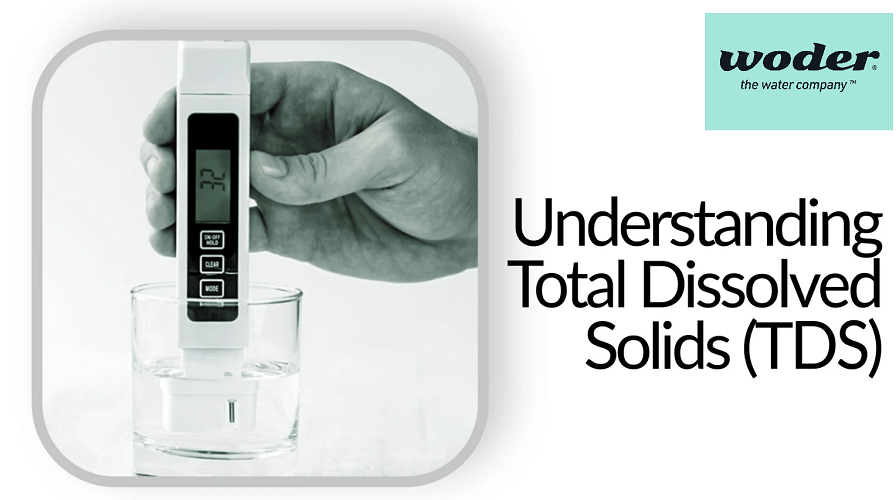Essential minerals are also picked up by TDS meter.
Water with a low TDS rate should not be considered a good drinking water.
In fact, experts consider it essentially dead water.
Woder filters have a unique technology that removes contaminants while leaving in all essential minerals, which are vital to your health, including calcium, potassium, and magnesium.
We call it Advanced Selective Filtration™.
When your water is pure yet healthy with essential minerals, it’s the way nature intended drinking water to be.
With Woder you can enjoy tap water as pure and healthy as spring water.
**Categories:** Woder Science
**Tags:** ppm meter, tds, tds meter, water quality
---
### [The Woder Accountability](https://woder.com/blog/the-woder-accountability/)
**Published:** August 11, 2022
**Author:** Vesta P.
**Content:**

We all need to take ownership of the quality of our drinking water. Water which is readily available, may not always be of the best quality, while best quality water systems, are not always affordable.
At Woder, we are helping people make their tap water as pure as it once was in nature.
Without expensive systems.
Without plastic water bottles.
Available all the time through your tap.
**Categories:** Woder Science
**Tags:** affordable water filter sytems, woder filtration system
---
### [Selective filtration®](https://woder.com/blog/selective-filtration/)
**Published:** August 4, 2022
**Author:** woder
**Content:**
The nanoparticles have an affinity for contaminants, but not for essential minerals. They attract and filter out 99.9% of contaminants but leave in the naturally occurring minerals that are essential to your health. (Reverse osmosis removes everything, so it is described by many experts as “dead” water.)
**Advanced Selective Filtration™ Technology removes 99.9% of contaminants while it leaves in essential minerals that are vital to your health.**
**Categories:** Woder Science
---
## Pages
### [Homepage](https://woder.com/)
**Published:** September 14, 2020
**Author:** woder_admin
---
### [IT'S YOUR WATER™](https://woder.com/wizard/)
**Published:** September 20, 2020
**Author:** woder_admin
**Content:**
Meet the [Woder](https://woder.com/) Wizard – your trusted guide to finding the perfect water filter. Just answer a few quick questions, and the Wizard will recommend the best system for your specific needs.
---
### [The Woder Guarantee](https://woder.com/guarantee/)
**Published:** January 22, 2023
**Author:** woder
**Content:**
Every Woder filter is covered by a 1-Year Limited Warranty against defects in materials and workmanship. If something goes wrong, we’ll repair or replace it — no runaround.
The warranty doesn’t cover normal wear and tear, misuse, improper installation, unauthorized modifications, or damage from freezing, extreme temperatures, chemicals, or pressure beyond design limits. Flow rate, taste, and filter lifespan naturally vary based on your water quality and usage, and aren’t covered under warranty.
To file a claim, email with your order number and a brief description of the issue. We may ask for photos or a return of the product before determining next steps.
---
**Happiness Guarantee**
We’ve been around since 2014 and we’re not going anywhere. If you’re not happy with your purchase for any reason, contact us within 60 days at . We’ll confirm your order and send return instructions. Once we receive the unused product, you’ll get a full refund — no questions asked.
If the filter has already been used, it isn’t eligible for return — but reach out anyway. If we can’t resolve the issue, we’ll send a prepaid return label and issue a full refund.
---
**Maintenance Note**
Mounting heads should be replaced every 3–4 years to maintain optimal performance.
---
### [About Us](https://woder.com/about-woder-filters/)
**Published:** January 21, 2020
**Author:** woder_admin
---
### [Returns & Refunds](https://woder.com/returns-refunds/)
**Published:** January 21, 2020
**Author:** woder_admin
**Content:**
## Thank you for shopping at Woder.com.
If you are not entirely satisfied with your purchase, we’re here to help.
Even if your return and refund request does not meet our policy as described below, please do not hesitate to [contact us](https://woder.com/contact-us/) to submit an inquiry.
Our products can be returned within 60 days of the original purchase of the product. A new product may be exchanged for another product or returned for a refund. A return for a refund will be a subject for 10% restocking fees.
To be eligible for a return, please make sure that the product was purchased in the last 60 days. The product isn’t used or damaged. That you obtained a Return Merchandise Number (RMN) from us.
Products that do not meet these criteria will not be considered for return.
To obtain a Return Merchandise Number (RMN) please [contact us](https://woder.com/contact-us/).
##### Send the product to:
**Woder.com**
Clearbrook LLC
1521 Azalea Rd
Mobile, AL 36693
---
### Shipping charges
Shipping charges incurred in connection with the return of a product are non-refundable.
You are responsible for paying the costs of shipping and for the risk of loss of or damage to the product during shipping, both to and from Woder.com.
---
### Damaged items
If you received a damaged product, please notify us immediately for assistance.
---
### Sale items
Sale items can be refunded.
---
### Contact us
If you have any questions about our Returns and Refunds Policy please [contact us](https://woder.com/contact-us/).
---
### [Installation Guides](https://woder.com/install/)
**Published:** February 29, 2020
**Author:** woder_admin
**Content:**
**UNDER SINK FILTERS**
Primary and secondary undersink water filtration systems can be installed in kitchens, bathrooms, or any other room where you, or your family need healthier cold tap water.
[TC (Twist-Connect) with DC Installation Guide](https://woder.com/wp-content/uploads/2026/04/Insert-TC-WEB-DC.pdf "Woder Filters installation")
WD-G4-DC, WD-HMG4-DC, WD-20m-DC, WD-D-FRM-G4-DC, WD-D-20m-G4-DC, WD-D-HMG4-G4-DC
[OP (One-Piece) with DC Installation Guide](https://woder.com/wp-content/uploads/2026/04/Insert-OP-WEB-DC.pdf)
WD-G4-210-DC, WD-G4-2512-DC
---
**REFRIGERATOR / INLINE FILTERS** (1/4″ JG)
Inline filters can be installed in pantries, cabinets, or behind your refrigerator – wherever you have convenient access to your 1/4″ water supply line.
[TC (Twist-Connect) with JG Installation Guide](https://woder.com/wp-content/uploads/2026/04/Insert-TC-WEB-JG.pdf)
WD-G4-JG, WD-HMG4-JG, WD-20m-JG, WD-D-FRM-G4-JG, WD-D-20m-G4-JG, WD-D-HMG4-G4-JG
[OP (One-Piece) with JG Installation Guide](https://woder.com/wp-content/uploads/2026/04/Insert-OP-WEB-JG.pdf)
WD-G4-210-JG, WD-G4-2512-JG
---
**CARTRIDGE REPLACEMENT**
[TC (Twist-Connect) Cartridge Replacement Guide](https://woder.com/wp-content/uploads/2026/04/Insert-Cartridges-WEB-TCJG.pdf "Woder Cartridge Replacement Guide")
WD-G4-REP, WD-FRM-REP, WD-20m-REP, WD-HMG4-REP
---
### [Green Disposal](https://woder.com/disposal/)
**Published:** October 15, 2020
**Author:** woder_admin
**Content:**
Our cartridges are not reusable, but the material is! We will take care of proper recycling, locally!
We charge $15 for this service. It covers the actual return costs only.
After checkout you’ll receive a return label via email.
---
### [FAQs](https://woder.com/faqs/)
**Published:** February 27, 2020
**Author:** woder_admin
---
### [Contact us](https://woder.com/contact-us/)
**Published:** January 21, 2020
**Author:** woder_admin
---
### [Online Catalog](https://woder.com/catalog/)
**Published:** October 15, 2020
**Author:** woder_admin
**Content:**
---
### [Wholesale](https://woder.com/wholesale/)
**Published:** January 21, 2020
**Author:** woder_admin
**Content:**
US-Made, WQA-certified, simple, cost-effective maintenance
---
### [Terms & Conditions](https://woder.com/terms-conditions/)
**Published:** January 21, 2020
**Author:** woder_admin
**Content:**
**LEGAL & DISTRIBUTION NOTICE**
Woder® is a registered trademark of Granit Tevel Group LTD. Woder is distributed in the US exclusively by Nehara LLC.
***Last updated: November 15, 2021***
These Terms and Conditions (“Terms”, “Terms and Conditions”) govern your relationship with woder.com website (the “Service”) operated by Granit Tevel Group LTD. (“us”, “we”, or “our”).
---
**Please read these Terms and Conditions carefully before using the Service.**
- These terms of use tell you the terms on which you may make use of our (www.woder.com) (our site) whether as a guest or a registered user. Use of our site includes accessing, browsing or registering to use our site.
- Please read these terms of use carefully before you start to use our site, as these will apply to your use of the site.
- By using our site, you confirm that you accept these terms of use and that you agree to comply with them.
- If you do not agree to these terms of use, you must not use our site.
- The following additional terms, which can be accessed from the home page of our site, will also apply to your use of our site:
- Our [Privacy Policy](https://www.itgovernance.eu/sv-se/privacy-notice-se), which sets out the terms on which we process any personal data we collect from you or that you provide to us. By using our web-site you consent to such processing and you warrant that all data you provide is accurate.
---
**Security**
- In order to ensure that this website remains available to all users, we may monitor network traffic to identify unauthorized attempts to upload or change information, or to otherwise cause damage to the site. Anyone using this site expressly consents to such monitoring.
- Unauthorized attempts to modify, alter, deface, destroy or corrupt any information stored on this site or this system, to defeat or circumvent any security features, to probe, scan or test for vulnerabilities, to breach security or authentication measures, to forge TCP/IP headers, to install or attempt to install unauthorized software, to mount denial-of-service attacks, or to utilize this system for other than its intended purposes are expressly prohibited and may result in criminal prosecution.
- Any possible criminal activity will be reported, together with any evidence that may be gathered, to the appropriate authorities.
- If you choose or are provided with a user identification code, password or any other piece of information as part of our security procedures, you must treat such information as confidential. You must not disclose it to any third party. We have the right to disable any user identification code or password whether chosen by you or allocated by us at any time if in our reasonable opinion you have failed to comply with any of the provisions of these terms of use.
---
**Changes to these terms and our site, and access to our site**
- We may revise these terms of use at any time by amending this page. Please check this page from time to time to take notice of any changes we make as they are binding on you. We will try to provide at least 30 days of notice prior to any new terms taking effect.
- We may update our site from time to time and change the content at any time. However, please note that any of the content on our site may be out of date at any given time, and we are under no obligation to update it.
- We do not guarantee that our site or any content on it will be free from errors or omissions.
- We do not guarantee that our site or any content on it will always be available or be uninterrupted. Access to our site is permitted on a temporary basis. We may suspend, withdraw, discontinue or change all or any part of our site without notice. We will not be liable to you if for any reason our site is unavailable at any time or for any period. You are responsible for making all arrangements necessary for you to have access to our site.
---
**Warranty Period**
Seller warrants to Buyer for a period of one year\* from the date of shipment of the Goods to Buyer that (i) the Goods will conform to the Seller’s specifications for the Goods in force at the date of shipment of the Goods to Buyer, and (ii) the Goods will be free from material defects in materials and workmanship.
---
**Return Policy**
Woder products can be returned within 60 days of the original purchase of the product in the US, and within 30 days to our Amazon Fulfilment spaces in Canada, Germany, France, Spain and Italy in accordance to Amazon’s terms and conditions.
To be eligible for a return (US):
- Warehouse returns – Products must be purchased within the last 60. Please contact us please contact us @ [http://woder.com/contact-us/](https://woder.com/contact-us/) for further instructions.
- Products returns to Amazon FBA – In accordance with Amazon policy.
To be eligible for a return (Outside US):
- Products returns to Amazon FBA centers – In accordance with Amazon FBA policy.
---
**Purchases**
If you wish to purchase any product or service made available through the Service (“Purchase”), you may be asked to supply certain information relevant to your Purchase including, without limitation, your credit card number, the expiration date of your credit card, your billing address, and your shipping information.
You represent and warrant that: (i) you have the legal right to use any credit card(s) or other payment method(s) in connection with any Purchase; and that (ii) the information you supply to us is true, correct and complete.
By submitting such information, you grant us the right to provide the information to third parties for purposes of facilitating the completion of Purchases.
We reserve the right to refuse or cancel your order at any time for certain reasons including but not limited to product or service availability, errors in the description or price of the product or service, error in your order or other reasons.
We reserve the right to refuse or cancel your order if fraud or an unauthorized or illegal transaction is suspected.
---
**Availability, Errors and Inaccuracies**
**Disclaimer**
Your use of the Service is at your sole risk. The Service is provided on an “AS IS” and “AS AVAILABLE” basis. The Service is provided without warranties of any kind, whether express or implied, including, but not limited to, implied warranties of merchantability, fitness for a particular purpose, non-infringement or course of performance.
Granit Tevel Group LTD. its subsidiaries, affiliates, and its licensors do not warrant that a) the Service will function uninterrupted, secure or available at any particular time or location; b) any errors or defects will be corrected; c) the Service is free of viruses or other harmful components; or d) the results of using the Service will meet your requirements.
---
Limitation of liability**
- Nothing in these terms of use excludes or limits our liability for death or personal injury arising from our negligence, or our fraud or fraudulent misrepresentation, or any other liability that cannot be excluded or limited by Eu law.
- To the extent permitted by law, we exclude all conditions, warranties, representations or other terms that may apply to our site or any content on it, whether express or implied.
- We will not be liable to any user for any loss or damage, whether in contract, tort (including negligence), breach of statutory duty, or otherwise, even if foreseeable, arising under or in connection with:
- use of, or inability to use, our site; or
- use of or reliance on any content displayed on our site.
- If you are a business user, please note that, in particular, we will not be liable for:
- loss of profits, sales, business or revenue
- business interruption
- loss of anticipated savings
- loss of business opportunity, goodwill or reputation; or
- any indirect or consequential loss or damage.
- We will not be liable for any loss or damage caused by a virus, distributed denial-of-service attack, or other technologically harmful material that may infect your computer equipment, computer programs, data or other proprietary material due to your use of our site or to your downloading of any content on it, or on any website linked to it.
- We assume no responsibility for the content of websites linked on our site. Such links should not be interpreted as endorsement by us of those linked websites. We will not be liable for any loss or damage that may arise from your use of them.
- Severability
If any of these terms is at any time held in any jurisdiction to be void, invalid or unenforceable, then it shall be treated as changed or reduced only to the extent minimally necessary to bring it within the laws of that jurisdiction and to prevent it from being void, and it shall be binding in that changed or reduced form. Subject to that, each provision shall be interpreted as severable and shall not in any way affect any other of these terms.
- No waiver by the Company, in exercising any right, power or provision hereunder shall operate as a waiver of any other right or of that same right at a future time; nor shall any delay in exercise of any power or right be interpreted as a waiver.
This clause survives termination or expiry of our agreement. ---
**Governing Law**
These Terms shall be governed and construed in accordance with the laws of Israel, without regard to its conflict of law provisions.
Our failure to enforce any right or provision of these Terms will not be considered a waiver of those rights. If any provision of these Terms is held to be invalid or unenforceable by a court, the remaining provisions of these Terms will remain in effect. These Terms constitute the entire agreement between us regarding our Service and supersede and replace any prior agreements we might have between us regarding the Service.
---
**Accounts**
When you create an account with us, you must provide us information that is accurate, complete, and current at all times. Failure to do so constitutes a breach of the Terms, which may result in immediate termination of your account on our Service.
You are responsible for safeguarding the password that you use to access the Service and for any activities or actions under your password, whether your password is with our Service or a third-party service.
You agree not to disclose your password to any third party. You must notify us immediately upon becoming aware of any breach of security or unauthorized use of your account.
You may not use as a username the name of another person or entity or that is not lawfully available for use, a name or trade mark that is subject to any rights of another person or entity other than you without appropriate authorization, or a name that is otherwise offensive, vulgar or obscene.
---
**Intellectual Property**
The Service and its original content, features and functionality are and will remain the exclusive property of Granit Tevel Group LTD. and its licensors. The Service is protected by copyright, trademark, and other laws of both the Israel and foreign countries. Our trademarks and trade dress may not be used in connection with any product or service without the prior written consent of Granit Tevel Group LTD..
---
**Links To Other Web Sites**
Our Service may contain links to third-party web sites or services that are not owned or controlled by Granit Tevel Group LTD..
Granit Tevel Group LTD. has no control over, and assumes no responsibility for, the content, privacy policies, or practices of any third party web sites or services. You further acknowledge and agree that Granit Tevel Group LTD. shall not be responsible or liable, directly or indirectly, for any damage or loss caused or alleged to be caused by or in connection with use of or reliance on any such content, goods or services available on or through any such web sites or services.
We strongly advise you to read the terms and conditions and privacy policies of any third-party web sites or services that you visit.
---
**Termination**
We may terminate or suspend your account immediately, without prior notice or liability, for any reason whatsoever, including without limitation if you breach the Terms.
Upon termination, your right to use the Service will immediately cease. If you wish to terminate your account, you may simply discontinue using the Service.
---
**Changes**
We reserve the right, at our sole discretion, to modify or replace these Terms at any time. If a revision is material we will try to provide at least 30 days notice prior to any new terms taking effect. What constitutes a material change will be determined at our sole discretion.
By continuing to access or use our Service after those revisions become effective, you agree to be bound by the revised terms. If you do not agree to the new terms, please stop using the Service.
---
**Contact Us**
If you have any questions about these Terms, please [contact us](https://woder.com/contact-us/).
---
### [Privacy Policy](https://woder.com/privacy-policy/)
**Published:** January 21, 2020
**Author:** woder_admin
**Content:**
##### *Last updated: February 23, 2020*
Granit Tevel Group LTD. (“us”, “we”, or “our”) operates the woder.com website (the “Service”).
This page informs you of our policies regarding the collection, use and disclosure of Personal Information when you use our Service.
We will not use or share your information with anyone except as described in this Privacy Policy.
We use your Personal Information for providing and improving the Service. By using the Service, you agree to the collection and use of information in accordance with this policy. Unless otherwise defined in this Privacy Policy, terms used in this Privacy Policy have the same meanings as in our Terms and Conditions, accessible at woder.com.
---
### Information Collection And Use
While using our Service, we may ask you to provide us with certain personally identifiable information that can be used to contact or identify you. Personally identifiable information may include, but is not limited to, your email address, name, phone number, postal address (“Personal Information”).
---
### Log Data
We may also collect information that your browser sends whenever you visit our Service (“Log Data”). This Log Data may include information such as your computer’s Internet Protocol (“IP”) address, browser type, browser version, the pages of our Service that you visit, the time and date of your visit, the time spent on those pages and other statistics.
In addition, we may use third party services such as Google Analytics that collect, monitor and analyze this type of information in order to increase our Service’s functionality. These third party service providers have their own privacy policies addressing how they use such information.
---
### Cookies
Cookies are files with small amount of data, which may include an anonymous unique identifier. Cookies are sent to your browser from a web site and stored on your computer’s hard drive.
We use “cookies” to collect information. You can instruct your browser to refuse all cookies or to indicate when a cookie is being sent. However, if you do not accept cookies, you may not be able to use some portions of our Service.
---
### Behavioral Remarketing
Granit Tevel Group LTD. uses remarketing services to advertise on third party web sites to you after you visited our Service. We, and our third party vendors, use cookies to inform, optimize and serve ads based on your past visits to our Service.
Google AdWords remarketing service is provided by Google Inc.
You can opt-out of Google Analytics for Display Advertising and customize the Google Display Network ads by visiting the Google Ads Settings page.
[http://www.google.com/settings/ads](https://www.google.com/ads/preferences/html/blocked-cookies.html)
Google also recommends installing the Google Analytics Opt-out Browser Add-on.
---
### Service Providers
We may employ third party companies and individuals to facilitate our Service, to provide the Service on our behalf, to perform Service-related services or to assist us in analyzing how our Service is used.
These third parties have access to your Personal Information only to perform these tasks on our behalf and are obligated not to disclose or use it for any other purpose.
---
### Communications
We may use your Personal Information to contact you with newsletters, marketing or promotional materials and other information that may be of interest to you. You may opt out of receiving any, or all, of these communications from us by following the unsubscribe link or instructions provided in any email we send.
---
### Compliance With Laws
We will disclose your Personal Information where required to do so by law or subpoena or if we believe that such action is necessary to comply with the law and the reasonable requests of law enforcement or to protect the security or integrity of our Service.
---
### Business Transaction
If Granit Tevel Group LTD. is involved in a merger, acquisition or asset sale, your Personal Information may be transferred. We will provide notice before your Personal Information is transferred and becomes subject to a different Privacy Policy.
---
### Security
The security of your Personal Information is important to us, but remember that no method of transmission over the Internet, or method of electronic storage is 100% secure. While we strive to use commercially acceptable means to protect your Personal Information, we cannot guarantee its absolute security.
---
### International Transfer
Your information, including Personal Information, may be transferred to — and maintained on — computers located outside of your state, province, country or other governmental jurisdiction where the data protection laws may differ than those from your jurisdiction.
If you are located outside Israel and choose to provide information to us, please note that we transfer the information, including Personal Information, to Israel and process it there.
Your consent to this Privacy Policy followed by your submission of such information represents your agreement to that transfer.
---
### Links To Other Sites
Our Service may contain links to other sites that are not operated by us. If you click on a third party link, you will be directed to that third party’s site. We strongly advise you to review the Privacy Policy of every site you visit.
We have no control over, and assume no responsibility for the content, privacy policies or practices of any third party sites or services.
---
### Children’s Privacy
Our Service does not address anyone under the age of 13 (“Children”).
We do not knowingly collect personally identifiable information from children under 13. If you are a parent or guardian and you are aware that your Children has provided us with Personal Information, please contact us. If we become aware that we have collected Personal Information from a child under age 13 without verification of parental consent, we take steps to remove that information from our servers.
---
### Changes To This Privacy Policy
We may update our Privacy Policy from time to time. We will notify you of any changes by posting the new Privacy Policy on this page.
You are advised to review this Privacy Policy periodically for any changes. Changes to this Privacy Policy are effective when they are posted on this page.
---
### Contact Us
If you have any questions about this Privacy Policy, please [contact us](https://woder.com/contact-us/).
---
##### LEGAL & DISTRIBUTION NOTICE
Woder® is a registered trademark of Granit Tevel Group LTD. Woder is Distributed in the US exclusively by Nehara LLC.
---
### [Test Your Water](https://woder.com/test-your-water/)
**Published:** May 2, 2020
**Author:** woder_admin
---
### [Woder.com Privacy Policy](https://woder.com/woder-com-privacy-policy/)
**Published:** November 11, 2021
**Author:** woder
**Content:**
**Privacy Policy**
Thank you for using the Woder website. This website is provided by Granit Tevel Group LTD. We are the controller of your personal data collected through our website and through for the purpose of data protection law, unless indicated otherwise.
The term Granit Tevel Group LTD or ‘us’ or ‘we’ refers to the owner of the website whose registered office is 12 Ein-Gev Kibbutz Ein-Gev, Israel, 149000. The term ‘you’ refers to the user or viewer of our website.
The use of this website is subject to the following terms of use:
- The content of the pages of this website is for your general information and use only. It is subject to change without notice.
- Neither we nor any third parties provide any warranty or guarantee as to the accuracy, timeliness, performance, completeness or suitability of the information and materials found or offered on this website for any particular purpose. You acknowledge that such information and materials may contain inaccuracies or errors and we expressly exclude liability for any such inaccuracies or errors to the fullest extent permitted by law.
- Your use of any information or materials on this website is entirely at your own risk, for which we shall not be liable. It shall be your own responsibility to ensure that any products, services or information available through this website meet your specific requirements.
- This website contains material which is owned by or licensed to us. This material includes, but is not limited to, the design, layout, look, appearance and graphics. Reproduction is prohibited other than in accordance with the copyright notice, which forms part of these terms and conditions.
- Unauthorized use of this website may give rise to a claim for damages and/or be a criminal offence.
- From time to time this website may also include links to other websites. These links are provided for your convenience to provide further information. They do not signify that we endorse the website(s). We have no responsibility for the content of the linked website(s).
- Your use of this website and any dispute arising out of such use of the website is subject to the laws of Israel.
**Non-Personal Information**
When you use our website, we and some third-party providers may work with and collect data in a form that does not, on its own, permit direct association with any specific individual. We may collect, use, transfer, and disclose non-personal information for any purpose.
**Personal Information – GDPR**
We collect personal information when you register with us through or when you communicate with us, including the names, addresses and other contact details of yourself and of your company, information about your function and your company’s business, communication data, and other information related to our business with your company. You are not under an obligation to provide personal data, but if you do not then we might not enter into an agreement with you and/or may not be able to provide certain services. We may use your personal information consistent with this policy and with applicable laws. In particular, we may use it for the following purposes:
1. to prepare and enter into or to perform an agreement with you or your company,
2. to comply with our legal obligations including to respond to requests of government agencies as required by applicable laws, court orders, or government regulations,
3. for our legitimate interests, to sell our goods and services provided by us.
We perform limited processing on your personal data in line with our legitimate interests, in order to effectively run our business.
We may use other personal information when you consent to such use. We will retain personal information for as long as necessary to fulfil the purposes set out in this Policy, unless a longer retention period is required or permitted by law. We may share your personal information with government authorities and with our affiliates, as required for the purposes set out above, and with service providers that help us with these purposes. These providers may only process your personal information in accordance with the current GDPR law. If you wish to obtain a copy of such contracts, please contact us at the address
You have the right, in accordance with applicable law, to request access to your personal data, obtain rectification or erasure, as applicable, and to ask for a copy of some of your personal data. Where processing is based on your consent, you may withdraw your consent at any time. If you wish to use one of these please contact us at the address indicated above. You may also lodge a complaint with the competent supervisory authority.
**Cookies and Other Technologies**
We collect information automatically through the use of “cookies”. A cookie is a text file containing small amounts of information that a website can send to your browser, which may then be stored in your browser or on your device as a tag that distinguishes your computer but does not name you. We may use cookies for various purposes, for example, to facilitate the use of the website, to collect information for statistical and analytical purposes, and for security purposes. Some of the cookies may expire when the session end and you exit your browser. Other cookies may be stored on your device. If you wish to block cookies, then please use the help button in your browser and follow the instructions. There are other technologies that can be used for similar purposes, such as HTML5 local storage and local shared objects (LSOs). We may use such technologies for authenticating you, for keeping track of information you have provided to us, and for storing your preferences or information about your visit to a web page. If you prefer not to use such technologies, you may configure your browser not to accept it or to notify and require approval. Some part of our Site may not function properly if such technologies are turned off.
**Links to Other Sites**
Our websites may contain links to other sites. If you click on a third-party link, you will be directed to that site. Note that these external sites are not operated by us. Therefore, we advise you to review the privacy policy of these websites, visit us. We have no control over, and assume no responsibility for the content, privacy policies, or practices of any third-party sites or services.
**Website Disclaimer**
The information contained in this website is for general information purposes only. The information is provided by Granit Tevel Group LTD and while we endeavor to keep the information up to date and correct, we make no representations or warranties of any kind, express or implied, about the completeness, accuracy, reliability, suitability or availability with respect to the website or the information, products, services, or related graphics contained on the website for any purpose. Any reliance you place on such information is therefore strictly at your own risk.
In no event will we be liable for any loss or damage including without limitation, indirect or consequential loss or damage, or any loss or damage whatsoever arising from loss of data or profits arising out of, or in connection with, the use of this website.
Through this website you are able to link to other websites which are not under the control of Granit Tevel Group LTD. We have no control over the nature, content and availability of those sites. The inclusion of any links does not necessarily imply a recommendation or endorse the views expressed within them.
Every effort is made to keep the website up and running smoothly. Granit Tevel Group LTD takes no responsibility for, and will not be liable for, the website being temporarily unavailable due to technical issues beyond our control.
**Copyright Notice –** **Woder Website**
This website and its content copyright of Granit Tevel Group LTD. All rights reserved.
You may not, except with our express written permission, distribute or commercially exploit the content. Nor may you transmit it or store it in any other website or other form of electronic retrieval system.
**Standard Contractual Clauses**
**Module Two: Transfer Controller to Processor (C2P)**
**SECTION I**
*Clause 1*
***Purpose and scope***
(a) The purpose of these standard contractual clauses is to ensure compliance with the requirements of Regulation (EU) 2016/679 of the European Parliament and of the Council of 27 April 2016 on the protection of natural persons with regard to the processing of personal data and on the free movement of such data (General Data Protection Regulation) for the transfer of personal data to a third country.
(b) The Parties:
(i) the natural or legal person(s), public authority/ies, agency/ies or other body/ies (hereinafter “entity/ies”) transferring the personal data, (hereinafter each “data exporter”), and
(ii) the entity/ies in a third country receiving the personal data from the data exporter, directly or indirectly via another entity also Party to these Clauses, (hereinafter each “data importer”)
have agreed to these standard contractual clauses (hereinafter: “Clauses”).
These Clauses apply with respect to the transfer of personal data.
*Clause 2*
*Effect and invariability of the Clauses*
(a) These Clauses set out appropriate safeguards, including enforceable data subject rights and effective legal remedies, pursuant to Article 46(1) and Article 46 (2)(c) of Regulation (EU) 2016/679 and, with respect to data transfers from controllers to processors and/or processors to processors, standard contractual clauses pursuant to Article 28(7) of Regulation (EU) 2016/679, provided they are not modified, except to select the appropriate Module(s) or to add or update information in the Appendix. This does not prevent the Parties from including the standard contractual clauses laid down in these Clauses in a wider contract and/or to add other clauses or additional safeguards, provided that they do not contradict, directly or indirectly, these Clauses or prejudice the fundamental rights or freedoms of data subjects.
(b) These Clauses are without prejudice to obligations to which the data exporter is subject by virtue of Regulation (EU) 2016/679.
*Clause 3*
*Third-party beneficiaries*
(a) Data subjects may invoke and enforce these Clauses, as third-party beneficiaries, against the data exporter and/or data importer, with the following exceptions:
(i) Clause 1, Clause 2, Clause 3, Clause 6, Clause 7
(ii) Clause 8 – Clause 8.1(b), 8.9(a), (c), (d) and (e)
(iii) Clause 9 – Clause 9(a), (c), (d) and (e)
(iv) Clause 12 – Clause 12(a), (d) and (f)
(v) Clause 13
(vi) Clause 15.1(c), (d) and (e)
(vii) Clause 16(e)
(viii) Clause 18 – Clause 18(a) and (b)
(b) Paragraph (a) is without prejudice to rights of data subjects under Regulation (EU) 2016/679
*Clause 4
*Interpretation*
(a) Where these Clauses use terms that are defined in Regulation (EU) 2016/679, those terms shall have the same meaning as in that Regulation.
(b) These Clauses shall be read and interpreted in the light of the provisions of Regulation (EU) 2016/679.
(c) These Clauses shall not be interpreted in a way that conflicts with rights and obligations provided for in Regulation (EU) 2016/679.
*Clause 5*
*Hierarchy*
In the event of a contradiction between these Clauses and the provisions of related agreements between the Parties, existing at the time these Clauses are agreed or entered into thereafter, these Clauses shall prevail.
*Clause 6*
*Description of the transfer(s)*
The details of the transfer(s), and in particular the categories of personal data that are transferred and the purpose(s) for which they are transferred, are specified in Annex I.B.
*Clause 7*
*Docking clause*
(a) An entity that is not a Party to these Clauses may, with the agreement of the Parties, accede to these Clauses at any time, either as a data exporter or as a data importer, by completing the Appendix and signing the Annex.
(b) Once it has completed the Appendix and signed the Annex, the acceding entity shall become a Party to these Clauses and have the rights and obligations of a data exporter or data importer in accordance with its designation in the Annex
(c) The acceding entity shall have no rights or obligations arising under these Clauses from the period prior to becoming a Party.
**SECTION II – OBLIGATIONS OF THE PARTIES**
*Clause 8*
***Data protection safeguards***
The data exporter warrants that it has used reasonable efforts to determine that the data importer is able, through the implementation of appropriate technical and organizational measures, to satisfy its obligations under these Clauses.
**8.1** **Instructions**
(a) The data importer shall process the personal data only on documented instructions from the data exporter. The data exporter may give such instructions throughout the duration of the contract.
(b) The data importer shall immediately inform the data exporter if it is unable to follow those instructions.
**8.2** **Purpose limitation**
The Data Importer shall process the personal data only for the specific purpose(s) of the transfer as set out in the Privacy Policy.
**8.3** **Transparency**
On request, the data exporter shall make a copy of these Clauses, including the Appendix as completed by the Parties, available to the data subject free of charge. To the extent necessary to protect business secrets or other confidential information, the data exporter may redact part of the text of the Appendix to these Clauses prior to sharing a copy but shall provide a meaningful summary where the data subject would otherwise not be able to understand its content or exercise his/her rights. On request, the Parties shall provide the data subject with the reasons for the redactions, to the extent possible without revealing the redacted information. This Clause is without prejudice to the obligations of the data exporter under Articles 13 and 14 of Regulation (EU) 2016/679.
**8.4** **Accuracy**
If the data importer becomes aware that the personal data it has received is inaccurate, or has become outdated, it shall inform the data exporter without undue delay. In this case, the data importer shall cooperate with the data exporter to erase or rectify the data.
**8.5** **Duration of processing and erasure or return of data**
Processing by the data importer shall only take place for the duration specified in Annex I.B. After the end of the provision of the processing services, the data importer shall, at the choice of the data exporter, delete all personal data processed on behalf of the data exporter and certify to the data exporter that it has done so, or return to the data exporter all personal data processed on its behalf and delete existing copies. Until the data is deleted or returned, the data importer shall continue to ensure compliance with these Clauses. In case of local laws applicable to the data importer that prohibit return or deletion of the personal data, the data importer warrants that it will continue to ensure compliance with these Clauses and will only process it to the extent and for as long as required under that local law. This is without prejudice to Clause 14, in particular the requirement for the data importer under Clause 14(e) to notify the data exporter throughout the duration of the contract if it has reason to believe that it is or has become subject to laws or practices not in line with the requirements under Clause 14(a).
**8.6** **Security of processing**
(a) The data importer and, during transmission, also the data exporter shall implement appropriate technical and organizational measures to ensure the security of the data, including protection against a breach of security leading to accidental or unlawful destruction, loss, alteration, unauthorized disclosure or access to that data (hereinafter “personal data breach”). In assessing the appropriate level of security, the Parties shall take due account of the state of the art, the costs of implementation, the nature, scope, context and purpose(s) of processing and the risks involved in the processing for the data subjects. The Parties shall in particular consider having recourse to encryption or pseudonymization, including during transmission, where the purpose of processing can be fulfilled in that manner. In case of pseudonymization, the additional information for attributing the personal data to a specific data subject shall, where possible, remain under the exclusive control of the data exporter. The data importer shall carry out regular checks to ensure that these measures continue to provide an appropriate level of security.
(b) The data importer shall grant access to the personal data to members of its personnel only to the extent strictly necessary for the implementation, management and monitoring of the contract. It shall ensure that persons authorized to process the personal data have committed themselves to confidentiality or are under an appropriate statutory obligation of confidentiality.
(c) In the event of a personal data breach concerning personal data processed by the data importer under these Clauses, the data importer shall take appropriate measures to address the breach, including measures to mitigate its adverse effects. The data importer shall also notify the data exporter without undue delay after having become aware of the breach. Such notification shall contain the details of a contact point where more information can be obtained, a description of the nature of the breach (including, where possible, categories and approximate number of data subjects and personal data records concerned), its likely consequences and the measures taken or proposed to address the breach including, where appropriate, measures to mitigate its possible adverse effects. Where, and in so far as, it is not possible to provide all information at the same time, the initial notification shall contain the information then available and further information shall, as it becomes available, subsequently be provided without undue delay.
(d) The data importer shall cooperate with and assist the data exporter to enable the data exporter to comply with its obligations under Regulation (EU) 2016/679, in particular to notify the competent supervisory authority and the affected data subjects, taking into account the nature of processing and the information available to the data importer.
**8.7** **Sensitive data**
Where the transfer involves personal data revealing racial or ethnic origin, political opinions, religious or philosophical beliefs, or trade union membership, genetic data, or biometric data for the purpose of uniquely identifying a natural person, data concerning health or a person’s sex life or sexual orientation, or data relating to criminal convictions and offences (hereinafter “sensitive data”), the data importer shall apply the specific restrictions and/or additional safeguards described in Annex I.B.
**8.8** **Onward transfers**
The data importer shall only disclose the personal data to a third party on documented instructions from the data exporter. In addition, the data may only be disclosed to a third party located outside the European Union (in the same country as the data importer or in another third country, hereinafter “onward transfer”) if the third party is or agrees to be bound by these Clauses, under the appropriate Module, or if:
(i) the onward transfer is to a country benefitting from an adequacy decision pursuant to Article 45 of Regulation (EU) 2016/679 that covers the onward transfer
(ii) the third party otherwise ensures appropriate safeguards pursuant to Articles 46 or 47 Regulation of (EU) 2016/679 with respect to the processing in question
(iii) the onward transfer is necessary for the establishment, exercise of legal claims in the context of specific administrative, regulatory or judicial proceedings or
(iv) the onward transfer is necessary in order to protect the vital interests of the data subject or of another natural person.
Any onward transfer is subject to compliance by the data importer with all the other safeguards under these Clauses, in particular purpose limitation.
**8.9** **Documentation and compliance**
(a) The data importer shall promptly and adequately deal with enquiries from the data exporter that relate to the processing under these Clauses.
(b) The Parties shall be able to demonstrate compliance with these Clauses. In particular, the data importer shall keep appropriate documentation on the processing activities carried out on behalf of the data exporter.
(c) The data importer shall make available to the data exporter all information necessary to demonstrate compliance with the obligations set out in these Clauses and at the data exporter’s request, allow for and contribute to audits of the processing activities covered by these Clauses, at reasonable intervals or if there are indications of non-compliance. In deciding on a review or audit, the data exporter may take into account relevant certifications held by the data importer.
(d) The data exporter may choose to conduct the audit by itself or mandate an independent auditor. Audits may include inspections at the premises or physical facilities of the data importer and shall, where appropriate, be carried out with reasonable notice.
(e) The Parties shall make the information referred to in paragraphs (b) and (c), including the results of any audits, available to the competent supervisory authority on request.
*Clause 9*
*Use of sub-processors*
(a) The data importer has the data exporter’s general authorization for the engagement of sub-processor(s) from an agreed list. The data importer shall specifically inform the data exporter in writing of any intended changes to that list through the addition or replacement of sub-processors at least 30 business days in advance, thereby giving the data exporter sufficient time to be able to object to such changes prior to the engagement of the sub-processor(s). The data importer shall provide the data exporter with the information necessary to enable the data exporter to exercise its right to object.
(b) Where the data importer engages a sub-processor to carry out specific processing activities (on behalf of the data exporter), it shall do so by way of a written contract that provides for, in substance, the same data protection obligations as those binding the data importer under these Clauses, including in terms of third-party beneficiary rights for data subjects. The Parties agree that, by complying with this Clause, the data importer fulfils its obligations under Clause 8.8. The data importer shall ensure that the sub-processor complies with the obligations to which the data importer is subject pursuant to these Clauses.
(c) The data importer shall provide, at the data exporter’s request, a copy of such a sub-processor agreement and any subsequent amendments to the data exporter. To the extent necessary to protect business secrets or other confidential information, including personal data, the data importer may redact the text of the agreement prior to sharing a copy.
(d) The data importer shall remain fully responsible to the data exporter for the performance of the sub-processor’s obligations under its contract with the data importer. The data importer shall notify the data exporter of any failure by the sub-processor to fulfil its obligations under that contract.
(e) The data importer shall agree a third-party beneficiary clause with the sub-processor whereby – in the event the data importer has factually disappeared, ceased to exist in law or has become insolvent – the data exporter shall have the right to terminate the sub-processor contract and to instruct the sub-processor to erase or return the personal data.
*Clause 10*
*Data subject rights*
(a) The data importer shall promptly notify the data exporter of any request it has received from a data subject. It shall not respond to that request itself unless it has been authorized to do so by the data exporter.
(b) The data importer shall assist the data exporter in fulfilling its obligations to respond to data subjects’ requests for the exercise of their rights under Regulation (EU) 2016/679. In this regard, the Parties shall set out in Annex \_\_ the appropriate technical and organizational measures, taking into account the nature of the processing, by which the assistance shall be provided, as well as the scope and the extent of the assistance required.
(c) In fulfilling its obligations under paragraphs (a) and (b), the data importer shall comply with the instructions from the data exporter.
*Clause 11*
*Redress*
(a) The data importer shall inform data subjects in a transparent and easily accessible format, through individual notice or on its website, of a contact point authorized to handle complaints. It shall deal promptly with any complaints it receives from a data subject.
(b) In case of a dispute between a data subject and one of the Parties as regards compliance with these Clauses, that Party shall use its best efforts to resolve the issue amicably in a timely fashion. The Parties shall keep each other informed about such disputes and, where appropriate, cooperate in resolving them.
(c) Where the data subject invokes a third-party beneficiary right pursuant to Clause 3, the data importer shall accept the decision of the data subject to:
(i) lodge a complaint with the supervisory authority in the Member State of his/her habitual residence or place of work, or the competent supervisory authority pursuant to Clause 13
(ii) refer the dispute to the competent courts within the meaning of Clause 18.
(d) The Parties accept that the data subject may be represented by a not-for-profit body, organization or association under the conditions set out in Article 80(1) of Regulation (EU) 2016/679.
(e) The data importer shall abide by a decision that is binding under the applicable EU or Member State law.
(f) The data importer agrees that the choice made by the data subject will not prejudice his/her substantive and procedural rights to seek remedies in accordance with applicable laws.
*Clause 12*
*Liability*
(a) Each Party shall be liable to the other Party/ies for any damages it causes the other Party/ies by any breach of these Clauses.
(b) The data importer shall be liable to the data subject, and the data subject shall be entitled to receive compensation, for any material or non-material damages the data importer or its sub-processor causes the data subject by breaching the third-party beneficiary rights under these Clauses.
(c) Notwithstanding paragraph (b), the data exporter shall be liable to the data subject, and the data subject shall be entitled to receive compensation, for any material or non-material damages the data exporter or the data importer (or its sub-processor) causes the data subject by breaching the third-party beneficiary rights under these Clauses. This is without prejudice to the liability of the data exporter and, where the data exporter is a processor acting on behalf of a controller, to the liability of the controller under Regulation (EU) 2016/679 or Regulation (EU) 2018/1725, as applicable.
(d) The Parties agree that if the data exporter is held liable under paragraph (c) for damages caused by the data importer (or its sub-processor), it shall be entitled to claim back from the data importer that part of the compensation corresponding to the data importer’s responsibility for the damage.
(e) Where more than one Party is responsible for any damage caused to the data subject as a result of a breach of these Clauses, all responsible Parties shall be jointly and severally liable and the data subject is entitled to bring an action in court against any of these Parties.
(f) The Parties agree that if one Party is held liable under paragraph (e), it shall be entitled to claim back from the other Party/ies that part of the compensation corresponding to its / their responsibility for the damage.
(g) The data importer may not invoke the conduct of a sub-processor to avoid its own liability.
*Clause 13*
*Supervision*
(a) The supervisory authority with responsibility for ensuring compliance by the data exporter with Regulation (EU) 2016/679 as regards the data transfer, as indicated in Annex I.C, shall act as competent supervisory authority.
(b) The data importer agrees to submit itself to the jurisdiction of and cooperate with the competent supervisory authority in any procedures aimed at ensuring compliance with these Clauses. In particular, the data importer agrees to respond to enquiries, submit to audits and comply with the measures adopted by the supervisory authority, including remedial and compensatory measures. It shall provide the supervisory authority with written confirmation that the necessary actions have been taken.
**SECTION III –**
**LOCAL LAWS AND OBLIGATIONS IN CASE OF ACCESS BY
PUBLIC AUTHORITIES**
*Clause 14*
*Local laws and practices affecting compliance with the Clauses*
(a) The Parties warrant that they have no reason to believe that the laws and practices in the third country of destination applicable to the processing of the personal data by the data importer, including any requirements to disclose personal data or measures authorizing access by public authorities, prevent the data importer from fulfilling its obligations under these Clauses. This is based on the understanding that laws and practices that respect the essence of the fundamental rights and freedoms and do not exceed what is necessary and proportionate in a democratic society to safeguard one of the objectives listed in Article 23(1) of Regulation (EU) 2016/679, are not in contradiction with these Clauses.
(b) The Parties declare that in providing the warranty in paragraph (a), they have taken due account in particular of the following elements:
(i) the specific circumstances of the transfer, including the length of the processing chain, the number of actors and the transmission channels used; intended onward transfers; the type of recipient; the purpose of processing; the categories and format of the transferred personal data; the economic sector in which the transfer occurs; the storage location of the data transferred
(ii) the laws and practices of the third country of destination- including those requiring the disclosure of data to public authorities or authorizing access by such authorities – relevant in light of the specific circumstances of the transfer, and the applicable limitations and safeguards
(iii) any relevant contractual, technical or organizational safeguards put in place to supplement the safeguards under these Clauses, including measures applied during transmission and to the processing of the personal data in the country of destination.
(c) The data importer warrants that, in carrying out the assessment under paragraph (b), it has made its best efforts to provide the data exporter with relevant information and agrees that it will continue to cooperate with the data exporter in ensuring compliance with these Clauses.
(d) The Parties agree to document the assessment under paragraph (b) and make it available to the competent supervisory authority on request.
(e) The data importer agrees to notify the data exporter promptly if, after having agreed to these Clauses and for the duration of the contract, it has reason to believe that it is or has become subject to laws or practices not in line with the requirements under paragraph (a), including following a change in the laws of the third country or a measure (such as a disclosure request) indicating an application of such laws in practice that is not in line with the requirements in paragraph (a).
(f) Following a notification pursuant to paragraph (e), or if the data exporter otherwise has reason to believe that the data importer can no longer fulfil its obligations under these Clauses, the data exporter shall promptly identify appropriate measures (technical or organizational measures to ensure security and confidentiality) to be adopted by the data exporter and/or data importer to address the situation. The data exporter shall suspend the data transfer if it considers that no appropriate safeguards for such transfer can be ensured, or if instructed by the competent supervisory authority to do so. In this case, the data exporter shall be entitled to terminate the contract, insofar as it concerns the processing of personal data under these Clauses. If the contract involves more than two Parties, the data exporter may exercise this right to termination only with respect to the relevant Party, unless the Parties have agreed otherwise. Where the contract is terminated pursuant to this Clause, Clause 16(d) and (e) shall apply.
*Clause 15*
*Obligations of the data importer in case of access by public authorities*
**15.1** **Notification**
(a) The data importer agrees to notify the data exporter and, where possible, the data subject promptly (if, necessary with the help of the data exporter) if it:
(i) receives a legally binding request from a public authority, including judicial authorities, under the laws of the country of destination for the disclosure of personal data transferred pursuant to these Clauses; such notification shall include information about the personal data requested, the requesting authority, the legal basis for the request and the response provided; or
(ii) becomes aware of any direct access by public authorities to personal data transferred pursuant to these Clauses in accordance with the laws of the country of destination; such notification shall include all information available to the importer.
(b) If the data importer is prohibited from notifying the data exporter and/or the data subject under the laws of the country of destination, the data importer agrees to use its best efforts to obtain a waiver of the prohibition, with a view to communicating as much information as possible, as soon as possible. The data importer agrees to document its best efforts in order to be able to demonstrate them on request of the data exporter.
(c) Where permissible under the laws of the country of destination, the data importer agrees to provide the data exporter, at regular intervals for the duration of the contract, with as much relevant information as possible on the requests received (in particular, number of requests, type of data requested, requesting authorities, whether requests have been challenged and the outcome of such challenges, etc.).
(d) The data importer agrees to preserve the information pursuant to paragraphs (a) to (c) for the duration of the contract and make it available to the competent suspensory authority on request.
(e) Paragraphs (a) to (c) are without prejudice to the obligation of the data importer pursuant to Clause 14(e) and Clause 16 to inform the data exporter promptly where it is unable to comply with these Clauses.
**15.2** **Review of legality and data minimization**
(a) The data importer agrees to review the legality of the request for disclosure, in particular whether it remains within the powers granted to the requesting public authority, and to challenge the request if, after careful assessment, it concludes that there are reasonable grounds to consider that the request is unlawful under the laws of the country of destination, applicable obligations under international law and principles of international comity. The data importer shall, under the same conditions, pursue possibilities of appeal. When challenging a request, the data importer shall seek interim measures with a view to suspending the effects of the request until the competent judicial authority has decided on its merits. It shall not disclose the personal data requested until required to do so under the applicable procedural rules. These requirements are without prejudice to the obligations of the data importer under Clause 14(e).
(b) The data importer agrees to document its legal assessment and any challenge to the request for disclosure and, to the extent permissible under the laws of the country of destination, make the documentation available to the data exporter. It shall also make it available to the competent supervisory authority on request.
(c) The data importer agrees to provide the minimum amount of information permissible when responding to a request for disclosure, based on a reasonable interpretation of the request.
**SECTION IV – FINAL PROVISIONS**
*Clause 16*
*Non-compliance with the Clauses and termination*
(a) The data importer shall promptly inform the data exporter if it is unable to comply with these Clauses, for whatever reason.
(b) In the event that the data importer is in breach of these Clauses or unable to comply with these Clauses, the data exporter shall suspend the transfer of personal data to the data importer until compliance is again ensured or the contract is terminated. This is without prejudice to Clause 14(f).
(c) The data exporter shall be entitled to terminate the contract, insofar as it concerns the processing of personal data under these Clauses, where:
(i) the data exporter has suspended the transfer of personal data to the data importer pursuant to paragraph (b) and compliance with these Clauses is not restored within a reasonable time and in any event within one month of suspension
(ii) the data importer is in substantial or persistent breach of these Clauses; or
(iii) the data importer fails to comply with a binding decision of a competent court or supervisory authority regarding its obligations under these Clauses.
In these cases, it shall inform the competent supervisory authority such non-compliance. Where the contract involves more than two Parties, the data exporter may exercise this right to termination only with respect to the relevant Party, unless the Parties have agreed otherwise.
(d) Personal data that has been transferred prior to the termination of the contract pursuant to paragraph (c) shall at the choice of the data exporter immediately be returned to the data exporter or deleted in its entirety. The same shall apply to any copies of the data. The data importer shall certify the deletion of the data to the data exporter. Until the data is deleted or returned, the data importer shall continue to ensure compliance with these Clauses. In case of local laws applicable to the data importer that prohibit the return or deletion of the transferred personal data, the data importer warrants that it will continue to ensure compliance with these Clauses and will only process the data to the extent and for as long as required under that local law.
(e) Either Party may revoke its agreement to be bound by these Clauses where (i) the European Commission adopts a decision pursuant to Article 45(3) of Regulation (EU) 2016/679 that covers the transfer of personal data to which these Clauses apply; or (ii) Regulation (EU) 2016/679 becomes part of the legal framework of the country to which the personal data is transferred. This is without prejudice to other obligations applying to the processing in question under Regulation (EU) 2016/679.
*Clause 17*
*Governing law*
These Clauses shall be governed by the law of one of the EU Member States provided such law allows for third-party beneficiary rights (without reference to conflicts of law principles).
*Clause 18*
*Choice of forum and jurisdiction*
(a) Any dispute arising from these Clauses shall be resolved by the courts of an EU Member State.
(b) The Parties agree that those shall be the courts of the jurisdiction specified in Clause 17.
(c) A data subject may also bring legal proceedings against the data exporter and/or data importer before the courts of the Member State in which he/she has his/her habitual residence.
(d) The Parties agree to submit themselves to the jurisdiction of such courts
**UK AND SWISS ADDENDUM TO THE STANDARD CONTRACTUAL CLAUSES**
(a) This Addendum amends the Standard Contractual Clauses so they operate for transfers made by the data exporter to the data importer, to the extent that the UK GDPR or Swiss DPA applies to the data exporter’s processing when making that transfer.
(b) The Standard Contractual Clauses shall be amended with the following modifications: (i) references to “Regulation (EU) 2016/679” shall be interpreted as references to the UK GDPR or Swiss DPA (as applicable)
(ii) references to specific Articles of “Regulation (EU) 2016/679” shall be replaced with the equivalent article or section of the UK GDPR or Swiss DPA (as applicable)
(iii) references to Regulation (EU) 2018/1725 shall be removed
(iv) references to “EU”, “Union” and “Member State” shall be replaced with references to the “UK” or “Switzerland” (as applicable)
(v) Clause 13(a) is not under application and the “competent supervisory authority” shall be the United Kingdom Information Commissioner or Swiss Federal Data Protection Information Commissioner (as applicable);
(vi) references to the “competent supervisory authority” and “competent courts” shall be replaced with references to the “Information Commissioner” and the “courts of England and Wales” or the “Swiss Federal Data Protection Information Commissioner” and “applicable courts of Switzerland” (as applicable)
(vii) in Clause 17, the Standard Contractual Clauses shall be governed by the laws of England and Wales or Switzerland (as applicable); and
(viii) to the extent the UK GDPR applies to the processing, Clause 18 shall be replaced to state: “Any dispute arising from these Clauses shall be resolved by the courts of England and Wales. A data subject may also bring legal proceedings against the data exporter and/or data importer before the courts of any country in the UK. The Parties agree to submit themselves to the jurisdiction of such courts”; and
(ix) to the extent the Swiss DPA applies to the processing, Clause 18 shall be replaced to state: “Any dispute arising from these Clauses shall be resolved by the competent courts of Switzerland. The Parties agree to submit themselves to the jurisdiction of such courts”.
(i) references to “Regulation (EU) 2016/679” shall be interpreted as references to the UK GDPR or Swiss DPA (as applicable)
(ii) references to specific Articles of “Regulation (EU) 2016/679” shall be replaced with the equivalent article or section of the UK GDPR or Swiss DPA (as applicable)
(iii) references to Regulation (EU) 2018/1725 shall be removed
(iv) references to “EU”, “Union” and “Member State” shall be replaced with references to the “UK” or “Switzerland” (as applicable)
(v) Clause 13(a) the “competent supervisory authority” shall be the United Kingdom Information Commissioner or Swiss Federal Data Protection Information Commissioner (as applicable)
(vi) references to the “competent supervisory authority” and “competent courts” shall be replaced with references to the “Information Commissioner” and the “courts of England and Wales” or the “Swiss Federal Data Protection Information Commissioner” and “applicable courts of Switzerland” (as applicable)
(vii) in Clause 17, the Standard Contractual Clauses shall be governed by the laws of England and Wales or Switzerland (as applicable); and
(viii) to the extent the UK GDPR applies to the processing, Clause 18 shall be replaced to state: “Any dispute arising from these Clauses shall be resolved by the courts of England and Wales. A data subject may also bring legal proceedings against the data exporter and/or data importer before the courts of any country in the UK. The Parties agree to submit themselves to the jurisdiction of such courts”; and
(ix) to the extent the Swiss DPA applies to the processing, Clause 18 shall be replaced to state: “Any dispute arising from these Clauses shall be resolved by the competent courts of Switzerland. The Parties agree to submit themselves to the jurisdiction of such courts”.
---
### [Payment Failed](https://woder.com/payment-failed-2/)
**Published:** November 22, 2020
**Author:** woder_admin
**Content:**
We’re sorry, but your transaction failed to process. Please try again or contact site support.
---
### [Payment Confirmation](https://woder.com/payment-confirmation/)
**Published:** November 22, 2020
**Author:** woder_admin
**Content:**
\[simpay\_payment\_receipt\]
---
### [Payment Failed](https://woder.com/payment-failed/)
**Published:** November 22, 2020
**Author:** woder_admin
**Content:**
\[simpay\_error show\_to=”admin”\]
We’re sorry, but your transaction failed to process. Please try again or contact site support.
---
### [Shop](https://woder.com/shop/)
**Published:** September 20, 2020
**Author:** woder_admin
---
### [Shop Filters](https://woder.com/shop-filters/)
**Published:** January 21, 2020
**Author:** woder_admin
**Content:**
Know your water is pure.
Be confident your drinking water is contaminant-free everywhere you go.
Pure and simple.
---
## Products
### [Woder WD-FRM-REP Fluoride Removal Cartridge (Gen4)](https://woder.com/products/wd-frm-rep/)
**Published:** March 16, 2023
**Author:** woder
**Excerpt:** SKU: WD-FRM-REP (Gen4)
WD = Woder.
FRM = Fluoride Removal.
REP = Replacement cartridge. Extended capacity.
Cartridge replacement instructions: PDF
IT’S YOUR WATER™
**Content:**
**Removal Capabilities**: Woder WD-FRM-REP Cartridge for up to 95% of Fluoride Removal.
**The WD-FRM-REP cartridge is the first stage replacement cartridge for the following dual stage systems:**
Woder [WD-D-FRM-G4-DC](https://woder.com/products/wd-d-frm-g4-dc/) Water Filtration System.
Woder [WD-D-FRM-G4-JG](https://woder.com/products/wd-d-frm-g4-jg/) Water Filtration System.
**Cartridge lifespan**: 1 year under warranty.
**Selective Filtration™**
Our proprietary Selective Filtration™ technology removes 99.9% of contaminants while leaving in all essential minerals. Reverse Osmosis (RO) filters also remove 99.9% of contaminants, however, RO also remove ALL the minerals found in tap water – including minerals your body needs. RO systems can waste thousands of gallons of water annually while flushing out contaminants down the drain.
## Fluoride Removal Replacement Cartridge – Gen4 (WD-FRM-REP)
If you’re already running one of our dual-stage fluoride removal systems, the WD-FRM-REP is the fluoride replacement filter cartridge built specifically to fit it. This is a cartridge-only order, meant for existing [WD-D-FRM-G4-DC](https://woder.com/product-category/filters/under-sink-filters/fluoride-removal/) or [WD-D-FRM-G4-JG](https://woder.com/product-category/filters/inline/flouride-inline/) owners who need a fresh cartridge rather than a new full system. It’s also commonly referred to as an frm cartridge for short, matching the model naming on the housing.
## What’s Inside This Cartridge
This cartridge combines fluoride-reduction media with our standard Gen4 Advanced stage, the same dual-media approach that powers your original system. As a fluoride cartridge filter, it doesn’t change what your system does, it just refreshes the media inside so filtration performance stays where it started. Anyone running a fluoride removal cartridge from us should expect the same non-RO fluoride reduction they had on day one, without water waste or mineral stripping.
Knowing when to swap this fluoride removal replacement filter comes down to a few signs: a noticeable drop in flow rate, fluoride levels creeping back up if you’re testing periodically, or simply hitting the cartridge’s expected lifespan listed on the product page. Tracking your install date is the most reliable way to stay ahead of a worn-out cartridge rather than waiting for symptoms.
## When and How to Replace It
Replacing it is a quick job either way. For the DC (under-sink) housing, it’s a simple unscrew-and-swap; for the JG (inline) version, it’s a push-to-connect cartridge change. Our install guides walk through the specific steps for each housing type, so you’re not guessing at the process. This filter is designed and packaged in the USA.
## Frequently Asked Questions
### Which Woder systems is this replacement cartridge compatible with?
It’s built for our WD-D-FRM-G4-DC (under-sink) and WD-D-FRM-G4-JG (inline) dual-stage fluoride removal systems, matching the media combination in both housing types.
### How often should I replace the fluoride removal cartridge?
Watch for a drop in flow rate or check the expected lifespan listed on the product page. Tracking your install date is the most reliable way to stay ahead of performance decline.
### How do I install the replacement cartridge?
It depends on your housing type: the DC version unscrews for a straightforward cartridge swap, while the JG version uses a push-to-connect cartridge change. Our install guides cover both processes step by step.
**Product categories:** Replacement Cartridges
**Product tags:** WD-FRM-REP
---
### [Replacement Dual Stage Mounting Head with JG](https://woder.com/products/wd-dsmh-jg/)
**Published:** September 1, 2026
**Author:** woder
**Excerpt:** SKU: WD-DSMH-JG
WD - Woder
DSMH - Dual stage mounting head
JG - Built-in John Guest quick-connect fittings
Mounting head replacement for dual-stage systems with built-in quick-connect John Guest fittings. Compatible with ¼" or ⅛" PEX cold water supply lines.
Replace every 3 to 4 years for optimal performance.
**Product categories:** Replacement Cartridges
---
### [Replacement Dual Stage Mounting Head with DC](https://woder.com/products/wd-dsmh-dc/)
**Published:** September 1, 2026
**Author:** woder
**Excerpt:** SKU: WD-DSMH-DC
WD - Woder
DSMH - Dual stage mounting head
DC - Direct Connect Hoses (Under Sink)
Mounting head replacement for dual-stage systems with a direct cold water supply line connection under the sink
Replace every 3 to 4 years for optimal performance
**Product categories:** Replacement Cartridges
---
### [Replacement Single Stage Mounting Head with JG](https://woder.com/products/wd-ssmh-jg/)
**Published:** September 1, 2026
**Author:** woder
**Excerpt:** SKU: WD-SSMH-JG
WD - Woder
SSMH - Single stage mounting head
JG - Built-in John Guest quick-connect fittings
Mounting head replacement for single-stage systems with built-in quick-connect John Guest fittings. Compatible with ¼" or ⅛" PEX cold water supply lines.
Replace every 3 to 4 years for optimal performance.
**Product categories:** Replacement Cartridges, Uncategorized
---
### [Replacement Single Stage Mounting Head with DC](https://woder.com/products/wd-ssmh-dc/)
**Published:** September 1, 2026
**Author:** woder
**Excerpt:** SKU: WD-SSMH-DC
WD - Woder
SSMH - Single stage mounting head
DC - Direct Connect Hoses (Under Sink)
Mounting head replacement for single-stage systems with a direct cold water supply line connection under the sink
Replace every 3 to 4 years for optimal performance
**Product categories:** Replacement Cartridges, Uncategorized
---
### [Woder Advanced HM and Lead Removal Dual Filtration System](https://woder.com/products/wd-d-hmg4-g4-dc/)
**Published:** February 24, 2020
**Author:** woder_admin
**Excerpt:** Annual Cartridges Cost: $116
Replacement Cartridges:
1st Stage WD-HMG4-REP Heavy Metals Cartridge.
2nd Stage WD-G4-REP WQA Gold Seal Certified Cartridge.
Test Results
SKU: WD-D-HMG4-G4-DC
Woder (WD) Dual Stage (D) Ultra High Capacity Heavy Metals Removal (HMG4) and Advanced (G4) Water Filtration System With direct connection (DC) to main faucet.
Installation instructions: PDF
IT’S YOUR WATER™
**Content:**
Heavy metals are present in all water supplies. Our Lead Removal Cartridge is specifically formulated for communities and households where water testing has confirmed heavy metal concentrations exceeding the EPA’s Maximum Contaminant Levels (MCLs).
**WQA-Certified**
Woder WD-GEN4-2512TC Cartridge (WD-G4-REP, 2nd stage of this system) is WQA certified to NSF/ANSI 42 for Chlorine taste, odor and NSF/ANSI 372 for lead free compliance as verified and substantiated by test data.**Product Specifications**:
**Removal Capabilities**: Our advanced Lead Removal cartridge removes 99.9% of lead, heavy metals, chlorine and chromium 6. In addition it also removes mercury, volatile organic compounds, carcinogens, and other contaminants. It also remove turbidity, odor, and bad tastes (claims tested by CLB Labs and are not certified by WQA).
**Product Dimensions**: 15.1″ X 7.25″ (12.25″ space needed with the hoses) X 2.52″
**Capacity:**
[WD-HMG4-REP ](https://woder.com/products/wd-hmg4-rep/)Cartridge – Dependent on heavy metals levels in your water.
[WD-G4-REP](https://woder.com/products/wd-g4-rep/) Cartridge – Woder Gen4 Advanced Filtration.
**Cartridge lifespan**: 1 year under warranty.
**Application:** Residential Point of use (POU). For residential areas with very high levels of heavy metals in the water.
**System includes:**
[WD-HMG4-REP](https://woder.com/products/wd-hmg4-rep/) cartridge (First stage, capacity depends on HM levels) and [WD-G4-REP](https://woder.com/products/wd-g4-rep/) cartridge (Second stage, WQA Gold Seal Certified). Head with dual, built-in shut off valves, inlet hose (3/8 female compression by 1/4 standard pipe thread), outlet hose (3/8 m compression by 1/4 standard pipe).
**Common applications include;**
Point of use(POU) under sink water filtration system (direct connect to municipal treated cold-water supply hose)
**Selective Filtration™**
Our proprietary Selective Filtration™ technology removes 99.9% of contaminants while leaving in all essential minerals. Reverse Osmosis (RO) filters also remove 99.9% of contaminants, however, RO also remove ALL the minerals found in tap water – including minerals your body needs. RO systems can waste thousands of gallons of water annually while flushing contaminants down the drain.
## Two-Stage Heavy Metal & Lead Removal Under-Sink Filter (WD-D-HMG4-G4-DC)
The WD-D-HMG4-G4-DC is our two stage under sink water filter for households facing more severe or persistent heavy-metal contamination than our single-stage combo model is sized for. It runs a dedicated first-stage heavy-metal cartridge ahead of the standard [Gen4 Advanced](https://woder.com/product-category/filters/under-sink-filters/advanced-undersink-filtration/) media, giving you an advanced heavy metals water filter with more capacity specifically for lead, arsenic, and related contaminants, rather than folding that media into a single combined cartridge.
## Dual-Stage vs. Single-Stage: Why Choose More Capacity
The natural question is why choose this over our single-stage WD-HMG4-DC. The answer comes down to capacity and severity. A dual stage hm water filter like this one uses a first-stage cartridge sized independently of the Gen4 stage, which means more dedicated heavy-metal removal media doing that specific job. For households with confirmed higher contamination levels, that extra capacity matters more than it would for milder cases. This is what we mean when we describe it as a heavy metals water filtration system built for more demanding situations.
On lead specifically, this system is one of our most capable options. An advanced lead water filter setup like this pairs dedicated first-stage media with Gen4’s own lead reduction, giving two separate opportunities to pull lead out of the water before it reaches your glass. If you’re comparing a dual stage lead water filter against our standard combo model, the dual-stage design is the more thorough option when a water test has confirmed elevated levels. As a lead water filtration system, it’s built specifically for that use case rather than general-purpose filtration.
## Lead Reduction and Installation
Installation direct-connects to your existing under-sink cold-water valve, no drilling required, following the same process as our [other Direct Connect products](https://woder.com/product-category/filters/under-sink-filters). As a heavy metals removal water filtration system and lead removal water filtration system in one, it’s meant to be the more serious option in our lineup without being any harder to install than our standard filters. This filter is designed and packaged in the USA.
## Frequently Asked Questions
### When should I choose the dual-stage system over the single-stage HMG4 filter?
The dual-stage system is the better fit when a water test shows more severe or persistent heavy-metal contamination, since its dedicated first-stage cartridge carries more capacity than the combined media in our single-stage model.
### What contaminants does this two-stage system remove?
The first stage targets heavy metals and lead specifically, while the second Gen4 Advanced stage adds broader reduction of chlorine, PFAS, and other common contaminants.
### How is this installed under the sink?
It direct-connects to your existing cold-water valve, the same install process as our other Direct Connect systems, with no drilling required.
### Is this filter WQA certified?
Only the second-stage Gen4 Advanced cartridge carries WQA Gold Seal certification. The first-stage heavy-metal media is tested separately, and we keep that distinction accurate on every product page.
**Product categories:** Lead Removal / Heavy Metals, Undersink Direct Connect (DC), Water filter systems
**Product tags:** Lead Removal, Under Sink Filter, WD-D-HMG4-G4-DC
**Product Capacity:** 8,000 Gallons
**Product Connection Type:** Direct Connect 3/8"
---
### [Woder WD-G4-210-JG Inline Water Filter w. JG (New WD-4K-ADV-JG)](https://woder.com/products/wd-g4-210-jg/)
**Published:** December 31, 2020
**Author:** woder_admin
**Excerpt:** SKU: WD-G4-210-JG (New WD-4K-ADV-JG)
WD = Woder.
JG = John Guest 1/4" (or 1/8" PEX) Quick Connect Fittings.
Installation instructions: PDF
IT’S YOUR WATER™
**Content:**
**Our Advanced filtration (ADV, Gen4) is for homes with whole house sediment filtration system OR with low sedimentation levels**. Woder WD-G4-210-JG [Inline Water Filter](https://woder.com/product-category/filters/inline/) w. JG (New WD-4K-JG).
**WQA-Certified**
Woder Advanced filters are certified by WQA to NSF/ANSI 42 for Chlorine taste, odor and NSF/ANSI 372 for lead free compliance as verified and substantiated by test data.## **Woder WD-G4-210-JG is the Gen4 version of previous Gen3 WD-4K-JG.**
**Removal Capabilities**: Our advanced WD-G4-210-JG inline water filter removes 99.9% of lead, heavy metals, chlorine, chromium 6, mercury, volatile organic compounds, carcinogens, and other contaminants. In addition, it also filters turbidity, odors, and bad tastes (claims tested by CLB Labs and are not certified by WQA).
**Product Dimensions**
10.25″ X 2.52″ X 2.52″
**Capacity:** May vary based on local water conditions or use patterns
**Cartridge lifespan**: 1 year under warranty.
**System includes:** WD-G4-210 filter, inlet and outlet welded in 1/4″ John Guest fittings, mounting clip and screws. Therefore, it fits all 1/4″ Plastic Flex Tubing and Flexible Copper Tubing used for water supply to ice makers and refrigerators, etc. A 1/4” JG also fits the 1/8″ PEX TUBING as its O.D. is the same as 1/4” Tube. DOES NOT FIT BRAIDED HOSES
**Common applications include;** Point of use (POU) inline water filtration system.
**Selective Filtration™**
Our proprietary Selective Filtration™ technology removes 99.9% of contaminants while leaving in all essential minerals. For example, Reverse Osmosis (RO) filters also remove 99.9% of contaminants, however, RO also remove ALL the minerals found in tap water – including minerals your body needs. In addition, RO systems can waste thousands of gallons of water annually while flushing contaminants down the drain.
**Preventing Sediment Buildup**
If your water supply contains elevated levels of sediment, then a dual-stage [Sediment Removal Filter System](https://woder.com/products/wd-d-20m-g4-jg/) is recommended. This is in order to prevent decreased filter life due to particulate buildup within the filter. Moreover, please note that rust from old plumbing, upstream construction contributing to excess sediment finding its way into your water supply, and water supplies with high levels of sand and contaminants can all result in water conditions not suitable for a single-stage filter system.
## Small Inline Water Filter (WD-G4-210-JG)
Not every install has room for a full-size cartridge, and that’s exactly the gap the WD-G4-210-JG fills. It’s our small inline water filter, running the same [Gen4 Advanced Selective Filtration](https://woder.com/product-category/filters/inline/adv-inline/) media as our larger models but built into a more compact housing. If you’re working in a tight cabinet, a smaller RV compartment, or just don’t need the extended capacity of our high-volume filters, this is the model sized for that.
## John Guest Quick-Connect Fittings
The “JG” in this filter’s name refers to John Guest, the push-to-connect fitting standard used across our entire inline lineup. A water filter with jg connection means no soldering, no thread sealant, and nothing to drill into, just a tube pushed into a fitting until it clicks. If you’ve seen the term water filter with john guest fittings on other products and wondered what it meant, this is it: a tool-free, quarter-inch push-fit connection that most people can complete in a couple of minutes.
This compact model fits the same appliances as the rest of our [inline family](https://woder.com/product-category/filters/inline/): refrigerators, dedicated ice makers, and RV water systems running standard quarter-inch tubing. The smaller housing doesn’t change what it filters, lead, chlorine, PFAS, and the rest of the standard Gen4 Advanced removal list are all still covered, just in a footprint that fits tighter spaces.
## Compatibility and Cartridge Life
Because it’s a smaller cartridge than our WD-G4-2512-JG model, expect a shorter capacity before a swap is due, generally suited to lighter household usage or applications where space matters more than maximum cartridge life. Tracking your install date is the easiest way to stay ahead of a replacement rather than waiting for a flow-rate drop to tell you. This filter is designed and packaged in the USA.
## Frequently Asked Questions
### How compact is this filter compared to Woder’s standard inline model?
It’s built into a smaller housing than our high-capacity inline filters, designed specifically for tight install spaces, while still using the same Gen4 Advanced filtration media.
### What does “JG” (John Guest) mean?
John Guest is the push-to-connect fitting standard used across our inline product line. It means the filter installs by pushing a quarter-inch tube into the fitting, no tools or sealant required.
### How long does the cartridge last?
Because of the smaller housing, expect a shorter capacity than our larger inline filters, generally suited to lighter usage. Tracking your install date will help you stay ahead of when a swap is due.
**Product categories:** Advanced Filtration, Inline Quick Connect (JG), Water filter systems
**Product tags:** advanced filtration, Cartridges, water filter, WD-4K-ADV-JG, WD-4K-JG, wqa certified, wqa gold seal certified
---
### [Woder Heavy Metals and Advanced Filtration System](https://woder.com/products/wd-hmg4-dc/)
**Published:** March 19, 2023
**Author:** woder
**Excerpt:** Annual Cartridge Costs: $68
Replacement Cartridge: WD-HMG4-REP
Test Results
Advanced filtration formula with additional heavy metal removal media, making it ideal for areas with high heavy metal (HM) contaminant levels.
SKU: WD-HMG4-DC
Woder (WD) Heavy Metals / Lead removal and Gen4 Advanced Water Filtration System (HMG4) With direct connection (DC) to main faucet.
Installation instructions: PDF
IT’S YOUR WATER™
**Content:**
Water supplies with elevated levels of heavy metals require specialized filtration. Our ADVANCED Combo filter combines our Advanced filtration formula with additional heavy metals removal, Lead removal media. Therefore making it ideal for households with high heavy metal (HM) contaminant levels.
HMG4 stands for Heavy Metals removal (HM, especially **[lead removal](https://www.nature.com/articles/s43247-022-00463-0)**) **and** Gen4 Advanced media. It is combined into a single stage filtration unit. This is primarily for homes with a whole house sediment filtration system OR with low sedimentation levels that need Heavy Metals Removal.
**Product Specifications**:
**Removal Capabilities**: Our advanced filter removes 99.9% of lead, heavy metals, PFAS, chlorine and chromium 6. In addition, it removes mercury, volatile organic compounds, carcinogens, and other contaminants, turbidity, odors, and bad tastes. (claims tested by CLB Labs and are not certified by WQA).
**Product Dimensions**: 15.4″ X 3.6″ (7″ space needed with the hoses) X 2.52″
**Application**: Residential Point of use (POU). Same as our Gen4 ADV ([WD-G4-DC](https://woder.com/products/wd-g4-dc/)) but with more heavy metal removal media.
**System includes**: [WD-HMG4-REP](https://woder.com/products/wd-hmg4-rep/) cartridge. Head with a built-in shut off valve, inlet hose (3/8 female compression by 1/4 standard pipe thread), outlet hose (3/8 m compression by 1/4 standard pipe).
**Common applications include;** Woder WD-HMG4-DC with Gen4 Advanced Media (G4) and more heavy metal removal formula for higher than EPA’s recommended level of heavy metals. Point of use (POU) inline water filter for refrigerators, dedicated filtered water faucets (under sink), and RVs
**Cartridge lifespan**: 1 year under warranty.
#### ***Selective Filtration™ combined with additional heavy metal removal.***
Heavy metals are present in all water supplies; however, excessive levels of heavy metals require filtration formulated to remove excess contaminants. The problem is they accumulate in the body and are difficult to remove. Our ‘Combo’ Filter is made for communities with reported increased levels of heavy metals.
Our proprietary Selective Filtration™ technology removes 99.9% of contaminants while leaving in all essential minerals. Reverse Osmosis (RO) filters also remove 99.9% of contaminants, however, RO also remove ALL the minerals found in tap water – including minerals your body needs. RO systems can waste thousands of gallons of water annually while flushing contaminants down the drain.
## Woder Heavy Metal & Lead Removal Water Filter (WD-HMG4-DC)
The WD-HMG4-DC is a water filter for lead removal built around a combo cartridge: standard [Gen4 Advanced](https://woder.com/product-category/filters/under-sink-filters/advanced-undersink-filtration/) media layered with a dedicated heavy-metal and arsenic removal stage. It’s designed for households that already know, typically through a water test, that lead or arsenic is showing up above where they’d like it. Rather than hoping standard filtration catches enough of it, this system adds media specifically engineered for that job.
## When Elevated Lead or Arsenic Calls for Dedicated Media
The EPA sets maximum contaminant levels for lead, arsenic, and other heavy metals in drinking water, and while municipal systems are required to stay under those thresholds, older service lines, aging plumbing, and some private wells can still push levels higher locally, even when the water leaving the treatment plant tested clean. If a test has flagged elevated arsenic or heavy metal levels in your tap water, that’s the scenario this filter directly addresses.
What sets this apart from our standard Gen4 filter is the added media stage targeting heavy metals and arsenic specifically. It’s worth being precise here: the base Gen4 Advanced stage carries WQA Gold Seal certification, but the added heavy-metal and arsenic media is CLB Labs tested rather than WQA certified. This is a direct-connect-to-faucet system, installing on your under-sink cold-water valve the same way our [other DC products](https://woder.com/product-category/filters/under-sink-filters) do.
## Selective Filtration vs. Reverse Osmosis and Installation
Selective Filtration is the technology doing the work here, and it’s worth understanding why that matters compared to reverse osmosis. RO systems force water through a membrane that strips out essentially everything, contaminants and minerals alike, along with wasting a meaningful volume of water in the process. Our media targets specific contaminants, lead, arsenic, chlorine, and the rest of the Gen4 removal list, while keeping calcium, magnesium, and other beneficial minerals right where they belong.
Getting it installed doesn’t require drilling into your counter or cabinet. It connects directly to the existing cold-water valve under your sink, following the same install process as the rest of our Direct Connect lineup, so most households handle it themselves with basic hand tools in under an hour. This filter is designed and packaged in the USA.
## Frequently Asked Questions
### How do I know if I need a heavy metal water filter?
A water test, either from your utility’s annual report or an independent lab, is the most reliable way to confirm elevated lead, arsenic, or other heavy metal levels before choosing a dedicated removal filter.
### Does this filter remove arsenic and lead?
Yes, the added heavy-metal media stage is built specifically to target arsenic and lead, layered on top of the standard Gen4 Advanced cartridge’s broader contaminant reduction.
### Is the WD-HMG4-DC certified to remove lead and arsenic?
The base Gen4 Advanced stage carries WQA Gold Seal certification. The added heavy-metal and arsenic removal media is CLB Labs tested, which is a different but still credible third-party verification standard.
### What is the difference between this and Woder’s standard Gen4 filter?
This model adds a dedicated heavy-metal and arsenic removal media stage on top of the standard Gen4 Advanced cartridge, built for households with confirmed elevated levels rather than general filtration needs.
### How is this filter installed?
It direct-connects to your existing under-sink cold-water valve, no drilling required, following the same install process as our other Direct Connect systems.
**Product categories:** Lead Removal / Heavy Metals, Undersink Direct Connect (DC), Water filter systems
**Product tags:** WD-HMG4-DC
---
### [Woder Sediment Water Filter - Dirt, Sand and Dust Removal](https://woder.com/products/wd-20m-dc/)
**Published:** December 27, 2020
**Author:** woder_admin
**Excerpt:** Annual Cartridge Costs: $40
SKU: WD-20m-DC
Woder (WD) 20-Micron (20µ) Sediment Water Filter With direct connection (DC) to main faucet.
Replacement Cartridge: WD-20m-REP 20-Micron Filtration Cartridge
Installation instructions: PDF
IT’S YOUR WATER™
**Content:**
**Woder WD-20m-DC Single Stage Sediment Water Filter – 20µ pre-sedimentation, dust, dirt, and contaminants filtration.**
**Product Dimensions**: 15.1″ X 3.6″ (8.6″ space needed with the hoses) X 2.52″
**Cartridge lifespan**: 1 year under warranty.
**Capacity (in gallons)**: Dependent on sedimentation levels in your water.
**Filtration Capabilities**: The Woder WD-S-20M under sink water filter is a POU 20µ pre-sedimentation water filter, specifically for [sediment](https://www.treehugger.com/water-pollution-sediment-1204128), dirt, sand, rust, and contaminant removal.
NO PLUMBING REQUIRED – The Woder WD-S-20M-DC comes with a Woder [WD-20m-REP](https://woder.com/products/wd-20m-rep/) cartridge, ‘Direct Connect’ hoses that fit standard 3/8” water valves under US kitchen and bathroom sinks. The 3/8” Direct Connect Hose are made to install directly to the existing cold-water valve and faucet stem under your sink.
MADE IN THE USA – Actual size: 12″ X 11.5″ (space needed with the hoses) X 3″. Installation: Vertical (Preferred).
## Sediment Water Filter – Dirt, Sand & Dust Removal (WD-20M-DC)
The WD-20M-DC is our under-sink sediment water filter, built as a single-stage 20-micron cartridge that mechanically traps dirt, sand, and dust before your water reaches the faucet. It’s worth stating plainly what this filter is and isn’t: it’s mechanical filtration only, with no chemical media, so it doesn’t reduce chlorine, lead, or other chemical contaminants. This is our highest-volume sediment product, and for households on well water or dealing with older plumbing, a water sediment filter like this one handles a real, visible problem.
## Protecting Your Advanced Filtration Stage
Pairing this ahead of an [advanced filtration stage](https://woder.com/product-category/filters/under-sink-filters/advanced-undersink-filtration/) is common for the same reason it matters on our [inline sediment products](https://woder.com/product-category/filters/inline/sediment-inline/): particulate is abrasive, and running it straight into a Gen4 Advanced cartridge shortens that cartridge’s usable life. A water filter sediment stage catches the dirt and rust first, so whatever filtration comes after it, or your fixtures directly if you’re running this standalone, sees cleaner water. As a sediment filter for water goes, that protective role is the main reason to run one even when your water looks reasonably clear.
Installation direct-connects to your under-sink cold-water valve, no drilling into the counter or cabinet required. As a sediment filter water setup, it follows the same Direct Connect approach as our other under-sink products, so most households complete the install themselves in well under an hour.
## Installation and Replacement Schedule
How often to replace it comes down to how much sediment your water actually carries, which varies a lot by source. Well water households and older homes typically see more particulate than newer construction on municipal supply, so a water sediment filter system running on well water will usually need attention sooner. Watching for a flow-rate drop is the clearest sign either way. This filter is designed and packaged in the USA.
## Frequently Asked Questions
### What does this sediment filter remove?
It mechanically traps dirt, sand, dust, and similar particulate down to about 20 microns, protecting your fixtures and any downstream filtration from abrasive buildup.
### Does this filter remove chlorine or other contaminants?
No, this is mechanical filtration only. For chemical contaminant reduction, pair it with a Gen4 Advanced under-sink filter or choose one of our dual-stage combo systems.
### How is this installed under the sink?
It direct-connects to your existing cold-water valve, the same Direct Connect approach used across our under-sink line, with no drilling required.
### How often should this cartridge be replaced?
It depends on your water’s sediment load. Well water and older plumbing typically need more frequent replacement than cleaner municipal supply, and a drop in flow rate is a reliable indicator either way.
**Product categories:** Pre-Sedimentation, Undersink Direct Connect (DC), Water filter systems
**Product tags:** Sediment Water Filter, WD-20m-DC
---
### [Woder Fluoride Removal and Advanced Dual Filtration System](https://woder.com/products/wd-d-frm-g4-jg/)
**Published:** March 16, 2023
**Author:** woder
**Excerpt:** Annual Cartridges Cost: $146
Replacement Cartridges:
1st Stage WD-FRM-REP Fluoride Removal Cartridge.
2nd Stage WD-G4-REP Gen4 Advanced Filtration Cartridge.
SKU: WD-D-FRM-G4-JG
Test Results
Woder (WD) Dual Stage (D) Ultra High Capacity Fluoride Removal (FRM) and Gen4 Advanced (G4) Water Filtration System With 1/4" John Guest (JG) Quick Connect Fittings for 1/4" Water Supply Lines.
Replacement Cartridges:
1st Stage WD-FRM-REP Fluoride Removal Cartridge.
2nd Stage WD-G4-REP Gen4 Advanced Filtration Cartridge.
Installation instructions: PDF
IT’S YOUR WATER™
**Content:**
#### **Municipally treated water supplies with elevated fluoride levels have been shown to potentially contribute to adverse health effects. Our dual-stage FRM Fluoride Removal system is engineered to remove up to 95% of fluoride contaminants.**
It is a dual stage water filter with FRM and Gen4 Advanced filtration. It provides up to 95% fluoride removal IN ADDITION to Woder’s G4 (Second stage) Advanced removal.
***Concerned about Fluoride?***
Enjoy fluoride-free water with the Woder Fluoride Removal Filter. Eliminate 95% of [fluoride present in municipally treated water](https://pubs.rsc.org/en/content/articlelanding/2023/ew/d2ew00826b) while also eliminating lead (99.9%), heavy metals, PFAS, chlorine (99.9%), chromium 6, mercury, volatile organic compounds, carcinogens, contaminants, as well as turbidity, odors, and bad tastes. Enjoy natural, healthy, spring-fresh water from the tap. (claims tested by CLB Labs and are not certified by WQA).
**Product Specifications**:
**Product Dimensions**: 15.4″ X 7.25″ (12.25″ is needed with the hoses) X 2.52″
**Capacity:**
[WD-FRM-REP](https://woder.com/products/wd-frm-rep/) – Dependent on sediment levels in your water.
[WD-G4-REP](https://woder.com/products/wd-g4-rep/) – Dependent on water quality.
**Cartridge lifespan**: 1 year under warranty.
**System includes:**
WD-FRM-REP cartridge (First stage) and WD-G4-REP cartridge (Second stage). Head with dual built-in shut off valves and 2 built in John Guest fittings on both sides – fits all 1/4″ Plastic Flex Tubing and Flexible Copper Tubing used for water supply to ice makers, refrigerators, dedicated filtered water faucets, RV’s and more. 1/4” JG also fits 1/8″ PEX TUBING as its O.D. (outer diameter) is the same as 1/4” tubing. DOES NOT FIT BRAIDED HOSES.
**Common applications include;**
Point of use (POU) under sink water filtration system.
**Selective Filtration™**
Our proprietary Selective Filtration™ technology removes 99.9% of contaminants while leaving in all essential minerals. Reverse Osmosis (RO) filters also remove 99.9% of contaminants, however, they also remove ALL the minerals found in tap water, including minerals your body needs. Worse, RO systems can waste thousands of gallons of water annually while flushing out contaminants down the drain.
## Dual-Stage Fluoride Removal Inline Water Filter (WD-D-FRM-G4-JG)
The WD-D-FRM-G4-JG is the inline sibling to our [under-sink fluoride removal system](https://woder.com/product-category/filters/under-sink-filters/fluoride-removal/), built as a dual stage fluoride water filter for a quarter-inch quick-connect line rather than a faucet valve. It combines dedicated fluoride-reduction media with standard Gen4 Advanced filtration, so you’re getting reduced fluoride alongside the usual lead and chlorine reduction, all from one cartridge stack on a refrigerator, ice-maker, or dedicated line. As a fluoride removal water filter, it’s built for the same use cases as our other JG-fitting products, just with fluoride specifically addressed.
## How the Two Stages Work Together
The two stages work together rather than independently: the fluoride-removal media handles that specific reduction while the Gen4 Advanced stage covers broader contaminant filtration. That’s what makes this a genuine dual stage water filtration system rather than just a fluoride filter with extras tacked on; both stages are doing real work on every gallon that passes through.
This model connects with John Guest push-to-connect fittings on standard quarter-inch tubing, which fits the same refrigerator, ice-maker, and RV lines as the rest of our [inline family](https://woder.com/product-category/filters/inline/). As a set of dual stage filters go, install is no more complicated than our single-stage products, since both cartridges are housed together in the same push-to-connect setup. That makes it a genuinely usable fluoride removal water filtration system for anyone already comfortable installing our inline products.
## Installation and Fluoride Reduction
On fluoride reduction specifically, this system works the same way as our under-sink dual-stage model: dedicated media pulling fluoride out without the mineral stripping or water waste that comes with reverse osmosis. If avoiding RO’s tradeoffs matters to you but you need an inline connection rather than a faucet setup, this is the model built for that combination. This filter is designed and packaged in the USA.
## Frequently Asked Questions
### How much fluoride does this two-stage filter remove?
The dedicated fluoride-reduction media is built to reduce fluoride significantly under typical conditions, working alongside the Gen4 Advanced stage for broader contaminant reduction.
### Can this be used with a refrigerator or ice maker?
Yes, it uses John Guest push-to-connect fittings on standard quarter-inch tubing, the same connection type used by most refrigerator and ice-maker lines, along with RV water systems.
### Do I need reverse osmosis to remove fluoride?
No, this dual-stage cartridge reduces fluoride through dedicated media rather than an RO membrane, avoiding the wasted water and mineral loss that come with reverse osmosis.
### Does this filter also remove chlorine and other contaminants?
Yes, the Gen4 Advanced stage reduces chlorine, lead, and other common contaminants in addition to the dedicated fluoride-removal media in the first stage.
**Product categories:** Fluoride Removal, Inline Quick Connect (JG), Water filter systems
---
### [Woder Pre-Sedimentation and Advanced Dual Filtration System](https://woder.com/products/wd-d-20m-g4-jg/)
**Published:** March 19, 2023
**Author:** woder
**Excerpt:** Annual Cartridges Cost: $88
SKU: WD-D-20m-G4-JG
Woder (WD) Dual Stage (D) 20 Micron Pre-Sedimentation Removal (20µ) and Gen4 Advanced (G4) Water Filtration System With 1/4″ John Guest (JG) Quick Connect Fittings for 1/4″ Water Supply Lines.
Replacement Cartridges:
1st Stage WD-20m-REP 20 Micron Filtration cartridge.
2nd Stage WD-G4-REP Cartridge.
Installation instructions: PDF
IT’S YOUR WATER™
**Content:**
**Pre-Sedimentation and Advanced Removal** *(WD-20m-REP + WD-G4-REP)*
For households with hard water that do not have an entry-point (whole-house) pre-sedimentation system, high sediment levels can act as carriers for absorbed chemicals and contaminants. **Our Sediment Removal Cartridge (Stage 1)** is engineered to capture these particulates while protecting the **Advanced Filtration Cartridge (Stage 2)** from premature clogging.
**Our Pre-Sedimentation Removal Cartridge (Stage 1)** is engineered to capture these particulates while protecting the **Advanced Filtration Cartridge (Stage 2)** from premature clogging.
The combination of a [WD-20m-REP](https://woder.com/products/wd-20m-rep/) 20µ [sediment](https://www.epa.gov/caddis/sediments) removal (First stage) and ADV Filtration facilitates the removal of lead, aluminum, heavy metals, chlorine (99%), contaminants (99%), mercury, PFCs, PFAS, glyphosate, chromium 6, copper, nitrates, turbidity, chloramines, VOCs, odors, bad tastes, sediment, dust, dirt, and contaminants.
**Product Specifications**:
**Product Dimensions**: 15.4″ X 7.25″ (12.25″ is needed with the hoses) X 2.52″
**Capacity**:
[WD-20m-REP](https://woder.com/products/wd-20m-rep/) – 1st stage cartridge – Capacity depends on dirt, sediments and dust levels in your water.
[WD-G4-REP](https://woder.com/products/wd-g4-rep/) – 2nd stage cartridge.
**Cartridge lifespan**: 1 year under warranty.
**System includes:** [WD-20m-REP](https://woder.com/products/wd-20m-rep/) cartridge (First stage, capacity depends on dirt, sediments and dust levels) and [WD-G4-REP](https://woder.com/products/wd-g4-rep/) cartridge (Second stage). Head with dual built-in shut off valves, inlet and outlet welded in 1/4″ John Guest fittings. Fits All 1/4″ Plastic Flex Tubing and Flexible Copper Tubing used for water supply to ice makers and refrigerators, etc. 1/4” JG also fits the 1/8″ PEX TUBING as its O.D. is the same as 1/4” Tube. DOES NOT FIT BRAIDED HOSES.
**Removal Capabilities**: Our sediment [WD-20m-REP](https://woder.com/products/wd-20m-rep/) cartridge removes sediment, dust, dirt and contaminants. Our Gen4 advanced [WD-G4-REP](https://woder.com/products/wd-g4-rep/) cartridge removes 99.9% of lead, heavy metals, chlorine, chromium 6, mercury, volatile organic compounds, carcinogens, contaminants, turbidity, odor, and bad tastes(claims tested by CLB Labs and are not certified by WQA).
**Common applications includes;**
Point of use(POU) under sink water filtration system.
**Selective Filtration™**
Our proprietary Selective Filtration™ technology removes 99.9% of contaminants while leaving in all essential minerals. Reverse Osmosis (RO) filters also remove 99.9% of contaminants, however, RO also remove ALL the minerals found in tap water – including minerals your body needs. RO systems can waste thousands of gallons of water annually while flushing contaminants down the drain.
## Dual-Stage Sediment + Advanced Water Filter
The WD-D-20M-G4-JG bundles two cartridges into one setup: a 20-micron [mechanical pre-filter](https://woder.com/product-category/filters/inline/sediment-inline/) ahead of our standard [Gen4 Advanced media](https://woder.com/product-category/filters/inline/adv-inline/). It’s a dual stage water filter built specifically for households seeing visible sediment, whether that’s from well water or older plumbing shedding rust and particulate. Rather than running that sediment straight into a Gen4 cartridge and shortening its life, this combo catches it first.
## Why Run Two Stages Instead of One
Running two stages instead of one isn’t just extra hardware for its own sake. Sediment is abrasive and can clog filtration media faster than it should, so pulling it out ahead of the Gen4 stage protects that cartridge and typically extends how long it lasts before needing a swap. As a dual stage water filter system, this setup is meant to keep both cartridges doing the job they’re actually built for, rather than asking one filter to handle everything.
Both stages install using John Guest quick-connect fittings on standard quarter-inch lines, matching the same refrigerator, ice-maker, and RV setups the rest of our inline family fits. There’s no difference in install complexity compared to a single-stage filter, you’re just connecting two cartridges in sequence instead of one.
## Installation and Cartridge Replacement
Because the two cartridges handle different jobs, they don’t necessarily need replacement on the same schedule. The sediment stage tends to need attention sooner in households with heavier particulate, while the Gen4 stage runs on its usual capacity-based timeline. Checking each cartridge independently rather than assuming they wear out together will get you the most out of both. This filter is designed and packaged in the USA.
## Frequently Asked Questions
### What does the sediment pre-filter stage do?
It mechanically traps dirt, sand, and rust down to about 20 microns before water reaches the Gen4 Advanced cartridge, protecting that stage from abrasive particulate.
### Do both cartridges need to be replaced at the same time?
Not necessarily. The sediment stage often needs replacement sooner in households with heavier particulate, while the Gen4 stage follows its own usage-based schedule, so it’s worth checking them independently.
### Will this fit my refrigerator or ice maker?
Yes, both stages use John Guest quick-connect fittings on standard quarter-inch tubing, the same connection type used by most refrigerators, ice makers, and RV water lines.
**Product categories:** Inline Quick Connect (JG), Pre-Sedimentation, Water filter systems
**Product tags:** WD-D-20m-G4-JG
---
### [Woder Advanced Water Filter WD-G4-JG](https://woder.com/products/wd-g4-jg/)
**Published:** March 15, 2023
**Author:** woder
**Excerpt:** Annual Cartridge Costs: $48
Replacement Cartridge: WD-G4-REP (WD-GEN4-2512TC)
Test Results
WD = Woder.
GEN4 = Advanced Gen4 Filtration.
2512 = 2.5" X 12"
TC = Twist (and) Connect cartridge.
JG = John Guest Quick Connect Fittings for 1/4″ Water Supply Lines.
The Woder WD-G4-JG Inline Water Filtration System takes water filtration to a whole new level with its advanced selective filtration process. Unlike traditional water filters that strip away all minerals, this system retains the essential minerals that contribute to the refreshing taste of mineral water.
Installation instructions: PDF
IT’S YOUR WATER™
**Content:**
**WQA-Certified**
Woder Advanced filters are certified by WQA to NSF/ANSI 42 for Chlorine taste, odor and NSF/ANSI 372 for lead free compliance as verified and substantiated by test data.## Woder WD-G4-JG Inline Water Filter – Experience the Power of Selective Filtration and the Taste of Mineral Water.
One of the key advantages of the Woder WD-G4-JG inline water filter is its ability to enhance the taste of your water. A delightful mineral water experience. Unlike traditional water filters that strip away all minerals, this system retains the essential minerals, such as calcium and magnesium. That contribute to the refreshing taste of mineral water. Every sip becomes a satisfying and invigorating experience for your senses.
### Easy Installation and Long-Lasting Performance
Installing and maintaining the Woder WD-G4-JG Water Filtration System is a breeze. The system is designed for easy installation in no time. With its long-lasting WD-G4-REP cartridge, you can have peace of mind knowing that your filtration system will continue to perform optimally with minimal maintenance.
### Robust 1-year warranty
This way we ensuring your peace of mind and satisfaction with our products. Moreover, our commitment to quality means that in the unlikely event of an early expiration, we provide hassle-free replacements. That guaranteeing that you receive the full value and longevity you deserve. With Woder, you can trust in our dedication to customer satisfaction and enjoy worry-free ownership of our exceptional products.
**Our Advanced filtration (Gen4) is for homes with whole house sediment filtration system OR with low sedimentation levels**.
**Removal Capabilities**: Our advanced filter removes PFAS, 99.9% of lead, heavy metals, chlorine, chromium 6, mercury, volatile organic compounds, carcinogens, and other contaminants, turbidity, odors, and bad tastes (claims tested by CLB Labs and are not certified by WQA).
**Product Dimensions**
15.4″ X 3.6″ X 2.52″
**Cartridge lifespan**: 1 year under warranty.
**System includes**: [WD-G4-REP](https://woder.com/products/wd-g4-rep/) cartridge, head with a built-in shut off valve, 2 X [John Guest Quick Connect fittings](https://www.johnguest.com/us/en) on both sides. Woder WD-G4-JG is an inline water filter that fits All 1/4″ Plastic Flex Tubing and Flexible Copper Tubing. (Used for water supply to ice makers and refrigerators, etc.). 1/4” JG also fits the 1/8″ PEX TUBING as its O.D. is the same as 1/4” Tube. DOES NOT FIT BRAIDED HOSES
**Selective Filtration™**
Our proprietary Selective Filtration™ technology removes 99.9% of contaminants while leaving in all essential minerals. Reverse Osmosis (RO) filters also remove 99.9% of contaminants, however, RO also remove ALL the minerals found in tap water – including minerals your body needs. RO systems can waste thousands of gallons of water annually while flushing contaminants down the drain.
**Preventing Sediment Buildup**
If your water supply contains elevated levels of sediment, a dual-stage [Sediment Removal Filter System](https://woder.com/products/wd-d-20m-g4-jg/) is recommended to prevent decreased filter life due to particulate buildup within the filter. Rust from old plumbing, upstream construction contributing to excess sediment finding its way into your water supply, and water supplies with high levels of sand and contaminants can all result in water conditions not suitable for a single-stage filter system.
## Inline Water Filter for Ice Makers & Refrigerators
If your ice tastes off or your fridge water has that flat, chlorinated edge, the WD-G4-JG is our most popular inline water filter for fixing exactly that. It’s a single-stage cartridge running on [Gen4 Advanced Selective Filtration](https://woder.com/product-category/filters/inline/adv-inline/) media, built to sit on your fridge or ice-maker line and pull out what’s affecting taste while leaving the minerals that actually give water its character. As an ice maker water filter, it’s the model we point most customers toward first.
## Easy Installation and Portability
Getting it installed doesn’t require a plumber or any real tooling. It’s a water filter for ice maker lines that connects with John Guest push-to-connect fittings on standard quarter-inch tubing, the same setup most refrigerators already run. Line the tube up, push it into the fitting, and you’re done, typically in five minutes or less. As an inline water filter for ice maker installs go, this is about as close to plug-and-play as filtration gets, and the cartridge itself is built to keep running reliably for months before a swap is needed.
Every WD-G4-JG ships backed by a one-year warranty, so if something’s not right, we stand behind it. It’s also genuinely portable across appliances: the same ice maker and water filter setup that works on your fridge today can move to an RV or a different water line tomorrow, since it’s not hardwired into your plumbing. That flexibility is part of why this water filter ice maker model shows up in so many different households and use cases.
## PFAS Reduction and Compatibility
PFAS reduction deserves its own mention here, not just a line on a spec sheet. These “forever chemicals” have become a real concern in municipal water supplies across the country, and Gen4 Advanced media is built to reduce them along with lead and chlorine, all through Selective Filtration rather than a membrane that would also strip out beneficial minerals. If PFAS is a specific concern in your area’s water report, this inline ice maker water filter addresses it directly rather than as an afterthought.
On compatibility, this filter is built for standard quarter-inch push-to-connect lines, which covers most refrigerators, dedicated ice makers, and RV water systems. As a water filter with ice maker hookups go, it won’t fit braided steel supply hoses or larger-diameter lines without an adapter, so it’s worth double-checking your existing tubing before ordering. Any ice maker water filter system running quarter-inch JG-style fittings is a safe match. This filter is designed and packaged in the USA. Replacement cartridges for this filter are available in our [Replacement Cartridges](https://woder.com/product-category/replacement-cartridges/) category.
## Frequently Asked Questions
### What is an inline water filter for an ice maker?
It’s a single-stage filter cartridge that connects directly to the water line feeding your ice maker or refrigerator, filtering water right at that point rather than treating your whole home’s supply.
### How do I install an inline ice-maker/refrigerator water filter?
It uses push-to-connect fittings on standard quarter-inch tubing, so installation is as simple as pushing the line into the fitting, no tools, wrenches, or thread sealant required.
### Will this fit my refrigerator’s water line?
It’s built for standard quarter-inch tubing with push-to-connect fittings, which most refrigerators and ice makers use. It won’t work with braided steel hoses without an adapter.
### What is a quick-connect water filter?
It’s a filter that installs by pushing the water line into a fitting rather than requiring threading, soldering, or sealant, making the whole process fast and tool-free.
### Does this filter remove PFAS?
Yes. Gen4 Advanced Selective Filtration media is built to reduce PFAS along with lead and chlorine, while leaving beneficial minerals like calcium and magnesium in your water.
**Product categories:** Advanced Filtration, Inline Quick Connect (JG), Water filter systems
**Product tags:** inline water filter, woder wd-g4-jg
---
### [IT’S YOUR WATER™ Filter w Garden Hose Faucet Adapter](https://woder.com/products/wd-10k-adv-port/)
**Published:** February 18, 2021
**Author:** woder_admin
**Excerpt:** Available on backorder. We do not have an estimated replenish date.
SKU: IYW-10K-Port
IYW=It's Your Water ™
10K=10,000gallons.
Port=Portable Garden Hose Fittings.
Installation instructions: [w_popup_link href="https://woder.com/wp-content/uploads/2020/11/Woder-Single-Dual-JG-Installation-Guide.pdf" text="PDF"] / [w_popup_link href="https://youtu.be/a-eLdgGnWDc" text="Video"]
IT’S YOUR WATER™
**Content:**
**Cartridge lifespan**: 1 year under warranty.
**WQA-Certified**
Woder Advanced filters are certified by WQA to NSF/ANSI 42 for Chlorine taste, odor and NSF/ANSI 372 for lead free compliance as verified and substantiated by test data.Our Advanced filter removes 99.9% of lead, heavy metals, chlorine, chromium 6, mercury, volatile organic compounds, carcinogens, and other contaminants – as well as turbidity, odor and bad taste. WQA Gold Seal certified for 10,000, depending on the levels of sediment found in your tap water. Cartridge lifespan: 1 year under warranty.
**Selective Filtration™**
Our proprietary Selective Filtration™ technology removes 99.9% of contaminants while leaving in all essential minerals. Reverse Osmosis (RO) filters also remove 99.9% of contaminants, however, RO also remove ALL the minerals found in tap water – including minerals your body needs. RO systems can waste thousands of gallons of water annually while flushing out contaminants down the drain.
**Preventing Sediment Buildup**
If your water supply contains elevated levels of sediment, a dual-stage Sediment Removal Filter System is recommended to prevent decreased filter life due to particulate buildup within the filter. Rust from old plumbing, upstream construction contributing to excess sediment finding its way into your water supply, and water supplies with high levels of sand and contaminants can all result in water conditions not suitable for a single-stage filter system.
## Portable Garden Hose Water Filter (WD-10K-ADV-PORT)
Not every use case is a fixed install, and the WD-10K-ADV-PORT is built for exactly that. It’s our garden hose water filter, a portable version of Gen4 Advanced filtration meant to connect wherever you’ve got a hose bib rather than a permanent water line. RVers, campers, and anyone filling up from an outdoor tap use this as a water filter for garden hose connections instead of a fixed under-sink or inline setup.
## Same Filtration, Built to Travel
What’s inside is the same media as our fixed installations: Gen4 Advanced Selective Filtration, reducing lead, chlorine, and other common contaminants while keeping beneficial minerals in the water. A water filter garden hose connection like this one doesn’t mean settling for weaker filtration just because it’s portable, the removal capability is identical to what you’d get from our permanently installed products.
This model connects through a standard garden-hose adapter fitting, so it works with the outdoor spigots most campgrounds, RV parks, and homes already have. A water filter for a garden hose setup like this threads on the same way any hose attachment would, no special tools or fittings needed beyond what’s already in the box.
## Installation, Care, and Storage
Because it’s meant to travel, storage and care matter more here than with a fixed installation. Keep it dry between uses, and if you’re using it for RV water in colder climates, winterizing it the same way you would other water system components helps avoid freeze damage. A garden water hose filter that’s been properly stored between trips will perform consistently season after season. This filter is designed and packaged in the USA. This portable filter runs on the same [Advanced Filtration (Under-Sink)](https://woder.com/product-category/filters/under-sink-filters/advanced-undersink-filtration/) media as the rest of our lineup, with replacement cartridges available in our [Replacement Cartridges](https://woder.com/product-category/replacement-cartridges/) category.
## Frequently Asked Questions
### What is this filter used for?
It’s a portable filter built for RVs, camping, and outdoor taps, bringing the same Gen4 Advanced filtration as our fixed installations to any standard hose bib connection.
### Does this fit a standard garden hose?
Yes, it connects through a standard garden-hose adapter fitting, working with most outdoor spigots at campgrounds, RV parks, and homes.
### What does this filter remove?
It uses the same Gen4 Advanced Selective Filtration media as our fixed installations, reducing lead, chlorine, and other common contaminants while retaining beneficial minerals.
### Can this be used for RV drinking water?
Yes, it’s a common choice for RV drinking water, connecting to the same outdoor spigots RVers already use to fill their fresh water systems.
**Product categories:** Advanced Filtration, Inline Quick Connect (JG), Water filter systems
---
### [Woder WD-G4-REP Advanced Filtration Cartridge (New WD-S-8K)](https://woder.com/products/wd-g4-rep/)
**Published:** March 5, 2023
**Author:** woder
**Excerpt:** SKU: WD-G4-REP (WD-GEN4-2512TC)
Test Results
WD = Woder.
GEN4 = Advanced Gen4 Filtration.
2512 = 2.5" X 12"
TC = Twist (and) Connect cartridge.
Cartridge replacement instructions: PDF
IT'S YOUR WATER™
**Content:**
**WQA-Certified**
Woder Advanced filters are certified by WQA to NSF/ANSI 42 for Chlorine taste, odor and NSF/ANSI 372 for lead free compliance as verified and substantiated by test data.**Removal Capabilities**: Woder’s Advanced Filtration cartridge WD-G4-REP (Replaces the WD-S-8K / WD-S-8K-REP / WD-Gen3) removes 99.9% of lead, heavy metals, chlorine, chromium 6, mercury, volatile organic compounds, carcinogens, and other contaminants, turbidity, odor and bad tastes. (claims tested by CLB Labs and are not certified by WQA)
**The WD-G4-REP cartridge, also known as WD-G4-L or WD-G4-2512TC, is a single stage replacement cartridge for:**
Woder [WD-G4-DC](https://woder.com/products/wd-g4-dc/) Water Filter.
Woder [WD-G4-JG](https://woder.com/products/wd-g4-jg/) Water Filter.
**The WD-G4-L is the second (last) stage replacement cartridge for the following dual stage systems:**
Woder [WD-D-FRM-G4-DC](https://woder.com/products/wd-d-frm-g4-dc/) Water Filtration System.
Woder [WD-D-FRM-G4-JG](https://woder.com/products/wd-d-frm-g4-jg/) Water Filtration System.
Woder [WD-D-HM-G4-DC](https://woder.com/products/wd-d-hmg4-g4-dc/) Water Filtration System.
Woder [WD-D-HM-G4-JG](https://woder.com/products/wd-d-hmg4-g4-jg/) Water Filtration System.
Woder [WD-D-20M-G4-DC](https://woder.com/products/wd-d-20m-g4-dc/) Water Filtration System.
Woder [WD-D-20M-G4-JG](https://woder.com/products/wd-d-20m-g4-jg/) Water Filtration System.
**Cartridge lifespan**: 1 year under warranty.
**Selective Filtration™**
Our proprietary Selective Filtration™ technology removes 99.9% of contaminants while leaving in all essential minerals. Reverse Osmosis (RO) filters also remove 99.9% of contaminants, however, RO also remove ALL the minerals found in tap water – including minerals your body needs. RO systems can waste thousands of gallons of water annually while flushing out contaminants down the drain.
## Gen4 Advanced Filtration Replacement Cartridge (WD-G4-REP)
The WD-G4-REP is our standard advanced filtration cartridge, the replacement most Woder customers order when it’s time to refresh their system. If you’re a returning customer, you may know this cartridge by its earlier name, WD-S-8K, from our Gen3 generation. It’s now built on Gen4 Advanced Selective Filtration media, and it fits the same housings that took the earlier cartridge, so upgrading doesn’t mean replacing your whole system.
## From Gen3 to Gen4: What Changed
The move from Gen3 to Gen4 wasn’t a rebrand, it reflects real upgrades to the filtration media itself, with improved reduction across the same core contaminants: lead, chlorine, PFAS, and chromium-6, while still keeping beneficial minerals in your water. If you’ve been running the older cartridge and are wondering whether the new one is a meaningful step up, it is, and it drops into your existing housing without any hardware changes on your end.
This cartridge carries WQA Gold Seal certification, the same third-party verification standard across our Gen4 Advanced product line. That certification means an independent lab has confirmed the contaminant reduction claims rather than us simply stating them, which matters if you’re relying on this cartridge as your household’s primary filtration.
## Certification and Replacement
Replacing it is straightforward: depending on your housing type, it’s either a push-to-connect swap or a quick unscrew-and-replace under the sink. Our install guides walk through both processes, and most people are back up and running in a matter of minutes. This filter is designed and packaged in the USA. It fits housings across both our [Advanced Filtration (Inline)](https://woder.com/product-category/filters/inline/adv-inline/) and [Advanced Filtration (Under-Sink)](https://woder.com/product-category/filters/under-sink-filters/advanced-undersink-filtration/) lineups.
## Frequently Asked Questions
### Is this the same as the old WD-S-8K cartridge?
It’s the Gen4 successor to that cartridge, sized to fit the same housings while running on upgraded Selective Filtration media with improved contaminant reduction.
### Which Woder systems is this cartridge compatible with?
It’s built for our standard Gen4 Advanced housings, both inline and under-sink, including systems originally set up with the earlier WD-S-8K Gen3 cartridge.
### Is this cartridge WQA certified?
Yes, it carries WQA Gold Seal certification, confirming its contaminant reduction performance through independent third-party testing.
### How often should I replace it?
Cartridge life depends on usage and water quality, and the product page lists expected capacity so you can plan replacements ahead of a noticeable flow-rate drop.
**Product categories:** Replacement Cartridges
**Product tags:** wd-g4-2512tc, wd-g4-l, wd-g4-rep, wd-gen4-2512tc, wd-s-8k, wd-s-8k-rep
---
### [Woder WD-G4-210-DC Water Filter (New WD-4K-ADV-DC)](https://woder.com/products/wd-g4-210-dc/)
**Published:** December 31, 2020
**Author:** woder_admin
**Excerpt:** SKU: WD-G4-210-DC (The New WD-4K-ADV-DC).
WD = Woder.
DC = Direct Connect Under Sink Fittings.
Installation instructions PDF
IT’S YOUR WATER™
**Content:**
**Woder WD-G4-210-DC Advanced filtration (ADV, Gen4) is for homes with whole house sediment filtration system OR with low sedimentation levels**. The Gen4 Woder WD-G4-210-DC One-Piece water filter replaces the older WD-4K-DC / WD-4K-ADV-DC / WD-4K / WD-Gen3 / WD-GenIII systems.
**WQA-Certified**
Woder Advanced filters are certified by WQA to NSF/ANSI 42 for Chlorine taste, odor and NSF/ANSI 372 for lead free compliance as verified and substantiated by test data.**Product Specifications:**
**Removal Capabilities**: Our advanced filter removes 99.9% of lead, heavy metals, chlorine and chromium 6. In addition, it removes mercury, volatile organic compounds, carcinogens, and other contaminants. WD-G4-210-DC also removes turbidity, odors, and bad tastes (claims tested by CLB Labs and are not certified by WQA).
**Product Dimensions**
10.25″ (15″ space needed with the hoses) X 2.52″ X 2.52″
**Capacity:** May vary based on local water conditions or use patterns
**Cartridge lifespan**: 1 year under warranty.
**System includes:** WD-G4-210 filter, inlet hose (3/8 female compression by 1/4 standard pipe thread), outlet hose (3/8 m compression by 1/4 standard pipe, mounting clip and screws).
**Common applications include;** Point of use (POU) under sink water filtration system.
**Selective Filtration™**
Our proprietary Selective Filtration™ technology removes 99.9% of contaminants while leaving in all essential minerals. Reverse Osmosis (RO) filters also remove 99.9% of contaminants, however, RO also remove ALL the minerals found in tap water – including minerals your body needs. RO systems can waste thousands of gallons of water annually while flushing contaminants down the drain.
**Preventing Sediment Buildup**
If your water supply contains elevated levels of sediment, a dual-stage [Sediment Removal Filter System](https://woder.com/products/wd-d-20m-g4-dc/) is recommended to prevent decreased filter life due to particulate buildup within the filter. Rust from old plumbing, upstream construction contributing to excess sediment finding its way into your water supply, and water supplies with high levels of sand and contaminants can all result in water conditions not suitable for a single-stage filter system.
The Gen4 Woder WD-G4-210-DC One-Piece water filter was previously known as the Woder WD-4K-DC / Woder WD-4K-ADV-DC / Woder WD-4K / Woder WD-Gen3 / Woder WD-GenIII systems.
## Long-Lasting Compact Water Filter (WD-G4-210-DC)
The WD-G4-210-DC is built for cabinets that don’t have room for a full-size housing. It’s our long lasting water filter in a compact form factor, running the same Gen4 Advanced Selective Filtration media as our larger models, just sized for tighter under-sink spaces without giving up meaningful cartridge life. If your existing under-sink setup is cramped, or you’re just working with a smaller kitchen, this model is built to fit.
## Cartridge Life in a Compact Housing
Despite the smaller housing, this is still a genuinely water filter long lasting enough for typical household use, it’s positioned between our compact and high-capacity models on cartridge life. It won’t match the extended capacity of the WD-G4-2512-DC, but for most single or smaller households, that tradeoff makes sense in exchange for the space savings.
We describe this as a universal water filter because it’s built to fit most standard under-sink configurations without requiring special adapters or nonstandard plumbing, though as with any filter, it’s worth double-checking your specific setup before ordering. As a universal water filtration system, it follows the same 3/8-inch valve connection most kitchen sinks already use, so compatibility issues are rare. This filter is designed and packaged in the USA.
## Fit and Installation
Installation direct-connects to your existing cold-water valve, no drilling into the counter or cabinet required, following the same process as the rest of our under-sink lineup. Most households complete it themselves with basic hand tools in well under an hour. This filter belongs to our [Advanced Filtration (Under-Sink)](https://woder.com/product-category/filters/under-sink-filters/advanced-undersink-filtration/) lineup, with replacement cartridges available in our [Replacement Cartridges](https://woder.com/product-category/replacement-cartridges/) category.
## Frequently Asked Questions
### How long does this cartridge last compared to Woder’s other under-sink filters?
It sits between our compact and high-capacity models, offering solid cartridge life for typical households while staying in a smaller housing than our WD-G4-2512-DC.
### Will this fit my existing under-sink setup?
It’s built to fit most standard under-sink configurations using the common 3/8-inch valve connection, though it’s worth confirming your specific setup before ordering.
### How is this filter installed?
It direct-connects to your existing cold-water valve, no drilling required, following the same install process as the rest of our Direct Connect lineup.
**Product categories:** Advanced Filtration, Undersink Direct Connect (DC)
**Product tags:** advanced filtration, Cartridges, water filter, wd-4k-adv-dc, wd-4k-dc, wd-g4-210-dc, wqa certified, wqa gold seal certified
---
### [Woder WD-GEN4-2512-DC Water Filter (New WD-10K-ADV-DC)](https://woder.com/products/wd-g4-2512-dc/)
**Published:** December 31, 2020
**Author:** woder_admin
**Excerpt:** SKU: WD-GEN4-2512-DC (New WD-10K-ADV-DC)
Test Results
WD = Woder.
DC = Direct Connect Under Sink Fittings.
Installation instructions PDF
IT’S YOUR WATER™
**Content:**
Our advanced One-Piece WD-G4-2512-DC Water Filter (The new version of the WD-10K-DC) combines Advanced filtration formula with additional heavy metal removal media. This is making it ideal for areas with high heavy metal contaminant levels.
**WQA-Certified**
Woder Advanced filters are certified by WQA to NSF/ANSI 42 for Chlorine taste, odor and NSF/ANSI 372 for lead free compliance as verified and substantiated by test data.## **Product Specifications:**
**Removal Capabilities**: The WD-G4-2512-DC filter removes 99.9% of lead, heavy metals, chlorine, chromium 6. In addition, it also removes mercury, volatile organic compounds, carcinogens, and other contaminants. And finally, it removes turbidity, odors, and bad tastes (claims tested by CLB Labs and are not certified by WQA).
**Product Dimensions**
12″ (17″ space needed with the hoses) X 2.52″ X 2.52″
**Capacity:** May vary based on local water conditions or use patterns
**Cartridge lifespan**: 1 year under warranty.
**System includes:** WD-G4-2512 filter, inlet hose (3/8 female compression by 1/4 standard pipe thread), outlet hose (3/8 m compression by 1/4 standard pipe), mounting clip and screws
**Common applications include;** Point of use (POU) under sink water filtration system.
**Selective Filtration™**
Our proprietary Selective Filtration™ technology removes 99.9% of contaminants while leaving in all essential minerals. Reverse Osmosis (RO) filters also remove 99.9% of contaminants. However, RO also remove ALL the minerals found in tap water. Unfortunately, it also removes minerals your body needs. RO systems can waste thousands of gallons of water annually while flushing contaminants down the drain.
## **WD-G4-2512-DC Preventing Sediment Buildup**
If your water supply contains elevated levels of sediment, then a dual-stage [Sediment Removal Filter System](https://woder.com/products/wd-d-20m-g4-dc/) is recommended to prevent decreased filter life due to particulate buildup within the filter. Rust from old plumbing, upstream construction contributing to excess sediment finding its way into your water supply, and water supplies with high levels of sand and contaminants can all result in water conditions not suitable for a single-stage filter system.
The Gen4 Woder WD-G4-2512-DC One-Piece water filter was previousely the Woder WD-10K-DC / Woder WD-10K-ADV-DC / Woder WD-10K / Woder WD-Gen3 or Woder WD-GenIII systems.
## High-Capacity Kitchen Sink Water Filter (WD-G4-2512-DC)
For households that want longer stretches between cartridge changes, the WD-G4-2512-DC is our high-capacity kitchen sink water filter, our second-highest-volume product page for good reason. It runs the same [Gen4 Advanced Selective Filtration](https://woder.com/product-category/filters/under-sink-filters/advanced-undersink-filtration/) media as our standard model, just packed into a larger cartridge built to handle more water before it needs replacing. As a water filter for kitchen sink installations where usage runs higher, whether from a big family or just heavy daily use, this is the model sized for that.
## Longer Intervals Between Cartridge Changes
The main practical difference from our standard-capacity model is how long the cartridge lasts before a swap. A water filter kitchen sink setup with this much media inside, or a water filter in kitchen sink installations more broadly, means fewer replacements per year for the same amount of filtered water, which matters if you’re running this at a busy kitchen tap. This kitchen sink water filter system trades a slightly larger housing for meaningfully longer intervals between cartridge orders.
Two trust signals are worth calling out directly here: this filter is made in the USA, and its Gen4 Advanced media carries WQA Gold Seal certification. A usa made water filter claim isn’t just a manufacturing detail, it reflects tighter quality control through the production process, and combined with independent WQA testing, it’s a meaningfully different standard than filters that skip third-party verification. If you’re specifically looking for a us made undersink filter with certified performance, this checks both boxes.
## Installation and Where to Buy
Installing this water filter system kitchen sink setup direct-connects to your existing cold-water valve, no drilling into the counter or cabinet required. It follows the same install process as the rest of our [Direct Connect line](https://woder.com/product-category/filters/under-sink-filters), so if you’ve set up a Woder filter before, the larger cartridge housing won’t change how the job goes.
This model is available directly through our site, making it easy to order a water filter system for kitchen sink setup without hunting through third-party retailers. As kitchen sink water filter systems go, buying direct also means you’re getting current-generation Gen4 media rather than older stock that might be sitting on a shelf elsewhere. If you’re comparing where to filter water for kitchen sink needs across multiple retailers, our site carries the full current lineup of water filter systems for kitchen sink and water filter systems kitchen sink options in one place.
## Frequently Asked Questions
### How is this different from Woder’s standard under-sink filter?
It uses a larger-capacity cartridge with the same Gen4 Advanced media, meaning longer intervals between cartridge replacements for households with higher water usage.
### Is this filter made in the USA?
Yes, this filter is manufactured in the USA, which supports tighter quality control throughout production.
### Is the WD-G4-2512-DC WQA certified?
Yes, its Gen4 Advanced media carries WQA Gold Seal certification, an independent verification of its contaminant reduction performance.
### How long does the cartridge last?
It’s built for extended capacity compared to our standard model, so expect a noticeably longer interval before a replacement is needed, particularly useful for households with heavier daily water use.
**Product categories:** Advanced Filtration, Undersink Direct Connect (DC), Water filter systems
**Product tags:** 10k-dc, Cartridges, Chromium 6, heavy metal filter, Heavy Metal Removal, lead filter, Lead Removal, wd-10k-adv-dc, wd-10k-dc, WD-G4-2512-DC
---
### [Woder Sediment Removal and Advanced Dual Filtration System](https://woder.com/products/wd-d-20m-g4-dc/)
**Published:** March 19, 2023
**Author:** woder
**Excerpt:** Annual Cartridges Cost: $88
SKU: WD-D-20m-G4-DC
Woder (WD) Dual Stage (D) 20 Micron Pre-Sedimentation Removal (20µ) and Gen4 Advanced (G4) Water Filtration System With direct connection (DC) to main faucet.
Replacement Cartridges:
1st Stage WD-20m-REP 20 Micron Filtration cartridge.
2nd Stage WD-G4-REP Cartridge.
Installation instructions: PDF
IT’S YOUR WATER™
**Content:**
**Pre-Sedimentation and Advanced Removal** *(WD-20m-REP + WD-G4-REP)*
For households with hard water that do not have an entry-point (whole-house) pre-sedimentation system, high sediment levels can act as carriers for absorbed chemicals and contaminants. **Our Sediment Removal Cartridge (Stage 1)** is engineered to capture these particulates while protecting the **Advanced Filtration Cartridge (Stage 2)** from premature clogging.
**WQA-Certified**
Woder WD-GEN4-2512TC Cartridge (WD-G4-REP, 2nd stage of this system) is WQA certified to NSF/ANSI 42 for Chlorine taste, odor and NSF/ANSI 372 for lead free compliance as verified and substantiated by test data.The combination of a 20µ sediment removal (First stage) and ADV Filtration facilitates the [removal of lead](https://www.nature.com/articles/s43247-022-00463-0), PFAS, aluminum, heavy metals, chlorine (99%), contaminants (99%), mercury, PFCs, glyphosate, chromium 6, copper, nitrates, turbidity, chloramines, VOCs, odors, bad tastes, sediment, dust, dirt, and contaminants.
##### **Product Specifications**:
**Product Dimensions**: 15.4″ X 7.25″ (12.25″ is needed with the hoses) X 2.52″
**Capacity**:
[WD-20m-REP](https://woder.com/products/wd-20m-rep/) – 1st stage cartridge – Capacity depends on dirt, sediments and dust levels in your water.
[WD-G4-REP](https://woder.com/products/wd-g4-rep/) – 2nd stage cartridge.
**Cartridge lifespan**: 1 year under warranty.
**System includes:** [WD-20m-REP](https://woder.com/products/wd-20m-rep/) cartridge (1st stage, capacity depends on dirt, sediments and dust levels). [WD-G4-REP](https://woder.com/products/wd-g4-rep/) cartridge (Second stage). Head with dual, built-in shut off valves, inlet hose (3/8 female compression by 1/4 standard pipe thread), outlet hose (3/8 m compression by 1/4 standard pipe).
**Removal Capabilities**: Our sediment [WD-20m-REP](https://woder.com/products/wd-20m-rep/) cartridge removes sediment, dust, dirt and contaminants. Our Gen4 advanced [WD-G4-REP](https://woder.com/products/wd-g4-rep/) cartridge removes 99.9% of lead, heavy metals, in addition to chlorine and chromium 6. Moreover, it removes mercury, and volatile organic compounds, carcinogens, contaminants, turbidity, odor, and bad tastes. Please note that these claims tested by CLB Labs and are not certified by WQA.
**Common applications includes;**
Point of use(POU) under sink water filtration system.
**Selective Filtration™**
Our proprietary Selective Filtration™ technology removes 99.9% of contaminants while leaving in all essential minerals. Reverse Osmosis (RO) filters also remove 99.9% of contaminants, however, RO also remove ALL the minerals found in tap water – including minerals your body needs. RO systems can waste thousands of gallons of water annually while flushing contaminants down the drain.
## Two-Stage Sediment + Advanced Water Filter (WD-D-20M-G4-DC)
The WD-D-20M-G4-DC combines two cartridges in a single under-sink housing: a 20-micron mechanical sediment stage ahead of our standard [Gen4 Advanced media](https://woder.com/product-category/filters/under-sink-filters/advanced-undersink-filtration/). It’s a two stage sediment water filter built for households dealing with visible particulate, whether from well water or aging plumbing, who also want the broader contaminant reduction Gen4 provides. As a pre-sediment water filter, the sediment stage runs first, protecting the Gen4 cartridge that follows it.
## Why Run Two Stages Instead of One
Running two stages instead of relying on Gen4 alone comes down to protecting your investment. Sediment is abrasive, and letting it hit the Gen4 media directly shortens that cartridge’s working life. A 2 stage sediment filter setup like this one catches the particulate first, so the more advanced (and more expensive to replace) stage lasts longer between swaps.
Installation direct-connects to your under-sink cold-water valve, the same process as our other [Direct Connect systems](https://woder.com/product-category/filters/under-sink-filters), with no drilling required. As a pre-sedimentation water filtration system, it doesn’t add any complexity to the install compared to a single-stage filter, both cartridges are housed together and connect the same way.
## Installation and Cartridge Replacement
Because the two stages handle different jobs, they don’t wear out on identical schedules. The sediment cartridge will typically need attention sooner in households with heavier particulate, while the Gen4 stage follows its usual capacity-based timeline. Checking each independently, rather than assuming a single replacement date covers both, gets the most life out of each cartridge. This filter is designed and packaged in the USA.
## Frequently Asked Questions
### What does the sediment pre-filter stage remove?
It mechanically traps dirt, sand, and rust down to about 20 microns, protecting the Gen4 Advanced stage that follows it from abrasive particulate buildup.
### Do both cartridges need to be replaced at the same time?
Not necessarily. The sediment stage often needs replacement sooner in households with heavier particulate loads, while the Gen4 stage runs on its own usage-based schedule.
### How is this installed under the sink?
It direct-connects to your existing cold-water valve, the same Direct Connect approach used across our under-sink line, with no drilling required.
**Product categories:** Advanced Filtration, Pre-Sedimentation, Undersink Direct Connect (DC), Water filter systems
**Product tags:** WD-20M-REP, WD-D-20m-G4-DC
---
### [Woder WD-G4-DC Lead, Chlorine, HM and PFAS Water Filter](https://woder.com/products/wd-g4-dc/)
**Published:** March 15, 2023
**Author:** woder
**Excerpt:** Annual Cartridge Costs: $48
Replacement Cartridge: WD-G4-REP (WD-GEN4-2512TC)
Test Results
SKU: WD-G4-DC (New WD-S-8K-DC)
WD = Woder.
GEN4 = Advanced Gen4 Filtration.
2512 = 2.5" X 12"
TC = Twist (and) Connect cartridge.
DC = Direct Connect to your main faucet's cold water supply line - head with a built-in shut off valve, inlet hose (3/8″ female compression by 1/4″ standard pipe thread), outlet hose (3/8″ compression by 1/4″ standard pipe).
The Woder WD-G4-DC Inline Water Filtration System takes water filtration to a whole new level with its advanced selective filtration process. Unlike traditional water filters that strip away all minerals, this system retains the essential minerals that contribute to the refreshing taste of mineral water.
Installation instructions: PDF
IT’S YOUR WATER™
**Content:**
**WQA-Certified**
Woder Advanced filters are certified by WQA to NSF/ANSI 42 for Chlorine taste, odor and NSF/ANSI 372 for lead free compliance as verified and substantiated by test data.### **Introducing the Woder WD-G4-DC Water Filtration System, the ultimate solution for natural, crisp and refreshing drinking water, mineral water on tap!**
The Woder WD-G4-DC Water Filtration System takes water filtration to a whole new level thanks to its advanced selective filtration. Developed in the USA, this cutting-edge technology allows the system to efficiently remove up to 99.99% of contaminants and impurities. It removes Lead, Chlorine, Heavy Metals, PFAS water filter. By targeting these harmful substances selectively, the system ensures that you receive water that is rich in essential minerals.
### **Easy Installation and Long-Lasting Performance**
Installing and maintaining the Woder WD-G4-DC PFAS water filter is a breeze. Indeed, the system is designed for easy installation under your sink in no time. With its long-lasting WD-G4-REP cartridge, you can have peace of mind knowing that your filtration system will continue to perform optimally with minimal maintenance.
### Woder proudly offers a robust 1-year warranty
Our commitment to quality means that in an unlikely event of an early expiration, we provide hassle-free replacements. This way you receive the full value and longevity you deserve. Therefore you can trust in our dedication to customer satisfaction. Moreover, enjoy worry-free ownership of our exceptional products.
**Removal Capabilities**: Our advanced [PFAS water filter](https://woder.com/blog/pfas-in-drinking-water/) removes 99.9% of lead, heavy metals, chlorine, and PFAS. This is in addition to chromium 6, mercury, volatile organic compounds, carcinogens, and other contaminants removal. It also remove turbidity, odors, and bad tastes (claims tested by CLB Labs and are not certified by WQA).
**Product Dimensions**
15.4″ X 3.6″ (7″ space needed with the hoses) X 2.52″
**Cartridge lifespan**: 1 year under warranty.
**System includes**: [WD-G4-REP](https://woder.com/products/wd-g4-rep/) cartridge, head with a built-in shut off valve, inlet hose (3/8″ female compression by 1/4″ standard pipe thread), outlet hose (3/8″ compression by 1/4″ standard pipe).
**Selective Filtration™**
Our proprietary Selective Filtration™ technology removes 99.9% of contaminants while leaving in all essential minerals. Reverse Osmosis (RO) filters also remove 99.9% of contaminants, however, RO also remove ALL the minerals found in tap water. This include minerals your body needs. RO systems can waste thousands of gallons of water annually while flushing contaminants down the drain.
**Preventing Sediment Buildup**
If your water supply contains elevated levels of sediment, a dual-stage [Sediment Removal Filter System](https://woder.com/products/wd-d-20m-g4-dc/) is recommended to prevent decreased filter life. This is due to particulate buildup within the filter. Rust from old plumbing, upstream construction contributing to excess sediment finding its way into your water supply. Water supplies with high levels of sand and contaminants can all result in water conditions not suitable for a single-stage filter system.
## PFAS, Lead & Chlorine Removal Water Filter (WD-G4-DC)
The WD-G4-DC is our flagship pfas water filter, and it’s the single-stage Gen4 Advanced system most households land on when they want broad, reliable contaminant reduction without a multi-cartridge setup. It connects directly to your under-sink cold-water valve and reduces PFAS, lead, and chlorine, along with a range of other common contaminants, while keeping the minerals your water is supposed to have in it. As a water filter for pfas reduction, this is our most-purchased single product.
## PFAS and Why It Matters
PFAS, sometimes called “forever chemicals” because they don’t break down easily in the environment, have become a growing concern in municipal water testing across the country. If you’re researching what water filter removes pfas effectively, EPA guidance has increasingly focused on these compounds precisely because they’re persistent and linked to health concerns at even low concentrations. A pfas filter for water, or what some people search for as a water filter pfas solution, that specifically targets these compounds, rather than incidentally catching a fraction of them, is the more reliable approach if PFAS shows up in your local water report.
This is where third-party verification matters. The WD-G4-DC’s Gen4 Advanced media carries WQA Gold Seal certification, meaning independent testing has confirmed the removal claims rather than us simply stating them. If you’re comparing options and looking for a pfas certified water filter, that certification is the difference between a marketing claim and a verified one, and it’s a big part of why we consider this the best water filter to remove pfas in our own lineup.
## Certification, Selective Filtration, and Installation
Selective Filtration is the technology behind all of this, and it’s fundamentally different from how reverse osmosis works. RO forces water through a membrane that strips out nearly everything, contaminants and minerals together, while producing a meaningful amount of wastewater along the way. Our media targets PFAS, lead, chlorine, and chromium-6 specifically, so the water filter removes pfas without also stripping calcium and magnesium out of your water. As a pfas removing water filter goes, that mineral retention is the core differentiator.
Installation is direct-connect to your existing faucet’s cold-water valve, no drilling required, and it’s widely available through our site if you’re searching for a pfas water filter near me rather than waiting on local stock. This model is also the recommended replacement for our discontinued WD-S-8K-ADV-DC, so if you’re upgrading from that older system, this is the direct successor. Any water pfas filter comparison should account for both the certification and the mineral-retention approach together, not just the removal percentage on its own. This filter is designed and packaged in the USA. This filter belongs to our [Advanced Filtration (Under-Sink)](https://woder.com/product-category/filters/under-sink-filters/advanced-undersink-filtration/) lineup, and replacement cartridges are available in our [Replacement Cartridges](https://woder.com/product-category/replacement-cartridges/) category.
## Frequently Asked Questions
### Does this filter really remove PFAS?
Yes, Gen4 Advanced Selective Filtration media is specifically engineered to reduce PFAS, and that removal capability is backed by WQA Gold Seal certification rather than just an unverified claim.
### Is the WD-G4-DC WQA certified?
Yes, the Gen4 Advanced media used in this filter carries WQA Gold Seal certification, an independent third-party verification of its contaminant reduction performance.
### How is this different from the discontinued WD-S-8K-ADV-DC?
The WD-G4-DC is the direct successor and recommended upgrade path, using our current Gen4 Advanced media in the same direct-connect housing style.
### How is this filter installed?
It direct-connects to your existing under-sink cold-water valve, no drilling required, following the same install process as the rest of our Direct Connect lineup.
### What else does this filter remove besides PFAS?
It also reduces lead, chlorine, chromium-6, and other common contaminants, all while retaining beneficial minerals like calcium and magnesium through Selective Filtration.
**Product categories:** Advanced Filtration, Undersink Direct Connect (DC), Water filter systems
**Product tags:** pfas water filter, Under Sink Filter, wd-g4-dc, woder undersink filter, woder wd-g4-dc
---
### [Woder WD-HMG4-REP Heavy Metals & Advanced Filtration](https://woder.com/products/wd-hmg4-rep/)
**Published:** March 19, 2023
**Author:** woder
**Excerpt:** SKU: WD-HMG4-REP
WD = Woder.
HMG4 = Heavy Metals and Gen4 Advanced Filtration.
REP = Replacement Cartridge.
Cartridge replacement instructions: PDF
IT’S YOUR WATER™
**Content:**
Woder WD-HMG4-REP Cartridge is similar to our Advanced Woder [WD-G4-REP](https://woder.com/products/wd-g4-rep/) Cartridge but with more Heavy Metal Removal Media for houses / offices with a higher then EPA’s recommended heavy metal rate in their water supply.
It removes 99.9% of lead, heavy metals, chlorine, chromium 6, mercury, volatile organic compounds, carcinogens, and other contaminants – as well as turbidity, odor and bad taste. Capacity depending on the levels of sediment found in your tap water.
**The WD-HMG4-REP is a single stage replacement cartridge for:**
Woder [WD-HMG4-DC](https://woder.com/products/wd-hmg4-dc/) Water Filter.
Woder [WD-HMG4-JG](https://woder.com/products/wd-hmg4-jg/) Water Filter.
**The WD-HMG4-REP is a 1st stage replacement cartridge in:**
Woder [WD-D-HMG4-G4-DC](https://woder.com/products/wd-d-hmg4-g4-dc/) Water Filter.
Woder [WD-D-HMG4-G4-JG](https://woder.com/products/wd-d-hmg4-g4-jg/) Water Filter.
**Cartridge lifespan**: 1 year under warranty.
**Selective Filtration™**
Our proprietary Selective Filtration™ technology removes 99.9% of contaminants while leaving in all essential minerals. Reverse Osmosis (RO) filters also remove 99.9% of contaminants, however, RO also remove ALL the minerals found in tap water – including minerals your body needs. RO systems can waste thousands of gallons of water annually while flushing out contaminants down the drain.
## Heavy Metal & Lead Removal Replacement Cartridge (WD-HMG4-REP)
For existing owners of our heavy-metal combo systems, the WD-HMG4-REP is the cartridge that keeps that protection going. It’s a water filter cartridge replacement built for our [WD-HMG4-DC](https://woder.com/product-category/filters/under-sink-filters) and [WD-HMG4-JG](https://woder.com/product-category/filters/inline/hm-inline/) products, combining the same Gen4 Advanced media with dedicated heavy-metal and lead removal, packaged as replacement water cartridges you can order without buying a whole new housing.
## What This Cartridge Removes
This cartridge removes the same things your original system did: standard Gen4 contaminants like chlorine and lead, plus the added heavy-metal media targeting arsenic and elevated lead specifically. It’s one of our more specialized replacement cartridges for water filters, functioning as a genuine heavy metals removal filter rather than a standard cartridge, since the media combination isn’t shared with our standard filters. On certification, it’s worth staying precise: the base Gen4 stage is WQA Gold Seal certified, while the added heavy-metal media is CLB Labs tested, a distinction we keep consistent across every heavy metals removal replacement cartridge we sell.
Knowing when it’s time for replacing water filter cartridge media like this comes down to the usual cues: a drop in flow rate, or simply hitting the cartridge’s expected lifespan as listed on the product page. Because this cartridge is doing more work than a standard filter, tracking your install date is especially worthwhile here, since waiting for a symptom means you may have already gone a while without full heavy-metal protection. Ordering water filter cartridge replacements on a set schedule rather than reactively is the more reliable approach for this specific product. This cartridge is designed and packaged in the USA.
## When to Replace It
Installing the new cartridge follows your original housing type: DC systems unscrew for a straightforward swap, while JG systems use a push-to-connect cartridge change. Either way, our install guides cover the exact steps, and most heavy metals removal cartridge swaps take just a few minutes.
## Frequently Asked Questions
### Which Woder systems is this replacement cartridge compatible with?
It’s built for our WD-HMG4-DC (under-sink) and WD-HMG4-JG (inline) heavy-metal combo filters, matching the same Gen4 plus heavy-metal media combination in both.
### How often should I replace this cartridge?
Watch for a drop in flow rate, and check the expected lifespan listed on the product page. Given the specialized media, replacing on a set schedule is more reliable than waiting for a symptom to show up.
### Is this cartridge WQA certified?
The base Gen4 Advanced media is WQA Gold Seal certified. The added heavy-metal removal media is CLB Labs tested rather than WQA certified, and we keep that distinction accurate across all our heavy-metal products.
**Product categories:** Replacement Cartridges
**Product tags:** WD-HMG4-REP
---
### [Woder WD-20M-REP 20m Sediment Removal Cartridge](https://woder.com/products/wd-20m-rep/)
**Published:** January 3, 2021
**Author:** woder_admin
**Excerpt:** SKU: WD-20µ-REP
WD = Woder.
20µ = 20 Micron Sediment, Dust, Dirt and Contaminants removal cartridge.
REP = Replacement Cartridge.
Cartridge replacement instructions: PDF
IT’S YOUR WATER™
**Content:**
**Removal Capabilities**: Woder WD-20M-REP Cartridge. 20 Micron Sediment, Dust, Dirt and Contaminants removal cartridge.
**The WD-20M-REP is a single stage replacement cartridge for:**
Woder [WD-20M-DC](https://woder.com/products/wd-20m-dc/) Water Filter.
Woder [WD-20M-JG](https://woder.com/products/wd-20m-jg/) Water Filter.
**The WD-20M-REP is the first stage replacement cartridge for the following dual stage systems:**
Woder [WD-D-20M-G4-DC](https://woder.com/products/wd-d-20m-g4-dc/) Water Filtration System.
Woder [WD-D-20M-G4-JG](https://woder.com/products/wd-d-20m-g4-jg/) Water Filtration System.
**Cartridge lifespan**: 1 year under warranty.
**Selective Filtration™**
Our proprietary Selective Filtration™ technology removes 99.9% of contaminants while leaving in all essential minerals. Reverse Osmosis (RO) filters also remove 99.9% of contaminants, however, RO also remove ALL the minerals found in tap water – including minerals your body needs. RO systems can waste thousands of gallons of water annually while flushing out contaminants down the drain.
## 20-Micron Sediment Replacement Cartridge (WD-20M-REP)
If your sediment pre-filter is due for a swap, the WD-20M-REP is the sediment filter cartridge built to match. This is a cartridge-only order for existing owners of our sediment pre-filter products, whether [inline](https://woder.com/product-category/filters/inline/sediment-inline/) or [under-sink](https://woder.com/product-category/filters/under-sink-filters), and it’s sized to drop right into your current housing without needing a new full system. It’s the same 20-micron media as the original sediment water filter cartridge you started with, just fresh.
## What This Cartridge Removes
What this cartridge removes hasn’t changed from the original: it’s mechanical filtration only, catching dirt, sand, and rust down to about 20 microns, with no chemical media involved. A sediment cartridge filter like this one won’t reduce chlorine or lead, that’s not its job, but it does keep particulate out of your fixtures and protects any downstream Gen4 stage from abrasive buildup. Every water sediment filter cartridge we sell for this line uses the same media spec, so performance stays consistent replacement after replacement.
Knowing when to swap comes down to a couple of clear signals: a drop in flow rate is usually the first thing people notice, and it means the cartridge has trapped enough sediment that water isn’t moving through as freely as it should. Households on well water or older plumbing will typically need to replace a cartridge sediment filter more often than those on cleaner municipal supply, simply because there’s more particulate coming through in the first place.
## When and How to Replace It
Swapping it in is quick regardless of housing type. Our install guides walk through the specific steps for both inline (push-to-connect) and under-sink (unscrew) versions, so you’re not guessing at the process even if it’s your first time replacing this particular cartridge. This cartridge is designed and packaged in the USA.
## Frequently Asked Questions
### Which Woder systems is this replacement cartridge compatible with?
It’s built to fit our sediment pre-filter products across both the inline (JG) and under-sink (DC) product lines, matching the original 20-micron media spec.
### How often should this cartridge be replaced?
That depends on your water’s sediment load. A noticeable drop in flow rate is the clearest sign it’s time, and households on well water or older plumbing typically need more frequent swaps.
### Does this cartridge remove anything besides sediment?
No, this is mechanical filtration only, built to trap dirt, sand, and rust. It doesn’t reduce chlorine, lead, or other chemical contaminants.
**Product categories:** Replacement Cartridges
**Product tags:** Cartridges, contaminant removal, dirt removal, dust removal, sand removal, sediment removal, WD-20M-REP
**Product Cartridge Models:** Advanced 5K : WD-S-5K-REP, Advanced 8K : WD-S-8K-REP
---
### [Woder Fluoride Removal and Advanced Dual Filtration System](https://woder.com/products/wd-d-frm-g4-dc/)
**Published:** March 16, 2023
**Author:** woder
**Excerpt:** Annual Cartridges Cost: $146
Replacement Cartridges:
1st Stage WD-FRM-REP Fluoride Removal Cartridge.
2nd Stage WD-G4-REP Gen4 Advanced Filtration Cartridge.
SKU: WD-D-FRM-G4-DC
Test Results
Woder (WD) Dual Stage (D) Ultra High Capacity Fluoride Removal (FRM) and Gen4 Advanced (G4) Water Filtration System With direct connection (DC) to main faucet.
Installation instructions: PDF
IT’S YOUR WATER™
**Content:**
**Municipally treated water supplies with elevated fluoride levels have been shown to potentially contribute to adverse health effects. Our dual-stage FRM Fluoride Removal system is engineered to remove up to 95% of fluoride contaminants.**
**WQA-Certified**
Woder Advanced filters are certified by WQA to NSF/ANSI 42 for Chlorine taste, odor and NSF/ANSI 372 for lead free compliance as verified and substantiated by test data.It is a dual stage water filter with FRM and Gen4 Advanced filtration. It provides up to 95% fluoride removal (First stage) IN ADDITION to Woder’s G4 Advanced removal (Second stage).
***Concerned about Fluoride?***
Enjoy [fluoride-free](https://www.sciencedirect.com/science/article/pii/S2666086522000467) water with the Woder Fluoride Removal Filter. It liminate 95% of fluoride present in municipally treated water. It also eliminating lead (99.9%), heavy metals and chlorine (99.9%). In addition, it also removes chromium 6, mercury, volatile organic compounds, carcinogens, PFAS, contaminants, as well as turbidity, odors, and bad tastes.
Enjoy natural, healthy, spring-fresh water from the tap. (claims tested by CLB Labs and are not certified by WQA).
**Product Specifications**:
**Product Dimensions**: 15.4″ X 7.25″ (12.25″ is needed with the hoses) X 2.52″
**Capacity:**
[WD-FRM-REP](https://woder.com/products/wd-frm-rep/) – Dependent on sediment levels in your water.
[WD-G4-REP](https://woder.com/products/wd-g4-rep/) – Dependent on municipal treated water quality.
**System includes:**
WD-FRM-REP cartridge (First stage) and WD-G4-REP cartridge (Second stage). Head with dual, built-in shut off valves, inlet hose (3/8 female compression by 1/4 standard pipe thread), outlet hose (3/8 m compression by 1/4 standard pipe).
**Common applications include;**
Point of use (POU) under sink water filtration system.
**Selective Filtration™**
Our proprietary Selective Filtration™ technology removes 99.9% of contaminants while leaving in all essential minerals. Reverse Osmosis (RO) filters also remove 99.9% of contaminants, however, they also remove ALL the minerals found in tap water, including minerals your body needs. Worse, RO systems can waste thousands of gallons of water annually while flushing out contaminants down the drain.
## Fluoride Removal Water Filter – Dual-Stage System (WD-D-FRM-G4-DC)
The WD-D-FRM-G4-DC is our under-sink water filter to remove fluoride, pairing dedicated fluoride-reduction media with standard Gen4 Advanced filtration in one direct-connect system. It’s built for households who’ve decided they want fluoride out of their tap water and want it handled alongside the usual contaminants like lead and chlorine, rather than as a separate project. As a fluoride removal water filter, it covers both jobs in a single cartridge stack.
## Why Choose Dedicated Fluoride Removal
Municipal fluoridation is standard practice across most of the US, set at levels intended for dental health. Some households are entirely comfortable with that, while others want the option to reduce it, whether due to local levels running higher than average, personal preference, or specific sensitivities. A water filter for fluoride removal gives that choice without requiring a switch to bottled water or a full RO system.
This is where the comparison to reverse osmosis matters most. If you’ve been searching for the best water filter to remove fluoride, RO systems do reduce it, but they also strip out beneficial minerals and waste a meaningful amount of water in the process, typically several gallons for every gallon filtered. Our dual-stage design targets fluoride directly through dedicated media instead, without the mineral loss or the wasted water. For anyone comparing options, that makes this one of the best fluoride water filter choices if RO’s tradeoffs are a dealbreaker.
## How It Compares to Reverse Osmosis
Installation direct-connects to your existing cold-water valve, no drilling required. As an under sink fluoride water filter, it fits the same Direct Connect approach as our other [under-sink products](https://woder.com/product-category/filters/under-sink-filters), so if you’ve installed a Woder filter before, this one won’t feel any different. For anyone comparing the best water filter for fluoride removal against the inline version, this DC model is specifically the under-sink option; see the [WD-D-FRM-G4-JG](https://woder.com/product-category/filters/inline/flouride-inline/) for the inline fluoride water filter equivalent. This filter is designed and packaged in the USA.
## Frequently Asked Questions
### How much fluoride does this filter remove?
The dual-stage media is built to reduce fluoride by up to 95% under typical conditions, alongside standard Gen4 Advanced reduction of lead and chlorine.
### Do I need reverse osmosis to remove fluoride from my water?
No. This dual-stage system reduces fluoride through dedicated media, without the water waste or mineral stripping that comes with an RO membrane.
### How is this installed under the sink?
It direct-connects to your existing cold-water valve, the same install approach as our other under-sink systems, with no drilling required.
### Does this filter also remove chlorine and other contaminants?
Yes, the second stage is our standard Gen4 Advanced media, which reduces chlorine, lead, and other common contaminants alongside the dedicated fluoride-reduction stage.
**Product categories:** Fluoride Removal, Undersink Direct Connect (DC), Water filter systems
**Product tags:** fluoride removal, WD-D-FRM-G4-DC
---
### [Woder WD-20m-JG Sediment Removal Water Filter](https://woder.com/products/wd-20m-jg/)
**Published:** December 29, 2020
**Author:** woder_admin
**Excerpt:** Annual Cartridge Costs: $40
SKU: WD-20m-JG
Woder (WD) Single Stage 20 Micron (20m) Filtration Water Filter With 1/4″ John Guest (JG) Quick Connect Fittings for 1/4″ Water Supply Lines.
Replacement Cartridge: WD-20m-REP 20 Micron Filtration Cartridge
Installation instructions: PDF
IT’S YOUR WATER™
**Content:**
**Single Stage 20µ sediment, dust, dirt, and contaminants filtration (Sediment Water Filter)**
**Product Dimensions**: 15.1″ X 3.6″ (8.6″ space needed with the hoses) X 2.52″
**Cartridge lifespan**: 1 year under warranty.
**Capacity (in gallons)**: Dependent on sedimentation levels in your water.
**Filtration Capabilities**: The Woder WD-20m inline water filter is a POU 20µ pre-sedimentation water filter, specifically for sediment, dirt, sand, rust, and contaminant removal.
**NO PLUMBING REQUIRED** – The Woder WD-20m-JG comes with a Woder [WD-20m-REP](https://woder.com/products/wd-20m-rep/) cartridge, head with built-in shut off valve and 2 built in John Guest fittings on both sides – fits all 1/4″ Plastic Flex Tubing and Flexible Copper Tubing used for water supply to ice makers, refrigerators, dedicated filtered water faucets, RV’s and more. 1/4” JG also fits 1/8″ PEX TUBING as its O.D. (outer diameter) is the same as 1/4” tubing. DOES NOT FIT BRAIDED HOSES.
MADE IN THE USA – Actual size: 12″ X 3.6″ X 3″. Installation: Vertical (Preferred).
## Inline Sediment Pre-Filter (WD-20M-JG)
The WD-20M-JG is a single-stage sediment pre-filter built to mechanically trap dirt, sand, and rust before they reach your fridge, ice maker, or any other line it’s installed on. It’s worth being clear about what this cartridge doesn’t do: this is mechanical filtration only, not a contaminant-removal product, so it won’t touch chlorine, lead, or anything chemical. If you’re on well water, older plumbing, or you’ve noticed visible particulate in your water, that’s the situation this pre sediment filter is built for.
## Protecting Your Gen4 Cartridge
The main reason to run a sediment pre filter ahead of an [advanced filtration stage](https://woder.com/product-category/filters/inline/adv-inline/) is protection. Sediment is abrasive, and running it straight into a Gen4 Advanced cartridge can shorten that cartridge’s working life. A dedicated pre filter sediment stage like this one catches the particulate first, so whatever comes after it, whether that’s a Gen4 filter or just your appliance directly, sees cleaner water going in.
Installation matches the rest of our inline lineup: John Guest push-to-connect fittings on standard quarter-inch tubing, which covers most refrigerators, ice makers, and RV water systems. As a water pre filter sediment filter setup, there’s no soldering or thread sealant involved, just a push-fit connection you can complete in a few minutes. Any sediment pre filter system running on quarter-inch JG-style lines will fit the same way.
## Installation and Replacement Schedule
How often to replace this pre-sediment filter depends on how much particulate your water actually carries. Households on well water with heavier sediment loads will typically need to swap sooner than those on cleaner municipal supply. A noticeable drop in flow rate is usually the clearest sign it’s time. This filter is designed and packaged in the USA. For a replacement cartridge, see our [Replacement Cartridges](https://woder.com/product-category/replacement-cartridges/) category.
## Frequently Asked Questions
### What does a sediment pre-filter remove?
It physically catches dirt, sand, rust, and similar particulate down to about 20 microns. It’s a mechanical filter only, so it doesn’t reduce chlorine or other chemical contaminants.
### Does this filter remove chlorine or other contaminants?
No, this is mechanical filtration only. For chemical contaminant reduction like chlorine, lead, or PFAS, pair this with a Gen4 Advanced cartridge or choose one of our dual-stage combo products.
### How often should this cartridge be replaced?
It depends on how much sediment your water carries. Heavier particulate loads, common on well water, will call for more frequent swaps than cleaner municipal supply. A drop in flow rate is a reliable cue either way.
**Product categories:** Inline Quick Connect (JG), Pre-Sedimentation, Water filter systems
**Product tags:** WD-20M-JG
---
### [Woder WD-GEN4-2512-JG Water Filter (New WD-10K-ADV-JG)](https://woder.com/products/wd-g4-2512-jg/)
**Published:** December 31, 2020
**Author:** woder_admin
**Excerpt:** SKU: WD-GEN4-2512-JG
Test Results
WD = Woder.
JG = John Guest 1/4" (or 1/8" PEX) Quick Connect Fittings.
Installation instructions: PDF
IT’S YOUR WATER™
**Content:**
Our advanced One-Piece WD-G4-2512-JG Water Filter (The new version of the WD-10K-ADV-JG) combines Advanced filtration formula with additional heavy metal removal media. This is making it ideal for areas with high heavy metal contaminant levels.
**WQA-Certified**
Woder Advanced filters are certified by WQA to NSF/ANSI 42 for Chlorine taste, odor and NSF/ANSI 372 for lead free compliance as verified and substantiated by test data.**Product Specifications:**
**Removal Capabilities**: Our Advanced WD-G4-2512-JG filter removes 99.9% of lead, heavy metals, chlorine, chromium 6. In addition, it removes mercury, volatile organic compounds, carcinogens, and other contaminants. And finally, it also removes turbidity, odors, and bad tastes (claims tested by CLB Labs and are not certified by WQA).
**Product Dimensions**
12″ X 2.52″ X 2.52″
**Capacity:** May vary based on local water conditions or use patterns
**Cartridge lifespan**: 1 year under warranty.
**System includes:** WD-G4-2512 filter, inlet and outlet welded in 1/4″ John Guest fittings, mounting clip and screws. Fits All 1/4″ Plastic Flex Tubing and Flexible Copper Tubing used for water supply to ice makers and refrigerators, etc. 1/4” JG also fits the 1/8″ PEX TUBING as its O.D. is the same as 1/4” Tube. DOES NOT FIT BRAIDED HOSES
**Common applications include;** Point of use (POU) under sink water filtration system.
**Selective Filtration™**
Our proprietary Selective Filtration™ technology removes 99.9% of contaminants while leaving in all essential minerals. Also a Reverse Osmosis (RO) filters also remove 99.9% of contaminants. However, RO also remove ALL the minerals found in tap water – including minerals your body needs. RO systems can waste thousands of gallons of water annually while flushing contaminants down the drain.
### **WD-G4-2512-JG Preventing Sediment Buildup**
If your water supply contains elevated levels of sediment, a dual-stage [Sediment Removal Filter System](https://woder.com/products/wd-d-20m-g4-jg/) is recommended to prevent decreased filter life due to particulate buildup within the filter. Rust from old plumbing, upstream construction contributing to excess sediment finding its way into your water supply, and water supplies with high levels of sand and contaminants can all result in water conditions not suitable for a single-stage filter system.
**Product categories:** Advanced Filtration, Inline Quick Connect (JG), Water filter systems
**Product tags:** Cartridges, Chromium 6, heavy metal filter, Heavy Metal Removal, lead filter, Lead Removal, wd-10k-adv-jg, wd-10k-jg, WD-G4-2512-JG
---
### [Woder Lead Removal and Advanced Filtration System](https://woder.com/products/wd-hmg4-jg/)
**Published:** March 19, 2023
**Author:** woder
**Excerpt:** Annual Cartridge Costs: $68
Replacement Cartridge: WD-HMG4-REP
Test Results
Advanced filtration formula with additional heavy metal removal media, making it ideal for areas with high heavy metal (HM) contaminant levels.
SKU: WD-HMG4-JG
Woder (WD) Heavy Metals AND Gen4 Advanced Water Filtration System (HMG4) With 1/4″ John Guest (JG) Quick Connect Fittings for 1/4″ Water Supply Lines.
Installation instructions: PDF
IT’S YOUR WATER™
**Content:**
Water supplies with elevated levels of heavy metals require specialized filtration. Our ADVANCED Combo filter combines our Advanced filtration formula with additional heavy metals removal media / Lead removal media. Therefore making it ideal for households with high heavy metal (HM) contaminant levels.
HMG4 stands for Heavy Metals removal (HM, especially **[lead removal](https://www.nature.com/articles/s43247-022-00463-0)**) **and** Gen4 Advanced media. It is combined into a single stage filtration unit. This is primarily for homes with a whole house sediment filtration system OR with low sedimentation levels that need Heavy Metals Removal.
**Product Specifications**:
**Removal Capabilities**: Our advanced filter removes 99.9% of lead, heavy metals, chlorine, chromium 6, mercury, volatile organic compounds, carcinogens, and other contaminants, turbidity, PFAS, odors, and bad tastes (claims tested by CLB Labs and are not certified by WQA).
**Product Dimensions**: 15.4″ X 3.6″ (7″ space needed with the hoses) X 2.52″
**Application**: Residential Point of use (POU). Same as our Gen4 ADV ([WD-G4-JG](https://woder.com/products/wd-g4-jg/)) but with more heavy metal removal media, for residential areas with increased levels of heavy metals in the water (higher than EPA’s critical level of heavy metals).
**System includes**: [WD-HMG4-REP](https://woder.com/products/wd-hmg4-rep/) cartridge. Head with a built-in shut off valve, inlet and outlet welded in 1/4″ John Guest fittings | Fits All 1/4″ Plastic Flex Tubing and Flexible Copper Tubing used for water supply to ice makers and refrigerators, etc. 1/4” JG also fits the 1/8″ PEX TUBING as its O.D. is the same as 1/4” Tube. DOES NOT FIT BRAIDED HOSES.
**Common applications include;** Woder WD-HMG4-JG with Gen4 Advanced Media (G4) and more heavy metal removal formula for higher than EPA’s recommended level of heavy metals. Point of use (POU) inline water filter for refrigerators, dedicated filtered water faucets (under sink), and RVs
**Cartridge lifespan**: 1 year under warranty.
#### ***Selective Filtration™ combined with additional heavy metal removal.***
Heavy metals are present in all water supplies; however, excessive levels of heavy metals require filtration formulated to remove excess contaminants. The problem is they accumulate in the body and are difficult to remove. Our ‘Combo’ Filter is ideal for communities with increased levels of heavy metals.
Our proprietary Selective Filtration™ technology removes 99.9% of contaminants while leaving in all essential minerals. Reverse Osmosis (RO) filters also remove 99.9% of contaminants, however, RO also remove ALL the minerals found in tap water – including minerals your body needs. RO systems can waste thousands of gallons of water annually while flushing contaminants down the drain.
## Arsenic & Heavy Metal Removal Inline Water Filter (WD-HMG4-JG)
For households with confirmed elevated arsenic or heavy-metal levels, the WD-HMG4-JG pairs our standard Gen4 Advanced media with a dedicated removal stage built specifically for that added contaminant load. As an arsenic water filter for inline installation, it’s meant for water that needs more than general-purpose filtration – typically after a test has confirmed elevated levels, rather than as a precaution taken beforehand.
## **Why These Levels Matter**
Arsenic and other heavy metals can occur naturally in groundwater or enter tap water through aging infrastructure, and the EPA sets maximum contaminant levels for these substances under the Safe Drinking Water Act. If a test puts your water at or near those thresholds, a targeted water filter for arsenic like this one makes more sense than a standard single-stage filter, since it’s built around dedicated removal media rather than general-purpose carbon alone. That same targeted approach applies whether you’re specifically after water filter arsenic reduction or broader heavy metals removal filter protection.
## **How It Goes Beyond Standard Gen4**
The WD-HMG4-JG layers a dedicated arsenic and heavy-metal removal media on top of the standard Gen4 Advanced stage rather than relying on Gen4 alone. Worth being precise here: only the base Gen4 Advanced stage carries WQA Gold Seal certification – the added heavy-metal and arsenic removal media is CLB Labs-tested rather than WQA-certified. As an arsenic water filter system or water filter for arsenic removal, that distinction matters, and we state it plainly rather than implying broader certification than the added media actually carries. This same combo filter also works well for households focused on heavy metals removal more broadly, not arsenic specifically.
## **Where It Connects**
This filter uses standard John Guest quick-connect fittings sized for quarter-inch tubing, fitting refrigerators, ice makers, and RV water lines the same way our other inline products do. Comparing an arsenic removal water filter against a water filter to remove arsenic built for under-sink use instead? Note that this JG variant is designed for appliance-line installation, not a faucet-mounted setup – our [WD-HMG4-DC](https://woder.com/products/wd-hmg4-dc/) covers that under-sink case. As a heavy metals water filter, this one sits specifically on the inline, appliance-fed side of the product line.
## **Getting It Installed**
Installation follows the same tool-free, push-to-connect process as our other John Guest filters: connect the housing to your existing quarter-inch line, and you’re filtering water within minutes. There’s no water filter arsenic removal plumbing expertise required, and no drilling into cabinetry.
## **Frequently Asked Questions**
### How do I know if I need an arsenic water filter?
A water test confirming elevated arsenic or heavy-metal levels is the clearest signal. If results land near or above EPA maximum contaminant levels, a dedicated removal filter like the WD-HMG4-JG is worth adding.
### Does this filter remove both arsenic and lead?
Yes – the dedicated heavy-metal removal stage in this filter targets both arsenic and lead, layered with the standard Gen4 Advanced media for chlorine and PFAS reduction.
### Is the WD-HMG4-JG certified to remove arsenic and heavy metals?
The base Gen4 Advanced stage is WQA Gold Seal certified. The added arsenic and heavy-metal removal media is CLB Labs-tested rather than WQA-certified – we state this distinction precisely rather than implying broader certification.
### What is the difference between this and Woder’s standard Gen4 filter?
The standard Gen4 Advanced filter reduces chlorine, lead, and PFAS through a single stage. The WD-HMG4-JG adds a dedicated second removal media specifically for arsenic and heavy metals, for households with confirmed elevated levels.
### Will this fit my refrigerator or ice maker?
Yes – it uses the same John Guest quick-connect fittings on quarter-inch tubing as our other inline filters, so it fits most refrigerators, ice makers, and RV water lines
**Product categories:** Heavy Metals / Lead Removal, Inline Quick Connect (JG), Water filter systems
**Product tags:** WD-HMG4-JG
---
### [High Flow Countertop Gravity Water Filter 3.25 Gallons w 2 Sets (4) of CB9 filters](https://woder.com/products/high-flow-countertop-gravity-water-filter/)
**Published:** August 10, 2026
**Author:** woder
**Excerpt:** Annual Cartridge Costs: $260 (2 sets of $130)
Replacement Cartridge: WD-CB9-REP (2 Pairs)
Test Results
SKU: WD-2XCLB-CGF-3.25
WD = Woder.
2XCLB= 2 Sets of CB9 Clearbrook Filtration (4)
CGF = Countertop Gravity Filtration (system)
3.25 = 3.25 Gallons / 24 Liters capacity
Includes: Stainless Steel Vessels, CB9 Filters, Sight Glass, Metal Stand, Primer Pump Kit
Weight: 9 lbs. Height: 26 inches.
IT’S YOUR WATER™
**Content:**
Woder features the Clearbrook High Flow Countertop Gravity Water Filter.
The 3.25 Gallon Double Filter is our highest flow countertop gravity water filter. Same large capacity. Twice the filtration speed. Built for households that want clean water fast — without waiting for gravity to catch up.
This high flow countertop gravity water filter comes with 4 CB9 filter elements — two full sets working simultaneously. That doubles the flow rate and cuts fill time in half. A full 3.25-gallon tank, ready in half the time of a standard single-set system.
It’s the right fit for larger families, frequent entertainers, and preparedness planners. Also ideal for anyone who’s ever stood waiting for a gravity filter to finish — and decided they’d had enough of that.
Crafted from American-engineered 304 stainless steel. No electricity or plumbing or installation. Just fill the upper chamber and let gravity do the work — faster than ever.
The CB9 filtration cartridges are made in the same facility that produced the legendary Berkey filters. Same trusted technology. Now part of a Woder system built and assembled in the USA.
**What it removes:**
Lead, arsenic, mercury, and heavy metals. PFAS and forever chemicals including PFOA and PFOS. Chlorine, chloramine, and disinfection byproducts. Pharmaceutical residues, hormones, and BPA. Pesticides and herbicides including glyphosate and atrazine. VOCs such as benzene and trichloroethylene. Microplastics (99.99%+ removal). Phthalates, PCBs, nitrates, nitrites, and radiological elements including Gross Alpha and Gross Beta.
Independently tested and certified across more than 365 contaminants. Meets NSF/ANSI 42, NSF/ANSI/CAN 401, and NSF/ANSI/CAN 372.
No electricity is needed. Easy installation / plumbing. Absolutely no compromises.
**Features**
- High flow gravity filtration — 4 CB9 elements, double the speed
- Gravity-fed — no power, no pressure, no installation
- 304 food-grade stainless steel with smooth-flow spigot
- Up to 12,000 gallons of filters life (6000 gals per CB9 set)
**Product categories:** Countertop Gravity Filters
---
### [Large Countertop Gravity Water Filter 3.25 Gallons](https://woder.com/products/large-countertop-gravity-water-filter/)
**Published:** August 10, 2026
**Author:** woder
**Excerpt:** Annual Cartridge Costs: $130
Replacement Cartridge: WD-CB9-REP (Pair)
Test Results
SKU: WD-CLB-CGF-3.25
WD = Woder.
CLB = CB9 Clearbrook Filtration.
CGF = Countertop Gravity Filtration (system)
3.25 = 3.25 Gallons / 24 Liters capacity
Includes: Stainless Steel Vessels, CB9 Filters, Sight Glass, Metal Stand, Primer Pump Kit
Weight: 9 lbs. Height: 26 inches.
IT’S YOUR WATER™
**Content:**
Woder features the Clearbrook Large Countertop Gravity Water Filter.
The 3.25 Gallon is our largest countertop gravity water filter. It’s built for households that can’t afford to run out of clean water. Bigger family. Busier schedule. Or you simply prefer to fill once and pour all day. This is the one.
Where the 2.25 Gallon is the everyday workhorse, the 3.25 Gallon is built for scale. It’s the right fit for larger families, frequent entertainers, and weekend hosts. It’s also ideal for preparedness planners and anyone stocking up for outages or off-grid stretches. Fill it once. Pour all day. After all, it is a large countertop gravity water filter, indeed.
Crafted from American-engineered 304 stainless steel. No electricity, plumbing nor complicated installation are needed. Just fill the upper chamber and let gravity do the work.
The CB9 filtration cartridges are made in the same facility that produced the legendary Berkey filters. Same trusted technology. Now part of a Woder system built and assembled in the USA.
**What it removes:**
Lead, arsenic, mercury, and heavy metals. PFAS and forever chemicals including PFOA and PFOS. Chlorine, chloramine, and disinfection byproducts. Pharmaceutical residues, hormones, and BPA. Pesticides and herbicides including glyphosate and atrazine. VOCs such as benzene and trichloroethylene. Microplastics (99.99%+ removal). Phthalates, PCBs, nitrates, nitrites, and radiological elements including Gross Alpha and Gross Beta.
Independently tested and certified across more than 365 contaminants. Meets NSF/ANSI 42, NSF/ANSI/CAN 401, and NSF/ANSI/CAN 372.
No electricity, plumbing nor compromises are needed!
**Features**
- Gravity-fed — no power, no pressure, no installation
- 304 food-grade stainless steel with smooth-flow spigot
- Up to 6,000 gallons of filter life per CB9 set
**Product categories:** Countertop Gravity Filters
---
### [Countertop Gravity Water Filter for Daily Use 2.25 Gallons](https://woder.com/products/countertop-gravity-water-filter-for-daily-use/)
**Published:** August 10, 2026
**Author:** woder
**Excerpt:** Annual Cartridge Costs: $130
Replacement Cartridge: WD-CB9-REP (Pair)
Test Results
SKU: WD-CLB-CGF-2.25
WD = Woder.
CLB = CB9 Clearbrook Filtration.
CGF = Countertop Gravity Filtration (system)
2.25 = 2.25 Gallons / 17 Liters capacity
Includes: Stainless Steel Vessels, CB9 Filters, Sight Glass, Metal Stand, Primer Pump Kit
Weight: 7 lbs. Height: 21 inches.
IT’S YOUR WATER™
**Content:**
Woder features the Clearbrook countertop gravity water filter for daily use.
The 2.25 Gallon is the most popular **countertop gravity water filter for daily use** — and for good reason. It hits the sweet spot for couples, small families, and everyday households that want clean water available throughout the day without taking over the kitchen counter.
This system has enough capacity to handle drinking, cooking, and refilling without having to think about it.
Where the 1.5 Gallon is built for compact spaces, the 2.25 Gallon is built for daily life. It keeps up with a household that actually uses its water filter — morning coffee, afternoon glasses, evening cooking — without constant refilling.
Crafted from American-engineered 304 stainless steel, the Clearbrook system requires no electricity, no plumbing, and no installation.
Just fill the upper chamber and let gravity do the work.
The CB9 filtration cartridges are produced in the same manufacturing facility as the legendary Berkey filters — the same trusted technology, now part of a Woder system built and assembled in the USA.
Certified and independently tested across more than 365 contaminants.
These filters remove lead, arsenic, mercury, and heavy metals; PFAS and forever chemicals including PFOA and PFOS; chlorine, chloramine, and disinfection byproducts; pharmaceutical residues, hormones, and BPA; pesticides and herbicides including glyphosate and atrazine; VOCs such as benzene and trichloroethylene; microplastics (99.99%+ removal); phthalates, PCBs, nitrates, nitrites, and radiological elements including Gross Alpha and Gross Beta.
Clearbrook systems meet NSF/ANSI 42 (Particulate, Class I), NSF/ANSI/CAN 401 (Microplastics & Emerging Contaminants), and NSF/ANSI/CAN 372 (Lead-Free Materials).
No electricity or plumbing are needed. Nor compromises.
**Features**
- Gravity-fed operation — no power, no pressure, no installation
- 304 food-grade stainless steel with smooth-flow spigot
- Up to 6,000 gallons of filter life per CB9 set
**Product categories:** Countertop Gravity Filters
---
### [Countertop Gravity Filtration System 1.5 Gallons](https://woder.com/products/countertop-gravity-filtration-system-1-5-gallon/)
**Published:** August 10, 2026
**Author:** woder
**Excerpt:** Annual Cartridge Costs: $130
Replacement Cartridge: WD-CB9-REP (Pair)
Test Results
SKU: WD-CLB-CGF-1.5
WD = Woder.
CLB = CB9 Clearbrook Filtration.
CGF = Countertop Gravity Filtration (system)
1.5 = 1.5 Gallons / 12 Liters capacity
Includes: Stainless Steel Vessels, CB9 Filters, Sight Glass, Metal Stand, Primer Pump Kit
Weight: 6 lbs. Height: 18 inches.
IT’S YOUR WATER™
**Content:**
Woder features the Clearbrook Countertop Gravity filtration system.
The 1.5 Gallon is our most compact gravity system — designed for one or two people without cutting corners. Same nano-filtration media, same 304 stainless steel construction, same off-grid simplicity as our larger units. Perfect for a small kitchen, a single counter, or anyone who doesn’t need a lot of water but still wants it clean.
Beautifully designed, American-engineered stainless steel unit that sits right on your counter and delivers clean, great-tasting water on demand, with no electricity and no plumbing required.
The filtration cartridges are manufactured in the same facility that produced the legendary Berkey filters, bringing that same trusted technology to a Woder system built and assembled in the USA.
These filters remove what matters most: lead, arsenic, mercury, and heavy metals; PFAS and forever chemicals including PFOA and PFOS; chlorine, chloramine, and disinfection byproducts; pharmaceutical residues, hormones, and BPA; pesticides and herbicides including glyphosate and atrazine; VOCs such as benzene and trichloroethylene; microplastics (99.99%+ removal); phthalates, PCBs, nitrates, nitrites, and radiological elements including Gross Alpha and Gross Beta.
Independently Tested & Certified Clearbrook systems are tested and certified to meet NSF/ANSI 42 (Particulate, Class I), NSF/ANSI/CAN 401 (Microplastics & Emerging Contaminants), and NSF/ANSI/CAN 372 (Lead-Free Materials). Every product claim is backed by independent third-party testing across more than 365 contaminants.
No compromises — just gravity doing what nature intended.
Features
- The Countertop Gravity Filtration System runs entirely on gravity — no power, plumbing, or pressure
- 304 food-grade stainless steel with smooth-flow spigot
- Up to 6,000 gallons of filter life per CB9 set
**Product categories:** Countertop Gravity Filters
---
### [Woder Advanced Lead and Heavy Metals Removal Dual Filtration System](https://woder.com/products/wd-d-hmg4-g4-jg/)
**Published:** December 29, 2020
**Author:** woder_admin
**Excerpt:** Annual Cartridges Cost: $116
Replacement Cartridges:
1st Stage WD-HMG4-REP Heavy Metals Cartridge.
2nd Stage WD-G4-REP WQA Gold Seal Certified Cartridge.
Test Results
SKU: WD-D-HMG4-G4-JG
Woder (WD) Dual Stage (D) Ultra High Capacity Heavy Metals Removal (HM) and Advanced (G4) Water Filtration System With 1/4″ John Guest (JG) Quick Connect Fittings for 1/4″ Water Supply Lines.
Installation instructions: PDF
IT’S YOUR WATER™
**Content:**
Heavy metals are present in all water supplies. Our Heavy Metals Removal Cartridge is specifically formulated for communities and households where water testing has confirmed heavy metal concentrations exceeding the EPA’s Maximum Contaminant Levels (MCLs).
**WQA-Certified**
Woder WD-G4-REP (WD-Gen4-2512TC) Cartridge (2nd stage of this system) is WQA certified to NSF/ANSI 42 for Chlorine taste, odor and NSF/ANSI 372 for lead free compliance as verified and substantiated by test data.### **Product Specifications**:
**Removal Capabilities**: Our advanced Heavy Metals Removal cartridge removes 99.9% of lead, heavy metals, chlorine and chromium 6, in addition to mercury, volatile organic compounds, carcinogens, and other contaminants, turbidity, odor, and bad tastes (claims tested by CLB Labs and are not certified by WQA).
**Product Dimensions**: 15.1″ X 7.25″ (12.25″ space needed with the hoses) X 2.52″
**Capacity:**
[WD-HMG4-REP](https://woder.com/products/wd-hmg4-rep/) Cartridge – Dependent on heavy metals levels in your water.
[WD-G4-REP](https://woder.com/products/wd-g4-rep/) Cartridge – Dependent on municipal treated water quality.
**Cartridge lifespan**: 1 year under warranty.
**Application:** Residential Point of use (POU). For residential areas with very high levels of heavy metals in the water.
**Cartridge lifespan**: 1 year under warranty.
### **System includes:**
### [WD-HMG4-REP](https://woder.com/products/wd-hmg4-rep/) Heavy Metals Removal cartridge (First Stage, capacity depends on HM levels) and [WD-G4-REP](https://woder.com/products/wd-g4-rep/) cartridge (2nd stage, WQA Gold Seal Certified), Head with dual built-in shut off valves, inlet and outlet welded in 1/4″ John Guest fittings | Fits All 1/4″ Plastic Flex Tubing and Flexible Copper Tubing used for water supply to ice makers and refrigerators, etc. 1/4” JG also fits the 1/8″ PEX TUBING as its O.D. is the same as 1/4” Tube. DOES NOT FIT BRAIDED HOSES.
**Selective Filtration™**
Our proprietary Selective Filtration™ technology removes 99.9% of contaminants while leaving in all essential minerals. Reverse Osmosis (RO) filters also remove 99.9% of contaminants, however, RO also remove ALL the minerals found in tap water – including minerals your body needs. RO systems can waste thousands of gallons of water annually while flushing contaminants down the drain.
**Product categories:** Heavy Metals / Lead Removal, Inline Quick Connect (JG), Water filter systems
**Product tags:** WD-D-HMG4-G4-JG
**Product Capacity:** 8,000 Gallons
**Product Connection Type:** Direct Connect 3/8"
---
### [Woder WD-HM-REP Heavy Metals / Lead Removal Cartridge](https://woder.com/products/wd-hm-rep/)
**Published:** January 3, 2021
**Author:** woder_admin
**Excerpt:** Available on backorder. We do not have an estimated replenish date.
SKU: WD-HM-REP
WD = Woder.
HM = Heavy Metal Removal formula. For higher than EPA's recommended level of Heavy Metals.
REP = Replacement Cartridge.
Cartridge replacement instructions: PDF
IT’S YOUR WATER™
**Content:**
Woder WD-HM-REP Cartridge. For higher than EPA’s recommended level of Heavy Metals / Lead.
**The WD-HM-REP is the first stage replacement cartridge for the following dual stage systems:**
Woder [WD-D-HM-G4-DC](https://woder.com/products/wd-d-hmg4-g4-dc/) Water Filtration System.
Woder [WD-D-HM-G4-JG](https://woder.com/products/wd-d-hmg4-g4-jg/) Water Filtration System.
**Cartridge lifespan**: 1 year under warranty.
**Selective Filtration™**
Our proprietary Selective Filtration™ technology removes 99.9% of contaminants while leaving in all essential minerals. Reverse Osmosis (RO) filters also remove 99.9% of contaminants, however, RO also remove ALL the minerals found in tap water – including minerals your body needs. RO systems can waste thousands of gallons of water annually while flushing out contaminants down the drain.
**Product categories:** Replacement Cartridges
**Product tags:** Cartridges, Heavy Metal Removal, Lead Removal, Replacement Cartridge, WD-HM-REP
**Product Cartridge Models:** Advanced 5K : WD-S-5K-REP, Advanced 8K : WD-S-8K-REP
---
### [Green Disposal - Return label](https://woder.com/products/green-disposal/)
**Published:** November 22, 2020
**Author:** woder_admin
**Product categories:** Uncategorized
---
### [Woder HMADV (Combo) Replacement Cartridge](https://woder.com/products/wd-s-hmadv-rep/)
**Published:** January 3, 2021
**Author:** woder_admin
**Excerpt:** Available on backorder. Please check our new Gen4 WD-HMG4 cartridge.
SKU: WD-S-HMADV-REP
WD = Woder.
S = Single Cartridge System.
HMADV = Heavy Metal and Advanced Media.
REP = Replacement Cartridge.
Cartridge replacement instructions: [w_popup_link href="https://woder.com/wp-content/uploads/2020/11/Woder-Single-Dual-Cartridge-Replacement.pdf" text="PDF"] / [w_popup_link href="https://youtu.be/fvioB89xFGs" text="Video"]
IT’S YOUR WATER™
**Content:**
Woder WD-S-HMADV-REP Cartridge is similar to our Advanced Woder [WD-S-8K](https://woder.com/products/wd-s-8k-rep/)-REP Cartridge but with more Heavy Metal Removal Media for houses / offices with a higher then EPA’s recommended heavy metal rate in their water supply. It removes 99.9% of lead, heavy metals, chlorine, chromium 6, mercury, volatile organic compounds, carcinogens, and other contaminants – as well as turbidity, odor and bad taste. Capacity depending on the levels of sediment found in your tap water.
**The WD-S-HMADV-REP is a single stage replacement cartridge for:**
Woder WD-S-8K-HMADV-DC Water Filter.
Woder [WD-S-8K-HMADV-JG](https://woder.com/products/wd-s-8k-hmadv-jg/) Water Filter.
**Cartridge lifespan**: 1 year under warranty.
**Selective Filtration™**
Our proprietary Selective Filtration™ technology removes 99.9% of contaminants while leaving in all essential minerals. Reverse Osmosis (RO) filters also remove 99.9% of contaminants, however, RO also remove ALL the minerals found in tap water – including minerals your body needs. RO systems can waste thousands of gallons of water annually while flushing out contaminants down the drain.
**Product categories:** Replacement Cartridges
**Product tags:** Cartridges, heavy metal filter, Heavy Metal Removal, lead filter, Lead Removal
**Product Cartridge Models:** Advanced 5K : WD-S-5K-REP, Advanced 8K : WD-S-8K-REP
---
### [Woder Advanced Inline Water Filter 8K](https://woder.com/products/wd-s-8k-adv-jg/)
**Published:** December 29, 2020
**Author:** woder_admin
**Excerpt:** Available on backorder. If you need it ASAP, Please check our new and upgraded Gen4 WD-G4-L-JG system (Same features, a new and improved cartridge).
Annual Cartridge Costs: $48
SKU: WD-S-8K-ADV-JG
Woder (WD) Single Stage (S) Ultra High Capacity 8,480 gallons (8K) Advanced Water Filtration System (ADV) Water Filtration System With 1/4″ John Guest (JG) Quick Connect Fittings for 1/4″ Water Supply Lines.
Replacement Cartridge: WD-S-8K WQA Gold Seal Certified Cartridge.
Installation instructions: [w_popup_link href="https://woder.com/wp-content/uploads/2020/11/Woder-Single-Dual-JG-Installation-Guide.pdf" text="PDF"] / [w_popup_link href="https://youtu.be/a-eLdgGnWDc" text="Video"]
IT’S YOUR WATER™
**Content:**
**Our Advanced filtration (ADV) is for homes with whole house sediment filtration system OR with low sedimentation levels**.
Our ADV Media meets most residential filtration needs and is WQA Gold Seal Certified.
**WQA-Certified**
Woder Advanced filters are certified by WQA to NSF/ANSI 42 for Chlorine taste, odor and NSF/ANSI 372 for lead free compliance as verified and substantiated by test data.**Product Specifications**
**Removal Capabilities**: Our advanced filter removes 99.9% of lead, heavy metals, chlorine, chromium 6, mercury, volatile organic compounds, carcinogens, and other contaminants, turbidity, odors, and bad tastes (claims tested by CLB Labs and are not certified by WQA).
**Flow Rate** :
**Flow Rate**: 2GPM @ 65psig
**Product Dimensions**
15.1″ X 3.6″ X 2.52″
**Capacity** : 8,480 gallons
**Cartridge lifespan**: 1 year under warranty.
**System includes**: [WD-S-8K](https://woder.com/products/wd-s-8k-rep/) cartridge, head with a built-in shut off valve, 2 X John Guest Quick Connect fittings on both sides. Fits All 1/4″ Plastic Flex Tubing and Flexible Copper Tubing used for water supply to ice makers and refrigerators, etc. 1/4” JG also fits the 1/8″ PEX TUBING as its O.D. is the same as 1/4” Tube. DOES NOT FIT BRAIDED HOSES
**Selective Filtration™**
Our proprietary Selective Filtration™ technology removes 99.9% of contaminants while leaving in all essential minerals. Reverse Osmosis (RO) filters also remove 99.9% of contaminants, however, RO also remove ALL the minerals found in tap water – including minerals your body needs. RO systems can waste thousands of gallons of water annually while flushing contaminants down the drain.
**Preventing Sediment Buildup**
If your water supply contains elevated levels of sediment, a dual-stage [Sediment Removal Filter System](https://woder.com/products/wd-d-20m-adv-dc/) is recommended to prevent decreased filter life due to particulate buildup within the filter. Rust from old plumbing, upstream construction contributing to excess sediment finding its way into your water supply, and water supplies with high levels of sand and contaminants can all result in water conditions not suitable for a single-stage filter system.
**Product categories:** Advanced Filtration, Inline Quick Connect (JG), Water filter systems
**Product tags:** Cartridges
---
### [Woder Advanced Water Filter 8K](https://woder.com/products/wd-s-8k-adv-dc/)
**Published:** December 29, 2020
**Author:** woder_admin
**Excerpt:** Available on backorder. Please check our new and upgraded Gen4 WD-G4-L-DC system (Same features, a new and improved cartridge).
Annual Cartridge Costs: $48
SKU: WD-S-8K-ADV-DC
Woder (WD) Single Stage (S) Ultra High Capacity 8,480 gallons (8K) Advanced Water Filtration System (ADV) With direct connection (DC) to main faucet.
Replacement Cartridge: WD-S-8K WQA Gold Seal Certified Cartridge.
Installation instructions:
[w_popup_link href="https://woder.com/wp-content/uploads/2020/11/Woder-Single-Dual-DC-Installation-Guide.pdf" text="PDF"] / [w_popup_link href="https://youtu.be/V8Bh2WAKypA" text="Video"]
IT’S YOUR WATER™
**Content:**
**Our Advanced filtration (ADV) is for homes with whole house sediment filtration system OR with low sedimentation levels**.
**WQA-Certified**
Woder Advanced filters are certified by WQA to NSF/ANSI 42 for Chlorine taste, odor and NSF/ANSI 372 for lead free compliance as verified and substantiated by test data.**Product Specifications**
**Removal Capabilities**: Our advanced filter removes 99.9% of lead, heavy metals, chlorine, chromium 6, mercury, volatile organic compounds, carcinogens, and other contaminants, turbidity, odors, and bad tastes (claims tested by CLB Labs and are not certified by WQA).
**Flow Rate**: 2GPM @ 65psig
**Product Dimensions**
15.1″ X 3.6″ (7″ space needed with the hoses) X 2.52″
**Capacity** : 8,480 gallons
**Cartridge lifespan**: 1 year under warranty.
**System includes**: [WD-S-8K-REP](https://woder.com/products/wd-s-8k-rep/) cartridge, head with a built-in shut off valve, inlet hose (3/8″ female compression by 1/4″ standard pipe thread), outlet hose (3/8″ compression by 1/4″ standard pipe).
**Selective Filtration™**
Our proprietary Selective Filtration™ technology removes 99.9% of contaminants while leaving in all essential minerals. Reverse Osmosis (RO) filters also remove 99.9% of contaminants, however, RO also remove ALL the minerals found in tap water – including minerals your body needs. RO systems can waste thousands of gallons of water annually while flushing contaminants down the drain.
**Preventing Sediment Buildup**
If your water supply contains elevated levels of sediment, a dual-stage [Sediment Removal Filter System](https://woder.com/products/wd-d-20m-adv-dc/) is recommended to prevent decreased filter life due to particulate buildup within the filter. Rust from old plumbing, upstream construction contributing to excess sediment finding its way into your water supply, and water supplies with high levels of sand and contaminants can all result in water conditions not suitable for a single-stage filter system.
**Product categories:** Advanced Filtration, Undersink Direct Connect (DC), Water filter systems
**Product tags:** Cartridges
---
### [Woder Advanced Water Filter 5K](https://woder.com/products/wd-s-5k-adv-dc/)
**Published:** December 29, 2020
**Author:** woder_admin
**Excerpt:** Available on backorder. Please check our new and upgraded Gen4 WD-G4-L-DC system (Same features, a new and improved cartridge).
Annual Cartridge Costs: $39
SKU: WD-S-5K-ADV-DC
Woder (WD) Single Stage (S) Ultra High Capacity 5,000 gallons (5K) Advanced Water Filtration System (ADV) With direct connection (DC) to main faucet.
Replacement Cartridge: WD-S-5K WQA Gold Seal Certified Cartridge.
Installation instructions:
[w_popup_link href="https://woder.com/wp-content/uploads/2020/11/Woder-Single-Dual-DC-Installation-Guide.pdf" text="PDF"] / [w_popup_link href="https://youtu.be/V8Bh2WAKypA" text="Video"]
IT’S YOUR WATER™
**Content:**
**Our Advanced filtration (ADV) is for homes with whole house sediment filtration system OR with low sedimentation levels**.
**WQA-Certified**
Woder Advanced filters are certified by WQA to NSF/ANSI 42 for Chlorine taste, odor and NSF/ANSI 372 for lead free compliance as verified and substantiated by test data.**Product Specifications**:
**Removal Capabilities**: Our advanced filter removes 99.9% of lead, heavy metals, chlorine, chromium 6, mercury, volatile organic compounds, carcinogens, and other contaminants, turbidity, odors, and bad tastes (claims tested by CLB Labs and are not certified by WQA).
**Flow Rate**: 2GPM @ 65psig.
**Product Dimensions:** 11.1″ X 3.6″ (7″ space needed with the hoses) X 2.52″.
**Capacity**: 5,000 gallons
**Cartridge lifespan**: 1 year under warranty
**System includes**: [WD-S-5K-REP](https://woder.com/products/wd-s-5k-rep/) cartridge, head with a built-in shut off valve, inlet hose (3/8″ female compression by 1/4″ standard pipe thread), outlet hose (3/8″ compression by 1/4″ standard pipe).
**Selective Filtration™**
Our proprietary Selective Filtration™ technology removes 99.9% of contaminants while leaving in all essential minerals. Reverse Osmosis (RO) filters also remove 99.9% of contaminants, however, RO also remove ALL the minerals found in tap water – including minerals your body needs. RO systems can waste thousands of gallons of water annually while flushing contaminants down the drain.
**Preventing Sediment Buildup**
If your water supply contains elevated levels of sediment, a dual-stage [Sediment Removal Filter System](https://woder.com/products/wd-d-20m-adv-dc/) is recommended to prevent decreased filter life due to particulate buildup within the filter. Rust from old plumbing, upstream construction contributing to excess sediment finding its way into your water supply, and water supplies with high levels of sand and contaminants can all result in water conditions not suitable for a single-stage filter system.
**Product categories:** Advanced Filtration, Undersink Direct Connect (DC), Water filter systems
**Product tags:** Under Sink Filter, Woder
---
### [Woder Advanced Replacement Cartridge 5K](https://woder.com/products/wd-s-5k-rep/)
**Published:** June 5, 2020
**Author:** woder_admin
**Excerpt:** Available on backorder. We do not have an estimated replenish date. If you need it ASAP, Please check our new WD-G4-L cartridge.
SKU: WD-S-5K-REP
WD = Woder.
S = Single Cartridge System.
5K = 5,000gallons. WQA Gold Seal Certified WD-S-5K.
REP = Replacement Cartridge.
Cartridge replacement instructions: [w_popup_link href="https://woder.com/wp-content/uploads/2020/11/Woder-Single-Dual-Cartridge-Replacement.pdf" text="PDF"] / [w_popup_link href="https://youtu.be/fvioB89xFGs" text="Video"]
IT’S YOUR WATER™
**Content:**
**WQA-Certified**
Woder Advanced filters are certified by WQA to NSF/ANSI 42 for Chlorine taste, odor and NSF/ANSI 372 for lead free compliance as verified and substantiated by test data.**Capacity**: 5,000 Gallons. Capacity is depending on the levels of sediment found in your tap water.
**Removal Capabilities**: Our Advanced Woder WD-S-5K-REP Cartridge removes 99.9% of lead, heavy metals, chlorine, chromium 6, mercury, volatile organic compounds, carcinogens, and other contaminants, turbidity, odor and bad tastes. (claims tested by CLB Labs and are not certified by WQA)
**The WD-S-5K-REP is a single stage replacement cartridge for:**
Woder [WD-S-5K-ADV-DC](https://woder.com/products/wd-s-5k-adv-dc/) Water Filter.
Woder [WD-S-5K-ADV-JG](https://woder.com/products/wd-s-5k-adv-jg/) Water Filter.
**The WD-S-5K-REP is the second (last) stage replacement cartridge for the following dual stage systems:**
Woder [WD-D-5K-FRM-ADV-DC](https://woder.com/products/wd-d-5k-frm-adv-dc/) Water Filtration System.
Woder [WD-D-5K-FRM-ADV-JG](https://woder.com/products/wd-d-5k-frm-adv-jg/) Water Filtration System.
**Cartridge lifespan**: 1 year under warranty.
**Selective Filtration™**
Our proprietary Selective Filtration™ technology removes 99.9% of contaminants while leaving in all essential minerals. Reverse Osmosis (RO) filters also remove 99.9% of contaminants, however, RO also remove ALL the minerals found in tap water – including minerals your body needs. RO systems can waste thousands of gallons of water annually while flushing out contaminants down the drain.
**Product categories:** Replacement Cartridges, Water filter systems
**Product tags:** Cartridges
**Product Cartridge Models:** Advanced 5K : WD-S-5K-REP, Advanced 8K : WD-S-8K-REP
---
### [Woder Fluoride Removal Cartridge 5K](https://woder.com/products/wd-frm-5k-rep/)
**Published:** January 3, 2021
**Author:** woder_admin
**Excerpt:** Available on backorder. If you need it ASAP, Please check our new WD-FRM-REP cartridge or upgrade to a Gen4 WD-D-FRM-G4 system with our 'Gen3 to Gen4' deals.
SKU: WD-FRM-5K-REP
WD = Woder.
FRM = Fluoride Removal.
5K = 5,000 Gallons.
REP = Replacement Cartridge.
Cartridge replacement instructions: [w_popup_link href="https://woder.com/wp-content/uploads/2020/11/Woder-Single-Dual-Cartridge-Replacement.pdf" text="PDF"] / [w_popup_link href="https://youtu.be/fvioB89xFGs" text="Video"]
IT’S YOUR WATER™
**Content:**
**Removal Capabilities**: Woder WD-FRM-5K-REP Cartridge for up to 95% of Fluoride Removal.
**The WD-FRM-5K-REP is the first stage replacement cartridge for the following dual stage systems:**
Woder [WD-D-5K-FRM-ADV-DC](https://woder.com/products/wd-d-5k-frm-adv-dc/) Water Filtration System.
Woder [WD-D-5K-FRM-ADV-JG](https://woder.com/products/wd-d-5k-frm-adv-jg/) Water Filtration System.
**Cartridge lifespan**: 1 year under warranty.
**Selective Filtration™**
Our proprietary Selective Filtration™ technology removes 99.9% of contaminants while leaving in all essential minerals. Reverse Osmosis (RO) filters also remove 99.9% of contaminants, however, RO also remove ALL the minerals found in tap water – including minerals your body needs. RO systems can waste thousands of gallons of water annually while flushing out contaminants down the drain.
**Product categories:** Replacement Cartridges
**Product tags:** Cartridges, fluoride filtration, fluoride removal
**Product Cartridge Models:** Advanced 5K : WD-S-5K-REP, Advanced 8K : WD-S-8K-REP
---
### [Woder Fluoride Removal Cartridge 8K](https://woder.com/products/wd-frm-8k-rep/)
**Published:** January 3, 2021
**Author:** woder_admin
**Excerpt:** SKU: WD-FRM-8K-REP
WD = Woder.
FRM = Fluoride Removal.
8K = 8,480 Gallons.
REP = Replacement Cartridge.
Cartridge replacement instructions: [w_popup_link href="https://woder.com/wp-content/uploads/2020/11/Woder-Single-Dual-Cartridge-Replacement.pdf" text="PDF"] / [w_popup_link href="https://youtu.be/fvioB89xFGs" text="Video"]
IT’S YOUR WATER™
**Content:**
**Removal Capabilities**: Woder WD-FRM-8K-REP Cartridge for up to 95% of Fluoride Removal.
**The WD-FRM-8K-REP is the first stage replacement cartridge for the following dual stage systems:**
Woder [WD-D-8K-FRM-ADV-DC](https://woder.com/products/wd-d-8k-frm-adv-dc/) Water Filtration System.
Woder [WD-D-8K-FRM-ADV-JG](https://woder.com/products/wd-d-8k-frm-adv-jg/) Water Filtration System.
**Cartridge lifespan**: 1 year under warranty.
**Selective Filtration™**
Our proprietary Selective Filtration™ technology removes 99.9% of contaminants while leaving in all essential minerals. Reverse Osmosis (RO) filters also remove 99.9% of contaminants, however, RO also remove ALL the minerals found in tap water – including minerals your body needs. RO systems can waste thousands of gallons of water annually while flushing out contaminants down the drain.
**Product categories:** Replacement Cartridges
**Product tags:** Cartridges, Fluoride Filter, fluoride filtration, fluoride removal
**Product Cartridge Models:** Advanced 5K : WD-S-5K-REP, Advanced 8K : WD-S-8K-REP
---
### [Laboratory Water Testing - Test your water quality](https://woder.com/products/water-testing/)
**Published:** June 11, 2023
**Author:** woder
**Excerpt:** Understand what's in your Water. Woder and SimpleLab give you detailed and easy-to-read laboratory Water Testing reports from certified labs nationwide.
**Content:**
Understand what’s in your Water with our Laboratory Water Testing.
Mail-to-lab test kit includes all sampling materials, prepaid return shipping, lab testing, and digital report-back.
Our second to none nationwide lab water testing includes:
[PFAS Water Test](https://gosimplelab.com/store/wiywa/collections/7cc9b10e-f823-4be3-ab07-fa9576578fb0) Drinking Water – Specialized testing for 14x PFAS compounds by EPA 537.1 (Also called Forever Chemicals)
Essential City Water Test Drinking Water – Ideal for those concerned about questionable plumbing or aging pipes and distribution lines.
Advanced City Water Test Drinking Water – Analyzes for common drinking water health concerns related to plumbing, as well as volatile organic compounds related to chlorine disinfection processes.
Certified Home Loan Water Test Drinking Water – Ideal for those evaluating the costs and important long term health and maintenance considerations for a home transaction and/or looking to meet VA, FHA and USDA Minimum Property Requirement.
VOC Water Test Drinking Water – Ideal for those concerned about disinfection byproducts from chlorine or chloramine disinfection, nearby contamination from waste facilities, oil and gas activity, or leaching from plastic plumbing.
Chromium-6 Water Test Drinking Water – Targeted test for hexavalent chromium, also called chromium-6 or CrVI.
**Product categories:** Water Testing
---
### [Woder 'Combo' Advanced / Heavy Metal / Lead Removal water filter](https://woder.com/products/wd-s-8k-hmadv-jg/)
**Published:** December 29, 2020
**Author:** woder_admin
**Excerpt:** Available on backorder. Please check our new WD-HMG4-JG.
Annual Cartridge Costs: $64
SKU: WD-S-8K-HMADV-JG
Woder (WD) Single Stage (S) Ultra High Capacity 8,480 gallons (8K) Advanced Water Filtration System (ADV) With 1/4″ John Guest (JG) Quick Connect Fittings for 1/4″ Water Supply Lines.
Replacement Cartridge: WD-S-HMADV Cartridge. Advanced Media w. More Heavy Metal Removal Media.
Installation instructions: [w_popup_link href="https://woder.com/wp-content/uploads/2020/11/Woder-Single-Dual-JG-Installation-Guide.pdf" text="PDF"] / [w_popup_link href="https://youtu.be/a-eLdgGnWDc" text="Video"]
IT’S YOUR WATER™
**Content:**
**Our HMADV Filtration is for homes with heavy metals (especially lead) above the EPA’s recommended levels in their water.**
HMADV stands for Heavy Metals and Advanced media, and is combined into a single stage filtration unit. This is primarily for homes with a whole house sediment filtration system OR with low sedimentation levels.
**Product Specifications**:
**Removal Capabilities**: Our advanced filter removes 99.9% of lead, heavy metals, chlorine, chromium 6, mercury, volatile organic compounds, carcinogens, and other contaminants, turbidity, odors, and bad tastes (claims tested by CLB Labs and are not certified by WQA).
**Flow Rate**: 2GPM @ 65psig
**Product Dimensions**: 15.1″ X 3.6″ (7″ space needed with the hoses) X 2.52″
**Capacity**: 8,480 gallons
**Application**: Residential Point of use (POU). Same as our ADV ([WD-S-8K-ADV](https://woder.com/products/wd-s-8k-adv-dc/)) but with more heavy metal removal media, for residential areas with increased levels of heavy metals in the water (higher than EPA’s recommended level of heavy metals).
**System includes:** [WD-S-HMADV](https://woder.com/products/wd-s-hmadv-rep/)-REP cartridge, Head with a built-in shut off valve, inlet and outlet welded in 1/4″ John Guest fittings | Fits All 1/4″ Plastic Flex Tubing and Flexible Copper Tubing used for water supply to ice makers and refrigerators, etc. 1/4” JG also fits the 1/8″ PEX TUBING as its O.D. is the same as 1/4” Tube. DOES NOT FIT BRAIDED HOSES.
**Common applications include;** Woder WD-S-HMADV-DC with Advanced Media (Gen3) and more heavy metal removal formula for higher than EPA’s recommended level of heavy metals. Point of use (POU) inline water filter for refrigerators, dedicated filtered water faucets (under sink), and RVs
**Cartridge lifespan**: 1 year under warranty.
#### ***Selective Filtration™ combined with additional heavy metal removal.***
Heavy metals are present in all water supplies; however, excessive levels of heavy metals require filtration formulated to remove excess contaminants. The problem is they accumulate in the body and are difficult to remove. Our ‘Combo’ Filter is made for communities with reported increased levels of heavy metals.
Our proprietary Selective Filtration™ technology removes 99.9% of contaminants while leaving in all essential minerals. Reverse Osmosis (RO) filters also remove 99.9% of contaminants, however, RO also remove ALL the minerals found in tap water – including minerals your body needs. RO systems can waste thousands of gallons of water annually while flushing contaminants down the drain.
**Product categories:** Heavy Metals / Lead Removal, Inline Quick Connect (JG), Water filter systems
**Product tags:** Under Sink Filter
**Product Capacity:** 8,000 Gallons
**Product Connection Type:** Direct Connect 3/8"
---
### [Woder Advanced Inline Water Filter 5K](https://woder.com/products/wd-s-5k-adv-jg/)
**Published:** December 29, 2020
**Author:** woder_admin
**Excerpt:** Available on backorder. Please check our new and upgraded Gen4 WD-G4-JG system (Same features, a new and improved cartridge).
Annual Cartridge Costs: $39
SKU: WD-S-5K-ADV-JG
Woder (WD) Single Stage (S) Ultra High Capacity 5,000 gallons (5K) Advanced Water Filtration System (ADV) Water Filtration System With 1/4″ John Guest (JG) Quick Connect Fittings for 1/4″ Water Supply Lines.
Replacement Cartridge: WQA Certified WD-S-5K Cartridge.
Installation instructions: [w_popup_link href="https://woder.com/wp-content/uploads/2020/11/Woder-Single-Dual-JG-Installation-Guide.pdf" text="PDF"] / [w_popup_link href="https://youtu.be/a-eLdgGnWDc" text="Video"]
IT’S YOUR WATER™
**Content:**
**Our Advanced filtration (ADV) is for homes with whole house sediment filtration system OR with low sedimentation levels**.
**WQA-Certified**
Woder Advanced filters are certified by WQA to NSF/ANSI 42 for Chlorine taste, odor and NSF/ANSI 372 for lead free compliance as verified and substantiated by test data.**Product Specifications**:
**Removal Capabilities**: Our advanced filter removes 99.9% of lead, heavy metals, chlorine, chromium 6, mercury, volatile organic compounds, carcinogens, and other contaminants, turbidity, odors, and bad tastes (claims tested by CLB Labs and are not certified by WQA).
**Flow Rate**: 2GPM @ 65psig.
**Product Dimensions:** 11.1″ X 3.6″ X 2.52″.
**Capacity**: 5,000 gallons
**Cartridge lifespan**: 1 year under warranty
**System includes**: [WD-S-5K](https://woder.com/products/wd-s-5k-rep/) cartridge, head with a built-in shut off valve, 2 X John Guest Quick Connect fittings on both sides. Fits All 1/4″ Plastic Flex Tubing and Flexible Copper Tubing used for water supply to ice makers and refrigerators, etc. 1/4” JG also fits the 1/8″ PEX TUBING as its O.D. is the same as 1/4” Tube. DOES NOT FIT BRAIDED HOSES
**Selective Filtration™**
Our proprietary Selective Filtration™ technology removes 99.9% of contaminants while leaving in all essential minerals. Reverse Osmosis (RO) filters also remove 99.9% of contaminants, however, RO also remove ALL the minerals found in tap water – including minerals your body needs. RO systems can waste thousands of gallons of water annually while flushing contaminants down the drain.
**Preventing Sediment Buildup**
If your water supply contains elevated levels of sediment, a dual-stage [Sediment Removal Filter System](https://woder.com/products/wd-d-20m-adv-dc/) is recommended to prevent decreased filter life due to particulate buildup within the filter. Rust from old plumbing, upstream construction contributing to excess sediment finding its way into your water supply, and water supplies with high levels of sand and contaminants can all result in water conditions not suitable for a single-stage filter system.
**Product categories:** Advanced Filtration, Inline Quick Connect (JG), Water filter systems
**Product tags:** Cartridges
---
### [Woder Fluoride Removal Filtration System 8K](https://woder.com/products/wd-d-8k-frm-adv-jg/)
**Published:** December 30, 2020
**Author:** woder_admin
**Excerpt:** Available on backorder. Please check our new WD-D-FRM-G4-JG.
Annual Cartridges Cost: $140
SKU: WD-D-8K-FRM-ADV-JG
Woder (WD) Dual Stage (D) Ultra High Capacity Fluoride Removal (FRM) and Advanced (ADV) Water Filtration System With 1/4" John Guest (JG) Quick Connect Fittings for 1/4" Water Supply Lines.
Replacement Cartridges:
1st Stage WD-8K-FRM Fluoride Removal Cartridge.
2nd Stage WD-S-8K WQA Gold Seal Certified Cartridge.
Installation instructions: [w_popup_link href="https://woder.com/wp-content/uploads/2020/11/Woder-Single-Dual-JG-Installation-Guide.pdf" text="PDF"] / [w_popup_link href="https://youtu.be/a-eLdgGnWDc" text="Video"]
IT’S YOUR WATER™
**Content:**
**Our Fluoride Removal (FRM) water filtration system is for homeowners who want to get rid of the fluoride in their water.**
It is a dual stage water filter with FRM and ADV filtration. It provides up to 95% fluoride removal IN ADDITION to Woder’s ADV (Second stage) removal.
**WQA-Certified**
Woder WD-S-8K (2nd stage cartridge of this system) is certified by WQA to NSF/ANSI 42 for Chlorine taste, odor and NSF/ANSI 372 for lead free compliance as verified and substantiated by test data.***Concerned about Fluoride?***
Enjoy fluoride-free water with the Woder Fluoride Removal Filter. Eliminate 95% of fluoride present in municipally treated water while also eliminating lead (99.9%), heavy metals, chlorine (99.9%), chromium 6, mercury, volatile organic compounds, carcinogens, contaminants, as well as turbidity, odors, and bad tastes. Enjoy pure, healthy, spring-fresh water from the tap. (claims tested by CLB Labs and are not certified by WQA).
**Product Specifications**:
**Flow Rate**: 1.32GPM @ 65psig
**Product Dimensions**: 15.1″ X 7.25″ (12.25″ is needed with the hoses) X 2.52″
**Capacity:**
[WD-FRM-8K](https://woder.com/products/wd-frm-8k-rep/)-REP – Dependent on sediment levels in your water.
[WD-S-8K](https://woder.com/products/wd-s-8k-rep/)-REP – 8,480 gallons with normal sediment levels.
**Cartridge lifespan**: 1 year under warranty.
**System includes:**
[WD-FRM-8K](https://woder.com/products/wd-frm-8k-rep/)-REP cartridge (First Stage) and [WD-S-8K](https://woder.com/products/wd-s-8k-rep/)-REP cartridge (2nd stage, Capacity: 8480 Gallons, WQA Gold Seal Certified), Head with dual built-in shut off valves and 2 built in John Guest fittings on both sides – fits all 1/4″ Plastic Flex Tubing and Flexible Copper Tubing used for water supply to ice makers, refrigerators, dedicated filtered water faucets, RV’s and more. 1/4” JG also fits 1/8″ PEX TUBING as its O.D. (outer diameter) is the same as 1/4” tubing. DOES NOT FIT BRAIDED HOSES.
**Common applications include;**
Point of use (POU) under sink water filtration system.
**Selective Filtration™**
Our proprietary Selective Filtration™ technology removes 99.9% of contaminants while leaving in all essential minerals. Reverse Osmosis (RO) filters also remove 99.9% of contaminants, however, they also remove ALL the minerals found in tap water, including minerals your body needs. Worse, RO systems can waste thousands of gallons of water annually while flushing out contaminants down the drain.
**Product categories:** Fluoride Removal, Inline Quick Connect (JG), Water filter systems
**Product tags:** Under Sink Filter
**Product Capacity:** 5,000 Gallons, 8,000 Gallons
**Product Connection Type:** Direct Connect 3/8", Quick Connect 1/4"
---
### [Woder Fluoride Removal Water Filter 5K](https://woder.com/products/wd-d-5k-frm-adv-jg/)
**Published:** December 30, 2020
**Author:** woder_admin
**Excerpt:** Available on backorder. Please check our new WD-D-FRM-G4-JG.
Annual Cartridges Cost: $97
SKU: WD-D-5K-FRM-ADV-JG
Woder (WD) Dual Stage (D) High Capacity Fluoride Removal (FRM) and Advanced (ADV) Water Filtration System With 1/4" John Guest (JG) Quick Connect Fittings for 1/4" Water Supply Lines.
Replacement Cartridges:
1st Stage WD-5K-FRM Fluoride Removal Cartridge.
2nd Stage WD-S-5K WQA Gold Seal Certified Cartridge.
Installation instructions: [w_popup_link href="https://woder.com/wp-content/uploads/2020/11/Woder-Single-Dual-JG-Installation-Guide.pdf" text="PDF"] / [w_popup_link href="https://youtu.be/a-eLdgGnWDc" text="Video"]
IT’S YOUR WATER™
**Content:**
**Our Fluoride Removal (FRM) water filtration system is for homeowners who want to get rid of the fluoride in their water.**
It is a dual stage water filter with FRM and ADV filtration. It provides up to 95% fluoride removal IN ADDITION to Woder’s ADV (Second stage) removal.
**WQA-Certified**
Woder [WD-S-5K](https://woder.com/products/wd-s-5k-rep/) (second stage cartridge of this system) is certified by WQA to NSF/ANSI 42 for Chlorine taste, odor and NSF/ANSI 372 for lead free compliance as verified and substantiated by test data.***Concerned about Fluoride?***
Enjoy fluoride-free water with the Woder Fluoride Removal Filter. Eliminate 95% of fluoride present in municipally treated water while also eliminating lead (99.9%), heavy metals, chlorine (99.9%), chromium 6, mercury, volatile organic compounds, carcinogens, contaminants, as well as turbidity, odors, and bad tastes. Enjoy pure, healthy, spring-fresh water from the tap. (claims tested by CLB Labs and are not certified by WQA).
**Product Specifications**
Flow Rate: 1.32GPM @ 65psig
**Product Dimensions**
11.1″ X 7.25″ (12.25″ space is needed with the hoses) X 2.52″
**Capacity:**
[WD-FRM-5K](https://woder.com/products/wd-frm-5k-rep/)-REP – Dependent on sediment levels in your water.
[WD-S-5K](https://woder.com/products/wd-s-5k-rep/)-REP – 5,000 gallons with normal sediment levels.
**Cartridge lifespan**: 1 year under warranty.
**System includes:**
[WD-FRM-5K](https://woder.com/products/wd-frm-5k-rep/)-REP cartridge (First Stage) and [WD-S-5K](https://woder.com/products/wd-s-5k-rep/)-REP cartridge (2nd stage), Head with dual built-in shut off valves and 2 built in John Guest fittings on both sides – fits all 1/4″ Plastic Flex Tubing and Flexible Copper Tubing used for water supply to ice makers, refrigerators, dedicated filtered water faucets, RV’s and more. 1/4” JG also fits 1/8″ PEX TUBING as its O.D. (outer diameter) is the same as 1/4” tubing. DOES NOT FIT BRAIDED HOSES.
**Common applications includes;**
POU (Point of use) under sink water filtration system
**Selective Filtration™**
Our proprietary Selective Filtration™ technology removes 99.9% of contaminants while leaving in all essential minerals. Reverse Osmosis (RO) filters also remove 99.9% of contaminants, however, they also remove ALL the minerals found in tap water, including minerals your body needs. Worse, RO systems can waste thousands of gallons of water annually while flushing out contaminants down the drain.
**Product categories:** Fluoride Removal, Inline Quick Connect (JG), Water filter systems
**Product tags:** Under Sink Filter
**Product Capacity:** 5,000 Gallons, 8,000 Gallons
**Product Connection Type:** Direct Connect 3/8", Quick Connect 1/4"
---
### [Woder Sediment and Advanced Water Filtration System](https://woder.com/products/wd-d-20m-adv-jg/)
**Published:** January 1, 2021
**Author:** woder_admin
**Excerpt:** Available on backorder. Please check our new WD-D-20m-G4-JG.
Annual Cartridges Cost: $86
SKU: WD-D-20µ-ADV-JG
Woder (WD) Dual Stage (D) 20 Micron Pre-Sedimentation Removal (20µ) and Advanced (ADV) Water Filtration System With 1/4″ John Guest (JG) Quick Connect Fittings for 1/4″ Water Supply Lines.
Replacement Cartridges:
1st Stage WD-20M-REP 20 Micron Filtration cartridge.
2nd Stage WD-S-8K WQA Gold Seal Certified Cartridge.
Installation instructions: [w_popup_link href="https://woder.com/wp-content/uploads/2020/11/Woder-Single-Dual-JG-Installation-Guide.pdf" text="PDF"] / [w_popup_link href="https://youtu.be/a-eLdgGnWDc" text="Video"]
IT’S YOUR WATER™
**Content:**
**Our Dual Stage WD-D-20m-ADV water filtration system is for homes with no whole house sediment filtration system OR with high sedimentation levels in the water.**
The combination of a 20µ sediment removal (First stage) and ADV Filtration facilitates the removal of lead, aluminum, heavy metals, chlorine (99%), contaminants (99%), mercury, PFCs, glyphosate, chromium 6, copper, nitrates, turbidity, chloramines, VOCs, odors, bad tastes, sediment, dust, dirt, and contaminants.
**WQA-Certified**
[WD-S-8K](https://woder.com/products/wd-s-8k-rep/) Cartridge (2nd stage of this system) is certified by WQA to NSF/ANSI 42 for Chlorine taste, odor and NSF/ANSI 372 for lead free compliance as verified and substantiated by test data.**Product Specifications**:
**Flow Rate**: 1.5GPM @ 65psig
**Product Dimensions**: 15.1″ X 7.25″ (12.25″ is needed with the hoses) X 2.52″
**Capacity**:
[WD-20M](https://woder.com/products/wd-20m-rep/)-REP – 1st stage cartridge – Capacity depends on dirt, sediments and dust levels in your water.
[WD-S-8K](https://woder.com/products/wd-s-8k-rep/)-REP – 2nd stage cartridge – 8,480 gallons with normal sediments levels.
**Cartridge lifespan**: 1 year under warranty.
**System includes:**
[WD-20M](https://woder.com/products/wd-20m-rep/)-REP cartridge (1st Stage) and [WD-S-8K](https://woder.com/products/wd-s-8k-rep/)-REP cartridge (2nd stage), Head with dual built-in shut off valves, inlet and outlet welded in 1/4″ John Guest fittings. Fits All 1/4″ Plastic Flex Tubing and Flexible Copper Tubing used for water supply to ice makers and refrigerators, etc. 1/4” JG also fits the 1/8″ PEX TUBING as its O.D. is the same as 1/4” Tube. DOES NOT FIT BRAIDED HOSES.
**Removal Capabilities**: Our sediment [WD-20M](https://woder.com/products/wd-20m-rep/)-REP cartridge removes sediment, dust, dirt and contaminants. Our advanced [WD-S-8K](https://woder.com/products/wd-s-8k-rep/)-REP cartridge removes 99.9% of lead, heavy metals, chlorine, chromium 6, mercury, volatile organic compounds, carcinogens, contaminants, turbidity, odor, and bad tastes(claims tested by CLB Labs and are not certified by WQA).
**Common applications includes;**
Point of use(POU) under sink water filtration system.
**Selective Filtration™**
Our proprietary Selective Filtration™ technology removes 99.9% of contaminants while leaving in all essential minerals. Reverse Osmosis (RO) filters also remove 99.9% of contaminants, however, RO also remove ALL the minerals found in tap water – including minerals your body needs. RO systems can waste thousands of gallons of water annually while flushing contaminants down the drain.
**Product categories:** Inline Quick Connect (JG), Pre-Sedimentation, Water filter systems
**Product tags:** heavy metal filter, Heavy Metal Removal, Lead Removal, sediment removal, Under Sink Filter
**Product Capacity:** 8,000 Gallons
**Product Connection Type:** Direct Connect 3/8"
---
### [Woder Fluoride Removal Filtration System 5K](https://woder.com/products/wd-d-5k-frm-adv-dc/)
**Published:** December 30, 2020
**Author:** woder_admin
**Excerpt:** Available on backorder. Please check on our new Gen4 Fluoride removal system WD-D-FRM-G4-DC.
Annual Cartridges Cost: $97
SKU: WD-D-5K-FRM-ADV-DC
Woder (WD) Dual Stage (D) High Capacity Fluoride Removal (FRM) and Advanced (ADV) Water Filtration System With direct connection (DC) to main faucet.
Replacement Cartridges:
1st Stage WD-5K-FRM Fluoride Removal Cartridge.
2nd Stage WD-S-5K WQA Gold Seal Certified Cartridge.
Installation instructions: [w_popup_link href="https://woder.com/wp-content/uploads/2020/11/Woder-Single-Dual-DC-Installation-Guide.pdf" text="PDF"] / [w_popup_link href="https://youtu.be/V8Bh2WAKypA" text="Video"]
IT’S YOUR WATER™
**Content:**
**Our Fluoride Removal (FRM) water filtration system is for homeowners who want to get rid of the fluoride in their water.**
It is a dual stage water filter with FRM and ADV filtration. It provides up to 95% fluoride removal IN ADDITION to Woder’s ADV (Second stage) removal.
**WQA-Certified**
Woder [WD-S-5K](https://woder.com/products/wd-s-5k-rep/) (second stage cartridge of this system) is certified by WQA to NSF/ANSI 42 for Chlorine taste, odor and NSF/ANSI 372 for lead free compliance as verified and substantiated by test data.***Concerned about Fluoride?***
Enjoy fluoride-free water with the Woder Fluoride Removal Filter. Eliminate 95% of fluoride present in municipally treated water while also eliminating lead (99.9%), heavy metals, chlorine (99.9%), chromium 6, mercury, volatile organic compounds, carcinogens, contaminants, as well as turbidity, odors, and bad tastes. Enjoy pure, healthy, spring-fresh water from the tap. (claims tested by CLB Labs and are not certified by WQA).
**Product Specifications**
Flow Rate: 1.32GPM @ 65psig
**Product Dimensions**
11.1″ X 7.25″ (12.25″ space is needed with the hoses) X 2.52″
**Capacity:**
[WD-FRM-5K](https://woder.com/products/wd-frm-5k-rep/)-REP – Dependent on sediment levels in your water.
[WD-S-5K](https://woder.com/products/wd-s-5k-rep/)-REP – 5,000 gallons with normal sediment levels.
**Cartridge lifespan**: 1 year under warranty.
**System includes:**
[WD-FRM-5K](https://woder.com/products/wd-frm-5k-rep/)-REP cartridge (First Stage) and [WD-S-5K](https://woder.com/products/wd-s-5k-rep/)-REP cartridge (2nd stage, Capacity: 5000 Gallons, WQA Gold Seal Certified), Head with dual built-in shut off valves, inlet hose – 3/8 female compression by 1/4 standard pipe thread, outlet hose- 3/8 m compression by 1/4 standard pipe.
**Common applications includes;**
POU (Point of use) under sink water filtration system
**Selective Filtration™**
Our proprietary Selective Filtration™ technology removes 99.9% of contaminants while leaving in all essential minerals. Reverse Osmosis (RO) filters also remove 99.9% of contaminants, however, they also remove ALL the minerals found in tap water, including minerals your body needs. Worse, RO systems can waste thousands of gallons of water annually while flushing out contaminants down the drain.
**Product categories:** Fluoride Removal, Undersink Direct Connect (DC), Water filter systems
**Product tags:** Under Sink Filter
**Product Capacity:** 5,000 Gallons, 8,000 Gallons
**Product Connection Type:** Direct Connect 3/8", Quick Connect 1/4"
---
### [Woder Fluoride Removal System 8K](https://woder.com/products/wd-d-8k-frm-adv-dc/)
**Published:** January 18, 2020
**Author:** woder_admin
**Excerpt:** Available on backorder. Please check on our new Gen4 Fluoride removal system WD-D-FRM-G4-DC.
Annual Cartridges Cost: $140
SKU: WD-D-8K-FRM-ADV-DC
Woder (WD) Dual Stage (D) Ultra High Capacity Fluoride Removal (FRM) and Advanced (ADV) Water Filtration System With direct connection (DC) to main faucet.
Replacement Cartridges:
1st Stage WD-8K-FRM Fluoride Removal Cartridge.
2nd Stage WD-S-8K WQA Gold Seal Certified Cartridge.
Installation instructions: [w_popup_link href="https://woder.com/wp-content/uploads/2020/11/Woder-Single-Dual-DC-Installation-Guide.pdf" text="PDF"] / [w_popup_link href="https://youtu.be/V8Bh2WAKypA" text="Video"]
IT’S YOUR WATER™
**Content:**
**Our Fluoride Removal (FRM) water filtration system is for homeowners who want to get rid of the fluoride in their water.**
It is a dual stage water filter with FRM and ADV filtration. It provides up to 95% fluoride removal IN ADDITION to Woder’s ADV (Second stage) removal.
**WQA-Certified**
Woder WD-S-8K (2nd stage cartridge of this system) is certified by WQA to NSF/ANSI 42 for Chlorine taste, odor and NSF/ANSI 372 for lead free compliance as verified and substantiated by test data.***Concerned about Fluoride?***
Enjoy fluoride-free water with the Woder Fluoride Removal Filter. Eliminate 95% of fluoride present in municipally treated water while also eliminating lead (99.9%), heavy metals, chlorine (99.9%), chromium 6, mercury, volatile organic compounds, carcinogens, contaminants, as well as turbidity, odors, and bad tastes. Enjoy pure, healthy, spring-fresh water from the tap. (claims tested by CLB Labs and are not certified by WQA).
**Product Specifications**:
**Flow Rate**: 1.32GPM @ 65psig
**Product Dimensions**: 15.1″ X 7.25″ (12.25″ is needed with the hoses) X 2.52″
**Capacity:**
[WD-FRM-8K](https://woder.com/products/wd-frm-8k-rep/)-REP – Dependent on sediment levels in your water.
[WD-S-8K](https://woder.com/products/wd-s-8k-rep/)-REP – 8,480 gallons with normal sediment levels.
**Cartridge lifespan**: 1 year under warranty.
**System includes:**
[WD-FRM-8K](https://woder.com/products/wd-frm-8k-rep/)-REP cartridge (First stage) and [WD-S-8K](https://woder.com/products/wd-s-8k-rep/)-REP cartridge (Second stage, Capacity: 8480 gallons, WQA Gold Seal Certified). Head with dual, built-in shut off valves, inlet hose (3/8 female compression by 1/4 standard pipe thread), outlet hose (3/8 m compression by 1/4 standard pipe).
**Common applications include;**
Point of use (POU) under sink water filtration system.
**Selective Filtration™**
Our proprietary Selective Filtration™ technology removes 99.9% of contaminants while leaving in all essential minerals. Reverse Osmosis (RO) filters also remove 99.9% of contaminants, however, they also remove ALL the minerals found in tap water, including minerals your body needs. Worse, RO systems can waste thousands of gallons of water annually while flushing out contaminants down the drain.
**Product categories:** Fluoride Removal, Undersink Direct Connect (DC), Water filter systems
**Product tags:** Under Sink Filter
**Product Capacity:** 5,000 Gallons, 8,000 Gallons
**Product Connection Type:** Direct Connect 3/8", Quick Connect 1/4"
---
### [Woder Sediment and Advanced Water Filtration System](https://woder.com/products/wd-d-20m-adv-dc/)
**Published:** January 1, 2021
**Author:** woder_admin
**Excerpt:** Available on backorder. Please check our new WD-D-20m-G4-DC
Annual Cartridges Cost: $86
SKU: WD-D-20µ-ADV-DC
Woder (WD) Dual Stage (D) 20 Micron Pre-Sedimentation Removal (20µ) and Advanced (ADV) Water Filtration System With direct connection (DC) to main faucet.
Replacement Cartridges:
1st Stage WD-20M-REP 20 Micron Filtration cartridge.
2nd Stage WD-S-8K WQA Gold Seal Certified Cartridge.
Installation instructions: [w_popup_link href="https://woder.com/wp-content/uploads/2020/11/Woder-Single-Dual-DC-Installation-Guide.pdf" text="PDF"] / [w_popup_link href="https://youtu.be/V8Bh2WAKypA" text="Video"]
IT’S YOUR WATER™
**Content:**
**Our Dual Stage WD-D-20m-ADV water filtration system is for homes with no whole house sediment filtration system OR with high sedimentation levels in the water.**
The combination of a 20µ sediment removal (First stage) and ADV Filtration facilitates the removal of lead, aluminum, heavy metals, chlorine (99%), contaminants (99%), mercury, PFCs, glyphosate, chromium 6, copper, nitrates, turbidity, chloramines, VOCs, odors, bad tastes, sediment, dust, dirt, and contaminants.
**WQA-Certified**
[WD-S-8K](https://woder.com/products/wd-s-8k-rep/) Cartridge (2nd stage of this system) is certified by WQA to NSF/ANSI 42 for Chlorine taste, odor and NSF/ANSI 372 for lead free compliance as verified and substantiated by test data.**Product Specifications**:
**Flow Rate**: 1.5GPM @ 65psig
**Product Dimensions**: 15.1″ X 7.25″ (12.25″ is needed with the hoses) X 2.52″
**Capacity**:
[WD-20M](https://woder.com/products/wd-20m-rep/)-REP – 1st stage cartridge – Capacity depends on dirt, sediments and dust levels in your water.
[WD-S-8K](https://woder.com/products/wd-s-8k-rep/)-REP – 2nd stage cartridge – 8,480 gallons with normal sediments levels.
**Cartridge lifespan**: 1 year under warranty.
**System includes:** [WD-20M](https://woder.com/products/wd-20m-rep/)-REP cartridge (First stage, capacity depends on dirt, sediments and dust levels) and [WD-S-8K](https://woder.com/products/wd-s-8k-rep/)-REP cartridge (Second stage, Capacity: 8480 gallons, WQA Gold Seal Certified). Head with dual, built-in shut off valves, inlet hose (3/8 female compression by 1/4 standard pipe thread), outlet hose (3/8 m compression by 1/4 standard pipe).
**Removal Capabilities**: Our sediment [WD-20M](https://woder.com/products/wd-20m-rep/)-REP cartridge removes sediment, dust, dirt and contaminants. Our advanced [WD-S-8K](https://woder.com/products/wd-s-8k-rep/)-REP cartridge removes 99.9% of lead, heavy metals, chlorine, chromium 6, mercury, volatile organic compounds, carcinogens, contaminants, turbidity, odor, and bad tastes(claims tested by CLB Labs and are not certified by WQA).
**Common applications includes;**
Point of use(POU) under sink water filtration system.
**Selective Filtration™**
Our proprietary Selective Filtration™ technology removes 99.9% of contaminants while leaving in all essential minerals. Reverse Osmosis (RO) filters also remove 99.9% of contaminants, however, RO also remove ALL the minerals found in tap water – including minerals your body needs. RO systems can waste thousands of gallons of water annually while flushing contaminants down the drain.
**Product categories:** Pre-Sedimentation, Undersink Direct Connect (DC), Water filter systems
**Product tags:** heavy metal filter, Heavy Metal Removal, Lead Removal, sediment removal, Under Sink Filter
**Product Capacity:** 8,000 Gallons
**Product Connection Type:** Direct Connect 3/8"
---
### [Water Filter Bottle Rivka™ 24-SUR Survival](https://woder.com/products/water-filter-bottle/)
**Published:** February 14, 2021
**Author:** woder_admin
**Excerpt:** SKU: Rivka-24-sur
Rivka=Rivka™
24=24oz. BPA Free
SUR=Survival Water Filter Bottle
IT’S YOUR WATER™
**Content:**
Water Filter Bottle 24-SUR
- High Capacity Water Filter – Drop-In Survival Water Filter ([IONIC Adsorption](https://www.sciencedirect.com/topics/materials-science/ionic-adsorption) Micron Filtration system) with 100 gal / 575 refills capacity when using municipal water only. A capacity of 25 gal / 145 refills is expected when used with water from the outdoors, including lakes, streams, rivers, wells or ponds.
- High Performance Survival Filter – Water Filter removes 99.99% Toxic chemicals, Heavy Metals, Unpleasant Tastes & Odors and Threats. Filter removes Volatile Organic Compounds (VOC’s), PCB’s, trihalomethanes, synthetic organic compounds (SOC’s), asbestos, aluminum, cadmium, chromium, copper, lead and mercury and more.
- Easy to use and Multi-purpose – Works great for outdoor activities and emergencies. Great for everyday use at home, school, work, while exercising or Sporting Events. (Home, office, School, Exercising, Boating, Camping, Hiking, Hunting, Fishing, Missions, sporting events, cycling, continental or Inter-continental Travel and emergency preparation).
- [US Made Water Filter Bottle](https://woder.com/products/water-filter-bottle/).
The Woder 24-sur works great for travel, outdoor activities and emergencies. It is also recommended for everyday use at work, school, home, sports events, exercising, fishing, hunting or cycling.
Rivka 24-SUR Water Filter Bottle is amazingly easy to use. Just remove the lid, fill the bottle with water, replace the lid tightly, open the drinking spout and use as a straw while squeezing the bottle.
Rivka 24-SUR Water Filter Bottle is environmentally safe. It can be reused for years by occasionally replacing the filter. The plastic bottle is made of low density polyethylene, will not leach, and is BPA free.
**Product categories:** Outdoors
---
### [Woder 24-SUR-R](https://woder.com/products/woder-24-sur-r/)
**Published:** January 18, 2020
**Author:** woder_admin
**Excerpt:** IT’S YOUR WATER™
**Content:**
Replacement Drop-In High Performance Ionic Filtration System for the Woder 24-SUR
—
Woder 24-SUR-R Replacement Drop-In High Performance Ionic Filtration System for the Woder 24-SUR
**Product categories:** Filter Bottles, Water filter systems
**Product tags:** Filter Bottle, Replacement Cartridges
---
## Categories
### [Woder Science](https://woder.com/blog/category/woder-science/)
---
### [Woder Social Media](https://woder.com/blog/category/woder-social-media/)
---
### [Woder Press Releases](https://woder.com/blog/category/woder-press-releases/)
---
## Product categories
### [Replacement Cartridges](https://woder.com/product-category/replacement-cartridges/)
**Description:** Find the right replacement cartridge for your Woder water filter system: Gen4 Advanced, sediment, fluoride, and heavy-metal options.
---
### [Filter Bottles](https://woder.com/product-category/water-filter-bottles/)
---
### [Undersink Direct Connect (DC)](https://woder.com/product-category/filters/under-sink-filters/)
**Description:** Shop Woder's WQA Gold Seal certified under-sink water filter systems, direct-connect install to your cold-water line, no drilling.
---
### [Water filter systems](https://woder.com/product-category/filters/)
**Description:** Shop Woder’s WQA Gold Seal certified, US made water filter systems – under-sink and inline options with Selective Filtration that keeps essential minerals in.
---
### [Uncategorized](https://woder.com/product-category/uncategorized/)
**Description:** Uncategorized
---
### [Inline Quick Connect (JG)](https://woder.com/product-category/filters/inline/)
**Description:** Explore Woder's inline water filtration systems for refrigerators, ice makers, and RVs, with a quick-connect install and Selective Filtration technology.
---
### [Advanced Filtration](https://woder.com/product-category/filters/under-sink-filters/advanced-undersink-filtration/)
**Description:** Woder's Gen4 Advanced under-sink filters reduce PFAS, lead, and chlorine while keeping essential minerals, WQA Gold Seal certified.
---
### [Advanced Filtration](https://woder.com/product-category/filters/inline/adv-inline/)
**Description:** Woder's Gen4 Advanced inline filters reduce lead, chlorine, and more from your drinking water line, with a quick-connect install that skips the drilling.
---
### [Heavy Metals / Lead Removal](https://woder.com/product-category/filters/inline/hm-inline/)
**Description:** Woder's inline heavy-metal filters add dedicated lead and arsenic removal media on top of Gen4 Advanced filtration, with a quick-connect install.
---
### [Lead Removal / Heavy Metals](https://woder.com/product-category/filters/under-sink-filters/lead-removal/)
**Description:** Reduce lead and heavy metals at the source with Woder’s under-sink filters – direct-connect install, no drilling required.
---
### [Fluoride Removal](https://woder.com/product-category/filters/under-sink-filters/fluoride-removal/)
**Description:** Woder's under-sink dual-stage filters reduce fluoride at the faucet, no reverse osmosis, no wasted water, direct-connect install.
---
### [Fluoride Removal](https://woder.com/product-category/filters/inline/flouride-inline/)
**Description:** Reduce fluoride from your fridge or ice-maker line with Woder's inline dual-stage filters, no reverse osmosis and no wasted water.
---
### [Pre-Sedimentation](https://woder.com/product-category/filters/inline/sediment-inline/)
**Description:** Woder's inline sediment pre-filters catch dirt, sand, and rust before they reach your appliances, with a simple quick-connect install.
---
### [Pre-Sedimentation](https://woder.com/product-category/filters/under-sink-filters/sedimentation/)
**Description:** Woder's under-sink sediment pre-filters remove dirt, sand, and rust before your main filtration stage - direct-connect install.
---
### [Water Testing](https://woder.com/product-category/water-testing/)
---
### [Outdoors](https://woder.com/product-category/outdoors/)
---
### [Countertop Gravity Filters](https://woder.com/product-category/filters/countertop-gravity-filters/)
**Description:** Woder features the Clearbrook Countertop Gravity filtration system — a beautifully designed, American-engineered stainless steel filter that requires no electricity and no plumbing. Just clean, great-tasting water on demand.
---