Utah
Water Filters for Utah Homes
Certified filtration for Wasatch Front municipal supply or a rural well, with sediment pre-filtration where grit is a factor.
Shop under-sink filtersUtah sits at an interesting intersection when it comes to tap quality. Salt Lake City and the Wasatch Front draw from mountain snowmelt – some of the cleanest source water in the American West – but the supply picks up treatment chemistry on its way through distribution, and the mineral content that makes Utah water naturally hard doesn’t disappear at the tap. Communities farther south and east deal with harder groundwater and, in agricultural areas, nitrates from land use nearby. A water filter Utah households install at the kitchen faucet targets what actually ends up in a glass or a pot: chlorine compounds from treatment, lead from aging pipe connections, PFAS documented in certain supply areas, heavy metals, and VOCs – without needing to generalize about the state.
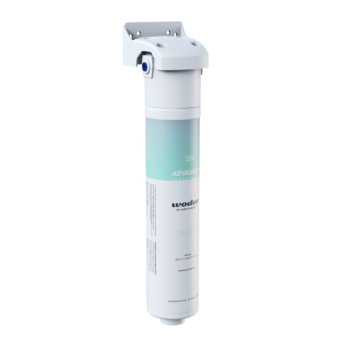
Woder’s Gen4 Advanced media is WQA Gold Seal certified and manufactured in the United States. A home water filter Utah residents install themselves connects to the cold-water shutoff valve already under the kitchen sink – no permits, no drilling, no plumber. The housing mounts in the cabinet out of sight. The faucet delivers filtered output. Reversible when you move, the same cartridge technology whether the supply is Salt Lake City municipal or well water from a rural lot in Sevier County.
Well Water and Sediment Pre-Filtration
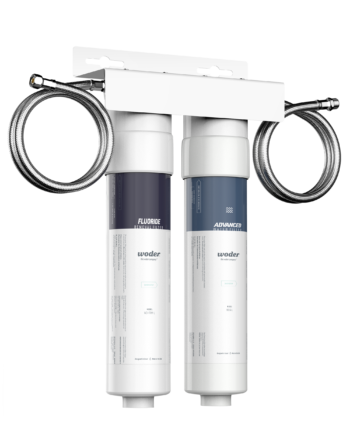
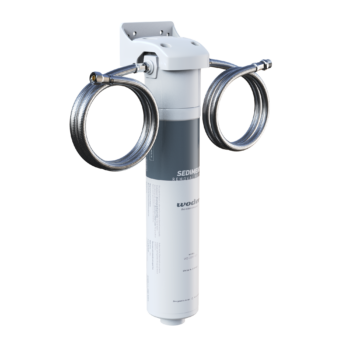
A significant share of rural Utah homes run on private wells rather than municipal supply, and well water in this state covers a wide range of conditions. Hard groundwater with elevated calcium and magnesium is the norm across much of the Colorado Plateau. Sediment – fine particles of clay, sand, and mineral grit that municipal treatment systems filter out before water enters distribution – reaches the tap directly from many Utah wells. Water well filter systems Utah homeowners need on private wells often benefit from a two-stage approach: a sediment pre-filter staged ahead of the Gen4 Advanced cartridge intercepts particulate before it reaches the primary filtration media. This extends the Gen4 cartridge’s working life considerably, because the main media isn’t loaded with grit that the sediment stage should have caught first.
For well water with visible color or a noticeable mineral odor, the sediment pre-filter is worth adding regardless of the specific chemistry. Hydrogen sulfide from anaerobic groundwater conditions – the source of that rotten-egg smell common in some Utah wells – isn’t addressed by sediment filtration, but the Gen4 Advanced media reduces a wide range of dissolved organic and chemical contaminants that show up in well water testing. If your well hasn’t been tested recently, a certified lab panel for your county is the right starting point before selecting a filtration configuration.
Commercial Applications
A commercial water filter Utah businesses install at a prep sink, office break room, or beverage service point uses the same Gen4 Advanced media as the residential version, scaled up with a high-capacity cartridge matched to commercial daily draw volume. A restaurant kitchen in Provo pulling water for cooking, staff drinks, and ice runs through considerably more cartridge capacity per year than a household tap. High-capacity models extend the replacement interval to a workable commercial maintenance schedule rather than requiring frequent swaps. The direct-connect installation process is identical to the residential setup – cold-water shutoff at the prep sink, inline fitting, no service contract required. A facilities manager or kitchen staff member who’s watched the install once can handle every subsequent cartridge change in about two minutes.
For Utah hotels, healthcare facilities, or multi-location businesses standardizing filtration across sites, using one cartridge SKU across every installed unit simplifies reordering to a single part number and makes the swap procedure consistent across locations. Woder’s customer support team can advise on cartridge selection and capacity matching for commercial applications before purchase.
Certification and Installation
Gen4 Advanced media carries WQA Gold Seal certification – an independent accredited laboratory result against NSF/ANSI standards, not a manufacturer’s self-description. The certification covers chlorine, lead, PFAS, heavy metals, and VOC reduction. For Utah households with a specific contaminant concern documented in their Consumer Confidence Report or a private well lab result, comparing that document against the Gen4 certification scope identifies precisely what the filter addresses for their supply.
Installation on a standard Utah kitchen goes like this: locate the 3/8-inch cold-water shutoff under the sink, turn it off, thread the inline filter fitting onto the valve body, turn it back on. The filter housing sits in the cabinet. About 15 minutes, one wrench, nothing permanent. Systems ship from US manufacturing facilities to all Utah addresses with standard domestic delivery. Replacement cartridges reorder through woder.com – the same cartridge covers every Woder direct-connect model, so one SKU handles the whole house if multiple units are installed.
Frequently Asked Questions
Does Woder make a filter system for well water in Utah?
Yes. The Gen4 Advanced direct-connect system works for both municipal and private well supply. For well water with sediment - visible particulate, color, or grit - pairing a sediment pre-filter ahead of the Gen4 cartridge intercepts solids before they reach the primary media, extending the cartridge's useful life. For well water where dissolved chemical contaminants are the concern, the Gen4 stage handles chlorine, lead, PFAS, heavy metals, and VOCs without a pre-filter stage. A well water lab test identifies which conditions apply before you choose the configuration.
What is the difference between a home and a commercial system?
The filtration media and the WQA Gold Seal certification are the same across residential and commercial Woder systems. What differs is cartridge capacity. A residential cartridge is sized for typical household draw - usually a year of use per cartridge for a standard family. A commercial-grade cartridge holds more media and is rated for higher daily throughput, which extends the replacement interval to something workable for a restaurant kitchen or office setting. The installation process is identical: cold-water shutoff, inline fitting, done. Commercial and residential units are interchangeable in terms of housing and connection; the cartridge selection is what changes based on volume.
Is a sediment pre-filter needed for well water?
Not always, but often worth adding for Utah private wells. If the output from the tap runs clear and odor-free, the Gen4 Advanced cartridge alone handles dissolved chemical contaminants effectively. If there's visible color, particulate, or a mineral sediment that settles in standing water, staging a sediment pre-filter ahead of the Gen4 media protects the primary cartridge from loading up with grit and exhausting its capacity prematurely. A simple visual check of your tap output - or a basic lab turbidity test - is enough to determine whether the pre-filter stage is warranted for your specific well.


