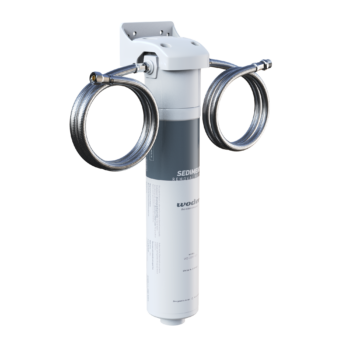
- What Is Clearly Filtered?
- Contaminant Removal: What Clearly Filtered Does Well
- Price and Long-Term Cost
- What Clearly Filtered Does Not Do: Mineral Retention
- Clearly Filtered Pros and Cons
- Who Should Buy Clearly Filtered
- A Closer Look at the Alternatives
- Clearly Filtered vs. Woder: Side-by-Side
- The Verdict
- Frequently Asked Questions
Clearly Filtered has built a loyal following on the back of strong contaminant removal claims and a reputation for testing transparency. If you've been researching water filters recently, you've almost certainly come across the brand. But a strong reputation and polished marketing don't always tell the full story.
This review covers what Clearly Filtered genuinely does well, where it falls short, and who it actually makes sense for. It also looks at where other options — including selective filtration systems like those from Woder Filters — may be a better fit depending on your priorities.
What Is Clearly Filtered?
Clearly Filtered is a US-based water filtration brand offering pitchers, under-sink systems, refrigerator filters, and water bottles. Their core technology is called Affinity Filtration — a proprietary multi-stage process designed to remove a wide range of contaminants while maintaining reasonable flow through the filter media.
The brand leans heavily on contaminant testing transparency, publishing third-party lab results for many of its products. That's a real strength. Buyers who want documented removal data rather than marketing claims will find Clearly Filtered more forthcoming than most competitors.
Contaminant Removal: What Clearly Filtered Does Well
Clearly Filtered's removal claims are among the most detailed in the consumer filter market. Their pitcher and under-sink products are marketed to remove or reduce:
- Lead
- PFAS (per- and polyfluoroalkyl substances)
- Chlorine and chloramines
- Chromium 6
- Pharmaceuticals
- Herbicides and pesticides
- Volatile organic compounds (VOCs)
Independent lab results back many of these claims, which adds real credibility. For buyers who want proof rather than promises, that transparency is worth something.
Where the Removal Claims Get Complicated
High removal percentages only tell part of the story. Flow rate matters in practice. Clearly Filtered pitchers are known for slow filtration — waiting several minutes for water to pass through is a genuine inconvenience that adds up over daily use.
Under-sink models largely solve the flow rate problem, but at a cost. Clearly Filtered's under-sink systems run $200 to $350, putting them at the higher end of the mid-market range.
Price and Long-Term Cost
The upfront price is only part of the equation. Replacement cartridge costs for Clearly Filtered products are notably higher than many alternatives, and over two to three years, the total cost of ownership can climb well past the initial purchase price.
Before committing, it's worth pricing out replacement filters for whatever model you're considering. A filter with a lower sticker price and more affordable replacements can end up significantly cheaper over its lifetime — even if the initial units look comparable on paper.
What Clearly Filtered Does Not Do: Mineral Retention
One area where Clearly Filtered's marketing is quieter is mineral retention. Affinity Filtration targets contaminants effectively, but it doesn't specifically preserve beneficial minerals like calcium and magnesium.
That matters for a couple of reasons. Calcium and magnesium affect how water tastes — people who switch from reverse osmosis often notice their water tastes flat or slightly off, and the same can apply here. These minerals also have nutritional value. If you're drinking several glasses of filtered water a day, losing them entirely is worth factoring in.
Selective filtration systems work differently. Woder's Advanced Selective Filtration technology, for example, uses nanoparticles to target specific contaminants while leaving beneficial minerals intact. That's a structural difference in how the filtration works — not a marketing distinction.
Clearly Filtered Pros and Cons
Pros
- Strong, documented contaminant removal across a wide range of substances
- Third-party lab testing published for many products
- Multiple product formats: pitcher, under-sink, bottle, fridge filter
- Testing transparency gives buyers real confidence
Cons
- Higher price range ($200 to $350 for under-sink systems)
- Replacement filter costs are high relative to alternatives
- Pitcher models have slow flow rates
- Does not specifically retain calcium and magnesium
- No WQA Gold Seal certification noted in available product information
Who Should Buy Clearly Filtered
Clearly Filtered makes sense if:
- Documented, third-party-tested contaminant removal is your top priority
- You're comfortable paying a premium for that level of transparency
- You want a pitcher format and can live with slower flow
- Mineral retention isn't a concern for you
It's a harder sell if you're working with a tighter budget, want faster flow, or specifically want to keep calcium and magnesium in your drinking water.
A Closer Look at the Alternatives
If Clearly Filtered's pricing or mineral-stripping approach gives you pause, it helps to understand the broader category.
Basic carbon filters — standard pitcher filters or faucet attachments — are inexpensive but won't address lead or PFAS. If those are your primary concerns, a basic carbon filter isn't the right tool.
Reverse osmosis systems remove nearly everything, contaminants included. The catch is they also strip out calcium and magnesium, produce wastewater, require a storage tank, and typically need professional installation. For most households, that's more complexity and cost than the problem actually requires.
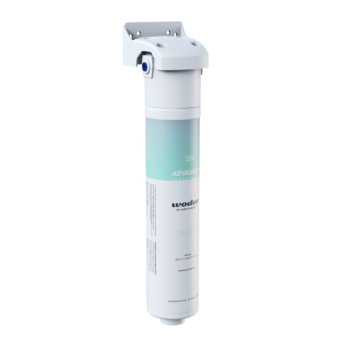
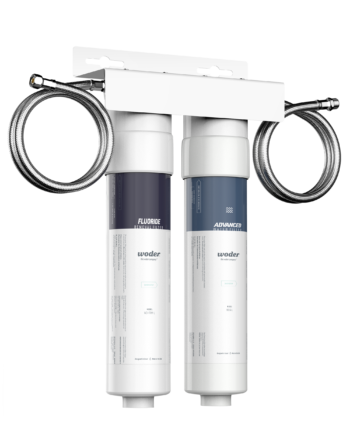
Selective filtration systems sit between those two options. They use filtration media engineered to attract and remove specific harmful substances while leaving beneficial minerals alone. Woder's under-sink filters are WQA Gold Seal certified, remove lead, chlorine, chromium 6, mercury, PFAS, carcinogens, and VOCs at a stated 99.9% removal rate, and retain calcium and magnesium. They install directly into an existing water line — no plumber, no storage tank, no wastewater.
Woder models fall within the $50 to $200 range that most households in this category are working with. If you want help finding the right model for your flow rate and household size, the product finder at woder.com/wizard walks you through it.
Clearly Filtered vs. Woder: Side-by-Side
| Feature | Clearly Filtered | Woder |
|---|---|---|
| Filtration technology | Affinity Filtration | Advanced Selective Filtration |
| Contaminant removal | Strong, lab-documented | 99.9% (WQA Gold Seal certified) |
| Mineral retention | Not specifically preserved | Calcium and magnesium retained |
| Price range | $200 to $350 (under-sink) | $50 to $200 range |
| Replacement filter cost | Higher | Lower |
| Installation | Varies by model | Self-install, no plumber needed |
| Wastewater produced | No | No |
| Certification | See product listings | WQA Gold Seal |
| US manufactured | Not confirmed in available data | Yes |
The Verdict
Clearly Filtered is a credible brand with real strengths — particularly around testing transparency and the breadth of contaminants it addresses. If you want a pitcher filter and are willing to pay for documented removal data, it's a defensible choice.
That said, if you're shopping for an under-sink system, want to keep beneficial minerals in your water, and want to stay under $200, Clearly Filtered's pricing and mineral-stripping approach make it a tougher sell. Selective filtration systems that retain calcium and magnesium, install without a plumber, and carry third-party certification address the same contaminant concerns at a lower total cost of ownership.
For a full look at what's available in the selective filtration category, visit woder.com.
Frequently Asked Questions
Does Clearly Filtered remove PFAS?
Clearly Filtered markets its products as capable of reducing PFAS and publishes third-party lab data to support that claim. Removal percentages vary by product, so check the published test results for the specific model you're considering.
Does Clearly Filtered keep minerals in the water?
Affinity Filtration is designed to remove contaminants but doesn't specifically preserve beneficial minerals like calcium and magnesium. If mineral retention matters to you, look at selective filtration systems engineered to leave those minerals intact.
Is Clearly Filtered worth the price?
It depends on what you're optimizing for. If testing transparency is your top priority, the premium may be justified. If you're comparing total cost of ownership — including replacement filters — or if mineral retention is important, there are lower-cost alternatives with comparable or better performance on those dimensions.
What is the difference between Clearly Filtered and reverse osmosis?
Reverse osmosis forces water through a semi-permeable membrane that strips out nearly all dissolved substances, including calcium and magnesium. It also produces wastewater and requires a storage tank. Clearly Filtered uses Affinity Filtration, which targets contaminants without a membrane and produces no wastewater — but it also doesn't specifically retain beneficial minerals.
How often do you replace Clearly Filtered filters?
It depends on the product and your household's water usage. Pitcher filters typically need replacement every 100 gallons. Under-sink models last longer. Either way, Clearly Filtered's replacement filter costs are higher than most alternatives, which affects the long-term math.
What is a good alternative to Clearly Filtered for under-sink filtration?
If you want under-sink filtration that removes lead, PFAS, chlorine, and other contaminants while retaining calcium and magnesium, selective filtration systems are worth a close look. Woder's under-sink models are WQA Gold Seal certified, self-install without a plumber, and fall within the $50 to $200 range. The product finder at woder.com/wizard can match you to the right model for your household.
Does Clearly Filtered require professional installation for under-sink models?
Clearly Filtered's under-sink systems are designed for DIY installation. No plumber is required for a standard setup.