A glass of tap water can look perfectly clear and still smell faintly like a pool. If you notice that in the kitchen, you’re not imagining it, and the water isn’t necessarily unsafe. In many homes, that smell is the sign of a disinfectant doing the job it was added to do, then lingering long enough to reach your faucet.
That’s why people start looking for a filter for chlorine. They’re usually not trying to fix a broken water system, they’re trying to make everyday water taste and smell better for drinking, cooking, coffee, and ice. The hard part is that “chlorine filter” gets used loosely, and the wrong filter can leave you with the same taste, the same odor, and a lot of confusion.
Table of Contents
- Why the Water from Your Tap Sometimes Smells Like a Pool
- What Chlorine Does in Your Water
- How Filters Remove Chlorine
- The Chloramine Problem Most Buyers Miss
- Reading Certifications and Spec Sheets Without Getting Fooled
- Choosing Between Under-Sink, Inline, and Whole-House Options
- A Simple Framework for Picking the Right Filter
- What to Do Next With What You Just Learned
Why the Water from Your Tap Sometimes Smells Like a Pool
You fill a glass at the kitchen sink, and the first thing you notice is the smell. It may be strongest in the morning, after the house has sat overnight, or right after the utility flushes lines in your neighborhood. That is usually what sends homeowners looking for a filter for chlorine, because the water may be acceptable on paper while still tasting and smelling wrong at the tap.
That distinction matters. Chlorine in tap water is usually there on purpose, and it became part of public health practice because it helped reduce waterborne disease at scale. The history matters too, because it explains why removing chlorine is not a rejection of safe water, it is a choice about taste, odor, and how the water feels when you use it every day. Chlorine’s modern history as a disinfectant runs from its discovery in 1774, to identification as an element in 1810, to first use in a public water supply in 1897 in Maidstone, Kent, and then into routine municipal treatment in the early 20th century. NCBI
Why the smell shows up at the kitchen sink
The smell is often easiest to notice where you use water cold and close. Coffee, tea, rice, soup, and ice make it harder to ignore because they do not mask flavor the way juice or a strongly flavored drink might. In practical terms, the problem the average homeowner is trying to solve is taste and odor.
Practical rule: if your tap water smells like disinfectant but your utility is treating the supply properly, you are usually dealing with a quality-of-life issue, not a sign that the water system has failed. For a plain-language explanation of why this happens, see does tap water have chlorine?
That is also why chlorine gets discussed differently from contaminants like lead or PFAS. Chlorine is intentionally present in treated water, and Minnesota’s Department of Health notes that it keeps protecting water as it moves from the treatment plant to the tap. Minnesota Department of Health
If you want a similar example from another everyday water setting, modern pool water treatment systems show the same basic pattern, disinfectant is used to control microbial growth, but the user experience changes when the residual becomes noticeable.
What Chlorine Does in Your Water
Municipal utilities add chlorine because water doesn’t stop moving once it leaves the treatment plant. It travels through pipes, tanks, valves, and pressure changes before it reaches your sink, and disinfectant has to stay active long enough to protect the water on that journey. A simple way to understand it is that chlorine works like a security guard that stays on duty inside the distribution system.
The EPA notes that disinfectants like chlorine played the largest role in reducing waterborne disease outbreaks in the early 1900s. CDC historical material also says that after Jersey City’s 1908 adoption of routine disinfection, thousands of U.S. cities and towns followed over the next decade. EPA historical material That history is why chlorine is still built into modern public water treatment, and why many utilities continue to rely on it or on chloramine.
What a homeowner is likely to see
The World Health Organization notes that disinfected drinking water commonly contains free chlorine at about 0.2–1 mg/L. WHO The exact numbers vary by utility, but the pattern is the same. There is enough residual left to keep water protected as it travels.
That residual is what can produce the taste, smell, or slightly dry feeling people notice at the tap. The EPA limit on chlorine residuals exists for public water systems, and that matters because it confirms the chlorine is being managed, not left to wander unchecked. For many households, the decision to use a filter for chlorine starts right there, with the gap between safe water and pleasant water.
Some guides stop at “carbon fixes chlorine,” but the choice is broader. You need to know whether your utility uses free chlorine or chloramine, because standard carbon behaves differently with each one. If you want the basic mechanics behind that difference, see how water filters work. That is also why modern pool water treatment systems get mentioned in water-treatment conversations, since they show the same basic pattern, disinfectant is used to control microbial growth, but the user experience changes when the residual becomes noticeable.
How Filters Remove Chlorine
The basic idea is straightforward. Chlorine is small, reactive, and easy for the right media to catch, but the water still needs enough time in the filter for that to happen. So the main performance factors are contact time, flow rate, and bed depth, not just the wording on the box.
Activated carbon removes chlorine mainly through adsorption and catalytic reduction. In plain terms, the chlorine is held on the carbon surface and also chemically changed as water moves through it. The geometry matters a great deal. Pentair’s technical sheet shows that a C2 cartridge is rated for >9,460 L at 1.9 L/min, while a longer C1-20 cartridge reaches >37,850 L at 7.6 L/min under the same 2 ppm free-chlorine test condition, and the sheet warns that higher flow rates reduce chlorine removal effectiveness. Pentair technical sheet
The main media homeowners run into
| Media | How it handles chlorine | Leaves minerals in place | Key tradeoff |
|---|---|---|---|
| Activated carbon | Adsorbs chlorine and helps reduce taste and odor | Yes | Needs enough contact time, and higher flow weakens performance |
| Catalytic carbon | Handles chlorine and is better suited for tougher disinfectant chemistry | Yes | Usually needs more media or more space |
| KDF media | Uses a copper-zinc redox reaction to reduce free chlorine | Yes | Often works best as part of a multi-stage setup |
| Selective filtration | Targets contaminants while retaining minerals | Yes | Performance depends on the engineered media, not just the housing |
| Reverse osmosis | Removes chlorine as part of a much broader dissolved-solids reduction | No | Better purity, but it changes the mineral profile and needs a different plumbing decision |
That last row is the comparison many homeowners miss. Reverse osmosis removes chlorine, but it does so as part of a much broader stripping process. That makes it a different decision from a point-of-use carbon system or a selective-filtration setup, and it is why people comparing products should not treat all “chlorine filters” as the same thing.
Practical rule: if a filter promises chlorine reduction, look at how much carbon it contains, and whether the flow rating matches the tap or appliance you want to use.
Cartridge size gives another useful clue. Independent product data for a 5 µm, 2.5″ × 9 7/8″ cartridge shows a rating of 20,000 gallons at 1 gpm with 4.0 psid initial pressure drop, while a shorter 2.5″ × 4 7/8″ version is rated for 3,000 gallons at 2.0 psid. CB-series cartridge data The lesson is simple. More carbon volume often means longer service life, but it can also mean more pressure drop and a larger cartridge.
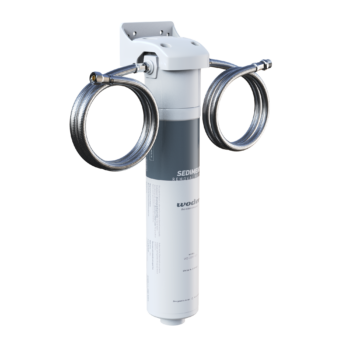
If you want a plain-language explanation of filter mechanics, how water filters work is a helpful companion. For sediment-heavy plumbing, Woder Sediment Water Filter – Dirt, Sand and Dust Removal shows the other side of the sizing question, where pre-filtration protects the downstream cartridge from dirt and debris rather than handling chlorine itself.
The Chloramine Problem Most Buyers Miss
A lot of homeowners think they need a chlorine filter when what they really have is chloramine. That matters because chloramine is not the same job for a filter, and a standard carbon block that handles plain chlorine well may leave chloramine behind at the tap. That’s one reason people buy something, install it, and still notice disinfectant taste.
Independent guides note the split clearly, plain chlorine can usually be handled by NSF/ANSI 42 carbon filters, while chloramine often needs catalytic carbon and more contact time, especially in whole-house or stronger under-sink systems. Clean Water Critic Municipal utilities in many major markets use chloramine as a secondary disinfectant, so the question is often not “what filter removes chlorine,” but “what disinfectant is in my water?”
How to find out what your utility uses
The most reliable place to start is your utility’s annual Consumer Confidence Report. It should tell you whether the system uses chlorine, chloramine, or both. If you want a quick at-home check, total-chlorine and free-chlorine testing can also show whether combined disinfectant is present, but the utility report is the cleaner first step.
Practical rule: if your tap water still tastes like disinfectant after you install a basic carbon filter, don’t assume the filter failed, check whether the utility is using chloramine.
That confusion shows up all the time because “chlorine filter” pages often talk as if all disinfectants behave the same. They don’t. Chloramine is used because it lasts longer in distribution systems, but that same stability makes it harder to remove with ordinary carbon alone. For homeowners, this means the right filter starts with the right water report, not with the most confident marketing copy.
Reading Certifications and Spec Sheets Without Getting Fooled
A filter box can look convincing and still miss the point. For chlorine taste and odor, the most relevant marker is NSF/ANSI 42, because that standard is tied to chlorine reduction rather than a broad set of health claims. A filter certified to 42 has to show chlorine reduction under controlled conditions, and the Canadian guideline document says a filter certified to NSF/ANSI 42 should reduce chlorine by at least 50% from an influent concentration of 2 mg/L. As noted earlier, that kind of label tells you the filter is built for chlorine, not for every other water issue in the house.
That certification does not mean the cartridge also handles lead, PFAS, or chloramine. Those claims sit under different standards, and sometimes they depend on different media altogether. A clear WQA and NSF label guide is useful because it shows why the badge on the package has to match the contaminant, not just the shopper’s expectation.
What the other common standards mean
- NSF/ANSI 53: health-related contaminant reduction, used for claims like lead in the right products.
- NSF/ANSI 401: emerging compounds, a separate category from basic chlorine taste and odor.
- NSF/ANSI 372: lead content compliance in materials, not the same thing as lead removal.
The spec sheet matters just as much as the certification line. Flow rate, micron rating, and cartridge life all work together, and a 5-micron filter that says it removes chlorine can still disappoint if water rushes through too little media. Micron rating mostly speaks to sediment loading, not chlorine chemistry, so a fine particle rating does not automatically mean stronger chlorine reduction.
A long list of contaminant claims is not the same as a good fit for your home. Match the standard, the media, and the flow rate to the water problem you have.
The quickest checklist is straightforward. Confirm the disinfectant, verify the relevant certification, read the flow rating, and check whether the cartridge life assumes your kind of usage. If the spec sheet does not answer those four questions clearly, keep looking.
If you are considering a bigger setup, the replacement side matters too. A whole house filter replacement guide is useful because a system that is hard to service can become a source of frustration even when the cartridge itself performs well.
Choosing Between Under-Sink, Inline, and Whole-House Options
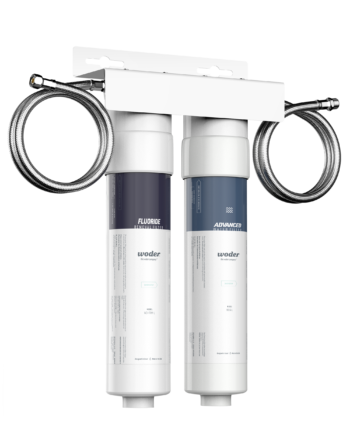
Where the filter sits matters as much as what’s inside it. For many homes, the right choice is a point-of-use system, not a whole-house system, because most households only want better-tasting water at the kitchen sink or one appliance. Under-sink units are the cleanest fit for drinking and cooking, inline filters are better when the problem is tied to a refrigerator, ice maker, or coffee machine, and whole-house systems make sense when every tap needs the same treatment.
Matching the form factor to the use case
Under-sink systems give you a dedicated drinking tap and keep the countertop clear. Inline filters are more targeted, which is useful if the fridge water or ice has the chlorine taste, but the rest of the house doesn’t need it. Whole-house systems are the broadest option, yet they also bring the biggest plumbing, replacement, and pressure-drop considerations.
That pressure-drop piece gets overlooked. If the filter creates too much resistance at the flow your household uses, the tap feels weak and the system becomes annoying to live with. For a homeowner, that’s usually the quiet failure point, not the filter media itself.
If you’re thinking about a bigger setup, a practical reference is a whole house filter replacement guide from Good Boy Plumbing, because replacement access is part of the decision, not an afterthought. A system that’s easy to maintain gets used, and a system that gets used is the one that pays off in daily life.
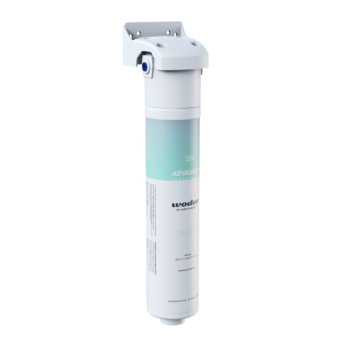
One reason many people move toward point-of-use filtration is that it lets them focus on the taps that matter most. Woder’s under-sink and inline systems are built around Advanced Selective Filtration®, which removes contaminants like chlorine, lead, chromium, and PFAS while retaining beneficial minerals. That’s one coherent path for households that want targeted filtration without turning the whole house into a project.
A Simple Framework for Picking the Right Filter
The cleanest decision process is straightforward. First, identify whether your utility uses chlorine, chloramine, or both, using the Consumer Confidence Report or a quick home test. Second, match that disinfectant to the right media, because carbon that handles chlorine well may not handle chloramine well. Third, verify the certification scope, since NSF/ANSI 42 covers taste and odor reduction but not every other contaminant under the sun. Fourth, size the filter to the tap or appliance that matters most.
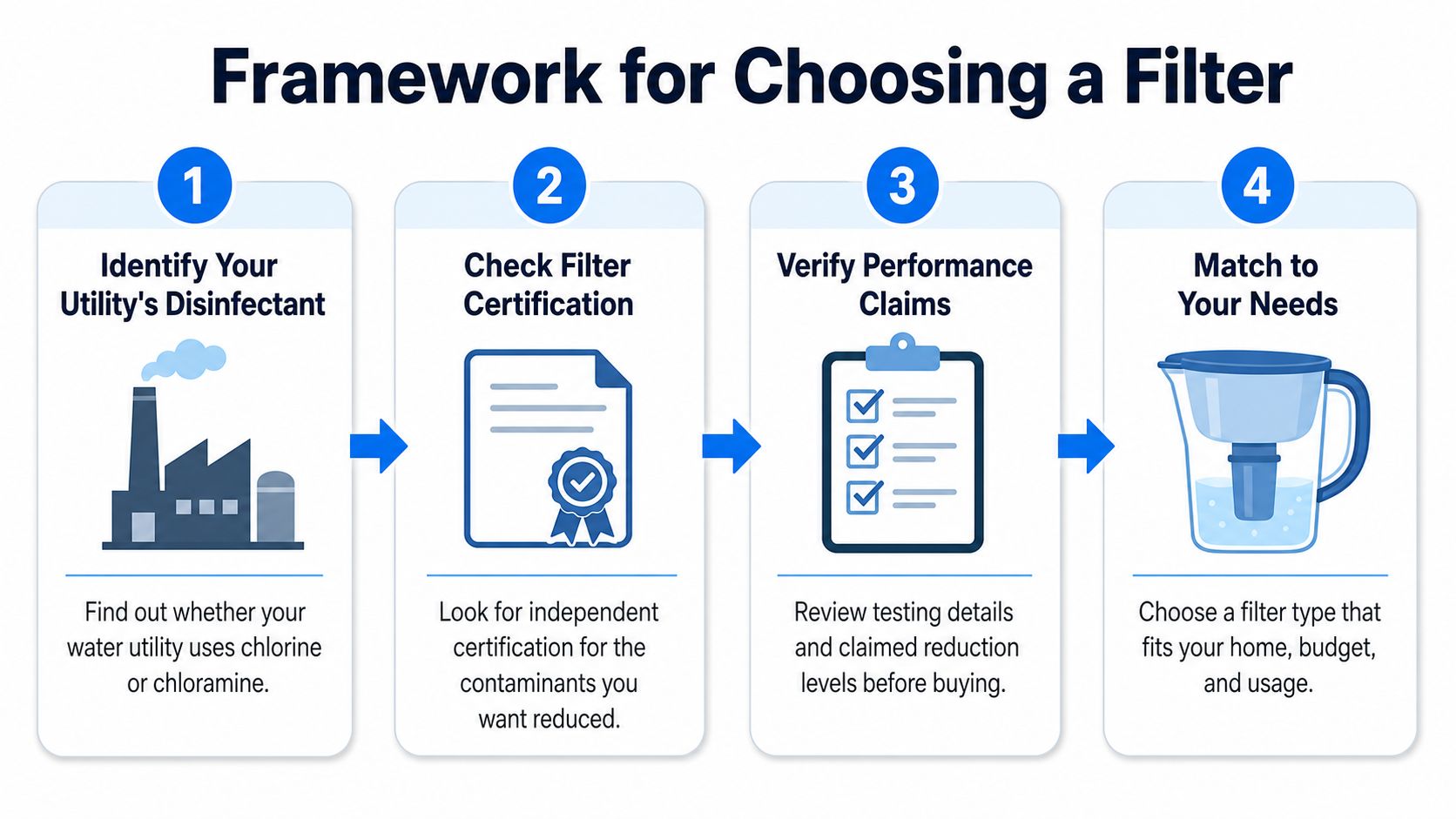
That framework keeps the decision grounded. It also explains why a selective-filtration approach can fit so many households, because it targets the contaminants people want out of their water, including chlorine, while leaving minerals in place. The point isn’t to buy the biggest system, it’s to buy the one that matches your water report and your tap.
Practical rule: if you know your disinfectant, know your certification, and know your flow rate, you’re already ahead of most marketing claims.
What to Do Next With What You Just Learned
A chlorine smell at the tap usually means the water is being protected, not that your home has a problem. The next step is simple, pull up your utility’s Consumer Confidence Report, confirm whether you’re dealing with chlorine or chloramine, and then compare filters against that specific disinfectant instead of a vague “removes chlorine” claim. That one check changes almost everything about the product you should consider.
If you want a point-of-use path that keeps the decision focused, Woder Filters offers under-sink and inline systems built around selective filtration, so the choice stays tied to your tap, your water report, and the contaminants you care about. It’s a calm way to get better-tasting water without overbuying for the whole house. Visit Woder Filters when you’re ready to compare options with your own water in hand.