Most advice about water filter bacteria removal starts in the wrong place. People are told to look for a filter that “cleans” water, as if taste improvement, odor reduction, and bacterial safety all come from the same mechanism. They don’t. A pitcher that makes water taste better can still be the wrong tool for bacteria, because removing microbes is a physical job, and physical jobs depend on pore size, validated performance, and what the filter does after it’s been in a house for weeks or months.
That difference matters because the word filter gets used very loosely. Some products are built to strain microbes out, some are built to reduce chlorine and improve flavor, and some do a little of both. If you want real protection, the better question is not “Which brand sounds strongest?” It’s “What technology is doing the work, and how reliably does it hold up in normal use?”
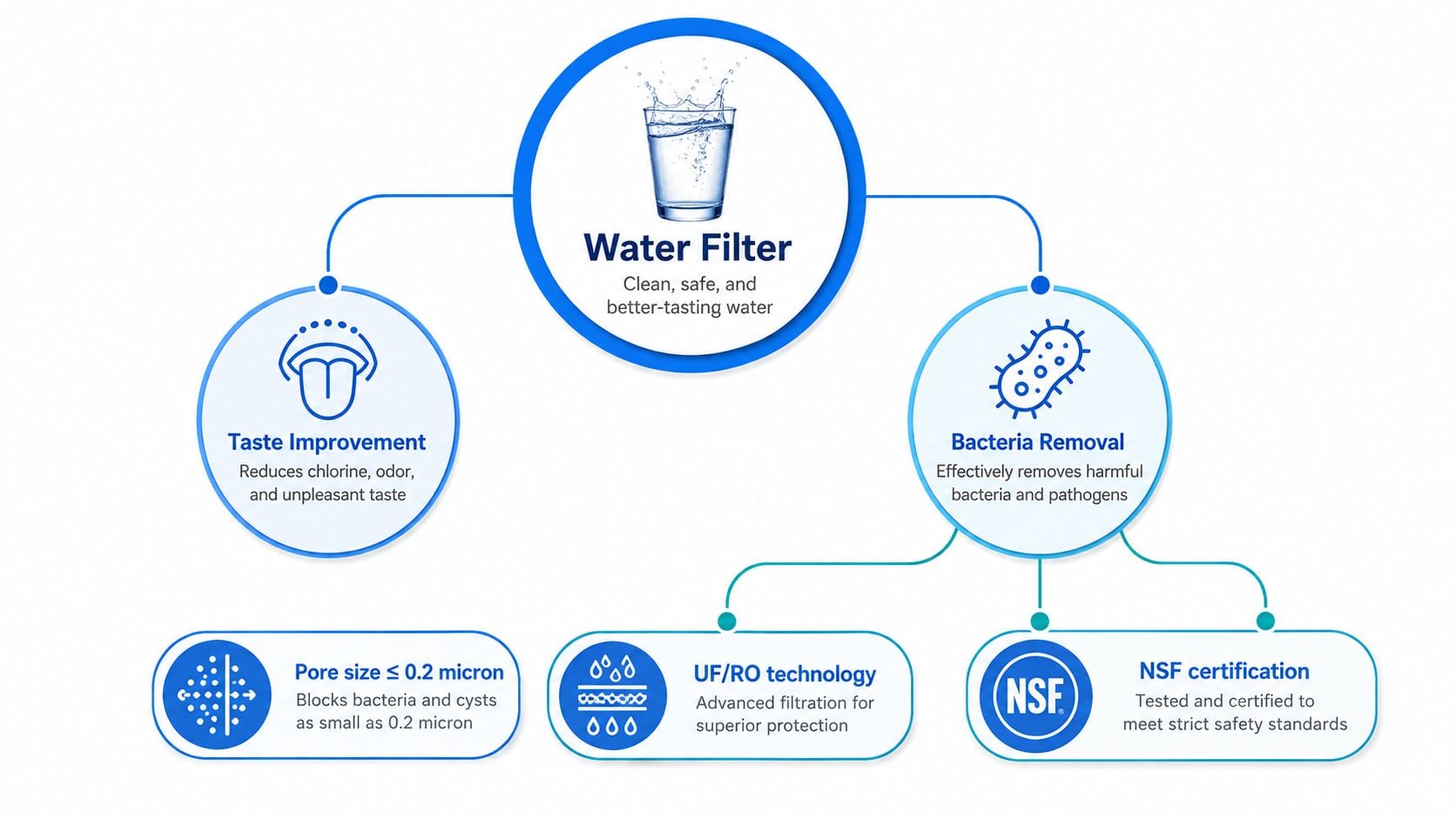
Table of Contents
- Why Bacteria Removal Is Not the Same as Purification
- Micron Ratings and What They Actually Mean
- The Four Technologies That Remove Bacteria From Water
- Log Reduction Values and the Standards Behind Them
- Real-World Reliability After Installation
- Matching a Bacteria Filter to Your Water Source
- What to Look for Before You Buy
Why Bacteria Removal Is Not the Same as Purification
The cleanest way to separate taste treatment from microbial removal is to ask what the filter is built to do. Carbon can improve flavor and reduce chlorine, so water often seems cleaner after filtration, but better taste does not mean bacteria are being removed. A filter can change how water tastes without being designed to stop microbes from passing through.
Physical removal is a size problem
Bacteria are microscopic, but they are still larger than water molecules, which means the right membrane can stop them. The CDC notes that filters with an absolute pore size of 0.3 micron or smaller, or ultrafiltration/nanofiltration, remove bacteria such as Salmonella and E. coli from water, while larger pores may reduce particles and taste without reliably removing bacteria (CDC guidance on home water filters). That is the part many buyers miss, because a pleasing glass of water is not the same thing as a microbiologically safer one.
A membrane works like a screen with a defined opening. A carbon block works more like a sponge with a large internal surface that can grab certain compounds. Both can improve water, but they do not do the same job, and the technology matters more than the packaging.
Practical rule: if the claim is about bacteria, look for a membrane or purifier standard, not just a taste-and-odor label.
A broad review in the scientific literature found that membrane filtration technologies, including microfiltration, ultrafiltration, and reverse osmosis, achieved the highest average bacterial reduction, with an average log removal value of 4.5 across 75 studies and 226 measurements, which works out to about 99.997% removal (systematic review). That does not mean every membrane performs the same way, but it does show why membrane-based point-of-use systems belong in a different category from carbon-only filters when bacteria is the concern.
A taste filter polishes water. A bacteria filter has to stop organisms from moving through the media at all.
For a simple companion explanation, Woder’s article on boiling water and purification is useful background: does boiling water purify it.
Micron Ratings and What They Actually Mean
Micron ratings are where many homeowners get tripped up, because the number looks exact even when the rating method is not. A micron is a unit of size, but the real question is whether the filter rating is absolute or nominal. Those words sound similar. In practice, they are very different.
Absolute versus nominal
An absolute rating means the filter is built to stop particles at or below a stated size under test conditions. A nominal rating usually means the filter captures some fraction of particles around that size, not all of them. Two products can carry the same micron number and still behave very differently in real water.
Bacteria-size comparisons help, but they do not settle the question by themselves. A bacterium may be larger than the opening on paper, yet flow rate, pressure, media quality, and cartridge condition can still affect what gets through. A spec sheet with a small number is not enough unless the rating type and test method are clear.
What to read on the label
If a product says 0.2 micron absolute, that is a very different claim from 1 micron nominal. The first language points to a tighter physical barrier. The second can describe a filter that improves water clarity and taste while still letting some bacteria pass under the wrong conditions.
Rule of thumb: when you see a micron number, ask two follow-up questions, “Is it absolute?” and “What organism or test was used to verify it?”
That is why pore-size language matters so much, and why a small micron number can mean very different things depending on how the cartridge is built. For a plain-language primer on what 0.5 micron means in practice, Woder’s explanation of water filter 0.5 micron is a useful reference point. A filter rated in this range may sound precise, but the rating still needs context before you assume it is a bacteria barrier.
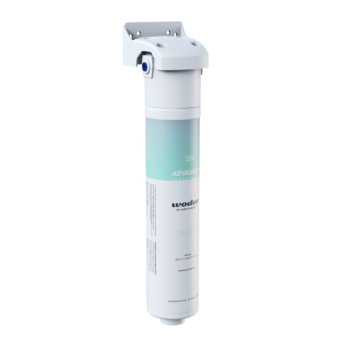
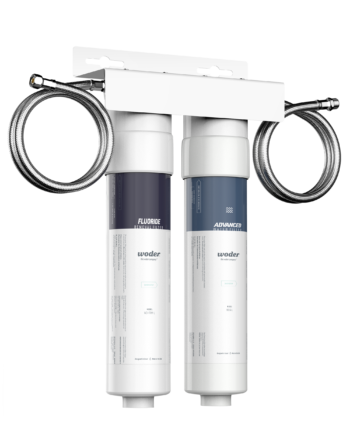
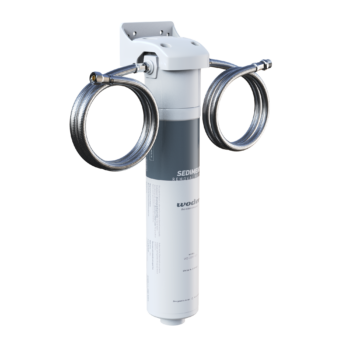
If you’re reading product pages, one useful example is the Woder Sediment Removal and Advanced Dual Filtration System. Its published snapshot combines a 20µ sediment removal first stage with ADV Filtration and lists reductions for contaminants including chlorine, chloramines, VOCs, and other impurities. That kind of staged design is about broader water quality, not a stand-alone bacteria purifier claim, which is exactly why the details matter.
For a deeper primer on size ratings, Woder’s post on small micron filters helps frame the difference between nominal language and actual barrier claims.
The Four Technologies That Remove Bacteria From Water
Different technologies solve different problems, and the confusion starts when people treat all of them as interchangeable. They aren’t. A homeowner comparing water filter bacteria removal should ask a simpler question first, whether the device physically removes microbes, inactivates them, or only improves the water in ways that make it seem cleaner.
Mechanical membranes
Mechanical membranes, including microfiltration, ultrafiltration, nanofiltration, and reverse osmosis, remove bacteria by physically blocking passage. That is their main advantage. Their weak point is just as straightforward. If the membrane is damaged, bypassed, fouled, or used outside its tested conditions, performance can change.
The CDC’s pore-size guidance fits here because membranes work by size exclusion rather than by taste correction. A recent systematic review also places this category among the strongest options for bacterial reduction. In practical terms, this is the technology class with the clearest path to verified microbial removal.
UV, carbon, and chemical treatment
UV works differently. It does not strain microbes out of the water. It damages their DNA so they cannot reproduce, which is why UV systems are often used after prefiltration, when the water is clear enough for light to do its job well. Carbon is different again. It can improve taste and reduce some chemicals, but by itself it does not reliably act as a bacteria barrier.
Chemical disinfection, such as chlorine or iodine, kills microbes rather than catching them. That can be useful in some settings, but it leaves a residual and does not feel the same as turning on a faucet and drinking directly from a point-of-use membrane.
A useful external primer on the broader treatment framework is BacteriaFAQ.com on water safety, which helps separate filtration from purification without burying the reader in jargon.
Carbon can improve water quality. It is just not a substitute for a barrier designed to stop bacteria.
That distinction shows up in the field studies too. One household and lab study found an active filter with an LRV of 2.98 for total thermotolerant coliforms, which the authors translated to about 99.8% removal, and 64% of treated samples were completely free of thermotolerant coliforms. In lab testing, the same filter reached 6.9 logs of bacterial reduction, about 99.99999% removal. The same technology can look very strong under one condition and much less consistent under another, which is why the mechanism matters as much as the headline claim.
Log Reduction Values and the Standards Behind Them
Log reduction is the measurement scientists use to show how much of a microorganism load a treatment removes. A 6-log reduction means 99.9999% removal. That figure matters because it says more than “passed a test” or “removes bacteria.” It shows how much was removed under a defined test condition, which is the level of detail a homeowner can compare across products.
What the standards mean
Home water standards are the bridge between marketing claims and evidence. NSF P231 is tied to microbiological purifier claims. NSF/ANSI 53 is often associated with mechanical filtration claims for specific contaminants. NSF/ANSI 58 covers reverse osmosis systems, which is why RO products often come up in bacteria discussions even though they are usually discussed for broader contaminant reduction too.
| Standard | What it tests | Typical bacterial claim | Best used for |
|---|---|---|---|
| NSF P231 | Microbiological purifier performance | High-level bacteria removal claims | Systems meant for purifier-style microbial protection |
| NSF/ANSI 53 | Mechanical filtration performance for specific health-related claims | Filter-specific reduction claims | Filters that need defined contaminant performance |
| NSF/ANSI 58 | Reverse osmosis system performance | RO-based reduction claims | RO systems used for broad drinking-water treatment |
For readers who want to make sense of certification language without getting lost in abbreviations, Woder’s guide to the standards is a practical companion: WQA, NSF, ANSI, WTH water quality alphabet soup.
A standard is only part of the story. It tells you the test framework, while the log reduction tells you the size of the microbial barrier under that framework. A filter that claims a high reduction number without naming the standard is like a thermometer with no scale. The number may look precise, but you cannot judge what it means.
Why the number and the standard both matter
A 6-log target is common in purifier-style products, and the benchmark matters because it shows the product was tested against a meaningful microbial challenge. Independent product data sheets also report ultrafilters with 0.02-micron membranes achieving 99.999999% bacteria reduction under test conditions, which shows how tight membrane design and validation can be when the goal is microbial control (product data sheet).
A useful way to read these claims is to ask two questions. How much bacteria was removed, and under what standard was that verified? The first tells you the claimed performance. The second tells you the testing frame behind it. That difference separates a brochure promise from a filter you can evaluate with confidence.
Real-World Reliability After Installation
A filter’s lab performance is only the first question. The second is what happens after it sits under a sink, handles everyday flow, and gets exposed to real household water. That’s where buyers often run into the gap between test claims and daily reality.
Why performance can drift
One older but still useful study found that total coliform bacteria persisted and proliferated on drinking-water filters for several days after transient contamination of the influent water, and that silver-containing activated carbon filters suppressed total coliform but not total bacterial growth (ASM study). That tells you something important. The filter itself can become part of the microbial environment if it isn’t designed, installed, and maintained carefully.
There’s also the issue of breakthrough. A 2021 study on popular faucet-mounted activated-carbon point-of-use filters found early breakthrough of spiked bacteria in the effluent under simulated daily use, which means some products can let bacteria pass sooner than buyers expect (2021 field and laboratory study). That doesn’t mean every filter fails. It does mean the household story is more complicated than the box copy.
Maintenance is part of the design
Flow rate, cartridge age, and sitting water all matter. If water moves too quickly through the media, the contact time changes. If a cartridge gets old, its performance can drift. If water sits in the unit, growth conditions can change again. None of that is glamorous, but it’s the part that decides whether bacteria removal stays dependable.
Practical question: ask the seller what happens to bacterial performance at the end of the cartridge’s life, not just on day one.
The broader systematic evidence also points to variability over time. Recent review data noted that two household-treatment studies averaged 94% E. coli reduction and improved over time to 99%, which is a useful reminder that real-world performance can be variable rather than binary (systematic evidence in the household-treatment review).
Matching a Bacteria Filter to Your Water Source
A city home and a private well need different answers. That sounds obvious until people shop as if one filter category fits every house. It doesn’t. The right setup depends on whether your utility is already disinfecting water, whether your plumbing is holding up, and whether you can install a permanent unit or need a removable point-of-use solution.
City water and apartments
If you’re on municipal water and your Consumer Confidence Report is current and reassuring, your main goal may be added protection at the tap rather than emergency disinfection. In that case, a point-of-use membrane or purifier-style unit can make sense if you’re specifically concerned about bacteria at the faucet or in premise plumbing. Renters and apartment dwellers often need a compact, noninvasive solution, which is why under-sink and inline point-of-use systems are usually more practical than whole-house equipment.
The trick is not to assume every faucet-mounted or under-sink filter does the same thing. Some are built mainly for taste and chlorine. Others are built for microbial reduction. That difference should drive the choice.
Private wells and higher-risk sources
Private well owners have a different burden, because source water can be exposed to surface contamination, and there isn’t a city treatment plant buffering the risk. In those homes, bacteria control tends to point toward absolute-pore membranes, UV in the right conditions, or multi-barrier setups that combine treatment steps. If the water is cloudy, UV gets less attractive until prefiltration is handled well.
For people who travel or live in small spaces, a resource like safe drinking water in a caravan can be useful because it shows how limited space changes the filtration strategy. The same idea applies to apartments and RVs, where point-of-use design matters as much as the treatment method.
Woder’s own approach fits this point-of-use world. The brand’s U.S.-made systems use Advanced Selective Filtration® to remove contaminants while retaining essential minerals, and that can be a good match when your main goal is chemical reduction and better tasting water, not bacterial purification. If bacteria is the primary concern, though, the membrane or purifier standard still has to be part of the conversation.
What to Look for Before You Buy
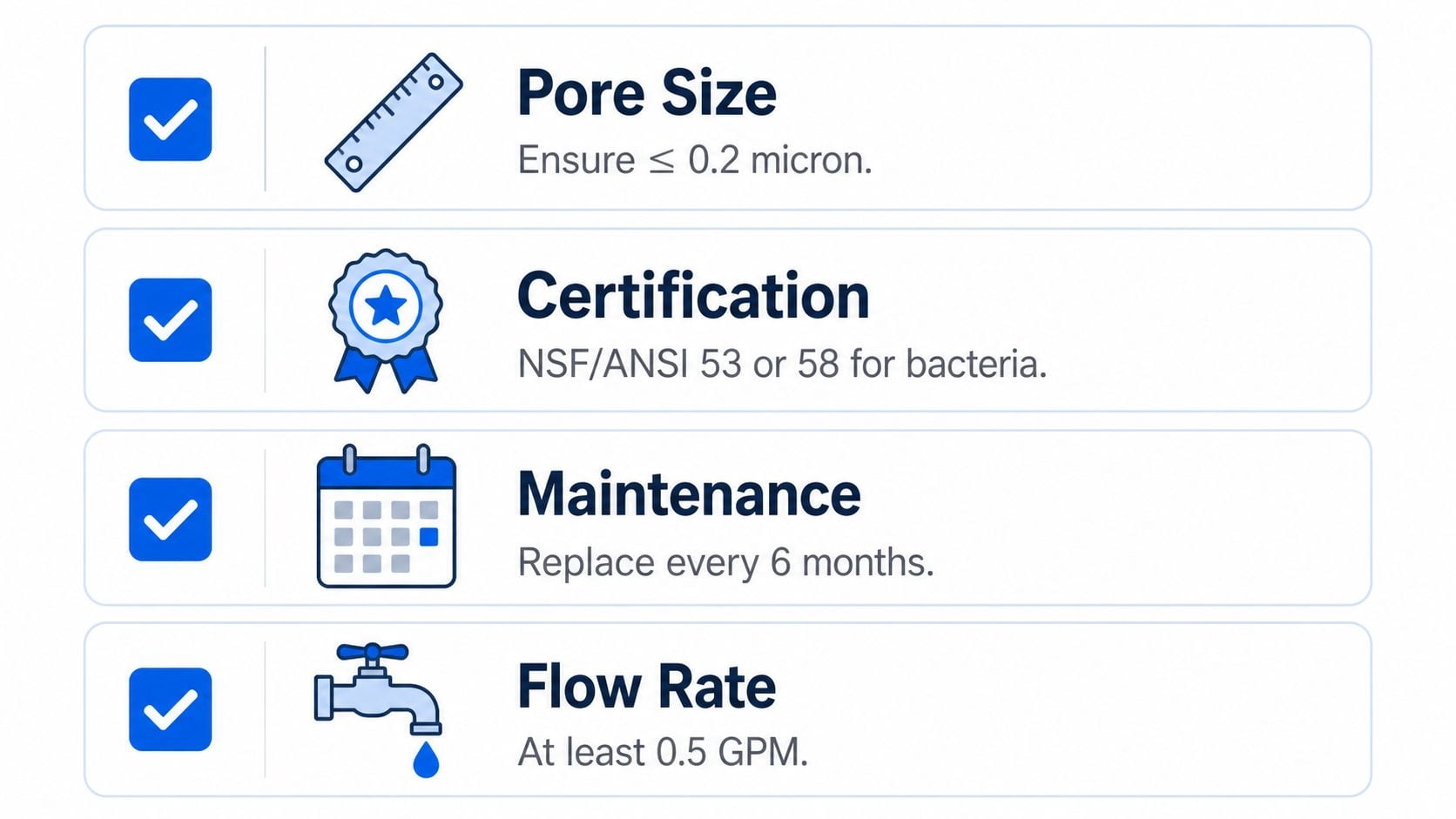
The calmest way to shop is to ask four questions and ignore the noise around them. First, what mechanism is removing bacteria. Second, what pore size or standard backs the claim. Third, how does the filter hold up after installation and aging. Fourth, what maintenance schedule keeps the claim valid.
A short buyer checklist
- Pore size: look for absolute ratings and membrane technologies that are sized to stop bacteria.
- Certification: check whether the product is tied to a relevant microbial standard, not just a general taste claim.
- Maintenance: replace cartridges on schedule, because aging media can change performance.
- Real use: ask what happens after normal household flow, not just in a lab setup.
If you’re comparing broader options for a house, a guide like choose the best whole-house filter can help frame whether you need point-of-use protection, whole-home treatment, or both. The right answer depends on the water source and the problem you’re solving.
For readers who care about retaining minerals while reducing contaminants, selective filtration is a real advantage, but it’s a different goal from bacteria removal. If microbial protection is your top priority, don’t let mineral-retention language distract you from the actual bacteria barrier.
If you want a U.S.-made point-of-use filter built around contaminant reduction without stripping out essential minerals, take a look at Woder Filters. If you’re comparing options for bacteria control, use the standards and pore-size checks above first, then see how Woder’s systems fit your broader water-quality goals.