- What a Water Softener Actually Does
- What a Water Filter Actually Does
- The Overlap: When Hard Water and Contamination Both Matter
- Do You Actually Have Hard Water, or Just a Contamination Problem?
- Why a Filter Is Often All You Need
- A Quick Decision Framework
- What to Look for in a Filter If You Skip the Softener
- The Bottom Line
- Frequently Asked Questions
You've noticed the white crust around your faucet. Maybe your skin feels dry after a shower, or your dishes come out spotted. So you type "water softener" into a search bar — and then pause. Because somewhere in the back of your mind, you're not sure that's actually what you need.
That pause is worth listening to.
A water softener and a water filter are not the same thing. They solve different problems. And for many homeowners, a quality inline filter handles everything that actually matters — without the salt, the maintenance, or the $1,000+ installation bill.
Here's how to figure out which one your household actually needs.
What a Water Softener Actually Does
A water softener targets hard water. Hard water contains elevated levels of calcium and magnesium — minerals that leave scale deposits on pipes, appliances, and fixtures. A traditional ion-exchange softener swaps those minerals out for sodium ions, which don't cause scale.
That's the whole job.
A softener does not remove lead. It doesn't filter out PFAS. It won't reduce chlorine, chromium 6, mercury, or volatile organic compounds. If your concern is drinking water safety, a softener leaves all of that untouched.
There's also a side effect worth knowing: softened water tastes flat to many people. The calcium and magnesium that got removed are the same minerals that give water its natural, slightly crisp character. You traded scale prevention for stripped water.
What a Water Filter Actually Does
A water filter targets contaminants — the stuff in your water that poses a health risk or affects taste and smell. Depending on the technology, that means removing lead, PFAS, chlorine, chromium 6, mercury, carcinogens, and volatile organic compounds.
The key difference between filter types comes down to what they do with minerals.
Reverse osmosis removes almost everything, including the calcium and magnesium your body uses. That's why so many homeowners searching for a water softener alternative end up frustrated with RO — you fix one problem and create another.
Selective filtration takes a different approach. Woder's Advanced Selective Filtration uses nanoparticles to attract and remove specific contaminants while leaving beneficial minerals intact. You get 99.9% reduction of lead, PFAS, chlorine, chromium 6, mercury, and VOCs — and you keep the calcium and magnesium that make water taste right and support your health.
That's not stripped water. It's clean water.
The Overlap: When Hard Water and Contamination Both Matter
Some households have genuinely hard water and legitimate contamination concerns. If that's your situation, you're not really choosing between a softener and a filter — you may need both, running in sequence.
A common setup: a whole-house softener on the main line to protect your pipes and appliances, plus an inline point-of-use filter at the kitchen tap for drinking and cooking water. The softener handles scale. The filter handles safety.
But before you spend money on both, it's worth asking a simpler question first.
Do You Actually Have Hard Water, or Just a Contamination Problem?
Hard water and contaminated water produce different symptoms.
Signs you likely have hard water:
- White or chalky deposits on faucets, showerheads, and kettles
- Soap that doesn't lather well
- Spots on glassware and dishes after washing
- Reduced efficiency in your water heater or dishwasher over time
Signs your concern is contamination:
- Metallic or chemical taste in tap water
- Chlorine smell, especially after municipal treatment
- A local PFAS or lead advisory you've seen in the news
- Older pipes or a home built before 1986
- Elevated contaminants listed in your municipal water report
If your symptoms fall into that second column, a water softener won't help you at all. You need filtration — specifically filtration that targets the contaminants you're actually worried about.
Why a Filter Is Often All You Need
Most homeowners searching for a water softener alternative aren't dealing with severe scale buildup. They're dealing with water that tastes off, smells like chlorine, or comes from a municipality that's been in the news for PFAS or lead contamination.
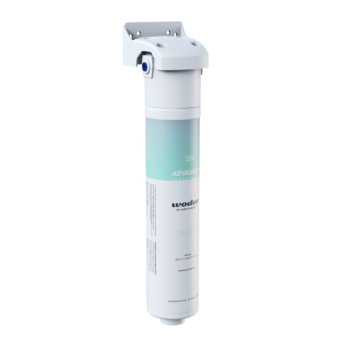
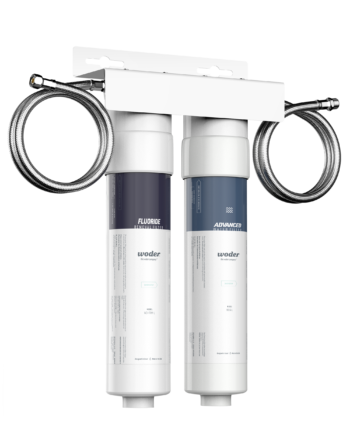
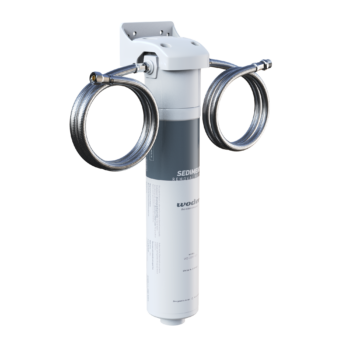
For those households, an inline filter like Woder is a complete answer.
- No salt to buy or refill
- No brine discharge into the water supply
- No $800 to $1,500 installation cost
- No plumber required — Woder connects inline in under 30 minutes
- No wastewater, no pressurized tank, no drain line
- Replacement cartridges run $40 to $80 per year
Compare that to a traditional softener, which requires ongoing salt purchases, periodic regeneration cycles, and professional servicing. Or to a reverse osmosis system, which runs $300 to $600 installed and strips out the minerals you want to keep.
A selective filter sits in the middle — doing more for drinking water safety than a softener, and doing it without the cost or complexity of RO.
A Quick Decision Framework
| Your situation | What you likely need |
|---|---|
| Scale on fixtures, spotty dishes, dry skin | Water softener (or descaler) |
| Metallic taste, chlorine smell, PFAS concern | Point-of-use filter |
| Both scale and contamination concerns | Softener on main line + filter at the tap |
| You want clean drinking water, full stop | Inline filter |
If you're still not sure what's in your water, Woder offers water testing kits that give you a clear starting point before you spend anything.
What to Look for in a Filter If You Skip the Softener
Not all filters are equal. When you're comparing options, these are the things that actually matter:
Contaminant coverage. Look for verified removal of lead, PFAS, chlorine, and chromium 6 at minimum. Vague claims about "improving taste" aren't enough.
Mineral retention. If you're avoiding a softener or RO specifically because you want to keep minerals, confirm the filter uses selective filtration — not a membrane that strips everything out.
Filter life. Woder's models are rated at 5K, 8K, and 10K gallons depending on the unit. Longer filter life means lower annual cost and less time spent on maintenance.
Installation simplicity. An inline filter that connects to your existing water line without a plumber is a real advantage. Woder's 30-minute setup is an actual number, not a marketing claim.
US manufacturing. When you're filtering drinking water, knowing where the filter was made matters. Woder manufactures in the US.
The Bottom Line
A water softener is a specific tool for a specific problem: scale from hard water. If that's genuinely your issue, it does its job well. But if your real concern is what's in your drinking water — lead, PFAS, chlorine, or other contaminants — a softener won't touch any of that.
For most homeowners, a quality inline filter is the smarter, simpler, and more affordable answer. It removes what you don't want. It keeps what you do. And it installs in the time it takes to watch a short video.
It's your water. Make sure what's in it is actually what you want.
Explore the full Woder filter lineup and find the right model for your household at woder.com.
Frequently Asked Questions
Can a water softener replace a water filter?
No. A water softener removes calcium and magnesium to prevent scale, but it doesn't filter out contaminants like lead, PFAS, chlorine, or chromium 6. If your concern is drinking water safety, you need a filter, not a softener.
Is a water filter a good alternative to a water softener?
It depends on your actual problem. If hard water is causing scale on fixtures and appliances, a filter won't solve that. But if your concern is taste, odor, or health-related contaminants, a point-of-use filter is often all you need — and it's significantly cheaper and easier to install than a softener.
Does a water filter remove hardness minerals like calcium and magnesium?
Most standard filters don't remove hardness minerals. Reverse osmosis systems do, but many homeowners consider that a drawback. Woder's Advanced Selective Filtration is specifically designed to keep calcium and magnesium while removing harmful contaminants.
What's the cost difference between a water softener and an inline filter?
A traditional water softener typically costs $800 to $1,500 installed, plus ongoing salt and servicing costs. An inline filter like Woder runs $80 to $200 for the unit and $40 to $80 per year on replacement cartridges — a fraction of what a softener requires over time.
Do I need both a water softener and a water filter?
Some households benefit from both — a whole-house softener to protect pipes and appliances, plus a point-of-use filter at the kitchen tap for drinking water. But many homeowners only need the filter. Start by testing your water to understand what you're actually dealing with before buying either.
How do I know if my water problem is hardness or contamination?
Hard water typically shows up as white scale deposits on fixtures, spotty dishes, and poor soap lather. Contamination usually presents as a metallic or chemical taste, a chlorine smell, or elevated levels listed in your municipal water quality report. A water testing kit gives you a definitive answer.
How long does a Woder filter take to install?
Woder filters connect inline to your existing water line and typically install in under 30 minutes. No plumber needed, and there's no tank, drain line, or wastewater involved.