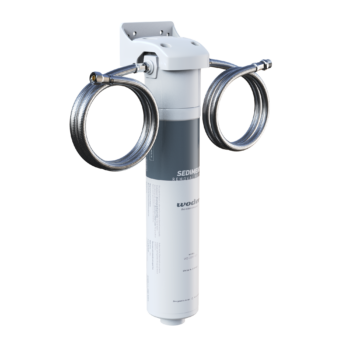
You’re kneeling in front of the kitchen cabinet with an old cartridge in one hand, an empty box somewhere in the recycling, and no clear idea what to order next. The model number has faded, the replacement page is full of codes, and every cartridge seems to promise a different micron rating, capacity, or certification.
That moment is less about shopping than matching. The right under sink water filter cartridge has to fit the housing, seal against the correct O-ring, suit the system’s connection style, and address the contaminants you care about. A smaller micron number alone doesn’t make it the right choice.
Table of Contents
- Staring at an Old Cartridge and Wondering What’s Next
- What an Under-Sink Cartridge Actually Is
- Micron Ratings Explained in Real Terms
- Cartridge Sizes, Fittings, and Connection Types
- Matching a Replacement Cartridge to Your Existing System
- Reading an NSF Listing Like a Shortcut
- Swapping Out a Cartridge Without Flooding the Cabinet
- When to Replace Based on Use, Not the Calendar
- Standard Carbon vs Selective Filtration vs RO Stages
- Quick Reference Table for Choosing Your Next Cartridge
Staring at an Old Cartridge and Wondering What’s Next
A homeowner replacing a cartridge usually starts with the wrong question: “Which filter has the highest rating?” The more useful question is, “Which cartridge belongs in the system I already have, and what is that system meant to reduce?”
The old cartridge may be a quick-change unit that twists out, a drop-in element inside a reusable sump, or an inline filter attached directly to tubing. Those formats aren’t interchangeable just because they look similar in a product photo. A cartridge with the wrong diameter, end cap, or sealing surface may fail to seat, leak, or bypass water entirely.
Before ordering, look for four clues:
- System identity: Find the brand and model on the housing, manifold, or installation label.
- Cartridge identity: Inspect the printed or stamped part number on the old element.
- Physical fit: Measure the cartridge and note its end caps, tabs, threads, and O-ring location.
- Water purpose: Decide whether the system is intended for sediment, chlorine taste and odor, health-related contaminants, or several targets together.
Micron rating matters, but it comes after physical compatibility and certified performance. A fine cartridge that doesn’t fit is useless, and a cartridge that fits but lacks a claim for your concern may provide only taste improvement.
Replacement timing also needs more thought than a generic calendar reminder. Carbon media can lose adsorption capacity while water still flows normally, so the manufacturer’s rated interval or gallon capacity should guide replacement, whichever comes first. That’s especially important in kitchens where filtered water is used for drinking, cooking, coffee, and ice.
What an Under-Sink Cartridge Actually Is
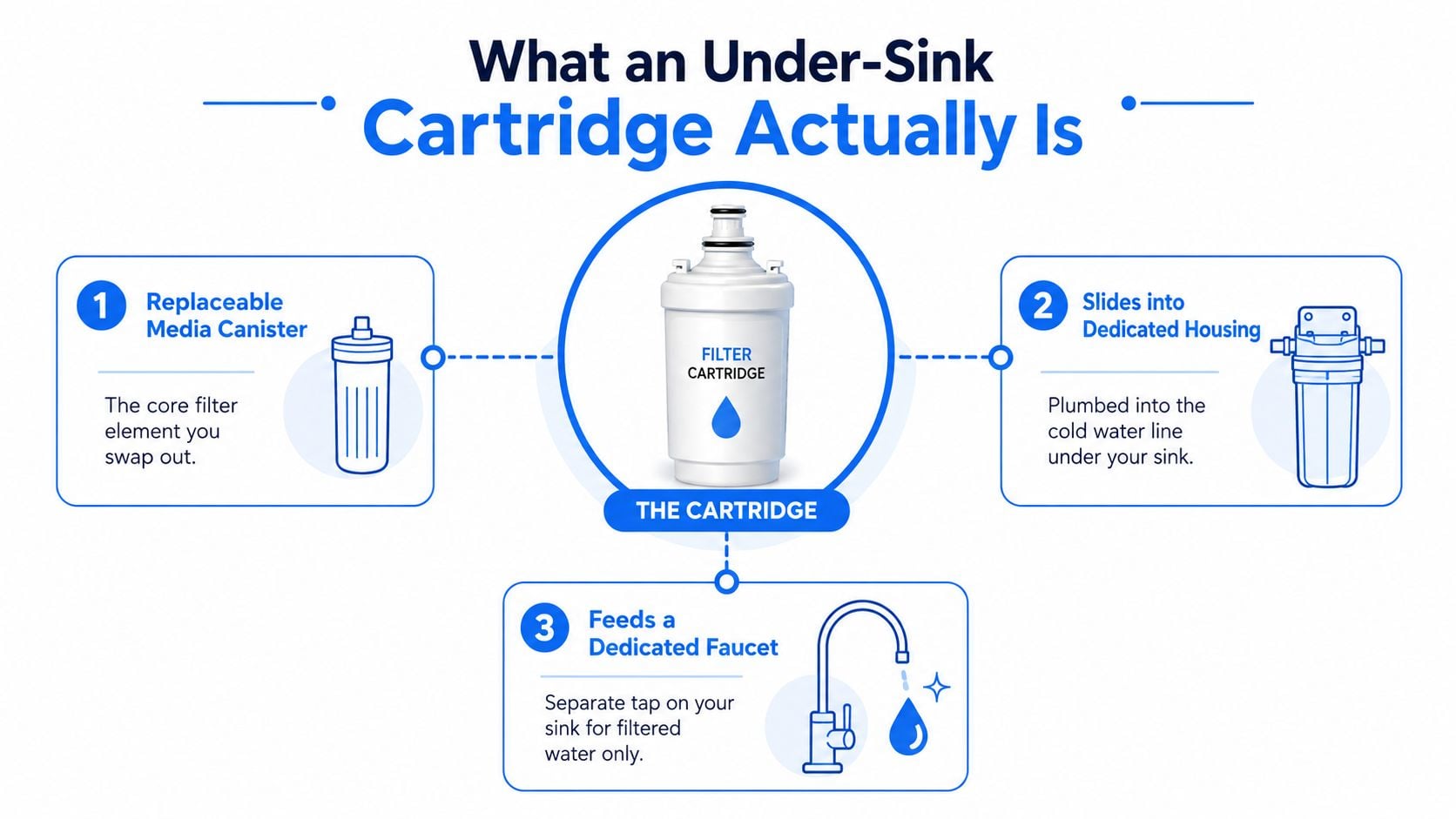
An under-sink water filter cartridge is the replaceable canister containing the filter media. It fits inside a dedicated housing connected to the cold-water line, while treated water usually flows to a separate drinking-water faucet. The housing, bracket, tubing, shutoff valve, and fittings remain in place and form the reusable plumbing around the cartridge.
The housing determines how the cartridge is supported and sealed. Tubing determines how water enters and exits. A cartridge can look similar to another model yet fail to seat correctly if its diameter, end caps, threads, or sealing surfaces differ. The result may be a leak or water that bypasses the media instead of passing through it.
The main media families
Sediment cartridges use pleated or spun polypropylene to catch physical particles such as rust, sand, silt, dust, and pipe scale. They often sit before a carbon stage because trapped sediment can clog finer media and reduce its useful life.
Carbon cartridges contain granular activated carbon or carbon block. Their familiar role is reducing chlorine, taste, and odor. Some are also certified for health-related contaminant reductions, but that depends on the specific product and its listing, not only on the word “carbon.”
Specialty media can include KDF, ion-exchange resin, or alkaline ceramic. Each is chosen for particular water concerns, so its usefulness depends on the stated contaminant targets and tested configuration.
Reverse osmosis systems use several stages rather than one general-purpose cartridge. A typical arrangement includes sediment and carbon pre-filters, a semipermeable membrane, and post-treatment. Each stage has a separate job, although a standalone cartridge may combine multiple media types in one canister.
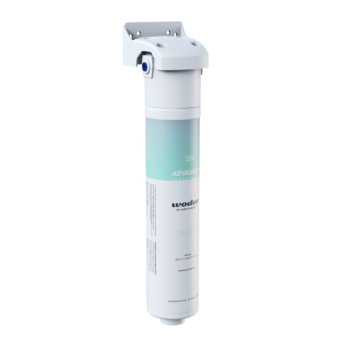
For example, the Woder Sediment Removal and Advanced Dual Filtration System pairs a 20µ sediment-removal first stage with ADV Filtration. Its listed targets include lead, PFAS, heavy metals, chlorine, mercury, chromium 6, chloramines, VOCs, odors, tastes, and sediment. The product states that its WD-GEN4-2512TC second-stage cartridge is WQA certified to NSF/ANSI 42 for chlorine taste and odor and NSF/ANSI 372 for lead-free compliance.
Micron Ratings Explained in Real Terms
A micron is a unit of length, roughly 1/25,000 of an inch. On a filter label, the number indicates the particle size the cartridge is designed to capture under specific test conditions. It is one part of the selection process, not a score for overall quality, and it does not show whether the cartridge reduces dissolved substances such as PFAS, fluoride, or chlorine.
The rating works like a sieve size. A larger opening generally allows more water through, while a finer one can hold back smaller particles but may increase resistance. A 20-micron sediment cartridge is commonly used before finer media to catch visible particles, sand, rust, and pipe scale. A 5-micron carbon block may reduce chlorine, cysts, and cloudiness when the product is designed and certified for those claims. A 1-micron block handles finer sediment and may address asbestos fibers under applicable testing. A 0.5-micron sub-micron block may meet cyst or bacterial reduction standards when specifically certified, though it can reduce faucet flow more quickly as pressure loss rises.
| Micron Rating | Typical Cartridge Type | What It Catches | Tradeoff to Expect |
|---|---|---|---|
| 20 micron | Sediment pre-filter | Sand, rust, dust, silt, and pipe scale | Higher flow, but it leaves finer particles behind |
| 5 micron | Carbon block or finer sediment element | Chlorine-related treatment, cysts, and much cloudiness when certified | More pressure loss than a coarse pre-filter |
| 1 micron | Fine carbon block | Finer sediment and specific particle targets such as asbestos fibers when certified | Flow can fall as the cartridge loads |
| 0.5 micron | Sub-micron carbon block | Cyst and bacterial reduction when the exact product is certified | Greater resistance and potentially earlier replacement |
A cartridge's nominal and absolute ratings describe different levels of performance. Nominal filtration indicates general particle reduction. Absolute filtration refers to a tighter threshold measured under a defined test, so the terms should not be treated as interchangeable.
Choose the rating by considering your incoming water, the cartridge's certified claims, and the system it fits. If sediment is the main issue, a coarse pre-filter can protect a finer stage while preserving more flow. If health-related contaminants are the concern, the tested contaminant list matters more than selecting the smallest micron number. The explanation of what a 0.5-micron filter means can help clarify why a small rating alone is not a complete safety answer.
Cartridge Sizes, Fittings, and Connection Types
The cartridge's physical format determines compatibility before the media type enters the discussion. Under most kitchen sinks, you'll encounter four broad designs.
The standard 2.5-inch cartridge, often roughly 10 inches tall, fits many two-stage and three-stage housings. The large-diameter version, often called “Big Blue,” provides more media volume and is used where the system needs greater flow or capacity. Those larger housings require matching cartridges and won't accept standard narrow elements.
A quick-change cartridge twists into a dedicated head and pulls out without opening a sump. An inline cartridge has no reusable housing. It connects directly to tubing, often through 1/4-inch fittings, and is common for direct-connect drinking lines, refrigerators, ice makers, and coffee equipment.
| Form Factor | Typical Dimensions | Connection Style | Common Systems |
|---|---|---|---|
| Standard drop-in | About 2.5 inches wide and roughly 10 inches tall | Housing with threaded sump and O-ring seal | Two-stage and three-stage under-sink housings |
| Large diameter | Wider than standard drop-in | Matching large housing and fittings | Higher-volume or higher-flow systems |
| Quick-change | Proprietary shape determined by filter head | Twist-lock head connection | Compact single-stage or multi-stage systems |
| Inline | Narrow sealed canister | 1/4-inch NPT or push-to-connect tubing fittings | Direct-connect faucet, refrigerator, ice-maker, and beverage lines |
Threads can be another source of confusion. A 1/4-inch NPT threaded port isn’t the same as a push-to-connect fitting in which tubing slides into a John Guest-style connector. The cartridge body may be compatible while the fittings still require a different adapter.
O-ring placement matters too. Some cartridges seal at the top, some at the bottom, and some use tabs or a molded interface instead of a loose O-ring. The Woder water filter housing guide shows why the housing and cartridge have to be treated as one matched assembly.
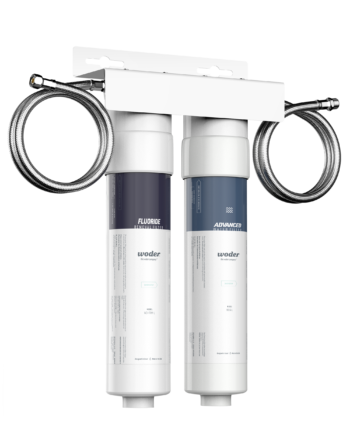
The Woder Advanced HM and Lead Removal Dual Filtration System is a U.S.-made dual-stage system formulated for households and communities where testing has confirmed heavy-metal concentrations above EPA maximum contaminant levels. Its WD-GEN4-2512TC second-stage cartridge is WQA certified to NSF/ANSI 42 for chlorine taste and odor and NSF/ANSI 372 for lead-free compliance, according to the product snapshot.
Matching a Replacement Cartridge to Your Existing System
The safest replacement process starts with identification, not browsing. Open the cabinet and photograph the entire assembly before disconnecting anything. Include the housing, manifold, tubing, faucet connection, labels, and the old cartridge’s printed end.
Use the system’s own clues
Check the brand label on the sump or filter head first. If the label is missing, inspect the cartridge for a stamped part number, molded end-cap code, or identifying tabs. A multi-stage manifold may also carry the model number on its bracket or central panel.
Woder Gen3 and Gen4 systems use their own replacement families, and a Gen4 successor may not be a universal substitute for every Gen3 configuration. The same caution applies to standard 10-inch housings sold under brands such as APEC, iSpring, and Whirlpool WHKF-DB0. “10-inch” describes length, not every dimension that controls sealing.
Culligan US-550 systems, direct-connect inline formats from PUR, and Woder inline setups may all look like simple under-sink filters, but their heads and fittings can differ. A cartridge that threads onto one head may need a push-to-connect interface on another.
Practical rule: Match the head, diameter, end-cap style, and O-ring location before comparing micron ratings.
Don’t assume that a replacement cartridge from one manufacturer fits another brand’s housing just because both listings mention standard dimensions. Compare the printed specification sheet with the stamped cap or manifold model. If those identifiers conflict, pause before ordering. A manufacturer’s replacement-parts reference is more reliable than a marketplace category label.
Reading an NSF Listing Like a Shortcut
An NSF/ANSI mark is useful only when you read what it covers. NSF/ANSI 42 addresses aesthetic effects, including chlorine taste and odor. NSF/ANSI 53 covers health-effect contaminants, including reductions such as lead, cysts, and other regulated contaminants when the specific product is listed for them. NSF/ANSI 401 addresses emerging contaminants. These distinctions are summarized in this NSF/ANSI certification comparison.
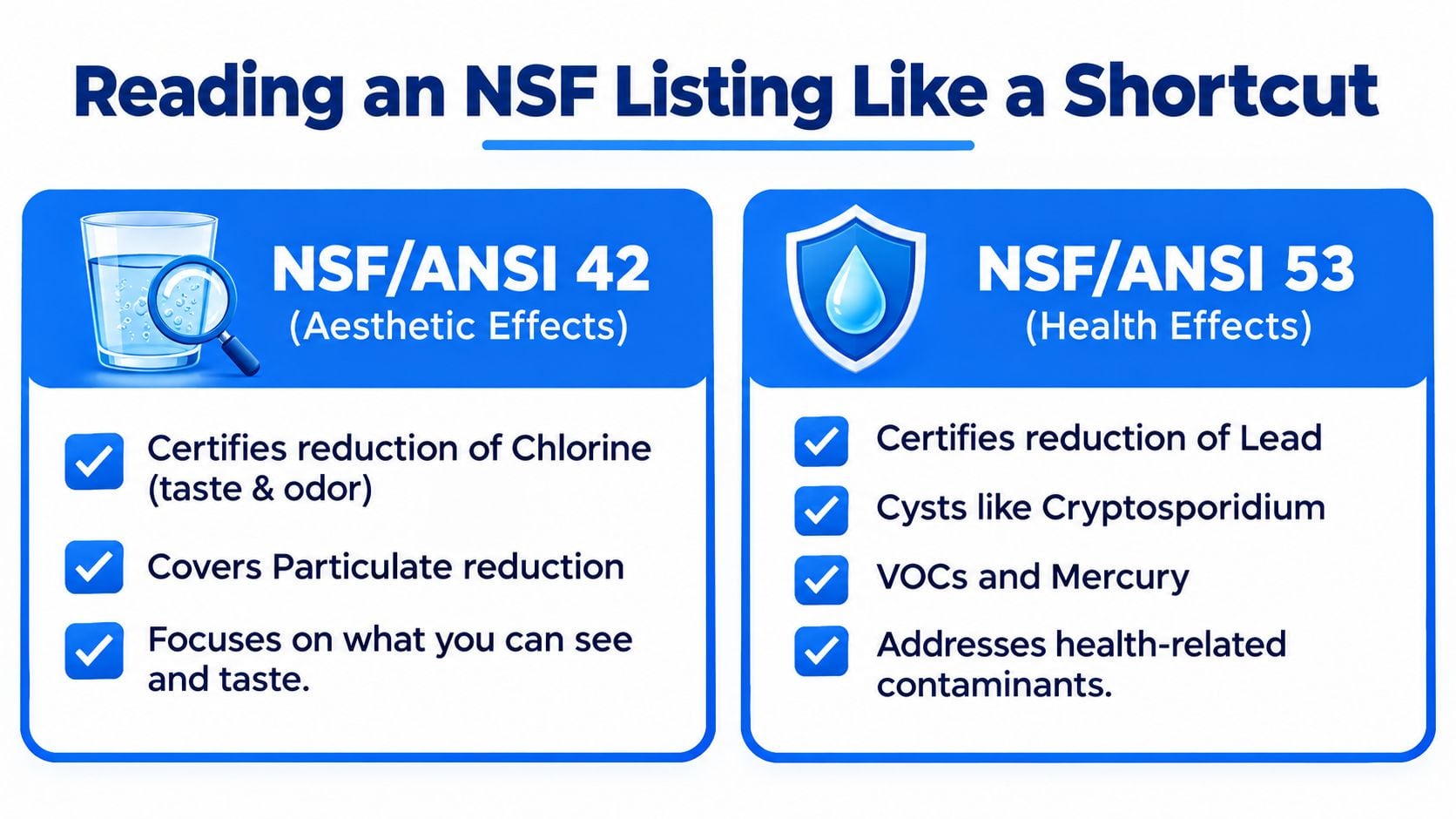
The standard applies to a tested product and configuration. A brand may sell several cartridges, but that doesn’t mean every cartridge carries the same certification or contaminant claim. Look for the exact model, the standard number, the contaminant, and the rated capacity.
A practical reading checklist
- Start with the concern: Use the water utility report or a certified home test to identify the contaminant you’re trying to reduce.
- Verify the endpoint: Confirm that the exact cartridge listing names that contaminant, not just “impurities” or “heavy metals.”
- Read the wording: “Reduces” describes tested performance under defined conditions. It isn’t the same as claiming total removal in every home.
- Check operating conditions: Flow rate, pressure, capacity, and cartridge configuration affect how the system performs.
- Ignore irrelevant badges: Don’t pay extra for a certification that doesn’t address a concern present in your water.
NSF also identifies point-of-use systems as a category with voluntary national standards because no federal regulations govern residential filters, purifiers, and reverse osmosis systems. NSF/ANSI 42 and NSF/ANSI 53 therefore function as major U.S. benchmarks for cartridge-based systems, including under-sink devices. NSF’s lead-reduction listings are a useful place to verify a specific health-effect claim.
Swapping Out a Cartridge Without Flooding the Cabinet
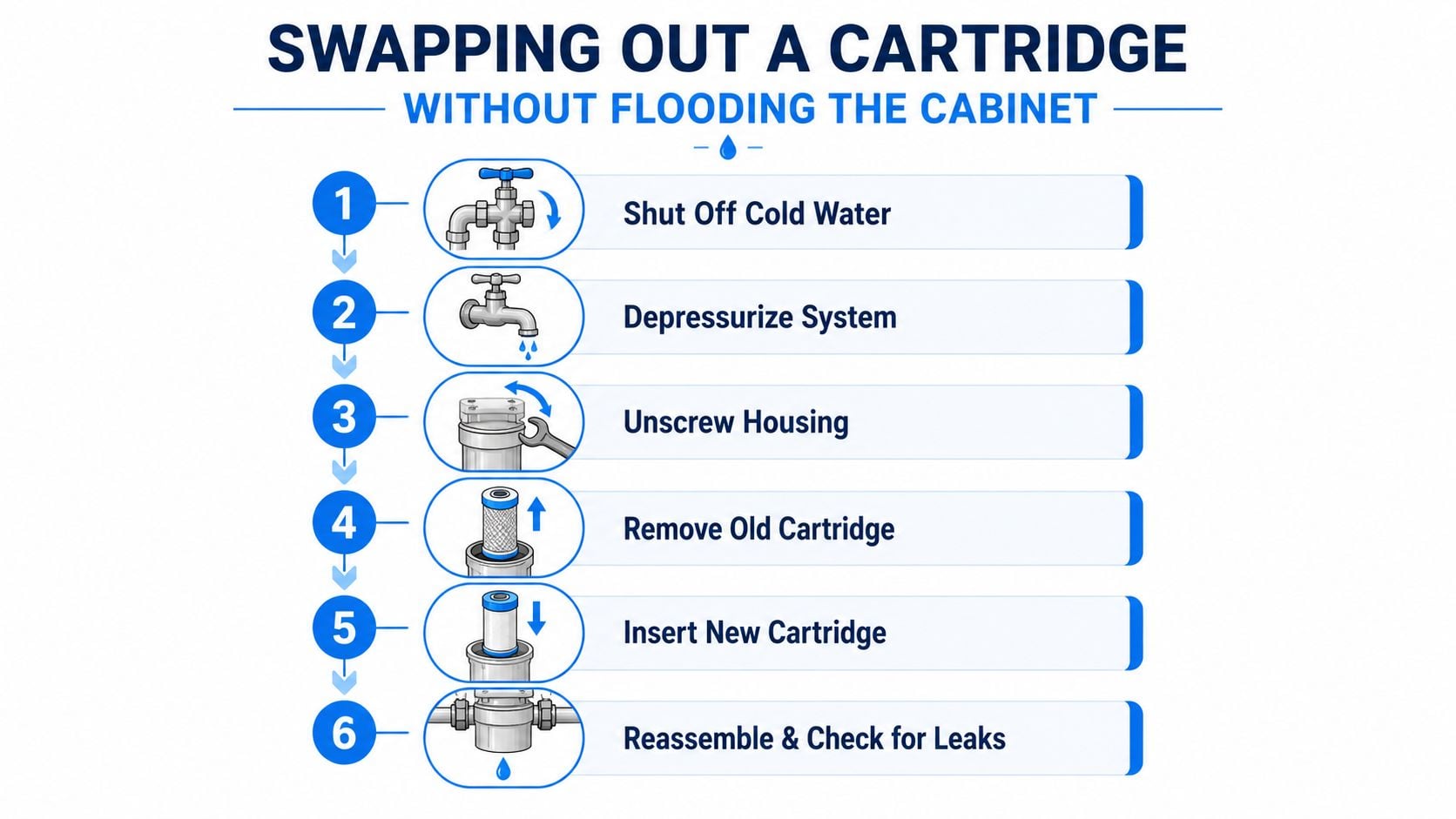
A cartridge replacement is usually manageable, but water pressure turns small mistakes into cabinet damage quickly. Start by locating the cold-water shutoff, either at the dedicated stop or the system’s supply valve. Close it before loosening any housing.
Open the dedicated filtered-water faucet. That releases pressure in the line and makes the housing easier to open. Put a towel and shallow pan under the sump because some water will remain inside even after the supply is closed.
The standard housing sequence
- Shut off the cold water. Turn the valve fully, but don’t force a stiff or corroded valve.
- Depressurize the system. Leave the dedicated faucet open until flow stops.
- Open the housing. Twist the sump carefully, keeping the pan underneath.
- Remove the old cartridge. Note which end faces up and how the O-ring sits.
- Insert the replacement. Seat it straight, with the correct end and seal in place.
- Reassemble and test. Thread the sump by hand first so it doesn’t cross-thread.
Quick-change cartridges skip the sump step. They typically twist out of the filter head and the replacement locks into place, but the exact turning direction varies by system.
Inspect the O-ring before reassembly. A pinched, dirty, dry, or displaced O-ring can cause a slow leak. Push-to-connect tubing creates another common failure point. The tube must be cut square and inserted fully into the fitting, with the collet engaged around it.
Reopen the supply slowly and watch the housing, fittings, and tubing for at least five minutes. Confirm flow at the faucet, then flush the new cartridge according to its instructions. Carbon cartridges commonly need several gallons flushed to clear carbon fines. The under-sink cartridge replacement guide offers another visual reference for the sequence.
Here’s a video showing the replacement process:
When to Replace Based on Use, Not the Calendar
The familiar 6 to 12 month replacement range is a starting point, not a universal rule. Carbon cartridge life depends on the manufacturer’s rated interval or gallon capacity, whichever comes first, along with incoming chlorine or chloramine load and the volume of water processed. Maintenance guidance for filter media replacement explains why adsorption media can exhaust before flow visibly drops.
A household that uses filtered water for every drink, pot of pasta, coffee, and ice will consume a cartridge faster than a lightly used drinking tap. High sediment can also load a cartridge early, even when the water still tastes acceptable.
Build a simple usage record
Write the installation date on the housing with a permanent marker. Record the cartridge’s rated capacity and estimate how much filtered water the household uses over several days. A state health resource recommends estimating daily sink usage over 3 days to help decide when replacement is due, rather than relying only on a generic interval. This public tap-water filter guidance also warns that overused cartridges may lose effectiveness and can allow bacterial growth.
Use these clues as supporting signals:
- Flow changes: A noticeable reduction can indicate sediment loading or pressure loss.
- Taste returns: Chlorine taste or odor returning may signal exhausted carbon media.
- Water-use rises: Heavy cooking, frequent beverage preparation, or a larger household shortens the service interval.
- Source conditions change: A plumbing repair, well disturbance, or utility treatment change can alter cartridge loading.
Don’t treat normal flow as proof that the cartridge is still performing. Adsorption capacity can be depleted without a dramatic visual or taste warning. Replace on the rated schedule when usage tracking is uncertain, and replace sooner when the water profile or household demand has changed.
Standard Carbon vs Selective Filtration vs RO Stages
The three approaches under a kitchen sink serve different purposes. Standard carbon is a practical choice for chlorine taste, odor, and some chemical compounds. It generally leaves naturally occurring minerals in the water and doesn’t function as a broad dissolved-solids remover.
Selective filtration uses media chosen for particular contaminants. Woder’s Advanced Selective Filtration® is designed to target listed contaminants such as PFAS, lead, heavy metals, fluoride, chromium, and chlorine while retaining essential minerals. The product claims must still be matched to the specific cartridge, certification, and tested contaminant list.
Reverse osmosis adds a semipermeable membrane. It can achieve very low TDS by removing dissolved solids broadly, but it also strips minerals and usually requires more equipment, maintenance, and water handling than a single cartridge. A zero-TDS reading isn’t proof that water is healthier. It indicates that dissolved solids, both desirable and undesirable, have been removed.
| Filter Type | Removes | Keeps Minerals | Flow Impact | Best For |
|---|---|---|---|---|
| Standard carbon | Chlorine, taste, odor, and listed chemical targets | Generally yes | Usually lower complexity and less resistance than RO | Taste and odor concerns |
| Selective filtration | Specific listed contaminants such as lead, PFAS, metals, fluoride, chromium, and chlorine | Designed to retain essential minerals | Depends on media and configuration | Targeted contaminant reduction without mineral stripping |
| RO stages | Broad dissolved-solids and contaminant reduction through a membrane | No, unless a remineralization stage is added | Slower, with more equipment and wastewater | Situations requiring broad dissolved-solids reduction |
The right comparison depends on the water report, not on the most aggressive-sounding technology. Readers deciding between countertop, pitcher, and installed systems may also find this guide helpful for how to compare pitcher and under-sink filters.
Quick Reference Table for Choosing Your Next Cartridge
Use this table as a first-pass lookup, then verify the exact part number and housing interface. Typical micron ranges describe common formats, not a guarantee for every product in that category.
| Cartridge Type | Typical Micron Rating | Primary Reduction Target | Common Compatible Systems |
|---|---|---|---|
| Standard 2.5-inch carbon block | About 0.5 to 5 micron | Chlorine, taste, odor, and listed health-related contaminants | Standard two-stage or three-stage housings |
| Large-diameter carbon | Product-specific | Chlorine, taste, odor, and listed chemical targets | Large-volume housings |
| Quick-change twist | Product-specific | Depends on the dedicated cartridge design | Matching quick-change filter head |
| Inline sediment | Often around 20 micron for pre-sedimentation | Sand, dust, dirt, silt, and visible particles | Direct-connect lines and pre-filter arrangements |
| Reverse osmosis stages | Stage-specific | Sediment, chlorine, dissolved solids, and membrane-specific contaminants | RO systems with matched pre-filters, membrane, and post-filter |
| Woder Gen3 or Gen4 replacement | Product-specific | Depends on the exact replacement model and system | Matching Woder Gen3 or Gen4 housing and head |
Start with the existing housing and fittings. Then confirm the cartridge dimensions, micron range, rated capacity, and NSF listing against the water concerns present in your home. If PFAS, lead, fluoride, chromium, or heavy metals are the reason you're shopping, don't rely on a generic “multi-contaminant” label.
Check the cartridge's exact model number, compare it with the system documentation, and record the installation date after you replace it. That small habit prevents the next cabinet-floor search.
Woder Filters offers U.S.-made point-of-use systems and replacement cartridges using Advanced Selective Filtration® to target listed contaminants while retaining essential minerals. Visit Woder Filters to match an under-sink cartridge to your existing system, water concerns, and installation needs.