- Where Arsenic Comes From
- Health Risks of Arsenic Exposure
- How to Know If Your Water Has Arsenic
- What Filter Types Actually Remove Arsenic
- Choosing the Right Filter for Arsenic in 2026
- A Note on Filter Certifications
- What You Can Do Right Now
- Frequently Asked Questions
Arsenic doesn't announce itself. No taste, no smell, no color. You can drink water that contains it for years without any indication something is wrong. That's what makes it one of the more serious contaminants in US drinking water — and one worth understanding before you choose a filter.
This article covers where arsenic comes from, how it ends up in tap water, what the health risks actually look like, and which filter types genuinely remove it.
Where Arsenic Comes From
Arsenic is a naturally occurring element found in soil and rock throughout the earth's crust. Industrial pollution can make things worse, but it doesn't need to be present for arsenic to show up in your water.
Natural Sources
As groundwater moves through rock formations, it picks up arsenic along the way. This is especially common in parts of the western United States, New England, and the upper Midwest, where certain geological formations slowly release arsenic into aquifers. Private wells drawing from these aquifers are particularly vulnerable — they aren't subject to the same federal monitoring requirements as municipal systems.
Industrial and Agricultural Sources
Mining operations, smelters, and coal-burning power plants release arsenic into the surrounding environment. Pesticides used in agriculture historically contained arsenic compounds, and residues can persist in soil for decades, eventually leaching into groundwater. Pressure-treated lumber manufactured before 2004 used chromated copper arsenate, which can contaminate soil near older structures.
Municipal vs. Well Water
Public water systems are required to test for arsenic and keep levels below 10 parts per billion (ppb) — the EPA's current maximum contaminant level, in place since 2006. Some systems still occasionally exceed it, and it's worth noting that the 10 ppb threshold is a regulatory compromise, not a declaration of safety. The EPA's own maximum contaminant level goal for arsenic is zero.
Private well owners don't have that safety net. No federal agency tests your well for you. You're responsible for doing it yourself. The US Geological Survey has documented elevated arsenic levels in groundwater across dozens of states, with particularly high concentrations in parts of Nevada, Arizona, California, Maine, and Michigan.
Health Risks of Arsenic Exposure
Long-term arsenic exposure is linked to serious health outcomes. The most well-documented include:
- Bladder, lung, and skin cancers from chronic exposure
- Cardiovascular disease, including increased heart attack risk
- Neurological effects, particularly in children, where arsenic exposure has been associated with lower IQ scores and developmental delays
- Skin changes, including darkening and lesions, at higher exposure levels
The risk is cumulative. Drinking water at 5 ppb for ten years is a very different exposure profile than drinking it for one year. That's why the filter you use at home matters more than any single test result.
How to Know If Your Water Has Arsenic
The most direct step is testing. For municipal water, your utility publishes an annual Consumer Confidence Report (CCR) listing detected contaminant levels. You can usually find it on your utility's website or request it directly.
For well water, you'll need an independent test. A certified lab can test specifically for arsenic, or you can order a broader panel covering multiple contaminants at once. Many county health departments can point you toward certified labs in your area.
If you're in a region with known arsenic geology, testing isn't optional — it's the only way to know what you're actually dealing with.
What Filter Types Actually Remove Arsenic
Not every filter removes arsenic, and this is where a lot of homeowners get tripped up. A standard carbon block filter does an excellent job on chlorine, chloramines, and some volatile organic compounds, but it won't meaningfully reduce arsenic.
Here's how the main filter categories perform:
Reverse Osmosis
RO systems are effective at removing arsenic, particularly arsenic V — the oxidized form. They force water through a semipermeable membrane that blocks most dissolved solids. The tradeoffs are real, though: RO systems typically waste 3 to 4 gallons for every gallon filtered, require a pressurized tank and drain line, and strip out beneficial minerals like calcium and magnesium along with the contaminants. Installation usually requires a plumber and runs $300 to $600 or more. The output is demineralized water, which many people find flat-tasting.
Activated Alumina
Activated alumina filters are specifically designed for arsenic removal and work well for both arsenic III and arsenic V. They're used in whole-house and point-of-use setups alike. Flow rate tends to be slower than other filter types, and the media needs periodic replacement.
Ion Exchange (Anion Exchange)
Anion exchange resins can remove arsenic V effectively by swapping arsenic ions for less harmful ones. These systems are often paired with other filtration stages and appear more commonly in whole-house setups than in consumer-grade under-sink products.
Advanced Selective Filtration
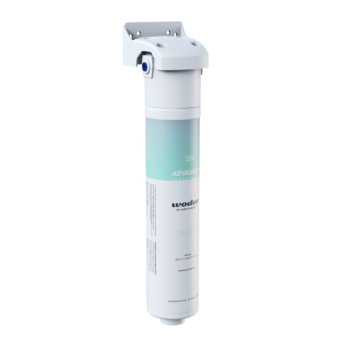
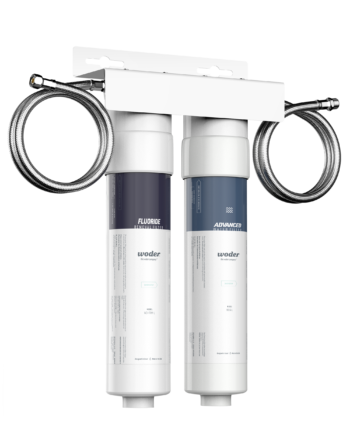
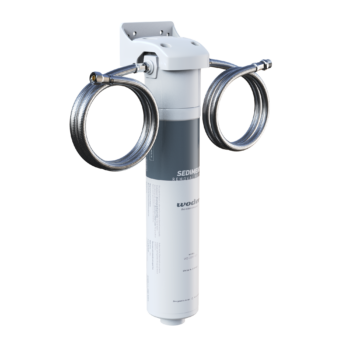
This is where Woder fits in. Woder's proprietary Advanced Selective Filtration uses nanoparticles that attract and bind specific contaminants — including heavy metals and carcinogens — while leaving beneficial minerals intact. Unlike RO, it doesn't strip everything out indiscriminately. Calcium and magnesium stay in your water. There's no wastewater output, no pressurized tank, no drain line. Installation is inline, connects directly to your existing water line, and takes about 30 minutes without a plumber.
For homeowners who want arsenic removal without the cost and complexity of a full RO system — and without sacrificing the minerals that make water taste right — selective filtration is a practical middle ground.
Choosing the Right Filter for Arsenic in 2026
A few questions help narrow the choice before you buy:
What's your arsenic level? Water testing at 2 ppb calls for a different approach than water testing at 15 ppb. Higher concentrations may warrant a more aggressive removal method.
Is it arsenic III or arsenic V? Arsenic V is more common in oxygenated surface water and easier to remove. Arsenic III, found more often in groundwater, is harder to capture with some filter types. If you're on a well, this distinction matters. Pre-oxidation — adding chlorine or another oxidant before filtration — converts arsenic III to arsenic V, making it more filterable.
Do you want to keep minerals? If the taste and health implications of demineralized water concern you, RO may not be the right call. Selective filtration keeps the minerals you want while targeting the contaminants you don't.
What's your installation situation? Renters and homeowners who'd rather not call a plumber benefit from inline filter systems that connect to an existing water line without permanent modification. Woder's models — including the WD-10K-ADV-PORT and WD-D-8K-FRM-ADV-DC — are designed for exactly this kind of setup.
What's your budget? A full RO system with installation runs $300 to $600 upfront. A quality under-sink selective filter sits in the $80 to $200 range, with replacement cartridges running $40 to $80 annually. Over three to five years, the cost difference adds up quickly.
A Note on Filter Certifications
When evaluating any filter for arsenic removal, look for NSF/ANSI Standard 58 (for RO systems) or NSF/ANSI Standard 53 (for reduction of health-related contaminants). These certifications mean the filter has been independently tested to verify the removal claims on the label. Don't rely on marketing language alone — ask specifically whether the filter is certified for arsenic reduction and at what concentration.
Woder's certified removal claims cover lead, chlorine, chromium 6, mercury, PFAS, carcinogens, and volatile organic compounds. If arsenic is your primary concern, use the product finder at woder.com/wizard to identify which model fits your household's flow rate and contaminant profile.
What You Can Do Right Now
- Get your water tested. If you're on a well, order an independent arsenic test. If you're on municipal water, pull your most recent Consumer Confidence Report.
- Know your arsenic form. Ask your lab whether the detected arsenic is primarily arsenic III or arsenic V — it affects which filter technology will work best.
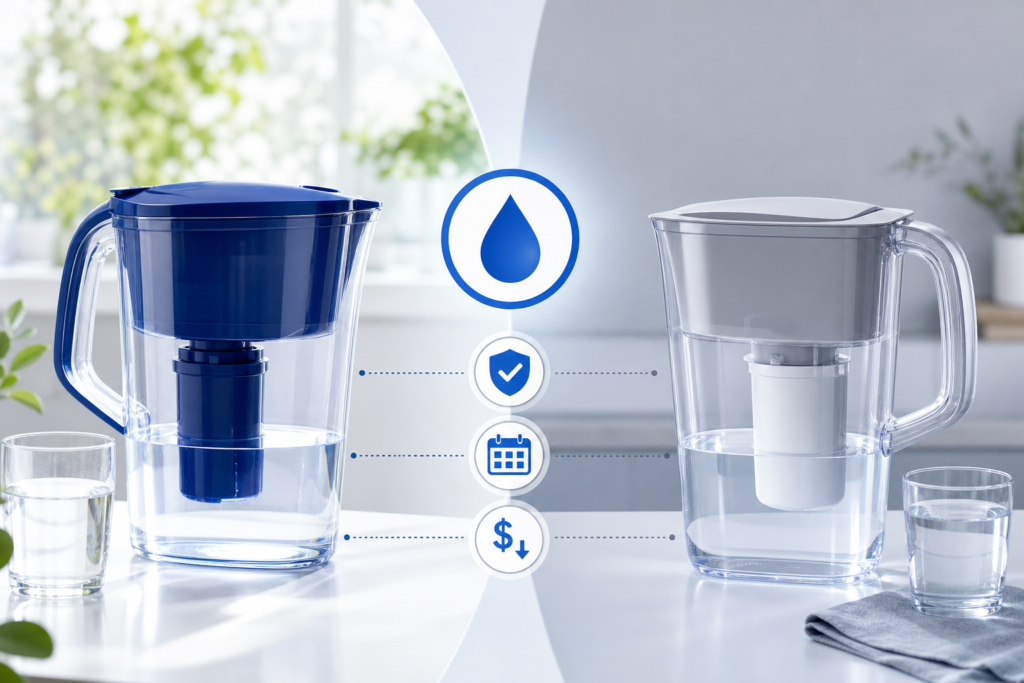
- Match the filter to the problem. A carbon pitcher filter isn't enough. Arsenic requires a filter specifically rated for heavy metal or arsenic removal.
- Factor in the full cost. Installation, ongoing cartridge replacement, and water waste all affect what a filter actually costs you over time.
Once you know what's in your water, choosing the right filter is straightforward.
Frequently Asked Questions
Does a standard Brita or carbon pitcher filter remove arsenic?
No. Standard activated carbon filters, including most pitcher filters, are designed for chlorine, taste, and odor — not arsenic. If arsenic is a concern, you need a filter specifically rated for arsenic or heavy metal reduction.
What is the safe level of arsenic in drinking water?
The EPA's maximum contaminant level for arsenic in public water systems is 10 ppb. The EPA's own goal, however, is zero — because arsenic is a known human carcinogen. Most health researchers treat 10 ppb as a regulatory threshold, not a safety guarantee.
Is arsenic more common in well water or city water?
Both can contain arsenic, but private well water carries higher risk because it isn't subject to federal monitoring requirements. Homeowners with wells are responsible for testing their own water. Municipal systems must test regularly and publish results.
Does reverse osmosis remove arsenic?
RO systems are effective against arsenic V, the more common oxidized form, but less effective against arsenic III without pre-treatment. The tradeoff is that RO also removes beneficial minerals, produces wastewater, and requires a more involved installation.
What is the difference between arsenic III and arsenic V?
Arsenic III (arsenite) is the reduced form, more common in low-oxygen groundwater. Arsenic V (arsenate) is the oxidized form, more common in surface water and oxygenated systems. Arsenic V is generally easier to remove through filtration. Converting arsenic III to arsenic V through pre-oxidation improves removal rates for most filter types.
Can I use a Woder filter if arsenic is my main concern?
Woder's Advanced Selective Filtration targets heavy metals and carcinogens. If arsenic is your primary concern, use the product finder at woder.com/wizard to identify the right model for your situation and confirm which contaminants each model is certified to reduce.
How often do I need to replace my filter if I'm filtering for arsenic?
Replacement frequency depends on your water volume and the specific filter model. For Woder filters, replacement cartridges are available and designed to maintain consistent performance over time. Following the manufacturer's recommended replacement schedule matters — a saturated filter can stop removing contaminants effectively, and in some cases may release previously captured contaminants back into the water.