Most advice about a water filter for faucet starts with the wrong question. People ask which model removes the most contaminants, then discover too late that the filter slows the sink to a crawl, doesn’t fit the faucet, or gets in the way every time they wash a pan. In real kitchens, the better question is simpler, what flow can you live with, and what level of filtration do you need at the tap?
That tradeoff is why faucet filtration is still a serious category, not a gimmick. One market report puts the global faucet water filter market at USD 360.29 million in 2025, rising to USD 581.01 million by 2031, with an estimated 8.29% CAGR over 2026 to 2031, while another projects the faucet-mounted segment at about USD 2.5 billion in 2024 and USD 4.5 billion by 2033 with 6.2% CAGR from 2025 to 2033 (TechSci Research). That growth makes sense when you’ve seen how many households want point-of-use filtration without a full under-sink overhaul.
Table of Contents
- The Hidden Tradeoff in Faucet Filtration
- Faucet-Mounted and Under-Sink Options Compared
- How Flow Rate Shapes Real-World Performance
- Understanding Contaminant Removal and What Certifications Actually Mean
- Installation Constraints and Renters Compatibility
- How to Choose a Water Filter for Your Specific Situation
The Hidden Tradeoff in Faucet Filtration
More filtration usually means less speed
The biggest mistake I see is treating filtration as a single ladder, where more stages always equal a better result. In faucet systems, that’s not how daily use feels. Lower flow usually means more water contact time with the media, and that gives the cartridge a better shot at reducing contaminants, but it also means the faucet can feel slower than people expect.
That’s why a faucet filter can be technically impressive and still irritating in a busy kitchen. If you cook often, fill pots at the sink, or rinse produce throughout the day, a sluggish stream becomes part of your routine fast. A filter that looks strong on paper can become the one you stop using because it’s inconvenient.
Practical rule: choose the slowest flow you’ll still use every day, not the slowest flow the packaging will let you tolerate.
What matters more than the longest contaminant list
The smartest buyers don’t start by chasing the longest list of contaminants. They start by deciding whether they need a compact tap-mounted unit, a larger under-sink system, or a setup that preserves faucet clearance. That’s why a good shopping process begins with usage, not marketing language.
If you want a broader look at how selective filtration fits into that decision, the overview at Woder’s selective filtration guide is a useful place to compare the idea against more familiar carbon-only approaches. For plumbers and homeowners comparing parts and layouts, even a catalog like Jays Plumbing water treatment gear can be more useful than product ads because it shows how much the market is shaped by fittings, mounts, and cabinet space as much as by claims.
The takeaway is plain. A faucet filter should match your habits first, then your water concerns. If it doesn’t fit your sink, your pace, or your patience, its contaminant claims won’t matter much in day-to-day use.
Faucet-Mounted and Under-Sink Options Compared
What each form factor does well
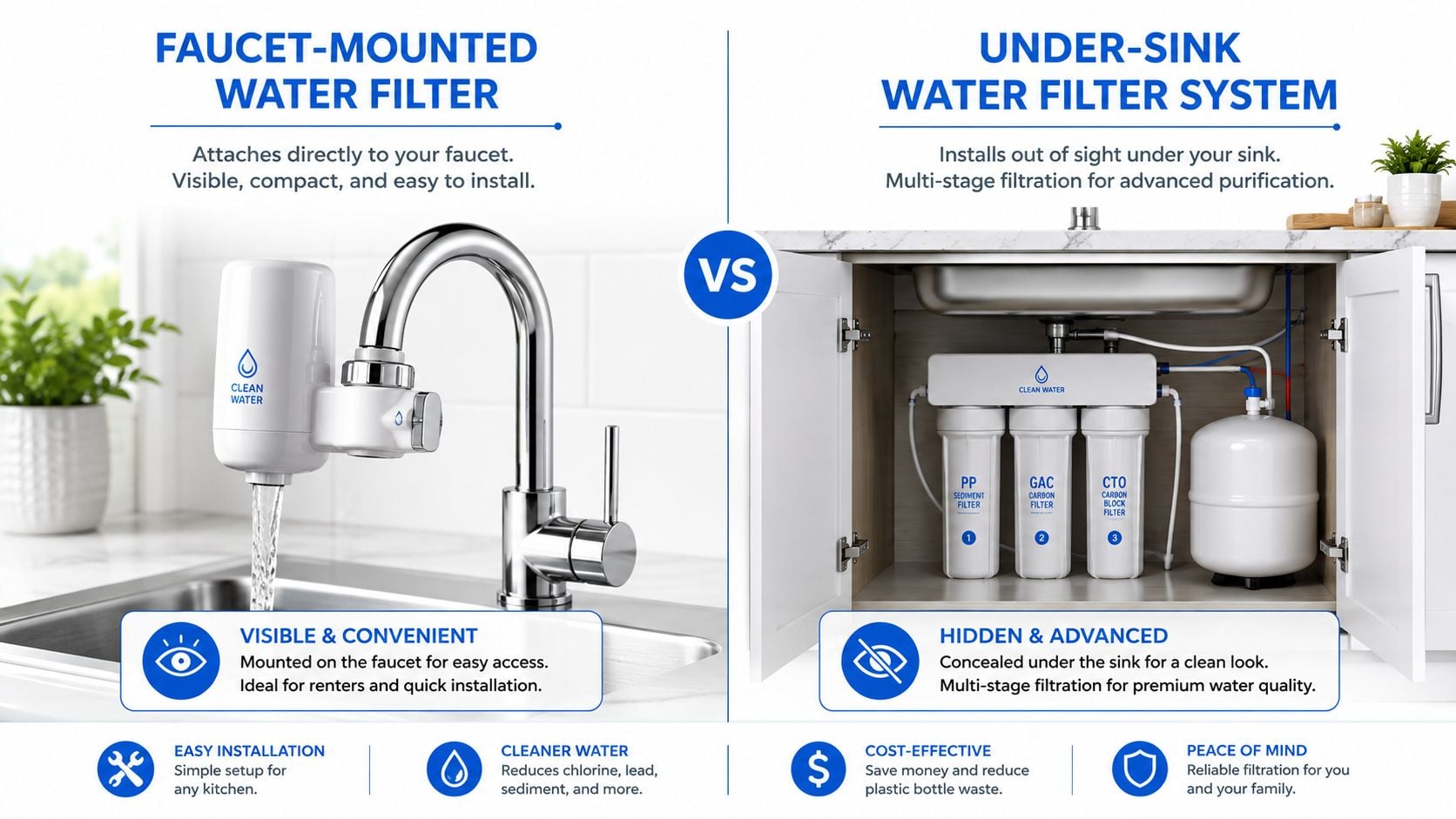
Faucet-mounted filters attach directly to the tap and are the most visible option in the kitchen. They’re usually easier to remove, they don’t require plumbing changes, and they’re a straightforward choice when you want filtered drinking water without committing to a cabinet install. Their main weakness is also obvious once you use one, they’re constrained by the faucet’s shape, clearance, and existing flow path.
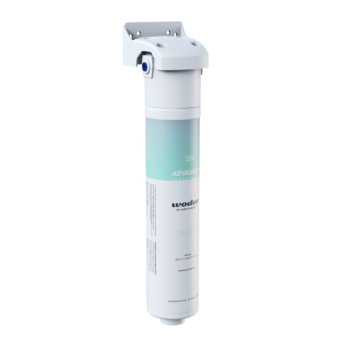
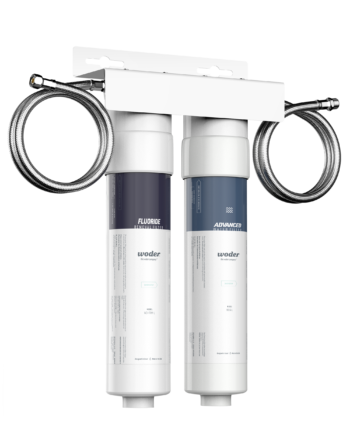
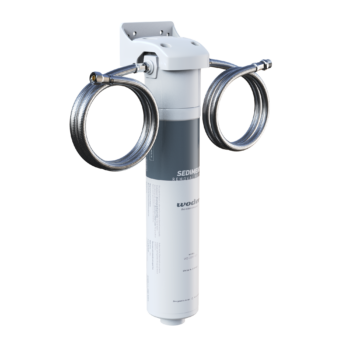
Under-sink filters work differently. They sit below the counter, connect to the cold-water line, and can feed either the existing kitchen faucet or a dedicated drinking-water faucet. They usually offer more room for multi-stage media and better cartridge capacity, but they ask for cabinet space and some installation effort in return. One under-sink option in the supplied product data, the Woder Sediment Removal and Advanced Dual Filtration System, is described as a U.S.-made under-sink water filter with a 20µ sediment stage and a second stage certified to NSF/ANSI 42 and NSF/ANSI 372.
Which household fits which setup
A faucet-mounted unit often makes sense for a small kitchen, a short-term living arrangement, or a buyer who wants reversibility. An under-sink system makes more sense when the sink cabinet has room, the household uses a lot of drinking and cooking water, or the family wants less visual clutter on the faucet itself.
That difference matters because the form factor determines the experience before the cartridge ever gets involved. A faucet-mount can be fine for a renter who wants an easy install, while an under-sink setup can be better for a homeowner who wants more hidden capacity and fewer daily compromises. The wrong choice usually isn’t about water quality, it’s about making your sink harder to live with.
How Flow Rate Shapes Real-World Performance
Why faucet filters feel slower
Flow rate is where product pages stop sounding abstract and start affecting daily life. GE’s specification chart lists faucet-mount flow at 0.6 gpm, while a kitchen and bath system is listed at 2.0 gpm and a high-flow shower system at 2.5 gpm (GE Appliances). That gap isn’t a defect, it’s the result of design.
A faucet cartridge has to create enough contact time for treatment, and that slows the water. In plain terms, the media can’t work hard and move fast at the same time. That’s why faucet filters are usually a better fit for drinking and cooking water than for tasks where you want a strong stream right away.
Lower flow is often the price of better treatment at the tap. The question is whether your kitchen habits make that trade acceptable.
Capacity and micron rating change the maintenance cycle
Flow isn’t the only number that matters. Capacity and micron rating shape how often you’ll be changing cartridges and how much fine material the filter can handle before it needs replacement. In the supplied specification examples, one under-sink model is rated at 2.5 gpm with 6,000 gallons capacity and a 0.5 nominal micron rating, while another is rated at 0.6 gpm, 625 gallons, and 0.2 micron (HD Supply).
The practical lesson is straightforward. Higher capacity usually means fewer replacements, but tighter filtration and lower flow usually come with more resistance. Those numbers are linked, not separate features you can optimize independently. A cartridge that lasts longer may not be the one that gives you the smoothest faucet feel, and the most restrictive cartridge isn’t automatically the right choice either.
What to compare before you buy
- Daily use pattern: If you fill bottles, cook often, or rinse food at the sink, slower flow will feel more noticeable.
- Replacement rhythm: A cartridge with a shorter service life may cost you more attention even if the initial install is simple.
- Sink role: Drinking-water taps can tolerate a slower stream better than the main prep faucet.
One lab-reviewed comparison listed a faucet model at 0.52 gpm with 100-gallon capacity and NSF/ANSI 42, 53, and 401 certification, while another faucet-mount system was listed at 0.30 gpm or less with 2,000 gallons and a 6 to 12 month service life (Quality Water Lab). That range shows how different faucet filters can feel in practice even when they all look compact on the shelf.
Understanding Contaminant Removal and What Certifications Actually Mean
Certifications tell you what was tested, not everything a label implies
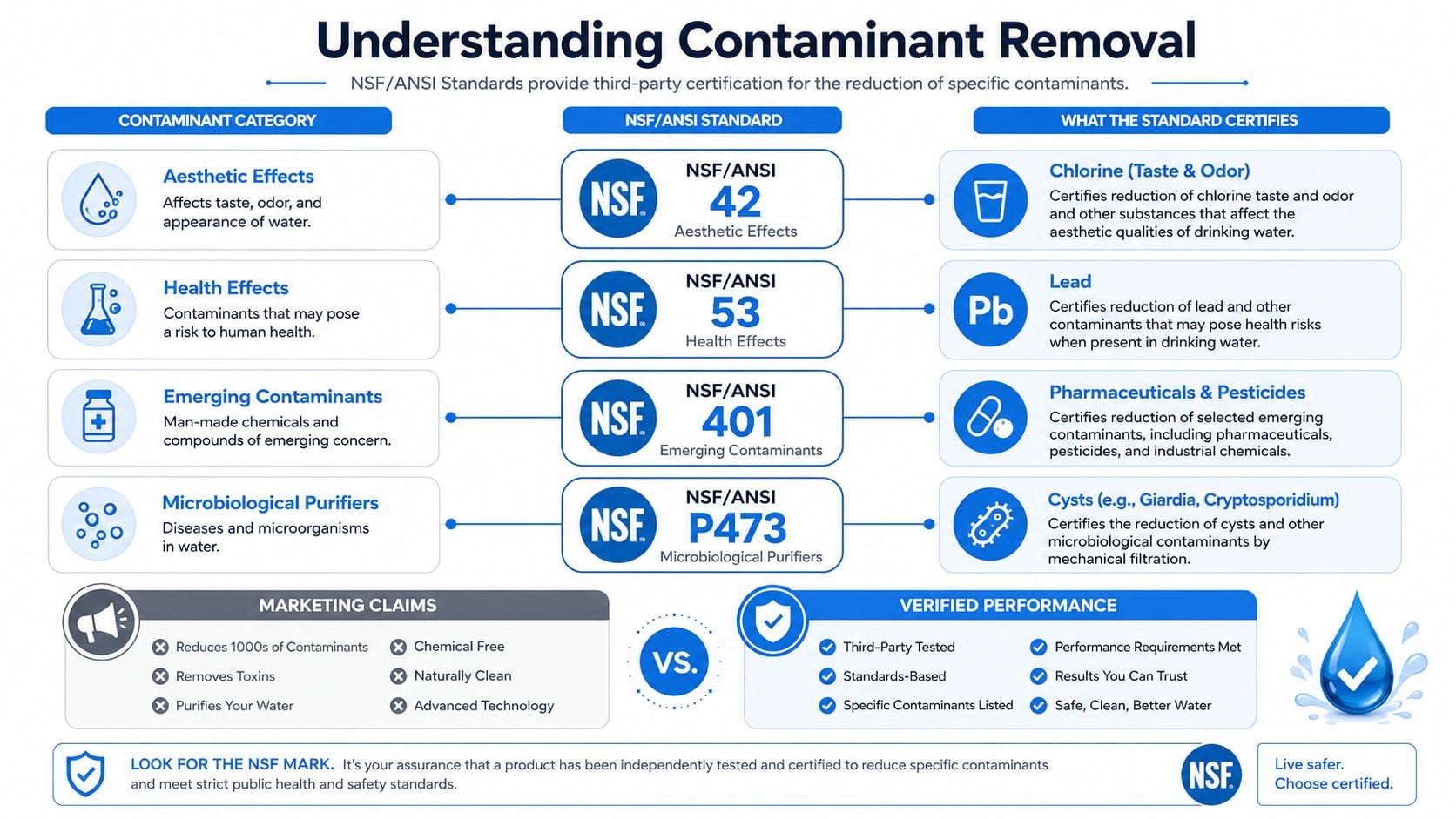
Contaminant claims only mean something when they’re tied to a standard that matches the problem you’re trying to solve. The CDC’s home-filter guidance says consumers should choose a filter based on the specific contaminant they want to address, because no single filter removes everything and the certification has to match the need (CDC). That advice cuts through a lot of packaging noise.
In U.S. retail coverage, faucet filters commonly advertise NSF/ANSI 42 for chlorine, taste, and odor, and NSF/ANSI 53 for health-related contaminants such as lead (CDC). Some higher-end systems claim reduction of 71 contaminants, but that statement still only matters if the underlying test standard lines up with the contaminant you care about. A published test summary also describes top faucet models as removing 99% of lead, which is only meaningful when the certification or test method is identified and verifiable (CDC).
Zero TDS is not the same thing as better drinking water
A lot of shoppers still get misled by a zero-TDS reading. Zero TDS means all dissolved solids are stripped out, both the beneficial minerals and the unwanted contaminants. That’s distilled water behavior, not selective drinking-water filtration.
That distinction matters because not every buyer wants mineral-stripped water at the sink. If a system removes contaminants while leaving in naturally occurring minerals, it’s serving a different goal than reverse osmosis. The reader doesn’t need more jargon here, just a clear filter question, do you want broad stripping, or targeted reduction with minerals left in place?
How to read the label without getting overwhelmed
- NSF/ANSI 42: Look here for taste, odor, and chlorine concerns.
- NSF/ANSI 53: Look here when the concern is a health-related contaminant such as lead.
- Specific contaminant claims: Treat these as useful only when the certified standard backs them up.
- Zero TDS claims: Treat them as a description of what was removed, not proof of purity.
For the alphabet soup behind the standards themselves, the primer at Woder’s NSF and WQA guide is useful because it keeps the focus on what the certifications mean, not just the badge on the box. That’s the part many buyers skip, then regret later.
Installation Constraints and Renters Compatibility
The first question is fit, not filtration
A filter can be certified and still be a bad fit for your sink. Independent reviews repeatedly note that faucet-mounted filters can clash with sink geometry or create a fixed horizontal body that gets in the way during normal use (Drinking Water Co.). That’s why the first question shouldn’t be which cartridge removes the most, it should be whether the unit will live comfortably on your faucet.
A lot of shopping guides fall short. They explain contaminant reduction, but they gloss over clearance, swivel range, and the awkwardness of a bulky attachment at the sink. If the filter blocks the spray path, hangs too low, or makes the faucet harder to maneuver, the daily cost shows up immediately.
If the faucet stops feeling like a faucet, the installation probably wasn’t a good match.
Renters need reversible setups
Renters and apartment dwellers face a different problem. Many under-sink filters assume a dedicated faucet hole or at least minor plumbing changes, while many households don’t have that option or don’t want to ask a landlord for it (The New York Times Wirecutter). That’s why direct-connect and other reversible setups keep showing up in practical buying advice.
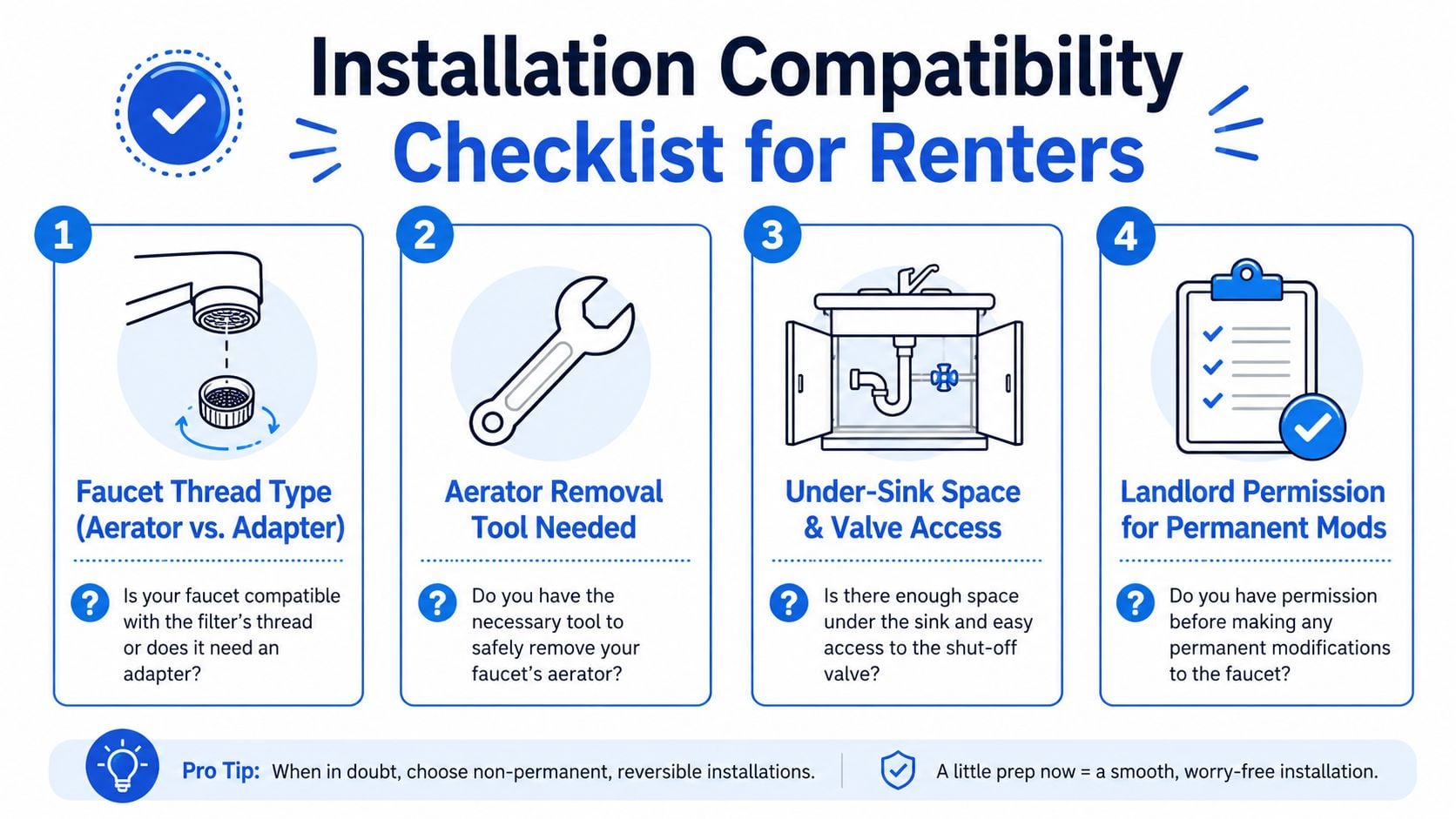
A useful checklist is simple:
- Faucet thread type: Does your faucet use an aerator that can accept an adapter?
- Tool access: Do you have the wrench or removal tool needed to take the aerator off cleanly?
- Cabinet space: If you’re considering under-sink equipment, is there room for the housing and valve access?
- Lease limits: Will your landlord allow a permanent modification, or do you need something that leaves no trace?
The bigger point is that “works in a kitchen” and “works in your kitchen” are not the same thing. If you’re comparing replacement options, the practical overview at Woder’s faucet replacement guide is useful because it centers fit and swap-out realities instead of only talking about filtration media.
How to Choose a Water Filter for Your Specific Situation
Match the filter to the household, not the hype
There isn’t one correct answer for every home. If you want the highest contaminant reduction capacity and don’t mind under-sink installation, a larger point-of-use system is usually easier to live with than a faucet body hanging off the tap. If you’re renting or sharing a small kitchen, a reversible faucet-mount or direct-connect setup is usually the cleaner choice.
Water concerns should drive the certification choice. Families focused on lead, PFAS, chromium-6, or fluoride should look for filters backed by health-contaminant standards such as NSF/ANSI 53 or equivalent validation, while households mainly bothered by chlorine taste and odor can focus on NSF/ANSI 42. That distinction keeps you from paying for claims you don’t need.
Minerals matter to some buyers more than others
The mineral question comes up a lot, and it’s worth handling directly. Selective filtration systems remove contaminants while leaving beneficial minerals in place, which is different from reverse osmosis, where the water is pushed toward a stripped-down, low-TDS result. For some households, that’s exactly the tradeoff they want. For others, it’s more filtration than they need.
If you’re selecting fixtures as part of a bigger kitchen update, a practical design guide like choosing the perfect kitchen fixture can help you think about clearance, use patterns, and visual fit before you buy hardware. The sink is a system, and the filter has to work inside that system.
A simple decision rule
- Homeowners with cabinet space: lean toward under-sink systems when flow and longer cartridge life matter more than visible hardware.
- Renters and apartment dwellers: favor reversible setups that don’t require drilling or permanent mods.
- Taste and odor concerns: NSF/ANSI 42 is often the right starting point.
- Health-related concerns: look for validated claims tied to the contaminant you’re trying to reduce.
If you want a point-of-use system that removes contaminants while keeping the setup focused and straightforward, Woder offers under-sink and inline filtration built around selective filtration and U.S. manufacturing. Visit Woder Filters to compare options, check fit, and decide whether your faucet setup calls for selective filtration or a different point-of-use layout.