You've probably noticed it at the sink already, a faint pool-like smell when the glass first fills, or a taste that seems sharper in coffee and tea than it should. That doesn't automatically mean your tap water is unsafe. In most homes, it means the utility did its job, and a disinfectant residual made it all the way to your faucet.
For homeowners, the question isn't just how to dechlorinate tap water, it's whether you're dealing with free chlorine or chloramine. That single detail decides whether sitting water overnight works, whether a carbon filter will keep up, and whether you need a faster chemical neutralizer for certain uses. If you get that part right, the rest of the decision gets much simpler.
Table of Contents
- Why Your Tap Water Smells Like a Swimming Pool
- The Critical Difference Between Chlorine and Chloramine
- Dechlorination Methods and How Long Each Takes
- Activated Carbon Filtration Done Right
- Choosing the Right Method for Your Situation
- When Dechlorination Isn't Enough
Why Your Tap Water Smells Like a Swimming Pool
You turn on the tap, fill a glass, and catch that sharp, pool-like odor before the water even reaches the counter. That smell usually comes from chlorine or chloramine, both of which utilities add on purpose to keep water protected as it moves through pipes and storage. The CDC explains that U.S. utilities first used chlorine in tap water in 1908, with chloramine following in 1929, and that history matters because those disinfectants solved one problem while creating a common point-of-use nuisance at the faucet, refrigerator line, or appliance CDC water disinfection overview.
What the residual means
By the time disinfectant reaches your kitchen, it is usually there to preserve water quality in the distribution system, not to make the glass at your sink materially different from the water leaving the plant. The CDC says chlorine or chloramine levels up to 4 mg/L, or 4 ppm, are considered safe in drinking water CDC water disinfection overview. In practice, municipal chlorine residuals are often much lower than that ceiling, which is why people usually notice taste and odor before they notice anything else.
Practical rule: If the water tastes and smells off, you are usually dealing with a quality issue, not a safety crisis.
That is why dechlorination makes sense for drinking water, cooking water, coffee, and ice. It can also reduce the smell on bath water, which is why many homeowners look for a separate chlorine filter for bathtub when shower or bath comfort matters.
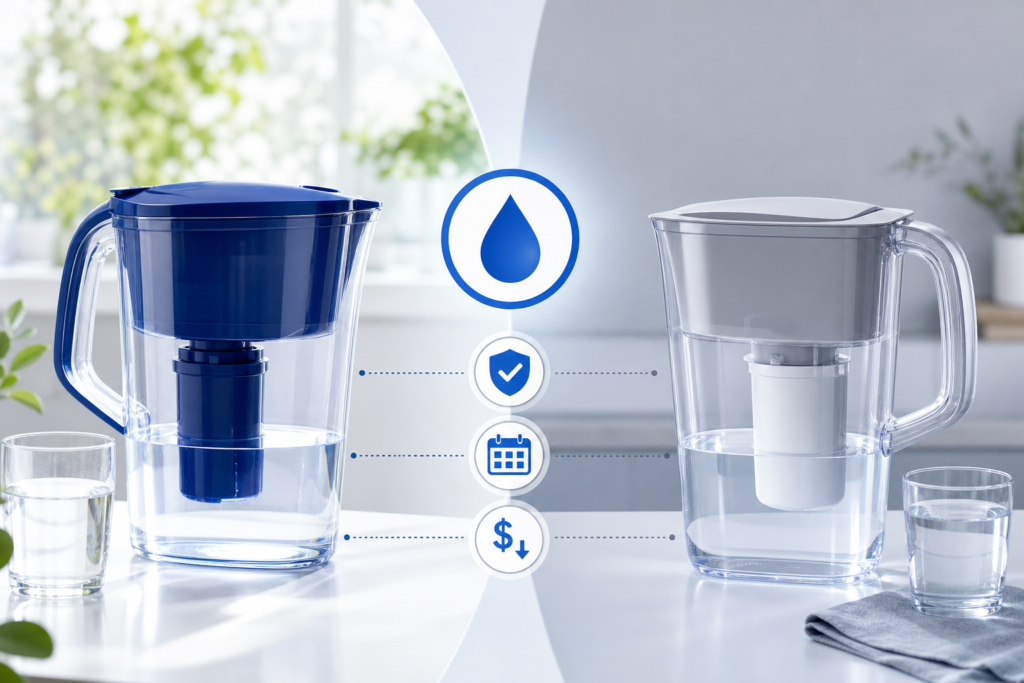
For homeowners comparing options, the decision is straightforward. If you only want better taste, point-of-use treatment is often enough. If you want to remove other contaminants too, chlorine removal becomes one part of a broader filtration plan. If you want a concise consumer-facing primer on household chlorine issues, Woder's overview, Does Tap Water Have Chlorine?, is a useful place to start.
The Critical Difference Between Chlorine and Chloramine
A lot of dechlorination advice falls apart right here. Free chlorine and chloramine both disinfect water, but they behave very differently once they leave the utility's pipes. In the U.S., about 20% of water systems use chloramine, which means a big share of “just let it sit” advice won't work for those homes TapWaterData guide.
Why standing water works for one and fails for the other
Free chlorine is unstable enough to leave water fairly quickly when it sits in an open container. Chloramine is deliberately more stable, which is why utilities choose it for longer-lasting protection in the distribution system. That same stability makes it stubborn at home, especially if you're trying to remove it by off-gassing alone.
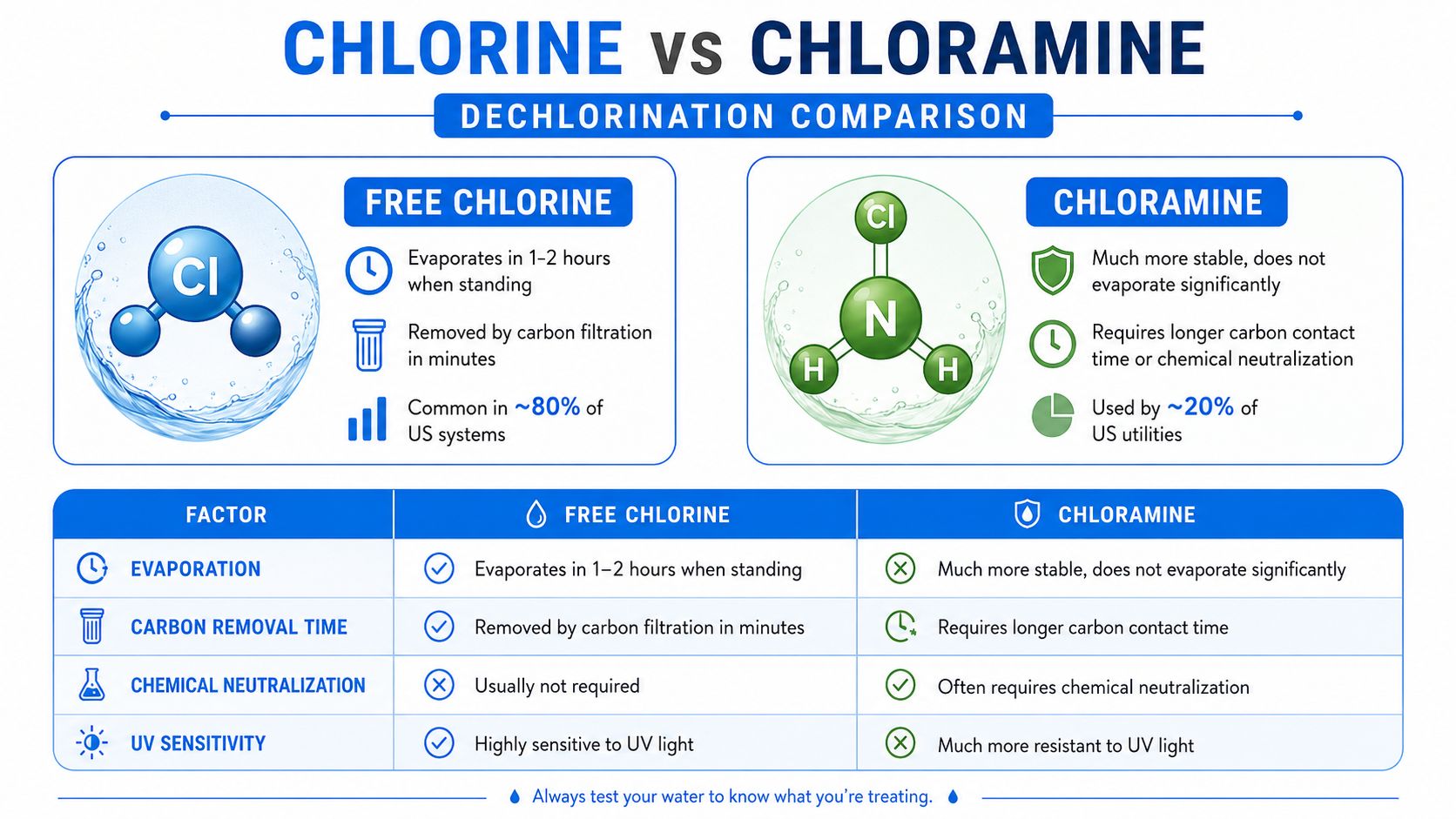
The cleanest way to find out which disinfectant you have is to read your utility's Consumer Confidence Report. That report is where the disinfectant type should be listed, and it's the first thing I'd check before buying anything. If you're in one of the chloraminated systems, the method that works for your neighbor's water may do almost nothing in your kitchen.
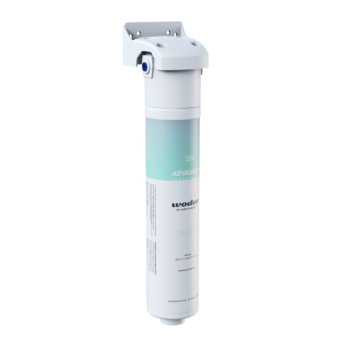
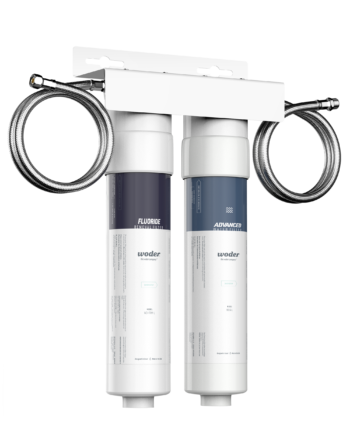
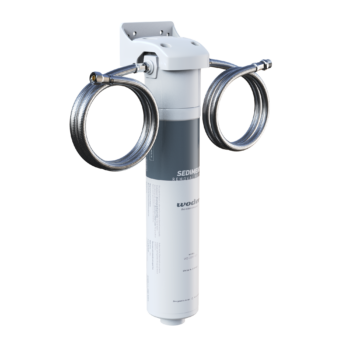
Woder Sediment Removal and Advanced Dual Filtration System is a good example of how product design reflects that difference, since its stated performance includes chlorine reduction and chloramines among the targeted contaminants. The broader point isn't about a single product, though. It's that your dechlorination method should match the disinfectant in your utility, not just your preference for a filter style.
If you don't know whether your utility uses chlorine or chloramine, you're guessing at the solution.
Dechlorination Methods and How Long Each Takes
If you need to dechlorinate tap water for drinking, cooking, or a quick household batch, the method depends on whether you are dealing with free chlorine or chloramine. Boiling is the fastest way to reduce free chlorine. A comparative BCIT study found boiling reduced chlorine to 0.24 ppm, while off-gassing left a mean of 0.51 ppm and filtration left 0.55 ppm. That boil result also fell below the WHO's 0.3 ppm taste and smell threshold, which is why boiled water often tastes flatter or less “chemical” than untreated tap water.
What works by method
Boiling is the blunt instrument. It is fast, it works well for free chlorine, and it becomes awkward if you need large volumes every day. The same BCIT work also found boiling was statistically superior under a Kruskal–Wallis test, with P=0.000. If you need water tonight, it helps. If you need a daily kitchen fix, it usually is not the method you keep using.
Passive aeration is the old “leave it on the counter” method. It can work for free chlorine, but it does not handle chloramine. For households on chloraminated water, that is the point where overnight standing water stops being a real solution. The BCIT study comparison showed how the three approaches differed even before you account for disinfectant type, with mean chlorine of 0.51 ppm after off-gassing, 0.24 ppm after boiling, and 0.55 ppm after filtration.
A simple method comparison
| Method | Timeline | Works for Chlorine | Works for Chloramine | Best For |
|---|---|---|---|---|
| Boiling | Fast | Yes | No | Immediate use, emergencies |
| Off-gassing | Slow | Yes | No | Free chlorine, patient users |
| Carbon filtration | Continuous | Yes | Sometimes, with proper sizing | Daily drinking water |
| Vitamin C | Fast | Yes | Yes | Baths, aquariums, quick neutralization |
Vitamin C is the most direct chemical option. The USDA Forest Service says 1 gram of ascorbic acid neutralizes 1 mg/L of chlorine per 100 gallons of water, and the reaction is very fast. That makes it useful when speed matters, especially for batch treatment rather than glass-by-glass drinking water.
For chloramine, the practical answer is different. Overnight standing water does not reliably remove it, and boiling is not the right fix either. If your utility uses chloramine, a carbon filter designed for that disinfectant is the method that deserves attention, not a pitcher left on the counter. The BCIT journal article reports the same lab comparison as the PDF version, so the two links point to the same underlying study rather than separate results.
If you want a practical walk-through of boiling as a household method, Woder's guide on Does Boiling Water Purify It? is a straightforward companion read.
Activated Carbon Filtration Done Right
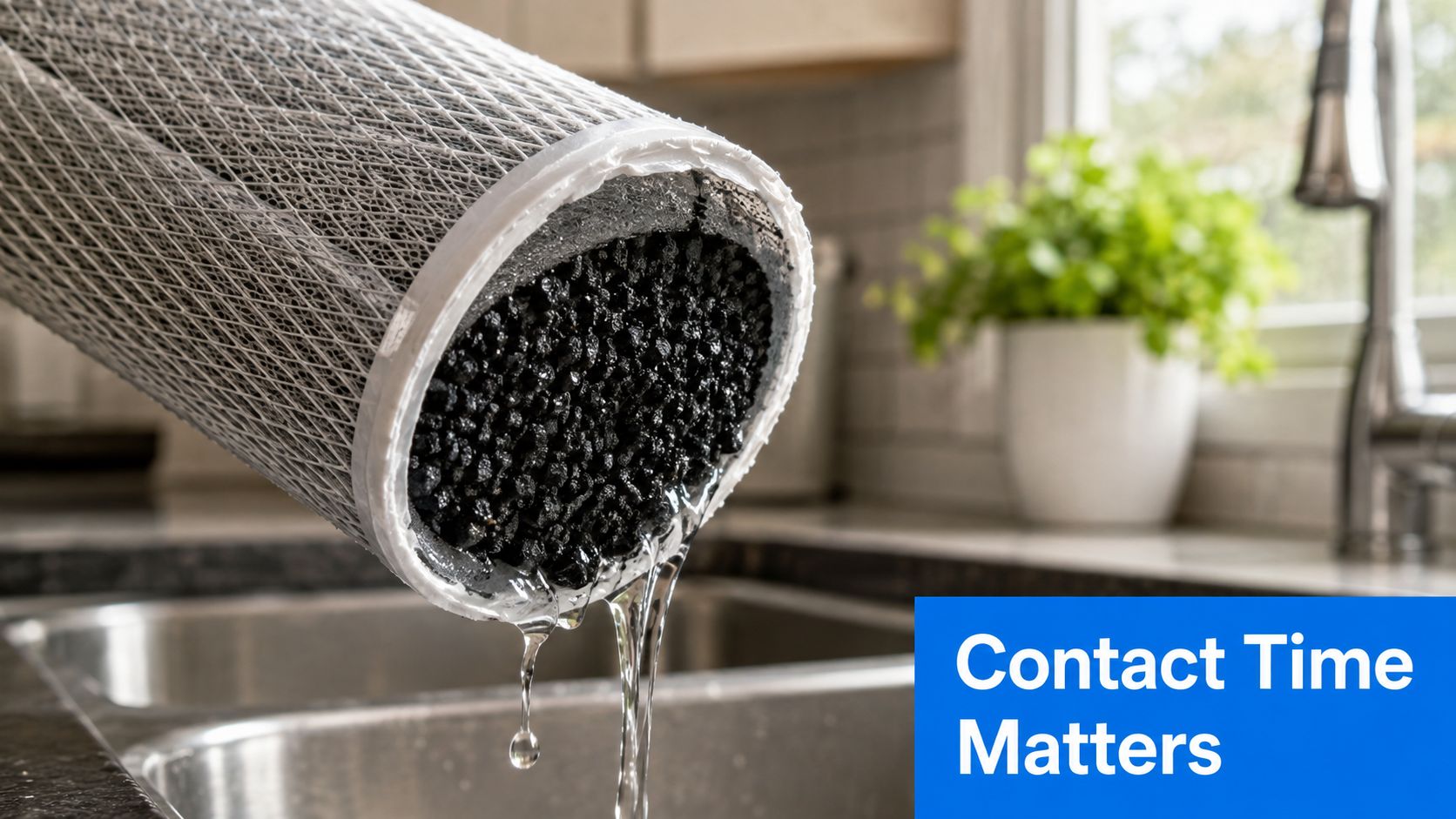
Carbon is the most practical long-term answer for many homes, but the filter media and contact time matter more than most buyers realize. The key term is empty-bed contact time, or EBCT, which is the time water spends in contact with the carbon. For chlorine, guidance in brewing and water-treatment references points to 2 to 3 minutes EBCT. For chloramine, the target is about 8 minutes EBCT, which is a much higher bar.
Why flow rate changes everything
A cartridge that looks generous on paper can still underperform if water moves through it too quickly. That's the basic trap: capacity claims tell you how much water a filter can process over its life, but not whether the water lingers long enough in the media to remove disinfectant well. When chloramine is present, standard granular activated carbon may not be enough, and catalytic carbon is the better fit because it's built for the slower chemistry of chloramine removal.
Practical rule: A filter's size matters less than its contact time when you're trying to remove chloramine reliably.
That's why flow rate needs to stay in the conversation. If you run a high-volume tap through undersized carbon, you can get weak dechlorination even when the cartridge is brand new. For a kitchen sink, that usually means choosing a system built for point-of-use flow rather than a generic cartridge sold on gallon count alone.
Standard GAC or catalytic carbon
Use standard GAC when your utility uses free chlorine and you want a simple drinking-water solution. Use catalytic carbon when chloramine is in the supply, or when you want more reliable performance under slower chemistry. The difference isn't marketing language. It's the difference between a filter that handles easy disinfection residuals and one built to handle the harder one.
The Woder article on filter for chlorine fits naturally here if you want to compare how carbon-based point-of-use systems are framed for everyday household use. That said, the right system still depends on your water report and your tap's actual flow, not just the label on the box.
Choosing the Right Method for Your Situation
The decision starts with three questions. What disinfectant does your utility use, how fast do you need the water ready, and what are you using it for. Once you answer those, the “best” method becomes a lot less vague.
A simple decision path
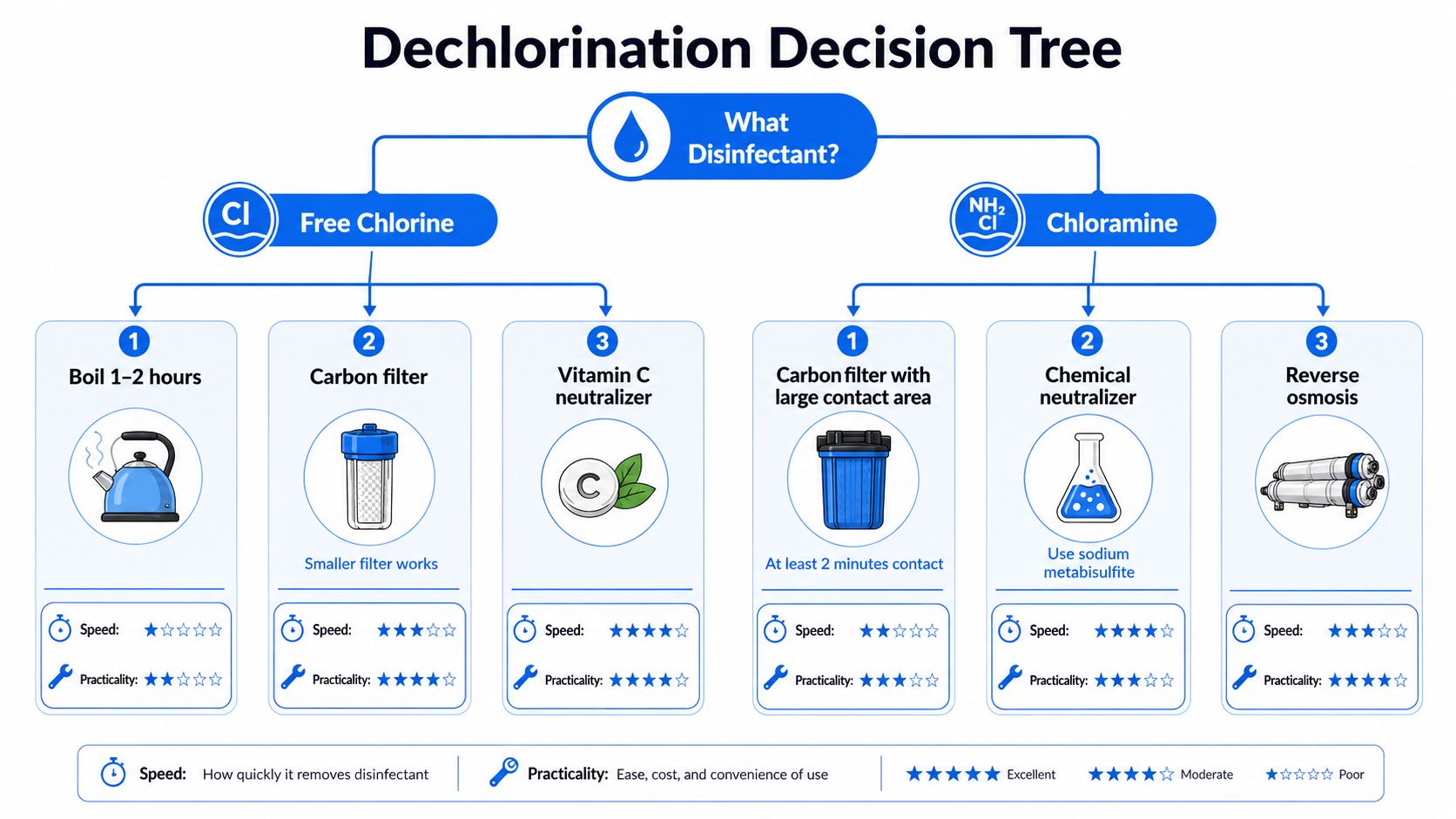
If your water contains free chlorine and you're planning ahead, sitting water in an open container can work well enough for tomorrow's coffee or cooking. If you need water right now, boiling is the quickest route. If your utility uses chloramine, standing water isn't a real solution, and you'll need carbon filtration with the right contact time or a chemical neutralizer like vitamin C.
Match the method to the use case
For drinking water, carbon filtration is usually the cleanest balance of convenience and taste. For coffee and tea, carbon has one more advantage, it removes the disinfectant residual without stripping the water down to a mineral-less base. That matters because many people want the chlorine gone but still want calcium and magnesium left in the water for flavor and extraction.
For aquariums, the rules are stricter. Untreated tap water can be a bad idea because fish are sensitive to disinfectants, so quick neutralization is often more important than flavor. For sensitive appliances, the issue is less about taste and more about preventing odor transfer and keeping the water chemistry predictable.
Boiling can help in a pinch, but it's not the best fit for every household use. Reverse osmosis also removes chlorine, but it changes the water much more aggressively than most homeowners want for everyday drinking and cooking. If your goal is just cleaner-tasting water, you usually don't need to go that far.
When Dechlorination Isn't Enough
Sometimes taking chlorine out of the water reveals the next problem. Chlorine can mask metallic tastes, organic odors, or mineral issues, so once the disinfectant is gone, the rest of the water becomes easier to notice. That's not a failure of dechlorination. It's useful feedback.
If the water still tastes off after removal, that's your sign to look deeper. Maybe the issue is lead or other metals. Maybe it's PFAS, sediment, or something your nose can pick up but your eye can't. A simple carbon filter can be enough when the only complaint is chlorine taste or smell, but it's not the answer if your concern is broader household water quality.
That's where point-of-use filtration becomes more than a taste fix. Woder's approach, for example, is built around Advanced Selective Filtration®, which targets contaminants while leaving beneficial minerals in place. For homeowners who want better-tasting water without stripping everything out, that distinction is often the deciding factor.
Test first, taste second. What you notice after dechlorination is often the clue you needed.
If you're still unsure what's in your tap, start with your Consumer Confidence Report and then choose the method that matches your disinfectant, your timeline, and your use case. If you want a point-of-use system that fits that kind of decision-making, visit Woder Filters and compare the options against your own water report and sink setup.