- Why Chlorine in Tap Water Is Worth Addressing
- The Main Types of Chlorine Filters
- What Makes a Chlorine Filter Actually Effective
- How Woder Handles Chlorine (and Everything Else)
- Comparing Your Options Side by Side
- What to Do Before You Buy
- The Bottom Line
- Frequently Asked Questions
If your tap water smells like a swimming pool, you already know chlorine is in there. Municipal water systems add it on purpose — it kills bacteria and keeps the supply safe from the treatment plant to your faucet. That part makes sense. The problem is chlorine doesn't stop working when it reaches your tap. It rides all the way to your glass, and by then it's just making your water taste and smell off.
So what actually removes it? This guide covers your real options in 2026, what each filter type does well, and what to look for before you buy.
Why Chlorine in Tap Water Is Worth Addressing
Low levels of chlorine aren't an acute health emergency. But chlorine does react with organic matter in pipes to form disinfection byproducts — compounds like trihalomethanes (THMs) and haloacetic acids — and long-term exposure to those byproducts is something researchers and regulators watch closely. Beyond the chemistry, there's a simpler issue: chlorinated water tastes flat and can dry out your skin and hair.
And if you're filtering for chlorine, you're almost certainly dealing with other contaminants too. Lead, PFAS, VOCs — they don't announce themselves. A filter worth buying handles all of it, not just the one thing on the label.
The Main Types of Chlorine Filters
Pitcher Filters
Pitchers like Brita and PUR use activated carbon to reduce chlorine taste and odor. For that specific job, they work reasonably well. The trade-off is speed, volume, and depth — they're slow, hold a small amount of water, and don't address serious contaminants like lead or PFAS with any real reliability. If taste is your only concern, a pitcher is a low-cost starting point. For broader protection, it's not enough.
Reverse Osmosis Systems
RO removes chlorine effectively — along with almost everything else, including the calcium and magnesium your body actually benefits from. These systems produce wastewater during filtration, require a storage tank under your sink, and usually need a plumber to install. They're thorough, but they're also expensive, wasteful, and more complicated than most homeowners want to take on.
Inline and Under-Sink Filters
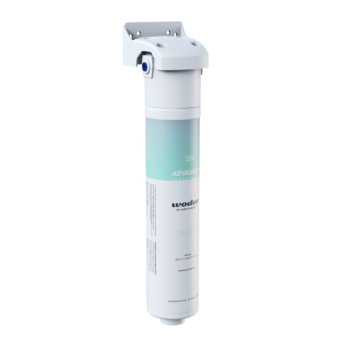
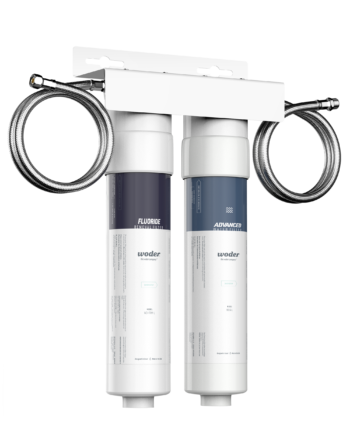
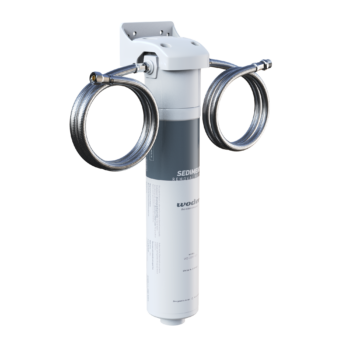
This is where most people land when they want real performance without the full RO commitment. Inline and under-sink filters connect directly to your existing water line — no tank, no wastewater, no plumber. The best ones remove chlorine alongside lead, PFAS, chromium 6, mercury, and VOCs, while keeping beneficial minerals right where they belong.
That's exactly what Woder Filters is built for.
What Makes a Chlorine Filter Actually Effective
Not every filter that claims to remove chlorine does it at the same level. Here's what separates a good one from a mediocre one:
Contaminant range. Chlorine rarely travels alone. Your water likely carries other contaminants too. A filter worth buying handles the full picture — chlorine, chloramines, lead, PFAS, VOCs, and more.
Flow rate. Some filters slow your water to a trickle. Look for a model matched to your household's actual demand. A family of four has different needs than a single-person apartment.
Mineral preservation. This is the detail most filter brands skip. Activated carbon and RO systems both remove chlorine, but RO strips out calcium and magnesium in the process. A filter that removes contaminants while keeping minerals gives you genuinely better water — not just less-bad water.
Installation simplicity. If you need a plumber, you're adding cost and complexity before you've even turned the water on. The best under-sink filters go in within minutes using basic tools.
Ongoing cost. The unit is just the beginning. Replacement cartridges are the real long-term expense. Know what you're committing to before you buy.
How Woder Handles Chlorine (and Everything Else)
Woder filters use Advanced Selective Filtration technology, which relies on nanoparticles to attract and remove contaminants at a molecular level. The "selective" part is what matters: the technology targets harmful substances — chlorine, lead, PFAS, chromium 6, mercury, carcinogens — while leaving calcium, magnesium, and other naturally occurring minerals exactly where they are.
The result is water that's clean and still tastes the way good water should. Not flat. Not stripped. Not mineral-free.
Woder's lineup covers a range of household needs:
- WD-G4-210-JG — a compact residential unit suited to smaller households
- WD-D-8K-FRM-ADV-DC — an 8 kGPM under-sink model for standard family use
- WD-10K-ADV-PORT — a 10 kGPM high-flow option for higher-demand households
- WD-S-5K-REP — a 5 kGPM replacement cartridge for existing Woder setups
- Water-Filter Bottle — a portable option for filtered water wherever you go
Every unit is manufactured in the United States. Installation connects directly to your existing water line — no whole-home overhaul, no tank, no professional required.
Comparing Your Options Side by Side
| Filter Type | Removes Chlorine | Removes Lead/PFAS | Keeps Minerals | No Wastewater | DIY Install |
|---|---|---|---|---|---|
| Pitcher filter | Partially | Rarely | Yes | Yes | Yes |
| Reverse osmosis | Yes | Yes | No | No | Often no |
| Woder inline/under-sink | Yes | Yes | Yes | Yes | Yes |
| Aquasana under-sink | Yes | Yes | Yes | Yes | Mostly |
| Culligan whole-home | Yes | Yes | Varies | No | No |
Aquasana is the closest competitor to Woder in the selective filtration space. Their Claryum technology is NSF-certified and performs well. The main difference is price — Aquasana typically runs 20 to 30 percent higher than comparable Woder models, which adds up once you factor in replacement cartridges over time.
Culligan covers the whole home but starts at $500 and generally requires professional installation. That's a different commitment entirely.
What to Do Before You Buy
If you're not sure what's actually in your tap water, start there. Woder offers a water testing tool on their site that helps you understand your specific situation before you choose a filter. Knowing whether your water has elevated lead, chlorine, or PFAS changes which model makes the most sense for your home.
From there, the product Wizard at woder.com/wizard walks you through your household's flow rate and needs to match you with the right filter. It takes a few minutes and removes the guesswork.
The Bottom Line
Chlorine removal is table stakes for any decent water filter in 2026. The real question is what else the filter handles, whether it keeps the minerals your water should have, and whether you can install it yourself without calling anyone.
Pitcher filters handle taste. RO handles everything but wastes water and strips minerals. A Woder inline or under-sink filter handles everything — chlorine, lead, PFAS, VOCs — while keeping calcium and magnesium in your glass where they belong. No tank, no plumber, no wastewater.
Remove the bad. Keep the good. That's the Woder difference.
Find the right filter for your home at woder.com.
Frequently Asked Questions
Does a water filter actually remove chlorine, or just reduce it?
It depends on the filter. Activated carbon reduces chlorine taste and odor but may not eliminate it entirely. Filters using more advanced technology — like Woder's Advanced Selective Filtration — remove 99.9% of contaminants including chlorine, which is a meaningfully different result than basic carbon alone.
Will removing chlorine from my water make it unsafe to drink?
No. Chlorine is added during treatment to kill bacteria in the distribution system. By the time water reaches your tap, that job is done. Filtering it out at the point of use doesn't reintroduce bacteria or make your water less safe.
Do under-sink filters remove chloramine as well as chlorine?
Many municipalities now use chloramine instead of chlorine because it's more stable in the distribution system. Not all filters handle both equally well. Woder's Advanced Selective Filtration addresses chlorine and a broad range of related contaminants. If you're on a chloramine-treated supply, check your local water report and confirm your filter covers it.
What's the difference between an under-sink filter and a whole-home filter for chlorine removal?
An under-sink filter treats water at the point you drink it — your kitchen faucet. A whole-home system treats all water entering the house, including showers and laundry. For drinking water quality, an under-sink filter is usually the more practical and cost-effective choice. Whole-home systems require professional installation and a significantly higher upfront investment.
How often do I need to replace the filter cartridge?
Replacement frequency depends on your household's water consumption and the model you're using. Woder sells replacement cartridges separately, so you swap the cartridge rather than the entire unit. The site includes guidance on replacement schedules based on your specific filter model.
Can I install an under-sink water filter myself?
Yes — if you choose the right filter. Woder filters connect inline to your existing water line without any plumbing modifications or professional help. Most homeowners finish installation in under 30 minutes with basic tools.
Is filtered tap water better than bottled water for chlorine removal?
For most households, yes. Bottled water quality varies by brand and isn't uniformly held to a higher standard than tap water. A quality under-sink filter gives you consistent, verified filtration at a fraction of the ongoing cost of bottled water — and without the plastic waste.