Table of Contents
- What Are PFAS Chemicals?
- Why PFAS Are Called "Forever Chemicals"
- How PFAS Get Into Your Drinking Water
- What Health Risks Are Linked to PFAS Exposure?
- PFAS Regulations in 2026: Where Things Stand
- How to Know If PFAS Are in Your Water
- How to Remove PFAS from Drinking Water
- FAQs
PFAS have been making headlines for years, but 2026 feels different. More water utilities are testing for them. More communities are finding them. And more homeowners are asking the same two questions: is this in my water, and what do I do about it?
This article answers both. Plainly, without the panic.
What Are PFAS Chemicals?
PFAS stands for per- and polyfluoroalkyl substances — a large family of synthetic chemicals, more than 12,000 compounds in total, that have been manufactured and used in consumer and industrial products since the 1940s.
You have almost certainly been exposed to them without knowing it. PFAS show up in non-stick cookware, water-resistant clothing, food packaging, firefighting foam, and stain-resistant carpet treatments. They are genuinely everywhere, which is exactly the problem.
What makes PFAS a persistent organic pollutant comes down to chemistry: the carbon-fluorine bond at their core is one of the strongest in nature. That stability is why these compounds do not break down in the environment — and why they accumulate in soil, water, and living tissue over time.
Why PFAS Are Called “Forever Chemicals”
The nickname earns its reputation. PFAS do not degrade under normal environmental conditions. Sunlight, water, soil — none of it breaks them down the way it does most other chemical contaminants. Once they are released, they stay.
That has two real consequences. First, PFAS build up in the environment over decades. Second, they accumulate in the human body — a process called bioaccumulation. The longer and more frequently you are exposed, the higher your body burden tends to climb.
This is what sets PFAS apart from something like chlorine, which dissipates relatively quickly. PFAS do not. That is why researchers and regulators treat them as a different category of concern.
How PFAS Get Into Your Drinking Water
PFAS reach water supplies through several routes, and most of them are not obvious from the outside.
Industrial discharge is one of the primary sources. Facilities that manufacture or use PFAS-containing products have historically released these compounds into nearby waterways and groundwater.
Firefighting foam is another major contributor. Aqueous film-forming foam (AFFF), used at military bases, airports, and industrial fire training sites, contains high concentrations of PFAS. Runoff from these sites has contaminated groundwater in hundreds of communities across the country.
Consumer product leaching adds to the picture. PFAS from packaging, textiles, and other everyday products can migrate into food and water over time.
Agricultural land application of biosolids — treated sewage sludge used as fertilizer — has spread PFAS into farmland and, eventually, into water sources that feed municipal supplies.
The result is that PFAS contamination is not limited to industrial zones. It has been detected in water systems serving rural towns, suburbs, and major cities alike.
What Health Risks Are Linked to PFAS Exposure?
Research on PFAS health effects has grown substantially, and the picture is not reassuring. The EPA and other health agencies have linked long-term PFAS exposure to a range of serious concerns:
- Increased risk of certain cancers, including kidney and testicular cancer
- Thyroid hormone disruption
- Immune system suppression, including reduced vaccine response
- Elevated cholesterol levels
- Reproductive and developmental effects, including reduced birth weight
- Liver damage
Children and pregnant people face heightened concern. PFAS can cross the placenta and appear in breast milk, and developing immune and endocrine systems are more sensitive to disruption.
To be clear: most of this research involves long-term, repeated exposure rather than a single glass of contaminated water. But because PFAS accumulate in the body and clear slowly, ongoing low-level exposure from tap water adds up over years. That is the part worth taking seriously.
PFAS Regulations in 2026: Where Things Stand
The regulatory landscape around PFAS has moved faster in recent years than at any point since these chemicals were first flagged as a concern.
The EPA's enforceable maximum contaminant levels (MCLs) for six PFAS compounds — including PFOA and PFOS — took effect in 2024, with public water systems required to comply by 2026. These are the first federal drinking water standards ever set for PFAS, and they cap PFOA and PFOS at 4 parts per trillion individually.
Four parts per trillion is an extremely low threshold. It reflects how seriously regulators now view even trace exposure. Many utilities are actively working toward compliance, but timelines vary — and private well owners fall entirely outside the scope of federal water system rules.
Several states have gone further, setting stricter limits or expanding testing requirements. The regulatory picture in 2026 is more protective than it was two years ago, but it is still evolving. And compliance does not guarantee zero PFAS in your tap water.
How to Know If PFAS Are in Your Water
If you get water from a public utility, your annual Consumer Confidence Report (CCR) is the place to start. Water systems are now required to test for PFAS and report results. You can request this report from your utility or find it through the EPA's online database.
If you are on a private well, you need to test independently. PFAS have no taste, no smell, and no visible effect on water — there is no sensory way to detect them. A certified laboratory test is the only reliable method.
Woder also offers water testing kits so you can understand what is actually in your water before choosing a filter.
How to Remove PFAS from Drinking Water
Not every filter removes PFAS — and that distinction matters. Here is how the main approaches compare.
Pitcher Filters
Standard pitcher filters use activated carbon, which can reduce some PFAS compounds to a degree. But they are not designed or tested for the full range of PFAS, and flow rates through the media are often too fast to achieve meaningful reduction. For serious contaminant concerns, most experts consider pitcher filters inadequate.
Reverse Osmosis Systems
RO systems are effective at removing PFAS. The membrane physically blocks these compounds from passing through. The tradeoffs are real, though: RO systems waste three to four gallons of water for every gallon filtered, strip out beneficial minerals like calcium and magnesium along with the contaminants, require a storage tank, and involve a more complex installation. Costs range from a few hundred dollars for countertop units to several thousand for whole-home systems with professional installation.
Inline and Under-Sink Filters
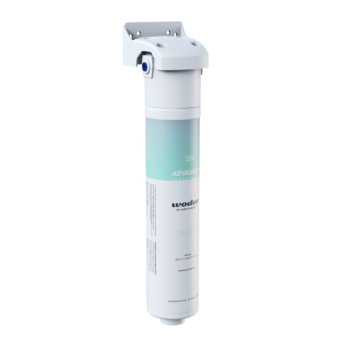
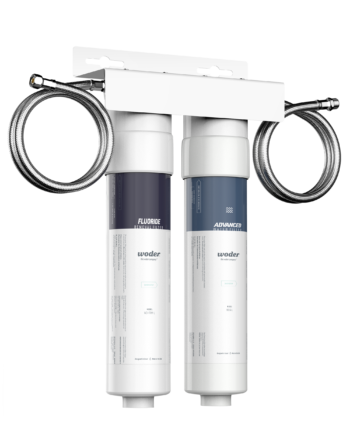
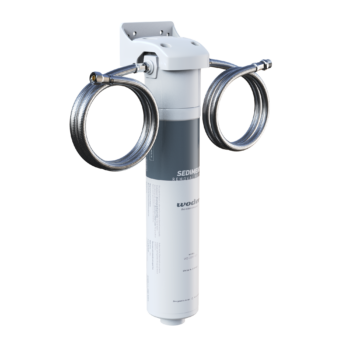
Advanced inline filters using selective filtration technology offer a middle path — removing PFAS and other serious contaminants without stripping out the minerals your body actually needs, and without producing wastewater.
Woder's Advanced Selective Filtration technology uses nanoparticles that attract and remove contaminants including PFAS, lead, chlorine, chromium 6, mercury, and VOCs — while leaving calcium, magnesium, and other naturally occurring minerals intact. The filters install directly into an existing water line under your sink. No tank, no plumber, no whole-home overhaul. Made in the United States, and built for genuine DIY installation.
Remove the bad. Keep the good. That is the Woder difference.
Not sure which model fits your household's flow rate and setup? The product Wizard at woder.com/wizard walks you through it in a few steps.
FAQs
What does PFAS stand for?
PFAS stands for per- and polyfluoroalkyl substances — an umbrella term covering thousands of synthetic chemicals that share a carbon-fluorine bond, making them highly resistant to breaking down in the environment or the human body.
Why are PFAS called persistent organic pollutants?
Because they do not degrade under normal environmental conditions. The carbon-fluorine bond at the core of PFAS chemistry is one of the strongest in nature, so these compounds accumulate in soil, water, and living tissue over time rather than breaking down. That is the defining characteristic of a persistent organic pollutant.
Are PFAS in my tap water right now?
Possibly. PFAS have been detected in water systems across the United States, including in suburban and urban areas far from industrial sites. Your utility's Consumer Confidence Report will show whether PFAS were detected in your supply. If you have a private well, you need to test independently.
What health problems are linked to PFAS in drinking water?
Long-term PFAS exposure has been associated with certain cancers (including kidney and testicular), thyroid disruption, immune suppression, elevated cholesterol, and developmental effects in children. Pregnant people and young children face particular concern because PFAS can cross the placenta and accumulate in developing systems.
Do regular water filters remove PFAS?
Standard carbon pitcher filters offer limited and inconsistent PFAS reduction. Reverse osmosis systems are effective but strip out beneficial minerals and produce significant wastewater. Advanced inline filters using selective filtration technology — like those from Woder — remove PFAS and other serious contaminants while preserving naturally occurring minerals.
What is the current EPA limit for PFAS in drinking water?
As of 2026, the EPA's enforceable maximum contaminant levels for PFOA and PFOS are set at 4 parts per trillion — the first federal drinking water standards ever established for PFAS. Public water systems are required to comply by 2026, though private well owners fall outside this requirement.
How do I find the right PFAS filter for my home?
Start by testing your water so you know what you are dealing with. Then match a filter to your household's flow rate and setup. Woder's product Wizard at woder.com/wizard helps you find the right model based on your specific situation — no guesswork required.
PFAS are a real concern, and the science behind them has only gotten clearer. But understanding what they are and how to address them puts you in a much stronger position than most people. Your water matters. So does what you do about it.
Learn more at woder.com.