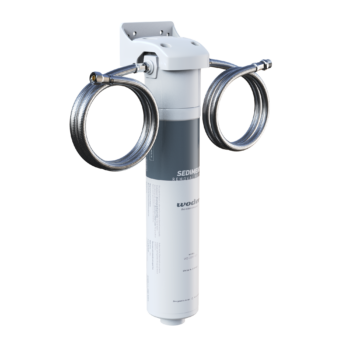
You can have clear water at the faucet and still have a sediment problem sitting upstream. The clue is often a small one, cloudy water after a hydrant flush, grit after a pump cycle, or a cartridge that seems to clog too quickly even though the water doesn’t look terrible. A pleated sediment water filter is usually about protecting the rest of the system first, so the more useful question isn’t just “what micron rating should I buy,” it’s “what kind of particles is my house seeing?”
Table of Contents
- Why Sediment Control Is the First Filter Decision
- How a Pleated Sediment Filter Works
- Pleated vs String-Wound vs Melt-Blown Depth Filters
- Choosing the Right Micron Rating and Housing Size
- When a Pleated Filter Is the Wrong First Choice
- Rinsing, Reuse, and Replacement Economics
- How Pleated Sediment Filtration Fits the Whole System
Why Sediment Control Is the First Filter Decision
A homeowner usually notices sediment at the worst moment, right after work on the water line, after the well pump kicks on, or when a faucet suddenly spits out cloudy water. That’s not just a cosmetic issue. Sediment acts like grit in a machine, it wears on downstream filters, clogs refrigerator lines, and settles in water heaters and other fixtures.
The first defense depends on where the particles are coming from. Municipal systems can shed debris after line disturbance, private wells often bring in silt and variable turbidity, and older galvanized piping can release rust and mineral scale as it ages. Those are different problems, even if they all show up as “dirty water.”
A pleated cartridge usually sits at the front of the system, not because it solves everything, but because it protects everything else. If the house is also using selective contaminant media or carbon, the sediment stage keeps those cartridges from loading up too early. That’s why sediment control is less about chasing the cleanest-looking water and more about preserving the life and flow of the whole setup.
Practical rule: if the water looks cloudy after a disturbance, start by asking what the particles are, not just how to filter them.
For a plain-language walkthrough of water testing basics, the guide on how to test your water is a useful starting point. If you’re also dealing with hot-water issues, Big Bear water heater repair tips from Bear Valley Plumbing & Heating gives a helpful example of how sediment and system wear can show up at the fixture.
How a Pleated Sediment Filter Works
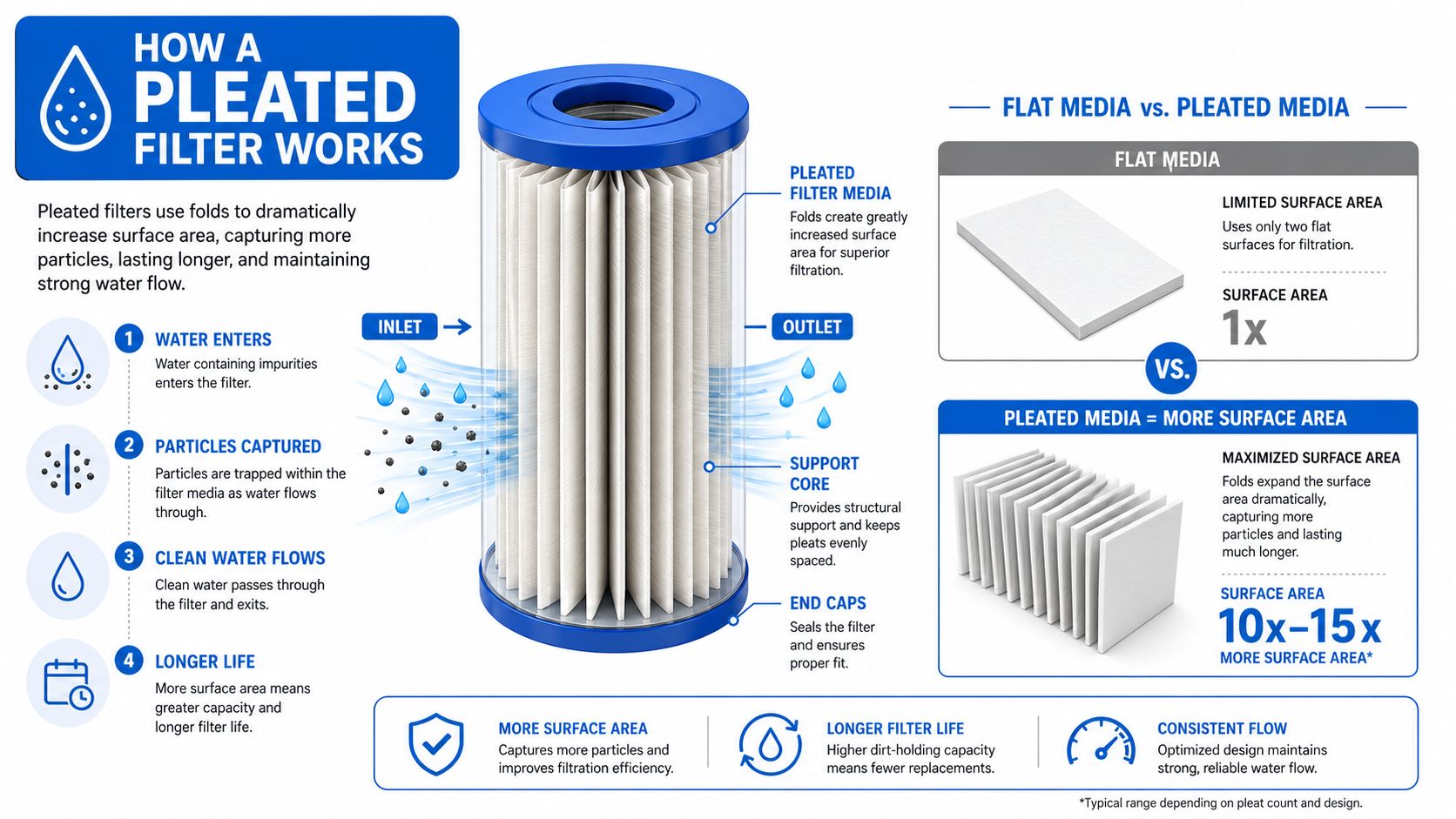
A pleated cartridge increases surface area the way an accordion expands, the material is the same, but more of it meets the water at once. That extra face area gives fine silt more places to land, which helps the cartridge hold debris longer in water that is cloudy some days and clearer on others.
The parts that matter
The media is usually a fine synthetic sheet, often PET polyester in product families described by suppliers. A polypropylene core keeps the cartridge from collapsing under flow, and the end caps seal the element into a standard housing. Those parts may seem minor, but they determine whether the cartridge keeps its shape, keeps its flow, and seats correctly in the filter body.
Pleated elements are surface filters. Particles collect on the outside of the folds, so the cartridge can hold more sediment before flow starts to tighten. That is different from depth-style cartridges, where particles move into the media itself and load through the thickness. The surface approach is why pleated designs are commonly described as having 5 to 10 times the surface area of standard filters, and one manufacturer notes up to 300% more surface area than spun-bond alternatives. That extra area helps lower pressure drop and stretch service intervals. Source on pleated surface-area design
Micron rating adds another layer. A nominal rating tells you where a cartridge is expected to catch a large share of particles, while an absolute rating is tighter. Industry descriptions in the brief place pleated product families across a broad range, roughly 0.1 μm to 60 μm, so the design can be matched to very different water conditions. Product family micron range
Fine silt behaves differently from coarse grit. In water with changing turbidity, the first layer of sediment can spread across the folds instead of packing a single patch, which is why the cartridge often keeps flowing after a small cloud of debris passes through. That behavior is easier to understand once you see how pleated media gives the water more lanes to move through instead of forcing everything onto one small spot. For a plain-language overview of filter flow and cartridge behavior, how water filters work is a helpful reference.
| Housing Size | Flow Rate (GPM) | Micron Ratings | Typical Use |
|---|---|---|---|
| 2.5 in x 10 in | 4.46 to 4.72 | 1 to 50 | Under-sink or inline sediment protection |
| 4.5 in x 20 in | 21.08 to 22.00 | 1 to 50 | Whole-house or higher-flow service |
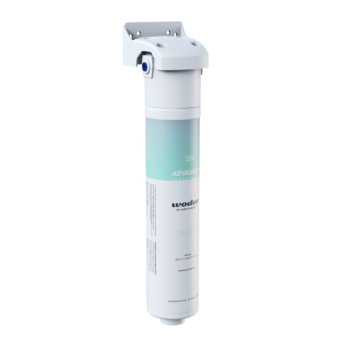
The housing size changes how the pleats behave in the world. A smaller cartridge suits a compact point-of-use setup, while a larger housing gives more media area for a whole-house system that has to handle a bigger and less predictable sediment load. A catalog example that matches this format is Woder Sediment Water Filter – Dirt, Sand and Dust Removal, a U.S.-made under-sink sediment filter described as a 20µ pre-sedimentation cartridge for dust, dirt, and contaminants.
Pleated vs String-Wound vs Melt-Blown Depth Filters
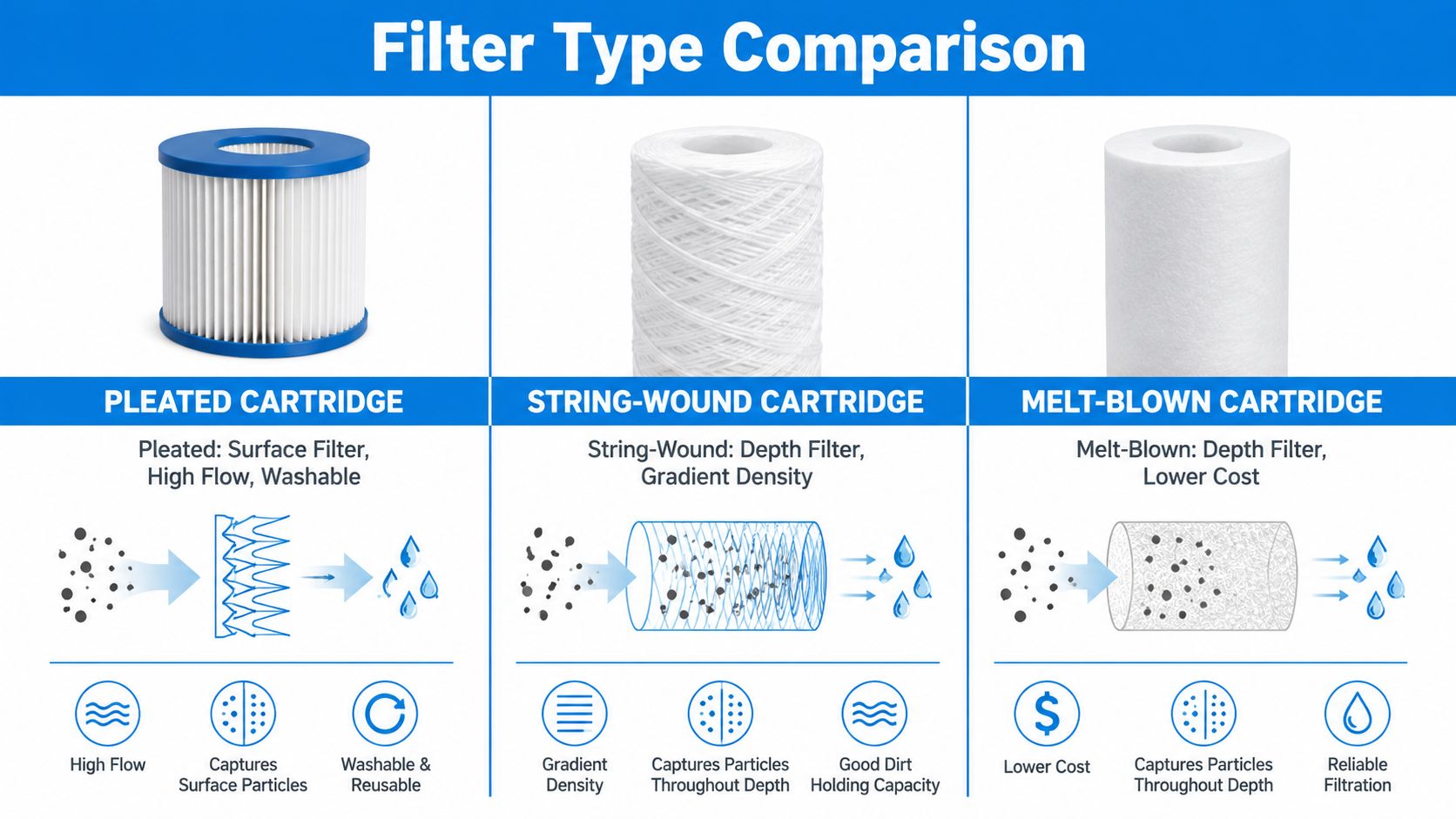
Pleated cartridges are usually the easiest to understand because they filter on the surface. That’s also why they stay more stable in clean municipal water, where the particle load is modest and the main goal is to preserve pressure. The tradeoff is that the surface can cake over, which changes performance fast once the outside layer starts loading.
String-wound cartridges work differently. They trap particles through the thickness of the media, so the dirty water keeps moving inward while the filter loads. That depth behavior gives them a strong role in harsher well-water conditions, but the pressure drop tends to rise sooner because the cartridge is doing more work inside a tighter structure.
Melt-blown cartridges sit in between on cost and construction. They’re made from compressed fibers with graded density, which makes them practical and widely available. They’re also the type homeowners often see in cheaper housings, but they usually load faster than a pleated cartridge when the water carries a steady sediment stream.
| Cartridge Type | How It Traps Sediment | Main Strength | Common Tradeoff |
|---|---|---|---|
| Pleated | Surface loading on the folds | Lower pressure drop, washable in some models | Can cake over on fine, variable silt |
| String-wound | Depth loading through the media | Good for heavier sediment loads | Pressure can fall off faster |
| Melt-blown | Graded-density depth filtration | Lower-cost option | Loads quickly in dirty water |
The selection question isn’t which one sounds more advanced. It’s which one matches the water profile. If the incoming water is mostly light sediment and you care about flow, pleated makes sense. If the water is muddy or highly variable, depth-style cartridges may belong first, with pleated media used later as a polishing stage.
Choosing the Right Micron Rating and Housing Size
A homeowner usually starts noticing the problem at the tap. The water may leave rust streaks, carry visible sand, or turn cloudy after a storm or a pump cycle, and that is the cue to match the micron rating to the sediment you are dealing with. If the water carries obvious sand or rust, a 50-micron cartridge is often the starting point. For general downstream protection, 20-micron is a common middle ground. Finer silt points the selection toward 5-micron, and polishing applications can go down to 1-micron.
The cartridge size has to keep pace with that choice. A 2.5 x 10 inch cartridge fits under-sink and inline installations where space is tight, but it has less media area to spread out the load. A 4.5 x 10 or 20 inch housing gives the pleats more room to work, which helps when flow demand rises and the cartridge needs more open area to avoid an early pressure drop. Product sheets in the brief show how larger formats support much higher service flow, with flow rates reaching the low 20s GPM in larger housings. Atlas Filtri pleated cartridge spec sheet
The operating limits matter just as much as micron rating and size. One product sheet lists a 176°F maximum operating temperature, 0.45 MPa maximum feed pressure, and 0.15 MPa proposed replacement differential pressure. Another Watts cartridge lists a maximum flow rate of 8.0 GPM, maximum temperature of 140°F, and maximum capacity of 9,999 gallons for a 2.5 in x 9.78 in format. Those limits define where the cartridge can run safely, and they also explain why a fine cartridge in a small housing can feel restrictive at the faucet. Operating limits and flow example
Decision shortcut: match the cartridge to the worst particle you can see, then choose the housing that keeps flow steady at peak demand.
For readers comparing tighter polishing stages, install and maintain a 0 2 micron shows how quickly expectations change as the rating gets finer. A washable pleated example can also be built for reuse, as shown by the Finerfilters 10-inch standard pleated sediment filter, which is rated for 160,000 liters / 42,268 U.S. gallons, with an average flow rate of 0.3 U.S. gallons per minute and a 6-month lifespan. Washable pleated cartridge example
When a Pleated Filter Is the Wrong First Choice
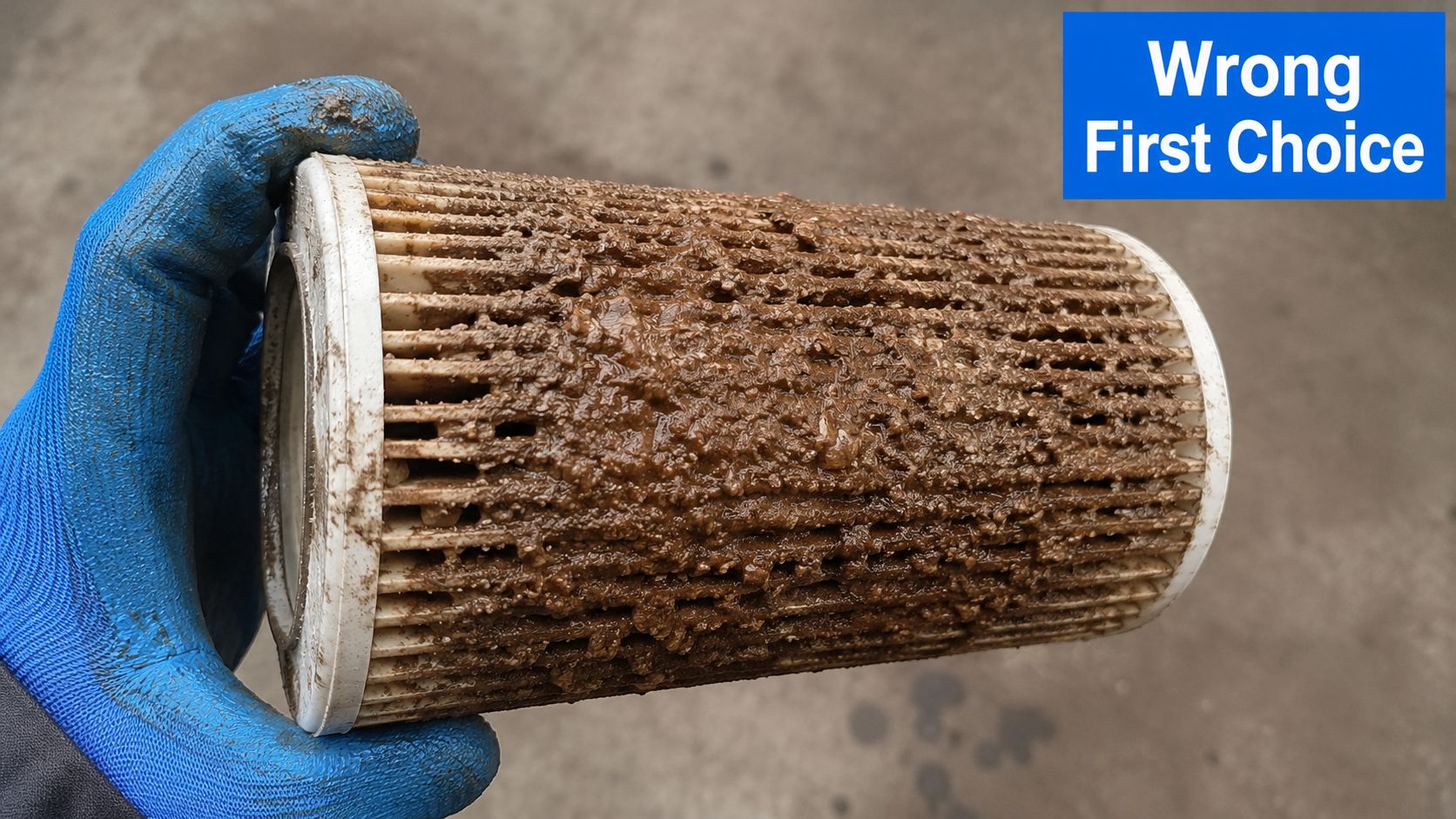
Pleated doesn’t automatically mean better. In water with fine silt, mixed particle sizes, or biologically active well conditions, the outside of the pleats can build a surface cake fast. The cartridge may still look usable, but flow can drop sharply because the water is being forced through a loaded skin instead of open media.
That’s the part many product pages skip. A pleated cartridge can handle large particulate loads well, but it’s not always the most forgiving option when the water is messy in a different way. Academic guidance on mechanical filtration notes that pleated cartridges are good at large particulate loads and high turbidity, yet the same surface-cake mechanism can slow flow as particles accumulate. UGA mechanical filtration guidance
A chronically muddy well often needs a different first step. A depth-style or gradient-density pre-filter can take the brunt of the load, then a pleated cartridge can polish the water afterward. That sequence is less glamorous than buying the sleekest-looking cartridge first, but it usually fits the water better.
A filter that lasts longer isn’t automatically a filter that works better for your house.
This is the main counterpoint to the usual consumer advice. If the water profile is unstable, sediment type matters more than cartridge style. Pleated media still has a place, just not always at the front of the line.
Rinsing, Reuse, and Replacement Economics
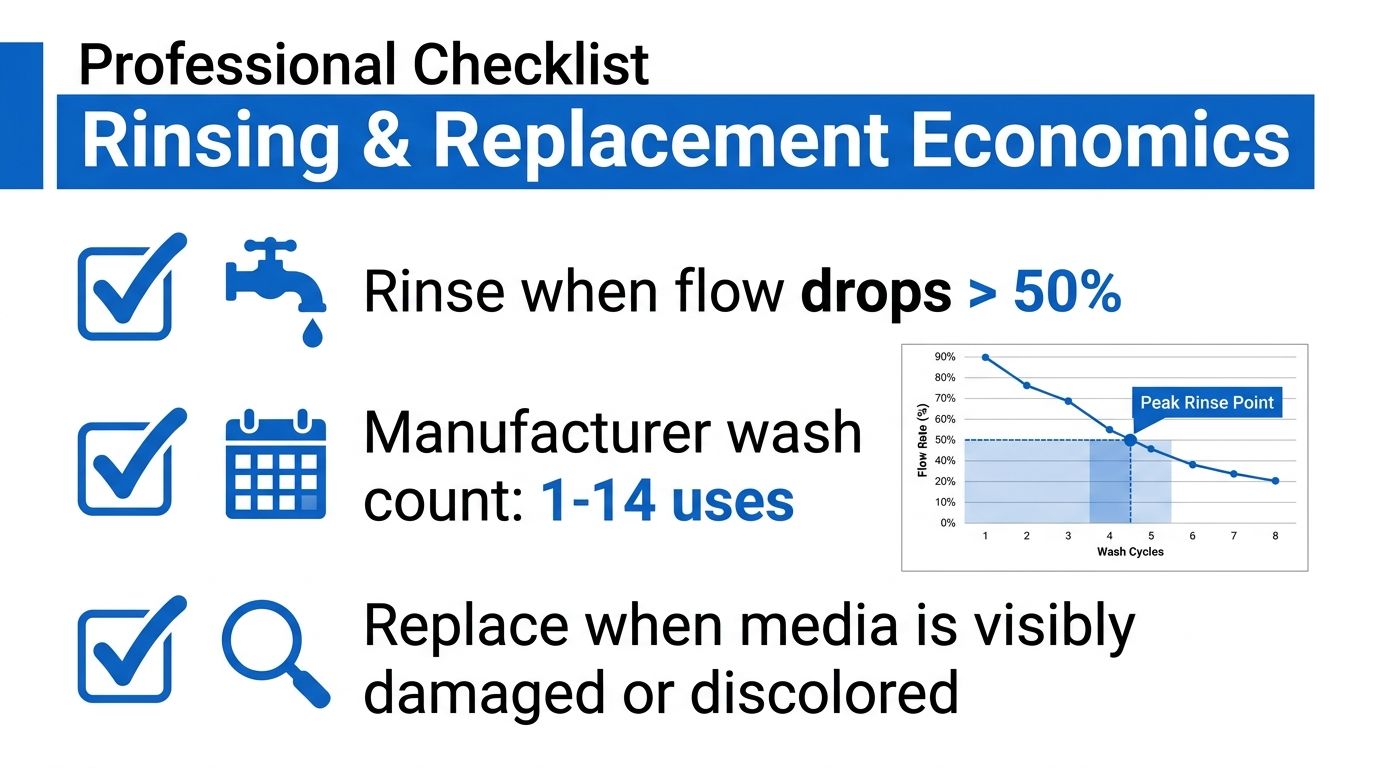
The maintenance question is the one homeowners ask after the first cartridge clogs: rinse it, or replace it. There isn’t one universal answer. Manufacturer-support guidance says the number of washes can range from 1 to 14 depending on use, and replacement timing is often tied to pressure drop rather than a fixed calendar date. Wash-count guidance
The practical rule is straightforward. Rinse when the cartridge is loaded with inert sediment like sand, rust, or silt, and the media still looks intact. Replace when the cartridge is discolored, when biological growth is present, or when flow doesn’t recover after a rinse. If the water has iron, biofilm, or oily residue, rinse-and-reuse becomes less predictable and replacement is usually the cleaner choice.
The economics change a lot by design. A reusable pleated cartridge can be engineered for far more total service than a disposable one, which is why the same product family can look inexpensive on paper but perform very differently in a real house. The Finerfilters example makes that obvious, a single 10-inch washable pleated cartridge is described with a 160,000 liter / 42,268 U.S. gallon capacity and a 6-month life, which tells you the manufacturer is assuming reuse as part of the maintenance model. Washable pleated cartridge example
For a broader replacement discussion, water filter replacement cartridge is a useful companion piece if you’re trying to compare upkeep styles across cartridge types. The key is to treat rinsing as a recovery step, not a guarantee. If the cartridge doesn’t bounce back, it’s telling you the load is beyond what that element should keep taking.
How Pleated Sediment Filtration Fits the Whole System
A pleated sediment cartridge doesn’t finish the job, it makes the rest of the system viable. Once grit and suspended solids are removed, the next stage can focus on the contaminants that matter most in drinking water, like lead, PFAS, chlorine, and chromium-6, without being worn down by particles first. That’s the part many whole-house plans miss, they treat filtration like one decision instead of a sequence.
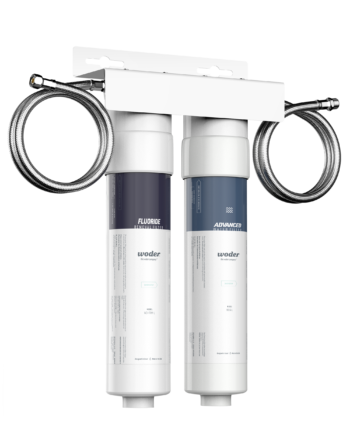
Selective filtration becomes useful here. Woder’s Advanced Selective Filtration® is built to remove contaminants while leaving essential minerals like calcium and magnesium in the water, which is a different outcome from reverse osmosis systems that strip dissolved solids out of the water entirely. The distinction matters because a sediment stage protects the selective stage, and the selective stage protects the water you drink.
For homeowners comparing installation paths, it helps to think in layers. The sediment cartridge takes the mechanical load. The selective stage handles the chemistry. If the house has variable sediment, cloudy water after maintenance work, or a well that changes with the season, that first layer is the one that keeps the rest of the system from getting exhausted too early.
If you’re checking a plumbing setup at the same time, Melbourne hot water system installation tips is a practical reminder that water treatment and water heating often affect each other more than people expect. Sediment in one part of the system tends to show up in another.
The most useful next step is simple, find out what your water contains through a Consumer Confidence Report or a lab test, then match the sediment stage and the contaminant stage to that profile. That keeps the decision grounded in the house you live in, not the label on the cartridge.
Woder Filters offers point-of-use systems built around Advanced Selective Filtration®, along with sediment cartridges that can help protect downstream drinking-water stages from grit and clogging. If you’re comparing cartridge types for your home, visit Woder Filters to review the options and see which setup fits your water profile.