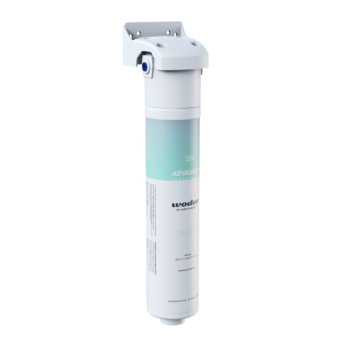
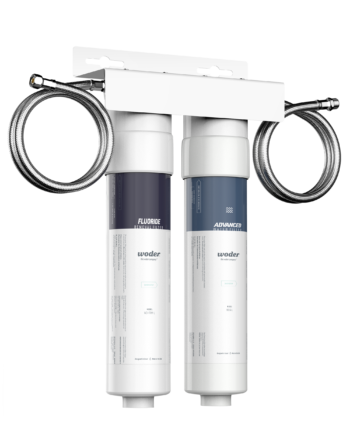
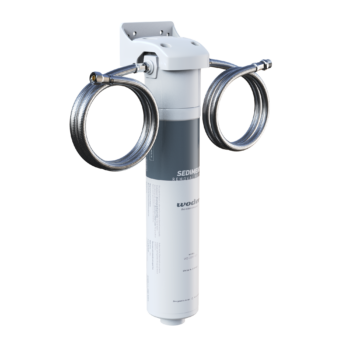
You've got the old cartridge out, or maybe you're staring at a housing that's still working but isn't doing the job anymore, and now the problem shows up. The water tastes off, the flow feels weaker, the original box is gone, and the part number on the filter has worn to nothing. That's where most homeowners get stuck, because the next cartridge looks simple until you try to match the old one to a shelf full of almost-identical options.
A water filter replacement cartridge is rarely a universal swap. The right one has to match the housing, seal correctly, fit the flow and pressure your system experiences, and stay within the cartridge's operating limits. A calendar reminder can help, but it won't tell you whether the filter has reached the end of its useful life.
Table of Contents
- When the Cartridge Goes Bad and You Don't Know What to Order
- How to Identify the Cartridge You Already Have
- What the Spec Sheet Means
- Cartridge Types and Where Each One Fits
- Replacement Timing Based on System Behavior
- A Safe and Clean Replacement Procedure
- Buying Without Getting Burned
- Quick Reference and Next Steps
When the Cartridge Goes Bad and You Don't Know What to Order
The usual moment is plain enough. The faucet slows down, the taste changes, and the old cartridge is either stained beyond recognition or already in the trash. If you've ever stood there with the housing open and a phone in your hand, you already know the problem isn't just replacement, it's identification.
The gap most buyers fall into
Many know they need a new cartridge, but they don't know which details matter enough to trust. Brand names help when the old part is still labeled, but plenty of cartridges lose their markings, and older housings can outlast the original paperwork by years. That's when guessing gets expensive, because a cartridge can look close and still fail to seal.
The category itself also encourages confusion. Replacement timing is often discussed as if every filter lived on the same schedule, but typical guidance puts most cartridges in a 3- to 12-month window, with many drinking-water and inline systems landing in the 6- to 12-month range source. That's useful as a broad frame, but it doesn't tell you whether your cartridge is the right size, the right media, or the right fit for the housing in front of you.
Practical rule: when the old part is gone, the housing and the cartridge dimensions matter more than the memory of what used to be installed.
For homeowners moving between generations of the same setup, even a model change can matter. Woder's own discussion of the transition from a Gen3 to a Gen4 replacement cartridge shows how easy it is to assume “close enough” will work when the interface changed enough to matter, especially at the sealing points Woder Gen3 to Gen4 replacement guidance. That's the mindset to keep here, measure first, then order.
By the time you finish this guide, the cartridge in front of you should feel less like a mystery part and more like a spec sheet you can read with confidence.
How to Identify the Cartridge You Already Have
Start with the cartridge itself, not the store listing. Look for a brand name, model code, flow marking, or any printed spec that hasn't fully faded. Then check the housing, because some systems tell you more from the cap, label, or canister shape than from the cartridge body.
Read the part like a mechanic, not like a shopper
The three measurements that matter most are length, outside diameter, and inside diameter. Industry support guidance says those are the core dimensions to verify, along with the core style, because a mismatch can stop the cartridge from sealing even if the filtration media is correct Boshart cartridge identification guidance. If the cartridge uses a plastic or metal core, note that too, because the interface is part of the fit.
You'll also want to look at the connection style. Some cartridges use push-fit or quick-connect arrangements, while others rely on threaded housings or a compression-style seal. A cartridge that slides in the wrong way can leave a tiny bypass path, and bypass is one of those failures that often shows up as “the filter doesn't seem to work,” even though the part technically installed.
If the old cartridge has no visible part number, don't stop there. Measure the body, check the seal groove, and compare the housing opening to the cartridge ends before you order anything. That's especially useful in legacy systems where the original part number has vanished but the physical dimensions are still readable.
One practical example of why this matters is Woder's Woder Sediment Removal and Advanced Dual Filtration System. Its second-stage cartridge, the WD-GEN4-2512TC, is described with WQA certification to NSF/ANSI 42 for chlorine taste and odor and NSF/ANSI 372 for lead free compliance, but the fit still depends on the system's cartridge envelope and interface, not just the media claim.
If the old cartridge is missing its label, the housing dimensions usually tell the truth faster than the brand memory does.
What the Spec Sheet Means
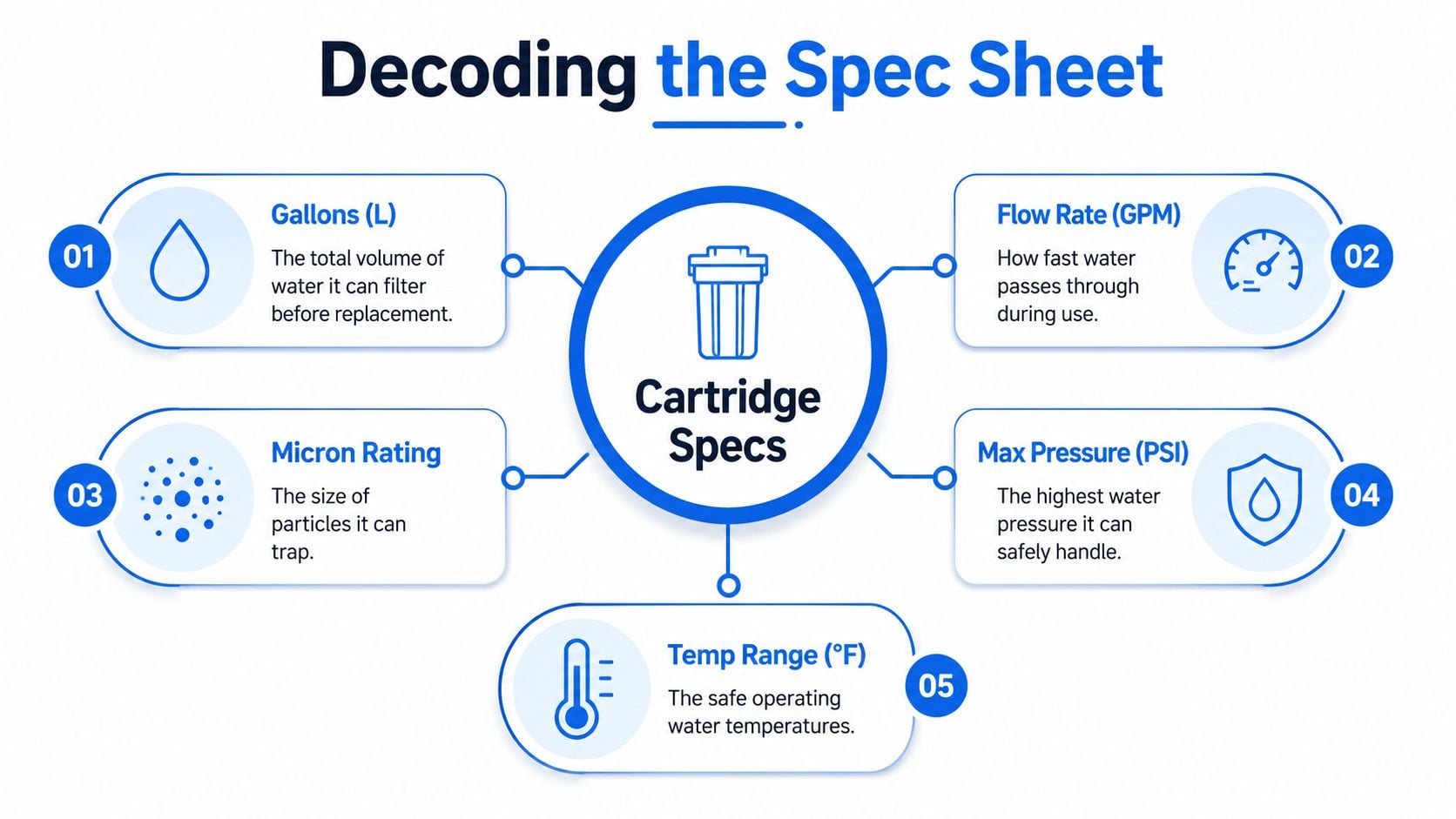
A cartridge spec sheet can look dense because it combines safety limits, performance numbers, and the conditions the manufacturer assumed when testing it. Once those pieces are separated, the page becomes much easier to read. The goal is not to memorize every line. It is to know which numbers protect the cartridge, and which numbers describe how it behaves in service.
Temperature, pressure, flow, and capacity are linked
Start with temperature. That range tells you the water the cartridge can safely handle without its materials being pushed past what they were designed to do. In one example, the spec data lists 40–100°F (4.4–38°C), while another common home cartridge class lists 40–120°F as its pressure context and 25–125 psi as a pressure range, with up to 1.67 gpm maximum flow Atlas Filtri spec sheet. Those figures are not filler. They describe the operating window where the cartridge is expected to hold up.
Capacity is a different kind of number. A cartridge rated at 700 gallons and 0.7 gpm can fit a household differently than a higher-flow model, even if the two cartridges look similar on paper Atlas Filtri spec sheet. The gallon rating tells you how much water it can process before replacement under the stated conditions, while flow rate tells you how quickly water can move through it during use. That is why two cartridges with similar shapes can behave very differently once they are in the same sink or appliance.
Why the numbers have to travel together
A spec sheet only helps if you read the numbers as a group. A cartridge with generous capacity can still fall short if the pressure is too high, the temperature is outside its range, or the daily demand is heavier than the design assumed. A single number on its own can hide that mismatch.
Practical rule: if the pressure or temperature is outside the stated range, the gallon rating stops being a clean promise and becomes a rough starting point.
Certification labels can create a second layer of confusion, because the badge often gets noticed before the underlying test scope does. Woder's explanation of WQA, NSF, and ANSI on water filter labels is useful here, because it helps translate what those marks mean on a cartridge spec sheet. That matters when you are comparing two cartridges that sound similar but are not tested for the same conditions.
The same habit helps with better home water quality decisions, where the box may sound persuasive but the spec sheet is what tells you whether the cartridge fits your system, your water, and your actual use. Once the sheet is read in pieces, the numbers stop feeling random and start acting like a map.
Cartridge Types and Where Each One Fits
Different cartridges solve different problems, and they belong in different parts of the system. A homeowner filtering a kitchen tap, a refrigerator line, or a whole-house feed is not shopping for the same cartridge class, even if the packaging looks similar.
The main cartridge families
Sediment pre-filters usually catch visible grit first, which is why they are often placed ahead of finer stages. Activated carbon blocks are common in drinking-water systems where taste and odor matter, and specialty media cartridges are used when a system is tuned for contaminants like lead or PFAS. Inline refrigerator filters are smaller and usually tied to appliance service lines, while reverse osmosis membranes sit in a different category altogether because they operate as part of a membrane system rather than a simple drop-in cartridge.
Typical capacities make the differences easier to see. Pitcher filters are often around 40 gallons, refrigerator filters around 200–300 gallons, under-sink filters around 500–1,000 gallons, and RO membranes about 1,500–2,000 gallons or more Springsv capacity guide. A cartridge that works fine in a refrigerator line can be the wrong fit for a kitchen sink, even before you look at the media inside it.
Match the cartridge to the fixture
The cartridge should match the fixture and the water problem together. A sediment stage makes sense where grit is the issue. A selective media block makes more sense where the goal is targeted contaminant reduction at a drinking tap. A refrigerator filter needs to be compact and appliance-friendly, while an RO membrane is part of a system that behaves very differently from a standard replacement cartridge.
For homeowners comparing whole-home and point-of-use options, better home water quality often depends on where the cartridge sits in the plumbing, not only on what media it uses. Placement changes the job, the load, and the kind of maintenance you end up doing.
| Cartridge Class | Typical Capacity | Common Replacement Window |
|---|---|---|
| Pitcher filter | About 40 gallons | Around 2 months |
| Refrigerator filter | 200–300 gallons | About 6 months |
| Under-sink filter | 500–1,000 gallons | 6–12 months |
| RO membrane | 1,500–2,000 gallons or more | 2–5 years |
Replacement Timing Based on System Behavior
The cleanest replacement date is often the one printed on the box. The more reliable one is usually the system telling you it is time. Water quality shifts, household use changes, and one neighborhood can load a cartridge very differently from another, so the calendar alone can miss the pattern.
Why pressure drop often matters more than age
A cartridge does not wear out in a vacuum. It clogs, loads with sediment, or slows as the water passing through it changes. That is why some technical guidance treats pressure drop or a visible flow decline as a better signal than age alone, and whole-house systems often use a 15 psi pressure-drop threshold as a replacement trigger. If the faucet flow has changed in a way you can notice, that is information worth taking seriously.
Slow flow does not always mean the cartridge is finished. A partially closed inlet valve, sediment sitting in the housing, or trapped air after installation can create the same symptom. A clogged filter and a plumbing issue can look alike at the tap, the way a weak battery and a loose connection can both make a flashlight seem unreliable. A quick check of the valve position and the housing condition helps before you order a new part.
What changes the lifespan
Incoming water quality is one of the biggest factors. Daily draw volume matters too, because a family that fills bottles, cooks from the tap, and sends ice through the same line will load a cartridge faster than a lighter-use household. Media type matters as well, since different cartridges follow different service patterns, as shown by the range of replacement intervals in the earlier section.
Usage is often where people get misled. Two homes can buy the same cartridge and still see different replacement timing because one system is doing more work all day. A cartridge on a rarely used line may still look fine long after the printed schedule, while a heavily used one may slow down early. The filter does not care what month it is. It responds to what has passed through it.
For a practical cross-check, the water filter cartridge replacement guide is a useful reminder that replacement is as much about keeping system behavior steady as it is about swapping parts. The better habit is to look at the water first, then the calendar second.
Practical rule: when the flow changes, check the system before you blame the cartridge. A stuck valve or trapped air can look exactly like filter failure.
A Safe and Clean Replacement Procedure
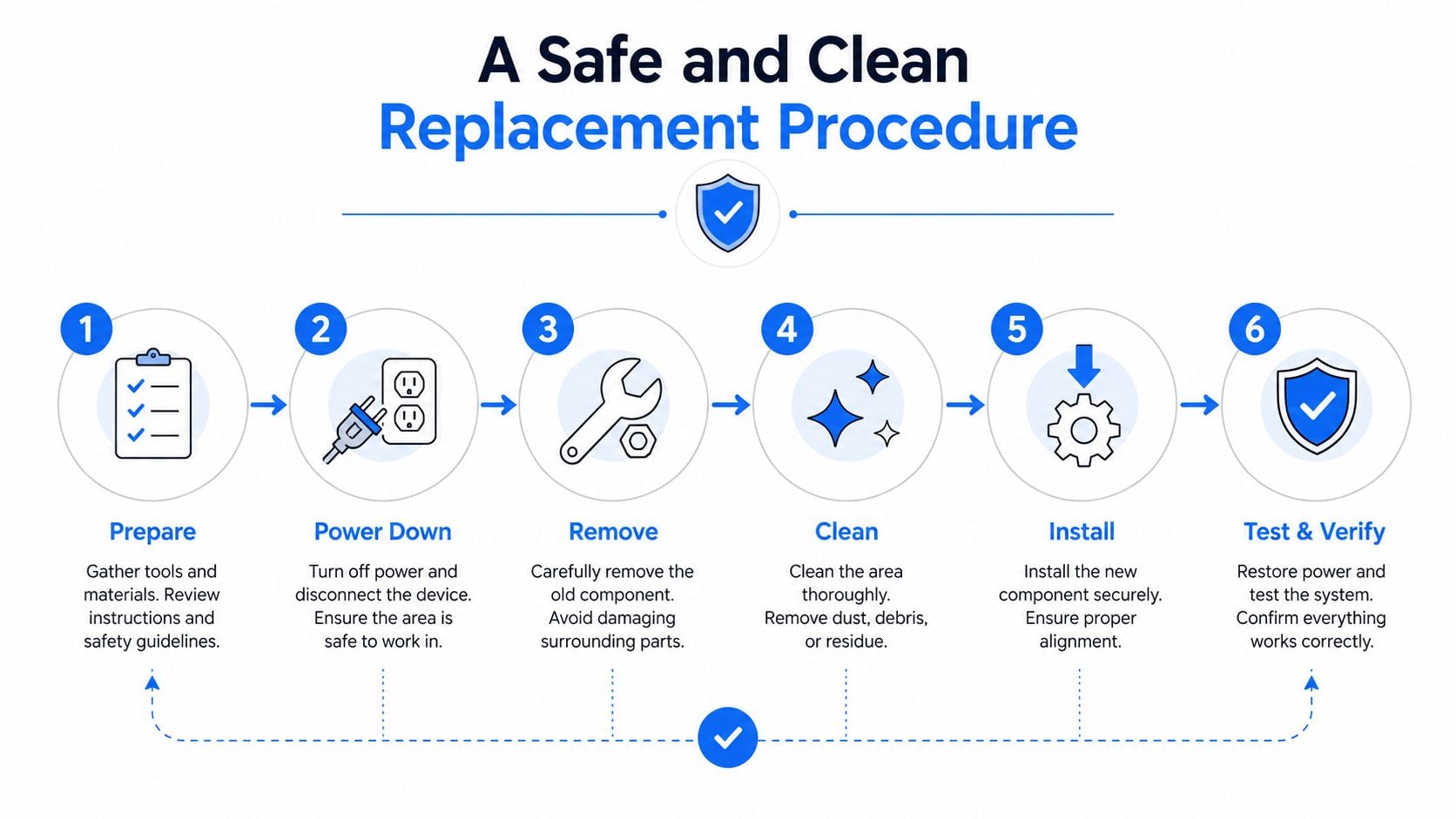
A cartridge change should feel like routine maintenance, not a guess-and-check job. The sequence is simple, but the details decide whether the swap ends cleanly or turns into a slow leak that shows up later.
The replacement sequence
Start by shutting off the water supply and releasing pressure from the line. Open the housing, remove the old cartridge, and clean the housing so grit, film, and loose sediment do not carry into the new part. Check the O-ring carefully. If it is cracked, flattened, or no longer sealing well, replace it.
Install the new cartridge in the correct orientation and make sure it seats fully. A cartridge that is slightly off-center can cause trouble even when it looks close enough by eye. Close the housing, then flush the system before putting it back into normal use.
Why the little steps matter
Flushing clears the first water through the cartridge and helps carry out trapped air and loose fines. Cleaning the housing matters because sediment can settle where you cannot see it. Checking the O-ring matters because a seal can look fine and still fail once pressure returns.
A missed seal or an unflushed cartridge can lead to leaks, weaker performance, or contaminated first-use water.
The same basic sequence shows up in standard replacement instructions, and it also lines up with the kind of buying caution covered in the PureHQ Inc. brewing guide. For a matching parts overview, the Woder replacement cartridges page is a practical reference point for seeing how cartridge options are grouped before installation. Replacement is maintenance, not just part swapping.
Buying Without Getting Burned
The cartridge market is full of parts that look right until you compare the details. Some listings inflate capacity claims, some labels sound official without showing independent verification, and some cartridges fit the housing while still underdelivering on what they're supposed to remove.
What to verify before you order
Check whether the cartridge has a real, independent certification that matches the claim being made. Look for the specific standard, not just the word “certified.” A claim about chlorine taste and odor should point to the relevant standard, and a lead-related claim should show the standard that applies to lead-free compliance or contaminant reduction.
You should also expect performance claims to be backed by published test data when the seller is serious. If the listing says the cartridge removes a contaminant but offers no document trail, treat that as a warning sign. A cartridge can be relabeled from a generic body and still look convincing in photos.

For a practical buying lens, the PureHQ Inc. brewing guide is a useful reminder that any filter purchase should be tied to use case, not just a generic product title. That applies here too.
- Check the exact fit: Match length, outside diameter, inside diameter, and core style before you buy.
- Match the claim to the standard: Don't assume one certification label covers every contaminant claim.
- Ask for the test trail: If a seller claims unusual contaminant reduction, look for the document behind it.
- Watch for physical fit without true compatibility: A cartridge can slide into a housing and still leak or bypass.
- Confirm the replacement category: Use the right cartridge class for the fixture, whether it's under-sink, refrigerator, or membrane-based.
If you want a clean place to start browsing replacements that are organized by system type, the replacement cartridges category is the right kind of reference point.
Quick Reference and Next Steps
The shortest version is simple. Identify the cartridge before you order. Match the dimensions, the connection style, and the operating limits to the system in front of you. Let pressure drop, flow decline, and water behavior tell you when it's time, then replace the cartridge with the full cleanup and flush routine.
| Cartridge Class | Typical Gallons | Common Replacement Window |
|---|---|---|
| Pitcher filter | About 40 gallons | Around 2 months |
| Refrigerator filter | 200–300 gallons | About 6 months |
| Under-sink filter | 500–1,000 gallons | 6–12 months |
| RO membrane | 1,500–2,000 gallons or more | 2–5 years |
If the old part number is gone, confirm the housing age with the manufacturer or measure the housing itself before ordering. If you want to match a cartridge to a specific contaminant profile instead of swapping blindly, a lab test on incoming water is the cleaner next step. That gives you a better baseline than guesswork ever will.
Woder Filters makes U.S.-made point-of-use filtration systems and replacement cartridges designed for homeowners who want a clearer match between water conditions and cartridge choice. If you're comparing options for a kitchen tap, a refrigerator line, or a legacy replacement, visit Woder Filters to review the available systems and support resources.