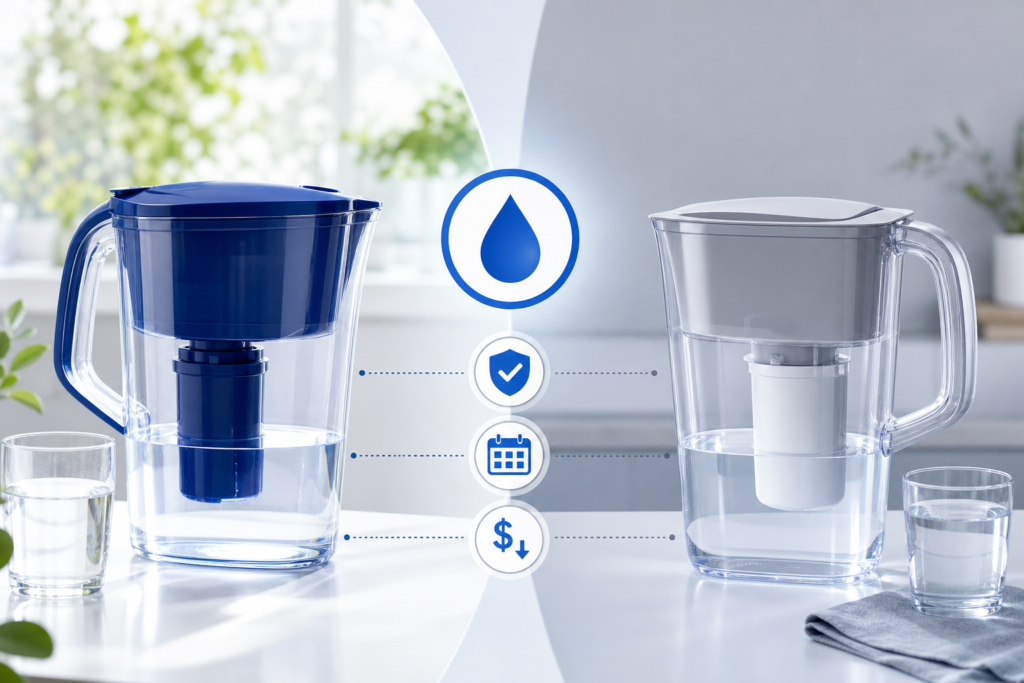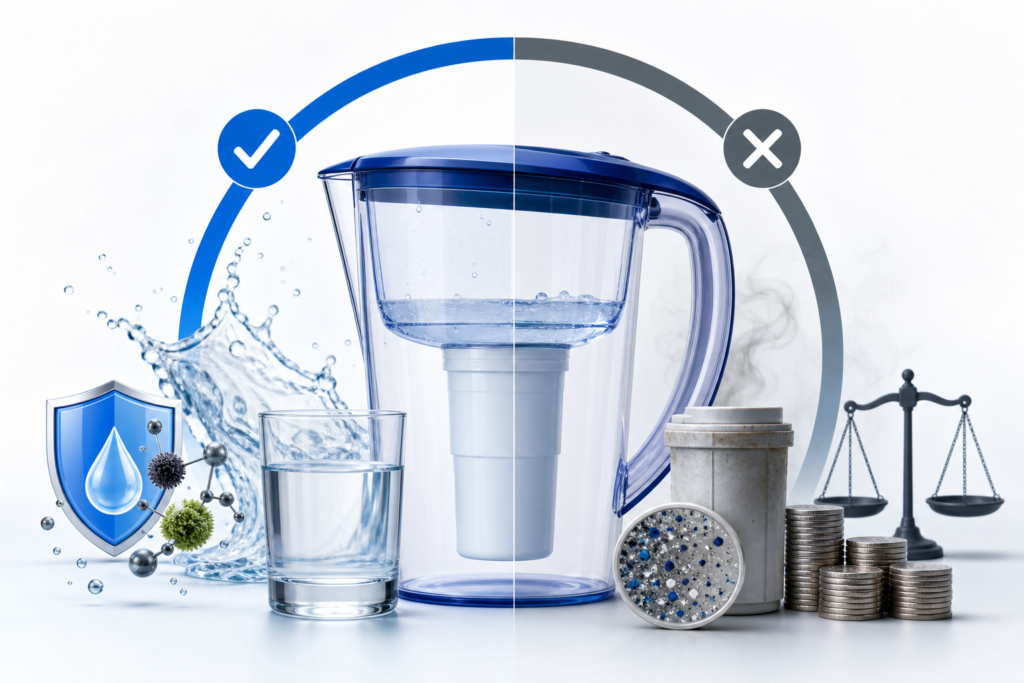
- What "Filtered Water" Actually Means
- What "Purified Water" Actually Means
- The Core Distinction
- Does Removing Minerals Actually Matter?
- When Filtration Is Enough
- When Purification Makes More Sense
- Purified Water, Distilled Water, and Bottled Water Labels
- The Environmental and Cost Angle
- How to Decide Which One You Need
- FAQs
- The Bottom Line
Standing in the water filter aisle or reading a bottled water label, you've probably seen "purified" and "filtered" used as if they mean the same thing. They don't. Understanding the difference between purified water and filtered water changes how you shop, how you treat your home's water supply, and what ends up in your glass every day.
This article breaks down what each term actually means, which contaminants each method targets, what happens to the minerals in your water along the way, and how to choose the right approach for your household.
What “Filtered Water” Actually Means
Filtration is a process. Water passes through one or more physical or chemical media that trap or attract specific contaminants while allowing the water and most dissolved minerals to continue through.
Common filtration methods include:
- Activated carbon filters, which adsorb chlorine, chloramines, volatile organic compounds (VOCs), and some heavy metals
- Sediment filters, which physically block particles like rust, sand, and silt. According to waterquality-hub.com, sediment filters typically catch particles down to 5 microns, while ceramic filters can reach 0.5 microns
- Ion exchange filters, which swap undesirable ions like lead or hardness minerals for less harmful ones
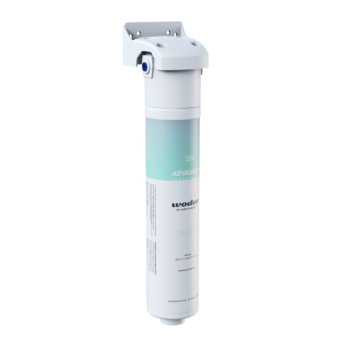
- Under-sink inline filters, which connect directly to your cold water line and treat water right at the point of use
The defining characteristic of filtered water is selectivity. A well-designed filter removes the contaminants you want gone and leaves behind the dissolved minerals your body actually uses — calcium, magnesium, potassium. Your water will still have a measurable level of total dissolved solids (TDS) after filtration, which is normal and generally desirable.
What “Purified Water” Actually Means
Purification is defined by an end result, not a method. Water labeled as purified must meet a specific purity threshold regardless of how it got there.
According to waterquality-hub.com, the FDA standard for bottled water labeled "purified" requires total dissolved solids of no more than 10 parts per million (ppm). For context, the EPA allows tap water to contain up to 500 ppm TDS. That's a dramatic gap, and it tells you something important: purified water has had nearly everything removed from it, including minerals.
The methods used to reach that 10 ppm threshold include:
- Reverse osmosis (RO): Forces water through a semi-permeable membrane under pressure, blocking most dissolved solids, heavy metals, nitrates, and microorganisms
- Distillation: Boils water into steam and recondenses it, leaving behind nearly all contaminants and minerals
- Deionization: Removes ionic contaminants through resin beds, producing water with very low conductivity
Each of these methods is effective at removing a broad range of contaminants. The tradeoff is that none of them are selective. They strip out the bad and the good together.
The Core Distinction
The simplest way to frame it: filtration is selective removal, purification is near-total removal.
| Filtered Water | Purified Water | |
|---|---|---|
| Minerals retained | Yes | No (or trace amounts) |
| TDS level | Moderate (varies by source) | Very low (under 10 ppm) |
| Common methods | Carbon, sediment, ceramic | RO, distillation, deionization |
| Contaminants targeted | Specific (chlorine, lead, VOCs) | Broad-spectrum |
| Taste | Depends on source minerals | Often flat or slightly acidic |
| Equipment cost | Lower to moderate | Moderate to high |
Does Removing Minerals Actually Matter?
This question doesn't get enough attention. Calcium and magnesium in drinking water contribute to your daily mineral intake, and water with a moderate TDS often tastes noticeably better than water stripped to near-zero.
Purified water — especially distilled — can taste flat or slightly hollow because the dissolved minerals that give water its characteristic mouthfeel are gone. Some people prefer this. Many don't.
From a health standpoint, if your diet is varied and nutritionally complete, the minerals in drinking water are more of a supplement than a primary source. But for households where dietary mineral intake is already marginal, or for children who drink a lot of water, the cumulative difference over time is worth thinking about.
When Filtration Is Enough
For most households on a municipal water supply, standard filtration is sufficient. Municipal water in the United States is treated to EPA standards before it reaches your tap. The main concerns are usually:
- Chlorine and chloramine taste and odor, added as disinfectants
- Trace lead from older home plumbing or service lines
- Disinfection byproducts like trihalomethanes
- Sediment from aging pipes
A quality under-sink or inline filter handles all of these without the cost and complexity of a full purification system. You get clean, safe water that still contains the minerals that make it taste good.
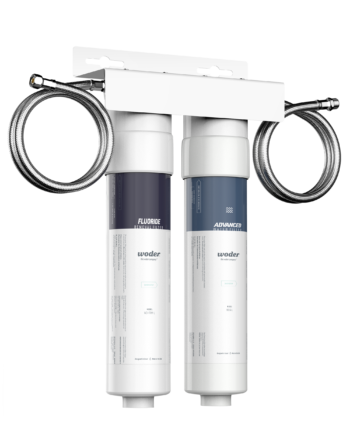
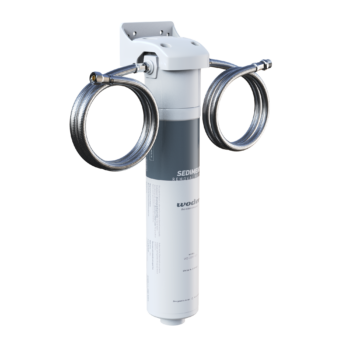
This is the approach behind Woder Filters. Their Advanced Selective Filtration technology uses nanoparticles to attract and remove specific contaminants while leaving beneficial minerals intact. The filter connects directly to your existing water line — no separate faucet to install, no storage tank to maintain, and no wastewater like a reverse osmosis system produces.
When Purification Makes More Sense
There are situations where near-total removal is the right call:
- Well water with unknown or variable contamination: If you're on a private well and your water test shows nitrates, bacteria, arsenic, or other serious contaminants at high levels, RO or distillation may be the safer starting point
- Areas with documented heavy contamination: Some municipal systems have had documented issues with lead, PFAS, or agricultural runoff that go beyond what carbon filtration alone can address
- Specific medical needs: Immunocompromised individuals or newborns sometimes require water purified to a higher standard on medical advice
For the average household on treated municipal water, these scenarios are the exception, not the rule.
Purified Water, Distilled Water, and Bottled Water Labels
These terms overlap in confusing ways on store shelves.
Distilled water is a type of purified water. All distilled water is purified, but not all purified water is distilled — it can also be produced by RO or deionization.
Spring water is not purified water. It comes from a natural underground source and retains its natural mineral content. It may or may not be filtered before bottling.
Filtered water on a label simply means the water passed through some filtration process. The label tells you very little about which contaminants were removed or to what level.
The FDA regulates bottled water labeling, but the definitions matter. If you're buying bottled water for purity, look for "purified" with a stated treatment method rather than relying on images of mountains or springs.
The Environmental and Cost Angle
In its 2025 report, IUScholarWorks at Indiana University noted that about two billion people rely on bottled or treated water for safety. That scale carries real environmental weight. Single-use plastic bottles represent a significant waste stream, and the carbon footprint of shipping bottled water nationally is substantial.
A home filtration system addresses both problems. You get consistently treated water at a fraction of the ongoing cost of bottled water, with no plastic waste. According to worldmetrics.org, U.S. household water filter ownership rose from 48% in 2018 to 63% in 2023 — reflecting a real shift in how people think about their water supply.
Maintenance cadence matters too. Most inline and under-sink filters need a cartridge replacement once or twice a year, depending on your water quality and household usage. Reverse osmosis systems require membrane replacement on a longer cycle but also involve pre-filters and post-filters that need separate attention.
How to Decide Which One You Need
Start with a water test. Most municipalities publish annual water quality reports — sometimes called Consumer Confidence Reports — that list detected contaminants and their levels. If you're on well water, a private test is worth the investment.
Once you know what's in your water:
- Municipal water with standard disinfectant treatment and no lead concerns: A high-quality carbon or selective filtration system is likely all you need
- Municipal water with documented lead or PFAS concerns: Look for filters certified to remove those specific contaminants, or consider RO for those specific taps
- Well water with bacteria or nitrates: Purification-level treatment is the safer starting point; combine with regular testing
- Renter or traveler: Inline filters that connect to a standard faucet or refrigerator line offer flexibility without permanent installation
The goal isn't the cleanest water by any single metric. It's water that is safe, tastes good, and fits your household's actual situation.
FAQs
Is filtered water the same as purified water?
No. Filtered water has passed through a medium that removes specific contaminants while retaining dissolved minerals. Purified water meets a strict purity standard — typically under 10 ppm TDS — meaning nearly all dissolved solids, including minerals, have been removed. The methods and outcomes are meaningfully different.
Does filtered water still contain minerals?
Yes. Most filtration methods are designed to remove contaminants selectively while leaving beneficial minerals like calcium and magnesium in the water. That's one of the main advantages of filtration over purification methods like distillation or reverse osmosis.
Is purified water safe to drink every day?
Purified water is safe to drink. The concern with drinking only purified or distilled water long-term is that it contributes no minerals to your diet. For most people with a balanced diet, this isn't a significant issue — but it's worth keeping in mind if your overall mineral intake is already low.
What contaminants does standard filtration remove?
A quality carbon or selective filtration system typically removes chlorine, chloramines, VOCs, some heavy metals like lead, and disinfection byproducts. Sediment filters also remove particulate matter. The specific contaminants removed depend on the filter media and its certification.
What contaminants usually require purification methods like RO?
Reverse osmosis and distillation are more effective against nitrates, arsenic, fluoride, PFAS, dissolved salts, and most bacteria and viruses. These contaminants either pass through carbon filters or require the membrane-level separation that RO provides.
How does distilled water differ from purified water?
Distilled water is a specific type of purified water, produced by boiling water into steam and recondensing it. All distilled water qualifies as purified, but purified water can also be produced by reverse osmosis or deionization without involving heat.
Do I need to test my water before choosing a filter?
Testing is the most reliable way to match a filter to your actual water quality. Your municipality's annual water quality report is a good free starting point. For well water or specific concerns, a private lab test gives you a clearer picture of what you're working with.
The Bottom Line
Purified water and filtered water are not interchangeable, and the difference has real consequences for what ends up in your glass. Purification strips water to near-zero dissolved solids — powerful, but it takes the minerals along with the contaminants. Filtration targets specific problems while leaving the beneficial stuff behind.
For most households on treated municipal water, a well-designed filtration system is the practical, cost-effective, and environmentally sound choice. If your water quality is genuinely uncertain or you're dealing with serious contamination, purification-level treatment may be worth the added complexity.
Knowing what's in your water is the first step. Choosing the right treatment method is the second. Woder Filters builds under-sink and inline filters around selective filtration, so you can remove what doesn't belong without losing what does.