- Why Chlorine in Tap Water Is Worth Addressing
- The Full Ranking: Tap Water Chlorine Removal Methods
- What to Look for When Choosing a Chlorine Removal Method
- Why Selective Filtration Sits at the Top of the Ranking
- Frequently Asked Questions
Chlorine is one of the most searched water quality topics for a reason. Utilities add it to municipal water to kill bacteria and pathogens during treatment—that part is genuinely useful. The problem is that it doesn't stop working once it leaves the plant. By the time water reaches your tap, it often smells like a pool, tastes flat, and carries disinfection byproducts formed when chlorine reacts with organic matter along the way.
This guide ranks every common removal method from most to least effective, explains why each one performs the way it does, and helps you figure out which approach actually fits your situation.
Why Chlorine in Tap Water Is Worth Addressing
Municipal utilities are required to maintain an active chlorine residual throughout the distribution system—meaning your tap water isn't just treated at the source. It arrives with chlorine still in it.
At low concentrations, chlorine isn't acutely dangerous. The longer-term concern is disinfection byproducts, particularly trihalomethanes (THMs) and haloacetic acids (HAAs), which form when chlorine reacts with naturally occurring organic compounds in source water. These byproducts are classified as probable carcinogens at elevated exposure levels. The taste and odor impact is more immediate—and it affects everything from drinking water to coffee to ice.
There's also the chloramine issue. Many utilities have shifted from free chlorine to chloramines—a chlorine-ammonia compound—because chloramines produce fewer regulated byproducts. The catch is that chloramine is harder to remove than free chlorine, and not every method handles both equally well. Where that distinction matters, it's noted below.
The Full Ranking: Tap Water Chlorine Removal Methods
1. Activated Carbon Filtration (Point-of-Use)
Effectiveness: Excellent for free chlorine, good for chloramine with catalytic carbon
Activated carbon is the gold standard for point-of-use chlorine removal. It works through adsorption—chlorine molecules bond to the enormous surface area inside the carbon matrix and are pulled out as water passes through.
Standard activated carbon, typically made from coconut shell or bituminous coal, handles free chlorine very effectively. For chloramine, catalytic activated carbon performs significantly better because its modified surface structure breaks the chlorine-ammonia bond rather than just capturing the molecule.
Point-of-use carbon filters come in several forms: under-sink units, inline filters, pitcher filters, and faucet-mounted attachments. The key variable is contact time. Faster flow through a smaller carbon block means less time for adsorption—and lower effectiveness. Well-designed under-sink systems with adequate carbon volume consistently outperform pitcher filters on this front.
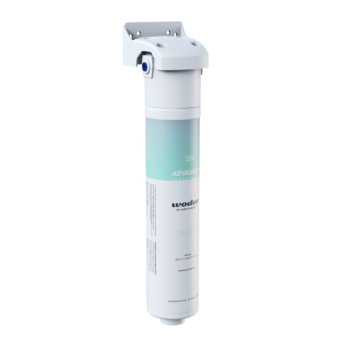
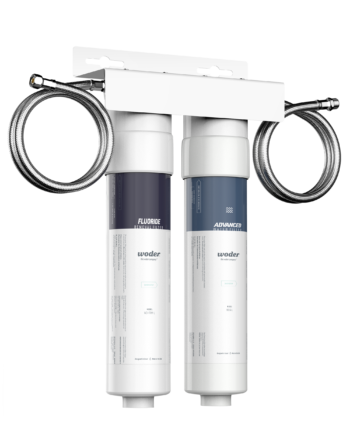
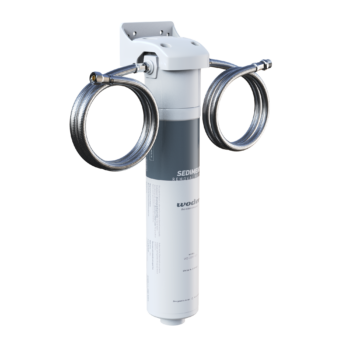
Woder's under-sink filters use Advanced Selective Filtration, a proprietary technology built around nanoparticles that attract and remove contaminants including chlorine—at 99.9% removal—along with lead, PFAS, chromium 6, mercury, and volatile organic compounds. Importantly, the system preserves naturally occurring beneficial minerals like calcium and magnesium. Carbon filters also leave minerals intact, but reverse osmosis systems do not, which is a meaningful distinction for many buyers. The WD-10K-ADV-PORT, rated for 10,000 gallons, is built for higher-flow households; the WD-D-8K-FRM-ADV-DC handles 8,000 gallons with advanced DC technology. The full model lineup and a product-selector tool are available at woder.com/wizard.
Best for: Homeowners and renters who want reliable, ongoing chlorine removal without major plumbing work.
2. Reverse Osmosis Systems
Effectiveness: Excellent for chlorine, but with real trade-offs
Reverse osmosis forces water through a semi-permeable membrane that blocks most contaminants, including chlorine and chloramine. In terms of raw removal rates, RO is among the most thorough options available.
The trade-offs are worth understanding before you commit. RO strips everything from the water—including the calcium and magnesium your body uses. The result is demineralized water that many people describe as flat or hollow-tasting, and it removes minerals that contribute to daily dietary intake. RO systems also produce wastewater, typically two to four gallons discarded for every gallon filtered, depending on the system. And they require a holding tank, which adds bulk under the sink and means you're drawing from stored water rather than filtering on demand.
If chlorine removal is your primary goal and mineral retention matters to you, RO is more than you need—and takes more than it should.
Best for: Households dealing with very high total dissolved solids, heavy contamination, or situations where demineralized water is acceptable.
3. Whole-House Carbon Filters
Effectiveness: Very good for free chlorine throughout the home
A whole-house system installs at the main water line and treats every tap, shower, and appliance in the home. For chlorine, that's genuinely useful—exposure isn't limited to drinking water. You absorb chlorine through your skin and inhale it as steam in the shower, and a point-of-use filter does nothing for those pathways.
The limitation is cost and complexity. Whole-house systems require professional installation, a significant upfront investment, and ongoing maintenance of large filter tanks. They're not practical for renters or apartment dwellers. And while they handle free chlorine well, effectiveness against chloramine depends heavily on the media used.
Best for: Homeowners who want whole-home coverage and are prepared to invest in installation and maintenance.
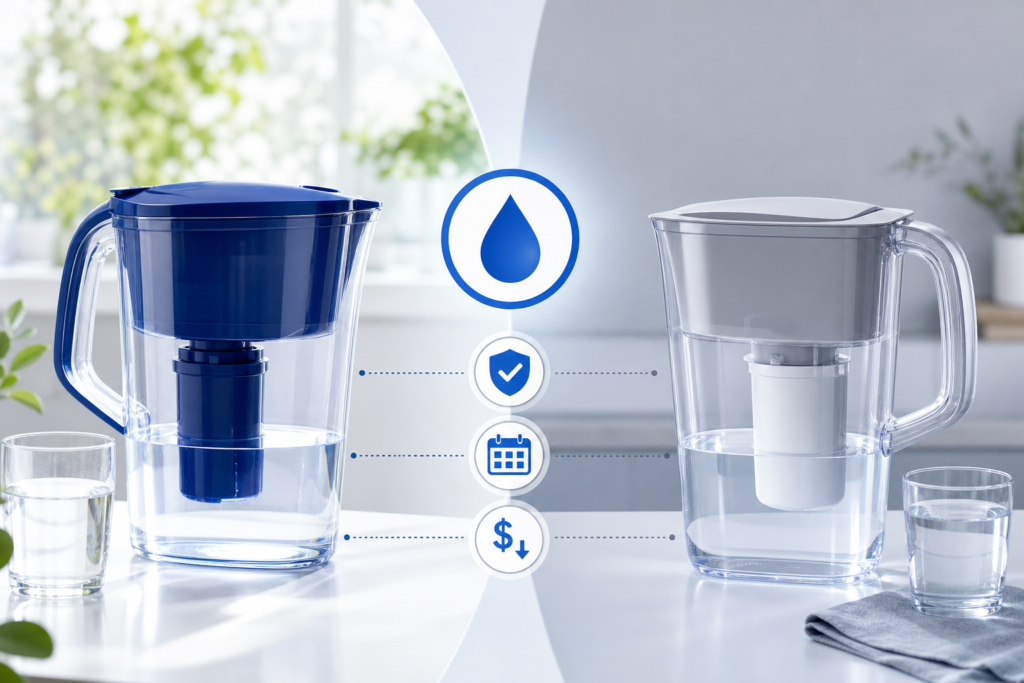
4. Pitcher Filters
Effectiveness: Moderate, limited by contact time and capacity
Pitcher filters with activated carbon cores do remove chlorine. Because water flows through by gravity, contact time is actually reasonable—but capacity is the constraint. A standard pitcher filter handles two to three liters at a time, cartridges need replacing every 40 gallons or so, and the ongoing cost adds up.
Most pitcher filters are designed primarily for taste and odor improvement. They're not certified to remove lead, PFAS, or chromium 6 at the same level as more advanced systems.
For chlorine removal specifically, a pitcher filter is functional but limited. It works for someone who wants better-tasting water and isn't concerned about the broader contaminant picture.
Best for: Renters with no installation options, or households with very light filtration needs.
5. Faucet-Mounted Filters
Effectiveness: Moderate, convenient but volume-limited
Faucet-mounted filters attach directly to your tap and filter water on demand using a small activated carbon block. They can reduce chlorine noticeably, and the convenience is real—no installation, no waiting, immediate filtered water.
The limitations are also real. Small carbon volume means faster depletion. Many faucet filters need cartridge replacement every 100 gallons, and they can slow water flow significantly. They don't address the broader contaminant picture either.
For chlorine removal alone, they work. For households that want comprehensive filtration, they fall short.
Best for: Renters or short-term situations where a more permanent solution isn't possible.
6. Boiling Water
Effectiveness: Good for free chlorine, ineffective for chloramine
Boiling drives off free chlorine because it's a volatile compound—boil water for a few minutes, let it cool, and most of the free chlorine will have evaporated. It's a legitimate method in a pinch.
The problems: it doesn't work for chloramine, which is far less volatile and requires a much longer boil time to reduce meaningfully. It does nothing for lead, PFAS, or other contaminants. It's time-consuming and impractical as a daily routine. And it concentrates any non-volatile contaminants already present in the water.
Best for: Emergency situations only. Not a practical daily solution.
7. Letting Water Sit (Off-Gassing)
Effectiveness: Slow and partial for free chlorine, nearly ineffective for chloramine
Free chlorine will naturally off-gas from water left in an open container. At room temperature, a significant portion can dissipate within 30 minutes to a few hours, depending on starting concentration and container surface area.
Chloramine, however, doesn't off-gas meaningfully at room temperature. This method is largely ineffective for utilities that use chloramine—a growing share of US water systems. Beyond chlorine, it does nothing for any other contaminant, and it's completely impractical as a household routine.
Best for: Aquarium owners dechlorinating water for fish. Not a practical drinking water solution.
8. UV Purification
Effectiveness: Poor for chlorine removal
UV systems are excellent at neutralizing bacteria, viruses, and other biological contaminants by disrupting their DNA. They are not designed to remove chemical contaminants like chlorine. UV light doesn't break down or adsorb chlorine molecules in any meaningful way.
UV is often used as a final stage in a multi-stage system—not as a standalone chlorine solution. If someone recommends UV specifically for chlorine removal, that recommendation is misplaced.
Best for: Biological contamination, well water, or as a complement to carbon filtration—not as a chlorine removal method on its own.
9. Vitamin C (Ascorbic Acid) Treatment
Effectiveness: Chemically effective, but impractical for drinking water
Ascorbic acid neutralizes both free chlorine and chloramine through a direct chemical reaction. It's fast, effective, and widely used in aquariums and by homebrewers who need to dechlorinate water quickly.
For drinking water, the practical issues are significant. You need to add the right dose, which varies based on chlorine concentration. Too little leaves residual chlorine; too much gives the water a slightly sour taste. It doesn't address any other contaminants, and it's not a scalable solution for daily household use.
Best for: Brewing, aquariums, or water used for plants. Not a practical daily drinking water solution.
What to Look for When Choosing a Chlorine Removal Method
A few questions will narrow your options quickly.
Do you rent or own? Renters who can't install an under-sink unit without permission are pushed toward pitcher filters, faucet-mounted filters, or inline models that connect without permanent plumbing changes.
Is chlorine your only concern? If you're also worried about lead, PFAS, chromium 6, or other contaminants, a method that only addresses chlorine isn't enough. You need a system tested and certified for the full spectrum of contaminants you're actually facing.
Do you want to keep your minerals? This matters more than most people realize. Reverse osmosis removes chlorine effectively, but it also removes the calcium and magnesium naturally present in your water. If you want clean water that still contains those minerals, selective filtration is the right category.
What's your flow rate requirement? A household of four has different demands than a single-person apartment. Woder's WD-10K-ADV-PORT (rated for 10,000 gallons) is built for higher-demand households, while a compact model like the WD-G4-210-JG suits smaller spaces.
What certifications matter to you? WQA Gold Seal certification is independent, third-party verification of performance claims. It's a meaningful signal when comparing products, and worth checking before you buy.
Why Selective Filtration Sits at the Top of the Ranking
The reason activated carbon and selective filtration methods rank highest isn't just raw chlorine removal—it's the combination of what they remove and what they leave behind.
Basic carbon filters remove chlorine well but don't address lead, PFAS, or chromium 6 at the same level. RO removes everything, including the beneficial minerals your water naturally contains. Selective filtration—the technology behind Woder's filter line—sits between those two positions: it removes 99.9% of chlorine along with lead, PFAS, chromium 6, mercury, carcinogens, and volatile organic compounds, while preserving calcium and magnesium.
That combination isn't available from every filter type. It's why selective filtration is the most practical answer for households that want comprehensive protection without sacrificing water quality in the process.
Woder's filters are US-manufactured and carry WQA Gold Seal certification. They install directly into an existing water line—no plumber required. You can explore the full product range and use the product-selector tool at woder.com.
Frequently Asked Questions
Does boiling tap water remove chlorine?
Boiling removes free chlorine effectively because it's a volatile compound that evaporates with heat. It does not remove chloramine, which many utilities now use instead of free chlorine. Boiling also concentrates any non-volatile contaminants already present and isn't practical as a daily routine.
What is the fastest way to remove chlorine from tap water?
An activated carbon or selective filtration under-sink system removes chlorine instantly as water flows through the filter—no waiting, no prep, no storage required. Boiling and off-gassing both take time and are less reliable for chloramine.
Does a Brita or similar pitcher filter remove chlorine?
Yes, pitcher filters with activated carbon reduce chlorine and improve taste and odor. Their limitations are capacity (small volume per cycle), replacement frequency, and the fact that most aren't designed to address lead, PFAS, or chromium 6 at the same level as more advanced systems.
What is the difference between free chlorine and chloramine?
Free chlorine is chlorine added directly to water. Chloramine is formed when chlorine is combined with ammonia. Chloramine is harder to remove than free chlorine—standard activated carbon handles free chlorine well, while catalytic activated carbon or advanced selective filtration is more effective against chloramine.
Does reverse osmosis remove chlorine?
Yes, RO systems remove chlorine effectively. The trade-off is that RO also removes beneficial minerals like calcium and magnesium, produces wastewater, and requires a storage tank. For households that want chlorine removal without losing minerals, selective filtration is a more targeted approach.
Will a water filter remove chlorine taste and smell?
Yes. Chlorine taste and odor are among the first things a quality activated carbon or selective filtration filter addresses. Most users notice the difference immediately after installation.
How do I know if my tap water uses chlorine or chloramine?
Your water utility is required to publish an annual Consumer Confidence Report (CCR) listing the disinfectants used in your supply. You can also call your utility directly or use a water testing kit to check. This distinction matters when choosing a filter, since not all carbon media handles chloramine equally well.
The right tap water chlorine removal method depends on what you're actually trying to solve. For most households, a point-of-use selective filtration system is the most practical answer—it removes chlorine and a broad range of other contaminants, preserves beneficial minerals, and installs without professional help. To match the right filter to your specific household, the product-selector tool at woder.com/wizard is a good place to start.