- What Is Fluoride Doing in Your Tap Water?
- Which Filter Types Remove Fluoride?
- Should You Actually Remove Fluoride?
- What to Prioritize When Choosing a Filter in 2026
- A Quick Comparison: Filter Types and Fluoride
- Test Your Water First
- FAQs
Fluoride is one of the most searched water quality topics — and one of the most misunderstood. If you're shopping for a water filter and wondering whether it will remove fluoride from your tap water, the honest answer is: it depends entirely on the type of filter you choose.
Some filters remove fluoride. Others don't touch it. And whether you actually want to remove it is worth thinking through before you buy.
Here's what you need to know.
What Is Fluoride Doing in Your Tap Water?
Most municipal water suppliers in the United States add fluoride intentionally. The practice started in the 1940s as a public health measure to reduce tooth decay, and it's still standard in most cities today. The EPA sets a maximum allowable level of 4 mg/L, with a secondary recommendation of 2 mg/L or below.
Unlike lead, PFAS, or chlorine byproducts, fluoride in municipal water isn't a contaminant that snuck in. It was added on purpose, at regulated levels, for a specific reason.
That said, some homeowners prefer to filter it out — whether for personal health reasons, because they're on well water with naturally high fluoride levels, or out of concern about cumulative exposure. That's a valid choice. The key is knowing which filter types actually do the job.
Which Filter Types Remove Fluoride?
Not all filtration methods work the same way on fluoride. Here's how the main categories compare.
Reverse Osmosis (RO)
RO systems are the most effective at removing fluoride. They push water through a semi-permeable membrane that blocks most dissolved solids, fluoride included. Removal rates typically exceed 90%. If fluoride removal is your top priority, RO gets the job done.
The trade-offs are real, though. RO strips out beneficial minerals too — calcium, magnesium, and others your body actually uses. It also produces wastewater (often 3 to 4 gallons discarded for every gallon filtered), requires a storage tank, and usually needs professional installation. That's a meaningful investment in both cost and complexity.
Activated Alumina and Bone Char Carbon
These are specialty media designed specifically to adsorb fluoride. Activated alumina filters can achieve high removal rates when water pH is right and the filter is properly maintained. Bone char carbon, made from animal bones, has been used for fluoride removal for decades.
Both require dedicated filter media and specific conditions to perform well. They're not common in mainstream under-sink products.
Standard Carbon Block and Activated Carbon Filters
This is where a lot of homeowners get surprised. Standard carbon filters — including most pitcher filters and many inline filters — do not effectively remove fluoride. Carbon excels at chlorine, chloramines, taste, odor, and some organic compounds. Fluoride is a small, stable ion that carbon simply doesn't bind to well.
If you buy a basic carbon filter expecting fluoride removal, you're likely not getting it.
Selective Filtration (What Woder Uses)
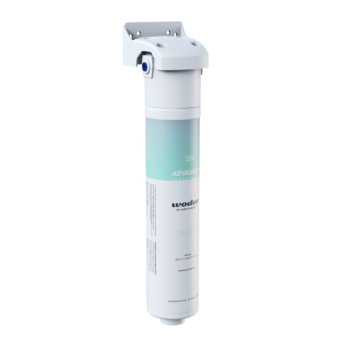
Woder's Advanced Selective Filtration technology uses nanoparticles to attract and remove specific contaminants while leaving naturally occurring minerals in your water. That includes lead, PFAS, chromium 6, mercury, chlorine, carcinogens, and volatile organic compounds — 99.9% removal across that group.
Fluoride is not on Woder's removal list. That's not a gap — it's a deliberate design choice. The technology is built to tell the difference between a harmful contaminant and a beneficial mineral. Since fluoride at regulated municipal levels isn't classified in the same category as lead or PFAS, it falls outside the target removal profile.
If your main concerns are lead, PFAS, chlorine, and VOCs — the contaminants most commonly found at harmful levels in US tap water — Woder handles those comprehensively. If fluoride removal is specifically what you need, an RO system is the more appropriate tool, with the understanding that it removes your minerals too.
Should You Actually Remove Fluoride?
Worth pausing on. The debate around fluoride is ongoing, and opinions vary. Here's a grounded way to think about it.
If you're on municipal water: Fluoride levels are regulated and monitored. The EPA's enforceable limit is 4 mg/L, and most municipal systems operate well below that. For most households, fluoride in tap water is not the most urgent water quality concern.
If you have well water: Naturally occurring fluoride can vary significantly by region. Some areas have naturally high levels that exceed safe thresholds. If you're on a private well, testing your water is the right first step before deciding what to filter.
If you have specific health concerns: Talk to your doctor or dentist. Fluoride's relationship to dental health is well-documented, and individual circumstances — particularly for infants and young children — may factor into your decision.
The point is: fluoride removal is a specific, intentional choice. It's not the same as filtering out lead or PFAS, which most water quality experts agree you want to remove whenever possible.
What to Prioritize When Choosing a Filter in 2026
For most homeowners, the contaminants with the clearest documented risk are lead, PFAS, chlorine disinfection byproducts, chromium 6, and mercury. These show up in water systems across the country, often at levels that exceed health guidelines, and they don't belong in your drinking water.
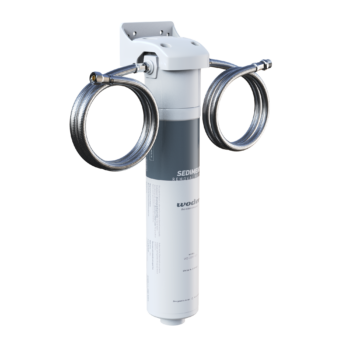
If your goal is to address those contaminants without the cost and complexity of a whole-home RO system, an inline or under-sink selective filter is a practical, proven option. Woder's filter lineup covers a range of household flow rates and installs directly into your existing water line — no tank, no plumber, no wastewater.
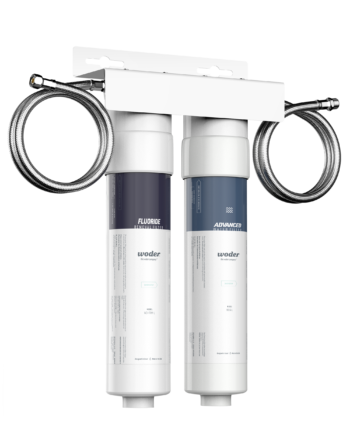
If fluoride removal is also on your list, you'll want to either pair a selective filter with a dedicated fluoride-removal stage, or go with an RO system and accept the mineral trade-off.
A Quick Comparison: Filter Types and Fluoride
| Filter Type | Removes Fluoride? | Removes Lead/PFAS? | Removes Minerals? |
|---|---|---|---|
| Reverse Osmosis | Yes (90%+) | Yes | Yes (strips all) |
| Activated Alumina | Yes (when maintained) | Limited | No |
| Standard Carbon | No | Limited | No |
| Woder Advanced Selective | No | Yes (99.9%) | No (minerals preserved) |
The right filter depends on what's actually in your water and what you want to keep or remove.
Test Your Water First
Before you spend money on any filter, know what you're filtering. A water quality test tells you exactly what's in your tap water — fluoride levels, lead, PFAS, hardness, and more. Woder offers water testing resources at woder.com so you can start from real information rather than guesswork.
Once you know what's in your water, choosing the right filter gets a lot simpler.
FAQs
Does a standard under-sink water filter remove fluoride?
Most standard under-sink filters, including carbon-based models, do not remove fluoride effectively. Fluoride is a stable ion that carbon doesn't bind to well. If fluoride removal is your goal, look for a filter specifically rated for it — an RO system or one with activated alumina media.
Does Woder's filter remove fluoride?
Woder's Advanced Selective Filtration removes 99.9% of harmful contaminants including lead, PFAS, chromium 6, mercury, chlorine, and VOCs. Fluoride at regulated municipal levels is not part of Woder's target removal profile. The technology is designed to remove documented harmful contaminants while preserving naturally occurring minerals.
Is fluoride in tap water dangerous?
At regulated levels, fluoride in municipal water is not classified as a health hazard by the EPA. The enforceable maximum is 4 mg/L. Concerns typically arise with well water in high-fluoride regions or with prolonged exposure above recommended levels. If you're unsure, test your water and talk to a healthcare provider.
What's the best filter for removing fluoride?
Reverse osmosis systems are the most effective option, typically achieving 90% removal or higher. Activated alumina filters are another route. Both require more investment than a basic carbon filter, and RO systems remove beneficial minerals along with contaminants.
Can I remove fluoride and keep my minerals?
This is difficult with current mainstream filtration technology. RO removes fluoride but also strips calcium, magnesium, and other minerals. Some multi-stage systems add a remineralization stage after RO, but that adds cost and complexity. Selective filtration like Woder's preserves minerals but does not target fluoride.
How do I know what's actually in my tap water?
Your municipal water supplier publishes an annual Consumer Confidence Report listing detected contaminants and their levels. You can also run an independent water test for a more detailed picture. Woder's website offers testing resources to help you understand your water quality before you choose a filter.
Should I filter fluoride if I have young children?
Fluoride exposure for infants and young children is worth discussing with your pediatrician or dentist, especially around formula preparation. There are specific guidelines around fluoride intake at different ages. If you have concerns, a water test and a conversation with your child's doctor will give you the clearest guidance.
Your water quality priorities are personal. Whether you're focused on lead, PFAS, chlorine, fluoride, or all of the above, the first step is knowing what's actually in your water. From there, choosing the right filter becomes a much clearer decision — not just grabbing whatever's popular on the shelf.
If lead, PFAS, and chlorine are your main concerns, Woder is built for exactly that. Use the product Wizard at woder.com/wizard to find the right model for your home. It's your water — filter it on your terms.