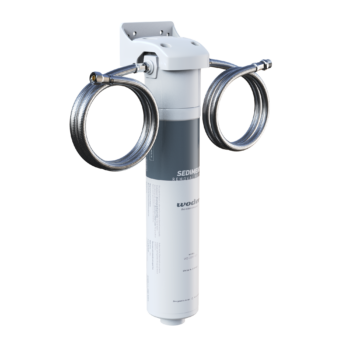
A reusable sediment water filter is a washable pre-filter that traps sand, silt, rust, and dirt before they reach your plumbing and downstream filters. It works best when cleaned regularly, not replaced on a fixed schedule.
That distinction matters when a homeowner installs a filter under the sink or near the main water entry, then forgets about it. At first, the water looks clearer and the filter seems almost invisible. Months later, the shower weakens, a faucet slows, or a glass fills with cloudy water after plumbing work. The filter may not have failed. It may be full of the material it was installed to catch.
Table of Contents
- Why Your Sediment Filter Needs More Attention Than You Think
- How Sediment Filtration Actually Works
- Benefits and Limits of Reusable Filters
- Reusable Versus Disposable Sediment Filters
- How to Clean and Maintain Your Reusable Sediment Filter
- When to Choose Reusable and When to Choose Disposable
- How a Sediment Filter Protects Your Whole Home
- Frequently Asked Questions About Reusable Sediment Filters
Why Your Sediment Filter Needs More Attention Than You Think
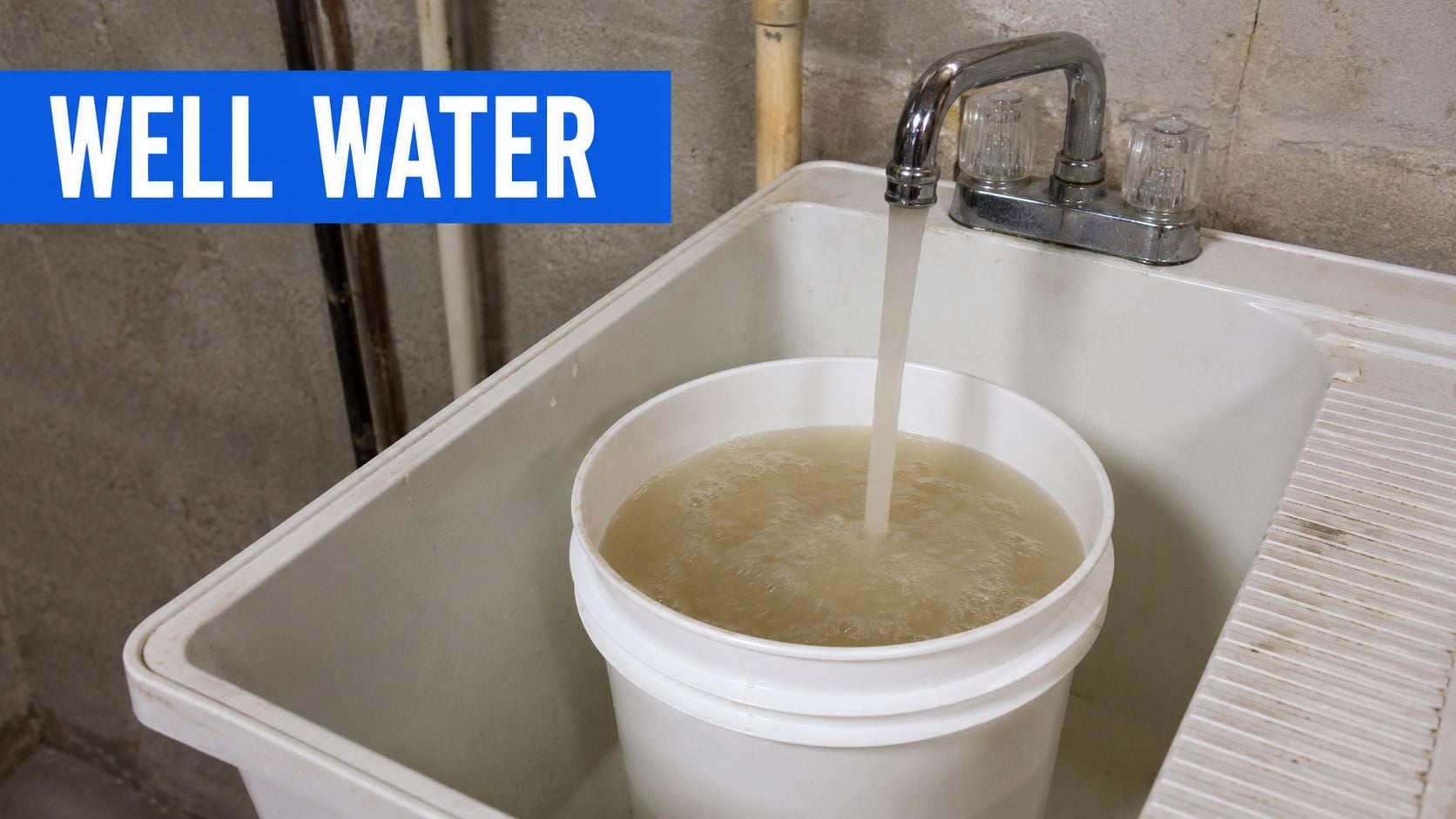
A homeowner named Mark installed a washable sediment cartridge to deal with grit entering his home from a private well. The first weeks went smoothly. He stopped seeing particles in the utility sink and assumed the filter would keep working indefinitely.
Several months later, the kitchen faucet had noticeably less flow. The shower pressure felt weak, and the under-sink contaminant filter was loading faster than expected. Mark initially blamed the plumbing. When he opened the sediment housing, he found the pleated media coated with sand, rust-colored residue, and fine dirt. The filter was doing its job, but the accumulated debris had narrowed the water path.
That’s the basic operating cycle of a reusable sediment water filter. It traps suspended material, then gradually becomes more restrictive as that material builds up. A reusable cartridge can be rinsed, but “reusable” doesn’t mean maintenance-free. Guidance for washable cartridges notes that cleaning needs depend heavily on incoming sediment, with well-water and high-iron conditions potentially shortening the interval from months to weeks (maintenance guidance for washable sediment cartridges).
Practical rule: Treat flow as a maintenance signal, not as a fixed calendar appointment.
A loaded pre-filter can also place extra demand on downstream equipment. Pumps may work harder to move water through a restricted path, and finer filters can clog sooner when a coarse stage stops accepting sediment efficiently. The solution isn’t automatically a finer cartridge. It’s usually a better maintenance routine, correct sizing, or staged filtration matched to the water entering the home.
The important question is therefore not only, “How long does this filter last?” Ask instead, “How quickly is it loading, and what does its pressure and flow tell me?” That answer changes with the source, the household’s water use, and the amount of sediment in the supply.
How Sediment Filtration Actually Works
A sediment filter is a mechanical barrier. Water passes through a screen or fibrous media while suspended particles become trapped. The filter can catch material such as sand, silt, loose scale, clay, organic matter, and sometimes insoluble iron and manganese, according to Nebraska Extension guidance on household water treatment.
Think of a coffee filter. It holds back coffee grounds while allowing brewed liquid through. A sediment filter performs a similar physical separation, although its media and construction are designed for water flow and particulate loading rather than coffee preparation.
What it can catch
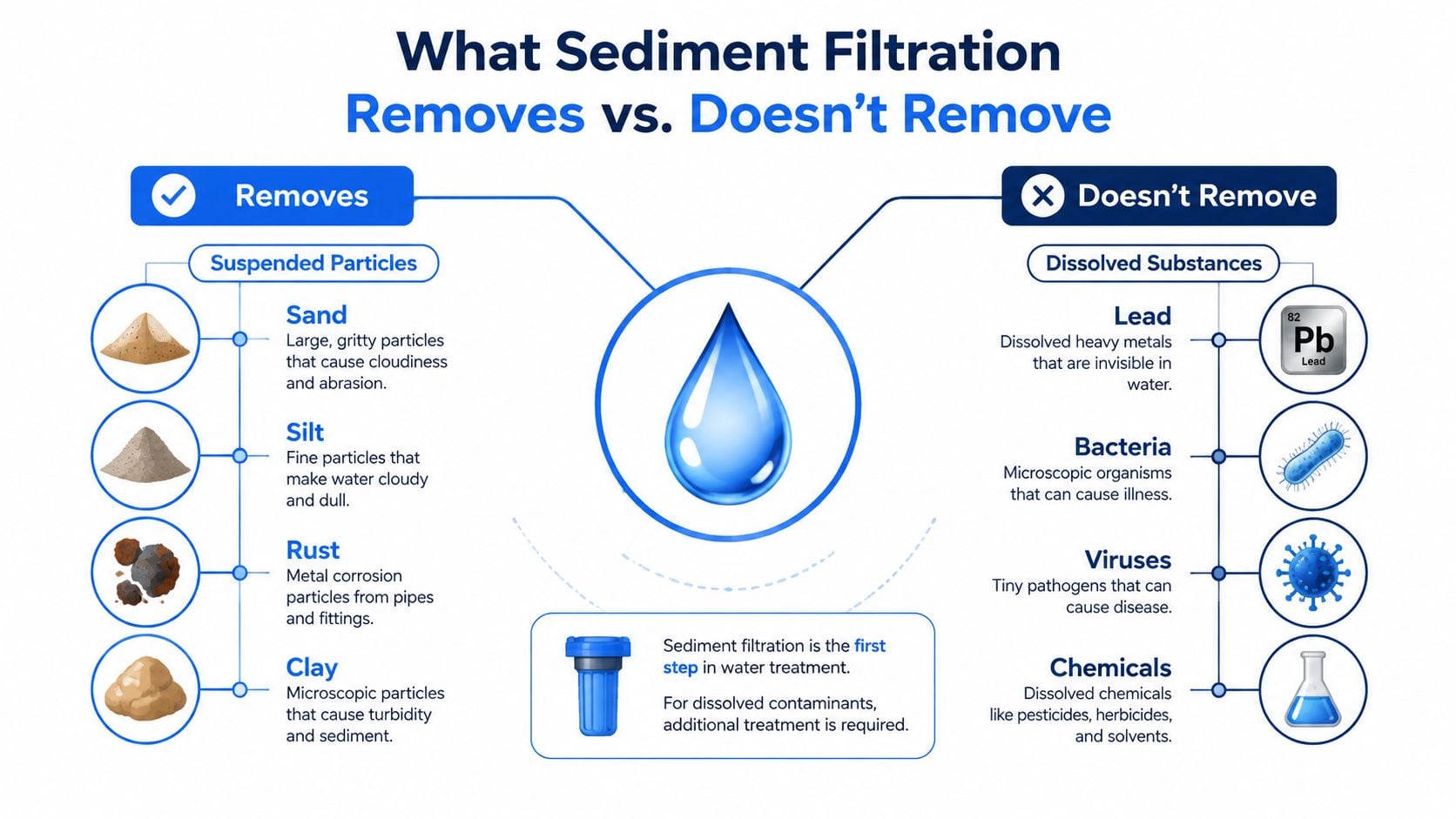
The filter works on substances that are floating in the water rather than fully dissolved in it. Common targets include:
- Sand and grit, which may enter from a private well or disturbed plumbing.
- Silt and clay, which can create a hazy or cloudy appearance.
- Rust flakes and loose scale, often released by aging pipes, valves, or water heaters.
- Organic debris, depending on the media and the size of the material.
Micron rating describes the approximate particle size the media is intended to capture. A smaller rating generally targets finer particles, but a nominal rating isn’t the same as an absolute guarantee that every particle of that size will be retained.
What it cannot solve
Dissolved contaminants pass through a basic sediment barrier. The same extension guidance explains that sediment filters don’t effectively remove nitrate, heavy metals, pesticides, or trihalomethanes. They also aren’t a complete treatment for PFAS, chlorine, fluoride, chromium, or other dissolved water-quality concerns.
That’s why a homeowner needs to separate two questions:
- Is the water carrying visible or suspended particles?
- Does testing or a water report show dissolved contaminants that need another treatment method?
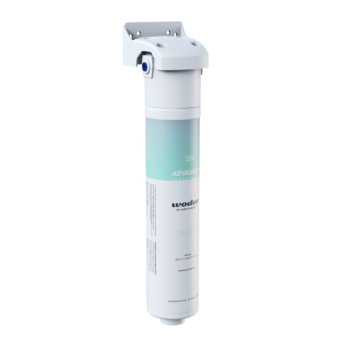
A sediment stage may protect a carbon, selective, or other contaminant filter from premature clogging. It shouldn’t be presented as the treatment stage for every contaminant in the water. For example, the Woder Sediment Water Filter for dirt, sand, and dust removal is described as a made-in-the-USA, 20-micron pre-sedimentation filter for under-sink use. That role is different from a filter designed to address dissolved chemicals or metals.
Benefits and Limits of Reusable Filters
A reusable filter earns its place when a home receives a steady load of coarse sediment. Instead of throwing away the cartridge after it fills, the homeowner can remove it, rinse off trapped debris, inspect the media, and put it back if the structure remains sound. This can reduce cartridge waste in homes that regularly receive sand, rust, or dirt.
Cleaning frequency determines whether that benefit holds up. A cartridge that is easy to rinse but left clogged will still restrict flow and reduce protection. Regular inspection and cleaning make reusable filtration useful. Ignoring those tasks turns its main advantage into a maintenance problem.
The filter also serves as a protective first stage. It intercepts larger particles before they reach a finer under-sink cartridge, appliance valve, water heater, or pump. Its job is mechanical separation, not complete water treatment. A sediment filter performs the same kind of physical separation as a coffee filter, but its media is engineered for continuous water flow and particulate loading.
Micron selection sets the main tradeoff. One product specification lists washable Harmsco sediment cartridges at 0.35, 5, 20, and 50 microns. It also lists flow rates for different cartridge sizes and ratings (washable sediment cartridge specifications).
Finer capture has a cost
A tighter rating can capture smaller particles, but it leaves less open space for water and sediment to pass through. In heavily sedimented water, the media may load quickly, reducing flow and requiring more frequent cleaning. A coarser rating may work better in practice if it keeps water moving while protecting a finer stage farther along the line.
Reusable media is not permanent. Pleats can become damaged, stretched, packed with material, or difficult to clean completely. A cartridge may look clear after rinsing while its structure has weakened, so inspection belongs in every cleaning cycle.
For more detail on how micron ratings affect capture and flow, see this guide to 0.5-micron water filters. Choose the rating for the actual sediment load, then watch flow, pressure, cleaning frequency, and cartridge condition. The smallest rating is not automatically the best choice.
Reusable Versus Disposable Sediment Filters
Reusable and disposable cartridges solve the same basic problem, but they place the work in different parts of the ownership cycle. A reusable filter asks the homeowner to clean and inspect the element. A disposable filter asks the homeowner to keep replacement cartridges available and install a new one when it loads.
| Criteria | Reusable Filter | Disposable Filter |
|---|---|---|
| Upfront cost | May require a washable cartridge and compatible housing | Usually uses a replacement-cartridge system |
| Ongoing maintenance effort | Requires shutoff, pressure release, cleaning, inspection, and reassembly | Requires shutoff, cartridge removal, and replacement |
| Filtration lifespan | Depends on sediment loading and whether the media remains intact after cleaning | Ends when the cartridge loads or reaches its service limit |
| Environmental impact | Can reduce the number of discarded filter elements | Produces a discarded cartridge each time the element is replaced |
A disposable filter can be the easier choice for a city apartment with relatively little visible sediment. The homeowner may prefer a predictable replacement routine over handling dirty media. Convenience has value, especially when the filter is easy to access and the incoming water doesn’t load it quickly.
A reusable cartridge becomes more attractive when a home receives moderate or heavy sediment. A private well, seasonal disturbance, visible sand, or recurring rust can make repeated disposable replacements inconvenient. The tradeoff is that the owner has to clean the element properly and recognize when washing no longer restores useful flow.
Neither option is universally superior. A reusable filter that nobody cleans is less useful than a disposable filter replaced on time. A disposable filter in a heavily sedimented home may create needless maintenance trips and recurring waste. The best choice depends on water condition, access to the housing, household flow needs, and willingness to perform routine service.
How to Clean and Maintain Your Reusable Sediment Filter
Cleaning should be deliberate, not rushed. Before opening the housing, identify the shutoff valve, place a container or towel beneath the assembly, and make sure nobody needs water while the system is depressurized.
Follow the full cleaning cycle
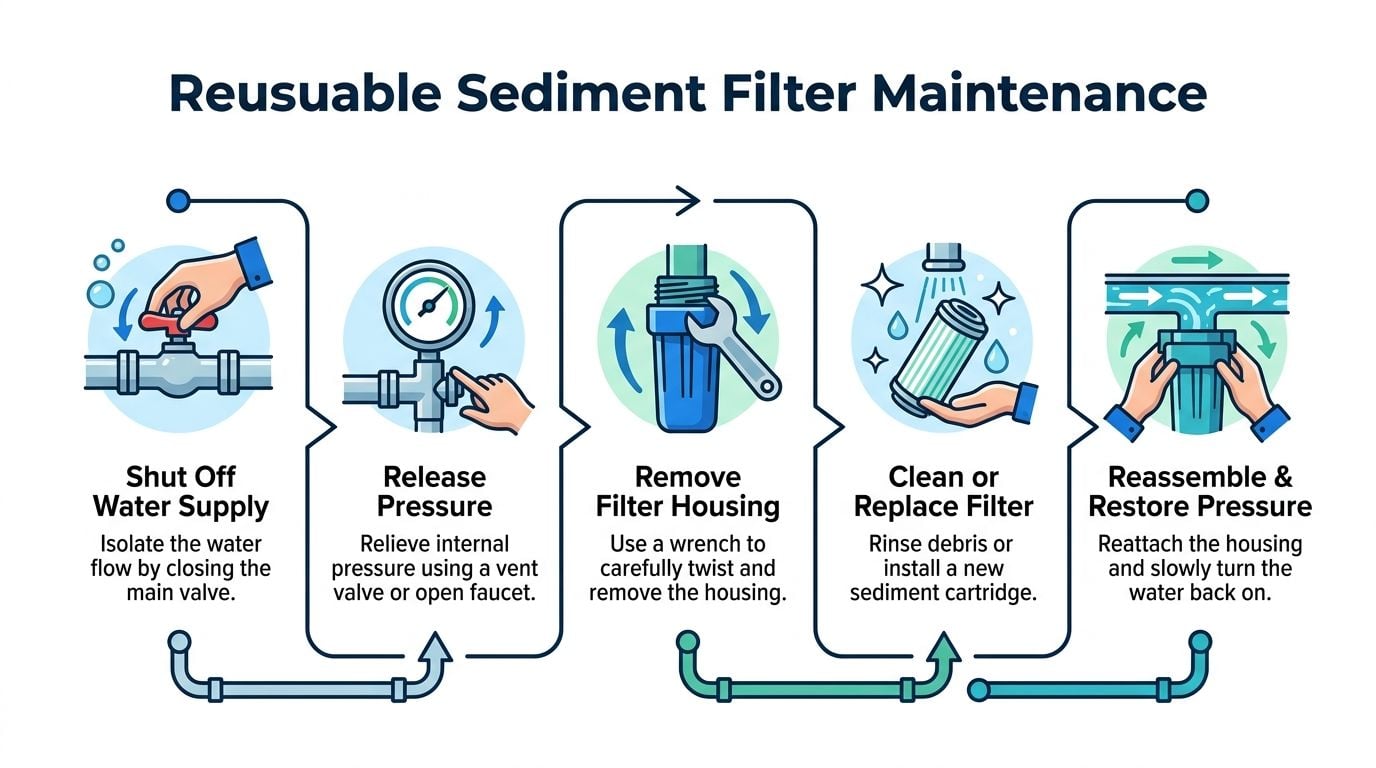
- Shut off the water supply. Close the valve feeding the filter. If the system has a pump, follow the manufacturer’s safe shutdown procedure.
- Release pressure. Open a downstream faucet until the water stops and the housing no longer holds line pressure.
- Remove the housing. Use the supplied housing wrench if needed. Support the housing as it comes free so the fittings and connected tubing aren’t strained.
- Inspect the cartridge. Look for torn pleats, crushed media, permanent discoloration, cracks, or material that remains embedded after rinsing.
- Clean the element. Rinse it with clean water. A soft brush can loosen buildup, but don’t use an abrasive pad that could damage the media.
- Clean the housing. Remove residue from the bottom and from the O-ring groove. Use a mild, unscented soap if the housing requires more than rinsing, then rinse thoroughly.
- Check the O-ring. Look for flattening, cracks, brittleness, or distortion. A damaged O-ring can leak even when the cartridge is in good condition.
- Reassemble carefully. Seat the cartridge and O-ring correctly, thread the housing evenly, and tighten it as directed. Avoid forcing or overtightening the plastic housing.
- Restore pressure slowly. Open the supply valve gradually and check every connection for leaks.
A pressure gauge can make the decision easier. One independent specification sheet reports a 15.6 psi pressure drop at a stated flow condition, while another washable cartridge line is marketed with pressure drop under 5 psi and maximum operating pressure up to 6.5 bar (sediment filter pressure-drop specification sheet). These figures aren’t universal limits for every housing. They show why the clean starting pressure and the loaded pressure matter more than a vague promise that a filter has “high flow.”
A noticeable pressure difference across the housing is a practical signal to inspect the cartridge. For detailed housing guidance, use this resource on water filter housing maintenance. If the housing is cracked, warped, persistently cloudy, or unable to seal, replace the housing rather than trying to extend its service life.
When to Choose Reusable and When to Choose Disposable
The best choice starts with the water source, not with the filter’s marketing label.
A private well with visible sand or recurring sediment is a strong candidate for a reusable pre-filter. The cartridge may need frequent attention, but that is precisely where washability has practical value. A homeowner can remove the accumulated material instead of treating every clogged element as disposable.
A city apartment with municipal water and little visible sediment may favor a disposable cartridge. The supply may still need point-of-use treatment for taste or dissolved contaminants, but a washable sediment stage can be unnecessary if the mechanical load is light and access is inconvenient.
A third situation is an under-sink contaminant filter that clogs prematurely. In that case, a reusable upstream sediment stage can serve as a protective barrier. It won’t replace the downstream treatment. It can keep sand, rust, and dirt from occupying the finer filter’s working capacity.
An old idea with a modern maintenance lesson
The principle is not new. Depictions in Egyptian tombs at Thebes from the 15th to 13th century BCE show early water filtration practices, and sand filters, settlement cisterns, and ceramic hydraulic filters were being used before 1100 BCE to remove sediment from domestic water supplies (history of water filters). In modern documented filtration history, John Gibb installed an experimental sand filter in Paisley, Scotland, in 1804, a milestone often associated with modern point-of-use and municipal filtration development.
The equipment has changed, but the logic remains familiar. Trap particles before they travel farther into the system.
Use this decision framework:
- Choose reusable if your water carries visible sediment, your housing is accessible, and you’re willing to clean the element.
- Choose disposable if sediment is light, convenience matters most, and replacement is easier than washing.
- Use staged filtration if the water is dirty enough to load a fine cartridge quickly.
- Test dissolved contaminants separately if your concern includes chemicals, metals, PFAS, fluoride, chlorine, or other substances a sediment barrier isn’t designed to remove.
This guide to a pleated sediment water filter can help you compare cartridge construction and fit.
How a Sediment Filter Protects Your Whole Home
A maintained sediment pre-filter works at the system’s first checkpoint. It catches larger particles before they reach finer filters, valves, pumps, appliances, and fixtures. By reducing debris entering those components, it can limit loading, support steadier operation, and make service easier.
The cartridge also has a clear limit: it removes suspended physical particles, not substances dissolved in water. Concerns about PFAS, lead, heavy metals, fluoride, chromium, chlorine, or taste and odor require treatment designed for those targets.
The EPA’s final PFAS rule sets enforceable maximum contaminant levels of 4.0 parts per trillion for PFOA and PFOS, 10 parts per trillion for PFHxS, PFNA, and HFPO-DA, and a Hazard Index of 1 for specified mixtures (EPA PFAS drinking water rule). A mechanical sediment filter cannot meet dissolved-contaminant targets because those substances pass through a particle barrier.
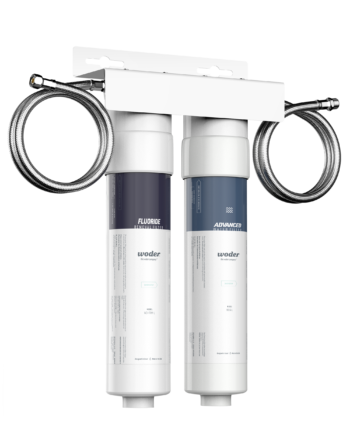
Woder manufactures point-of-use sediment filters in the United States, including the WD-20m-DC, described as a 20-micron pre-sedimentation stage. For broader contaminant treatment, Woder’s Advanced Selective Filtration® is designed to target contaminants while retaining essential minerals, unlike reverse osmosis systems that strip dissolved solids from treated water.
Placement and upkeep determine how much protection the cartridge provides. A reusable filter can help when it is cleaned before heavy loading restricts flow. Left unattended, even a correctly sized filter becomes a clogged checkpoint, so maintenance frequency is a better performance guide than the label alone.
Frequently Asked Questions About Reusable Sediment Filters
How often should you clean one?
Clean it whenever flow declines noticeably, the pressure difference across the housing increases, or visible loading covers the media. Homes with heavy well sediment may need attention far more often than homes with clean municipal water. Keep a simple maintenance log so you can spot your own pattern instead of relying on a generic interval.
Can you use one with a high-iron well?
You can use a reusable sediment filter as a coarse pre-filter when iron is present as suspended particles. It won’t reliably solve dissolved iron, and high-iron water may load or stain the media quickly. Test the water and use treatment designed for the form of iron involved.
When should you replace the element instead of cleaning it?
Replace it when rinsing no longer restores flow, the pleats are torn or collapsed, the media has become brittle, or the cartridge remains heavily embedded with material. Also replace the housing or seal when cracks, distortion, or persistent leakage appear. A washable element is useful only while it can be cleaned and safely reinstalled.
A reusable sediment filter is manageable when you match it to the water and pay attention to its condition. You’re not choosing between perfect and useless equipment. You’re choosing the right first stage for the particles your home receives.
Woder Filters offers U.S.-manufactured point-of-use filtration, including sediment pre-filtration and Advanced Selective Filtration® for targeted contaminant removal while retaining essential minerals. Visit Woder Filters to review options for your water source, fixture, and maintenance preferences.