- Why Cartridge Lifespan Is Never One-Size-Fits-All
- Clear Signs Your Water Filter Cartridge Needs Replacing
- How to Build a Replacement Schedule That Actually Works
- What Happens If You Don't Replace It on Time
- Different Filter Types, Different Replacement Timelines
- Practical Tips for Staying on Schedule
- FAQs
- Keep Your Filter Working the Way It's Supposed To
Most people replace their water filter cartridge on a rough schedule — maybe when they remember, maybe when the water starts tasting off. Neither approach is reliable. A cartridge that looks fine can be exhausted well before its rated lifespan, and one that's technically "due" might still have months of useful life left depending on your water quality and how much your household actually uses it.
This guide covers the real signs your water filter replacement cartridge needs attention, how to build a schedule that fits your situation, and what happens if you let it go too long.
Why Cartridge Lifespan Is Never One-Size-Fits-All
Filter manufacturers publish lifespan estimates in gallons or months, and those numbers are a reasonable starting point. But they're based on average water quality and average household consumption. Your water isn't average.
If your municipal supply carries higher-than-normal sediment, chlorine, or heavy metals, your filter works harder and exhausts faster. A household of five goes through water faster than a couple. A filter in a vacation home might sit idle for months, then see heavy use on weekends.
Think of the rated lifespan as a ceiling, not a guarantee. Pay attention to the signals below.
Clear Signs Your Water Filter Cartridge Needs Replacing
1. Taste or Odor Changes
This is the most obvious signal. When a cartridge approaches exhaustion, it stops catching the chlorine, sulfur compounds, and organic matter that make tap water taste or smell unpleasant. If your water starts tasting flat, metallic, or faintly chemical, the cartridge is likely saturated.
The catch: some contaminants are tasteless and odorless. A change in taste tells you the filter is done, but the absence of one doesn't mean it's still working.
2. Reduced Flow Rate
A drop in water pressure at your filtered tap is a reliable physical indicator. As sediment and particulate matter accumulate inside the cartridge, they restrict flow. If your faucet is running noticeably slower or your filtered pitcher takes longer to fill, the cartridge may be clogged rather than chemically exhausted.
Some filters slow down before they stop filtering effectively. Others maintain flow while losing their ability to remove contaminants. Either way, a significant drop in flow rate is reason to inspect or replace the cartridge.
3. Visible Discoloration in the Water
Cloudiness, a yellowish tint, or visible particles in filtered water are signs the cartridge is no longer doing its job. This is less common with quality filters under normal conditions, but it can happen when a cartridge is severely overdue or when a sudden spike in source water quality overwhelms an aging filter.
4. You’ve Hit the Usage Threshold
Even if the water looks and tastes fine, a cartridge that has processed its rated volume should be replaced. The filtration media inside has a finite capacity to bind contaminants. Once that capacity is reached, contaminants pass through whether you can detect them or not.
Track your replacement dates and, where possible, your household's daily water consumption. A family of four using roughly 50 gallons of filtered water per day will cycle through a 10,000-gallon-rated cartridge in about 200 days — not the full year the packaging might suggest.
How to Build a Replacement Schedule That Actually Works
Start With the Manufacturer’s Rating
The rated lifespan is your baseline. Note it, then adjust based on your household.
Factor In Your Water Quality
If you're on city water with high chlorine levels, or in an area with known agricultural runoff or aging infrastructure, assume your cartridge will exhaust toward the lower end of its rated range. If your source water is relatively clean and you're filtering mainly as a precaution, the upper end is more realistic.
Your municipality's annual water quality report is a good starting point — it's required to be published each year. For more precise data, a home water test kit or lab test gives you a clearer picture of what your filter is actually working against.
Adjust for Household Size
A simple calculation: divide the cartridge's rated gallon capacity by your household's estimated daily filtered water consumption. Most households use between 1 and 3 gallons of drinking and cooking water per person per day from a filtered source. A household of three using 2 gallons per person per day consumes about 6 gallons daily, which means a 6,000-gallon cartridge lasts roughly 1,000 days under those conditions.
Set a Physical Reminder
Don't rely on memory. Write the installation date on the cartridge with a marker, set a recurring calendar reminder, or use the date-tracking feature if your system includes one. Set the reminder a few weeks before the expected end date so you have time to order a replacement without a gap in coverage.
What Happens If You Don’t Replace It on Time
Contaminant Passthrough
The most serious consequence is straightforward: an exhausted filter stops removing what it's rated to remove. Heavy metals, chlorine byproducts, sediment, and other contaminants flow through as if the filter weren't there. Depending on your source water, this could mean drinking water that's meaningfully worse than unfiltered tap water — because the filter housing can also become a collection point for what it previously captured.
Bacterial Growth
A saturated or neglected cartridge can become a site for bacterial growth, particularly if the filter sits idle for extended periods. The organic matter trapped in an exhausted cartridge provides a food source. It's a less common concern with well-maintained systems, but a real risk when cartridges are left in place far beyond their rated lifespan.
Damage to Your Filter System
Excessive sediment buildup inside an overdue cartridge can restrict flow to the point where it stresses fittings, connections, and the filter housing itself. More of a long-term wear issue than an immediate concern, but another reason not to let replacement slide indefinitely.
The False Sense of Security
Perhaps the most practical risk is behavioral. If you believe your water is filtered when it isn't, you're less likely to take other precautions. An exhausted cartridge that still produces clear, odorless water can be genuinely misleading.
Different Filter Types, Different Replacement Timelines
Not all water filter replacement cartridges follow the same schedule. The filtration technology determines both how the cartridge works and when it needs replacing.
Activated carbon filters are the most common type in under-sink and inline systems. They adsorb chlorine, organic compounds, and some heavy metals. Typical ratings run from 6 months to a year for household use, though high-demand households may need to replace sooner.
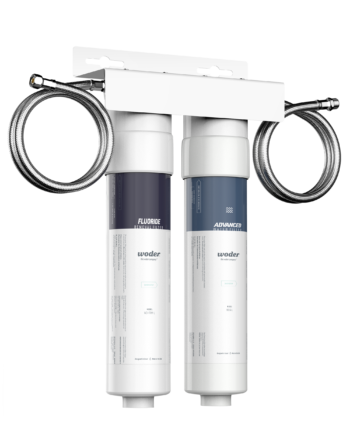
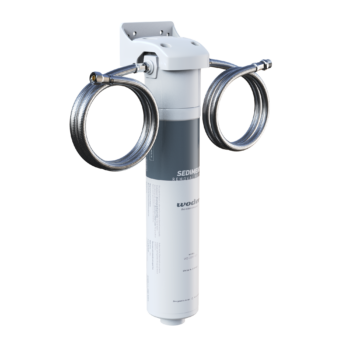
Sediment pre-filters are often the first stage in multi-stage systems, catching particulate matter before it reaches the main filter. Because they're trapping physical debris, they can clog faster than chemical filtration stages — especially in areas with older pipes or high-turbidity water.
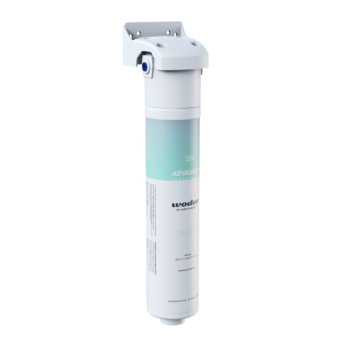
Selective filtration media, like the nanoparticle-based technology used in Woder filters, works differently from standard activated carbon. Rather than adsorbing contaminants indiscriminately, it targets specific ones while leaving beneficial minerals intact. Replacement schedules still apply, but the more targeted filtration mechanism affects how the cartridge ages and what you're monitoring for.
Reverse osmosis membranes have their own replacement cycle — typically every two to three years for the membrane itself, with pre- and post-filters replaced more frequently. RO systems generally require more maintenance than inline or under-sink filters without membranes.
Practical Tips for Staying on Schedule
- Buy your replacement cartridge before you need it. Shipping delays and out-of-stock situations happen. Having a spare on hand means no gap in filtration.
- Pair replacement with a recurring event. Changing your clocks, a seasonal milestone, or a birthday — anything that happens on a predictable schedule makes it easier to remember.
- Test your water periodically. An annual water test, or one after any significant change in your source water (nearby construction, a boil-water advisory, a change in supplier), helps you calibrate your replacement schedule to actual conditions rather than estimates.
- Keep a simple log. A sticky note inside the cabinet with the installation date and expected replacement date takes 30 seconds and removes all ambiguity.
FAQs
How do I know if my water filter cartridge is exhausted before the rated date?
Watch for changes in taste, odor, or flow rate. Any of these can signal the cartridge has reached its capacity earlier than expected — usually because your source water has higher contaminant levels than the manufacturer's baseline assumption.
Can I run a water filter cartridge past its rated lifespan if the water still tastes fine?
It's not a good idea. Many contaminants — including certain heavy metals and some chlorine byproducts — are tasteless and odorless. A cartridge that tastes fine can still be passing contaminants it's no longer able to capture.
Does a filter cartridge go bad if the system isn't used for a long time?
Yes, it can. Extended stagnation can promote bacterial growth inside a saturated cartridge. If your filtered water system has been sitting unused for more than a few weeks, flush it thoroughly and consider replacing the cartridge before resuming regular use.
What's the difference between replacing a cartridge and replacing the whole filter unit?
The cartridge is the replaceable filtration media inside the filter housing. The housing itself is designed to last for years. You're typically replacing only the cartridge on a regular schedule — not the entire unit — which keeps ongoing maintenance costs manageable.
How does household size affect how often I need to replace my water filter cartridge?
Directly. A larger household consumes more filtered water, which means the cartridge processes more volume and exhausts faster. Divide the cartridge's rated gallon capacity by your estimated daily filtered water usage to get a more accurate replacement timeline than the generic "replace every 12 months" guidance.
Is there a way to test whether my current cartridge is still working?
A home water test kit can give you a rough sense of contaminant levels in your filtered water compared to your unfiltered tap. If the filtered water shows similar levels to the unfiltered source for the contaminants your filter is rated to remove, the cartridge is likely exhausted.
Do all filter cartridges need to be replaced at the same frequency in a multi-stage system?
No. Different stages have different lifespans. Sediment pre-filters often need replacing more frequently than the main filtration cartridge because they catch physical debris that accumulates faster. Follow the manufacturer's guidance for each stage individually.
Keep Your Filter Working the Way It’s Supposed To
A water filter cartridge doesn't announce when it's done. It just quietly stops doing its job. The best approach combines scheduled replacements based on your actual household usage, attention to the physical signals your water gives you, and periodic testing to confirm your filtered water is meeting the standard you expect.
If you're using an under-sink or inline filter and want to understand the specific replacement schedule for your system, Woder provides guidance for their filter models based on filtration technology and household conditions. Getting the timing right is the simplest thing you can do to make sure your filter keeps delivering what it promises.