You turn on the tap, fill a glass, and move on with your day. That routine feels ordinary because the water looks ordinary. The trouble with chromium-6 is that a utility report can still look acceptable even when the hexavalent form is present, and most homeowners never get a clear breakdown of what's in the water they drink.
That's why a chromium 6 water filter isn't just a product search. It's a decision about testing, certification, and whether the number on a report is telling you the whole story. Federal rules, state rules, and filter claims don't always line up, so the smarter first step is to understand what your water report can, and can't, prove.
Table of Contents
- The Glass of Water Most Homeowners Don't Think Twice About
- What Chromium-6 Is and Where It Comes From
- Why Federal Rules and State Rules Tell Different Stories
- How to Find Out Whether Chromium-6 Is Actually in Your Water
- Filtration Technologies That Remove Chromium-6
- How to Read Filter Claims and Certifications Without Getting Misled
- Why RO Is Not the Only Answer for Renters and Small Spaces
- A Practical Next Step for Your Household
The Glass of Water Most Homeowners Don't Think Twice About
The kitchen gets quiet at night. Someone fills a glass, drinks half of it, and leaves the rest by the sink. That's the moment people never question, because the water is clear and the report from the utility usually looks reassuring on the surface.
The catch is that total chromium and chromium-6 are not the same thing. The U.S. EPA regulates total chromium at 0.1 mg/L, or 100 ppb, but that federal limit combines chromium-6 with chromium-3 and does not set a separate national standard for hexavalent chromium specifically, according to the EPA's drinking water page. EPA chromium drinking water overview
Why a normal report can leave you with a blind spot
That distinction matters because a homeowner can look at a report, see “chromium,” and assume the issue is settled. It isn't. If the utility only reports total chromium, you still don't know how much, if any, is the hexavalent form that people usually mean when they say chromium-6.
Practical rule: if your report doesn't separate chromium-6 from total chromium, treat it as incomplete, not reassuring.
The other reason this topic comes up so often is that chromium-6 has shown up broadly in U.S. water systems. The EPA's national survey found it in more than three-fourths of sampled systems, which supplied water to more than two-thirds of the American population. That doesn't tell you what's in your tap today, but it does explain why this contaminant can't be dismissed as a niche issue. EPA chromium drinking water overview
For a homeowner, the takeaway is simple. A glass of water can look fine while the report still leaves a key question unanswered. The issue isn't panic, it's knowing whether your utility data distinguishes between total chromium and chromium-6, because that changes the filter decision later.
What Chromium-6 Is and Where It Comes From
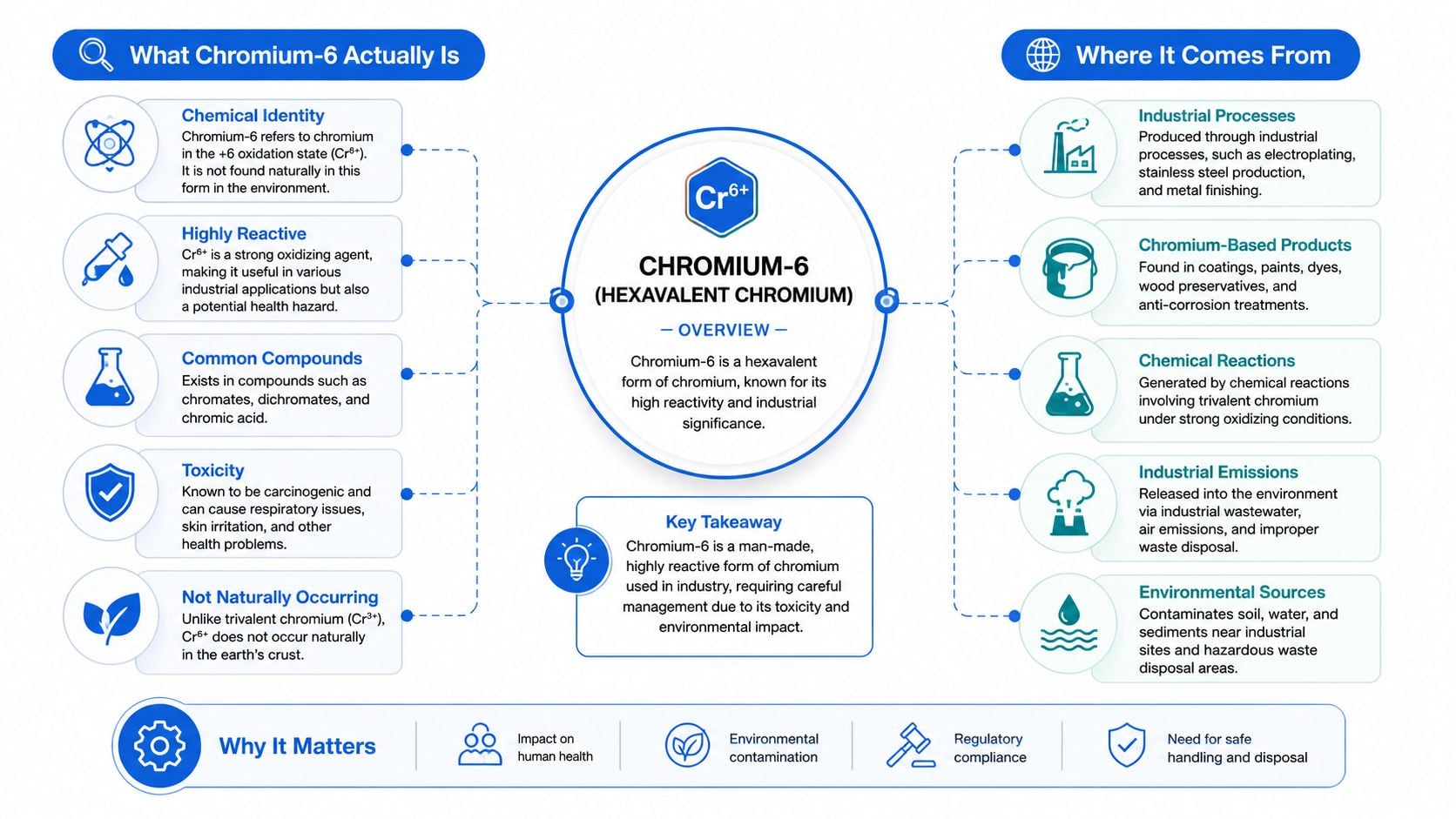
Chromium is an element, but it does not behave the same way in every form. Chromium-6, also called hexavalent chromium, is one chemical form of the metal, while chromium-3 is another. The two forms share a name, but they do not play the same role in drinking water or in the body. One form is used in some biological processes, while the other is the one that raises concern in water treatment.
Where it tends to enter water
Chromium-6 can enter drinking water through industrial discharge, legacy plating operations, and natural occurrence in some geological formations. That mix is why it can show up in both municipal systems and private wells. The source matters, but the homeowner-facing problem stays the same, it may be present even when the water looks clear and has no obvious smell or taste.
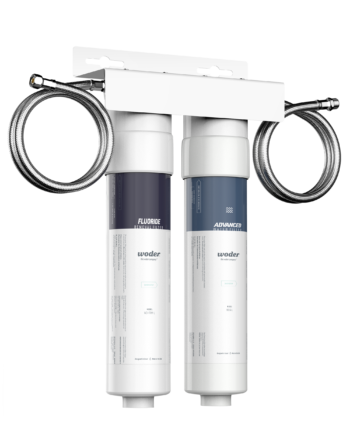
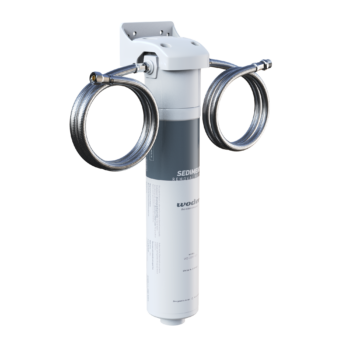
A small point of practical plumbing helps here. If your water also carries sediment, dirt, or dust, a pre-sedimentation stage such as Woder Sediment Water Filter – Dirt, Sand and Dust Removal can make sense before you evaluate contaminant-specific treatment. It is a 20µ pre-sedimentation under-sink filter, made in the USA, and it is meant for particulate load, not for solving the chromium-6 question by itself.
Why chromium-6 gets its own conversation
A lot of consumer filter content groups all heavy metals together. That is too broad for this contaminant. Chromium-6 deserves its own discussion because certification and performance claims depend on whether a system was tested for the specific form, not just for “metals” in general.
Chromium-6 is a contaminant you usually have to identify by name. Generic language rarely tells you enough.
That is the point to keep in mind as you read the rest of your report and compare filters. Rather than buying the most impressive-looking cartridge, match a real contaminant profile with a system verified for that contaminant.
Why Federal Rules and State Rules Tell Different Stories
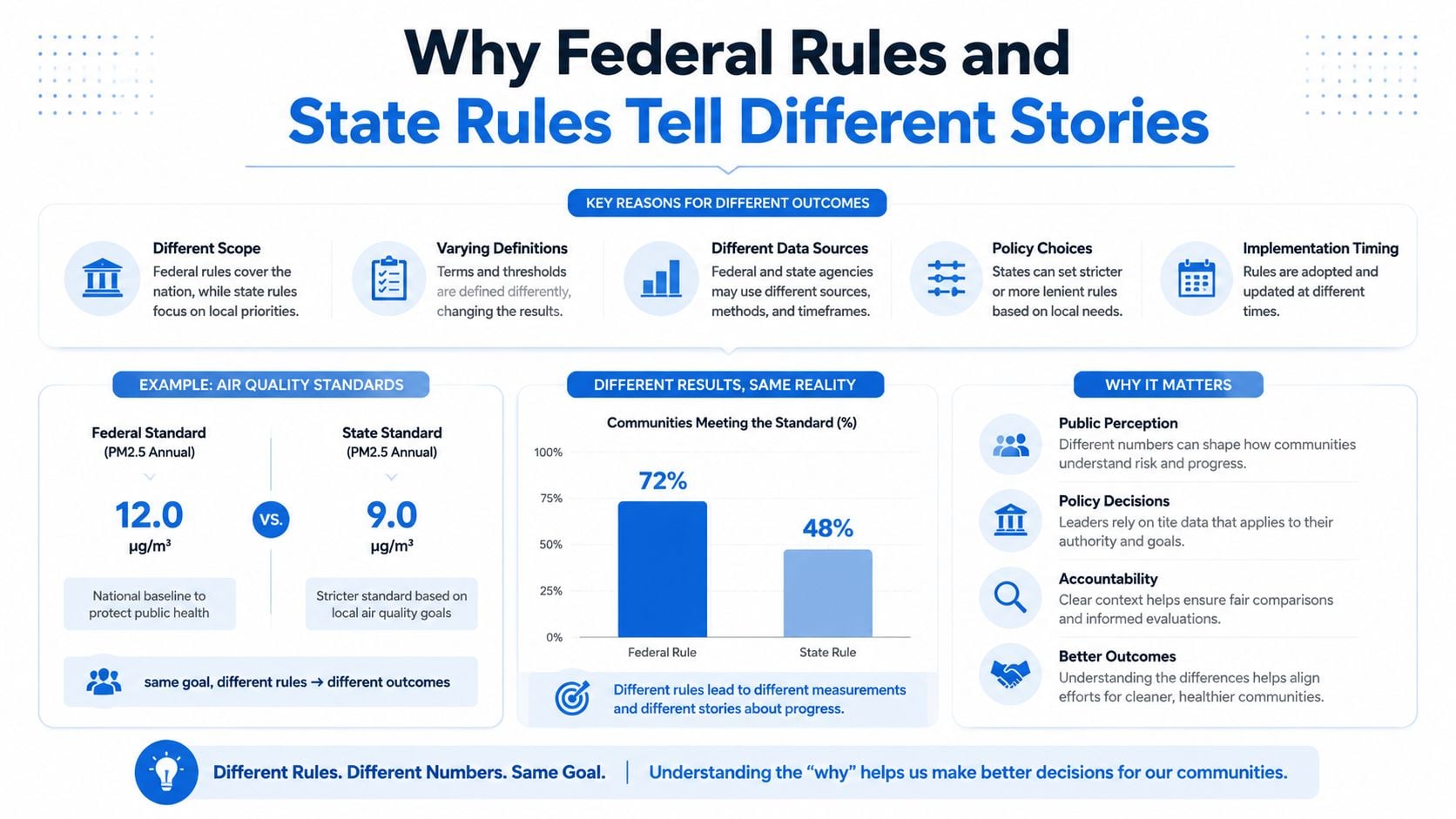
A homeowner opening a water report can easily expect one clear chromium answer. The problem is that the rules do not line up that neatly. The EPA sets a 100 ppb limit for total chromium, while California set a much tighter 10 ppb chromium-6-specific drinking-water limit in July 2024, making it the first U.S. jurisdiction with an enforceable chromium-6 standard. Those numbers measure different things, so they cannot be treated as the same standard. EPA chromium drinking water overview
The state goal sits much lower than the federal ceiling
California's public-health benchmark sits even lower. Its health goal is 0.02 ppb, which is 5,000 times lower than the EPA's 100 ppb total-chromium limit. That does not mean every household needs the same treatment level, but it does show the size of the gap between a legal ceiling and a health-based target. EWG chromium-6 drinking water review
That gap is a big reason homeowners get mixed signals. A utility may report total chromium and still leave you unsure how much of it is chromium-6. A kitchen tap report can feel a little like a receipt that lists “fruit” without saying whether you bought apples, oranges, or both. For filter selection, that missing detail matters, because a general metals problem and a hexavalent chromium problem do not lead to the same choice.
Why the numbers matter in practice
Analysts at the Environmental Working Group reported that a 2016 analysis of EPA tap-water testing found measurable chromium-6 in water serving more than 218 million Americans across all 50 states, based on more than 60,000 utility samples collected between 2013 and 2015. Those figures do not tell you what is in your own tap, but they do explain why homeowners keep running into this issue in ordinary municipal water. The pattern was broad enough to show up across the country, even though any one household still needs local information before buying a filter.
Bottom line: a legal total-chromium number can be true and still leave the chromium-6 question unanswered.
That is why the smartest starting point is not a filter brand. It is the level of detail in the rules, then the quality of the data in your own report. If the report does not separate chromium forms, you still do not have the information needed to choose a treatment system with confidence.
How to Find Out Whether Chromium-6 Is Actually in Your Water
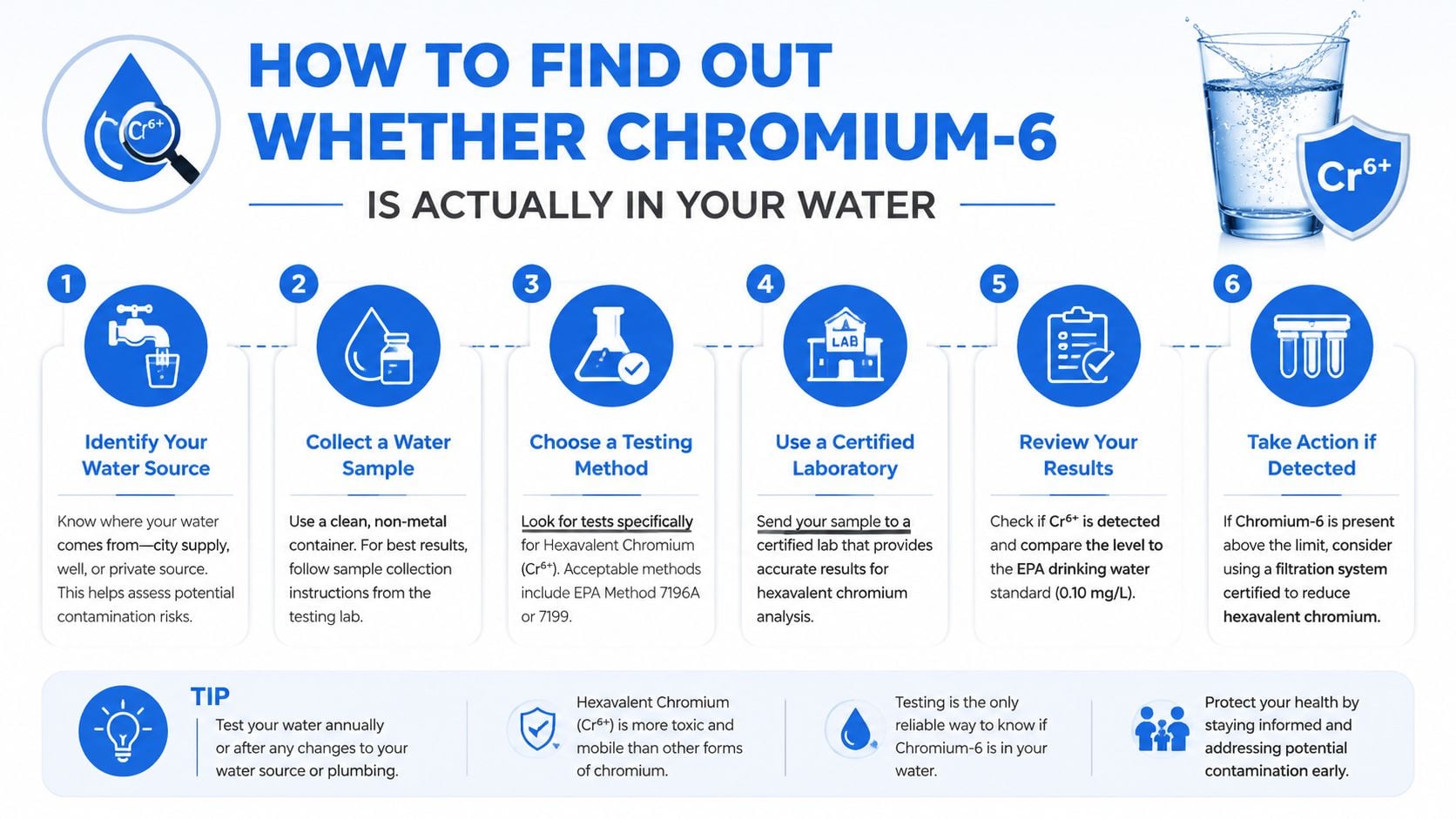
Start with the utility report. Your Consumer Confidence Report may list chromium, total chromium, or sometimes more specific notes, and that's the first place to look before you shop for anything. If you want a plain-language guide for reading that report, the walkthrough at how to read a water quality report is a useful companion.
What to look for first
If the report only gives a total chromium number, you still don't know whether chromium-6 is the form of concern. That's the main blind spot. Total chromium can be helpful as a screening number, but it can't tell you the ratio between chromium-3 and chromium-6, and that ratio is exactly what affects the filter choice.
A private well owner has a different problem. Generic metals panels may tell you that chromium is present, but they may not separate hexavalent chromium. In that case, a specialized lab test for chromium-6 is the cleaner option because it measures the contaminant you're trying to solve for.
A simple workflow that keeps you from guessing
- Check the utility report. Look for chromium, total chromium, or a separate chromium-6 line.
- See whether the report separates forms. If it doesn't, treat the data as partial.
- Use a specialized lab test when needed. Private wells and vague utility reports often need a chromium-6-specific result.
- Match the test to the filter. Don't buy based on “heavy metals” language alone.
- Verify the certification before purchase. The contaminant name has to appear on the product's performance data sheet.
- Retest after installation if the situation is unclear. That gives you a cleaner picture of whether the system fits the actual water.
If the report only gives you a general metals number, don't treat that as a chromium-6 answer. It's a starting point, not a conclusion.
This step matters because it keeps you from overbuying or buying the wrong technology. The right filter choice starts with knowing whether you're dealing with a known chromium-6 issue, a broad metals concern, or a report that still needs better testing.
Filtration Technologies That Remove Chromium-6
A homeowner staring at a utility report can feel stuck between vague labels and product claims. The useful question is narrower than “What kind of filter should I buy?” It is whether a system has certified performance for chromium-6 itself, because that is what separates a marketing claim from a tested result. In practice, that usually leads you to reverse osmosis, certain carbon or selective-filtration systems that list chromium-6 on the performance data sheet, or ion-exchange systems.
What the certified technologies actually do
Reverse osmosis is the most common certified path for chromium-6 reduction. Guidance from the Water Research Foundation explains that NSF/ANSI 58 is used to verify performance against dissolved inorganic contaminants under standardized test conditions. Many carbon pitchers and faucet filters are not certified for hexavalent chromium at all, which is why the category name alone does not tell you much. Water Research Foundation chromium-6 background document
Health Canada gives a concrete example of what verified reduction can look like. It cites a pilot-scale polyamide thin-film composite RO membrane that reduced 5.0 mg/L Cr(VI) feed water to 0.01 mg/L permeate, with >99% rejection at 58.8 L/m²·h flux and >42.5% recovery. That matters because it shows chromium-6 reduction can be measured under test conditions, not just described with broad claims. Health Canada chromium technical document
Some NSF/ANSI 53 carbon systems can reduce chromium-6 too, but only when the product's performance data sheet explicitly lists it. That is different from generic carbon filtration, which may improve taste or odor without proving anything about hexavalent chromium. Ion-exchange systems can also target dissolved contaminants, but the deciding factor is still the product's test data, not the label type by itself.
A quick comparison homeowners can actually use
| Technology | Typical Certification | Chromium-6 Performance | Mineral Impact | Best Fit |
|---|---|---|---|---|
| Reverse osmosis | NSF/ANSI 58 | Certified products can reduce chromium-6 under test conditions | Strips many dissolved minerals along with contaminants | Homeowners who want a dedicated drinking-water system |
| Selective filtration or carbon with chromium-6 listed | NSF/ANSI 53 when the data sheet names chromium-6 | Product-specific, only if tested and listed | Usually preserves more minerals than RO | Renters or smaller installs that need a non-RO option |
| Ion exchange | Product-specific, sometimes paired with other certifications | Depends on resin and test data | Can alter mineral balance depending on design | Targeted contaminant reduction in certain systems |
If you are comparing options beyond the kitchen sink, a broader resource like a water filter for hiking trips can help you see how different filtration setups trade portability against contaminant coverage. The setting is different, but the decision rule is the same, the specific contaminant claim matters more than the product category.
For homeowners who also want to compare certification language across product types, a practical reference on heavy metal water filter certifications and system claims can make the labels easier to sort out. The point is not to memorize every standard. It is to check whether chromium-6 is named, whether the certification matches the technology, and whether the test data fits the system you are planning to install.
Chromium-6 reduction is highly product-specific. Two filters in the same technology family can perform very differently depending on membrane design, resin type, or whether the manufacturer tested for chromium-6 instead of only saying “heavy metals.”
How to Read Filter Claims and Certifications Without Getting Misled
A label can sound reassuring and still leave the key question unanswered. Phrases like “heavy metals,” “cleaner water,” or “advanced filtration” may be true in a broad sense, yet they do not tell you whether a filter has been verified for chromium-6. Start with the contaminant name, then check whether the certification matches the technology.
What the certification should tell you
For chromium-6, NSF/ANSI 58 is the standard most often tied to reverse osmosis systems, while NSF/ANSI 53 may apply to certain carbon or selective-filtration products only when chromium-6 appears on the performance data sheet. A generic carbon pitcher may improve taste and odor, but that does not mean it is certified for hexavalent chromium.
The background guidance from the Water Research Foundation makes the same point. Many carbon pitchers and faucet filters are not certified to remove hexavalent chromium, so the product category alone does not tell you much. As noted earlier in the filtration technologies section, the chemistry and the certification have to line up before a claim becomes useful.
How to check a claim before you buy
- Find the exact NSF listing. A logo in a product photo is not enough.
- Look for chromium-6 by name. “Heavy metals” is too vague.
- Check the performance data sheet. The contaminant should be listed with the test condition.
- Compare the certification to the technology. RO claims should line up with NSF/ANSI 58.
- Read the concentration tested. A claim without the test level is hard to evaluate.
For a closer look at how certifications are tied to different system types, see our guide to heavy metal water filter certifications and systems.
Practical rule: if chromium-6 is not named on the data sheet, assume the product was not verified for it.
A company's filtration language matters too. Woder's Advanced Selective Filtration® is described as reducing contaminants without stripping the minerals that remain naturally in water, and the brand materials cite WQA Gold Seal verification. That kind of claim is different from broad “filters everything” wording, because it sends you back to certification and product-specific performance instead of marketing phrasing.
The habit to build is simple. Look for the exact contaminant, the exact standard, and the exact product data. If one of those is missing, you still do not have a solid chromium-6 answer.
Why RO Is Not the Only Answer for Renters and Small Spaces
Reverse osmosis gets recommended so often for chromium-6 that it can sound like the only serious option. Renters and apartment dwellers often run into a different set of limits, though. RO can reduce dissolved contaminants well, but it also needs under-sink space, a drain line, and ongoing upkeep, and it removes beneficial minerals along with the contaminants.
When the default advice stops fitting real life
That matters for renters, apartment dwellers, breakrooms, and refrigerator or coffee-machine lines. In those settings, installation space can be limited, lease rules may block plumbing changes, and wastewater is a real concern. If you are trying to improve drinking water without turning the kitchen into a project, those tradeoffs can rule RO out. To understand how reverse osmosis works and where it fits, see our guide to reverse osmosis water filters.
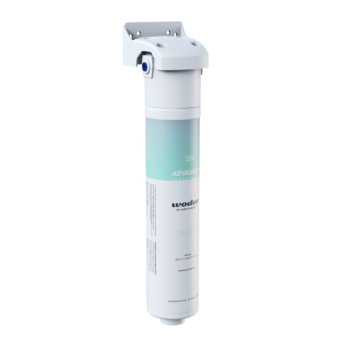
A more realistic answer can be a point-of-use selective-filtration system, or a carbon system that is certified for chromium-6 on its data sheet. Woder's Advanced Inline Water Filter WD-G4-JG is one example of a made-in-the-USA inline approach that uses selective filtration and is described as retaining essential minerals. It is the kind of form factor that fits drinking taps and small installs better than a full RO setup.
The use case matters as much as the chemistry
For a refrigerator line, ice maker, or shared office sink, the question is usually not “What is the most aggressive system?” It is “What can I install, maintain, and verify in this space?” A filter that fits the plumbing and has documented chromium-6 performance is more useful than a stronger-sounding system that cannot be installed cleanly or kept up over time.
Under-sink selective systems and inline options deserve more attention than they usually get in chromium-6 discussions. They can give a homeowner or renter a way to target the contaminant without taking on the space and plumbing demands of a full reverse osmosis setup.
Practical rule: choose the smallest certified system that matches the contaminant profile and the space you actually have.
RO still makes sense for many homes, especially when you want a dedicated drinking-water tap and do not mind the mineral loss. But it should not be treated as the default answer for every household. The better choice is the one that fits your layout, your tolerance for maintenance, and the certification that matches your water.
A Practical Next Step for Your Household
Start with the paper trail, not the product page. Review your utility's Consumer Confidence Report for total chromium and any separate chromium-6 notation, then decide whether the report is specific enough to answer your question. If you're on a private well, or the data are vague, a specialized chromium-6 lab test is the cleaner next move.
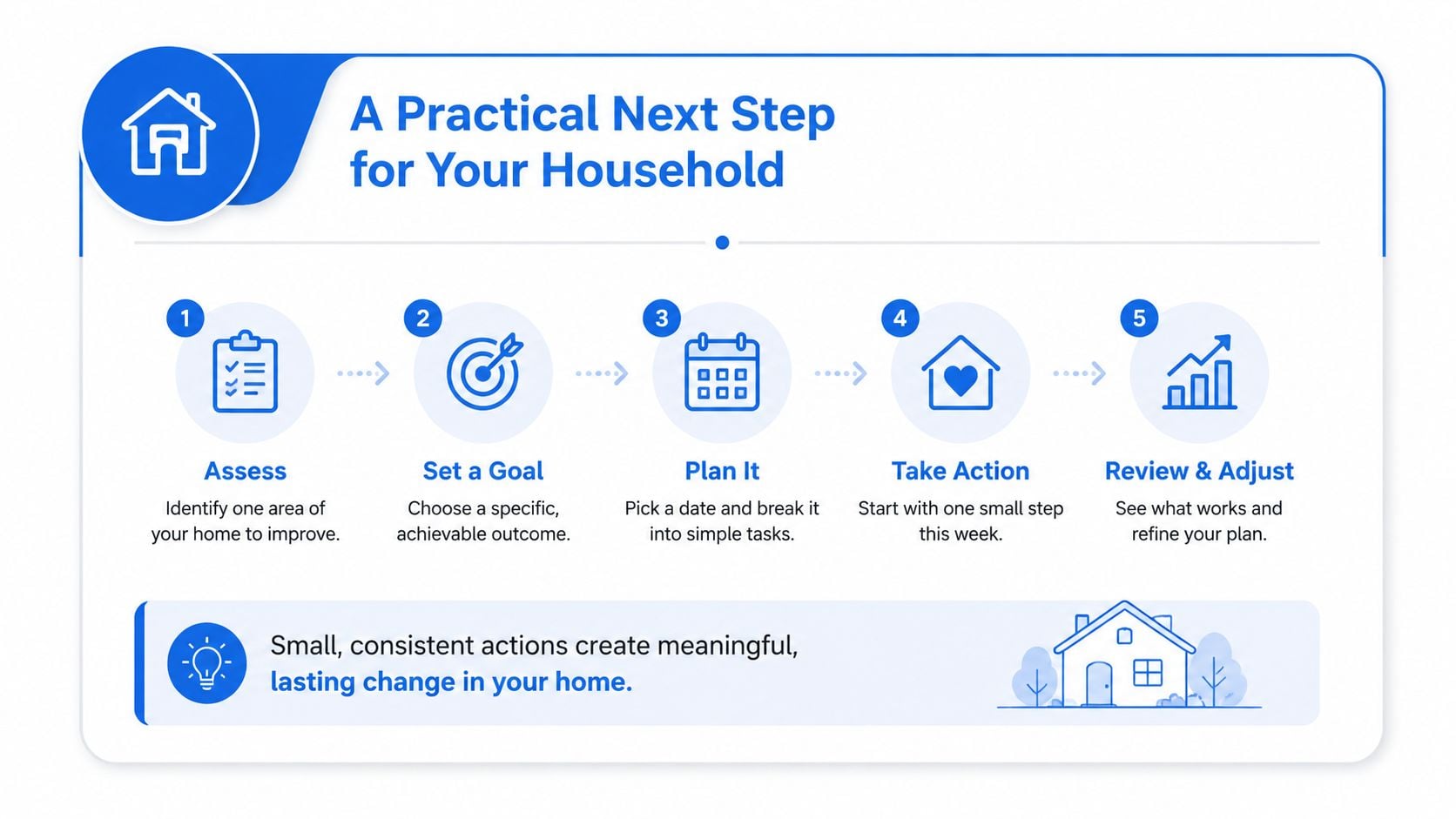
A simple decision path
- Confirm the contaminant. Total chromium isn't the same as chromium-6.
- Confirm the space. Under-sink RO is useful, but it's not always practical.
- Confirm the certification. Look for the exact contaminant on the performance data sheet.
- Choose the format that fits your home. RO, selective filtration, or a certified carbon option.
- Keep the minerals question in view. Some households want contaminant reduction without stripping everything else out.
Woder's Advanced Selective Filtration® fits that mineral-preserving approach, and the brand also points to WQA Gold Seal verification as part of its documentation. That doesn't replace your own testing, but it does give you a framework for comparing products without getting lost in broad claims.
It's Your Water® means the choice is yours, but it should be an informed choice. Check the report, verify the certification, and pick the system that matches both the contaminant and the way you live.
If you want a straight answer for your own kitchen, start by reviewing the filter options and product documentation at Woder Filters. Their point-of-use systems are built for homeowners who want targeted contaminant reduction, including chromium-related concerns, without giving up the minerals they want to keep.