You’ve spent time comparing under-sink filters, checking contaminant claims, and measuring the cabinet space beneath the kitchen sink. Then you fill a glass from the faucet and realize the last part of the system, the fixture the water touches before you drink it, received almost no attention.
That endpoint matters. A filter can be carefully selected, but the faucet still has wetted materials, internal passages, seals, and connection points that affect how filtered water reaches your glass. The right setup also determines whether filtration is convenient enough for everyday drinking and cooking, or whether your household gradually stops using it.
Table of Contents
- Why Your Faucet Choice Matters as Much as Your Filter
- Understanding the Two Main Faucet Configurations
- Integrated Main Faucet Versus Dedicated Drinking Tap
- Certification Standards That Define a Safe Drinking Water Faucet
- Pairing Your Faucet with the Right Under-Sink Filtration
- How to Choose the Right Setup for Your Household
- Common Misconceptions About Faucet Filters and Water Quality
Why Your Faucet Choice Matters as Much as Your Filter
A parent filling a child’s cup before school usually isn’t thinking about plumbing design. They’re thinking about breakfast, backpacks, and whether the water tastes or smells different today. Yet that quick pour passes through a complete delivery system, including the supply line, filter, fittings, and faucet.
The faucet is the final point of contact. Its materials and internal design can influence lead contribution during periods when water sits inside the fixture. That’s why a drinking-water faucet shouldn’t be treated as decorative hardware added after the filter decision. It’s part of the water-quality system.
The endpoint can affect exposure
U.S. drinking-water faucets must meet lead-leaching requirements under NSF/ANSI/CAN 61. Current NSF guidance says endpoint devices that dispense drinking water, including faucets, use a pass/fail criterion of 1 microgram of lead leaching, reduced from 5 micrograms under the earlier test regime. The test is intended to reflect the faucet as a potential exposure source during stagnation, so material selection, alloy composition, and wetted-surface design matter directly. Read the current NSF guidance on NSF/ANSI/CAN 61 before relying on a broad “lead-free” statement.
Practical rule: Treat the faucet, tubing, filter, and connections as one system. A strong cartridge doesn’t automatically make every downstream component appropriate for drinking water.
Configuration matters, too. An integrated main faucet can make filtered water available without changing the appearance of the sink, but it may send more water through the filter than your household drinks. A dedicated drinking tap limits filtered flow to drinking and cooking, while leaving the main faucet available for washing dishes and other tasks.
That distinction affects filter capacity, daily convenience, installation effort, and countertop appearance. The best choice isn’t universal. It depends on how your household uses water and what your kitchen can accommodate.
Understanding the Two Main Faucet Configurations
The two configurations operate differently. An integrated system sends filtered water through the kitchen’s main faucet, while a dedicated drinking tap creates a separate outlet for water used for drinking and cooking. That choice affects installation, countertop appearance, and which filtration systems will fit beneath the sink.
Integrated filtration through the main faucet
An integrated setup keeps one visible fixture. Depending on the product, filtered water may travel through a dedicated internal channel, a diverter, or an inline connection beneath the sink. You use the existing faucet and select the appropriate mode when the design provides one.
This arrangement suits homeowners who want a clear countertop and prefer not to drill a new opening. It can also work when the existing faucet has the required connection or when the filtration system is designed for that fixture. The term “faucet filter” covers several installation types, so review the plumbing arrangement in this guide to a water filter for a faucet before choosing a connection.
Compatibility deserves close attention. The faucet, filter, diverter, tubing, and shutoff arrangement must work together, particularly when the system uses advanced selective filtration rather than a basic cartridge.
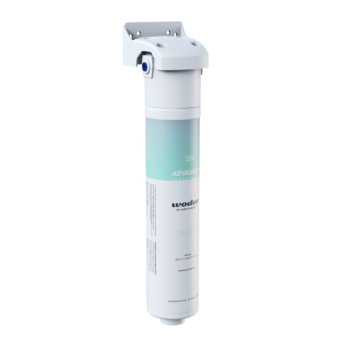
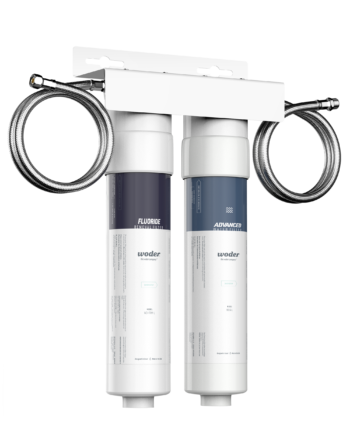
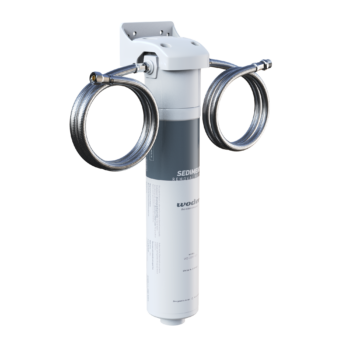
An inline product such as the Woder Advanced Inline Water Filter WD-G4-JG uses Advanced Selective Filtration to retain essential minerals instead of removing all minerals. Its catalog describes the product as made in the USA and intended for inline water filtration.
A separate dedicated drinking tap
A dedicated setup sends filtered water through its own faucet beside the main fixture. A separate line runs from the filter outlet to that tap under the sink. The main faucet remains available for ordinary cold water, hot water, dishwashing, rinsing, and cleanup.
This layout generally requires another hole in the sink or countertop. An unused soap-dispenser opening can provide a convenient location. A solid countertop may require drilling, and brittle materials such as stone or porcelain call for careful work by a plumber or countertop professional.
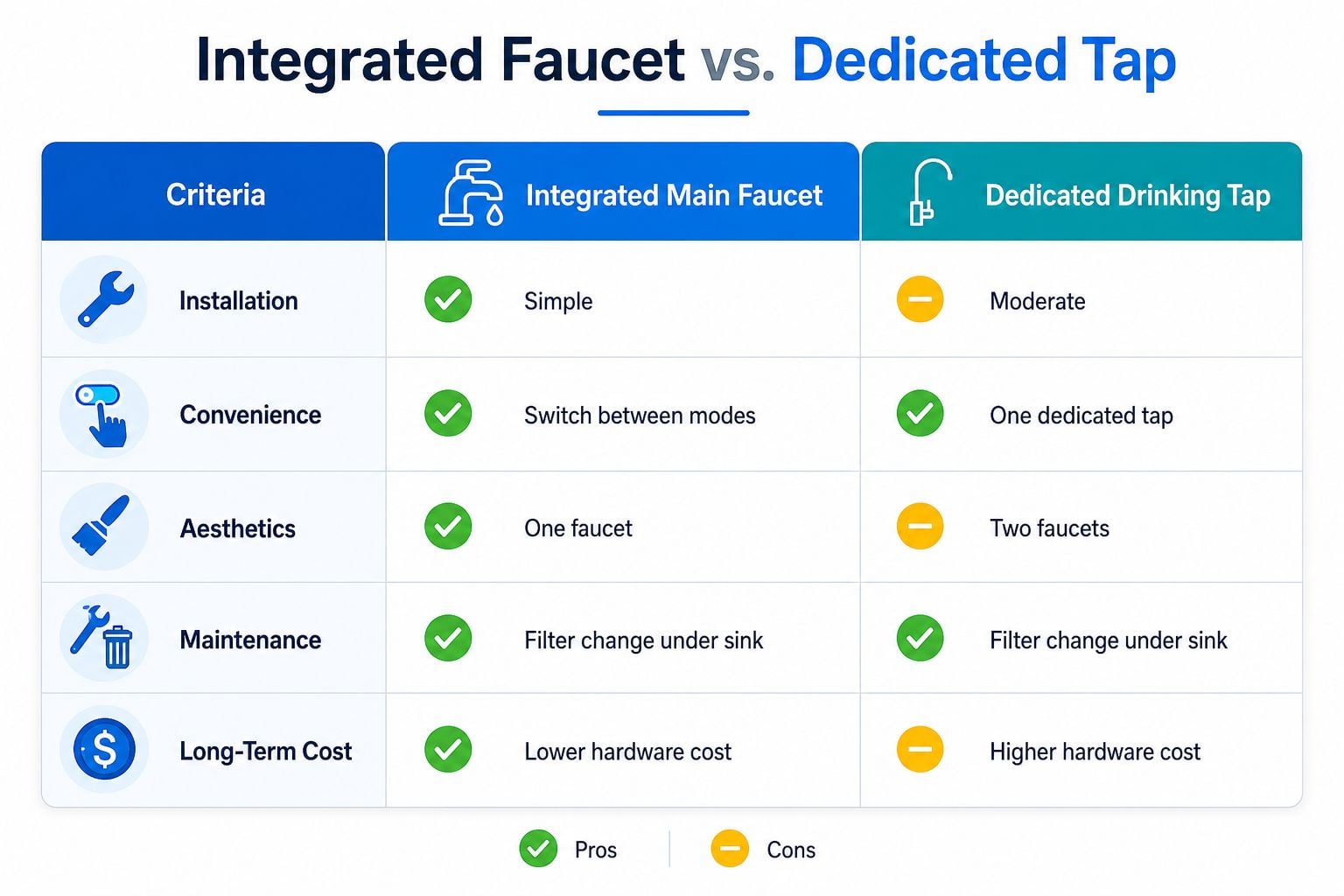
The practical distinction is simple: an integrated faucet makes filtered water available at the main fixture, while a dedicated tap reserves the filtered line for drinking and cooking.
Integrated Main Faucet Versus Dedicated Drinking Tap
The choice becomes noticeable during ordinary kitchen routines. An integrated system sends filtered water through the kitchen’s main fixture, while a dedicated tap creates a separate outlet used mainly for drinking and cooking. That difference affects filter use, installation work, and the appearance of the countertop.
An integrated faucet can supply filtered water for a glass, coffee maker, rinsing produce, or meal preparation. Because the same fixture may also handle other tasks, the filter can process more water than a drinking-only setup. This may make cartridge replacement less predictable, especially in a busy kitchen.
A dedicated drinking tap keeps the filtered line focused. The main faucet remains available for dishes, rinsing, and cleanup, while the smaller outlet supplies drinking and cooking water. Its purpose is easy to identify, much like having a clearly labeled control instead of sharing one control among several functions.
Installation and countertop appearance
An integrated arrangement may preserve a one-faucet look and may avoid drilling when the existing fixture supports the connection. The convenience depends on compatibility among the faucet, filter, diverter, tubing, and shutoff components. Advanced selective filtration systems can make that matching more specific because the filtered outlet must operate as intended without sending treated water through the wrong path.
A dedicated tap adds a visible fixture, but it also gives the filtered water its own dispensing point. An existing soap-dispenser opening or sink knockout may provide a straightforward location. If the sink or countertop has no suitable opening, drilling adds work, and brittle surfaces such as stone or porcelain require careful handling by a plumber or countertop professional.
Daily use and maintenance
Both configurations typically place the cartridge beneath the sink. Replacement access therefore depends on cabinet clearance and the position of nearby plumbing, not solely on the faucet style.
An integrated fixture can feel natural when several people share the kitchen. If it uses a switch or separate mode, everyone must know which setting provides filtered water. A dedicated tap removes that decision at the point of use, although it occupies more counter space.
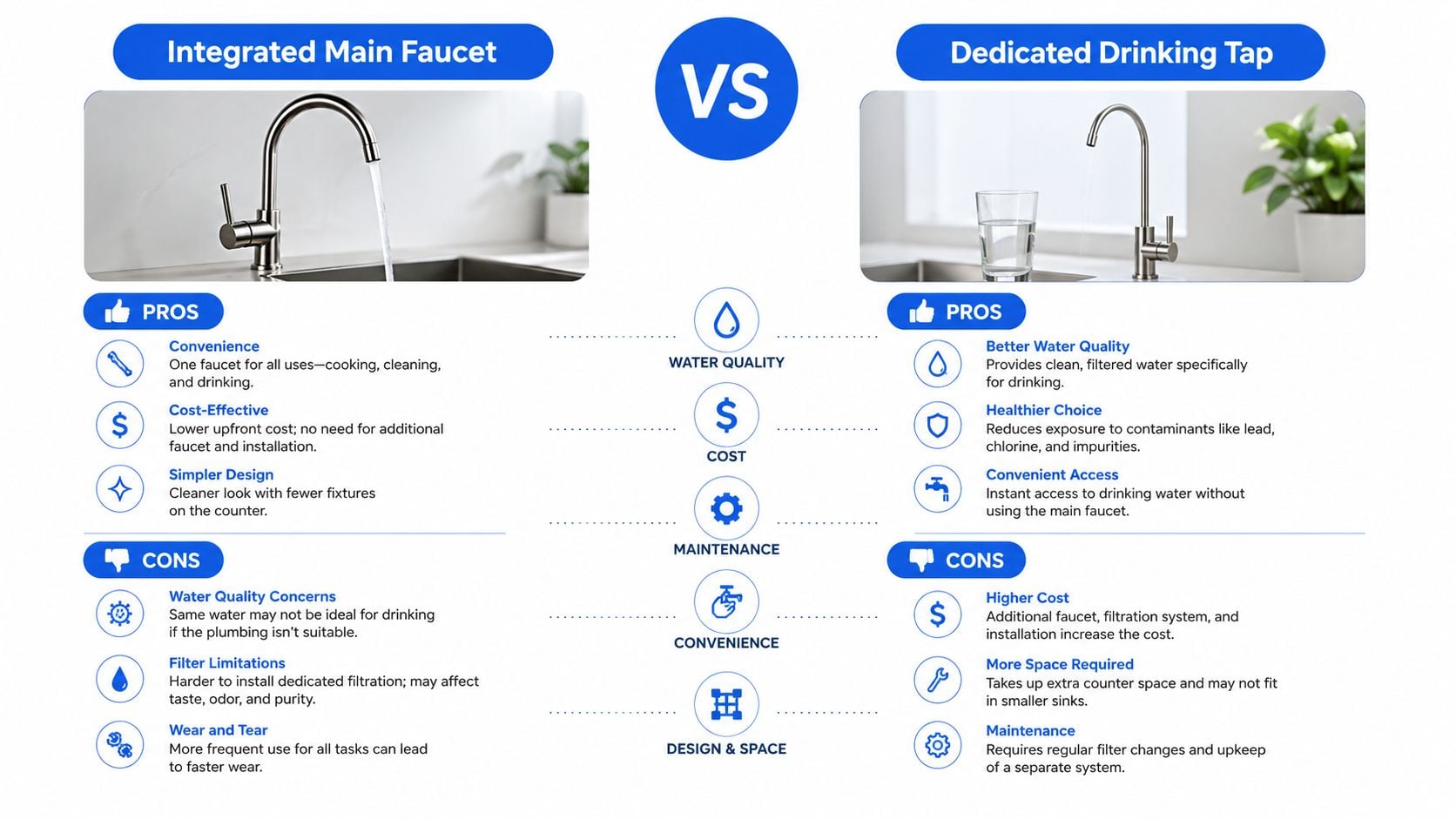
The main tradeoffs are:
- Integrated main faucet: fewer visible fixtures, potentially simpler installation, and filtered water at the primary sink outlet. It may send treated water to tasks that do not require filtration, and it depends closely on the existing faucet’s design.
- Dedicated drinking tap: a separate, clearly identified source for drinking and cooking, with the main faucet available for general work. It may require another opening and creates a second visible fixture.
- Advanced selective filtration compatibility: either layout can work, provided the faucet and connection arrangement match the filter’s intended outlet and flow path.
Neither configuration automatically makes water safer. The faucet needs materials suitable for drinking-water contact, and the filter must target the contaminants you want to reduce.
Certification Standards That Define a Safe Drinking Water Faucet
A faucet can look polished and still require closer inspection before it supplies drinking water. “Lead-free” describes an outcome, but the certification tells you which materials, components, and tests support that wording. Faucet certification evaluates the fixture’s contact with drinking water. It does not show that the faucet removes PFAS, fluoride, chromium, chlorine, or other contaminants.
NSF/ANSI/CAN 61 addresses leaching
For drinking-water faucets sold in the U.S., NSF/ANSI/CAN 61 evaluates whether materials release contaminants into water. As noted in the previous section, current guidance identifies 1 microgram as the stricter pass/fail criterion for endpoint devices such as faucets, compared with 5 micrograms under the prior testing regime. The point is the water’s contact with the faucet, including water that remains inside the fixture before use.
Brass alloys, stainless steel, plating, seals, and other wetted components all form part of that evaluation. A visible finish is only the outer layer. Chrome plating may cover a brass body, so check how the complete water-contacting assembly performs under the applicable test.
NSF/ANSI/CAN 372 addresses lead content
NSF/ANSI/CAN 372 sets a maximum weighted lead content of 0.25% for drinking-water system components. The Safe Drinking Water Act requirements explained by NSF connects certification with lead content and lead leaching, depending on the product and certification path.
Check the package, product documentation, or certification listing for specific markings, such as NSF/ANSI/CAN 61: Q ≤ 1 and NSF/ANSI/CAN 372. Terms such as “safe,” “low lead,” or “lead-free” provide less information without a named standard.
The same check matters when pairing a faucet with an under-sink or inline water filter system overview. The faucet must suit the filter’s outlet and intended water path, while the filter’s certification and performance claims determine which contaminants it addresses. For broader terminology, consult this water-quality standards guide while comparing fixtures.
Certification is a defined technical claim, not a substitute for checking the filter’s contaminant-reduction claims.
Pairing Your Faucet with the Right Under-Sink Filtration
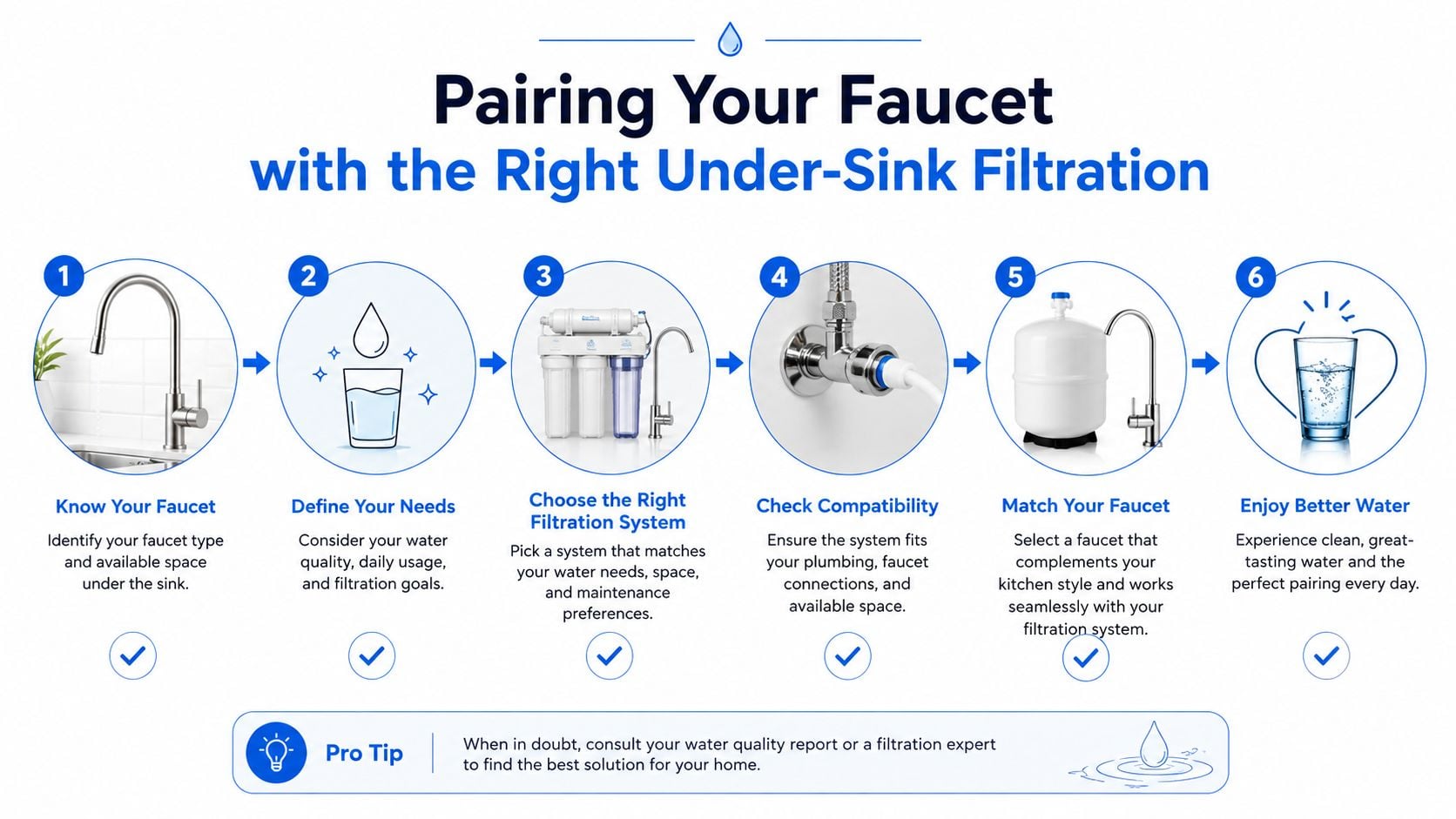
The faucet and filter function as one water path. Choosing the faucet first can create a mismatch if the filter uses a particular connection, requires a certain flow rate, or treats water for a specific purpose. Confirm those details before deciding whether one integrated fixture or a separate drinking tap fits the installation.
Woder® Advanced Selective Filtration® targets selected contaminants rather than broadly removing dissolved solids. Its stated focus includes PFAS, lead, heavy metals, fluoride, chromium, and chlorine, while retaining essential minerals. Reverse osmosis follows a different treatment path, reducing dissolved solids broadly, including minerals that can affect taste.
Match the outlet to the filtration path
A dedicated drinking tap works naturally with a point-of-use filter. The treated line runs to that faucet, so drinking and cooking water receive filtration while dishwashing remains on the main supply. This arrangement also limits cartridge use for tasks that do not require filtered water.
An integrated main faucet sends filtered water through the fixture everyone already uses. That can simplify the visible countertop layout, but it may send more cold-water activity through the cartridge. The household’s actual usage should therefore match the filter’s intended capacity and flow behavior.
For installation options and connection details, see a guide to inline water filter systems. An inline product using Advanced Selective Filtration retains essential minerals rather than stripping them away.
Match the certification to the contaminant
NSF/ANSI 53 covers point-of-use and point-of-entry drinking-water treatment units designed to reduce specified health-related contaminants. The NSF/ANSI 53 overview explains the standard’s testing context.
A general certification does not establish every contaminant claim. For PFAS, fluoride, chromium, or lead, look for a performance claim that names the contaminant and identifies its testing or certification scope. The faucet may suit the plumbing arrangement while the cartridge still lacks the treatment capability required by the available water-quality information.
How to Choose the Right Setup for Your Household
Start with the way water moves through your kitchen, not with the faucet’s finish. A polished fixture may look excellent, but it won’t solve a layout problem, fit a crowded cabinet, or make an unsuitable cartridge effective.
Begin with household use
Ask yourself a few practical questions:
- Drinking demand: How many people regularly fill glasses or bottles from the sink?
- Cooking habits: Do you use filtered water for soups, coffee, tea, and meal preparation?
- Existing openings: Does the sink or counter already have a suitable opening for a dedicated tap?
- Cabinet access: Can you reach the shutoff, tubing, and cartridge without removing stored items?
- Water source: Are you on municipal water or a private well, and what concerns appear in your available water-quality information?
A dedicated faucet often makes sense when filtered water is reserved for drinking and cooking. An integrated arrangement may be more appropriate when a single visible fixture matters most or when adding a countertop opening would be difficult.
Check the installation details
Before ordering, confirm the filter’s inlet and outlet connections, the faucet’s required tubing, the available cabinet clearance, and the expected flow behavior. If you’re installing reverse osmosis, check local plumbing requirements because some systems use an air-gap faucet for wastewater backflow protection. That requirement doesn’t automatically apply to every under-sink filter.
A DIY installation may be realistic when the sink already has a compatible opening and the system uses straightforward connections. Drilling stone or porcelain, modifying supply plumbing, or working in a cramped cabinet is a reasonable point to call a licensed plumber.

Use a selection tool such as the Woder Wizard to compare fixture types and water profiles, and consider lab testing when you don’t know which contaminants are present. The point isn’t to buy the most complicated system. It’s to choose a faucet and filter that match your actual water, habits, and kitchen.
Common Misconceptions About Faucet Filters and Water Quality
A zero-TDS meter reading is often presented as proof of “pure” water. It isn’t. TDS measures dissolved solids collectively, so removing good minerals and unwanted substances can produce the same broad result. Very low TDS is associated with distilled or reverse-osmosis-style treatment, but it doesn’t identify which contaminants were reduced or whether the remaining water meets your household’s needs.
“NSF certified” also needs context. A faucet may be certified for material safety under a standard such as NSF/ANSI/CAN 61 or NSF/ANSI/CAN 372, while a filter’s contaminant-reduction claims may involve a different standard. The fixture certification and the cartridge performance certification answer different questions.
Reverse osmosis has its own recognized standard, NSF/ANSI 58, which covers contaminant-reduction claims including fluoride and hexavalent chromium. NSF/ANSI 58 is distinct from NSF/ANSI 53, which focuses on health-effect reductions in general drinking-water treatment units. The NSF standards comparison helps clarify why one certification shouldn’t be used as shorthand for another.
Finally, under-sink filters aren’t interchangeable with every drinking-water faucet. Flow rates, connection sizes, filter capacity, pressure, and the intended dispensing configuration all have to align. A dedicated tap can simplify the water path, but only when the cartridge and fixture were selected as compatible parts of the same installation.
Woder Filters offers U.S.-manufactured point-of-use and inline systems using Advanced Selective Filtration®, including options designed to reduce targeted contaminants while retaining essential minerals. Visit Woder Filters to review filter and faucet configurations, use the Woder Wizard, and choose a setup that fits your kitchen and water-quality priorities.