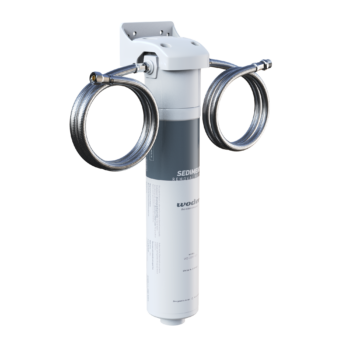
A faint chlorine smell from the refrigerator dispenser, scale collecting in a coffee carafe, and a family that wants better-tasting water without opening a wall can all point to the same practical question: where does filtration need to happen? For many U.S. kitchens, the answer isn’t a whole-home treatment plant. It’s a filter installed directly on the line serving the refrigerator, ice maker, coffee machine, or drinking tap.
An inline water filter system works in that single water path. It can improve taste and target specific contaminants without taking over a cabinet or requiring a storage tank. But “inline” describes the filter’s location, not everything it can remove. The cartridge media, flow rate, pressure, testing, installation, and maintenance still determine whether the system fits your home.
Table of Contents
- Why the Line Behind Your Fridge Matters More Than You Think
- What an Inline Water Filter System Actually Is
- Where Inline Filters Make Sense in a Real Kitchen
- Installation Basics Without the Plumbing Headache
- What These Filters Actually Remove and What They Don’t
- Inline Filtration vs Reverse Osmosis Without the Hype
- What to Check Before You Buy and What Comes Next
Why the Line Behind Your Fridge Matters More Than You Think
The water line behind a refrigerator is easy to ignore. It stays out of sight, yet it supplies the water your household drinks, freezes into ice, and uses in everyday routines. If that water tastes strongly of chlorine, an inline filter can treat it before it reaches the dispenser and ice maker. If a coffee machine develops mineral residue, filtering its dedicated feed may improve the water going into the heating system, although a drinking-water filter shouldn’t be confused with a descaler or a whole-house softener.
That distinction matters because one kitchen can contain several different water jobs. A refrigerator line needs enough flow for dispensing and ice production. A coffee machine may draw water in short bursts. A wet-bar faucet may serve as a steady drinking-water outlet. Each application places a different demand on the cartridge.
Practical rule: Filter the line you actually use for drinking or beverage preparation instead of treating every fixture in the home by default.
An inline unit sits between the cold-water supply and the selected appliance or fixture. It doesn’t normally need a tank, drain connection, or electrical outlet. That makes it useful when a family wants a quieter upgrade than a remodel, or when a renter needs a solution that can be removed later. Renters and apartment residents still need permission before changing supply connections, but the physical footprint can be much smaller than an under-sink reverse-osmosis installation.
The refrigerator itself also creates confusion. Some models use a proprietary cartridge inside the appliance. Others allow a filter to connect along the external supply line. The connection type, available clearance, pressure, and manufacturer requirements matter more than the label “fridge filter.” A helpful starting point is this guide to inline refrigerator water filter models, especially if you’re trying to determine which arrangement your appliance supports.
The useful question isn’t whether an inline filter is automatically better. It’s whether the filter’s tested performance and plumbing design match the one line that matters most in your kitchen.
What an Inline Water Filter System Actually Is
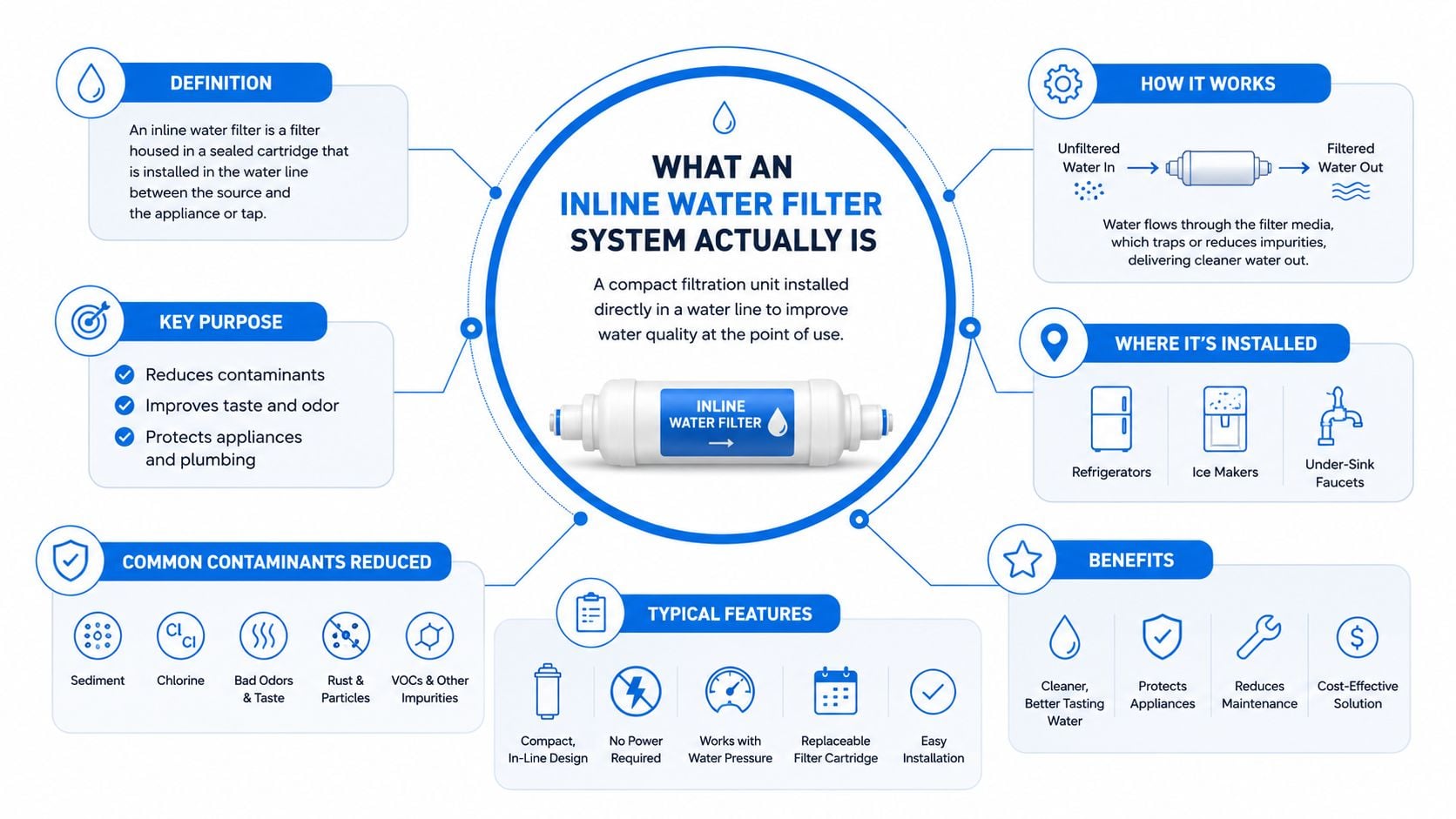
Think of an inline filter as a toll booth on one water line, not a treatment plant for the entire house. Water enters through the cold-water feed, passes through the cartridge, and continues to one destination. If that destination is the refrigerator, the shower and bathroom sinks remain untreated.
Most systems have a few straightforward parts:
- An inlet connection, where unfiltered water enters.
- A sealed cartridge or housing, which contains the treatment media.
- An outlet connection, which sends filtered water to the appliance or tap.
- Tubing and fittings, often designed for compact appliance connections.
Because the water moves through the existing line, an inline water filter system typically has no storage tank, no drain line, and no electricity. That simplicity is its advantage in a tight kitchen. It also defines its limits. The cartridge is usually sized for drinking-water or appliance flow, not for simultaneous showers, laundry, toilets, and kitchen use.
Inline systems commonly use granular activated carbon, carbon block, or a more selective adsorption medium. Activated carbon works by attracting certain substances to its internal surface. Carbon block compresses carbon into a denser form, guiding water through more of the media and helping limit channeling. Selective media use a different design goal, targeting particular contaminants while retaining some naturally occurring minerals.
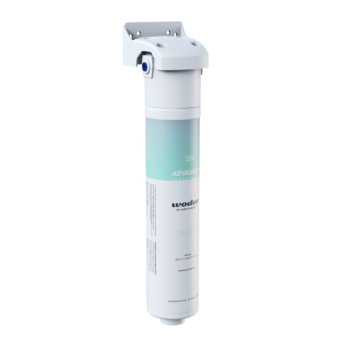
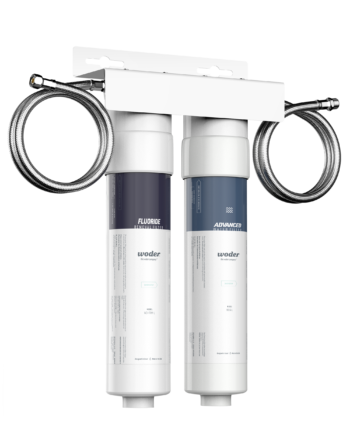
The word “inline” doesn’t tell you whether a cartridge addresses lead, PFAS, fluoride, chromium, chlorine, or sediment. Those claims must come from the actual product specifications and test documentation. Woder’s Woder Advanced Inline Water Filter WD-G4-JG uses Advanced Selective Filtration® and is described as retaining essential minerals rather than stripping them from the water.
Typical inline designs operate at modest appliance-scale flow. One drinking-water cartridge is specified at 1.0 gallon per minute at 60 psi, with a 30 to 100 psi operating range, while another refrigerator-style cartridge is rated at 0.5 gallon per minute with limits of 20 to 90 psig. Those specifications come from the manufacturer data summarized in inline filter specifications. In plain language, the filter needs enough pressure to deliver water, but moving water faster can reduce the time it spends in contact with the media.
Where Inline Filters Make Sense in a Real Kitchen
The best application is usually the fixture that provides drinking or beverage water but doesn’t require whole-home volume. Four kitchen setups appear often.
Refrigerator water and ice
A refrigerator line is a natural match because one filter can treat both dispenser water and ice, provided the appliance and connection layout support that arrangement. Ice makers can make taste problems more noticeable because unpleasant odors become concentrated in something you chew or let melt into a drink.
A busy refrigerator may draw water throughout the day, while a lightly used unit may sit for long periods. Cartridge life depends on the water entering the filter, the volume your household uses, and the filter’s stated capacity. Don’t infer service life from the appliance alone. A cartridge serving only an occasional dispenser can experience a very different workload from one serving a large household’s drinks and ice.
Standalone ice makers
A dedicated ice maker often has a short, accessible supply line. An inline filter can be installed upstream when the connection size and pressure requirements match. Flush the cartridge before sending treated water into the machine, and make sure the housing can be removed without pulling on the appliance tubing.
Coffee and espresso machines
Coffee equipment benefits from water that tastes clean, but filtration doesn’t solve every scale problem. Carbon may improve chlorine taste and odor, while hardness minerals can still affect heating components if the cartridge is designed to retain minerals. Check the coffee machine’s water requirements and maintenance instructions before choosing a filter.
A machine that draws water only during morning preparation may use less total water than a refrigerator dispenser, yet its heated passages can make residue more noticeable. The right cartridge depends on whether your priority is taste, contaminant reduction, scale control, or a combination that the product documents.
Secondary sinks and wet bars
A wet bar or secondary drinking tap is a strong candidate when you want filtered water in a specific location without treating every cold-water fixture. The line should remain accessible enough for cartridge replacement, and the tap should be used regularly enough to support the manufacturer’s storage and flushing guidance.
For broader household habits that reduce waste and resource use, Fillaree’s practical eco-friendly kitchen tips can complement a point-of-use filtration plan.
The central decision is simple: match the filter to the line’s job. A compact inline system is a mismatch for a whole home’s peak demand, but it can be a sensible choice for one refrigerator, beverage machine, ice maker, or dedicated drinking tap.
Installation Basics Without the Plumbing Headache
An inline installation is often manageable, but “simple” doesn’t mean “careless.” Before touching the tubing, identify the cold-water shut-off, confirm the filter’s inlet and outlet direction, and check whether the existing line uses push-fit, John Guest-style, compression, or another connection.
The basic sequence looks like this:
- Shut off the water. Use the local valve if one exists. Apartment residents may need building management to identify the correct shut-off.
- Depressurize the line. Open the connected tap or dispenser until water stops flowing.
- Plan the cut. Mark a clean, straight section of tubing with enough slack for the filter and future cartridge removal.
- Add a feed adapter or tee if required. Don’t force incompatible fittings together.
- Mount the housing accessibly. Leave room to disconnect the line and remove the cartridge without moving the refrigerator or emptying a cabinet.
- Flush the new cartridge. Carbon fines can appear as dark particles if this step is skipped.
- Inspect under pressure. Turn the water back on slowly, check every connection, and revisit the area after use.
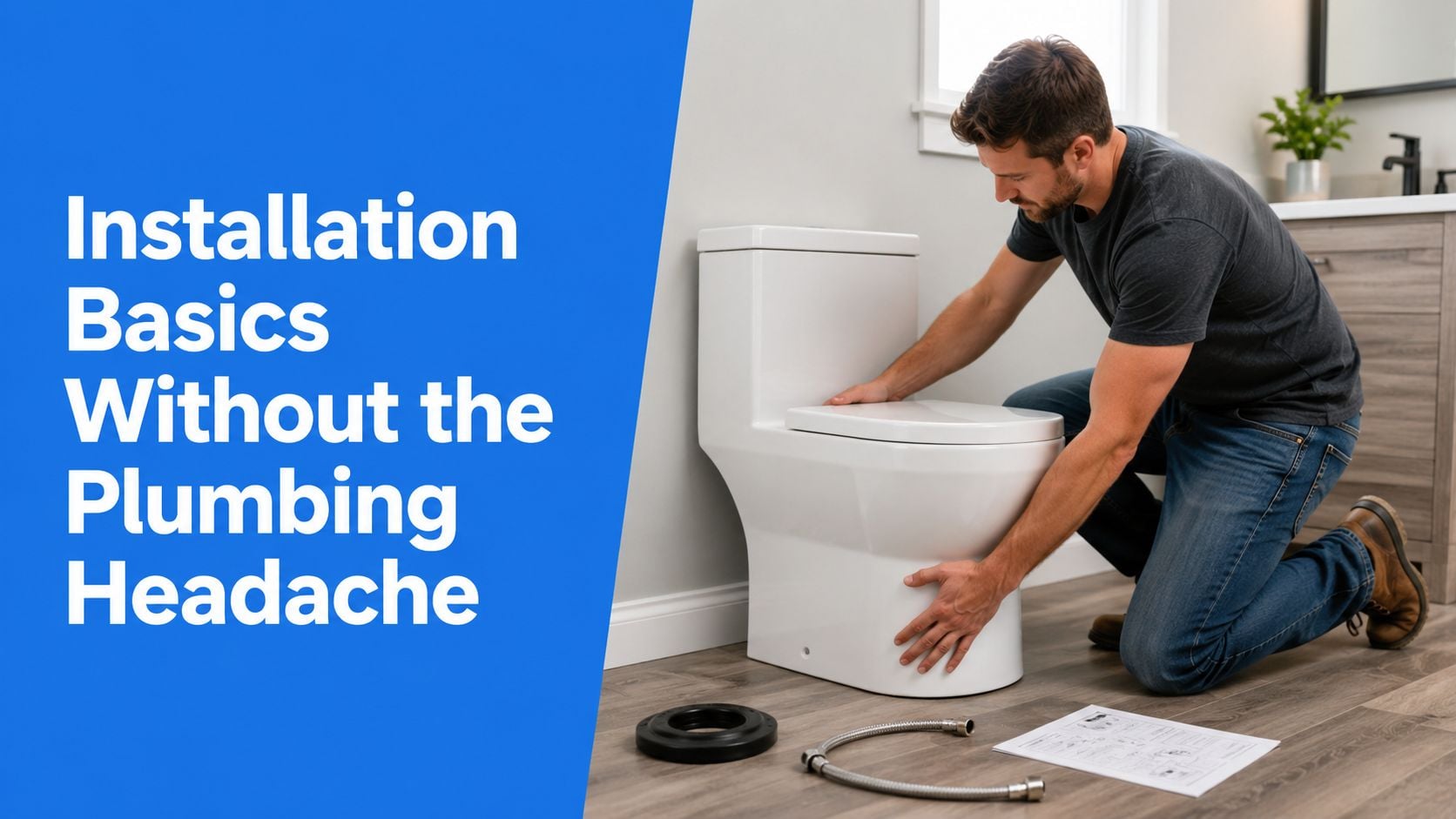
A refrigerator installation has its own traps. Tubing can kink when the appliance slides back, and a filter mounted sideways may technically work while making cartridge changes awkward. Keep the filter supported, avoid sharp bends, and don’t let the housing hang from a small plastic connection.
If you’re planning a remodel or adding a new branch line, it helps to check water pressure before remodeling. Pressure affects fixture performance and filter flow, so it shouldn’t be treated as an afterthought.
Renters and apartment residents
A renter should check the lease before altering a supply line, even if the modification seems reversible. Look for an existing appliance valve or accessible cold-water connection, and favor fittings that can be removed without cutting built-in plumbing. Shared shut-offs, cramped cabinets, and landlord restrictions can make a plumber the safer choice.
Call a professional when the shut-off doesn’t close, the tubing is brittle, the connection is unfamiliar, or the installation requires opening a wall. A small leak behind a refrigerator can go unnoticed long enough to damage flooring, so confidence should come from a controlled installation, not from avoiding a service call.
What These Filters Actually Remove and What They Don’t
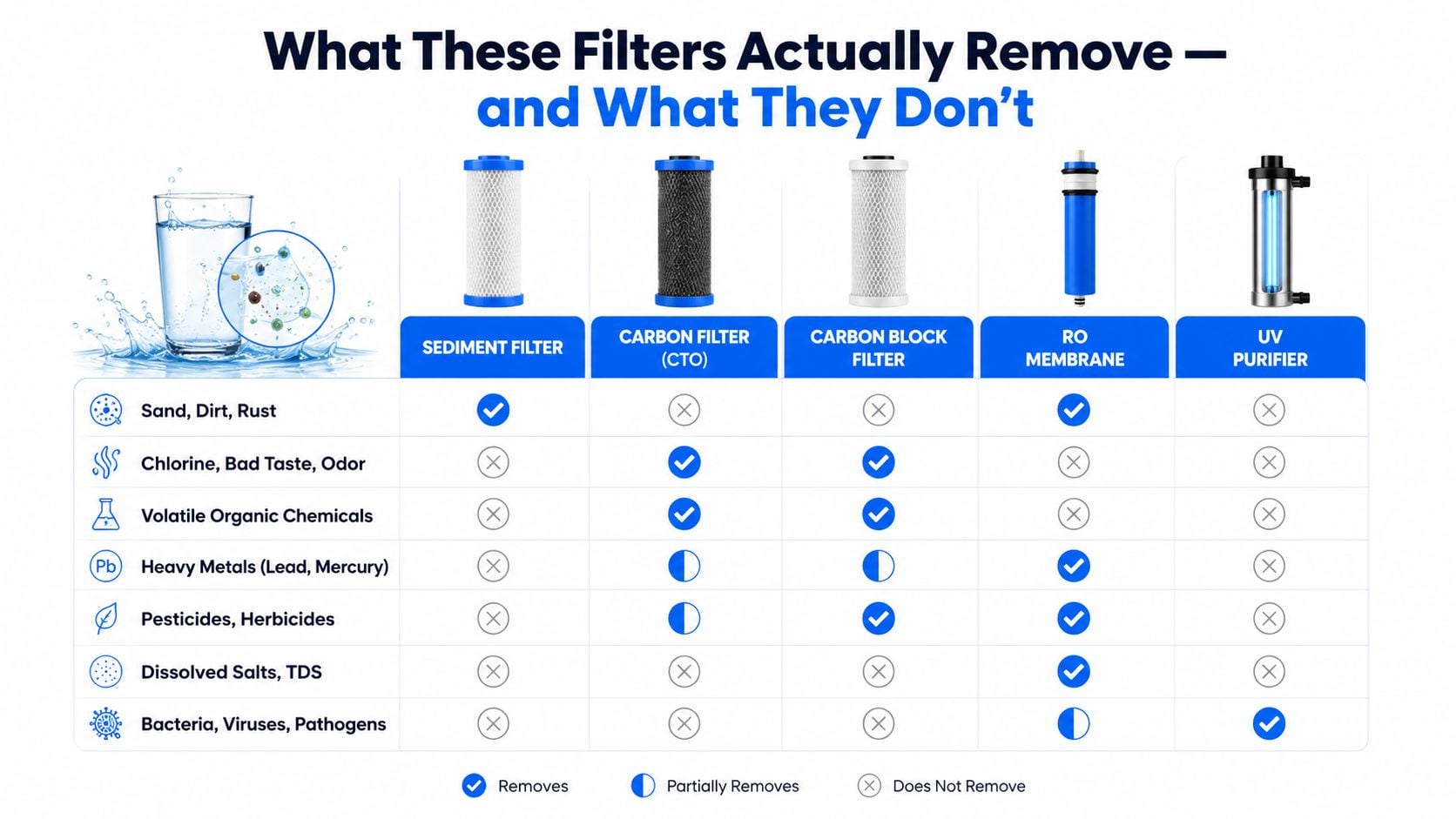
An inline filter isn’t a magic eraser. The cartridge media, flow rate, contact time, and documented testing determine which contaminants it can reduce.
Activated carbon works somewhat like a sponge with a finite supply of useful surfaces. As water moves through, some compounds attach to the carbon. Once available sites fill, performance can decline. A faster flow gives water less contact time with the media, which is why a cartridge optimized for appliance delivery can’t automatically be treated as a whole-home solution.
Carbon block designs can improve contact by forcing water through the media bed and reducing channeling. Technical material from Pentair describes the relationship between flow, contact time, and adsorption, and notes that carbon cartridges are tested across different operating conditions in carbon cartridge guidance.
Read the standard, not just the bullet point
A claim such as “reduces contaminants” needs a specific target and test basis. The common standards serve different purposes:
| Standard | What it generally addresses |
|---|---|
| NSF/ANSI 42 | Aesthetic concerns such as chlorine taste, odor, and particulate reduction |
| NSF/ANSI 53 | Health-related contaminant reduction claims, including lead when the product is certified for that claim |
| NSF/ANSI 401 | Certain emerging or incidental contaminants, depending on the certified claim |
| NSF/ANSI P473 | Specific PFAS-related claims for certified products |
The EPA guide to filters certified for lead reduction explains that lead-reduction claims for point-of-use filters should connect to NSF/ANSI 53. It also distinguishes NSF/ANSI 42 for particulate reduction and NSF/ANSI 58 for certified reverse-osmosis systems that make lead-reduction claims.
Lead content and lead leaching aren’t identical. NSF explains that NSF/ANSI/CAN 372 addresses lead-content requirements, while NSF/ANSI 61 Annex G covers both lead content and lead leaching requirements in its standards portfolio. A product can therefore satisfy a materials requirement without carrying the same certification for leaching performance.
PFAS deserves extra caution. NSF explains that certified systems can make elective PFAS claims under NSF/ANSI 53 or 58, while WQA discusses current national standards supporting PFOS and PFOA reduction to a cumulative 20 parts per trillion for total PFAS claims, with limits for specific compounds in PFAS filtration standards guidance. Performance can vary across PFAS compounds, media types, cartridge sizes, and flow conditions. “Good for PFAS” isn’t precise enough by itself.
Chromium, including chromium-related concerns, also requires a documented claim. WQA’s standards discussion identifies NSF/ANSI 53 and 58 as addressing several metals, including total chromium, when the specific product carries the applicable certification and claim. Fluoride, chlorine, lead, PFAS, and other contaminants shouldn’t be treated as one interchangeable category.
A useful buying test: If the product page doesn’t identify the contaminant, standard, test challenge, flow condition, and capacity, the claim needs more investigation.
Water quality can also affect appliances, not only drinking taste. For a practical discussion of how water affects dishwashers, see Simply Hospitality’s dishwasher water guide. For a focused explanation of contaminant claims, this guide to inline water filter contaminant removal offers another useful reference.
Inline Filtration vs Reverse Osmosis Without the Hype
Reverse osmosis and inline selective filtration solve different problems. RO pushes water through a semipermeable membrane, producing water with very low dissolved-solids content. That can be useful when a household has a documented contamination profile that calls for RO, or when a specialized application requires very low TDS.
The tradeoff is that RO removes dissolved substances broadly. That includes calcium and magnesium, the minerals many people associate with the taste of ordinary drinking water. RO systems also commonly use a storage tank and drain connection, and their operation can involve water waste, more components, and more maintenance than a direct inline cartridge.
A zero-TDS reading isn’t proof that water is safe or ideal for drinking. It shows that dissolved solids, both desirable and undesirable, have been removed. TDS meters also don’t identify individual contaminants, so a low reading can’t confirm PFAS, lead, fluoride, chromium, or any other specific reduction claim.
Selective inline filtration follows another philosophy. Woder’s Advanced Selective Filtration® is designed to target listed contaminants while retaining essential minerals, rather than treating mineral removal as the definition of purity. A direct inline setup can avoid a tank and drain line, which is useful in a crowded cabinet or for a refrigerator feed.
| Consideration | Inline selective filtration | Reverse osmosis |
|---|---|---|
| Minerals | Designed to retain essential minerals when the product documentation supports that approach | Removes dissolved solids broadly |
| TDS reading | May remain above zero because minerals remain | Can produce very low TDS |
| Plumbing | Usually connects directly to a selected line | Commonly needs drain and storage components |
| Maintenance | Cartridge replacement and flushing | Multiple filter and membrane service needs |
| Best fit | Targeted point-of-use drinking and appliance lines | Specific contamination profiles or specialized low-TDS needs |
Neither technology deserves blanket praise or dismissal. Choose based on your water test, the contaminant claim you need, the space available, and whether retaining minerals matters to your daily drinking water.
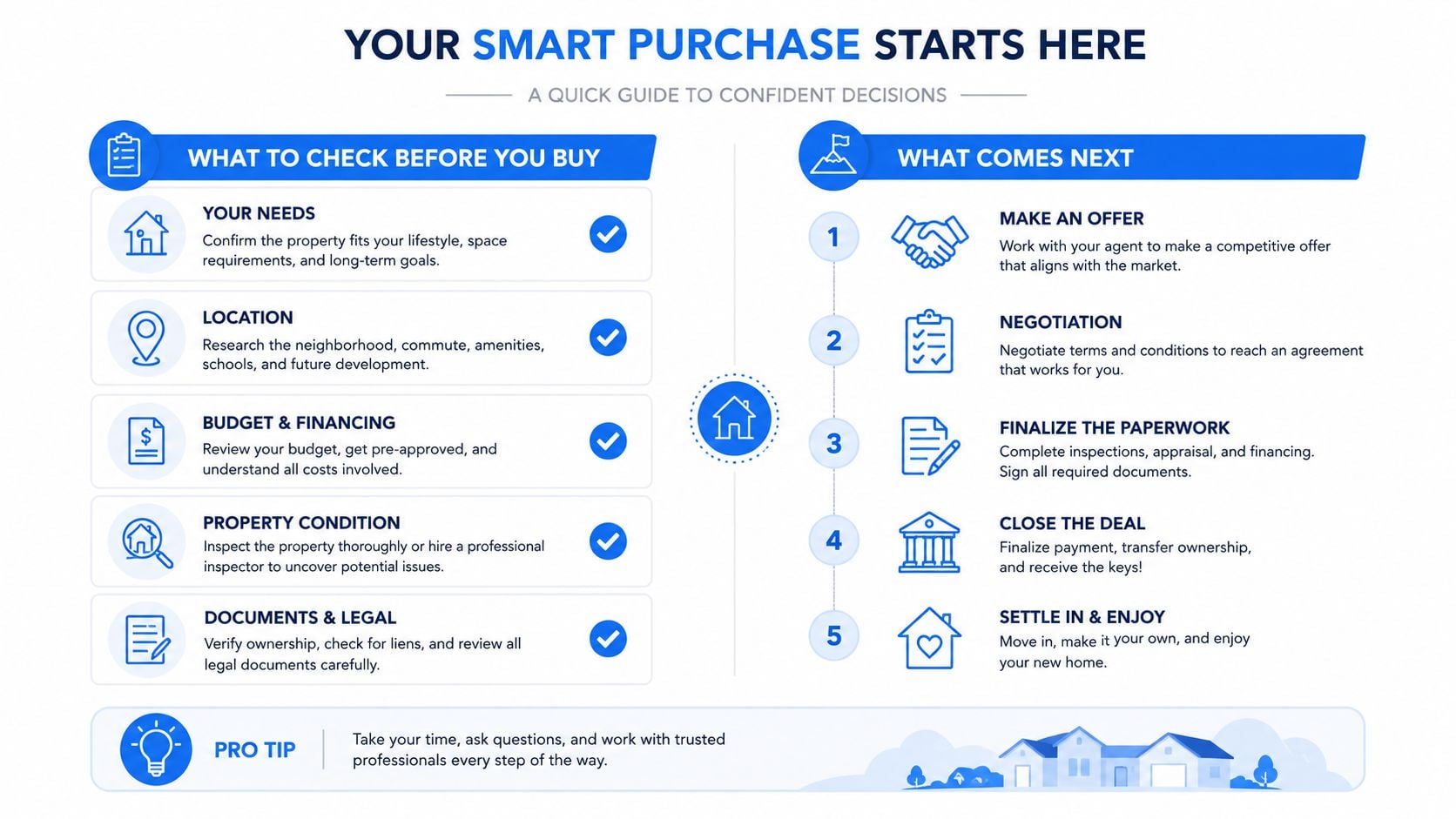
What to Check Before You Buy and What Comes Next
A sensible purchase starts with the water, not the marketing label. Work through these questions in order:
- What enters the home? Read your utility’s Consumer Confidence Report, or arrange a laboratory test for a private well or a more specific contaminant profile.
- Which line needs treatment? Identify the refrigerator, ice maker, coffee machine, wet bar, or dedicated tap.
- What backs the claim? Match each target, such as lead, chlorine, PFAS, fluoride, or chromium, to a documented test and applicable standard.
- Can you service it? Confirm that the cartridge can be changed without moving an appliance or dismantling the cabinet.
- Can you reverse the installation? Renters should verify lease rules and preserve the original fittings.
Woder offers lab water testing, installation resources, and replacement cartridges for its point-of-use systems. If you’re comparing cartridge formats and service needs, this guide to the best water filter cartridge can help organize the decision.
Woder Filters offers U.S.-made point-of-use inline and under-sink filtration systems that use Advanced Selective Filtration® to target listed contaminants while retaining essential minerals. Review your water report, identify the line you want to treat, and visit Woder Filters to find a system and replacement-cartridge path that fits your kitchen.