The most popular advice about the best water filter cartridge is also the least useful: choose the cartridge with the longest life, the most impressive contaminant list, or the highest review score. None of those answers tells you whether the cartridge is right for your water.
A cartridge should earn its place through verified contaminant reduction at its rated capacity, compatibility with your plumbing, acceptable flow, and a sensible replacement cost. Municipal water, private well water, older plumbing, and refrigerator lines create different filtration problems. A cartridge that performs well in one kitchen may be the wrong choice in the next.
The comparison below gives you the short version before the technical details.
| Cartridge approach | Best suited to | Main strength | Main limitation |
|---|---|---|---|
| Sediment media | Sand, rust, silt, and visible particles | Protects downstream equipment | Doesn't address dissolved contaminants |
| Granular activated carbon | Chlorine, taste, odor, and some organic compounds | Simple and widely available | Flow and contact time can limit performance |
| Carbon block | Chlorine, taste, odor, and selected organic contaminants | More consistent contact with carbon than loose granules | Requires attention to pressure drop and certification |
| Ion exchange resin | Selected dissolved ions and hardness-related applications | Targets specific charged contaminants | Can alter mineral chemistry and needs a precise use case |
| Selective filtration media | Certified target contaminants while retaining minerals | Targets contaminants without treating every dissolved solid as waste | Must be matched to the exact certification and rated life |
| Reverse osmosis | Very broad dissolved-solids reduction | Produces very low TDS water | Removes beneficial minerals and adds maintenance and water-waste tradeoffs |
Table of Contents
- Why There Is No Single Best Cartridge for Every Home
- Decoding Water Filter Certifications and What They Actually Verify
- Comparing Cartridge Media Types by Contaminant Target
- Matching Your Water Profile to the Right Cartridge
- The Real Cost of Cartridge Ownership Over Time
- Building Your Cartridge Decision Framework
- Why Selective Filtration Outperforms Reverse Osmosis for Most Homes
Why There Is No Single Best Cartridge for Every Home
A cartridge isn’t good in the abstract. It’s good or bad for a specific source-water profile.
Municipal systems can differ in disinfectant use, pipe materials, mineral content, and contaminant history. A homeowner concerned mainly with chlorine taste needs a different verified performance claim from someone dealing with lead from household plumbing or PFAS in the source supply. Private wells add another layer because groundwater conditions can vary by location, well construction, depth, and local geology.
That makes product rankings based on one overall score misleading. They often compare capacity, price, or review sentiment without asking the question that determines filtration performance: what must this cartridge remove from your water?
Municipal water and well water need different starting points
A city water report can show regulated contaminants detected in the distribution system, but it won’t necessarily describe what happens between the street and your faucet. Older service lines, household plumbing, and point-of-use fixtures can change the water that reaches a glass.
Well owners have an even stronger reason to test before buying. A clear glass doesn’t prove that well water is free of dissolved metals, microorganisms, or other contaminants. A filter designed for chlorine taste won’t solve every well-water problem, and a cartridge designed for drinking water shouldn’t be treated as whole-home treatment for sediment, bacteria, or hardness.
Practical rule: Start with the water report or a laboratory test, not a product ranking.
The market itself shows why replacement cartridges deserve careful comparison. The global water filter cartridges market was valued at US$13.9 billion in 2024 and is projected to reach US$19.7 billion by 2030, a projected increase of US$5.8 billion and a compound annual growth rate of 6.1%, according to the market reference associated with the cartridge category. Replacement filtration is now a recurring purchase, so a poor match can keep costing you long after installation.
The useful question is narrower
Instead of asking, “What is the best cartridge overall?” ask:
- What contaminants are present?
- Which of those contaminants matter most at my tap?
- Does the cartridge have certification for those specific claims?
- Will it still meet the claim at the end of rated life?
- Can my fixture deliver the required flow without excessive pressure loss?
That framework eliminates many attractive but irrelevant options. It also prevents a common mistake, choosing a cartridge because it sounds thorough when its documented certification covers only chlorine taste and odor.
Decoding Water Filter Certifications and What They Actually Verify
Certification logos don’t mean a cartridge removes everything. They identify a standard, a tested claim, and a defined test method. The contaminant claim matters more than the logo by itself.
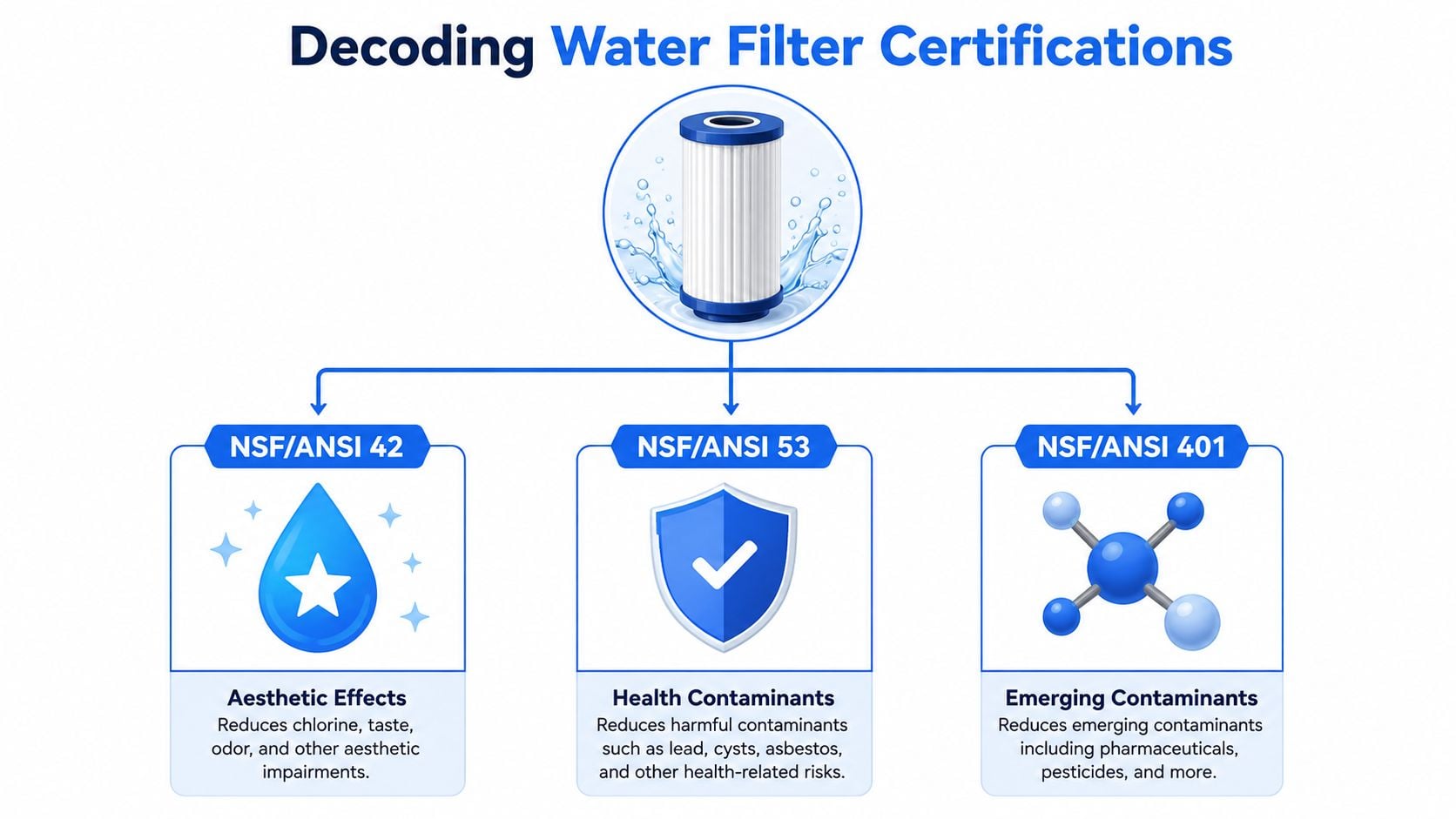
NSF/ANSI 42 generally addresses aesthetic effects such as chlorine, taste, and odor. A cartridge listed under this standard may be appropriate for improving drinking-water flavor, but that certification alone doesn’t establish reduction of lead, PFAS, fluoride, or chromium-6.
NSF/ANSI 53 addresses health-related contaminant claims, including lead and other substances covered by the specific certification. NSF/ANSI 58 is associated with reverse osmosis systems. Other standards, including NSF/ANSI 401, may address emerging contaminants, but you still need to identify the exact substances included in the product’s listing.
Read the performance listing, not just the package
A proper listing should tell you:
- The exact contaminant claim, such as chlorine taste and odor or lead reduction.
- The rated capacity, meaning how much water the cartridge is intended to treat under the stated conditions.
- The challenge conditions, including relevant water chemistry and flow requirements.
- The replacement instruction, because capacity isn’t a guarantee that the cartridge performs indefinitely.
- The certification scope, which may apply to a replacement cartridge rather than every part of a complete system.
For example, one NSF listing reports a cartridge tested to a capacity of 4,000 liters for chlorine, taste, and odor reduction under NSF/ANSI 42. That figure is meaningful for that tested claim and test context. It isn’t evidence that the same cartridge removes every health-related contaminant.
Lead claims require closer reading. NSF/ANSI 53-certified point-of-use filters for lead reduction are tested with challenge water at pH 6.5 and pH 8.5. The benchmark tightened in December 2019 from total lead reduction to ≤10 μg/L to ≤5 μg/L, and the test requires the filter to meet the lead benchmark at 100% of rated capacity while maintaining post-capacity flow at or below 75% of the initial clean flow rate under the pH 8.5 challenge, as detailed in this PFAS and point-of-use filtration fact sheet.
Verify independent certification
A certification mark is useful only when you can verify the listing and its scope. The Water Quality Association explanation of Gold Seal certification describes independent product certification as testing to recognized industry standards, with a public indication that a product has been proven effective at reducing certain contaminants.
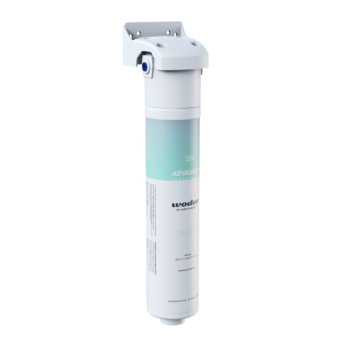
For a plain-language explanation of the labels and organizations involved, see WQA, NSF, and ANSI water-quality terminology. If you’re reviewing a product such as the Woder WD-G4-DC Lead, Chlorine, HM and PFAS Water Filter, check the specific listing rather than assuming the product name itself establishes every reduction claim.
Comparing Cartridge Media Types by Contaminant Target
The media inside a cartridge determines what it can plausibly reduce. Granular activated carbon, carbon block, ion exchange resin, and selective filtration media rely on different mechanisms, so the label “carbon filter” isn’t enough to predict performance.
Granular activated carbon adsorbs many compounds and is commonly used for chlorine, taste, odor, and some organic contaminants. Carbon block compresses carbon into a denser structure. Purdue Extension notes that block activated carbon has been shown to remove chlorine, taste, and halogenated organic compounds more effectively than granular activated carbon, while a peer-reviewed study found that meaningful micropollutant removal required a minimum empty-bed contact time of 20 to 30 minutes under the study conditions, as reported in this activated-carbon filtration research.
That finding has a practical consequence. Flow rate and contact time matter as much as media name. Water moving too quickly through a cartridge may leave sorption capacity underused. A cartridge that creates excessive pressure loss may be difficult to live with, even if its media is technically capable of reducing the target contaminant.
| Media type | PFAS | Lead | Chlorine | Chromium-6 | Fluoride | Mineral retention |
|---|---|---|---|---|---|---|
| Granular activated carbon | Requires a specific verified claim | May reduce selected metals, only trust a documented claim | Common application | Requires a specific verified claim | Usually not the default choice | Generally retains dissolved minerals |
| Carbon block | Requires PFAS-specific certification | May address lead when specifically tested | Often stronger than loose granules for taste and odor | Requires a specific verified claim | Usually limited without additional media | Generally retains dissolved minerals |
| Ion exchange resin | Depends on resin chemistry and certification | Can target selected ions | Not its primary role | Depends on the resin and test claim | Can be used in specialized designs | May exchange one ion for another |
| Selective filtration media | Must be certified for the PFAS claim | Can target lead and other listed metals when verified | Can address chlorine when tested | Can target chromium-6 when verified | Requires an explicit fluoride claim | Designed to retain essential minerals |
| Reverse osmosis membrane | Broad dissolved-contaminant reduction depends on system design | Strong reduction potential | Usually requires pretreatment | Strong reduction potential | Strong reduction potential | Removes dissolved minerals with other dissolved solids |
PFAS deserves special caution. The EPA guidance on filters certified to reduce PFAS directs consumers to look for NSF/ANSI 53 or NSF/ANSI 58 labeling, but certification is tied to a defined standard and claim. It isn’t a blanket guarantee for every PFAS compound or every gallon of use.
For chlorine-specific guidance, use this practical explanation of how filters address chlorine. The right cartridge depends on whether your priority is taste and odor, lead, PFAS, fluoride, chromium-6, or a combination. Don’t infer one result from another.
Matching Your Water Profile to the Right Cartridge
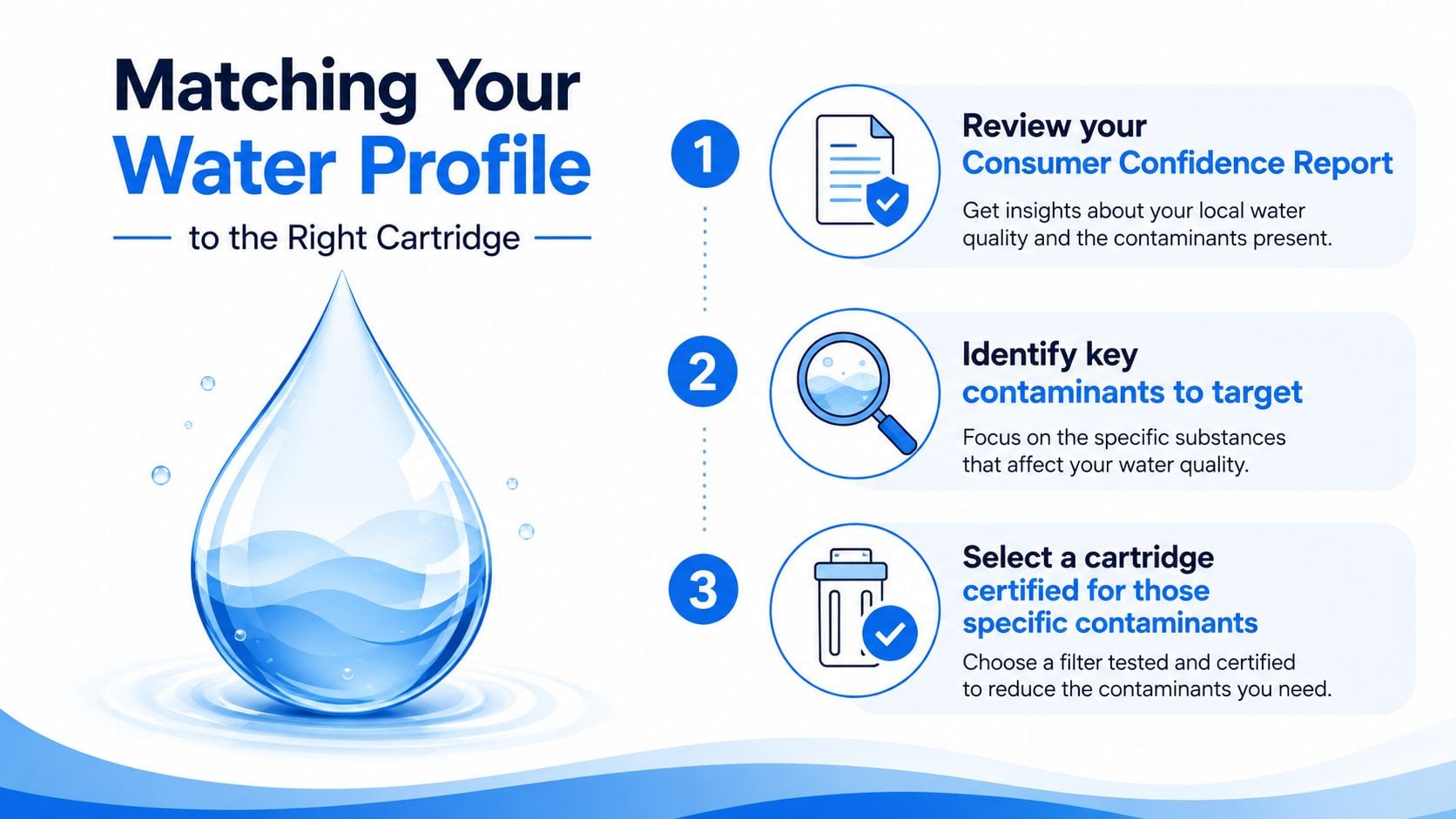
Choosing a cartridge becomes straightforward once you stop treating “water quality” as one problem. Work from the source to the faucet and match each concern to a documented claim.
Start with the source
If you receive municipal water, find your utility’s Consumer Confidence Report. Look for contaminant tables, detected levels, treatment information, and any notes about source-water vulnerabilities. The report describes the regulated public system, so it should be treated as a starting point rather than a complete analysis of water after it travels through household plumbing.
If you use a private well, arrange laboratory testing before selecting treatment. A useful overview of water quality testing methods from BacteriaFAQ.com can help you understand the difference between sampling approaches and why test selection matters.
Match the claim to the contaminant
Make a short list, not a shopping list. If chlorine taste is the problem, look for NSF/ANSI 42 chlorine, taste, and odor claims. If lead is the concern, look for a lead claim under NSF/ANSI 53 and verify the rated capacity and challenge conditions. If PFAS is the concern, look for an explicit PFAS reduction certification rather than relying on the word “carbon.”
The EPA’s finalized PFAS rule sets enforceable maximum contaminant levels of 4.0 parts per trillion for PFOA and PFOS, plus 10 parts per trillion for PFHxS, PFNA, and HFPO-DA, also called GenX chemicals, along with a hazard index for certain PFAS mixtures, according to the EPA’s PFAS drinking-water rule. A later 2025 federal update indicated that the agency planned to retain the 4 ppt PFOA and PFOS limits, narrow the broader rule to those two prevalent PFAS, and extend public-system compliance to 2031, as reported in this federal regulatory update.
The contaminant list on the front of a box is a starting point. The certification listing is the evidence.
Account for the plumbing
Older plumbing can create a point-of-use lead concern even when the utility report looks acceptable. A well may require treatment beyond a drinking-water cartridge, particularly if testing identifies bacteria, high sediment, iron, sulfur compounds, or hardness. In those cases, solve the whole-water problem separately and use a point-of-use cartridge for the contaminants that remain relevant at the tap.
The Real Cost of Cartridge Ownership Over Time
The purchase price is only the first line in the cost calculation. A cartridge with a low upfront price can become expensive if it needs frequent replacement, loses flow early, or isn’t certified for the contaminant you need to remove.
Replacement timing varies widely. Neutral maintenance guidance commonly places sediment-filter replacement around 3 to 6 months, carbon cartridges around 6 to 12 months, and RO membranes around 24 to 36 months or longer, depending on water quality and usage, as summarized in this water filter cartridge replacement schedule. Those are categories, not universal promises.
Use capacity, not calendar language alone
A replacement interval printed on a package may assume a particular household’s consumption and water conditions. Sediment can clog a cartridge early. High contaminant loading can consume media capacity before the calendar date. Low usage can make a large cartridge look economical while offering little practical advantage.
Calculate your annual cost this way:
Annual cartridge cost = cartridge price × the number of replacements required each year
Then calculate:
Cost per gallon = total cartridge cost ÷ gallons treated during the same period
A cartridge’s rated capacity is useful only when you also know your household demand and the claim attached to that capacity. The Ferguson listing for a Pentair granular activated carbon cartridge illustrates why shoppers should read the full specification. Distribution listings may show formats such as 10-inch and 20-inch cartridges and service-life claims such as 15,000 gallons or 3 months, but those claims must be evaluated against the specific product, water conditions, and certified reduction target.
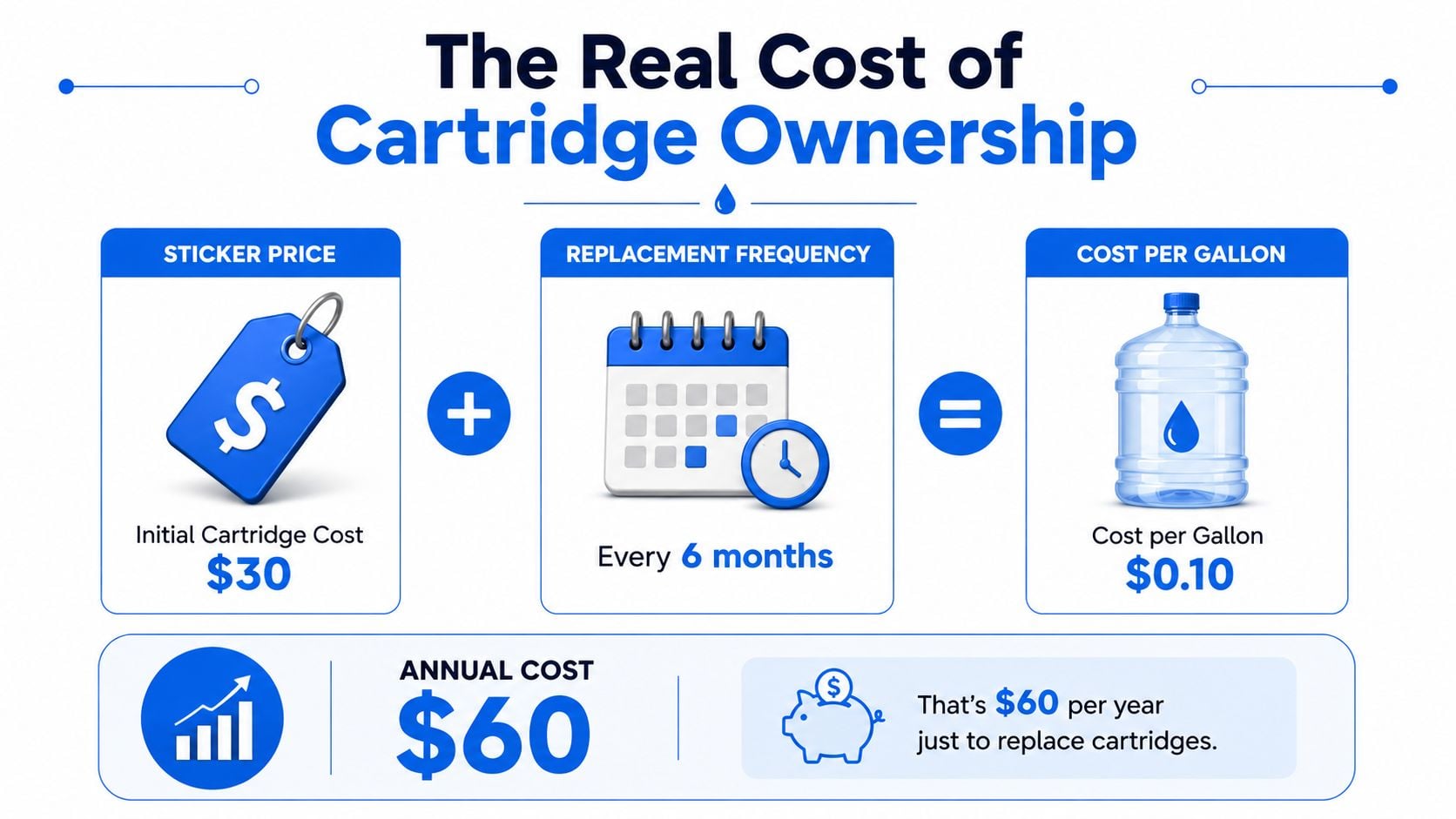
The required visual illustrates a simple example using a $30 cartridge replaced every 6 months, with a $0.10 cost per gallon and a $60 annual cost. Treat that as a calculation example, not a universal market price or performance promise.
Look for the hidden cost
The most expensive cartridge is often the one that solves the wrong problem. If it doesn’t address your target contaminant, its capacity has no meaningful value. If it reduces flow enough that your household stops using it, the theoretical savings disappear.
Choose a capacity that fits actual demand. A low-use apartment may not benefit from a very large cartridge, while a busy household may pay more over time by choosing a small cartridge that reaches capacity quickly.
Building Your Cartridge Decision Framework
You don’t need to compare every cartridge on the market. Build a shortlist by applying the same filters in the same order.
Confirm the contaminant claim
Write down the specific targets first: PFAS, lead, chlorine, fluoride, chromium-6, heavy metals, or another identified concern. Then reject any cartridge that lacks a verifiable claim for the contaminant that matters most.
A general certification logo isn’t enough. Record the standard, exact contaminant, rated capacity, flow conditions, and replacement instruction. This turns vague marketing language into comparable information.
Check the physical match
A technically suitable cartridge still fails if it doesn’t fit the system. Confirm:
- Housing compatibility: Under-sink housings, refrigerator lines, inline coffee filters, and dedicated drinking taps use different connection and size requirements.
- Flow requirements: A cartridge must deliver enough water for the fixture without unacceptable pressure loss.
- Installation limits: Check available space, shutoff access, tubing connections, and the system’s intended operating conditions.
- Replacement access: A cartridge is only practical if the correct replacement remains available when needed.
Compare ownership rather than sticker price
Estimate annual replacements using your actual household usage. Include the cartridge cost, any required prefilter, installation parts, and the time or service cost involved in changing it. Then compare the cost per gallon for the same verified contaminant claim.
Narrow the choice to two or three cartridges. The winner should be the one that satisfies all four conditions:
- It targets the contaminant identified in your water.
- Its certification applies to the exact claim.
- Its capacity and flow fit your household.
- Its replacement cost makes sense over time.
This framework also exposes misleading comparisons. “Long life” means little if the claim applies only to initial performance. A cartridge that maintains verified reduction through rated life is more useful than one with a larger headline capacity but unclear end-of-life evidence.
Why Selective Filtration Outperforms Reverse Osmosis for Most Homes
Reverse osmosis is a capable technology, but very low TDS isn’t the same as universally better drinking water. RO membranes reduce dissolved solids broadly, which means they also remove minerals such as calcium and magnesium. The result is water with very low TDS, but the meter can’t distinguish beneficial minerals from unwanted contaminants.
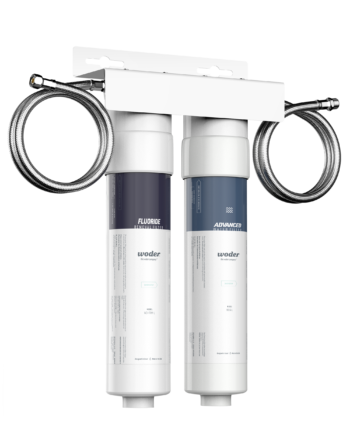
Woder’s Advanced Selective Filtration® takes a different approach. It uses engineered filtration media to target contaminants such as PFAS, lead, heavy metals, fluoride, chromium-6, and chlorine while retaining essential minerals. That distinction matters if you want filtered drinking water without turning every dissolved solid into a problem.
The practical tradeoff
RO can be the right choice for a household with a specific need for broad dissolved-solids reduction. It can also address contaminants that require membrane treatment when the system is correctly designed and maintained. But it generally adds more components, maintenance tasks, installation complexity, and water waste than a simple point-of-use cartridge.
A zero-TDS reading only proves that dissolved solids have been removed. It doesn’t prove that the water is healthier, and it doesn’t identify which solids were removed. For many homeowners, selective filtration is the more sensible balance because it focuses treatment on unwanted contaminants while preserving mineral character and avoiding the complexity associated with full dissolved-solids stripping.
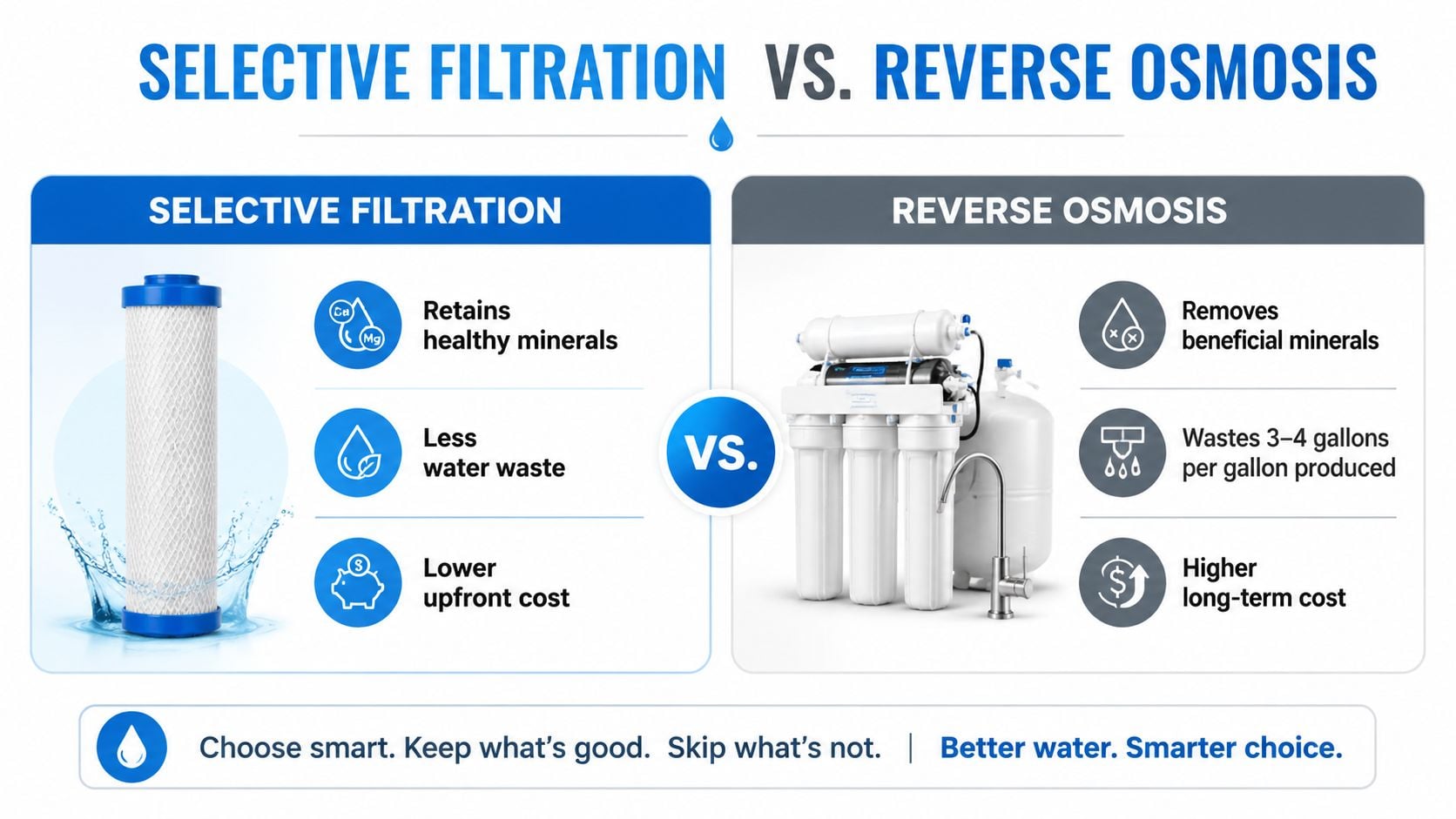
RO systems also waste water during production, while selective point-of-use filtration doesn’t require the same membrane reject-water process. For a homeowner who wants filtered water at a kitchen faucet, refrigerator, ice maker, or coffee line, a cartridge can be easier to install and maintain.
The difference is explained in more detail in this guide to selective filtration and mineral retention.
Woder is manufactured in the United States and built for U.S. building code compliance. Each Woder cartridge comes with a one-year guarantee, and the company states that it replaces a cartridge if it underperforms, without requiring the customer to complete a complicated claim. The broader principle is simple: choose the treatment method that matches your water and your priorities, then verify the claim at rated life.
Woder Filters offers U.S.-manufactured point-of-use cartridges using Advanced Selective Filtration® to target contaminants while retaining essential minerals, with under-sink and inline options for household fixtures. Review your water profile and visit Woder Filters to compare a cartridge approach with your specific drinking-water needs.