A parent fills a child’s glass at the kitchen tap, then notices the latest Consumer Confidence Report waiting in the mail. A quick search for a drinking water filter system opens a maze of carbon blocks, reverse osmosis membranes, selective media, NSF standards, replacement schedules, and confident product claims. The difficult question isn’t whether filtration exists. It’s which contaminants are present in this home, and whether a specific system has verified performance against them.
The right choice depends on more than a product category. A municipal supply, an older home with possible lead plumbing, and a private well can present very different filtration needs. The following guide focuses on how water moves through a household, what the main technologies do, where their limits are, and how to compare certified claims without treating any one system as a universal answer.
Table of Contents
- Why Choosing a Drinking Water Filter System Feels Overwhelming
- The Three Main Types of Point-of-Use Drinking Water Filter Systems
- How Filtration Technologies Actually Work
- Matching Your Water to the Right Filter
- Reverse Osmosis Compared With Selective Filtration
- Maintenance, Cartridge Life, and Real-World Ownership
- What Clean Water Actually Means Beyond Zero TDS
- A Practical Framework for Choosing Your System
Why Choosing a Drinking Water Filter System Feels Overwhelming
The label doesn’t tell the whole story
A household may begin with a simple concern, such as chlorine taste, then discover that filters marketed for taste aren’t necessarily designed for lead, nitrate, fluoride, chromium, bacteria, or PFAS. The EPA home drinking water filtration fact sheet exists in part because homeowners need clearer explanations of what household systems do and don’t treat.
Certification language adds another layer. NSF/ANSI 42, 53, 58, 401, and 473 don’t mean the same thing, and a certification applies to a defined performance claim, not to every contaminant a product might encounter. A system can be well suited to chlorine reduction yet not be the right choice for nitrate or a particular PFAS claim.
Practical rule: Choose the contaminant claim first, then choose the filter format that can deliver it conveniently.
The best system is specific to the house
A family in a city apartment may want a compact filter for drinking and cooking, while a homeowner with a private well may need laboratory testing before selecting any cartridge. A water utility report can reveal what the supplier detects in treated water, but it won’t always describe conditions inside a home’s service line, plumbing, or storage equipment.
That distinction explains why generic “best filter” lists often disappoint. They rank features without answering the more important question, which is whether the product is certified for the substances in your water and remains practical for your daily use. A calm decision starts with the local water profile, then weighs contaminant reduction, mineral retention, flow, installation, maintenance, and certification scope.
The point-of-use market reflects how many households are looking for that kind of control. One market summary valued the global point-of-use water treatment systems market at US$17.39 billion in 2024 and projects US$38.72 billion by 2033, with a projected 10.51% CAGR from 2025 to 2033. The same summary estimates that about 780 million households worldwide depend on these systems for drinking and cooking, and identifies North America as the largest regional market in 2024 with 38% share. These figures come from the market summary published by Yahoo Finance.
The Three Main Types of Point-of-Use Drinking Water Filter Systems
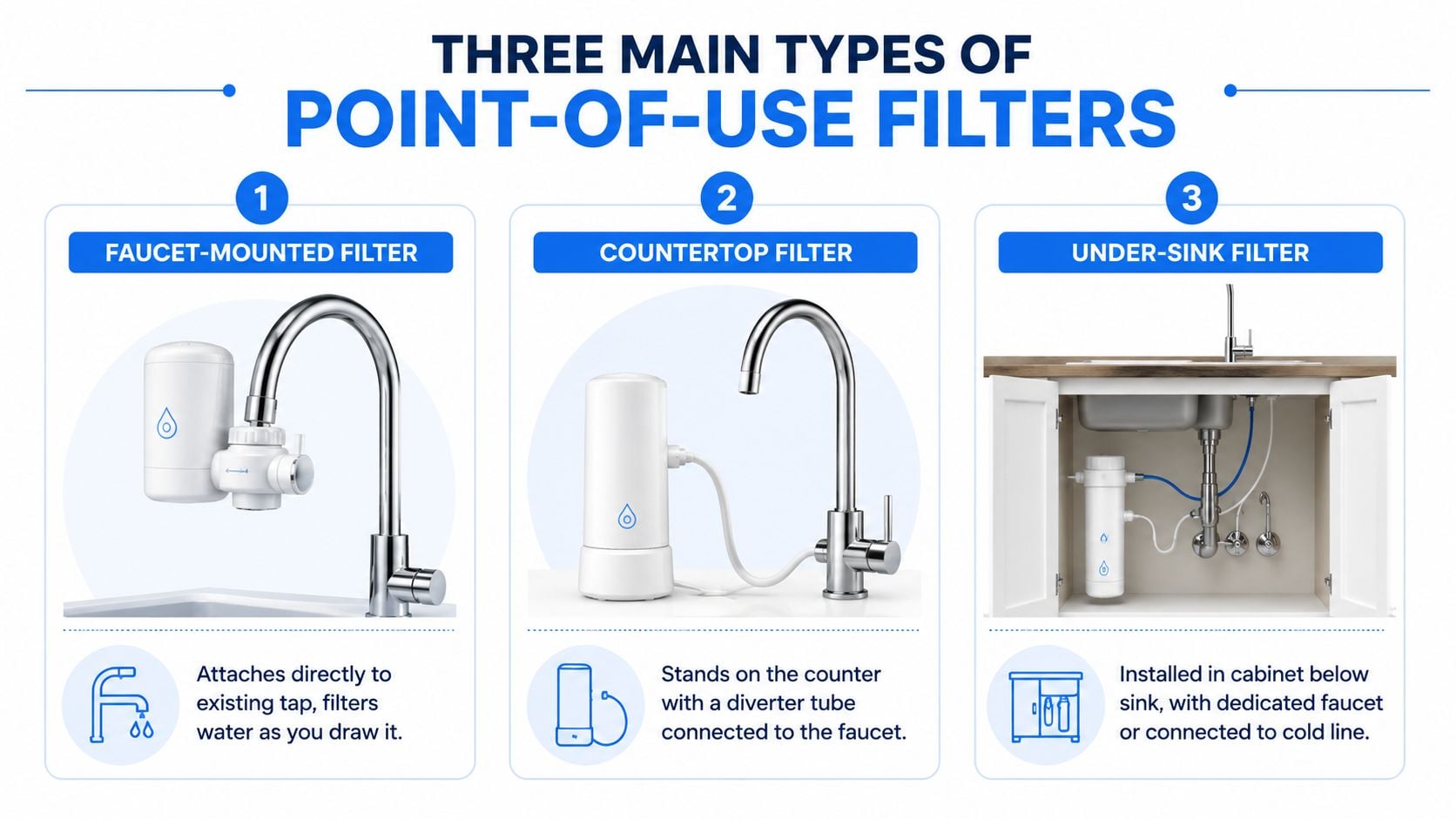
Before comparing filtration media, identify where the system sits. A point-of-use device treats water at one fixture, usually the kitchen sink, rather than filtering every line entering the home.
Faucet-mounted systems
A faucet-mounted filter attaches directly to the existing tap. When you turn on the filtered setting, water passes through a small cartridge before leaving the spout. The assembly stays visible above the sink, takes little space, and usually suits renters or households that want installation to take only a short time.
The tradeoff is capacity. A compact cartridge has less room for media than a larger under-sink housing, and the filter may reduce flow as it loads with sediment. The faucet connection also has to fit the tap, so pull-out and specialty faucets may limit compatibility.
Countertop and inline systems
A countertop filter sits beside the sink and connects to the faucet through a diverter tube. It sends water through a cartridge before dispensing it from the unit or through a connected outlet. This arrangement avoids cabinet work and can suit renters, temporary homes, or anyone who has counter space but doesn’t want to drill for a dedicated faucet.
An inline filter follows a similar idea but remains in the water line. It can serve a refrigerator, ice maker, coffee machine, or dedicated beverage line. The visible equipment is minimal, although the cartridge still needs a compatible connection and a replacement plan.
Under-sink systems
An under-sink system connects to the cold-water supply below the cabinet. Filtered water may travel to a dedicated faucet, or the system may feed a selected cold-water line. The housing occupies cabinet space, and installation can involve a shutoff connection, tubing, fittings, and sometimes a new faucet opening.
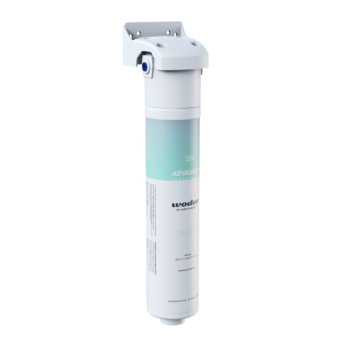
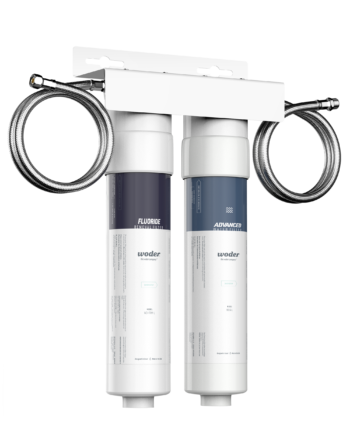
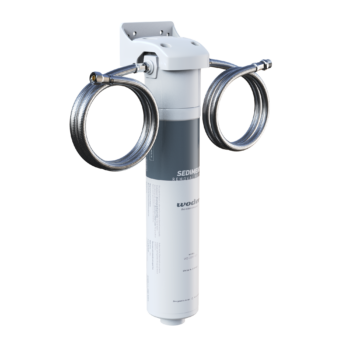
This format generally gives the designer more room for higher-capacity media or multiple stages. For a homeowner comparing an under-sink option, the Woder WD-G4-DC Lead, Chlorine, HM and PFAS Water Filter is described as a U.S.-made under-sink system using selective filtration that retains essential minerals. Its WD-G4-REP filters are identified as certified by WQA to NSF/ANSI 42 for chlorine taste and odor, and to NSF/ANSI 372 for lead-free compliance, based on the supplied product information.
How Filtration Technologies Actually Work
The cartridge housing tells you where filtration happens. The media inside tells you what the system can plausibly reduce.
Activated carbon block
Activated carbon uses adsorption. Instead of trapping every dissolved substance like a sieve, the media provides surfaces that attract and hold certain compounds. Carbon is widely used for chlorine taste and odor, chlorination byproducts, and many organic compounds.
Carbon isn’t a universal chemical sponge. Basic carbon filtration generally does little for dissolved minerals, fluoride, nitrate, or broad inorganic contamination. PFAS performance also depends on the media design, contact time, cartridge condition, and the exact claim being tested. A carbon block built for aesthetic improvement shouldn’t automatically be treated as a health-protection system.
Selective adsorption media
Selective filtration adds media designed to interact more strongly with particular contaminants. Catalytic carbon can improve performance against some chlorine-related compounds, while specialized adsorbents and ion-exchange materials can target substances such as lead or certain PFAS compounds when the complete system has been tested for that purpose.
That specificity is useful because it can reduce unwanted contaminants without removing every dissolved mineral. Woder describes Advanced Selective Filtration® as its core approach, designed to remove listed contaminants while retaining essential minerals. Its U.S. manufacturing and stated U.S. building code compliance are relevant considerations for homeowners who want domestic construction and installation expectations aligned with local practice.
The Woder explanation of how water filters work offers additional background for readers who want to follow the movement from incoming water to treated output. For households that serve filtered water at events or offices, durable drinkware such as durable tritan bottles for branding can also make a practical filtered-water program easier to manage, but the bottle doesn’t replace treatment certification.
Reverse osmosis
Reverse osmosis forces water through a semipermeable membrane under pressure. Residential RO membranes typically reject about 95% to 99% of total dissolved solids, according to the extension guidance summarized by Crystal Quest’s RO rejection-rate explanation. The same guidance lists common contaminant-specific rejection ranges, including 94% to 96% for arsenic, 93% to 96% for nitrate, 94% to 96% for fluoride, 96% to 98% for lead, and 99% or more for bacteria and sulfates.
RO can provide broad dissolved-solids reduction, but it also removes minerals and creates a wastewater stream. NSF/ANSI 58 is the relevant standard for reverse osmosis systems, while NSF/ANSI 42 covers aesthetic claims, NSF/ANSI 53 covers health-related claims such as lead and cyst reduction, and NSF/ANSI 401 addresses selected emerging contaminants. A PFAS claim should be tied to a specific certified standard and test scope, not inferred from the phrase “multi-stage filtration.”
Matching Your Water to the Right Filter
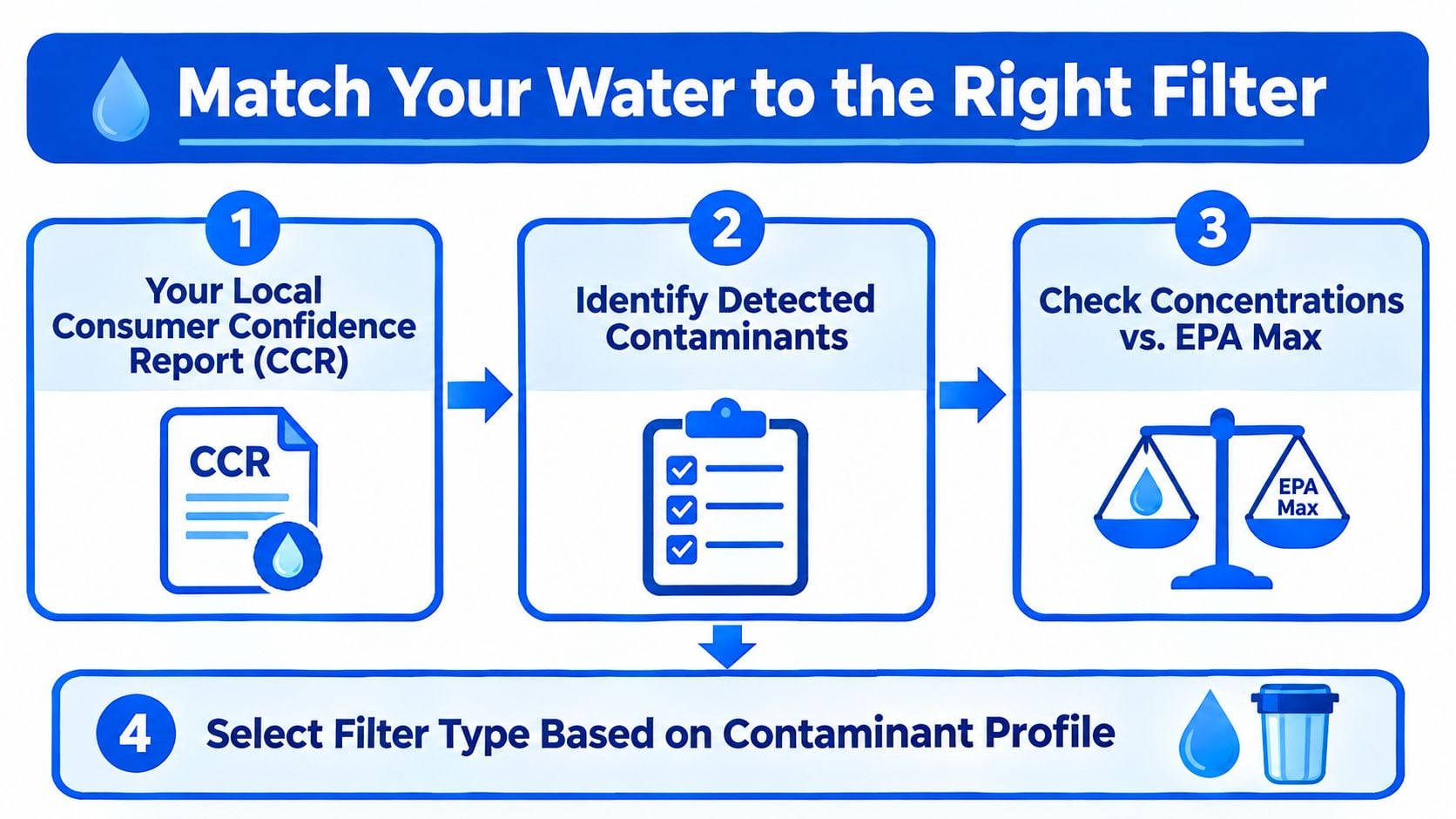
Start with the document your water utility provides. A Consumer Confidence Report, often available on the utility website, describes detected contaminants and compares results with applicable regulatory limits. It gives you a starting profile for municipal water, not a complete diagnosis of every tap in every home.
Look for the contaminant names, reported concentrations, and notes about the source or treatment process. If lead is your concern, recognize the regulatory threshold clearly. EPA’s Lead and Copper Rule uses an action level of 15 ppb, and the EPA rule explanation says additional corrosion-control actions are required when more than 10% of tap samples exceed that level. EPA also expresses the threshold as 0.015 mg/L, which equals 15 ppb, in its basic drinking-water information.
Turn the report into a filter question
A report showing chlorine as the main taste concern points toward an aesthetic reduction claim. A home with suspected lead plumbing needs a health-related lead claim supported by the right certification and usage conditions. Nitrate, arsenic, fluoride, microorganisms, and PFAS may require different media or a different system altogether.
For PFAS, don’t stop at the word “PFAS.” NSF explains that drinking-water units certified to NSF/ANSI 53 or NSF/ANSI 58 can be effective ways to limit exposure, and that its P473 protocol was created to verify reduction of specific long-chain PFAS such as PFOA and PFOS under a defined challenge condition maintained across the rated cartridge life. The NSF explanation of PFAS filtration standards shows why a new-filter snapshot isn’t enough.
EPA finalized the first national legally enforceable drinking-water standard for six PFAS in April 2024. The rule sets 4.0 ppt limits for PFOA and PFOS, 10 ppt limits for PFHxS, PFNA, and HFPO-DA, also known as GenX, and a hazard-index limit for mixtures involving PFHxS, PFNA, HFPO-DA, and PFBS, as described by EPA’s PFAS drinking-water rule.
If the CCR is unavailable, outdated, or doesn’t answer questions about the household tap, test the water directly. The result should guide the certified reduction list. Filter type alone isn’t enough.
Reverse Osmosis Compared With Selective Filtration
Reverse osmosis and selective filtration solve different problems. RO is built to reject a broad range of dissolved material, while selective systems are built to target specified contaminants and leave much of the mineral profile in place.
What RO changes
RO’s membrane can produce very low TDS because it rejects dissolved solids broadly. That can be useful when the incoming water contains several dissolved contaminants, when a laboratory result points to a broad treatment need, or when the homeowner specifically wants mineral-stripped water.
The cost of that broad removal is practical. RO typically needs pressure, a drain connection for concentrate water, and often a storage tank. It also removes calcium and magnesium along with unwanted substances. The system may require more components and more maintenance than a single-cartridge selective system, and the water can taste noticeably flatter to people accustomed to mineral-containing tap water.
What selective filtration preserves
Selective systems use media chosen for particular contaminant interactions. They can reduce substances such as lead, chlorine, certain heavy metals, and selected PFAS compounds when the product’s performance data supports those claims. Because the process isn’t designed to remove every dissolved solid, essential minerals can remain in the treated water.
That design usually means no RO-style wastewater stream and a simpler point-of-use footprint. It can also support a more direct flow from the cold-water line to a dedicated faucet. The limitation is equally important: selective filtration isn’t automatically the right answer for every dissolved contaminant, and the certified scope must match the water test.
| Decision factor | Reverse osmosis | Selective filtration |
|---|---|---|
| Main approach | Semipermeable membrane under pressure | Targeted adsorption and related media |
| TDS result | Very low TDS is possible | Minerals generally remain |
| Waste stream | Produces concentrate water | Doesn't use an RO wastewater stream |
| Installation | Often needs drain and additional components | Often fits a simpler point-of-use layout |
| Best starting question | Is broad dissolved-solids reduction needed? | Which specific contaminants need reduction? |
Neither approach deserves a blanket verdict. Choose RO when broad dissolved-solids reduction is the priority and its installation and maintenance are acceptable. Choose selective filtration when certified contaminant targeting, mineral retention, water efficiency, and a smaller setup matter more.
Maintenance, Cartridge Life, and Real-World Ownership
A filter can meet its performance claim only while it’s used within its rated conditions. Replacement timing matters because a cartridge can become exhausted or clogged without producing an obvious visual warning.
Service life is a working estimate
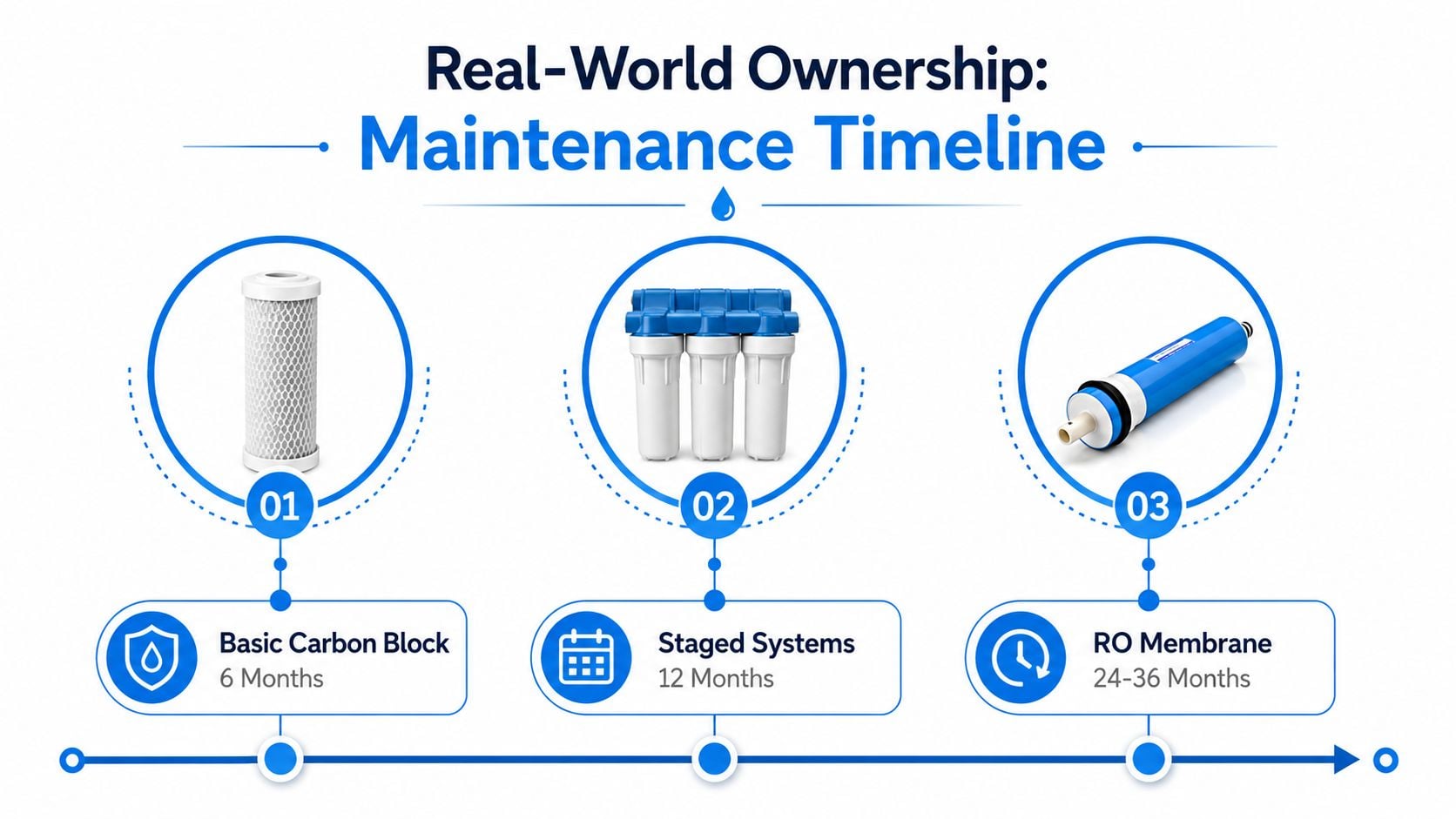
Basic carbon blocks are often planned around six months, staged systems around twelve months, and RO membranes or remineralization cartridges around two to three years, assuming typical household use. Those intervals come from the supplied product guidance, not a universal rule, and actual life changes with sediment, hardness, pressure, contaminant concentration, and water volume.
A busy household may reach the cartridge limit earlier. A well with substantial sediment can clog a prefilter before the stated calendar date. A sudden pressure drop may signal loading, while a return of taste or odor can indicate exhausted media. Neither symptom reliably proves that every contaminant is being reduced, so follow the manufacturer’s rated capacity and replacement instructions.
Build a routine you can keep
Mark the installation date on the housing or in a phone calendar. Keep the next cartridge available before the current one reaches its scheduled interval, and inspect tubing and connections whenever you replace media.
During a housing change, shut off the supply, relieve pressure, and follow the system’s sanitation instructions. Under-sink installations may require a dedicated faucet opening and a cold-water connection, while faucet-mounted and some inline units can be installed with minimal tools. If a fitting, valve, or cabinet layout is unfamiliar, a plumber can prevent a small leak from becoming a larger repair.
The Woder water filter replacement schedule guide can help organize that calendar-based routine. Woder also states that every cartridge includes a one-year guarantee, with replacement if it underperforms under the guarantee terms. That kind of support doesn’t remove the need for maintenance, but it gives the homeowner a clearer ownership path.
What Clean Water Actually Means Beyond Zero TDS
A zero-TDS reading sounds definitive because it produces a simple number. TDS, or total dissolved solids, is a bulk measurement, however. It includes harmless dissolved minerals such as calcium and magnesium as well as substances a homeowner may want to reduce.
A meter that reads zero can’t identify every individual contaminant. It mainly reflects the conductivity of the water, so it may confirm that dissolved ions have been removed without proving that volatile organic compounds or every health-related contaminant has been addressed. The explanation of why TDS is not an effective measure of water quality makes the practical distinction clear.
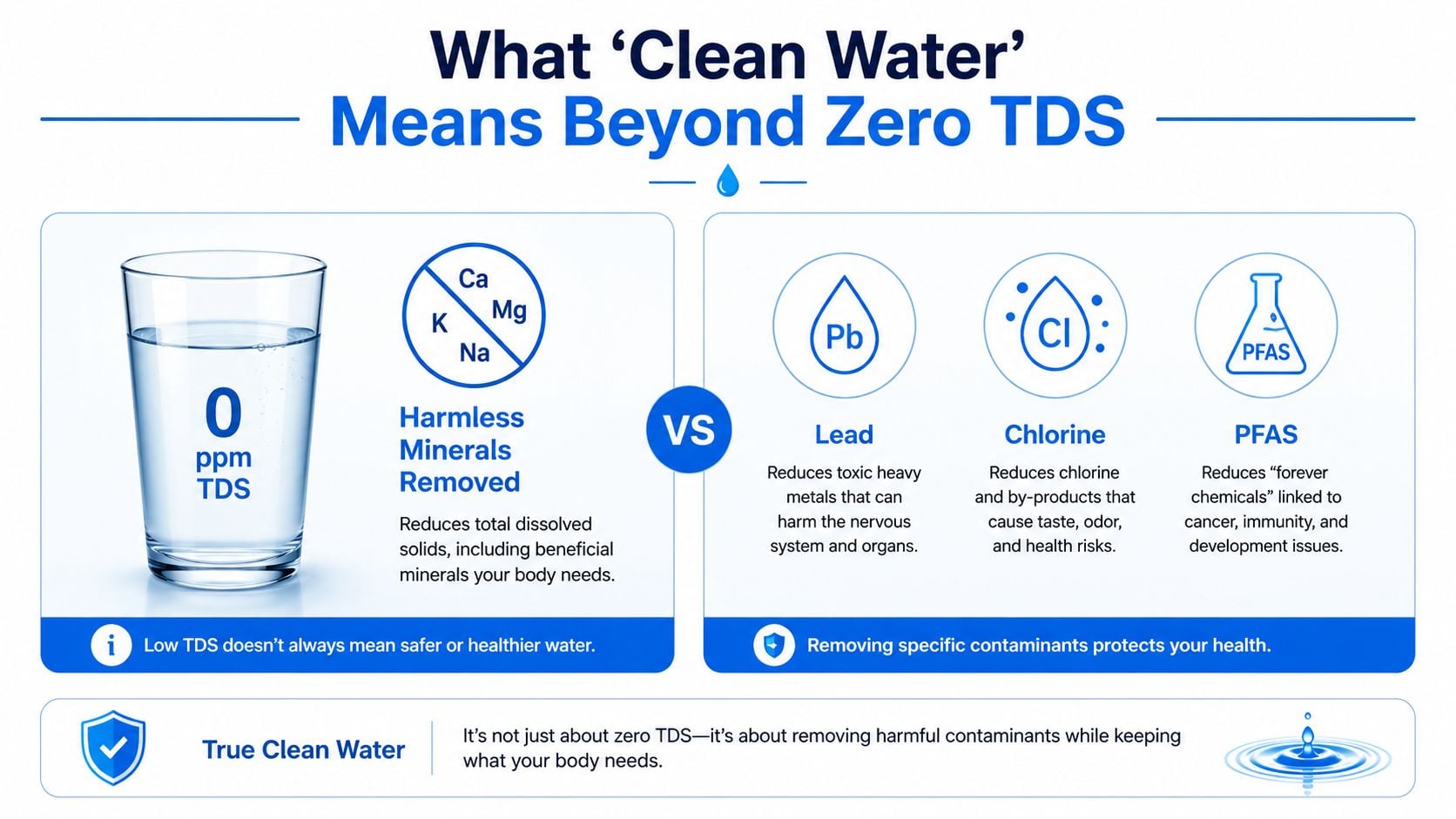
A lower number isn’t automatically a better glass
RO and distillation can strip water of minerals, producing a very low-solids result. Some people prefer that taste, while others find mineral-containing water more pleasant. Mineral removal also changes the chemistry that flows through the home’s dispensing equipment, so the TDS number should be treated as one measurement, not a complete safety score.
For drinking water, “clean” is more useful when it means verified reduction of specific unwanted contaminants. That could mean chlorine and taste compounds for one household, lead for another, or selected PFAS compounds for a home whose testing and certification review point in that direction.
The better question isn’t “How low can the TDS go?” It’s “What does my water contain, what do I want to reduce, and does the system prove that it can do so while operating within its rated life?”
A Practical Framework for Choosing Your System
Begin with the most recent Consumer Confidence Report and, when appropriate, a tap-water test. Note the contaminants that matter to your home, including lead, PFAS, nitrate, arsenic, chlorine byproducts, and hardness, then separate a taste concern from a health-related reduction need.
Next, decide which tradeoffs you value:
- Broad reduction: Consider whether the water profile calls for membrane treatment or targeted media.
- Mineral preservation: Look for a system designed to reduce specified contaminants without stripping all dissolved minerals.
- Low waste: Compare whether the process sends water to a drain.
- Simple ownership: Check cartridge access, replacement timing, flow, and installation requirements.
Then verify the shortlist against the relevant third-party standard. Depending on the claim, that may include NSF/ANSI 42, 53, 58, 401, or 473, but the standard number alone isn’t enough. Read the exact contaminant list, test conditions, rated cartridge life, installation requirements, and any limitations.
Finally, check U.S. manufacturing, U.S. building code compliance, performance data, replacement support, and warranty terms. Woder presents its Advanced Selective Filtration® approach as a way to target contaminants such as PFAS, lead, heavy metals, fluoride, chromium, and chlorine while retaining essential minerals. Its stated philosophy, It’s Your Water®, is a useful reminder that the homeowner should make the decision from verified information, not pressure.
If your water report points toward targeted contaminant reduction with mineral retention, explore the point-of-use options from Woder Filters. Review the certified scope, installation requirements, replacement support, and one-year cartridge guarantee before deciding whether the system fits your household.