- What Drives the Total Cost
- DIY vs. Professional Installation
- The Cost of Different Filter Types
- Ongoing Maintenance Costs
- Hidden Costs to Watch For
- How to Keep Costs Down Without Cutting Corners
- Is It Worth the Investment?
- FAQs
- Final Thoughts
Most under-sink filters cost $100 to $400 for the unit. If you put it in yourself, there’s no extra charge. A plumber usually asks about $100 to $300 for a simple job. Budget another $40 to $150 a year for cartridges. You can compare models and prices in our under-sink water filter systems.
Key takeaways:
- The filter itself is the biggest cost, not the labor.
- Systems that use your existing faucet are the cheapest to put in.
- Reverse osmosis costs more upfront and to install.
- Yearly cartridges matter more over five years than the sticker price.
Installing an under-sink water filter is one of the smarter home upgrades you can make—and knowing the under-sink water filter installation cost upfront means no unpleasant surprises when the bill arrives. Whether you’re doing it yourself or calling a plumber, the total spend comes down to a handful of factors that are easy to plan around once you understand them.
This guide covers every cost layer—filter unit, labor, fittings, and ongoing maintenance—so you can budget accurately before you buy anything.
What Drives the Total Cost
The final number isn’t just the price of the filter. It’s the sum of several moving parts, each of which varies based on your plumbing setup, the filter type you choose, and whether you bring in a professional. Here’s what a typical under-sink install breaks down to, based on common home-service estimates and current retail prices:
| Cost item | Typical range | Notes |
| Filter unit, single stage | $100 to $250 | Carbon or specialty media, uses your existing faucet |
| Filter unit, multi-stage | $200 to $400 | Adds lead, fluoride or sediment stages |
| Reverse osmosis unit | $200 to $600 | Needs a tank, a drain line and its own faucet |
| Plumber labor | $100 to $300 | More if drilling or a new valve is needed |
| Extra fittings and valves | $10 to $60 | Only if your shutoff valve is old or a size doesn’t match |
| Yearly cartridges | $40 to $150 | Depends on stages and household use |
The Filter Unit
Under-sink filters range from simple inline cartridge systems to more complex multi-stage setups. A basic inline filter that connects directly to your existing cold-water line sits at the lower end of the market. Multi-stage systems—including reverse osmosis units with separate faucets and storage tanks—sit at the higher end.
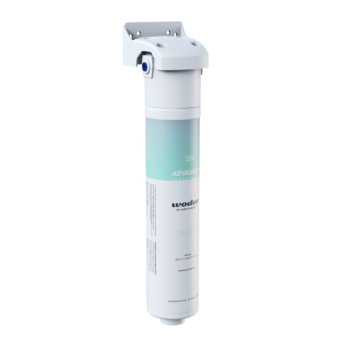
Filtration technology matters here too. Systems built around advanced media, like the nanoparticle-based approach in Woder Filters, are designed to remove contaminants selectively without stripping out beneficial minerals. That means you’re not paying extra for a remineralization stage the way some reverse osmosis systems require. For reference, a single-stage unit like the Woder WD-G4-DC attaches between the shutoff valve and the faucet hose, so it needs no extra parts for a standard kitchen.
Labor Costs
If you hire a licensed plumber, you’re paying their hourly rate plus any parts they supply. Rates vary significantly by region—urban markets typically run higher than rural ones. A straightforward installation where the plumbing is accessible and no modifications are needed usually wraps up in under an hour. More involved jobs—adding a dedicated faucet, running a new line, or working around a cramped cabinet—take longer and cost more.
Additional Parts and Fittings
Some installations need components beyond what comes in the box. A dedicated filter faucet, if your system requires one, adds to the total. Compression fittings, braided supply lines, and shutoff valves are often sold separately. If the existing shutoff valve under your sink is old or corroded, a plumber may recommend replacing it while they’re already there—and that’s usually worth doing.
DIY vs. Professional Installation
Whether to install the filter yourself or hire someone is one of the biggest cost decisions you’ll make.
DIY Installation
Doing it yourself is where you save the most. A system that connects to your existing faucet takes most people 30 to 60 minutes with a wrench and a towel. The cost to install under sink water filter units yourself is basically zero, unless your shutoff valve is worn and needs replacing, which is a $10 to $30 part.
DIY makes sense if your valves turn easily, there’s room in the cabinet, and the system doesn’t need a new faucet or a hole in the counter.
Professional Installation
Hire a pro when the job involves countertop drilling, a dedicated faucet, a drain connection, or old valves that won’t close. A typical plumber labor rate runs $75 to $150 an hour, and most under-sink jobs take one to two hours. That’s where the $100 to $300 range comes from.
People often search for a general water filter installation cost without saying what type of system they mean. Always ask for a quote that lists parts and labor separately.
The Cost of Different Filter Types
The type of filter you choose shapes both the upfront price and what you’ll spend over time.
Inline Filters
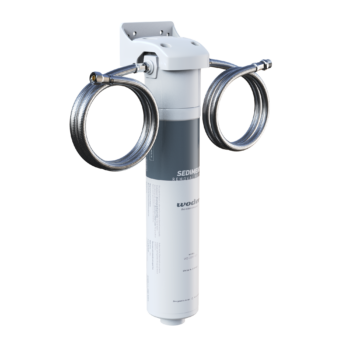
These are the simplest option and typically the most affordable to install. They splice directly into the cold-water supply line using push-fit or compression fittings—no new faucet, no tank, no drain line. The filter sits inside the cabinet and treats water before it reaches your existing tap. Installation is quick, and the ongoing cost is just the replacement cartridge on whatever schedule the manufacturer recommends.
Multi-Stage Cartridge Systems
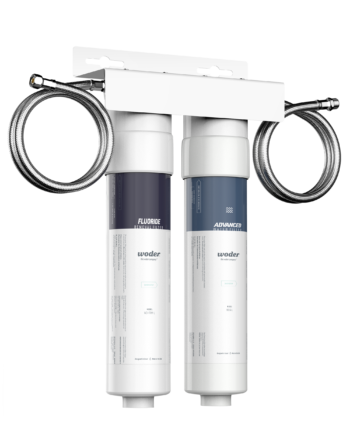
These run water through two or three filter stages housed in separate canisters, which removes a broader range of contaminants. They often require a dedicated faucet, which means mounting the canisters, connecting them in sequence, and potentially drilling a faucet hole. Labor time goes up, and so does the upfront cost.
Reverse Osmosis Systems
RO systems are the most expensive to install. They need a dedicated faucet, a storage tank, and a drain connection—and if your home’s water pressure is low, a booster pump on top of that. Installation is more involved, and ongoing maintenance includes multiple filter stages that need replacing at different intervals.
One thing worth knowing: RO systems strip out nearly everything, including beneficial minerals like calcium and magnesium. If you want mineral-rich water, you either need a remineralization filter added to the system or a technology that filters selectively from the start. A typical reverse osmosis water filter installation cost lands higher, often $150 to $400 for labor alone, because the installer has to mount a storage tank, connect a drain saddle, and usually drill the sink or counter for the extra faucet.
Ongoing Maintenance Costs
Installation is a one-time expense. Maintenance is the recurring one, and it’s easy to underestimate.
Filter Cartridge Replacement
Every filter has a service life, typically measured in gallons or months. When the cartridge is due, you either swap it yourself or pay someone to do it. Most under-sink cartridges are designed for simple DIY replacement, so this is rarely a labor cost—just the cartridge itself.
Woder’s filter models are built for long service intervals, which keeps the annual replacement cost manageable. Check the specific model’s rated capacity when you’re budgeting. A simple way to compare systems is the cost per gallon. Divide the replacement cartridge cost by its rated capacity. A $60 cartridge rated for 1,000 gallons comes to 6 cents a gallon, while a $20 pitcher cartridge rated for 40 gallons comes to 50 cents. Our guide on how long a water filter lasts explains when to swap.
Faucet and Fitting Maintenance
Over time, the dedicated faucet on a multi-stage or RO system may develop a drip or need a washer replaced. Minor stuff, but worth factoring in if you’re thinking about five-year ownership costs.
Hidden Costs to Watch For
A few things tend to catch homeowners off guard.
- A new shutoff valve: $10 to $30 for the part, or $100 to $200 if a plumber replaces it.
- A drain saddle and tubing for RO units: $10 to $25.
- Drilling a granite or quartz counter for a second faucet: often $50 to $150 extra.
- Water pressure below 40 psi, which some RO units need a booster pump for: $100 to $200.
- Permits: rarely needed for a simple under-sink filter, but check local rules if you add new plumbing lines.
How to Keep Costs Down Without Cutting Corners
You don’t need to spend the maximum to get clean water.
Start by choosing a filter that matches your actual water quality concerns. If your municipal water is treated and your main issues are taste, chlorine, or sediment, a well-designed inline filter handles that without the complexity of a full RO system.
If you’re comfortable with basic plumbing, DIY installation on an inline or simple multi-stage system is genuinely achievable. Most quality filters walk you through every step.
Look for a system with a long cartridge life. A filter that needs replacing every six months costs more to maintain than one rated for a year or more at the same flow rate.
Think in terms of total cost of ownership over three to five years, not just the sticker price. A slightly more expensive filter with a longer service life and simpler maintenance often works out cheaper than a budget unit with frequent cartridge changes.
Whole-Home vs Under-Sink: How the Costs Compare
If you’re weighing the cost to install water filter system options for the entire house, the gap is big. Whole-home units usually cost $800 to $3,000 for equipment plus $300 to $1,500 for installation, and they need a plumber. An under-sink unit costs a fraction of that and treats the tap you drink from.
So how much does it cost to install a water filter overall? For one kitchen faucet, most homes spend $100 to $700 all in. For the whole house, plan on $1,000 to $4,500. Many families start under the sink and add a whole-home unit later only if they need it for showers or appliances.
Is It Worth the Investment?
For most households, yes. The alternative is bottled water or accepting unfiltered tap water—neither of which is a great long-term answer. Bottled water adds up fast when you calculate the annual spend, and the plastic waste is hard to ignore. An under-sink filter delivers clean water on demand at a fraction of that ongoing cost once it’s installed.
Filtration quality matters too. A system that removes contaminants while keeping beneficial minerals intact—like the approach used by Woder Filters—means you’re drinking water that’s genuinely better, not just water with everything stripped out.
Frequently Asked Questions
How much does a plumber charge to install an under-sink water filter?
Most plumbers charge about $100 to $300 for a simple under-sink install, based on a typical rate of $75 to $150 an hour. The price goes up if they need to replace a shutoff valve, drill the counter, or add a separate faucet and drain line for reverse osmosis.
Can I install an under-sink water filter myself?
Yes, for most inline and many multi-stage systems. If you can identify your cold-water supply line and use basic hand tools, DIY installation is realistic. Reverse osmosis systems are more involved and may be worth having a plumber handle, especially if a new faucet hole needs to be drilled.
What ongoing costs should I budget for?
The main recurring cost is cartridge replacement, which varies by model and household water usage. Most cartridges are simple DIY swaps. Budget for at least one replacement per year, though higher-capacity filters can go longer between changes.
Does a reverse osmosis system cost more to install than a standard under-sink filter?
Yes. RO systems require a dedicated faucet, a storage tank, and a drain connection. Installation takes longer, the system itself costs more upfront, and ongoing maintenance involves multiple cartridge stages at different replacement intervals.
Do I need a permit to install an under-sink water filter?
In most cases, no. A basic filter installation that connects to an existing supply line doesn’t require a permit. If you’re making more substantial plumbing changes, check your local building codes to be sure.
What’s the difference between an inline filter and a multi-stage under-sink system?
An inline filter connects directly to your existing supply line and delivers filtered water through your regular faucet. A multi-stage system uses multiple filter canisters in sequence and usually requires a dedicated faucet. Inline systems are simpler and cheaper to install; multi-stage systems typically address a broader range of contaminants.
Will an under-sink filter remove beneficial minerals from my water?
It depends on the technology. Reverse osmosis removes nearly everything, including minerals—which is why some RO systems add a remineralization stage. Selective filtration systems, like those from Woder, are designed to remove contaminants while leaving beneficial minerals like calcium and magnesium intact.
Is it cheaper to install a water filter yourself?
Yes. Doing it yourself costs nothing beyond the filter if it connects to your existing faucet. The cost to install water filter under sink yourself only rises if a valve is worn out. Most people finish in under an hour with a wrench, a towel and the instructions.
Final Thoughts
Budgeting for an under-sink water filter installation in 2026 means looking at the full picture: the filter unit, any fittings, labor if you go the professional route, and the ongoing cartridge cost over the years you own it. For most households, the total spend is manageable—especially when you stack it against what bottled water costs over the same period.
Not sure which system fits your kitchen? Our Filter Wizard asks a few quick questions and points you to the right model.