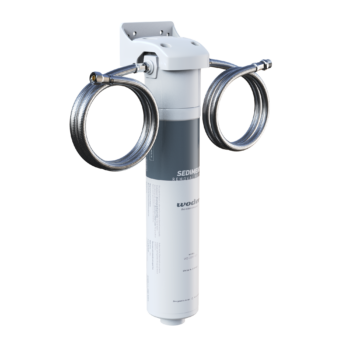
A parent can spend an evening reading a municipal water report, notice references to lead or PFAS, and then lose another hour comparing sink water purification systems. One product promises broad contaminant reduction. Another emphasizes mineral retention. A third displays certification marks that look similar until you learn they cover different types of claims.
The confusion is understandable. “Under-sink,” “inline,” and “countertop” describe installation architectures, not necessarily filtration performance. Activated carbon, ion exchange, selective media, and reverse osmosis can all appear in products sold for the same kitchen. The right choice depends on your water profile, available cabinet space, plumbing, and willingness to maintain the system.
This guide focuses on those practical decisions. The aim isn't maximum removal at any cost. It's to help you choose a system that addresses the contaminants that matter in your water while fitting the way your household uses the kitchen.
Table of Contents
- Why Choosing a Sink Water Purification System Feels Overwhelming
- Under-Sink vs Inline Filtration Systems Explained
- Filtration Technologies and What They Remove
- How to Match a Filter to Your Household Needs
- Selecting the Right System and Cartridge for Your Water
- Making a Confident Decision for Your Home
Why Choosing a Sink Water Purification System Feels Overwhelming
A homeowner can open a water report, notice references to lead or PFAS, and then face dozens of sink water purification systems that make broad claims. The key question is narrower: which contaminant needs attention, how much water must the system treat, where can it fit, and what maintenance will the household realistically complete?
“Effective” has no useful meaning without those details. A filter that improves chlorine taste and odor is not automatically certified for lead, PFAS, fluoride, or chromium. A certification applies to a specific contaminant claim, not to a product's entire marketing page.
Certification claims need close reading
NSF/ANSI 42 generally covers aesthetic treatment, including chlorine taste and odor. NSF/ANSI 53 addresses health-related contaminant reduction claims such as lead. NSF/ANSI 58 applies to reverse-osmosis systems and may cover dissolved contaminants such as fluoride, arsenic, chromium-6, and PFAS, but only when those claims are specifically listed for the certified product. Review the EPA drinking-water information for federal drinking-water context, then verify the exact certification and capacity for the model under consideration.
A certification mark alone does not settle the purchase. Check the contaminant, rated capacity, replacement cartridge, and installation requirements shown for that product.
The same kitchen can need a different filter
A municipal-water household may mainly want better chlorine taste. An older home may raise plumbing concerns, while a private-well owner may first need testing for sediment, metals, or changing water chemistry. A general “best filter” ranking cannot account for those conditions.
PFAS require particular care because the EPA is establishing the first nationwide, legally enforceable drinking-water standards for these compounds. That makes PFAS a significant U.S. tap-water concern, not a reason to buy the broadest system without confirming the specific claim.
Practical rule: Start with the contaminant, not the filter category. A system should earn its place by matching a documented water concern.
Three checks narrow the choices quickly:
- What's in the water? Read the utility's Consumer Confidence Report, or test private-well water through a qualified laboratory.
- What space and plumbing do you have? Cabinet dimensions, shutoff access, faucet openings, and drain connections can eliminate otherwise suitable systems.
- What maintenance will you perform? A capable filter becomes a poor household choice if cartridges are ignored or reduced flow goes unnoticed.
These checks prevent a common mistake: choosing the most aggressive technology because its marketing sounds all-encompassing. Reverse osmosis has a clear role when dissolved contaminants require that level of treatment. A carbon or selective-filtration system may fit better when the goal is targeted reduction, mineral retention, limited cabinet space, and simpler installation.
| Household situation | Usually sensible starting point | Main tradeoff |
|---|---|---|
| Chlorine taste and odor | Certified carbon filtration | It may not address every health-related contaminant |
| Documented lead concern | A product with a specific NSF/ANSI 53 lead claim | Certification must match the exact product and capacity |
| PFAS or dissolved contaminants | A certified system with the specific PFAS claim, often evaluated against RO options | More complexity may mean more maintenance or installation work |
| Rental or limited cabinet space | Compact inline filtration | Plumbing compatibility and pressure deserve attention |
| Private well with uncertain chemistry | Water testing before equipment selection | Testing adds a step, but prevents mismatched media |
Under-Sink vs Inline Filtration Systems Explained
Under-sink and inline systems can use similar filter media. Their biggest difference is where they connect to the plumbing and which faucet receives the treated water.
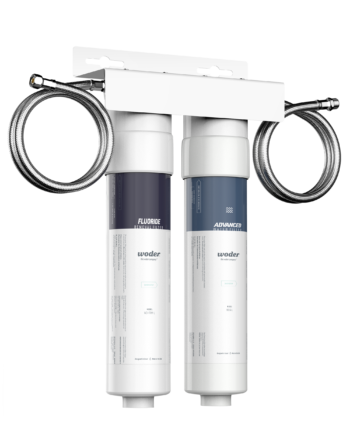
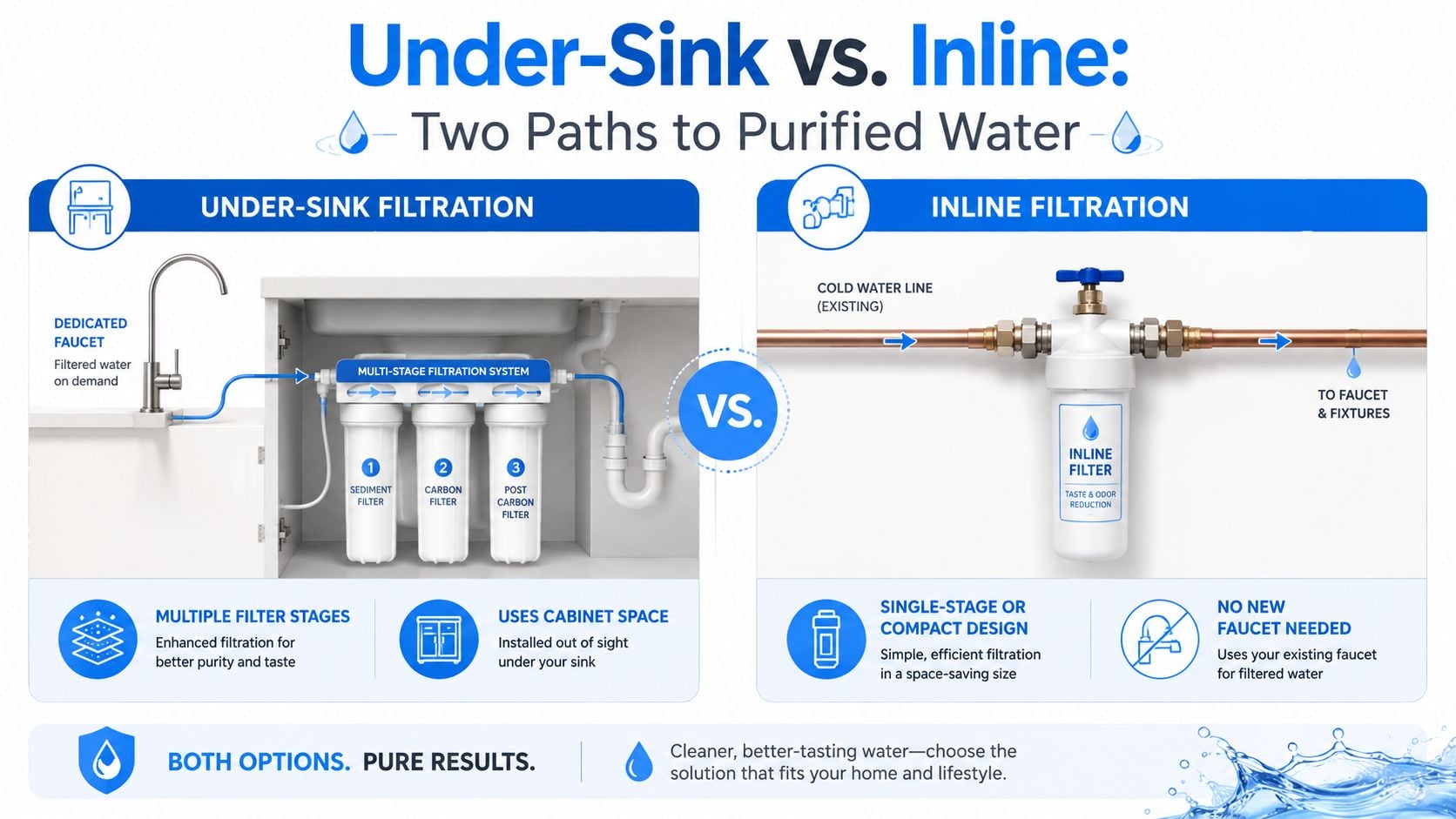
An under-sink system usually sits on the cabinet wall or floor. A tee fitting connects it to the cold-water line, and purified water travels through dedicated tubing to a separate faucet installed in the sink deck or countertop. The arrangement keeps treatment equipment out of sight and gives you a distinct drinking-water outlet, but it uses cabinet space and may require a new countertop opening.
A typical unit may occupy a meaningful section of the cabinet, especially if it uses multiple cartridges. Before buying, measure the available width, depth, and vertical clearance with the cabinet doors closed and the shutoff valves accessible. The filter shouldn't force you to kink tubing, block the main shutoff, or make cartridge replacement nearly impossible.
Inline systems splice into an existing cold-water line. Depending on the application, they may serve the main faucet, refrigerator, ice maker, coffee machine, or another point-of-use connection. They generally avoid a dedicated faucet and countertop drilling, which makes them attractive to renters and homeowners who want less visible hardware.
Plumbing architecture changes the user experience
A dedicated under-sink faucet separates filtered drinking water from unfiltered water used for washing dishes. That's useful when you want to reserve treated water for drinking and cooking. An inline arrangement is more integrated, but the flow path and connection point must be confirmed before installation.
Flow also depends on cartridge design, pressure, temperature, and loading. Under-sink dedicated faucets commonly feel slower than the main kitchen faucet because the water passes through restricted media and smaller tubing. Inline systems can preserve the familiar faucet arrangement, but sediment accumulation can create pressure loss as the cartridge loads.
Don't confuse a faster outlet with better filtration. Longer contact time can help carbon media reduce certain compounds, while excessive flow can shorten the opportunity for treatment. The relevant design question is whether the system's rated flow and capacity match your household's use.
For a neutral overview of how installation layouts and filter technologies compare, this clean water system comparison is a useful additional resource. You can also review Woder's explanation of an inline water filter system before deciding whether an existing cold-water connection can accommodate one.
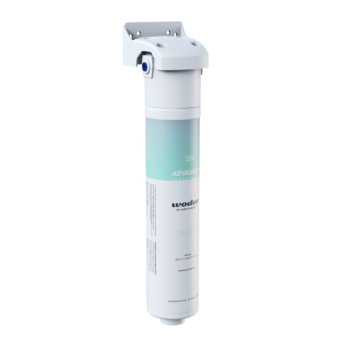
The Woder Advanced Inline Water Filter WD-G4-JG uses Advanced Selective Filtration, retains essential minerals, and is made in the USA. Those are product attributes, not a substitute for checking the contaminant claim that matches your water.
Filtration Technologies and What They Remove
The right filter depends on your water profile, available space, and willingness to replace cartridges. The number of stages on the box is a weak buying guide. Several stages may improve sediment control or taste, but they do not prove that the system targets the contaminant in your water.
Activated carbon handles common taste problems well
Granular activated carbon and carbon block are widely used for chlorine, taste, odor, and some organic compounds. Carbon block generally provides more consistent contact and particulate capture than loose granular media, but performance depends on the formulation, bed depth, flow rate, and cartridge condition.
For free chlorine, effective empty-bed contact time is commonly around one to two minutes, with reported removal above 95% to 99% under the cited conditions. Chloramine is harder to reduce. It may need approximately three to four minutes of contact time for roughly 85% to 95% removal. In a sink system, that makes flow control and water residence time important. The performance ranges and testing context are summarized in this NSF certification and contact-time guide.
Catalytic carbon is the better choice when chloramine is the concern. Its treated or specially structured surface supports reactions that ordinary carbon may handle less efficiently. Confirm that the cartridge lists a chloramine claim rather than assuming any carbon filter provides the same reduction.
Other media target different contaminant classes
Ion exchange can bind selected dissolved ions, including some metals. KDF-type media use copper and zinc formulations to support reduction of certain heavy metals and chlorine. These media are specialized tools, not universal solutions. Match the product claim and test protocol to the contaminant you need to address.
Reverse osmosis pushes water through a semipermeable membrane. It can reduce a broad range of dissolved contaminants and produce very low TDS, but it also removes minerals. It typically requires a storage tank, drain connection, and more maintenance than a basic point-of-use cartridge. A zero-TDS reading means dissolved solids have been removed, including both desirable and undesirable minerals. It does not establish that the water is healthier in every respect.
| Filtration technology | Primary contaminants addressed | NSF/ANSI standards commonly relevant | Minerals retained | Typical flow-rate impact |
|---|---|---|---|---|
| Activated carbon | Chlorine taste and odor, some organic compounds, selected pesticides and VOCs | NSF/ANSI 42, with NSF/ANSI 53 or other claims when specifically certified | Usually retains calcium and magnesium | Low to moderate restriction, depending on carbon density and flow |
| Catalytic carbon | Chloramine and selected organic compounds | Product-specific claims, often evaluated alongside NSF/ANSI standards | Generally retains most minerals | Moderate restriction because contact time matters |
| Ion exchange or KDF media | Selected metals and dissolved ions | NSF/ANSI 53 or other product-specific claims | Varies by resin and target ion | Moderate restriction as media loads |
| Selective filtration | Targeted contaminants listed by the manufacturer, while retaining selected minerals | Check the exact certification and performance sheet | Designed to retain essential minerals | Usually lower complexity than RO, but depends on cartridge |
| Reverse osmosis | Broad dissolved-contaminant reduction, including claims for fluoride, arsenic, chromium-6, and PFAS when listed | NSF/ANSI 58 | No, it removes dissolved minerals with other TDS | Higher plumbing complexity and lower treated-water delivery |
Use certification as the buying checkpoint. The documentation should name the contaminant, influent challenge, effluent limit, and rated capacity. NSF/ANSI 42 chlorine testing commonly uses challenge water at 3.0 mg/L and requires effluent at or below 0.5 mg/L through rated capacity. NSF/ANSI 53 lead certification must reduce 150 µg/L lead to 5 µg/L or less, representing more than 99% removal under that test. Review the NSF certification and contact-time guide for the relevant certification framework.
For a kitchen drinking tap, maximum contaminant removal is not automatically the best choice. If testing shows a targeted need, choose media that addresses that contaminant, retains desired minerals when appropriate, and fits your cabinet, flow expectations, and cartridge replacement routine. Choose RO when broad dissolved-contaminant reduction justifies its tank, wastewater, space, and maintenance demands.
How to Match a Filter to Your Household Needs
The right system emerges from constraints, not from a universal ranking. Start under the sink with a tape measure, then look at the plumbing, the water report, and your maintenance habits.
Cabinet space sets the first boundary
Measure the usable space, not the empty cabinet. Leave room for tubing bends, shutoff access, cartridge removal, and the filter housing's service direction. A system that fits only when the doors are open isn't a workable installation.
Renters often prefer inline designs because they can avoid drilling for a dedicated faucet. Homeowners with generous cabinet space may choose a multi-stage under-sink layout, especially when sediment or several treatment steps need to be managed separately.
Plumbing determines what installation really involves
Identify the cold-water shutoff and determine whether the supply uses copper, PEX, or another connection. Do not assume an adapter will fit just because a product page shows a generic diagram. Check the connection size, available shutoff configuration, tubing route, and whether the filter serves a dedicated faucet or the existing line.
If an RO system discharges to the sink trap, plumbing rules may require an air gap above the sink rim. Minnesota's point-of-use RO guidance also says the air-gap faucet or device must meet IAPMO PS 65, NSF 58, or ASME A112.1.3 standards. Review the Minnesota Department of Health point-of-use RO guidance before modifying a drain connection.
Water chemistry eliminates mismatches
Use your Consumer Confidence Report for municipal water, but remember that a utility report describes the system, not necessarily the water after it travels through your home's plumbing. Private-well owners should test before selecting media. Hardness, sediment, chlorine, lead, PFAS, fluoride, and chromium require different questions and may call for different technologies.
Your maintenance tolerance matters just as much. A cartridge that loads quickly in high-sediment water needs closer attention than the same cartridge on a clean municipal supply. If you know you won't monitor several stages, a simpler system with a clear replacement process may serve you better than an elaborate setup.
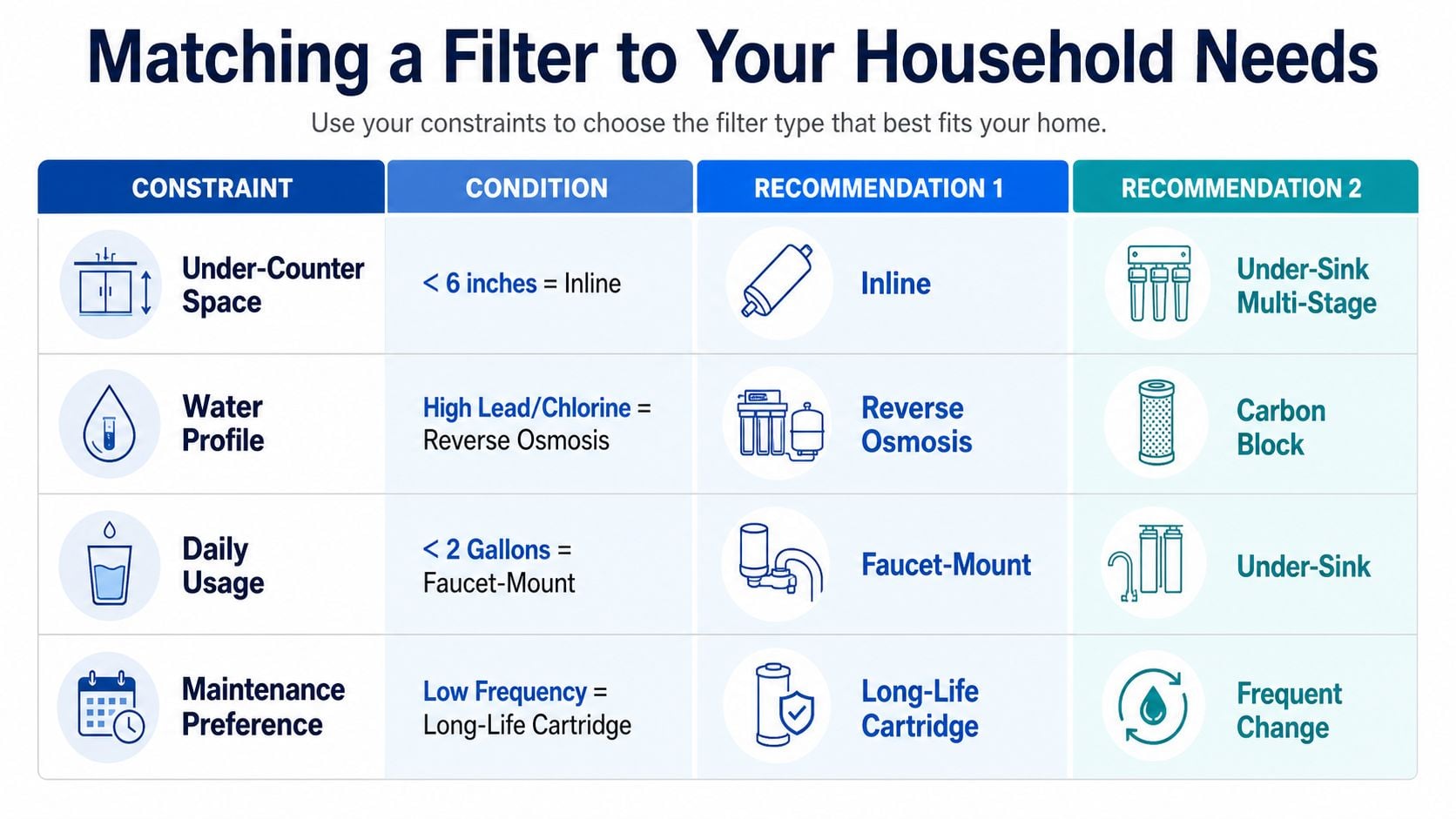
Use this decision logic:
- Limited space or rental restrictions: Start with an inline system that matches the existing connection.
- Sediment or changing well conditions: Consider staged treatment with a pre-filter, but test first.
- Specific lead concern: Require a product-specific NSF/ANSI 53 claim rather than relying on a general “heavy metals” statement.
- PFAS or dissolved contaminants: Compare a certified claim for the exact contaminant against the added drain, tank, and maintenance requirements of RO.
- Taste and mineral preference: Carbon or selective filtration may offer a better fit than a zero-TDS approach.
A filter isn't “good enough” because it removes many contaminants on paper. It's good enough when its certified claims match the water you have, its flow meets your use, and you'll replace the cartridge on schedule.
Selecting the Right System and Cartridge for Your Water
A kitchen filter should address a specific water problem, fit the available cabinet or connection, and match the maintenance you will perform. Start with evidence. Download your utility's Consumer Confidence Report, identify the listed contaminants, and separate aesthetic concerns such as chlorine taste from health concerns such as lead or PFAS. Private-well owners should use independent testing rather than rely on regional assumptions.
Read the product documentation before buying. It should name the contaminant claim, test standard, rated capacity, installation conditions, and replacement requirements. “Reduces impurities” is too vague to support a sound choice. Verify the exact cartridge, housing, fittings, flow direction, and replacement part.
Match the cartridge to the actual concern
For chlorine taste and odor, look for an NSF/ANSI 42 claim. For lead, require NSF/ANSI 53 certification that names lead specifically. Fluoride, arsenic, chromium-6, and PFAS require an exact contaminant claim. NSF/ANSI 58 may apply to these reductions when the certification listing names the contaminant, often directing buyers toward RO or another specifically tested technology.
Woder's Advanced Selective Filtration® is designed around targeted contaminant reduction while retaining essential minerals. Woder Filters is a U.S.-based manufacturer of point-of-use systems. Check any Woder product against your water test and the cartridge's current performance documentation.
| Contaminant concern | Recommended cartridge approach | Compatible systems | Certified reduction |
|---|---|---|---|
| Chlorine taste and odor | Activated carbon or selective media with an NSF/ANSI 42 claim | Inline or under-sink point-of-use systems, subject to manufacturer fit | Use the exact product certification, not a general category claim |
| Lead | Carbon block, ion exchange, or specialized media with NSF/ANSI 53 lead certification | Under-sink or inline systems designed for the cartridge | Confirm that the product's NSF/ANSI 53 claim covers lead specifically |
| PFAS | Carbon, RO, or another technology with a specific PFAS claim | Product-specific, with capacity and flow limits | Do not assume a generic reduction rate. Verify the exact listing |
| Fluoride | RO or another specifically tested selective process | Usually a dedicated under-sink system | NSF/ANSI 58 can cover fluoride when the claim is specifically listed |
| Chromium, including chromium-6 | Media certified for the relevant chromium claim | Depends on the product listing | Confirm whether the certification covers the form of chromium in question |
| Sediment | Sediment pre-filter or carbon block with particulate reduction | Usually staged under-sink systems | Check the product's particulate claim and replacement guidance |
The under-sink water filter cartridge guide explains cartridge fit, replacement, and installation details. Use it to check compatibility rather than treating similar-looking housings as interchangeable.
RO adds a drain line and usually a storage component. A selective or inline cartridge needs less plumbing, but it will not automatically address every dissolved contaminant. Compare the filter's certified claim with your test results, available space, flow needs, and willingness to replace cartridges. Choose the simplest system that solves the identified problem.
Making a Confident Decision for Your Home
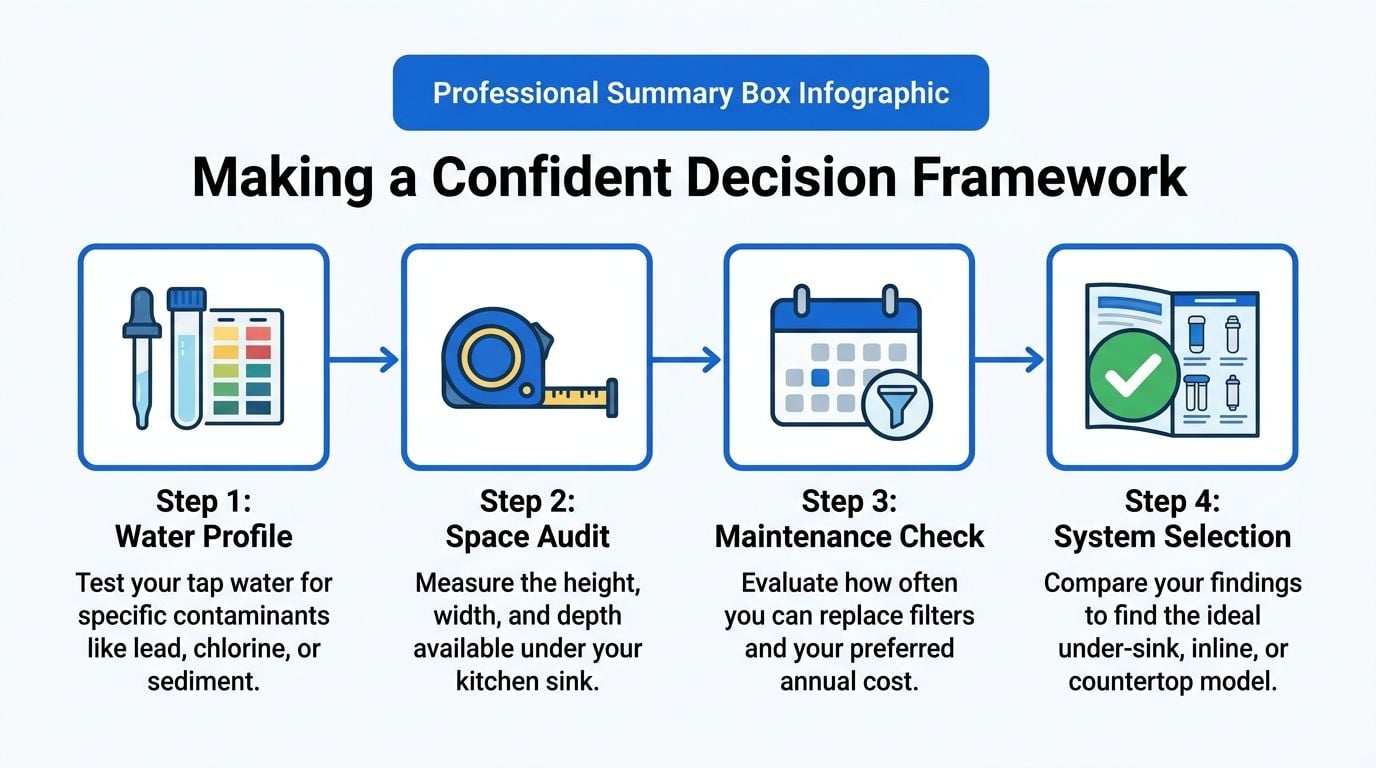
A sound purchase follows four questions:
- What does the water test show? Identify the contaminant, not just the general concern.
- What space is available? Measure the cabinet and inspect shutoffs, tubing paths, and drain access.
- What maintenance will happen? Choose a replacement schedule and system complexity you can sustain.
- Which technology fits the tradeoff? Compare certified reduction, mineral retention, water use, installation, and cost over time.
Three household patterns appear often. A renter or apartment resident may favor a compact inline carbon system that avoids countertop drilling. A homeowner with cabinet room and several treatment needs may prefer an under-sink system with staged media. A household facing a documented dissolved-contaminant concern may accept the tank, drain, wastewater, and maintenance demands of RO because its broader removal profile is necessary.
Selective filtration deserves serious consideration for everyday drinking water. It targets harmful contaminants while retaining essential minerals, rather than treating very low TDS as the only definition of quality. That doesn't make it universal, and it doesn't replace testing. It does make the comparison more honest.
Certification labels also deserve a closer look. The water filter NSF certification guide explains why the standard, contaminant, and product listing matter more than a logo displayed without context.
Take a few minutes to download your water report, measure the cabinet, and write down the maintenance you're realistically prepared to handle. That small audit can prevent a mismatched cartridge, an awkward installation, or a system whose claimed performance doesn't fit your kitchen.
Woder Filters offers U.S.-made point-of-use filtration systems built around Advanced Selective Filtration®, with options designed to reduce targeted contaminants while retaining essential minerals. Visit Woder Filters to compare the available approach with your water profile, space, and maintenance preferences before choosing a sink water purification system.