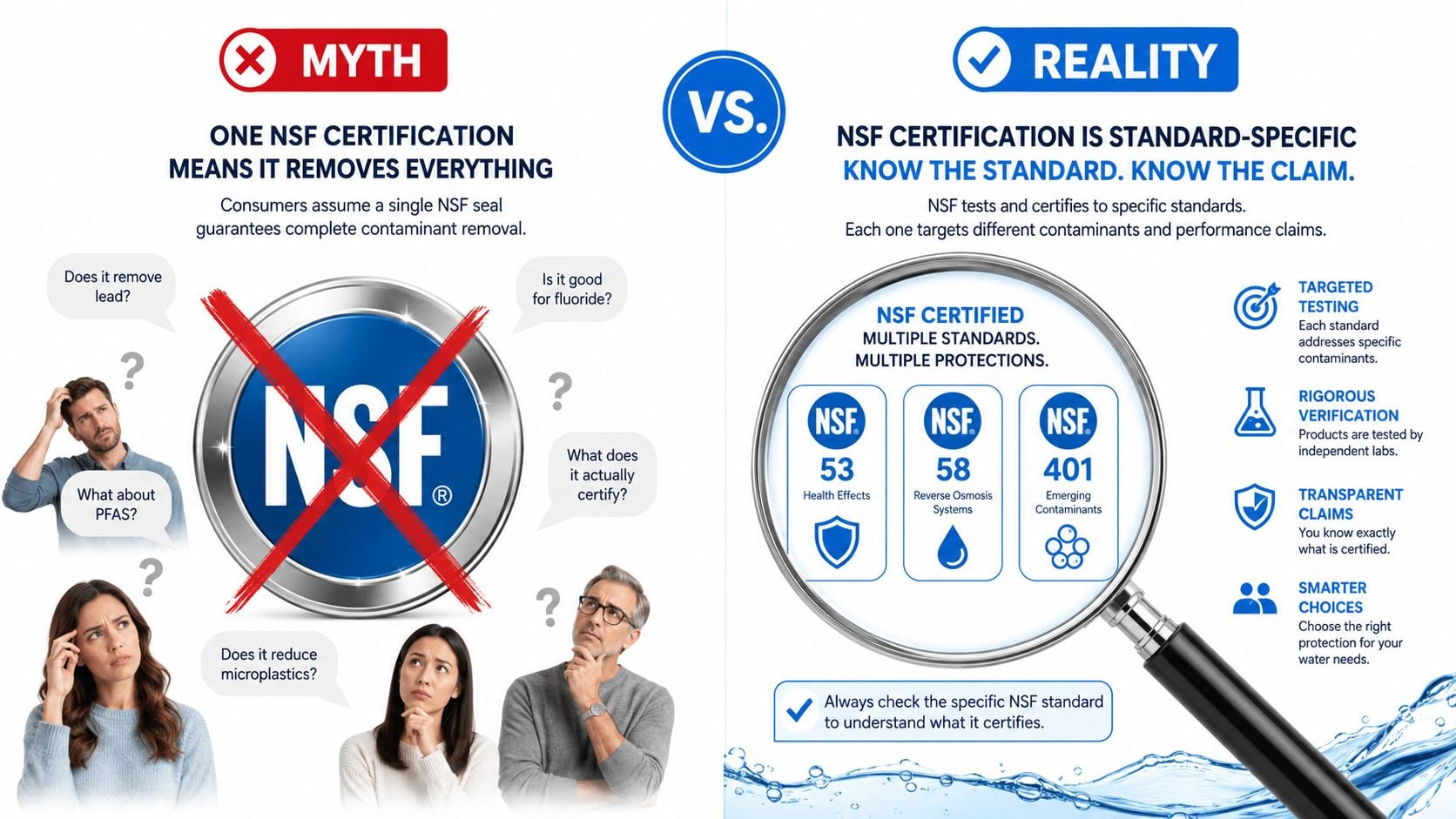
A water filter carrying an NSF certified label isn’t automatically certified to remove every contaminant you care about. NSF certification applies to a specific standard, a specific performance claim, and often a specific model. The number beside the certification mark matters more than the logo itself.
That distinction changes how you should compare filters for PFAS, lead, fluoride, chromium, chlorine, and other substances in municipal or well water. A filter can be independently certified for chlorine taste and odor while having no certified claim for lead or PFAS. The practical question isn’t, “Is this filter NSF certified?” It’s, “Certified to which NSF/ANSI standard, for which contaminant, and under what conditions?”
Table of Contents
- Why the NSF Certified Label Is Not Enough
- Decoding the Core NSF Standards for Home Water Filters
- The Critical Difference Between Lead-Free and Lead Reduction
- What PFAS Certification Covers Today
- How to Verify a Filter’s Real Certification Claims
- Matching Certification to Your Household Water Needs
Why the NSF Certified Label Is Not Enough
NSF certification on a water filter signals one thing: the model meets a specific standard for a defined set of contaminants. The label becomes useful only after you identify the standard number and the performance claim behind it. NSF’s overview of drinking-water treatment standards explains that NSF/ANSI 42 covers aesthetic effects such as chlorine, taste, and odor, while NSF/ANSI 53 addresses specified health-related contaminant reduction and NSF/ANSI 401 covers selected emerging compounds. NSF’s overview of drinking-water treatment standards shows why the number defines the claim.
A filter certified under NSF/ANSI 42 may have validated performance for chlorine taste or odor without a certified claim for lead. The certification can be legitimate while the shopper’s interpretation is wrong. A certification is a tested promise about a defined function, not a universal declaration that the water is free from every possible contaminant.
The number is the meaningful part
Read the full wording on the box, performance data sheet, or manufacturer listing:
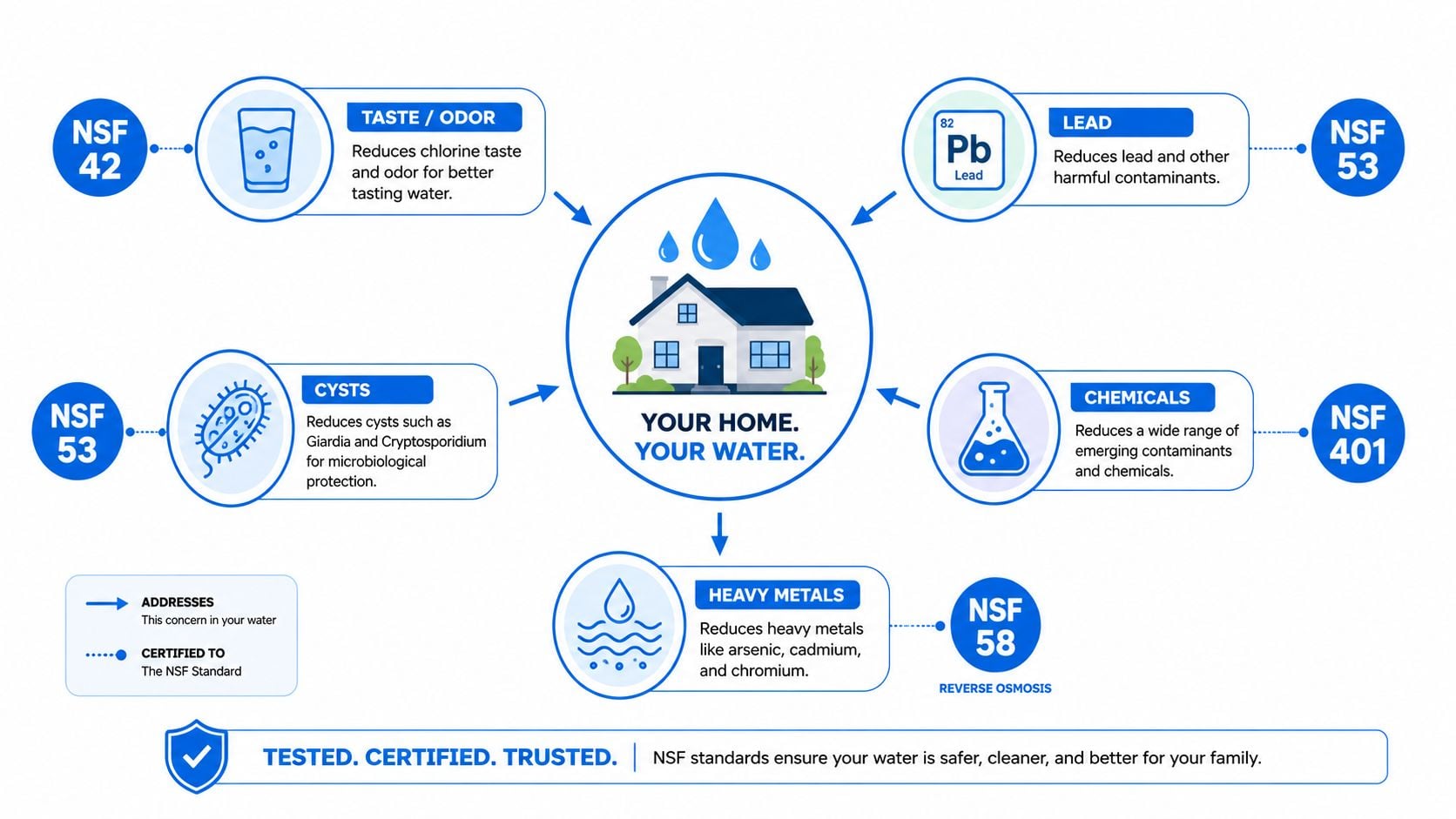
- NSF/ANSI 42 generally points to taste, odor, chlorine, and other aesthetic effects.
- NSF/ANSI 53 points to specified health-related contaminants, such as lead, when that contaminant appears in the certified claim.
- NSF/ANSI 58 applies to reverse-osmosis systems and their defined reduction claims.
- NSF/ANSI 401 addresses selected emerging compounds.
The standards portfolio also includes 42, 53, 58, 62, 177, and NSF P473. A plain-language standards guide explains why “NSF certified” alone leaves important questions unanswered.
Practical rule: Treat the NSF logo as the beginning of your research. Treat the standard number and contaminant listing as the actual evidence.
Manufacturers may give the seal more attention than the limited scope of the certification. Check the exact contaminant claim before comparing capacity, installation style, or price. For terminology covering certification organizations and water-quality standards, see WQA, NSF, and ANSI water-quality terms.
Decoding the Core NSF Standards for Home Water Filters
Each NSF standard targets a distinct category of concern. Matching the standard to your household’s water issue helps turn a broad label into a practical shopping filter.
NSF/ANSI 42: taste, odor, and chlorine
Choose NSF/ANSI 42 when municipal water has a swimming-pool smell, an unpleasant flavor, or visible particulate concerns. The standard evaluates aesthetic effects, so it can support claims about chlorine, taste, odor, and some particles. A 42 claim does not establish reduction of lead, PFAS, fluoride, or other health-related contaminants.
NSF/ANSI 53: named health contaminants
NSF/ANSI 53 applies when a filter makes a performance claim for a specified health-related contaminant. Lead is one example, but the contaminant must appear in the product’s certified listing or performance data. A 53 certification does not create a blanket claim for every contaminant associated with the standard.
NSF/ANSI 58: reverse-osmosis systems
For a homeowner comparing reverse-osmosis equipment, NSF/ANSI 58 is the relevant standard to examine. Certified RO systems may list reductions for dissolved substances such as fluoride, lead, and chromium-related contaminants. The listed claim remains the deciding detail, because two NSF 58 systems may address different substances.
NSF/ANSI 401: selected emerging compounds
NSF/ANSI 401 covers selected emerging compounds, including some pharmaceuticals, herbicides, and other chemical compounds. It can matter when the concern involves substances outside the familiar taste, odor, and traditional health-contaminant categories.
| Standard | Choose it when… | Examples listed in certified claims | Typical filter types |
|---|---|---|---|
| NSF/ANSI 42 | Chlorine taste, odor, or particulate concerns affect drinking water | Chlorine, taste, odor, particulates | Carbon and other point-of-use or point-of-entry filters |
| NSF/ANSI 53 | You need a named health-contaminant reduction claim | Lead and other specified health contaminants | Carbon, specialty media, and other certified systems |
| NSF/ANSI 58 | You are evaluating a reverse-osmosis system for dissolved substances | Fluoride, lead, chromium-related contaminants, and other named substances | Reverse-osmosis systems |
| NSF/ANSI 401 | Your concern involves selected emerging compounds | Pharmaceuticals, herbicides, and other specified chemical compounds | Advanced carbon and other systems with specific claims |
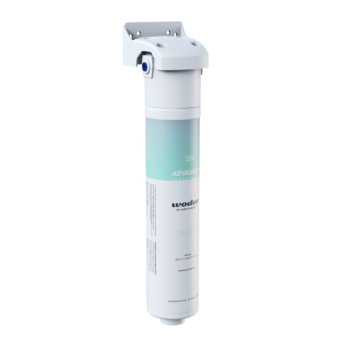
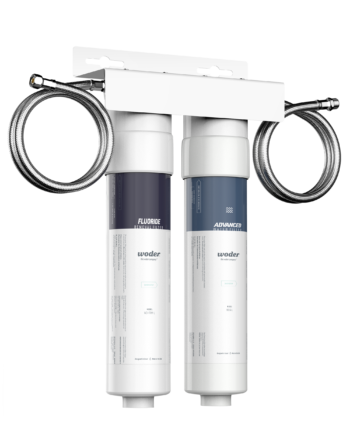
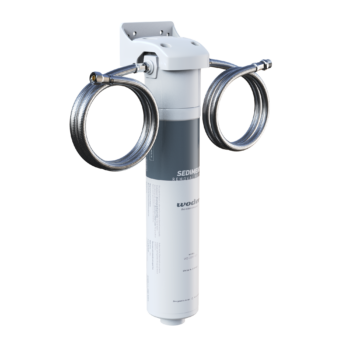
Filter technology provides useful context, but the certification claim remains contaminant-specific. Woder’s WD-G4-DC Lead, Chlorine, HM and PFAS Water Filter uses Advanced Selective Filtration® and retains essential minerals. Its WD-G4-REP filters are certified by WQA to NSF/ANSI 42 for chlorine taste and odor and NSF/ANSI 372 for lead-free compliance, as substantiated by test data.
Write down the water concern first. Then look for the matching standard plus contaminant claim. That sequence keeps a familiar logo from standing in for evidence about what the cartridge removes.
The Critical Difference Between Lead-Free and Lead Reduction
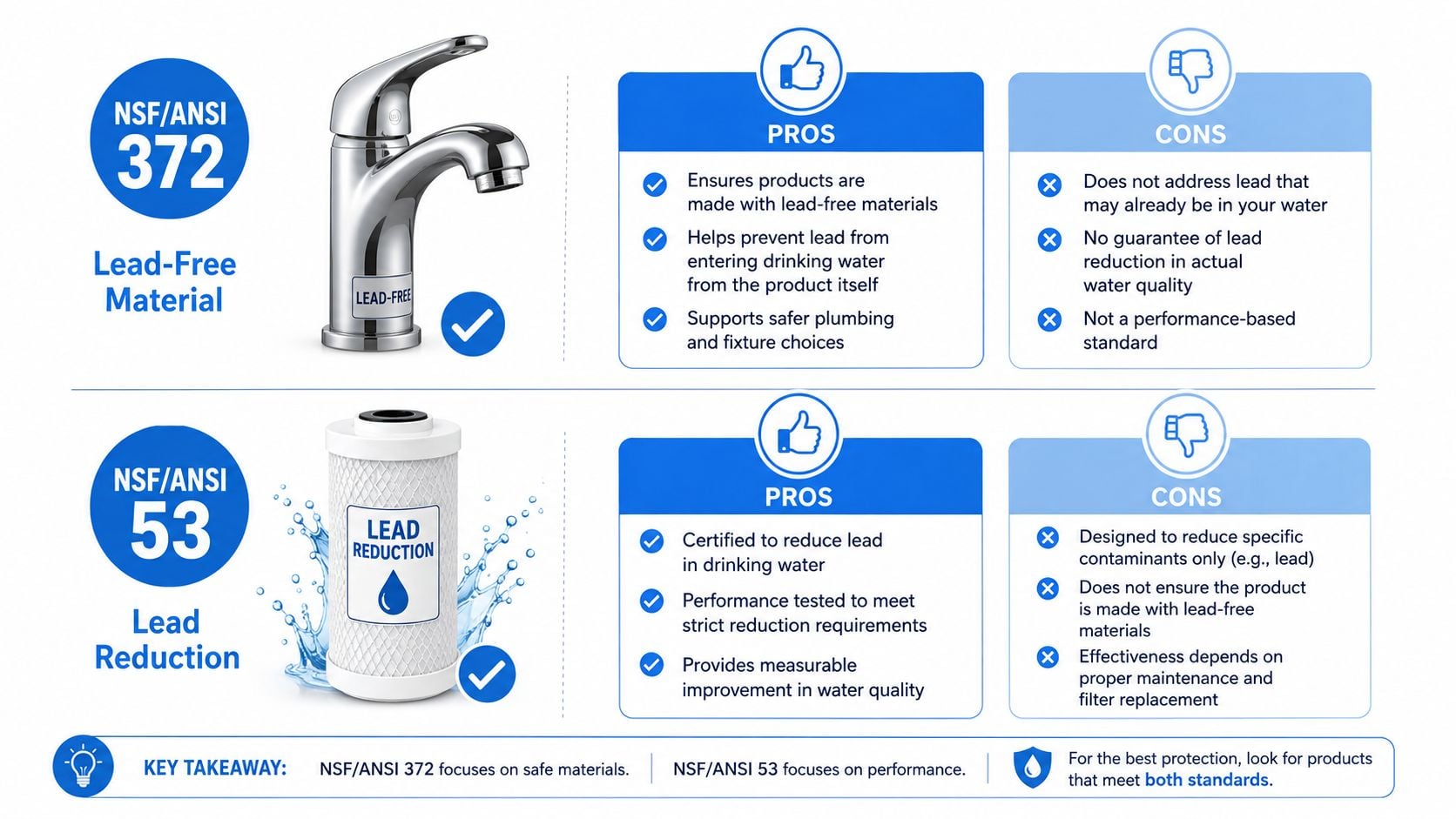
“Lead-free” and “lead reduction” describe different things. NSF/ANSI 372 concerns the lead content of product materials, while NSF/ANSI 53 evaluates whether a drinking-water treatment unit reduces a named contaminant, including lead. NSF’s lead-reduction listings distinguish these categories, and they shouldn’t be treated as synonyms. NSF’s lead-reduction certification listings are the appropriate reference for checking the performance claim.
A filter certified for lead-free materials has components that meet lead-content requirements. That’s important because water should not pick up lead from the filter itself. But the certification doesn’t prove that the cartridge removes dissolved lead already present in incoming water.
Lead reduction requires a performance claim under the relevant standard. The U.S. EPA’s National Primary Drinking Water Regulations use a lead action level of 0.15 mg/L, or 15 ppb, as a public-water compliance benchmark. NSF’s drinking-water treatment reference provides context for the standard and the role of certified treatment units.
Why both claims can matter
Under-sink systems, inline filters, and other point-of-use devices put drinking water in contact with housings, fittings, seals, and filter media. A responsible evaluation therefore has two separate questions:
- Are the materials suitable for contact with drinking water?
- Does the treatment system reduce the lead already in the water?
The first question relates to material safety. The second relates to filtration performance. One certificate cannot answer both unless the product documentation shows both applicable claims.
Marketing language can create confusion by placing “lead-free” in a prominent position without making a lead-reduction claim equally clear. That wording may be accurate, but it can lead shoppers to infer protection the certification doesn’t establish.
Read the claim literally: “Lead-free” describes the product. “Lead reduction” describes what the product does to contaminated water.
For a household with an older service line, aging plumbing, or a known lead concern, check the exact model, the NSF/ANSI 53 lead claim, the NSF/ANSI 372 material claim, and the replacement requirements. Woder’s educational resource on an under-sink water filter for lead can help clarify the distinction before you choose a system.
What PFAS Certification Covers Today
PFAS certification under NSF/ANSI 53 or NSF/ANSI 58 is narrower than the phrase “PFAS certified” implies. Current claims depend on the tested compounds and the specific claim listed for that product. NSF says a filter making a PFAS reduction claim must reduce PFAS to below 20 parts per trillion. NSF’s contaminant-reduction claims guide directs consumers to its certified-product database for individual claims, including PFOA and PFOS.
NSF’s consumer guidance describes how these certifications developed. The earlier PFAS-focused protocol, NSF P473, was followed by PFAS claims under standards such as NSF/ANSI 53 and 58. The standards added more PFAS compounds and lowered the combined PFAS claim threshold from 70 ppt to 20 ppt. NSF’s PFAS drinking-water guidance identifies a further limitation: existing PFAS certification standards do not yet show whether a filter will reduce PFAS to the newer EPA drinking-water standard.
The practical meaning is precise. A filter certified for a named PFAS claim has been evaluated for that claim under specified test conditions. That certification does not establish removal of every PFAS compound or compliance with every regulatory target.
| PFAS Compound | Commonly Certified Under NSF 53/58 | Typical Detection in Municipal Water | Current EPA Health Advisory Level |
|---|---|---|---|
| PFOA | May be included in a listed PFAS claim | Varies by location and source | Use the applicable current federal or state guidance for interpretation |
| PFOS | May be included in a listed PFAS claim | Varies by location and source | Use the applicable current federal or state guidance for interpretation |
| PFAS compounds beyond the named claim | Not automatically included | Varies by location and source | Check the current guidance for the specific compound |
The table’s qualitative fields are intentional. A national average can’t tell you what’s at your tap, while a brand name cannot show which PFAS compounds a cartridge has been tested to reduce.
Questions worth asking before purchase
Check the exact model listing and ask:
- Which PFAS compounds are named?
- Is the claim for PFOA, PFOS, or a broader Total PFAS category?
- What influent and effluent conditions appear in the performance documentation?
- Does the claim match contaminants identified in your utility report or private-water test?
For practical guidance on choosing a system, Woder’s guide to a PFAS removal water filter is a useful starting point. Treat certification as specific technical evidence, then compare that evidence with the compounds and water conditions relevant to your home.
How to Verify a Filter’s Real Certification Claims
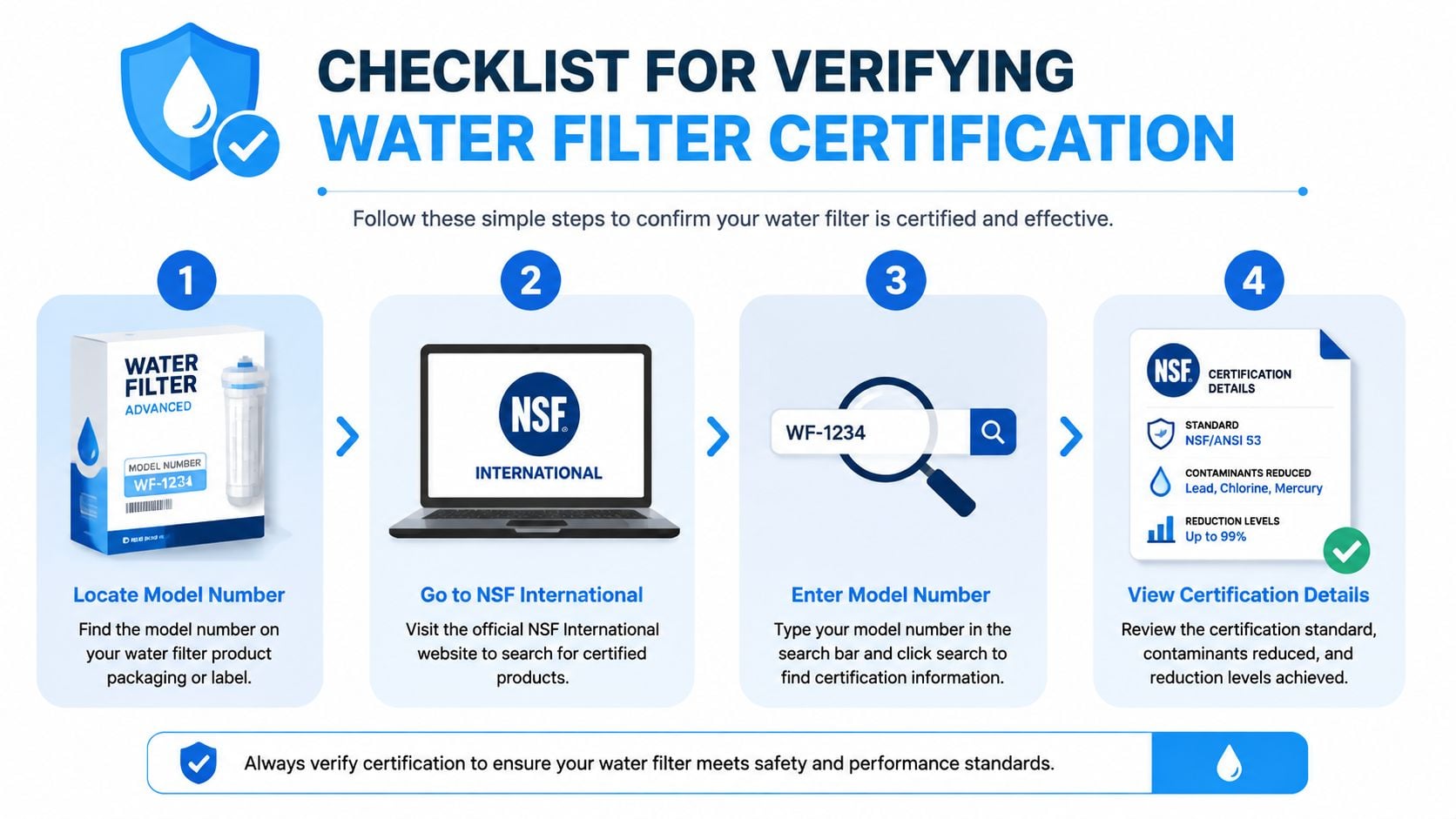
You don’t have to rely on packaging alone. NSF maintains a consumer database of certified products and systems, and its listings can be checked for the model and contaminant claims that matter to you.
Start with the exact product identity
Find the manufacturer name and complete model number on the cartridge, housing, box, installation manual, or performance data sheet. A product family name may not be enough. Different cartridges, revisions, or system configurations can have different listings.
Search the model in NSF’s database, then inspect the entry rather than stopping at the search result. Confirm:
- The manufacturer matches the product in your hands.
- The exact model number appears.
- The applicable standard numbers are listed.
- The contaminants are named under those standards.
- The certification status is current.
- The claim applies to the filter or complete system you intend to use.
Compare the listing with the product documents
The database entry should agree with the package, manual, and manufacturer website. If the package highlights PFAS but the listing shows only a chlorine claim, pause before buying. If a housing is certified for material safety but the complete filtration system has no contaminant-reduction listing, don’t treat the housing certification as proof of treatment performance.
Phrases such as “tested to NSF standards” also need careful reading. Testing to a standard isn’t the same as third-party certification, which involves independent evaluation and continuing oversight. The exact wording, certifier, standard, and model all matter.
Finally, read the operating conditions. Capacity limits, flow requirements, cartridge replacement intervals, and installation instructions affect whether the certified performance applies in your home. A filter used beyond its rated conditions may no longer deliver the performance the listing evaluated.
Before checkout: Match the exact model, standard number, named contaminant, certification status, and operating instructions. If one piece is missing, keep researching.
Matching Certification to Your Household Water Needs
The right filter begins with the water issue, not the seal. A municipal customer can start with the utility’s consumer confidence report, while a private-well owner may need water testing because well conditions can vary by property. Either way, identify the actual concern before choosing a technology.
Use this practical mapping:
- Chlorine taste or odor: Look for NSF/ANSI 42 and a specific chlorine claim.
- Lead from plumbing: Look for NSF/ANSI 53 lead reduction, then separately check NSF/ANSI 372 for lead-free materials.
- PFAS: Look for a named PFAS claim under NSF/ANSI 53 or 58, and verify which compounds are included.
- Fluoride or dissolved contaminants: NSF/ANSI 58 is the established certified route for reverse-osmosis systems.
- Selected pharmaceuticals or herbicides: Check NSF/ANSI 401 and its listed compounds.
- Chromium or other heavy metals: Confirm the exact contaminant claim and the standard under which it was tested.
Water source changes the priority. Municipal water has treatment and distribution controls, but plumbing can still affect what reaches the tap. Well water doesn’t pass through the same public-system framework, so testing and treatment selection deserve particular attention. A household with infants or immunocompromised residents may also choose to discuss test results and treatment decisions with an appropriate health professional.
Technology involves trade-offs
Activated carbon and selective media can target particular contaminants while preserving minerals, but their claims depend on media design, contact time, flow, and replacement. Reverse osmosis can provide broad dissolved-solids reduction and is the established certified route for fluoride, though it also strips dissolved minerals and brings additional maintenance and water-use considerations.
A zero-TDS reading isn’t proof of “pure” drinking water. TDS measures dissolved solids collectively, good and bad alike, so a zero reading indicates that minerals have been removed along with unwanted substances. RO systems can achieve very low TDS, but that result alone doesn’t identify which contaminants were reduced or whether the trade-off suits your household.
For a neutral overview of technology trade-offs, including filtration cost and contaminant removal considerations, review this cost and contaminant removal guide.
A sensible process is simple: review your water report or test results, identify your top three concerns, and search only for filters with matching, verifiable claims. Woder Filters offers U.S.-made point-of-use systems using Advanced Selective Filtration®, designed to reduce listed contaminants while retaining essential minerals, with each cartridge backed by a one-year guarantee. Visit Woder Filters to compare the relevant certification language and find a system that fits your water, fixture, and household needs.