A BPA-free label doesn’t mean the water in a bottle, pitcher, filter housing, or cap is free from every chemical concern. It makes a narrower statement about one material ingredient, and that distinction matters because chemicals can migrate from plastic under real-use conditions, while the water itself may contain contaminants unrelated to the container.
For homeowners researching BPA free water, the better question isn’t just whether a product carries the label. It’s what material touches the water, how the product is used, whether the manufacturer supports its claim with migration testing, and whether the water needs treatment for broader contaminants such as PFAS, lead, fluoride, chromium, or chlorine.
Table of Contents
- Why BPA Free Does Not Mean Chemical Free
- How Temperature and Materials Drive Chemical Migration
- Reading Container Labels and Recycling Codes Correctly
- Bottled Water Safety Claims Versus Actual Testing Results
- Connecting BPA Concerns to Broader Water Quality Issues
- Making Informed Choices for Your Household Water
Why BPA Free Does Not Mean Chemical Free
The most popular advice is also the least complete: look for “BPA-free,” and the water is safe from plastic chemicals. BPA-free is a narrow ingredient claim, not a universal purity certification. It doesn’t promise that a product contains no other bisphenols, plasticizers, stabilizers, additives, or contaminants that may enter water during use.
Public concern about bisphenol A, or BPA, grew sharply in the 2000s. A 2008 Harvard study found that participants’ urinary BPA concentrations increased significantly after drinking from polycarbonate bottles, helping drive the shift toward BPA-free labeling in bottles and similar drinkware. You can review the study background in Harvard Medical School’s report on chemicals leaching from water bottles.
Earlier work had already measured BPA migration from reusable plastic water bottles at 0.20 to 0.79 nanograms per hour. That finding matters because it showed that routine contact with water could release measurable BPA into the contents, even without an unusual accident or visibly damaged bottle.
The substitute problem
Manufacturers responded to consumer demand by removing BPA from many products. Some replaced it with related bisphenols, including BPS. A product can therefore meet a BPA-free specification while still using a different chemical in the resin, lining, cap, or another component that touches the water.
A controlled study of reusable plastic drinking bottles labeled BPA-free detected BPA in all bottle migrates, reaching up to 0.047 micrograms per liter, while BPS reached up to 0.043 micrograms per liter in the tested products, as reported in the peer-reviewed PubMed study on bisphenol migration from BPA-free bottles. Those results don’t mean every BPA-free bottle behaves identically. They do show why the label shouldn’t be treated as proof of zero bisphenol migration.
Practical rule: Read “BPA-free” as “this product is marketed without intentionally using BPA,” not as “nothing can migrate into the water.”
That distinction is similar to the difference between filtered and purified water. Filtered water and purified water describe different treatment outcomes, just as BPA-free and chemical-free describe very different claims. The material, temperature, contact time, and complete water pathway all matter.
How Temperature and Materials Drive Chemical Migration
Heat changes the migration equation. Chemicals move more readily from some polymers into water when the container is heated, exposed to hot contents, or subjected to repeated high-temperature washing. A bottle left in a hot car and a bottle stored at room temperature may look identical, but they haven’t experienced the same material conditions.
A peer-reviewed study of polycarbonate bottles found BPA migration into water of 228 to 521 micrograms per liter after heating at 70°C for six days, with average migration rates of 1.84 to 4.83 nanograms per square centimeter per hour. The results are documented in the study of BPA migration from polycarbonate bottles.
The same study reported no detectable BPA contamination during room-temperature storage in lower-risk materials such as co-polyester plastic or uncoated stainless steel. That contrast points to two variables working together: polymer chemistry and thermal stress.
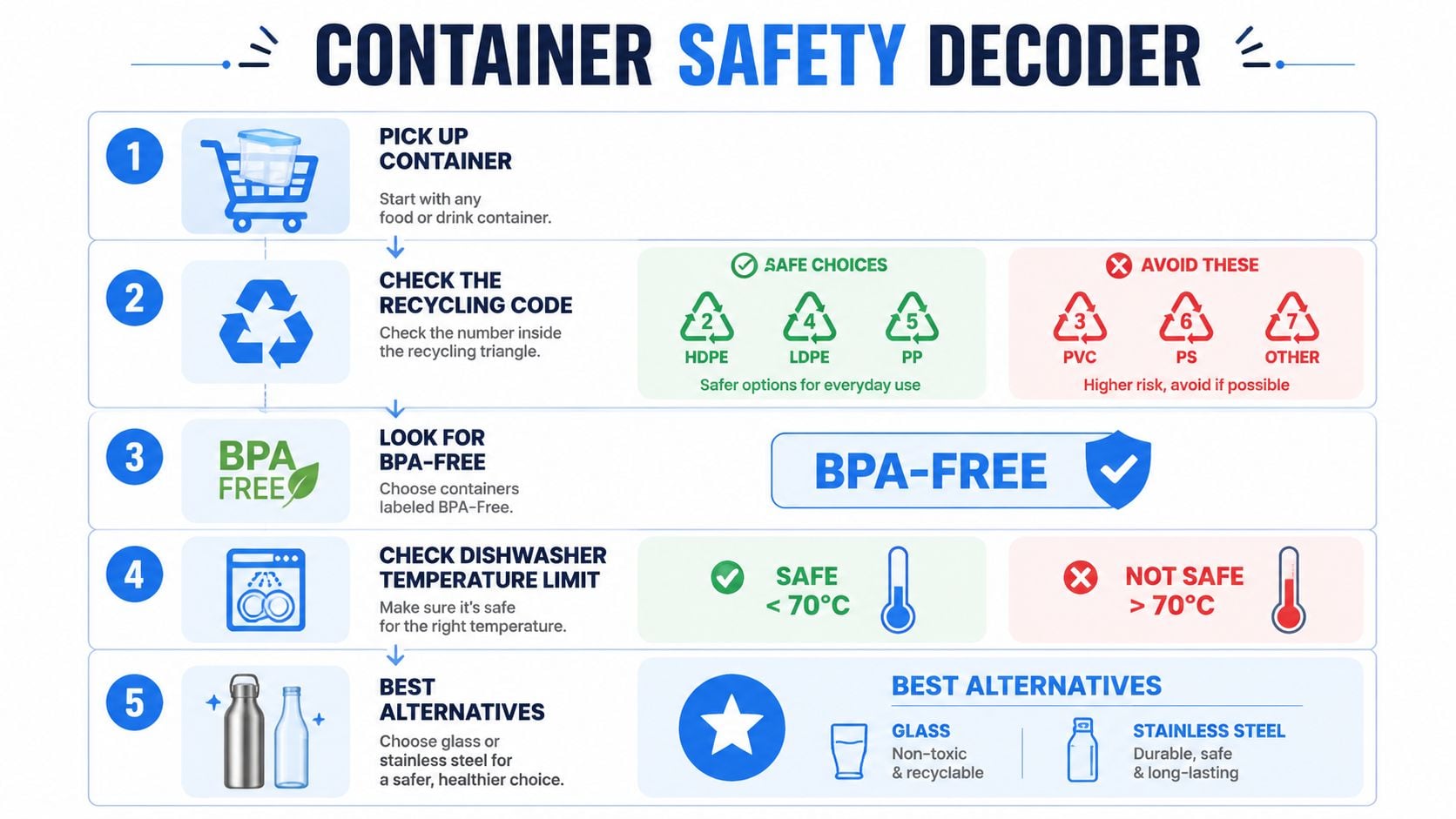
How everyday use changes the exposure pathway
A container doesn’t have to be visibly damaged to deserve careful handling. Heat, long storage, repeated washing, and contact with the lid assembly can all change which materials touch the water and for how long.
- Hot storage: Don’t use a plastic bottle for hot water unless the manufacturer specifically designs it for that use.
- Dishwasher cycles: Follow the product’s temperature and dishwasher instructions. Repeated heat can place more stress on some plastics than cool hand washing.
- Long contact times: Water stored for extended periods has more time to interact with the container, cap, gasket, or straw.
- Component contact: The bottle body may be stainless steel while the cap liner, straw, or gasket uses a separate polymer.
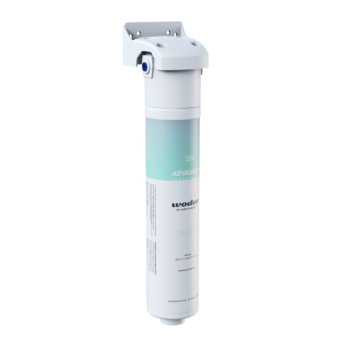
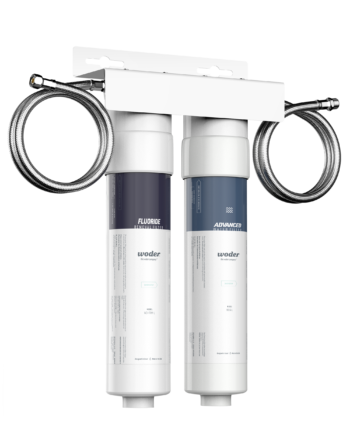
Material choice also matters in filtration equipment. A household evaluating heavy-metal concerns may consider the Woder Heavy Metals and Advanced Filtration System, which combines Woder’s Advanced filtration formula with additional heavy-metals and lead-removal media and is described as a US-made water filter. The housing and water-contact components still deserve the same attention as any other drinking-water product.
Taste can provide a useful warning about plumbing or materials, but it can’t identify every contaminant. A metallic taste may have several possible causes, so homeowners should avoid treating taste alone as a complete water-quality test. The discussion of metallic-tasting water, pipes, and health offers useful context for separating sensory clues from verified testing.
Reading Container Labels and Recycling Codes Correctly
Start with the part of the product that contacts water. That may include the bottle body, interior coating, cap liner, straw, valve, gasket, filter housing, adhesive, or tubing. A manufacturer can describe the main bottle material accurately while providing little information about the smaller components that remain in contact with water every day.
The FDA says a plastic container marked with recycling code 7 may be made of a BPA-containing plastic, so a BPA-free claim is more specific than looking for a resin code. The FDA also explains that BPA labeling concerns the material used, not a universal safety certification or a guarantee that substitute chemicals aren’t present. Its consumer guidance on BPA in food-contact applications is a useful primary source.
A practical label check
Use the product information as a set of questions rather than a single pass or fail sticker.
- Identify the main material. Glass, uncoated stainless steel, and some co-polyester products may behave differently from polycarbonate under heat.
- Check every water-contact component. Look for details about caps, liners, straws, gaskets, and filter housings.
- Read temperature instructions. A BPA-free label doesn’t make a container suitable for boiling water or high-temperature cleaning.
- Look for test details. Independent migration testing is more informative when the product faces heat, repeated washing, or prolonged storage.
- Separate claims from certifications. A material claim and a performance certification answer different questions.
The same logic applies to water filters. A system may claim to reduce a contaminant, comply with a material standard, or carry an independent certification, but those statements shouldn’t be blended together. The explanation of WQA, NSF, and ANSI water-quality terminology can help decode those labels.
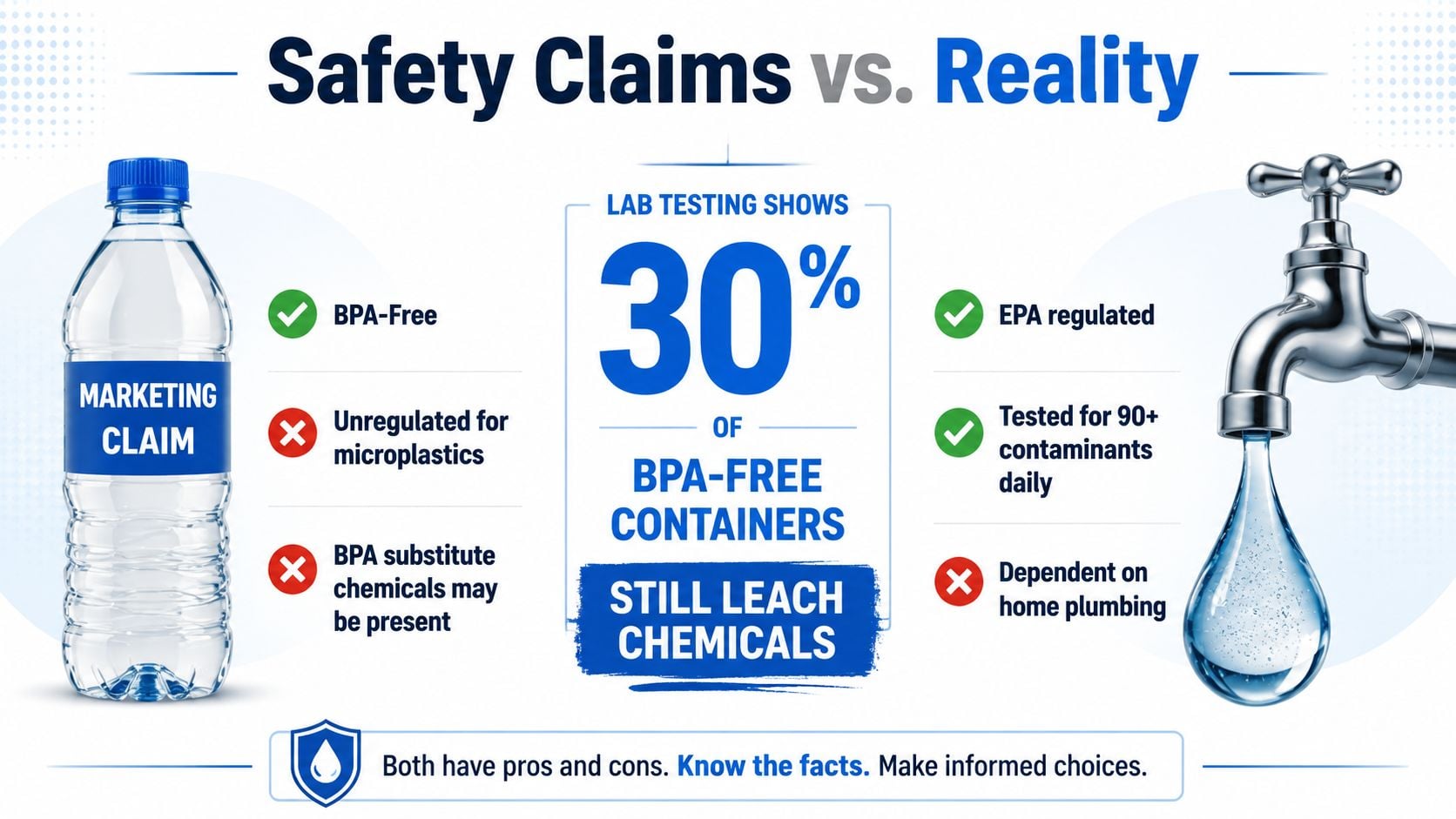
For families comparing bottles, a plain-language bottle chemical safety guide can help organize the questions around plastics and component materials. The important habit is to inspect the complete water-contact pathway, not just the largest printed claim on the package.
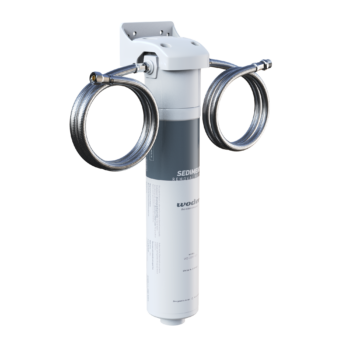
For under-sink use, the Woder WD-G4-DC Lead, Chlorine, HM and PFAS Water Filter uses Advanced Selective Filtration, retains essential minerals, and is a US-made water filter. Woder states that its WD-G4-REP advanced filters are certified by WQA to NSF/ANSI 42 for chlorine taste and odor and NSF/ANSI 372 for lead-free compliance, as verified and substantiated by test data.
Bottled Water Safety Claims Versus Actual Testing Results
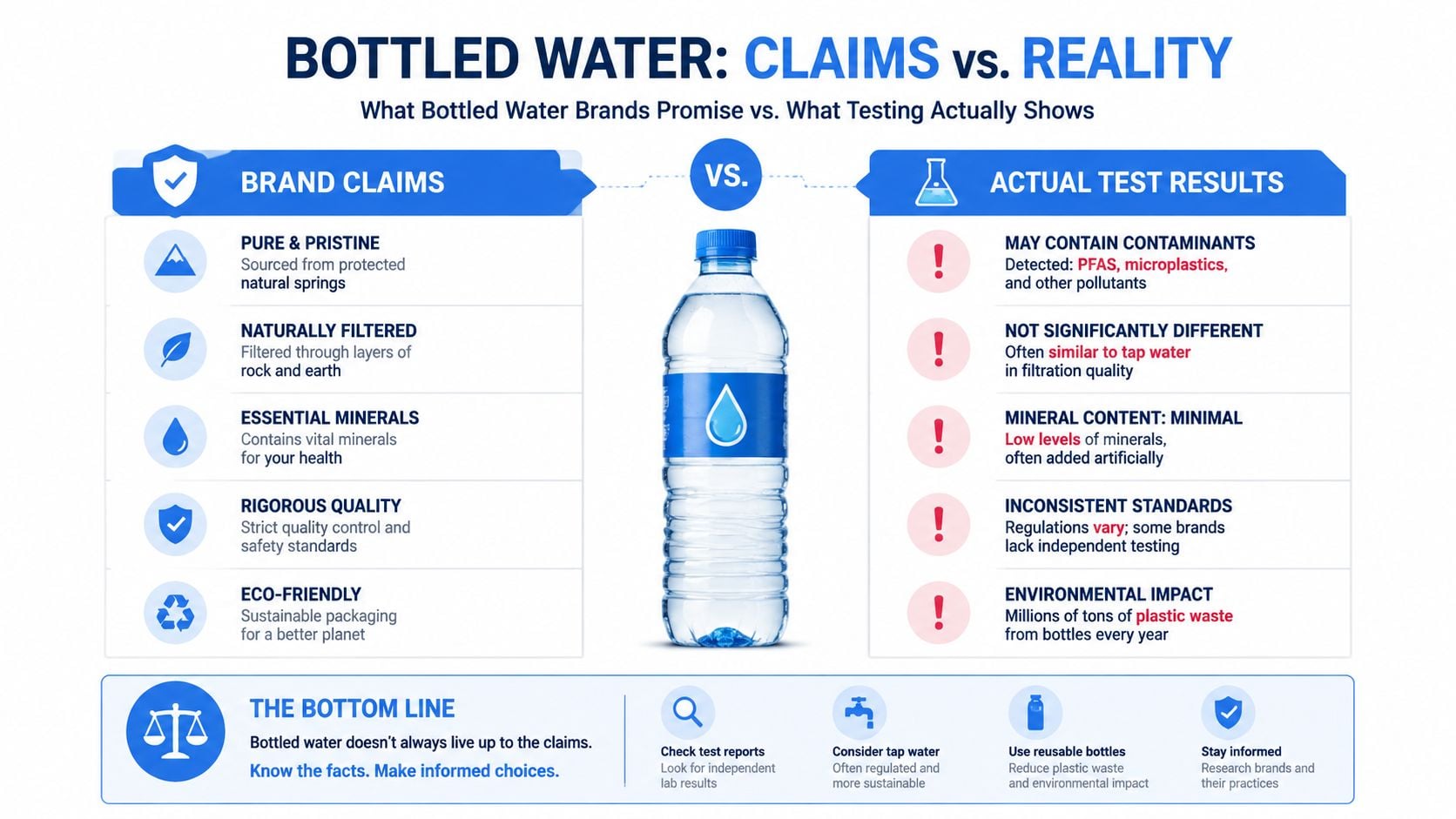
A BPA-free bottle label tells you about the packaging claim. It doesn’t tell you that the water inside is free from PFAS or other contaminants. That’s why the bottled-water question can’t be answered by comparing package labels alone.
Consumer Reports found PFAS in several bottled-water products and reported that 39 of more than 100 tested bottled waters contained PFAS in a peer-reviewed study, as described in its report on PFAS in bottled water. FDA testing in April 2025 also found detectable PFAS in 10 bottled-water samples. These findings don’t establish that every bottled-water product has the same result, but they do challenge the assumption that bottled automatically means cleaner for every contaminant category.
Two separate questions often get mixed together
When a homeowner asks whether bottled water is safer, they may be asking about several different things:
| Question | What the package label can tell you | What it can't establish |
|---|---|---|
| Is BPA intentionally used in the bottle? | A BPA-free claim addresses that specific ingredient | It doesn't address every substitute chemical |
| Is the water free from PFAS? | Usually nothing conclusive | Only testing or validated treatment can answer that |
| Are the cap and liner low-migration materials? | Sometimes, if the manufacturer provides details | A bottle-body claim may not cover every component |
| Is tap water a better everyday option? | The label can't compare sources | Water reports, testing, and treatment determine the answer |
BPA-free packaging and PFAS-free water are different goals. A product can address one while leaving the other unanswered, and the reverse can also be true. The most direct way to reduce exposure is to identify the contaminant in question and choose a treatment process tested for that contaminant, rather than relying on a broad impression created by package design.
For many households, point-of-use filtration can offer a more consistent way to manage drinking and cooking water at the kitchen tap. It also lets the homeowner evaluate the incoming water and the filter’s documented performance separately, instead of assuming that a sealed container resolves every water-quality concern.
Connecting BPA Concerns to Broader Water Quality Issues
BPA is only one part of a household water decision. If the goal is safer drinking water, a bottle label can’t answer whether the tap supply contains PFAS, lead, fluoride, chromium, chlorine, or another contaminant that enters before the water ever reaches the container.
PFAS illustrates the scale of the issue. EPA regulations set enforceable limits for five PFAS chemicals individually, including PFOA, PFOS, PFNA, PFHxS, and HFPO-DA. The final maximum contaminant levels are 4.0 parts per trillion for PFOA, 4.0 parts per trillion for PFOS, and 10 parts per trillion each for PFNA, PFHxS, and HFPO-DA, according to the EPA’s national primary drinking-water regulations.
Why a single-chemical mindset falls short
Homeowners often begin with one visible concern, such as BPA in a bottle. The more useful approach is to map the entire path:
- Source water: Municipal and well supplies can have different contaminant profiles.
- Treatment and distribution: Utilities treat public water, but pipes and building plumbing can affect water before it reaches the faucet.
- Fixture and container materials: Caps, liners, tubing, and bottles add another possible contact point.
- Use conditions: Heat, storage time, and repeated cleaning can influence migration.
Chromium adds another layer of confusion. EPA’s national drinking-water standard for total chromium is 0.1 milligrams per liter, or 100 parts per billion, and that standard includes all forms of chromium, including chromium-6, as explained in the EPA information summarized by The Cary Company’s discussion of BPA-free bottles and water concerns. A homeowner choosing treatment should look at measured water results and verified filter performance, rather than assuming that a product designed for one form of chromium covers every situation.
Woder’s Advanced Selective Filtration® is designed to target contaminants such as PFAS, lead, heavy metals, fluoride, chromium, and chlorine while retaining essential minerals. That differs from reverse osmosis, which can produce very low-TDS water by removing dissolved solids broadly, including minerals. A zero-TDS reading therefore isn’t proof that water is “pure” in a meaningful health sense. It indicates that dissolved solids, beneficial and undesirable alike, have been stripped out.
Making Informed Choices for Your Household Water
Begin with the water, not the marketing. Read your utility’s Consumer Confidence Report if you receive municipal water, and consider laboratory testing when you use a private well or need a more specific contaminant profile. A report tells you about the supply, while testing at the point of use can help reveal what changes between the source and your kitchen faucet.
For containers, choose materials and designs that limit unnecessary exposure to heat and prolonged contact. Glass and uncoated stainless steel are practical options for many households, while any plastic product deserves careful attention to its resin, temperature instructions, cap assembly, and cleaning method. If you’re comparing metal bottles, this guide to titanium versus stainless steel water bottles provides a useful material-focused comparison.
A filter decision should answer four questions
- What’s in the water? Match treatment to a verified contaminant profile rather than a general promise.
- Where do you need treatment? An under-sink filter suits drinking and cooking at one faucet, while an inline system may fit a refrigerator or ice maker.
- What does the system retain? Woder’s Advanced Selective Filtration is intended to remove targeted contaminants while leaving essential minerals in the water.
- What evidence supports the claim? Look for relevant independent testing or certifications, including WQA Gold Seal where applicable, and confirm that the certification covers the performance claim you care about.
Reverse osmosis remains a legitimate option for homeowners who want broad dissolved-solids reduction and very low TDS. Its tradeoffs include mineral removal, more maintenance, and water waste during filtration. Woder Filters offers US-manufactured point-of-use systems built for U.S. building-code compliance, with a one-year cartridge guarantee. The choice should follow your water test, plumbing setup, desired mineral profile, and willingness to manage maintenance.
Your water decision is yours, and understanding the difference between a narrow BPA-free claim and targeted filtration makes that decision clearer.
Visit Woder Filters to review US-made point-of-use filtration options that target contaminants such as PFAS, lead, heavy metals, fluoride, chromium, and chlorine while retaining essential minerals. Use your water report or lab results to identify the system that fits your household, then choose a filtration approach based on evidence rather than a bottle sticker.