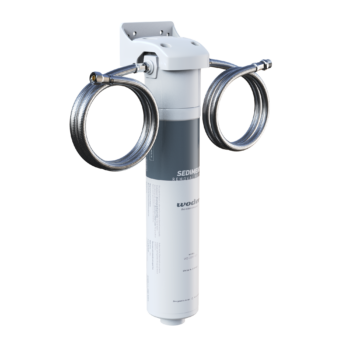
You've just moved into an apartment, filled a glass at the kitchen tap, and started wondering what the filter from your last place can remove. A pitcher might be simple, but it takes refrigerator space. An under-sink system keeps the counter clear, but connecting it to the cold-water line may conflict with your lease. An older cabinet may also leave barely enough room to install and service a cartridge.
A renter friendly water filter has to do more than avoid drilling. It needs to fit the fixture, work within the lease, leave the plumbing intact, and come with you when you move.
Table of Contents
- Why Renters Need a Different Approach to Filtered Water
- Choosing a Renter Friendly Filter Without Drilling or Damage
- How to Make Any Filter Lease Safe Before You Buy
- Installing and Removing Your Filter With No Damage
- What Cleaner Water Actually Means for Renters on Tap Water
- Keeping Your Portable Filter Ready for Your Next Move
Why Renters Need a Different Approach to Filtered Water
Renters and homeowners face different filtration decisions. A homeowner can approve a dedicated faucet, modify cabinetry, or install whole-home equipment. A renter usually needs a point-of-use system that connects temporarily, occupies little space, and can be removed without leaving evidence that it was ever there.
That makes apartment filtration less about choosing the most elaborate technology and more about matching the filter to the home. A faucet-mounted unit may be ideal for someone who wants no plumbing work. A direct-connect under-sink filter may make more sense for someone who wants filtered water without filling a pitcher, provided the lease and cabinet allow it.
Renters are already an important part of the household filtration market. A 2022 U.S. analysis found that 29.5% of respondents lived in rented housing, and renters were more likely than homeowners to use a filter for drinking tap water at home, with an adjusted odds ratio of 1.36, with a 95% confidence interval of 1.02–1.80 (the housing-status study). The practical lesson isn't that every renter needs the same filter. It's that rental status itself is closely connected with point-of-use filtration decisions.
What renter friendly really means
A filter marketed for apartments should answer four basic questions:
- Can it be installed without permanent alteration? “No drilling” is useful, but it doesn't automatically mean the plumbing connection is permitted.
- Can it fit the space? Measure cabinet width, depth, height, and the room needed to remove the cartridge.
- Can it be reversed cleanly? You should be able to restore the original adapter, hose, aerator, or valve arrangement.
- Does it target the contaminants you care about? Taste improvement alone doesn't tell you whether the filter addresses lead, PFAS, fluoride, chromium-6, or other dissolved contaminants.
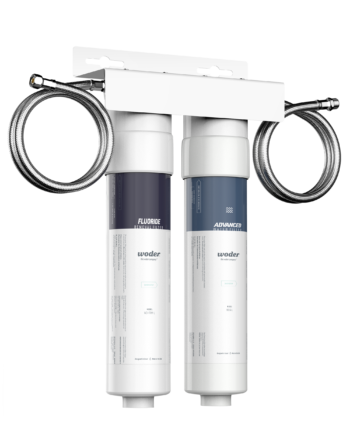
Woder's Advanced Selective Filtration® takes a different approach from reverse osmosis. It is designed to remove targeted contaminants such as PFAS, lead, heavy metals, fluoride, chromium-6, and chlorine while retaining essential minerals. RO systems can reduce dissolved solids very aggressively, but they also strip minerals from the water and bring added maintenance and water-use considerations.
Practical rule: A filter is renter friendly only when its installation, performance claims, physical footprint, and removal process all fit your situation.
The right choice may be a pitcher, a faucet attachment, a countertop-adjacent unit, or an under-sink system. The label matters less than the connection, the lease, and the actual contaminant claim.
Choosing a Renter Friendly Filter Without Drilling or Damage
Start with the connection, not the marketing name. Four formats cover most apartment kitchens, and each solves a different problem.
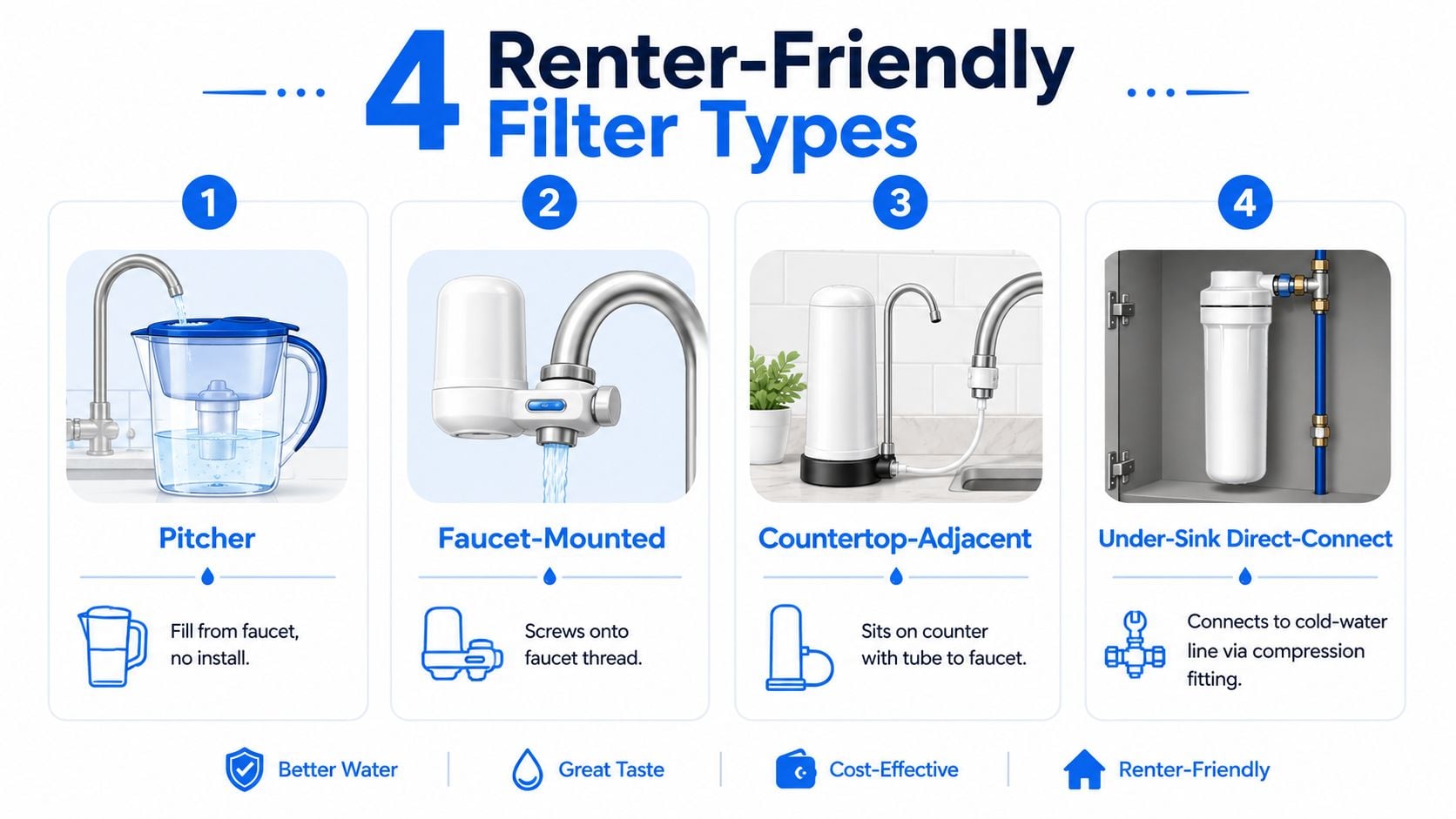
| Format | Installation impact | Daily tradeoff | Portability |
|---|---|---|---|
| Pitcher | Fill it from the faucet, with no installation | Slower, and it occupies refrigerator or counter space | Very high |
| Faucet-mounted | Attaches to the faucet thread | Can affect flow and may not fit every faucet | High |
| Countertop-adjacent | Sits beside the sink and connects near the faucet | Uses counter space but avoids cabinet work | High |
| Under-sink direct-connect | Connects to the cold-water line | Convenient and discreet, but requires compatibility and lease review | Moderate to high |
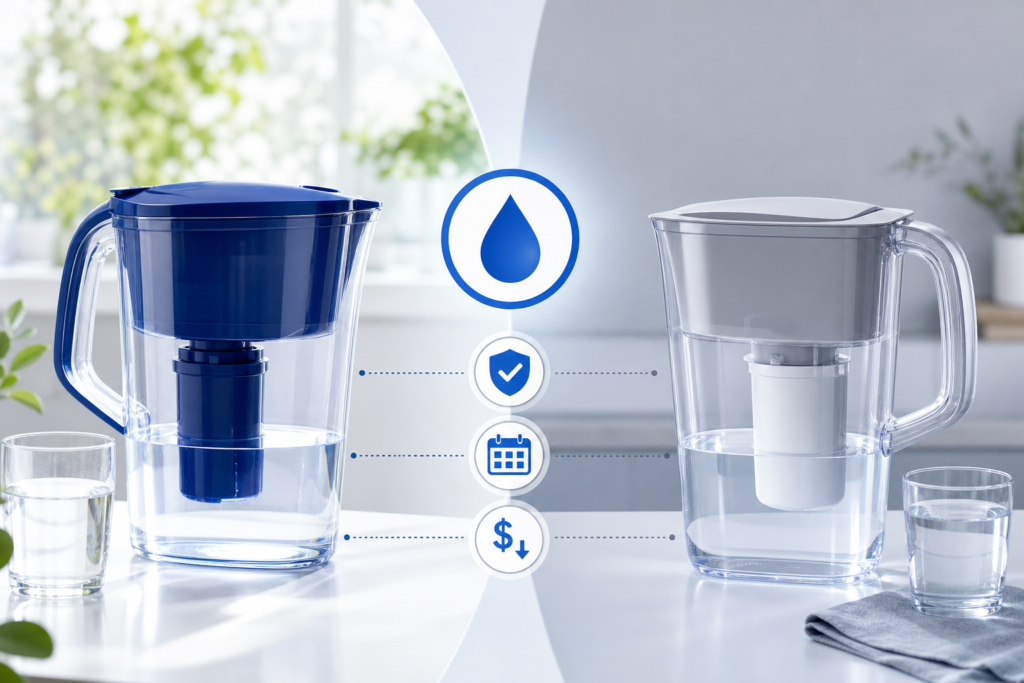
A pitcher is the least complicated choice. You fill it, wait for filtration, and store it. It's useful when the lease prohibits plumbing work or when you expect to move soon. The cost of that simplicity is space and the need to refill it.
Faucet-mounted systems attach to an existing faucet outlet, so they don't require drilling or changes below the cabinet. They're easy to remove, but threaded faucet designs vary, and some pull-down or specialty faucets don't accept attachments. Flow can also feel slower when the filter is operating.
Countertop-adjacent systems sit beside the sink and use a connection at or near the faucet. They avoid cabinetry changes, although the tubing and equipment remain visible. This format often suits renters who want more daily convenience than a pitcher without touching the cold-water shutoff.
When under-sink is the better fit
Under-sink direct-connect systems keep filtration out of sight and send treated water through the existing faucet or a compatible outlet. They're most reversible when they reuse an existing opening, such as a soap-dispenser or unused sprayer hole, rather than requiring a new hole in the counter (apartment filter installation options).
Before buying, check the filter's intended claims. Under-sink carbon or compound systems commonly reference NSF/ANSI 42, 53, 401, and 372, while reverse osmosis systems add NSF/ANSI 58. These standards aren't interchangeable labels. Read what the specific product has been evaluated to reduce, and confirm that the claim applies to the exact model.
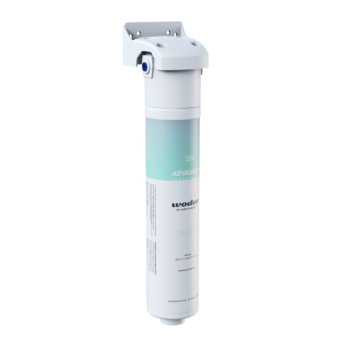
For sediment that may enter through dusty, older, or disturbed plumbing, the Woder Sediment Water Filter – Dirt, Sand and Dust Removal is a made-in-the-USA, single-stage under-sink sediment filter with 20µ pre-sedimentation for dust, dirt, and contaminants filtration. It isn't a substitute for a contaminant-specific drinking-water filter, so treat it as a sediment-focused component.
For a plain-language look at faucet attachments and their limitations, see this faucet water filter guide. The useful question isn't “Which format is best?” It's “Which format gives me the needed filtration without creating a lease or maintenance problem?”
How to Make Any Filter Lease Safe Before You Buy
“Reversible” and “lease-safe” aren't the same thing. A system may come out of the cabinet cleanly while still requiring you to touch a shutoff valve, disconnect a supply line, or alter a fixture. Some renter guidance states that landlords can prohibit under-sink systems and may require written approval for supply-line work, even when no drilling is involved (renter-focused lease guidance).
Read the lease before opening a product page. Search for language about plumbing, fixtures, alterations, water connections, cabinetry, and tenant responsibility for damage. If the wording is unclear, ask the landlord or property manager in writing and describe the exact connection you plan to make.
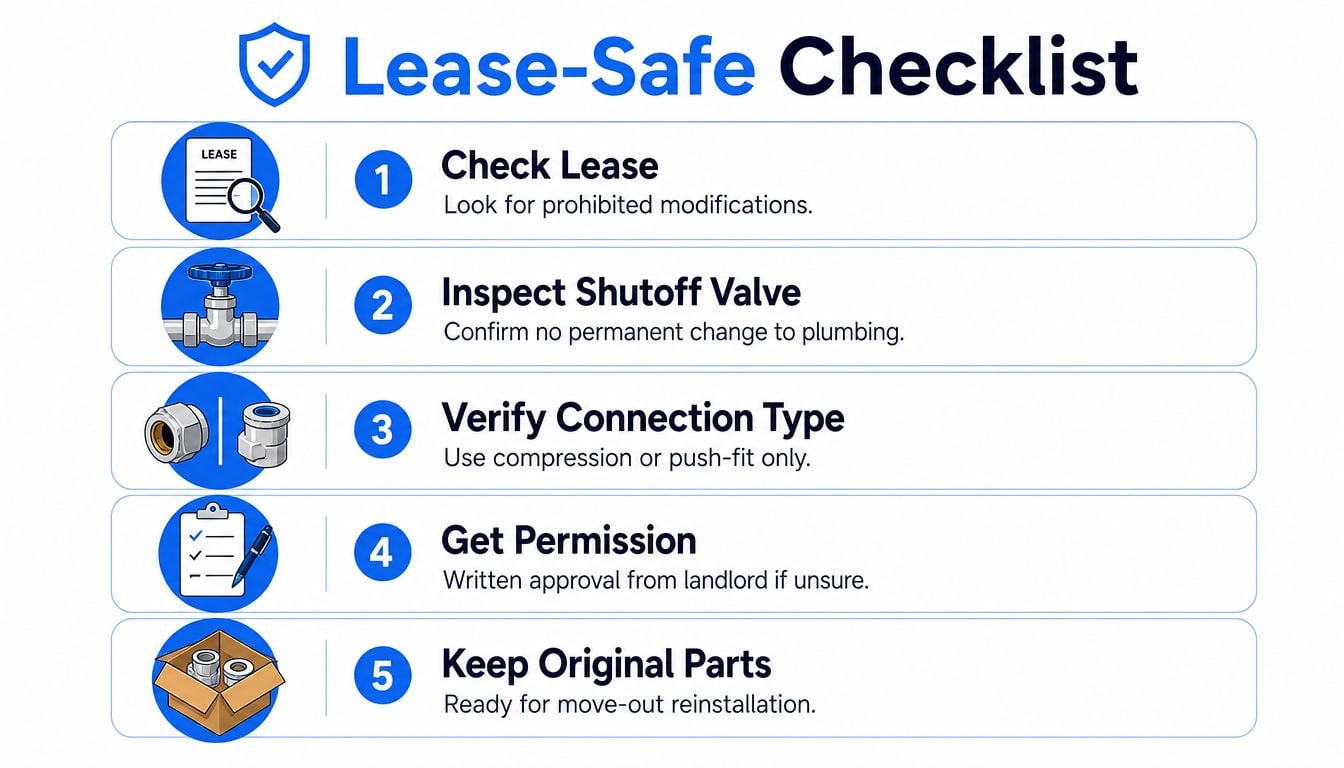
A practical permission checklist
- Check the lease. Look for restrictions on plumbing changes, supply lines, valves, and fixture removal.
- Identify the connection. Determine whether the filter attaches to the faucet, an existing opening, or the cold-water line.
- Inspect before touching anything. Photograph the valve, hose, fittings, cabinet floor, and faucet area. Save the photos with your move-in records.
- Ask for written approval when unsure. A short message that names the filter type and confirms that you'll restore the original parts protects both sides.
- Keep every original part. Store the original hose, adapter, aerator, mounting hardware, and any removed fastener in a labeled bag.
Approval should specify restoration expectations. Ask whether the landlord wants the filter removed at move-out, whether the original configuration must be restored, and whether maintenance staff must handle the connection.
A filter made in the United States and built to U.S. building code compliance still isn't automatically permitted by your lease. Building-code compliance describes the product and installation requirements. Lease permission describes your relationship with the property owner. You need both to be comfortable.
Installing and Removing Your Filter With No Damage
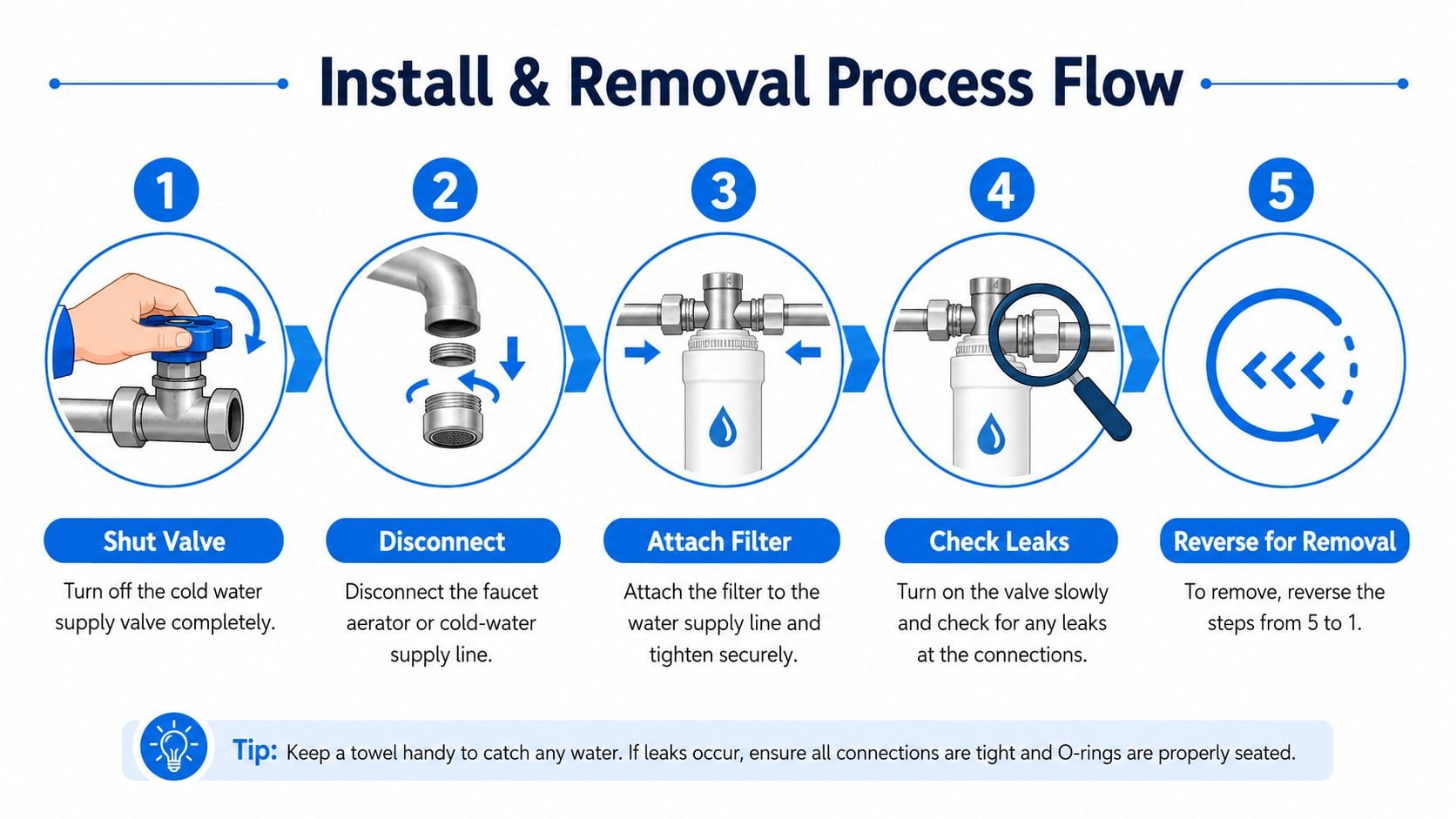
A direct-connect filter can work in an apartment when the parts fit, the cabinet has room, and the shutoff valve operates normally. The basic sequence is to close the cold-water valve, release pressure, disconnect the cold-water line, add a compatible tee or feed adapter, connect the tubing, and flush the cartridge before drinking. Follow the manufacturer's instructions for the exact fittings and connection order.
Prepare the cabinet first
Empty the cabinet completely. Place a towel or shallow tray under the valve, then keep an adjustable wrench, the filter instructions, a dry paper towel, and a container within reach. Photograph the original plumbing arrangement before disconnecting anything. That picture gives you a clear reference when the filter comes out.
Measure the cabinet with the doors both open and closed. The filter body needs enough room to fit, but also space to turn, pull out, and replace the cartridge later. A unit that fits only when it stays untouched is not a practical apartment installation.
Test the shutoff valve gently. If it feels stuck, appears corroded, or drips while you operate it, stop and contact maintenance or the landlord. An old valve can fail when forced, changing a small installation into a plumbing repair.
Connect slowly and check every joint
Close the cold-water valve, then open the cold faucet briefly to release pressure. Disconnect the cold line and install the compatible tee or feed adapter as directed. Push-fit tubing must enter fully and evenly. It should not bend sharply or pull sideways on the fitting.
The two common trouble spots are connector mismatch and incomplete push-fit seating. A fitting that looks nearly right can still leak if its size or thread does not match. Tubing that stops short of its proper seat may pull out or seep once pressure returns.
Before reopening the valve, place a dry paper towel beneath each connection. Open the valve gradually and inspect the towel. A small damp mark appears on paper before water spreads across the cabinet floor, giving you time to shut the valve and correct the joint.
Flush the cartridge according to the instructions. New filtration media can release harmless startup fines or affect taste until flushing is complete, so the first output is not a reliable indication of normal performance.
Watch this installation demonstration for a visual reference:
Reverse the process at move-out
Turn off the cold-water valve and open the faucet to release pressure. Disconnect the filter tubing, remove the tee or adapter, and reinstall the original cold-water line using your photograph as a guide. Run the faucet, then check the connection with a dry paper towel.
Faucet-mounted and countertop systems need the same care. Remove the attachment without twisting the faucet body, reinstall the original aerator, and wipe away residue. For help adapting a faucet connection, see this faucet replacement resource.
If a valve will not close, a line will not loosen, or a connection starts leaking, stop and call maintenance. More force can damage an older fitting and make restoration harder.
What Cleaner Water Actually Means for Renters on Tap Water
A filter claim should identify what it reduces, under what testing conditions, and whether the claim applies to the exact cartridge you're buying. “Cleans water” is too broad to guide a purchase. Taste and odor improvements can be useful, but they don't prove removal of every contaminant that concerns you.
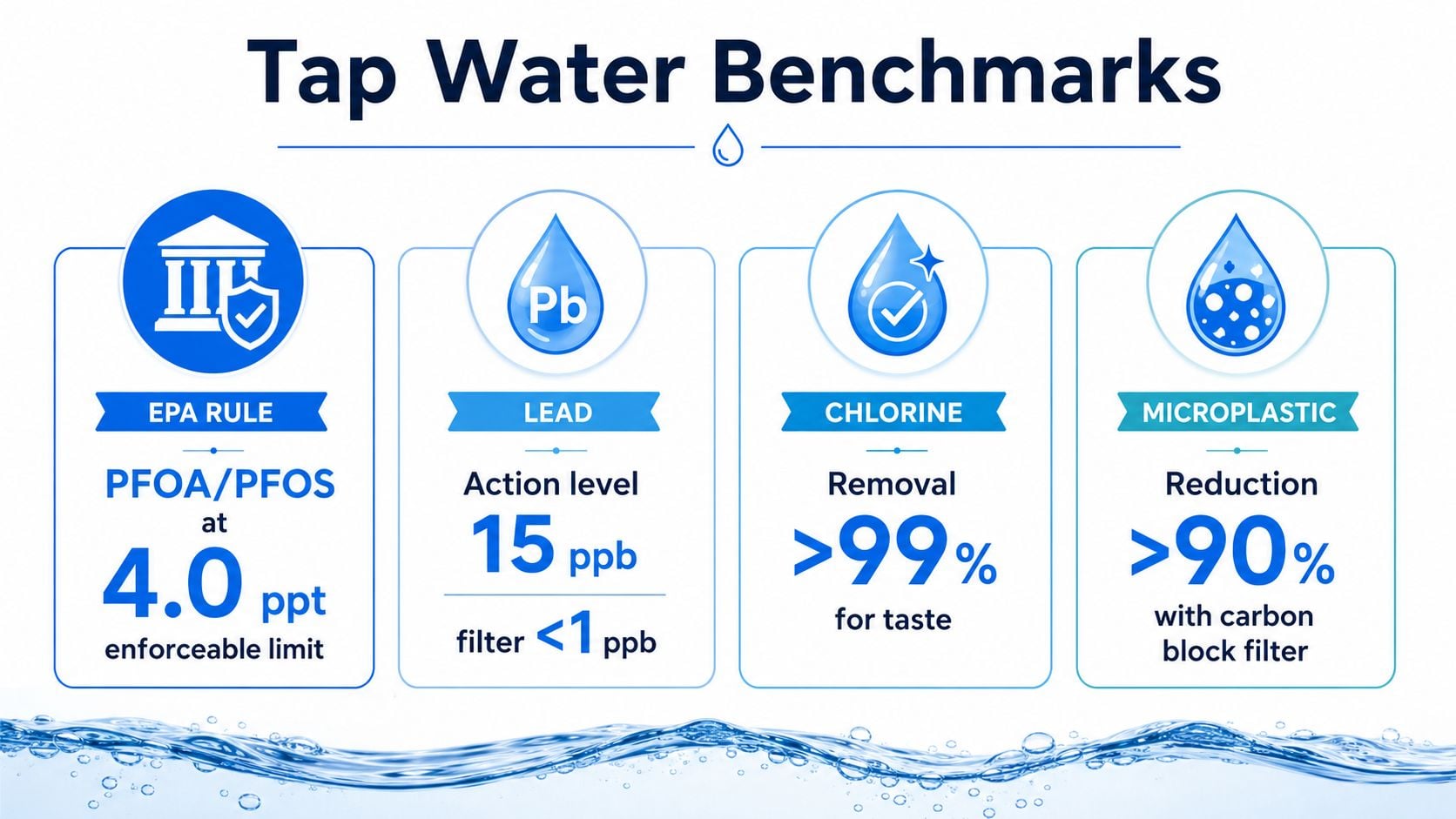
EPA's April 2024 PFAS rule provides a concrete benchmark. It established legally enforceable Maximum Contaminant Levels for six PFAS. PFOA and PFOS each have a limit of 4.0 ppt, while PFHxS, PFNA, and HFPO-DA, also known as GenX, each have a limit of 10 ppt. The rule also includes a Hazard Index limit of 1 for mixtures containing at least two of PFHxS, PFNA, HFPO-DA, and PFBS (EPA's PFAS drinking water rule).
Read lead claims in context
EPA's Lead and Copper Rule uses an action level of 15 ppb, which is the same as 0.015 ppm. If lead exceeds that level in more than 10% of customer taps sampled, the water system must take additional corrosion-control actions (EPA's Lead and Copper Rule).
That rule is based on system sampling, not a guarantee that every individual faucet has identical water. Lead can enter through plumbing and service lines, so a point-of-use kitchen filter can still be relevant even when a utility meets its system-wide obligations.
A zero-TDS reading doesn't prove that water is safe or that a filter selected the unwanted substances. TDS measures dissolved material generally. A reading near zero means minerals and other dissolved solids have been removed together, which describes distilled-style water, not a targeted assessment of PFAS, lead, chromium-6, fluoride, or chlorine.
Woder's Advanced Selective Filtration is designed around targeted removal while retaining essential minerals such as calcium and magnesium. That creates a different tradeoff from RO, which can produce very low TDS but also removes beneficial minerals, requires more maintenance, and may waste water during filtration.
For renters thinking about water use beyond drinking and cooking, dry climate landscaping for rentals offers broader context on making responsible water choices in rental properties. The same principle applies here: measure the actual need rather than treating a single number as the whole answer.
Keeping Your Portable Filter Ready for Your Next Move
A portable filter should be chosen for the apartment you have now and the kitchen you may have later. Keep the footprint modest, leave access around the cartridge, and avoid a design that depends on a particular cabinet opening or dedicated faucet unless you already have permission to use it.
Maintenance is part of portability. Mark cartridge changes on a calendar or use the manufacturer's schedule, and don't wait for a major taste change before checking the filter. A change in taste or odor can signal that the cartridge needs attention, but normal taste doesn't prove that the filter is still performing every claimed reduction.
Use this water filter replacement schedule to create a simple reminder system. Woder also provides a one-year guarantee with every cartridge. If a cartridge underperforms, Woder replaces it without questions, according to the brand's stated guarantee.
Pack the system like a fixture
Keep the original parts in a sealed, labeled bag. Store adapters, tubing, aerators, brackets, caps, and instructions together. Photograph the filter before removal, then cap or secure loose lines according to the product instructions so they don't collect dust or become damaged during the move.
For a new apartment, inspect the cabinet before reconnecting anything. Older buildings may have restricted cabinet clearance, worn valves, or pressure conditions that make installation unsuitable. Guidance for apartment systems discusses input pressure around 20 PSI as a minimum and notes that many apartments operate around 40–80 PSI (apartment pressure and space considerations). If your pressure seems weak or inconsistent, ask maintenance to evaluate it rather than assuming the filter is defective.
Some renters need a sediment pre-filter for dirt or dust, while others need an inline connection for a refrigerator, ice maker, or coffee machine. The right setup depends on the line, the fixture, and the contaminants you want to address. Optional lab testing can help identify that profile before you buy, and a selection tool such as the Woder Wizard can help match a system to the incoming water and fixture.
The larger lesson is simple. Choose the filter around your lease, connection, cabinet, pressure, and contaminant goals. Keep the original parts, maintain the cartridge, and leave the apartment exactly as you found it. It's Your Water®.
Woder Filters offers U.S.-made point-of-use systems using Advanced Selective Filtration® to target contaminants while retaining essential minerals, with installation resources and replacement support for apartment setups. Review your lease, measure your cabinet, and visit Woder Filters to compare an approach that can move with you.